Hubbry Logo
Subscapularis muscleSubscapularis muscleMain
Open search
Subscapularis muscle
Community hub
Subscapularis muscle
logo
8 pages, 0 posts
0 subscribers
Be the first to start a discussion here.
Subscapularis muscle
from Wikipedia

Subscapularis muscle
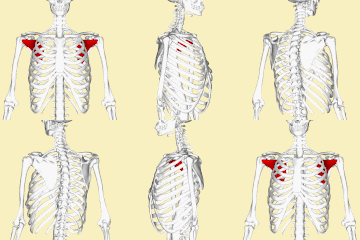
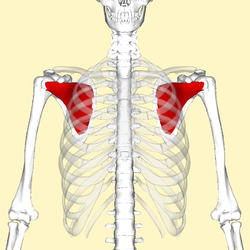
Subscapularis muscle (in red). Ribs are shown as semi-transparent. Anterior view.
The subscapularis is difficult to see from the front (labeled middle right)
Details
OriginSubscapular fossa
InsertionLesser tubercle of humerus
ArterySubscapular artery
NerveUpper subscapular nerve, lower subscapular nerve (C5, C6)
ActionsInternally rotates and adducts humerus; stabilizes shoulder
Identifiers
Latinmusculus subscapularis
TA98A04.6.02.012
TA22460
FMA13413
Anatomical terms of muscle

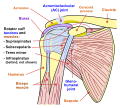
The subscapularis is a large triangular muscle which fills the subscapular fossa and inserts into the lesser tubercle of the humerus and the front of the capsule of the shoulder-joint.

Structure

[edit]

The subscapularis is covered by a dense fascia which attaches to the scapula at the margins of the subscapularis' attachment (origin) on the scapula.[1]

The muscle's fibers pass laterally from its origin before coalescing into a tendon of insertion.[citation needed] The tendon intermingles with the glenohumeral (shoulder) joint capsule.[1]

A bursa (which communicates with the cavity of the shoulder joint[1][2] via an aperture in the joint capsule[2]) intervenes between the tendon and a bare area at the lateral angle of the scapula[1]/the neck of the scapula.[2] The subscapularis (supraserratus) bursa separates the subscapularis is from the serratus anterior.[2]

Origin

[edit]

It arises from its medial two-thirds of the costal surface of the scapula, the intermuscular septa (which create ridges upon the scapula),[1] and the lower two-thirds of the groove on the axillary border (subscapular fossa) of the scapula.[citation needed]

Some fibers arise from tendinous laminae, which intersect the muscle and are attached to ridges on the bone; others from an aponeurosis, which separates the muscle from the teres major and the long head of the triceps brachii.[citation needed]

Insertion

[edit]

It inserts onto the lesser tubercle of the humerus[1] and the anterior part of the shoulder-joint capsule. Tendinous fibers extend to the greater tubercle with insertions into the bicipital groove.[citation needed]

Innervation

[edit]

The subscapularis is supplied by the upper and lower subscapular nerves (C5-C6), branches of the posterior cord of the brachial plexus.[1]

Actions/movements

[edit]

The subscapularis medially (internally) rotates the humerus (acting here as a prime mover)[1] and adducts it. When the arm is raised, it draws the humerus forward and downward.[citation needed]

Function

[edit]

The subscapularis stabilises the shoulder joint by contributing to the fixation of the proximal humerus during movements of the elbow, wrist, and hand.[1] It is a powerful defense to the front of the shoulder-joint, preventing displacement of the head of the humerus.[citation needed]

Clinical significance

[edit]

Examination

[edit]

It is difficult to isolate the action of the subscapularis from other medial rotators of the shoulder joint; there is no satisfactory test for this muscle.[1] The Gerber Lift-off test is the established clinical test for examination of the subscapularis.[3] The bear hug test (internal rotation while palm is held on opposite shoulder and elbow is held in a position of maximal anterior translation) for subscapularis muscle tears has high sensitivity. Positive bear-hug and belly press tests indicate significant tearing of subscapularis.[4]

Imaging

[edit]
MRI. Partial rupture of the cranial subscapularis tendon at the insertion site

There is no singularly imaging device or technique for a satisfying and complete subscapularis examination, but rather the combination of the sagittal oblique MRI / short-axis US and axial MRI / long-axis US planes seems to generate useful results. Additionally, lesser tuberosity bony changes have been associated with subscapularis tendon tears. Findings with cysts seem to be more specific and combined findings with cortical irregularities more sensitive.[5]

Another fact typically for the subscapularis muscle is the fatty infiltration of the superior portions, while sparing the inferior portions.

Since the long biceps tendon absents itself from the shoulder joint through the rotator cuff interval, it is easily possible to distinguish between the supraspinatus and the subscapularis tendon. Those two tendons build the interval sling.

Ultrasonography

[edit]

Mack et al. developed an ultrasonographic procedure with which it is possible to explore almost the complete rotator cuff within six steps. It unveils clearly the whole area from the subedge of the subscapularis tendon until the intersection between the infraspinatus tendon and musculus teres minor. One of six steps does focus on the subscapularis tendon. In the first instance the examinator guides the applicator to the proximal humerus as perpendicularly as possible to the sulcus intertubercularis. Gliding now medially shows the insertion of the subscapularis tendon.[6]

Longitudinal plane of the musculus subscapularis and its tendon

[edit]

The subscapularis tendon lies approximately 3 to 5 cm under the surface. Quite deep for ultrasonography, and therefore displaying through a highly penetrative 5 MHz linear applicator is worth a try. And it really turned out to ease a detailed examination of the muscle which just abuts to the scapula. However, the tendon of primary interest does not get mapped as closely as desired. As anatomical analysis showed, it is only by external rotation possible to see the ventral part of the joint socket and its labrum. While at the neutral position the tuberculum minus occludes the view. Summing up it is through an external arm rotation and a medially applied 5 MHz sector sonic head possible to display the ventral part of the joint socket and its labrum with notedly lower echogenicity.[7]

The following sectional planes are defined for the sonographic examination of the different shoulder joint structures:[8]

Ventral transversal Ventral sagittal medial Ventral sagittal lateral Lateral coronal Lateral transversal/sagittal: Dorsal transversal Dorsal sagittal
subscapularis muscle (longitudinal) subscapularis muscle (transversal) Intertub. sulcus with long head of biceps brachii (longitudinal) supraspinatus muscle (longitudinal) supraspinatus muscle (transversal) infraspinatus muscle (longitudinal) supraspinatus muscle (transversal)
Intertubercular sulcus with long head of biceps brachii (transversal) Hill-Sachs-Lesio

Tissue harmonic imaging

[edit]

Primarily in abdominal imaging, tissue harmonic imaging (THI) gets more and more valued and used additionally to conventional ultrasonography.

THI involves the use of harmonic frequencies that originate within the tissue as a result of nonlinear wave front propagation and are not present in the incident beam. These harmonic signals may arise differently at anatomic sites with similar impedances and thus lead to higher contrast resolution." Along with higher contrast resolution it has an elevated signal-to-noise ratio and significantly reduced inter- and intraobserver variability compared with conventional US. Additionally it is possible to nearly eliminate ordinary US artifacts, i.e. side-lobe, near-field artifacts, reverberation artifacts. As aforementioned THI has already led to enhanced abdominal, breast, vascular and cardiac sonography.

For musculo-skeletal aspects THI has not been used that much, although this method features some useful potential. For example, for the still tricky discrimination between the presence of a hypoechoic defect and/or loss of the outer tendon convexity/non-visualization of the tendon, that is between partial- and full-thickness rotator cuff tears.

In comparison to a checking MR Arthrography Strobel K. et al. has arrived at the conclusion that through THI it is possible to achieve a generally improved visibility of joint and tendon surfaces, especially superior for subscapularis tendon abnormalities.[9]

Additional images

[edit]

References

[edit]
[edit]
Revisions and contributorsEdit on WikipediaRead on Wikipedia
from Grokipedia
The subscapularis muscle is a large, triangular-shaped muscle situated on the anterior surface of the , forming one of the four key components of the alongside the supraspinatus, infraspinatus, and teres minor muscles. It originates primarily from the subscapular fossa, encompassing the medial and lower two-thirds of this concave region on the 's costal surface. The muscle fibers converge into a broad, multipennate tendon that inserts mainly onto the of the , with the superior tendinous portion (about 60% of the tendon) attaching over a mediolateral width of approximately 2 cm and a superioinferior length of 2.5–6 cm, while the inferior muscular portion (about 40%) extends to the anterior humeral metaphysis; some fibers may also reach the or . As the largest and most anterior muscle of the rotator cuff, the subscapularis plays a critical role in shoulder stability and motion, serving as the primary internal rotator of the humerus at the glenohumeral joint while also contributing to adduction and extension of the arm. It helps prevent anterior displacement of the humeral head and resists superior and anteroposterior translation, thereby maintaining joint congruence during arm movements. Innervated by the upper and lower subscapular nerves (arising from C5–C7 roots of the brachial plexus posterior cord), the muscle receives variable dual innervation in many individuals, with about 51% having a single upper subscapular nerve and 79% a single lower one. Blood supply is provided by branches of the suprascapular, axillary, and subscapular arteries, supporting its robust structure. Clinically, the subscapularis is susceptible to pathology such as , partial or full-thickness tears (often from trauma, dislocations, or chronic overuse), and involvement in syndromes, though isolated tears are less common than in other cuff muscles. Its lies adjacent to the glenohumeral and communicates via structures like the of Weitbrecht, making it relevant in conditions like frozen shoulder or during surgical interventions such as shoulder arthroplasty, where precise release and repair techniques are essential to avoid or instability.

Anatomy

Origin

The subscapularis muscle originates from the subscapular fossa, a large concavity occupying much of the anterior (costal) surface of the . This attachment covers the medial and lower two-thirds of the fossa, providing a broad base for the muscle's multipennate structure. The subscapular fossa is bounded superiorly by the superior of the and the , inferiorly by the lateral of the , and medially by the medial of the . Muscle fibers arise from the walls of this fossa, with superficial fibers oriented horizontally and deeper fibers running obliquely toward the lateral aspect.

Insertion

The subscapularis muscle inserts primarily via a onto the of the , with its fibers blending into the anterior portion of the capsule to reinforce glenohumeral stability. The forms a broad, trapezoid-shaped structure composed of 4-6 collagenous bundles, measuring approximately 2 cm mediolaterally and 2.5–6 cm superioinferiorly, which passes inferior to the and posterior to the . The superior 60% of the insertion is tendinous, attaching to the upper facet of the lesser tuberosity with a discrete rolled edge, while the inferior 40% consists of direct muscular fibers onto the anterior humeral and lower aspect of the lesser tuberosity. In some individuals, the upper fibers extend laterally to the greater tuberosity and intertubercular groove, and the superior edge contributes to the rotator interval by merging with supraspinatus fibers. Deep fibers of the blend with the transverse humeral and middle glenohumeral . Anatomical variations in insertion include extensions limited to the lesser tuberosity or broader attachments reaching the greater tuberosity, as well as occasional slips that envelop the long head of the . The overall insertion footprint width and lateral extent can vary significantly among individuals.

Innervation

The subscapularis muscle is primarily innervated by the upper and lower subscapular nerves, both arising from the posterior cord of the brachial plexus with contributions from the C5 to C7 spinal roots. The upper subscapular nerve typically supplies the superior portion of the muscle, entering near its origin on the subscapular fossa after piercing the muscle belly shortly after branching from the posterior cord. In contrast, the lower subscapular nerve innervates the inferior portion of the subscapularis and also provides branches to the teres major muscle, often bifurcating to achieve this dual supply. These nerves follow a consistent anatomical course within the : they originate from the , course medially and dorsally across the , and penetrate the subscapularis muscle from its dorsal (costal) surface, distributing motor fibers deep to the muscle's anterior aspect. This pathway ensures targeted innervation that supports the muscle's role in shoulder internal . Anatomical variations in subscapularis innervation occur frequently, with the arising directly from the rather than the in approximately 25-28% of cases, potentially altering surgical approaches in the . The shows less variability, originating from the in only about 3-4% of specimens, while accessory branches from the may supplement the primary nerves in 7-48% of individuals depending on the study. Direct contributions from the are not documented in standard anatomical reviews.

Blood supply

The primary arterial supply to the subscapularis muscle is provided by the , which arises from the third part of the and enters the muscle via the axillary space. The upper portion of the muscle receives additional supply from branches of the , while the posterior aspect is contributed to by the , forming part of the broader network. Venous drainage follows the arterial pathways, with the subscapular vein collecting blood from the muscle and emptying into the . Within the subscapular fossa, the intramuscular vasculature features rich anastomoses that ensure robust to meet the muscle's high metabolic demands during movements. The subscapular artery travels in close accompaniment with the upper and lower .

Relations

The subscapularis muscle occupies the subscapular fossa on the anterior surface of the , forming the majority of the posterior wall of the . Posteriorly, it lies directly against the costal aspect of the , with the subscapular fossa serving as its immediate bed. Anteriorly, the muscle faces the contents of the , including a pad of axillary fat; it lies adjacent to the along its medial aspect, and the , vein, and divisions of the rest directly on its anterior surface. Laterally, the subscapularis converges with the tendons of the teres major and latissimus dorsi muscles, collectively forming the posterior axillary fold. Superiorly, it relates to the of the , while inferiorly and laterally, it integrates with the teres minor and infraspinatus muscles through the shared fibrous connections of the . The tendon of the subscapularis contributes to the anterior portion of the , blending with its fibers and lying adjacent to the superior, middle, and inferior , thereby reinforcing the anterior stability of the .

Function

Primary actions

The subscapularis muscle primarily functions to produce internal (medial) rotation of the at the , serving as the sole rotator cuff muscle dedicated to this motion. This action is essential for movements such as tucking the hand behind the back or crossing the arm over the chest, where the muscle contracts to rotate the arm inward relative to the . In addition to its primary role, the subscapularis contributes secondary actions including adduction of the arm toward the body's midline, extension of the (particularly in certain positions), and stabilization of the humeral head within the through compressive forces. The muscle's force generation varies by fiber orientation: the upper fibers, with approximately 60% inserting as a onto the , primarily drive internal rotation by pulling the of the anteriorly, while the lower fibers assist in depressing the humeral head to counter superior migration during arm elevation. This differential contribution enhances the muscle's efficiency across a range of positions. Biomechanically, the subscapularis opposes the external rotators of the , including the infraspinatus and teres minor, balancing rotational forces to maintain coordinated glenohumeral motion. As a key component of the , it integrates with other muscles to support dynamic mechanics.

Role in shoulder stability

The subscapularis muscle serves as the anterior component of the , playing a in glenohumeral stability by compressing the humeral head against the glenoid fossa. This concavity-compression mechanism, generated through coordinated rotator cuff activity, centers the humeral head and resists translational forces during arm elevation and rotation, thereby maintaining joint congruence. In addition to compression, the subscapularis balances the pulling forces exerted by the posterior muscles, such as the infraspinatus and teres minor, to counteract anterior humeral head displacement and prevent or . This anterior restraining action is particularly vital in positions of abduction and external , where the muscle's tension directly opposes dislocating vectors. The subscapularis tendon integrates closely with the anterior , blending with its fibers to reinforce the capsuloligamentous structures and enhance overall integrity. This anatomical fusion strengthens the anterior capsule against excessive external rotation and abduction, providing both static and dynamic resistance to without relying solely on its primary internal rotation function. Furthermore, the subscapularis contributes to shoulder through mechanoreceptors in its and muscle fibers, facilitating position sense and enabling reflexive neuromuscular control during dynamic overhead activities. This sensory feedback supports anticipatory muscle activation, optimizing stability across the 's wide .

Clinical significance

Pathology

The subscapularis muscle is susceptible to various pathologies, primarily involving its , which can lead to significant dysfunction. Common conditions include partial and full-thickness tears, which may arise from acute trauma such as falls or hyperextension with external , or from degenerative processes in older individuals due to reduced tendon elasticity and vascularity. Other notable pathologies encompass , characterized by tendon degeneration and inflammation, calcific tendinopathy with deposits, and avulsions at the , often linked to anterior glenohumeral dislocations. Isolated subscapularis tears are uncommon, accounting for approximately 4% of all tears, though they more frequently occur in combination with supraspinatus or involvement. These tears, particularly full-thickness ones affecting more than 50% of the , can result in pseudoparalysis due to severe weakness and anterior from increased glenohumeral translation. Partial tears predominantly involve the upper third of the , leading to anterosuperior defects in 9-44% of cases. Risk factors for subscapularis include advancing age, as tears are prevalent in 25–30% of adults over 60 and up to 62% over 80, with subscapularis occurring in a significant subset of these cases, as well as repetitive overhead activities in sports or occupations that strain the through subcoracoid impingement. Association with is common, observed in 20-90% of subscapularis tears, exacerbating instability and pain. Traumatic mechanisms, such as forced external rotation or direct impacts, are more typical in younger patients. Symptoms of subscapularis pathology typically manifest as anterior , often dull and aching, worsened by internal activities like tucking in a , alongside in internal and tenderness over the lesser tuberosity. Patients may also experience limited , popping or clicking sensations, and in chronic cases, increased passive external due to instability.

Examination

The of the subscapularis muscle focuses on assessing its , strength, and contribution to internal of the , particularly to detect or dysfunction. Clinicians typically begin with for or in the anterior region, followed by targeted maneuvers that isolate the subscapularis while minimizing compensatory actions from other muscles. These tests are performed with the patient seated or standing, and results are interpreted in the context of the patient's history of , , or trauma. The lift-off test, originally described for evaluating subscapularis tendon integrity, involves the patient placing the dorsum of the hand on the mid-lumbar region with the flexed and internally rotated. The patient is instructed to lift the hand away from the back against resistance applied by the examiner's palm; inability to maintain the position or weakness indicates subscapularis dysfunction, with higher sensitivity for full-thickness tears. A positive test is confirmed if the patient cannot resist the push or if the externally rotates during the effort. This maneuver primarily activates the lower subscapularis fibers. The belly-press test complements the lift-off by targeting the upper subscapularis. The patient flexes the to 90 degrees, places the palm on the , and presses the hand inward while keeping the forward against the chest wall; the examiner resists by pulling the hand away. or inability to maintain results in the dropping backward (positive Gerber's sign), signifying subscapularis impairment. Electromyographic studies confirm greater activation of the upper subscapularis compared to the lift-off test, making it useful for isolated upper pathology. Additional maneuvers include the bear-hug test, where the patient places the ipsilateral hand on the contralateral with the elbow anteriorly directed and resists external force applied by the examiner. A positive result—drop in the elbow or inability to resist—demonstrates high sensitivity (60%) for subscapularis tears, outperforming other tests in detecting partial lesions. The internal lag sign further assesses tendon integrity: with the arm at 20 degrees abduction and maximal internal rotation, the examiner passively moves the forearm to neutral; an inability to actively hold this position (lag >5 degrees) indicates a tear, with specificity up to 90% for full-thickness disruptions. These tests are particularly valuable when the lift-off or belly-press cannot be performed due to pain or limited mobility. Palpation of the subscapularis is challenging due to its deep anterior position beneath the and overlying structures like the deltoid and . Tenderness may be elicited over the lesser tuberosity of the or along the anterior joint line, but anterior axillary tenderness can suggest associated inflammation or from subscapularis pathology. Clinicians often combine with active internal rotation to provoke symptoms. Strength grading for the subscapularis is evaluated through manual muscle testing of internal rotation, typically with the arm at the side and elbow flexed to 90 degrees against resistance. The Medical Research Council () scale, ranging from 0 (no contraction) to 5 (normal strength against full resistance), quantifies deficits; grades below 4/5 correlate with functional impairment and may indicate when combined with lag signs. This assessment isolates subscapularis contribution while monitoring for compensatory deltoid or pectoralis activity.

Imaging

Magnetic resonance imaging (MRI) serves as the gold standard for evaluating the subscapularis and , particularly for detecting , with reported sensitivity ranging from 36% to 88% and specificity of 90% to 100%. On MRI, appear as areas of intermediate or -like signal intensity within the on T2-weighted sequences, along with margin irregularity, defects, retraction, and associated best visualized on sagittal oblique views; axial T1-weighted sequences help assess fatty infiltration and retraction, while T2-weighted images highlight or in full-thickness . Ultrasound provides dynamic assessment of the subscapularis , allowing real-time evaluation during internal rotation to detect , and demonstrates high sensitivity for full-thickness lesions, though overall sensitivity for subscapularis varies from 30% to 78% depending on operator and tear type. Key ultrasound findings include defects, irregularity, or discontinuity, with the modality's advantages lying in its portability and ability to assess subluxation associated with subscapularis . Computed tomography (CT) arthrography is particularly useful for detecting bony avulsions of the subscapularis and evaluating patients with contraindications to MRI, offering high sensitivity (100%) and specificity of 95–100% for . Intra-articular contrast administration enhances visualization of partial and capsular involvement, while multiplanar reconstructions aid in assessing retraction and lesser tuberosity fractures. Plain radiography () has a limited role in direct visualization of the subscapularis but can identify calcifications within the , appearing as radiopaque densities, or associated fractures such as lesser tuberosity avulsions. Indirect signs on anteroposterior views include lesser tuberosity irregularity or cysts, which correlate with chronic . Advanced techniques like MR arthrography improve detection of partial-thickness subscapularis , with sensitivity up to 86% and specificity of 96% compared to conventional MRI, as intra-articular contrast extravasation highlights defects and capsular disruptions. This method is especially valuable for preoperative planning in complex pathology.

Treatment

Conservative management is often the initial approach for partial-thickness subscapularis tears or tendinopathy, involving rest, activity modification, nonsteroidal anti-inflammatory drugs (NSAIDs) for pain and inflammation control, and physical therapy to strengthen the rotator cuff and improve shoulder stability. Physical therapy protocols emphasize gentle range-of-motion exercises progressing to isometric strengthening, particularly for partial tears, to promote tendon healing without surgery. This approach is suitable for select patients with low functional demands or comorbidities precluding surgery, though success rates vary, with up to 75% achieving satisfactory outcomes in rotator cuff-related conditions. A 2025 study indicated that arthroscopic repair yields superior midterm functional outcomes compared to conservative treatment for subscapularis tears. For persistent , intra-tendinous or subacromial injections of corticosteroids into the can provide short-term and reduce , though repeated use risks tendon weakening. (PRP) injections offer an alternative, with studies on rotator cuff showing superior mid- to long-term reduction and functional improvements compared to corticosteroids, potentially aiding repair through stimulation. Surgical intervention is indicated for full-thickness , failed conservative treatment, or acute injuries in active patients, typically via to repair the . Techniques include side-to-side suturing for smaller or anchor-based fixation (single- or double-row) to reattach the to the lesser tuberosity, with double-row methods potentially improving footprint coverage and stability. For associated long head of pathology, concomitant tenodesis using a single can be performed to prevent and enhance repair outcomes. Postoperative rehabilitation follows a phased protocol to protect the repair while restoring function, typically involving sling immobilization for 4-6 weeks to limit external rotation beyond 30-45 degrees and avoid active internal rotation. Passive range-of-motion exercises begin at 2-4 weeks, progressing to active-assisted motion by 6 weeks, followed by strengthening from 8-12 weeks with emphasis on rotator cuff and scapular stabilizers, and full return to activity by 4-6 months. Clinical outcomes for arthroscopic subscapularis repairs demonstrate high success rates of 80-95% for good-to-excellent pain relief and function in acute or smaller at 2-year follow-up, with retear rates around 9-13% for single-row techniques. However, chronic with advanced fatty infiltration (Goutallier 3-4) are associated with poorer results, including higher retear rates up to 90% and reduced functional gains due to irreversible .

References

Add your contribution
Related Hubs
User Avatar
No comments yet.