Hubbry Logo
search
logo

Sweden Solar System

logo
Community Hub0 Subscribers
Read side by side
from Wikipedia

Sweden Solar System is located in Sweden
Swift-Tuttle
Swift-Tuttle
Halley
Halley
Earth, Eros, Saltis, Mars, Sun, Mercury, Venus
Earth, Eros, Saltis, Mars,
Sun, Mercury, Venus
Sweden Solar System
Sweden Solar System
Sweden Solar System
Sweden Solar System
Sweden Solar System
Sweden Solar System
Jupiter
Jupiter
Sweden Solar System
Saturn and 5025 PL
Saturn and 5025 PL
Uranus
Uranus
Neptune
Neptune
Pluto and Charon
Pluto and Charon
Ixion
Ixion
Eris
Eris
Sedna
Sedna
Termination Shock
Termination Shock
The Sweden Solar System

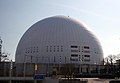
The Sweden Solar System is the world's largest permanent scale model of the Solar System. The Sun is represented by Avicii Arena in Stockholm (still known by most as Globen), the largest hemispherical building in the world. The inner planets can also be found in Stockholm but the outer planets are situated northward in other cities along the Baltic Sea. The system was started by Nils Brenning, professor at the Royal Institute of Technology in Stockholm, and Gösta Gahm, professor at the Stockholm University.[1][2] The model represents the Solar System on the scale of 1:20 000 000, i.e. one metre represents 20,000 km.[3]

The system

[edit]
Avicii Arena, representing the Sun in the Sweden Solar System

The bodies represented in this model include the Sun, the planets (and some of their moons), dwarf planets and many types of small bodies (comets, asteroids, trans-Neptunians, etc.), as well as some abstract concepts (like the Termination Shock zone). Because of the existence of many small bodies in the real Solar System, the model can always be further increased.

The Sun is represented by the Avicii Arena (Globen), Stockholm, which is the largest hemispherical building in the world, 110 m (360 ft) in diameter. To respect the scale, the globe represents the Sun including its corona.[citation needed]

Inner planets

[edit]
Mercury Model just outside the Stockholm City Museum
  • Mercury (25 cm (9.8 in) in diameter) is placed at Stockholm City Museum, 2,900 m (1.8 mi) from the Globe. The small metallic sphere was built by the artist Peter Varhelyi.
  • Venus (62 cm (24 in) in diameter) is placed at Vetenskapens hus at the KTH Royal Institute of Technology, 5,500 m (3.4 mi) from the Globe. It was previously located at the Observatory Museum in Stockholm (now closed). A previous model, made by the United States artist Daniel Oberti, was inaugurated during a Venus transit on 8 June 2004 and placed at the KTH Royal Institute of Technology. It fell and shattered around 11 June 2011.
  • Earth (65 cm (26 in) in diameter) is located at the Swedish Museum of Natural History, 7,600 m (4.7 mi) from the Globe. Satellite images of the Earth are exhibited beside the Globe. An elaborate model of the Moon (18 cm (7.1 in) in diameter) is also on display, about 20 metres (66 ft) from the model of Earth.
  • Mars (35 cm (14 in) in diameter) is located at Mörby centrum, a shopping centre and Stockholm metro station in Danderyd, a suburb of Stockholm. It is 11.6 km (7.2 mi) from the Globe. The model, made in copper by the Finnish artist Heikki Haapanen, is connected by an "umbilical cord" to a steel plate on the floor having an Earth image.[4] The globe also features marks that represent some typical Martian chemical elements.

Gas giants

[edit]
  • Jupiter (7.3 m (24 ft) in diameter) is placed inside the Clarion Hotel located at Stockholm Arlanda Airport in Sigtuna Municipality, 40 km (25 mi) from the Globe. Previously, it was made as a flower decoration, with different flowers representing different zones of the giant gas planet. Today, the planet is depicted as a ring light above a lobby.[5]
  • Saturn (6.1 m (20 ft) in diameter) is placed outside the old observatory of Anders Celsius, in the square Celsiustorget in the centre of Uppsala, 73 km (45 mi) from the Globe. Inaugurated during the International Year of Astronomy,[6] the model is a mat with a picture of Saturn, but will eventually grow to crown a school planetarium in the city. In addition, several schools in Uppsala are to provide moons of Saturn: the first completed was Enceladus (diameter 2.5 cm or 0.98 in) at Kvarngärdesskolan.[7] (Note: The model was taken down due to vandalism)
  • Uranus (2.6 m (8 ft 6 in) in diameter) was vandalized and the new model was reconstructed behind Stora magasinet in Lövstabruk in 2012. It is an outdoor model made of blue steel bars. The rotation axis of the planet is marked in red.[8]
2.5-m representation of Neptune, by the river Söderhamnsån in Söderhamn
  • Neptune (2.5 m (8 ft 2 in) in diameter) is located by the river Söderhamnsån in Söderhamn, a coast town with tradition of fishing and sailing (which relates to Neptune being the deity of the seas). Placed 229 km (142 mi) from the Globe, the model is made of acrylic and, at night, shines with a blue light.

Trans-Neptunian objects

[edit]
  • Pluto (12 cm (4.7 in) in diameter) and its largest moon Charon are placed near the southern of the Dellen lakes, in Delsbo, 300 km (190 mi) from the Globe. The lakes are thought to be formed by a meteorite impact 90 million years ago. The two bodies' sculptures are supported by two gravelike pillars (as Pluto is the deity for death), made up with dellenite, a rare mineral formed at that place by the meteorite impact.
  • Haumea (8.5 cm (3.3 in) in diameter) and its moons are depicted in the 2047 Science Centre, Borlänge, 200 km (120 mi) from the Globe.
  • Quaoar (6 cm (2.4 in) in diameter) is located in the library in Gislaved, 340 km (210 mi) from the Globe.
  • Ixion (6.5 cm (2.6 in) in diameter), a dwarf planet candidate, is located at Technichus, a science center in Härnösand, 360 km (220 mi) from the Globe. The sculpture is an orb held by a hand with the arm. This plutino was discovered by a team which included scientists from Uppsala.
  • Makemake (7 cm (2.8 in) in diameter) is located at Slottsskogsobservatoriet, an observatory in Gothenburg, 400 km (250 mi) from the Globe.
  • 'Oumuamua (0.3 mm (0.012 in) in diameter) is placed in the village of Plönninge, Halland, 440 km (270 mi) from the Globe.
  • Gonggong (7.5 cm (3.0 in) in diameter) is placed near the Tycho Brahe Observatory in Oxie, Malmö Municipality, 500 km (310 mi) from the Globe.
  • Eris (13 cm (5.1 in) in diameter) is located at Umeå Arts Campus, Umeå, 518 km (322 mi) from the Globe. Made by Theresa Berg, the golden model is inspired by the mythical story of Eris sparking a quarrel between three Greek goddesses with a golden apple bearing the inscription καλλίστῃ (kallistē, "to the most beautiful one").
  • Sedna (10 cm (3.9 in) in diameter), another dwarf planet candidate, is located at Teknikens Hus, a science center in Luleå, 734 km (456 mi) from the Globe. This represents a distance of about 15 billion km (100 AU); Sedna has a highly elliptical orbit, its distance from the Sun varying between 11–140 billion km (74–936 AU).

Other bodies

[edit]
The dwarf planet Sedna

List of objects

[edit]
Object Distance from Globen[9] Diameter[9] Location[9] Coordinates Inauguration date
Sun N/a 71 m (233 ft), the disk
110 m (361 ft), incl. the corona
Avicii Arena, Stockholm 59°17′36.80″N 18°04′59.65″E / 59.2935556°N 18.0832361°E / 59.2935556; 18.0832361 19 February 1989
471926 Jörmungandr 1.8 km (1.1 mi) 0.05 mm Ion Game Design office, Stockholm 59°18′34.7″N 18°04′21.9″E / 59.309639°N 18.072750°E / 59.309639; 18.072750 23 September 2023[10]
Mercury 2.99 km (1.86 mi) 25 cm (9.8 in) Stockholm City Museum, Stockholm 59°19′10.8″N 18°04′16.8″E / 59.319667°N 18.071333°E / 59.319667; 18.071333 1998
Venus 6.76 km (4.20 mi) 62 cm (24.4 in) Vetenskapens hus, Stockholm 59°21′10.38″N 18°03′30.78″E / 59.3528833°N 18.0585500°E / 59.3528833; 18.0585500 8 June 2004
Earth and Moon 8.58 km (5.33 mi) 65 cm (25.6 in) and 18 cm (7.1 in) Swedish Museum of Natural History, Stockholm 59°22′08.48″N 18°03′12.34″E / 59.3690222°N 18.0534278°E / 59.3690222; 18.0534278 before 2000[11]
(433) Eros 11 km (6.8 mi) 2.0 mm × 0.7 mm × 0.7 mm Mörbyskolan, Danderyd 59°23′38″N 18°02′41″E / 59.39389°N 18.04472°E / 59.39389; 18.04472 14 February 2000
(36614) Saltis 11 km (6.8 mi) < 1 mm Kunskapsskolan, Saltsjöbaden 59°16′21″N 18°18′17″E / 59.27250°N 18.30472°E / 59.27250; 18.30472 14 January 2010[12]
Mars 11.93 km (7.41 mi) 35 cm (13.8 in) Mörby centrum, Danderyd 59°23′52.58″N 18°02′11.58″E / 59.3979389°N 18.0365500°E / 59.3979389; 18.0365500 before 2000[11]
4 Vesta 16.4 km (10.2 mi) 2.6 cm Åva gymnasium, Täby 59°26′24″N 18°03′47.16″E / 59.44000°N 18.0631000°E / 59.44000; 18.0631000 6 September 2017[13]
Jupiter 40.6 km (25.2 mi) 7.3 m (24 ft) Stockholm Arlanda Airport 59°38′58.52″N 17°55′50.38″E / 59.6495889°N 17.9306611°E / 59.6495889; 17.9306611 before 2000[11]
(306367) Nut (5025 PL) 60 km (37 mi) 0.2 mm Knivsta 59°43′10″N 17°48′07″E / 59.71944°N 17.80194°E / 59.71944; 17.80194
Saturn 67.9 km (42.2 mi) 6.1 m (20 ft) Celsiustorget, Uppsala 59°51′34″N 17°38′14″E / 59.85944°N 17.63722°E / 59.85944; 17.63722 2025 (Titan has been removed)
Uranus 124.8 km (77.5 mi) 2.6 m (8.5 ft) Stora magasinet, Lövstabruk 60°24′31″N 17°52′37″E / 60.40861°N 17.87694°E / 60.40861; 17.87694 13 October 2012[14]
Haumea 200 km (120 mi) 10 cm Borlänge 60°29′18.1″N 15°25′51.5″E / 60.488361°N 15.430972°E / 60.488361; 15.430972
Halley's Comet 204 km (127 mi) Four representations, not scale models.[a] Balthazar Science Center, Skövde 58°23′14″N 13°51′11″E / 58.38722°N 13.85306°E / 58.38722; 13.85306 16 December 2009[17]
Neptune 230.9 km (143.5 mi) 2.5 m (8.2 ft) by the river Söderhamnsån, Söderhamn 61°18′07″N 17°03′19″E / 61.30194°N 17.05528°E / 61.30194; 17.05528 29 October 1998[18]
Pluto and Charon 291.4 km (181.1 mi) 12 cm (4.7 in) and 6 cm (2.4 in) by the lake Dellen South, Delsbo 61°47′50.13″N 16°32′59.96″E / 61.7972583°N 16.5499889°E / 61.7972583; 16.5499889 before 2000[11]
50000 Quaoar 340 km (210 mi) 6 cm Gislaved Library, Gislaved 57°17′46.9″N 13°31′49.8″E / 57.296361°N 13.530500°E / 57.296361; 13.530500 18 November 2017[19]
(28978) Ixion 360 km (220 mi) 6.5 cm (2.6 in) Technichus, Härnösand 62°37′49″N 17°56′12″E / 62.63028°N 17.93667°E / 62.63028; 17.93667 18 April 2002[20]
174567 Varda 370 km (230 mi) 33 mm Bohusläns museum, Uddevalla 58°20′57.4″N 11°55′44.0″E / 58.349278°N 11.928889°E / 58.349278; 11.928889 4 September 2021[21]
109P/Swift-Tuttle comet 390 km (240 mi) < 1 cm Kreativum, Karlshamn 56°11′39″N 14°51′09″E / 56.19417°N 14.85250°E / 56.19417; 14.85250
Makemake 400 km (250 mi) 7 cm Slottsskogsobservatoriet, Gothenburg 57°41′28.3″N 11°56′36.4″E / 57.691194°N 11.943444°E / 57.691194; 11.943444 23 September 2017[22]
ʻOumuamua 440 km (270 mi) 0.3 mm Halmstad Municipality 56°44′04.8″N 12°44′42.8″E / 56.734667°N 12.745222°E / 56.734667; 12.745222 August 2018
225088 Gonggong 400 km (250 mi) 7.5 cm Tycho Brahe-observatoriet, Oxie 55°32′33.9″N 13°05′04.0″E / 55.542750°N 13.084444°E / 55.542750; 13.084444 23 September 2017[23]
(136199) Eris 510 km (320 mi) 13 cm (5.1 in) Umeå Arts Campus, Umeå 63°49′14.2″N 20°16′34.1″E / 63.820611°N 20.276139°E / 63.820611; 20.276139 6 December 2007[24]
(90377) Sedna 810 km (500 mi) 10 cm (3.9 in) Teknikens Hus, Luleå 65°36′59.50″N 22°08′06.00″E / 65.6165278°N 22.1350000°E / 65.6165278; 22.1350000 8 December 2005[25]
Termination shock 950 km (590 mi) A plate Institute of Space Physics, Kiruna 67°50′27″N 20°24′34.5″E / 67.84083°N 20.409583°E / 67.84083; 20.409583
[edit]

See also

[edit]

Notes

[edit]

References

[edit]
[edit]
Revisions and contributorsEdit on WikipediaRead on Wikipedia
from Grokipedia
The Sweden Solar System (SSS) is the world's largest permanent scale model of the Solar System, built at a ratio of 1:20 million and spanning over 950 kilometers across Sweden from Stockholm in the south to Kiruna in the north.[1][2] The Sun is represented by the Avicii Arena (formerly the Ericsson Globe), a 110-meter-diameter spherical building in Stockholm, while the planets, moons, and other celestial bodies are depicted through sculptures, installations, and exhibits at 26 locations, totaling more than 60 objects that illustrate the vast distances and relative sizes of the solar system.[1][2] This educational project merges science, art, and mythology to provide a tangible sense of cosmic scale, with inner planets clustered near Stockholm and outer ones extending northward, though Saturn remains unbuilt due to funding challenges.[2][3] Conceived in the mid-1990s by Swedish scientists Nils Brenning, a professor at the Royal Institute of Technology in Stockholm, and Gösta Gahm, the model originated from Brenning's idea to use the newly opened Ericsson Globe as the Sun in a scaled representation.[3] Initially envisioned as the Stockholm Solar System, it quickly expanded nationwide through collaborations with schools, museums, science centers, and the Swedish Astronomical Society, which coordinates the project.[1][3] The first installations appeared in the late 1990s, with ongoing additions including dwarf planets, comets, and trans-Neptunian objects like Sedna and the recent moons Varda and Ilmarë installed in 2021.[2] Key sites include Mercury at the Stockholm City Museum (2.9 km from the Sun), Venus at the Royal Institute of Technology (KTH) (5.5 km from the Sun) and Earth at the Swedish Museum of Natural History (7.6 km away), Mars at Mörby Centrum (11 km from the Sun), Jupiter at Arlanda Airport (40 km north), and Neptune in Söderhamn, while Pluto is modeled in Delsbo, 300 km from the center.[2][4] The project's scale means that, for example, the distance from the Sun to Pluto equates to a full drive across the country, emphasizing the emptiness of space and serving as a pedagogical tool for visitors traveling by car, train, or plane.[1][2] Maintained as a public attraction, it continues to grow, highlighting Sweden's commitment to science outreach and innovative public art.[3]

Overview and History

Concept and Origins

The Sweden Solar System serves as an educational tool to offer a physical, large-scale depiction of the Solar System's enormous distances and relative sizes, enabling the public to grasp the vast emptiness of space through travel across Sweden's landscape. By transforming the country's geography into a proportional model, it promotes astronomy outreach and highlights the challenges of visualizing astronomical scales in everyday terms.[1][5] The idea originated in the mid-1990s when Nils Brenning, a plasma physicist and professor at the Royal Institute of Technology in Stockholm, conceived the project during bicycle rides past the newly built Globe Arena, pondering its potential as a scaled representation of the Sun. Collaborating with Gösta Gahm, an astronomer and professor at Stockholm University, they developed the concept to create a permanent installation that surpassed smaller planetarium models, exploiting Sweden's north-south extent for an immersive, nationwide experience.[5][6] The model officially launched with the Sun embodied by the Avicii Arena (formerly Ericsson Globe), inaugurated on 19 February 1989 as the world's largest spherical building, providing a ready-made centerpiece for the endeavor. Initial planetary installations followed in 1998, establishing the project's foundation before later expansions incorporated additional celestial features.[5]

Development Timeline

The Sweden Solar System project originated in the mid-1990s, spearheaded by plasma physicist Nils Brenning of the Royal Institute of Technology in Stockholm and astronomer Gösta Gahm of Stockholm University, who died in 2020 and coordinated initial placements of scale models with host institutions across the country.[7][3] The centerpiece, representing the Sun, utilizes the Avicii Arena (formerly Ericsson Globe) in Stockholm, which was inaugurated in 1989 and measures 110 meters in diameter to match the 1:20 million scale.[2] During the early 1990s, the inner terrestrial planets—Mercury, Venus, Earth, and Mars—were installed in and around Stockholm, sparking initial public interest through educational exhibits and media coverage that highlighted the model's innovative representation of solar system distances.[8][1] Expansions accelerated in the mid-2000s, with the addition of outer solar system features to extend the model northward. The dwarf planet Sedna's model, crafted by artist Antero Koskitalo, was inaugurated in 2005 at Teknikens Hus science center in Luleå, near the Arctic Circle, emphasizing Sedna's remote orbit and ties to Inuit mythology.[9] Pluto was included as the ninth planet at Delsbo during this period, prior to its 2006 reclassification by the International Astronomical Union, reflecting the model's alignment with contemporary astronomical understanding.[8] Neptune's model followed in Söderhamn, incorporating nautical themes tied to the planet's mythological namesake, while a plaque marking the heliosphere's termination shock was dedicated in Kiruna in 2004.[2][8] These additions were funded through collaborations between universities, local governments, and the Swedish Astronomical Society, which oversees coordination.[3][1] The 2010s brought updates in response to astronomical developments and logistical hurdles. Saturn received a temporary flower carpet representation in Uppsala in 2009 after funding for a permanent dome over the local planetarium fell through, underscoring persistent financial challenges.[2] A model of Uranus was installed in Lövstabruk in October 2012, replacing an earlier version damaged by vandalism and illustrating maintenance difficulties posed by the models' dispersed locations and exposure to weather.[10][2] The project's evolution incorporated Pluto's dwarf planet status without removing its model, maintaining scale consistency while adding extended features like asteroids.[8] Recent milestones have further diversified the model, reaching over 60 objects by 2025 across 26 locations. The asteroid (471926) Jörmungandr, an Apollo-type near-Earth object, was added in Stockholm on September 23, 2023—the International Day of Astronomy—with an artistic design inspired by Norse mythology, but was stolen in March 2025; the host is working on a replacement.[11][2] Ongoing challenges include securing funding from academic and municipal sources amid economic constraints, as well as addressing maintenance issues from harsh Nordic weather and the vast distances between sites, which complicate repairs and public access.[2][3]

Scale and Design Principles

Model Scale and Proportions

The Sweden Solar System utilizes a consistent scale of 1:20,000,000, meaning that 1 meter in the model represents 20,000 kilometers in the actual solar system. This scaling factor ensures proportional representation of both sizes and distances, allowing the entire model to span a manageable distance within Sweden's geography. The choice of this scale derives from the country's north-south extent of approximately 1,600 kilometers, which accommodates the solar system's dimensions up to Pluto at a model distance of roughly 300 kilometers from the Sun.[1][12][13] Object sizes in the model follow this proportion closely for planets and major bodies, emphasizing the vast disparities in the real solar system. For instance, the Sun's actual diameter of 1.39 million kilometers scales to about 70 meters, though it is represented by the Avicii Arena—a spherical building with an external diameter of 110 meters—to serve as a prominent central landmark. Earth's diameter of 12,742 kilometers translates to approximately 64 centimeters in the model, underscoring how planets appear as modest spheres relative to the Sun. These calculations highlight the conceptual challenge of visualizing solar system scales, where planetary diameters range from centimeters to meters while maintaining fidelity to real proportions.[13] Distances further illustrate the model's emphasis on spatial emptiness, with inner planets clustered within 12 kilometers of the Sun model and outer planets extending progressively farther. Mercury lies at 2.9 kilometers, Venus at 5.5 kilometers, Earth at 7.6 kilometers, and Mars at 11.6 kilometers, all within the Stockholm metropolitan area. Jupiter is positioned 40 kilometers away, Uranus at 130 kilometers, Neptune at 229 kilometers, and Pluto at 300 kilometers, demonstrating how the interstellar void dominates the solar system's layout—most of the model's expanse consists of empty space between these points.[13] While the model adheres strictly to the 1:20,000,000 scale for core elements, some adaptations incorporate artistic liberties for practical visibility and educational impact, such as slightly enlarged representations of small moons or distant objects to make them observable without magnification. For example, the Moon's model is 18 centimeters in diameter and placed 20 meters from Earth, aligning closely with scale but ensuring accessibility for visitors. These adjustments balance scientific accuracy with the need to convey the solar system's grandeur in a terrestrial setting.[13]

Representation of the Sun

The representation of the Sun in the Sweden Solar System is provided by the Avicii Arena in Stockholm, a prominent spherical building originally constructed as the Ericsson Globe and completed in 1989. With an external diameter of 110 meters, it holds the distinction of being the world's largest hemispherical structure, making it an ideal symbolic stand-in for the central star due to its size and form.[2][14] This choice aligns with the model's 1:20,000,000 scale, where the arena's dimensions approximate the Sun's proportional representation, serving as both a visual landmark and the primary entry point for visitors exploring the installation. The building's internal lighting and prominent location enhance its role as the radiant core, drawing attention to the vast spatial arrangement of the solar system model extending northward across Sweden. As a multifunctional venue, it integrates seamlessly into public life while preserving its astronomical symbolism.[1][15] On-site features include artistic informational plaques that describe the overall Sweden Solar System, providing context on its scale and educational purpose for passersby and tourists. The arena, owned and maintained by Stockholm Globe Arena Fastigheter AB—a subsidiary fully owned by the City of Stockholm—undergoes periodic renovations to ensure structural integrity, such as the major modernization completed in 2025, without compromising its function in the planetary model. It continues to host concerts, sports events, and other gatherings, underscoring its dual role as a cultural hub and celestial icon.[16][17][14]

Core Planetary Components

Inner Terrestrial Planets

The inner terrestrial planets in the Sweden Solar System are represented by scaled models clustered within the Stockholm urban area, allowing visitors to explore them via public transport or short walks, emphasizing the relatively compact nature of these rocky worlds compared to the vast outer system.[1] These models adhere to the overall 1:20 million scale, with distances from the Sun model at Avicii Arena (formerly the Ericsson Globe) reflecting actual orbital separations, and each features educational plaques detailing key astronomical facts such as orbital periods and surface characteristics.[1] Mercury, the innermost planet, is depicted as a 25 cm diameter metallic sphere installed at the Stockholm City Museum in Slussen, positioned 2.9 km north of the Sun model.[18][2] The model, heated to evoke the planet's extreme proximity to the Sun, includes etched craters and support symbols referencing orbital precession from Einstein's general relativity, with a plaque noting Mercury's 88-Earth-day orbit and temperature swings from -170°C to 427°C.[18] Installed in 1998 as part of the project's early phase, it highlights the planet's barren, heavily cratered surface.[19] Venus, the second planet, is a 62 cm diameter sculpted sphere at the AlbaNova University Centre's House of Science (Vetenskapens Hus) in Roslagstull, 5.5 km from the Sun.[20] Created by artist Peter Varhelyi and inaugurated in 2016, the model is surrounded by five informational plates explaining Venus's 225-Earth-day orbit, visible phases, thick CO₂ atmosphere causing a runaway greenhouse effect with surface temperatures around 464°C, and its mythological names across cultures.[20] The design evokes the planet's cloudy veil, underscoring its status as Earth's "sister" world yet hostile environment.[20] Earth, our home planet, is represented by a 65 cm diameter blue-and-green sphere at the Swedish Museum of Natural History (Naturhistoriska riksmuseet), specifically outside the Cosmonova space theater entrance, 7.6 km from the Sun model.[21][13] Accompanying it is an 18 cm Moon model by Peter Varhelyi, placed 20 meters away to scale their relative separation of about 384,400 km.[21] Plaques provide details on Earth's 365.25-day orbit, continents, oceans, and the Moon's phases and tidal influences, emphasizing the planet's unique habitability in the solar system.[21] The Earth model is currently displayed in the museum's fossil exhibition for added context on geological history.[21] Mars, the outermost terrestrial planet in this section, is a 35 cm diameter copper sphere oxidized to a reddish hue at Mörby Centrum shopping mall in Danderyd, 11.6 km from the Sun.[22][23] The model, connected by an "umbilical cord" to a steel plate symbolizing Earth, bears etched chemical symbols for Martian surface compounds like iron oxides responsible for its red color, with plaques covering its 687-Earth-day orbit (1.88 years), polar ice caps, and ancient river valleys suggesting past water flow.[22][2] This representation draws attention to Mars's role in ongoing space exploration efforts.[22] These inner planet models share consistent design principles, including durable outdoor placements for public accessibility and multilingual plaques that compare scaled distances to real astronomical scales—for instance, Mercury's model is as far from the Sun as a real Mercury year is short—fostering conceptual understanding of solar system proportions without exhaustive metrics.[1] All are reachable within Stockholm's metro network, promoting educational visits that contrast the inner system's proximity with the expansive outer representations.[4]

Outer Gas and Ice Giants

The outer gas and ice giants in the Sweden Solar System are represented by models dispersed across central Sweden, extending northward from the Stockholm region and highlighting the vast scaled distances of these distant worlds, in contrast to the compact urban placements of the inner terrestrial planets.[2] These installations emphasize the representational challenges of capturing the giants' immense sizes, gaseous compositions, and dynamic features within the 1:20 million scale, often integrating artistic interpretations to convey their atmospheric turbulence and ring systems.[1] Jupiter, the largest planet in the model, is depicted as a 7.3-meter-diameter illuminated ring inside the Clarion Hotel at Stockholm Arlanda Airport, located 40 kilometers from the Sun model at Avicii Arena.[24] This installation, originally established in the early 1990s and updated with a new light-based representation in May 2019, symbolizes the planet's stormy atmosphere, though it does not explicitly feature the Great Red Spot in its design.[25] The model's placement at a major international hub underscores the project's aim to engage travelers with cosmic scales.[4] Saturn remains the only outer giant without a permanent model as of November 2025, though planning continues for a representation in Uppsala at approximately 73 kilometers from the Sun model.[26] Temporary installations, such as a 6-meter decorative mat in Celsius Square, have appeared, but no fixed structure exists yet; local schools in Uppsala have contributed by creating scaled models of Saturn's moons to support the ongoing community-driven project.[27] This delay reflects logistical challenges in fabricating the planet's expansive ring system at scale, estimated at over 12 meters across.[2] Uranus is portrayed through a minimalist 2.6-meter steel ring model, tilted to emphasize the planet's extreme 98-degree axial inclination, installed in October 2012 at the historic Lövstabruk ironworks, 146 kilometers from the Sun.[10] Crafted by the nearby Forsmark Mechanical Workshop, this outdoor sculpture replaced an earlier version vandalized shortly after its 2005 debut, integrating with the site's industrial heritage to evoke the icy giant's remote, obliquely rotating nature.[28] The design prioritizes conceptual symbolism over precise sphericity, addressing the challenges of modeling Uranus's faint rings and hazy blue atmosphere.[15] Neptune's model consists of a 2.5-meter blue sphere in Iron Park (Strykjärnsparken) in Söderhamn, 229 kilometers from the Sun, inaugurated in the fall of 1998 to represent the planet's deep oceanic hues and high-speed winds exceeding 2,000 kilometers per hour.[16] While the primary installation focuses on the planet's composition of hydrogen, helium, and methane, a separate small model of its largest moon, Triton, is occasionally referenced in local exhibits but not permanently affixed to the sphere.[2] Positioned in a public park near the coast, it ties into Söderhamn's maritime culture, evoking Neptune's mythological sea-god associations.[4] Visiting these outer models necessitates road travel between cities, with distances growing exponentially to illustrate solar system scales, and many sites—such as airports, libraries, and ironworks—are woven into cultural or educational venues for enhanced accessibility.[29]

Extended Solar System Features

Dwarf Planets and Trans-Neptunian Objects

The Sweden Solar System incorporates models of key dwarf planets and trans-Neptunian objects (TNOs) to represent the outer reaches of the planetary system beyond Neptune, with these installations concentrated in northern Sweden to emphasize their remote positions. Following the International Astronomical Union's 2006 reclassification of Pluto as a dwarf planet, the model was updated to reflect this status, highlighting the Kuiper Belt's population of icy bodies. These additions underscore the scale model's commitment to incorporating contemporary astronomical understanding, including the discovery of larger trans-Neptunian objects that prompted the reevaluation of planetary definitions. Other dwarf planets and TNOs include Haumea at 2047 Science Center in Borlänge (340 km from the Sun, 10×7.5×5 cm), Quaoar at Gislaved’s library (340 km, 6 cm), Makemake at Slottsskogsobservatoriet in Göteborg (400 km, 7 cm), Gonggong at Tycho Brahe-observatoriet in Malmö (500 km, 7.5 cm), and Ixion at Technichus in Härnösand (360 km, 6.5 cm).[13] The model of Pluto, depicted as an icy sphere with a diameter of approximately 12 cm, along with its moon Charon (approximately 6 cm), is situated at Delsbo Church, approximately 300 km north of the Sun representation at Avicii Arena in Stockholm. Installed before 2000, this installation was adjusted to align with Pluto's dwarf planet designation, portraying it as a member of the Kuiper Belt rather than a major planet. The site's northern location accentuates Pluto's average distance of about 39 AU from the Sun in the real solar system.[30][13][31] Eris, a dwarf planet larger than Pluto, is represented by a approximately 13 cm model at Curiosum in Umeå, positioned 510 km from the Sun model. Added following Eris's 2005 discovery, this feature was included specifically to illustrate Eris's greater size—estimated at around 2,326 km in diameter—compared to Pluto, which contributed to the 2006 IAU debates on planetary criteria. The model's placement in northern Sweden evokes Eris's extreme orbit, averaging 68 AU from the Sun.[32][13] Sedna, a trans-Neptunian object with one of the most elongated orbits known, is symbolized by a 10 cm model at Teknikens Hus in Luleå, 810 km from the Sun. Inaugurated in 2005, it represents Sedna's perihelion of 76 AU and aphelion exceeding 900 AU, capturing the challenges of modeling objects at the solar system's fringes. This installation highlights Sedna's hypothetical yet significant role in probing the scattered disc and inner Oort Cloud.[9][13] At Kiruna, approximately 950 km from the Sun model, the Swedish Institute of Space Physics hosts a plaque marking the termination shock—the boundary where the solar wind slows upon encountering the interstellar medium, approximately 90-94 AU away in reality—dedicated in 2004. A sculpture inspired by aurorae is planned for this site.[15][33] Recent additions include models of the moons Varda (of the TNO Orcus) and Ilmarë (of Haumea), installed in 2021, further extending representations of outer solar system satellites.[2] Collectively, these models illustrate the Kuiper Belt's icy debris and the tentative edges of the Oort Cloud, demonstrating the difficulties in visualizing faint, distant bodies that require advanced telescopes for detection. By placing them in Sweden's far north, the installation conveys the vast emptiness and isolation of trans-Neptunian space, enhancing public appreciation of the solar system's extended architecture.

Moons, Asteroids, and Other Bodies

The Sweden Solar System incorporates models of select major moons to illustrate the diversity of satellite systems around the gas and ice giants, with placements positioned near their respective parent planet representations to maintain proportional orbital relationships. The Moon of Earth, depicted as an 18 cm diameter sphere, is located at the Swedish Museum of Natural History in Stockholm, attached to a pillar in the ticket hall adjacent to the Earth model, emphasizing its close tidal locking and role in stabilizing Earth's axial tilt.[34] Similarly, Titan, Saturn's largest moon known for its thick nitrogen atmosphere and hydrocarbon lakes, is represented by a model at Celsius Square in Uppsala, near the planned Saturn installation, highlighting its potential as a prebiotic analog environment. Asteroids are scattered throughout the model to evoke the density of the main belt between Mars and Jupiter, using small-scale sculptures placed at varying distances from the central Sun to demonstrate the region's vast, sparsely populated nature. Vesta, one of the belt's largest asteroids and a protoplanet remnant with a differentiated interior, is modeled as a approximately 3 cm oblate spheroid with cratered surface details at Åva Gymnasium in Täby, approximately 17 km from the Globe, featuring base panels with symbols referencing its namesake Roman goddess of the hearth.[35] The near-Earth asteroid (471926) Jörmungandr, an Apollo-group object that crosses Earth's orbit, was added in 2023 as a 0.05 mm artistic pearl-like installation at Allhelgonagatan 5 in Stockholm, 1.8 km from the Sun, designed by Lewis Clamp to evoke the Norse world serpent with a flashing light effect under certain conditions; as of March 2025, the model was stolen, with a replacement in progress.[11][36] Another example, the asteroid Eros, is represented at Mörbyskolan in Danderyd, underscoring the variety of near-Earth objects that pose potential impact risks.[34] Comets extend the model's portrayal of transient solar system visitors, with Halley's Comet serving as a representative periodic comet at its aphelion distance. Inaugurated in December 2009 at the Balthazar science center in Skövde, 260 km north of the Globe, it consists of three outdoor sculptures inspired by children's drawings alongside an indoor laser-etched glass block, capturing the comet's dusty nucleus and coma to convey orbital periodicity and outgassing processes.[37] Beyond these, the model includes abstract representations of outer solar system features, such as Kuiper Belt objects like Ixion, positioned at Technichus in Härnösand to depict the icy debris disk's scattered distribution. The Termination Shock, marking the boundary where solar wind slows abruptly upon encountering interstellar medium, is symbolized in Kiruna at 950 km from the Sun through an aurora-inspired installation at the Swedish Institute of Space Physics, emphasizing the transition to the heliopause and the vast scale of the heliosphere.[33] These supplementary bodies integrate with dwarf planet models, such as Charon's binary companion placement near Pluto in Delsbo, to provide a holistic view of the solar system's small-object populations without dedicated probe representations like Pioneer or Voyager.[34]

Locations and Accessibility

Geographical Distribution

The Sweden Solar System follows a north-south linear alignment, primarily along the E4 highway and parallel rail lines, stretching over 950 kilometers from the Sun model in south-central Stockholm to the northernmost installations beyond the Arctic Circle in Kiruna.[4][2] This path leverages Sweden's elongated geography, with models positioned at proportional scaled distances from the central Sun representation at Avicii Arena, facilitating accessibility via major transportation corridors that connect urban centers to remote northern regions.[1] The distribution integrates seamlessly with the country's infrastructure, allowing visitors to traverse the route by car, train, or bus while encountering the models in sequence. Saturn lacks a dedicated model due to funding issues, though plans for installation in Uppsala continue, with several moons already represented by local schools.[26] Regional clusters organize the installations thematically and geographically: the inner terrestrial planets (Mercury, Venus, Earth, and Mars) are concentrated in and around Stockholm, spanning just a few kilometers across museums and public sites; outer gas giants like Jupiter and Uranus appear in central Sweden, such as at Stockholm Arlanda Airport and the historic Lövstabruk ironworks village; while trans-Neptunian objects, including dwarf planets like Pluto, Eris, and Sedna, extend into Norrland's northern landscapes, with sites in towns like Delsbo, Umeå, Luleå, and Kiruna.[2][15] Over 60 objects are distributed across more than 26 locations, including science museums (e.g., Swedish Museum of Natural History for Earth), airports (e.g., Arlanda for Jupiter), hotels, and cultural landmarks, enhancing educational and touristic value by embedding astronomical representations within Sweden's heritage sites.[2] For instance, the Uranus model at Lövstabruk, a preserved 17th-century industrial site, was relocated there following vandalism of the original in Gävle in 2012, promoting tourism by combining historical exploration with celestial education.[15] Environmental challenges influence the northern models, where harsh Arctic winters with extreme cold and snow accumulation necessitate durable materials and occasional maintenance, as seen in Kiruna's Termination Shock installation at the Institute of Space Physics.[2] Some relocations have occurred due to unforeseen issues, such as the replacement of the original Uranus model in Lövstabruk following vandalism in 2012, ensuring the project's longevity amid evolving site conditions.[15] This strategic distribution not only mirrors the solar system's vast emptiness but also highlights Sweden's diverse terrain, from urban Stockholm to the subarctic wilderness of Norrland.

Visiting Routes and Logistics

Visiting the Sweden Solar System requires strategic planning due to its expansive scale, spanning over 950 kilometers from Stockholm in the south to Kiruna in the north. For those based in the capital, a day trip can cover the inner solar system cluster, including the Sun at Avicii Arena, Mercury at Stockholm City Museum, Venus at AlbaNova University Centre, and Earth and Moon at the Swedish Museum of Natural History, all accessible via the city's efficient public transport network such as the T-bana subway and bus line 50.[3][38] A comprehensive tour of the full model typically demands a multi-day itinerary, such as a 7- to 10-day road trip or train journey northward, allowing stops at Jupiter near Stockholm Arlanda Airport, Mars in Danderyd, and outer planets like Uranus near Gävle, Neptune in Söderhamn, and Pluto in Delsbo. The official Sweden Solar System website provides an interactive map and station coordinates to facilitate route planning, enabling visitors to plot custom paths via apps like Google Maps or the Swedish Transport Administration's journey planner. For a full traversal to distant objects like Sedna in Luleå, expect a total one-way driving time of approximately 12 hours, though partial visits focusing on central sites are more common among tourists.[39][38] Transportation options emphasize flexibility given the rural placements of many models. SJ trains connect Stockholm Centralstation to key northern stops like Söderhamn in about 2 hours for 300–650 SEK ($28–$60 USD), while buses via operators like FlixBus offer cheaper alternatives at around 450 SEK ($42 USD) for similar routes. Flights to Arlanda Airport provide quick access to the Jupiter model, followed by airport shuttles or taxis into Stockholm for 100–200 SEK ($9–$18 USD). Car rentals, available from providers like Hertz or Avis at Stockholm Arlanda or city centers for 250–500 SEK ($23–$46 USD) per day including insurance, are ideal for off-highway flexibility, though fuel and tolls add 200–400 SEK ($18–$37 USD) for a 300 km leg.[40][41] Most installations are free and outdoors, promoting easy access year-round in southern and central Sweden, though some inner-planet models in museums require entry fees ranging from 10 SEK ($1 USD) at shopping centers like Mörby Centrum to 200 SEK ($18 USD) for the Natural History Museum. Northern sites, such as those in Luleå, may face seasonal closures or limited access from November to March due to snow and short daylight hours, necessitating checks via the official site or local tourism boards.[3][1] Enhancements include educational programs coordinated by the Swedish Astronomical Society, which offers school group resources and occasional public lectures tied to the model, though dedicated guided tours for individuals remain limited—visitors are encouraged to self-guide using site-provided materials. Plans for a Saturn model in Uppsala remain ongoing, with some moons already modeled by local schools.[42][26] The model's vast distances often result in partial itineraries, with many opting for the Stockholm cluster alone to avoid extensive travel; weather apps like Yr.no are recommended for monitoring northern conditions, especially during winter when icy roads can disrupt bus and train schedules.[3]

References

User Avatar
No comments yet.