Hubbry Logo
logo
Syvash
Community hub

Syvash

logo
0 subscribers
Read side by side
from Wikipedia

The Syvash or Sivash[3] (Ukrainian and Russian: Сива́ш; Crimean Tatar: Sıvaş, Сываш, lit.'dirt'), also known as the Putrid Sea or Rotten Sea (Russian: Гнило́е Мо́ре, romanized: Gniloye More; Ukrainian: Гниле́ Мо́ре, romanized: Hnyle More; Crimean Tatar: Çürük Deñiz), is a large area of shallow lagoons on the western edge of the Sea of Azov. Separated from the sea by the narrow Arabat Spit, the water of the Syvash covers an area of around 2,560 km2 (990 sq mi) and the entire area spreads over about 10,000 km2 (3,900 sq mi). The Henichesk Strait is its eastern connection to the Sea of Azov. The Syvash borders the northeastern coast of the main Crimean Peninsula. The central and eastern Syvash were registered as wetlands of Ukraine under the Ramsar Convention. Since the 2022 Russian invasion of Ukraine, the entire Syvash has been occupied by Russia.

Key Information

Overview

[edit]

The Syvash nearly cuts the Crimean Peninsula off from the mainland, serving as a natural border between the Kherson region and the Autonomous Republic of Crimea. The long (110 km (68 mi)) and narrow (0.27–8 km (0.2–5.0 mi)) Arabat Spit runs to its east, separating it from the Sea of Azov. The two bodies are connected in the north at the Henichesk Strait beside the port of Henichesk. To its west, the Isthmus of Perekop separates it from the Black Sea and connects Crimea to the mainland.

Natural-colour satellite image of the Syvash

The Syvash is extremely shallow. The deepest place is about 3 meters (10 ft), with most areas between 12–1 m (1 ft 8 in – 3 ft 3 in) deep. The bottom is covered with silt up to 5 m (16 ft) thick. Being very shallow, the waters in the Syvash heat up in the summer and produce a putrid smell. The wide area for evaporation also leaves the water extremely salty. The amount of various salts is estimated at 200 million metric tons.[4] Several industrial plants harvest the mineral resources of Syvash. The Syvash area is a wetland of international importance. The shores are low, slightly sloping, swampy and salty. In summer, the water level of Syvash decreases significantly, revealing barren solonets soils called "syvashes" by locals.

The Syvash is sometimes divided into the Western Syvash and Eastern Syvash. These are connected to each other by the Chongar Strait.

History

[edit]

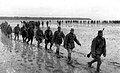
During the Russian Civil War, the Syvash became famous for a surprise crossing by the Red Army during the Perekop-Chongar Operation in November 1920.

Flora

[edit]

The Syvash may appear red in color due to the salt-tolerant micro-alga Dunaliella salina.[5]

The eastern parts of the Syvash contain less salt and are home to reeds and other wetland vegetation.[6]

The large islands in the Central Syvash are mainly covered with steppes consisting of feather grass, tulips, tauric wormwood (Artemisia taurica), sage, crested wheat grass, fescue.[6]

The shores of the Syvash contain a large number of salt-tolerant vegetation, including glasswort, Tripolium, plantains, sea lavender (Limonium caspium), saltbush (Atriplex aucheri).[6]

[edit]

References

[edit]
[edit]
Revisions and contributorsEdit on WikipediaRead on Wikipedia
from Grokipedia
The Syvash, also known as Sivash or the Putrid Sea, is the world's largest hypersaline lagoon system, consisting of a network of shallow, marshy inlets spanning approximately 2,560 square kilometers in the northern Crimean Peninsula, separated from the Sea of Azov by the narrow Arabat Spit.[1][2] Its waters exhibit extreme salinity levels, historically averaging around 140 grams per liter prior to anthropogenic interventions, fostering a unique ecosystem dominated by salt-tolerant algae such as Dunaliella salina that impart striking pink and reddish hues to the lagoons during blooms.[3][4] The shallowness—typically 0.5 to 1 meter deep—combined with high evaporation rates, leads to periodic salt precipitation on the surface and the emission of hydrogen sulfide gases, contributing to its "putrid" moniker and distinctive rotten-egg odor.[5][4] Ecologically, the Syvash supports specialized biodiversity, including hypersaline-adapted phototrophs, microbial mats, and serves as a critical wetland for migratory waterfowl, designated as a Ramsar site of international importance for conservation.[6][1] Human alterations, notably the opening and subsequent closure of the North Crimean Canal in the late 20th and early 21st centuries, induced rapid salinity fluctuations—from hypersaline to brackish and back—triggering ecosystem shifts that threaten endemic species and underscore the lagoon's vulnerability to hydrological engineering.[1][7] Historically, the Syvash has been exploited for salt production, with estimated reserves exceeding 200 million tonnes harnessed since the 19th century for industrial and chemical uses, while its strategic fordability played a pivotal role in World War II, enabling Soviet forces to execute a surprise crossing in late 1943 during the Crimean Offensive to outflank German defenses.[8][5] These attributes define the Syvash as a geomorphologically dynamic, biologically resilient, yet politically contested feature amid ongoing territorial disputes in the region.[6]

Physical Geography

Location and Extent

The Syvash consists of a chain of shallow lagoons positioned along the western margin of the Sea of Azov, extending inland across the northern and eastern coasts of the Crimean Peninsula. This lagoon system forms a natural boundary feature, separated from the open sea primarily by the Arabat Spit to the east.[9] The total expanse encompasses approximately 2,560 square kilometers of interconnected basins and flats.[9] [5] The primary marine inlet is the narrow Henichesk Strait, located near the town of Henichesk, which links the Syvash to the Sea of Azov and facilitates limited water exchange. The geographical coordinates of the Syvash span roughly from 45°30' to 46°00' N latitude and 33°30' to 35°30' E longitude, aligning with the northeastern perimeter of Crimea and adjacent mainland areas. The system is subdivided into Eastern, Western, and Southern Syvash, delineating distinct lagoonal zones bounded by landforms.[10] Depths across the Syvash average 0.5 to 1 meter, with exceptional points reaching up to 3 meters, creating a predominantly flat, intricate mosaic of water bodies interspersed with sandy spits and expansive mudflats that define its fragmented extent.[5]

Geological Origins and Topography

The Syvash lagoon system formed during the Holocene as part of the broader post-glacial transgression of the Black Sea and Sea of Azov, which inundated low-lying coastal plains, tectonic depressions, and radiating ravines (known locally as balkas) in the region. This marine flooding, occurring primarily between approximately 8,000 and 6,000 years before present amid rising sea levels following the Last Glacial Maximum, created shallow inland basins that evolved into the restricted lagoon complex observed today.[11] The isolation of these basins from open marine waters was facilitated by the development of elongate barrier spits, most notably the Arabat Spit to the east, which accumulated through Holocene longshore sediment transport, aeolian deposition, and biogenic shell accumulation from littoral and shallow-water malacofauna.[12] Underlying the Syvash is the Scythian Platform, a tectonic unit characterized by a heterogeneous basement of Baikalian-Variscan-Cimmerian age, overlain by relatively undeformed Mesozoic and Cenozoic sedimentary sequences, with gentle subsidence promoting basin development.[13] This platform setting, bounded by the East European Craton to the north and influenced by distant compressional tectonics from the Caucasus, provided a stable yet subsiding foundation for the accumulation of fine-grained clastic and chemical sediments without significant structural disruption.[14] Topographically, the Syvash features vast, low-relief evaporite basins lying at or below sea level, with average water depths of 0.5–1 meter and maxima reaching no more than 3 meters across its approximately 2,560 square kilometers. The basin floors consist primarily of clayey silts and muds, punctuated by expansive salt flats formed by halite precipitation and lesser gypsum accumulations from recurrent evaporation-drying cycles over millennia in this semi-enclosed system.[15] Scattered low islands, mudflats, and ephemeral bars emerge intermittently, shaped by wind action and sediment winnowing, reflecting the dynamic interplay of minimal relief and high aridity in the regional climate.[16]

Hydrology and Water Chemistry

Connections and Water Exchange

The Syvash maintains its primary physical connection to the Sea of Azov through the Henichesk Strait (also known as the Tonky Strait), a narrow channel approximately 5 km in length with widths ranging from 70 to 180 meters.[17] This strait facilitates limited water exchange, primarily driven by wind-induced currents and minor tidal influences, though the process is constrained by the channel's shallow sills and overall bathymetry, with historical surveys indicating effective depths of 1-3 meters in key sections that impede significant inflow or outflow.[17] Seepage through permeable barriers also contributes marginally to this exchange, but empirical measurements show annual water renewal rates remaining low, often below 1% of the lagoon's total volume due to these restrictions.[18] Freshwater inputs into the Syvash are minimal and derive chiefly from surrounding rivers, with the Salgir River accounting for about 70% of the total runoff entering the system.[19] Other minor rivers contribute sporadically, but their combined discharge is insufficient to offset the dominant hydrological forces, as regional precipitation averages are outpaced by evaporation rates that exceed them by a factor of approximately two.[20] This imbalance results in a net water loss, where outflow through the strait and evaporative demand predominate over inflows, maintaining the lagoon's closed-basin characteristics despite the connective strait.[21] Seasonal variations in wind direction further modulate exchange dynamics, with eastern winds enhancing Azov Sea inflow while westerly winds promote outflow from the Syvash, though overall volumes remain subdued by the strait's geometry and the lagoon's shallow topography.[21] Bathymetric data from pre-1970s surveys confirm these patterns, highlighting how sill elevations and sediment accumulation limit deep-water mixing, thereby preserving distinct hydrological separation between the lagoon and the sea.[17]

Salinity Variations and Chemical Properties

The Syvash lagoon maintains hypersaline conditions primarily through intense evaporation exceeding limited freshwater inflows and restricted exchange with the Sea of Azov via the narrow Tonky Strait, concentrating dissolved ions from marine origins. Prior to significant 20th-century hydrological modifications, average salinity reached approximately 140 g/L across much of the semi-closed system, with isolated eastern sectors exhibiting levels up to 250 g/L in evaporation-dominated pools.[3][22] Current natural gradients span 30–120 g/L, reflecting spatial differences in confinement and wind-driven mixing that homogenize or isolate water masses.[23] Seasonal fluctuations arise from temperature-dependent evaporation rates, which peak during summer months under high solar radiation and low precipitation, elevating salinity by 10–20% relative to winter minima when increased rainfall and stronger westerly winds enhance inflow from the Azov Sea.[24] Empirical observations confirm intra-annual cycles tied to meteorological forcing, with maximum concentration in July–August and dilution during March–April outflow peaks, though inter-annual variability modulates these patterns via precipitation periodicity.[25][26] The chemical profile features elevated concentrations of major ions including chloride, sodium, sulfate, magnesium, and calcium, with relative abundances shifting toward magnesium sulfate and calcium chloride dominance in hypersaline cores due to sequential precipitation of less soluble salts like gypsum during evaporative progression.[22] This ionic enrichment sustains equilibria conducive to mineral precipitation and limits solubility of certain trace elements, as documented in sediment studies across salinity gradients from 39 to 252 g/L.[22] Such properties underscore the lagoon's role as a natural concentrator of evaporitic brines, independent of external dilution influences.[16]

Visual and Olfactory Characteristics

The waters of Syvash display distinctive pink to red coloration, most pronounced in summer, resulting from high concentrations of halophilic microalgae such as Dunaliella salina. These algae produce carotenoid pigments that tint the hypersaline brine and precipitating salt crusts, with color intensity varying by salinity gradients and seasonal algal blooms verifiable in satellite imagery.[4] In spring, hues appear dusty pink, intensifying to vivid reddish tones by mid-summer as evaporation concentrates the water and enhances microbial pigmentation.[27] Syvash earns its moniker "Putrid Sea" from pervasive hydrogen sulfide emissions, imparting a rotten egg odor detectable over wide areas.[4] This gas originates via sulfate reduction by anaerobic bacteria in the oxygen-depleted lower strata of the shallow, stratified waters, where hypersalinity limits mixing and promotes stagnation.[2] Odor intensity escalates in summer as elevated temperatures—often exceeding 30°C in the shallow basins—accelerate microbial decomposition rates, amplifying gas production from organic matter decay under low-oxygen conditions.[28]

Ecology and Biodiversity

Flora and Vegetation

The vegetation of Syvash is predominantly halophytic, adapted to high salinity levels on the lagoon's margins and surrounding saline soils, where sparse meadows form under conditions of osmotic stress that exclude most mesophytic species.[29] Key vascular plants include Salicornia europaea, Limonium gmelinii, and Limonium suffriticosum, which dominate these fringes as succulent, salt-excreting species capable of tolerating soil salinities exceeding 100 g/L.[29][30] Other halophytes such as Argusia sibirica (syn. Tournefortia sibirica) occur on steppe-adjacent saline patches, contributing to low-diversity communities shaped by evaporation-driven salt accumulation.[31] In the hypersaline central basins, where water salinity often surpasses 200 g/L, vascular plants are absent due to lethal osmotic and ionic stresses, limiting primary productivity to non-vascular "flora" in the form of microbial mats and benthic algae.[32] These mats, composed of cyanobacteria and eukaryotic microalgae, cover substrates in layered biofilms, with inventories recording up to 93 species of terrestrial oxygenic phototrophs (49 cyanoprokaryotes and 44 algae) on peripheral islands under wet gleyic conditions.[33] Macroalgal blooms, notably mats of Cladophora spp., have historically occupied 20–60% of surface areas in varying years, thriving in shallow, sun-exposed zones before salinity spikes reduced microphytobenthos diversity from 61 to 12 species in eastern Sivash post-2014.[34][32] Overall botanical richness remains low, with halophytic dominance reflecting causal constraints of extreme aridity and salinity gradients that favor specialist osmoregulators over diverse competitors, as evidenced by regional surveys tying species distributions to soil and water chemistry thresholds.[29][35]

Fauna and Microbial Life

The fauna of Syvash is restricted by hypersalinity levels often exceeding 150 g/L, which preclude most metazoans beyond specialized extremophiles. The brine shrimp Artemia salina dominates as the primary macrozooplankton, sustaining dense populations across the lagoon's 2,560 km² extent, making Bay Sivash the world's largest natural habitat for this species.[36] These crustaceans exhibit physiological adaptations, including osmoregulation via ion-transport mechanisms, enabling survival in salinities up to 300 g/L.[37] Harpacticoid copepods inhabit benthic zones, achieving abundances up to 3.5 × 10⁶ individuals per m² in sediments.[38] Fish are absent from central hypersaline areas, though tolerant species may enter diluted fringes influenced by freshwater inflows.[3] Migratory birds opportunistically exploit Syvash resources, with greater flamingos (Phoenicopterus roseus) feeding on Artemia and microalgae; nesting was first documented in 2017 on hypersaline islands, marking the inaugural breeding in Ukraine.[39] Overall biomass remains low, reflecting the exclusion of higher trophic levels beyond these resilient invertebrates and avian visitors. Prokaryotic communities prevail in microbial life, comprising haloarchaea such as halobacteria that impart reddish hues through carotenoid pigments and thrive via compatible solute accumulation against osmotic stress. Sulfate-reducing bacteria dominate anoxic sediments, reducing sulfate to hydrogen sulfide—responsible for the lagoon's characteristic rotten egg odor—and facilitating sulfur cycling essential to the ecosystem's biogeochemistry.[4] These microbes exhibit high endemism, with strains adapted to salinity thresholds that bar most eukaryotes, sustaining low-biomass but functionally critical populations.[40]

Conservation Status and Threats

The central and eastern portions of the Syvash lagoon system were designated as Wetlands of International Importance under the Ramsar Convention on January 1, 1998, recognizing their role in supporting hypersaline ecosystems with high concentrations of waterbirds, raptors, and endemic microbial communities adapted to extreme salinity levels.[41] Approximately 10% of the site overlaps with the Azovo-Syvashkyi National Nature Park, where stricter protections apply, but broader enforcement of Ramsar guidelines has been inconsistent since 2014 due to administrative disruptions in the region.[29] Key threats to the Syvash's biodiversity stem from salinity instability, which undermines the hypersaline conditions necessary for resilient endemic species; historical dilution from freshwater inflows via the North Crimean Canal reduced average salinity from over 140 g/L to as low as 17 g/L by 1997, triggering sharp declines in Artemia sp. populations, as these brine shrimp require salinities of 80–90 g/L or higher for reproduction and survival.[1] [42] Subsequent salinity rebounds above 50 g/L have correlated with reduced plankton taxa diversity, illustrating a narrow optimal range where ecosystem productivity peaks before hypersalinity suppresses broader biotic assemblages.[1] Natural pressures include episodic droughts that concentrate brines further or cause shallow basins to dry, fragmenting habitats and stressing microbial mats and Artemia cysts, which rely on stable water cover for viability; such events have historically amplified evaporation rates in this endorheic system, leading to localized habitat patches unsuitable for recolonization. Human-induced factors, such as brine extraction for salt production, have historically lowered water volumes in extraction zones, reducing connected wetland areas and altering local hydrodynamics, though data on long-term population impacts remain limited to observational correlations with salinity shifts. Erosion of the fragile sandy spits (e.g., Arabat and Chonhar) from wind-driven waves further risks breaching the lagoon's isolation from the Sea of Azov, potentially introducing oscillatory salinity fluctuations that disrupt the causal equilibrium of this thalassohaline environment.[1] Maintaining salinity stability is thus critical for ecosystem resilience, as deviations beyond species tolerances—evidenced by Artemia's multi-year recovery lags post-dilution—cascade to diminish biodiversity and bird foraging grounds.[42]

Human Utilization and Economy

Salt Production History and Methods

Salt production in the Syvash lagoon relies predominantly on solar evaporation, a passive process exploiting the region's arid climate and shallow depths averaging 0.5–1 meter to concentrate brine from limited Black Sea inflows or residual waters. Seawater or hypersaline brine is directed into engineered ponds or natural basins, where evaporation during summer months—driven by high solar radiation and low humidity—precipitates sodium chloride crystals on the basin floors, often intermixed with magnesium and potassium salts. This method's efficiency stems from the Syvash's baseline salinity exceeding 100–300 g/L, far surpassing open seawater's 35 g/L, thereby requiring minimal mechanical intervention or energy compared to vacuum evaporation or underground mining techniques used in lower-salinity regions.[1] Historical records indicate organized extraction at Lake Sasyk-Sivash, the Syvash's primary production hub, began in 1768 under Russian imperial administration, utilizing rudimentary flooding and manual scraping of crystallized layers from evaporation pans. By the 19th century, operations expanded across Crimean lagoons including Syvash, with 1833 estimates recording over 246,000 tonnes extracted from regional salt lakes, though specific Syvash contributions were smaller due to inconsistent water exchange. Harvesting involved seasonal draining of ponds via sluices, followed by labor-intensive collection of salt slabs, which in Sasyk-Sivash often exhibit a distinctive pink coloration from beta-carotene pigments produced by halophilic Dunaliella salina microalgae thriving in the brine.[43][44] Soviet-era industrialization from the 1920s onward mechanized these processes, introducing rail-mounted scrapers and conveyor systems to gather up to several square kilometers of salt pans annually, with peak outputs in the 1970s reaching hundreds of thousands of tonnes facilitated by damming and pond segmentation for staged crystallization. Post-damming of the North Crimean Canal in 2014, salinity surges enhanced evaporation rates but disrupted prior freshwater-modulated gradients, reducing overall yields; Sasyk-Sivash operations, for instance, stabilized at around 65,000 tonnes per year pre-conflict, emphasizing the pink variant for its mineral profile including trace magnesium.[45][1]

Other Economic and Industrial Uses

The hypersaline brines of Syvash support extraction of bromine through chlorination and air desorption processes, leveraging the system's natural evaporation for concentration. JSC Brom, based in Krasnoperekopsk near Sivash Gulf, maintains a production capacity of 52,000 metric tons of bromine annually from these brines, contributing to Ukraine's chemical industry output.[46][47] Syvash brines also enable magnesium production via precipitation and thermal reduction methods, exploiting high magnesium chloride concentrations achieved through solar evaporation, which reduces energy inputs compared to ore-based processing. The Sivash Magnesia Works utilizes these resources for magnesia and metallic magnesium output, with the brine's composition—enriched in magnesium salts—facilitating efficient recovery.[48][49] Populations of Artemia salina thrive in variably saline sections of Syvash, particularly in eastern arms where salinity permits cyst formation, offering a supplementary resource for aquaculture feed in fish and shellfish larviculture; however, commercial harvesting volumes remain modest due to ecological variability and regional access constraints.[50][51] The surrounding flats host the Syvash Wind Farm, a 250 MW onshore facility operational since the late 2010s, generating 850 GWh of electricity yearly through turbines suited to the open terrain, supplying power equivalent to 250,000 households and offsetting fossil fuel dependence.[52][53]

Historical Context

Pre-20th Century Development

Salt extraction from the Syvash lagoons dates back to antiquity, with practices documented in the broader Black Sea region where hypersaline lakes served as vital resources for local populations. Archaeological and historical records indicate that nomadic groups, including Scythians inhabiting the Crimean steppes around 500 BCE, likely utilized nearby salt deposits for preservation and trade, as evidenced by burial mounds proximate to Sasyk-Sivash Lake associated with early steppe cultures.[44][54] By the medieval period, Genoese colonists in the 14th century facilitated organized salt exploitation from Crimean lagoons, integrating Syvash products into Black Sea commerce networks that supplied markets in Constantinople, Greece, and beyond. Salt from northern shores and the peninsula acted as a key preservative for fish and meat, underpinning regional trade routes despite the lagoon's inaccessibility, which limited development to temporary evaporation ponds and coastal outposts rather than permanent settlements. No major battles or urban centers emerged centered on the Syvash, owing to its shallow, treacherous waters and foul odors.[44][55][45] In the 17th century, Ottoman traveler Evliya Çelebi documented crossings of the Syvash, referring to it in terms evocative of its Russian designation "Gniloye More" (Rotten Sea), highlighting ford points amid the putrid expanse that enabled intermittent human passage for trade and herding. These accounts underscore the lagoon's role as a peripheral yet strategically navigable barrier in Crimean Khanate territories, with salt caravans by merchants like the later Chumaks extending this tradition into the 18th and 19th centuries prior to industrial scaling.[44][45]

Soviet Era Infrastructure and Modifications

The primary Soviet-era infrastructure project affecting the Syvash was the North Crimean Canal, initiated to address water scarcity in northern Crimea by diverting Dnieper River water from the Kakhovka Reservoir. Construction commenced in 1957, with the initial phase extending from the reservoir to the Crimean isthmus at Krasnoperekopsk completed by 1963, enabling preliminary freshwater delivery; the full network, including branches across the peninsula to Kerch, reached operational completion between 1975 and 1976.[56][57] This engineering intervention introduced substantial freshwater inflows for irrigation, with return flows and direct discharges into the Syvash reducing its average salinity from hypersaline levels above 140 g/L prior to 1963 to brackish ranges of 18–23 g/L by the late 1980s, varying by sub-basin due to evaporation and limited Azov Sea exchange.[7][3] The hydrological alteration transformed the lagoon's ecosystem from halophile-dominated, supporting extremophile microalgae like Dunaliella salina, to a brackish state conducive to euryhaline plankton and invertebrates, though native hypersaline specialists declined sharply.[42] The lowered salinity facilitated experimental fish introductions and limited aquaculture trials in accessible shallows, shifting ecological dynamics toward brackish-water assemblages, but yields remained modest compared to open coastal fisheries due to persistent high evaporation and sediment loads.[7] Regionally, the canal boosted Crimean agriculture by irrigating over 300,000 hectares of arid steppe, increasing grain, vegetable, and rice production by factors of 2–5 times in the 1970s1980s relative to pre-canal baselines, though salinization of soils emerged as a long-term side effect from inefficient drainage.[58] Post-1991, following Ukraine's independence, reduced Dnieper allocations began reversing salinity declines, with partial canal flows sustaining brackish conditions until fuller restrictions in subsequent years.[7]

Modern Developments and Geopolitics

Post-2014 Salinity Shifts and Ecosystem Changes

In April 2014, Ukraine ceased the supply of Dnieper River water through the North Crimean Canal, eliminating the primary source of freshwater inflow to Syvash and initiating a rapid reversal of the artificial desalination that had persisted since the canal's construction in the 1970s.[1] This hydrological shift caused salinity levels to surge, with Eastern Syvash recording averages of 27–33 g/L in spring 2014, escalating to over 50 g/L by 2017 and exceeding 100 g/L in isolated hypersaline pockets by 2016 as evaporation concentrated the remaining brines.[59] [60] By 2020, mean salinity across much of the lagoon had stabilized at 40–60 g/L, approaching pre-canal hypersaline norms of 90–320 g/L, driven by natural processes including summer evaporation rates of up to 1.5 m annually and minimal precipitation.[61] [62] The salinity escalation triggered a profound ecosystem reconfiguration, favoring hypersaline-adapted biota while decimating brackish-water species sustained by prior canal inputs. Zooplankton communities shifted toward dominance by brine shrimp (Artemia salina), which proliferated in salinities above 50 g/L, alongside copepods tolerant of extreme conditions, restoring a microbial food web centered on halophilic algae like Dunaliella salina that tint waters reddish-pink via beta-carotene production.[1] Benthic assemblages underwent restructuring, with meiofauna diversity initially declining due to osmotic stress on euryhaline nematodes and ostracods, but recovering via hypersaline specialists; macrofauna losses included introduced fish stocks (e.g., mullet and gobies) unviable above 40 g/L, reducing overall vertebrate biomass but curbing eutrophication from nutrient-laden river inflows.[63] [64] These changes yielded mixed biodiversity outcomes under empirical metrics: hypersaline recovery enhanced endemic microbial productivity and supported specialized crustacean populations, mitigating prior oxygen depletion from algal blooms in diluted waters, though total species richness fell as non-native brackish elements vanished.[1] Salt extraction operations adapted to the stabilized hypersalinity, with evaporation ponds achieving higher crystallization efficiency without freshwater dilution, though quantitative production data post-2020 remains limited amid regional instability.[3]

Geopolitical Status and Disputes

The Syvash lagoon system lies within the territory annexed by Russia in 2014 as part of the Crimean Peninsula, placing it under de facto Russian administration as the Republic of Crimea. A referendum held on March 16, 2014, reported 96.77% approval for joining Russia among voters in Crimea, with turnout at 83.1%, enabling subsequent integration into the Russian Federation.[65] This control extends to resource oversight and infrastructure development in the region. Following the 2022 invasion, Russian forces captured the western mainland approaches, securing full occupation of the Syvash area previously partially held by Ukraine.[66] Ukraine and most international bodies reject this status, viewing the Syvash as occupied Ukrainian territory within 1991 borders. UN General Assembly Resolution 68/262, passed on March 27, 2014, by 100 votes to 11, declared the referendum invalid and reaffirmed Ukraine's sovereignty over Crimea, including the Syvash.[67] Ukrainian policy, such as blocking the North Crimean Canal in April 2014 to cut freshwater inflows, reflects retaliation against the annexation, impacting regional water dynamics.[68] Russia justifies the incorporation as reunification correcting the 1954 Soviet transfer of Crimea to Ukraine, aligning with the peninsula's historical Russian ties and majority ethnic composition. Russian authorities have pursued felony charges of ecocide against Ukraine over the canal closure, alleging deliberate harm to Crimean ecosystems.[69] In practice, Russian governance has enabled targeted infrastructure investments in Crimea, contrasting Ukrainian restrictions and fostering de facto resource utilization amid unresolved territorial claims.[70]

References

User Avatar
No comments yet.