


Community hub
Recent from talks
Contribute something
Nothing was collected or created yet.
TOI-1338
View on Wikipedia
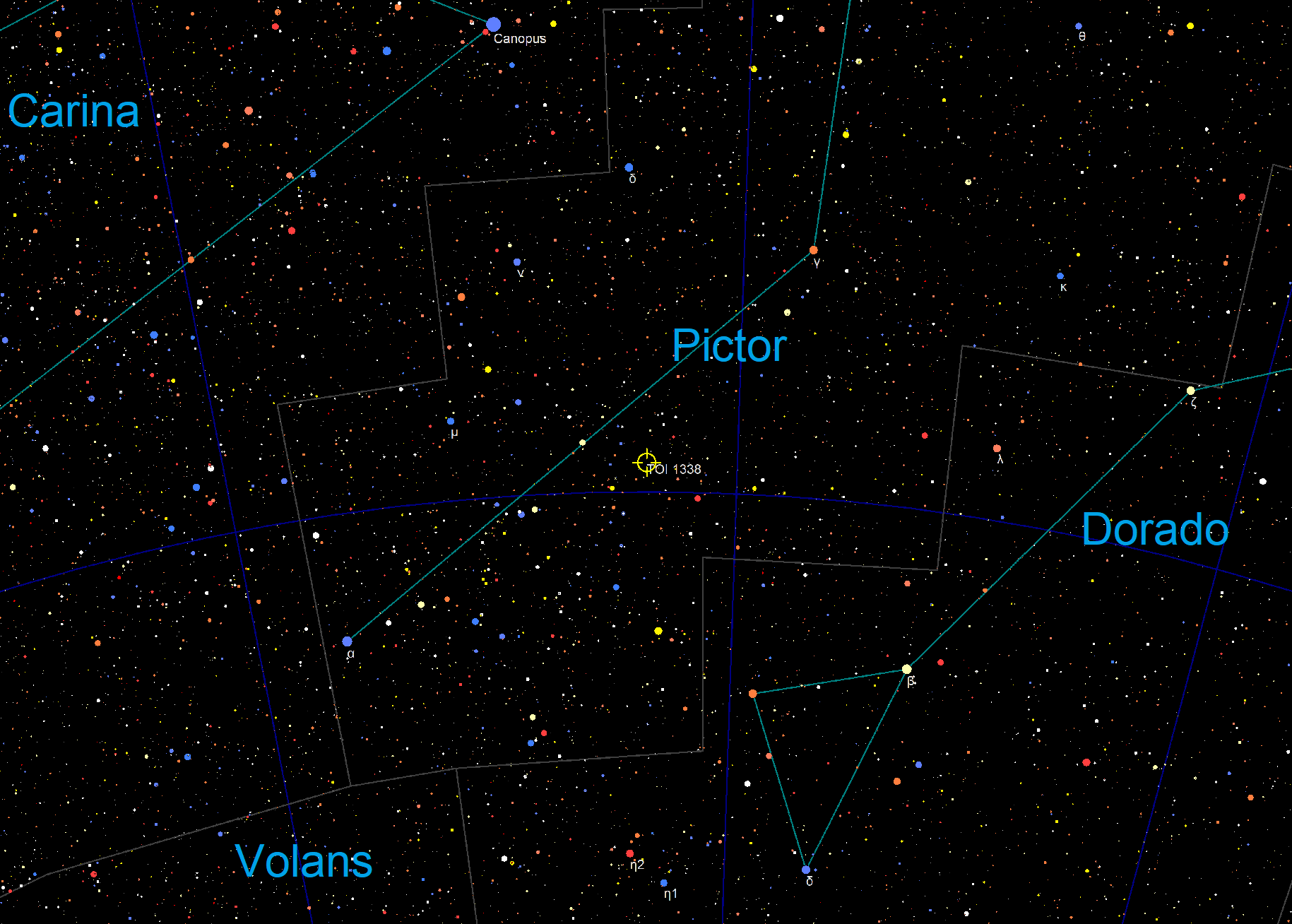
 Position of TOI-1338 in Pictor | |
| Observation data Epoch J2000 Equinox J2000 | |
|---|---|
| Constellation | Pictor |
| Right ascension | 06h 08m 31.968s[1] |
| Declination | −59° 32′ 28.08″[1] |
| Apparent magnitude (V) | 11.72[2] |
| Characteristics | |
| Spectral type | F8 / M[3] |
| Variable type | eclipsing[3] |
| Astrometry | |
| Radial velocity (Rv) | 23.56±5.34[1] km/s |
| Proper motion (μ) | RA: −12.057[1] mas/yr Dec.: +34.513[1] mas/yr |
| Parallax (π) | 2.4752±0.0099 mas[1] |
| Distance | 1,318 ± 5 ly (404 ± 2 pc) |
| Orbit[4] | |
| Period (P) | 14.6085659+0.0000062 −0.0000057 d |
| Semi-major axis (a) | 0.1321+0.0024 −0.0025 AU[2] |
| Eccentricity (e) | 0.155489+0.000011 −0.000010 |
| Inclination (i) | 90.403+0.045 −0.047° |
| Argument of periastron (ω) (secondary) | 117.7638+0.0042 −0.0041° |
| Semi-amplitude (K1) (primary) | 21.619±0.007[2] km/s |
| Details | |
| TOI-1338 A | |
| Mass | 1.0936±0.0072[4] M☉ |
| Radius | 1.313±0.0038[4] R☉ |
| Luminosity | 2.1[1] L☉ |
| Surface gravity (log g) | 4.0±0.08[2] cgs |
| Temperature | 6,050±80[2] K |
| Metallicity [Fe/H] | +0.01±0.05[2] dex |
| Rotation | 19±3 d[2] |
| Rotational velocity (v sin i) | 3.6±0.6[2] km/s |
| Age | 4.4±0.2[2] Gyr |
| TOI-1338 B | |
| Mass | 0.3069±0.0012[4] M☉ |
| Radius | 0.30582±0.00094[4] R☉ |
| Other designations | |
| TOI-1338, TIC 260128333, TYC 8533-950-1, 2MASS J06083197-5932280, BEBOP-1, EBLM J0608-59, RAVE J060832.0-593228[5] | |
| Database references | |
| SIMBAD | data |
TOI-1338 is a binary star system located in the constellation Pictor, about 1,320 light-years from Earth. It is orbited by two known circumbinary planets, TOI-1338 b, discovered by the Transiting Exoplanet Survey Satellite (TESS)[2] and BEBOP-1c, discovered by the Binaries Escorted By Orbiting Planets project.[6]
Discovery and nomenclature
[edit]The circumbinary planet TOI-1338 b was found in July 2019 by Wolf Cukier, a 17-year-old high school student who joined the Goddard Space Flight Center as a summer intern.[7] The acronym TOI stands for "TESS Objects of Interest." Cukier studied data provided by volunteers of the Planet Hunters citizen science project, looking through data that had been flagged as an eclipsing binary.[8] Cukier and six of the Planet Hunter volunteers are co-authors of the publication regarding the planet.[2]
The discovery of TOI-1338 b was announced in early January 2020 at the 235th American Astronomical Society meeting in Honolulu, Hawaii.[9] In June 2023, a second circumbinary planet within the system was announced to have been discovered, named BEBOP-1c.[10] It was the first circumbinary planet to be found using the radial velocity method.[6]
In February 2021, a petition was launched calling for TOI-1338 b to be renamed SOPHIE in honor of late Scottish musician Sophie.[11][12] It was supported by Charli XCX and Caroline Polachek.[11] The petition was unsuccessful in renaming TOI-1338 b, but in June 2021, the International Astronomical Union announced that the minor planet 1980 RE1 was given the permanent name Sophiexeon.[13]
Stellar binary
[edit]
TOI-1338 is a single-lined spectroscopic binary system, consisting of an F8 star and a red dwarf of spectral type M. The system has an age of 4.4 billion years. The two stars with masses of 1.13 and 0.313 M☉ revolve around each other every 14.6 days. The red dwarf is about nine magnitudes fainter than the primary star and cannot be detected in the spectrum.[15][2]
The orbit of the two stars is inclined at 89.7° to the plane of the sky (so edge-on) and both primary and secondary eclipses can be observed, although the brightness changes are very small. The primary eclipse occurs when the hotter primary star is partially occulted by the cooler secondary. It lasts about five hours and the brightness decreases by about 4%. The secondary eclipses occur when the cooler star is occulted by the hotter star. They also last about five hours but the brightness drops by less than half a percent.[2]
Planetary system
[edit]
The planet TOI-1338 b is between Neptune and Saturn in size, and has an orbit that is within ~1° coplanar with the binary.[2] Its mass is estimated to be roughly 11 times that of Earth, indicating a low density similar to that of circumbinary planet Kepler-47c.[4]
The spin of the primary star aligns with the orbits of the binary and the planet (spin-orbit angle β = 2.8°±17.1°). This is the second time the Rossiter–McLaughlin effect was measured for a star hosting a circumbinary planet. Kepler-16 was the first system with such a measurement. The measurement of the alignment for TOI-1338 suggests that the planet formed from a single circumbinary disk.[16]
TOI-1338 c, or BEBOP-1c,[6] is a gas giant about 75 times the mass of Earth. It is also coplanar (or nearly so) with the binary stars and planet b.[4]
| Companion (in order from star) |
Mass | Semimajor axis (AU) |
Orbital period (days) |
Eccentricity | Inclination | Radius |
|---|---|---|---|---|---|---|
| b | 11.3±2.1 M🜨 | 0.4607+0.0084 −0.0088[2] |
95.4001+0.0062 −0.0056 |
0.0331+0.0022 −0.0021 |
90.494+0.013 −0.014° |
7.661±0.053 R🜨 |
| c | 75.4+4.0 −3.6 M🜨 |
0.794±0.016[6] | 215.79+0.46 −0.51 |
0.037+0.032 −0.026 |
97.0+6.7 −6.8° |
— |
See also
[edit]References
[edit]- ^ a b c d e f g Vallenari, A.; et al. (Gaia collaboration) (2023). "Gaia Data Release 3. Summary of the content and survey properties". Astronomy and Astrophysics. 674: A1. arXiv:2208.00211. Bibcode:2023A&A...674A...1G. doi:10.1051/0004-6361/202243940. S2CID 244398875. Gaia DR3 record for this source at VizieR.
- ^ a b c d e f g h i j k l m n o Kostov, Veselin B.; Orosz, Jerome A.; Feinstein, Adina D.; Welsh, William F.; Cukier, Wolf; Haghighipour, Nader; Quarles, Billy; Martin, David V.; Montet, Benjamin T.; Torres, Guillermo; Triaud, Amaury H. M. J. (7 May 2020). "TOI-1338: TESS' First Transiting Circumbinary Planet". The Astronomical Journal. 159 (6): 253. arXiv:2004.07783. Bibcode:2020AJ....159..253K. doi:10.3847/1538-3881/ab8a48. hdl:10023/20067. ISSN 1538-3881. S2CID 215785933.
- ^ a b Triaud, Amaury H. M. J.; Martin, David V.; Ségransan, Damien; Smalley, Barry; Maxted, Pierre F. L.; Anderson, David R.; Bouchy, François; Collier Cameron, Andrew; Faedi, Francesca; Gómez Maqueo Chew, Yilen; Hebb, Leslie; Hellier, Coel; Marmier, Maxime; Pepe, Francesco; Pollacco, Don; Queloz, Didier; Udry, Stéphane; West, Richard (2017). "The EBLM Project. IV. Spectroscopic orbits of over 100 eclipsing M dwarfs masquerading as transiting hot Jupiters". Astronomy and Astrophysics. 608: A129. arXiv:1707.07521. Bibcode:2017A&A...608A.129T. doi:10.1051/0004-6361/201730993. S2CID 119372451.
- ^ a b c d e f g h Wang, Mu-Tian; Liu, Hui-Gen (July 2024). "Photo-dynamical Analysis of Circumbinary Multi-planet System TOI-1338: A Fully Coplanar Configuration with a Puffy Planet". The Astronomical Journal. 168 (1): 31. arXiv:2404.18415. Bibcode:2024AJ....168...31W. doi:10.3847/1538-3881/ad4a60.
- ^ "TOI-1338". SIMBAD. Centre de données astronomiques de Strasbourg. Retrieved 12 August 2024.
- ^ a b c d Standing, Matthew R.; Sairam, Lalitha; Martin, David V.; Triaud, Amaury H. M. J.; Correia, Alexandre C. M.; Coleman, Gavin A. L.; Baycroft, Thomas A.; Kunovac, Vedad; Boisse, Isabelle; Andrew Collier Cameron; Dransfield, Georgina; Faria, João P.; Gillon, Michaël; Hara, Nathan C.; Hellier, Coel; Howard, Jonathan; Lane, Ellie; Mardling, Rosemary; Maxted, Pierre F. L.; Miller, Nicola J.; Nelson, Richard P.; Orosz, Jerome A.; Pepe, Franscesco; Santerne, Alexandre; Sebastian, Daniel; Udry, Stéphane; Welsh, William F. (2023), "Radial-velocity discovery of a second planet in the TOI-1338/BEBOP-1 circumbinary system", Nature Astronomy, 7 (6): 702–714, arXiv:2301.10794, Bibcode:2023NatAs...7..702S, doi:10.1038/s41550-023-01948-4, S2CID 259138442
- ^ Pereira, Ivan (9 January 2020). "New York teen discovers new planet while interning with NASA". ABC News.
- ^ "Discovery Alert! High School Student Finds a World With Two Suns". Exoplanet Exploration: Planets Beyond our Solar System. Retrieved 14 February 2020.
- ^ Hess, Abigail Johnson (10 January 2020). "17-year-old discovers planet 6.9 times larger than Earth on third day of internship with NASA". CNBC. Retrieved 16 July 2023.
- ^ Choi, Charles Q. (12 June 2023). "New Tatooine-like exoplanet discovered orbiting twin suns. Meet BEBOP-1c". Space.com. Retrieved 16 July 2023.
- ^ a b "SOPHIE fans call for NASA to name a planet after the late musician". Dazed. 3 February 2021. Retrieved 4 February 2021.
- ^ Richards, Will (30 January 2021). "DJ and producer SOPHIE has died". NME. Archived from the original on 30 January 2021. Retrieved 31 January 2021.
- ^ "WGSBN Bulletin, Volume 1, #3" (PDF). International Astronomical Union. 16 June 2021. ISSN 2789-2603. Archived (PDF) from the original on 6 October 2021. Retrieved 10 February 2023.
- ^ "MAST: Barbara A. Mikulski Archive for Space Telescopes". Space Telescope Science Institute. Retrieved 8 December 2021.
- ^ Martin, David V.; Triaud, Amaury H. M. J.; Udry, Stephane; Marmier, Maxime; Maxted, Pierre F. L.; Cameron, Andrew Collier; Hellier, Coel; Pepe, Francesco; Pollacco, Don; Segransan, Damien; West, Richard (April 2019). "The BEBOP radial-velocity survey for circumbinary planets I. Eight years of CORALIE observations of 47 single-line eclipsing binaries and abundance constraints on the masses of circumbinary planets". Astronomy & Astrophysics. 624: A68. arXiv:1901.01627. Bibcode:2019A&A...624A..68M. doi:10.1051/0004-6361/201833669. ISSN 0004-6361.
- ^ Kunovac Hodzic, Vedad; Triaud, Amaury H. M. J.; Martin, David V.; Fabrycky, Daniel C.; Cegla, Heather M.; Collier Cameron, Andrew; Gill, Samuel; Hellier, Coel; Kostov, Veselin B.; Maxted, Pierre F. L.; Orosz, Jerome A. (1 July 2020). "The EBLM project - VII. Spin-orbit alignment for the circumbinary planet host EBLM J0608-59 A/TOI-1338 A". Monthly Notices of the Royal Astronomical Society. 497 (2): 1627–1633. arXiv:2007.05514. Bibcode:2020MNRAS.497.1627K. doi:10.1093/mnras/staa2071. S2CID 220486377.
External links
[edit]- TESS – Official WebSite
- NASA Telescope Discovers Its First Planet Orbiting Two Stars
- TOI 1338 at ExoFOP TESS
- The TOI 1338 subject at Planet Hunters, as mentioned in the paper

2020 in space | ||
|---|---|---|
| Space probe launches  |
|   _on_Jul_14_2020_aligned_to_stars.jpg) |
| Impact events | ||
| Selected NEOs |
| |
| Exoplanets |
| |
| Discoveries |
| |
| Comets | ||
| Space exploration |
| |


