
_on_Jul_14_2020_aligned_to_stars.jpg/250px-Comet_2020_F3_(NEOWISE)_on_Jul_14_2020_aligned_to_stars.jpg)


_on_Jul_14_2020_aligned_to_stars.jpg/2000px-Comet_2020_F3_(NEOWISE)_on_Jul_14_2020_aligned_to_stars.jpg)
Community hub
Recent from talks
Contribute something
Nothing was collected or created yet.
Comet NEOWISE
View on Wikipedia
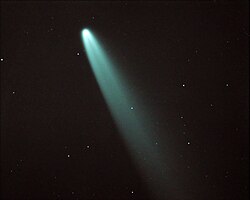
_on_Jul_14_2020_aligned_to_stars.jpg) Comet NEOWISE photographed from Germany on July 14, 2020 | |
| Discovery[1] | |
|---|---|
| Discovered by | NEOWISE |
| Discovery date | March 27, 2020 |
| Designations | |
| CK20F030 | |
| Orbital characteristics[2][3] | |
| Epoch | July 6, 2020 (JD 2459036.5) |
| Observation arc | 1.2 years (438 days) |
| Number of observations | 1,315 |
| Aphelion | 538 AU (inbound) 710 AU (outbound) |
| Perihelion | 0.295 AU |
| Semi-major axis | 270 AU (inbound) 355 AU (outbound) |
| Eccentricity | 0.99921 |
| Orbital period | ~4,500 yrs (inbound) ~6,800 yrs (outbound) |
| Inclination | 128.94° |
| 61.010° | |
| Argument of periapsis | 37.279° |
| Mean anomaly | 0.0003° |
| Last perihelion | 3 July 2020 |
| TJupiter | −0.408 |
| Earth MOID | 0.362 AU |
| Jupiter MOID | 0.813 AU |
| Physical characteristics[1] | |
| Dimensions | ~5.0 km (3.1 mi) |
| 7.58±0.03 hours | |
| Comet total magnitude (M1) | 7.5–12.1 |
| 0.5–1.0 (2020 apparition) | |
C/2020 F3 (NEOWISE) or Comet NEOWISE is a long period comet with a near-parabolic orbit discovered on March 27, 2020, by astronomers during the NEOWISE mission of the Wide-field Infrared Survey Explorer (WISE) space telescope. At that time, it was an 18th-magnitude object, located 2.0 AU (300 million km; 190 million mi) away from the Sun and 1.7 AU (250 million km; 160 million mi) away from Earth.[4]
NEOWISE is known for being the brightest comet in the northern hemisphere since Comet Hale–Bopp in 1997.[5] It was widely photographed by professional and amateur observers and was even spotted by people living near city centers and areas with light pollution.[6] While it was too close to the Sun to be observed at perihelion, it emerged from perihelion around magnitude 0.5 to 1, making it bright enough to be visible to the naked eye.[7] Under dark skies, it could be seen with the naked eye and remained visible to the naked eye throughout July 2020.[8][9] By July 30, the comet was about magnitude 5,[10] when binoculars were required near urban areas to locate the comet.
For observers in the Northern Hemisphere, the comet could be seen on the northwestern horizon, below the Big Dipper. North of 45 degrees north, the comet was visible all night in mid-July 2020. On July 30, Comet NEOWISE entered the constellation of Coma Berenices, below the bright star Arcturus.
NEOWISE was retroactively dubbed the Great Comet of 2020.
History and observations
[edit].jpg)
The object was discovered by a team using the WISE space telescope under the NEOWISE program on March 27, 2020.[1] It was classified as a comet on March 31 and named after NEOWISE on April 1.[4] It has the systematic designation C/2020 F3, indicating a non-periodic comet which was the third discovered in the second half of March 2020.
Comet NEOWISE made its closest approach to the Sun (perihelion) on July 3, 2020, at a distance of 0.29 AU (43 million km; 27 million mi). This passage through the planetary region increases the comet's orbital period from about 4500 years to about 6800 years.[2] Its closest approach to Earth occurred on July 23, 2020, 01:09 UTC, at a distance of 0.69 AU (103 million km; 64 million mi) while located in the constellation of Ursa Major.[11]
In early July, the comet could be seen in the morning sky just above the north-eastern horizon and below Capella. Seen from Earth, the comet was less than 20 degrees from the Sun between June 11–July 9, 2020. By June 10, 2020 as the comet was being lost to the glare of the Sun, it was apparent magnitude 7.0,[10] when it was 0.7 AU (100 million km; 65 million mi) away from Sun and 1.6 AU (240 million km; 150 million mi) away from Earth. When the comet entered the field of view of the SOHO spacecraft's LASCO C3 instrument on June 22, 2020, the comet had brightened to about magnitude 3.0, when it was 0.4 AU (60 million km; 37 million mi) away from the Sun and 1.4 AU (210 million km; 130 million mi) away from Earth.[10]
By early July, Comet NEOWISE had brightened to magnitude 1.0,[12][13] far exceeding the brightness attained by previous comets that year, C/2020 F8 (SWAN), and C/2019 Y4 (ATLAS). By July, it also had developed a second tail. The first tail was blue and made of gas and ions. There was also a red separation in the tail caused by high amounts of sodium. The second twin tail was a golden color and was made of dust, like the tail of Comet Hale–Bopp.[citation needed] The comet was brighter than C/2011 L4 (PanSTARRS),[14] but not as bright as Hale–Bopp was in 1997. After perihelion, the comet began to fade, dropping to magnitude 2.0 in mid-July.[15] Its nucleus activity subdued after mid-July, and its green coma was clearly visible after that.
On July 13, 2020, a sodium tail was confirmed by the Planetary Science Institute's Input/Output facility.[16] Sodium tails have only been observed in very bright comets such as Hale–Bopp and C/2012 S1 (ISON).
From the infrared signature, the diameter of the comet nucleus is estimated to be approximately 5 km (3.1 mi).[1] The nucleus is similar in size to Comet Hyakutake and many short-period comets such as 2P/Encke, 7P/Pons–Winnecke, 8P/Tuttle, 14P/Wolf, and 19P/Borrelly.[17] By July 5, NASA's Parker Solar Probe had captured an image of the comet, from which astronomers also estimated the diameter of the comet nucleus at approximately 5 km (3.1 mi) as well.[18]Later in July 2020, other observations were also reported, including those related to coma morphology,[19] and spectrographic emissions.[20][21][22][23] On 31 July 2020, strong detection of OH 18-cm emission was observed in radio spectroscopic studies at the Arecibo Observatory.[24]On August 14, 2020, the rotation period of the comet was reported to be "7.58±0.03 hr".[25]
After its perihelion and closest approach to Earth, a number of authors have suggested considering NEOWISE as a great comet.[26][27][28][29][30][31] Others have argued that it lacked the brightness and visible tail to qualify.[32] Retroactively, in the years that followed, NEOWISE is commonly remembered as a great comet.[33][34]
Trajectory
[edit]![[icon]](https://en.wikipedia.org/wiki/File:Wiki_letter_w_cropped.svg) | This section needs expansion. You can help by adding to it. (July 2020) |
Comet NEOWISE's retrograde orbit crossed to the north of the plane of the ecliptic, to which it is inclined at approximately 129 degrees, on June 29, 2020, 01:47 UTC.[12][2] It made its closest approach to the Sun (perihelion) on July 3, 2020, at a distance of 0.29 AU (43 million km; 27 million mi). This passage increases the comet's orbital period from about 4400 years to about 6700 years.[2] On July 18, the comet peaked at a northern declination of +48 and was circumpolar down to latitude 42N.[11] Its closest approach to Earth occurred on July 23, 2020, 01:09 UTC, at a distance of 0.69 AU (103 million km; 64 million mi) while located in the constellation of Ursa Major.[11]
The comet's orbital characteristics suggest it originated from the Oort cloud. Its high orbital eccentricity of 0.99921 confirms its path is a nearly parabolic trajectory, typical of long-period comets making one of their first passages into the inner Solar System. The orbital inclination of 129 degrees classifies it as a retrograde comet, meaning it orbits the Sun in the opposite direction to Earth and the other planets. This path is what allowed it to approach the Sun from the south of the ecliptic plane before crossing northwards just before its perihelion. The difference between the inbound orbital period of about 4,400 years and the outbound period of about 6,700 years is a result of gravitational perturbations from the planets. As the comet passed through the planetary region, the slight gravitational pull from the planets transferred energy to it, accelerating it and placing it on a higher-energy, longer-period outbound orbit. This also increased its aphelion, the farthest point in its orbit from the Sun.
-
 Diagram of the comet's nearly parabolic orbit
 -
 Comet's position in the sky – the retrograde loops are caused by parallax from Earth's annual motion around the Sun; the most apparent movement occurs when the comet is closest to Earth
 -
 Animation of C/2020 F3's orbit around Sun
C/2020 F3 · Sun · Mercury · Venus · Earth · Mars


In popular culture
[edit]The fictional comet Dibiasky on the 2021 film Don't Look Up was "very loosely" modelled after comet NEOWISE.[35][36]
Gallery
[edit]In chronological order:
-
 July 7, 2020, Golden Gate Bridge, California, United States
 -
 Inverted telescope image photographed on July 9, 2020
 -
 July 14, 2020 near the San Francisco Peaks in the Flagstaff dark sky preserve
 -
 July 17, 2020, 18:59 UTC over Asterousia, Crete, as it entered into Ursa Major
 -
 Comet C2020 NEOWISE 17-07-2020 20:51:57 UTC La Canada observatory
 -
 Midnight, July 18, 2020 – in a time-lapse taken from the Shenandoah National Park, Virginia, U.S. the view was rotating because the lens was on a tracking mount
 -
 Above Chimney Rock on July 18, 2020
 -
 July 19, 2020 in Villanovaforru (Sardinia, Italy)
 -
 NEOWISE from the Eastern Sierra Mountains – July 20, 2020
 -
 July 21, 2020 in Quebec, Canada
 -
 Joshua Tree National Park, a dark-sky preserve, on July 21, 2020
 -

-
 Hubble image taken on August 8, 2020


.jpg)


See also
[edit]
References
[edit]- ^ a b c d M. Mace (July 8, 2020). "Comet NEOWISE Sizzles as It Slides by the Sun, Providing a Treat for Observers". Infrared Processing and Analysis Center. Archived from the original on July 13, 2020. Retrieved July 14, 2020.
- ^ a b c d JPL Horizons barycentric solution for epoch 1800 (before entering planetary region)
Goto JPL Horizons
1800-Jan-01 is "PR = 1.64 × 10⁶/365.25 days" = 4490 years
2200-Jan-01 is "PR = 2.48 × 10⁶/365.25 days" = 6789 years
(For long-period comets on multi-thousand year orbits, asymmetric outgassing will affect the highly sensitive orbital period and eccentricity.) - ^ "C/2020 F3 (NEOWISE) – JPL Small-Body Database Lookup". ssd.jpl.nasa.gov. Jet Propulsion Laboratory. Retrieved June 9, 2024.
- ^ a b J. Masiero; P. Breitenstein; H. Sato; P. Camilleri; et al. (April 1, 2020). "MPEC 2020-G05: Comet C/2020 F3 (NEOWISE)". www.minorplanetcenter.net. Minor Planet Center. Archived from the original on July 15, 2020. Retrieved July 13, 2020.
- ^ D. Falk (July 9, 2020). "One of the brightest comets in decades is passing Earth. Here's how to see it". National Geographic. Archived from the original on July 10, 2020. Retrieved July 29, 2020.
- ^ A. Mann (July 15, 2020). "Comet NEOWISE: How to See It in Night Skies". The New York Times. Archived from the original on July 28, 2020. Retrieved July 29, 2020.
- ^ M. Armstrong (July 17, 2020). "Don't miss Comet NEOWISE in the evening". Astronomy Now. Archived from the original on July 19, 2020. Retrieved July 29, 2020.
- ^ E. Irizarry. "How to see Comet NEOWISE". EarthSky. Archived from the original on July 11, 2020. Retrieved July 11, 2020.
- ^ S. Yoshida. "C/2020 F3 (NEOWISE)". www.aerith.net. Archived from the original on May 14, 2020. Retrieved April 4, 2020.
- ^ a b c "C/2020 F3 (NEOWISE)". Comet Observation database (COBS). Archived from the original on July 16, 2020. Retrieved July 18, 2020.
- ^ a b c "Horizons Web-Interface". ssd.jpl.nasa.gov. Archived from the original on July 8, 2020. Retrieved July 24, 2020. Ephemeris Type: Observer, Observer Location: Geocentric 500, Note: Closest approach occurs when deldot flips from negative to positive; Maximum northern declination is 2020-Jul-18 07h)
- ^ a b D. Dickinson (June 30, 2020). "Comet F3 NEOWISE May Perform in July". Universe Today. Archived from the original on July 15, 2020. Retrieved June 30, 2020.
- ^ M. M. Knight; K. Battams (August 14, 2020). "Morphology and Photometry of Comet C/2020 F3 (NEOWISE) from SOHO". The Astronomer's Telegram. 13853: 1. Bibcode:2020ATel13853....1K.
- ^ A. MacRobert (April 2, 2013). "Updates on Comet PanSTARRS". Sky & Telescope. Archived from the original on November 12, 2020. Retrieved November 11, 2020.
- ^ N. James (July 6, 2020). "Visual observations page". Comet Section. British Astronomical Association. Archived from the original on July 16, 2020. Retrieved July 13, 2020.
- ^ A. Fischer; J. Mergenthaler (July 13, 2020). "NEOWISE: Rare Image of a Comet's Sodium Tail". Planetary Science Institute. Archived from the original on July 14, 2020. Retrieved July 14, 2020.
- ^ "JPL Small-Body Database Search Engine: numbered comets and diameter > 4 (km) and diameter < 6 (km)". JPL Solar System Dynamics. Archived from the original on July 15, 2020. Retrieved July 13, 2020.
- ^ Nemiroff, R.; Bonnell, J., eds. (July 11, 2020). "The Tails of Comet NEOWISE". Astronomy Picture of the Day. NASA. Retrieved July 17, 2020.
- ^ F. Manzini; P. Ochner; V. Oldani; L. R. Bedin (July 21, 2020). "Morphological Structures in the inner coma of comet C/2020 F3 (NEOWISE)". The Astronomer's Telegram. 13884: 1. Bibcode:2020ATel13884....1M.
- ^ Z. Y. Lin; C. Wang; W. H. Ip; K. P. Huang; et al. (July 22, 2020). "The Sodium Emission of comet C/2020 F3 (NEOWISE) observed at KenTing and Lulin observatory". The Astronomer's Telegram. 13886: 1. Bibcode:2020ATel13886....1L.
- ^ A. Krishnakumar; D. Angchuk; K. Venkataramani; et al. (July 26, 2020). "CN, C2, C3 production rates of Comet C/2020 F3 (NEOWISE) as observed from Himalayan Chandra Telescope, Hanle, India". The Astronomer's Telegram. 13897: 1. Bibcode:2020ATel13897....1K.
- ^ M. Mugrauer; R. Bischoff (August 9, 2020). "Follow-Up Spectroscopy of Comet C/2020 F3". The Astronomer's Telegram. 13928: 1. Bibcode:2020ATel13928....1M.
- ^ M. Mugrauer; R. Bischoff (2021). "Follow-Up Spectroscopy of Comet C/2020 F3". Astronomische Nachrichten. 342 (6): 833–839. arXiv:2105.02193. Bibcode:2021AN....342..833B. doi:10.1002/asna.202113961.
- ^ A. J. Smith; P. K. Manoharan; A. McGilvray; et al. (August 25, 2020). "Strong detection of OH 18-cm emission from Comet C/2020 F3 (NEOWISE)". The Astronomer's Telegram. 13968: 1. Bibcode:2020ATel13968....1S.
- ^ M. Drahus; P. Guzik; A. Stephens; S. B. Howell; et al. (August 14, 2020). "Rotation of Comet C/2020 F3 (NEOWISE)". The Astronomer's Telegram. 13945: 1. Bibcode:2020ATel13945....1D.
- ^ S. Yoshida (July 18, 2020). "Weekly Information about Bright Comets (2020 July 18: North)". www.aerith.net. Archived from the original on July 19, 2020. Retrieved July 18, 2020.
- ^ S. Yoshida (July 19, 2020). "Seiichi Yoshida's Diary of Comet Observations (2020)". www.aerith.net. Archived from the original on July 20, 2020. Retrieved July 19, 2020.
- ^ B. Berman (July 18, 2020). "Comet NEOWISE Update: Easy To See In The Evening! When And How To See Comet NEOWISE". Farmer's Almanac. Archived from the original on July 19, 2020. Retrieved July 19, 2020.
- ^ Nemiroff, R.; Bonnell, J., eds. (July 18, 2020). "Comet NEOWISE Rising over the Adriatic Sea". Astronomy Picture of the Day. NASA. Retrieved July 19, 2020.
- ^ J. Carter (July 23, 2020). "Act Now For Your Best And Last Chance To See Comet NEOWISE This Weekend. Here's When, Where And How". Forbes. Archived from the original on July 29, 2020. Retrieved July 29, 2020.
- ^ "The Great Comet of 2020 (NEOWISE)". The University of Arizona's Mt. Lemmon Skycenter. July 23, 2020. Archived from the original on July 26, 2020. Retrieved July 29, 2020.
- ^ J. Rao (July 24, 2020). "The curtain is about to come down on Comet NEOWISE". Space.com. Archived from the original on July 26, 2020. Retrieved July 27, 2020.
- ^ Nemiroff, R.; Bonnell, J., eds. (July 26, 2022). "Comet NEOWISE Rising over the Adriatic Sea". Astronomy Picture of the Day. NASA. Retrieved October 17, 2024.
- ^ "Great Comets: What Are They, And When Will the Next Comet Be Visible?". Star Walk. October 16, 2024. Retrieved October 17, 2024.
- ^ A. Cohen (March 5, 2024). "Meet Dr. Amy Mainzer, the Comet Consultant on "Don't Look Up"". Netflix. Retrieved November 26, 2024.
- ^ N. Atkinson (December 28, 2021). "The Real Science Behind the Movie "Don't Look Up"". Universe Today. Retrieved November 26, 2024.
External links
[edit]
- C/2020 F3 (NEOWISE) – Comet Watch
- C/2020 F3 (NEOWISE) Archived July 16, 2020, at the Wayback Machine – AiM-Project-Group
- C/2020 F3 (NEOWISE) – Ernesto Guido & Adriano Valvasori
- Comet C/2020 F3 (NEOWISE) Information & Planetarium Archived July 19, 2020, at the Wayback Machine – TheSkyLive
- C/2020 F3 (NEOWISE) on YouTube – ISS view (video; 7:00; July 7, 2020)
- C/2020 F3 (NEOWISE) on YouTube – Tom Polakis; 300w rms/20mins (video; 0:10; July 7, 2020)
- C/2020 F3 (NEOWISE) – Seiichi Yoshida
- C/2020 F3 (NEOWISE) photo gallery – Mathew Browne
- HDR Astrophotography: Simulations Atlas of Past Comets (2000 to Today) by Nicolas Lefaudeux
- Comet NEOWISE at the JPL Small-Body Database

.png)
2020 in space | ||
|---|---|---|
| Space probe launches  |
|   |
| Impact events | ||
| Selected NEOs |
| |
| Exoplanets |
| |
| Discoveries |
| |
| Comets | ||
| Space exploration |
| |


Comet NEOWISE
View on GrokipediaDiscovery and Observations
Discovery
Comet C/2020 F3 (NEOWISE) was discovered on March 27, 2020, by NASA's Near-Earth Object Wide-field Infrared Survey Explorer (NEOWISE) spacecraft during its ongoing all-sky survey for potentially hazardous asteroids and comets. The initial detection captured the object at an apparent magnitude of approximately 17 in the constellation Puppis, appearing as a series of faint infrared sources in multiple exposures taken over a short period.[7] The NEOWISE mission originated as a reactivation of the Wide-field Infrared Survey Explorer (WISE), a space telescope launched in 2009 to conduct an all-sky infrared survey, which entered hibernation in 2011 after depleting its cryogen. Repurposed in 2013 without cryogen to focus on near-Earth object detection, NEOWISE utilized its remaining infrared channels (at 3.4 and 4.6 micrometers) to detect thermal emissions from sunlit surfaces, enabling the identification of objects like this comet that emit more strongly in infrared than in visible light. This capability proved essential for spotting C/2020 F3, whose heat signature stood out against the cooler background of space at a heliocentric distance of about 2.1 AU.[6][8] The discovery prompted immediate follow-up observations from ground-based facilities to verify the detection and assess its cometary activity. Telescopes including those of the Catalina Sky Survey and the Mount Lemmon Observatory in Arizona captured optical images showing a small coma and faint tail, confirming the object's cometary nature by March 29. The International Astronomical Union's [Minor Planet Center](/page/Minor Planet Center) officially announced the find on April 1, 2020, via Circular CBET 4740 and Minor Planet Electronic Circular 2020-G05, assigning the provisional designation C/2020 F3 (NEOWISE). This nomenclature follows IAU conventions for non-periodic comets, with "C/" denoting the category, "2020" the discovery year, "F" indicating the latter half of March, "3" the ordinal discovery in that interval, and "(NEOWISE)" crediting the discovering mission.[9]Observational Campaigns
Following its discovery, Comet C/2020 F3 (NEOWISE) became the subject of intensive observational campaigns involving both space-based and ground-based assets to track its evolution and physical properties. The primary space-based effort was led by the NEOWISE spacecraft itself, which continued imaging the comet in its two active infrared bands at 3.4 μm (W1) and 4.6 μm (W2) from late March through early August 2020, capturing data on dust and gas emissions before and after perihelion on July 3. These observations documented the comet's increasing activity as it approached the Sun, including the development of its coma and tails, with post-perihelion images revealing enhanced thermal emission due to solar heating.[10] Ground-based telescopes complemented these efforts with visual, photometric, and spectroscopic measurements. Professional observatories such as Kitt Peak National Observatory, where the Spacewatch program conducted follow-up astrometry and photometry using telescopes including the 0.9-m and 2.3-m instruments, contributed precise positional data to refine the comet's orbit. On Mauna Kea, the NASA Infrared Telescope Facility (IRTF) employed the iSHELL spectrograph for high-resolution infrared spectroscopy (resolving power ~70,000) from July 9 to August 1, while the Keck Observatory's NIRSPEC instrument (resolving power ~25,000–37,500) provided complementary spectra from August 4 to 6, detecting emissions from species like H₂O, CO, CH₃OH, and HCN. Amateur networks, coordinated through organizations like the Association of Lunar and Planetary Observers (ALPO) and the British Astronomical Association (BAA), supplied thousands of visual magnitude estimates and images, particularly as the comet brightened to naked-eye visibility in July.[2][11] Observational efforts intensified from April to July 2020, coinciding with the comet's approach to perihelion and its rapid brightening from magnitude ~16 to ~1. Pre-perihelion monitoring in April and May focused on faint infrared signatures via NEOWISE and limited ground-based photometry, while June saw increased activity tracking as outbursts were detected. Post-perihelion, from mid-July onward, spectral analysis dominated, revealing variable gas production rates and molecular mixing ratios, such as stable HCN/H₂O ratios (~0.2%) alongside fluctuating CH₃OH/H₂O (~1.5–2.5%). These campaigns spanned the comet's inbound and outbound legs, enabling studies of its heterogeneous nucleus composition.[12][2] Challenges included the comet's initial faintness pre-perihelion, which necessitated long integration times (up to hours) for ground-based detections amid twilight conditions, and its unpredictable brightening post-perihelion, which saturated some detectors and required adaptive exposure strategies. The NEOWISE spacecraft's cryogenic limitations also constrained post-perihelion coverage to warmer-band imaging only. Despite these hurdles, the campaigns yielded over 1,300 astrometric observations archived in the JPL Small-Body Database Browser, alongside extensive photometric and spectroscopic datasets in NASA's Planetary Data System, facilitating detailed modeling of the comet's activity.[2][13]Physical Characteristics
Nucleus Properties
The nucleus of Comet C/2020 F3 (NEOWISE) is estimated to have an effective diameter of approximately 5 km, derived from thermal infrared observations conducted by NASA's NEOWISE spacecraft, which modeled the emission assuming a low geometric albedo of 0.04 typical for dark cometary surfaces.[1][14] This size places it among moderately sized comet nuclei, consistent with thermal modeling that accounts for the comet's dust coma contribution to the overall infrared flux. The assumption of low albedo reflects the nucleus's dark, refractory surface materials that absorb most incident sunlight. The nucleus is likely irregular in shape, as inferred from high-resolution imaging that reveals non-spherical dust ejection patterns influenced by its rotation. Observations from the Hubble Space Telescope and Gemini North telescope captured the nucleus's rotation over intervals spanning several hours, yielding a sidereal rotation period of approximately 7.5 hours based on periodic variations in the coma structure and light curves. This rotation rate suggests a tumbling or elongated body, common for primordial solar system remnants, though direct resolution of the nucleus shape was limited by its small angular size and surrounding coma. Surface composition analyses indicate a heterogeneous mix dominated by water ice, interspersed with organic refractories and silicate grains, as evidenced by the diverse molecular emissions originating near the nucleus during its active phase. The low albedo points to a coating of dark, carbon-rich materials, likely complex organics and amorphous carbon, which mantles much of the icy core and contributes to the nucleus's overall primitive, unaltered nature.[2] Post-perihelion observations confirmed the nucleus's structural integrity, with no signs of fragmentation or disruptive outbursts despite its close solar approach at 0.29 AU, highlighting the robustness of its framework against thermal stresses.[2] Continuous monitoring through August 2020 showed stable activity levels, underscoring the nucleus's ability to withstand intense insolation without catastrophic disassembly.Coma and Tails
As Comet C/2020 F3 (NEOWISE) approached its perihelion on July 3, 2020, at 0.29 AU from the Sun, solar heating intensified the sublimation of ices from its nucleus, leading to the development of a prominent coma consisting of gas and dust. The water production rate peaked shortly after perihelion at approximately 6 × 10^{29} molecules per second on July 22, 2020, while dust production contributed to the formation of a diffuse envelope spanning about 10 arcminutes in angular diameter.[15] The coma exhibited high activity levels, with the Afρ parameter—a measure of dust production—reaching values up to 10,000 cm shortly after perihelion on July 21, 2020, indicating substantial dust ejection influenced by the nucleus's size of roughly 5 km in diameter. Water production rates were measured at around 4.5 × 10^{29} molecules per second on July 24, 2020, decreasing to 1 × 10^{29} molecules per second by early August as the comet receded from the Sun. These rates highlight the comet's vigorous outgassing, comparable to highly active long-period comets like C/1995 O1 (Hale-Bopp).[15][2][15] Comet NEOWISE displayed two distinct tail types: a prominent dust tail extending up to 25° in length in the anti-solar direction, curved due to the combined effects of radiation pressure and the comet's orbital motion, and a shorter ion tail influenced by the solar wind, often appearing bluish and reaching lengths of around 20° or more. The dust tail featured highly structured elements, including syndynic bands at scattering angles β ≈ 0.42° and β ≈ 1.63°, with a dust-sparse region in between, as observed post-perihelion between July 10 and 20, 2020. The ion tail showed dynamic behavior, including disconnection events triggered by solar wind interactions, where portions of the tail were detached and reformed.[16][17] Post-perihelion, the tails brightened initially due to continued sublimation and dust release, with the overall activity following a heliocentric distance dependence close to r_h^{-2} for water production. Imaging in visible light captured the curved, pinkish dust tail and the straighter, blue ion tail, while hydrogen-alpha filters revealed emissions from the extended coma, highlighting neutral hydrogen envelopes around the ion structures. These observations, conducted with ground-based telescopes and space instruments like the Parker Solar Probe's WISPR, provided detailed views of the tail evolution from July 5 to 20, 2020.[15][15]Orbital Dynamics
Orbital Elements
Comet C/2020 F3 (NEOWISE) follows a near-parabolic orbit with an eccentricity , classifying it as a long-period comet originating from the Oort cloud. This high eccentricity indicates that the comet's trajectory is only slightly bound to the Solar System, with its specific orbital energy very close to zero, distinguishing it from both short-period comets and truly hyperbolic visitors.[2] The key orbital elements, derived from osculating solutions at a standard epoch, include a semi-major axis AU, an inclination relative to the ecliptic, and a perihelion distance AU, reached on July 3, 2020. These parameters describe the comet's highly elongated and retrograde path, with the inclination confirming its retrograde motion around the Sun.| Parameter | Value | Description |
|---|---|---|
| Eccentricity () | 0.9992 | Measures the orbit's deviation from a circle; near 1 indicates near-parabolic shape. |
| Semi-major axis () | 370 AU | Average distance from the Sun; large value reflects the comet's distant origin. |
| Inclination () | 129.2° | Angle of the orbital plane to the ecliptic; >90° denotes retrograde orbit. |
| Perihelion distance () | 0.29 AU | Closest approach to the Sun, inside Earth's orbit. |
| Perihelion date | July 3, 2020 | Time of closest solar approach during the 2020 apparition. |