


Community hub
Recent from talks
Contribute something
Nothing was collected or created yet.
Simca 1307
View on Wikipedia
| Simca 1307 | |
|---|---|
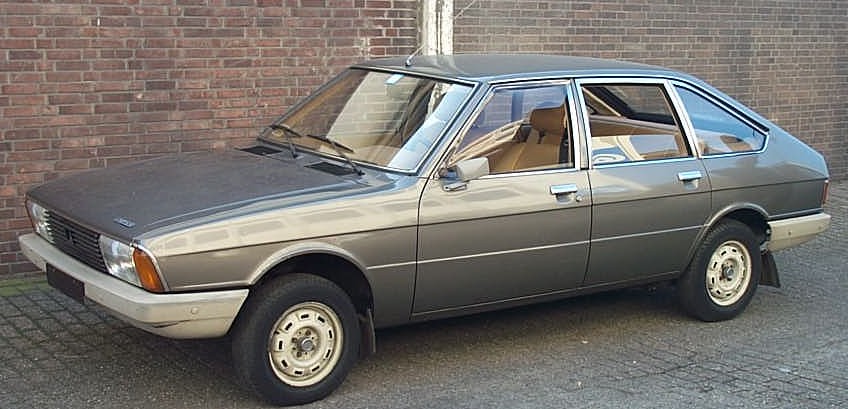
 Simca 1307 GLS | |
| Overview | |
| Manufacturer | Chrysler Europe (1975–1979) PSA Peugeot Citroën (1979–1986) |
| Also called |
|
| Production | 1975–1986 |
| Assembly |
|
| Designer | Roy Axe |
| Body and chassis | |
| Class | Large family car (D) |
| Layout | FF layout |
| Related | Simca 1100 Simca Horizon |
| Powertrain | |
| Engine | |
| Transmission | 4 speed manual all-synchromesh[1] 5-speed manual Automatic |
| Dimensions | |
| Wheelbase | 102.5 in (2,604 mm)[1] |
| Length | 167 in (4,242 mm)[1] |
| Width | 66 in (1,676 mm)[1] |
| Curb weight | 2,314 lb (1,050 kg)[1] |
| Chronology | |
| Predecessor | Simca 1301/1501 Hillman Hunter |
| Successor | Peugeot 405 |
The Simca 1307 is a large family car produced by Chrysler Europe and subsequently PSA Peugeot Citroën from 1975 to 1986. Codenamed 'C6' in development, the car was styled in the United Kingdom by Roy Axe and his team at Whitley, and the car was engineered by Simca at Poissy in France.
A modern, front-wheel drive hatchback, it was one of the earliest such cars in the large family class along with the Renault 20/Renault 30 and Volkswagen Passat, and became the 1976 European Car of the Year.[2] It had been in development since 1972.[3]
The model was marketed variously as the Simca 1308 and 1309 models (with larger engines), Chrysler Alpine (UK,[4] Ireland and New Zealand), Dodge Alpine (Colombia), Chrysler 150 (Spanish market), and later Talbot 1510 / Talbot Alpine / Talbot 150 (a facelifted version launched by PSA after its takeover of Chrysler Europe) and Talbot Solara (the saloon version).
History
[edit]Originally the car was powered by 1294 cc and 1442 cc versions of the "Poissy engine" with electronic ignition and a four-speed gearbox. From launch it was available in three trim levels: GL, S and GT. Equipment levels were high, with the later GLS version featuring central door locking and electric windows, accessories that up until then had only generally featured in larger more upmarket cars. Having won the Car of the Year award, it was initially a success both at home and in the export. Production levels shot up from a daily 400 at introduction in September 1975 to 850 in December of that year, to 1100 a day in late 1976.[5] The 1307 (7 CV) had the smaller engine, while the 1308 (8 CV) received the larger version. Unlike the other models, the more sporting 1307 S received twin Weber carburettors in continental European markets to provide a more powerful and revvy engine while remaining in a lower tax category. In the UK, the 1307 S has the same single Solex carburettor as the GL.[6]
.JPG)
More upmarket models were designated 1308 (1508 in some markets, reflecting the size of the engine) and 1309 (similarly sold as a 1609 in a few markets). All of the models replaced the Simca 1301/1501 range in France, while on the British market it was sold alongside the ageing Hillman Hunter, a rear-wheel drive range of saloons and estates which would continue until 1979. This type of car was generally more popular in Britain in 1975, with the best-selling cars in this sector being the Ford Cortina and Morris Marina. The Chrysler Alpine was first sold in Britain in January 1976, going on sale just after the similar-sized Vauxhall Cavalier, a rear-wheel drive saloon which consistently outsold it.
Styled by Roy Axe, the Simca 1307, along with the recently introduced Volkswagen Passat, was one of several full-size European family hatchbacks inspired by the Renault 16 that had defined the sector back in 1965. In the 1970s the most popular mid-size cars in Europe were still traditional sedans like Ford Taunus (Ford Cortina in Britain), Opel Ascona B (Vauxhall Cavalier) and Morris Marina, and indeed it would be the next generations of those competing vehicles (the Ford Sierra and the Ascona C) before the concept became fully accepted in the mainstream.
Near the end of the original model's run, the Italian importer marketed a sporty and luxurious version of the bigger-engined 1308 GT. Called the "1308 GLS Superstrada", it featured alloy wheels, black striped along the lower flanks, and all chrome (aside from the pentastar logo) was blacked out.[7]
Facelift and Solara
[edit]For 1980 the car, which was now sold under the Talbot-brand, received an extensive facelift. The new model, shown at the Frankfurt Show, was known as the Talbot 1510 (the Talbot Alpine name was used in the UK).[8] It received new front and rear lights and the new top of the range SX featured alloy wheels, cruise control, headlamp wash/wipe, power steering and trip computer. Automatic transmission and a five-speed gearbox also became available. The lineup became clearer, with the 1307 GLS replaced by the 1510 LS, the 1307 S by the GL, the 1308 GT by the GLS, and finally the 1309 SX by the 1510 SX (automatic transmission only at first).[9]
A four-door saloon version, called the Talbot Solara, was released in the same year, with either 1.3 or 1.6 engines, and was produced alongside the hatchback version. Trim levels were similar to the Alpine. It effectively took over from the Hunter, axed a year earlier, as the four-door large family saloon in the range. In the Benelux countries, a well-equipped "Ultra" special edition with metallic paint, alloy wheels, and velour interior appeared in December 1983.[10]
.jpg)
.jpg)
French manufacturing of 1510, Alpine and Solara, along with the smaller Horizon, ended in 1986. In the United Kingdom, the last cars were rebadged as the Rapier and Minx which were badged depending on trim level rather than body style. Production of the Alpine, Solara and Horizon models had already finished at Ryton in the autumn of 1985 to make way for the Peugeot 309. The names were sourced from the corporate ancestor of Chrysler Europe, the Rootes Group, having been used on the Sunbeam Rapier and Hillman Minx. Supply of these models was limited and in 1986 production ceased, with the Talbot marque being shelved soon afterwards on all passenger vehicles. Thus, the Alpine/1510/Solara series was not directly replaced; however, the Citroën BX (already released in 1982) and the forthcoming Peugeot 405 (launched in late 1987) were effectively its de facto successors as PSA's entries in the D-segment. Both of these cars were very successful in Europe and helped Citroën and Peugeot increase their market share in the UK and many other export markets.
In early 1985, with the end of production nearing, Finnish assemblers Saab-Valmet began offering the Talbot 1510 GLD, using PSA's 1.9-liter XUD9 diesel engine with 65 PS (48 kW).[11] This was the only diesel-engined version of the Simca 1307 ever offered; PSA's Spanish branch had worked on such a model but work was never completed due to internal competition from the 305 and BX. Valmet did not offer the Solara with the diesel engine so as to avoid competing in-house with the 305 Diesel, as they were both saloons.[11]
Whilst the 1307 sold in big numbers in France, the Chrysler Alpine did not fulfil its potential in the UK, initially losing out to contemporaries such as the Ford Cortina/Sierra and the Vauxhall Cavalier primarily due to the lack of larger engines (Ford and Vauxhall offered 2.0L engines in their products, whilst the Alpine/Solara range topped out at a 1.6L unit). The Alpine's OHV Simca engines were particularly "tappety" and unrefined compared to the more modern overhead camshaft units of its rivals which further dented its appeal. In more recent years, due to corrosion problems similar to those of the Horizon[citation needed] few Alpines have survived in the UK. As of 2017, there were only 19 examples (including the later Talbot-badged versions) still licensed on British roads.[12] However, the car has fared better in its native France, where it still has a cult following among Simca enthusiasts and many hundreds are still in service.
The body styling of the Simca 1307 was the direct inspiration for the design of Russian Moskvitch Aleko (1986–2001)[13]
Manufacture
[edit]The car was originally manufactured in Poissy in France, in Ryton in the United Kingdom, from 1977 in Villaverde by Barreiros, a subsidiary of Chrysler Europe in Spain, and assembled from CKD kits by Todd Motors (later Mitsubishi Motors NZ) in New Zealand between 1977 and 1984. It was also assembled in Colombia as Dodge Alpine between 1978 and 1982 at the Chrysler Colmotores plant in Bogotá.[14] Between 1979 and 1985 the car was also built by Saab-Valmet in Uusikaupunki factory in Finland. Saab-Valmet was only interested in building the smaller Horizon, but Simca-Talbot would only license that car if Valmet also agreed to assemble the larger 1307.[15] The Finnish-made cars gradually introduced some local changes, including the option of a diesel engine, and featured many Saab interior parts. The most visible Saab-parts were the seats, which began to use Saab's internal structure at the time that the Talbot name replaced Simca. This change also allowed for the fitment of a heated driver's seat, which was not originally available.[15] Talbot did not allow Valmet to export any Finnish-built cars; they were only meant for local sales.[15]
In New Zealand, Chrysler, Talbot, Alpine, and 1510 badges were used on the car during its lifetime, though it was officially in price lists as an Alpine, following the UK convention.[16][17][18] In 1982 the car was facelifted and renamed "Talbot SX" there.[19]
References
[edit]- ^ a b c d e "Chrysler's new Alpine". Autocar. Vol. 143, no. 4107. 26 July 1975. pp. 20–23.
- ^ Roberts, Andrew (9 April 2016). "Chrysler Alpine: remembering the most unlikely Car of the Year". The Daily Telegraph. Archived from the original on 6 May 2016.
- ^ "Development of the Chrysler – Talbot Alpine cars". Rootes-chrysler.co.uk. 2 April 1976. Retrieved 8 July 2011.
- ^ Wood, Jonathan (10 March 1988), Wheels of misfortune: the rise and fall of the British motor industry, Sidgwick & Jackson, p. 215, ISBN 978-0283995279
- ^ Thevenet, Jean-Paul, ed. (January 1977). "30 jours d'automobile" [30 days of the automobile]. L'Automobile (in French) (367). Neuilly, France: Societé des Editions Techniques et Touristiques de France: 4.
- ^ Armstrong, Douglas (December 1975). "International Exchange". SA Motor. Cape Town, South Africa: Scott Publications: 18–19.
- ^ Mazzocchi, Gianni, ed. (March 1979). "Novità Chrysler" [Chrysler news]. Quattroruote (in Italian). 24 (280). Milan, Italy: Editoriale Domus: 78.
- ^ "Talbot's Solara/Alpine with a notchback". Automotive News. Crain Automotive Group: 4. 1980.
- ^ Costa, André; Fraichard, Georges-Michel, eds. (September 1979). "Salon 1979: Toutes les Voitures du Monde". l'Auto Journal (in French). No. 14 & 15. Paris: Homme N°1. p. 108.
- ^ de Jong, Nico, ed. (24 December 1983). "Autokrant" [Car Gazette]. Autovisie (in Dutch). 28 (26). Hilversum, Netherlands: Folio Groep B.V.: 14.
- ^ a b Sukava, Jarmo (19 March 1985). "Nallen oppivuodet" [Teddy Bear's Apprenticeship]. Tekniikan Maailma (in Finnish). Vol. 41, no. 5/85. Helsinki: TM-Julkaisu. p. 38. ISSN 0355-4287.
- ^ "Chrysler Alpine". How Many Left?. Retrieved 5 May 2017.
- ^ The East European motor industry: prospects & developments, vol. 1167, Economist Intelligence Unit, 1989, p. 46, ISBN 9780850582536
- ^ Importaciones de automóviles y camperos: documento para Consejo Directivo de Comercio Exterior, INCOMEX, Instituto Colombiano de Comercio Exterior, 1982, page 20
- ^ a b c Kurki-Suonio, Hannu (18 October 1979). "Se on nyt Talbot" [It's Talbot now]. Tekniikan Maailma (in Finnish). Vol. 35, no. 17/79. Helsinki: TM-Julkaisu. p. 111. ISSN 0355-4287.
- ^ Parliamentary Debates, New Zealand. Parliament, House of Representatives, 15 Aug 1978, page 2323
- ^ The New Zealand Journal of Agriculture, New Zealand Department of Agriculture, 1981, page 51
- ^ Alpine impressive, The Press, 6 November 1980, page 11
- ^ Alpine owners are very loyal, The Press, 7 July 1983, page 22
External links
[edit]
- Chrysler 1307 overview (in French)
- Simca Talbot Information Centre, featuring Chrysler Alpine and SIMCA 1307 / 1308, Talbot Alpine / Talbot 1510 and Talbot Solara
- Club del Chrysler 150 (in Spanish)
- Simca Automobile Club Netherlands (in English and Dutch)
Established in 1900, a division of Chrysler since 1928 | |||||||||||||||||||||||||||||||
| Current models |
|  | |||||||||||||||||||||||||||||
| Former models (by date of introduction) |
| ||||||||||||||||||||||||||||||
| Related topics | |||||||||||||||||||||||||||||||

| Current models |
| ||||||||||||||||||||
|---|---|---|---|---|---|---|---|---|---|---|---|---|---|---|---|---|---|---|---|---|---|
| Discontinued (by date of introduction) |
| ||||||||||||||||||||
| Concept | |||||||||||||||||||||


Simca 1307
View on GrokipediaDevelopment
Design
The Simca 1307 featured styling developed by Roy Axe and his team at Chrysler's Whitley design studio in Coventry, UK, resulting in clean, crisp lines that reflected mid-1970s European automotive trends with a focus on modernity and practicality.[2][4] The design emphasized a contemporary aesthetic and was selected from sketches by designer Keith Cockell in 1973.[2] As a pioneering large family hatchback, the Simca 1307 adopted a five-door liftback configuration, which provided versatile cargo space through a large rear opening facilitated by a sloping tailgate and fastback roofline that enhanced aerodynamics.[5][2] This body style was built on a scaled-up version of the front-wheel-drive Simca 1100 platform, prioritizing family-friendly proportions with a spacious cabin accommodating five passengers comfortably.[4][2] The interior design complemented the exterior's simplicity with a futuristic dashboard layout for 1975 standards and generous glass areas for improved visibility and openness.[4] Upholstery options included cloth or velour on higher trims and vinyl on base models, contributing to the overall practical and inviting feel aimed at everyday family use.[2][4]Engineering
The Simca 1307 emerged from the C6 project, initiated by Chrysler Europe in 1972 to develop a successor to the Simca 1500 and address the need for a modern family car.[2] Initially, dual rear- and front-wheel-drive variants were considered for different markets, but cost constraints led to a unified front-wheel-drive layout. This effort built on Simca's established engineering heritage while incorporating cost-effective adaptations under Chrysler's oversight.[1][2] The platform originated from an enlarged version of the Simca 1100 floorpan, retaining its front-wheel-drive architecture but scaling up for larger dimensions and greater passenger space.[2] Independent suspension was a core feature, with the front employing wishbones and longitudinal torsion bars complemented by an anti-roll bar and telescopic dampers, while the rear used wide-based trailing arms, coil springs, an anti-roll bar, and telescopic dampers.[5] This setup shared components with the Simca 1100 to streamline development and reduce costs, ensuring a balance of ride comfort and handling suited to European conditions.[1] Development was primarily led by Simca engineers at the Poissy technical center in France, where the emphasis was on chassis tuning optimized for varied European road surfaces.[2] Although styling input came from the Whitley design team in the UK, the mechanical focus remained on French-led innovations to enhance drivability.[1] Key advancements included rack-and-pinion steering, which provided precise handling with just four turns lock-to-lock, and servo-assisted disc brakes on the front wheels paired with rear drums for effective stopping power.[5] Engineers also prioritized noise, vibration, and harshness (NVH) reduction through refined suspension geometry and integral body-chassis construction, contributing to a quieter cabin experience.[2] Safety considerations reflected 1970s standards, with the unibody design offering a reinforced passenger compartment for improved crash protection and a brake pad wear warning light integrated into the center console.[5][2] Airbags were absent, as they were not yet common in production vehicles.[1]Models and Variants
Initial Launch Models
The Simca 1307 was unveiled to the press in July 1975 in continental Europe, marking the debut of this front-wheel-drive family hatchback equipped with a 1.3-liter engine producing 68 bhp. Built on the engineering platform derived from the Simca 1100, it represented a significant step forward in Simca's lineup with its spacious five-door configuration and modern transverse engine layout. The 1308 variant followed shortly thereafter in late 1975, featuring an enlarged 1.4-liter engine delivering 85 bhp.[4][1] Available from launch in trim levels that varied by market, with continental Europe offering the base GLS (68 bhp), mid-level S (82 bhp from the same 1.3 L engine), and GT (85 bhp 1.4 L), while the UK market had the entry-level GL (68 bhp) and upper S (85 bhp 1.4 L). The base models emphasized economy with essential features like cloth upholstery and basic instrumentation, making them suitable for budget-conscious families. Mid-range options added comfort-oriented enhancements, including reclining front seats, improved heating controls, and higher-grade interior trim for greater daily usability. The sportier upper trims catered to enthusiasts with upgraded styling elements such as body-colored bumpers, sport wheels, and a tachometer, along with firmer suspension tuning for a more dynamic drive. In 1979, the 1309 SX variant was added with a 1.6-liter engine producing 88 bhp.[2][1] In the UK market, the model was introduced in January 1976 as the right-hand-drive Chrysler Alpine, adapted for local driving conditions with modifications to the dashboard and steering components. It was positioned as a practical alternative to traditional saloons like the Ford Cortina, highlighting the versatility of its liftback design for family transport and luggage space. Early buyers could opt for accessories such as a manual sunroof, lightweight alloy wheels, and a factory-fitted radio-cassette player to personalize the vehicle.[1]Facelift and Solara
In 1980, the Simca 1307 underwent a significant mid-cycle facelift following Peugeot's acquisition of Chrysler Europe in 1979, which led to the rebranding of the model as the Talbot 1510 in most markets and the Talbot Alpine in the United Kingdom.[1][2] The updates included a revised front grille with a more modern "lean back" nose design, redesigned bumpers for improved aesthetics and safety, and an enhanced interior dashboard that prioritized better ergonomics, such as improved instrument layout and controls accessibility.[1][2] These changes were introduced at the end of 1979 in continental Europe and launched in Britain in January 1980, aligning with the transition to full Talbot badging by 1981 under PSA ownership.[1][2] Concurrently, in April 1980, Talbot introduced the Solara as a three-box saloon variant to appeal to conservative buyers preferring traditional styling over the hatchback design of the original 1307 platform.[1][2] Measuring 4.32 meters in length, the Solara featured a dedicated four-door body with a prominent trunk for increased luggage capacity and slightly more rear legroom (an additional 0.5 inches compared to the Alpine), while retaining the core front-wheel-drive mechanical layout.[2] Positioned for the company car market, it offered similar engine options to the facelifted model, with trim levels including an enhanced GLS specification that incorporated better soundproofing, optional three-speed automatic transmission, and revised PSA-era badging.[2] In some regions, it retained the Chrysler Solara name until the full rebranding to Talbot.[1] The Solara remained in production until 1986, with minor updates in later years focused on practicality, such as improved rustproofing in the 1982 Series 2 models (available in LE, LS, GL, and GLS trims) and special editions like the 1983 Pullman and Executive variants that added luxury features for fleet buyers.[2] Production volumes peaked at 69,226 units in France in 1980 but declined sharply thereafter, reaching only 7,704 by 1984, reflecting the model's struggle in a competitive market before the Ryton plant shifted to Peugeot 309 assembly.[1][2]Technical Specifications
Engines and Drivetrain
The Simca 1307 featured a range of inline-four overhead valve (OHV) engines derived from the Type 315 family, initially shared with the smaller Simca 1100 model. The base engine was a 1.3-liter unit displacing 1294 cc, producing 68 hp (51 kW) at 5600 rpm and 105 Nm of torque at 2800 rpm. A mid-range 1.4-liter variant with 1442 cc displacement followed; the base version delivered 75 hp (55 kW) at 5600 rpm and 112 Nm at 3000 rpm, while the GT trim offered 82 hp (60 kW) at 5600 rpm and 125 Nm at 3000 rpm. These engines emphasized reliability and everyday usability over high performance, with a conventional pushrod design that contributed to the car's reputation for straightforward maintenance, though regular servicing was essential to avoid valvetrain wear.[1][2] In 1979, coinciding with the model's facelift, a larger 1.6-liter engine (1592 cc) was introduced for the 1309 SX trim, offering 88 hp (65 kW) at 5400 rpm and 134 Nm of torque at 3000 rpm. This update included refinements for better emissions compliance, aligning with evolving European regulations, while maintaining the OHV architecture. No diesel engine options were available during the Simca 1307's production run under Chrysler Europe, limiting the lineup to petrol powertrains focused on family-oriented efficiency.[1][2][6] The drivetrain was front-wheel drive, a configuration carried over from the Simca 1100 platform to optimize space and handling in the compact hatchback body. A four-speed manual transmission was standard, with gear ratios (3.906:1 first, 2.315:1 second, 1.524:1 third, 1.080:1 fourth) and a final drive ratio of 3.71:1 tuned for economical operation rather than outright speed. An optional three-speed automatic became available from 1977, providing smoother urban driving at the cost of slightly reduced fuel efficiency. Performance varied by engine, with the 1.3-liter model achieving 0-100 km/h in approximately 16 seconds and a top speed of 152 km/h, while the 1.6-liter version improved to 13 seconds and 170 km/h. Combined fuel economy ranged from 7 to 9 L/100 km, depending on driving conditions and transmission, reflecting the engines' design priority on moderate consumption for a mid-1970s family car.Dimensions and Suspension
The Simca 1307 featured compact yet practical dimensions suited to its role as a family hatchback, with an overall length of 4245 mm, width of 1680 mm, height of 1390 mm, wheelbase of 2604 mm, and ground clearance of 130 mm. These measurements contributed to its maneuverability in urban environments while providing sufficient interior space for five passengers. The kerb weight varied between 970 kg for base models and 1070 kg for higher-trim versions equipped with larger engines or additional features, resulting in a payload capacity of approximately 400 kg.[7][8]| Dimension | Measurement |
|---|---|
| Length | 4245 mm |
| Width | 1680 mm |
| Height | 1390 mm |
| Wheelbase | 2604 mm |
| Ground Clearance | 130 mm |
Production and Sales
Manufacturing Sites
The Simca 1307 was primarily assembled at the Poissy plant in France, the main facility of Simca and later Chrysler Europe, where production began in September 1975 and quickly scaled to a capacity of 900 units per day by early 1976, rising to 1,050 units per day by May of that year.[2] The assembly process at Poissy involved welding monocoque bodies constructed from pressed steel panels, followed by on-site painting and the installation of transversely mounted inline-four engines derived from the Simca 1100 series, produced at the same facility.[2] This plant served as the core production hub, handling the majority of left-hand-drive models for European markets. Right-hand-drive versions, marketed as the Chrysler Alpine in the UK, were produced at the Ryton plant near Coventry, England, starting in August 1976 to meet local demand after initial imports from Poissy proved insufficient.[2] Assembly at Ryton followed a similar process to Poissy, adapting the platform for British specifications, and cumulative output there approached 200,000 units by the end of production in 1985.[10] Additional assembly occurred at the Barreiros subsidiary plant in Villaverde, near Madrid, Spain, beginning in 1977, where the model was localized as the Chrysler 150 for the domestic market, focusing on variants like the 150 GT with a 1.4-liter engine.[11] Further production of the Talbot 1510 and Solara took place at the Uusikaupunki plant in Finland from 1979 to 1985, totaling 31,978 units.[2][1] Following PSA Peugeot Citroën's acquisition of Chrysler Europe in 1978, production of the rebadged Talbot 1510 was consolidated primarily at the Poissy plant in France, where it continued until spring 1983, while Ryton output persisted under the Talbot Alpine name until mid-1985 before the site was retooled for other models.[2]Production Numbers and Market Performance
The Simca 1307, along with its variants such as the Chrysler Alpine, Talbot 1510, and Talbot Solara, achieved total production of over 1 million units across European facilities from 1975 to 1986.[2] Production was primarily concentrated in France at the Poissy plant, with additional assembly at the Ryton plant in the United Kingdom starting in 1976 to serve the British market. By 1979, cumulative output had reached approximately 779,000 units, reflecting strong early demand.[1] Annual production peaked in 1977 with 258,195 units assembled, following a high of 218,126 units in 1976 when the model accounted for 7% of all car sales in France—outpacing combined figures for the Citroën GS, Peugeot 304, Renault 12, and Simca 1100.[2][1] The following table summarizes key yearly production figures from the French Poissy plant, which represented the majority of output:| Year | Units Produced (France) |
|---|---|
| 1975 | 32,836 |
| 1976 | 218,126 |
| 1977 | 258,195 |
| 1978 | 156,875 |
| 1979 | 112,966 |
| 1980 | 116,530 (including Solara) |
| 1981 | 60,509 (including Solara) |
| 1982 | 43,608 (including Solara) |
| 1983 | 26,892 (Solara only) |
| 1984 | 7,704 (Solara only) |