Hubbry Logo
Tangible user interfaceTangible user interfaceMain
Open search
Tangible user interface
Community hub
Tangible user interface
logo
8 pages, 0 posts
0 subscribers
Be the first to start a discussion here.
Tangible user interface
from Wikipedia

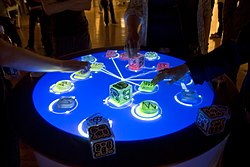
Reactable, an electronic musical instrument example of tangible user interface
SandScape device installed in the Children's Creativity Museum in San Francisco

A tangible user interface (TUI) is a user interface in which a person interacts with digital information through the physical environment. The initial name was Graspable User Interface, which is no longer used. The purpose of TUI development is to empower collaboration, learning, and design by giving physical forms to digital information, thus taking advantage of the human ability to grasp and manipulate physical objects and materials.[1]

This was first conceived by Radia Perlman as a new programming language that would teach much younger children similar to Logo, but using special "keyboards" and input devices. Another pioneer in tangible user interfaces is Hiroshi Ishii, a professor at the MIT who heads the Tangible Media Group at the MIT Media Lab. His particular vision for tangible UIs, called Tangible Bits, is to give physical form to digital information, making bits directly manipulable and perceptible. Tangible bits pursues the seamless coupling between physical objects and virtual data.

Characteristics

[edit]

There are several frameworks describing the key characteristics of tangible user interfaces. Brygg Ullmer and Hiroshi Ishii describe six characteristics concerning representation and control:[2]

  1. Physical representations are computationally coupled to underlying digital information.
  2. Physical representations embody mechanisms for interactive control.
  3. Physical representations are perceptually coupled to actively mediated digital representations.
  4. Physical state of tangibles embodies key aspects of the digital state of a system

Eva Hornecker and Jacob Buur describe a structured framework with four themes:[3]

  1. Tangible manipulation: material representations with distinct tactile qualities, which are typically physically manipulated. A typical example is haptic direct manipulation: can user grab, feel and move important elements in the interface?
  2. Spatial interaction: tangible interaction is embedded in real space; interaction occurs as movement in this space. An example is full body interaction: can the user make use of their whole body?
  3. Embodied facilitation: the configuration of material objects and space affects how multiple users interact jointly with the tangible user interface. Examples include multiple access points: can all users in the space see what is going on and interact with central elements of the interface?
  4. Expressive representation: expressiveness and legibility of material and digital representations employed by tangible interaction systems. An example is representational significance: do physical and digital representations have the same strength and salience?

According to Mi Jeong Kim and Mary Lou Maher, the five basic defining properties of tangible user interfaces are as follows:[4]

  1. Space-multiplex both input and output.
  2. Concurrent access and manipulation of interface components.
  3. Strong specific devices.
  4. Spatially aware computational devices.
  5. Spatial re-configurability of devices.

Comparison with graphical user interfaces

[edit]

A tangible user interface must be differentiated from a graphical user interface (GUI). A GUI exists only in the digital world, whereas a TUI connects the digital with the physical world. For example, a screen displays the digital information, whereas a mouse allows us to directly interact with this digital information.[5] A tangible user interface represents the input directly in the physical world, and makes the digital information directly graspable.[6]

A tangible user interface is usually built for one specific target group, because of the low range of possible application areas. Therefore, the design of the interface must be developed together with the target group to ensure a good user experience.[7]

In comparison with a TUI, a GUI has a wide range of usages in one interface. Because of that it targets a large group of possible users.[7]

One advantage of the TUI is the user experience, because it occurs a physical interaction between the user and the interface itself (E.g.: SandScape: Building your own landscape with sand). Another advantage is usability, because the user knows intuitively how to use the interface by knowing the function of the physical object. So, the user does not need to learn the functionality. That is why the Tangible User interface is often used to make technology more accessible for elderly people.[6]

Interface type/attributes Tangible user interface Graphical user interface
Range of possible application areas Build for one specific application area Build for many kinds of application areas
How the system is driven Physical objects, such as a mouse or a keyboard Based on graphical bits, such as pixels on the screen
Coupling between cognitive bits and the physical output Unmediated connection Indirect connection
How user experience is driven The user already knows the function of the interface by knowing how the physical objects function The user explores the functionality of the interface
User behavior when approaching the system Intuition Recognition

[7]

Examples

[edit]

A simple example of tangible UI is the computer mouse: Dragging the mouse over a flat surface moves a pointer on the screen accordingly. There is a very clear relationship about the behaviors shown by a system with the movements of a mouse. Other examples include:

  • Marble Answering Machine by Durrell Bishop (1992).[8] A marble represents a single message left on the answering machine. Dropping a marble into a dish plays back the associated message or calls back the caller.
  • The Topobo system. The blocks in Topobo are like LEGO blocks which can be snapped together, but can also move by themselves using motorized components. A person can push, pull, and twist these blocks, and the blocks can memorize these movements and replay them.[9]
  • Implementations which allow the user to sketch a picture on the system's table top with a real tangible pen. Using hand gestures, the user can clone the image and stretch it in the X and Y axes just as one would in a paint program. This system would integrate a video camera with a gesture recognition system.
  • jive. The implementation of a TUI helped make this product more accessible to elderly users of the product. The 'friend' passes can also be used to activate different interactions with the product.[10]
  • a projection augmented model.
  • SandScape: Designing landscape with TUI. This interface lets the user form a landscape out of sand on a table. The sand model represents the terrain, which is projected on the surface. In real-time the model projects the deformations of the sand.[6]

Several approaches have been made to establish a generic middleware for TUIs. They target toward the independence of application domains as well as flexibility in terms of the deployed sensor technology. For example, Siftables provides an application platform in which small gesture sensitive displays act together to form a human-computer interface.

For collaboration support, TUIs have to allow the spatial distribution, asynchronous activities, and the dynamic modification of the TUI infrastructure, to name the most prominent ones. This approach presents a framework based on the LINDA tuple space concept to meet these requirements. The implemented TUIpist framework deploys arbitrary sensor technology for any type of application and actuators in distributed environments.[11]

State of the art

[edit]

Interest in tangible user interfaces (TUIs) has grown constantly since the 1990s, and with every year, more tangible systems are showing up. A 2017 white paper outlines the evolution of TUIs for touch table experiences and raises new possibilities for experimentation and development.[12]

In 1999, Gary Zalewski patented a system of moveable children's blocks containing sensors and displays for teaching spelling and sentence composition.[13]

Tangible Engine is a proprietary authoring application used to build object-recognition interfaces for projected-capacitive touch tables. The Tangible Engine Media Creator allows users with little or no coding experience to quickly create TUI-based experiences.

The MIT Tangible Media Group, headed by Hiroshi Ishi is continuously developing and experimenting with TUIs including many tabletop applications.[14]

The Urp[15] system and the more advanced Augmented Urban Planning Workbench[16] allow digital simulations of air flow, shadows, reflections, and other data based on the positions and orientations of physical models of buildings, on the table surface.

Newer developments go even one step further and incorporate the third dimension by allowing a user to form landscapes with clay (Illuminating Clay[17]) or sand (Sand Scape[18]). Again different simulations allow the analysis of shadows, height maps, slopes and other characteristics of the interactively formable landmasses.

InfrActables is a back projection collaborative table that allows interaction by using TUIs that incorporate state recognition. Adding different buttons to the TUIs enables additional functions associated to the TUIs. Newer versions of the technology can even be integrated into LC-displays[19] by using infrared sensors behind the LC matrix.

The Tangible Disaster[20] allows the user to analyze disaster measures and simulate different kinds of disasters (fire, flood, tsunami,.) and evacuation scenarios during collaborative planning sessions. Physical objects allow positioning disasters by placing them on the interactive map and additionally tuning parameters (i.e. scale) using dials attached to them.

The commercial potential of TUIs has been identified recently. The repeatedly awarded Reactable,[21] an interactive tangible tabletop instrument, is now distributed commercially by Reactable Systems, a spinoff company of the Pompeu Fabra University, where it was developed. With the Reactable users can set up their own instrument interactively, by physically placing different objects (representing oscillators, filters, modulators...) and parametrise them by rotating and using touch-input.

Microsoft is distributing its novel Windows-based platform Microsoft Surface[22] (now Microsoft PixelSense) since 2009. Beside multi-touch tracking of fingers, the platform supports the recognition of physical objects by their footprints. Several applications, mainly for the use in commercial space, have been presented. Examples range from designing an own individual graphical layout for a snowboard or skateboard to studying the details of a wine in a restaurant by placing it on the table and navigating through menus via touch input. Interactions such as the collaborative browsing of photographs from a handycam or cell phone that connects seamlessly once placed on the table are also supported.

Another notable interactive installation is instant city[23] that combines gaming, music, architecture and collaborative aspects. It allows the user to build three-dimensional structures and set up a city with rectangular building blocks, which simultaneously results in the interactive assembly of musical fragments of different composers.

The development of the Reactable and the subsequent release of its tracking technology reacTIVision[24] under the GNU/GPL as well as the open specifications of the TUIO protocol have triggered an enormous amount of developments based on this technology.

In the last few years, many amateur and semi-professional projects outside of academia and commerce have been started. Due to open source tracking technologies (reacTIVision[24]) and the ever-increasing computational power available to end-consumers, the required infrastructure is now accessible to almost everyone. A standard PC, webcam, and some handicraft work allows individuals to set up tangible systems with a minimal programming and material effort. This opens doors to novel ways of perceiving human-computer interaction and allows for new forms of creativity for the public to experiment with.[citation needed]

It is difficult to keep track and overlook the rapidly growing number of all these systems and tools, but while many of them seem only to utilize the available technologies and are limited to initial experiments and tests with some basic ideas or just reproduce existing systems, a few of them open out into novel interfaces and interactions and are deployed in public space or embedded in art installations.[25]

The Tangible Factory Planning[26] is a tangible table based on reacTIVision[24] that allows to collaboratively plan and visualize production processes in combination with plans of new factory buildings and was developed within a diploma thesis.

Another example of the many reacTIVision-based tabletops is ImpulsBauhaus-Interactive Table[27] and was on exhibition at the Bauhaus-University in Weimar marking the 90th anniversary of the establishment of Bauhaus. Visitors could browse and explore the biographies, complex relations and social networks between members of the movement.

Using principles derived from embodied cognition, cognitive load theory, and embodied design TUIs have been shown to increase learning performance by offering multimodal feedback.[28] However, these benefits for learning require forms of interaction design that leave as much cognitive capacity as possible for learning.

Physical icon

[edit]

A physical icon, or phicon, is the tangible computing equivalent of an icon in a traditional graphical user interface, or GUI. Phicons hold a reference to some digital object and thereby convey meaning.[29][30][31]

History

[edit]

Physical icons were first used as tangible interfaces in the metaDesk project built in 1997 by Professor Hiroshi Ishii's tangible bits research group at MIT.[32][33] The metaDesk consisted of a table whose surface showed a rear-projected video image. Placing a phicon on the table triggered sensors that altered the video projection.[34]

See also

[edit]

References

[edit]
[edit]
Revisions and contributorsEdit on WikipediaRead on Wikipedia
from Grokipedia
A tangible user interface (TUI) is a human-computer interaction paradigm that gives physical form to digital information, enabling users to directly manipulate bits through graspable everyday objects and architectural surfaces, in contrast to traditional graphical user interfaces (GUIs) that rely on abstract pixels and indirect controls. This approach bridges the physical and digital worlds by coupling computational processes with tangible artifacts, allowing for intuitive, embodied interactions that leverage users' natural haptic and perceptual skills. The concept of TUIs was first formalized in the 1997 paper "Tangible Bits: Towards Seamless Interfaces between People, Bits and Atoms" by Hiroshi Ishii and Brygg Ullmer at the , building on earlier inspirations from visions and prototypes like the Bricks system. Ishii and Ullmer's work sought to overcome the limitations of screen-based GUIs by reintroducing the richness of physical manipulation into computing, drawing from historical artifacts and emerging technologies in the . Since its inception, TUIs have evolved as a distinct field within human-computer interaction, influencing design in education, , and collaborative environments. At its core, TUIs operate on three foundational principles: computational coupling, where physical representations are linked to underlying ; embodiment of control, in which objects serve dual roles as both visual/tactile representations and interactive controls; and perceptual coupling, which integrates tangible elements with ambient displays like projections or sounds for cohesive feedback. Early prototypes exemplified these ideas, such as the metaDESK, which used physical models on a to interact with digital maps and simulations, or ambientROOM, employing water, light, and sound for peripheral awareness of information. These principles emphasize seamless integration, making digital computation feel as natural and accessible as handling physical materials. TUIs have found applications across diverse domains, including education—where physical manipulatives aid learning in programming and STEM—healthcare for intuitive tools, and design for collaborative modeling, such as the Urp urban planning system that simulates building interactions via physical miniatures. Despite challenges in and input precision, ongoing advancements in sensing technologies continue to expand TUI's potential, fostering more inclusive and expressive forms of interaction.

Introduction and Definition

Definition

A tangible user interface (TUI) is a system that gives physical form to digital information, employing physical artifacts both as representations and controls for computational media. This approach enables direct manipulation of digital content through hands or body interactions with everyday objects, distinguishing TUIs from abstract, screen-mediated interfaces by leveraging users' innate physical skills for sensing and handling the environment. TUIs emphasize bridging the physical and digital worlds, where physical artifacts embody to facilitate intuitive, tangible interactions that integrate seamlessly into real-world activities. The foundational concept of "tangible bits," coined by Ishii and Brygg Ullmer, refers to making digital information (bits) directly graspable and manipulable by coupling it with physical objects and surfaces, thereby augmenting the physical environment with computational capabilities. Basic components of TUIs include physical manipulanda, such as blocks or , which serve as graspable handles for input and representation; sensing mechanisms, like for tracking visual markers or RFID for detecting tagged objects; and computational feedback, provided through projections for visual output or sounds for auditory cues.

Core Principles

Tangible user interfaces (TUIs) are grounded in several foundational principles that emphasize the integration of physical and digital realms to facilitate intuitive interaction. These principles draw from philosophies, aiming to bridge the gap between abstract digital data and the tangible world users naturally understand. Central to TUIs is the idea of leveraging physicality to make computational processes more accessible and expressive, contrasting with the screen-based abstractions of traditional graphical user interfaces. The three foundational principles outlined in the seminal work by Ishii and Ullmer (1997) are computational coupling, where physical representations are linked to underlying ; embodiment of control, in which objects serve dual roles as both visual/tactile representations and interactive controls; and perceptual coupling, which integrates tangible elements with ambient displays like projections or sounds for cohesive feedback. A key principle is natural mapping, where physical actions directly correspond to digital outcomes, eliminating the need for abstract metaphors or indirect controls. In TUIs, this means that manipulating a —such as rotating a knob—immediately and visibly affects the associated digital representation, aligning user expectations with system responses based on real-world physics and . This approach reduces by exploiting users' pre-existing knowledge of physical interactions, making interfaces more predictable and learnable. Another core tenet is embodiment, which posits that digital information should take on physical form to harness human intuition about real-world objects and their behaviors. By embodying bits as graspable or structures, TUIs enable users to interact with data as if it were material, fostering a deeper sensory engagement that supports spatial reasoning and manipulation. This underscores how physical representations can externalize internal states of , allowing users to "feel" and reason about digital processes through bodily experience. The externalization of information is further formalized through the token+constraint model, where physical tokens serve as representations of , and constraints define valid manipulations to guide interactions. Tokens act as concrete handles for abstract information, while constraints—such as mechanical guides or spatial rules—enforce permissible actions, ensuring that physical gestures map reliably to digital operations. This model provides a structured approach to designing TUIs that maintain consistency between physical inputs and digital outputs. A related framework is the MCRpd model (Model-Control-Representation, physical and digital), which highlights the coupling of physical and digital representations in tangible interactions. TUIs also inherently support multi-user collaboration by affording interactions in shared physical spaces, where multiple participants can simultaneously grasp and manipulate without the bottlenecks of single-point inputs like a . This principle promotes social and parallel engagement, as physical objects naturally encourage , , and , enhancing in tasks such as or . The distributed nature of physical interfaces allows for seamless co-presence, making TUIs particularly suited for collaborative environments. As a precursor to these principles, the concept of graspable user interfaces emphasized direct manipulation through physical handles, shifting from indirect pointing devices to embodied controls that users could physically grasp and move in space. This idea laid the groundwork for TUIs by prioritizing haptic feedback and , where multiple objects could be handled concurrently to control distinct aspects of a digital .

Historical Development

Origins and Early Concepts

The origins of tangible user interfaces (TUIs) can be traced to early innovations in human-computer interaction that emphasized direct manipulation and physical engagement with computational systems, predating the formalization of TUIs in the mid-1990s. Sutherland's , developed in 1963 as part of his PhD thesis at MIT, introduced pioneering concepts of direct manipulation through a that allowed users to create, select, and modify graphical objects on a display in real time, laying foundational ideas for interactive systems that bridged human intent with digital representation. This work influenced subsequent efforts to make computing more intuitive and less abstract, setting the stage for interfaces that extended beyond purely virtual interactions. In the 1960s and 1970s, Seymour Papert's development of the Logo programming language further advanced these ideas within educational contexts, promoting constructionism—a learning theory where knowledge is actively built through hands-on creation of tangible artifacts. Logo incorporated physical elements like the Turtle robot, a mobile device that children could program to draw shapes on the floor, embodying computational concepts through bodily movement and real-world feedback to foster situated learning. Building on this, Radia Perlman in the mid-1970s designed the Button Box at MIT's Logo Group, a physical input device using pictorial buttons to enable preschoolers as young as three to control the Turtle without keyboards or text, thus pioneering tangible programming interfaces that prioritized accessibility and kinesthetic interaction for children. By the early 1990s, these influences converged in precursors that explicitly combined physical and , reacting against the limitations of screen-bound graphical user interfaces (GUIs) by reintroducing the affordances of the real world. Pierre Wellner's DigitalDesk (1993), developed at EuroPARC, augmented an ordinary desk with an overhead camera and projector to enable seamless interaction between paper documents and projected digital content, such as pointing at handwritten numbers for calculator input or overlaying translations on text. Concurrently, early graspable concepts emerged in research, where physical proxies like handles or blocks were used to manipulate virtual objects, foreshadowing TUIs' emphasis on embodied control. This evolution drew from ' focus on feedback loops between physical actions and system responses, as well as situated cognition theories, which underscore how environmental context and bodily engagement enhance understanding and interaction.

Key Milestones and Pioneers

The concept of graspable user interfaces was first formally introduced in 1995 by George Fitzmaurice, along with Hiroshi Ishii and William Buxton, in their seminal CHI paper "Bricks: Laying the Foundations for Graspable User Interfaces." This work proposed using physical "bricks"—small, wireless handles augmented with sensing and display capabilities—to directly manipulate digital objects on a computer display, enabling space-multiplexed interactions where multiple users could grasp and control elements simultaneously. The approach emphasized how physical artifacts could extend traditional graphical user interfaces by leveraging users' natural abilities to manipulate real-world objects, laying early groundwork for tangible interaction paradigms. Building on this foundation, Ishii and Brygg Ullmer formalized the field of tangible user interfaces (TUIs) in their 1997 CHI paper "Tangible Bits: Towards Seamless Interfaces Between People, Bits, and Atoms," presented at the . The paper articulated a vision for coupling digital information with physical objects and surfaces, introducing key concepts like interactive workspaces and graspable tokens that embody computational state. To illustrate these ideas, they developed prototypes such as metaDESK, a horizontal interactive surface combining video projectors, cameras, and physical tokens for 2D/3D manipulations like storyboarding virtual scenes, and Tri-Visions, a subsequent vertical display system from 1998 using physical slabs to control 3D object transformations and augmentations. These systems demonstrated how TUIs could make abstract more accessible through direct physical engagement, marking a pivotal shift toward . In the 2000s, the field expanded through ongoing innovations at the MIT Tangible Media Group, led by Ishii since its founding in 1995, which continued to pioneer projects blending physical and digital media. Early efforts in the group evolved into advanced systems like inFORM, a dynamic shape display introduced in 2013 at UIST, whose conceptual roots trace back to mid-2000s explorations of actuated tangibles for 3D content rendering and remote collaboration. inFORM used an array of actuated pins to create real-time physical representations of digital models, allowing users to interact with deformable shapes and even manipulate remote objects via coupled interfaces. Ishii's leadership fostered a research ecosystem that influenced global TUI development, emphasizing "Radical Atoms" as a progression from static bits to dynamic, material-based computing. Other notable pioneers emerged during this period, including Scott R. Klemmer, whose 2000s work at Stanford focused on tangible input techniques for collaborative design. Klemmer's 2000 on "The Designers' Outpost" described a wall-sized TUI using sketches and physical to web sites, integrating camera tracking with digital feedback to support iterative, embodied ideation. His 2004 dissertation further advanced tools like , a toolkit for developing tangible user interfaces with camera-based tracking, highlighting TUIs' role in bridging physical sketching with computational augmentation. Internationally, the 2007 Reactable project from Pompeu Fabra University's Music Technology Group exemplified TUI applications in creative domains; this used fiducial markers on movable blocks to enable collaborative sound synthesis, blending tangible manipulation with visual feedback on a projected surface. Institutional milestones solidified the TUI community in the early 2000s, with dedicated workshops at CHI conferences beginning in 2002 to discuss emerging designs and evaluations, followed by the inaugural Tangible, Embedded, and Embodied Interaction (TEI) conference in 2007, which became a central venue for the field's growth. These gatherings facilitated knowledge exchange among researchers, leading to standardized protocols like TUIO for and tangible tracking, and spurred interdisciplinary collaborations across HCI, design, and engineering.

Key Characteristics

Physical-Digital Mapping

Physical-digital mapping in tangible user interfaces (TUIs) refers to the core mechanism that establishes bidirectional linkages between physical manipulations and digital computations, enabling users to interact with information through graspable objects while maintaining a seamless integration of the two domains. This mapping ensures that physical actions, such as moving or reconfiguring objects, directly influence digital states, and vice versa, through real-time sensing and actuation processes that support intuitive control without abstract intermediaries like screens or mice. Seminal frameworks emphasize the importance of this coupling to leverage users' natural spatial skills, transforming into tangible forms that afford direct manipulation. Mappings in TUIs can be categorized by their structure and complexity. One-to-one mappings link a single physical object or action to a specific digital , such as translating the position of a physical model to update its corresponding digital representation in a simulated environment. In contrast, many-to-many mappings involve combinatorial interactions, where multiple physical elements collectively represent or manipulate aggregated , allowing for emergent behaviors through object arrangements or sequences. These mappings often employ static binding, predefined by designers to associate fixed physical with digital attributes, or dynamic binding, where users define linkages on-the-fly to adapt to contextual needs. The tokens-and-constraints model further refines this by using physical objects as to embody digital while mechanical or spatial constraints guide permissible interactions, reducing ambiguity in interpretation. Sensing technologies form the foundation for detecting physical inputs and enabling accurate mappings. Fiducial markers, visual patterns attached to objects, allow cameras to track identity, position, and orientation in real-time via libraries like ReacTIVision, supporting robust recognition even under partial occlusion. RFID and NFC tags provide wireless identification and proximity detection without line-of-sight requirements, ideal for embedding in everyday objects to trigger digital events upon contact or arrangement. techniques, employing algorithms for , background subtraction, and image moments, capture continuous spatial data from overhead or embedded cameras, while measures touch patterns or positional changes through voltage variations, offering high-resolution input for surface-based interactions. These methods are selected based on factors like environmental robustness and , with hybrid approaches combining them to handle diverse input modalities. Feedback loops in TUIs close the mapping cycle by providing immediate responses to physical inputs, enhancing user awareness and control. Auditory feedback delivers sounds synchronized with actions, such as tonal cues for object placement, while haptic responses use vibrations or mechanical actuation to convey digital states tactilely, ensuring collocated sensory confirmation. Projected visual feedback overlays digital visualizations onto physical surfaces via projectors, creating augmented shadows or highlights that reflect computational outcomes in real-time. These loops rely on low-latency computation to maintain responsiveness, often processing sensor data through event-driven architectures that trigger parallel physical and digital outputs, thereby reinforcing the mapping's intuitiveness. Designing effective physical-digital mappings presents several challenges that impact and . arises when mappings lack clear perceptual cues, leading users to misinterpret how physical gestures correspond to digital effects, necessitating careful alignment with interaction affordances. Scalability issues emerge with multiple objects, as sensing technologies like can suffer from recognition errors—such as 1-3% false positives or missed detections due to occlusions—complicating real-time tracking in dense configurations. Ensuring intuitive feedback without overwhelming the physicality requires balancing multimodal outputs to avoid cognitive overload, while environmental factors like or interference demand robust preprocessing to sustain mapping reliability. Addressing these demands ongoing advancements in and error-recovery mechanisms to preserve the seamless embodiment central to TUIs.

Interaction Affordances

In tangible user interfaces (TUIs), interaction affordances draw from , where the physical form of objects suggests possible actions to users, facilitating intuitive manipulation without extensive training. This concept, originally proposed by James J. Gibson as the actionable properties of an environment relative to an organism, was adapted for design by Donald Norman to emphasize perceived affordances—those cues that users recognize as inviting specific interactions. In TUIs, designers exploit these by shaping physical tokens or controls to align with natural human gestures; for instance, cylindrical objects afford rotation, while flat, grooved surfaces suggest sliding or stacking, thereby constraining and guiding user actions to match digital functions. Haptic and kinesthetic feedback further enhances these affordances by leveraging users' sensory-motor skills and , reducing during interactions. Physical objects in TUIs provide immediate tactile sensations—such as the weight and texture of a manipulandum—that offer passive guidance and confirmation of actions, allowing for eyes-free operation in complex tasks. For example, the resistance encountered when pushing a physical slider or the click of a repositioned token reinforces kinesthetic awareness, enabling precise control that feels more natural than abstract screen-based inputs and minimizing errors from mode confusion. This sensory richness supports low-attention, embodied engagement, where users draw on pre-existing motor schemas to interact fluidly. Spatial and temporal dimensions of TUIs amplify affordances through three-dimensional manipulation and support for concurrent activities, contrasting with the planar constraints of traditional interfaces. Physical layouts enable direct 3D positioning and orientation of objects, fostering spatial reasoning and multi-perspective , while space-multiplexing allows multiple users to handle distinct elements simultaneously in shared environments, promoting parallel input without sequential bottlenecks. Temporally, the persistence of physical arrangements maintains state across interactions, enabling incremental adjustments over time that align with real-world workflows. These aspects briefly reference underlying mappings to digital representations but prioritize the perceptual seamlessness they afford. TUIs' affordances also yield accessibility advantages, particularly for non-experts, young children, and individuals with disabilities, by minimizing reliance on symbolic or abstract representations. Intuitive physical cues lower entry barriers, allowing users to engage through familiar motor actions rather than learning conventions, as seen in systems like LinguaBytes, which uses magnetic tokens to guide hand placement for speech therapy in multi-handicapped toddlers. This approach supports inclusive collaboration in group settings and leverages haptic feedback to aid those with visual or cognitive impairments, enhancing overall without demanding high or fine motor precision.

Comparisons with Other Interfaces

Versus Graphical User Interfaces

Tangible user interfaces (TUIs) fundamentally differ from graphical user interfaces (GUIs) in their approach to interaction, emphasizing physical manipulation of objects over virtual representations on screens. In GUIs, users interact indirectly through abstract icons, pointers, and windows mediated by devices like mice and keyboards, confining digital information to a two-dimensional display. In contrast, TUIs enable direct embodiment by coupling digital data with graspable physical artifacts, such as "phicons" (physical icons), allowing users to manipulate bits through tangible actions that leverage natural motor skills and haptic feedback. This physical-digital mapping reduces mediation layers, making interactions more intuitive and aligned with principles. The dominance of GUIs since the 1980s, pioneered by Xerox PARC's Alto and Star systems, established a screen-centric paradigm that prioritized pixel-based visualization and sequential input, influencing widespread adoption in personal computing via Apple and Microsoft platforms. TUIs emerged as a counter-movement in the mid-1990s, driven by researchers like Hiroshi Ishii, to address the limitations of this "desktop metaphor" by reintegrating physical affordances lost in the shift to digital interfaces, inspired by ubiquitous computing visions. This evolution sought to bridge the physical and digital worlds, countering GUI's abstraction with seamless, multi-sensory engagement. TUIs offer several advantages over GUIs, particularly in enhancing , supporting multi-user , and minimizing the "gulf of execution." By allowing direct physical relocation and of objects, TUIs facilitate better spatial reasoning and problem-finding in collaborative design tasks, as designers spend more time exploring configurations compared to GUI-based interactions. Multi-user scenarios benefit from space-multiplexed input, where multiple participants can simultaneously manipulate shared artifacts without conflicts or , as seen in systems like the metaDESK. Additionally, TUIs reduce the gulf of execution—the gap between user intentions and actions—by drawing on pre-existing physical skills, lowering and enabling more natural goal achievement than the indirect controls of GUIs. Despite these benefits, TUIs face notable limitations relative to GUIs, including higher development and deployment costs due to specialized hardware like sensors and projectors, which can exceed those of software-only GUI implementations. poses challenges for handling complex or large datasets, as physical representations are constrained by and the number of manipulable objects, unlike the flexible zooming and layering in GUIs. issues also arise, with physical components susceptible to wear, loss, or environmental damage, potentially requiring frequent maintenance not typical of virtual GUI elements.

Versus Virtual and Augmented Reality Interfaces

Tangible user interfaces (TUIs) fundamentally differ from (VR) and (AR) interfaces in their reliance on real physical objects for interaction, as opposed to simulated or digitally overlaid environments. In TUIs, users manipulate tangible artifacts—such as blocks or models—that directly represent and control digital information, providing immediate haptic feedback without the need for head-mounted displays or virtual simulations typical in VR and AR. VR immerses users entirely in a computer-generated world, while AR superimposes digital elements onto the physical environment via screens or optical see-through devices, but both lack the inherent physicality of TUIs where objects serve as both input and output mechanisms. Despite these contrasts, overlaps exist, particularly in hybrid systems where TUIs integrate AR elements, such as projected augmentations onto physical models to enhance visualization without fully replacing tangibility. For instance, the metaDESK system combines graspable physical "bricks" with AR-like displays to project interactive and animations, bridging the physical-digital gap in ways that pure VR cannot achieve due to its absence of true tangible elements. VR, by design, operates in isolated virtual spaces devoid of physical persistence, whereas these TUI-AR hybrids allow users to interact with augmented content through direct physical manipulation. TUIs offer distinct advantages over VR and AR, notably in maintaining a persistent physical state where manipulated objects retain their configuration even after a session ends or power is removed, enabling users to resume work seamlessly without recapturing virtual positions. This persistence contrasts with the ephemeral nature of VR/AR states, which reset upon disconnection. Additionally, TUIs facilitate easier multi-user collaboration in shared physical spaces, as multiple participants can simultaneously grasp and adjust artifacts without requiring synchronized VR hardware or AR tracking for each individual, promoting natural collocated interaction. However, TUIs have limitations compared to VR and AR, particularly in immersion for abstract or non-physical simulations, where VR's fully enclosed environments provide deeper sensory engagement and AR excels in overlaying impossible real-world scenarios, such as remote or hazardous explorations. TUIs are constrained by the scalability of physical artifacts for representing vast or dynamic datasets, making VR and AR more suitable for scenarios demanding high-fidelity virtual prototyping beyond tangible constraints.

Notable Examples

Early Prototypes

One of the earliest tangible user interface prototypes was the metaDESK, developed in 1997 by Brygg Ullmer and Hiroshi Ishii at the MIT Media Lab. This system featured a horizontal projection table where users manipulated physical models, such as architectural representations, to interact with digital content; computer vision tracked the models' positions, enabling dynamic projections of "digital shadows" that simulated environmental effects like water flow or structural information for architectural design exploration. The metaDESK demonstrated core TUI principles by coupling graspable objects with computational feedback, allowing intuitive spatial manipulation without traditional input devices. Building on similar concepts, the Urp (Urban Planning Workbench) emerged in 1999 from the same MIT group, led by John Underkoffler and Hiroshi Ishii. Users placed physical scale models of buildings, trees, and wind generators on a large horizontal surface, where identified their positions and orientations to control real-time digital simulations of wind patterns, shadows, and sunlight projected onto the table. This setup facilitated collaborative by integrating tangible elements with luminous feedback, enabling multiple users to simultaneously adjust models and observe environmental impacts. An influential precursor to these systems was the Marble Answering Machine, conceptualized in 1992 by Durrell Bishop during his studies at the Royal College of Art. The device used physical s as tangible representations of incoming voicemails; each recorded message triggered the machine to dispense a marble into a bowl, with users dropping a marble into a slot to play back the message or manipulating it to redial the caller, embodying through simple physical tokens. This prototype highlighted early ideas of mapping abstract digital information to concrete, manipulable forms, influencing subsequent TUI designs. These prototypes collectively established the feasibility of integrating physical manipulations with digital responses in controlled laboratory environments, laying foundational groundwork for tangible interfaces by proving their potential for natural, multi-user interaction and spatial reasoning tasks.

Contemporary Systems

One prominent contemporary tangible user interface is , developed by the MIT Tangible Media Group in 2013. This system features a pin-based dynamic shape display composed of physical pixels that enable remote tangible interaction by rendering three-dimensional content in real time. Users can manipulate virtual objects on a connected device, with the display actuating physical pins to mirror movements, facilitating applications such as in-air sculpting and object deformation. The Reactable, introduced in 2007 by researchers at and evolved through subsequent iterations, represents a modular electronic instrument utilizing physical blocks on a surface for sound synthesis. These tangible blocks, each representing audio components like oscillators or effects, connect via proximity to form synthesis networks, allowing collaborative performances without traditional notation. Commercial versions have been deployed in live settings worldwide, enhancing for non-expert musicians through intuitive physical reconfiguration. Topobo, originally prototyped in 2004 at the and refined in later versions, is a constructive assembly system for building programmable robotic creatures with kinetic memory. Users snap together passive and active components to create biomorphic forms, then record and replay motions by manipulating body parts, enabling kinetic behaviors like walking or gesturing without coding. Evolved implementations have supported constructionist learning by allowing creatures to autonomously repeat programmed sequences. In 2014, LuminoCity, developed by researchers at , emerged as a tangible interface for visualizing , using a 3D-printed model of the MIT campus illuminated via projections to represent metrics such as tweet volumes in campus contexts. This approach integrates physical models with sensor and projection data to provide interactive insights into spatial patterns. Post-2015 developments include tangible augmented reality hybrids leveraging , where physical objects serve as manipulable controls for virtual content overlay. For instance, end-users adapt geometric-feature-based tangibles to AR environments, enabling direct interaction with holographic models through tracked physical proxies. Contemporary trends in TUIs emphasize integration with (IoT) devices and for creating customizable manipulanda. 3D-printed tokens, embedded with IoT sensors, allow for dynamic, user-fabricated interfaces that respond to environmental data in real time, enhancing and in interactive systems. As of 2023, examples include educational TUIs combining 3D-printed objects with IoT for STEM learning, such as sensor-embedded models for .

Applications and Use Cases

In Education and Learning

Tangible user interfaces (TUIs) align closely with constructionist pedagogy, as articulated by , by enabling learners to actively construct knowledge through manipulation of physical objects that represent computational concepts. This approach fosters , where children build and debug programs using tangible elements, mirroring Papert's emphasis on "learning-by-making" to develop deeper understanding. For instance, Osmo's coding blocks allow young learners to sequence physical pieces that control on-screen characters, promoting problem-solving in a hands-on manner suitable for and early programming education. Similarly, systems like iCETA use tactile blocks to represent numbers, integrating to support and arithmetic for children with visual impairments, enhancing in math instruction. TUIs in education offer benefits such as increased and improved spatial reasoning, often outperforming screen-based methods in retention and . Studies indicate that multisensory TUIs, incorporating tactile, auditory, and olfactory elements, lead to higher retention; for example, one evaluation with children showed recall scores of 2.86 (on a standardized scale) after one week with interactive TUIs compared to 1.62 for auditory-only screen-based tools, representing a substantial in long-term retention. Additionally, TUIs promote collaborative , with demonstrating higher behavioral indicators of involvement—such as sustained interaction and fewer distractions—when compared to graphical interfaces, though learning gains may vary by task. These advantages are particularly evident in STEM contexts, where physical manipulation aids conceptualization of abstract ideas, leading to improved performance in spatial and problem-solving tasks in some controlled studies. Specific applications of TUIs in education include chemistry simulations and history visualizations that leverage physical interactions for conceptual grasp. In chemistry, tools like Augmented Chemistry enable students to snap physical "atoms" (marked cubes and grippers) onto a platform, triggering digital 3D models of molecules with haptic and aural feedback to simulate bonding and the , improving visualization and enjoyment over traditional ball-and-stick models. For history, tangible timelines such as ChronoTape use physical tapes and markers to construct and navigate chronological events, allowing learners to rearrange artifacts for interactive storytelling and sequence understanding in educational settings. Recent developments include TangiBuild, a 2025 smart tangible manipulative for children's structural engineering learning, enabling interactive 3D structure building to teach physics and design principles. Case studies from MIT's Tangible Media Group highlight TUIs' impact in K-12 environments, emphasizing collaborative problem-solving. Topobo, a kinetic assembly system, lets children record and replay motions on built creatures, supporting constructionist exploration in and physics; longitudinal evaluations in classrooms showed sustained use over months, fostering and among diverse learners, including those with autism. In broader K-12 implementations, TUIs like neuroscience microworlds have demonstrated enhanced preparation for future learning through group activities, where tangible models promote shared manipulation and discussion, resulting in better transfer of concepts to novel problems compared to screen-based alternatives. These tools encourage equitable participation in collaborative settings, bridging physical and digital realms to support inclusive STEM education.

In Design and Prototyping

Tangible user interfaces (TUIs) have found significant application in architectural and , where physical models enable real-time simulations of environmental factors. The seminal Urp system, developed by the MIT Tangible Media Group, allows planners to manipulate scaled physical building models on a luminous to visualize shadows, reflections, and wind flows projected onto the surface. Evolutions of Urp, such as enhanced simulation tools for pedestrian-level wind analysis and shadow casting under varying sunlight conditions, facilitate iterative exploration of urban layouts without relying solely on software simulations. In , TUIs support 3D ideation through tangible sketching tools that bridge physical manipulation and digital representation. Systems like those for creating organic 3D shapes use hand gestures and physical tools—such as for scaling and magnets for refinement—integrated with modeling software to allow designers to sculpt forms intuitively. Integration with CAD software is achieved via tangible interfaces, where physical prototypes overlay virtual CAD models for review and modification, enabling seamless transitions between analog and digital workflows. Another example is the Skin tool, which projects material textures onto physical shape models, aiding designers in exploring surface properties during early ideation. TUIs enhance collaborative aspects of design by providing shared physical spaces that promote team brainstorming and reduce the isolation of digital tools. Shared s, such as the Designers' Outpost, combine paper sketches with digital projections for web site design, allowing multiple users to manipulate tangible elements like cards to reorganize content structures in real time. Similarly, Diamond's Edge supports group brainstorming by integrating paper notes with a , where physical annotations trigger digital linkages and visualizations. These setups foster natural interaction, as participants can gesture and discuss around a common physical artifact. Industry examples illustrate TUIs' practical impact, particularly in through tangible mockups that simulate vehicle interfaces. Tangible augmented prototyping systems enable designers to handle physical handheld models augmented with AR overlays, testing and digital feedback in a hybrid environment akin to dashboard mockups. In prototyping, smart fabrics serve as manipulable elements; for instance, Rapid Iron-On User Interfaces allow makers to fabricate interactive patches with conductive inks, prototyping responsive garments that integrate sensors for movement or touch. Shape-changing fabric samples further support ideation by enabling tangible exploration of dynamic material behaviors, such as folding or stretching, to inform wearable designs. Recent advancements include TUIs for urban infrastructure planning, such as 2025 prototypes enabling physical manipulation of digital models for enhanced in . The outcomes of TUIs in design include accelerated iteration cycles and heightened empathy among teams. By supporting rapid physical-digital feedback loops, TUIs like Urp reduce the time needed for prototype revisions compared to purely virtual tools, as evidenced in iterative TUI development processes that emphasize quick tangible adjustments. Enhanced empathy arises from handling scale models, which empathetic modeling studies show increases designers' understanding of user contexts—such as spatial constraints in architecture—leading to more user-centered outcomes. Tangible mockups further promote collaboration by making abstract concepts physically accessible, resulting in aligned team decisions and fewer design silos.

Physical Icons

Concept and Design

Physical icons, also known as phicons, are graspable physical tokens that represent digital functions or data objects, extending the metaphor of icons into the tangible realm to enable direct manipulation by users. These objects serve dual roles as both representations and controls, allowing users to interact with digital through physical actions such as grasping, moving, or combining them, thereby bridging the gap between the physical and digital worlds. In tangible user interfaces (TUIs), phicons augment traditional screen-based icons by providing haptic feedback and spatial arrangement, making abstract digital entities more concrete and accessible. Design principles for phicons emphasize intuitive recognition and usability through careful selection of shape, material, and labeling. Shapes are often symbolic rather than strictly iconic, evoking the associated digital content—such as wooden blocks for media files—to facilitate quick comprehension without relying solely on visual resemblance. Materials vary from crafted wood or plexiglas to found objects, chosen to afford natural interactions like stacking or rotating while ensuring durability and tactile appeal. Labeling incorporates symbolic markings or engravings that minimize , enabling users to associate the phicon directly with its function, such as representing a specific like a person's name. is a key aspect, promoting combinatorial use where phicons can be assembled like building blocks to create complex structures or workflows, enhancing expressiveness and reusability in interactive systems. Technical integration of phicons involves embedding recognition mechanisms to link physical manipulations to digital responses, ensuring seamless coupling. Common sensors include QR codes for optical identification via or magnets for proximity detection, allowing the system to track position, orientation, or attachment without invasive wiring. These enable scalable implementations, as seen in toolkits like Phidgets, which provide modular hardware components—such as interface kits with sensors and actuators—that abstract device connectivity, facilitating and extension for diverse TUI applications. Theoretically, phicons build on GUI principles by transitioning icons from 2D screens to 3D physical forms, which reduces the semiotic distance—the gap between a representation and the action it signifies—through embodied interaction. This extension promotes a more natural mapping between user intentions and system responses, as physical constraints and affordances guide intuitive use, aligning with broader TUI goals of integrating representation and control in a unified space.

Evolution and Examples

The concept of physical icons, or "phicons," emerged in 1997 through Hiroshi Ishii and Brygg Ullmer's foundational work on tangible bits, which proposed physical embodiments of digital information to enable seamless manipulation of virtual data via real-world objects. This introduction built on prior explorations of graspable interfaces, as articulated by George Fitzmaurice in his 1996 thesis, which advocated a transition from flat, 2D graphical icons to three-dimensional physical proxies that users could directly handle, thereby enhancing spatial intuition and direct manipulation in computational environments. In the , phicons advanced with embedded technologies like RFID tags, allowing for robust recognition and interaction. A seminal example is the musicBottles system, developed by Ishii and Ali Mazalek in 2001, where corked glass bottles embedded with RFID served as phicons on a tabletop display; uncorking a bottle triggered a specific music playlist, while shaking or arranging them enabled dynamic mixing of tracks, demonstrating phicons' potential for expressive, multi-user audio control. Modern implementations continue to innovate on phicon design for broader accessibility. The littleBits kits, introduced in the 2010s, feature colorful, snap-together electronic modules as physical icons that represent functions like sensors, actuators, and power sources, empowering non-experts—particularly children and educators—to prototype interactive gadgets without wiring or coding expertise. Similarly, tangible voting systems employ simple token-based phicons on interactive tabletops; for instance, the 2017 Tangible Voting interface uses movable physical tokens placed into zoned enclosures to aggregate group preferences visually and in real-time, supporting collaborative in settings like meetings or classrooms. Throughout their evolution, phicons have confronted practical hurdles, including limited durability from wear and high fabrication costs for custom forms, which early prototypes often exacerbated through labor-intensive manufacturing. These issues have been mitigated by 3D printing, which facilitates low-cost, on-demand production of durable, bespoke phicons, as seen in systems like Interactiles (2018), where printed tactile overlays augment mobile touchscreens for enhanced physical feedback without specialized hardware. TUI research communities have also pursued standardization, such as through token+constraint models that define modular phicon behaviors for interoperability across devices, reducing design fragmentation. The progression of phicons has profoundly influenced tangible user interfaces by democratizing access, allowing non-technical users to engage with complex digital systems through familiar physical gestures and objects, thus fostering intuitive learning and creativity in diverse applications.

Current State and Future Directions

Recent Advancements

In the 2020s, tangible user interfaces (TUIs) have increasingly integrated for adaptive mappings, enabling dynamic responses to user interactions through algorithms that interpret geometric features and gestures in physical setups. For instance, the AdapTUI system leverages and geometry perception to allow end-users to customize TUIs by adapting controls based on object shapes, with facilitating gesture-based adaptations for more intuitive handling of digital assets. Advancements in connectivity have introduced 5G-enabled remote TUIs, supporting ultra-low-latency haptic feedback and high-reliability interactions in environments. These systems combine tactile internet with 's ultra-reliable low-latency communication to enable remote manipulation of physical-digital hybrids, such as in collaborative simulations, though challenges like persist beyond current capabilities toward enhancements. Hybrid systems have advanced through AR overlays on tangible objects, enhancing spatial interaction in domains like . Prototypes presented at ACM conferences in 2019, such as those extending 3D-printed TUIs for AR-based model manipulation, allow users to interact with overlaid digital information on physical urban mockups, improving visualization and in collaborative sessions. Bio-inspired materials have enabled responsive structures that change properties like color or texture in response to stimuli, potentially applicable for more lifelike feedback in interactive environments. Commercial growth has been evident in consumer products evolving from , with updates like the 2024 EVN system introducing Technic-compatible controllers and expanded ports for scalable , fostering tangible programming in educational and hobbyist contexts. In enterprise settings, TUIs have gained traction in healthcare simulations, where scoping reviews highlight their use in training tools like SpinalLog for medical students, providing low-cost, interactive physical models to simulate procedures and improve diagnostic skills. Research highlights from 2025 CHI proceedings emphasize sustainable TUIs incorporating recyclable materials, such as computational designs for multi-material 3D-printed objects with dissolvable interfaces that achieve up to 89.97% recyclability, reducing waste in interactive prototypes. has been addressed through modular , where ensembles of small-scale modules enable reconfigurable TUIs, with studies showing improved interaction performance via optimized bonding and shape variations. Earlier studies, such as a empirical , demonstrate gains in collaborative tasks with TUIs over graphical user interfaces (GUIs), including higher task performance and learning outcomes in group settings like training, suggesting potential for increased adoption with further recent validation. One major challenge in the development of tangible user interfaces (TUIs) is the high cost associated with prototyping and fabrication, which involves specialized materials, custom , and iterative testing that can significantly exceed budgets for standard digital interfaces. Additionally, the lack of standardized protocols hinders seamless integration across diverse hardware and software ecosystems, often requiring bespoke solutions that limit scalability and adoption. remains a critical barrier, particularly for users with motor impairments, as many TUIs rely on precise physical manipulations that may exclude those with limited dexterity, despite potential benefits from haptic feedback. Technical hurdles further complicate TUI implementation, including the difficulty of achieving precise object tracking in dynamic environments where factors like occlusion, variable lighting, and rapid movements degrade accuracy in vision-based or sensor-driven systems. Energy efficiency poses another constraint for embedded sensors, as compact designs limit battery capacity and necessitate to sustain operations without frequent recharging. Emerging trends in TUIs include their integration with platforms to create hybrid physical-virtual experiences, enabling seamless blending of tangible manipulations with immersive digital environments for enhanced spatial interaction. Ethical considerations around data privacy are also gaining prominence in IoT-enabled TUIs, where physical objects collect sensitive user data, raising concerns about secure transmission and consent in connected ecosystems. Looking ahead, visions for TUIs encompass ubiquitous deployment in smart cities, with projections suggesting interactive urban furniture could become commonplace by 2030 to facilitate public engagement through embedded tangibles. Democratization efforts are advancing via platforms, such as reacTIVision toolkits, which lower entry barriers and encourage widespread innovation. Significant research gaps persist, including the scarcity of long-term user studies to evaluate sustained impacts on and learning outcomes beyond short-term prototypes. Furthermore, inclusivity in global contexts requires more investigation, as current designs often overlook cultural and socioeconomic variations that affect equitable access to TUIs.

References

Add your contribution
Related Hubs
User Avatar
No comments yet.