Hubbry Logo
Teredo (bivalve)Teredo (bivalve)Main
Open search
Teredo (bivalve)
Community hub
Teredo (bivalve)
logo
8 pages, 0 posts
0 subscribers
Be the first to start a discussion here.
Contribute something
Teredo (bivalve)
Teredo (bivalve)
from Wikipedia

Teredo
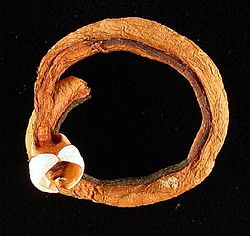
This dried specimen of Teredo navalis was extracted from the wood and the calcareous tunnel that originally surrounded it and curled into a circle artificially. The two valves of the shell are the white structures at the anterior end; they are used to dig the tunnel in the wood.
Scientific classification Edit this classification
Kingdom: Animalia
Phylum: Mollusca
Class: Bivalvia
Order: Myida
Superfamily: Pholadoidea
Family: Teredinidae
Genus: Teredo
Linnaeus, 1758
Type species
Teredo navalis
Species

See text.

Synonyms[1]
  • Austroteredo Habe, 1952
  • Coeloteredo
  • Pingoteredo Barsch, 1932
  • Teredo (Bitubuloteredo) Li, 1965
  • Teredo (Coeloteredo) Bartsch, 1923
  • Teredo (Zopoteredo) Bartsch, 1923
  • Zopoteredo

Teredo is a genus of highly modified saltwater clams which bore in wood and live within the tunnels they create. They are commonly known as "shipworms;" however, they are not worms, but marine bivalve molluscs (phylum Mollusca) in the taxonomic family Teredinidae. The type species is Teredo navalis.[1]

The tunneling habit of species in the genus inspired the name of the Teredo network tunneling protocol. The submarine HMS Teredo may also have been named after this genus, which works invisibly, below the surface, and can be very damaging to marine installations made of wood.

Diet

[edit]

Like most marine based bivalves, teredo worms are primarily filter feeders and consume mostly seston, and not wood.[2] Wood supplements their primary diet and is consumed with the assistance of bacteria inside their [gill] cells.[3] However, wood is not a necessary part of their diet and they can live on the surface both of wooden and non-wooden structures.[4]

This photo demonstrates teredo worms do not require wood to survive and can damage non-wooden structures. This photo is of an epoxy-fiber glass vessel. Hole depths were less than 10mm. Remnants of a casing on the surface of the hull appear bottom right.

Species

[edit]

Species within the genus Teredo include:

[edit]

See also

[edit]

References

[edit]
[edit]
Revisions and contributorsEdit on WikipediaRead on Wikipedia
from Grokipedia
Teredo is a of marine bivalve molluscs belonging to the family Teredinidae, commonly referred to as shipworms due to their elongated, worm-like appearance and specialized adaptation for boring into submerged wood. These organisms possess highly reduced, tri-lobed shells at the anterior end, which function as rasping tools to excavate tunnels in wooden substrates, while their soft, tubular bodies can extend up to 60 cm in length and are lined with a sheath secreted for protection within the burrows. The genus includes 16 accepted , with serving as the type and the most widespread, notorious for its historical role in damaging wooden maritime structures. Species of Teredo inhabit coastal marine and brackish waters globally, particularly in temperate and tropical regions, where they colonize submerged timber such as ships' hulls, piers, , and mangroves. They thrive in salinities above 9 ppt and temperatures between 15–25°C, with larvae settling on wood surfaces before boring inward to establish permanent burrows. Biologically, Teredo species are unique among wood-boring bivalves for their reliance on endosymbiotic that aid in digesting and fixing from the wood, enabling them to derive nearly all from this substrate after a brief planktonic larval phase. occurs seasonally through broadcast spawning, with females releasing up to 5 million eggs per season, and individuals exhibiting protandrous hermaphroditism—beginning as males before potentially transitioning to females. Ecologically, Teredo plays a key role in marine wood decomposition, recycling nutrients and creating microhabitats within burrows for other organisms like crustaceans, though it poses significant economic threats by accelerating the deterioration of wooden infrastructure in ports and coastal areas. The genus's invasive potential, exemplified by T. navalis, has led to widespread distribution via human-mediated transport on timber, affecting regions from the Atlantic and Pacific Oceans to enclosed seas like the Baltic.

Taxonomy and Classification

Etymology and Naming

The genus name Teredo originates from the term terēdōn (τερηδών), meaning "wood-worm" or "wood-borer," a reference to the characteristic habit of these bivalves of excavating tunnels in submerged wood. This underscores their ecological role and distinguishes them from other marine borers. first formalized the genus Teredo in the 10th edition of in 1758, introducing for the group and designating —the naval shipworm—as the based on earlier descriptions of wood-boring organisms affecting ships. Linnaeus's work in marked a pivotal advancement in malacological , shifting from pre-Linnaean descriptive accounts to a systematic classification that integrated these mollusks into the bivalve lineage. The evolution of nomenclature for Teredo species involved resolving historical misclassifications, such as the synonym Serpula teredo proposed by Emanuel M. da Costa in 1778, which erroneously placed the organism in the polychaete genus Serpula due to its elongated, worm-like form. Subsequent taxonomic revisions, including Ruth D. Turner's comprehensive 1966 survey and catalogue of the Teredinidae, clarified synonyms and stabilized the binomial names for approximately 30 recognized Teredo species within the family Teredinidae.

Phylogenetic Position

The genus Teredo is classified within the family Teredinidae, order Myida, subclass Autobranchia, class , phylum . This placement positions Teredo among the wood-boring bivalves known as shipworms, which exhibit highly specialized adaptations for xylotrophy. Molecular phylogenetic analyses, including those based on partial 18S rRNA gene sequences, support the of Teredinidae, with Teredo forming part of this alongside sister genera such as and Lyrodus. These studies confirm the family's cohesive evolutionary origin from a single ancestor adapted to wood-boring lifestyles, distinguishing it from related myid families like . The order Myida itself is resolved within the superorder Euheterodonta and infraclass based on combined 18S and 28S rRNA data, highlighting Teredo's position in the broader imparidentian lineage of heterodont bivalves. Key synapomorphies defining Teredo and its relatives in Teredinidae include a greatly reduced, chisel-like shell used for rasping , an elongated, worm-like body, and fused siphons terminating in pallets that protect against predation and facilitate respiration in confined burrows. These traits differentiate teredinids from non-boring bivalves, emphasizing their derived morphology for obligate . The taxonomic framework for Teredo was significantly revised in Ruth D. Turner's 1966 monograph, which cataloged all known teredinid species, synonymized several genera, and reorganized subfamilies based on pallet morphology and shell characteristics, establishing a foundational still referenced today. This work shifted earlier groupings, which had lumped Teredo with less specialized borers, toward a more precise delineation of family boundaries.

Recognized Species

The genus Teredo comprises 16 valid species, as recognized in current taxonomic databases. The type species is Teredo navalis Linnaeus, 1758, widely distributed in temperate and subtropical waters, distinguished by its pallets featuring a short, robust stalk supporting a concave, horn- or spoon-shaped blade that aids in siphon protection. Key species include T. bartschi Clapp, 1923, a warm-water form often found in tropical regions, characterized by highly variable pallet morphology with an elongated stalk and blade that may exhibit lateral horns or bifurcations, reflecting adaptations to diverse wooden substrates. Another notable species is T. malleolus Turton, 1822, though recent classifications place it in the related genus Teredora due to distinct pallet features like a hammer-shaped blade with a broad, malleate expansion; it was historically included in Teredo but resolved as a separate taxon. T. clappi Bartsch, 1923, is identified by pallets with a slender stalk and triangular, pointed blades, typically occurring in subtropical Atlantic waters. The full list of valid species encompasses T. aegypos Moll, 1941; T. bitubula K.-M. Li, 1965; T. fulleri Clapp, 1924; T. furcifera E. von Martens, 1894; T. johnsoni Clapp, 1924; T. mindanensis Bartsch, 1923; T. parksi Bartsch, 1921; T. poculifer Iredale, 1936; T. portoricensis Clapp, 1924; T. remiformis K.-M. Li, 1965; T. somersi Clapp, 1924; T. triangularis Edmondson, 1942; and T. turnerae A. C. P. Müller & Lana, 2004, each differentiated primarily by shape variations such as stalk length, blade concavity, and apical projections. Taxonomic status of several Teredo taxa has been debated, with numerous synonyms resolved through early 20th-century revisions, including works by Bartsch (1923, 1928) that clarified distinctions among morphologically similar forms like T. bartschi and T. mindanensis based on and tube features. These revisions reduced redundancy by reclassifying variants previously lumped under T. navalis.

Physical Description

Shell Morphology

The shells of Teredo species are highly specialized and greatly reduced, consisting of small anterior valves adapted for a wood-boring existence. The worm-like body resides within a tube secreted by the mantle that houses the soft body and can extend up to 60 cm in length and 1 cm in diameter. The anterior portion features a pair of small, triangular valves, typically 2.8–5.9 mm long, that cover only the head region and function primarily as rasping tools rather than protective covers. These valves consist of three subglobular lobes—the auricle, anterior lobe (AL), and anterior median lobe (AmL)—with an internal styloid apophysis, a curved hook-like process that anchors the shell to surrounding tissues. Internally, the valves bear intricate rasping ridges optimized for abrading wood fibers during burrowing. In T. navalis, the AL displays parallel, triangular prismatic ridges averaging 37 μm in height, 40 μm in width, and 104 μm in spacing, tipped with saw-like serrations (14 μm opening width, 69° angle) that enable precise at burrow tips. The AmL, by contrast, has roof tile-like plates with wedge-shaped serrations averaging 26 μm high, 34 μm wide, and 34 μm apart (9 μm opening, 67° angle), facilitating broader rasp-like grinding to widen tunnels; these features contribute to values of 12 μm on the AL and 6 μm on the AmL. Scanning electron reveals additional microscopic indentations (~0.7 μm) on these ridges, enhancing their efficiency. At the posterior siphon ends, paired s serve as protective flaps that seal the entrance against predators and . These paddle-like structures, 5–6 mm long in T. navalis, feature a short stalk shorter than the concave cap, a U-shaped distal margin without transverse ridges, and a pale yellow periostracum covering the distal third. morphology varies across , aiding taxonomic identification; for instance, T. navalis pallets are relatively smooth and tan-bladed with an inverted triangular anterior edge, while T. norvagicus exhibits more complex, layered internal structures with ornate edges. These pallets integrate briefly with al tissues for retraction and extension.

Soft Body Anatomy

The soft body of Teredo species, such as T. navalis, is highly elongated and worm-like, typically reaching lengths of 20–40 cm and diameters of about 1 cm in mature individuals, enabling efficient navigation and residence within narrow wood burrows. This body form is supported by a thin, flexible mantle that secretes a lining for the burrow walls, while the anterior region bears a small, reduced shell that partially encloses the foot used for rasping . The mantle cavity is divided into inhalant and exhalant chambers, which house the paired gills responsible for both respiration and filter-feeding on suspended organic particles, including wood-derived material. The gills of Teredo are demibranchiate and contain specialized bacteriocytes within the gland of Deshayes, a posterior gill tissue that harbors endosymbiotic ; these microbes produce cellulolytic enzymes essential for breaking down the in ingested wood. At the posterior end, the body terminates in separate inhalant and exhalant s, which extend through small openings in the for drawing in oxygenated water and fine wood particles while expelling waste and pseudofeces; the inhalant siphon captures seston via ciliary action on the gills. Attached to the exhalant siphons are paired, calcareous pallets—flattened, disc-like structures that can close to seal the burrow entrance, protecting the animal from predators and maintaining internal water flow when retracted. The digestive system in Teredo is specialized for processing , featuring a short leading to an elongated , a capacious caecum for initial wood particle storage, and digestive diverticula in the of Deshayes; unlike many bivalves, it lacks reliance on a prominent crystalline style for enzymatic action, with digestion instead dominated by symbiont-derived cellulases transported from the gills to the gut via the ducts of Deshayes. This bacterial cellulolysis allows efficient nutrient extraction from lignocellulosic material, supplemented by filter-fed , supporting the wood-boring lifestyle without significant endogenous production from a style.

Habitat and Distribution

Environmental Preferences

Teredo species, particularly T. navalis, thrive in submerged wooden substrates within warm, brackish to fully marine waters, exhibiting a broad tolerance to levels ranging from approximately 5 to 35 parts per thousand (ppt), though optimal growth and boring activity occur between 10 and 35 ppt. These bivalves favor temperatures between 15°C and 25°C for peak metabolic rates and , with larval development and settlement most efficient in this range; temperatures below 10°C or above 32°C can inhibit activity and survival. Salinity-temperature interactions play a critical role, as low combined with cold temperatures limits distribution and infestation rates in marginal habitats. Regarding oxygen, Teredo demonstrates remarkable tolerance to low dissolved oxygen levels, surviving anoxic conditions for up to six weeks by relying on stored reserves, which supports anaerobic during periods of burrow confinement. This resilience is enhanced by gill-associated bacterial symbionts, such as Teredinibacter species, which are facultatively anaerobic and aid in under microaerophilic or hypoxic environments, allowing the bivalves to persist in oxygen-poor sediments or waterlogged . However, optimal boring and feeding occur in well-oxygenated coastal waters with dissolved oxygen above 4 mg/L, where higher respiration rates support rapid growth and pellet production from ingested . Substrate specificity is a key factor in Teredo selection, with a strong preference for softwoods such as (Pinus spp.) over hardwoods like (Quercus spp.), due to the former's lower density and higher content, which facilitate easier larval penetration and adult boring. Larval settlement is critically dependent on the presence of microbial on the wood surface, which produce chemical cues—such as methyl esters and quorum-sensing signals—that attract competent larvae and induce ; clean, biofilm-free wood results in negligible . This biofilm requirement ensures that Teredo colonizes only preconditioned, decaying or naturally fouled submerged timber, optimizing survival in dynamic estuarine and coastal environments.

Global Range and Endemism

The genus Teredo, comprising wood-boring bivalves of the family Teredinidae, exhibits a across temperate and tropical marine environments worldwide, facilitated by human-mediated transport and natural dispersal. The most widespread species, T. navalis, is recorded in coastal waters of the Atlantic Ocean, , , , and northwestern Pacific, with established populations in , , and parts of . While the genus as a whole shows lower compared to the broader Teredinidae family, within Teredo is limited but notable in certain regions, reflecting historical biogeographic patterns and barriers to dispersal. The global spread of Teredo species, particularly T. navalis, has been profoundly influenced by anthropogenic vectors such as ship hulls and , enabling colonization of distant locales since at least the and blurring native-exotic boundaries. Teredo species predominantly inhabit tropical and subtropical waters, with optimal temperatures above 10–15°C limiting their persistence in colder regions, though recent climate warming has prompted observable range expansions. Post-2000 studies document poleward shifts and phenological changes, such as extended breeding seasons in the for T. navalis, driven by rising sea surface temperatures that enhance larval survival and recruitment. In northwestern European estuaries, including the Rhine-Meuse and areas, warming trends have facilitated upstream distributional advances into previously unsuitable brackish habitats. These shifts underscore the genus's sensitivity to climatic variability, potentially increasing invasion risks in temperate zones.

Ecology and Life Cycle

Feeding Mechanisms

, commonly known as the naval , utilizes a dual feeding strategy that combines the digestion of wood cellulose with filter-feeding on planktonic particles. Stable analyses indicate that the primary nutrient source derives from suspended (seston) captured by the inhalant , while ingested wood particles provide supplementary through symbiotic interactions with housed in the gills. This complementary approach supports the bivalve's energy demands in submerged wooden substrates, with similar mechanisms observed in other Teredo species. The gill endosymbionts, predominantly from the genus Teredinibacter (e.g., Teredinibacter turnerae), play a central role in wood digestion by producing cellulolytic enzymes such as endoglucanases (primarily from glycoside hydrolase family GH5) and exoglucanases (from GH6). These enzymes cleave β-1,4-glycosidic bonds in cellulose, converting the indigestible plant material into fermentable sugars that the host can assimilate. The bacteria also contribute nitrogen fixation, addressing nutritional limitations in wood, which is nitrogen-poor. Enzyme production occurs in the gills, with the proteins transported to the nearly sterile digestive via the ducts of Deshayes for targeted breakdown. This mechanism enables high assimilation , as proteomic analyses of shipworms reveal that a high proportion of cecum proteins are active against polymers like and . Adult T. navalis ingest shavings produced during boring, processing them efficiently to meet caloric needs, though exact daily rates vary with environmental conditions and individual size. Traits described here for T. navalis are representative of the Teredo, with potential variations among .

Reproduction and Development

Teredo species, such as the common shipworm Teredo navalis, exhibit protandrous hermaphroditism, beginning life as males before transitioning to females, with separate sexes in adulthood. Reproduction occurs through broadcast spawning of sperm by males into the water column during warm months when temperatures exceed 15–16°C, facilitating internal fertilization within the female's epibranchial cavity. Females retain fertilized eggs in modified gill chambers for brooding, where embryonic development proceeds for 2–3 weeks until hatching as D-shaped veliger larvae, which are then released into the plankton. These veliger larvae are free-swimming for 2–4 weeks, feeding on and growing to the pediveliger stage, during which they become competent to settle. Settlement is triggered by chemical cues from wood surfaces, including those produced by bacterial biofilms, prompting larvae to attach and metamorphose. Post-settlement, the larvae bore into the using their shell valves, which rapidly develop into the characteristic reduced, rasping structures of juvenile shipworms, marking the transition to the wood-boring adult phase. Females demonstrate high fecundity, producing up to 1–5 million veliger larvae per season over multiple spawning events, though early larval stages suffer high mortality rates due to predation and environmental stresses. This reproductive strategy supports the species' wide dispersal and invasive potential in wooden substrates worldwide, with similar patterns in other Teredo species.

Wood-Boring Behavior

Teredo species, such as , excavate wood using a combination of mechanical rasping with their modified shell valves and aided by the foot. The anterior shell valves, reduced and equipped with sharp, ridges, are positioned against the wood substrate, where the animal rocks its body to scrape and abrade fibers in a rasping motion. The foot extends to anchor the body, providing leverage and enabling forward into the excavated space, allowing the animal to advance while maintaining stability. This process creates extensive, often branched tunnels that can reach lengths of up to several meters, lined internally by a secretion from that reinforces the walls and prevents collapse of the surrounding wood. Burrowing behaviors are consistent across Teredo species. Larval stages exhibit behavioral adaptations that facilitate initial settlement and burrowing. Competent larvae display negative phototaxis, avoiding illuminated areas to seek darker, submerged substrates, and positive toward wood-derived volatiles, which guide them to suitable hosts. Once settled, the post-metamorphic juvenile begins boring and remains in a single burrow for its entire adult life, extending the tunnel as it grows without relocating. The rate of boring varies but typically ranges from 1 to 2 mm per day under optimal conditions, such as in soft, low-density woods like . This rate is influenced by wood density, with harder, denser materials slowing excavation due to increased resistance to rasping, while softer woods allow faster penetration.

Human Interactions

Economic and Structural Impacts

Teredo navalis, commonly known as the naval shipworm, has inflicted severe damage on wooden maritime infrastructure throughout history, particularly during outbreaks in the 18th century. In the Netherlands, infestations destroyed approximately 50 km of wooden seawalls, leading to a national crisis that required their replacement with stone structures to prevent flooding. These events, coupled with widespread hull degradation, contributed to the sinking of thousands of wooden ships globally before the transition to iron and steel vessels in the 19th and 20th centuries. Such historical impacts accelerated naval innovations and timber demands, reshaping maritime economies. In contemporary settings, Teredo species continue to erode piers, docks, pilings, and seawalls, resulting in global annual economic losses exceeding $1 billion. For instance, a 1920s outbreak in caused an estimated $615 million in damages (in 1992 dollars, equivalent to over $1.2 billion today), severely affecting ports and coastal facilities. These costs encompass repairs, replacements, and downtime for affected infrastructure, underscoring the ongoing threat to commercial shipping and harbor operations. Beyond maritime structures, Teredo boring degrades and wooden elements in coastal forests, including props and roots, where high wood productivity facilitates rapid and . This activity has historically driven increased to supply replacement timber for damaged coastal installations. In modern , shipworms including Teredo species threaten wooden cages, nets, and supports used in fisheries, potentially compromising operations in tropical and subtropical regions. Mitigation strategies have evolved from mechanical to chemical protections. , applied to ship hulls since the , creates a toxic barrier that deters larval settlement and boring. treatments, involving pressure-impregnation of wood with coal-tar distillates, release preservatives that inhibit shipworm penetration and are widely used for pilings and docks. Additional methods include impregnation with metal salts such as , , or , though environmental concerns have prompted shifts toward less toxic alternatives.

Historical and Cultural Significance

The earliest recorded descriptions of Teredo shipworms as maritime pests appear in and Roman literature, where they were recognized for their destructive boring into en ships and structures. Authors such as , , and documented these organisms, noting their role in weakening hulls and contributing to vessel losses, with Pliny describing protective measures like coating with resins and waxes to deter infestation. These accounts from the 4th century BCE onward highlight Teredo's longstanding threat to , influencing early practices across the Mediterranean. In medieval , protections against Teredo extended to docks and harbors, where wooden pilings and wharves were treated with , pitch, and occasionally lead sheathing to prevent boring, continuing ancient techniques amid ongoing threats to coastal . Culturally, Teredo featured prominently in maritime lore as "wood worms," often blamed in seafaring tales for mysterious shipwrecks and the sudden foundering of vessels, symbolizing the unseen perils of the sea that could humble even the mightiest fleets. The 19th century marked significant advancements in malacological study of Teredo, with Jean-Baptiste Lamarck's classifications in works like Histoire naturelle des animaux sans vertèbres (1818) elucidating its bivalve anatomy and global spread via human-mediated transport on ships, thereby elevating its profile in scientific discourse on marine mollusks. A pivotal scientific milestone occurred in the early with the discovery of bacterial symbionts in Teredo's gills, as detailed by Distel et al. (), who used 16S rRNA sequencing to identify these microbes' role in , offering key evolutionary insights into how wood-boring bivalves transitioned to symbiotic nutrition strategies. Subsequent research in 2024 discovered in the shipworm's intestinal typhlosole that produce enzymes for breaking down , resolving how they digest the indigestible parts of wood.

References

Add your contribution
Related Hubs
Contribute something
User Avatar
No comments yet.