Hubbry Logo
TextbookTextbookMain
Open search
Textbook
Community hub
Textbook
logo
8 pages, 0 posts
0 subscribers
Be the first to start a discussion here.
Textbook
Textbook
from Wikipedia

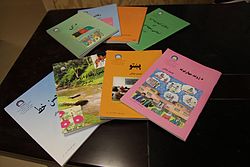
Textbooks written in Pashto distributed to Afghan school children

A textbook is a book containing a comprehensive compilation of content in a branch of study with the intention of explaining it. Textbooks are produced to meet the needs of educators, usually at educational institutions, but also of learners (who could be independent learners outside of formal education). Schoolbooks are textbooks and other books used in schools.[1][2] Today, many textbooks are published in both print and digital formats.

History

[edit]
School textbooks used during the Japanese occupation of Hong Kong

The history of textbooks dates back to ancient civilizations. For example, Ancient Greeks wrote educational texts. The modern textbook has its roots in the mass production made possible by the printing press. Johannes Gutenberg himself may have printed editions of Ars Minor, a schoolbook on Latin grammar by Aelius Donatus. Early textbooks were used by tutors and teachers (e.g. alphabet books), as well as by individuals who taught themselves.

The Greek philosopher Socrates lamented the loss of knowledge because the media of transmission were changing.[3] Before the invention of the Greek alphabet 2,500 years ago, knowledge and stories were recited aloud, much like Homer's epic poems. The new technology of writing meant stories no longer needed to be memorized, a development Socrates feared would weaken the Greeks' mental capacities for memorizing and retelling. (Ironically, we know about Socrates' concerns only because they were written down by his student Plato in his famous Dialogues.)[4]

Peter Ramus (Petrus Ramus) in 16th Century France challenged the curriculum taught at university and published a text book that could be used by anyone. It was a textbook with a structure of headings and summaries.[5]

The next revolution in the field of books came with the 15th-century invention of printing with changeable type. The invention is attributed to German metalsmith Johannes Gutenberg, who cast type in molds using a melted metal alloy and constructed a wooden-screw printing press to transfer the image onto paper.

Gutenberg's first and only large-scale printing effort was the now iconic Gutenberg Bible in the 1450s – a Latin translation from the Hebrew Old Testament and the Greek New Testament. Gutenberg's invention made mass production of texts possible for the first time. Although the Gutenberg Bible itself was expensive, printed books began to spread widely over European trade routes during the next 50 years, and by the 16th century, printed books had become more widely accessible and less costly.[6]

While many textbooks were already in use, compulsory education and the resulting growth of schooling in Europe led to the printing of many more textbooks for children. Textbooks have been the primary teaching instrument for most children since the 19th century. Two textbooks of historical significance in United States schooling were the 18th century New England Primer and the 19th century McGuffey Readers.

Recent technological advances have changed the way people interact with textbooks. Online and digital materials are making it increasingly easy for students to access materials other than the traditional print textbook. Students now have access to electronic books ("e-books"), online tutoring systems and video lectures. An example of an e-book is Principles of Biology from Nature Publishing.

Most notably, an increasing number of authors are avoiding commercial publishers and instead offering their textbooks under a creative commons or other open license.

Market

[edit]

The market for textbooks

[edit]
Sri Lanka emergency medical technician textbook

As in many industries, the number of providers has declined in recent years (there are just a handful of major textbook companies in the United States).[7] Also, elasticity of demand is fairly low. The term "broken market" appeared in the economist James Koch's analysis of the market commissioned by the Advisory Committee on Student Financial Assistance.[8]

In the United States, the largest textbook publishers are Pearson Education, Cengage, McGraw-Hill Education, and Wiley. Together they control 90% of market revenue.[9] Another textbook publisher is Houghton Mifflin Harcourt.[10]

The market for textbooks does not reflect classic supply and demand because of agency problems.[11]

New editions and the used book market in the United States

[edit]

Some students save money by buying used copies of textbooks, which tend to be less expensive, and are available from many college bookstores in the US, who buy them back from students at the end of a term. Books that are not being re-used at the school are often purchased by an off-campus wholesaler for 0–30% of the new cost, for distribution to other bookstores. Some textbook companies have countered this by encouraging teachers to assign homework that must be done on the publisher's website. Students with a new textbook can use the pass code in the book to register on the site; otherwise they must pay the publisher to access the website and complete assigned homework.

Students who look beyond the campus bookstore can typically find lower prices. With the ISBN or title, author and edition, most textbooks can be located through online used booksellers or retailers.

Most leading textbook companies publish a new edition every 3 or 4 years, more frequently in math and science. Harvard economics chair James K. Stock has stated that new editions are often not about significant improvements to the content. "New editions are to a considerable extent simply another tool used by publishers and textbook authors to maintain their revenue stream, that is, to keep up prices."[12] A study conducted by The Student PIRGs found that a new edition costs 12% more than a new copy of the previous edition (not surprising if the old version is obsolete), and 58% more than a used copy of the previous edition. Textbook publishers maintain these new editions are driven by demand from teachers. That study found that 76% of teachers said new editions were justified "half of the time or less" and 40% said they were justified "rarely" or "never".[13] The PIRG study has been criticized by publishers, who argue that the report contains factual inaccuracies regarding the annual average cost of textbooks per student.[14]

The Student PIRGs also point out that recent emphasis on e-textbooks does not always save students money. Even though the book costs less up-front, the student will not recover any of the cost through resale.[15]

Bundling in the United States

[edit]

Another publishing industry practice that has been highly criticized is "bundling", or shrink-wrapping supplemental items into a textbook.[13] Supplemental items range from CD-ROMs and workbooks to online passcodes and bonus material. Students often cannot buy these things separately, and often the one-time-use supplements destroy the resale value of the textbook.[16]

According to the Student PIRGs, the typical bundled textbook costs 10%–50% more[clarification needed] than an unbundled textbook, and 65% of professors said they "rarely" or "never" use the bundled items in their courses.[13]

A 2005 Government Accountability Office (GAO) Report in the United States found that the production of these supplemental items was the primary cause of rapidly increasing prices:

While publishers, retailers, and wholesalers all play a role in textbook pricing, the primary factor contributing to increases in the price of textbooks has been the increased investment publishers have made in new products to enhance instruction and learning...While wholesalers, retailers, and others do not question the quality of these materials, they have expressed concern that the publishers' practice of packaging supplements with a textbook to sell as one unit limits the opportunity students have to purchase less expensive used books....If publishers continue to increase these investments, particularly in technology, the cost to produce a textbook is likely to continue to increase in the future.[17]

Bundling has also been used to segment the used book market. Each combination of a textbook and supplemental items receives a separate ISBN. A single textbook could therefore have dozens of ISBNs that denote different combinations of supplements packaged with that particular book. When a bookstore attempts to track down used copies of textbooks, they will search for the ISBN the course instructor orders, which will locate only a subset of the copies of the textbook.

Legislation at state and federal levels seeks to limit the practice of bundling, by requiring publishers to offer all components separately.[18] Publishers have testified in favor of bills including this provision,[19] but only in the case that the provision exempts the loosely defined category of "integrated textbooks". The Federal bill[20] only exempts 3rd party materials in integrated textbooks, however publisher lobbyists have attempted to create a loophole through this definition in state bills.[21][22]

Price disclosure

[edit]

Given that the problem of high textbook prices is linked to the "broken" economics of the market, requiring publishers to disclose textbook prices to faculty is a solution pursued by a number of legislatures.[23] By inserting price into sales interactions, this regulation will supposedly make the economic forces operate more normally.

No data suggests that this is in fact true. However, The Student PIRGs have found that publishers actively withhold pricing information from faculty, making it difficult to obtain. Their most recent study found that 77% of faculty say publisher sales representatives do not volunteer prices, and only 40% got an answer when they directly asked. Furthermore, the study found that 23% of faculty rated publisher websites as "informative and easy to use" and less than half said they typically listed the price.[18]

The US Congress passed a law in the 2008 Higher Education Opportunity Act that would require price disclosure.[18][24][25] Legislation requiring price disclosure has passed in Connecticut,[26] Washington,[27][18] Minnesota,[28] Oregon,[27] Arizona,[29] Oklahoma,[30] and Colorado.[22] Publishers are currently supporting price disclosure mandates, though they insist that the "suggested retail price"[31] should be disclosed, rather than the actual price the publisher would get for the book.

Used textbook market

[edit]

Once a textbook is purchased from a retailer for the first time, there are several ways a student can sell his/her textbooks back at the end of the semester or later. Students can sell to 1) the college/university bookstore; 2) fellow students; 3) numerous online websites; or 4) a student swap service.

Campus buyback

[edit]

As for buyback on a specific campus, faculty decisions largely determine how much a student receives. If a professor chooses to use the same book the following semester, even if it is a custom text, designed specifically for an individual instructor, bookstores often buy the book back. The GAO report found that, generally, if a book is in good condition and will be used on the campus again the next term, bookstores will pay students 50 percent of the original price paid. If the bookstore has not received a faculty order for the book at the end of the term and the edition is still current, they may offer students the wholesale price of the book, which could range from 5 to 35 percent of the new retail price, according to the GAO report.[17]

When students resell their textbooks during campus "buyback" periods, these textbooks are often sold into the national used textbook distribution chain. If a textbook is not going to be used on campus for the next semester of courses then many times the college bookstore will sell that book to a national used book company. The used book company then resells the book to another college bookstore. Finally, that book is sold as used to a student at another college at a price that is typically 75% of the new book price. At each step, a markup is applied to the book to enable the respective companies to continue to operate.

Student to student sales

[edit]

Students can also sell or trade textbooks among themselves. After completing a course, sellers will often seek out members of the next enrolling class, people who are likely to be interested in purchasing the required books. This may be done by posting flyers to advertise the sale of the books or simply soliciting individuals who are shopping in the college bookstore for the same titles. Many larger schools have independent websites set up for the purpose of facilitating such trade. These often operate much like digital classified ads, enabling students to list their items for sale and browse for those they wish to acquire. Also, at the US Air Force Academy, it is possible to e-mail entire specific classes, allowing for an extensive network of textbook sales to exist.

Student online marketplaces

[edit]

Online marketplaces are one of the two major types of online websites students can use to sell used textbooks. Online marketplaces may have an online auction format or may allow the student to list their books for a fixed price. In either case, the student must create the listing for each book themselves and wait for a buyer to order, making the use of marketplaces a more passive way of selling used textbooks. Unlike campus buyback and online book, students are unlikely to sell all their books to one buyer using online marketplaces, and will likely have to send out multiple books individually.

Online book buyers

[edit]

Online book buyers buy textbooks, and sometimes other types of books, with the aim of reselling them for a profit. Like online marketplaces, online book buyers operate year-round, giving students the opportunity to sell their books even when campus "buyback" periods are not in effect. Online book buyers, who are often online book sellers as well, will sometimes disclaim whether or not a book can be sold back prior to purchase. Students enter the ISBN numbers of the books they wish to sell and receive a price quote or offer. These online book buyers often offer "free shipping" (which in actuality is built into the offer for the book), and allow students to sell multiple books to the same source. Because online book buyers are buying books for resale, the prices they offer may be lower than students can get on online marketplaces. However, their prices are competitive, and they tend to focus on the convenience of their service. Some even claim that buying used textbooks online and selling them to online book buyers has a lower total cost than even textbook rental services.

Textbook exchanges

[edit]

In response to escalating textbook prices, limited competition, and to provide a more efficient system to connect buyers and sellers together, online textbook exchanges were developed. Most of today's sites handle buyer and seller payments, and usually deduct a small commission only after the sale is completed.

According to textbook author Henry L. Roediger (and Wadsworth Publishing Company senior editor Vicki Knight), the used textbook market is illegitimate, and entirely to blame for the rising costs of textbooks. As methods of "dealing with this problem", he recommends making previous editions of textbooks obsolete, binding the textbook with other materials, and passing laws to prevent the sale of used books.[32] The concept is not unlike the limited licensing approach for computer software, which places rigid restrictions on resale and reproduction. The intent is to make users understand that the content of any textbook is the intellectual property of the author and/or the publisher, and that as such, subject to copyright. Obviously, this idea is completely opposed to the millennia-old tradition of the sale of used books, and would make that entire industry illegal.

E-textbooks

[edit]

Another alternative to save money and obtaining the materials you are required are e-textbooks. The article "E books rewrite the rules of education" states that, alternately to spending a lot of money on textbooks, you can purchase an e-textbook at a small amount of the cost. With the growth of digital applications for iPhone, and gadgets like the Amazon kindle, e-textbooks are not an innovation, but have been "gaining momentum".[33] According to the article " Are textbooks obsolete?", publishers and editorials are concerned about the issue of expensive textbooks. "The expense of textbooks is a concern for students, and e-textbooks, address the face of the issue, Williams says " As publishers we understand the high cost of these materials, and the electronic format permit us diminish the general expense of our content to the market".[34] E-textbook applications facilitate similar experiences to physical textbooks by allowing the user to highlight and take notes in-page. These applications also extend textbook learning by providing quick definitions, reading the text aloud, and search functionality.[35]

Rental programs

[edit]

In-store rentals are processed by either using a kiosk and ordering books online with a third party facilitator or renting directly from the store's inventory. Some stores use a hybrid of both methods, opting for in-store selections of the most popular books and the online option for more obscure titles or books they consider too risky to put in the rental system. Rented items can be used for a set duration of time, then are required to be returned to the physical store or shipped back to the third party facilitator by the rental due date. Writing and highlighting is sometimes allowed in rented items, although excessive markup which makes the item unrentable is discouraged.[36] Overdue items are often charged a fee up to the retail price of the rented item. Rented items typically do not include supplemental materials such as access codes, CDs, or loose-leafs.[37]

Textbook sharing

[edit]

Using textbook sharing, students share the physical textbook with other students, and the cost of the book is divided among the users of the textbook. Over the life of the textbook, if 4 students use the textbook, the cost of the textbook for each student will be 25% of the total cost of the book.

Open textbooks

[edit]

The latest trend in textbooks is "open textbooks". An open textbook is a free, openly licensed textbook offered online by the copyright holders. According to PIRG, a number of textbooks already exist, and are being used at schools such as MIT and Harvard.[38] A 2010 study published found that open textbooks offer a viable and attractive means to meet faculty and student needs while offering savings of approximately 80% compared to traditional textbook options.[18]

Although the largest question seems to be who is going to pay to write them, several state policies suggest that public investment in open textbooks might make sense.[39][citation needed] To offer another perspective[citation needed], any jurisdiction might find itself challenged to find sufficient numbers of credible academics who would be willing to undertake the effort of creating an open textbook without realistic compensation, to make such a proposal work. Currently, some open textbooks have been funded with non-profit investment.

The other challenge involves the reality of publishing, which is that textbooks with good sales and profitability subsidize the creation and publication of low demand but believed to be necessary textbooks.[citation needed] Subsidies skew markets and the elimination of subsidies is disruptive; in the case of low demand textbooks the possibilities following subsidy removal include any or all of the following: higher retail prices, a switch to open textbooks, a reduction of the number of titles published.

On the other hand, independent open textbook authoring and publishing models are developing. Most notably, the startup publisher Flat World Knowledge already has dozens of college-level open textbooks that are used by more than 900 institutions in 44 countries.[40][41][42] Their business model[43] was to offer the open textbook free online,[44][45] and then sell ancillary products that students are likely to buy if prices are reasonable – print copies, study guides, ePub, .Mobi (Kindle), PDF download, etc. Flat World Knowledge compensates its authors with royalties on these sales.[46] With the generated revenue Flat World Knowledge funded high-quality publishing activities with a goal of making the Flat World financial model sustainable. However, in January 2013 Flat World Knowledge announced their financial model could no longer sustain their free-to-read options for students.[47] Flat World Knowledge intends to have open textbooks available for the 125 highest-enrolled courses on college campuses within the next few years.[48]

CK-12 Flexbooks are the open textbooks designed for United States K-12 courses.[49] CK-12 FlexBooks are designed to facilitate conformance to national and United States and individual state textbook standards. CK-12 FlexBooks are licensed under a Creative Commons BY-NC-SA license. CK-12 FlexBooks are free to use online and offer formats suitable for use on portable personal reading devices and computers – both online and offline. Formats for both iPad and Kindle are offered. School districts may select a title as is or customize the open textbook to meet local instructional standards. The file may be then accessed electronically or printed using any print on demand service without paying a royalty, saving 80% or more when compared to traditional textbook options. An example print on demand open textbook title, "College Algebra" by Stitz & Zeager through Lulu is 608 pages, royalty free, and costs about $20 ordered one at a time (March 2011).[50] (Any print on demand service could be used – this is just an example. School districts could easily negotiate even lower prices for bulk purchases to be printed in their own communities.) Teacher's editions are available for educators and parents. Titles have been authored by various individuals and organizations and are vetted for quality prior to inclusion in the CK-12 catalog. An effort is underway to map state educational standards correlations.[51] Stanford University provided a number of titles in use.[52]

Curriki is another modular K-12 content non-profit "empowering educators to deliver and share curricula." Selected Curriki materials are also correlated to U.S. state educational standards.[53] Some Curriki content has been collected into open textbooks and some may be used for modular lessons or special topics.

International market pricing

[edit]

Similar to the issue of reimportation of pharmaceuticals into the U.S. market, the GAO report[17] also highlights a similar phenomenon in textbook distribution. Retailers and publishers have expressed concern about the re-importation of lower-priced textbooks from international locations. Specifically, they cited the ability students have to purchase books from online distribution channels outside the United States at lower prices, which may result in a loss of sales for U.S. retailers. Additionally, the availability of lower-priced textbooks through these channels has heightened distrust and frustration among students regarding textbook prices, and college stores find it difficult to explain why their textbook prices are higher, according to the National Association of College Stores. Retailers and publishers have also been concerned that some U.S. retailers may have engaged in reimportation on a large scale by ordering textbooks for entire courses at lower prices from international distribution channels. While the 1998 Supreme Court decision Quality King v. L'anza protects the reimportation of copyrighted materials under the first-sale doctrine, textbook publishers have still attempted to prevent the U.S. sale of international editions by enforcing contracts which forbid foreign wholesalers from selling to American distributors.[54] Concerned about the effects of differential pricing on college stores, the National Association of College Stores has called on publishers to stop the practice of selling textbooks at lower prices outside the United States.[55] For example, some U.S. booksellers arrange for drop-shipments in foreign countries which are then re-shipped to America where the books can be sold online at used prices (for a "new" unopened book). The authors often getting half-royalties instead of full-royalties, minus the charges for returned books from bookstores.

Production

[edit]

Cost distribution

[edit]

According to the National Association of College Stores, the entire cost of the book is justified by expenses, with typically 11.7% of the price of a new book going to the author's royalties (or a committee of editors at the publishing house), 22.7% going to the store, and 64.6% going to the publisher. The store and publisher amounts are slightly higher for Canada. [citation needed] Bookstores and used-book vendors profit from the resale of textbooks on the used market, with publishers only earning profits on sales of new textbooks.[citation needed]

Research

[edit]

According to the GAO study published July 2005:

Following closely behind annual increases in tuition and fees at postsecondary institutions, college textbook and supply prices have risen at twice the rate of annual inflation over the last two decades.

Rising at an average of 6 percent each year since academic year 1987–1988, compared with overall average price increases of 3 percent per year, college textbook and supply prices trailed tuition and fee increases, which averaged 7 percent per year. Since December 1986, textbook and supply prices have nearly tripled, increasing by 186 percent, while tuition and fees increased by 240 percent and overall prices grew by 72 percent. While increases in textbook and supply prices have followed increases in tuition and fees, the cost of textbooks and supplies for degree-seeking students as a percentage of tuition and fees varies by the type of institution attended. For example, the average estimated cost of books and supplies per first-time, full-time student for academic year 2003–2004 was $898 at 4-year public institutions, or about 26 percent of the cost of tuition and fees. At 2-year public institutions, where low-income students are more likely to pursue a degree program and tuition and fees are lower, the average estimated cost of books and supplies per first-time, full-time student was $886 in academic year 2003–2004, representing almost three-quarters of the cost of tuition and fees.[17]

According to the 2nd edition of a study by the United States Public Interest Research Group (US PIRG) published in February 2005[citation needed]: "Textbook prices are increasing at more than four times the inflation rate for all finished goods, according to the Bureau of Labor Statistics Producer Price Index. The wholesale prices charged by textbook publishers have jumped 62 percent since 1994, while prices charged for all finished goods increased only 14 percent. Similarly, the prices charged by publishers for general books increased just 19 percent during the same time period."

According to the 2007 edition of the College Board's Trend in College Pricing Report published October 2007[citation needed]: "College costs continue to rise and federal student aid has shown slower growth when adjusted for inflation, while textbooks, as a percentage of total college costs, have remained steady at about 5 percent."

K-12 textbooks

[edit]

In most U.S. K-12 public schools, a local school board votes on which textbooks to purchase from a selection of books that have been approved by the state Department of Education. Teachers receive the books to give to the students for each subject. Teachers are usually not required to use textbooks, however, and many prefer to use other materials instead.

Textbook publishing in the U.S. is a business primarily aimed at large states. This is due to state purchasing controls over the books, most notably in Texas, where the Texas Education Agency sets curricula for all courses taught by the state's 1,000+ school districts, and therefore also approves which textbooks can be purchased.

Commonly used American history textbooks are customized for students in California and Texas.[56]

High school

[edit]

In recent years, high school textbooks of United States history have come under increasing criticism. Authors such as Howard Zinn (A People's History of the United States), Gilbert T. Sewall (Textbooks: Where the Curriculum Meets the Child) and James W. Loewen (Lies My Teacher Told Me: Everything Your American History Textbook Got Wrong), make the claim that U.S. history textbooks contain mythical untruths and omissions, which paint a whitewashed picture that bears little resemblance to what most students learn in universities. Inaccurately retelling history, through textbooks or other literature, has been practiced in many societies, from ancient Rome to the Soviet Union (USSR) and the People's Republic of China. The content of history textbooks is often determined by the political forces of state adoption boards and ideological pressure groups.[57]

Science textbooks have been the source of ongoing debates and have come under scrutiny from several organizations. The presentation or inclusion of controversial scientific material has been debated in several court cases. Poorly designed textbooks have been cited as contributing to declining grades in mathematics and science in the United States and organizations such as the American Academy of Arts and Sciences (AAAS) have criticized the layout, presentation, and amount of material given in textbooks.

Discussions of textbooks have been included on creation and evolution in the public education debate. The Smith v. Board of School Commissioners of Mobile County case brought forward a debate about scientific fact being presented in textbooks.

In his book, Surely You're Joking, Mr. Feynman!, the late physics Nobel Prize laureate Richard P. Feynman described his experiences as a member of a committee that evaluated science textbooks.[58] At some instances, there were nonsensical examples to illustrate physical phenomena; then a company sent – for reasons of timing – a textbook that contained blank pages, which even got good critiques. Feynman himself experienced attempts at bribery.

Higher education

[edit]
Programming language textbooks

In the U.S., college and university textbooks are chosen by the professor teaching the course, or by the department as a whole. Students are typically responsible for obtaining their own copies of the books used in their courses, although alternatives to owning textbooks, such as textbook rental services and library reserve copies of texts, are available in some instances.

In some European countries, such as Sweden or Spain, students attending institutions of higher education pay for textbooks themselves, although higher education is free of charge otherwise.

With higher education costs on the rise, many students are becoming sensitive to every aspect of college pricing, including textbooks, which in many cases amount to one tenth of tuition costs. The 2005 Government Accountability Office report on college textbooks said that since the 1980s, textbook and supply prices have risen twice the rate of inflation in the past two decades.[59] A 2005 PIRG study found that textbooks cost students $900 per year, and that prices[17] increased four times the rate of inflation over the past decade.[13] A June 2007 Advisory Committee on Student Financial Assistance (ACSFA) report, "Turn the Page", reported that the average U.S. student spends $700–$1000 per year on textbooks.[60]

While many groups have assigned blame to publishers, bookstores or faculty, the ACSFA also found that assigning blame to any one party—faculty, colleges, bookstores or publishers—for current textbook costs is unproductive and without merit. The report called on all parties within the industry to work together to find productive solutions, which included a movement toward open textbooks and other lower-cost digital solutions.

Textbook prices are considerably higher in law school. Students ordinarily pay close to $200 for case books consisting of cases available free online.[citation needed]

Textbook bias on controversial topics

[edit]

In cases of history, science, current events, and political textbooks, "the writer might be biased towards one way or another. Topics such as actions of a country, presidential actions, and scientific theories are common potential biases".[citation needed]

See also

[edit]
Types
  • Casebook – a special type of textbook used in law schools in the United States
  • Open textbook – a textbook licensed under an open copyright license, and made available online to be freely used
  • Problem book – a textbook, usually graduate level, organized as a series of problems and full solutions
  • Sourcebook – a collection of texts, often used in social sciences and humanities in the United States
  • Study guide – a textbook used to study for a topic, exam, etc.
  • Workbook – a type of textbook with practice problems, where answers can be written directly in the book
Lists
Controversies
Other
  • John Amos Comenius – Czech philosopher, pedagogue and theologian who is credited by some with introducing pictorial textbooks
    • Orbis Pictus – 1658 textbook by Comenius, one of the first books with pictures for children
  • Kirtsaeng v. John Wiley & Sons, Inc. – a 2013 decision of the United States Supreme Court regarding textbook resale

Citations

[edit]
  1. ^ "schoolbook". The American Heritage Dictionary of the English Language (5th ed.). HarperCollins.
  2. ^ "schoolbook – definition of schoolbook in English from the Oxford dictionary". Archived from the original on 18 August 2016. Retrieved 23 April 2016.
  3. ^ "True Stuff: Socrates vs. The Written Word". Archived from the original on 30 January 2013. Retrieved 12 May 2013. True Stuff: Socrates vs. the Written Word, 27 January 2011. By David Malki
  4. ^ Marcia Clemmitt, "Learning Online Literacy," in "Reading Crisis?" CQ Researcher, 22 February 2008, pp. 169–192.
  5. ^ [1]
  6. ^ Wight, C. "Gutenberg Bible: Background about Gutenberg and his Bibles". bl.uk. Retrieved 20 February 2023.
  7. ^ "The Columbus Dispatch – Local/State | The Columbus Dispatch". 23 May 2011. Archived from the original on 23 May 2011. Retrieved 20 February 2023.
  8. ^ Koch, James P. (June 2006). "An Economic Analysis of Textbook Prices and the Textbook Market". Archived from the original on 22 June 2012. Retrieved 12 June 2012.
  9. ^ "Textbook publishers Cengage, McGraw-Hill extend merger agreement to May 1". Reuters. 29 January 2020. Retrieved 2 December 2020.
  10. ^ Alfonso, III, Fernando (24 July 2020). "This one letter in a textbook could change how millions of kids learn about race". CNN. Retrieved 2 December 2020.
  11. ^ "Textbook Prices", Initiative on Global Markets, 27 January 2015, retrieved 20 February 2023[permanent dead link]
  12. ^ D’gama, Alissa; Jaffe, Benjamin (4 March 2008). "Professors Find Different Uses for Textbook Profits". The Harvard Crimson. Retrieved 14 July 2019.
  13. ^ a b c d "Ripoff 101: 2nd Edition". Student PIRGs. 27 February 2005. Retrieved 20 February 2023.
  14. ^ "Inside Higher Ed's News". Inside Higher Ed. Archived from the original on 29 October 2008. Retrieved 20 February 2023.
  15. ^ "Course Correction". Student PIRGs. 1 August 2008. Retrieved 20 February 2023.
  16. ^ "Required Reading". Student PIRGs. 27 October 2007. Retrieved 20 February 2023.
  17. ^ a b c d e "College Textbooks: Enhanced Offerings Appear to Drive Recent Price Increases Archived 2008-06-19 at the Wayback Machine." U.S. Government Accountability Office, Washington, DC, 2005. Abstract. Retrieved 7 October 2011.
  18. ^ a b c d e Zomer, Saffron. "Exposing the Textbook Industry". Archived from the original on 14 March 2010.
  19. ^ "House Committee on Education (03/06/2008)". Archived from the original on 13 April 2008. Retrieved 23 April 2016.
  20. ^ "Higher Education Opportunity Act Archived 2008-09-21 at the Wayback Machine." H.R.4137, U.S. House of Representatives, 110th Congress (2007–2008.) Public Law No. 110-315. Retrieved 7 October 2011.
  21. ^ "HB 2048 – TEXTBOOK TRANSPARENCY ACT – Zimmerman, Jake". house.mo.gov. Retrieved 20 February 2023.
  22. ^ a b "Summarized History for Bill Number SB08-073", Colorado General Assembly Home Page, retrieved 25 February 2023
  23. ^ Elia Powers. "Textbook Battle's New Frontier". Archived from the original on 21 August 2016. Retrieved 23 April 2016.
  24. ^ "Congress.gov – Library of Congress". thomas.loc.gov. Retrieved 8 May 2018.[permanent dead link]
  25. ^ Jason (11 February 2008). "The Stingy Scholar". Archived from the original on 4 May 2016. Retrieved 23 April 2016.
  26. ^ "AN ACT CONCERNING TEXTBOOK AFFORDABILITY". Archived from the original on 11 March 2016. Retrieved 23 April 2016.
  27. ^ a b "Archived copy" (PDF). Archived from the original (PDF) on 10 September 2008. Retrieved 24 March 2008.{{cite web}}: CS1 maint: archived copy as title (link)
  28. ^ "HF 1063". Archived from the original on 24 December 2012. Retrieved 23 April 2016.
  29. ^ "Documents For Bill". Archived from the original on 4 March 2016. Retrieved 23 April 2016.
  30. ^ "Tutoring Rates in Oklahoma: An Analysis of over 34,000 Private Tutors". ateamtutors.com. 13 November 2015. Archived from the original on 21 July 2020. Retrieved 14 June 2016.
  31. ^ "House Bill Proposes Disclosure Rules to Control Textbook Prices". The Chronicle of Higher Education. Archived from the original on 16 February 2008. Retrieved 23 April 2016.
  32. ^ Henry L. Roediger, III (January 2005). "Why Are Textbooks So Expensive?". Observer. Association for Psychological Science. Archived from the original on 17 March 2018. Retrieved 23 April 2016.
  33. ^ Mullan, Eileen (4 May 2009). "Ebooks Rewrite the Rules of Education". EContent Magazine. Archived from the original on 17 March 2018.
  34. ^ "Are textbooks obsolete? An education in the impact of electronic textbooks". go.galegroup.com. Retrieved 22 January 2016.
  35. ^ Reckelhoff, Benjamin (16 February 2021). "Vitalsource Bookshelf App capabilities for etextbooks". VitalSource Bookshelf.
  36. ^ Reckelhoff, Benjamin (10 February 2021). "College Book Rental Frequently Asked Questions". eCampus.com.
  37. ^ Reckelhoff, Benjamin (10 February 2021). "Will my rental come with an access card/CD/study guide/supplement". eCampus. Retrieved 10 February 2021.
  38. ^ "Open Textbooks: Catalog". Student PIRGs. Retrieved 20 February 2023.
  39. ^ "AB 2261 Assembly Bill – INTRODUCED". Archived from the original on 4 March 2016. Retrieved 23 April 2016.
  40. ^ Flat World Knowledge President Eric Frank Addresses Oregon Legislators on Solving Textbook Affordability. Archived 23 February 2011 at the Wayback Machine Pressitt. 21 February 2011.
  41. ^ "Open-source textbook co. Flat World goes back to school with 40,000 new customers". VentureBeat. 20 August 2009. Retrieved 20 February 2023.
  42. ^ "150,000 College Students Save $12 Million Using Flat World Knowledge Open Textbooks". Marketwire. 23 August 2010. Archived from the original on 24 November 2010.
  43. ^ Forte, Sanford. "Flat World Knowledge: Open College Textbooks". opensource.com. Retrieved 20 February 2023.
  44. ^ Organizational Behavior v1.1 Archived 5 April 2011 at the Wayback Machine by Talya Bauer & Berrin Erdogan. Irvington, NY: Flat World Knowledge. 2010. (Free online open textbook format sample – PDF view)
  45. ^ Introduction to Psychology Archived 7 April 2011 at the Wayback Machine by Charles Stangor. Irvington, NY: Flat World Knowledge. 2010. (Free online open textbook format sample – web view)
  46. ^ See Flat World Knowledge's website Archived 30 July 2012 at archive.today
  47. ^ "Why Flat World is Moving from Free to Fair on January 1, 2013". Archived from the original on 20 January 2013. Retrieved 17 February 2013. Flat World Knowledge Website.
  48. ^ "Flat World Knowledge Gets $15 Million in Funding". Publishers Weekly. Retrieved 20 February 2023.
  49. ^ "CK12-Foundation". ck12.org. Retrieved 20 February 2023.
  50. ^ Carl Stitz/Jeff Zeager on Ohio Textbook HQ Archived 14 July 2011 at the Wayback Machine 2010.
  51. ^ "State, National, and Common Core Standards Correlations | CK-12 Foundation". ck12info.org. Retrieved 20 February 2023.
  52. ^ "Human Biology - Genetics". CK-12 Foundation. 2016. Retrieved 12 April 2023.
  53. ^ "Curriki – Shaping the Future of Learning". curriki.org. Retrieved 20 February 2023.
  54. ^ Lewin, Tamar (21 October 2003). "Students Find $100 Textbooks Cost $50, Purchased Overseas". The New York Times. Archived from the original on 16 September 2009. Retrieved 24 September 2009.
  55. ^ "Testimony of Marc L. Fleischaker, Counsel, National Association of College Stores". Hearing on "Are College Textbooks Priced Fairly?". U.S. House of Representatives, Committee on Education and the Workforce, Subcommittee on 21st Century Competitiveness. 20 July 2004. Archived from the original on 6 August 2009. Retrieved 24 September 2009.
  56. ^ Goldstein, Dana (12 January 2020). "Two States. Eight Textbooks. Two American Stories". The New York Times. Retrieved 2 December 2020.
  57. ^ Jr, James C. McKinley (12 March 2010). "Texas Conservatives Win Curriculum Change". The New York Times. ISSN 0362-4331. Archived from the original on 7 January 2023. Retrieved 18 January 2023.
  58. ^ "Book Review: Surely You're Joking, Mr. Feynman!". Textbooks.org – Compare Textbook Prices. Archived from the original on 8 May 2016. Retrieved 23 April 2016.
  59. ^ Ben, Popen. "College Textbook Prices Have Risen 1,041 Percent Since 1977". nbc news. nbc news. Retrieved 17 March 2022.
  60. ^ "Archived: Advisory Committee for Student Financial Assistance (ACSFA) – U.S. Department of Education". Archived from the original on 9 May 2012. Retrieved 23 April 2016.

Further reading

[edit]
[edit]
Revisions and contributorsEdit on WikipediaRead on Wikipedia
from Grokipedia
A textbook is a comprehensive designed for educational use, presenting systematic explanations of principles, concepts, and within a specific academic subject or field of study, often supplemented by examples, diagrams, exercises, and questions to support student learning and instruction.
Such resources serve as standardized tools in classrooms, enabling consistent delivery of across institutions, though their content is shaped by authors, publishers, and prevailing educational standards.
The modern textbook's origins trace to the in , evolving from earlier manuscript-based educational materials into printed volumes that combined with , supplanting oral traditions and individual teacher-prepared notes as primary instructional media.
Despite their utility in organizing factual and fostering self-study, textbooks have drawn for embedding interpretive biases—such as underrepresentation of certain historical perspectives or overemphasis on ideologically driven narratives—which empirical analyses attribute in part to the left-leaning orientations dominant in and processes.

History

Origins and Early Development

The earliest precursors to modern textbooks emerged in ancient around 3000–2000 BCE, where scribal schools known as edubba trained young students in writing and administrative skills using clay tablets as instructional materials. Students practiced by copying model texts provided by teachers onto fresh clay tablets, which served as repeatable lesson exemplars covering vocabulary, mathematics, literature, and legal phrases; these tablets functioned as durable, low-cost media for rote memorization and skill acquisition in a aimed at producing literate bureaucrats. Archaeological evidence from sites like reveals thousands of such exercise tablets, demonstrating a structured pedagogical system reliant on standardized teaching aids predating paper-based books by millennia. Similar instructional materials appeared in other ancient civilizations, adapting to local writing technologies. In from approximately 2000 BCE, scrolls contained hieroglyphic exercises and moral texts for apprentice scribes, emphasizing practical for temple and administrative roles. In and , philosophical and rhetorical works by authors such as and were copied and used in elite , though dissemination remained limited to handwritten manuscripts shared among tutors and students. Ancient China employed bamboo slips and silk for Confucian classics like the , which structured moral and scholarly training in imperial academies, highlighting a consistent pattern of using durable, replicable texts to transmit knowledge across generations despite pre-industrial constraints on production. During the medieval period in , from the 5th to 15th centuries, in monastic schools and emerging universities relied on hand-copied of classical and theological works, such as Aristotle's treatises and grammatical primers like Priscian's Institutiones Grammaticae. These codices, laboriously produced by scribes, served as core teaching tools in cathedral schools and institutions like the (founded 1088), where professors lectured from authoritative copies while students took notes or rented exemplars for study. Access was restricted to elites due to high costs and rarity—often one per classroom—fostering a lecture-dominated supplemented by oral , yet laying groundwork for systematic subject organization that persists in textbooks today. The pivotal advancement came with the invention of the movable-type by in , , around 1440, which drastically reduced costs and enabled the of identical copies, transforming educational materials from scarce artifacts to accessible commodities. Early printed works included school grammars, such as editions of Aelius Donatus's Ars Minor (first printed circa 1451), which became staples in European classrooms by providing uniform, error-reduced texts for Latin instruction. This innovation spurred the proliferation of vernacular and specialized instructional books in the late , aligning with rising demands from and early state-sponsored schooling, though full-scale textbook standardization awaited broader reforms.

Expansion in the Modern Era

The expansion of textbooks in the modern era, spanning the 19th and early 20th centuries, was propelled by the widespread adoption of compulsory education laws, the growth of public school systems, and innovations in printing technology that reduced production costs and enabled mass dissemination. In the United States, states like Massachusetts enacted the first compulsory attendance law in 1852, mandating schooling for children aged 8 to 14, which spurred demand for affordable, uniform instructional materials to support emerging common school models advocated by reformers such as Horace Mann. This legal framework, gradually adopted across the nation by the early 1900s, correlated with a surge in textbook adoption, as educators sought standardized content to instill literacy, civic values, and basic knowledge amid rapid urbanization and immigration. A pivotal example of this growth was the , compiled by and first published in 1836, which emphasized moral lessons drawn from Protestant ethics, nature, and through graded reading selections. By 1850, sales had reached seven million copies, reflecting the scalability of steam-powered presses introduced earlier in the century, which allowed for cheaper paper and faster compared to hand composition. Overall, approximately 120 million copies circulated by 1960, making them a cornerstone of American elementary education and outselling all but the and in influence on generational . These texts not only taught reading but also reinforced cultural norms, though critics later noted their bias toward rural, Anglo-Protestant perspectives amid a diversifying . In , similar dynamics unfolded with national efforts to standardize curricula amid industrialization and nation-building. Britain's schoolbook market expanded significantly during the , responding to the Elementary Education Act of 1870, which established universal elementary schooling and fueled demand for examination-oriented materials in subjects like arithmetic and . advancements, including the steam press patented by Friedrich Koenig in 1810, multiplied output; by mid-century, British publishers produced millions of affordable primers, aligning with rising literacy rates from 50% in 1800 to over 90% by 1900 among males. Continental examples included France's post-Revolutionary state-approved textbooks, which by the 1830s under Minister promoted republican values, while Prussia's earlier compulsory system from 1763 scaled up in the with regimented readers to foster discipline and loyalty, influencing models exported via colonial education. This era's proliferation thus tied textbooks to state agendas, often prioritizing ideological uniformity over diverse pedagogical approaches, as evidenced by controversies over content in imperial contexts.

Post-WWII Standardization and Global Spread

In the , post-World War II textbook publishing emphasized standardization through nationally marketed, multigrade series that integrated alignment and pedagogical consistency across grade levels, responding to rising enrollments and state adoption systems from the onward. This approach facilitated uniform content delivery amid debates over historical narratives, where conservative influences promoted nationalistic portrayals in history texts during the and . UNESCO, founded in 1945, advanced global standardization by initiating programs for educational materials, including its fundamental education effort from 1946 to 1958, which produced teaching aids and textbooks tailored for basic in developing areas. These initiatives aimed at creating adaptable models for member states, promoting consistent core competencies in subjects like reading and arithmetic while addressing local languages and needs, though implementation varied due to resource constraints. The propelled textbook distribution worldwide as ideological tools, with the funding programs like Franklin Book Programs from 1952 to stimulate local production of school texts in over 20 developing countries to enhance and Western-oriented . The countered by subsidizing publishing and exporting materials to propagate socialist principles in allied states and beyond, contributing to expanded access in post-colonial regions despite biases favoring state narratives in both blocs' offerings.

Digital Transition from the 1990s Onward

The integration of digital technologies into textbooks began in the mid-, initially through supplementary materials such as CD-ROMs bundled with printed editions to provide enhancements like videos and interactive exercises for K-12 and higher education. These early efforts were limited by hardware constraints and high production costs, but they marked the onset of hybrid formats amid falling prices for digital storage and compression technologies. Full digital textbooks, or e-textbooks, gained traction in the late and early alongside the development of dedicated e-readers, with publishers experimenting with PDF-based distributions for academic content. The launch of devices like Sony's Librie in 2004 and Amazon's Kindle in 2007 accelerated portability and readability via e-ink displays, enabling higher education institutions to pilot e-textbook programs that reduced physical distribution . By 2012, e-textbook usage among U.S. college students had risen to over 50% in at least one course, driven by platforms offering searchable text, annotations, and device-agnostic access. Adoption expanded unevenly through the , with universities leading due to cost pressures—e-textbooks often priced 40-60% lower than print equivalents—though student preferences for tangible formats and concerns over screen fatigue slowed widespread uptake. Between 2012 and 2016, coursework reliance on e-textbooks grew from 42% to 66% among students, correlating with rising print textbook costs averaging $1,200 annually per undergraduate. K-12 adoption lagged, with only 23% of teachers exclusively using printed textbooks by 2023, as digital tools integrated into curricula via learning management systems like and . The (OER) movement, formalized in the early 2000s, further propelled the shift by promoting freely adaptable digital textbooks to combat proprietary pricing. Initiatives like University's OpenStax released its first peer-reviewed OER textbook in 2012, covering subjects such as and , which by 2020 had saved U.S. students over $1 billion in costs through millions of adoptions. This paralleled industry pivots to subscription models, exemplified by Pearson's digital-first strategy in 2019, emphasizing dynamic content with embedded assessments and analytics over static print runs. By the 2020s, digital textbooks dominated higher education, with fewer than 10% of courses requiring solely physical copies as of 2024, reflecting investments in and tablets. Benefits included real-time updates to reflect empirical revisions—reducing obsolescence in fields like —and enhanced via hyperlinks and simulations, though empirical studies show mixed pedagogical outcomes compared to print for retention. The transition disrupted traditional , shrinking print revenues by up to 50% for major houses while fostering scalable, data-driven content creation.

Definition and Core Characteristics

Essential Features of Textbooks

Textbooks serve as structured instructional resources aligned with specific educational curricula, covering core subject matter objectives and outcomes to impart essential knowledge and skills. This alignment ensures that content reflects accurate, up-to-date disciplinary standards while providing a comprehensive foundation in the subject, organized into logical concept systems suitable for progressive learning. A defining organizational feature is the division of material into coherent chapters or thematic units, featuring elements like tables of contents, learning objectives, summaries, and review sections to guide navigation and reinforce key points. Didactic design incorporates diverse pedagogical tools, including explanations, examples, open-ended questions, exercises, and assignments that build on prior , scaffold concepts, and target skills such as analysis and application. Visual and graphical aids—diagrams, charts, illustrations, and tables—are integrated to clarify complex ideas and support comprehension, often sequenced to integrate new information with existing understanding. These elements promote active engagement, preventing rote memorization by linking abstract content to practical, real-world contexts and encouraging . Language in textbooks emphasizes clarity and precision, with consistent definitions of technical terms, controlled sentence complexity adjusted for learner age, and avoidance of to facilitate meaningful interpretation. Content selection prioritizes and non-discriminatory representation, integrating cultural diversity where appropriate without compromising factual integrity. Physical attributes contribute to longevity and usability, including durable binding for repeated handling, legible , and efficient layout that minimizes during study. Supplementary features, such as glossaries or companion materials in textbook sets, extend functionality by aiding and extension activities.

Distinctions from Reference Books, Workbooks, and Trade Books

Textbooks differ from reference books primarily in their pedagogical intent and structure. Textbooks provide a sequential, narrative-driven exposition of subject matter aligned with educational curricula, incorporating explanations, examples, and guided progression to facilitate structured learning over time. In contrast, reference books, such as dictionaries, encyclopedias, or handbooks, prioritize concise, topical entries for rapid factual retrieval and verification rather than comprehensive instruction, serving as supplementary tools rather than primary course materials. This distinction arises because textbooks aim to build foundational through integrated and application, whereas reference works focus on isolated data access without assuming prior sequential study. Relative to workbooks, textbooks emphasize content delivery and conceptual development, offering detailed theoretical frameworks, historical context, and illustrative diagrams without interactive writing spaces. Workbooks, by comparison, function as ancillary practice tools, featuring blank fields for student responses, repetitive drills, and problem-solving exercises to reinforce textbook material, often lacking the depth of explanatory narrative found in textbooks. For instance, a textbook might derive formulas and provide proofs, while its accompanying workbook supplies problems for and application, enabling measurable skill consolidation but not independent content mastery. Textbooks also diverge from trade books in purpose, production, and market orientation. Trade books target broad consumer audiences for general reading, emphasizing engaging narratives, literary style, or without mandatory alignment to standardized syllabi or inclusion of assessment elements like end-of-chapter questions. Textbooks, developed through rigorous editorial processes tied to academic standards, incorporate pedagogical features such as learning objectives, glossaries, and instructor resources to support instruction, often resulting in higher production costs and edition updates driven by curricular revisions rather than market trends. Trade books may supplement textbooks by offering vivid, topic-specific insights—such as biographical accounts in —but lack the systematic coverage and evaluative components essential for formal .

Pedagogical Design Principles

Textbooks incorporate pedagogical design principles rooted in and empirical studies of learning efficacy to structure content for retention and application. These principles prioritize sequential knowledge building, where foundational concepts precede advanced applications, enabling that supports gradual mastery without overwhelming . Research indicates that such progression aligns with how processes information, as overloading novices with complexity impairs comprehension. For instance, effective textbooks begin chapters with reviews of prerequisites, introduce new material in discrete steps, and provide guided examples before independent tasks, yielding higher student success rates in subjects like and . A core is the integration of active engagement mechanisms, such as embedded questions, problem sets, and retrieval prompts, which promote deeper processing over passive reading. Evidence from instructional shows that textbooks facilitating practice with immediate feedback—through worked solutions or self-checks—enhance long-term retention by 20-30% compared to exposition-only formats, as these elements leverage the and . Visual and multimedia aids must adhere to substantive relevance, drawing from Gestalt to organize hierarchically; decorative elements, however, can increase extraneous load and reduce efficacy, particularly in younger learners. like Merrill's emphasize problem-centered starts, activating prior to anchor new learning, followed by demonstrations and application opportunities. Alignment with assessment and learner variability further refines design, incorporating (UDL) elements like multiple representation formats (e.g., text, diagrams, summaries) to accommodate diverse processing styles without diluting rigor. Studies confirm that textbooks embedding formative assessments at chapter ends correlate with improved scores, as they enable error correction and metacognitive monitoring. Overall, these principles, validated through controlled trials rather than anecdotal advocacy, distinguish high-impact textbooks from mere compilations, though implementation varies by publisher adherence to evidence over market trends.

Production and Content Creation

Authoring and Subject Matter Expertise

Textbook authoring relies on individuals possessing advanced subject matter expertise, typically professors or holding doctoral degrees in the relevant discipline, ensuring the content reflects current scholarly understanding and pedagogical efficacy. These authors draw from years of specialized , , and peer-reviewed publications to synthesize complex concepts into structured, accessible formats suitable for students at various educational levels. Institutional affiliation with universities is often a prerequisite for publisher acceptance, as it signals credibility and alignment with established curricula taught across multiple institutions. Without such credentials, aspiring authors face significant barriers, as publishers prioritize proposals demonstrating both expertise and market viability through sample chapters, outlines, and evidence of course adoption potential. Subject matter experts in textbook development must excel in translating esoteric into practical, illustrative material that facilitates student comprehension, often incorporating real-world examples, diagrams, and problem sets to bridge theoretical gaps. This requires not only domain mastery but also skills in , , and curriculum design, enabling authors to anticipate learner misconceptions and integrate evidence-based teaching strategies. In collaborative models, such as those used by open-access publishers like , teams of 5 to 10 academics—predominantly faculty—divide responsibilities for drafting chapters, with lead authors coordinating expertise to maintain consistency and rigor before external . Challenges in leveraging expertise include the "negative transfer" from research-oriented , which emphasizes narrow specialization over broad , often resulting in overly dense prose that academics struggle to adapt for undergraduate or K-12 audiences. Authors must balance depth with brevity, avoiding dilution of core principles while ensuring factual precision amid evolving —tasks complicated by the need for interdisciplinary input in fields like STEM, where single experts may lack holistic perspectives. Despite these hurdles, effective authoring elevates textbooks beyond mere compilation, embedding causal mechanisms and empirical validations to foster critical reasoning rather than rote .

Editorial and Research Processes

The editorial and research processes in textbook production emphasize alignment with educational standards, pedagogical efficacy, and factual accuracy, typically spanning 2 to 5 years for complex projects. Publishers initiate research by conducting to identify gaps in existing materials, such as unmet needs or emerging instructional trends, often through surveys of educators and review of state or national standards. Authors, usually subject-matter experts like professors or experienced teachers, then compile content from primary sources, peer-reviewed studies, and empirical data, prioritizing verifiable facts over interpretive narratives to ensure causal explanations reflect real-world mechanisms rather than ideological overlays. Developmental editing follows manuscript drafting, where in-house editors collaborate with authors to refine structure, clarity, and engagement, incorporating feedback from pilot testing in classrooms to validate comprehension and retention. External , involving panels of independent educators and specialists, assesses content for completeness, logical progression, and freedom from errors, with reviewers often using rubrics to evaluate accuracy against established knowledge bases. This stage may include multiple iterations, as seen in teaching textbooks where sample units undergo scrutiny by target users. Fact-checking integrates throughout, with dedicated specialists verifying dates, statistics, and scientific claims against original documents or databases, a process heightened in educational materials due to their influence on learners' foundational understanding. Copyediting and proofreading address grammatical precision and consistency, while final quality controls ensure visual aids and exercises support core concepts without introducing unsubstantiated assumptions. However, these mechanisms operate within academic ecosystems prone to institutional biases, where content selection by university-affiliated authors and reviewers can inadvertently embed prevailing interpretive frameworks, necessitating scrutiny of sources for empirical robustness over consensus-driven narratives.

Cost Structures and Publishing Economics

Textbook publishing features a cost structure dominated by high fixed costs associated with content development, which can exceed hundreds of thousands of dollars per title due to the need for specialized authoring, extensive , peer reviews, and pedagogical enhancements such as ancillary materials and digital supplements. These upfront investments reflect the complexity of creating materials aligned with educational standards and curricula, often involving subject-matter experts who command royalties of 10-15% of net sales. Variable costs, by contrast, remain relatively low, particularly for digital formats where marginal production expenses approach zero after initial digitization, enabling as sales volume increases. Developmental editing and quality assurance for textbooks amplify fixed costs, with comprehensive processes including structural revisions, against evolving standards, and integration of elements costing 0.080.08-0.15 per word or more for specialized content. Ancillary production—such as instructor resources, test banks, and online platforms—further elevates these expenses, often comprising 20-30% of total development budgets in higher education titles. and binding for physical editions add variable costs of 4.504.50-7 per unit for paperbacks in standard runs, declining with higher print volumes due to bulk efficiencies, while distribution incurs additional fees of 11-1.20 per plus shipping for smaller orders. expenditures, including sales representative outreach to educators and digital promotion, typically range from 5-10% of revenues but are front-loaded to secure adoptions. Economically, this structure incentivizes publishers to maximize new edition cycles—often every 3-4 years—to recoup fixed costs before used and rental markets erode sales, a strategy that sustains pricing power in an oligopolistic industry led by firms like Pearson and McGraw-Hill. Gross profit margins reflect these dynamics, with McGraw-Hill reporting 25% in 2012 and approximately 77% gross margins in recent quarters driven by digital shifts, while Pearson's hovered around 10-17% amid cost-saving efforts. The U.S. college textbook segment alone generates billions in annual revenue, but high barriers to entry from developmental investments limit competition, contributing to persistent pricing pressures despite digital alternatives reducing variable costs.

Quality Control and Fact-Checking Mechanisms

In textbook production, begins with the selection of s who possess specialized expertise in the subject matter, ensuring initial content draws from verifiable and empirical . Publishers typically require s to provide source documentation for claims, with responsibility for factual accuracy resting primarily on the during manuscript development. Developmental editors then for coherence and alignment with educational standards, often commissioning external s from academics, teachers, and subject specialists to identify inaccuracies, outdated information, or pedagogical flaws. For example, the American Historical Association's guidelines emphasize that history textbooks must incorporate current and undergo to maintain scholarly rigor. Peer review serves as a core mechanism, involving multiple rounds where reviewers evaluate content against established criteria such as factual precision, to curricula, and avoidance of unsubstantiated interpretations. In jurisdictions with formal adoption processes, such as certain U.S. states or Hong Kong's , independent panels conduct additional audits for alignment with standards, including accuracy in depicting historical events, scientific principles, and cultural facts. Copyediting follows, where editors cross-verify dates, names, and technical details against reliable references, though comprehensive by dedicated teams is rare due to economic constraints, with publishers often deferring to author warranties rather than independent verification. Despite these safeguards, factual errors and interpretive distortions persist, as demonstrated by a revealing hundreds of inaccuracies across 12 widely used U.S. textbooks, including misstatements on basic and physics. Similar issues have arisen in texts, such as a 2015 McGraw-Hill textbook erroneously describing enslaved individuals as "workers" from , prompting after . In interpretive fields like , reliance on peer reviewers from ideologically aligned academic pools can embed systemic biases, leading to contested portrayals that prioritize certain narratives over causal or primary accounts, as critiqued in reviews of U.S. curricula. Post-publication, errata sheets, digital updates, and user feedback from educators provide ongoing , though adoption of revisions varies by market dynamics.

Economic and Market Dynamics

The global market for educational textbooks, which includes print and digital materials designed for structured pedagogical use in K-12 and higher education settings, was valued at $27.6 billion in 2024. This segment represents a specialized portion of the broader publishing industry, valued at approximately $126.9 billion in 2025, where educational content focuses on curriculum-aligned resources rather than general or titles. Growth in the textbook market has been modest, with a projected (CAGR) of 3.9% over the coming years, influenced by steady demand in emerging economies with expanding school enrollments and vocational training needs. In contrast, the digital subset of educational publishing is expanding more rapidly, anticipated to reach $20.47 billion in 2025 and grow at a CAGR of 18.16% thereafter, driven by investments in interactive platforms, tools, and subscription-based access models that integrate and analytics. Interactive textbooks, a niche within this digital trend, generated $3.9 billion in 2024 and are forecasted to attain $5.7 billion by 2030, reflecting enhanced engagement features like embedded videos and assessments. Key trends include a gradual decline in print dominance in developed regions, offset by sustained adoption in and where infrastructure limitations favor physical copies, alongside pressures from free alternatives like open educational resources that erode revenue from proprietary editions. Overall, while total educational revenues grow incrementally, the shift toward hybrid and digital formats signals structural changes, with higher margins in software-integrated products potentially outpacing traditional sales volumes.

Pricing Strategies and Edition Cycles

Publishers of textbooks employ pricing strategies that reflect the inelastic demand in educational markets, where and institutions often have limited alternatives due to course requirements. New textbooks typically retail for $100 to $150, with annual expenditures per averaging $1,200 to $1,400 across multiple required volumes. These prices have risen at rates exceeding general , with a 162% increase from 2001 to 2025 according to U.S. data, driven by factors including production costs and market positioning. Pricing incorporates cost-plus elements, covering authoring, editing, and printing expenses—estimated at 6 to 8 times costs in broader guidelines—while aiming for margins that sustain revenue amid competition. In higher education, bundling print with digital access codes or ancillary materials further elevates effective prices, as these often expire or tie to specific editions, reducing resale value. Edition cycles are calibrated to balance content obsolescence with revenue optimization, typically occurring every 3 to 5 years for many titles. This frequency, roughly three updates per decade, allows publishers to incorporate genuine revisions such as updated or pedagogical enhancements, but empirical indicates it exceeds necessities in durable subjects like or , where core content changes slowly. A key driver is the economic incentive to undermine the used-book market: by altering , reorganizing chapters, or adding minor features, new editions render prior versions incompatible with instructor materials or assignments, compelling purchases of fresh copies. Economic modeling shows that without such cycles, publishers would face dominance by resale channels, halving potential sales in interim periods; thus, frequent releases sustain higher per-unit pricing, with each new edition averaging 12% costlier than its predecessor. In response to scrutiny, some publishers like Pearson have pivoted to digital-first models since 2019, enabling more granular updates without full reprints and integrating subscription-based access to align revenue with usage rather than one-time sales. However, this shift maintains high barriers to secondary markets through platforms and time-limited licenses. Proposals for regulatory intervention, such as mandating longer intervals between editions, risk counterproductive outcomes: extended cycles could inflate initial prices to recoup fixed costs over fewer sales or diminish textbook utility by delaying necessary revisions in fast-evolving fields like . Overall, these strategies prioritize publisher profitability over affordability, with empirical evidence underscoring that edition-driven obsolescence, rather than rampant inaccuracies, underpins the cycle's persistence.

Secondary Markets: Used, Rental, and Resale

The for textbooks, dominated by higher education usage, enables students to access materials at reduced costs through used sales, rentals, and resales, often via campus bookstores, online platforms like Amazon and , or peer-to-peer exchanges. Used textbooks typically retail at 40-60% below new prices, reflecting wear and prior ownership, while resale values depend on edition relevance and condition, frequently recovering 20-50% of purchase cost for students who sell post-semester. In the U.S., the National Association of College Stores (NACS) reported that 70% of students acquired at least one course material via purchase (including used) in spring 2024, underscoring the market's scale amid average annual textbook spending of approximately $389 per student as of 2021-2022 data. Rental options, both physical and digital, have expanded to address affordability, with 21% of students at least one material in spring 2024 per NACS surveys, down slightly from 35% in the 2020-2021 but stable amid rising digital adoption. Physical from campus stores or vendors like Follett allow semester-long access at 50-75% of purchase price, while e-textbook —projected to grow from USD 0.33 billion globally in 2023 to USD 1.6 billion by 2032—offer convenience via platforms such as or publisher portals, though they often include time-limited access codes that prevent resale. This segment's growth, at a CAGR exceeding 20% in recent forecasts, stems from student demand for lower upfront costs, averaging $100-200 per rental versus $200-300 for new print editions. Resale dynamics amplify efficiency for consumers but erode publisher s, as books circulate multiple times before ; empirical models indicate that high resale values and low substitutability between new and used copies can paradoxically boost overall sales by expanding access, though exert a net negative pull on new unit volumes by substituting ownership. Publishers counter this through strategies like annual edition updates with minimal substantive changes—driven by secondary market pressures—and bundling with non-resalable digital components, such as expiring access codes that inflate effective costs by 10-50% and render used books less viable. The shift to digital formats further diminishes physical resale, as e-books lack transferable ownership, contributing to a contraction in traditional used markets while capture deferred for publishers. Despite these adaptations, secondary markets have sustained savings, with 30-40% historically opting out of purchases under traditional models, though incomplete access risks persist without verified acquisition.

International Pricing Disparities and Trade Factors

Textbook prices vary significantly across international markets, with editions in the United States typically commanding premiums of 50% or more compared to those in the United Kingdom, and in some instances exceeding double the price for equivalent hardcover volumes. This disparity arises primarily from publishers' deliberate price discrimination, where identical or near-identical content is segmented by geography to capture higher consumer surplus in wealthier markets with greater willingness to pay, such as the U.S., where educational subsidies and institutional purchasing insulate demand from price sensitivity. In contrast, general trade books show minimal international price variation, underscoring that textbooks' elevated differentials stem from publishers' ability to exploit market-specific elasticities rather than universal production costs. Publishers enforce these disparities through territorial licensing agreements with local printers, producing "international editions" at lower costs via thinner , soft covers, and regional adaptations, which are priced 30-70% below U.S. equivalents to align with reduced in developing economies. These editions often include disclaimers prohibiting resale in high-price markets like , preventing parallel imports that could erode segmented pricing. Such strategies reflect causal dynamics of : high U.S. prices, averaging $100-200 per text as of 2003 data extrapolated to persistent trends, subsidize global R&D and edition cycles, while lower prices elsewhere expand volume in price-elastic markets, though they risk quality compromises like reduced durability. Trade factors exacerbate these imbalances, as intellectual property regimes under the WTO's enable publishers to restrict cross-border flows, with customs enforcement in the U.S. confiscating unauthorized international editions to uphold territorial exclusivity. While educational materials face low bound tariffs—often 0-5% under WTO commitments—non-tariff barriers like import quotas and anti-dumping measures in select markets, combined with volatility, further segment pricing; for instance, appreciation of the U.S. dollar post-2008 increased effective costs for imported texts in weaker- regions. In developing countries, local production incentives and subsidies reduce reliance on imports, yielding prices as low as 10-20% of U.S. levels, but persistent shortages arise from bottlenecks rather than liberalization alone. Empirical evidence from 2007 analyses confirms that absent prevention, prices would converge, highlighting how contractual and regulatory mechanisms sustain disparities over pure economic fundamentals.

Educational Applications

K-12 Implementation

In the , K-12 textbook implementation begins with state or district-level processes designed to align materials with standards. Approximately 20 states function as "adoption states," where state-appointed boards or commissions review submissions from publishers, evaluate alignment with academic standards, and compile approved lists for districts to select from, often for cycles of 5 to 8 years. Large states like and exert significant influence on national content due to their purchasing volume, rejecting materials that fail criteria such as factual accuracy or pedagogical fit—for instance, over 25% of language arts submissions were rejected in in 2019. In the remaining states, local districts handle selections, typically involving teacher committees and public input to ensure materials support state learning objectives. Once adopted, textbooks are distributed by schools or to students, often at no direct cost to families in systems, serving as core instructional resources. A 2023 survey found that 72% of K-12 teachers require textbooks in their classrooms, with students averaging 19.9 textbooks per semester across subjects like , , and history. Implementation in classrooms emphasizes sequential coverage of standards-aligned content, where teachers use textbooks for , guided practice, assignments, and formative assessments; for example, chapters are paced to match annual benchmarks, with ancillary materials like workbooks reinforcing key concepts. About 60% of teachers integrate textbooks as one resource among supplements such as modules or teacher-created materials, blending print and digital formats—over half report using both versions to enhance and . Empirical data indicate textbooks remain foundational despite digital shifts, with public schools expending roughly $8 billion annually on them as of 2021 to support structured learning outcomes. In practice, effective implementation requires training on material utilization, as misalignment with needs can reduce efficacy; studies show that when textbooks are supplemented thoughtfully, student achievement correlates with consistent use for skill-building in and problem-solving. Challenges include outdated content during long adoption cycles and varying teacher fidelity to texts, prompting some districts to pilot adaptive digital versions for real-time updates. Overall, textbooks facilitate standardized knowledge transmission in K-12 settings, underpinning accountability measures like standardized testing tied to covered curricula.

Higher Education Usage

In higher education, textbooks function as foundational resources for delivering structured course content, providing in-depth explanations, examples, and exercises that complement lectures and discussions. Faculty members typically select textbooks during design, often requiring them as assigned reading to align with syllabi and learning objectives. A study analyzing habits found that regular textbook engagement correlates with improved academic performance, including higher interest levels and better retention of material, though usage varies by discipline—STEM fields emphasize problem-solving sections, while courses prioritize analytical narratives. Empirical data from digital analytics platforms further indicates that tracking textbook interactions, such as page views and highlight frequency, can predict course outcomes with reasonable accuracy, underscoring their role in self-directed study. Adoption rates reflect faculty preferences, with surveys showing that in the 2023-24 , approximately 92% of courses offered textbooks in digital formats, while only 8% relied exclusively on print versions. However, acquisition lags: 65% of undergraduates in a 2024 poll reported forgoing purchases due to costs averaging $1,370 annually for books and supplies, leading to alternatives like access or shared copies. This non-purchase rate contributes to documented academic risks, including 35% of students dropping courses, 34% withdrawing, and 31% failing when materials prove unaffordable. Faculty surveys from the same period reveal a for print among 66% teaching in single modalities, citing perceived effectiveness for comprehension over digital alternatives. Despite these barriers, textbooks remain to assessment preparation, with showing consistent use for during exams and assignments across institutions. Longitudinal analyses confirm that courses employing high-quality textbooks yield stable achievement levels comparable to those without, provided access is equitable. In practice, usage patterns involve pre-lecture reading (reported by 40-50% of students in surveyed cohorts) and post-lecture review, though highlights if texts misalign with instructor emphasis. Overall, while economic pressures erode full adoption, textbooks' structured format sustains their centrality in fostering independent learning in settings.

Vocational and Specialized Training Contexts

Vocational textbooks prioritize practical skills and industry-specific procedures, contrasting with academic texts that emphasize theoretical foundations and critical analysis. These materials integrate hands-on exercises, technical diagrams, and step-by-step guides to align with outcomes in trades and professions. In vocational programs at community colleges, trade schools, and apprenticeships, textbooks serve as core resources for fields including automotive technology, , , , and healthcare assistance, supporting exams and workplace simulations. Publishers such as Delmar (part of Cengage) produce specialized content for disciplines like automotive diagnostics and occupations, while Schoolcraft Publishing offers over 140 titles focused on technical and courses. Specialized training contexts, such as certifications and in or , rely on textbooks that incorporate current standards, job position requirements, and benchmarks to prepare learners for immediate . These texts often evolve to include digital elements like interactive simulations, reflecting adaptations to technological advancements in sectors demanding rapid skill updates. Learning Matters, an imprint of SAGE, and similar publishers extend vocational textbook coverage to and professional courses, ensuring alignment with regulatory bodies and practical competencies. Empirical studies highlight their role in bridging educational content with labor market needs, though critiques note occasional lags in updating for fast-changing industries like IT.

Innovations and Alternatives

Shift to Digital and E-Textbooks

The transition to digital textbooks began accelerating in the early , coinciding with widespread adoption of portable devices such as e-readers and tablets, which enabled publishers to distribute interactive formats beyond static PDF replicas of print editions. Higher education institutions led this shift, with platforms like and Apple iBooks facilitating e-textbook pilots around 2010-2012, driven by student demands for affordability amid rising print costs exceeding $1,000 per year for some majors. By the mid-2010s, publishers such as Pearson and McGraw-Hill introduced subscription models, like Pearson's in 2019, emphasizing dynamic content with embedded , , and real-time updates to address criticisms of outdated print materials. Market data reflects robust growth in digital educational , valued at $20.32 billion in 2025 and projected to reach $82.86 billion by 2034, with a (CAGR) of 16.89%, fueled by and integration with learning management systems. In higher education, adoption rates have climbed, with digital formats comprising a significant portion of course materials through bundled access codes and platforms offering unlimited e-textbook libraries for flat fees, reducing per-title costs to under $50 in many cases. K-12 adoption lags, however, with print-dominant in lower grades—over 50% of teachers reporting print-only use—while digital penetration rises in upper grades via state initiatives, though overall U.S. K-12 textbook market growth to $200 billion in 2025 includes only incremental digital shifts amid barriers. Proponents cite advantages including portability (74.6% of students preferring e-books for ease of carrying multiple titles), search functionality, and interactive elements like hyperlinks and quizzes that enhance engagement without physical bulk. Cost savings are empirically verified in subscription models, often halving expenses compared to print, alongside from reduced use. Yet, empirical studies on learning outcomes reveal mixed results: a 2025 comparative analysis found printed books correlating marginally stronger with academic performance, attributing this to superior comprehension and retention during deep reading tasks, where digital formats may induce shallower processing due to distractions and screen fatigue. Systematic reviews confirm reading aids metacognitive strategies like and re-reading, with e-textbooks underperforming in narrative recall despite preferences for their convenience among 57.5% of surveyed students. Challenges persist, including the —requiring reliable devices and internet, which disadvantages low-income students—and piracy risks eroding publisher revenues, prompting DRM restrictions that limit offline access and printing. A 2022 study highlighted faculty agreement on e-textbook benefits for but noted stagnant adoption rates due to perceived deficiencies in pedagogical depth compared to tactile print interactions. Despite these hurdles, the shift continues, propelled by post-pandemic remote learning normalization and AI-enhanced adaptive features, though causal evidence underscores that digital efficacy hinges on format design rather than medium alone, with non-interactive PDFs yielding outcomes inferior to enriched print equivalents.

Open Educational Resources and Free Alternatives

Open educational resources (OER) consist of teaching, learning, and research materials in any medium that reside in the public domain or have been released under an open copyright license permitting their free use, adaptation, and distribution by others. These resources encompass full textbooks, course modules, videos, and assessments, often licensed under Creative Commons frameworks that allow retention, reuse, revision, remixing, and redistribution with minimal restrictions. OER emerged prominently in the early 2000s, building on earlier open-access efforts from the 1970s, with initiatives like MIT OpenCourseWare launching in 2001 to provide free access to course materials. Prominent OER platforms include , which offers peer-reviewed college textbooks in subjects like biology and economics, available at no cost online or low cost in print; LibreTexts, a customizable platform aggregating content across disciplines; and the Open Textbook Library, hosting over 1,700 downloadable texts vetted for quality. Other examples are the Directory of Open Access Books for scholarly monographs and OER Commons for curated K-12 and higher education materials. These platforms enable educators to adapt content to specific needs, reducing reliance on proprietary publishers. Adoption of OER has demonstrably lowered student costs, with institutions reporting substantial savings; for instance, faculty using OER enabled over $20 million in student savings since 2019, while the achieved nearly $500,000 in savings during the 2023-2024 academic year alone. Studies indicate OER can maintain or improve learning outcomes without increasing expenses, as evidenced by meta-analyses showing no significant differences in student performance compared to commercial texts. However, widespread adoption remains uneven, often requiring faculty incentives and training to overcome integration barriers. Critics highlight variability in OER quality, noting that while some undergo , many lack the rigorous vetting of commercial textbooks, potentially leading to inaccuracies or incomplete coverage. Adaptation demands additional instructor effort, and concerns persist about technological access, cultural relevance, and inconsistent updates, which can undermine reliability in fast-evolving fields. Empirical evaluations underscore the need for to assess OER for accuracy and alignment before use, as unvetted resources may propagate errors or biases akin to those in unsubstantiated academic contributions. Beyond structured OER, free alternatives include texts via , offering over 60,000 classic works suitable for literature and history courses, and consortia providing no-cost e-books or course reserves. Specialized repositories like eLangdell for further expand options, allowing substitution of commercial texts with openly licensed equivalents in niche areas. These alternatives promote equity by mitigating financial barriers, though their efficacy depends on supplementary instructor guidance to ensure comprehensive coverage.

AI Integration and Adaptive Technologies

Artificial intelligence integration in textbooks has transitioned from supplementary tools to core components of digital platforms, enabling real-time content modification based on user interaction . Unlike traditional static textbooks, AI-driven systems employ algorithms to analyze student responses, learning pace, and comprehension levels, thereby generating customized explanations, examples, or exercises. This approach draws on to anticipate knowledge gaps, with early implementations emerging around 2010 but accelerating post-2020 due to advancements in and large language models. Adaptive technologies within these systems function through iterative feedback loops, where AI models—often powered by or Bayesian knowledge tracing—dynamically alter instructional pathways. For instance, if a struggles with algebraic concepts, the system may simplify terminology, insert remedial modules, or escalate to advanced applications upon mastery, supported by empirical data from randomized controlled trials indicating up to 20-30% gains in retention compared to non-adaptive formats. Peer-reviewed analyses confirm that such adaptations enhance engagement by tailoring difficulty to individual proficiency, though efficacy varies by subject; and sciences benefit more than due to quantifiable problem-solving metrics. Notable implementations include South Korea's nationwide rollout of AI-integrated textbooks starting March 2025 for , English, , and , featuring automated grading and personalized remediation to address demographic learning disparities. Similarly, ViewSonic's AI Textbook platform, launched in 2024, allows educators to input syllabi for AI-generated variants that adapt to diverse , backed by a documenting pilot tests with improved student outcomes in hybrid classrooms. Generative AI experiments, such as Google's 2025 research on reimagining textbook sections via large language models, demonstrated statistically significant learning gains in controlled studies by embedding interactive queries and adaptive narratives directly into digital texts. Despite these advances, integration faces empirical hurdles: algorithmic biases from training data can perpetuate inaccuracies if not audited, as noted in U.S. Department of Education reports emphasizing the need for transparent in educational tools. Longitudinal studies reveal that while short-term boosts scores—e.g., 15% average improvement in adaptive vs. linear textbook users—sustained benefits depend on oversight to mitigate over-reliance on , which risks undermining development. Ongoing underscores causal links between adaptive fidelity (measured by response accuracy to student inputs) and outcomes, prioritizing systems validated through rigorous over anecdotal vendor claims.

Sharing Platforms and Collaborative Models

Sharing platforms for textbooks primarily encompass (P2P) models designed to facilitate direct exchanges or rentals between students, aiming to undercut traditional pricing structures. BonoBooks, launched in 2021 in , operates as a dedicated P2P app for renting physical textbooks, connecting student owners with renters to minimize intermediary costs and promote reuse. Similarly, MyBeeble introduced a in 2014 for buying and selling textbooks via social P2P networks, emphasizing community-driven transactions on campuses. These platforms address logistical challenges like shipping and condition verification through user ratings and app-based coordination, though their scale remains limited compared to centralized marketplaces, with adoption hindered by trust issues in peer verification and competition from established rental services. For digital sharing, platforms like Bookshare provide accessible formats of textbooks, enabling qualified users to download and share materials under legal provisions for disabilities, with features such as audio support and no-wait access. This model extends to broader OER repositories where users share customized digital texts, but P2P physical sharing has seen sporadic innovation without widespread disruption to commercial models as of 2025. Collaborative models shift focus from mere distribution to joint creation and iteration of textbook content, often leveraging open licensing to enable multiple contributors. LibreTexts, a non-profit platform, supports educators in constructing adaptive textbooks by remixing peer-reviewed modules from its 16 specialized libraries, fostering incremental updates and customization for specific courses. This approach promotes causal efficiency in content relevance, as users can integrate real-time data or local examples, though it risks inconsistencies without centralized editorial control, contrasting traditional publishing's rigorous vetting. In open pedagogy frameworks, students participate as co-authors in textbook development, compiling and editing resources under instructor guidance to enhance ownership and applicability. Platforms like Pressbooks facilitate this by offering tools for collaborative authoring and public directories of resulting open texts, enabling reuse across institutions. Such models have proliferated since the , driven by cost savings— with adopters reporting up to 100% reductions in material expenses— but empirical studies highlight variable quality, underscoring the need for faculty oversight to maintain empirical validity over crowd-sourced enthusiasm. Collaborative digital textbooks further integrate interactive elements like assessments, supporting diverse learning scenarios but demanding technological proficiency from contributors.

Controversies and Critiques

Economic Accessibility and Student Burden

The cost of textbooks imposes a significant financial strain on students, particularly in higher education, where annual expenditures on books and supplies averaged $1,290 at public four-year institutions in the 2024-25 . For full-time students, this figure reached approximately $1,370 in the same period, encompassing both required texts and supplementary materials. These expenses, often borne out-of-pocket or through financial aid, contribute to broader affordability challenges, with 5.2 million U.S. undergraduates allocating $1.5 billion in aid toward textbooks each semester. Textbook prices have escalated far beyond general , rising 162% from January 2000 to June 2022 compared to a 74.4% increase in overall consumer prices. This disparity, approximately three times the inflation rate over recent decades, stems from practices such as frequent new editions that render prior versions obsolete and bundled digital access codes with limited validity, reducing the resale value of used materials. Since 1977, prices have surged over 1,000%, outpacing tuition growth in some periods and amplifying the cumulative burden over a student's academic career. Surveys reveal widespread coping mechanisms that compromise educational outcomes: 65% of students across multiple campuses forgo purchasing required textbooks due to cost, while over half report taking fewer courses or avoiding specific classes with high material expenses. In one analysis, 44% reduced course loads and 32% earned lower grades as a result, with 24% dropping courses entirely. These decisions exacerbate , as deferred purchases or reliance on loans for essentials divert resources from other needs, disproportionately affecting lower-income and historically underserved groups who experience heightened stress and reduced persistence. In K-12 contexts, where textbooks are often district-funded, individual burdens are lower but still evident through supplemental costs for advanced or specialized materials not covered by public budgets.

Ideological Bias in Content Selection

A content analysis of major U.S. publishers' K-12 textbooks conducted in 2025 revealed systematic left-wing ideological bias in the selection and framing of topics, including disproportionate emphasis on systemic oppression in , critical portrayals of in , and prioritization of collectivist solutions in over individual rights or market mechanisms. This bias manifests in content selection through the inclusion of narratives aligned with progressive academic consensus—such as extensive coverage of racial inequities as causal drivers of U.S. development—while marginalizing countervailing evidence, like the role of constitutional or entrepreneurial innovation in national progress. In U.S. history textbooks, state-level adoption processes amplify these disparities; a examination of eight widely used texts approved for versus found that versions selected content foregrounding 's centrality to American identity (e.g., 161 instances of "slavery" across sampled chapters) and critiquing founding documents for inherent flaws, whereas editions balanced these with selections highlighting abolitionist triumphs, contributions, and free-market growth, reflecting conservative board influences. Peer-reviewed of materials similarly detected ideological skews, with algorithms quantifying higher frequencies of terms associated with inequality and intervention in left-leaning standards, often excluding or downplaying data on failures like extended welfare dependencies. Contemporary political events illustrate further selection biases; a 2024 study of four recent U.S. history textbooks analyzed coverage of the Trump administration (2017–2021), finding uniform inclusion of narratives and border policy critiques but selective omission of empirical metrics like pre-COVID lows (3.5% in 2019) or reforms, with explicit negative framing in 75% of instances despite varying publisher bases. Such patterns align with broader empirical documentation of content exclusion, including minimal treatment of religion's historical influence or positive family structures, as identified in analyses of and sections that favor secular . Publishers' decisions, driven by lucrative markets in ideologically divergent states like (progressive) and (conservative), result in hybrid texts that nonetheless trend toward accommodation of dominant academic viewpoints, which surveys indicate are overwhelmingly left-leaning (e.g., 12:1 Democrat-to-Republican ratio among education faculty). This systemic tilt, corroborated across multiple content audits, privileges interpretive lenses from biased institutional sources—such as university historians emphasizing grievance over empirical causality—over balanced evidentiary selection, potentially distorting causal understanding of events like economic expansions or civil rights advancements.

Adoption Processes and Parental Challenges

In the , textbook adoption processes vary by state, with 19 states and of Columbia employing centralized state-level adoption where boards review and approve lists of for local districts to select from, often prioritizing alignment with state standards, cost, and content accuracy. In these "adoption states," committees of educators and subject experts evaluate submissions from publishers during multi-year cycles, incorporating criteria such as pedagogical efficacy and factual reliability, before state boards vote on approvals; for instance, and , due to their large student populations, exert outsized influence on national textbook markets by requiring revisions to meet state-specific guidelines. Open-adoption states, numbering 31, delegate selection primarily to local school districts or individual schools, allowing greater flexibility but potentially leading to inconsistencies in content exposure across regions. Parental involvement in these processes is typically limited but includes public comment periods during state reviews, where objections can influence outcomes, as seen in Texas's annual hearings that have prompted publishers to alter content on topics like historical narratives or social issues to secure approval. Post-adoption challenges arise when parents identify materials they deem age-inappropriate, ideologically slanted, or factually deficient, often filing formal complaints under district policies or state laws permitting opt-outs for religious or moral reasons; such challenges surged in the early , with over 1,600 unique titles targeted in schools by , many involving explicit or contested views on gender and race. A prominent example unfolded in , where parents objected to elementary school storybooks promoting transgender themes and events, arguing they conflicted with religious beliefs; the district's 2022 policy eliminating prior notice and opt-outs led to a federal lawsuit, culminating in a June 27, 2025, U.S. ruling (Mahmoud v. Taylor) affirming parents' First Amendment rights to exempt children from such instruction without broader curriculum disruption. This decision highlighted tensions between parental authority and administrative discretion, as districts in multiple states faced similar suits over materials integrating LGBTQ+ topics without alternatives, with critics of centralized adoption noting that educator-dominated committees often overlook diverse in favor of prevailing academic consensus, which empirical reviews have shown can embed unverified interpretive frameworks. Challenges extend to historical and scientific content, where parents have contested textbooks for inaccuracies, such as downplaying evolutionary or overstating climate alarmism without counter-data; in , 2023-2024 reviews rejected dozens of math and texts for extraneous ideological insertions unrelated to core standards, reflecting parental and legislative pushback against content perceived as advancing partisan agendas over empirical rigor. These disputes underscore causal factors like publisher incentives to preempt objections by self-censoring toward dominant institutional narratives, yet successful challenges remain rare without legal escalation, as districts cite pedagogical while facing resource strains from revisions or litigation. Overall, while adoption aims for uniformity and quality, parental interventions reveal gaps in accommodating pluralistic viewpoints, prompting calls for transparent, evidence-based selection insulated from selection biases in content development.

Accuracy, Outdatedness, and Empirical Validity Issues

Textbooks frequently contain factual inaccuracies, with studies identifying errors in scientific depictions such as the anatomy of the in texts for , where inverted retinal images are misrepresented despite basic optical principles. A 2023 incident involved a elementary textbook erroneously illustrating the rock cycle by depicting forming directly from lava, an error spotted by a fifth-grade and confirmed by geological standards. Analyses of curricula reveal persistent inaccuracies, including outdated or false claims about evolutionary evidence like peppered moths or embryonic homology, which have been debunked for decades yet remain in print. Outdated content exacerbates these problems, particularly in rapidly evolving fields; for instance, many U.S. texts retain imperial systems despite global metric adoption, hindering practical applicability. A 2021 audit of public schools highlighted curricula reliant on materials over a decade old, correlating with lower student outcomes due to misalignment with contemporary standards. In and , textbooks often lag behind empirical advancements, with publishers citing production cycles of 2-3 years that fail to incorporate discoveries like applications post-2012, leading to obsolete pedagogical examples. Empirical validity is undermined when textbooks present ideologically driven narratives without supporting data, as seen in history texts that distort events to fit progressive frameworks, such as minimizing communist atrocities while amplifying colonial faults, per analyses of K-12 materials. Educational psychology texts perpetuate the neuromyth of —visual, auditory, kinesthetic—despite meta-analyses showing no causal link to improved outcomes, with over 80% of reviewed higher-education volumes endorsing this unsubstantiated model as of 2019. Such inclusions reflect institutional biases in academia, where prioritizes conformity over rigorous falsification, resulting in claims lacking replicable evidence and potentially misleading students on causal mechanisms in social sciences. Comprehensive reviews advocate for error-tracking protocols, but adoption remains low, perpetuating systemic validity gaps.

References

Add your contribution
Related Hubs
User Avatar
No comments yet.