Hubbry Logo
Chickasaw NationChickasaw NationMain
Open search
Chickasaw Nation
Community hub
Chickasaw Nation
logo
8 pages, 0 posts
0 subscribers
Be the first to start a discussion here.
Chickasaw Nation
Chickasaw Nation
from Wikipedia

The Chickasaw Nation (Chickasaw: Chikashsha I̠yaakni) is a federally recognized Indigenous nation with headquarters in Ada, Oklahoma, in the United States. The Chickasaw Nation descends from an Indigenous population historically located in the southeastern United States, including present-day northern Mississippi, northwestern Alabama, southwestern Kentucky, and western Tennessee.[1] Today, the Chickasaw Nation is the 12th largest Indigenous nation in the United States, with a population exceeding 80,000 citizens, most of whom reside in Oklahoma.

Key Information

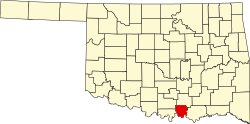
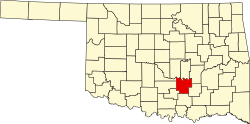
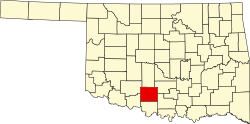
The Chickasaw Nation’s reservation[2] spans approximately 7,648 square miles in south-central Oklahoma. It is divided into four districts: Pontotoc, Pickens, Tishomingo, and Panola, which include counties such as Bryan, Carter, Coal, Garvin, Grady, Jefferson, Johnston, Love, McClain, Marshall, Murray, Pontotoc, and Stephens counties.[3]

During the 18th and 19th centuries, several Indigenous nations, including the Chickasaw Nation, were noted for adopting centralized governments, written constitutions, and participating in agricultural economies. These nations, historically referred to as the Five Civilized Tribes, also engaged in cross-cultural exchanges, such as intermarriage and the integration of educational and religious practices, as part of their adaptive strategies to navigate changing political and social conditions.[4]

The Chickasaw language (Chikashshanompa’) is part of the Muskogean language family. It is primarily an oral language, and much of the Chickasaw cultural heritage is preserved through intergenerational storytelling.[5] The linguistic similarities between Chickasaw and Choctaw have led to various theories about their shared origins, though definitive conclusions remain uncertain.[6]

The Chickasaw Nation’s societal structure is based on matrilineal clans, with two traditional moieties: the Imosak Chá'a' and the Inchokka' Lhipa'. Clan leaders hold significant roles in maintaining the cultural and organizational integrity of the nation.[7]

Clans within the Chickasaw Nation are separated into two moieties: the Imosak Chá'a' and the Inchokka' Lhipa', with each clan having their own leaders. Their tradition of matrilineal descent provides the basic societal structure of the nation, with children becoming members of and under the care of their mother’s clan.[8]

History

[edit]

Origins

[edit]

Mississippian cultures developed around 800 CE along the Mississippi River and across the Eastern Woodlands with some regional variations. This was a period of increasing sociopolitical complexity, with the intensification of agriculture, settlements in larger towns or chiefdoms, and the formation of strategic alliances to facilitate communication. Organization of labor is evidenced by mounds, and the skill and craftmanship of artisans is reflected in the elaborate and intricate remains of burials.[9] Furthermore, as chiefdoms arose within the Chickasaw Nation—and across the Southeast in general—the increased social complexity and population growth were sustained by effective and widespread farming practices.

While the origins of the Chickasaw continue to remain uncertain, anthropologists and historians have proposed several theories. One theory is that the Chickasaw were at one time a part of the Choctaw and later branched off, given their close connections linguistically and geographically.[10] Another is that they were descendants of the pre-historic Mississippian tribes, having migrated from the West given their oral histories.[11] According to some of their oral stories, the Chickasaw first settled in the Chickasaw Old Fields, what is currently northern Alabama today, and later re-established themselves near the Tombigbee River.[12]

European contact, 16th–17th century

[edit]

Hernando de Soto is credited as being the first European to contact the Chickasaw during his travels of 1540, and along with his army, were some of the first, and last, European explorers to come into contact with the Mississippian cultures and nations of the Southeast. He learned they were an agrarian nation with the political organization of a chiefdom governmental system, with the head chief residing in the largest and main temple mound in the chiefdom, with the remaining family lineage and commoners spreading out across the villages.[13] Months after an uneasy truce permitting the Spanish stay in their camps for the winter and survive on the tribe's food supply, the Chickasaws planned a surprise night attack on Desoto and his men as they prepared to leave. By this, they successfully sent a defiant message to their European enemies not to return to their land. As a result, 150 years passed before the Chickasaw received another European expedition.[14]

The next encounter the Chickasaw Nation had with European settlers was with French explorers René-Robert de La Salle and Henri de Tonti.[15] Not long after, by the end of the 17th century, the Chickasaw Nation had established successful trade relationships with European settlers in the American Southwest. In exchange for hides and slaves, the Chickasaw obtained metal tools, guns, and other supplies from the settlers.[16] With a population of around 3,500–4,000, the Chickasaw were smaller than their surrounding neighbors such as the Choctaw, with a population of about 20,000.[17] However, there became increased efforts by the English and the French to establish and maintain strong alliances with the Chickasaw Nation and surrounding sovereign tribes due to power struggles in the region; effective trade routes later became the focal point of the wars fought between Great Britain and France.[18] During the colonial period, some Chickasaw towns traded with French colonists from La Louisiane, including their settlements at Biloxi and Mobile.

18th–19th century

[edit]

After the American Revolutionary War, the new state of Georgia was trying to strengthen its claim to western lands, which it said went to the Mississippi River under its colonial charter. It also wanted to satisfy a great demand by planters for land to develop, and the state government, including the governor, made deals to favor political insiders. Various development companies formed to speculate in land sales. After a scandal in the late 1780s, another developed in the 1790s. In what was referred to as the Yazoo land scandal of January 1795, the state of Georgia sold 22 million acres of its western lands to four land companies, although this territory was occupied by the Chickasaw and other tribes, and there were other European nations with some sovereignty in the area.[19] This was the second Yazoo land sale, which generated outrage when the details were publicized. Reformers passed a state law forcing the annulment of this sale in February 1796.[20] But the Georgia-Mississippi Company had already sold part of its holdings to the New England Mississippi Company, and it had sold portions to settlers. Conflicts arose as settlers tried to claim and develop these lands. Georgia finally ceded its claim to the U.S. in 1810, but the issues took nearly another decade to resolve.

Abraham Bishop of New Haven, Connecticut, wrote a 1797 pamphlet to address the land speculation initiated by the Georgia-Mississippi Company. Within this discussion, he wrote about the Chickasaw and their territory in what became Mississippi:

The Chickasaws are a nation of Indians who inhabit the country on the east side of the Mississippi, on the head branches of the Tombeckbe (sic), Mobille (sic) and Yazoo rivers. Their country is an extensive plain, tolerably well watered from springs, and a pretty good soil. They have seven towns, and their number of fighting men is estimated at 575.[21]

James Adair, who in 1744 resided among the Chickasaw, named their principal towns as being Shatara, Chookheereso, Hykehah, Tuskawillao, and Phalacheho.[22][23] The Chickasaw sold a section of their lands with the Treaty of Tuscaloosa, resulting in the loss of what became known as the Jackson Purchase, in 1818. This area included western Kentucky and western Tennessee, both areas not heavily populated by members of the tribe. They remained in their primary homeland of northern Mississippi and northwest Alabama until the 1830s. After decades of increasing pressure by federal and state governments to cede their land, as European Americans were eager to move into their territory and had already begun to do so as squatters or under fraudulent land sales, the Chickasaw finally agreed to cede their remaining Mississippi homeland to the U.S. under the Treaty of Pontotoc Creek and relocate west of the Mississippi River to Indian Territory.

Map of Chickasaw Nation, 1891

The Chickasaw removal is one of the most traumatic episodes in the history of the nation. As a result of the Indian Removal Act of 1830, the Chickasaw Nation was forced to move to Indian territory, suffering a significant decline in population. However, due to the negotiating skills of the Chickasaw leaders, they were led to favorable sales of their land in Mississippi. Of the Five Civilized Tribes, the Chickasaw were one of the last ones to move. In 1837, the Chickasaw and Choctaw signed the Treaty of Doaksville,[24] by which the Chickasaw purchased the western lands of the Choctaw Nation in Indian Territory. This western area was called the Chickasaw District, and consisted of what are now Panola, Wichita, Caddo, and Perry counties.

Although originally the western boundary of the Choctaw Nation extended to the 100th meridian, virtually no Chickasaw lived west of the Cross Timbers, due to continual raiding by the Plains Indians of the southern region. The United States eventually leased the area between the 100th and 98th meridians for the use of the Plains tribes. The area was referred to as the "Leased District".[25]

The division of the Choctaw Nation was ratified by the Choctaw–Chickasaw Treaty of 1854. The Chickasaw constitution, establishing the nation as separate from the Choctaw, was signed August 30, 1856, in their new capital of Tishomingo (now Tishomingo, Oklahoma). The first Chickasaw governor was Cyrus Harris. The nation consisted of four divisions: Tishomingo County, Pontotoc County, Pickens County, and Panola County. Law enforcement in the nation was provided by the Chickasaw Lighthorsemen. Non-Indians fell under the jurisdiction of the federal court at Fort Smith.

Following the Civil War, the United States forced the Chickasaw Nation into a new peace treaty due to their support for the Confederacy. Under the new treaty, the Chickasaw (and Choctaw) ceded the "Leased District" to the United States.

20th century to present

[edit]

In 1907, when Oklahoma entered the Union as the 46th state, the role of tribal governments in Indian Territories ceased, and as a result, the Chickasaw people were then granted United States citizenship.[citation needed] Sippia Paul Hull, born 1852, wrote about her experiences growing up in the Chickasaw Nation.[26] These accounts were later stored in the archives of the Pauls Valley Memorial Library.[26] For decades until 1971, the United States appointed representatives for the Chickasaw Nation. Douglas H. Johnston was the first man to serve in this capacity. Governor Johnston served the Chickasaw Nation from 1906 until his death in 1939 at age 83.

Though it may have seemed like the federal government finally achieved their goal of completely assimilating the Chickasaw Nation into mainstream American life, the Chickasaw people continued to practice traditional activities and gather together socially, believing that the community involvement would sustain their culture, language, core beliefs, and values. This gave rise to the movement towards which the Chickasaw would govern themselves.

During the 1960s and the civil rights movement, Native American Indian activism was on the rise. A group of Chickasaw met at Seeley Chapel, a small country church near Connerville, Oklahoma, to work toward the re-establishment of its government. With the passage of Public Law 91-495, their tribal government was recognized by the United States. In 1971, the people held their first tribal election since 1904. They elected Overton James by a landslide as governor of the Chickasaw Nation, further tightening communal support and identity.

Since the 1980s, the tribal government has focused on building an economically diverse base to generate funds that will support programs and services to Indian people.

Culture

[edit]

Language

[edit]

Chikashshanompa’, a traditionally oral language, is the primary and official language of the Chickasaw Nation. Over 3,000 years old,[27] Chikashshanompa’ is part of the Muskogean language family and is very similar to the Choctaw language. There has been a great decline over the years in the number of speakers, as the language is spoken by less than two hundred people today, with the majority being Chickasaw elders.[28] The Chickasaw language was often discouraged in students attending school (often even including tribally run schools).[29]

In 2007, the Chickasaw Nation of Oklahoma enacted and began promoting the Chickasaw Language Revitalization Program. A focus of this program is the Master Apprentice Program, which pairs a language-learning student with an individual already fluent in Chikashshanompa’ in attempts to gain conversational fluency.[30] Other attempts at language revitalization have included establishing university language courses, creating a language learning app, and running youth language clubs.

Religion and cultural practice

[edit]

At the core of Chickasaw religious beliefs and traditions is the supreme deity Aba' Binni'li' (lit.'the One sitting / dwelling above'), the spirit of fire and giver of life, light, and warmth. Aba' Binni'li' is believed to live above the clouds along with a number of other lesser deities, such as the spirits of the sky and clouds, and evil spirits.[10]

The Chickasaw Nation follows the traditional monogamous marriage system,[31] with the groom obtaining the blessings of the wife’s parents and following with a simple ceremony soon after. Marriage ceremonies were all arranged by women. Adultery is a misdemeanor seriously looked down upon with severe private as well as public consequences since this was thought to bring shame and dishonor to the families.[10] As the Chickasaws practice matrilineal descent, children usually follow their mother’s house or clan name.

The Green Corn Festival is one of the largest and most important ceremonies of the Chickasaw Nation. This religious festival takes place in the latter half of summer, lasting two to eight days. It serves as a religious renewal in addition to thanksgiving, as all members of the tribe give thanks for the year’s corn harvest and pray to Aba' Binni'li'.[32] Major events held during the celebration include a two-day fast, a purification ceremony, the forgiveness of minor sins, the Stomp Dance (the most well-known traditional dances of the Chickasaw), and major ball games.[33]

Government and politics

[edit]

The Chickasaw Nation is headquartered in Ada, Oklahoma. Their tribal jurisdictional area is in Bryan, Carter, Coal, Garvin, Grady, Jefferson, Johnston, Love, McClain, Marshall, Murray, Pontotoc, and Stephens counties in Oklahoma. The tribal governor is Bill Anoatubby.[34] Anoatubby was elected governor in 1987, and at the time, the tribe had a larger spending budget than funds available.[35] Anoatubby's effective management gradually led the tribe toward progress, as tribal operations and funding have increased exponentially. Governor Anoatubby lists another of his primary goals as meeting the needs and desires of the Chickasaw people by providing opportunities for employment, higher education, and health care services.

The Chickasaw Nation’s current three-department system of government was established with the ratification of the 1983 Chickasaw Nation Constitution. The tribal government takes the form of a democratic republic. The governor and the lieutenant governor are elected to serve four-year terms and run for political office together. The Chickasaw government also has an executive branch, legislative branch, and judicial department. In addition to electing a governor and lieutenant governor, voters also select thirteen members to make up the tribal legislature (with three-year terms), and three justices to make up the tribal supreme court.[36] The elected officials provided for in the Constitution believe in a unified commitment, whereby government policy serves the common good of all Chickasaw citizens. This common good extends to future generations as well as today’s citizens.

The structure of the current government encourages and supports infrastructure for strong business ventures and an advanced tribal economy. The use of new technologies and dynamic business strategies in a global market are also encouraged. Revenues generated by Chickasaw Nation tribal businesses support tribal government operations, are invested in further diversification of enterprises, and fund more than 200 programs and services. These programs cover education, health care, youth, aging, housing and more, all of which directly benefit Chickasaw families, Oklahomans, and their communities.[37][38] This unique system is key to the Chickasaw Nation’s efforts to pursue self-sufficiency and self-determination, ensuring the continuous enrichment and support of Indian lives.

Governor Anoatubby appointed Charles W. Blackwell as the Chickasaw Nation's first Ambassador to the United States in 1995.[39] Blackwell had previously served as the Chickasaw delegate to the United States from 1990 to 1995. At the time of his appointment in 1995, Blackwell became the first Native American tribal ambassador to the United States government. Blackwell served in Washington as ambassador from 1995 until his death on January 3, 2013.[39] Governor Anoatubby named Neal McCaleb ambassador-at-large in 2013, a role similar to Blackwell's. McCaleb died in January 2025.[40]

Economy

[edit]
The WinStar World Casino

The Chickasaw Nation operates more than 100 diversified businesses in a variety of services and industries, including manufacturing, energy, health care, media, technology, hospitality, retail and tourism.[37] Among these are Bedré Fine Chocolate in Davis, Lazer Zone Family Fun Center and the McSwain Theatre in Ada; The Artesian Hotel in Sulphur; Chickasaw Nation Industries in Norman; Global Gaming Solutions, LLC; KADA (AM), KADA-FM, KCNP, KTLS, KXFC, and KYKC radio stations in Ada; and Treasure Valley Inn and Suites in Davis. In 1987, with funding from the U.S. federal government, the Chickasaw Nation operated just over thirty programs with the goal of developing a firm financial base. Today, the nation has more than two hundred tribally funded programs and more than sixty federally funded programs providing services in sectors such as housing, education, entertainment, employment, and healthcare.

Governor Anoatubby highly prioritizes the services available to the Chickasaw people. Two health clinics (in Tishomingo and Ardmore), as well as the Chickasaw Nation Medical Center in Ada, were established in 1987.[citation needed] Not long after, many additional health clinics and facilities opened, with even a convenient housing facility on the campus of the Chickasaw Nation Medical Center designed to relieve families and patients of travel and lodging costs if traveling far from home.

Increases in higher education funding and scholarships have enabled many students to pursue higher education, with funding increasing from $200,000 thirty years ago[as of?][citation needed] to students receiving more than $15 million in scholarships, grants, and other educational support.[38]

The Chickasaw Nation is also contributing heavily to the tourism industry in Oklahoma. In 2010, the Chickasaw Cultural Center opened, attracting more than 200,000 visitors from around the world as well as providing hundreds of employment opportunities to local residents.[41] In this year alone, the Chickasaw Nation also opened a Welcome Center, Artesian Hotel, Chickasaw Travel Shop, Chickasaw Conference Center and Retreat, Bedré Fine Chocolate Factory, and the Salt Creek Casino.

In 2002, the Chickasaw Nation purchased Bank2 with headquarters in Oklahoma City. It was renamed 'Chickasaw Community Bank' in January 2020. It started with $7.5 million in assets and has grown to $135 million in assets today.[42] The Chickasaw Nation also operates many historical sites and museums, including the Chickasaw Nation Capitols and Kullihoma Grounds, as well as a number of casinos. Their casinos include Ada Gaming Center, Artesian Casino, Black Gold Casino, Border Casino, Chisholm Trail Casino, Gold Mountain Casino, Goldsby Gaming Center, Jet Stream Casino, Madill Gaming Center, Newcastle Casino, Newcastle Travel Gaming, RiverStar Casino, Riverwind Casino, Treasure Valley Casino, Texoma Casino, SaltCreek Casino, Washita Casino, and WinStar World Casino. They also own Lone Star Park in Grand Prairie, Texas, and Remington Park Casino in Oklahoma City. The estimated annual tribal economic impact in the region from all sources is more than $3.18 billion.[34]

From 2023 to 2025, Chickasaw nation was looking to build a casino hotel in New York City. They proposed building The Coney which would have been built in Coney Island, located in Brooklyn. The proposed development faced significant opposition with the community advisory committee affirming their intents to reject the proposed casino hotel development.[43]

Notable people

[edit]

References

[edit]

Sources

[edit]

Further reading

[edit]
[edit]
Revisions and contributorsEdit on WikipediaRead on Wikipedia
from Grokipedia

The (Chickasaw: Chikashsha I̠yaakni) is a federally recognized sovereign Native American tribe headquartered in , originally from the Southeastern Woodlands and now spanning 13 counties in south-central with a government structured into three branches under a 1983 constitution.
The people migrated to present-day , , , and in prehistoric times, establishing a society marked by advanced governance, trade, and military strength, as evidenced by their resistance to European incursions following first contact with in 1540.
Forcibly relocated to via the in the 1830s under the Treaty of Doaksville, the Chickasaws separated from the Choctaws in 1856 to form an independent nation, which allied with the Confederacy during the Civil War before rebuilding through agriculture, , and early institutions post-1907 statehood.
Revitalized in the late 20th century, the Nation has pursued , with Governor leading since 1987 to foster economic diversification beyond gaming—though like WinStar generate substantial revenue—into , healthcare, and , funding extensive citizen services in , housing, and cultural preservation.
This strategic development has elevated the to economic prominence among tribes, supporting over 140,000 jobs statewide through tribal enterprises while maintaining tribal amid ongoing negotiations over gaming compacts and federal relations.

History

Pre-Columbian Origins and Early Society

The ancestors of the inhabited the upland regions of northeast during the late prehistoric period, with archaeological evidence linking them to the that flourished from approximately 1000 to 1500 CE across the . Sites in this area reveal platform mounds, earthen enclosures, and artifacts indicative of hierarchical chiefdoms centered on intensive agriculture supplemented by beans, squash, and riverine resources. Settlement patterns favored ridge tops for defense and drainage, featuring dispersed farmsteads clustered around central plazas rather than densely fortified towns, reflecting a society adapted to fertile soils and proximity to streams for hunting and fishing. Chickasaw oral traditions recount a migration from western lands, guided by prophets who divined a new homeland through rituals involving a sacred pole, but archaeological continuity in ceramics, lithic tools, and village layouts from Mississippian to protohistoric phases (ca. 1400–1540 CE) suggests local evolution rather than large-scale population movement. This empirical record prioritizes in-situ cultural development from earlier predecessors, with no substantial faunal or botanical evidence supporting transcontinental migration; traditions may encode symbolic ancestral journeys or post-contact displacements. Social organization was matrilineal, with descent, inheritance, and clan affiliation traced exclusively through the mother's line, fostering kinship networks that regulated exogamous marriages and provided mutual aid in warfare or subsistence shortfalls. Society divided into two moieties—Imosak Chá'a' (those who are alike) and Inchokka' Lhipa' (those who are different)—encompassing multiple totemic clans such as Raccoon, Panther, and Wild Cat, each with elders advising on disputes and rituals. Leadership emerged from accomplished warriors and minko (peace chiefs), selected for prowess in raids and hunts, while women managed households, agriculture, and pottery production essential to village economies of 100–500 inhabitants. Communal structures included thatched wattle-and-daub houses arranged in kin-based clusters, underscoring a warrior-farmer ethos sustained by bow hunting of deer and turkey alongside cultivated fields.

European Contact and Colonial Interactions (16th–18th Centuries)

The first encountered Europeans during Hernando de Soto's expedition in late 1540, when the Spanish force entered their territory in present-day northeastern and established a winter camp at the village of Chicaza. De Soto demanded porters and supplies from the , who resisted, launching a nighttime attack on March 4, 1541, that destroyed much of the Spanish baggage train and livestock, forcing de Soto to retreat northward without establishing lasting contact. This encounter, documented in Spanish chronicles, highlighted the 's military resolve but introduced diseases that decimated their population in subsequent decades. By the late , hunters engaged in the deerskin trade and Indian slave raids, initially with French traders from country, but shifted alliances toward English colonies in Carolina by 1700 due to better terms for guns, , and cloth in exchange for pelts and captives. This trade fueled conflicts with French-allied , who received firearms and scalping bounties, leading to raids that burned villages and crops in the 1720s and 1730s. The , leveraging English-supplied weapons, conducted retaliatory strikes on French convoys and allied Natchez, maintaining autonomy despite numerical disadvantages. French military campaigns intensified in the 1730s under governors like Jean-Baptiste Le Moyne de Bienville, culminating in the failed 1736 expedition where combined French-Choctaw forces numbering over 1,200 suffered defeats at Chickasaw bluffs, with leaders like Pierre d'Artaguette captured and burned. A second major push in 1739-1740 also faltered due to logistical failures and Chickasaw ambushes, prompting a 1744 peace treaty that recognized Chickasaw independence but left underlying trade rivalries unresolved. During the French and Indian War (1754-1763), Chickasaw neutrality tilted toward British interests, harassing French outposts and contributing to the expulsion of French influence from the Mississippi Valley by 1763. These interactions preserved Chickasaw sovereignty amid colonial competition, with their strategic position enabling selective alliances rather than subjugation.

19th-Century Expansion, Treaties, and Removal

In the early , the Chickasaw Nation controlled extensive hunting grounds and settlements primarily in northern , with portions extending into western , northwestern , and southwestern , territories acquired through prior intertribal conflicts and migrations from the Ohio Valley region. These lands faced encroachment from American settlers following the in 1803, prompting initial treaties to define boundaries and cede marginal areas. The 1816 Treaty with the Chickasaw, signed at the Chickasaw Old Fields in , established perpetual peace and confirmed U.S. over certain frontier posts while securing Chickasaw rights to their core domains. By the 1820s, intensified settlement and speculative land claims eroded Chickasaw autonomy, leading to resistance against further concessions until the of 1830 formalized U.S. policy to relocate southeastern tribes west of the . The Chickasaw initially rejected a proposed 1830 treaty at , which sought their immediate removal, but mounting pressures—including state assertions of jurisdiction over tribal lands—culminated in the Treaty of Pontotoc Creek on October 20, 1832. This agreement ceded all Chickasaw lands east of the to the in exchange for $3 million, earmarked for purchasing equivalent western territory and covering removal costs, with provisions allowing the Chickasaw to select their new homeland rather than accept predefined allotments. Negotiations for western lands proceeded amid Choctaw prior claims in , resulting in the Treaty of Doaksville, which enabled the to buy 10 million acres from the for $530,000, establishing a provisional district within Choctaw boundaries. Removal detachments commenced on July 4, , from , with the —unlike many tribes—financing their own migration using treaty proceeds, organizing overland and steamboat convoys that transported approximately 4,600 people in multiple groups between and 1847. Mortality rates remained lower than in contemporaneous or removals, attributed to self-managed logistics and fewer forced marches, though the process still involved significant hardships, including disease and harsh travel conditions; by 1851, the vast majority had relocated to what is now south-central , with stragglers arriving into the . This relocation marked the end of presence in their ancestral Southeast, transitioning their society toward adaptation in the new territory under shared governance until formal separation in 1855.

Civil War Involvement and Post-War Reconstruction

The Chickasaw Nation aligned with the early in the Civil War, driven by economic interdependence with southern states, ownership of enslaved , and cultural affinities with the . On May 25, 1861, the Chickasaw legislature passed a resolution dissolving ties with the and endorsing . This was formalized on July 12, 1861, when Confederate commissioner signed a treaty with the Chickasaw and nations, granting them territorial guarantees, representation in the , and protections for in exchange for military support and from the Union. The Chickasaw, the wealthiest of the Five Civilized Tribes with significant slaveholdings, viewed the alliance as a defense of their property rights and autonomy against perceived federal overreach. Chickasaw forces contributed to Confederate efforts in , forming units such as the First Regiment and Chickasaw Mounted Rifles under pro-Confederate agent Douglas H. Cooper. These troops participated in engagements like the Battle of Mill Creek and defended against Union incursions, though internal divisions emerged among some leaders and Unionist factions. The Nation's commitment persisted until the war's end; it was the last Confederate entity to surrender formally in June 1865, reflecting the depth of their alignment despite territorial devastation from raids and supply shortages. Post-war reconstruction imposed severe penalties on the for their Confederate allegiance. On April 28, 1866, the Nation, in a joint treaty with the proclaimed July 10, 1866, formally reestablished relations with the , abolishing and except as punishment for crime. The treaty required ceding approximately 4,000 square miles of land west of the domain for railroad rights-of-way and potential white settlement, while allocating funds for freedmen's support—$300 per initially, without granting them tribal , a provision the resisted unlike other tribes. This arrangement, which provided annual payments to freedmen instead of integration, stemmed from the Nation's insistence on preserving communal resources amid war-induced and population losses exceeding 10% from , , and . The agreements also mandated internal reforms, including councils to abolish and liquor , signaling federal oversight to realign tribal institutions with Union policies. These concessions diminished sovereignty and territory, setting precedents for future federal encroachments that exacerbated economic decline in the late .

Allotment, Statehood, and Early 20th-Century Decline

The , established by an on March 3, 1893, initiated the enrollment and allotment process for the Five Civilized Tribes, including the Nation, aiming to dissolve communal land holdings in . Negotiations culminated in the Atoka Agreement of April 23, 1897, between the Chickasaw and Nations and the , which outlined the division of their shared 10.5 million-acre territory into individual allotments while reserving minerals and timber rights. This agreement was ratified by Congress as part of the Curtis Act on June 28, 1898, which extended mandatory allotment to resistant tribes, abolished tribal courts and governments upon completion of allotments, and facilitated the transfer of surplus lands—approximately 70 percent of tribal holdings—to federal control for eventual sale to non-Native settlers. Under the , each enrolled citizen received 160 acres of land, with additional provisions for freedmen and intermarried whites, based on the compiled between 1898 and 1906; by final enrollment, approximately 5,742 by blood were recorded, alongside smaller numbers of other categories, totaling over 6,300 tribal citizens. Restrictions on land sales were imposed for 25 years to prevent immediate exploitation, but an "incompetency" clause allowed guardians to manage allotments for those deemed incapable, often leading to fraudulent sales and rapid alienation of holdings. Surplus lands were opened to white settlement through auctions and lotteries starting in 1901, flooding the region with non-Natives and eroding the land base. Oklahoma statehood, enacted via the Oklahoma Enabling Act of June 16, 1906, and effective on November 16, 1907, incorporated the Chickasaw territories into the new state, formally dissolving the Chickasaw Nation's constitutional government and placing its principal chief under presidential appointment rather than tribal election. Tribal courts were replaced by state judiciary, and public schools, previously funded and operated by the nation, fell under state control, though federal promises of retained and citizenship were inconsistently honored. This transition stripped the Chickasaw of , integrating their 13 counties—primarily in south-central —into state structures that prioritized assimilation and resource extraction. In the ensuing decades, the Chickasaw experienced a marked decline in collective autonomy and , as fractionated allotments from led to disputes and sales, reducing tribal land ownership to scattered parcels by the ; many families, lacking capital or legal protections, lost holdings to taxes, , or unscrupulous buyers, fostering widespread amid the that benefited outsiders more than allottees. Population figures remained around 6,000 enrolled members through the , but cultural practices waned under state-imposed English-only schooling and Prohibition-era disruptions, while federal policies like the granted individual rights at the expense of tribal . By the , the absence of unified governance exacerbated hardships, with the nation reduced to an administrative shell until mid-century reforms.

Revival, Self-Governance, and Modern Developments (Mid-20th Century to Present)

In the mid-20th century, the Chickasaw Nation faced ongoing challenges from the allotment era and statehood, which had fragmented tribal lands and curtailed governance authority, yet federal shifts toward Indian began fostering revival efforts. The Indian Self-Determination and Education Assistance Act of 1975 enabled tribes to assume control over federal programs, allowing the Chickasaw to expand services in health, education, and social welfare despite not reorganizing under the 1934 , from which the Five Civilized Tribes were largely exempt. By the 1970s, under Overton James (serving 1948–1971) and successors, the Nation initiated steps to reconstitute formal governance, culminating in a 1979 constitution modeled on the pre-Removal 1867 framework, though it was superseded by a more comprehensive document in 1983. The 1983 Chickasaw Nation Constitution, ratified on August 27, 1983, marked a pivotal revival by establishing a modern three-branch government—executive, legislative, and judicial—restoring sovereign structures eroded since the early 1900s. This framework separated powers, created a 13-member Chickasaw Nation Council, and empowered the governor with administrative authority, enabling proactive self-governance amid federal recognition of tribal sovereignty. , elected governor in 1987, has led continuously through 10 terms as of 2023, overseeing expansions in tribal infrastructure, including courts, , and administrative bodies that assert jurisdiction over reservation lands. Modern developments since the 1980s have centered on economic self-sufficiency, driven initially by the of 1988, which authorized tribal casinos on reservation lands. The Chickasaw Nation opened its first gaming facilities in the early 1990s, with and Resort—launched in , in 2003—emerging as the world's largest by gaming floor space, generating substantial revenue that funds diversification into manufacturing, banking, government contracting, and energy sectors. By 2023, the Nation employed over 14,000 individuals and supported an enrolled citizenry exceeding 80,000, with investments in education (e.g., scholarships and the Chickasaw Institute of Technology, graduating 187 students since 2019), healthcare facilities, and cultural preservation programs reinforcing community resilience. These advancements have strengthened federal-tribal relations, with the Chickasaw asserting treaty-based rights in land acquisitions and resource management, while navigating compacts with for gaming exclusivity. Economic growth has enabled , such as partnerships in non-gaming ventures like a proposed development in 2025, underscoring the Nation's transition from historical marginalization to sovereign prosperity.

Territory and Demographics

Original Homeland and Traditional Lands

The Chickasaw Nation's original homeland was located in the , primarily encompassing northern , with extensions into northwestern , western , and southwestern . This territory featured dense hardwood forests, fertile river valleys along the , , and Tombigbee rivers, and open prairies that supported a mixed economy of , , and gathering. The landscape's riverine and woodland characteristics facilitated the Chickasaw's semi-permanent villages, mound-building practices, and control over trade routes, which were central to their societal organization prior to European contact. Archaeological and ethnohistorical evidence indicates that the occupied these lands by at least the late prehistoric period, around 1000–1500 CE, as part of the broader Mississippian cultural complex, with mound sites such as those near present-day , serving as ceremonial and residential centers. Oral traditions preserved by the describe a migration from western regions across the to this homeland in prehistoric times, establishing a distinct identity separate from but linguistically related to neighboring tribes like the . The traditional lands' boundaries were fluid, defined by kinship networks, warfare, and resource claims rather than fixed borders, extending eastward to the Appalachian foothills and northward along the . These homelands provided essential resources, including deer, turkey, and small game for protein; , beans, and squash cultivated in river-bottom fields; and clay for , enabling a estimated at 3,000–5,000 individuals organized into matrilineal clans by the time of early European exploration in the . The Chickasaw's strategic position in the region positioned them as intermediaries in pre-colonial networks, exchanging deerskins, salt, and captives for European goods following initial contacts with Spanish expeditions like Hernando de Soto's in 1540. However, repeated conflicts with and rival tribes, exacerbated by colonial expansion, progressively eroded control over these traditional territories through a series of treaties beginning in the late .

Current Reservation and Enrolled Population

The Chickasaw Nation's current jurisdictional territory spans 7,648 square miles across south-central , encompassing all or portions of 13 counties. These counties are Bryan, Carter, , Garvin, Grady, Jefferson, Johnston, , McClain, Marshall, Murray, Pontotoc, and Stephens. The territory serves as the basis for tribal services, governance, and economic activities, though it consists primarily of fee-simple lands rather than a contiguous reservation due to historical allotment and statehood processes. The Nation maintains approximately 38,000 enrolled citizens, defined by lineal descent from individuals listed on the 1890-1914 as by blood, verified through a Certificate of Degree of Indian Blood (CDIB). About one-third reside within the 13-county area, another third elsewhere in , and the remainder across the and abroad. This enrollment figure reflects strict blood quantum and descent criteria, distinguishing it from self-identified ancestry counts in censuses, which are higher.

Government and Sovereignty

Constitutional Government and Structure

The 's constitutional framework was reestablished with the ratification of its on January 1, 1983, which divides governmental powers into three distinct departments: legislative, executive, and judicial, modeling a akin to the U.S. federal system. This document, amended on June 22, 1990, and June 21, 2002, vests authority to serve the people through elected representatives and officials. The emphasizes self-governance, with the tribal seat located in , and regional offices in Ardmore, Tishomingo, and Purcell. The executive branch is headed by a , styled as the , who holds supreme executive power under Article X of the , elected by registered voters for a four-year term alongside a . The Governor oversees administration, enforces laws, and manages tribal operations, supported by appointed officials and departments focused on services like , and . Legislative authority resides in the Chickasaw Nation Tribal Legislature, a unicameral body of 13 members elected from four —Panola, Pickens, Pontotoc, and Tishomingo—for staggered four-year terms. The Legislature convenes in regular sessions to enact laws, approve budgets, and oversee reapportionment plans, with district representation ensuring proportional voice based on enrolled . Leadership roles, such as chairperson and secretary, rotate among members. The judicial department includes a Supreme Court comprising three justices elected for six-year terms, along with district and appellate courts to interpret the , resolve disputes, and administer justice under tribal law. This structure upholds , with checks and balances to prevent overreach, as ratified voters directly elect all principal officials to maintain accountability.

Leadership and Political Institutions

The Chickasaw Nation operates under a constitutional framework that divides governmental powers into three distinct branches: executive, legislative, and judicial, as established by the of its modern on November 19, 1983, and subsequent amendments including those in 2002. This structure revives elements of the tribe's 1856 , which first formalized self-governance after separation from the Choctaw Nation, emphasizing modeled on republican principles to ensure checks and balances. The system prioritizes citizen participation, with eligible voters—enrolled Chickasaw citizens aged 18 and older—electing officials in nonpartisan elections held every four years. The executive branch is led by the , who serves as the responsible for implementing tribal laws, managing administrative operations, and representing the nation in external affairs, including federal negotiations and economic initiatives. The lieutenant assists and assumes duties in the governor's absence. has held the governorship since his election in 1987, overseeing expansions in , , and gaming enterprises that have bolstered tribal without imposing direct taxes on citizens. As of October 2025, Anoatubby continues in office, delivering the annual State of the Nation address on October 4, 2025, which highlighted ongoing infrastructure projects and cultural preservation efforts. Legislative authority resides in the Chickasaw Nation Legislature, comprising 13 elected representatives from defined districts across the 13 counties of the Chickasaw Nation territory, who convene to enact laws, approve budgets, and oversee executive actions. Members serve four-year terms, with elections staggered to maintain continuity, and the body operates through committees addressing policy areas such as and public welfare. This unicameral assembly reflects the tribe's emphasis on localized representation, drawing from traditional councils while adapting democratic processes to contemporary needs. The judicial branch, independent from the other arms, includes a with three justices appointed by the and confirmed by the , tasked with interpreting the , resolving disputes, and upholding tribal . Lower courts handle civil and criminal matters under the Nation , which codifies laws without reliance on federal taxation for operations. This framework has enabled the nation to assert over internal affairs, fostering stability amid historical federal encroachments.

Federal Relations, Treaties, and Sovereignty Assertions

The Chickasaw Nation's relations with the federal government originated through a series of treaties that recognized the tribe's while facilitating land cessions and eventual removal from ancestral territories in the . The first formal treaty, the signed on January 10, 1786, established peace between the Chickasaw and the U.S., defined boundaries, and guaranteed the tribe's right to and protection from encroachments. This was followed by the 1801 Treaty of Chickasaw Bluffs, which provided reciprocal trade advantages and mutual defense commitments, further affirming the nation-to-nation relationship. By the early , escalating pressures from white settlement led to additional agreements, including the unratified Treaty of Franklin, which sought to exchange Mississippi lands for western territories but faced internal tribal opposition. The pivotal Treaty of Pontotoc Creek, signed October 20, 1832, ceded approximately 6.4 million acres of Chickasaw land in and to the U.S. in exchange for and a western homeland, marking the formal commencement of removal processes under President Andrew Jackson's policies. In 1837, the Treaty of Doaksville with the Nation enabled the Chickasaw to purchase a separate district within Choctaw lands in (present-day ) for $3 million, allowing relocation of about 4,000 tribal members between 1837 and 1839 amid significant hardship and mortality. Post-Civil War relations were reshaped by the 1866 Treaty with the and Chickasaw, ratified April 28, 1866, which required the abolition of within tribal territories, granted rights-of-way for railroads, and reaffirmed U.S. oversight while restoring annuity payments disrupted by the conflict. Federal policies in the late 19th and early 20th centuries, including the and the , imposed allotment of communal lands and curtailed tribal governance, dissolving the Chickasaw National Council by 1906 and integrating the territory into statehood on November 16, 1907, which diminished sovereignty through federal trusteeship over resources. The Chickasaw Nation reasserted its sovereignty through the ratification of a new constitution on June 1, 1983, approved by the U.S. Department of the Interior, which restored a three-branch emphasizing inherent self-rule predating European contact and rooted in guarantees of jurisdiction over persons and . This framework invokes treaties to claim "unrestricted right of self-government" and full authority within reservation boundaries, countering historical federal intrusions. In contemporary federal relations, the Chickasaw Nation maintains a government-to-government partnership, collaborating on services like and under acts such as the Indian Self-Determination and Education Assistance Act of 1975, while asserting in areas including , taxation (limited by ), and resource management. Tribal leaders emphasize inherent as enduring and pre-colonial, enabling investments in public safety and independent of state interference, as articulated by Governor in 2024 statements on treaty-based autonomy. The nation has invoked in inter-tribal compacts, such as 2024 agreements honoring and fishing licenses among Five Tribes to exercise wildlife jurisdiction. Despite federal plenary authority under Supreme Court precedents like (1832) and modern limitations, the Chickasaw continue to litigate and negotiate to expand , viewing treaties as binding compacts that underpin ongoing assertions against erosion by congressional acts or state claims.

Economy

Traditional and Historical Economic Practices

The Chickasaw people's pre-contact economy centered on agriculture, supplemented by , , gathering, and inter-tribal . Women primarily managed communal fields, cultivating corn alongside beans, squash, and other crops using stone tools and slash-and-burn techniques, yielding surpluses for storage and exchange. Men hunted deer, , and small game with bows and traps, providing hides, meat, and bone implements, while riverine locations facilitated with nets and hooks. Gathering wild , nuts, and berries filled seasonal gaps, and networks with neighboring tribes exchanged surplus goods like salt and shells for ceramics and items. European contact in the late introduced the deerskin trade, transforming Chickasaw economic patterns by orienting hunting toward export. Chickasaw hunters supplied thousands of deerskins annually to British and French traders via the , bartering for firearms, metal axes, cloth, and iron kettles, which enhanced productivity but depleted local deer populations by the mid-18th century and fostered dependency on imported goods. This integration into colonial markets spurred matrilineal clans to specialize in hide preparation, with women tanning and packing skins for shipment to ports like Mobile and New Orleans. Under U.S. policies from 1790 to 1837, the Chickasaw shifted to individualized plow , ranching, and cottage industries, adopting European-style farming tools and . Mixed-blood elites acquired plows, , and hogs, producing corn, , and for market sale, while incorporating African enslaved labor—numbering over 1,000 by —to expand plantations along fertile river bottoms. This transition from communal deerskin-focused systems to export-oriented cash crops generated wealth for a minority but eroded traditional roles, as men increasingly handled plowing and . After forced removal to in 1837, economy emphasized subsistence and commercial farming on allotted lands, with and corn as staples alongside prairie stock raising of , , and hogs. By 1843, agricultural output exceeded local needs, enabling exports; the 1850s saw establishment of gristmills, sawmills, and blacksmith shops, reflecting self-sufficiency efforts amid treaty-funded infrastructure. Civil War alliances with the Confederacy disrupted operations, but post-1865 recovery through ranching and grain production restored prosperity, with mixed-blood slaveholders leading commercial resurgence until allotment pressures in the fragmented holdings.

Gaming Industry and Economic Diversification

The Chickasaw Nation entered the gaming industry following the of 1988, which enabled federally recognized tribes to operate casinos on their lands under tribal-state compacts. The tribe established the Chickasaw Nation Office of the Gaming Commissioner in 1994 via the Public Gaming Act to regulate gaming activities across its 7,648-square-mile treaty territory, ensuring compliance with federal, state, and tribal laws. This office oversees licensing, investigations, and enforcement to maintain integrity in operations. The Nation operates over 20 gaming facilities, including and Resort in —the world's largest casino by gaming floor space with more than 10,500 electronic games and 100 table games—and others such as Riverwind Casino, Ada Gaming Center, Artesian Casino, Black Gold Casino, and Border Casino. These facilities generated more than $2 billion in gross gaming revenue in 2022, contributing significantly to the tribe's economy and funding public services. Under a tribal-state compact renewed in 2018, the Chickasaw Nation pays exclusivity fees to based on Class III gaming revenue, with statewide tribal payments exceeding $200 million in fiscal year 2023 from over $3.34 billion in such revenues. Gaming revenues have driven economic diversification, with the Chickasaw Nation investing in non-gaming sectors to reduce reliance on and support long-term self-sufficiency for its over 66,000 citizens. Governor has emphasized business diversification as key to growth, funding expansions in (e.g., Bedré Fine Chocolate production), hospitality (e.g., Artesian Hotel and Spa), retail (e.g., tobacco shops and gift shops), government contracting, and banking. These efforts have created jobs and bolstered tribal services in , and community programs, with net gaming income from facilities like WinStar directly supporting such initiatives.

Broader Economic Impacts and Self-Reliance

The Chickasaw Nation's economic activities generate substantial ripple effects across , supporting an estimated 14,000 direct jobs and contributing nearly $3 billion annually to the regional economy as of 2025. This impact encompasses not only tribal enterprises but also indirect employment in supply chains, , and local services, with broader state-level analyses attributing over $2.4 billion in total economic output to the Nation's operations, including wages, benefits, and vendor expenditures. Nationally, these efforts sustain more than 35,000 jobs and an $8.2 billion economic footprint, driven by diversified revenue streams that enhance fiscal stability amid fluctuating federal allocations. To foster , the Chickasaw Nation has pursued aggressive diversification beyond gaming, which accounts for approximately 91% of its revenue, into sectors such as manufacturing, banking, finance, retail, government contracting, and commercial healthcare. Operating over 60 businesses, including entities like Chickasaw Nation Industries and Bedré Fine Chocolate, the Nation has established a dedicated management team in 2025 to execute expansion strategies, thereby mitigating risks from gaming volatility and funding essential services independently. This approach aligns with long-term goals of economic self-sufficiency, reducing historical dependence on federal funds for health, education, and welfare programs, as enabled by the Indian Self-Determination Act of 1975. These initiatives have enabled the Nation to reinvest revenues—totaling billions in governmental income through August 2024—into self-funded , such as expanded healthcare facilities and educational resources, while maintaining strong financial reserves without over-reliance on external aid. By prioritizing internal growth and partnerships, the Chickasaw Nation exemplifies tribal through economic , supporting over 70,000 citizens and insulating community programs from budgetary uncertainties.

Culture and Society

Language Preservation and Linguistics

The , known as Chikashshanompa', belongs to the Western branch of the and is closely related to , sharing sufficient that some classify them as dialects of a single language. It exhibits agglutinative morphology, where words are formed by stringing affixes to roots, and follows a subject-object-verb . Phonologically, Chickasaw features a contrast between plain and glottalized stops, as well as tones that distinguish meaning in some contexts, reflecting adaptations common in Southeastern Native American languages. As of recent assessments, fewer than 75 fluent speakers remain, with the vast majority over age 55, rendering the language critically endangered due to historical disruptions from forced relocation, boarding schools, and assimilation policies that suppressed its use. First-language acquisition has nearly ceased, with estimates of fully fluent elders ranging from 30 to 50, and no monolingual speakers persisting into the 21st century. Despite this, over 1,000 Chickasaw citizens actively engage in learning, indicating potential for partial reversal through structured intervention. The Chickasaw Nation initiated formal language revitalization in 2007, establishing a dedicated department in 2009 to coordinate efforts grounded in the view that the language embodies ancestral knowledge essential to cultural identity. Key initiatives include the Revitalization Program, which deploys digital tools such as a custom course, a for basic vocabulary and phrases, and Chickasaw.TV for immersive video content featuring elders. Community-based components encompass adult immersion at the Chikasha Academy, where participants study in group settings to achieve conversational proficiency and subsequently teach others; youth clubs and summer camps; and master-apprentice pairings pairing fluent elders with learners for one-on-one transmission. These programs have yielded measurable progress, including the planned graduation of five advanced immersion students in 2024 to expand the teaching cadre, alongside to resources that have engaged hundreds in regular practice. However, challenges persist, as revitalization depends on sustained among new learners amid English dominance, with success metrics focusing on second-language proficiency rather than native-like mastery due to the absence of child acquirers. Complementary efforts involve documenting oral histories and translating hymns to preserve linguistic variants tied to Chickasaw-specific cultural expressions.

Traditional Practices, Religion, and Social Customs

The Chickasaw traditionally adhered to a monotheistic system centered on Aba' Binni'li', the supreme deity described as "the One who sits above" or the Creator, who formed humans from clay or dust and derived power from the sun. Villages maintained perpetual sacred fires as symbols of this divine energy, tended continuously to honor the creator's life-giving force. Unlike neighboring , Chickasaw cosmology avoided superstitious interpretations of celestial events like solar or lunar eclipses, emphasizing instead explanations rooted in natural and ancestral phenomena, migration legends, and family lineages. An concept prevailed, wherein virtuous individuals ascended to a heavenly reward while wrongdoers roamed eternally in a shadowy below. Religious observances intertwined with communal ceremonies, most notably the annual , a multi-day rite of renewal that consecrated the harvest, purified participants through fasting and emetics, and reinforced social bonds via stomp dances around central fires. Dancers employed shakers for rhythmic accompaniment, symbolizing harmony with nature and the Creator. Face in red, black, or white marked ceremonial participation or warfare preparations, while men styled hair into greased roaches atop shaved scalps to signify readiness for ritual or combat. Subsistence practices balanced , , and gathering, with women cultivating , beans, and squash in fertile riverine fields using hoes and slash-and-burn methods, yielding staple crops that supported sedentary villages. Men pursued deer, , and smaller game with , and traps, supplemented by seasonal of nuts, berries, and roots, fostering dietary diversity and resilience against environmental variability. Social organization revolved around a matrilineal clan system, wherein descent, inheritance, and identity traced exclusively through the mother's line, with clans symbolized by totemic animals like panthers, birds, or squirrels. —typically 10 to 12 in number—dictated exogamous marriage rules prohibiting unions within the same group to preserve lineage purity and networks, while vesting women with authority over , households, and child-rearing. Courtship often involved dances such as the Stealing Partners, where eligible men selected partners through ritualized exchanges, culminating in bride-price negotiations of deerskins or goods presented to her family. This structure upheld gender complementarity, with women wielding influence in councils and men leading war parties, ensuring clan-based reciprocity in governance and resource distribution.

Education, Health Services, and Community Programs

The Chickasaw Nation supports educational advancement through targeted programs spanning , , higher education, and vocational training, primarily for tribal citizens and residents within its 13-county service area in . Child development centers provide year-round childcare and foundational education to promote readiness for young children of Chickasaw Nation residents. The Learning Program offers academic assistance to adults seeking High School Equivalency certification, addressing barriers to completing . Higher education initiatives include grants, scholarships, and incentives disbursed each semester, with awards typically ranging from $150 to $800 based on institution type, credit hours (minimum three), and maintenance of a 2.0 GPA; these supplements cover tuition, books, and related costs for enrolled Chickasaw students. Vocational pathways are bolstered by the and Technical Grant, which funds up to $6,000 per certification for tuition and fees, and the Toksali SMART Program, offering workforce training and experiential opportunities for youth aged 14 to 21 to build practical skills. Health services are delivered via the Chickasaw Nation Department of Health, which maintains the Chickasaw Nation Medical Center—a full-service in —supplemented by three satellite clinics in Ardmore, Purcell, and Tishomingo, collectively employing around 1,300 personnel to serve tribal citizens and other First Americans. Core offerings at these facilities encompass acute for post-surgical recovery or illness management, for hearing diagnostics, behavioral health interventions including crisis support and family counseling, testing such as EKGs and stress tests, dental care, , emergency services, , , and psychiatric evaluations for conditions like depression, anxiety, and . Specialized programs address unmet needs, including the Tribal Health initiative providing up to $5,000 annually per citizen for supplemental medical, dental, or durable equipment expenses not covered elsewhere, and culturally informed options like the 52-week O.T.A.P. education program and Aalhakoffichi' trauma treatment integrating traditions. Community Health Representatives extend guidance in underserved areas where other resources are limited. Community programs emphasize practical support and cultural continuity, with the Tribal Burial Assistance Program reimbursing up to $5,000 toward final funeral expenses for deceased citizens, easing financial burdens on families. Youth-focused efforts include the Youth Support Reimbursement Program, which funds up to $300 annually for extracurricular participation, , or related activities for children aged 3 to 18, alongside subsidies allowing families to select from diverse providers. Additional services cover violence prevention for victims aged 15 and older, recovery through programs like Hinaꞌ Chokma—a residential treatment for adult males incorporating trauma-informed and cultural elements—and access to centers in locations such as Ada, Ardmore, and Tishomingo for fellowship and local events. These initiatives, funded through tribal revenues including gaming, prioritize by supplementing federal resources while targeting barriers like economic hardship and geographic isolation.

Controversies and Disputes

Inter-Tribal and State Gaming Conflicts

The Chickasaw Nation's gaming operations, governed by tribal-state compacts under the of 1988, have led to notable disputes with the state of over compact terms, audits, and regulatory authority. In December 2019, the Chickasaw Nation joined the and Nation in filing a federal lawsuit against Governor , seeking a judicial declaration that their 2004 gaming compacts automatically renewed for an additional 15-year term on January 1, 2020, rather than expiring as Stitt contended. The compacts provided tribes with exclusivity for Class III gaming—such as slot machines and table games—in exchange for exclusive fees paid to the state, totaling hundreds of millions annually across tribes. Stitt's refusal to recognize auto-renewal stemmed from his view that the agreements required renegotiation to address perceived imbalances, including fee structures and state oversight. Federal and state courts largely sided with the tribes in related litigation. On July 28, 2020, U.S. District Judge Timothy DeGiusti ruled that model gaming compacts, including those akin to the 's, automatically renewed, affirming tribal rights to continued operations without interruption. This decision resolved immediate threats to Chickasaw casinos like , which generate significant revenue—over $1 billion annually for the tribe alone—funding government services and . However, ongoing tensions persisted; in November 2020, Stitt signed new 15-year compacts with select tribes, prompting further lawsuits from non-signatory tribes like the , who argued the deals undermined and exclusivity provisions. Attorney General later intervened in federal suits, criticizing aspects of the new compacts as potentially violating state law. Separate from compact renewals, the Chickasaw Nation asserted against state auditing demands in December 2019, rejecting Oklahoma officials' request to review tribal gaming financials and directing them instead to third-party audits already conducted. The tribe maintained that such audits infringed on its regulatory independence under and compact terms, which limit state involvement to verification rather than operational oversight. This standoff highlighted broader friction over fiscal , as the state sought greater transparency on the $400 million-plus in annual exclusivity fees from Chickasaw operations. Inter-tribal gaming conflicts involving the Chickasaw Nation appear limited, with available records showing cooperation rather than rivalry in challenging state actions. The 2019 federal lawsuit exemplified joint efforts with the and Nations to preserve compact stability, reflecting shared interests in maintaining Oklahoma's tribal gaming framework against unilateral state changes. No major lawsuits or arbitrations directly pitting the Chickasaw against other tribes over gaming territories, revenue, or exclusivity have been documented in recent decades, though competitive pressures exist among Oklahoma's 30+ gaming tribes operating over 100 . Historical ties, such as the Chickasaw's former union with the Choctaw under 19th-century treaties, may foster alignment on gaming policy, minimizing overt inter-tribal disputes. Indirect tensions could arise from market saturation, as Chickasaw facilities like WinStar draw patrons from neighboring tribal operations, but these have not escalated to formal conflicts. The Chickasaw Nation's sovereignty has faced repeated challenges from the state of , particularly regarding taxation authority over tribal activities. In Oklahoma Tax Commission v. Chickasaw Nation (1995), the U.S. addressed the state's imposition of sales taxes on cigarettes, motor vehicle fuels, and motor vehicles sold by the tribe on its reservation. The Court ruled that states lack authority to tax transactions where the legal incidence of the tax falls on the tribe or its members for on-reservation sales, absent explicit congressional authorization, thereby affirming tribal immunity in such cases but remanding for factual determination of . This decision stemmed from the tribe's challenge to state taxes totaling millions annually, highlighting tensions over whether state revenue needs could override treaty-based exemptions. Gaming-related taxation presented further legal friction. In Chickasaw Nation v. United States (2001), the held that the of 1988 does not exempt tribes from state taxes on casino revenues or activities conducted under gaming compacts. The ruling rejected the tribe's argument for implied immunity, clarifying that IGRA's framework for compact negotiations does not preempt state taxation powers, thus exposing Chickasaw gaming operations— a key economic pillar—to potential state levies unless negotiated otherwise. Jurisdictional disputes intensified after the U.S. Supreme Court's McGirt v. Oklahoma (2020) decision, which confirmed the continuity of the Muscogee (Creek) Nation's reservation boundaries. Applying similar treaty analysis, a federal district court in the Eastern District of Oklahoma ruled in March 2021 that Congress never disestablished the Chickasaw reservation established by the 1830 Treaty of Dancing Rabbit Creek and subsequent agreements, preserving tribal criminal jurisdiction over major crimes by or against Indians within its boundaries. This prompted the Chickasaw Nation to assert prosecutorial authority, filing over 1,200 cases through its Lighthorse Police and tribal courts by late 2021, directly conflicting with state claims of exclusive jurisdiction. Oklahoma's responses included attempts to challenge tribal jurisdiction in specific prosecutions. In 2021, the Chickasaw Nation opposed the Oklahoma Attorney General's petition to the U.S. seeking to overturn a state appeals court ruling affirming tribal sovereignty in a death penalty case involving crimes on reservation land, arguing it would undermine federal Indian law precedents. The (2022) decision partially addressed such conflicts by permitting concurrent state over non-Indians in for certain crimes, but it left primary federal and tribal authority intact for Indians, sustaining Chickasaw claims while fueling ongoing compact negotiations with the state over overlapping enforcement. More recently, in January 2025, the Chickasaw Nation joined the and Nations in intervening in U.S. Department of lawsuits against two Oklahoma district attorneys, defending federal jurisdictional statutes like the against state efforts to prosecute cases involving tribal members or lands, emphasizing the need to uphold treaty obligations for public safety. These interventions underscore persistent state-tribal friction, where has sought legislative fixes like the 2021 state law attempting to redefine , often rebuffed by federal courts prioritizing historical treaties over subsequent allotments or statehood acts.

Criticisms of Governance and Economic Strategies

Criticisms of Chickasaw Nation governance have centered on the extended tenure of Governor Bill Anoatubby, who has held office since 1987 and secured a tenth term in 2023 without opposition after no challengers filed. This pattern of unopposed reelections has raised questions about democratic competition and accountability within the tribal structure, though supporters attribute it to effective leadership and broad citizen approval. In 2003, Anoatubby faced a rare challenger, tribal lawmaker Jefferson Keel, who faulted his management of layoffs at the Ada hospital and operations at the Chickasaw Cultural Center. Internal financial controls have faced scrutiny following instances of by tribal employees. In 2022, a former accounting manager pleaded guilty to stealing between $225,000 and $550,000 from the Chickasaw Nation by redirecting funds, highlighting vulnerabilities in oversight mechanisms. Separate external schemes, such as a 2025 case where a resident was sentenced for wire against the Chickasaw Nation Department of Health via emails, underscore ongoing risks but do not directly implicate governance failures. Proposals for major infrastructure, including a new capitol building, have drawn dissent from some citizens concerned about , particularly amid reported strains on the tribal . Anoatubby defended the project by separating health finances from general tribal revenues, which he stated generated over $14 million monthly at the time. On economic strategies, the Nation's approach of reinvesting gaming and revenues into services rather than distributing payments has elicited mixed views among members. Unlike many gaming tribes, the Nation provides no regular distributions, opting instead for one-time aid and program investments, a policy some citizens have questioned in online forums as limiting direct financial benefits. This model prioritizes long-term diversification but may foster perceptions of unequal access to wealth among enrollees. Local non-tribal communities have expressed unease over the Nation's aggressive land and acquisitions, which have expanded its economic footprint in Ada and surrounding areas, potentially crowding out competitors. Allegations of strategic surfaced in when a former high-ranking official claimed the Chickasaw Nation sought to "mislead" the agency regarding land-into-trust applications to facilitate gaming expansions. The Nation has denied such intent, framing its actions as legitimate exercises of , though the episode fueled broader debates on transparency in federal-tribal dealings. Overall, while empirical measures show robust economic outputs—such as $5.5 billion in statewide impact—critics argue that governance centralization and investment priorities risk entrenching elite decision-making over broader citizen input.

Notable Individuals

Piominko (c. 1750–c. 1799), a pre-removal Chickasaw leader, acted as a to safeguard tribal and culture during early U.S. interactions. Born near , at Chokkilissa (Old Town), he led a key faction and signed the in 1786, negotiating protections against encroachment. Tishominko (c. 1735–1839), remembered as one of the last hereditary Chickasaw leaders, exemplified traditional warrior ethos as a defender of tribal lands. Originating from , he allied with U.S. forces in conflicts and signed treaties, embodying resistance to external pressures before removal. His image appears on the Chickasaw Great Seal as a symbol of martial heritage. Levi Colbert (1759–1834), known as Ittawamba Minko or Bench Chief, served as a principal negotiator for the in dealings with the U.S. government during the lead-up to removal. Born to trader James Colbert and a mother, he advocated for tribal interests in land cessions and explorations of western territories, including a 1828 expedition to lands. Cyrus Harris (1817–1888), the first elected governor of the post-removal, played a central role in establishing its government and constitution in . A lacking formal education but skilled as an interpreter, he won elections in 1856, 1860, 1866, 1868, and 1872, guiding the nation through reorganization after the 1837 treaty separation from the . (b. 1945), the incumbent governor since his 1987 election, has directed the Chickasaw Nation's expansion in health, finance, and economic self-sufficiency. Starting in tribal service in 1975 as health director and advancing to finance leadership, he secured multiple reelections, fostering growth in services for over 70,000 citizens amid sovereignty assertions.

References

Add your contribution
Related Hubs
User Avatar
No comments yet.