Hubbry Logo
search
logo
1921083

The Chora

logo
Community Hub0 Subscribers
Read side by side
from Wikipedia

Exterior rear

Key Information

Front

The Chora Church or Kariye Mosque (Turkish: Kariye Camii) is a Byzantine church, now converted to a mosque (for the second time), in the Edirnekapı neighborhood of Fatih district, Istanbul, Turkey. It is famous for its outstanding Late Byzantine mosaics and frescos.

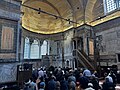
In the 16th century, during the Ottoman era, it was converted into a mosque; it became a museum in 1945, and was turned back into a mosque in 2020 by President Recep Tayyip Erdoğan.[1][2] The interior is covered with some of the finest surviving Byzantine Christian mosaics and frescoes, which were left in plain sight during Muslim worship throughout much of the Ottoman era.[3] They were restored after the building was secularized and turned into a museum.

The church in the western Fatih district of İstanbul. It stands on sedimentary layers and anthropogenic infills on a slope descending towards the north. It is oriented east-west, as are typical Byzantine churches throughout the city.

The Chora Church/Mosque, c. 1900
Chora Church/Mosque, Istanbul, Turkey, 1903 survey

History

[edit]
Sections and ground plan

First phase (4th century)

[edit]

The Chora Church was originally built in the early 4th century as part of a monastery complex outside the city walls of Constantinople erected by Constantine the Great, to the south of the Golden Horn. However, when Theodosius II built his formidable land walls in 413–414, the church became incorporated within the city's defences, but retained the name Chora (for the presumed symbolism of the name see below).

Second phase (11th century)

[edit]

The majority of the fabric of the current building dates from 1077–1081, when Maria Doukaina, the mother-in-law of Alexius I Comnenus, rebuilt the Chora Church as an inscribed cross or quincunx: a popular architectural style of the time. Early in the 12th century, the church suffered a partial collapse, perhaps due to an earthquake.

Third phase: new decoration (14th century)

[edit]

The church was rebuilt by Isaac Comnenus, Alexius's third son. However, it was only after the third phase of building, two centuries after, that the church as it stands today was completed. The powerful Byzantine statesman Theodore Metochites endowed the church with many of its fine mosaics and frescoes. Theodore's impressive decoration of the interior was carried out between circa 1310 and 1317.[4] The mosaic work is the finest example of the Palaeologian Renaissance. The artists remain unknown. A renowned classical scholar as well as statesman, Theodore donated his personal library to the Chora monastery, as well.[5] Later on, between 1315 and 1321, Theodore Metochites, the Grand Logothete of the Treasury, commissioned the construction of the funerary chapel, outer buttress supports, and the narthexes. In 1328, Theodore was sent into exile by the usurper Andronicus III Palaeologus. However, he was allowed to return to the city two years later, and lived out the last two years of his life as a monk in his Chora Church.

Until the Conquest of Constantinople

[edit]

In the late 13th and early 14th centuries, the monastery was home to the scholar Maximus Planudes, who was responsible for the restoration and reintroduction of Ptolemy's Geography to the Byzantines and, ultimately, to Renaissance Italy. During the last siege of Constantinople in 1453, the Icon of the Theotokos Hodegetria, considered the protector of the City, was brought to Chora in order to assist the defenders against the assault of the Ottomans.[6]

Kariye Mosque (c. 1500–1945)

[edit]

Around fifty years after the fall of the city to the Ottomans, Hadım Ali Pasha, the Grand Vizier of Sultan Bayezid II, ordered the Chora Church to be converted into a mosqueKariye Camii. The word Kariye derived from the Greek name Chora.[7] The architectural modifications were kept minimal with minor whitewashing and the addition of a brick minaret and mihrab. None altered the spatial organisation of the church. Ottoman records indicate maintenance rather than renovation.[8] Due to the prohibition against iconic images in Islam, the mosaics and frescoes were covered by a layer of plaster. This and frequent earthquakes in the region have taken their toll on the artwork. Additionally, the intervention efforts of the 19th century, led by Evkaf Nezareti, flattened the original domed roof profile, and masked the Late Byzantine silhouette.

Museum, art restoration (1945–2020)

[edit]

In 1945 the site was secularized and designated a museum via Cabinet Decree, reflecting early Republican efforts to position Byzantine monuments as universal patrimony.[9] In 1945, the building was designated a museum by the Turkish government.[10] In 1948, the American scholars Thomas Whittemore and Paul A. Underwood, from the Byzantine Institute of America and the Dumbarton Oaks Center for Byzantine Studies, sponsored a restoration program. From that time on, the building ceased to be a functioning mosque. In 1958, it was opened to the public as a museum, Kariye Müzesi.

Reconversion to a mosque (2020–2024)

[edit]

In 2005, the Association of Permanent Foundations and Service to Historical Artifacts and Environment filed a lawsuit to challenge the status of the Chora Church as a museum.[11] In November 2019, the Turkish Council of State, Turkey's highest administrative court, ordered that it was to be reconverted to a mosque.[10] In August 2020, its status changed to a mosque.[12]

The move to convert Chora Church into a mosque was condemned by the Greek Foreign Ministry and by Greek Orthodox and Protestant Christians.[1] This caused a sharp rebuke by Turkey.[13]

On Friday 30 October 2020, Muslim prayers were held for the first time after 72 years.[14]

The building was opened for Muslim worship on 6 May 2024.[15]

[edit]

Kariye Mosque is situated within the “Historic Areas of Istanbul” inscribed on the UNESCO World Heritage List since 1985. It falls under the protection of the 1972 UNESCO World Heritage Convention, where State Party reporting, conservation planning, and risk monitoring under the World Heritage Centre are mandated. The site is registered as a 1st degree archaeological and architectural heritage asset and is protected under Law No. 2863 on the Conservation of Cultural and Natural Properties.

The conversion to a museum in 1945, by the Cabinet Decree, was annulled. Regardless of the lawsuit opened by the Association of Permanent Foundations and Service to Historical Artifacts and Environment in 2005, for its right to be museum, in 2019 by the Council of State ruling based on religious foundations. In 2020, the Presidential Decree transferred the rights to the Presidency of Religious Affairs.

Interior

[edit]

The Chora Church is not as large as some of the other surviving Byzantine churches of Istanbul (it covers 742.5 m²) but it is unique among them, because of its almost completely still extant internal decoration. The building is divided into three main areas: the entrance hall or narthex, the main body of the church or naos (nave), and the side chapel or parecclesion. The building has six domes: two above the esonarthex, one above the parecclesion and three above the naos.

Mosaic of the enrollment for taxation before Governor Quirinius
Mosaic of the journey to Bethlehem
The mosaic in the lunette over the doorway to the esonarthex portrays Christ as “The Land of the Living”.
Mosaic of Christ enthroned with Theodore Metochites presenting a model of his church

Narthex

[edit]

The main, west door of the Chora Church opens into the narthex. It divides north–south into the outer, or exonarthex and the inner, or esonarthex.

Exonarthex

[edit]
Mosaic of Saint Peter

The exonarthex (or outer narthex) is the first part of the church that one enters. It is a transverse corridor, 4 m wide and 23 m long, which is partially open on its eastern length into the parallel esonarthex. The southern end of the exonarthex opens out through the esonarthex forming a western antechamber to the parecclesion. The mosaics that decorate the exonarthex include:

  1. Joseph's dream and the journey to Bethlehem
  2. The enrollment for taxation
  3. The Nativity
  4. The journey of the Magi
  5. The inquiry of King Herod;
  6. The flight into Egypt
  7. Two frescoes of the massacres ordered by King Herod
  8. Mothers mourning their children
  9. The flight of Elizabeth, mother of John the Baptist
  10. Joseph dreaming, and the return of the Holy Family from Egypt to Nazareth
  11. Christ taken to Jerusalem for the Passover
  12. John the Baptist bearing witness to Christ
  13. A miracle
  14. Three more miracles
  15. The Virgin and angels praying. This image faces the Christ Pantokrator lunette (#16 in this list), and Mary is labelled in Greek, “Mother of God, container (chora) of the uncontainable (achoritou).” This phrase both refers to the theological paradox of Christ's dual nature, as well as the name of the monastery, the Chora.[5]
  16. Christ Pantokrator (or "Almighty," this image is in the lunette over the doorway to the inner narthex, and depicts Christ blessing the viewer with his right hand, and holding a jeweled Gospel in his left.) The label plays on the monastery's name, the Chora, in its reference to Christ as the "land of the living."[5] This phrase comes from Psalm 116:9, used in the Orthodox funeral service, also significant because of the addition of the funerary spaces under Metochites, who anticipated burial in this monastery.[5]

Esonarthex

[edit]
Mosaic of the Virgin and Child, north dome of the inner narthex
Mosaic of Christ Pantocrator, south dome of the inner narthex

The esonarthex (or inner narthex) is similar to the exonarthex, running parallel to it. Like the exonarthex, the esonarthex is 4 m wide, but it is slightly shorter, 18 m long. Its central, eastern door opens into the naos, while another door at the southern end of the esonarthex opens into the rectangular antechamber of the parecclesion. At its northern end, a door from the esonarthex leads into a broad west–east corridor that runs along the northern side of the naos and into the prothesis. The esonarthex has two "pumpkin" domes. The smaller is above the entrance to the northern corridor; the larger is midway between the entrances into the naos and the pareclession, and they continue the emphasis on imagery of the Virgin and Christ seen elsewhere in these mosaics.[5]

  1. Enthroned Christ with Theodore Metochites presenting a model of his church. This image depicts Theodore in the traditional visual formula indicating that he is the donor, for this fourteenth-century leader was responsible for renovating the twelfth-century church as well as adding the parecclesion.[5]
  2. Saint Peter
  3. Saint Paul
  4. A monumentally scaled mosaic of the Deesis: Christ and the Virgin Mary (without John the Baptist) with two earlier donors below, Isaac Komnenos and a nun labeled “Melanie, the Lady of the Mongols,” who may be the daughter of emperor Michael VIII (reigned 1261–82).[5] The subject matter and large scale probably alludes to a similar scene in the south gallery of the Hagia Sophia, installed soon after the Latin occupation of Constantinople (1204–61) ended.[5]
  5. The genealogy of Christ
  6. Religious and noble ancestors of Christ

The mosaics in the first three bays of the inner narthex give an account of the life of the Virgin, and those of her parents. Some of them are as follows:

  1. The rejection of Joachim's offerings
  2. The annunciation to Saint Anne: the angel of the Lord announcing to Anne that her prayer for a child has been heard
  3. The meeting of Joachim and Anne
  4. The birth of the Virgin
  5. The first seven steps of the Virgin
  6. The Virgin given affection by her parents, this scene is more typical of the late Byzantine era, when artists were more inclined to explore emotional and/or everyday themes than artists in the early or middle Byzantine periods.[5]
  7. The Virgin blessed by the priests
  8. The presentation of the Virgin in the Temple
  9. The Virgin receiving bread from an Angel
  10. The Virgin receiving the skein of purple wool, as the priests decided to have the attendant maidens weave a veil for the Temple
  11. Zechariah praying; when it was time for the Virgin to marry, the High Priest Zechariah called all the widowers together and placed their rods on the altar, praying for a sign showing to whom she should be given
  12. The Virgin entrusted to Joseph;
  13. Joseph taking the Virgin to his house;
  14. The Annunciation to the Virgin at the well. This image, in which the young Mary awkwardly turns towards the approach of the archangel Gabriel, was adapted to triangular space in which it was depicted. There is a strong emphasis on images of Christ and Mary in the exonarthex and esonarthex.[5]
  15. Joseph leaving the Virgin; Joseph had to leave for six months on business and when he returned the Virgin was pregnant, arousing his suspicion.

Naos

[edit]

The central doors of the esonarthex lead into the main body of the church, the naos. The largest dome in the church (7.7 m in diameter) is above the centre of the naos. Two smaller domes flank the modest apse: the northern dome is over the prothesis, which is linked by short passage to the bema; the southern dome is over the diaconicon, which is reached via the parecclesion. Only three mosaics survive in the Chora's naos:

  1. Koimesis (the Dormition of the Virgin; i.e. her last sleep before ascending to Heaven). Jesus is holding an infant, symbolic of Mary's soul.
  2. Jesus Christ
  3. Theotokos (the Virgin and Child), both the image of Christ (#2 in this list) and this mosaic of the Virgin originally were positioned as proskynetaria icons to flank the templon, the barrier which was in front of the sanctuary, though the templon no longer survives.[5]

Parecclesion

[edit]
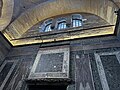
View into the parecclesion

To the right of the esonarthex, doors open into the side chapel, or parecclesion. The parecclesion was used as a mortuary chapel for family burials and memorials. The second largest dome (4.5 m diameter) in the church graces the centre of the roof of the parecclesion. A small passageway links the parecclesion directly into the naos, and off this passage can be found a small oratory and a storeroom. The parecclesion is covered in frescoes that emphasize the theological message of salvation, in keeping with the space's use as a funerary chapel.[5] Within the Christian worldview, God raises the dead at the end of time, hence the significance of the Anastasis and Last Judgement scenes painted prominently on the ceiling. The image of the Anastasis is particularly renowned, appearing in many art history survey books as a key examplar of late Byzantine art.

  1. Anastasis (literally Resurrection)": the Harrowing of Hell. Christ, who has just broken down the gates of Hell, is standing in the centre and pulling Adam and Eve out of their tombs. Christ is adorned in vivid white garments as well as encircled by a radiant mandorla, setting him in contrast to the dark colors of the fresco's background. Behind Adam stand John the Baptist, David, and Solomon, and other righteous kings. Below is the bound personification of Hades, rendered as an African individual.
  2. The Last Judgment, or Second Coming. Christ is enthroned with the Virgin and John the Baptist on either side of him. (This trio is also called the Deesis.)
  3. Virgin and Child
  4. Heavenly court of angels
  5. Two panels of Moses

Along the walls of the Chora's parecclesion are arcosolia, arched recesses for tombs, likely intended for Theodore Metochites and his family. Also at this level are depictions of soldier saints, who wield swords as if protecting the tombs they accompany.[5]

Name

[edit]

The original, 4th-century monastery containing the church was outside Constantinople's city walls. Literally translated, the church's full name was the Church of the Holy Saviour in the Country (Greek: ἡ Ἐκκλησία τοῦ Ἁγίου Σωτῆρος ἐν τῇ Χώρᾳ, hē Ekklēsia tou Hagiou Sōtēros en tēi Chōrāi). It is therefore sometimes incorrectly referred to as "Saint Saviour". However, "The Church of the Holy Redeemer in the Fields" would be a more natural rendering of the name in English. The last part of the Greek name, Chora, referring to its location originally outside of the walls, became the shortened name of the church. The name must have carried symbolic meaning, as the mosaics in the narthex describe Christ as the "Land of the Living" (ἡ Χώρα τῶν ζώντων, hē Chōra tōn zōntōn) and Mary, the mother of Jesus, as the "Container of the Uncontainable" (ἡ Χώρα τοῦ Ἀχωρήτου, hē Chōra tou Achōrētou).

See also

[edit]

Notes

[edit]

References

[edit]

Literature

[edit]
  • Chora: The Kariye Museum. Net Turistik Yayınlar (1987). ISBN 978-975-479-045-0
  • Feridun Dirimtekin. The historical monument of Kariye. Türkiye Turing ve Otomobil Kurumu (1966). ASIN B0007JHABQ
  • Semavi Eyice. Kariye Mosque Church of Chora Monastery. Net Turistik Yayınlar A.Ş. (1997). ISBN 978-975-479-444-1
  • Çelik Gülersoy. Kariye (Chora). ASIN B000RMMHZ2
  • Jonathan Harris, Constantinople: Capital of Byzantium. Hambledon/Continuum (2007). ISBN 978-1-84725-179-4
  • Karahan, Anne. Byzantine Holy Images – Transcendence and Immanence. The Theological Background of the Iconography and Aesthetics of the Chora Church (monography, 355 pp) (Orientalia Lovaniensia Analecta No. 176) Leuven-Paris-Walpole, MA: Peeters Publishers 2010.ISBN 978-90-429-2080-4
  • Karahan, Anne. “The Paleologan Iconography of the Chora Church and its Relation to Greek Antiquity”. In: Journal of Art History 66 (1997), Issue 2 & 3: pp. 89–95 Routhledge (Taylor & Francis Group online publication 1 September 2008: DOI:10.1080/00233609708604425) 1997
  • Krannert Art Museum. Restoring Byzantium: The Kariye Camii in Istanbul and the Byzantine Institute Restoration. Miriam & IRA D. Wallach Art Gallery (2004). ISBN 1-884919-15-4
  • Ousterhout, Robert G. (1988). The Architecture of the Kariye Camii in Istanbul. Dumbarton Oaks Research Library and Collection. ISBN 978-0-88402-165-0.
  • Robert Ousterhout (Editor), Leslie Brubaker (Editor). The Sacred Image East and West. University of Illinois Press (1994). ISBN 978-0-252-02096-4
  • Moutafov, Emmanuel S. The Chora Monastery of Constantinople. Cambridge: Cambridge University Press (2025). (Elements in the History of Constantinople). ISBN 9781108946476 doi:10.1017/9781108946476
  • Saint Saviour in Chora. A Turizm Yayınları Ltd. (1988). ASIN B000FK8854
  • Cevdet Turkay. Kariye Mosque. (1964). ASIN B000IUWV2C
  • Paul A. Underwood. The Kariye Djami in 3 Volumes. Bollingen (1966). ASIN B000WMDL7U
  • Paul A. Underwood. Third Preliminary Report on the Restoration of the Frescoes in the Kariye Camii at Istanbul. Harvard University Press (1958). ASIN B000IBCESM
  • Edda Renker Weissenbacher. Kariye: The Chora Church, Step by Step. ASIN B000RBATF8
[edit]
Revisions and contributorsEdit on WikipediaRead on Wikipedia
from Grokipedia
The Church of the Holy Saviour in Chora (Greek: ἡ κῆρα τοῦ ἁγίου Σωτῆρος ἐν τῇ Χώρᾳ), now Kariye Mosque, is a Byzantine monastic church in Istanbul's Fatih district, distinguished by its extensive and exceptionally preserved mosaics and frescoes from the early 14th century that depict biblical narratives including the life of the Virgin Mary, the ministry of Christ, and eschatological themes.[1] Originally established as part of a monastery outside Constantinople's Constantinian walls, possibly as early as the 4th or 6th century, the surviving structure primarily dates to a rebuilding in the late 11th and early 12th centuries, followed by a comprehensive restoration and artistic program commissioned by the Byzantine statesman and scholar Theodore Metochites around 1315–1321 to affirm Orthodox doctrines of salvation and divine incarnation.[2][3] Following the Ottoman capture of Constantinople in 1453, the church was repurposed as a mosque with additions such as a mihrab and minaret, though its figurative Christian artwork remained largely intact, unlike many contemporaries that were plastered over.[3] Designated a museum in 1945 to facilitate study and tourism of its Byzantine heritage, it was reconverted to active mosque use in 2020, prompting discussions on the preservation and accessibility of its historical artifacts amid Turkey's policy of reverting select Ottoman-era religious sites.[4][5]

History

Early Construction and Byzantine Development (4th–11th centuries)

The origins of the Church of the Holy Saviour in Chora trace to the early 4th century, when the site—located outside the Constantinian walls of Constantinople—was reportedly Christianized shortly before the city's refoundation by Constantine I (r. 306–337), initially serving as a repository for relics such as those of Saint Babylas.[6] The monastery complex, dedicated to the Holy Saviour and the Virgin Mary, functioned amid rural surroundings, with "Chora" denoting its position "in the fields."[6] By the early 5th century, the site was enclosed within the Theodosian Land Walls erected under Theodosius II (r. 408–450), positioning it near the Adrianople Gate.[6] Archaeological evidence reveals vaulted substructures in the naos foundations dating to the 6th century, likely tied to a rebuilding effort under Justinian I (r. 527–565) after an earthquake, possibly incorporating dedications to Saint Theodore.[6] Repairs to these substructures occurred in the 9th century, reflecting ongoing maintenance amid seismic risks and monastic continuity.[6] The principal structural development within this period unfolded in the late 11th century, circa 1077–1081, when Maria Doukaina—mother-in-law of Alexios I Komnenos (r. 1081–1118)—commissioned the erection of the north, west, and south walls, forming a cross-in-square plan with a narrow main apse flanked by lateral apses and a modest central dome.[6][7] This reconstruction established the core layout of the naos, adapting earlier foundations to Komnenian architectural preferences for compact, vaulted interiors suited to monastic liturgy.[6]

Theodore Metochites' Patronage and Decoration (c. 1303–1321)

Theodore Metochites, a prominent Byzantine statesman, scholar, and advisor to Emperor Andronikos II Palaiologos, undertook the major restoration and decoration of the Chora Church (then a monastery) as its ktetor, or founder-patron, beginning around 1315 or 1316 and completing the work by 1321.[6][8] Initially serving as mesazon (chief minister) and overseer of the imperial treasury, Metochites transformed the dilapidated 12th-century structure into a lavish complex emphasizing themes of salvation and resurrection, reflecting his personal piety and ambition for posthumous redemption.[9][6] Appointed ktetor by the emperor, he was the first non-imperial figure to found an imperial-level monastery, endowing it with estates, a hospital, a public kitchen, and a substantial library of donated manuscripts to support monastic life.[8][6] Architecturally, Metochites rebuilt the naos dome, pastophoria (side chambers), and apse side rooms; added domed inner and outer narthexes to the west; constructed a two-story annex on the north; and erected a domed parekklesion (funerary chapel) on the south flank, along with flying buttresses for structural stability.[6][8] He also refurbished the interior with new marble revetments, floors, and a templon screen, while adding an external belfry (later modified).[6] These expansions created a multi-layered entry sequence leading to the naos, enhancing the liturgical and funerary functions, with the parekklesion intended as his eventual burial site—where he was interred in 1332 after political downfall and exile.[9][6] The decoration program featured mosaics in the narthexes and naos, and frescoes in the parekklesion, executed by skilled Byzantine workshops and representing one of the pinnacles of Palaiologan art.[9] Mosaics included Christ Pantokrator in the outer narthex dome, the Deësis and Annunciation in the inner narthex, the Dormition of the Virgin in the naos, and cycles depicting the infancy, ministry, and miracles of Christ alongside the genealogy and life of the Virgin Mary.[9][6] Frescoes in the parekklesion covered the walls and vault with the Virgin and Child in the dome, Old Testament typological scenes, the Anastasis (Harrowing of Hell), and a vivid Last Judgment, emphasizing eschatological themes of divine mercy and judgment.[9][6] Metochites' involvement is attested by his donor portrait above the naos entrance, depicting him offering a model of the church to Christ, and monograms in the dome cornice identifying him as "Theodore Metochites, Logothete and Ktetor."[8] These elements underscore his role in commissioning a visually interconnected program that guided viewers toward salvation narratives, innovative in its narrative flow and theological depth.[9]

Fall of Constantinople and Initial Ottoman Conversion (1453–1511)

Following the Ottoman conquest of Constantinople on May 29, 1453, the Church of the Holy Saviour in Chora was among the structures looted by Ottoman forces during the siege, though it sustained no irreparable structural damage.[8] [3] Despite the fall of the city to Sultan Mehmed II, the church continued to operate as a place of Christian worship for the remaining Greek Orthodox population, benefiting from the sultan's pragmatic policies that permitted select Byzantine churches to serve the non-Muslim millet communities under Ottoman rule.[10] [11] This tolerance stemmed from Mehmed's aim to maintain administrative stability and tax revenue from the Orthodox patriarchate, rather than immediate wholesale conversion of all religious sites, as seen with the prompt transformation of Hagia Sophia.[12] Throughout the late 15th century, the Chora remained under ecclesiastical use without significant Ottoman alterations, its Byzantine fabric—including the 14th-century mosaics and frescoes commissioned by Theodore Metochites—intact and visible for Christian liturgy.[13] [14] The building's location in the Edirnekapı district, near the city walls and away from the imperial core, likely contributed to its delayed repurposing, as Ottoman priorities initially focused on central sites for symbolic conversions.[8] No records indicate active maintenance or repairs by Ottoman authorities during this interval, reflecting a period of benign neglect toward peripheral Christian holdings.[15] In 1511, during the reign of Sultan Bayezid II (1481–1512), Grand Vizier Atik Ali Pasha (d. circa 1511–1512), a Bosnian-origin eunuch who resided in a nearby palace, sponsored the church's conversion into a mosque, renaming it Kariye Camii or Atik Ali Pasha Camii.[10] [16] [17] This shift involved installing a mihrab in the main apse to indicate the qibla direction, adding a minbar for sermons, and removing or repurposing the belfry for the call to prayer, while the structure's core Byzantine layout was preserved to facilitate worship.[14] [15] To comply with Islamic prohibitions on figurative imagery, the extensive mosaics and frescoes—depicting Christological and Marian themes—were covered with plaster layers, concealing rather than destroying the artwork, a practice consistent with Ottoman approaches to repurposed sacred spaces that prioritized functionality over iconoclasm.[8] [18] Pasha's endowment included waqf provisions for upkeep, and his mausoleum was constructed adjacent to the site, embedding the mosque within his pious foundations.[16] [19]

Ottoman Mosque Period and Modifications (16th–19th centuries)

The Chora Church was formally converted into the Kariye Camii mosque in 1511 by Grand Vizier Atik Ali Pasha during the reign of Sultan Bayezid II (r. 1481–1512), following a period of neglect after the 1453 conquest; Pasha restored and cleaned the structure to adapt it for Islamic worship.[20][21] To facilitate prayer, Ottoman additions included a mihrab niche inserted into the main apse, a minbar pulpit for the imam, and a minaret erected in place of the Byzantine belfry at the southwest corner, with minimal structural alterations to the core building.[6][22] By the 17th or 18th century, the church's Byzantine mosaics and frescoes—depicting Christian iconography—were covered with layers of plaster and paint to align with Islamic prohibitions on figural representation in places of worship, though the covering was uneven and did not fully obscure the artwork, preserving it beneath.[6] The Kariye Camii functioned as a neighborhood mosque thereafter, serving the local Muslim community without significant further iconoclastic interventions. In the 19th century, the mosque received restorations, including major work on 16 August 1875 under Ottoman auspices, which addressed structural decay and involved modifications such as leveling the Byzantine-era roofline to enhance functionality.[23] These efforts maintained the building's usability amid gradual decline in prominence, reflecting pragmatic Ottoman stewardship of repurposed Byzantine monuments.[6]

Republican Secularization and Museum Era (1923–2020)

The establishment of the Republic of Turkey on October 29, 1923, under Mustafa Kemal Atatürk marked the onset of aggressive secularization policies aimed at modernizing the nation and diminishing the influence of Islamic institutions inherited from the Ottoman Empire. These reforms included the abolition of the caliphate in 1924, the adoption of a secular civil code in 1926, and the closure of religious schools, fostering a state ideology that emphasized cultural heritage over active religious practice. In this context, historic Byzantine sites like the Chora Church, which had functioned as the Kariye Mosque since the 16th century, were eyed for repurposing to symbolize Turkey's European-oriented, secular future, similar to the conversion of Hagia Sophia into a museum in 1935. The Chora Church was officially secularized and designated as the Kariye Museum by a decree of the Council of Ministers on October 24, 1945, during the presidency of İsmet İnönü, Atatürk's successor. This move ended its use as a place of Muslim worship and opened it to scholarly examination and public visitation, aligning with the Republican emphasis on preserving pre-Ottoman architectural and artistic legacies as national assets rather than religious spaces. The conversion reflected a pragmatic approach to heritage management, prioritizing conservation amid post-World War II recovery, without immediate large-scale alterations.[24] Restoration efforts commenced in 1948 under the auspices of the Byzantine Institute of America, sponsored by Dumbarton Oaks Research Library and Collection, with Paul A. Underwood directing the project through the late 1950s. Teams systematically removed whitewash and plaster layers applied over centuries to cover Christian iconography, uncovering approximately 40 mosaics and extensive frescoes in the narthexes, naos, and parecclesion, including depictions of the Life of Christ, the Virgin Mary, and eschatological themes. Conservation techniques involved cleaning, stabilization, and documentation, transforming the site into a showcase for late Byzantine artistry and drawing international acclaim for its preserved 14th-century decorations.[2] As the Kariye Museum, the structure operated continuously as a cultural institution, integrated into Istanbul's tourism economy and academic study of Byzantine art. In 1985, it was included within the UNESCO World Heritage-listed Historic Areas of Istanbul, ensuring ongoing maintenance funded by state and international sources. Visitor access to the mosaics and frescoes remained unrestricted, fostering appreciation of the site's theological and aesthetic significance, until a Turkish court annulled the 1945 decree on July 2, 2020, initiating processes that concluded the museum era by year's end, though physical operations persisted as such through 2020.

Reconversion Decree and Restoration (2020–2024)

On July 15, 2019, Turkey's Council of State annulled the 1945 decision to convert the Kariye into a museum, ruling that its status as a pious foundation (waqf) dedicated to mosque use under Ottoman law could not be altered by secular decree.[24] This paved the way for reconversion, mirroring the prior Hagia Sophia case. On August 21, 2020, President Recep Tayyip Erdoğan issued a presidential decree formally transferring the Chora Museum—known as Kariye Camii—to the Religious Affairs Presidency (Diyanet İşleri), designating it as the Kariye Mosque and opening it for Islamic worship while mandating preservation of its historical features.[25][26] The decree followed ongoing restoration work initiated in 2013 by Turkey's General Directorate of Foundations, which intensified post-2020 to address structural decay, moisture damage, and conservation of the 14th-century Byzantine mosaics and frescoes.[27] Efforts included cleaning over 2,000 square meters of surfaces, revealing previously hidden mosaic fragments under plaster layers, reinforcing the vaulted ceilings and walls against seismic risks, and installing modern climate control to protect artworks from humidity.[28] Unlike its Ottoman-era mosque phase, when Christian iconography was plastered over, the restored mosaics—depicting scenes like the Dormition of the Virgin and the Life of Christ—were left uncovered and visible during prayers, with Turkish officials emphasizing compatibility with Islamic aniconism as non-idolatrous representations.[29][30] The mosque reopened to worshippers and visitors on May 6, 2024, following a ceremony attended by Erdoğan, who described the event as reclaiming Ottoman heritage after 79 years of secular interruption.[31] Access for non-Muslim tourists remains permitted outside prayer times, with the site's UNESCO World Heritage status upheld, though international bodies like the World Council of Churches and Greek Orthodox leaders criticized the change as eroding shared cultural patrimony.[29] By late 2024, the Kariye Mosque hosted regular Friday prayers, with its preserved artworks drawing scholarly attention to the balance between liturgical reuse and conservation.[27]

Architecture and Layout

Structural Design and Spatial Organization

The Chora Church exemplifies a modified cross-in-square plan, the predominant form in Middle Byzantine architecture, featuring a central naos under a dome supported by four piers, with eastern apse and transverse arms defining the cross shape.[6] This core structure, dating to an early 12th-century rebuilding, was further stabilized with sturdy piers to address earlier instabilities, while the eastern end—including the apse and flanking pastophoria (prothesis to the north and diaconicon to the south)—was entirely reconstructed around 1315–1320 under Theodore Metochites' patronage.[6] The plan's irregularity stems from the sloping terrain descending northward and adaptations for monastic functions, resulting in asymmetrical extensions rather than a rigidly symmetrical layout.[32] Metochites' interventions expanded the western facade with a two-bay outer narthex and a single-bay inner narthex, creating a prolonged axial approach that enhanced ceremonial procession from public space into the sacred naos; the outer narthex's upper story likely served auxiliary purposes, such as a gallery or storage.[32] To the south, a parekklesion—a narrow, barrel-vaulted side chapel with its own five-sided apse and tomb arcosolia—was appended as a funerary annex, its dome articulated differently from the main structure to accommodate burial rites.[32] A two-story northern annex, possibly a library, adjoined the naos and adjusted the northern narthex dome, while a belfry occupied the southwest corner bay, later replaced by an Ottoman minaret.[32] Spatially, the organization prioritizes hierarchical progression: worshippers entered via the outer narthex's five domes, transitioned through the inner narthex's Deesis-themed lunette, and accessed the naos via central doors, where the dome's light emphasized the liturgical core.[33] Side chambers and the parekklesion allowed parallel rituals, such as commemorative services, without disrupting the main axis, reflecting Palaiologan-era emphases on personal devotion amid monastic constraints.[34] The ensemble's compact scale—encompassing roughly 20 by 25 meters in the naos and narthexes—facilitated intimate illumination by mosaics and frescoes, integrating structure with decorative theology.[6]

Narthex Complex

The narthex complex of the Chora Church encompasses the outer narthex (exonarthex) and inner narthex (esonarthex), functioning as vestibules that progressively transition worshippers from the exterior into the naos, the main body of the church. These areas were substantially rebuilt and decorated during the early 14th century under the patronage of Theodore Metochites, who served as logothetes tou genikou (minister of the treasury) and oversaw renovations starting around 1315 to enhance structural stability and aesthetic grandeur.[8] The outer narthex, the primary entry point on the west facade, originally comprised an open arcaded portico with a belfry at the southwest corner, later enclosed by walling up passageways into arcosolia during the 14th–15th centuries.[35][8] The outer narthex features mosaics in its lunettes and domical vaults depicting scenes from Christ's infancy and ministry, including a prominent lunette of Christ Pantocrator above the central doorway—portrayed holding the Gospels and offering a blessing—and an opposing lunette of the Virgin Mary bearing Christ, inscribed as the "Mother of God, container of the uncontainable."[1] These tesserae works, executed in gold-ground technique, emphasize narrative cycles that prepare entrants for the church's salvific themes. The inner narthex, directly adjoining the naos via a central door, includes two characteristic "pumpkin domes" (fluted, ribbed vaults resembling a pumpkin's surface): the northern dome illustrates the Virgin Mary encircled by her ancestors with accompanying life scenes, while the southern dome shows Christ amid his forebears.[1] A large Deësis mosaic adorns the eastern wall, featuring Christ flanked by the Virgin Mary and John the Baptist in intercessory pose, with earlier donor portraits of Isaac Komnenos and Melane integrated.[8] Above the naos entrance in the inner narthex, a lunette mosaic depicts Christ enthroned receiving a model of the church from the kneeling Theodore Metochites, symbolizing his patronage and underscoring the personal devotion embedded in the decorative program.[1] Additional inner narthex mosaics portray events from the Virgin's life, complemented by marble revetments and sculpted elements throughout both narthexes, forming an L-shaped progression integrated with the adjacent parecclesion via a narrow passageway.[35] This layout reflects late Byzantine adaptations of the cross-in-square plan, prioritizing experiential depth over strict symmetry, with the narthexes' vaults and arches distributing weight to support the overlying galleries.[8] The mosaics' preservation, achieved through their execution on curved surfaces and use of glass tesserae set at angles to catch light, highlights the technical sophistication of Palaiologan artistry.[1]

Naos and Sanctuary

The naos forms the core worship area of the Chora Church, oriented eastward toward the sanctuary and measuring roughly 10.5 meters by 15 meters.[36] This space adheres to a cross-in-square plan characteristic of Byzantine ecclesiastical design, featuring a central dome elevated on pendentives that spans approximately 7.7 meters in diameter.[37] The structure underwent significant reinforcement and redesign under Theodore Metochites circa 1310–1320, including the rebuilding of the main dome and integration with flanking pastophoria chambers.[38] Adjoining the naos to the east, the sanctuary—or bema—comprises an elevated platform housing the altar within a semi-circular apse, flanked by the prothesis (north) for preparing Eucharistic elements and the diakonikon (south) for vestments and sacred vessels.) These side chambers, each capped by smaller domes, extend the eastern axis while maintaining spatial cohesion with the naos.[35] The bema was historically screened from the naos by a templon, remnants of which inform the placement of surviving decorative panels.[1] Decoration in the naos centers on a limited but iconographically pivotal set of mosaics executed during Metochites' patronage. A monumental panel depicting the Dormition (Koimesis) of the Virgin Mary occupies the western wall, portraying her deathbed scene with apostles and Christ holding her soul as an infant.[1] Framing the sanctuary entrance on the eastern wall are proskynetaria mosaics: Christ Antiphonetes to the south and the Virgin Theotokos with Child to the north, serving as donor veneration icons.[1] [39] Above the prothesis doorway, a mosaic of Saint Peter reinforces apostolic authority.[40] The sanctuary apse conch, by contrast, preserves fewer visible elements, with emphasis historically on liturgical function over extensive figural programs.[1] These features underscore the naos and sanctuary's role in channeling worship toward the divine presence, with architectural symmetry and selective mosaics emphasizing salvation themes amid the church's late Byzantine refinements.[1] Marble revetments and opus sectile floors further delineate the spaces, though Ottoman-era modifications introduced mihrab and minbar alignments in the bema.[41]

Parecclesion and Side Chapel

The parecclesion, positioned along the southern flank of the naos, was reconstructed under Theodore Metochites' patronage around 1315 as a dedicated funerary chapel for his kin and eventual burial site.[8] [1] This elongated annex features a linear, barrel-vaulted structure oriented east-west, parallel to the main church, with transverse arches reinforcing the vault and an projecting apse at its eastern terminus for liturgical use.[42] [43] Access occurs via a single doorway from the naos, integrating it into the church's spatial flow while preserving its distinct commemorative purpose. Unlike the mosaic-clad core of the Chora, the parecclesion's walls and vaults bear solely frescoes, applied in secco and fresco techniques to convey themes of death, resurrection, and divine intercession.[1] The program includes a lower register of the Virgin's infancy and miracles along the north and south walls, transitioning upward to apostolic and hierarchical figures, with the western wall dominated by the Last Judgment and the apse conch featuring the Anastasis—Christ's harrowing of Hades—emphasizing eschatological triumph over mortality.[1] This iconographic emphasis aligns with Byzantine funerary theology, invoking salvation for the deceased amid the site's arcosolia niches for sarcophagi.[44] At the parecclesion's southeastern corner lies a compact side chapel, a square vaulted chamber with additional tomb arcosolia, likely serving as an extension for private memorial rites or subsidiary burials within Metochites' endowment.[42] This adjunct space, connected internally, underscores the complex's layered funerary adaptations, blending architectural pragmatism with symbolic depth in late Palaiologan design.[43]

Artistic Heritage

Mosaics: Techniques, Preservation, and Iconographic Programs

The mosaics in the Chora Church, executed primarily between 1315 and 1321 under the patronage of Theodore Metochites, employed classic Late Byzantine techniques characterized by tesserae of colored glass, stone, and gold-backed elements set into lime mortar beds. Gold tesserae were crafted by sandwiching gold leaf between glass sheets, then slicing into cubes oriented at varied angles to maximize light reflection and create an ethereal glow evoking divine presence; this method, refined in the Palaiologan era, allowed for subtle shading and expressive facial details influenced by contemporary Gothic naturalism, as seen in the gentler contours and emotive gazes of figures like Christ in the Deesis mosaic.[45][1] Artists began with the naos, applying mosaics directly to vaults and walls for durability, before extending to narthexes, where the medium's permanence suited narrative cycles exposed to entry traffic.[41] Preservation efforts spanned centuries, with the mosaics initially spared post-1453 Ottoman conquest due to their elevated placement and non-interference with prayer spaces, though partial plastering occurred around the 17th or 18th century to conceal figural imagery amid evolving Islamic sensitivities.[8] Systematic conservation commenced in 1948 by the Byzantine Institute of America, led by Thomas Whittemore and continued by Paul Underwood into the 1950s, involving meticulous plaster removal layer by layer, cleaning of tesserae with solvents, and application of consolidants like Paraloid B-72 to stabilize flaking surfaces without altering original materials; this revealed over 80% intact coverage, preserving luminous pigments after seven centuries.[2][40] Further restorations from 2019 to 2024 by Turkish authorities focused on structural reinforcement and surface cleaning, employing non-invasive laser and chemical methods to address soot and degradation, culminating in the site's May 2024 reopening with protective curtains over mosaics during prayer times to balance heritage access and religious use.[27] The iconographic programs systematically unfold across spatial zones, emphasizing theological motifs of incarnation—divine entry into material space—and eschatological salvation, tailored to the church's dedication to the Virgin Mary as the "chora ton zonton" (container of the living). In the outer narthex, vaults depict Mary's genealogy and infancy cycle, including her presentation and nativity, framing entry with themes of divine embodiment; the inner narthex shifts to Christ's miracles and ministry, such as healings, underscoring redemptive acts. The naos features hierarchical icons like the Deesis (Christ enthroned with Mary and John the Baptist interceding) above the door and the Dormition (Koimesis) of the Virgin in the eastern arch, symbolizing transition to eternal life, while dome medallions portray Christ Pantocrator as cosmic ruler. This progression, starting from preparatory incarnation narratives to culminate in salvific centrality, integrates donor portraits like Metochites presenting a model church to Christ, blending personal piety with doctrinal exposition without adhering to rigid canonical formulas of earlier Byzantine eras.[41][1][46] These programs distinguish Chora's mosaics by their narrative density—over 40 scenes—prioritizing humanistic expression and spatial illusion over abstraction, reflecting Palaiologan revival amid Byzantine decline, where figural realism conveyed causal links between earthly devotion and heavenly intercession.[9]

Frescoes: Subjects and Artistic Style

The frescoes in the Church of the Holy Saviour in Chora, primarily located in the parekklesion (a side chapel used for funerary rites), date to the early 14th century, executed around 1315–1321 during the renovation sponsored by Theodore Metochites.[1] These works complement the church's mosaics, focusing on eschatological themes rather than narrative cycles of Christ's or the Virgin's lives, which dominate the narthex mosaics. The parekklesion's program emphasizes salvation, resurrection, and divine judgment, reflecting Byzantine Orthodox theology on the afterlife and intercession.[47] Key subjects include the Anastasis (Harrowing of Hell or Descent into Limbo), depicted on the eastern apse wall, where Christ, clad in radiant white robes, triumphs over death by pulling Adam and Eve from their tombs while trampling Satan beneath his feet—a standard Byzantine icon of resurrection promising eternal life to the faithful.[48] Above this, scenes of the Virgin Mary's intercessory role and the Last Judgment unfold across the vaults and walls, culminating in representations of the Second Coming, the resurrection of the dead, and divine mercy versus condemnation.[1] These motifs, drawn from scriptural and patristic sources like the Book of Revelation and homilies of saints such as John Chrysostom, underscore the parekklesion's role as a memorial space for Metochites' family burials, invoking prayers for the deceased's salvation.[47] Artistically, the Chora frescoes exemplify late Palaiologan Byzantine style, characterized by elongated figures with fluid drapery, expressive gestures, and subtle emotional depth that depart from the more rigid, hieratic forms of earlier periods like the Komnenian era.[49] Painters employed a secco technique with mineral pigments on lime plaster, achieving vibrant colors—deep blues, golds, and reds—that enhance dramatic lighting effects and spatial illusionism, such as architectural frames mimicking real vaults.[41] This experimental naturalism, blending traditional iconography with humanistic tendencies influenced by contemporary manuscript illumination, marks a high point of Byzantine monumental painting before the empire's decline, prioritizing theological persuasion over strict realism.[50] Despite partial overpainting during Ottoman rule and modern restorations, the frescoes retain exceptional preservation, revealing masterful modeling of faces and hands that convey pathos and divine transcendence.[51]

Theological and Symbolic Content

The iconographic program of the Chora Church's mosaics and frescoes articulates a cohesive theological narrative centered on salvation history, divine incarnation, and eschatological hope, reflecting late Byzantine emphases on personal redemption amid political decline. Commissioned primarily by Theodore Metochites around 1315–1321, the artworks integrate cycles of the Virgin Mary's life, Christ's ministry, and apocalyptic scenes to affirm Christ's role as the "Chora ton Zonton" (Receptacle of the Living), a liturgical title evoking containment of eternal life. This symbolism underscores the believer's journey from ancestral origins to heavenly fulfillment, with dense layering of scriptural and hagiographic references guiding liturgical participation and monastic contemplation.[1][52] In the outer narthex, the extensive Marian cycle—spanning 40 scenes from her genealogy through infancy to dormition—positions Mary as the fulcrum of salvation, her immaculate lineage and temple dedication prefiguring the Incarnation and emphasizing purity and divine election in Byzantine Mariology. These mosaics, executed in the refined Palaiologan style, employ symbolic motifs like the temple's golden glow to represent sacred enclosure, paralleling the church itself as a microcosm of heavenly order. Transitioning inward, the inner narthex's Christological panels depict miracles and the Great Feasts, such as the Nativity and Baptism, symbolizing theophany and humanity's restoration through Christ's earthly acts, with hierarchical compositions reinforcing Trinitarian doctrine.[1][53] The naos mosaics, including the dome's Christ Pantocrator and the apse's Virgin and Child with angels, embody divine sovereignty and maternal intercession, their radiant gold tesserae evoking uncreated light and theosis in hesychast theology. The Koimesis (Dormition) mosaic over the west arch illustrates Mary's assumption, a cornerstone of Orthodox eschatology signifying victory over death and bodily resurrection for the faithful. In the parecclesion, frescoes dominate with the Anastasis—Christ's harrowing of Hades—depicting cosmic redemption by pulling Adam and Eve from the grave, theologically linking Paschal triumph to universal salvation and paralleling Transfiguration motifs in affirming Christ's dual nature.[52][54] The Last Judgment fresco cycle in the same chapel extends this to final reckoning, with Christ enthroned amid resurrected souls, symbolizing divine justice and mercy; partitioned hierarchies of the saved and damned underscore moral causality and the urgency of repentance in a funerary context. Deësis compositions, featuring the Virgin and John the Baptist supplicating Christ, recurrently invoke intercessory prayer, a devotional staple reinforcing communal hope amid Byzantine trials. Metochites' donor portrait, kneeling before Christ, personalizes this theology, portraying patronage as soteriological investment. Collectively, these elements prioritize empirical scriptural fidelity over speculative allegory, aligning with Orthodox iconodulism's vindication post-iconoclasm.[1][55][56]

Etymology and Naming

Origins of "Chora" and Historical Designations

The designation "Chora" originates from the Greek term chōra (χώρα), signifying "country," "land," or "countryside," which alluded to the site's position outside the original Constantinian walls of Constantinople during the monastery's early establishment in the 4th or 5th century.[57][20] This rural connotation persisted in the name despite the 5th-century Theodosian Walls incorporating the area into the city's defenses, likely due to the retention of the original topographic reference or the enduring perception of the locale as peripheral.[58][59] In Byzantine records, the full name was the Monastery of the Holy Saviour in Chora (Greek: Μονή τοῦ Ἁγίου Σωτῆρος ἐν τῇ Χώρᾳ) or equivalently the Church of the Holy Saviour en tē Chōra (Ἐκκλησία τοῦ Ἁγίου Σωτῆρος ἐν τῇ Χώρᾳ), emphasizing its dedication to Christ as Savior while incorporating the locative qualifier.[60][61] The monastery, founded possibly under Emperor Justinian I (r. 527–565), functioned primarily as a religious and burial site for Byzantine elites, with its name documented in medieval texts and inscriptions.[8] Following the Ottoman conquest of Constantinople in 1453, the structure was repurposed as a mosque and redesignated Kariye Camii, where "Kariye" represents the Turkic phonetic rendering of "Chora," adapting the Greek toponymy without altering its essential reference to the site's historical extramural status.[20][57] This Ottoman-era name endured through the mosque's active use until the early 20th century, when secular reforms under the Turkish Republic led to its conversion into the Kariye Museum in 1945 or 1958, preserving the "Kariye" designation in a museological context.[42][14] Following the Ottoman conquest of Constantinople on May 29, 1453, the Chora Monastery initially remained in use by the Orthodox community but was converted into the Kariye Mosque around 1511 by Grand Vizier Atik Ali Pasha during the reign of Sultan Bayezid II (r. 1481–1512), who established a vakıf (waqf) endowment to support its operations as a Muslim house of worship.[8] [62] This transformation occurred under the Ottoman legal tradition, which permitted sultans to repurpose Byzantine churches in conquered territories not explicitly protected by surrender terms or treaties, integrating them into the empire's Islamic religious infrastructure via imperial ferman (decrees) and perpetual waqf foundations governed by Hanafi jurisprudence.[63] Such waqfs, as charitable endowments, were legally irrevocable under Ottoman canon law, dedicating properties exclusively to specified pious purposes like mosque maintenance, with oversight by the şeyhülislam and local kadı courts.[64] In the early Turkish Republic, established in 1923, the Kariye Mosque was secularized by a 1945 cabinet decision that redesignated it as the Kariye Museum under the Ministry of Education, reflecting Atatürk-era policies to preserve cultural heritage amid broader reforms separating religion from state functions.[65] [24] This move aligned with Law No. 677 on the Protection of Antiquities (amended from 1930s frameworks), prioritizing the site's Byzantine artworks for public access while prohibiting religious use.[66] The museum status was challenged in court, culminating in a November 15, 2019, ruling by Turkey's Council of State (Danıştay), which annulled the 1945 decision as unlawful, citing the site's endowment as an immovable waqf under the mazbut Fatih Sultan Mehmed Foundation—established post-1453 for Ottoman religious properties—and violations of the 1934 Law on Foundations (No. 2762), which safeguards waqf perpetuity against repurposing without judicial override.[67] [64] The court emphasized that Ottoman private law provisions rendered the waqf's mosque designation binding, overriding republican-era administrative changes lacking equivalent legal foundation.[68] On August 21, 2020, President Recep Tayyip Erdoğan formalized the reconversion via Presidential Decree No. 1672, transferring administrative authority to the Presidency of Religious Affairs (Diyanet İşleri Başkanlığı) and the General Directorate of Pious Foundations, thereby restoring its function as Kariye Mosque while mandating protection of non-Islamic artifacts under cultural heritage laws.[69] [65] The site reopened for Muslim prayers on May 6, 2024, following restoration, with mosaics covered during services per Diyanet guidelines, though accessible to visitors outside prayer times under a hybrid management model.[31] [29]

Presidential Decrees on Religious Status Changes

In 1945, during the presidency of İsmet İnönü, a governmental decree—reflecting the secular Kemalist reforms—converted the Kariye Mosque, previously a Byzantine church turned Ottoman mosque, into a secular museum managed by the Ministry of Pious Foundations, effectively removing its active religious function despite retaining its historical Christian mosaics under partial cover.[24][70] This status persisted until August 21, 2020, when President Recep Tayyip Erdoğan issued Presidential Decree No. 27/1, explicitly revoking the museum designation and reclassifying the structure as the Kariye Mosque under the administration of the Presidency of Religious Affairs (Diyanet İşleri Başkanlığı), thereby restoring its role for Islamic worship while committing to preserve its Byzantine artworks as state property.[69][24][26] The decree was predicated on a prior November 2019 ruling by Turkey's Council of State, which invalidated the 1945 conversion by citing the site's original 14th-century vakıf (Islamic endowment) deed stipulating perpetual mosque use, arguing that the Republican-era change violated foundational legal status.[24][71] The 2020 decree aligned with similar actions at Hagia Sophia earlier that year, emphasizing reversion to Ottoman-era religious designations amid Turkey's executive presidential system, which bypasses parliamentary approval for such administrative transfers of cultural properties.[31][72] Following the decree, restoration work commenced under Diyanet oversight, culminating in the mosque's reopening to Muslim prayer on May 6, 2024, with provisions for visitor access to mosaics during non-prayer hours, though critics from Orthodox and Western heritage bodies questioned the decree's compatibility with UNESCO World Heritage obligations for universal accessibility.[20][17][29] No subsequent presidential decrees altering the Chora's status have been issued as of October 2025, though a August 2025 Council of State affirmation upheld the 2020 decision against legal challenges, solidifying its mosque designation under current Turkish administrative law.[71][73]

Controversies and Debates

Iconoclasm, Looting, and Post-Conquest Alterations

During the Ottoman conquest of Constantinople on May 29, 1453, the Chora Church, situated near the Theodosian Walls, was among the initial targets for Ottoman troops after breaching the defenses. Ottoman soldiers looted the church extensively, seizing relics and icons as spoils of war. Notably, the large icon of Christ Pantokrator was cut into fragments and distributed among the invaders, exemplifying the systematic pillaging that accompanied the city's fall.[74][3][62] Following the conquest, the church remained in use by the Greek Orthodox community for several decades before its formal conversion to a mosque around 1511 under the patronage of Grand Vizier Atik Ali Pasha during Sultan Bayezid II's reign. This reconsecration involved structural modifications, including the addition of a mihrab, minbar, and minaret, to adapt the space for Islamic worship. The Byzantine mosaics and frescoes, depicting Christian theological scenes, were systematically covered with plaster layers to align with Islamic prohibitions on figural representation in sacred spaces, effectively enacting a post-conquest form of iconoclasm that obscured rather than entirely demolished the artwork.[57][55][8] This plastering preserved the underlying artworks from immediate destruction—unlike more destructive iconoclastic episodes elsewhere—but prioritized the erasure of visible Christian iconography, reflecting the conquering regime's aim to assert dominance over subjugated religious heritage. Historical accounts indicate that while some surface-level damages occurred during the covering process, the majority of the 14th-century mosaics survived intact beneath the layers until their partial uncovering in the 20th century. Earthquakes, such as the 1894 event, later caused additional structural harm, including the collapse of the minaret, but these were secondary to the initial conquest-related alterations.[75][8][28]

Secular Museum Period vs. Religious Reconversion

The Chora Church was designated a museum in 1945 by a cabinet decision of the newly established Republic of Turkey, aligning with Mustafa Kemal Atatürk's secularization policies that aimed to separate religion from state affairs and promote cultural heritage accessible to all.[76] During this 75-year period, the site functioned as a secular institution under the Ministry of Culture, prioritizing the preservation and display of its Byzantine mosaics and frescoes, which had been largely concealed under Islamic plaster since the Ottoman conversion in the 16th century.[8] Restorations began in 1948 under the Byzantine Institute of America, led by Thomas Whittemore and Paul A. Underwood, involving meticulous cleaning and conservation that revealed over 2,000 square meters of artwork, making the Chora a key destination for scholars and tourists focused on art historical study rather than religious observance.[3] As a museum, entry was unrestricted by faith, with emphasis on its UNESCO World Heritage status within Istanbul's historic areas, fostering international appreciation of Byzantine legacy without active liturgical use.[77] In July 2020, President Recep Tayyip Erdoğan issued a presidential decree reconverting the Kariye Museum to the Kariye Mosque, citing a July 2020 Council of State ruling that invalidated the 1945 cabinet decision for disregarding the site's original Ottoman waqf endowment established for Muslim worship.[31] This legal basis echoed arguments used for the 2020 Hagia Sophia reconversion, asserting restoration of historical religious function over secular appropriation. Following four years of state-funded restoration costing approximately 50 million Turkish lira, the mosque reopened for prayers on May 6, 2024, during a ceremony attended by Erdoğan, with provisions for non-Muslim visitors outside prayer times.[27] Unlike the museum era's constant visibility, mosaics and frescoes are now curtained during the five daily Islamic prayers to comply with aniconic traditions, potentially limiting scholarly access and raising empirical questions about long-term exposure to humidity and dust from worship activities.[30] The shift from secular museum to active mosque contrasts in purpose and access: the former emphasized universal cultural preservation through open display and conservation science, enabling detailed iconographic analysis without religious interruption, while the latter prioritizes Islamic liturgical use, with Turkish officials guaranteeing heritage protection via Vakıflar Genel Müdürlüğü oversight, though critics from Western media and heritage groups contend it risks politicized erosion of shared patrimony amid Erdoğan's neo-Ottoman policies.[71] Empirical data from prior restorations indicate successful uncovering without irreversible damage, but reconversion introduces variables like increased foot traffic from congregants—up to 500 during peak prayers—potentially straining fresco integrity unless maintenance protocols match museum standards.[78] Proponents argue the waqf reversion rectifies post-Ottoman secular overreach, restoring causal continuity to the site's 500-year mosque history, whereas opponents highlight biases in Turkish judicial interpretations favoring endowment claims over republican secularism.[79] As of 2025, the Kariye Mosque remains open to visitors six days a week, with mosaics unveiled between prayers, balancing religious primacy and touristic appeal.[20]

International Criticisms and Turkish Justifications

Greece's government issued sharp condemnation following the reconversion, with Prime Minister Kyriakos Mitsotakis describing the move as a "provocation" during a May 7, 2024, visit to the site, emphasizing its status as a UNESCO World Heritage monument and arguing that such actions undermine efforts for religious tolerance.[80] The Greek Foreign Ministry echoed this, labeling the reopening as a mosque on May 6, 2024, an affront to the site's universal cultural value and a step backward from its secular museum phase established in 1945.[81] Greece's main opposition party similarly decried the decision as inflammatory, citing historical sensitivities tied to Byzantine heritage.[82] European religious authorities also voiced opposition, with the Commission of the Bishops' Conferences of the European Community condemning the conversion on May 27, 2024, as an erosion of shared Christian patrimony and a challenge to interfaith dialogue in a multi-religious region.[83] The American Hellenic Institute, representing Greek-American interests, issued a strong rebuke in May 2024, framing the act as part of a pattern disregarding minority religious freedoms under Turkish administration.[84] Broader international responses remained relatively subdued compared to the 2020 Hagia Sophia reconversion, with outlets noting concerns over the site's mosaics potentially facing restricted access or covering during Muslim prayers, though no formal UNESCO intervention occurred by late 2024.[29] Turkish officials justified the reconversion by invoking the site's legal status as a vakıf—an Ottoman-era Islamic endowment foundation designated for perpetual religious use as a mosque since its transformation post-1453 conquest—arguing that the 1945 museum designation violated this foundational charter under both Ottoman private law and modern Turkish civil code.[71] A 2020 decree by President Recep Tayyip Erdoğan formalized the change, aligning with a Council of State ruling that prioritized the waqf's original intent over secular interpretations imposed in the Republican era.[67] Authorities emphasized national sovereignty over internal religious affairs, asserting that the building functioned as the Kariye Mosque for nearly five centuries before Atatürk's secular reforms and that reconversion restores historical continuity without prohibiting non-Muslim visitation or study of its Byzantine art, provided it adheres to active worship requirements.[78] Erdoğan inaugurated the mosque on May 6, 2024, after restorations that preserved mosaics under curtains during prayer times, framing the decision as fulfilling public demand and correcting what was portrayed as an artificial interruption of its Islamic heritage.[85]

Cultural Significance and Preservation

Influence on Byzantine Art and Theology

The Chora Church's mosaics and frescoes, executed between approximately 1316 and 1321 under the patronage of Theodore Metochites, exemplify the Palaiologan Renaissance in Byzantine art, marking a stylistic evolution toward greater expressiveness and humanism while adhering to traditional iconographic conventions.[1] This late Byzantine phase featured elongated figures with exaggerated gestures, contorted poses, and asymmetrical compositions that conveyed human emotion and tenderness, departing from earlier rigidity to incorporate subtle realism in drapery and facial expressions.[1] [41] The program's innovative adaptation to architectural spaces—such as domical vaults and irregular lunettes—unified disparate elements through decorative motifs, influencing subsequent understandings of how Byzantine artists integrated narrative cycles with built environments for elite, intellectually engaged audiences.[41] As one of the last major commissions before the empire's decline, the Chora's works represent the high point of Byzantine artistic experimentation, often described as a form of "postmodernism" in their playful instability and critical self-reference, shaping scholarly views of the period's aesthetic sophistication.[41] Theologically, the Chora's decorative scheme systematically articulates doctrines of incarnation, salvation, and eschatology through interconnected cycles: the naos features the Dodekaorton (feasts of Christ) and Koimesis (Dormition of the Virgin), while the narthexes depict the lives of the Virgin Mary and Christ, culminating in Old Testament ancestors as prefigurations of divine fulfillment.[1] [86] The parekklesion frescoes emphasize resurrection themes, including the Anastasis (Harrowing of Hell) and Last Judgment, linking past typology (e.g., Jacob's Ladder) to future salvation, with the Virgin portrayed as the "Container of the Uncontainable" and Christ as the "Dwelling-place of the Living."[1] [86] Depictions of hymnographers like John of Damascus in the pendentives honor Marian theology, reinforcing the Virgin's intercessory role in Orthodox doctrine.[86] Eucharistic symbolism, evident in motifs of bread and wine, underscores sacramental realism central to Byzantine liturgy.[86] Metochites' personal involvement, including his donor portrait offering the church to Christ, imbued the program with a visual treatise on salvation, potentially countering emerging hesychast emphases by prioritizing rational, historical, and incarnational imagery over mystical introspection associated with Gregory Palamas.[1] [87] This theological positioning through art influenced late Byzantine visual exegesis, providing a comprehensive model for conveying doctrinal continuity and assurance of redemption amid imperial crisis, as evidenced by the program's deliberate sequence from naos to parekklesion.[41] [86] The Chora's integration of theology and aesthetics thus served as a capstone for Byzantine artistic-theological synthesis, preserving and propagating Orthodox teachings in monumental form.[1]

Restoration Efforts and Challenges

The restoration of the Chora Church, known as Kariye Mosque since its reconversion, has involved multiple phases addressing structural decay, plaster overpainting from Ottoman-era modifications, and environmental threats to its Byzantine mosaics and frescoes. In the early 14th century, Theodore Metochites, a Byzantine statesman, oversaw a major refurbishment from 1316 to 1321, commissioning the surviving mosaics and frescoes that depict theological themes such as the life of the Virgin Mary and the Last Judgment.[14] Following the Ottoman conquest in 1453, the interior was plastered over to obscure figurative Christian iconography, aligning with Islamic prohibitions on such imagery during worship.[2] Significant modern efforts began in the mid-20th century under the Byzantine Institute of America, founded by Thomas Whittemore, which from 1948 to 1958 systematically uncovered, cleaned, and conserved the mosaics and frescoes previously hidden beneath layers of plaster and whitewash.[51] [2] This work, continued by Paul Underwood after Whittemore's death, revealed over 2,000 square meters of artwork, employing techniques like chemical removal of overpaint and stabilization of tesserae without modern interventions that could alter original materials.[88] The site operated as a museum from 1945 until 2020, allowing these interventions to prioritize preservation over religious use.[8] In preparation for its 2024 reopening as a mosque, Turkish authorities conducted a four-year restoration project starting in 2020, led by the General Directorate of Foundations and involving structural reinforcements to the dome, vaults, and walls, alongside mitigation of water infiltration that had caused fresco delamination and mosaic detachment.[27] [28] The effort included seismic assessments given Istanbul's earthquake risk and cleaning of accessible surfaces, with the mosque reopening for worship on May 6, 2024, and full public access by July.[30] Restoration specialist Erdal İnci emphasized repairs to humidity-induced damage without removing or altering the Christian artworks, which remain visible to visitors outside prayer times.[28] Challenges persist due to the site's dual role as a place of Muslim worship and a repository of Byzantine heritage, where Islamic aniconism necessitates covering mosaics with removable curtains during prayers to avoid veneration of images, potentially accelerating wear through repeated handling and exposure cycles.[30] Historical precedents, such as Ottoman plastering, highlight recurring tensions between adaptive reuse and artifact integrity, compounded by modern factors like increased visitor traffic—over 1 million annually pre-closure—and urban pollution contributing to pigment fading.[51] Critics, including heritage organizations, argue that reconversion risks long-term conservation by limiting expert monitoring, though Turkish officials assert compliance with international standards like UNESCO guidelines, with no verified damage reported as of mid-2025.[27] Ongoing seismic vulnerabilities and funding constraints for maintenance further complicate sustaining the 14th-century artworks amid active religious use.[28]

Current Access, Visitation, and Ongoing Status (as of 2025)

Following its reconversion to a mosque by presidential decree in 2020 and a subsequent four-year restoration, the Kariye Mosque (formerly Chora Church) reopened to visitors and worshippers in May 2024.[30] [89] The site's Byzantine mosaics and frescoes remain largely intact and visible to tourists outside prayer times, with curtains deployed to cover them during Islamic services as a precautionary measure against iconoclasm.[30] [90] As of 2025, the mosque operates daily for worship, with Turkish citizens and Muslim foreigners admitted free for prayers.[20] Tourist visitation is permitted from 9:00 AM to 6:00 PM Saturday through Thursday, excluding Fridays when the site is reserved exclusively for congregational prayers.[91] [90] Access halts 15 minutes prior to each of the five daily prayers, and entry for non-worshippers requires a €20 fee for foreigners.[92] [19] Visitors must adhere to a strict dress code, including covered shoulders and knees, with women required to cover their hair using a personal scarf—no on-site coverings are provided.[93] [94] Prohibitions include food, drink, and flash photography to preserve the interior.[92] Restoration efforts concluded by early 2024, installing modern features like prayer carpets while preserving the 14th-century artwork, enabling the site's dual function as a place of worship and cultural attraction.[89] No major ongoing structural works are reported in 2025, though visitation may face intermittent restrictions tied to religious observances or security protocols.[92] The mosque's management emphasizes behavioral standards, reserving the right to limit access during peak worship periods.[92]

References

User Avatar
No comments yet.