Hubbry Logo
FenerFenerMain
Open search
Fener
Community hub
Fener
logo
8 pages, 0 posts
0 subscribers
Be the first to start a discussion here.
Fener
Fener
from Wikipedia

Fener (Turkish pronunciation: [feˈnæɾ]; Greek: Φανάρι, romanizedPhanári), also spelled Phanar, is a quarter midway up the Golden Horn in the district of Fatih in Istanbul, Turkey. The Turkish name is derived from the Greek word "phanarion" (Medieval Greek: Φανάριον), meaning lantern, streetlight or lamppost;[1] the neighborhood was so called because of a column topped with a lantern which stood here in the Byzantine period and was used as a street light or lighthouse.

Key Information

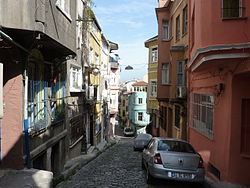
Fener was a traditionally Greek neighbourhood during the Ottoman era and its streets still contain many old stone houses and churches dating from Byzantine and Ottoman times. The grand mansions between the main road and the shore of the Golden Horn were often used to store wood imported from the Black Sea (Pontos) area; one now houses Istanbul's Women's Library. Their picturesque façades were damaged as a result of street-widening work from the 1930s onwards.

Fener is sandwiched between Cibali and Balat on the southern shore of the Golden Horn. The steep hills behind it run up to the Fatih neighbourhood.

Fener is served by the T5 tram line which links it with Cibali and the small bus terminal (for buses to Anatolia) at Alibeyköy. The Golden Horn ferry also stops at Fener, linking it to Üsküdar, Karaköy, Kasımpaşa, Balat, Ayvansaray, Hasköy, Sütlüce and Eyüp.

History

[edit]

After the Fall of Constantinople in 1453, Fener became home to many of the Greeks living in the city. The Patriarchate of Constantinople also moved here and remains here today. As a result, the term "Phanar" is sometimes used as a shorthand reference to the Ecumenical Patriarchate, just as "Vatican" is used for the Holy See of the Roman Catholic Church.

During the Ottoman period, the Greek inhabitants of Fener were called Phanariotes and often served the Sultan in important roles. Wealthy Phanariotes often served as dragomans (translators) or became the governors of provinces in the Balkans and Greece. Several served as hospodars of Wallachia and Moldavia between 1711 and 1821.

During WWI, the area was affected by the British bombing of Istanbul.[2]

Attractions

[edit]

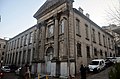
Fener's most notable attraction is the walled compound that encloses the Patriarchal Church of St. George, home to the patriarch who is still head of the Ecumenical Patriarchate of Constantinople, one of fifteen to seventeen independent jurisdictions of the Eastern Orthodox Church. The current holder of the office is Patriarch Batholomew I. The patriarchate moved here in 1602 but a fire in 1720 destroyed the original basilican church on the site. Another fire in 1941 did further damage to the older buildings in the compound; aside from the church itself and the brick-and-stone library at the end of the garden most of what a visitor sees today is fairly new. The Middle Gate (Orta Kapı) leading into the compound has been sealed since the then Patriarch was hanged there in 1821 when Greece rebelled against Ottoman suzerainty. Crowds, including visitors from Athens, flock here for the celebration of Greek Orthodox Easter.

The Church of St Mary of the Mongols (Panagia Muhliotissa, Theotokos Panagiotussa), inland and uphill from the Patriarchate, is interesting as the one church in Constantinople that was never turned into a mosque, even after the Conquest of Istanbul in 1453. The architect Atik Sinan (not to be confused with the better known Mimar Sinan) is said to have persuaded Sultan Mehmet II to allow it to continue providing services for the Greek population and a copy of the ferman (edict) decreeing this still hangs on the church wall.

Near the Church of St Mary of the Mongols is the huge red-brick Phanar Greek Orthodox College. The historian Dimitri Cantemir was a student here in the 17th century. Today it has only a tiny number of pupils. A second Greek school in Fener, the Maraşlı Greek Orthodox Primary School, is also an imposing building but no longer has any pupils.

Battered remnants of the Sea Walls that used to close Constantinople off from the Golden Horn still skirt Fener. The Ayakapı gate through the walls is believed to have been designed by Mimar Sinan in 1562.

The back streets of Fener are full of two and three-storied terraced houses often with cumbas (bay windows) as well as a handful of much grander houses. Many have been converted to house cafes, restaurants and tourist accommodation.[3]

Blessing of the Waters

[edit]

As elsewhere in the Orthodox world, every 6 January - the Feast of the Epiphany - a ceremony called the Blessing of the Waters take place in which a priest tosses a cross into water and swimmers race to see who can bring it back to shore first. In Istanbul this ceremony is performed by the Patriarch who tosses a cross into the Golden Horn to be retrieved by the swimmers.

[edit]

See also

[edit]

References

[edit]
[edit]
Revisions and contributorsEdit on WikipediaRead on Wikipedia
from Grokipedia
Fener (Greek: Φανάρι, Phanárion), meaning "" in reference to its ancient lighthouse along the , is a quarter in the district of , , positioned midway up the inlet's southern shore. It emerged as the principal hub of the Greek Orthodox community in the city following the Ottoman conquest in 1453, hosting influential Phanariote families who served as interpreters, administrators, and governors of under Ottoman rule. The neighborhood remains the seat of the , with the Patriarchal Church of St. George functioning as its central cathedral since its relocation there by Patriarch Matthew II around 1600, marking it as the fifth such site since the fall of the . Key institutions defining Fener include the Great School of the Nation, established in 1454 to educate the Orthodox elite and later housed in the prominent building, alongside historic churches such as St. Mary of the , the sole Byzantine-era church to evade conversion after 1453. The quarter's colorful Ottoman-era wooden houses and steep streets reflect its Phanariote heritage, though the Greek population has significantly diminished due to 20th-century migrations and events.

History

Byzantine and Early Ottoman Periods

During the Byzantine period, Fener, referred to as Phanar in Greek, constituted a coastal residential within the fourteenth region of , positioned along the southern shore of the and enclosed by the city's sea walls. This location facilitated its role as a suburban area outside the primary urban core, inhabited by diverse communities including merchants and . Archaeological and historical indicate the presence of early Christian monastic in the vicinity, such as a established in the early seventh century by Sopatra, daughter of Emperor Maurice, though subsequent structures reflect later rebuildings. The district hosted several Byzantine churches that underscored its importance, including the Church of Panagia Mouchliotissa, constructed as a domed in the eleventh century, and the Church of Saint Mary of the , originally a monastic site from the thirteenth century onward, uniquely preserved in its Orthodox function without conversion to a . These institutions highlight Fener's integration into the broader Byzantine religious landscape, where proximity to the supported maritime trade and pilgrimage activities. The Ottoman conquest of on May 29, 1453, marked a transitional phase for Fener, as Sultan implemented policies granting relative tolerance to remaining Christian residents, permitting the continuation of Orthodox practices under status. In the aftermath, Phanar became a concentrated settlement for the surviving Greek , who were allowed to retain property and communal structures amid the resettlement of Muslim Turks in other quarters. This arrangement fostered initial demographic continuity for the Orthodox enclave, evidenced by the persistence of churches and the eventual consolidation of Greek mercantile activities in the area. Mehmed II's restoration of the Ecumenical Patriarchate on January 6, 1454, with the appointment of Gennadios II Scholarios, reinforced institutional stability for the Orthodox community, though the patriarchal seat's formal relocation to the Church of Saint George in Fener occurred later, in 1601 under Patriarch Matthew II. Early Ottoman administrative practices, including the use of tahrir defterleri for taxation, registered non-Muslim households in coastal districts like Fener, indicating a mixed but enduring Christian presence without immediate mass displacement. This period thus established Fener as a of Greek Orthodox continuity under Ottoman rule.

Phanariote Era and Peak Influence

The Phanariote era began in the early as the , facing military setbacks and the need for reliable Christian intermediaries, appointed elites from Constantinople's Phanar district—known as Phanariotes—to key administrative roles, particularly as hospodars of the . This shift commenced in 1711 for after local ruler defected to during the Pruth River Campaign, with following by 1716, establishing a that lasted until 1821. Prominent families like the Mavrocordatoi secured these short-term appointments (typically 2-3 years), leveraging their positions as grand dragomans to navigate Ottoman-European . Wealth accumulation from hospodarships, including fixed tributes of around 30,000 kuruş annually per principality and oversight of tax farming and trade monopolies, directly fueled Fener's elevation from modest waterfront settlements to an affluent Greek Orthodox enclave. This prosperity manifested in the funding of opulent bipartite masonry-and-timber mansions along the Golden Horn, supplanting earlier simple fisher dwellings and symbolizing Phanariote status. Phanariote influence extended to the Ecumenical Patriarchate, where they dominated administrative roles, intervened in hierarch selections, and directed resources toward maintaining and embellishing its Fener complex, thereby linking their political gains to the district's institutional grandeur. While Phanariote introduced elements of enlightened , such as regulatory efforts to standardize administration and curb excesses in the principalities, it drew sharp criticisms for systemic and exploitation. Hospodars often prioritized rapid wealth extraction via heavy impositions on local populations, fostering resentment among Romanian boyars and peasants who viewed the imported Greek elites as detached and self-serving. Nonetheless, their patronage sustained Orthodox ecclesiastical structures, including charitable initiatives and cultural preservation, mitigating Ottoman encroachments on the church and indirectly bolstering Fener's role as a hub of Greek Orthodox authority. This duality—personal enrichment alongside institutional safeguarding—marked the peak of Phanariote influence, intertwining Fener's fortunes with the vicissitudes of Ottoman peripheral rule.

19th and 20th Century Transformations

The reforms, proclaimed through the 1839 Gülhane Edict and extending to 1876, centralized Ottoman administration and promoted legal equality among subjects, diminishing the Phanariote families' intermediary roles in governance that had sustained Greek Orthodox influence in Fener. These measures shifted power toward a professional bureaucracy, eroding traditional ethnic privileges as reforms emphasized Ottoman citizenship over millet-based autonomy. Urban modernization under introduced European-inspired planning, public services, and infrastructure, transforming Fener's layout from clustered wooden residences to more regulated masonry developments resistant to frequent fires. Secular education initiatives expanded state schools, challenging the dominance of confessional institutions like those tied to the Ecumenical Patriarchate, while permitting restorations of Greek Orthodox churches that briefly enhanced community infrastructure. By the late , Istanbul's Greek Orthodox population approached 160,000, concentrated in neighborhoods including Fener, supporting its role as an ecclesiastical and mercantile hub amid gradual economic shifts favoring Muslim entrepreneurs. World War I exacerbated pressures through wartime requisitions, inflation, and selective mobilization of non-Muslims into labor battalions, disrupting Fener's community stability and accelerating emigration driven by survival hardships. The subsequent Greco-Turkish War (1919–1922) fueled reciprocal ethnic violence and nationalist mobilization, undermining Greek positions in Ottoman successor states. The 1923 Treaty of Lausanne formalized a compulsory exchange displacing 1.2 million Greek Orthodox from Anatolia and eastern Thrace to Greece, but exempted Istanbul's residents, retaining a core Greek remnant in Fener numbering tens of thousands, though under heightened scrutiny and demographic dilution.

Post-1923 Decline and Key Events

Following the 1923 , which exempted Istanbul's Greek Orthodox population from the Greco-Turkish population exchange and estimated at approximately 110,000 individuals, the community faced a series of discriminatory measures that precipitated a steep demographic decline. Policies restricting non-Muslims from employment and , combined with economic pressures, initiated , reducing the Greek population to around 67,000 by 1955. The 1942 Varlık Vergisi, a capital tax imposed during , disproportionately targeted non-Muslims, assessing , , and at rates up to five times higher than with equivalent wealth, leading to widespread bankruptcies and forced labor for defaulters in work battalions. In , this resulted in the of thousands of non-Muslim businesses, particularly in commerce and finance, eroding the economic base of the Greek community in neighborhoods like Fener and accelerating outward migration. Turkish officials justified the tax as a wartime necessity, but assessments based on ethnicity rather than verifiable assets indicate intent to diminish minority economic influence. The September 6–7, 1955, marked a pivotal escalation, with mobs—mobilized via state-orchestrated transport from —targeting Greek properties in response to fabricated reports of a Greek attack on Atatürk's birthplace in . Over two days, 4,348 shops, 1,084 dwellings, 73 churches, and 27 schools were damaged or destroyed, primarily in Greek enclaves including Fener; official figures reported 11 deaths, though independent estimates cite up to 30 fatalities, dozens of rapes, and hundreds injured. Declassified U.S. diplomatic cables document police inaction and complicity, including the bombing's staging by Turkish agents to incite violence. While Turkish narratives framed the events as spontaneous retaliation for Greek actions in , the coordinated scale and near-total absence of Muslim casualties underscore a one-sided assault on Christian minorities, prompting an exodus of over 100,000 from in subsequent years. Tensions from the conflict further hastened the decline in the , as Turkish authorities invoked reciprocity for alleged Greek mistreatment of Istanbul's by expelling around 12,000 holding Greek passports in , freezing minority bank accounts, and imposing travel bans. These measures, tied to intercommunal violence on starting in 1963 and culminating in Turkey's 1974 invasion, reduced Istanbul's Greek population to fewer than 2,000 by the , with Fener's community dwindling to a fraction of its pre-1923 size amid ongoing restrictions on property ownership and cultural institutions. Empirical data on property seizures and rates reveal the policies' causal role in demographic erasure, outweighing official claims of mutual ethnic frictions.

Geography and Demographics

Location and Urban Layout

Fener occupies a position in the district of , on the historic peninsula's European side, directly along the western bank of the (Haliç). This inlet served as a natural harbor in Byzantine and Ottoman times, with Fener's terrain rising from the shoreline into steep hills that historically offered defensive advantages through elevated oversight of approaching vessels. The neighborhood is delimited to the south by Balat and extends northward toward the remnants of the Haliç sea walls, forming a compact enclave somewhat isolated from the broader urban expanse by its topography and the encircling historic fortifications. The urban layout of Fener reflects adaptations to its hilly geography, featuring narrow, cobblestoned streets that wind up slopes and facilitate pedestrian navigation while limiting vehicular access, a configuration rooted in pre-modern settlement patterns for enhanced . These paths cluster around central axes like Vodina Caddesi, promoting a dense, vertical that maximizes the hilltop's strategic vantage. Over time, the layout has faced pressures from adjacent developments, including industrial remnants along the and expanding transportation corridors. Contemporary challenges stem from Fener's adjacency to key , notably the Atatürk Bridge spanning the nearby, which channels heavy traffic flows and contributes to localized noise and from emissions. This proximity exacerbates urban encroachment, with the neighborhood's narrow confines vulnerable to spillover effects from broader congestion, underscoring its peripheral yet pressured spatial role within the metropolis.

Historical and Current Population Shifts

Following the population exchange between and , which exempted the Greek Orthodox community of under the , approximately 100,000 remained in the , with a significant concentration in the Fener-Phanar district, the historical center of Orthodox and Phanariote influence. This retention clause aimed to preserve , yet the community faced immediate and sustained pressures that initiated a demographic collapse, reducing numbers to around 7,000 by 1978 through emigration prompted by violence, property expropriations, and institutional restrictions. Key causal factors included the 1971 closure of the Halki Theological Seminary, which prevented the training of new and accelerated shortages, alongside economic marginalization that disproportionately affected minority-owned businesses and , driving outflows not attributable to voluntary migration but to targeted insecurities. These dynamics contrasted with Istanbul's overall population expansion, from roughly 1 million in the to over 15 million by 2023, fueled by internal Turkish migration and higher birth rates among the Muslim majority. By the 2020s, the Greek Orthodox population in had fallen to fewer than 2,000, predominantly elderly individuals in , with birth rates approaching zero and Fener's demographics shifting to a majority of Muslim residents, including economic migrants from and refugees, rendering the neighborhood's original Christian character vestigial. Turkish state policies, justified on grounds of and secular uniformity, have restricted minority religious training and , measures community representatives contend amount to cultural erasure, though empirical trends confirm attrition via and natural decline rather than assimilation.

Ecumenical Patriarchate

Establishment and Canonical Role

The was elevated to prominence at the Second in 381 AD, where Canon 3 granted the Bishop of a primacy of honor immediately after the Bishop of , recognizing the city's status as the "." This canonical foundation positioned the see as a leading voice in , with its influence rooted in the council's affirmation of doctrinal unity against and other heresies. Following the Great Schism of 1054, the Patriarchate assumed the role of —first among equals—among the heads of autocephalous Orthodox churches, a status derived from the privileges accorded by early ecumenical councils rather than . This doctrinal primacy entails coordinating pan-Orthodox affairs, convening synods, and preserving liturgical and theological traditions without overriding the autonomy of other Orthodox primates, as evidenced by the Patriarchate's historical in inter-church disputes. In 1601, amid threats from fires and unrest, Matthew II transferred the patriarchal seat to the Church of St. George in Fener, enhancing its security while maintaining continuity of operations. After the fall of in 1453, Gennadios II Scholarios negotiated with Sultan to secure ecclesiastical privileges, establishing the Patriarch as over Orthodox subjects under the Ottoman millet framework and enabling the preservation of Byzantine liturgical practices amid Islamic rule. Today, under Ecumenical Patriarch Bartholomew I, who has served since his election on October 2, 1991, the Patriarchate guides roughly 300 million Orthodox faithful worldwide through its leadership, emphasizing doctrinal fidelity and unity despite jurisdictional constraints limited to Istanbul's historic core.

Architectural and Institutional Features

The Patriarchal Cathedral Church of St. George serves as the central architectural feature of the Ecumenical Patriarchate, featuring a design with three aisles that emphasizes simplicity amid its historical reconstructions. The current structure largely stems from rebuilds initiated in 1614 under Patriarch Timothy II following earlier fires, with subsequent restorations after destructions in 1640 and 1729, and major work in 1797 by Patriarch Gregory V, underscoring its resilience as a Christian edifice in Istanbul's urban landscape. Post-1955 pogroms, the complex incorporates fortified walls and restricted access protocols to safeguard its premises, reflecting adaptations to local security dynamics while preserving Orthodox liturgical functions. Key relics within the church include the Column of Flagellation, venerated as the remnant where Christ was scourged, alongside artifacts like the patriarchal throne dating to Byzantine origins, which symbolize continuity of . The adjacent patriarchal library maintains an extensive collection of historical manuscripts and documents essential for Orthodox theology and administration, though exact inventories remain partially unpublished due to preservation concerns. Institutionally, the Holy and Sacred Synod, comprising twelve hierarchs serving annual terms under the Ecumenical Patriarch's presidency, convenes regularly at the to address doctrinal, jurisdictional, and pastoral matters, reinforcing its primatial coordination among autocephalous churches. Historically, the Patriarchate hosted the Ottoman Empire's first Greek in 1627–1628, established by Nikodemos Metaxas, which produced liturgical texts and contributed to Orthodox literary dissemination before its suppression. The Patriarchate's institutional framework has facilitated efforts toward Orthodox unity, such as convening and presiding over the 2016 Holy and Great Council in , which addressed contemporary challenges like and mission despite absences by some churches. However, its 2018 decision to grant to the , announced on October 11, provoked a with the , which severed Eucharistic communion citing jurisdictional overreach; proponents view this as a diplomatic assertion of primacy rooted in historical precedents, while detractors argue it exacerbated divisions, highlighting tensions in the Synod's authority.

Interactions with Turkish State

The (1923) recognized the Ecumenical Patriarch as the spiritual leader solely of the Greek Orthodox minority within Turkey's borders, explicitly rejecting any broader ecumenical authority over Orthodox Christians worldwide. Turkish authorities have consistently enforced this limitation, prohibiting the public use of the term "ecumenical" by the Patriarch and denying legal personality to the institution as anything beyond a local religious body. This stance aligns with Turkish assertions of sovereignty, viewing expanded recognition as a potential infringement on national control, though international observers, including U.S. State Department reports, criticize it as restricting religious freedom. In 1971, closed the Halki Theological School—the primary seminary for training Orthodox clergy—under a law mandating the affiliation of all private higher education institutions with state universities, effectively halting domestic and contributing to an aging priesthood reliant on foreign-trained hierarchs subject to short-term visas. The government maintains this closure upholds educational uniformity and security, while advocates and European bodies argue it systematically undermines the community's viability; repeated Turkish promises to reopen, as in 1998 and recent diplomatic overtures, have not materialized. Post-1923, Turkish authorities have confiscated numerous properties from the Ecumenical Patriarchate and affiliated foundations, with the (ECHR) ruling in cases such as November 2022 that such expropriations violated property rights under the European Convention. In 2024, amid tensions over the Patriarchate's perceived involvement in Ukraine-related diplomacy—including protests leading to its removal from a Swiss peace summit communique— reaffirmed the institution's non-state status and imposed visa restrictions on foreign Orthodox hierarchs, limiting stays to three months and requiring for electoral participation. These measures are justified by as safeguarding national security against external influences, contrasting with criticisms from bodies like the EU Parliament of minority suppression, though historical Greek policies toward Muslim exchanges post-Lausanne provide context for bilateral sensitivities without excusing current asymmetries.

Education and Institutions

Fener Greek Orthodox College

The Phanar Greek Orthodox College, known in Greek as the Megáli tou Génous Scholí or Great School of the Nation, was founded on January 6, 1454, by Ecumenical Patriarch Gennadios II Scholarios shortly after the Ottoman conquest of Constantinople, under an agreement with Sultan Mehmed II. Originally established as a patriarchal academy to preserve Orthodox education, it evolved into a prominent lyceum serving the Greek Orthodox community. The current iconic red-brick building, constructed between 1881 and 1883 by Greek architect Constantinos Dimidis, accommodated 731 students upon opening, reflecting its pre-1923 peak enrollment amid a thriving minority population. Over the , enrollment plummeted due to mass emigration of Istanbul's Greek Orthodox population following events like the 1923 population exchange, 1955 anti-Greek riots, and ongoing demographic decline, reducing numbers from hundreds to critically low levels. By 2025, the school had only 30-31 students, with zero new enrollments for the 2025-2026 academic year, marking the first such instance in its 571-year history and signaling severe threats to the community's institutional viability. This collapse correlates with Istanbul's Greek Orthodox population shrinking to an estimated 2,000-3,000, driven by emigration and low birth rates, compounded by restrictions on minority seminaries like Halki, which limit clergy training and cultural continuity. In October 2025, Turkey's Ministry of National Education ordered the evacuation of the premises within 90 days due to seismic vulnerabilities identified in recent assessments, requiring over €10 million in reinforcements that the underfunded institution cannot afford. Principal Dimitris Zotos reported seeking alternative buildings to sustain operations, as closure would exacerbate the erosion of Greek Orthodox educational infrastructure. Despite these challenges, the college's alumni have included influential Orthodox patriarchs, scholars, and leaders who shaped Greek and Balkan ecclesiastical and intellectual life, underscoring its historical role in fostering elite community figures.

Other Community Facilities

The Greek Orthodox minority foundations in Turkey, governed by the 1936 Foundations Law and subsequent regulations, administer a network of social welfare institutions including hospitals, orphanages, and community centers that historically supported the Phanariot community in and broader . These entities integrate with Turkish legal frameworks for and operations but face restrictions on acquiring new assets and electing boards, limiting expansion amid demographic decline. Following the 1955 , which inflicted widespread damage on Greek properties and accelerated emigration, several community facilities underwent reconstruction in the 1960s funded by local remnants and diaspora contributions. This effort aimed to sustain cultural and linguistic continuity, with institutions like the Balıklı Greek Hospital—established in 1753 and serving Orthodox patients—continuing limited operations despite staff shortages from population loss, now numbering around 2,000 ethnic Greeks in as of the 2020s. Orphanages and elder care centers, often Patriarchate-affiliated, exemplify dependency on external philanthropy; the , under Fener's oversight, housed up to 5,800 children from 1903 until its 1964 closure due to enrollment drops post-Cyprus tensions and anti-minority policies, remaining derelict thereafter. Such facilities preserve rituals and language but operate at reduced capacity, reliant on sporadic aid amid ongoing property disputes and local integration challenges under foundation laws.

Cultural and Architectural Heritage

Major Monuments and Churches

The Church of St. George, the patriarchal cathedral of the Ecumenical Patriarchate, features a neo-classical exterior distinct from typical Byzantine Orthodox designs, with its interior adorned by an 18th-century iconostasis blending Byzantine, Renaissance, Baroque, and Ottoman elements. Originally a nuns' convent, the structure retains a traditional basilica layout divided into vestibule, nave, and altar. Rebuilt after fires and damages, including those from the 1955 riots that targeted Greek Orthodox sites in Fener, it underwent private community-funded restorations to address vandalism and structural wear. The Church of St. Mary of the Mongols, constructed in the late 13th century by Byzantine princess , stands as the only surviving Byzantine church in never converted to a , owing to a protective issued by guaranteeing its Orthodox use. This Middle Byzantine edifice, altered in Palaiologan and Ottoman periods, preserves original dedicatory functions amid risks of and decay, with continuous services despite historical threats. Post-1955 damages, including to nearby Fener churches, prompted private restorations, though empirical assessments highlight vulnerabilities like seismic instability common to the district's aged . Turkish authorities claim oversight in heritage maintenance, while Greek Orthodox reports cite persistent access restrictions and underfunding exacerbating structural cracks and corrosion observed in similar local edifices. The Fener Rum Hospital, established in the 18th century as a community institution for the Greek Orthodox population, exemplifies Ottoman-era philanthropy with its monumental architecture serving healthcare needs until modern declines. Preservation efforts focus on countering decay from neglect and past unrest, though detailed surveys reveal ongoing challenges in maintaining seismic resilience without state intervention.

Religious and Social Traditions

The annual Blessing of the Waters ceremony on , commemorating the Christ, remains a central religious tradition in Fener, where the Ecumenical throws a wooden into the from the Patriarchal pier, and young Orthodox participants dive into the cold waters to retrieve it, symbolizing spiritual purification. This rite traces its origins to Byzantine Epiphany practices, adapted locally since the Ottoman era, and continues to draw crowds from the diminished Greek Orthodox community and observers, affirming communal bonds despite secular pressures in contemporary . Social traditions, such as name-day celebrations honoring patron saints according to the Orthodox calendar, persist among Fener's residents as intimate gatherings with feasts, prayers, and family visits, reflecting Greek cultural continuity even as broader festivals see reduced attendance. Participation has causally declined with the Greek Orthodox population in shrinking from over 100,000 in the mid-20th century to approximately 1,500 today, driven by historical events like the 1955 pogroms, economic migration, and assimilation incentives, which have eroded the needed for vibrant communal events. These practices endure as empirical markers of ethnic-religious identity resilience against assimilation, with the community's adherence to liturgical cycles and serving to preserve distinctiveness amid Turkey's Muslim-majority context and state . Under Ecumenical Bartholomew I, since 1991, interfaith dialogues have achieved milestones like joint environmental initiatives with Muslim leaders and calls for mutual respect, countering perceptions of Orthodox traditions as anachronistic relics in a modernizing republic, though some Turkish nationalists view such persistence as incompatible with national unity.

Contemporary Developments

Urban Regeneration Efforts

The Rehabilitation of Fener and Balat Districts Program, initiated in 2006 through a partnership between Municipality and the , aimed to address seismic vulnerabilities and preserve historic fabric in the area. Funded with approximately €7 million, the initiative focused on around 200 residential buildings for resistance, restoring facades, rehabilitating the Balat market, and implementing systems alongside social centers for community support. These efforts prioritized minimal interventions to maintain structural integrity in vernacular Ottoman-era , emphasizing sustainable restoration techniques like targeted seismic strengthening without wholesale replacement. In the , Turkey's urban transformation legislation (Law No. 6306, enacted 2012) expanded regeneration to include demolitions of seismically unsafe structures in Fener-Balat, shifting from rehabilitation to broader renewal led by private firms. This phase involved clearing dilapidated buildings to enforce safety standards post-1999 Marmara lessons, with reports indicating partial that displaced low-income households unable to afford relocated or rebuilt housing costs. Outcomes included upgraded utilities in select zones, such as improved and networks in restored blocks, but coverage remained uneven, with many interventions halting amid disputes. These projects accelerated dynamics, where rising property values from renovations priced out original residents, including remnants of minority communities, exacerbating socioeconomic fragmentation rather than fostering inclusive continuity. Academic analyses highlight how initial EU-driven preservation gave way to market-led displacement, with 2020s reports noting increased alienation and cultural dilution in the district's social fabric.

Tourism and Gentrification

Tourism in Fener has expanded significantly since the , integrated into broader heritage itineraries that highlight the neighborhood's Ottoman-era Greek Orthodox and the Ecumenical . As part of 's record 20 million international visitors in 2024, Fener attracts pilgrims, history enthusiasts, and influencers drawn to its colorful, decaying mansions and churches like St. George's Cathedral, generating revenue for local guides and vendors through guided tours focused on minority heritage sites. This influx supports partial funding for site maintenance, with entry fees and donations aiding preservation efforts at attractions such as the Fener Greek Orthodox , though exact figures remain limited due to the neighborhood's niche status within the city's ecosystem. The proliferation of short-term rentals, including listings, has accelerated dynamics in Fener and adjacent Balat, mirroring trends in other historic districts where such platforms correlate with rental price surges of up to 3.1% per 10% increase in rental gaps. Property conversions for tourist accommodations have altered streetscapes, displacing long-term residents and fostering a commodified aesthetic that prioritizes Instagram-worthy facades over lived community spaces, thereby risking the erosion of Fener's authentic socio-cultural fabric originally shaped by its Greek Orthodox Phanariote . While bolsters economic activity amid Istanbul's visitor growth, strains at key sites, with increased foot traffic in 2024-2025 exacerbating wear on structures like the Patriarchal residence and contributing to localized overcrowding during peak seasons. Concurrent demographic shifts, driven by post-1955 non-Muslim exodus and subsequent influxes of internal Anatolian Muslim migrants alongside recent Syrian refugees integrating into low-income housing, intersect with tourism pressures to further diversify and dilute the neighborhood's historical ethnic homogeneity, prioritizing transient economic gains over sustained cultural continuity.

Ongoing Challenges and Controversies

The Fener Greek Orthodox High School, established in 1454, recorded zero new enrollments for the 2025–2026 , marking the first such instance in its over 500-year history, amid a broader decline in the local Greek Orthodox population to approximately 1,500 individuals in . This development, coupled with mid-2025 assessments deeming the school's historic structure seismically unsafe and requiring over €10 million in reinforcements, has fueled fears of evacuation and potential operational suspension, though school officials have rejected claims of imminent closure as misleading. Turkish authorities attribute such pressures to demographic realities rather than targeted policy, while groups frame them as symptomatic of systemic erosion of minority institutions. Demands for reopening the Halki Theological School, shuttered since 1971 under Turkey's secular higher education laws requiring state university affiliation, persist without resolution as of October 2025, with Turkish officials citing constitutional secularism as grounds for rejection despite intermittent diplomatic overtures. President Erdoğan signaled potential discussions in September 2025 following U.S. President Trump's advocacy, yet a subsequent government letter reaffirmed Turkey's longstanding denial of the Ecumenical Patriarchate's international "ecumenical" status, viewing recognition as incompatible with national sovereignty over religious leadership confined to Turkish citizens. This stance contrasts with Orthodox advocacy emphasizing the school's role in training clergy, amid evidence of agency in the Patriarchate's global engagements that Turkish narratives portray as overreach beyond minority rights. The Ecumenical Patriarchate's 2018 granting of to the precipitated a , with the severing communion on October 15, 2018, accusing of overstep in supporting Ukraine's from Moscow's influence. This decision, exercised as a demonstration of the Patriarchate's primatial despite its diminished local flock, has intensified Turkish scrutiny, framing such interventions as extensions of influence that challenge Ankara's control over Fener-based institutions. Greek Orthodox leaders counter with calls for reciprocity, invoking the 1923 population exchange treaty's mutual displacements of Anatolian Greeks and Balkan Turks as historical context for current protections, while data from U.S. Commission on International Religious Freedom reports highlight ongoing property disputes and an uptick in vandalism against Christian sites, though Islamist terrorist bombings in during the 2000s primarily targeted synagogues and secular sites rather than Fener churches specifically. Turkish perspectives emphasize safeguards post-exchange, rejecting unilateral victimhood narratives in favor of balanced bilateral .

References

Add your contribution
Related Hubs
User Avatar
No comments yet.