Hubbry Logo
The Lower DepthsThe Lower DepthsMain
Open search
The Lower Depths
Community hub
The Lower Depths
logo
8 pages, 0 posts
0 subscribers
Be the first to start a discussion here.
The Lower Depths
The Lower Depths
from Wikipedia
The Lower Depths
Written byMaxim Gorky
Date premiered18 December 1902
Place premieredMoscow Art Theatre, Moscow, Russia
Original languageRussian

The Lower Depths (Russian: На дне, romanizedNa dne, literally: At the bottom) is a play by Russian writer Maxim Gorky written in 1902 and produced by the Moscow Arts Theatre on December 18, 1902, under the direction of Konstantin Stanislavski. It became his first major success, and a hallmark of Russian social realism.[1] The play depicts a group of impoverished Russians living in a homeless shelter near the Volga.

When it first appeared, The Lower Depths was criticized for its pessimism and ambiguous ethical message. The presentation of the lower classes was viewed as overly dark and unredemptive, and Gorky was clearly more interested in creating memorable characters than in advancing a formal plot. However, in this respect, the play is generally regarded as a masterwork.

The theme of harsh truth versus the comforting lie pervades the play; most of the characters choose to deceive themselves over the bleak reality of their condition.

Characters

[edit]
  • Mikhail Ivanov Kostylyov – keeper of a night lodging
  • Vasilisa Karpovna – his wife
  • Natasha – her sister
  • Medvedev – her uncle, a policeman
  • Vaska Pepel – a young thief
  • Andrei Mitritch Kleshtсh – a locksmith
  • Anna – his wife
  • Nastya – a street-walker
  • Kvashnya – a vendor of meat-pies
  • Bubnov – a cap-maker
  • The Baron
  • Satine
  • The Actor
  • Luka – a pilgrim
  • Alyoshka – a shoemaker
  • The Tatar
  • Krivoi Zob

Plot

[edit]
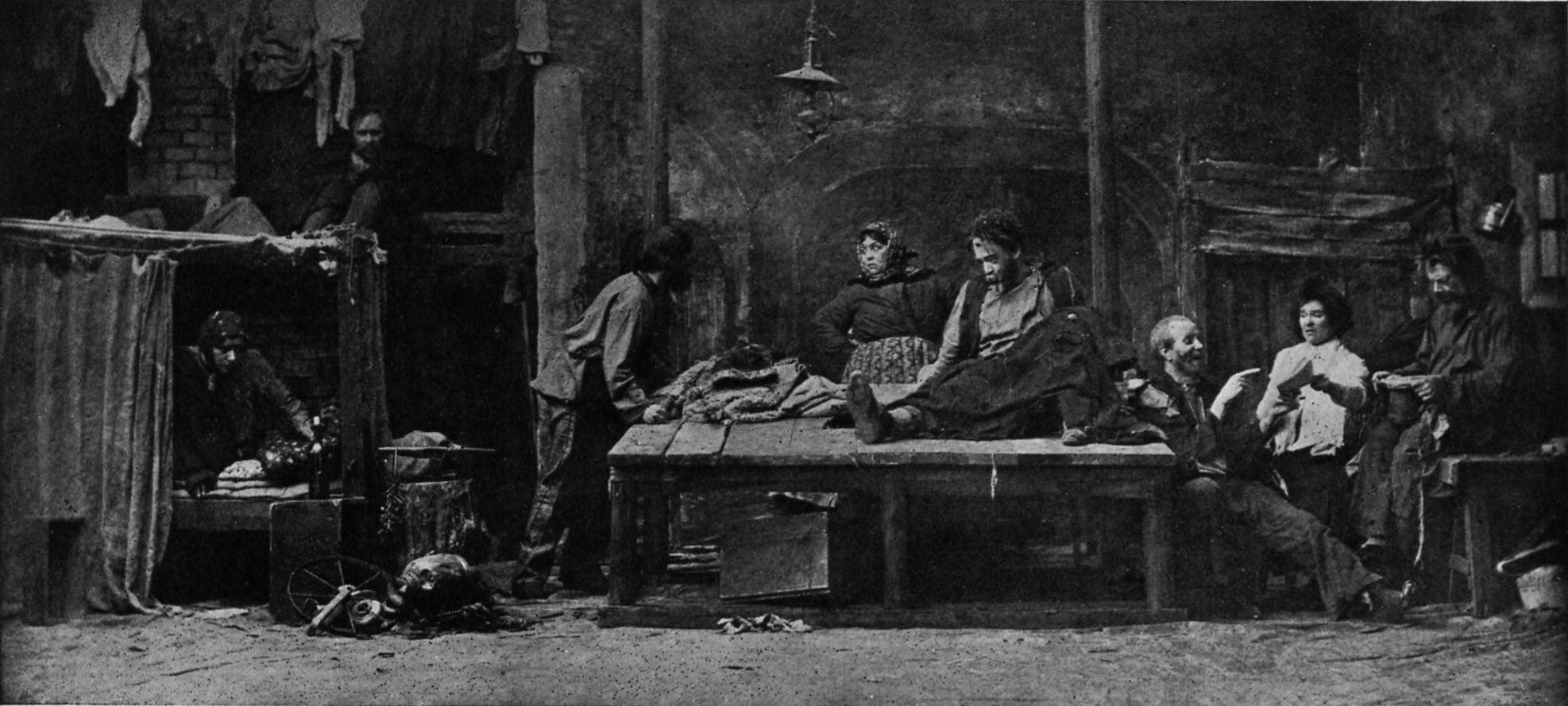
Ivan Moskvin as Luka and Vasily Kachalov as the Baron. Moscow Art Theatre, 1902

In the cellar of a small boarding house, thin boards partition off the room of Vaska, a young thief. In the kitchen live Kvashnya (Dough), a vendor of meat pies, the decrepit Baron, and the streetwalker Nastya. Other lodgers sleep in bunks in the same room.

Nastya is reading a novel titled Fatal Love. The Baron, who lives largely on Nastya's earnings, seizes the book and mocks Nastya. Satin rises from his bunk, knowing only that he took a beating the night before, and the others tell him he had been caught cheating at cards. The Actor wakes in his bed on top of the stove. He predicts that someday Satin will be beaten to death.

The Actor reminds the Baron to sweep the floor to satisfy the strict landlady. The Baron and Kvashnya leave to go shopping. The Actor claims a doctor has told him he has an organ poisoned by alcohol, and sweeping the floor would be bad for his health. Anna, who is dying of consumption, lies in her bunk while her husband, Kleshtch (Tick), works at his bench, fitting old keys and locks. Anna offers him the dumplings that Kvashnya has left for her in the pot. Kleshtch agrees that there is no use feeding a dying woman, and eats the dumplings. The Actor helps Anna down from her bed and into the hall. As they go through the door, the landlord, Kostylyov, enters, nearly knocking them down. He looks around the dirty cellar and tells Kleshtch that he is taking up too much room and that henceforth the rent will be increased. Then Kostylyov asks Vaska furtively if his wife has been in; he suspects that his wife, Vasilisa, is sleeping with Vaska. The thief comes out of his room and denounces the landlord for not paying his debts, saying that Kostylyov still owes seven roubles for a watch he had bought. Ordering Kostylyov to produce the money immediately, Vaska sends him out of the room. The others admire Vaska for his courage and urge him to kill Kostylyov and marry Vasilisa, so he can be the landlord. Vaska decides that he is too softhearted to be a landlord, especially as he is thinking of discarding Vasilisa for her sister, Natasha. Satin asks Vaska for twenty kopecks, which he gives him.

Natasha comes in with the tramp Luka, who is put in the kitchen to sleep with the three already there. Luka begins to sing, but the others object. When Vasilisa comes in, she gives orders for an immediate sweeping of the floor. She asks to see Luka's passport, but he has none, making him more readily accepted by the others. Medvedev, who is a policeman and Vasilisa's uncle, enters the cellar and begins to question Luka, but when the tramp calls him sergeant, Medvedev leaves him alone.

That night, Anna lies in her bunk while a noisy card game goes on. Luka talks gently to her, and Kleshtch comes occasionally to check on her. Luka remarks that her death will be hard on her husband, but Anna accuses Kleshtch of causing her death, and says that she looks forward to rest and peace after her death.

The card players become louder and Satin is accused of cheating. Luka quietens them down. He tells Vaska that he will be able to reform in Siberia, and he assures the Actor that at a sanatorium he could be cured of alcoholism. Vasilisa comes in and offers Vaska three hundred rubles to kill Kostylyov. Vaska knows he would be free to marry Natasha, who is recovering from a beating given to her by her jealous sister, and he is about to refuse when Kostylyov enters; Vaska pushes him out of the cellar.

Luka has overheard everything and warns Vaska not to have anything to do with Vasilisa. Luka sees that Anna is dead and Kleshtch is brought to look at her body, which he agrees to take outside. The Actor begins to cavort in joy, saying he has made up his mind to go to the sanatorium. Luka has told him that he can even be cured at state expense.

In the backyard that night, as Natasha is telling romantic stories to the crowd, Kostylyov comes out and orders her back to work. As she goes in, Vasilisa pours boiling water on Natasha's feet. Vaska attempts to rescue her and knocks Kostylyov down, and in the ensuing brawl Kostylyov is killed. Vasilisa immediately accuses Vaska of murder. Natasha thinks that Vaska has murdered Kostylyov for the sake of Vasilisa.

Sensing trouble, Luka disappears. Vaska escapes a police search, and Natasha is taken to the hospital, while the rest of the down-and-outers continue as before. Satin cheats at cards, and the Baron tries to convince the others of his former affluence. They all agree that Luka was a liar.

During a bitter quarrel with Nastya, the Baron steps outside. Satin and the others begin singing, but they break off when the Baron bursts in with the news of the actor's suicide, to which Satin retorts: "You spoiled the song, you idiot".

Production history

[edit]

The characters of The Lower Depths are said to have been inspired by the denizens of the Bugrov Homeless Shelter (Russian: Бугровская ночлежка, Bugrovskaya nochlezhka) in Nizhny Novgorod, which had been built in 1880–1883 by the Old Believer grain merchant and philanthropist Nikolai Alexandrovich Bugrov in memory of his father, A. P. Bugrov. When the actors of the Moscow Arts Theatre were preparing the play for its first run in 1902, Maxim Gorky supplied them with photographs of the Nizhny Novgorod underclass taken by the famous local photographer, Maxim Dmitriev, to help with the realism of the acting and costumes.[2]

Film versions

[edit]

Influences

[edit]

Gorky's play has been recognized as an important influence on Eugene O'Neill's 1946 drama The Iceman Cometh.[6] In the dog pound scene from the 1955 Disney animated film Lady and the Tramp, the incarcerated homeless Russian Wolfhound, Boris, quotes a passage from the play: "Miserable being must find more miserable being. Then is happy."[7][8]

See also

[edit]

References

[edit]
[edit]
Revisions and contributorsEdit on WikipediaRead on Wikipedia
from Grokipedia

The Lower Depths (Russian: На дне, romanized: Na dne; lit. 'At the bottom') is a play written by Russian author Maxim Gorky in 1902, first performed on December 18 of that year by the Moscow Art Theatre under Konstantin Stanislavski's direction. The work portrays the grim existence of destitute individuals—a thief, a disgraced nobleman, a prostitute, and an alcoholic former actor, among others—confined to a dilapidated flophouse near the Volga River, emphasizing their degradation amid philosophical debates on truth, lies, and human dignity.
Gorky's naturalistic depiction draws from his own experiences with , presenting characters trapped in cycles of , illness, and despair, yet clinging to illusions of introduced by the enigmatic wanderer Luka, whose advocacy for comforting falsehoods contrasts with the cynical assertions of Satin that man must confront unvarnished reality. The play's marked a commercial and artistic success, solidifying Gorky's reputation as a voice for the , though it provoked debate over its perceived and rejection of revolutionary optimism in favor of raw human frailty. Influential in the development of on stage, The Lower Depths has been adapted into films, operas, and numerous productions worldwide, highlighting enduring themes of existential struggle and the tension between deception and truth in the face of suffering, while reflecting early 20th-century Russian society's underbelly without romanticization.

Background and Creation

Maxim Gorky's Biographical Context

Alexei Maximovich Peshkov, who adopted the pen name —meaning "bitter" in Russian—was born on March 28, 1868, in , , to a family of modest means that had declined into hardship. His father, a ship's captain and carpenter, died in 1871 from , reportedly after being beaten by his employer, leaving Peshkov in the care of his mother, who struggled with poverty and later died of in 1879 when he was eleven. Orphaned, he was taken in by his maternal grandfather, Vasily Kashirin, a dye-works owner whose household was marked by religious fanaticism, physical abuse, and familial violence, experiences Peshkov later detailed in his autobiographical trilogy beginning with Childhood (1913-1923). From around age eight or nine, Peshkov was compelled to work to survive, beginning as a boy in a River steamboat where he endured beatings and squalor, then apprenticing as a draftsman in an workshop and later as a cook's assistant. By his early teens, after leaving his grandfather's home amid ongoing strife, he took on itinerant labor including village fieldwork, dishwashing in , railway signaling, and jobs in fisheries, saltworks, and repair shops across and the . These years of exposed him directly to the destitute —tramps, thieves, prostitutes, and alcoholics—whose raw existence he observed without romanticization, shaping his realist literary approach as a self-taught autodidact who quit formal schooling at age ten and devoured borrowed amid chronic and . In 1892, at age 24, Peshkov settled in Tiflis (now ) and began publishing sketches under his pseudonym, drawing from these formative encounters with societal margins to critique Tsarist Russia's inequities. By the late , his short stories gained notice for portraying the "lower depths" of human degradation and resilience, culminating in The Lower Depths (1902), a play whose shelter-dwelling characters echoed the archetypes he met during his youth—figures trapped in illusion, vice, and futile rebellion against destitution—reflecting his unsparing view of poverty's corrosive effects without socialist idealization at that stage. His radicalization through underground Marxist circles in the further honed this perspective, though his early works prioritized empirical observation over doctrine.

Historical and Socio-Economic Setting in Tsarist Russia

In the late 19th and early 20th centuries, Tsarist Russia under (r. 1894–1917) experienced accelerated industrialization driven by policies such as those of Finance Minister , emphasizing railway expansion and to modernize the economy. This period saw urban population growth from approximately 7 million to 28 million over the preceding half-century, fueled by rural-to-urban migration as peasants sought work following the 1861 emancipation of serfs. However, agricultural stagnation persisted, with many rural areas remaining mired in poverty due to inefficient communal land systems and frequent famines, exacerbating the influx of destitute migrants into cities like . Socio-economically, this industrialization created stark inequalities, with Russia's per capita income lagging at less than half that of Western European nations like and around 1900. Factory workers endured harsh conditions, including 12–14-hour shifts, minimal safety regulations, and wages insufficient for basic sustenance, often leading to chronic and reliance on informal economies. A 1904 survey highlighted widespread and inadequate , where multiple families shared single rooms in insalubrious tenements, fostering environments rife with and . Urban poverty manifested in the proliferation of flophouses, shelters, and basements the "lower depths"—a transient comprising failed artisans, alcoholics, petty criminals, and the unemployed, distinct from the organized . In around the , shortages were acute, with workers often living in or improvised dwellings lacking , contributing to high mortality rates and social disintegration. Philanthropic efforts and state workhouses provided limited relief, but systemic corruption and autocratic resistance to reform perpetuated these conditions, sowing seeds of discontent that erupted in strikes and the 1905 Revolution.

Composition and Initial Intent

Maxim Gorky conceived the idea for The Lower Depths (Na dne) around 1900, drawing from his personal encounters with vagrants and the impoverished during his itinerant youth in Tsarist Russia. He composed the play primarily during the winter of 1901 and spring of 1902, completing the manuscript in time for production by the (). Gorky tailored the work to MAT's naturalistic methods under , incorporating authentic dialogue and behaviors observed among real destitute individuals to achieve in performance. Gorky's initial intent was to portray the unvarnished lives of society's outcasts—thieves, prostitutes, and casual laborers—in a Russian flophouse, marking the first major dramatic work in to center such characters without conventional heroic arcs or redemptive plots. Rather than preaching overt revolutionary change, the play aimed to humanize these figures by juxtaposing their self-deceptions and philosophical debates against their material degradation, thereby critiquing the social structures that perpetuated their condition. Proposed titles such as Without the Sun and The Doss underscored Gorky's focus on existential darkness and communal squalor, reflecting his view of literature as a tool to expose and potentially elevate amid systemic failure. This approach stemmed from Gorky's broader commitment to realism over , informed by his self-education and rejection of bourgeois sentimentality in depicting .

Synopsis and Structure

Plot Overview

The Lower Depths unfolds in a cavernous near the River in late 19th-century Tsarist , serving as a for impoverished outcasts such as thieves, former aristocrats, alcoholics, and laborers. The residents include Vaska Pepel, a young thief entangled in romantic rivalries; , a sharp-tongued gambler; the Baron, a decayed nobleman; the Actor, a tubercular drunkard; Nastya, a prostitute fond of romantic novels; Bubnov, a cynical cap-maker; Kleshtch, a locksmith tending to his dying wife Anna; and the proprietors, the miserly Kostilyov and his jealous wife Vassilisa, whose sister Natasha is coveted by Pepel. The play's loose narrative structure emphasizes character interactions over linear progression, beginning in Act I with the lodgers' daily squabbles, card games, and petty thefts amid Anna's consumptive coughs and Kostilyov's rent collections. The arrival of Luka, a wandering pilgrim offering solace through fabricated hopes, disrupts the group's fatalism, as he consoles individuals like the Actor with tales of redemption clinics and urges escape from harsh realities. Act II shifts to nighttime tensions, featuring a raucous that turns violent and Anna's offstage death, which Kleshtch confronts stoically while Vassilisa schemes to have Pepel kill Kostilyov, promising him Natasha in return. Domestic escalates as Vassilisa scalds Natasha with boiling water, prompting Pepel's intervention. In Act III, set outdoors amid washtubs, philosophical debates on truth and pity interweave with Nastya's melodramatic storytelling and Pepel's proposal to Natasha, but confrontations culminate in Pepel fatally stabbing Kostilyov after catching him with Nastya, leading to mutual accusations and arrests among Vassilisa, Natasha, and Pepel. The final act depicts the in disarray post-Luka's quiet departure, with the lodgers reflecting on loss as the , inspired briefly by Luka's lies about a free , attempts but hangs himself upon learning no such cure exists for his advanced and . asserts dominance in a raw proclaiming human freedom and the supremacy of unvarnished truth over pitying deceptions, as the group disperses into uncertainty following raid.

Key Dramatic Elements

unfolds across four acts with an unconventional dramatic structure that prioritizes character exposition and philosophical discourse over a linear plot or rising action. Rather than a traditional arc, the play consists of episodic vignettes depicting daily life in a destitute , allowing tensions to accumulate through interpersonal revelations and debates. This static form, which critiqued as superfluous in its final act for insufficient character development and action, shifts focus from external events to internal conflicts, culminating in sporadic violence such as the landlord Kostylyov's murder and the Actor's suicide. The setting amplifies dramatic intensity by confining most action to a single, cavernous basement in an unnamed River town, evoking a cave-like of dampness, makeshift partitions, and that symbolizes societal and . This claustrophobic environment, detailed through descriptions of its lair-like , fosters a liminal atmosphere where characters oscillate between despair and fleeting illusions, directly influencing conflicts over resources and as residents yield earnings to exploitative proprietors. Act III's brief relocation to an adjacent vacant lot provides momentary contrast but reinforces the overarching stasis. Naturalistic techniques dominate, with vivid, slang-infused dialogues overlapping in a polyphonic manner to mimic authentic and reveal individual psyches, drawing from Moscow Art Theatre's on-site research into urban poverty for . emerges via characters' fabricated tales, such as Luka's parables of , which heighten irony when confronted by harsh realities like Anna's . Interpersonal frictions—romantic rivalries, thefts, and abuses—propel limited plot momentum, while the operates as a protagonist, embodying diverse social strata without a singular . Philosophical monologues provide rhetorical peaks, exemplified by Satin's Act IV declarations exalting human truth—"Man—that’s the truth!"—which challenge the pilgrims' comforting deceptions and underscore the play's didactic undercurrent, though critics noted this as bordering on preachiness. Luka's arrival functions as a catalytic device, igniting debates on truth versus lies that permeate interactions and precipitate tragic resolutions, blending psychological depth with sociological commentary in a manner that shocked 1902 audiences through its unsparing realism.

Characters

Primary Figures and Their Roles

Mikhail Ivanoff Kostilyov functions as the keeper of the night lodging, a meddlesome and hypocritical proprietor who preaches while exploiting residents and engaging in an affair with Nastya, ultimately provoking his murder by Vaska Pepel. Vassilisa Karpovna, his wife, exerts tyrannical control over the , abusing her Natasha physically and conspiring with Vaska to eliminate Kostilyov for financial gain. Natasha, Vassilisa's downtrodden , endures repeated beatings and briefly entertains escape with Vaska before suffering severe injuries amid the ensuing violence. Vaska Pepel, a young thief and Vassilisa's lover, represents fleeting aspirations for reform, rejecting her murderous scheme initially but killing Kostilyov in and facing arrest while planning flight with . Luka, the enigmatic pilgrim, arrives as a transient offering compassionate to the destitute, urging the toward redemption and advising Vaska and to seek a distant refuge, before vanishing during the raid. , a cynical ex-convict and former telegrapher, dominates philosophical exchanges by advocating unflinching truth and the inherent value of humanity, dismissing pity as enervating. The , a decayed aristocrat, clings to pretensions of amid destitution, frequently quarreling over cards and mocking others' illusions while fabricating his own faded grandeur. The , a ruined performer battling , briefly rallies under Luka's fabricated tale of a , vowing and departure before despairing and hanging himself upon discovering the lie. Nastya, a streetwalker and avid reader of romances, fabricates tragic love stories for validation, clashing with the Baron over their veracity and weeping profusely at perceived slights. Andrei Mitritch Kleshtch, a locksmith, toils desperately to escape while nursing his dying wife Anna, descending into bitterness after her and the loss of work prospects. Bubnov, a cap-maker and cynic, observes events impassively, commenting on the inescapability of harsh and profiting marginally from the chaos by acquiring Kostilyov's possessions. Medvedev, Vassilisa's uncle and a policeman, attempts to impose order with ineffectual authority, losing his whistle in scuffles and failing to prevent the unfolding disorders.

Character Archetypes and Symbolism

The characters in Maxim Gorky's The Lower Depths (1902) function as archetypes representing diverse facets of human degradation among Russia's urban underclass, each illustrating responses to existential despair, social exclusion, and moral ambiguity. Luka embodies the archetype of the compassionate pilgrim or wanderer, a transient figure who dispenses "consoling lies" to alleviate suffering, such as promising the alcoholic Actor a free clinic for recovery or assuring the dying Anna of posthumous peace. This archetype draws from Tolstoyan influences of nonresistance and pity, yet Gorky later critiqued it in 1932 as "dated and even harmful," viewing Luka's evasion of harsh realities as fostering passivity rather than resilience. In contrast, Satin represents the cynical intellectual or truth-teller archetype, a former gambler who, in Act IV's monologues, asserts "Man—that’s the truth!" and elevates truth as "the god of the free man," rejecting pity in favor of self-reliant dignity. Other lodgers reinforce archetypal patterns of decline: the Actor symbolizes the fallen , a once-talented performer eroded by and , culminating in his upon confronting unvarnished failure after Luka's departure. The Baron archetypes the déclassé noble, a bankrupt aristocrat peddling faded pretensions and mocking others' illusions, evoking the decay of imperial hierarchies amid industrialization. Figures like Kostylev, the exploitative , and his domineering wife Vassilisa embody parasitic authority, preying on vulnerability without contributing to uplift, while peripheral types—the dreamer Nastya fabricating romantic tales, the locksmith Kleshch clinging to laborious integrity, and the thief Vasska Pepel navigating cycles of —collectively archetype the spectrum of strategies in poverty's . Symbolically, these archetypes interlock to debate versus , with Luka's representing ephemeral solace akin to a , enabling denial but precipitating collapse, as seen in the Actor's fate. Satin's symbolizes an emergent, godless ethic grounded in individual agency, positing respect over paternalistic comfort as the path to transcending the "depths"—a cavernous evoking , , or infernal pit, where bunks and sparse props reinforce and . The old , a recurrent motif, symbolizes nostalgic ties to a pre-industrial , offering illusory warmth amid the lodgers' philosophical , underscoring Gorky's naturalistic portrayal of : environmental erodes agency unless countered by unflinching truth. This ensemble critiques escapist archetypes as perpetuating stasis, privileging those aligned with causal realism for potential emancipation.

Themes and Philosophical Analysis

Illusion Versus Reality

In Maxim Gorky's The Lower Depths (1902), the theme of versus reality manifests as a philosophical conflict between comforting falsehoods that shield individuals from despair and the unvarnished truth that demands confrontation with human degradation. The transient pilgrim Luka embodies the advocate for , dispensing fabricated hopes to the flophouse inhabitants as a form of mercy, arguing that truth alone exacerbates suffering without offering solace. In opposition, characters like champion truth as essential to human freedom and dignity, asserting that "lies are the religion of slaves and bosses" while truth belongs to the free. This tension underscores Gorky's exploration of whether illusions sustain morale or merely postpone inevitable collapse, privileging empirical observation of the characters' fates over abstract . Luka's interventions provide specific instances of illusion as psychological balm. To the dying Anna, he promises serene rest in the , enabling her peaceful despite her physical torment. He fabricates the existence of a for alcoholics to motivate the , who briefly abstains and recites in renewed vigor, and encourages the petty thief Vassilii (Vassya) with tales of redemption in . These lies divide the residents: some, like Nastasya, embrace them for emotional relief, while skeptics such as Bubnov dismiss them as evasion, preferring raw realism that aligns with their unchanging circumstances. Luka's philosophy echoes Tolstoyan non-resistance and self-delusion, which Gorky viewed as opiates that inhibit action against systemic ills. The play's dramatic arc exposes the fragility of illusions when stripped by . Luka's abrupt departure in Act IV leaves the group vulnerable; the , upon discovering the clinic's nonexistence through a police verification, hangs himself in despair, illustrating how deferred truth amplifies . Satin's monologues in the final act reinforce this, eulogizing man as "magnificent" only through truthful self-recognition, rejecting as that perpetuates subjugation. Vassya's subsequent further demonstrates that illusory yields no causal alteration in their deterministic plight. Gorky's critiques illusion as ultimately self-serving and destructive, as he later described Luka's approach as fostering dependency rather than resilience. Drawing from his observations of Russia's in the late 1890s, Gorky posits that enduring truth, however brutal, affirms for defiance against bourgeois exploitation, aligning with his broader advocacy for proletarian awakening over escapist . This resolves ambivalently: illusions offer transient dignity but collapse under scrutiny, while truth imposes harsh clarity without immediate remedy, mirroring the characters' entrapment in Tsarist socio-economic decay.

Human Dignity and Social Determinism

In The Lower Depths, portrays the inhabitants of a squalid shelter as products of relentless social and economic pressures, where , , criminality, and institutional failures trap individuals in cycles of degradation, suggesting a deterministic view of human fate shaped by environment over innate agency. Characters like the , haunted by lost , and the , succumbing to despair and after false hopes of rehabilitation, exemplify how societal conditions erode personal and self-worth, rendering escape illusory without . This naturalistic depiction aligns with Gorky's early socialist leanings, emphasizing causal chains from Tsarist Russia's industrial underbelly—evident in the play's premiere context of urban slums housing thousands of destitute workers—to the moral and psychological atrophy of its denizens. Yet Gorky counters strict with affirmations of inherent , most strikingly in the character Satin's extended in Act Four, where he declares, "Man! It’s magnificent; it has a proud ring to it! A man has to be respected! Not pitied…," rejecting pity as dehumanizing and asserting individual : "A man is free—he pays for everything himself." Satin's philosophy, influenced by Nietzschean ideals of the "Proud Man," posits as transcending material —"The man is higher than satiety!"—and rooted in self-responsibility for beliefs, loves, and errors, offering a first-principles to environmental by prioritizing internal truth over external consolations. This elevates the "lower depths" figures from mere victims to potential bearers of universal , challenging deterministic narratives with the possibility of philosophical self-assertion amid ruin. The play's philosophical core lies in the between Luka's compassionate lies—which preserve fragile through illusions of hope, such as promising the dying Anna a painless or the a curative clinic—and Satin's insistence on unvarnished truth as the "god of the free man," arguing that enslaves while liberates. Luka's approach, while empathetic, implicitly concedes to by shielding the weak from reality's brutality, whereas Satin's vision synthesizes pagan strength, Christian elements, and emerging socialist to envision toward , though constrained by real-world conditions. Gorky thus neither fully endorses —evident in characters' flashes of defiance, like Vassilisa's raw vitality—nor romanticizes unbridled agency, presenting as a contested ideal forged in of social adversity, where empirical observation of poverty's toll meets aspirational realism about .

Critiques of Bourgeois Society and Individual Agency

Gorky's The Lower Depths (1902) portrays the as a microcosm of societal refuse, critiquing bourgeois indifference by exposing how capitalist structures abandon the unproductive—thieves, prostitutes, and laborers—to squalor and , as evidenced by the vivid degradation of Kostilyoff's dwelling. Characters' histories, including the Baron's aristocratic through and by 1902 standards of economic , underscore rigid class hierarchies that transform potential into perdition, indicting middle-class complacency for sustaining such systemic exclusion. This naturalistic lens, aligned with early 20th-century emphases on environmental causation, reveals bourgeois morality as hypocritical, with exploiters like the Kostilyoff embodying parasitic profiteering amid widespread urban poverty in tsarist . The drama interrogates individual agency against , showing characters ensnared by inherited vices and material want, as in the locksmith Kleshtch's futile labor ethic thwarted by illness and circumstance, yielding no upward mobility. Luka's consoling fabrications—promising the a curative that proves illusory—highlight reliance on for endurance, yet precipitate despair upon confrontation with unyielding reality, culminating in the 's in Act IV. counters with a of unflinching truth, declaring in 1902 premiere lines, "Man—that’s the truth!... Lies are the religion of slaves and bosses. Truth is the of the free ," affirming intrinsic and potential self-assertion beyond pity. However, such rhetoric falters against deterministic pressures, as characters revert to brawls and resignation, implying limited agency without broader structural rupture—a nod to Gorky's socialist leanings, where individual will buckles under class documented in contemporaneous Russian reports of 1900s rates exceeding 3% of urban populations. This duality critiques bourgeois as insufficient, privileging causal chains of exploitation over isolated resolve.

Production History

Premiere and Early Staging

The Lower Depths premiered on December 18, 1902, at the in , , directed by Konstantin Stanislavsky in collaboration with . Stanislavsky also starred as the character Satin, delivering a performance that contributed to the production's critical acclaim and the theatre's reputation for psychological realism. The staging emphasized naturalistic sets and ensemble acting, drawing on Gorky's descriptions of urban poverty to depict the inhabitants of a squalid authentically. The premiere marked Maxim Gorky's first major dramatic success, with the play running successfully during the 1902-1903 season at the and quickly establishing itself as a cornerstone of their repertoire. Early performances featured prominent actors including Ivan Moskvin as the Actor and Kachalov in a supporting role, enhancing the production's emotional depth through techniques pioneered by Stanislavsky. Despite initial challenges under tsarist authorities, which required minor alterations to the script, the production resonated with audiences for its unflinching portrayal of social underclasses. In the years immediately following the , The Lower Depths saw limited but influential stagings in other Russian provincial theatres, adapting the model to local conditions while preserving the play's focus on human degradation and resilience. These early productions, up to around 1910, reinforced the work's status as a vehicle for , though they often faced scrutiny from conservative critics who viewed its deterministic worldview as subversive. The Art Theatre's version toured select cities, spreading its influence and solidifying Gorky's position as a leading voice in Russian realism before the 1917 Revolution.

Soviet and International Productions

In the , The Lower Depths became a cornerstone of the state-sponsored theatrical canon after the 1917 , valued for its depiction of societal outcasts as precursors to proletarian awakening. The , originator of the 1902 premiere, revived the play repeatedly, reframing Luka's consolatory illusions as bourgeois escapism and elevating Satin's monologues on human worth as proto-revolutionary defiance. By , amid Maxim Gorky's rehabilitation and elevation as a socialist realist pioneer, productions proliferated across major venues like the Maly Theatre and Leningrad's Alexandrinsky, often touring abroad to exemplify Soviet cultural ideology. These stagings numbered in the hundreds annually by mid-decade, with over 1,000 performances documented at state theaters between 1920 and 1940, underscoring the regime's promotion of Gorky's early works as critiques of tsarist exploitation. Internationally, the play's export began promptly post-premiere, cementing Gorky's status as a naturalist innovator. The debut foreign staging occurred in Berlin's Kleines Theater on January 10, 1903, under directors and Richard Vallentin, drawing packed houses for 23 performances and praising its raw portrayal of urban poverty. In the United States, Broadway presentations commenced December 22, 1919, at the Plymouth Theatre, running briefly before a 1923 revival at Jolson's 59th Street Theatre, where audiences numbered over 100 nightly in initial weeks, influencing American expressions of . European adaptations, including in by the early 1910s and via émigré troupes like Tatiana Pavlova's 1926–1928 efforts, adapted the text to local contexts while retaining its focus on destitution's dehumanizing effects, amassing translations in 20 languages by 1930. These efforts, totaling dozens of professional mountings by 1940, disseminated Gorky's themes amid interwar labor unrest but occasionally faced censorship for perceived radicalism.

Recent Adaptations and Revivals

In 2024, a co-production between Seattle's Intiman Theatre and The Seagull Project presented a new adaptation emphasizing contemporary issues of homelessness, poverty, addiction, and healing, running from February 6 to 24 at the Erickson Theatre. The staging drew parallels between the play's depiction of destitute Russians in early 20th-century squalor and modern urban crises, incorporating input from local nonprofits aiding Seattle's unhoused population. That same year, Italian director Massimo Popolizio revived the play at Rome's from February 9 to March 3, featuring a new dramatic by Emanuele Trevi that highlighted its choral exploration of and destiny with a large . This production marked a national debut for the revised text, building on historical stagings by figures like Konstantin Stanislavsky and while underscoring the work's enduring focus on societal margins. In , Yuri Grymov's interpretation at Moscow's Teatr Modern, premiered in 2018 and remaining in the through 2024, reimagined the drama as a 21st-century commentary on despair and survival in a nocturnal shelter. The staging retained Gorky's core ensemble of outcasts but updated their dynamics to reflect post-Soviet existential struggles. Internationally, Feisal Alkazi's production with India's Ruchika toured cities including Bengaluru in September 2024 and returned to New Delhi in April 2025, stressing themes of social injustice drawn from Gorky's firsthand observations of pre-revolutionary poverty. Performed in English, it featured actors like Ritvik Mohan and emphasized the play's roots in Russian realism to critique enduring human degradation. These revivals demonstrate the play's adaptability to global socioeconomic critiques while preserving its unflinching portrayal of the underclass.

Adaptations

Film and Television Versions

Jean Renoir's 1936 French adaptation, titled Les Bas-fonds, relocates the story to a Parisian slum while preserving Gorky's exploration of destitution and among the underclass; it stars as the thief Pepel and as the Baron, emphasizing class tensions and redemption arcs through Renoir's fluid camerawork and ensemble dynamics. The film premiered on December 11, 1936, and received acclaim for its atmospheric depiction of proletarian life, though some critics noted deviations from the original's Russian specificity to suit French popular front-era sensibilities. Akira Kurosawa's Japanese version, Donzoko, transposes the narrative to an Edo-period tenement, foregrounding universal themes of versus harsh reality amid feudal ; portrays the rogue Yama, with [Isuzu Yamada](/page/Isuzu Yamada) as the abused Natsuko, and the production integrates influences for stylistic depth while critiquing social immobility. Released on , , it runs 137 minutes and is noted for its stark black-and-white and ensemble performances that amplify Gorky's deterministic worldview without overt ideological overlay. Earlier silent adaptations include Drankov's 1909 Russian short, which captures rudimentary elements of the intrigue, and Pyotr Chardynin's 1914 version, both limited by era constraints to plot outlines rather than thematic nuance. A Soviet production filmed a staging of Na dne, preserving the ensemble's interpretive fidelity to Gorky's text through live-performance capture, directed in the Stanislavskian tradition. Television adaptations include a 1958 BBC Sunday-Night Theatre episode, which aired a straightforward rendering of the play's slum dialogues and character conflicts for British audiences. In 1966, broadcast a U.S. version emphasizing the tenants' existential struggles, reviewed for its authentic portrayal of Gorky's "wretched" outcasts. A 1982 Soviet teleplay by Yuri Karasik adapted the drama for state television, aligning with official socialist realist emphases on collective hardship. More recent efforts, such as the 2014 Russian Na dne directed by Andrey Frolov, modernize the setting to contemporary while retaining core motifs of degradation and faint hope.

Other Media Interpretations

A radio adaptation of The Lower Depths was produced by the Works Progress Administration's on June 20, 1937, with a script adapted by Harry Goldsmith for broadcast. This version, part of the WPA's efforts to bring to mass audiences during the , emphasized the play's depiction of poverty and human resilience among the destitute, aligning with New Deal-era social themes. The British Broadcasting Corporation has featured full-cast radio dramatizations of the play, preserving Gorky's naturalistic dialogue and ensemble interactions through audio performance. These productions, included in collections of Gorky's works, highlight the philosophical debates central to the narrative, such as Satin's assertions of human dignity against Luka's compassionate illusions. Such adaptations underscore the play's enduring suitability for radio, where can evoke the claustrophobic atmosphere of the without visual elements.

Reception and Criticism

Contemporary Responses

The premiere of The Lower Depths (Na dne) at the on December 18, 1902, directed by , who also portrayed , marked a commercial triumph, drawing packed audiences and solidifying Maxim Gorky's reputation as a dramatist of . The production's authenticity in depicting destitute characters in a Volga River shelter resonated with Moscow's theatrical community, overcoming initial censorial skepticism that anticipated failure due to the play's raw portrayal of poverty and moral ambiguity. Anton Chekhov, a prominent contemporary voice, commended the play's second act as its strongest element, describing how its conclusion evoked near-ecstatic response upon reading, though he critiqued specific characterizations, such as the pilgrim Luka's consoling philosophy, deeming it overly sentimental amid the grim realism. Other reviewers highlighted the work's innovative ensemble structure over conventional plotting, praising its unflinching exposure of human degradation while faulting its occasional preachiness and absence of clear resolution, which some saw as reflecting Gorky's deterministic view of societal underclasses trapped without agency. In St. Petersburg, responses diverged sharply, with Tsarist-aligned publications and aristocratic commentators decrying the play's sympathetic lens on , thieves, and alcoholics as an endorsement of moral decay and revolutionary sentiment, prompting claims of visceral disgust from elite audiences unaccustomed to such unvarnished depictions. This conservative backlash contrasted with Moscow's acclaim, underscoring ideological divides: progressive critics valued the empirical realism of lower-class existence, while establishment sources, protective of hierarchical norms, interpreted the ambiguity between harsh truth and illusory hope as subversive against bourgeois order. Early debates often centered on the play's perceived , questioning whether Gorky's refusal to impose uplifting redemption undermined ethical clarity or, conversely, compelled unflattering causal of pre-revolutionary Russia's social failures.

Ideological Debates and Controversies

The primary ideological contention surrounding The Lower Depths centers on the philosophical opposition between unvarnished truth and compassionate illusion, embodied in the characters and Luka. 's asserts that "man" must confront without pity or lies, declaring truth as the foundation of and , a view Gorky initially positioned as aspirational . Luka, conversely, advocates soothing falsehoods to preserve the fragile psyches of the destitute, exemplified by his encouragement of the Actor's illusory dreams of recovery, which culminate in the Actor's upon truth's revelation. This tension remains unresolved in the play's structure, as the Actor's death undermines 's advocacy, preventing a definitive endorsement of either stance and critiquing simplistic ideological resolutions. Gorky himself offered conflicting interpretations of Luka's role, at times portraying him as a misguided of weakness and at others as a bearer of necessary mercy, reflecting Gorky's evolving views on resilience amid . Critics have debated whether serves as Gorky's unambiguous mouthpiece for atheistic truth or if the play's ambiguity signals a deeper toward absolute , with some interpreting it as an early challenge to dogmatic . In this light, the work resists reduction to a singular , emphasizing individual agency and inner over collective , despite its portrayal of systemic . Soviet-era readings framed the play as a precursor to , highlighting its depiction of proletarian life and implicit critique of bourgeois exploitation, though the absence of explicit revolutionary calls sparked contention among interpreters seeking alignment with Bolshevik ideology. Post-revolutionary productions often emphasized Satin's humanistic defiance as proto-socialist vigor, yet Gorky's later disillusionment with Soviet excesses—evident in his 1921 exile and criticisms of Lenin—underscored the play's non-conformist undercurrents, resisting forced optimism. Western analyses, by contrast, have viewed it through a naturalistic lens, debating its versus affirmation of , with some scholars noting how academic traditions overlook the play's rejection of pity-based in favor of self-reliant truth-seeking. These divergences persist, as the drama's open-ended form eludes ideological co-optation, prioritizing causal human behaviors over prescribed narratives.

Modern Scholarly Assessments

Scholars in the early have increasingly interpreted The Lower Depths as a philosophical synthesis rather than mere , tracing Gorky's depiction of through a progression of intellectual influences from to Nietzscheanism. Characters are categorized into three groups reflecting evolutionary stages: the "wild" animalistic figures like Kvashnya, Nastya, and the , representing base instincts; the Christian humanists such as the and Luka, drawing from Tolstoyan ; and Satin as the harbinger of the "Proud Man," emphasizing strength, truth, and self-overcoming over humility. This structure culminates in an ascent from chaos to harmony, prioritizing human dignity through assertive rather than passive consolation. Critiques persist regarding the play's structural inconsistencies and Gorky's overt ideological insertions, which some analysts argue undermine its naturalistic authenticity. For instance, the underdevelopment of Luka's compassionate philosophy, as later acknowledged by Gorky himself, contributes to a disjointed Act IV, potentially alienating audiences through abrupt shifts in character presence and thematic resolution. Modern readings position the work as a psychological exploration of destitute lives—marked by vivid portrayals of inhabitants' conflicts, such as Anna's and Vassya's desperation—over a cohesive proletarian , highlighting tensions between truth-telling (Satin's of human value) and comforting illusions (Luka's lies). While often linked retrospectively to due to Gorky's revolutionary sympathies, post-2000 assessments emphasize the play's pre-1917 and proto-existential debates on truth versus survival, cautioning against overreading it through Soviet lenses that amplified its class-struggle elements at the expense of individual agency. This reevaluation underscores the drama's enduring relevance in examining marginalization without prescriptive uplift, though academic sources influenced by leftist traditions may underemphasize Gorky's Nietzschean leanings in favor of collective pathos.

Legacy and Influence

Impact on Realism and Socialist Realism

The Lower Depths (1902) advanced in Russian theater by authentically depicting the destitute underclass—thieves, prostitutes, and laborers—in a derelict , drawing on naturalistic techniques to expose societal decay under tsarism. from the , including , researched real flophouses to ensure in dialogue and behavior, marking a departure from idealized portrayals toward unvarnished psychological and . This approach elevated the marginalized as central protagonists, influencing subsequent realist works that prioritized empirical observation of proletarian life over . Though predating the formal doctrine of —codified at the 1934 Soviet Writers' Congress—the play served as a foundational precursor, with Gorky, its author, later championing the style as a method combining truthful realism with revolutionary to depict reality in its socialist development. By vividly rendering the despair and illusions among the "lower depths," it critiqued capitalist alienation, laying groundwork for socialist realism's emphasis on class struggle, even as the work itself eschews overt optimism or heroic resolution, reflecting Gorky's early critical realism rather than the later prescriptive optimism. Gorky's portrayal of human resilience amid degradation informed the doctrine's humanistic core, influencing Soviet literature to contrast pre-revolutionary misery with proletarian uplift. Internationally, the play's realist innovations impacted dramatists like , who hailed it as "the great proletarian revolutionary play," and , whose epic theater echoed its social critique, bridging Russian realism to broader leftist aesthetics. In the Soviet context, it exemplified Gorky's shift from naturalism's pessimism toward a realism infused with potential for transformation, though some analyses note its resisted full alignment with socialist realism's ideological mandates.

Cultural and Political Ramifications

The premiere of The Lower Depths at the on December 25, 1902, marked a pivotal moment in theatrical realism, introducing naturalistic portrayals of Russia's urban underclass—including thieves, prostitutes, and vagrants—as central protagonists rather than peripheral figures. This approach elevated the voices of societal outcasts, influencing subsequent dramatists like and by emphasizing collective human struggle over individual heroism. The play's rapid success, with over 40,000 copies sold in its first two weeks and widespread international stagings, normalized depictions of poverty's dehumanizing effects, fostering a cultural shift toward empathetic yet unflinching examinations of social margins in modern drama. Philosophically, the work's core debate—between Luka's consoling illusions and Satin's insistence on unvarnished truth as the path to human dignity—resonated beyond , informing existential and humanistic themes in global while challenging escapist narratives. Its minimalist set and authentic character speech, achieved through collaboration with Konstantin Stanislavski's ensemble method, set standards for immersive realism that permeated 20th-century theater practices. Politically, The Lower Depths amplified pre-revolutionary discontent by vividly illustrating Tsarist Russia's industrial-era squalor and class exploitation, aligning with Maxim Gorky's own Marxist activism—he was imprisoned in 1901 for seditious writing and participated in the 1905 uprisings. Though lacking explicit revolutionary calls, its indictment of systemic degradation contributed to heightened among intellectuals and workers, indirectly bolstering opposition to . In the Soviet period, the play was enshrined as a foundational text of , with its lifelike proletarian characters repurposed to underscore materialist critiques of pre-revolutionary decay and affirm atheistic —exemplified by Satin's declaration that "man is magnificent" without divine aid. State theaters frequently revived it to propagate ideological messaging, yet its unresolved despair and absence of triumphant uplift occasionally invited scrutiny under stricter Stalinist doctrines demanding optimistic resolutions. Gorky's endorsement of Bolshevik ideals post-1917 further cemented its role in official culture, though his later criticisms of Leninist excesses highlight interpretive tensions.

References

Add your contribution
Related Hubs
User Avatar
No comments yet.