


Community hub
Recent from talks
Contribute something
Nothing was collected or created yet.
Theodor Busse
View on Wikipedia | This article needs additional citations for verification. (October 2012) |
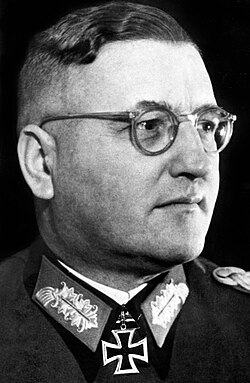
Ernst Hermann August Theodor Busse (15 December 1897 – 21 October 1986)[1] was a German officer during World War I and World War II.[2]
Key Information


Early life and career
[edit]Busse, a native of Frankfurt (Oder), joined the Imperial German Army as an officer cadet in 1915 and was commissioned in February 1917. He also was awarded the Knight's Cross with Swords of the Hohenzollern Order. After the armistice, he was accepted as one of 2,000 officers into the new Reichswehr in which he steadily rose in rank.
World War II
[edit]Busse was a General Staff officer in April 1939 and prepared a training program that was approved by the Chief of the General Staff in August and covered a period from 1 October 1939 to 30 September 1940. Between 1940 and 1942, he served as the Chief of Operations to General (later Field Marshal) Erich von Manstein in the 11th Army on the Eastern Front. He remained serving on von Manstein's staff from 1942 to 1943 as Chief of Operations of Army Group Don and then from 1943 to 1944 he was Chief of Staff of Army Group South, both on the Eastern Front. Serving with Army Group South, he was awarded the Knight's Cross of the Iron Cross on 30 January 1944. He spent a short time in reserve and was then appointed General Officer Commanding German 121st Infantry Division. In July 1944, he commanded I Army Corps.
While Busse took command of the 9th Army on 21 January 1945, his appointment was never confirmed. It would appear that it was customary for commanders of formations of the status of an Army and higher to be on six months probation before their final appointments as Commanders-in-Chief. Germany surrendered unconditionally before Busse's probationary period had expired.[3]
During the last five months of the war, Busse commanded the 9th Army, which had become part of Army Group Vistula. As the Soviets continued to advance into Germany, he fought to protect the German capital. Specifically, Busse commanded the 9th Army during the Battle of Seelow Heights and the Battle of the Oder-Neisse. In April 1945, during the Battle of Berlin, Busse's Ninth Army was cut off from the armies on its flanks and almost encircled by Soviet Forces. General Gotthard Heinrici tried to convince Busse to withdraw several times, but Busse refused even to consider withdrawal unless a specific command arrived from the Führer. Eventually Busse's Ninth Army was driven into a pocket in the Spree Forest south of the Seelow Heights and west of Frankfurt, where it became fully encircled by two prongs of the massive Soviet assault on Berlin. In the ever-shrinking pocket, Busse's forces were all but annihilated in what is known as the Battle of Halbe, but remnants ultimately managed to break through to the west to link up with General Walther Wenck’s 12th Army south of Beelitz and then to withdraw west to the Elbe, cross the partially-destroyed bridge at Tangermünde and surrender to American forces between May 4 and 7.
Postwar
[edit]Between 1945 and 1947, Busse was a prisoner of war.[3] After the war Busse was West Germany's director of civil defence, and he wrote and edited a number of works on the military history of World War II.
Awards and decorations
[edit]- Ehrenkreuz für Frontkämpfer on 5 December 1934
- Clasp to the Iron Cross
- 2nd Class on 27 May 1940
- 1st Class on 30 May 1940
- German Cross in Gold on 24 May 1942 as Oberst im Generalstab in AOK 11[4]
- Knight's Cross of the Iron Cross (N 2611) on 30 January 1944 as Generalleutnant and Chief of the Generalstab of Heeresgruppe Süd[5][6]
- Knight Commander's Cross of the Order of Merit of the Federal Republic of Germany (25 January 1966)
Books edited
[edit]- Kursk: The German View by Steven H. Newton. The first part of the book goes to a new translation of a study of Operation Citadel (the great tank battle of Kursk) edited by General Theodor Busse, which offers the perspectives of key tank, infantry, and air commanders.
References
[edit]Citations
[edit]- ^ "0131786 - THEODOR BUSSE (1897-1986). Ernst Hermann August Theodor Busse. German general during World War I and World War II. Photographed wearing the Knight's Cross, 1944". Granger. Retrieved 2021-02-02.
- ^ "World War 2 Generals – A thru B / Weltkrieg 2 Generäle – A durch B". Historical Society of German Military History - Historische Gesellschaft der deutschen Militärgeschichte. 2016-12-31. Retrieved 2021-02-02.
- ^ a b Nuremberg Trial Proceedings Volume 42. See Bibliography
- ^ Patzwall & Scherzer 2001, p. 71.
- ^ Fellgiebel 2000, p. 151.
- ^ Scherzer 2007, p. 256.
Bibliography
[edit]- Fellgiebel, Walther-Peer (2000) [1986]. Die Träger des Ritterkreuzes des Eisernen Kreuzes 1939–1945 — Die Inhaber der höchsten Auszeichnung des Zweiten Weltkrieges aller Wehrmachtteile [The Bearers of the Knight's Cross of the Iron Cross 1939–1945 — The Owners of the Highest Award of the Second World War of all Wehrmacht Branches] (in German). Friedberg, Germany: Podzun-Pallas. ISBN 978-3-7909-0284-6.
- Patzwall, Klaus D.; Scherzer, Veit (2001). Das Deutsche Kreuz 1941 – 1945 Geschichte und Inhaber Band II [The German Cross 1941 – 1945 History and Recipients Volume 2] (in German). Norderstedt, Germany: Verlag Klaus D. Patzwall. ISBN 978-3-931533-45-8.
- Scherzer, Veit (2007). Die Ritterkreuzträger 1939–1945 Die Inhaber des Ritterkreuzes des Eisernen Kreuzes 1939 von Heer, Luftwaffe, Kriegsmarine, Waffen-SS, Volkssturm sowie mit Deutschland verbündeter Streitkräfte nach den Unterlagen des Bundesarchives [The Knight's Cross Bearers 1939–1945 The Holders of the Knight's Cross of the Iron Cross 1939 by Army, Air Force, Navy, Waffen-SS, Volkssturm and Allied Forces with Germany According to the Documents of the Federal Archives] (in German). Jena, Germany: Scherzers Militaer-Verlag. ISBN 978-3-938845-17-2.
| International | |
|---|---|
| People | |


Theodor Busse
View on GrokipediaEarly Life and World War I
Birth and Family Background
Theodor Ernst Hermann August Busse was born on 15 December 1897 in Frankfurt an der Oder, Province of Brandenburg, German Empire.[1][5] His father, August Ernst Karl Busse, was a career non-commissioned officer who served as a Vize-Feldwebel in the Leib-Grenadier-Regiment König Friedrich Wilhelm III (1. Brandenburgisches) Nr. 8, a prestigious infantry unit in the Imperial German Army.[6] Little is documented about his mother or other immediate family circumstances, though Busse grew up in a military household that likely influenced his early inclination toward service.[6] Busse had at least one sibling, a younger brother named Alfred Heinrich Busse (born 10 May 1909 in Bromberg, died 29 April 1990), who pursued a military career as a major and pastor, eventually assigned to the 122nd Infantry Division in 1942.[6]Entry into Military Service
Theodor Busse entered military service in the Imperial German Army on 1 December 1915 at the age of 17, enlisting as a Fahnenjunker (officer cadet) with the 12th Grenadier Regiment.[4] Assigned initially to the regiment from 1 December 1915 to 25 July 1916, he then underwent specialized training detached to the Fahnenjunker course at Döberitz.[4] Busse received his commission as a Leutnant (lieutenant) in February 1917, marking his formal entry as an active officer amid ongoing World War I operations.[7] This early enlistment reflected the mobilization demands of the conflict, with Busse's selection for cadet training indicating aptitude for leadership roles in the Prussian infantry tradition. Following the Armistice of 11 November 1918, he was retained as one of approximately 2,000 officers transferred into the provisional Reichswehr, ensuring continuity of service into the Weimar-era army.[7]Combat Experience and Wounding
Busse entered the Imperial German Army as an officer cadet in 1915, undergoing training amid the ongoing World War I. He received his commission as a Leutnant (second lieutenant) in February 1917 and was subsequently deployed to active combat duties on the front lines.[8][4] During his frontline service, Busse demonstrated valor in engagements that earned him progressive decorations for bravery. He was awarded the Iron Cross, Second Class, early in his officer tenure, followed by the First Class on 22 August 1917. His leadership and actions further distinguished him, culminating in the Knight's Cross with Swords of the Royal Prussian House Order of Hohenzollern on 29 July 1918, a high honor reserved for exceptional merit in combat.[8][9][4] Busse sustained a wound during World War I service, qualifying him for the Wound Badge in Black, indicating a single injury severe enough to merit recognition but not resulting in permanent disability that ended his career. Specific details of the wounding incident, such as date, location, or circumstances, remain undocumented in available military records, though it occurred amid the intense trench warfare typical of his period of active duty.[8]Interwar Military Career
Service in the Reichswehr
Following the Armistice of 11 November 1918, Busse was retained in the nascent Reichswehr, selected among approximately 2,000 officers from the Imperial German Army to form the core of the 100,000-man force mandated by the Treaty of Versailles.[6] His initial assignment involved transfer to the 54th Reichswehr Grenadier Regiment on 1 August 1919, followed by service as a court officer with that unit until 8 February 1920, after which he shifted to a similar role on the staff of the 10th Reichswehr Grenadier Regiment until 1 January 1921.[4] From 1 January 1921, Busse served as a platoon leader in the 2nd Company of the 8th Infantry Regiment, a position he held intermittently until 2 February 1923, resuming platoon leadership duties with the same regiment through 1 October 1932. During this regimental tenure, he underwent specialized training, detaching to the Infantry School in Munich from 1 October 1921 to 5 August 1922 for an infantry course focused on tactical instruction and leadership development. His performance in these frontline and training roles contributed to his promotion to Oberleutnant on 31 July 1925.[4] Advancing to Rittmeister (equivalent to Hauptmann) on 1 February 1933, Busse transitioned to administrative and planning functions amid the Reichswehr's expansion under covert rearmament efforts. From 1 April 1933 to 1 July 1935, he advised in the Troop Office (Truppenamt) of the Reichswehr Ministry's T1 section, a disguised general staff entity responsible for operational planning and doctrinal refinement within Versailles constraints. This posting positioned him at the intersection of policy and preparation for future mobilization, reflecting his emerging expertise in infantry organization and staff procedures.[4]Staff Education and Promotions
Busse entered the Reichswehr in 1919 as one of approximately 2,000 officers selected for the 100,000-man army limited by the Treaty of Versailles, serving initially in infantry regiments.[6] He underwent early specialized training, including detachment to the Infantry School in Munich from October 1, 1921, to August 5, 1922, for the first course focused on infantry tactics and leadership.[10] Additional short-term detachments included training with the 3rd Pioneer Battalion in 1925 and a sub-machine gun course at Döberitz in 1927, enhancing his technical and tactical proficiency in small-unit operations.[10] His assignments progressed from platoon leadership in machine-gun and infantry companies of the 8th Infantry Regiment (1921–1928) to battalion adjutant (1928–1929), reflecting steady evaluation and preparation for higher command.[10] By 1929, Busse transferred to the 10th Mounted Regiment and received detachment for leadership training at the Command Office in Berlin and the staff of the 5th Division until 1932, marking his entry into broader command and staff development.[10] Promoted to Hauptmann (Captain) on April 1, 1933, he served as an advisor in the Troop Office (T1) of the Reichswehr Ministry from 1933 to 1935, transitioning into administrative and planning roles amid Germany's covert rearmament.[10][2] Advancement accelerated with his promotion to Major on April 1, 1936, followed by assignment as group director in the 6th Department of the Army General Staff (1935–1936), where he contributed to operational planning.[10][2] Busse then commanded a company in the 83rd Infantry Regiment (1936–1937) before becoming Chief of Operations (Ia) for the 22nd Infantry Division from July 5, 1937, to March 1, 1939, honing staff coordination skills essential for divisional-level operations.[10] By July 1937, as a Major, he had risen to significant operational influence within the expanding Wehrmacht.[11]| Date | Promotion | Notes |
|---|---|---|
| April 1, 1933 | Hauptmann (Captain) | Following leadership training and regiment service.[10][2] |
| April 1, 1936 | Major | Coincided with General Staff assignment.[10][2] |
| February 1, 1939 | Oberstleutnant (Lieutenant Colonel) i.G. | Designated General Staff officer; prepared training program approved August 1939.[2][12] |