


Community hub
Recent from talks
Contribute something
Nothing was collected or created yet.
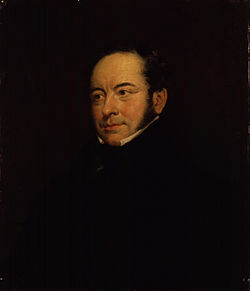
Theodore Hook
View on Wikipedia
Theodore Edward Hook (22 September 1788 – 24 August 1841) was an English writer, intellectual, prankster and briefly a civil servant in Mauritius. One of the first writers of the English fashionable novel, he is best known for his practical jokes, particularly the Berners Street hoax in 1810. The world's first postcard was received by Hook in 1840; he likely posted it to himself.[1]
Key Information


Biography
[edit]Early life
[edit]Hook was born in Charlotte Street, Bedford Square, London. His father, James Hook (1746–1827), was a composer; his elder brother, also called James Hook (1771–1828), became Dean of Worcester.
He spent a year at Harrow School and subsequently matriculated at the University of Oxford. At the age of 16, in conjunction with his father, he scored a dramatic success with The Soldier's Return, a comic opera, and it followed up with a series of popular ventures with John Liston and Charles Mathews, including Tekeli.
Hook then became a playboy and practical joker best known for the Berners Street hoax in 1810 in which he arranged for dozens of tradesmen, and notables such as the Lord Mayor of London, the Governor of the Bank of England, the Chairman of the East India Company and the Duke of Gloucester to visit Mrs Tottenham at 54 Berners Street to win a bet that he could transform any house in London into the most talked-about address within a week.[2]
Another notable prank of Hook's was played on the actor Robert Coates a few years later. While performing at the Theatre Royal Haymarket, Hooks forged and hand-delivered an invitation from The Prince Regent to a party at Carlton House. Coates was initially invited in, but on examination of the ticket he was "politely informed that a mistake had occurred", and turned away. Having sent off his carriage, he was obliged to wait at the Hackney carriage stand. The Prince, unwittingly involved in Hook's prank, regretted that Coates had been turned away, observing him to be an "inoffensive gentleman", and noting that "his presence might have amused many of the guests, and could have done harm to no one." The Prince invited Coates to the home the next day, which he accepted. It was observed that, "to do him justice", Hook, in retelling the story of his prank, "never told the story without some signs of compunction."[3]
Career
[edit]He took up residence at St Mary Hall, Oxford University, leaving after two terms to resume his former life. His gift of improvising songs charmed the Prince Regent, who appointed him accountant-general and treasurer of Mauritius with a salary of £2,000 a year (£142,325; US$194,771 in 2021 terms). He started his term in October 1813. In 1817, it was discovered that a sum of about £12,000 (£1,054,500; US$1.44 million in 2021 terms) had been extracted by a deputy official; Hook was put on trial and ultimately found guilty of negligence and held responsible for the missing amount.

In 1820, to repay the debt, he launched the newspaper John Bull, which championed Toryism. Though it had strong circulation, he failed to repay what he owed and was confined to a sponging-house from 1823 to 1825. While imprisoned, he wrote the nine volumes of stories afterwards collected under the title of Sayings and Doings (1824–1828). In the early 1820s, he helped the singer Michael Kelly compile his Reminiscences, which include details of working with Mozart. In the remaining 23 years of his life, he wrote novels, essays, and plays. His novels have frequent passages of racy narrative and vivid portraiture. They include Maxwell (1830), a portrait of his friend the Reverend E. Cannon; Love and Pride (1833); the autobiographical Gilbert Gurney (1835) and Gurney Married (1838); Jack Brag (1837) and Peregrine Bunce (1842). His last novel was Births, Marriages and Deaths (1839).
The world's oldest postcard was sent to Hook in 1840,[1] bearing a Penny Black stamp. Hook probably created and posted the card to himself as a practical joke on the postal service, since the image is a caricature of workers in the post office.[1][4] In 2002, the postcard sold for a record £31,750.[1]
Later life and death
[edit]Hook died at home in Fulham on 24 August 1841 aged 52. His estate was seized by the Treasury. He never married but lived with Mary Anne Doughty; they had six children.
Hook is remembered as one of the most brilliant figures of Georgian times. He inspired the characters of Lucian Gay in Benjamin Disraeli's novel Coningsby and Mr Wagg in Thackeray's Vanity Fair. His style was parodied by the Smith brothers in Rejected Addresses (1812). Samuel Taylor Coleridge praised him as being "as true a genius as Dante".[5]
Novels
[edit]- Maxwell (1830)
- Love and Pride (1833)
- The Parson's Daughter (1833)
- Gilbert Gurney (1836)
- Jack Brag (1837)
- Gurney Married: A Sequel to Gilbert Gurney (1838)
- All in the Wrong; or, Births, Deaths, and Marriages (1839)
- Precepts and Practice (1840)
- Fathers and Sons (1842)
- Peregrine Bunce; or, Settled at Last (1842)
Notes
[edit]- ^ a b c d "Oldest postcard sells for £31,750". BBC News. 8 March 2002. Retrieved 16 June 2012.
- ^ Fone, Martin (2018). Fifty Scams and Hoaxes. Market Harborough, Leicestershire: Troubador Publishing. p. 119. ISBN 978-1-7890-1577-5.
- ^ The Quarterly Review, collected volume LXXI, published in December 1842 and March, John Murray, 1843, pp. 63-64
- ^ Arifa Akbar, "Oldest picture postcard in the world snapped up for £31,750", The Independent, 9 March 2002.
- ^ Lockhart, John Gibson (1852). Theodore Hook; A Sketch. London: John Murray. p. 24.
References
[edit]- Richard Harris Barham, Life and Remains of Hook (3rd ed, 1877).
- John Gibson Lockhart, Review of Peregrine Bunce, Quarterly Review (May 1843), 53-108. Includes biographical sketch of Hook.
- Bill Newton Dunn, The Man Who Was John Bull (1996 but still in print), Allendale Publishing, 29 Old Palace Lane, Richmond TW9 1PQ, GB
- Graeme Harper, 'Hook, Theodore Edward (1788–1841)’, Oxford Dictionary of National Biography, Oxford University Press, 2004; online edition, January 2008 Retrieved 17 September 2012
Attribution
- This article incorporates text from a publication now in the public domain: Chisholm, Hugh, ed. (1911). "Hook, Theodore Edward". Encyclopædia Britannica (11th ed.). Cambridge University Press.

External links
[edit]- Works by Theodore Hook at LibriVox (public domain audiobooks)


Theodore Hook
View on GrokipediaTheodore Edward Hook (22 September 1788 – 24 August 1841) was an English writer, wit, and prankster noted for his early dramatic successes, the infamous Berners Street Hoax, a scandalous colonial administrative post, and prolific satirical novels that critiqued Regency society.
The son of musician and composer James Hook, young Theodore demonstrated precocious talent by penning librettos for comic operas, achieving acclaim with Tekeli; or, the Siege of Savadruga staged at London's Lyceum Theatre in 1803 when he was just sixteen. His social circle included the Prince Regent, whose favor secured Hook's appointment as accountant-general and treasurer of Mauritius in 1813, a lucrative role marred by extravagant living that culminated in the discovery of a £12,000 deficit in 1818, resulting in his arrest, imprisonment, and return to England without formal trial after friends covered the shortfall.[1]
Hook's most notorious escapade, the Berners Street Hoax of 27 November 1809, stemmed from a wager with architect Samuel Beazley that he could render any London house the city's focal point; over weeks, Hook anonymously ordered thousands of goods, services, and dignitaries—including chimney sweeps, physicians, and the Lord Mayor—to converge on unsuspecting resident Mrs. Sarah Black's home at No. 54 Berners Street, paralyzing the area in chaos and highlighting urban vulnerabilities to coordinated mischief.[2]
Freed from incarceration around 1820, Hook sustained himself through journalism for publications like John Bull magazine, which he co-founded, and serialized fiction such as the multi-volume Sayings and Doings (1824–1828) and Gilbert Gurney (1836–1837), works blending autobiography, social observation, and humor that captured the era's mores despite his chronic debts and dissipated lifestyle.
Early Life
Family Background and Childhood
Theodore Edward Hook was the younger son of James Hook (1746–1827), a Norwich-born organist, composer, and performer renowned for his prolific output of over 500 songs, glees, and light operatic works, as well as his long tenure as organist at Marylebone Pleasure Gardens from 1769 onward.[3] James Hook's career in London's musical scene, including performances at Vauxhall and compositions for theater, afforded the family a respectable middle-class standing amid the city's artistic circles.[4] His mother, Elizabeth Jane Hook (née Madden; d. 1795), was a miniaturist and writer whose artistic talents complemented the household's creative environment.[5] Hook had one elder brother, James Hook (1772–1828), who pursued a clerical career culminating in his appointment as Dean of Worcester.[6] The family resided in Charlotte Street, Bedford Square, a fashionable London district suitable for professionals of their station. James Hook's second marriage after Elizabeth Jane's death produced additional siblings, though Theodore's early years were shaped primarily by his parents' musical and literary pursuits before his mother's passing when he was seven years old. Born on 22 September 1788, Hook's infancy and toddler years unfolded in this intellectually stimulating home, where his father's daily compositions and performances likely provided constant auditory immersion, though specific anecdotes of his pre-school experiences remain undocumented in contemporary accounts.[7] The premature death of his mother in October 1795 marked a pivotal shift, leaving the younger Hook under his father's care amid ongoing family musical endeavors.Education and Precocious Talents
Hook received his initial education via private tutoring, reflecting the circumstances of his family's modest but culturally engaged household, before enrolling briefly at Harrow School around age fifteen or sixteen.[5] There, he struggled academically, later describing his school experience as unhappy, characterized by idleness, aversion to classical languages like Greek and Hebrew, and minimal effort on tasks requiring sustained study, though he excelled in quick, improvisational endeavors that aligned with his emerging wit.[8] His precocious literary and musical talents, nurtured under his father James Hook's influence as a composer, manifested early; by his mid-teens, he contributed words for comic operas, leveraging the family's connections in London's theatrical circles. In 1804, at age sixteen, Hook authored the libretto for a comic opera composed by his father, which achieved public performance and acclaim, marking his debut as a youthful playwright and demonstrating his aptitude for satirical verse and dramatic structure.[9] Following Harrow, Hook matriculated at St. Mary Hall, Oxford, on July 2, 1810, but departed soon after without a degree, drawn instead to writing farces, melodramas, and social pursuits amid mounting debts.[10]Professional Career
Literary and Theatrical Beginnings
Hook's entry into literature and theater was facilitated by his father, James Hook, a prominent composer and musician at Vauxhall Gardens, who involved his son in composing lyrics for operatic works. At the age of sixteen, Theodore Hook penned the libretto for the comic opera The Soldier's Return (music by his father), which premiered successfully at the Theatre Royal, Drury Lane, on April 23, 1805, and continued performances until October 31, 1806, with subsequent productions in cities including Edinburgh, Aberdeen, Newcastle, Exeter, and Hampshire.[5] [11] This early collaboration earned Hook £50 and marked his precocious debut as a librettist, demonstrating his aptitude for witty dialogue and song integration despite limited formal education.[11] Building on this success, Hook shifted toward melodrama, an emerging genre in British theater, adapting works from the French playwright René-Charles Guilbert de Pixerécourt to suit local audiences. His adaptation Tekeli, or the Siege of Montgatz premiered on November 24, 1806, at Drury Lane, achieving notable popularity despite satirical critique from Lord Byron in English Bards and Scotch Reviewers (1809).[5] [11] Subsequent adaptations included The Fortress on July 16, 1807, and The Siege of St. Quintin, or Spanish Heroism on November 10, 1808, both staged at Drury Lane and reflecting Hook's skill in dramatic plotting, spectacle, and moral contrasts typical of the form.[5] These theatrical ventures established Hook as a prolific young playwright, contributing to over a dozen stage works by his early twenties, often featuring punning repartee, mistaken identities, and comic resolutions to evade debts or intrigues.[12] His early output blended literary invention with performative flair, laying the groundwork for his later satirical prose, though melodramas like Tekeli highlighted his reliance on adaptation amid the era's enthusiasm for sensational stage effects.[5]Journalistic Endeavors and John Bull
In December 1820, Theodore Hook launched the weekly newspaper John Bull on December 17, as a staunchly Tory publication designed to rally opposition against Queen Caroline during George IV's divorce proceedings via the Pains and Penalties Bill.[13][7] The paper's founding was partly motivated by Hook's need to repay approximately £12,000 in debts stemming from irregularities during his Mauritius tenure, leveraging his wit to build a profitable venture amid heightened political tensions.[1][13] Hook assumed the role of editor and principal contributor, infusing John Bull with incisive political satire, poetical squibs, and humorous verses that mercilessly targeted Caroline, her supporters at Brandenburg House, and Whig figures seeking to amplify continental influences in British affairs.[7][13] His pieces, such as rapid rhymes lampooning royal and public figures, exemplified a reckless yet effective style that prioritized Tory orthodoxy over restraint, reportedly suggested by Sir Walter Scott for its alignment with high Tory objectives.[7] The publication achieved swift commercial success, attaining a circulation of 10,000 copies by its sixth week and generating Hook an annual income of £2,000 in its inaugural year through advertisements and sales.[7][13] This popularity stemmed from its unyielding invective, which swayed public sentiment against Caroline's cause and bolstered Tory efforts during the 1820 crisis, though it invited libel prosecutions that Hook evaded by publicly disclaiming authorship.[7][13] Following Caroline's death in August 1821, John Bull transitioned to wider satirical commentary on politics, literature, and society, maintaining its combative tone under Hook's guidance until his 1823 imprisonment for unrelated debts curtailed his direct involvement.[7][1] The paper's early formula under Hook pioneered a blend of humor and partisanship that endured, influencing subsequent British periodical journalism despite his personal financial failures.[1]Civil Service in Mauritius
In 1813, Theodore Edward Hook received the appointment of Accountant-General and Treasurer of the British colony of Mauritius, secured through the patronage of the Prince Regent despite Hook's complete lack of prior experience in bookkeeping or colonial administration; the position carried an annual salary of £2,000.[14] He departed England shortly thereafter and arrived at Port Louis on 8 October 1813, assuming office the next day.[15] Hook's five-year tenure from 1813 to 1818 was marked by minimal engagement with his responsibilities, as he prioritized an active social life, hosting lavish entertainments and pursuing personal amusements amid the island's expatriate community.[16] Lacking aptitude for fiscal oversight, he delegated much of the work to subordinates, which later facilitated irregularities in the treasury.[17] In early 1818, an audit uncovered a substantial shortfall of 37,000 dollars in the government accounts, traced primarily to embezzlement by a clerk named Allan, who subsequently died by suicide; while no evidence implicated Hook in direct misappropriation, his gross negligence in supervision was deemed a key enabling factor.[18][14] The Colonial Office recalled Hook to England later that year for further inquiry, effectively ending his public service career.[10]Pranks and Hoaxes
Berners Street Hoax
The Berners Street hoax took place on November 26, 1810, targeting number 54 Berners Street in Westminster, London, the home of Mrs. Tottenham, a widow of limited means.[19] Theodore Hook, then aged 22, is widely regarded as the perpetrator, having confessed to the scheme later in life.[19] The prank originated from a wager with his friend, architect Samuel Beazley, in which Hook bet one guinea that he could transform any ordinary London house into the city's most notorious address within a week.[2] To execute it, Hook and possibly accomplices rented a furnished room opposite the target house from which to observe the proceedings.[19] In the weeks prior, Hook forged and dispatched between 1,000 and 4,000 letters of order, signed in Mrs. Tottenham's name, to tradesmen, professionals, and officials across London.[19] These requested immediate delivery or attendance for purported needs such as house renovations, medical consultations, and ecclesiastical services.[2] On the designated Monday, arrivals began early and escalated rapidly: coal wagons from Paddington Wharf clogged the street, preventing passage; up to 30 chimney sweeps appeared en masse; dozens of physicians arrived with supposed patients; furniture dealers brought sofas, sideboards, and pier glasses; fishmongers delivered hampers of fowl and oysters; and a baker supplied a wedding cake sufficient for 500 guests.[19] Further summonses drew post-chaises, linen drapers, upholsterers, wig makers, and even undertakers with hearses and coffins, alongside professions including lawyers, priests, and organ grinders.[19] High-profile figures, such as the Lord Mayor of London and the Duke of York, were also inexplicably called to the scene.[2] The influx created profound disorder: Berners Street became impassable, with crowds of onlookers swelling to thousands and blocking adjacent thoroughfares like Oxford Street.[19] Mrs. Tottenham, bewildered and distressed, barricaded her door as deliveries piled up outside; police and magistrates, including those from nearby Marlborough Street station, intervened to disperse the throng and halt further arrivals, restoring order only after dark.[19] Contemporary reports in publications like The Times and The Morning Chronicle detailed the annoyance but noted a more modest scale than later embellishments, criticizing the cruelty to the innocent victim and the wasted time of responders.[20] Hook evaded immediate suspicion by fleeing to the countryside but was soon linked to the event through his known penchant for pranks.[2] No legal action followed, as the hoax inflicted no direct financial harm—only inconvenience and temporary disruption—despite the potential for fraud charges.[19] The incident was chronicled in period sources such as the London Annual Register for 1810 and The Universal Magazine (1811), fueling public fascination and inspiring satirical prints, theatrical skits, and exaggerated retellings that amplified the numbers involved over time.[19] While the core facts of mass unwanted solicitations and resulting chaos hold in primary accounts, subsequent narratives likely inflated specifics for dramatic effect, reflecting the era's appetite for sensationalism.[20]Other Pranks and Witty Exploits
In addition to the Berners Street Hoax, Hook perpetrated a notable practical joke in 1840 by mailing to himself what is widely regarded as the world's first picture postcard, known as the "Penny Penates." The hand-drawn and colored card depicted a satirical scene of two classical deities overseeing a post office, with caricatured postal clerks scrambling amid bags of mail; addressed to Hook at his residence in Fulham, London, it was postmarked July 14, 1840, and intended to mock the inefficiencies and pretensions of the postal service workers who handled it.[21] This stunt, rediscovered in 2001 and auctioned for significant value, exemplified Hook's penchant for exploiting emerging technologies for humorous disruption.[22] Hook's witty exploits extended beyond hoaxes to his renowned improvisational talents, particularly in composing satirical songs and verses on the spot during social gatherings. His ability to extemporize lyrics mocking current events or individuals earned him acclaim in Regency society; for instance, at dinners hosted by the Prince Regent, Hook would produce verses lampooning Whig politicians or fashionable absurdities, often incorporating puns and wordplay that delighted audiences.[1] Such performances contributed to his reputation as a conversational genius, where anecdote flowed into bon mot with effortless rapidity, though contemporaries noted his wit sometimes veered into scurrility.[7] Examples of Hook's punning humor included quips like classifying puns into "classes" based on their ingenuity, as detailed in his writings, where he defended the form against critics by arguing its intellectual merit despite groans it elicited.[23] These verbal exploits, preserved in collections of his humorous works, underscored his role as a social provocateur whose cleverness masked a deeper satirical edge on societal follies.[24]Literary Works
Novels and Serialized Fiction
Hook's entry into serialized fiction came with Sayings and Doings; or, Sketches from Life, a collection of tales set in fashionable society that he published in three series between 1824 and 1828, expanding from an initial three volumes to nine in total.[25][26] The first series, issued in 1824 by Henry Colburn, comprised interconnected sketches and novellas such as "Danvers," each tied to a proverb or social maxim, blending humor, satire, and observations of upper-class manners.[26] The second series followed in 1825, and the third in 1828, maintaining the format of episodic narratives that captured the vogue for "silver-fork" depictions of Regency and post-Regency elite life.[27][28] These works, serialized in volume form rather than periodicals, proved commercially viable amid Hook's financial pressures, leveraging his journalistic flair for witty anecdotes and character sketches.[29] From 1830 onward, Hook shifted to standalone three-volume novels, typical of the era's circulating library format, often infused with autobiographical elements from his prankish youth and social observations.[30] Key titles include Maxwell (1830, H. Colburn and R. Bentley), a tale of Irish life and adventure; Love and Pride (1833, Whittaker & Co.), exploring romantic entanglements; and The Parson's Daughter (1833, Richard Bentley), focusing on rural clerical themes.[31][32][30] Gilbert Gurney (1836, Whittaker), a semi-autobiographical picaresque recounting youthful exploits in London society, was followed by its sequel Gurney Married (1838, Richard Bentley), which continued the protagonist's matrimonial misadventures.[30] Jack Brag (1837, Richard Bentley) satirized dandyism and social climbing through its titular braggart character.[33]| Title | Publication Year | Publisher(s) | Format/Notes |
|---|---|---|---|
| Sayings and Doings (Series 1–3) | 1824–1828 | Henry Colburn | 9 volumes; silver-fork sketches |
| Maxwell | 1830 | H. Colburn and R. Bentley | 3 volumes; Irish themes |
| Love and Pride | 1833 | Whittaker & Co. | 3 volumes; romance |
| The Parson's Daughter | 1833 | Richard Bentley | 3 volumes; clerical life |
| Gilbert Gurney | 1836 | Whittaker | 3 volumes; semi-autobiographical |
| Jack Brag | 1837 | Richard Bentley | 3 volumes; satire on dandies |
| Gurney Married | 1838 | Richard Bentley | 3 volumes; sequel to Gilbert Gurney |
Satirical and Miscellaneous Writings
Hook's satirical output included political squibs and songs that targeted Whig politicians and supporters of Queen Caroline during her 1820 trial for adultery. In "Ass-ass-ination," he employed puns to deride figures like Lord Erskine as "Ass-erter of our freedom," portraying them as foolish radicals undermining the constitution.[34] Similarly, "Mrs. Muggins's Visit to the Queen" mocked Caroline's backers through humorous verses depicting absurd loyalty and scandalous associations, while "Hunting the Hare" lampooned her controversial visitors as predatory opportunists.[34] These pieces, often published in periodicals like The Arcadian, reflected his Tory allegiance and sharp critique of reformist excesses, blending wordplay with topical invective.[34] Pamphlets formed another satirical vein, such as Tentamen; or, an Essay towards the History of Whittington (1820), which ridiculed Alderman Matthew Wood, a Caroline partisan, by fabricating absurd historical parallels to expose perceived hypocrisy in radical politics.[34] Solomon Logwood similarly assailed her defenders through exaggerated folly.[34] These works prioritized caustic humor over subtlety, leveraging Hook's improvisational flair for epigrams and puns to dismantle opponents' credibility. Miscellaneous writings encompassed bons mots, jests, and pseudonymous letters like the "Ramsbottom Papers" (1822–1831), a series of 29 satirical epistles in John Bull under the persona of Mrs. Ramsbottom, satirizing social pretensions, travel mishaps, and political missteps through malapropisms and irony.[34] Collections such as The Choice Humorous Works, Ludicrous Adventures, Bons Mots, Puns, and Hoaxes (c. 1840s editions) compiled these with anecdotes, including puns on parliamentary dining ("Brougham’s spitch-cock’d eel") and conundrums, preserving his reputation for verbal dexterity amid lighter absurdities.[35]Controversies and Scandals
Mauritius Financial Affair
In 1813, Theodore Hook was appointed accountant-general and treasurer of Mauritius through the influence of his friend, the Prince Regent, despite lacking experience in accounting or finance.[36] He arrived on the island on October 8, 1813, and assumed office the following day.[15] During his tenure, Hook lived extravagantly, hosting lavish entertainments that strained his personal finances but did not initially impact official accounts.[1] In 1817, an audit uncovered a substantial deficit in the treasury, estimated at 62,000 dollars, which Hook could not adequately explain.[36] The shortage was later attributed by some accounts to embezzlement by a subordinate clerk named Allan, who reportedly committed suicide shortly afterward, though other reports cited figures around 37,000 dollars for the misappropriated sum.[18] Hook's property on the island was confiscated as a precautionary measure, and he was arrested and deported to England in 1818 on suspicion of malfeasance.[36][37] A subsequent investigation by the British Treasury found no evidence of personal criminality on Hook's part, attributing the loss primarily to negligence in oversight rather than deliberate fraud, though he remained civilly liable for the full amount.[36] The affair damaged his reputation and finances, leaving him responsible for repaying the debt from personal assets, which contributed to his later insolvency.[38] No formal charges of embezzlement were sustained against him, but the incident highlighted his unsuitability for administrative roles requiring fiscal rigor.[39]Political Satire and Backlash
Hook employed his satirical talents to champion Tory interests, particularly through the weekly periodical John Bull, which he founded on 11 January 1820 and edited until 1841, using it to lambast Whig politicians and reformers with pointed lampoons that emphasized their perceived hypocrisy, foreign influences, and moral failings.[11] His writings often featured scurrilous personal attacks, such as ridiculing Whig figures like George Tierney and Henry Brougham for alleged corruption and intellectual pretensions, framing them as threats to British stability amid post-Napoleonic tensions.[40] During the 1820 Queen Caroline affair, Hook's contributions to John Bull unleashed vulgar pasquinades portraying the queen's supporters as licentious radicals, effectively swaying public opinion against her divorce trial but amplifying partisan divides.[41] These efforts drew sharp backlash from Whig-aligned critics and literary observers, who condemned Hook's style as excessively coarse and ill-natured, arguing it degraded political discourse into personal vituperation rather than reasoned critique.[42] Figures like Caroline Norton decried his output as a "disgrace" due to its "abominable coarseness," reflecting broader Victorian unease with satire that blurred into outright slander, even as it achieved commercial success with circulations exceeding 10,000 copies weekly.[42] Whig publications retaliated with counter-satire, portraying Hook as a government hack reliant on ministerial subsidies—rumored at £1,500 annually from Tory patrons—thus questioning the independence of his barbs and fueling accusations that his work prioritized partisan venom over journalistic integrity.[13] Despite such rebukes, Hook's unrepentant approach solidified his notoriety, with contemporaries like Thomas Moore enduring his jabs in John Bull as emblematic of Tory malice, though empirical impact on elections, such as bolstering Tory majorities in 1826, underscored the satire's causal potency in shaping voter sentiment.[43]Later Years and Death
Financial Decline and Imprisonment
Following the resolution of the Mauritius financial affair without criminal charges but with civil liability for a £12,000 treasury deficit, Hook returned to England in 1818 burdened by seized assets and an outstanding crown debt that lingered unresolved.[14] This liability, combined with his established pattern of fiscal irresponsibility, set the stage for further decline despite professional successes.[5] Hook's appointment as editor of the Tory satirical weekly John Bull in 1820 generated significant revenue through its high circulation and advertising, yet his habitual extravagance—marked by lavish entertaining, gambling, and support for family—outpaced earnings and accumulated private debts alongside the public obligation.[1] By 1823, creditors, including the state pressing for the Mauritius balance, pursued enforcement; Hook, making no substantial repayment efforts, faced arrest for insolvency.[5] He was confined to a sponging-house in Shire Lane, a temporary facility for debtors pending bail or full imprisonment, transitioning to the King's Bench Prison as proceedings advanced.[14] The two-year detention from 1823 to 1825, during which his remaining property was liquidated, compelled Hook to rely on literary output for survival; confined, he drafted early installments of Sayings and Doings, a series of anecdotal novels issued in nine volumes from 1824 to 1828 by Henry Colburn, which achieved commercial success and provided post-release income.[5] Release in 1825 followed partial settlements and parliamentary interventions remitting portions of the crown claim, though the debt's shadow persisted, fueling chronic anxiety and health deterioration without full absolution until after his death.[5] This episode underscored the causal link between Hook's administrative negligence in Mauritius and his later personal profligacy, rendering him perpetually vulnerable to enforcement despite creative talents.[14]Final Years and Passing
Hook's health began a marked decline in the mid-1830s, exacerbated by years of excessive drinking and irregular habits, leading to a progressive weakening that curtailed his once-prolific output.[7] Over the final six to seven years, he experienced steady deterioration in physical condition, personal finances, and creative vigor, though he persisted in contributing satirical pieces to periodicals like John Bull, which he had edited since 1820.[5] Despite occasional bursts of wit, his writing grew less sharp, reflecting the toll of chronic ailments and unrelieved penury.[11] By 1841, Hook resided in modest lodgings in Fulham, London, where he succumbed on 24 August at age 52.[7] The precise medical cause remains undocumented in contemporary accounts, but contemporaries attributed his end to the cumulative effects of a dissipated lifestyle.[5] He left no will, and his scant estate—comprising personal effects and unpublished manuscripts—was immediately seized by the Treasury to offset lingering civil debts from the Mauritius affair, leaving his six illegitimate children and longtime companion unprovided for.[44][5] Hook had never married, maintaining a long-term relationship that produced his family amid his peripatetic and scandal-plagued existence.[11]Legacy and Reception
Impact on British Journalism and Humor
Hook's establishment and editorship of the weekly periodical John Bull, launched on 10 December 1820, introduced a model of personal journalism characterized by the editor's overt personality, sharp satire, and fusion of political polemic with anecdotal gossip.[45] This approach, which prioritized the proprietor's voice over detached reporting, influenced the tone of subsequent Tory-leaning publications by demonstrating how humorous invective could mobilize public sentiment, particularly in opposition to Whig initiatives during the Queen Caroline scandal of 1820–1821.[46] John Bull's success in swaying opinion against Catholic emancipation and royal divorce proceedings underscored the efficacy of such journalism in shaping conservative discourse, with its vivid, abusive style exerting pressure on other weeklies to adopt more engaging, partisan formats.[1] Hook's satirical bent extended the Regency-era emphasis on improvisational wit and social mockery, embedding punning repartee and exaggerated caricature into British periodical humor. His contributions to John Bull featured serialized sketches that lampooned political figures through absurd scenarios and verbal dexterity, prefiguring the blend of levity and critique in later Victorian satire. Beyond print, Hook's legacy in humor stems from elaborate hoaxes like the 1810 Berners Street prank, where he reportedly dispatched over 4,000 forged invitations and orders to overwhelm a single address, thereby popularizing the orchestrated practical joke as a form of public spectacle that tested societal credulity and logistics.[1] This audacious style, combined with his impromptu song-writing—praised by George IV for its spontaneity—reinforced a tradition of verbal agility and irreverence that informed subsequent humorists' reliance on timely, personality-driven mockery.[5]Historical Assessments and Criticisms
Hook's literary output, particularly the Sayings and Doings series (1824–1828), received positive contemporary reviews for its innovative blend of sociological observation, fiction, and metafictional elements depicting fashionable society, influencing the emerging silver-fork genre.[12] Critics noted its engagement with speech, performance, and identity, drawing from Hook's journalistic and improvisational background, though it was later critiqued for assimilation into the broader, often dismissed silver-fork tradition emphasizing superficial aristocratic life.[12] [28] Historical evaluations highlight Hook's wit and satirical prowess, as in his contributions to periodicals like John Bull, but fault him for prioritizing scandal-mongering over substance, with William Hazlitt dismissing similar fashionable novels as "trash" and "absurd perversions."[47] [48] His pranks, exemplified by the 1810 Berners Street Hoax—which summoned dozens of unrelated parties including dignitaries and tradesmen to one address, causing widespread chaos—earned admiration for ingenuity but drew criticism for reckless disruption of public order and resources.[49] [19] The 1819 Mauritius financial scandal, where Hook as accountant-general authorized £46,000 in unbacked treasury notes amid administrative lapses, prompted a parliamentary inquiry and his resignation, tarnishing his reputation despite no formal conviction; biographers assess this as emblematic of his extravagance and poor judgment rather than deliberate corruption.[50] [17] Later assessments portray Hook as a flawed genius whose talents in humor and improvisation outshone his writings, which faded into obscurity, overshadowed by personal failings like chronic debt leading to 1825 imprisonment and a dissipated lifestyle.[7] [51] Modern scholarship views his legacy as one of untapped potential undermined by irresponsibility, with silver-fork works critiqued for frivolity amid reform-era scrutiny of elite excess.[52] [53]References
- https://en.wikisource.org/wiki/Page:Imperialdictiona02eadi_Brandeis.pdf/986