Hubbry Logo
Customs officerCustoms officerMain
Open search
Customs officer
Community hub
Customs officer
logo
8 pages, 0 posts
0 subscribers
Be the first to start a discussion here.
Customs officer
Customs officer
from Wikipedia
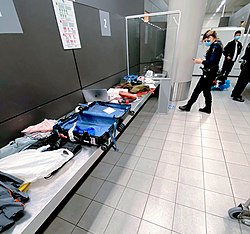
Dutch customs officers at work at Schiphol Airport

A customs officer is a law enforcement official who enforces customs laws.

Canada

[edit]

Canadian customs officers are members of the Canada Border Services Agency. It was created in 2003 and preceded by the Canada Customs and Revenue Agency (1999-2003). Customs officers has existed since 1868 under various departments: Customs Office, Customs and Inland Revenue from 1918 to 1923, Customs and Excise from 1923 to 1927 and Revenue Department from 1927 to 1999. They are most visible at 117 land border crossings and 13 international airports between Canada and US, but are also founded at 3 seaports, 3 mail centres within Canada.

Hong Kong

[edit]

4,931 posts, of which nine are directorate officers, 3,804 are members of the Customs and Excise Department, 504 are Trade Controls Officers and 614 are staff of the General and Common Grades.

Hong Kong is one of the busiest container ports in the world. It handled 20.4 million TEUs (Twenty-foot Equivalent Units) in 2003. Of these, 12.1 million TEUs were handled at the Kwai Chung Container Terminal. In 2003, 70,910 ocean-going ships and 365,190 coastal vessels entered and left Hong Kong.

Ships and vessels are subject to customs check. Cargoes are either examined on board sea freighters or after off-loading.

In 2004, a total of 8.6 million passengers arrived in Hong Kong from the Mainland and Macau by sea and by helicopters. They were processed at the China Ferry Terminal in Tsim Sha Tsui and the Hong Kong-Macau Ferry Terminal in Central. In addition, a daily average of 49 helicopter flights between Hong Kong and Macau are operated at the Hong Kong-Macau Ferry Terminal. Four Customs launches conduct maritime patrol in the territorial waters round the clock whereas four high-speed pursuit crafts and two shallow water patrol launches are employed to carry out interception at sea.

The C&ED is an active member of the World Customs Organization (WCO) and Asia Pacific Economic Cooperation (APEC). It exchanges intelligence and works closely with overseas customs administrations and law enforcement agencies. The department has also entered bilateral Cooperative Arrangements with other customs authorities on administrative assistance. At the working level, the department and the China Customs have each established designated liaison officers to facilitate the exchange of intelligence through direct telephone hotlines.

Mission

[edit]
  • To protect the Hong Kong Special Administrative Region against smuggling
  • To protect and collect revenue on dutiable goods
  • To detect and deter narcotics trafficking and abuse of narcotic drugs
  • To protect intellectual property rights
  • To protect consumer interests
  • To protect and facilitate legitimate trade and industry and to uphold Hong Kong's trading integrity
  • To fulfill international obligations

United Kingdom

[edit]

Ancient usage

[edit]

In ancient usage a "customer" was a person to whom the right to collect customs in a particular port had been granted by the crown, often for a consideration in the form of a farm (an arrangement whereby one rents the income that derives from a revenue stream).

Modern usage

[edit]

Officers working for HM Revenue and Customs (HMRC) and the UK Border Force collect a range of taxes and duties, control imported and exported goods, and prevent banned items from entering or leaving the United Kingdom.

The powers of customs officers ("officers") derive from the Customs and Excise Management Act 1979. Officers are appointed by the Commissioners of Revenue and Customs, who are in turn appointed by the King.[1] Failure to return a commission by an officer is an offence,[2] as is imitating[3] or obstructing[4] an officer. Officers at ports are now officially part of the Border Force (Home Office) and as such have their powers conferred by the Borders, Citizenship and Immigration Act 2009.[5]

At any time, any officer may board and search:[6]

  • ships within the limits of a port,
  • aircraft at aerodromes, or
  • vehicles that are:
    • entering, leaving or about to leave the United Kingdom,
    • within the prescribed area,
    • within the limits of or entering or leaving a port or any land adjacent to a port and occupied wholly or mainly for the purpose of activities carried on at the port,
    • at, entering or leaving an aerodrome,
    • at, entering or leaving an approved wharf, transit shed, customs warehouse or free trade zone, or
    • at, entering or leaving any such premises as are mentioned in subsection (1) of section 112 of the 1979 Act.

Officers shall have free access to every part of any ship or aircraft at a port or aerodrome and of any vehicle as described above or is brought to a customs and excise station, and may:

  • cause any goods to be marked before they are unloaded from that ship, aircraft or vehicle,
  • lock up, seal, mark or otherwise secure any goods carried in the ship, aircraft or vehicle or any place or container in which they are so carried,
  • break open any place or container which is locked and of which the keys are withheld, and
  • seize any goods found concealed on board any such ship, aircraft or vehicle.

Carrying away an officer is an offence.[7]

Officers may inspect aircraft and aerodromes,[8] and prevent the departure of aircraft if they have not given their permission for them to depart.[9] They may stop ships in UK territorial waters for the purposes of checking that they have been cleared to leave the UK.[10]

Officers may examine any goods carried or to be carried in a coasting ships at any time while they are on board the ship, or at any place in the United Kingdom to which the goods have been brought for shipment in, or at which they have been unloaded from, the ship.[11]

Officers may ask questions with respect to the baggage of people entering or leaving the United Kingdom and any thing contained therein or carried with them.[12] They may inspect such baggage.[12] Since the amendments to CEMA 1979 inserted by the Policing and Crime Act 2009 Officers may also require a person entering or leaving the United Kingdom to produce a Passport (or National ID Card when that may be used as an alternative) and answer questions about their journey.[13] Any person entering the UK from outside the EU who fails to declare any thing or to produce any baggage or thing as required (unless it they are entitled to exemption from duty and tax by virtue of any order under section 13 of the Customs and Excise Duties (General Reliefs) Act 1979) commits an offence.[12] Any thing chargeable with any duty or tax which is found concealed, or is not declared, and any thing which is being taken into or out of the UK contrary to any prohibition or restriction can be seized.[12]

Officers on anti-smuggling duties may haul up, leave or moor vessels where they wish.[14] They may also enter any part of the coast (or of the shore or bank of any river or creek), railway or aerodrome (or land adjoining any aerodrome), and over any land in Northern Ireland within the prescribed area.[14] They may not, however, enter any garden or pleasure ground.[14]

An officer may board or enter any ship, aircraft, vehicle, house or place and take such steps as are reasonably necessary to stop or prevent the sending of a signal or message connected with smuggling.[15]

Officers may seize:

  • ships or aircraft that have been in the UK or vehicles that have been in a port or aerodrome and are constructed, adapted, altered or fitted for concealing goods,[16]
  • ships that have thrown overboard, staved or destroyed any part of the cargo to prevent seizure while the ship is in United Kingdom waters or where the ship, having been properly summoned to bring to by any vessel in the service of Her Majesty, fails so to do and chase is given,[17]
  • ships or aircraft that have been within the limits of any port in the United Kingdom or the Isle of Man, or any aircraft has been in the United Kingdom or the Isle of Man where the master or commander fails to account for a substantial part of the cargo that has been on board.[18]

Officers may fire upon ships liable to forfeiture or examination where they have failed to bring to after the commander of any vessel in the service of Her Majesty has hoisted the proper ensign and caused a gun to be fired as a signal and chase has been given.[19]

Officers may ask any person entering or leaving a free trade zone (as designated by the Treasury) questions with respect to any goods. That person shall, if required by the officer, produce those goods for examination at such place as the Commissioners may direct.[20] Officers may board a vehicle at any time while it is entering or leaving a free trade zone search any part of it.[20] Officers may, at any time, enter upon and inspect a free trade zone and all buildings and goods within the zone.[20]

Officers may enter any premises, vehicles, vessels, aircraft, hovercraft or structures used in connection with an excise licence, and may inspect the premises and search for, examine and take account of any machinery, vehicles, vessels, utensils, goods or materials belonging to or in any way connected with that trade.[21] Officers must be accompanied by a constable at night.[21] If the premises are those of a distiller, rectifier, compounder, brewer for sale, producer of wine, producer of made-wine, maker of cider or occupier of an excise warehouse, an officer, after having demanded admission into the premises and declared his name and business at the entrance may break open any door or window of the premises or break through any wall for the purpose of obtaining admission.[21] Officers or people acting in their aid must be accompanied by a constable at night.[21]

If an officer has reasonable grounds to suspect that any secret pipe or other means of conveyance, cock, vessel or utensil is kept or used by a distiller, rectifier, compounder, registered brewer, producer of wine, producer of made-wine and maker of cider, that officer may, at any time, break open any part of the premises of that trader and forcibly enter them and so far as is reasonably necessary break up the ground in or adjoining those premises or any wall thereof to search for that pipe or other means of conveyance, cock, vessel or utensil.[22]

If the officer finds any such pipe or other form of conveyance leading to or from the trader's premises, he may enter any other premises from or into which it leads, and so far as is reasonably necessary break up any part of those other premises to trace its course, and may cut it away and turn any cock thereon, and examine whether it conveys or conceals any goods chargeable with a duty of excise, or any materials used in the manufacture of such goods, in such manner as to prevent a true account thereof from being taken.[22] Every such pipe or other means of conveyance, cock, vessel or utensil as mentioned, and all goods chargeable with a duty of excise or materials for the manufacture of such goods found therein, may be seized.[22] Officers must be accompanied by a constable at night, and damage caused by unsuccessful searches shall be made good by the Commissioners.[22]

Officers may, at a reasonable time of day, enter any premises used for the conduct of a business.[23] If they have reasonable cause to believe that any premises are used for gaming to which section 10 of the Finance Act 1997 (gaming duty) applies or are used in connection with the supply, importation or exportation of goods of a class or description chargeable with a duty of excise and that any such goods are on those premises, they may inspect those premises and any goods found on them.[23] If they believe serious fraud is occurring in connection with such gaming, they may obtain a court warrant to enter the premises using reasonable force.[23]

Officers may detain any person who has committed, or whom there are reasonable grounds to suspect of having committed, any offence for which he is liable to be detained under the customs and excise Acts at any time within 20 years from the date of the commission of the offence.[24] Officers may seize any ship, aircraft, vehicle, animal, container (including any article of passengers’ baggage) or other thing which has been used for the carriage, handling, deposit or concealment of any thing that has become liable to forfeiture under the customs and excise Acts, or any other thing mixed, packed or found with the thing so liable.[25] They may also seize all the tackle, apparel or furniture in any ship, aircraft, vehicle or animal that has become liable to forfeiture under the customs and excise Acts.[25] Ships (but not their contents) of over 250 tons (but not hovercraft) are exempt unless the voyage itself was the offence that caused the seizure, or the ship was being chased.[26]

Officers may "examine and take account of" any goods:[27]

  • which are imported,
  • which are in a warehouse or Queen's warehouse,
  • which are in a free trade zone,
  • which have been loaded into any ship or aircraft at any place in the United Kingdom or the Isle of Man,
  • which are entered for exportation or for use as stores,
  • which are brought to any place in the United Kingdom for exportation or for shipment for exportation or as stores, or
  • in the case of which any claim for drawback, allowance, rebate, remission or repayment of duty is made.

Officers may take samples of certain goods,[28] enter premises with a writ of assistance[29] or search warrant[30] and stop and search vehicles or vessels where there are reasonable grounds to suspect that they are carrying or may be carrying any goods which are:[31]

  • chargeable with any duty which has not been paid or secured,
  • in the course of being unlawfully removed from or to any place, or
  • otherwise liable to forfeiture under the customs and excise Acts

Officers may detain people to search their possessions for dutiable alcoholic liquor, or tobacco products, which are chargeable with any duty of excise, and liable to forfeiture under the customs and excise Acts.[32]

If an officer has reasonable grounds to suspect that

  • any person who is on board or has landed from any ship or aircraft,
  • any person entering or about to leave the United Kingdom,
  • any person within the dock area of a port,
  • any person at a customs and excise airport,
  • any person in, entering or leaving any approved wharf or transit shed which is not in a port,
  • any person in, entering or leaving a free trade zone, or
  • in Northern Ireland, any person travelling from or to any place which is on or beyond the boundary

is carrying any article which is chargeable with any duty which has not been paid or secured or (if being imported or exported) of which any prohibition or restriction is in force, they may detain them and search them.[33] This search may be a rub down, strip or intimate search, and must be approved by a superior officer or justice of the peace.[33]

Sri Lanka

[edit]

In Sri Lanka, as per the Customs Ordinance, enforcement is carried out by the Sri Lanka Customs headed by the Director General of Customs.[34] They wear an all white (without insignia) or khaki (with insignia) uniform.

United States

[edit]
US Officers boarding a ship

In the United States, a customs officer is a federal law enforcement officer working to enforce customs laws as well as over 400 laws for other federal agencies. Customs officers enforce these laws for every person or thing that enters or leaves U.S. Among their many functions are detecting and confiscating contraband, making sure that import duties are paid, and preventing those without legal authorization from entering the United States. In the past, American customs officers were part of the Department of the Treasury, the oldest law enforcement agency in the U.S., dating back to 1789. U.S. Customs (CBP) is the second highest revenue collector in the United States through fines, collection of duties, and illegal money seized; only the IRS collects more money for the federal government. Every day, on average, U.S. Customs arrests 135 suspects of different crimes, seizes 2,313 pounds of narcotics, confiscate 196 firearms, intercept 210 fraudulent documents, prevents 54 criminal aliens from entering the U.S., and detains one suspected terrorist. Customs officers need no probable cause to search, detain, or seize anything or any person. Today customs officers work for the Department of Homeland Security within U.S. Customs and Border Protection (CBP) and U.S. Immigration and Customs Enforcement (ICE) Office of Investigations. They are present at every international airport, seaport, and all land border crossings.

References

[edit]
[edit]
Revisions and contributorsEdit on WikipediaRead on Wikipedia
from Grokipedia

A customs officer is a law enforcement official employed by national customs agencies to enforce customs laws and regulations at ports of entry, including inspecting imports and exports, collecting duties and taxes, and preventing smuggling of prohibited goods. Their core responsibilities involve examining documents and cargo for compliance with trade rules, interviewing travelers to verify declarations, and seizing contraband such as narcotics, weapons, or undeclared valuables that pose risks to revenue collection, public health, or national security.
In practice, customs officers serve as the frontline defenders of border integrity, balancing facilitation of legitimate commerce—which underpins economic activity—with stringent to deter illicit cross-border flows driven by incentives like profit from evasion or ideological threats. This dual mandate traces back to early revenue-focused services, such as the U.S. Service established in 1789 to fund the federal government through tariffs, evolving into modern agencies like U.S. and Protection that integrate anti-terrorism and anti-trafficking operations post-2003 reorganization. Officers must possess skills in , often honed through academy training covering legal frameworks, detection technologies, and physical , with entry typically requiring , fitness standards, and background vetting to ensure impartial execution of duties amid high-stakes encounters. Defining characteristics include authority to conduct searches with and collaboration with other agencies, underscoring their role in causal chains of where undetected breaches can cascade into broader societal costs like fiscal shortfalls or security vulnerabilities.

Definition and Role

Core Responsibilities

Customs officers enforce regulations on the and of , services, and across international borders, implementing the three core functions of administrations: collecting duties and taxes, protecting and securing borders, and facilitating legitimate . These responsibilities involve verifying compliance with national laws, international agreements, and rules to prevent loss and illicit activities while enabling efficient cross-border movement. A primary duty is the assessment and collection of customs duties, taxes, and fees on imported goods, which requires officers to examine declarations, classify merchandise under tariff schedules, appraise values, and calculate liabilities. In the United States, for example, Customs and Border Protection officers processed over 30 million entries in fiscal year 2023, collecting approximately $80 billion in duties and fees. Officers also enforce anti-smuggling measures by inspecting , luggage, vehicles, and passengers for prohibited items such as narcotics, weapons, counterfeit products, and , often using risk-based targeting to prioritize high-threat shipments. This includes conducting physical examinations, employing detection technologies like X-rays and canine units, and collaborating with other agencies to intercept threats. In addition to revenue and protection roles, customs officers facilitate by processing compliant entries expeditiously, providing guidance on regulations, and implementing programs like schemes to expedite low-risk traders. They interview travelers and examine documents to determine admissibility under and laws, denying entry to those posing risks while ensuring the smooth flow of legitimate . Officers may also enforce export controls to prevent the illicit transfer of sensitive technologies and dual-use goods, contributing to and economic interests. Customs officers are empowered by national statutes to conduct inspections, searches, and seizures at borders, ports of entry, and designated zones to enforce laws, prevent , and interdict prohibited or restricted goods. These authorities stem from the state's right to regulate cross-border and protect economic interests, often permitting routine, suspicionless examinations of persons, , vehicles, vessels, and without judicial warrants. Such powers are narrowly tailored to , excluding general domestic policing unless explicitly extended by law or designation. In the United States, U.S. Customs and Border Protection (CBP) officers exercise border search authority under 19 U.S.C. §§ 1467, 1581, and related regulations like 19 C.F.R. § 162.6, enabling warrantless examinations of incoming persons and effects to detect violations of customs, immigration, and related federal laws. They may detain individuals for brief periods to verify admissibility, question about citizenship or cargo contents, and seize contraband or undeclared merchandise, with statutory provisions for warrantless arrests upon probable cause of customs offenses committed in their presence or on reasonable grounds. CBP officers can also demand assistance from bystanders during searches or arrests under 19 U.S.C. § 507, though their jurisdiction is confined to federal border-related matters, lacking plenary authority over state crimes absent specific agreements. In the , officers derive powers from the Customs and Excise Management Act 1979 (CEMA), which authorizes boarding of ships, , and entering or leaving the country, free access to for inspections, and detention of vessels or suspected of customs breaches. Sections 27–29 of CEMA permit rummaging through holds and searches of passengers' upon questioning, with provisions for seizing forfeitable items and arresting individuals for offenses like or evasion of duties. These powers extend to controlled areas like railway customs zones and may involve forced entry into if necessary to enforce compliance, balanced by requirements for in non-border contexts. Internationally, customs officers' authorities align with standards, emphasizing risk-based targeting for efficiency, but vary by jurisdiction; for instance, many nations grant equivalent warrantless border powers justified by the plenary nature of territorial control, while inland extensions often require judicial oversight to mitigate overreach. Limitations universally include prohibitions on unreasonable force and protections against arbitrary detention, with mechanisms like internal reviews to address potential abuses.

Historical Development

Ancient and Early Modern Origins

In ancient , around 3000 BCE, city-states such as those in imposed tariffs on traded goods transported via rivers and caravan routes, with local officials enforcing collection to fund rulers and temples; these duties represented early systematic extraction from commerce. Similar practices emerged in by the third millennium BCE, where pharaohs levied tolls on Nile River and imports like , overseen by appointed scribes who inspected cargoes and recorded payments in kind or labor to sustain state granaries and monumental projects. These roles functioned as proto-customs officers, prioritizing over facilitation, though relied on rudimentary checks at ports and borders rather than formalized agencies. In , from the 5th century BCE, city-states like maintained port duties (teloneia) on imports and exports, collected by elected or appointed magistrates at harbors such as , where officials verified manifests and assessed values to protect local producers and generate funds for naval and civic needs. The advanced this system through the portorium, a 2-5% duty on goods crossing provincial boundaries or entering ports, administered initially by private tax farmers (publicani) who bid for collection rights but later by imperial appointees stationed at customs houses (stationes publicanorum) equipped with scales and records for weighing and taxing merchandise like wine, oil, and textiles. Roman customs officers, often military , conducted searches to curb evasion, establishing precedents for authority over borders that influenced subsequent European practices, with exemptions granted to allies via treaties to encourage trade loyalty. During the in , from the onward, the rise of absolutist monarchies and mercantilist policies spurred centralized customs administrations to maximize state revenues amid expanding Atlantic and overland trade. In , the customs service evolved from medieval port tolls into a structured under Charles II, with the 1671 establishment of a Board of Commissioners formalizing oversight of duties on imports like and spices, employing tide-waiters and surveyors for ship inspections to combat that undermined fiscal control. French customs, reliant on tax-farming (traites) until the late , featured fermiers généraux and their agents patrolling frontiers with armed guards, collecting droits on goods while internal barriers fragmented enforcement until revolutionary reforms in 1791 nationalized the system. These officers, increasingly professionalized with warrants for seizures, reflected causal priorities of revenue protection and , though corruption and evasion persisted due to fragmented jurisdictions and reliance on private contractors.

19th and 20th Century Evolution

In the 19th century, customs officers' roles expanded significantly amid rising global trade volumes driven by the and colonial expansion. In the United States, the Customs Service, formalized under the Tariff Act of 1789, collected duties that constituted the federal government's primary revenue source, funding up to 95% of expenditures by the and enabling infrastructure projects such as the construction of , lighthouses, and the completed in 1869. Officers enforced protectionist tariffs, including the controversial Tariff of 1828 and the of 1861, which raised rates to support Northern industry during the Civil War, while combating along coasts and borders. In the , customs establishments grew to over 50 major ports by mid-century, with officers shifting from revenue collection under mercantilist policies toward facilitating freer trade following the repeal of the in 1846, though persisted due to high duties on spirits and tobacco until reforms in the 1840s reduced incentives. Professionalization marked this era, as governments addressed corruption and inefficiency. U.S. customs collectors, often politically appointed, faced scandals prompting reforms like the Pendleton Civil Service Act of 1883, which introduced merit-based hiring for some positions to curb patronage. Officers gained authority to inspect manifests, seize goods, and pursue evaders, exemplified by enforcement of the of 1882, where they detained over 20,000 immigrants at ports like by 1890. In , similar patterns emerged; French and German customs services centralized post-Napoleonic Wars, emphasizing uniform application amid nation-state formation, with officers deploying patrols to intercept in growing rail and steamship networks. The 20th century transformed customs officers from primarily revenue agents to multifaceted enforcers, influenced by world wars, economic upheavals, and prohibition-era smuggling surges. In the U.S., the of 1919 thrust customs into enforcement, with officers seizing over 100,000 vessels and vehicles by 1933 amid a crisis that overwhelmed resources and fostered ties to bootlegging. The creation of the U.S. Border Patrol in 1924 under the Labor Department supplemented customs efforts against and liquor smuggling, employing mounted inspectors who made thousands of apprehensions annually along the Mexican border. Post-1933, focus shifted to narcotics, with the of 1906 and subsequent laws empowering officers to intercept and later shipments, culminating in the 1970 that integrated customs into federal drug interdiction strategies. Globally, the saw heightened , as the U.S. Smoot-Hawley of 1930 escalated duties to 60% on dutiable imports, burdening officers with complex valuations amid the . accelerated inspections for wartime and , with U.S. employing women in non-uniform roles at ports since the early 1900s, expanding to uniformed service post-1941 attack. Postwar liberalization via the General Agreement on s and Trade in 1947 reduced average tariffs from 40% to under 10% by century's end, redirecting officers toward compliance facilitation and anti-smuggling technologies like early scanners in the 1970s, while international cooperation grew through bodies like the founded in 1952. This evolution reflected causal pressures from trade liberalization eroding revenue roles—U.S. duties fell to under 2% of federal revenue by 2000—while enforcement against illicit flows intensified due to globalization's facilitation of .

Post-9/11 and Contemporary Shifts

The , 2001 terrorist attacks prompted a fundamental reorientation of customs officers' duties worldwide, elevating counter-terrorism and security to core priorities alongside revenue and trade facilitation. In the United States, the established the Department of (DHS), which restructured federal agencies to prioritize threat prevention. On , 2003, U.S. and Protection (CBP) was formed by integrating the legacy U.S. Service with immigration functions from the Immigration and Naturalization Service, agricultural specialists from the Animal and Plant Health Service, and border patrol elements, creating the first consolidated agency for securing borders, travel, and trade. This merger expanded customs officers' responsibilities to include intelligence-driven targeting, passenger and cargo vetting for terrorism risks, and coordinated enforcement against transnational threats like weapons . Internationally, the (WCO) introduced the Framework of Standards to Secure and Facilitate Global Trade (SAFE Framework) in 2005, standardizing risk management and supply chain security measures adopted by over 180 member administrations. Customs officers' roles shifted toward pre-clearance protocols, such as analyzing advance electronic cargo data to identify high-risk consignments before arrival, exemplified by the U.S. Container Security Initiative (CSI) launched in 2002, which stationed officers at 58 foreign ports by 2010 to screen U.S.-bound containers for radiological and nuclear threats. These initiatives emphasized partnerships with entities through trusted trader programs like Authorized Economic Operators, enabling officers to allocate resources to intelligence-led inspections rather than routine physical examinations. Contemporary developments further integrate technology to augment officers' capabilities, transitioning from labor-intensive manual processes to data-centric, risk-based operations. Advanced non-intrusive imaging systems, including high-energy X-rays and , deployed at ports since the early 2000s, allow officers to detect concealed in sealed containers without unpacking, processing over 98% of U.S. ocean cargo non-intrusively by 2020. and tools now assist in sifting vast datasets for anomalies, such as irregular patterns signaling evasion or illicit activity, as outlined in CBP's Customs Framework initiated in 2016 to enhance automated targeting and biometric verification. Officers increasingly employ unmanned aerial systems and sensor networks for perimeter , reflecting a broader emphasis on officer and amid rising global volumes exceeding 25 billion tons annually. These evolutions maintain revenue yields—U.S. customs duties collected $80 billion in fiscal year 2022—while adapting to evolving threats like cyber-enabled .

Training and Qualifications

Global Standards and Requirements

The (WCO), comprising 188 member administrations as of 2023, promotes harmonized professional standards for customs officers through its PICARD program, focusing on competency-based frameworks rather than mandatory qualifications, given national sovereignty over customs enforcement. These standards outline essential knowledge areas such as instruments including the Revised Kyoto Convention, techniques, and supply chain security protocols like the SAFE Framework of Standards; skills in inspection, valuation, and ; and behavioral attributes like , , and adaptability to technological advancements. The WCO Professional Standards document from 2019 serves as a benchmark, encouraging administrations to align training with these elements to enhance cross-border efficiency and compliance, though adoption varies by country with no enforcement mechanism. Entry-level training often emphasizes foundational competencies, with the WCO's Virtual Orientation (VCOA) providing a standardized e-learning program for new officers, comprising 14 modules that deliver basic for customs tasks and core professional competencies aligned with global instruments. This initiative, accessible via the WCO's CLiKC! platform, covers topics like law application, procedural simplification under the Revised Convention, and ethical decision-making, aiming to equip recruits for effective border management without prescribing minimum educational prerequisites, which typically range from completion to higher diplomas depending on national policies. Competency-based guidelines from the WCO further recommend practical assessments, simulation exercises, and integration of training centers to elevate standards, with over 500 hours of e-courses available through the WCO on subjects like classification and programs. Advanced qualifications stress ongoing , including proficiency in such as and non-intrusive inspection tools, as outlined in WCO frameworks linking workforce strategies to organizational performance. While no universal certification exists, WCO-endorsed programs like the Programme facilitate international exposure, selecting officials for 10-month attachments at the WCO Secretariat to build expertise in policy implementation and . National implementations, such as those guided by WCO tools, commonly require background , physical fitness evaluations, and competencies for multilingual environments, but empirical adherence to WCO standards correlates with improved facilitation metrics, as tracked in biennial WCO reports.

Specialized Skills and Ongoing Education

Customs officers cultivate specialized competencies in , detection, and regulatory enforcement to facilitate legitimate while mitigating illicit activities. Core skills encompass behavioral observation for identifying , proficiency in non-intrusive technologies such as scanners, and application of international standards like the for commodity classification. These abilities are grounded in competency frameworks from the (WCO), which prioritize analytical thinking, adaptability, and alongside technical knowledge of facilitation and valuation rules. In practice, officers in agencies like U.S. Customs and Border Protection (CBP) master interviewing techniques, physical examinations of persons and goods, and admissibility determinations under federal laws. Proficiency in multilingual communication and supports operations at diverse ports of entry, where officers must integrate intelligence-led targeting with hands-on . Ongoing education ensures officers remain adept amid shifting threats, regulatory updates, and technological advancements. The WCO advocates principles, delivering continuous developmental opportunities through its Academy's 23 e-learning courses exceeding 500 hours on topics including valuation, single windows, and authorized economic operators. National programs reinforce this via recurrent training on emerging risks like vulnerabilities and updated schedules, with competency-based evaluations maintaining professional standards. For instance, WCO initiatives equip officers with whole-of-career strategies, including webinars and modules on practices, to adapt to global compliance demands.

Organizational Frameworks

United States (CBP and ICE Integration)

U.S. Customs and Border Protection (CBP), established on March 1, 2003, under the Department of Homeland Security (DHS), serves as the primary federal agency responsible for customs enforcement at the nation's 328 ports of entry, including airports, seaports, and land borders. CBP officers, numbering over 28,000, conduct inspections of passengers, cargo, and conveyances to prevent the entry of prohibited goods, enforce trade laws under Title 19 of the U.S. Code, collect import duties exceeding $100 billion annually, and facilitate legitimate trade valued at more than $3 trillion yearly. These officers also interdict narcotics, weapons, and contraband, with CBP seizing over 2.4 million pounds of drugs in fiscal year 2023 alone. Complementing CBP's border-focused operations, U.S. Immigration and Customs Enforcement (ICE), also formed in 2003 within DHS, handles interior enforcement of customs laws through its Homeland Security Investigations (HSI) directorate. HSI special agents, comprising about 7,000 personnel, investigate transnational crimes such as theft, trade fraud, forced labor in supply chains, , and child exploitation networks originating from cross-border activities, leading to over 10,000 arrests annually for customs-related violations. ICE's Enforcement and Removal Operations (ERO) supports by detaining and removing individuals involved in customs infractions tied to immigration violations, managing a network of over 400 detention facilities. Integration between CBP and ICE stems from their shared origins in the post-9/11 reorganization of legacy agencies like the U.S. Customs Service and Immigration and Naturalization Service, enabling coordinated security under DHS oversight. CBP provides frontline intelligence on threats detected at ports, which HSI uses for domestic probes, while joint task forces, such as the Security Task Force (BEST), combine resources from both agencies alongside local to dismantle organizations, resulting in thousands of disruptions yearly. This structure ensures seamless transition from border interdiction to interior prosecution, with DHS facilitating via systems like the Automated Targeting System, though operational silos have occasionally drawn congressional scrutiny for inefficiencies in resource allocation. Both agencies report to the DHS Secretary, with CBP's Commissioner and ICE's Director collaborating on policy through interagency protocols to address evolving threats like trafficking and illicit finance.

United Kingdom (HMRC and Border Force)

In the , customs officer functions are operationally divided between , a command under the , and Her Majesty's Revenue and (HMRC), a non-ministerial department of the . officers conduct frontline inspections and enforcement at the UK's 140 air, sea, and rail ports, screening passengers, baggage, vehicles, freight, and port staff for prohibited, restricted, or undeclared goods such as narcotics, weapons, counterfeit items, and excise-evading products. These officers exercise dual powers as both and officials, enabling them to detain individuals, seize goods, and pursue criminal investigations under statutes including the Customs and Excise Management Act 1979 and the Borders, Citizenship and Act 2009. HMRC, in contrast, focuses on revenue administration, processing import declarations via the Handling of Import and Export Freight (CHIEF) system, assessing and collecting duties, import VAT, and , and conducting inland compliance audits and investigations into networks. This division originated with the 2009 Borders, Citizenship and Immigration Act, which devolved certain customs enforcement powers from HMRC to the , creating the Director of Border Revenue role within to handle revenue collection at frontiers while preserving HMRC's oversight of broader and declarations. Post-Brexit, effective January 1, 2021, the exited the Customs Union, necessitating full customs declarations on imports and expanding 's workload; HMRC assumed primary responsibility for application and compliance guidance, while intensified physical checks to combat increased risks, including via applications for action on infringements. In 2023-2024, bolstered protection, contributing to HMRC's customs yield exceeding £3 billion annually from seizures and penalties, though inland HMRC teams handled the bulk of post-entry audits. maintains approximately 10,000 staff, predominantly in operational roles, with HMRC's Trade and Customs Directorate employing several thousand specialists for declaration processing and risk analysis. Inter-agency coordination occurs through shared intelligence and joint operations; for instance, detections at ports trigger HMRC referrals for fiscal recovery, while HMRC's data analytics inform targeting via risk-based profiling. Officers in both entities undergo specialized training in customs law, with emphasizing tactical response to threats like groups exploiting post-Brexit trade routes, as evidenced by heightened seizures of small boat-conveyed across the , where over 37,000 irregular crossings were detected in 2024. This framework prioritizes layered security—pre-arrival declarations vetted by HMRC, followed by 's on-site verification—to balance trade facilitation with enforcement, though reports highlight ongoing challenges in staffing and technology integration to manage volume without undue delays.

Canada and North American Context

In Canada, customs enforcement is integrated into the broader mandate of the , a established to secure borders, facilitate legitimate trade and travel, and enforce over 100 federal acts and regulations, including the Customs Act. CBSA border services officers (BSOs), who perform customs officer duties, operate at 117 land-border crossings, 13 international airports, three major seaports, and three mail processing centers, conducting inspections for prohibited goods, collecting duties, and assessing compliance with trade agreements. The agency's president reports directly to the Minister of Public Safety and Emergency Preparedness, overseeing a unified structure that combines customs, immigration, and security functions without separate customs-specific divisions, enabling coordinated enforcement at points of entry. BSOs, serving as frontline customs personnel, undergo standardized recruitment requiring Canadian citizenship or , a , and successful completion of entrance exams, psychological assessments, tests (including the Physical Abilities Requirement Evaluation), and specialized training at the Border Services College, which includes a four-week online module followed by approximately 4.5 months of in-person instruction on procedures, firearms handling, and legal authorities. Their duties emphasize risk-based targeting, with authority under the Customs Act to examine declarations, search conveyances, and seize , while collaborating with partners like the Royal Canadian Mounted Police (RCMP) for inland investigations—CBSA handling ports of entry and RCMP managing inter-port enforcement. Within the North American context, CBSA customs operations align with U.S. Customs and Border Protection (CBP) through joint programs fostering integrated border management under the United States-Mexico-Canada Agreement (USMCA), prioritizing secure trade facilitation across the continent's $2.6 trillion annual goods flow as of 2023. Key initiatives include the NEXUS trusted traveler program, co-managed by CBSA and CBP since 2002, which expedites low-risk individuals at 80% of shared land ports using pre-approved biometrics and shared data, reducing wait times by up to 50% at peak crossings. Similarly, the Free and Secure Trade (FAST) program, launched in 2002, streamlines commercial cargo clearance for certified carriers, with CBSA and CBP exchanging advance shipment data to mitigate risks from high-volume U.S.-Canada trade exceeding 400 million truck crossings annually. These mechanisms extend to trilateral USMCA customs verification, where CBSA participates in rules-of-origin audits and mutual recognition of security certifications with CBP and Mexico's Tax Administration Service (SAT), enhancing continental supply chain resilience while addressing asymmetric threats like fentanyl smuggling, which saw CBSA seizures rise 25% to over 45 kg in 2024. Coordination also involves synchronized port hours—adjusted in November 2024 for 38 U.S.-Canada crossings—and biographic data sharing to track overstays, balancing enforcement with economic imperatives.

European Union Harmonization

The European Union's Customs Union, established in 1968, eliminates internal customs duties and borders for goods movement among member states while applying a common external tariff and unified procedures at external frontiers. This framework requires customs officers in all 27 member states to enforce identical tariff classifications via the Harmonized System (HS), which organizes over 5,000 commodity groups into a six-digit coding structure for consistent valuation and duty assessment. The Union Customs Code (UCC), enacted as Regulation (EU) No 952/2013 and effective from May 1, 2016, further standardizes customs declarations, risk management, and controls to ensure uniformity and legal certainty for officers and traders. It mandates electronic submission of declarations through interoperable IT systems, such as the Customs Data System, reducing discrepancies in processing times and enforcement across borders. National customs administrations retain operational responsibility, but the UCC compels alignment in procedures like post-clearance audits and certifications, minimizing variations that could undermine the . Harmonization extends to officer training through the EU Customs Competency Framework (EU CFW), introduced in , which outlines core competencies in areas like risk analysis, trade facilitation, and digital tools to modernize workforce skills uniformly. The CustCompEU initiative complements this by providing standardized performance development programs, aiming to elevate operational consistency and address gaps in national capacities. While recruitment and basic qualifications remain national prerogatives, EU-funded initiatives promote cross-border exchanges and e-learning on HS classification to foster shared expertise. Recent reforms, including the European Commission's 2023 proposal for a Modernised Union Customs Code, seek to establish an Customs Authority and a centralized to enhance oversight and reduce persistent divergences in enforcement rigor among member states. On June 27, 2025, EU ministers endorsed a common position advancing this overhaul, targeting full digitalization by to streamline officer workflows amid rising volumes. These efforts reflect ongoing causal pressures from global trade complexities, where inconsistent application risks revenue losses estimated at billions annually.

Asia-Pacific Examples (Hong Kong and Sri Lanka)

In , the Customs and Excise Department (C&ED) operates as a unified agency under the Commissioner of Customs and Excise, supported by two Deputy Commissioners—one for Control and Enforcement and one for Administration and —overseeing a hierarchical structure that integrates customs officers into core enforcement and administrative functions. The primary operational cadre for customs officers is the Customs and Excise Service, encompassing the Commissioner Grade, Superintendent Grade, Inspectorate Grade, and Customs Officer Grade, with officers deployed across boundary control points, maritime patrols, and inland anti- operations to enforce , suppress smuggling, and regulate trade controls including rights. This integrated framework emphasizes frontline inspection and risk-based enforcement without fragmentation into separate border or immigration entities, enabling seamless coordination at ports like and seaports. In , the Sri Lanka Customs functions as an autonomous department under the , headed by a who supervises five Additional Directors General and over 25 specialized directorates, such as Task Force, Central Investigation, and Industries & Services, where customs officers handle hierarchical roles from superintendents to field examiners focused on collection, fraud prevention, and facilitation. Officers, appointed under the Customs Ordinance of 1869 (as amended), are organized into directorate-specific units for tasks like cargo examination, export bonding, and compliance audits, with integration into port operations at Colombo Port to manage data and prevent leakages amid high-volume . In 2023, this structure facilitated a record collection of Rs. 975 billion, alongside implementations like e-manifests and programs to enhance efficiency. Structural reforms announced on March 5, 2025, by President Anura Kumara Dissanayake aim to further modernize the framework, aligning it with contemporary needs while addressing institutional inefficiencies.

Enforcement Practices and Technologies

Inspection Methods and Risk Assessment

Customs officers employ risk assessment frameworks to prioritize inspections, focusing resources on high-risk shipments, passengers, and vehicles while facilitating low-risk trade. In the United States, U.S. Customs and Border Protection (CBP) utilizes a five-step risk assessment process that involves identifying threats, assessing vulnerabilities, determining consequences, evaluating mitigation strategies, and prioritizing actions based on empirical data from trade patterns and intelligence. Similarly, the European Union's Customs Risk Management Framework (CRMF) standardizes risk criteria across member states, including common risk indicators, financial risk profiles, and Priority Control Areas such as safety, security, health, and environment, enabling targeted controls via the Customs Risk Management System (CRMS) for real-time information exchange. These approaches rely on advance cargo information, passenger name records, and trader compliance histories to classify consignments into risk lanes, such as green (minimal checks), yellow (document review), or red (physical inspection), reducing overall inspection rates to under 5% in many jurisdictions while enhancing detection of illicit activities. Risk profiling draws from multiple data sources, including bill of lading details, origin and destination countries, commodity codes, and behavioral indicators from passengers or drivers. For instance, high-risk factors may include shipments from known smuggling hotspots, undervalued declarations, or inconsistencies in manifests, assessed through automated systems that flag anomalies for officer review. In the UK, Border Force integrates intelligence-led risk assessments with detection technologies like carbon dioxide monitors and motion sensors for vehicle checks, particularly at juxtaposed controls in northern France. Empirical validation of these profiles occurs through post-inspection audits and performance metrics, ensuring adjustments based on seizure rates and false positives rather than unverified assumptions. Inspection methods range from non-intrusive technologies to hands-on examinations, selected based on risk scores. Primary inspections typically involve document verification and visual or cursory checks, escalating to secondary where officers use scanners, gamma-ray imaging, or trace detectors for narcotics and explosives without unpacking cargo. Canine units trained for scents of drugs, , or agricultural pests provide rapid detection, often deployed in high-volume environments like airports and seaports. Physical searches, reserved for elevated risks, may include dismantling vehicles or unpacking containers, guided by legal warrants where required, with CBP's land port processes featuring pre-primary targeting via license plate readers and primary questioning before secondary disassembly if warranted. Maritime inspections, such as boarding vessels, combine these with crew interviews and hold sweeps to uncover concealed . Overall, these methods balance trade facilitation with enforcement, with non-intrusive tools enabling up to 90% of exams without physical intrusion in advanced operations.

Revenue Collection and Trade Facilitation

Customs officers assess and collect tariffs, duties, taxes, and fees on imported and exported goods, verifying declarations for accuracy in classification, valuation, and origin. They apply the for tariff nomenclature and use methods outlined in the WTO Agreement on Customs Valuation to determine dutiable value, often through transaction value or alternative hierarchical methods when primary data is unavailable. In fiscal year 2023, U.S. Customs and Border Protection collected $92 billion in such revenues. In the , customs authorities gathered €26.8 billion in import duties in 2024, with €20.1 billion allocated to the EU budget and the remainder retained by member states. To facilitate legitimate , officers implement systems, channeling low-risk shipments for automated clearance while targeting high-risk ones for examination, thereby reducing delays and costs. They process electronic submissions via single windows and pre-arrival notifications, enabling faster release; programs like status grant compliant entities simplified procedures and priority handling. The WTO Trade Facilitation Agreement, implemented by over 160 members as of 2023, mandates such measures, including time-bound release of goods and agency , to cut transaction costs by up to 14% in developing countries. Post-clearance audits and digital tools further balance revenue protection with facilitation, verifying compliance after enter the market to minimize bottlenecks. Globally, customs duties comprise about 2% of in high-income countries but significantly more in low-income ones, underscoring their fiscal importance. Officers also enforce anti-dumping duties and trade remedies, ensuring fair competition while supporting efficient supply chains.

Digital and AI-Driven Innovations

Customs administrations worldwide have integrated digital tools to streamline declarations and inspections, with systems like electronic single windows enabling automated submission of trade data, reducing processing times from days to hours in implementations such as the EU's Union Customs Code digital framework adopted in 2023. These platforms leverage APIs for real-time data exchange between traders and officers, facilitating risk-based targeting where algorithms analyze shipment manifests against historical patterns to flag anomalies, as seen in the World Customs Organization's (WCO) promotion of paperless trade under its 2022 disruptive technologies report. Artificial intelligence (AI) enhances these digital systems by powering for detection, with U.S. Customs and Border Protection (CBP) deploying models since March 2023 to process cargo scans, achieving higher throughput and fewer false positives in inspections by prioritizing high-risk containers based on probabilistic risk scores derived from vast datasets including volumes and prior seizures. CBP's AI tools, integrated into border operations, have demonstrated rapid , such as identifying suspicious motorist patterns in 1.4 seconds during crossings, thereby augmenting officers' without replacing human oversight. In , German Customs employs AI for tariff classification via its eZOLL app and risk analysis, processing declarations with to improve accuracy in high-volume ports, as outlined in their 2025 AI implementation strategy. The WCO's Smart Customs Project, culminating in a March 2025 report, details AI/ML frameworks for , emphasizing to mitigate biases in while enabling applications like automated and supply chain forecasting, with adoption rates accelerating post-2023 due to enhanced computational capabilities in cloud environments. These innovations, however, require ongoing validation against empirical outcomes, as AI efficacy depends on and integration with physical inspections, with CBP noting in 2025 that while AI boosts efficiency, it cannot supplant agents' contextual judgment in complex scenarios. Peer-reviewed analyses underscore causal links between AI deployment and reduced inspection backlogs, yet highlight risks of over-reliance leading to undetected novel threats if models fail to adapt to evolving tactics.

Achievements and Impacts

Security and Anti-Smuggling Successes

Customs officers have demonstrated effectiveness in disrupting smuggling networks through large-scale drug seizures. In fiscal year 2024, U.S. and Protection (CBP) reported a 4.4% increase in total drug seizures at the border, totaling 573,000 pounds, with operations targeting primarily at ports of entry where over 92% of such seizures occurred from FY 2018 to FY 2024. In August 2025, CBP noted a surge in seizures, contributing to broader declines in illicit crossings by 56% compared to the prior year. In the , achieved record-breaking interceptions, seizing over £1 billion worth during the summer of 2025 alone, with more than 15 s confiscated in the previous year through intelligence-led operations. A notable September 2025 operation yielded one of valued at £72 million by outmaneuvering criminal gangs at a port. Additionally, collaborative efforts reduced from by 90% in early 2025 via partnerships enhancing postal inspections. European customs authorities, coordinated through bodies like the (), seized 531 million illicit cigarettes in 2022 as part of international operations targeting tobacco smuggling. Globally, reports highlight enforcement gains, including INTERPOL-coordinated actions yielding 76 tonnes of drugs seized, with 51 tonnes of in 2025 operations involving multiple agencies. These outcomes underscore the role of risk-based inspections and international cooperation in preventing entry, though official data from government sources like CBP and provide the most direct metrics of success.

Economic Contributions and Trade Efficiency

Customs officers contribute substantially to national economies by enforcing tariff regimes and collecting import duties, which serve as a critical fiscal resource, particularly in developing and emerging markets. In many low- and middle-income countries, customs duties account for 10-20% of total , providing essential funding for public expenditures without relying solely on domestic taxation. For instance, World Bank from 2022 shows that and other import duties averaged over 15% of in several African and Asian nations, underscoring their role in budget stabilization amid volatile commodity prices. In advanced economies like the , U.S. and Border Protection collected approximately $80 billion in duties and fees in fiscal year 2023, supporting federal revenue streams that fund and programs. These officers also drive trade efficiency by balancing revenue protection with facilitation measures that reduce processing times and logistical frictions. The World Trade Organization's Trade Facilitation Agreement (TFA), implemented through customs administrations, has boosted global merchandise by an estimated US$231 billion since its entry into force in 2017, with disproportionate gains in agricultural exports due to simplified procedures. Full TFA adherence could lower average trade costs by 14.3%, equivalent to removing all existing tariffs in some scenarios, and expand annual world by up to $1 trillion. Customs officers achieve this through risk-based targeting, which prioritizes high-risk consignments while expediting low-risk ones, thereby minimizing unnecessary inspections that inflate costs for compliant traders. Border delays from inefficient customs handling impose measurable economic penalties, often equating to ad valorem tariffs in their trade-distorting effects. Research indicates that a one-day delay in export processing can increase trade costs by 0.5-1% of goods value, disproportionately harming perishable or time-sensitive sectors like electronics and agriculture. By contrast, effective customs interventions—such as automated clearance systems—have been shown to enhance GDP growth through expanded trade volumes; for example, econometric models project that port and customs efficiency gains could raise trade flows by 10-15% in implementing regions. In the European Union, harmonized customs procedures under the Union Customs Code have reduced average clearance times to under 24 hours for most declarations, correlating with a 5-7% uplift in intra-EU trade efficiency since 2016.

Challenges and Controversies

Corruption and Internal Misconduct

Corruption among customs officers arises from opportunities inherent to their roles, including discretionary over valuations, inspections, and exemptions amid high-volume flows, leading to practices such as for undervaluation, expedited clearances, or facilitation. The (WCO) recognizes these vulnerabilities as universal, with no administration immune, and estimates that can result in losses equivalent to 3% or more of total taxes in affected ports through manipulated assignments. Globally, such distorts market mechanisms and hampers by favoring connected importers and enabling illicit . In the United States, U.S. Customs and Border Protection (CBP) has documented persistent risks, with a 2023 retrospective study analyzing cases revealing patterns of and facilitation. Between fiscal years 2006 and 2016, nearly 200 Department of employees, including CBP officers, accepted bribes to permit unauthorized entries of immigrants and drugs. Arrests peaked in fiscal 2018 at 268 CBP personnel, including seven for corruption-related offenses like facilitation, with some officers facing multiple charges. Recent cases include a CBP officer sentenced in October 2024 to prison for accepting bribes to wave through drug-laden vehicles and undocumented migrants, and another in November 2024 indicted for to evade import taxes. Internal misconduct extends to non-corrupt violations; CBP's FY2023 report detailed 8,041 investigated matters, including criminal allegations routed for prosecution and administrative issues leading to discipline in thousands of instances. European examples highlight cross-border dimensions, with collusive corruption enabling drug trafficking networks. In , July 2024 charges against eleven individuals, including public officials, involved customs fraud, , and ties for evading duties on imports. At the Turkey- border, investigations since 2025 exposed networks bribing officials to smuggle and synthetics along Balkan routes, underscoring vulnerabilities in transit points despite efforts. The WCO's and Integrity Promotion Programme, launched in 2019, promotes risk mapping and audits to mitigate these, though implementation varies by . Overall, empirical detection methods, such as discrepancy analysis in ports like Madagascar's, reveal that a small cadre of officers often drives disproportionate losses, with top perpetrators accounting for over half in studied schemes.

Civil Rights and Profiling Debates

Customs officers' authority to conduct searches and inspections at borders and ports of entry has sparked ongoing debates regarding potential violations of civil rights, particularly under the Fourth Amendment protections against unreasonable searches and seizures in the United States. Critics, including advocacy organizations like the (ACLU), argue that practices such as interior checkpoints and roving patrols by U.S. and Protection (CBP) agents often result in disproportionate targeting of individuals based on apparent or , leading to claims of . For instance, a 2021 ACLU analysis of CBP data in found that 85% of Border Patrol apprehensions involved individuals from , prompting allegations of bias in stop decisions despite the region's demographic composition. Similarly, Freedom of Information Act records from 2024 revealed that agents at a northern station primarily profiled darker-skinned Latino males perceived as laborers, resulting in stops yielding low apprehension rates relative to the volume of encounters. Proponents of profiling emphasize risk-based assessments grounded in behavioral indicators rather than race alone, asserting these methods enhance enforcement efficiency without inherent discrimination. CBP's official policy explicitly prohibits considering race or ethnicity in law enforcement decisions, favoring instead data-driven tools like passenger risk assessments and behavioral detection programs. A 2015 Department of Homeland Security report substantiated the validity of behavioral indicators for identifying potential threats at aviation checkpoints, demonstrating through controlled studies that trained officers could detect deception cues with statistical reliability, independent of demographic factors. Empirical analyses of immigration enforcement, such as a 2024 study on traffic stops near borders, found that heightened enforcement correlated with increased stops of non-citizens but did not produce disproportionate racial disparities in outcomes when controlling for legal status and smuggling patterns. Legal challenges have highlighted isolated instances of misconduct but limited evidence of systemic policy failures. Federal court cases, including convictions in 2024 and 2025, have held individual CBP officers accountable for civil rights violations, such as falsifying records during unlawful detentions or coercing invasive searches, with sentences including prison terms for offenses like deprivation of liberty under color of law. However, broader lawsuits alleging widespread profiling have often settled without admitting liability, as in a 2022 class-action case involving ethnic targeting during workplace raids, which yielded over $1 million in compensation but focused on procedural errors rather than proven discriminatory intent. These debates underscore tensions between border security imperatives—where empirical risks from specific migration corridors justify targeted scrutiny—and safeguards against overreach, with outcomes varying by jurisdiction and enforcement context.

Operational Inefficiencies and Resource Strain

U.S. Customs and Border Protection (CBP) officers operate under persistent staffing shortages that impair inspection and facilitation duties. As of April 2024, CBP employed 25,879 officers, yet internal staffing models projected a nationwide deficit of 5,800 officers, even prior to an anticipated retirement wave beginning in 2027. These gaps arise from attrition rates outpacing hiring, with Border Patrol components—often overlapping with officer workloads—falling short of a 22,000-agent target through the second quarter of 2024. To mitigate, CBP resorts to temporary duty rotations and processing coordinators, but these measures divert personnel from core inspections, contributing to extended wait times at ports of entry. Resource strain intensified amid record encounters, totaling 3 million in 2023, which shifted officers toward migrant processing over and collection. This reallocation, combined with low retention—evidenced by a 61% employee score in 2023 versus a government-wide 72%—fosters inefficiencies such as overtime reliance and morale erosion, further hindering proactive risk assessments. Congressional assessments in 2025 confirmed the shortages' persistence, prompting bipartisan proposals for expanded hiring authority to address gaps at land ports. In the , customs officers face analogous pressures from surging volumes, with over 2.6 billion imported items processed in 2023 alone, including 2.1 billion low-value parcels under simplified regimes. Forthcoming reforms, such as eliminating the €150 threshold, are projected to multiply declaration requirements, imposing a "dramatic increase" in administrative burdens on under-resourced offices, particularly in high-import states like the (handling 18% of EU imports). Disparities in member-state readiness exacerbate this, risking uneven enforcement and backlogs, as personnel lack sufficient training for escalated digital workflows and risk profiling. Empirical analyses attribute 20 to 40 percent of customs delays to preventable errors in and , which resource constraints amplify by limiting verification capacity. Overall, these dynamics—driven by trade growth outstripping personnel and infrastructural capacity—yield causal inefficiencies: prolonged clearance times elevate business costs and undermine revenue assurance, as understaffed teams prioritize high-risk over routine compliance checks.

References

Add your contribution
Related Hubs
User Avatar
No comments yet.