



Community hub
Recent from talks
Contribute something
Nothing was collected or created yet.
Glossary of Riemannian and metric geometry
View on Wikipedia
 | This article needs additional citations for verification. (November 2024) |
This is a glossary of some terms used in Riemannian geometry and metric geometry — it doesn't cover the terminology of differential topology.
The following articles may also be useful; they either contain specialised vocabulary or provide more detailed expositions of the definitions given below.
See also:
- Glossary of general topology
- Glossary of differential geometry and topology
- List of differential geometry topics
Unless stated otherwise, letters X, Y, Z below denote metric spaces, M, N denote Riemannian manifolds, |xy| or denotes the distance between points x and y in X. Italic word denotes a self-reference to this glossary.

A caveat: many terms in Riemannian and metric geometry, such as convex function, convex set and others, do not have exactly the same meaning as in general mathematical usage.
A
[edit]Alexandrov space a generalization of Riemannian manifolds with upper, lower or integral curvature bounds (the last one works only in dimension 2).
Arc-wise isometry the same as path isometry.
Autoparallel the same as totally geodesic.[1]
B
[edit]Barycenter, see center of mass.
Bi-Lipschitz map. A map is called bi-Lipschitz if there are positive constants c and C such that for any x and y in X


Boundary at infinity. In general, a construction that may be regarded as a space of directions at infinity. For geometric examples, see for instance hyperbolic boundary, Gromov boundary, visual boundary, Tits boundary, Thurston boundary. See also projective space and compactification.
Busemann function given a ray, γ : [0, ∞)→X, the Busemann function is defined by

C
[edit]Cartan-Hadamard space is a complete, simply-connected, non-positively curved Riemannian manifold.
Cartan–Hadamard theorem is the statement that a connected, simply connected complete Riemannian manifold with non-positive sectional curvature is diffeomorphic to Rn via the exponential map; for metric spaces, the statement that a connected, simply connected complete geodesic metric space with non-positive curvature in the sense of Alexandrov is a (globally) CAT(0) space.
Cartan (Élie) The mathematician after whom Cartan-Hadamard manifolds, Cartan subalgebras, and Cartan connections are named (not to be confused with his son Henri Cartan).

Center of mass. A point is called the center of mass[2] of the points if it is a point of global minimum of the function


Such a point is unique if all distances are less than the convexity radius.

Complete manifold According to the Riemannian Hopf-Rinow theorem, a Riemannian manifold is complete as a metric space, if and only if all geodesics can be infinitely extended.
Conformal map is a map which preserves angles.
Conformally flat a manifold M is conformally flat if it is locally conformally equivalent to a Euclidean space, for example standard sphere is conformally flat.
Conjugate points two points p and q on a geodesic are called conjugate if there is a Jacobi field on which has a zero at p and q.

Convex function. A function f on a Riemannian manifold is a convex if for any geodesic the function is convex. A function f is called -convex if for any geodesic with natural parameter , the function is convex.


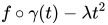
Convex A subset K of a Riemannian manifold M is called convex if for any two points in K there is a unique shortest path connecting them which lies entirely in K, see also totally convex.
Convexity radius at a point of a Riemannian manifold is the supremum of radii of balls centered at that are (totally) convex. The convexity radius of the manifold is the infimum of the convexity radii at its points; for a compact manifold this is a positive number.[3] Sometimes the additional requirement is made that the distance function to in these balls is convex.[4]

D
[edit]Diameter of a metric space is the supremum of distances between pairs of points.
Developable surface is a surface isometric to the plane.
Dilation same as Lipschitz constant.
E
[edit]Exponential map Exponential map (Lie theory), Exponential map (Riemannian geometry)
F
[edit]Finsler metric A generalization of Riemannian manifolds where the scalar product on the tangent space is replaced by a norm.
First fundamental form for an embedding or immersion is the pullback of the metric tensor.
G
[edit]Geodesic is a curve which locally minimizes distance.
Geodesic equation is the differential equation whose local solutions are the geodesics.
Geodesic flow is a flow on a tangent bundle TM of a manifold M, generated by a vector field whose trajectories are of the form where is a geodesic.

Gromov-hyperbolic metric space
Geodesic metric space is a metric space where any two points are the endpoints of a minimizing geodesic.
H
[edit]Hadamard space is a complete simply connected space with nonpositive curvature.
Holonomy group is the subgroup of isometries of the tangent space obtained as parallel transport along closed curves.
Horosphere a level set of Busemann function.
Hyperbolic geometry (see also Riemannian hyperbolic space)
I
[edit]Injectivity radius The injectivity radius at a point p of a Riemannian manifold is the supremum of radii for which the exponential map at p is a diffeomorphism. The injectivity radius of a Riemannian manifold is the infimum of the injectivity radii at all points.[5] See also cut locus.
For complete manifolds, if the injectivity radius at p is a finite number r, then either there is a geodesic of length 2r which starts and ends at p or there is a point q conjugate to p (see conjugate point above) and on the distance r from p.[6] For a closed Riemannian manifold the injectivity radius is either half the minimal length of a closed geodesic or the minimal distance between conjugate points on a geodesic.
Infranilmanifold Given a simply connected nilpotent Lie group N acting on itself by left multiplication and a finite group of automorphisms F of N one can define an action of the semidirect product on N. An orbit space of N by a discrete subgroup of which acts freely on N is called an infranilmanifold. An infranilmanifold is finitely covered by a nilmanifold.[7]


Isometric embedding is an embedding preserving the Riemannian metric.
Isometry is a surjective map which preserves distances.
Isoperimetric function of a metric space measures "how efficiently rectifiable loops are coarsely contractible with respect to their length". For the Cayley 2-complex of a finite presentation, they are equivalent to the Dehn function of the group presentation. They are invariant under quasi-isometries.[8]

J
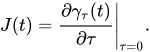
[edit]Jacobi field A Jacobi field is a vector field on a geodesic γ which can be obtained on the following way: Take a smooth one parameter family of geodesics with , then the Jacobi field is described by


K
[edit]L
[edit]Length metric the same as intrinsic metric.
Levi-Civita connection is a natural way to differentiate vector fields on Riemannian manifolds.
Lipschitz constant of a map is the infimum of numbers L such that the given map is L-Lipschitz.
Lipschitz convergence the convergence of metric spaces defined by Lipschitz distance.
Lipschitz distance between metric spaces is the infimum of numbers r such that there is a bijective bi-Lipschitz map between these spaces with constants exp(-r), exp(r).[9]
Logarithmic map, or logarithm, is a right inverse of Exponential map.[10][11]
M
[edit]Minimal surface is a submanifold with (vector of) mean curvature zero.
Mostow's rigidity In dimension , compact hyperbolic manifolds are classified by their fundamental group.

N
[edit]Natural parametrization is the parametrization by length.[12]
Net A subset S of a metric space X is called -net if for any point in X there is a point in S on the distance .[13] This is distinct from topological nets which generalize limits.


Nilmanifold: An element of the minimal set of manifolds which includes a point, and has the following property: any oriented -bundle over a nilmanifold is a nilmanifold. It also can be defined as a factor of a connected nilpotent Lie group by a lattice.

Normal bundle: associated to an embedding of a manifold M into an ambient Euclidean space , the normal bundle is a vector bundle whose fiber at each point p is the orthogonal complement (in ) of the tangent space .


Nonexpanding map same as short map.
O
[edit]Orthonormal frame bundle is the bundle of bases of the tangent space that are orthonormal for the Riemannian metric.
P
[edit]Polyhedral space a simplicial complex with a metric such that each simplex with induced metric is isometric to a simplex in Euclidean space.
Principal curvature is the maximum and minimum normal curvatures at a point on a surface.
Principal direction is the direction of the principal curvatures.
Proper metric space is a metric space in which every closed ball is compact. Equivalently, if every closed bounded subset is compact. Every proper metric space is complete.[14]
Q
[edit]Quasi-convex subspace of a metric space is a subset such that there exists such that for all , for all geodesic segment and for all , .[15]


![{\textstyle [y,y']}](https://wikimedia.org/api/rest_v1/media/math/render/svg/0e2bde3957d7a803c920714de32591a5d266c308)
![{\textstyle z\in [y,y']}](https://wikimedia.org/api/rest_v1/media/math/render/svg/625ba2f7078116f17619abb6839dc25c48ee86d1)

Quasigeodesic has two meanings; here we give the most common. A map (where is a subinterval) is called a quasigeodesic if there are constants and such that for every



Note that a quasigeodesic is not necessarily a continuous curve.
Quasi-isometry. A map is called a quasi-isometry if there are constants and such that
and every point in Y has distance at most C from some point of f(X). Note that a quasi-isometry is not assumed to be continuous. For example, any map between compact metric spaces is a quasi isometry. If there exists a quasi-isometry from X to Y, then X and Y are said to be quasi-isometric.
R
[edit]Radius of metric space is the infimum of radii of metric balls which contain the space completely.[16]
Ray is a one side infinite geodesic which is minimizing on each interval.[17]
Riemann The mathematician after whom Riemannian geometry is named.
Riemann curvature tensor is often defined as the (4, 0)-tensor of the tangent bundle of a Riemannian manifold asfor and (depending on conventions, and are sometimes switched).

![{\displaystyle R_{p}(X,Y,Z)W={g_{p}({\nabla _{X}\nabla _{Y}Z-\nabla _{Y}\nabla _{X}Z-\nabla _{[X,Y]}Z,W})},}](https://wikimedia.org/api/rest_v1/media/math/render/svg/ec2c9da51c8d3431192a550610b90c64aa75d141)


Riemannian submanifold A differentiable sub-manifold whose Riemannian metric is the restriction of the ambient Riemannian metric (not to be confused with sub-Riemannian manifold).
Riemannian submersion is a map between Riemannian manifolds which is submersion and submetry at the same time.
S
[edit]Second fundamental form is a quadratic form on the tangent space of hypersurface, usually denoted by II, an equivalent way to describe the shape operator of a hypersurface,

It can be also generalized to arbitrary codimension, in which case it is a quadratic form with values in the normal space.
Sectional curvature at a point of a Riemannian manifold along the 2-plane spanned by two linearly independent vectors is the numberwhere is the curvature tensor written as , and is the Riemannian metric.


![{\textstyle R_{p}(X,Y,Z)W={g_{p}({\nabla _{X}\nabla _{Y}Z-\nabla _{Y}\nabla _{X}Z-\nabla _{[X,Y]}Z,W})}}](https://wikimedia.org/api/rest_v1/media/math/render/svg/7c8e0966f2568e2429337748d2327e937cf86872)

Shape operator for a hypersurface M is a linear operator on tangent spaces, Sp: TpM→TpM. If n is a unit normal field to M and v is a tangent vector then
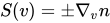
(there is no standard agreement whether to use + or − in the definition).
Short map is a distance non increasing map.
Sol manifold is a factor of a connected solvable Lie group by a lattice.
Submetry A short map f between metric spaces is called a submetry[18] if there exists R > 0 such that for any point x and radius r < R the image of metric r-ball is an r-ball, i.e.Sub-Riemannian manifold

Symmetric space Riemannian symmetric spaces are Riemannian manifolds in which the geodesic reflection at any point is an isometry. They turn out to be quotients of a real Lie group by a maximal compact subgroup whose Lie algebra is the fixed subalgebra of the involution obtained by differentiating the geodesic symmetry. This algebraic data is enough to provide a classification of the Riemannian symmetric spaces.
Systole The k-systole of M, , is the minimal volume of k-cycle nonhomologous to zero.

T
[edit]Thurston's geometries The eight 3-dimensional geometries predicted by Thurston's geometrization conjecture, proved by Perelman: , , , , , , , and .


Totally convex A subset K of a Riemannian manifold M is called totally convex if for any two points in K any geodesic connecting them lies entirely in K, see also convex.[19]
Totally geodesic submanifold is a submanifold such that all geodesics in the submanifold are also geodesics of the surrounding manifold.[20]
U
[edit]Uniquely geodesic metric space is a metric space where any two points are the endpoints of a unique minimizing geodesic.
V
[edit]W
[edit]Word metric on a group is a metric of the Cayley graph constructed using a set of generators.
References
[edit]- ^ Kobayashi, Shōshichi; Nomizu, Katsumi (1963). "Chapter VII Submanifolds, 8. Autoparallel submanifolds and totally geodesic submanifolds". Foundations of differential geometry. Interscience Publishers, New York, NY. pp. 53–62. ISBN 978-0-471-15732-8. Zbl 0175.48504.
{{cite book}}: ISBN / Date incompatibility (help) - ^ Mancinelli, Claudio; Puppo, Enrico (2023-06-01). "Computing the Riemannian center of mass on meshes". Computer Aided Geometric Design. 103 102203. doi:10.1016/j.cagd.2023.102203. ISSN 0167-8396.
- ^ Gallot, Sylvestre; Hulin, Dominique; Lafontaine, Jacques (2004), Gallot, Sylvestre; Hulin, Dominique; Lafontaine, Jacques (eds.), "Riemannian metrics", Riemannian Geometry, Berlin, Heidelberg: Springer, Remark after Proof of Corollary 2.89, p.87, doi:10.1007/978-3-642-18855-8_2, ISBN 978-3-642-18855-8, retrieved 2024-11-28
- ^ Petersen, Peter (2016), Petersen, Peter (ed.), "Sectional Curvature Comparison I", Riemannian Geometry, Graduate Texts in Mathematics, vol. 171, Cham: Springer International Publishing, Theorem 6.4.8, pp. 258-259, doi:10.1007/978-3-319-26654-1_6, ISBN 978-3-319-26654-1, retrieved 2024-11-29
- ^ Lee, Jeffrey M. (2009). "13. Riemannian and Semi-Riemannian Geometry, Definition 13.141". Manifolds and differential geometry. Providence, RI: American Mathematical Society (AMS). p. 615. ISBN 978-0-8218-4815-9. Zbl 1190.58001.
- ^ Gallot, Sylvestre; Hulin, Dominique; Lafontaine, Jacques (2004), Gallot, Sylvestre; Hulin, Dominique; Lafontaine, Jacques (eds.), "Curvature", Riemannian Geometry, Berlin, Heidelberg: Springer, Scholium 3.78, doi:10.1007/978-3-642-18855-8_3, ISBN 978-3-642-18855-8, retrieved 2024-11-28
- ^ Hirsch, Morris W. (1970). "Expanding maps and transformation groups". Global Analysis. Proceedings of Symposia in Pure Mathematics. Vol. 14. pp. 125–131. doi:10.1090/pspum/014/0298701. ISBN 978-0-8218-1414-7. Zbl 0223.58009.
- ^ Bridson, Martin R.; Haefliger, André (1999), Bridson, Martin R.; Haefliger, André (eds.), "δ-Hyperbolic Spaces and Area", Metric Spaces of Non-Positive Curvature, Berlin, Heidelberg: Springer, 2. Area and isoperimetric inequalities, pp. 414 – 417, doi:10.1007/978-3-662-12494-9_21, ISBN 978-3-662-12494-9, retrieved 2024-12-23
- ^ Burago, Dmitri; Burago, Yurii; Ivanov, Sergei (2001). A course in metric geometry. Providence, RI: American Mathematical Society (AMS). Chapter 7, §7.2, pp. 249-250. ISBN 0-8218-2129-6. Zbl 0981.51016.
- ^ Burago, Dmitri; Burago, Yurii; Ivanov, Sergei (2001). A course in metric geometry. Providence, RI: American Mathematical Society (AMS). Chapter 9, §9.1, pp. 321-322. ISBN 0-8218-2129-6. Zbl 0981.51016.
- ^ Lang, Serge (1999). "Fundamentals of Differential Geometry". Graduate Texts in Mathematics. 191. Chapter XII An example of seminegative curvature, p. 323. doi:10.1007/978-1-4612-0541-8. ISBN 978-1-4612-6810-9. ISSN 0072-5285.
- ^ Burago, Dmitri; Burago, Yurii; Ivanov, Sergei (2001). A course in metric geometry. Providence, RI: American Mathematical Society (AMS). Chapter 2, §2.5.1, Definition 2.5.7. ISBN 0-8218-2129-6. Zbl 0981.51016.
- ^ Burago, Dmitri; Burago, Yurii; Ivanov, Sergei (2001). A course in metric geometry. Providence, RI: American Mathematical Society (AMS). Chapter 1, §1.6, Definition 1.6.1, p. 13. ISBN 0-8218-2129-6. Zbl 0981.51016.
- ^ Bridson, Martin R.; Haefliger, André (1999), Bridson, Martin R.; Haefliger, André (eds.), "Basic Concepts", Metric Spaces of Non-Positive Curvature, Berlin, Heidelberg: Springer, Chapter I.1, § Metric spaces, Definitions 1.1, p. 2, doi:10.1007/978-3-662-12494-9_1, ISBN 978-3-662-12494-9, retrieved 2024-11-29
- ^ Bridson, Martin R.; Haefliger, André (1999), Bridson, Martin R.; Haefliger, André (eds.), "Non-Positive Curvature and Group Theory", Metric Spaces of Non-Positive Curvature, Berlin, Heidelberg: Springer, Definition 3.4, p. 460, doi:10.1007/978-3-662-12494-9_22, ISBN 978-3-662-12494-9, retrieved 2024-12-23
- ^ Burago, Dmitri; Burago, Yurii; Ivanov, Sergei (2001). A course in metric geometry. Providence, RI: American Mathematical Society (AMS). Chapter 10, §10.4, Exercise 10.4.5, p. 366. ISBN 0-8218-2129-6. Zbl 0981.51016.
- ^ Petersen, Peter (2016). "Riemannian Geometry". Graduate Texts in Mathematics. 171. Chapter 7, §7.3.1 Rays and Lines, p. 298. doi:10.1007/978-3-319-26654-1. ISBN 978-3-319-26652-7. ISSN 0072-5285.
- ^ Berestovskii, V. N. (1987-07-01). "Submetries of space-forms of negative curvature". Siberian Mathematical Journal. 28 (4): 552–562. Bibcode:1987SibMJ..28..552B. doi:10.1007/BF00973842. ISSN 1573-9260.
- ^ Petersen, Peter (2016). "Riemannian Geometry". Graduate Texts in Mathematics. 171. Chapter 12, §12.4 The Soul Theorem, p. 463. doi:10.1007/978-3-319-26654-1. ISBN 978-3-319-26652-7. ISSN 0072-5285.
- ^ Gallot, Sylvestre; Hulin, Dominique; Lafontaine, Jacques (2004). "Riemannian Geometry". Universitext. Chapter 2, §2.C.1, Definition 2.80 bis, p.82. doi:10.1007/978-3-642-18855-8. ISBN 978-3-540-20493-0. ISSN 0172-5939.
Glossary of Riemannian and metric geometry
View on GrokipediaFoundational Concepts
Manifolds and Structures
A smooth manifold is a second-countable Hausdorff topological space locally homeomorphic to Euclidean space , equipped with an atlas of charts where the transition maps between overlapping charts are smooth (i.e., infinitely differentiable).[4] This structure allows the application of calculus on the manifold by transferring problems locally to Euclidean space via the charts.[4] A Riemannian manifold is a smooth manifold together with a Riemannian metric, which is a smooth assignment to each point of a positive-definite inner product on the tangent space , varying smoothly with .[5] This metric endows the manifold with the ability to measure lengths, angles, and volumes in a coordinate-independent way. The positive-definiteness ensures that the metric induces a norm on tangent vectors, making distances well-defined along curves. The tangent bundle of a smooth manifold is the disjoint union , where each is the tangent space at , and it is endowed with a natural smooth manifold structure of dimension .[6] This bundle provides a global way to handle tangent vectors across the manifold, with the projection map sending each vector to its base point.[6] Locally, over chart domains, resembles the product .[6] The cotangent bundle is the vector bundle dual to the tangent bundle, consisting of the disjoint union , where is the space of linear functionals (covectors) on .[7] It inherits a smooth structure from , enabling the study of differential forms and other contravariant objects on .[7] The duality pairs each covector with tangent vectors via the evaluation map.[7] The orthonormal frame bundle of a Riemannian manifold is the principal -bundle over , where , whose fibers over each consist of all orthonormal bases (frames) of the tangent space with respect to the metric .[8] This bundle captures the local orthogonal structures induced by the metric and serves as a framework for defining connections and parallel transport.[8] Reductions to the special orthogonal group yield oriented versions when admits an orientation.[8] Euclidean space serves as the prototypical flat Riemannian manifold, with the standard Euclidean metric providing zero curvature everywhere. The -sphere , embedded in , is a compact Riemannian manifold obtained by inducing the metric from the ambient Euclidean space, illustrating a bounded geometry with finite volume.Metrics and Tensors
In Riemannian geometry, the metric tensor, often denoted , provides a smoothly varying inner product on the tangent spaces of a manifold, enabling the measurement of lengths, angles, and distances. Specifically, at each point on a smooth manifold , the metric is a symmetric, positive-definite bilinear form that defines an inner product on the tangent space . This structure induces a norm on tangent vectors via for , allowing for the quantification of infinitesimal displacements. The collection of all such inner products across the manifold constitutes the Riemannian metric, which is smooth in the sense that its components in local coordinates are smooth functions.[9][10] The first fundamental form arises in the context of immersions into Euclidean space, where it represents the pullback of the ambient Euclidean metric under the immersion map. For a smooth immersion of a surface , the first fundamental form is the induced Riemannian metric on , where is the flat Euclidean metric; this captures the intrinsic geometry of the embedded surface by specifying how tangent vectors on pair under the pulled-back inner product.[11] On a product manifold , where and are equipped with Riemannian metrics and , the product metric is defined as , which in local coordinates takes a block-diagonal form combining the components of and . This construction ensures that the product manifold inherits a natural Riemannian structure compatible with the individual geometries.[12] A conformal map between Riemannian manifolds is a diffeomorphism that scales the metric by a positive smooth scalar function , yielding a new metric ; such maps preserve angles between tangent vectors since the inner product ratios remain unchanged. A manifold is conformally flat if, around every point, there exists a neighborhood and a positive scalar function such that the rescaled metric is flat, meaning it is locally isometric to Euclidean space up to conformal equivalence.[13][14] In broader contexts, such as relativity, pseudo-Riemannian metrics generalize the Riemannian case by allowing indefinite signatures, as in the Minkowski metric of signature (1,3) on spacetime, which is non-degenerate but not positive-definite.[15][16] The Riemannian metric defines the length of a piecewise smooth curve as which serves as the foundation for the induced distance function on the manifold.[10]Connections and Derivatives
Affine and Linear Connections
In Riemannian and metric geometry, connections provide a framework for defining differentiation of vector fields on manifolds, enabling the extension of directional derivatives from Euclidean spaces to curved geometries. An affine connection on a smooth manifold is a bilinear map , where denotes the space of smooth vector fields on , satisfying for smooth functions on and linearity in the first argument. This structure is compatible with the manifold's topology and allows parallel transport of vectors along curves, measuring how tangent spaces at nearby points relate through infinitesimal displacements. A linear connection generalizes this to vector bundles over , specifying a covariant derivative on sections that preserves the bundle's linear fiber structure. For a vector bundle , a linear connection on acts on sections and vector fields via , satisfying the Leibniz rule and linearity . This ensures parallel transport along paths in maps fibers linearly, preserving vector addition and scalar multiplication within each fiber. On a Riemannian manifold equipped with a metric tensor , the Levi-Civita connection is the unique affine connection that is torsion-free and metric-compatible, meaning . Introduced by Tullio Levi-Civita, it satisfies for all vector fields , ensuring the metric is preserved under parallel transport. This connection, often denoted , provides the standard notion of geodesics as autoparallel curves in Riemannian geometry.[17][18] In local coordinates on , an affine connection is expressed through Christoffel symbols , defined by , where . These symbols, named after Elwin Bruno Christoffel, encode the connection's components and transform non-tensorially under coordinate changes, reflecting the affine nature of the structure. For the Levi-Civita connection, they are given explicitly by , facilitating computations of covariant derivatives.[19] Cartan connections extend affine connections by incorporating principal bundle structures, modeling geometries as deformations of homogeneous spaces. Formulated by Élie Cartan, a Cartan connection on a principal -bundle with model space is an -valued 1-form on that is equivariant under -actions, reproduces infinitesimal generators of the -action, and is surjective with contractible fibers. This combines an Ehresmann connection with a soldering form, capturing both infinitesimal displacements and group actions, as in Weyl or conformal geometries.[20] Ehresmann connections apply to general fiber bundles, defining a horizontal subbundle complementary to the vertical tangent spaces. On a fiber bundle with structure group , an Ehresmann connection is a smooth distribution such that pointwise, with projecting isomorphically to . Introduced by Charles Ehresmann, this horizontal distribution enables parallel transport of fibers along paths in , generalizing affine connections to non-linear fibers while preserving bundle structure.[21] The torsion tensor of an affine connection quantifies the failure of the connection to preserve the Lie bracket of vector fields, defined as for vector fields . This -valued 2-form is antisymmetric, , and vanishes for torsion-free connections like the Levi-Civita, where covariant derivatives commute with Lie brackets up to the bracket itself. Élie Cartan highlighted its role in non-Riemannian geometries, measuring "twist" in the parallel transport. The holonomy group of a connection at a point is the Lie subgroup of (or the structure group for bundles) generated by parallel transport maps along all loops based at . As characterized by the Ambrose-Singer theorem, its Lie algebra is spanned by iterated curvature endomorphisms along paths ending at , linking global geometry to local infinitesimal structure. In Riemannian manifolds, the restricted holonomy group classifies possible symmetries and parallel tensor fields.[22]Covariant Derivatives and Symbols
In Riemannian geometry, the covariant derivative provides a way to differentiate vector fields and tensors in a manner compatible with the manifold's metric structure. Given an affine connection ∇ on a Riemannian manifold (M, g), the covariant derivative ∇_X Y of a vector field Y along a vector field X is defined as the "directional derivative" of Y in the direction X, incorporating the connection to ensure the result transforms as a tensor. This operation generalizes the ordinary directional derivative from Euclidean space to curved manifolds, allowing for the differentiation of sections of tensor bundles while respecting the geometry. The Levi-Civita connection, which is torsion-free and metric-compatible, uniquely realizes this derivative on Riemannian manifolds.[23] Parallel transport arises naturally from the covariant derivative as a means to compare vectors at different points along a curve. For a curve γ: I → M with tangent vector field γ', a vector field V along γ is parallel if it satisfies ∇_{γ'} V = 0, which is a first-order linear ordinary differential equation whose unique solution, given an initial vector V(0) at γ(0), defines the parallel transport of V(0) to any point γ(t). On a Riemannian manifold equipped with the Levi-Civita connection, this parallel transport preserves the inner product g(V, W) for any two parallel vector fields V and W along γ, reflecting the metric-compatibility of the connection. This preservation ensures that lengths and angles are maintained under transport, a key property distinguishing Riemannian geometry from more general affine settings.[23] The explicit form of the Levi-Civita covariant derivative is given by the Koszul formula, which expresses it solely in terms of the metric and its partial derivatives. For vector fields X, Y, Z on (M, g), the formula states: where [·, ·] denotes the Lie bracket of vector fields. This bilinear expression uniquely determines the torsion-free, metric-compatible connection ∇, as polarizing it yields the full tensorial properties. The Koszul formula, introduced in the context of Lie algebra cohomology and adapted to differential geometry, facilitates computations of ∇ without prior knowledge of connection coefficients. Killing vector fields represent infinitesimal symmetries of the Riemannian metric, characterized by their action on the covariant derivative. A vector field ξ on (M, g) is a Killing field if it generates local isometries, satisfying the Killing equation g(∇_X ξ, Y) + g(X, ∇_Y ξ) = 0 for all vector fields X, Y, or equivalently, the Lie derivative L_ξ g = 0.[24] This symmetric condition implies that the flow of ξ preserves the metric tensor, making Killing fields essential for studying the isometry group of the manifold. Seminal work on such fields arose in the classification of Lie algebras underlying continuous transformation groups, where they appear as generators of metric-preserving actions. Riemannian submersions extend the notion of covariant differentiation to mappings between manifolds, preserving horizontal metric structure. A submersion π: (M, g) → (B, h) between Riemannian manifolds is Riemannian if the differential dπ restricts to an isometry on the horizontal subspace of the tangent space at each point, meaning ||dπ(X)||_h = ||X||_g for horizontal X orthogonal to the fibers. The covariant derivative along horizontal directions thus aligns the geometries of M and B, with the Levi-Civita connections related by formulas involving the O'Neill tensors, which measure the integrability of the horizontal distribution. This framework, developed through fundamental equations governing the second fundamental form of fibers, enables the study of fiber bundles with preserved metric properties.[25] In local coordinates (x^i) on M, the covariant derivative admits an explicit component form via Christoffel symbols, the connection coefficients of the Levi-Civita connection. For the coordinate basis vector fields ∂i = ∂/∂x^i, the derivative is ∇{∂_i} ∂j = Γ^k{ij} ∂k, where the Christoffel symbols Γ^k{ij} are given by derived from the metric components g_{ij}. These symbols, which are symmetric in the lower indices due to torsion-freeness, fully encode the connection locally and arise from symmetrizing partial derivatives of the metric to ensure compatibility. Introduced in the context of geodesic curvature on general manifolds, they provide the practical tool for coordinate-based computations of covariant derivatives on tensor fields.Geodesics and Paths
Geodesic Curves and Equations
In Riemannian geometry, a geodesic is defined as a smooth curve on a Riemannian manifold , where is an interval, such that the tangent vector is parallel transported along the curve, satisfying for all , with denoting the Levi-Civita connection.[26] This condition implies that geodesics are autoparallel curves, meaning they are parallel to their own tangent vectors, and for the torsion-free Levi-Civita connection, autoparallels coincide exactly with geodesics.[26] Geodesics locally minimize length, serving as the shortest paths between nearby points on the manifold.[26] In local coordinates on , the geodesic equation takes the form for , where are the Christoffel symbols of the Levi-Civita connection, and the indices follow the Einstein summation convention.[26] This second-order system of ordinary differential equations characterizes geodesics intrinsically, independent of the specific parametrization , as long as it is affine (i.e., proportional to arc length).[27] A natural parametrization of a geodesic is the arc-length parametrization, where the parameter satisfies constantly along the curve, ensuring the speed is unit and the length is directly given by the parameter interval.[26] Any reparametrization by an affine function (with ) preserves the geodesic property, but only the arc-length version yields constant unit speed.[28] A geodesic ray is a half-infinite geodesic starting at a point , defined on the non-negative reals, and minimizing distances between any two of its points.[29] Such rays are crucial in studying the global structure of complete Riemannian manifolds, particularly in contexts like non-compact spaces or asymptotic behavior.[29] A Riemannian manifold is called uniquely geodesic if, for any two points in a suitable neighborhood, there exists a unique geodesic connecting them that realizes the minimal distance, with this geodesic varying smoothly with and .[27] This property holds locally in normal neighborhoods around points and underscores the role of geodesics in defining the intrinsic metric topology.[27] The geodesic flow on a Riemannian manifold is the one-parameter group of diffeomorphisms on the tangent bundle (or the unit tangent bundle ) generated by solving the geodesic equations with initial conditions , yielding trajectories , which preserve the Sasaki metric and the squared norm levels on .[27] This flow encodes the dynamics of all geodesics and is a key tool for analyzing completeness and curvature effects.[27] A rectifiable curve on a Riemannian manifold is a continuous map with finite length , where the length is well-defined even for non-smooth curves by approximation with piecewise smooth or polygonal paths whose lengths converge to .[26] Rectifiable curves form the basis for defining the Riemannian distance , with geodesics achieving the infimum locally.[27]Exponential Maps and Loci
In Riemannian geometry, the exponential map provides a fundamental way to relate the tangent space at a point to the manifold itself via geodesics. For a Riemannian manifold and a point , the exponential map is defined by sending a tangent vector to the endpoint , where is the unique geodesic satisfying and , assuming the geodesic is defined on the interval . This map is smooth and locally a diffeomorphism near the origin in , facilitating normal coordinates and the study of local geometry around .[30] The logarithmic map serves as a right inverse to the exponential map where the latter is injective. Specifically, for points in the image of a diffeomorphic domain of , the logarithmic map is defined such that , yielding the initial velocity vector of the unique minimizing geodesic from to . This inverse is well-defined on open sets where is a diffeomorphism, enabling computations like vector transport and geodesic interpolation in manifold optimization.[31] The injectivity radius at , denoted , quantifies the scale at which the exponential map remains a global diffeomorphism. It is the supremum of radii such that restricts to a diffeomorphism from the open ball (of radius with respect to the norm induced by ) onto its image in . The global injectivity radius is then the infimum of over all ; on complete manifolds, it is positive if is compact.[30] The cut locus of , denoted , captures the boundary beyond which geodesics from cease to be distance-minimizing. It consists of all points that are cut points of , meaning lies on some geodesic segment from of length , but either another geodesic of the same length exists or the segment fails to minimize distance beyond . The cut locus is a closed set, and the manifold minus is covered diffeomorphically by on the relevant domain, with marking the first points of geodesic multiplicity or non-minimality.[30] Conjugate points along a geodesic arise from singularities in the differential of the exponential map and are analyzed via Jacobi fields. A point along a geodesic with is conjugate to if and the differential is not injective, equivalently if there exists a non-zero Jacobi field vanishing at both endpoints. The conjugate locus of is the image under of such first conjugate points along all geodesics from .[30] Jacobi fields describe infinitesimal variations of geodesics and satisfy a linear second-order ODE involving the curvature tensor. Along a geodesic with unit speed tangent , a Jacobi field is a vector field satisfying the Jacobi equation where is the Riemann curvature tensor and is the covariant derivative along ; such fields arise as variation fields of one-parameter families of geodesics. Non-trivial Jacobi fields with and indicate conjugate points at , signaling the onset of geodesic focusing or spreading influenced by curvature.[30] The convexity radius at , denoted , measures the largest scale for geodesic convexity of balls around . It is the supremum of such that the open ball is (strongly) convex, meaning any two points in it are joined by a unique minimizing geodesic entirely contained in the ball. On complete Riemannian manifolds, is positive and relates to the injectivity and focal radii via bounds like , ensuring local uniqueness of geodesics without curvature assumptions. The global convexity radius is positive for compact manifolds.[32]Curvature Measures
Riemann and Sectional Curvature
The Riemann curvature tensor quantifies the intrinsic curvature of a Riemannian manifold by measuring the extent to which the covariant derivatives fail to commute. For vector fields on a Riemannian manifold , it is defined as where denotes the Levi-Civita connection and is the Lie bracket.[33] This expression captures the deviation from flatness in the manifold's geometry, arising from the non-commutativity of second-order covariant differentiation adjusted for the torsion-free nature of the connection.[33] The tensor can be viewed as inducing a curvature endomorphism at each point, defined by the linear map . This endomorphism encodes how infinitesimal parallelograms spanned by and are distorted by the manifold's curvature, providing a pointwise linear transformation on the tangent space.[34] Sectional curvature provides a normalized measure of this distortion restricted to two-dimensional subspaces. For a two-plane spanned by orthonormal vectors at a point , the sectional curvature is given by where the denominator simplifies to 1 for orthonormal bases; more generally, it accounts for the area of the parallelogram spanned by .[35] This quantity determines the full Riemann tensor on manifolds of dimension at most three and serves as the primary invariant for classifying local geometry up to isometry.[35] A Riemannian manifold is flat if its sectional curvature vanishes identically at every point and tangent plane, implying local isometry to Euclidean space.[36] In contrast, an almost flat manifold admits a sequence of metrics with diameters bounded away from zero but sectional curvatures converging uniformly to zero, often arising in limits of degenerating geometries; Gromov's almost flat manifolds theorem characterizes such compact manifolds as finite covers of infranilmanifolds for sufficiently small curvature bounds depending on dimension.[37] For two-dimensional Riemannian manifolds (surfaces), the sectional curvature of the tangent plane coincides with the Gauss curvature, the product of the principal curvatures in a local embedding.[38] In higher dimensions (), the Weyl tensor isolates the trace-free, conformally invariant part of the Riemann tensor, defined in index notation by where is the Ricci tensor and the scalar curvature; it vanishes if and only if the manifold is conformally flat.[39]Ricci and Scalar Curvature
The Ricci curvature tensor on a Riemannian manifold is obtained by contracting the Riemann curvature tensor . Specifically, for tangent vectors [X, Y](/page/X&Y) \in T_pM, the Ricci curvature is defined as the trace of the endomorphism , where the trace is taken with respect to an orthonormal basis of .[40] This contraction captures the average sectional curvature in planes containing , providing a measure of how geodesics orthogonal to converge or diverge relative to .[40] The scalar curvature at a point is the trace of the Ricci tensor with respect to the metric , equivalently in local coordinates.[40] It can also be expressed as the sum of sectional curvatures over all planes spanned by an orthonormal basis of : .[40] Geometrically, the scalar curvature quantifies the local volume distortion of the manifold compared to Euclidean space, influencing the growth of geodesic balls.[41] An Einstein manifold is a Riemannian manifold where the Ricci tensor is proportional to the metric: for some constant , with the scalar curvature on an -dimensional manifold.[42] This condition implies that all eigenvalues of the Ricci operator are equal, yielding isotropic average curvature and simplifying many geometric analyses, such as rigidity theorems under curvature bounds.[42] A Kähler-Einstein metric on a complex manifold is a Kähler metric that is also Einstein, satisfying where is the Kähler form and is constant.[43] Such metrics preserve both the complex structure and the Einstein condition, playing a central role in the study of compact complex surfaces and higher-dimensional Fano varieties.[43] The Cheeger constant of a compact Riemannian manifold is defined as , where the infimum is over compact subdomains with smooth boundary and denotes the -dimensional volume.[44] Lower bounds on the Ricci curvature, such as , imply quantitative estimates on , relating it to the first eigenvalue of the Laplacian and controlling the manifold's connectivity and expansion properties.[44] The systole of a Riemannian manifold is the infimum of lengths of non-contractible closed geodesics. Positive lower bounds on the scalar curvature restrict the systole from above, as in Gromov's inequalities linking to and , preventing arbitrarily long essential cycles in positively curved spaces.[41] The isoperimetric function of a Riemannian manifold measures the infimum of boundary areas enclosing volume , i.e., .[45] Lower bounds on the scalar curvature influence by providing Euclidean-like estimates for small , with deviations controlled by , as seen in comparisons for manifolds with nonnegative scalar curvature.[45]Submanifolds and Embeddings
Fundamental Forms and Curvatures
In the context of submanifolds embedded in a Riemannian manifold, the fundamental forms quantify how the geometry of the submanifold is influenced by its embedding, particularly through extrinsic curvature effects. The first fundamental form captures the induced metric on the submanifold, defining its intrinsic geometry, while the second fundamental form measures the manner in which the submanifold bends away from being totally flat within the ambient space. These forms arise naturally from the decomposition of the covariant derivative of tangent vectors into tangential and normal components relative to the submanifold. The second fundamental form, denoted II, at a point of a submanifold , where is a Riemannian manifold equipped with Levi-Civita connection , is defined for tangent vectors as the normal component of the ambient covariant derivative: where is the normal bundle and denotes projection onto it. This bilinear form is symmetric and valued in the normal space, providing a measure of the extrinsic bending or deviation of geodesics in from those in . For a general submanifold of codimension greater than one, II is a tensor field that encodes the full extrinsic curvature information. For hypersurfaces, where the codimension is one and a unit normal vector field can be chosen, the shape operator (or Weingarten map) simplifies the analysis of II. It is defined by where denotes the tangential component, relating the normal derivative to the change in the tangent plane. The eigenvalues of , known as the principal curvatures (with ), represent the maximum and minimum curvatures in principal directions, diagonalizing II with respect to an orthonormal basis. The mean curvature vector, or simply mean curvature for hypersurfaces, is the trace of II normalized by dimension: averaging the extrinsic curvature and indicating the net bending tendency. A key relation between intrinsic and extrinsic geometries is given by the Gauss equation, which for surfaces () in an ambient space states that the intrinsic sectional curvature satisfies where is the ambient sectional curvature and is the Gaussian curvature contribution from extrinsic effects. In higher dimensions, this generalizes to the Gauss-Codazzi equations, with the Codazzi-Mainardi relations ensuring compatibility by stating that the covariant derivative of II is symmetric in a certain sense, linking it to the ambient Riemann curvature. Developable surfaces are characterized by vanishing Gaussian curvature , implying they are intrinsically flat; examples include cylinders and cones, which may have non-zero mean curvature and exhibit extrinsic bending in one direction, unlike planes where both and .[46] In contrast, minimal surfaces are submanifolds with vanishing mean curvature , making them critical points of the area functional and locally area-minimizing, independent of Gaussian curvature; examples include the catenoid, where principal curvatures cancel pairwise.Minimal and Totally Geodesic Submanifolds
A Riemannian submanifold is a submanifold of a Riemannian manifold equipped with the induced metric, where the metric tensor on is the restriction of the ambient metric to the tangent spaces for each .[47] This induced metric makes a Riemannian manifold in its own right, inheriting the inner product structure from .[1] An isometric embedding between Riemannian manifolds and is a smooth embedding such that the pullback metric , preserving lengths and angles of tangent vectors.[48] Consequently, induces an isometry between and its image , which becomes a Riemannian submanifold of with the restricted metric.[49] An isometry is a diffeomorphism that preserves the metric tensor pointwise, i.e., , ensuring it is both distance-preserving and orientation-preserving where applicable.[50] A totally geodesic submanifold of a Riemannian manifold is one where every geodesic curve in (with respect to its induced metric) is also a geodesic in .[47] This property is equivalent to the second fundamental form of vanishing identically, , meaning has no extrinsic curvature and lies "flat" relative to .[51] The fixed-point set of an isometry of forms a totally geodesic submanifold.[47] In Euclidean space, totally geodesic submanifolds are precisely the affine subspaces.[47] On a submanifold , conjugate points can be defined using the restricted exponential map , where two points are conjugate along a geodesic in if there exists a non-trivial Jacobi field along that geodesic vanishing at both and the points corresponding to and .[52] This extends the notion from the ambient manifold, capturing points where nearby geodesics in intersect, analogous to focal points but restricted to the tangent bundle of .[53] Classic examples include great circles on the sphere , which are totally geodesic submanifolds as they are intersections with 2-planes through the origin, preserving geodesics of the round metric.[54]Metric Spaces and Properties
Length Spaces and Completeness
In metric geometry, a length space, also known as an intrinsic metric space, is a metric space where the distance between any two points is given by the infimum of the lengths of all paths connecting them, formally , with the length defined as the supremum of sums of distances along partitions of the path.[55] This structure ensures that the metric is induced by path lengths, generalizing the way Riemannian metrics define distances via integrals along curves.[55] Length spaces form the foundational framework for studying geometric properties without assuming differentiability, as seen in spaces like the Euclidean plane or hyperbolic plane.[55] A complete metric space is one in which every Cauchy sequence converges to a point in the space, providing the stability needed for limits and compactness arguments in analysis.[55] In contrast, a proper metric space satisfies the Heine-Borel property, meaning that every closed and bounded subset is compact, which implies that closed balls are compact and aids in embedding theorems and gluing constructions.[55] A geodesic metric space strengthens the length space condition by requiring that for any , there exists at least one path of length exactly , called a geodesic, which locally minimizes distances and preserves the parametrization such that for appropriate scaling.[55] The diameter of a metric space , denoted , measures its overall size as , which can be finite or infinite and influences properties like boundedness in ultralimits.[55] The radius is the infimum of radii such that is contained in a ball for some , representing the smallest enclosing ball's radius and relating to the space's width.[55] A Polish space is a separable complete metric space, equivalent to a topological space that is completely metrizable with a countable basis, making it essential for descriptive set theory, probability measures, and analytic constructions in metric geometry.[55]Convexity and Diameter
In geodesic metric spaces, where every pair of points can be joined by a geodesic, a subset is defined as convex if, for any two points , there exists at least one geodesic segment connecting and that lies entirely within .[55] This notion extends the classical Euclidean convexity to more general geometries by replacing straight lines with geodesics. A convex set is strictly convex if, for any with , there is a unique geodesic segment joining them that remains in , ensuring a stronger form of "straightness" within the subset.[56] Convex functions provide a way to measure "convexity" for scalar fields on these spaces. A function on a geodesic metric space is convex if, for every geodesic and every , the inequality holds, mirroring the standard convexity condition along one-dimensional parameterizations.[57] This property implies that sublevel sets are convex for all . In contrast, a subspace is quasi-convex if there exists a constant such that every geodesic segment joining points in lies within the -neighborhood of , allowing bounded deviations from full containment.[58] Global size measures in metric spaces include the diameter, defined as , which quantifies the largest possible distance between points and indicates boundedness when finite.[59] In contexts involving multiple points, the center of mass of a finite set is the unique point that minimizes , with uniqueness holding in Hadamard spaces due to the strict convexity of the distance-squared function.[60] To analyze behavior at infinity in unbounded spaces, the Busemann function associated with a point at the boundary at infinity is defined as , where is a geodesic ray tending to .[61] This 1-Lipschitz function captures asymptotic distance relative to the direction of . A horosphere is then a level set of a Busemann function, given by for some constant , representing "spheres" centered at infinity with flat Euclidean-like geometry in hyperbolic settings.[62]Convergence and Limits
Gromov-Hausdorff Convergence
Gromov-Hausdorff convergence provides a framework for studying limits of sequences of metric spaces, including those arising from Riemannian manifolds, by quantifying how closely two metric spaces resemble each other intrinsically without requiring embeddings into a fixed ambient space.[63] This notion is particularly useful in Riemannian geometry for analyzing degenerations or approximations of manifolds, such as in the study of collapsing phenomena or asymptotic behavior.[63] The Gromov-Hausdorff distance between two compact metric spaces and is defined as where the infimum is taken over all metric spaces and all isometric embeddings , , and denotes the Hausdorff distance between subsets , given by [63] This distance measures the minimal distortion needed to superimpose the two spaces isometrically into a common metric space, capturing both topological and metric structure.[63] A sequence of compact metric spaces is said to converge to a compact metric space in the Gromov-Hausdorff sense if as .[63] Such convergence implies that the spaces become arbitrarily close in a uniform sense, preserving properties like completeness when the limit space is complete.[63] In the context of convergence on a fixed ambient space, Lipschitz convergence refers to a sequence of maps between metric spaces that are uniformly Lipschitz (i.e., there exists such that for all and all ) and converge pointwise to a limit map , measured via the uniform Lipschitz distance.[63] A bi-Lipschitz map between metric spaces satisfies constants such that for all , ensuring the spaces are metrically equivalent up to bounded distortion.[63] Quasi-isometries generalize bi-Lipschitz maps to allow additive errors, defined as a map with constants and such that for all , and is coarsely surjective (every point in is within bounded distance of ).[63] Coarse geometry studies the large-scale structure of metric spaces, focusing on properties invariant under quasi-isometries, such as asymptotic dimension or growth rates, which are crucial for understanding infinite or non-compact spaces in Riemannian settings.[63] The word metric on a finitely generated group with symmetric generating set (i.e., ) is defined by , representing the minimal length of a word in expressing the group element .[63] This metric induces the Cayley graph structure and is quasi-isometric to other word metrics with different finite generating sets, making it a fundamental tool in coarse geometry for group actions on Riemannian manifolds.[63]Asymptotic and Tangent Cones
In metric geometry, the tangent cone at a point in a metric space , denoted , is defined as the pointed Gromov-Hausdorff limit of the rescaled spaces as , where is the metric on .[64] This limit captures the local infinitesimal structure around , often resulting in a metric cone that reflects the directions and angles accessible from .[64] For example, in a Riemannian manifold, the tangent cone at coincides with the Euclidean tangent space equipped with the induced norm.[65] The existence of such limits is guaranteed under suitable completeness assumptions on , and the tangent cone is unique up to isometry.[66] The asymptotic cone of a metric space , often denoted for a scaling sequence , is the ultralimit or Gromov-Hausdorff limit of the rescaled spaces , which reveals the large-scale geometry of by "zooming out" from infinity.[67] Introduced by Gromov, these cones encode the behavior at infinity, such as hyperbolicity or tree-like structures, and are independent of the choice of scaling sequence under uniform ultrafilter convergence.[68] For instance, the asymptotic cone of a hyperbolic group is a real tree, highlighting its coarse negative curvature.[67] These cones complement Gromov-Hausdorff convergence by focusing on pointed or scaled limits rather than global convergence of entire spaces. The boundary at infinity of a proper geodesic metric space , denoted , consists of equivalence classes of geodesic rays starting from a basepoint, where two rays are equivalent if they remain within a bounded distance asymptotically as their parameters tend to infinity.[69] This construction, due to Gromov, compactifies by adding points representing directions toward infinity and endows with a natural topology.[70] In hyperbolic spaces, is homeomorphic to a Cantor set and captures the space's asymptotic directions without embedding cycles.[69] The Tits boundary equips with the Tits metric , defined for distinct points as the infimum of lengths of paths in connecting and , which measures the angular separation between rays.[71] This metric, introduced in the context of CAT(0) spaces, induces a length structure on the boundary and distinguishes Euclidean from hyperbolic geometries by the presence of flat subsets.[72] For example, the Tits boundaries of both Euclidean and hyperbolic spaces are round spheres, distinguished by the presence of flat subsets in the former, reflecting their differing curvatures.[73] An Alexandrov space is a complete length metric space where the curvature is bounded below by a constant , defined via comparison triangles: for any geodesic triangle in the space, the Alexandrov angle at a vertex is at least the comparison angle in the model space of constant curvature , ensuring a synthetic lower bound on sectional curvature.[74] This notion, originating from Alexandrov's work on intrinsic metrics, generalizes Riemannian manifolds with sectional curvature and admits a rich stratification into manifolds.[75] Alexandrov spaces with include Euclidean spaces and flat tori, while positive yields spherical-like local geometry.[76] A real tree is a geodesic metric space that is 0-hyperbolic, meaning it satisfies the slim triangle condition with , and thus admits unique geodesics between any pair of points, analogous to the metric completion of a simplicial tree.[77] These spaces, studied in geometric group theory, are contractible and serve as models for the asymptotic cones of free groups or negatively curved manifolds at infinity.[78] Every real tree can be realized as the union of isometrically embedded lines intersecting at branch points of finite valence.[77] A tree-graded space is a geodesic metric space partitioned into a family of closed subsets called pieces, such that any two distinct pieces intersect at most at a single point, and the space is "glued" along a transverse real tree structure with no cycles crossing between pieces.[79] Defined by Drutu and Sapir, these spaces generalize real trees by allowing arbitrary metric structure within pieces while maintaining tree-like global connectivity, and they arise as asymptotic cones of relatively hyperbolic groups.[79] For instance, the pieces can be hyperbolic spaces, ensuring the overall space has cut points separating components.[80]Special Geometries
Hyperbolic and Spherical Spaces
In Riemannian geometry, hyperbolic space, denoted , is the model space of constant sectional curvature . It serves as the standard example of a simply connected Riemannian manifold with negative curvature, where the sectional curvature satisfies for all planes in the tangent space at every point. This uniform negative curvature implies that geodesics diverge exponentially, distinguishing it from Euclidean space. The hyperbolic plane can be realized via the upper half-plane model or the Poincaré disk, both exhibiting this constant curvature property.[81][82] Spherical space, exemplified by the unit sphere embedded in , is the model of constant positive sectional curvature . Here, the sectional curvature leads to converging geodesics and a finite diameter, with great circles as geodesics. Rescaling the standard metric on yields spheres of arbitrary positive curvature , but the unit sphere provides the canonical form. These spaces are compact and simply connected for , contrasting sharply with hyperbolic geometry's unbounded nature.[83][40] Complex hyperbolic space extends the hyperbolic model to a Kähler manifold of complex dimension , inheriting constant holomorphic sectional curvature while maintaining a compatible holomorphic structure. As a rank-one symmetric space, it admits a natural complex structure preserved by its isometry group , and its metric is induced from the Bergman kernel on the unit ball in . This holomorphic framework allows for rich interactions with complex analysis, such as proper holomorphic maps.[84][85] A Cartan-Hadamard manifold is a complete, simply connected Riemannian manifold with non-positive sectional curvature, diffeomorphic to . These manifolds generalize Euclidean and hyperbolic spaces, exhibiting properties like no conjugate points and unique geodesics between points. The Cartan-Hadamard theorem states that for any complete Riemannian manifold of non-positive sectional curvature, its universal cover is diffeomorphic to via the exponential map at any point , which is a diffeomorphism; in the simply connected case, this applies directly to itself. This result underscores the topological triviality induced by non-positive curvature.[86][87][88][89] Gromov-hyperbolic spaces, or -hyperbolic spaces, are metric spaces where geodesic triangles are -thin, meaning each side lies within of the union of the other two. This slimness condition captures asymptotic tree-like behavior, with the Gromov boundary being a compact space homeomorphic to a sphere in many cases, such as for . The boundary encodes the space's large-scale geometry via visual metrics.[90][91][92] Hadamard spaces are complete CAT(0) metric spaces, meaning they satisfy non-positive curvature bounds via comparison with Euclidean space and are uniquely geodesic. These spaces are contractible, with convex balls and unique minimizing geodesics between any pair of points, extending the properties of Cartan-Hadamard manifolds to purely metric contexts without a smooth structure.[93][87][94]Symmetric and Kähler Manifolds
A symmetric space is a Riemannian manifold equipped with an involution at each point such that , the differential , and the geodesics through are preserved under , meaning that if is a geodesic with , then is a geodesic reparametrized by .[95] This structure ensures that the isometry group acts transitively on , making symmetric spaces homogeneous, and the curvature tensor is invariant under parallel transport along geodesics.[96] Examples include Euclidean space , spheres , and hyperbolic spaces , where the involutions correspond to reflections through points.[95] A locally symmetric space is a Riemannian manifold that is locally isometric to a symmetric space, meaning every point has a neighborhood isometric to an open set in a symmetric space.[95] These spaces arise as quotients of symmetric spaces by discrete groups of isometries acting freely and properly discontinuously, such as lattices in the isometry group, and they inherit many analytic properties like bounded geometry from their universal covers.[96] In the context of symmetric spaces, Killing vector fields play a key role as infinitesimal generators of isometries, satisfying for the Lie derivative, and their flows preserve the metric and the involutions .[95] A Kähler manifold is a complex manifold equipped with a Hermitian metric such that the associated Kähler form , where is the complex structure with , is closed, i.e., .[97] This condition implies that the metric is compatible with both the complex and symplectic structures, making Kähler manifolds a special class of Hermitian manifolds where the Levi-Civita connection preserves .[97] Examples include complex projective space with the Fubini-Study metric and complex tori with flat metrics.[97] An infranilmanifold is the quotient , where is a discrete subgroup acting cocompactly via affine transformations whose linear parts generate a nilpotent group.[98] These manifolds generalize nilmanifolds by allowing a finite extension via automorphisms, and they admit left-invariant metrics induced from the nilpotent structure, often used in studying flat or nearly flat geometries.[98] A nilmanifold is the quotient of a simply-connected nilpotent Lie group by a discrete, cocompact subgroup acting freely and properly discontinuously.[99] Equipped with a left-invariant Riemannian metric, nilmanifolds have a transitive nilpotent group of isometries and are key examples of homogeneous spaces with polynomial growth, such as the Heisenberg nilmanifold in dimension 3.[99] A Sol manifold is the quotient of the solvable Lie group , where the action is given by , by a cocompact lattice .[100] This group admits left-invariant metrics of Sol geometry, characterized by expanding and contracting directions, and Sol manifolds model certain toroidal 3-manifolds in Thurston's classification.[100] Thurston geometries refer to the eight complete, simply-connected 3-dimensional Riemannian manifolds with constant curvature or specific homogeneous structures that serve as models for geometric 3-manifolds: (spherical), (Euclidean), (hyperbolic), , , (universal cover of SL(2,R)), Nil (Heisenberg), and Sol.[101] Every closed orientable 3-manifold admits a decomposition into pieces each modeled on one of these geometries, with the isometry groups acting transitively on each model space.[101]Advanced Structures
Einstein and Ricci Flow Metrics
An Einstein metric on a Riemannian manifold is characterized by the condition that its Ricci curvature tensor is proportional to the metric tensor itself, specifically for some constant scalar .[102] This equation implies constant Ricci curvature, with the sign of determining key geometric properties: positive corresponds to manifolds like spheres with positive sectional curvature, zero yields flat tori or Euclidean spaces, and negative describes hyperbolic manifolds with negative sectional curvature. Such metrics represent fixed points or equilibria in curvature evolution processes, as their Ricci tensor aligns uniformly with the metric. The Ricci flow, introduced by Richard Hamilton in 1982 to study three-manifolds with positive scalar curvature, evolves a Riemannian metric according to the partial differential equation . This parabolic flow deforms the metric over time to uniformize curvature, shrinking regions of positive Ricci curvature and expanding those with negative curvature, often leading toward Einstein metrics as attractors. In the context of hyperbolic manifolds of dimension at least three, the Mostow rigidity theorem asserts that the fundamental group uniquely determines the hyperbolic metric up to isometry, implying that any homotopy equivalence between such manifolds induces an isometry. This rigidity underpins the stability of negative Einstein metrics under deformations like Ricci flow.[103] A significant phenomenon in Ricci flow is the collapsing of manifolds, where the injectivity radius tends to zero while the diameter remains bounded, causing the geometry to limit to a lower-dimensional orbifold structure.[104] This collapse highlights singularities in the flow, requiring techniques like surgery to continue the evolution. Perelman's groundbreaking application of Ricci flow with surgery proved Thurston's geometrization conjecture, decomposing any three-manifold into pieces modeled on eight geometric structures, including those with Einstein metrics.Sub-Riemannian and Finsler Geometry
Sub-Riemannian geometry extends Riemannian geometry by restricting the metric to a subbundle of the tangent space, specifically a smooth distribution of rank on an -dimensional manifold , equipped with a Riemannian metric on . A sub-Riemannian structure is the pair , where varies smoothly and is a positive definite quadratic form on . The geometry is defined via horizontal curves, those with tangent vectors in , and the Carnot-Carathéodory distance is the infimum of the lengths of such curves connecting to , given by . If the distribution is bracket-generating (satisfying Chow's condition), the space is connected by horizontal curves, yielding a well-defined length space metric.[105] Finsler geometry generalizes further by replacing the quadratic Riemannian metric with a more general norm on the tangent spaces. A Finsler metric on a manifold is a function that is positive homogeneous of degree 1 in the fiber variable ( for ), strictly convex, and smooth away from the zero section, but not necessarily induced by a quadratic form. The length of a curve is , defining a metric on as the infimum over such lengths. This structure captures asymmetric distances and non-Euclidean norms at each point, originating from Paul Finsler's 1918 thesis and emphasized by Hilbert as a key problem in the calculus of variations. Finsler metrics generalize Riemannian metrics by replacing inner products on tangent spaces with arbitrary Minkowski norms, allowing for direction-dependent lengths while preserving many variational properties.[106] In these generalized geometries, continuity and path properties are analyzed using concepts from metric spaces. A map between metric spaces is Hölder continuous with exponent if there exists such that for all , providing a control stricter than uniform continuity for and coinciding with Lipschitz for . Quasigeodesics approximate geodesics up to distortion: a map (with ) is a -quasigeodesic if for all and constants , , ensuring the image behaves like a geodesic segment on large scales.[107][108] Related metric structures include polyhedral spaces and cubical complexes, which model non-smooth geometries via piecewise Euclidean constructions. A polyhedral space is a compact length space admitting a finite triangulation where each simplex is globally isometric to a Euclidean simplex, obtained by gluing Euclidean polyhedra along faces to form a metric via shortest paths. A cubical complex is constructed by gluing Euclidean cubes of various dimensions along faces using isometries, with the path metric defined as the infimum of lengths of rectifiable paths (decomposed into segments within cubes), yielding a complete geodesic space if finite-dimensional.[109][110] Orbifolds provide a framework for spaces with singularities, locally modeled on quotients where is a finite group acting smoothly and effectively. An orbifold is a Hausdorff, second-countable space with an atlas of charts , where is open, finite acts on , and is -invariant inducing a homeomorphism , allowing metric structures that resolve singularities via group actions.[111]References
- https://proofwiki.org/wiki/Local_Expression_for_Metric_of_Product_Riemannian_Manifold