Tsimshian
Tsimshian
Main page
2176086

Tsimshian

logo
Community Hub0 subscribers
Read side by side
from Wikipedia

Key Information

PeopleTs'msyen
LanguageSm'álgyax
Sgüüx̣s
CountryLa̱xyuubm Ts’msyen[3]
Tsimshian Nisga'a stone mask, made around 1870 - greenish hard stone (Gabbro), pigment; from the Alphonse Pinart collection, Musée du quai Branly in Paris.[4] This stone mask has a twin, without apertures for eyes, residing in the Canadian Museum of History. Separated over one hundred years, the two masks were reunited 1975, when the Paris mask travelled to Canada to appear in the exhibition "Images Stone: B.C." It was then that the relationship between the two masks, expressions of the same face, was re-discovered.[5]

The Tsimshian[a] (/ˈsɪmʃiən/; Tsimshian: Ts'msyen, lit.'Inside the Skeena River') are an Indigenous people of the Pacific Northwest Coast of North America. Their communities are mostly in coastal British Columbia in Terrace and Prince Rupert, and Metlakatla, Alaska on Annette Island, the only reservation in Alaska.

The Tsimshian estimate there are 45,000 Tsimshian people and approximately 10,000 members are federally registered in eight First Nations communities: Kitselas, Kitsumkalum, Gitxaala, Gitga'at, Kitasoo, Lax Kw'Alaams, and Metlakatla. The latter two communities resulted in the colonial intersections of early settlers and consist of Tsimshian people belonging to the 'nine tribes.' The Tsimshian are one of the largest First Nations peoples in northwest British Columbia. Some Tsimshian migrated to the Annette Islands in Alaska, and today approximately 1,450 Alaska Tsimshian people are enrolled in the federally recognized Metlakatla Indian Community, sometimes also called the Annette Island Reserve. The Tsimshian honor the traditional Tlingit name of Taquan for this recent location.

Tsimshian society is matrilineal kinship-based, which means identity, clans and property pass through the maternal line. Their moiety-based societal structure is further divided into sub clans for certain lineages. The Tsimshian language has some 27 different terms for 'chief' likely because it is a stratified and ranked society.

Early Euro-Canadian anthropologists and linguists had classified the Gitxsan and Nisga'a as Tsimshian, because of apparent linguistic affinities. The three were all referred to as "Coast Tsimshian", even though some communities were not coastal. These three groups, however, are separate nations.

History

[edit]

Tsimshian translates to "Inside the Skeena River"[6] At one time the Tsimshian lived on the upper reaches of the Skeena River near present-day Hazelton, British Columbia.

According to southern Tsimshian oral history, after a series of disasters befell the people, a chief led a migration away from the cursed land to the coast, where they founded Kitkatla Village, the first of three Southern Tsimshian villages. Kitkatla is still considered to be the most conservative of the Tsimshian villages.[7] The Nisga'a and Gitxsan remained in the upper Skeena region (above the canyon) near the Nass River and forks of the Skeena respectively, but other Tsimshian chiefs moved down the river and occupied all the lands of the lower Skeena valley. Over time, these groups developed a new dialect of their ancestral language and came to regard themselves as a distinct population, the Tsimshian-proper. They continued to share the rights and customs of those who are known as the Gitxsan, their kin on the upper Skeena.

The Tsimshian maintained winter villages in and around the islands of Prince Rupert Harbour and Venn Pass (Metlakatla). They returned to their summer villages along the lower Skeena River when the salmon returned. Archaeological evidence shows 5,000 years of continuous habitation in the Prince Rupert region.[7]

Gitxaala might have been the first Tsimshian village contacted by Europeans when Captain Charles Duncan and James Colnett arrived in 1787[7] although Russian fur traders may have visited northern groups earlier. The confluence of the Skeena and Bulkley Rivers was formerly the site of the Tsimshian village of Kitanmaks and became a new European settlement of Skeena Forks (today known as Hazelton). When the Hudson's Bay Company moved their fort to modern-day Lax Kwʼalaams in 1834, nine Tsimshian tribal chiefs moved to the surrounding area for trade advantage. Many of the Tsimshian peoples in Canada still live in these regions.

Throughout the second half of the 19th century, epidemics of infectious disease contracted from Europeans ravaged their communities, as the First Nations had no acquired immunity to these diseases. The 1862 Pacific Northwest smallpox epidemic killed many of the Tsimshian people. Altogether, one in four Tsimshian died in a series of at least three large-scale outbreaks.

In 1835, the total population of the Tsimshian peoples was estimated at 8,500.[7] By 1885, the population had dropped to 4,500, 817 of whom moved to Alaska two years later following missionary William Duncan.

In the 1880s the Anglican missionary William Duncan, along with a group of the Tsimshian, left Metlakatla, British Columbia and requested settlement on Annette Island from the U.S. government. After gaining approval, the group founded New Metlakatla on Annette Island in southern Alaska. Duncan appealed to Congress to grant the community reservation status, which it did in the late 19th century.

In 1895, the BC Tsimshian population stood at 3,550, while the Alaska Tsimshian population had dropped to 465 by 1900. Some of the Tsimshian had returned south to their homelands on the Skeena. After this low-water point, the Tsimshian population began to grow again, eventually to reach modern numbers comparable to the 1835 population estimate. However, the numbers of the inland Tsimshian peoples are now higher than they were historically, while those of the Southern and Coastal Tsimshian are much lower.[7]

In the 1970s, the Metlakatla Indian Community voted to retain their rights to land and water, and opted out of the Alaska Native Claims Settlement Act (ANCSA); they have the only Native reservation in Alaska. The Metlakatla Tsimshian maintained their reservation status and holdings exclusive of the ANSCA. They do not have an associated Native Corporation, although Tsimshian in Alaska may be shareholders of the Sealaska Corporation. The Annette Islands Reserve was the only location in Alaska allowed to maintain fish traps according to traditional rights. The use of these were otherwise banned when Alaska became a state in 1959. The traps were used to gather fish for food for people living on the reservation. Legally the community was required to use the traps at least once every three years or lose the right permanently. They stopped the practice early in the 2000s and lost their right to this traditional way of fishing.

The majority of Tsimshian still live in the lower Skeena River watershed near Prince Rupert, as well as northern coastal BC. Some Tsimshian moved south into the Columbia River Basin mid-nineteenth century for picking hops and other agricultural crops. Many Tsimshian have moved into Seattle region from both AK and BC. Long distance canoe travel for a variety of activities was not uncommon prior to contact, and for some duration after contact into the 1920s. A battle ensued at Dungeness Spit near Port Townsend, Washington where some Tsimshian were camped along the shore. One woman survived and was rescued by a lighthouse operator who later married her.

Culture

[edit]
Bag with 65 Inlaid Gambling Sticks, Tsimshian (Native American), 19th century, Brooklyn Museum

The Tsimshian have a matrilineal kinship system, with a societal structure based on a tribe, house group and clan system. Descent and property are transmitted through the maternal line. Hereditary chiefs obtain their rights through their maternal line through their mother's brother. Although it is inherited the protege must be trained for proper behavior and groomed well for specific obligations. No lineage should be sullied by inappropriate behaviors of high-ranking members.

The marriage ceremony was an extremely formal affair, several prolonged and sequential ceremonies. Arranged marriages and births were common to protect rights of access to territories and resources. Some cultural taboos have related to prohibiting women and men from eating improper foods during and after childbirth. Several taboos still exist and are actively practiced.

Like all Northwest Coastal peoples, the Tsimshian harvested the abundant sea life, especially salmon. The Tsimshian became seafaring people, like the Haida. Salmon continues to be at the center of their nutrition, despite large-scale commercial fishing in the area. Due to this abundant food source, the Tsimshian developed permanent towns. They lived in large longhouses, made from cedar house posts and panels to withstand the wet climate. These were very large and usually housed an entire extended family.

Tsimshian bentwood box featuring formline painting, 1850, collection of the UBC Anthropology Museum

Tsimshian religion centered on the "Lord of Heaven", who aided people in times of need by sending supernatural servants to earth to aid them. The Tsimshian believed that charity and purification of the body (either by cleanliness or fasting) was the route to the afterlife.

The Tsimshian engage in the feast system or potlatch, which they refer to as the yaawk (feast) for one specific event. Today in Tsimshian culture, the potlatch is held to honour deaths, burials, and succession to name-titles. The Tsimshian have four different types of feasts. The feast system is the agency for social reproduction, expression of law, the transmission of knowledge, and demonstration of the obligations for chiefs to provide stewardship for resources and attending to needs of communities.[8] The planning and delivery of feast events requires very specific protocols, including those required for the guests. It is untoward to hold out one's hand while payments (also known as 'gifts' by external observers) are being distributed.

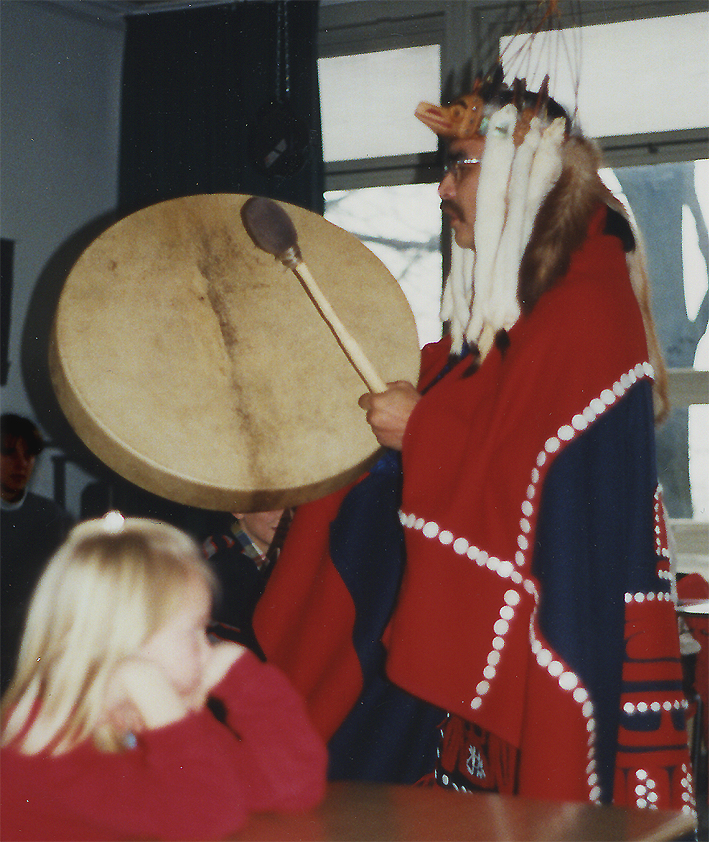
The Tsimshian have maintained their fishing and hunting lifestyle (although constrained by colonialism and declining fish and animal population abundances), art and culture, and are working to revitalize the common use of their language. Artists have excelled in traditional mediums and contemporary forms with pieces spread around the world. These artisans practice the tradition of story telling with their chosen mediums.

Ethnobotany

[edit]

Like other coastal peoples, the Tsimshian fashioned most of their goods out of western red cedar, especially its bark. It could be fashioned into tools, clothing, roofing, armour, building materials, and canoe skins. They used cedar in their Chilkat weaving, which they are credited with inventing.[9] They use the berries of Vaccinium Vitis-idaea ssp. minus as food.[10]

Tribes

[edit]

The Tsimshian people of British Columbia encompass fifteen tribes:

Some of the Chiefs of these nine tribes happened to be located at Fort Simpson (later Lax Kw'alaams, British Columbia) when the Indian Agent assigned reserve communities

Other Chiefs were located at the mission created community of Metlakatla, with some subsequently migrating to Metlakatla, Alaska, newest tribe, with lineages from all Tsimshian tribes.

Clans

[edit]

The Tsimshian clans are the

Treaty process

[edit]

The Tsimshian wanted to preserve their villages and fishing sites on the Skeena River and Nass River as early as 1879. They were not able to begin negotiating a treaty with the Canadian government until July 1983.[11] A decade later, fourteen tribes united to negotiate under the collective name of the Tsimshian Tribal Council. A framework agreement was signed in 1997. Due to litigation by one community for commercial fisheries rights, the federal government forced a confidentiality clause against other communities and caused dissolution of the main treaty group and subsequently the TTC. A subset of the Tsimshian First Nations continues to negotiate with the BC Treaty Commission to reach an Agreement-in-Principle[12] that has alienated most members.

Language

[edit]

The Tsimshian speak a language, called Sm'algyax, which translates as "real or true tongue". The Tsimshian also speak a language variety similar to Gitxsan and Nisga’a (two inland Tsimshianic languages), but differentiated from the regional Tsimshian variations. In 2016, only 160 people in Canada were Tsimshian speakers.[13]

Some linguists classify Tsimshian languages as a member of the theoretical Penutian language group.

Notable Tsimshian people

[edit]
Benjamin Haldane, 1907, Tsimshian photographer and musician

Anthropologists and other scholars who have worked with the Tsimshian

[edit]

Missionaries who proselytized the Tsimshian

[edit]

See also

[edit]

Notes

[edit]

Citations

[edit]
  1. ^ "Aboriginal Ancestry Responses (73), Single and Multiple Aboriginal Responses (4), Residence on or off reserve (3), Residence inside or outside Inuit Nunangat (7), Age (8A) and Sex (3) for the Population in Private Households of Canada, Provinces and Territories, 2016 Census – 25% Sample Data". www12.statcan.gc.ca. Government of Canada. 25 October 2017. Retrieved 2017-11-23.
  2. ^ "American FactFinder – Results". factfinder.census.gov. Archived from the original on 2020-02-14. Retrieved 2018-03-30.
  3. ^ Armstrong, Chelsey Geralda; Lyons, Natasha; McAlvay, Alex C.; Ritchie, Patrick Morgan; Lepfsky, Dana; Blake, Michael (2023). "Historical ecology of forest garden management in Laxyuubm Ts'msyen and beyond". Ecosystems and People. 19 (1). Bibcode:2023EcoPe..1960823A. doi:10.1080/26395916.2022.2160823.
  4. ^ "Masque - Musée du Quai Branly: Cartographie des Collections".
  5. ^ "Gateway to Aboriginal Heritage - Pacific Coast". Canadian Museum of History. Archived from the original on 2024-05-24.
  6. ^ Campbell, Lyle (1997). American Indian Languages : The Historical Linguistics of Native America. Oxford: Oxford University Press. pp. 396 n. 29. ISBN 978-0-19-514050-7.
  7. ^ a b c d e Halpin, Marjorie M.; Seguin, Margaret. "Tsimshian Peoples: Southern Tsimshian, Coast Tsimshian, Nishga, and Gitksan" (PDF). In Sturtevant, William C. (ed.). Handbook of North American Indians. Vol. 7: Northwest Coast. Smithsonian Institution Scholarly Press. ISBN 978-0-16-020390-9.
  8. ^ Ryan, Teresa Loa (2014). Territorial jurisdiction : The cultural and economic significance of eulachon Thaleichthys pacificus in the north-central coast region of British Columbia (PhD thesis). Vancouver: University of British Columbia. pp. 216–217. doi:10.14288/1.0167417.
  9. ^ , Shearer, Cheryl. Understanding Northwest Coast Art; Vancouver: Douglas & McIntyre; 2000; 28 ISBN 0-295-97973-9
  10. ^ Crompton, Brian D. (1993). Upper North Wakashan and Southern Tsimshian ethnobotany: the knowledge and usage of plants and fungi among the Oweekeno, Hanaksiala (Kitlope and Kemano), Haisla (Kitamaat) and Kitasoo Peoples of the central and north coasts of British Columbia (PhD thesis). Vancouver: University of British Columbia. p. 101. doi:10.14288/1.0098829. Retrieved 2024-12-17.
  11. ^ Kitsumkalum and the Tsimshian Treaty Process Archived 2006-09-02 at the Wayback Machine Kitsumkalum Treaty Office
  12. ^ Tsimshian First Nations – BC Treaty Commission
  13. ^ Meloche-Holubowski, Mélanie (2017). "L'immigration transforme le portrait linguistique du Canada. Voici comment" [Immigration is changing Canada's linguistic portrait. Here's how]. Radio Canada (in French). Retrieved 2025-01-15.
  14. ^ "VIDEO and story: Totem pole raised on Lelu after LNG project falls". Prince Rupert Northern View. 2017-10-21. Retrieved 2020-06-01.
  15. ^ "Action at All Native Basketball tournament creates backdrop for new novel from B.C. author". CBC News. 2020-02-15. Retrieved 2025-01-15.
  16. ^ https://americanindian.si.edu/collections-search/objects/NMAI_278728 Doulk

Bibliography

[edit]
[edit]
Revisions and contributorsEdit on WikipediaRead on Wikipedia
from Grokipedia
The Tsimshian are an Indigenous people indigenous to the Pacific Northwest Coast of North America, traditionally occupying territories along the lower Skeena River and surrounding coastal areas in what is now British Columbia, Canada, with some communities established in southeastern Alaska following 19th-century migrations.[1][2] They speak dialects of the Tsimshianic language family, which are isolate or distantly related to other Northwest Coast tongues, though speaker numbers have declined sharply due to historical assimilation pressures.[3] Archaeological evidence from sites like Prince Rupert Harbour demonstrates continuous occupation by Tsimshian ancestors for several millennia, supporting a cultural continuity rooted in maritime resource exploitation, including salmon runs and eulachon grease production, which formed the basis of their economy and extensive trade networks.[4][5] Tsimshian society was hierarchically organized into matrilineal clans bearing crests and privileges validated through oral adawx narratives and potlatch distributions, fostering wealth redistribution and social validation amid a landscape of inter-village raiding and alliances.[6][7] European contact in the late 18th century introduced trade goods and missionaries, culminating in the 1887 exodus of about 800 Tsimshian to Annette Island, Alaska, under Anglican missionary William Duncan, establishing a self-governing community that persists as a unique enclave outside Canadian reserves.[8] Their artistic legacy, exemplified by formline carving on totem poles, boxes, and regalia, reflects cosmological motifs tied to raven mythology and ancestral claims, influencing broader Northwest Coast aesthetics.[9]

Origins and Prehistory

Archaeological and Genetic Evidence

Archaeological investigations in Tsimshian territory, particularly around Prince Rupert Harbour (PRH), reveal evidence of human occupation dating back at least 9,000 years before present (BP), with sites indicating early coastal adaptations including shell middens and lithic tools.[10] The Paul Mason site in Kitselas Canyon provides the earliest dated evidence in the broader region at approximately 5,000 BP, featuring seasonal camps associated with salmon fishing and resource processing.[11] Further inland, rockshelters in the Lower Skeena Valley date to 2,700–1,600 years ago, while coastal PRH sites document the Middle Period (3,500–1,500 BP) with plank house villages, architectural remains, and indicators of complex social organization such as multi-house settlements and resource storage.[12] Analysis of 66 village sites across the area identifies 22 as small-scale, persisting alongside larger centers from early prehistory through the late period, suggesting diverse settlement strategies rather than uniform urbanism.[13] Genetic studies of ancient DNA from the Northwest Coast affirm long-term continuity in Tsimshian ancestry, with autosomal genomes from individuals dated ~10,300 calibrated years BP (cal y BP) showing predominant North American components and regional population structure distinct from other ancient North American samples.[14] Specific ancient individuals from ~2,500 and ~1,750 cal y BP cluster closely with modern Tsimshian as a sister clade, indicating genetic stability over millennia without major external admixtures disrupting local lineages.[14] Exome sequencing from PRH ancients (~6,260–1,036 cal y BP) reveals positive selection on immune-related genes like HLA-DQA1, adapted to local pathogens, with allele frequencies shifting post-European contact due to epidemics, alongside a confirmed 57% effective population size reduction correlating to 19th-century smallpox outbreaks.[15] Population genomic analyses spanning 6,000 to 500 years ago further demonstrate steady decline in Tsimshian effective population size since the mid-Holocene, followed by recovery in modern cohorts through limited gene flow from other Native American groups, underscoring resilience amid continuity rather than replacement.[16] These findings align archaeological records of persistent coastal settlements with genetic signals of in situ adaptation, challenging narratives of large-scale migrations and emphasizing localized demographic processes.[14][15]

Linguistic Classification and Migrations

The Tsimshianic languages form a small, genetically related family indigenous to the Pacific Northwest Coast of North America, consisting of three principal varieties: Coast Tsimshian (Sm'algyaɬ), spoken by coastal communities from the Skeena River mouth northward; Nisga'a, along the Nass River; and Gitxsan (or Gitksan), in the upper Skeena River watershed. These languages diverged from a common proto-Tsimshianic ancestor, exhibiting shared phonological, morphological, and lexical features such as complex verb structures and glottalized consonants, while displaying mutual unintelligibility due to geographic separation and cultural divergence.[17][18] Proposed inclusions of Tsimshianic within the broader Penutian phylum—a hypothetical macro-family linking languages from coastal Oregon to inland California and the Plateau, first outlined by Edward Sapir in the early 20th century—rely on limited resemblances in vocabulary and grammar, such as pronominal patterns. However, demonstrable cognates are sparse, and the phylum's internal relationships lack robust reconstruction, rendering Tsimshianic's affiliation tentative and debated among linguists, with many treating the family as an isolate pending stronger evidence.[19] Archaeological evidence from sites in Prince Rupert Harbour and adjacent territories documents Tsimshian ancestral occupation spanning over 10,000 years, beginning with small, extended-family settlements (wilnat'aał) adapted to marine and riverine resources, transitioning to larger tribal villages (galts'ap) with increased trade and ceremonial networks.[20] During the Middle Period (3,500–1,500 BP), population dynamics included westward interior movements around 3,600 BP, marked by new lithic technologies like parallel-flaked points at Kitselas Canyon sites, and dispersals of Temlaxam groups fleeing landslides and famine (3,500–2,500 BP), integrating with coastal phratries such as Gitwilgyoots and Ginaxangiik.[11] Intergroup conflicts, particularly with Tlingit raiders advancing southward (2,500–1,500 BP), prompted temporary coastal evacuations around 1,900 BP, followed by reclamation through alliances, leading to fortified winter villages at defensible passes like Metlakatla by 1,500 BP. These movements, corroborated by oral traditions and shifts in artifacts (e.g., obsidian sourcing, salmon-processing tools), likely facilitated the upriver expansion of proto-Nisga'a and Gitxsan speakers from coastal bases, fostering linguistic differentiation amid matrilineal clan exogamy that preserved genetic lineages despite gene flow.[11][21]

Traditional Social Organization

Clans and Matrilineal Descent

The Tsimshian kinship system is matrilineal, with descent, inheritance, and hereditary chiefly titles traced exclusively through the female line, a structure shared with neighboring Northwest Coast groups such as the Tlingit and Haida.[21] This matrilineality governed the transmission of property, names, and social statuses, where children belonged to their mother's clan, and maternal uncles (often chiefs themselves) played key roles in oversight and resource management.[22] Exogamy was strictly enforced, requiring marriage outside one's own phratry to maintain alliances and prevent incest, with violations potentially leading to social sanctions or supernatural repercussions in traditional beliefs.[23] Tsimshian society was divided into four exogamous phratries, functioning as the primary clans: G̲anhada (Raven), Laxsgiik (Eagle), Laxgyibuu (Wolf), and Gisbutwada (Killer Whale).[24] These phratries provided the framework for social organization, with each associated with specific crests, totemic animals, and ceremonial privileges, such as the Raven phratry's links to trickster myths and the Killer Whale's to maritime prowess. Within phratries, descent groups or "houses" (wilnaat'a) formed smaller, localized units sharing crests and territories, often numbering dozens per village in pre-contact times.[25] The four-phratry system appears to have solidified in post-contact coastal villages like Lax Kw'alaams (Port Simpson), where intermarriage and mission influences concentrated populations, though inland groups like the Gitxsan retained variations with potentially fewer operative divisions historically.[22] This structure facilitated reciprocal obligations, such as potlatch ceremonies where phratries validated titles through witnessed wealth redistribution, reinforcing matrilineal authority amid patrilocal residence patterns post-marriage.[26] Ethnographic accounts from the early 20th century, drawing on indigenous oral histories, confirm that chiefly deposition could occur via matrilineal kin if a leader failed in duties, underscoring women's central role in lineage continuity despite male-dominated public roles.[27] Genetic studies corroborate the persistence of matrilineal clan exogamy, showing low relatedness within phratries due to out-marriage practices persisting into modern times.[21]

Tribes and Territorial Control

The Tsimshian were divided into exogamous phratries, with membership inherited matrilineally, and each phratry comprising multiple clans and houses that collectively managed territorial resources.[28] The four primary phratriesGisbutwada (Killer Whale), Laxgyibuu (Wolf), Laxsgyiik (Eagle), and Ganhada (Raven)—formed the foundational social divisions, prohibiting intra-phratry marriage to maintain alliances and resource-sharing networks.[24] Within these, matrilineal houses (waawx or numayms) served as the core economic units, each owning hereditary rights to specific lands, fishing sites, and resource patches, such as salmon streams or berry grounds, with boundaries defined through oral traditions and enforced by house leaders (sm'ooygyet).[28] [29] Tribes functioned as localized village-based polities, each controlling a discrete territory often aligned with watersheds or coastal inlets, granting exclusive access to marine and riverine resources critical for subsistence.[29] Pre-contact Coast Tsimshian tribes included groups like the Gispaxlo'ots (centered near the mouth of the Skeena River), Kitselas (upstream along the Skeena), and Kitsumkalum (near Terrace), alongside others such as Giluts'aaw, Ginaxangiik, and Gitzaklaa, totaling around nine to fourteen allied tribes depending on historical aggregations.[28] Interior Tsimshian-speaking groups, such as the Gitxsan and Nisga'a, maintained analogous structures along the upper Skeena and Nass Rivers, with territories extending into forested hinterlands for hunting and trade routes.[30] Territorial control was corporate, vested in house groups under tribal oversight, allowing rights to use, exclude outsiders, and transfer lands through chiefly validation at feasts, while sustainable practices like controlled salmon weirs prevented depletion.[28] Inter-tribal boundaries were respected but fluid through alliances, with disputes over high-value sites resolved via diplomacy, compensation, or raids, as villages operated autonomously without centralized authority beyond resource stewardship.[31] House leaders regulated access, distributing yields to maintain hierarchies, and territories encompassed not only exploitable lands but also crest privileges and trade prerogatives, reinforcing phratry-wide cohesion.[29] This system ensured self-sufficiency, with each tribe's domain—spanning roughly 10-50 kilometers of coastline or river length—supporting populations through diversified harvesting rights validated in adaawx (oral histories).[28]

Subsistence Economy and Technology

Marine and Riverine Resource Exploitation

The Tsimshian economy centered on the seasonal exploitation of anadromous salmon runs in rivers such as the Nass and Skeena, where communities temporarily relocated to fishing camps during summer and fall to harvest chinook, coho, sockeye, pink, and chum species using wooden weirs, traps, dip nets, and spears.[5] These methods allowed selective capture during peak migrations, with harvested fish dried on racks or smoked over alder fires for winter storage and trade, supporting population densities estimated at several thousand in pre-contact villages.[5] Weirs, constructed from cedar stakes and branches, channeled fish into traps, minimizing bycatch compared to later non-selective gillnets introduced post-contact. Offshore marine fishing relied on large cedar dugout canoes, capable of carrying multiple crew members to halibut banks, where bottom-set lines with bone or shell hooks targeted Pacific halibut and lingcod in depths up to 100 meters.[5] Spring eulachon runs in coastal rivers provided another key resource, with fish scooped en masse using dip nets and rendered into eulachon grease through fermentation and boiling, yielding a high-calorie oil preserved for months and serving as a primary trade commodity that enriched Tsimshian elites via hereditary fishing rights and monopoly control over production.[5][32] This grease, nutrient-dense in omega-3 fatty acids, was exchanged inland along grease trails for furs, obsidian, and dentalia shells, underpinning pre-contact wealth hierarchies.[33] Hunting of harbor seals and sea lions occurred from canoes using harpoons with detachable bone points and floats, often at the same offshore sites as halibut fishing, providing meat, blubber for oil, and hides for clothing and ropes. Intertidal gathering of clams, cockles, mussels, and abalone supplemented diets year-round, particularly in winter near villages, as evidenced by persistent shell middens at ancient sites, with low-tide expeditions yielding protein-rich foods processed by steaming in cedar boxes or roasting.[5] These practices emphasized sustainable yields through site-specific knowledge of tides, fish behavior, and habitat, avoiding overexploitation via communal regulations and fallow periods.

Land-Based Practices and Ethnobotany

The Tsimshian engaged in seasonal hunting of terrestrial mammals to supplement marine resources, with deer (Odocoileus hemionus) serving as the primary land game for meat and hides used in clothing and tools.[34] Other hunted species included mountain goat (Oreamnos americanus) for wool in textiles, black bear (Ursus americanus), elk, mountain sheep, beaver (Castor canadensis), and porcupine, often pursued using bows, arrows, snares, and deadfalls in clan-owned territories extending inland from coastal villages.[22][34] These practices emphasized sustainable harvest, with clans regulating access to specific hunting grounds to prevent overexploitation, reflecting territorial control documented in ethnographic accounts from the late 19th and early 20th centuries.[22] Gathering of wild plants provided carbohydrates, vitamins, and materials, with women and children typically responsible for collecting berries, roots, and greens during summer and fall expeditions into forested uplands.[35] Key food plants included salmonberry (Rubus spectabilis, known as makooxs), harvested fresh from May to June for immediate consumption; soapberry (Shepherdia canadensis, ‘as), dried into nutrient-dense cakes; saskatoon berry (Amelanchier alnifolia, gyem), eaten fresh or preserved; and salal (Gaultheria shallon, dzawes), processed into dried cakes or mixed with grease for storage.[36] Other gathered items encompassed huckleberries, blueberries, cranberries, and edible roots or bark, which augmented diets during periods of low marine yields and were preserved through drying over fires or solar exposure.[36][34] Ethnobotanical knowledge extended to medicinal and technological applications, with plants selected for specific pharmacological properties observed through empirical use. Devil's club (Oplopanax horridus) roots and inner bark were decocted or applied as poultices by Tsimshian healers for treating rheumatism, arthritis, tuberculosis, stomach troubles, and skin conditions, leveraging bioactive compounds like oplopanaxin for anti-inflammatory effects.[37] Fireweed (Epilobium angustifolium, Haas) roots served as poultices for wounds, while shoots were consumed for blood purification; licorice fern (Polypodium glycyrrhiza) rhizomes provided expectorant teas for respiratory ailments.[36] Materials derived from land plants included cedar bark for basketry and mats, and skunk cabbage leaves for wrapping preserved foods, with harvesting protocols—such as leaving offerings or avoiding wasteful collection—ensuring ecological balance as reported by elders in Kitkatla and Kitasoo communities.[36][38] Early European observers noted rudimentary horticultural tendencies, such as weeding around berry patches and digging root gardens for species like springbank clover (Trifolium wormskioldii), indicating active landscape management rather than passive foraging.[35] This integration of hunting, gathering, and selective plant tending supported population densities estimated at 10-15 individuals per square kilometer pre-contact, with land-based yields contributing up to 20-30% of caloric intake based on comparative Northwest Coast subsistence models.[35]

Cultural Practices and Worldview

Art, Symbolism, and Material Culture

Tsimshian artistic expression is rooted in the formline tradition shared with Tlingit and Haida peoples, employing continuous, curving black lines of varying widths to delineate stylized representations of clan crests such as ravens, eagles, wolves, and killer whales, which encode hereditary rights to names, territories, and supernatural narratives.[39][40] These crests, validated through oral traditions and potlatch ceremonies, adorn functional and monumental objects to affirm matrilineal clan identities and social hierarchies rather than serving purely decorative roles.[8][41] Totem poles, hewn from western red cedar trunks, stand as public declarations of lineage histories, with Tsimshian variants often incorporating isolated mask-like faces sans bodies and separately carved animal or bird appendages to narrate crest acquisitions.[42][43] Interior house posts and frontal poles similarly feature formline carvings depicting stacked crest figures, integrating art into architectural elements that reinforced chiefly authority within plank houses.[8] Ceremonial masks, carved from wood and painted with natural pigments, represent spirit helpers or transformation figures worn during winter initiations and potlatches to dramatize ancestral myths and invoke supernatural aid, as in the Nax Nox guardian masks embodying personal or clan powers.[44] Bentwood boxes, crafted by kerfing a cedar plank, steaming it to bend into rectangular forms, and pegging corners without metal, bear incised or painted crest designs; these versatile containers stored goods, cooked foods via steam pits, or symbolized wealth when distributed as heirlooms in feasts.[45][46] Material culture extends symbolism to ritual implements like soul-catcher pendants, raven rattles depicting crest-bearing figures, and inlaid bone or shell gambling sticks used in high-stakes games that tested skill and resolved disputes, embedding artistic motifs into objects that perpetuated social and spiritual continuity.[47][24] Heirlooms such as these embodied not transient value but enduring lineage essences, passed matrilineally without alienation to preserve causal ties between past privileges and present status.[41]

Ceremonial Life and Social Hierarchies

Tsimshian society was organized matrilineally into four phratries, each comprising multiple clans: G̲anhada (Raven), Laxsgiik (Eagle), Laxgyiip (Wolf), and Gispaxlo'ots (Killer Whale).[24] Individuals inherited membership from their mothers, with clan crests depicting ancestors and supernatural beings used to symbolize identity and lineage.[24] Social stratification divided the population into three primary classes: nobles, who included chiefs and their kin holding hereditary high rank; commoners, comprising the majority engaged in subsistence labor; and slaves, typically war captives or their descendants who performed menial tasks and could be ransomed or inherited.[34] Rank within classes was determined by genealogy but required validation through public displays of wealth and generosity, preventing erosion by ensuring only those with resources could maintain status.[22] Ceremonial life revolved around the potlatch, a winter festival serving as the primary mechanism for affirming social hierarchies and transmitting cultural knowledge.[24] Potlatches involved elaborate feasts, speeches, dances, and the distribution of blankets, canoes, and other valuables to guests, with the host's generosity publicly witnessed to confirm titles, settle debts, or commemorate events like chiefly deaths or name-givings.[24] [22] High nobles hosted the most lavish events, often inviting chiefs from allied villages, while the scale and quality of gifts directly correlated with the host's prestige, reinforcing inequalities as recipients reciprocated in future potlatches to avoid loss of face.[22] Winter ceremonies extended beyond potlatches to include masked dances impersonating spirits, such as those of the Naxnox secret society, where initiates underwent rituals symbolizing supernatural encounters and integration into esoteric knowledge systems.[24] Eagle down scattered during performances signified peace and spiritual purity, underscoring the intertwining of ceremony, rank, and cosmology.[24] Slaves occasionally participated in rituals, such as being freed or symbolically sacrificed to honor the deceased, further embedding class distinctions into sacred practices.[34] These events, held in communal houses during the non-fishing season, not only redistributed wealth but also dramatized clan histories through theatrical elements, ensuring hierarchies endured across generations.[22]

Pre-Contact Warfare and Intergroup Relations

Pre-contact Tsimshian warfare centered on predatory raids rather than large-scale battles, with the primary objectives being the capture of slaves, plunder of resources, and enhancement of noble status through demonstrated prowess.[48] Slaves, typically war captives from neighboring villages, formed a key economic asset, representing stored value that aggressive leaders trafficked or redistributed in ceremonial contexts to build alliances and prestige; estimates indicate slaves comprised 5-15% of the population, with high-ranking chiefs holding 10-20 and house heads 2-10. While slave raiding differed from full warfare—often involving opportunistic strikes on undefended groups rather than territorial conquests—it frequently escalated into intergroup conflicts driven by revenge cycles or competition for prestige goods.[7] Relations with neighboring peoples, such as the Haida to the west and Tlingit to the north, oscillated between hostility and pragmatism. Haida canoe fleets launched devastating raids on Tsimshian coastal camps and villages, enslaving large numbers—sometimes dozens per incursion—and destroying property to assert dominance, as documented in oral accounts of familial war parties retaliating collectively.[49] Tsimshian responses included defensive coalitions among tribes, forged in reaction to such invasions, which solidified ethnohistoric alliances like those among the nine allied Tsimshian houses for mutual protection.[48] Conflicts with inland groups, including the Nisga'a and Gitxsan, arose over resource territories but were mitigated by shared kinship ties, though raids occasionally targeted these kin for slaves or prestige. Peaceful intergroup ties underpinned broader regional stability, with Tsimshian serving as maritime intermediaries in extensive trade networks spanning coastal and interior groups.[28] They exchanged surplus marine products—such as eulachon oil, smoked salmon, and halibut—for inland commodities like obsidian, goat wool, and berries, often via seasonal gatherings or noble-hosted feasts that reinforced reciprocity.[48] Exogamous marriages between Tsimshian phratries and those of Haida or Tlingit lineages cemented diplomatic bonds, reducing raid frequencies and enabling safe passage for traders; these unions, arranged by elites, integrated diverse clans into extended kin networks that prioritized alliance over annihilation. Overall, warfare and trade coexisted as mechanisms of social regulation, where martial success funded the potlatch economy that, in turn, sustained peaceful exchanges.[50]

European Contact and Transformations

Initial Trade and Alliances

The Tsimshian encountered European fur traders in the late 18th century, with initial maritime trade voyages reaching their coastal territories along the Skeena and Nass Rivers by the 1780s. British and American vessels, seeking sea otter pelts, initiated exchanges for furs, dentalia shells, and eulachon oil, which the Tsimshian leveraged to expand their pre-existing regional networks.[28] Tsimshian leaders, particularly from the Gispaxlo'ots phratry, positioned themselves as intermediaries, controlling access to interior furs from groups like the Gitxsan and Wet'suwet'en via riverine routes.[51] By the 1830s, the Hudson's Bay Company (HBC) formalized trade at Fort Simpson, established in 1831 at the Nass River mouth and relocated to the Tsimshian Peninsula in 1834 to secure higher volumes of furs.[52] Tsimshian elites, led by figures such as Ligeex—a high-ranking Gispaxlo'ots chief—dictated terms, supplying sea otter, beaver, and land otter pelts while demanding manufactured goods like firearms, iron tools, and textiles.[53] Ligeex's influence extended through strategic marriages and potlatch distributions, enhancing his clan's dominance in the trade.[54] Alliances formed via intermarriage between HBC traders and Tsimshian nobility, exemplified by Chief Trader John Kennedy's union with Ligeex's daughter in the 1830s, which stabilized supply chains and reduced conflicts.[51] These ties enabled the HBC to navigate Tsimshian geopolitics, where chiefs enforced monopolies on trade routes and mediated raids on competitors like Haida and Tlingit groups.[55] However, Tsimshian autonomy persisted, as they integrated European goods into ceremonial economies without ceding territorial control.

Demographic Impacts of Diseases

European contact with the Tsimshian, primarily through maritime fur trade networks beginning in the late 18th century, introduced pathogens such as smallpox, measles, and influenza to populations lacking prior exposure and immunity, resulting in recurrent epidemics that caused severe demographic contractions.[56] Genetic analysis of ancient and modern Tsimshian exomes reveals a pronounced population bottleneck, with an estimated 57% decline in the Coast Tsimshian effective population size approximately 178 years prior to 2016—around 1838—aligning with documented smallpox outbreaks on the Northwest Coast during the 1830s.[15] This decline reflects not only direct mortality but also reduced birth rates and fertility disruptions from surviving adults' impaired health.[57] A major smallpox epidemic swept the region from 1835 to 1838, originating from Russian and British trade vessels and spreading via indigenous mobility, decimating coastal communities including Tsimshian groups through high case fatality rates exceeding 30% in unvaccinated populations.[58] Hudson's Bay Company records from 1835, shortly after the establishment of Fort Simpson, estimated the Coast Tsimshian population at around 3,000, already indicative of prior losses from earlier disease waves transmitted indirectly through Haida and Tlingit intermediaries.[59] The 1862 smallpox outbreak, arriving via steamships from San Francisco to Victoria and radiating northward, further exacerbated mortality among unvaccinated Tsimshian villages, though some groups received limited inoculation from colonial agents, mitigating total wipeout compared to more isolated tribes.[60] These epidemics fragmented social structures, as high death rates among elders and leaders disrupted knowledge transmission and matrilineal inheritance, while abandoned villages and consolidated settlements altered territorial control.[61] By 1885, total Tsimshian numbers had fallen to approximately 4,500, a roughly 47% drop from 1835 estimates of 8,500, attributable primarily to disease rather than warfare or famine, with recovery impeded by ongoing susceptibility to respiratory illnesses into the early 20th century.[62] Post-epidemic genetic signatures show selection for rare variants conferring partial resistance to infectious diseases, underscoring the evolutionary pressures exerted by these events.[57]

Missionary Interventions and Internal Divisions

Missionary activities among the Tsimshian began in earnest with the arrival of English lay missionary William Duncan at Fort Simpson (now Lax Kw'alaams) in October 1857, under the auspices of the Church Missionary Society (CMS).[63] Duncan focused on converting the Tsimshian from their traditional practices, emphasizing temperance, monogamy, and European-style education and labor; by 1860, he had relocated a group of approximately 200 converts to the nearby site of Metlakatla to establish an isolated Christian village free from secular influences like the Hudson's Bay Company fort.[64] His approach yielded rapid results, with hundreds baptized and traditional potlatches, shamanism, and alcohol consumption suppressed under community codes enforced by Duncan as de facto governor.[65] Tensions arose in the 1870s as Duncan resisted CMS oversight, particularly after the appointment of ordained priest William Ridley in 1877, who challenged Duncan's authority on issues such as baptizing polygamists and allowing native-led governance.[63] These doctrinal and administrative disputes escalated into a schism, dividing Metlakatla between Duncan's supporters—who viewed him as their spiritual leader—and a minority aligned with Ridley and the Anglican hierarchy; from 1882 to 1887, the community fractured, with roughly 100 residents opposing Duncan while the majority upheld his independent model.[63] In 1887, Duncan led 825 Tsimshian followers southward by canoe to Annette Island in Alaska, securing U.S. government land grants and establishing New Metlakatla as a self-governing Christian enclave outside CMS control, an exodus that permanently split families and clans along lines of loyalty to Duncan versus denominational orthodoxy.[66] Among those remaining in British Columbia, particularly at Port Simpson, Methodist missionary Thomas Crosby arrived in 1874 at the invitation of local leaders seeking alternatives to Anglican conflicts; Crosby, supported by his wife Emma, built a church, day school, and hospital, converting additional Tsimshian and integrating Methodist practices that competed with Duncan's influence.[67] [68] This denominational shift deepened internal divisions, as Methodist adoption empowered new converts and eroded traditional chiefly authority in favor of church elders, while geographic separation from Alaska migrants fostered ongoing rivalries over resources, marriages, and cultural legitimacy.[69] Presbyterian efforts, including aid from Sheldon Jackson to Duncan's group in Alaska, further fragmented affiliations, with native Tsimshian evangelists like Philip McKay extending Protestant outreach but exacerbating tensions between reformist and conservative factions within tribes.[70] Overall, these interventions prioritized conversion metrics and moral reform over cultural continuity, resulting in lasting schisms that realigned Tsimshian social hierarchies around missionary patrons rather than matrilineal lineages.[71]

Language and Oral Traditions

Dialects and Structural Features

The Tsimshianic language family comprises three principal languages: Coast Tsimshian (Sm'algya̱x), Nisga'a, and Gitxsan, which exhibit mutual intelligibility challenges despite shared ancestry, leading most linguists to classify them as distinct languages rather than mere dialects.[18][72] Coast Tsimshian, the variety most closely associated with Tsimshian communities, features dialects tied to specific First Nations groups, including those of the Gitga'at, Gitxaala, Kitselas, Kitsumkalum, Lax Kw'alaams, and Metlakatla.[73] These dialects show minor phonological and lexical variations but maintain core grammatical unity; for instance, the Metlakatla variety in Alaska, established since 1887, retains about 70 elderly fluent speakers as of recent estimates.[3] A standardized orthography for Coast Tsimshian was adopted in 1977, facilitating documentation and revitalization across Canadian and Alaskan communities.[3] Structurally, Sm'algya̱x employs a verb-subject-object (VSO) word order, diverging from the subject-verb-object pattern of English, with connectives linking elements such as possessives (e.g., waaba 'yuuta gwii for "that man's house").[74] It exhibits ergative-absolutive alignment, where transitive subjects receive ergative marking (often via the particle -t), while intransitive subjects and transitive objects align as absolutives, with rigid ergativity in person and number agreement but a unique three-way distinction in certain classifiers or case patterns.[75][76] Morphology is agglutinative and complex, incorporating morphemes for causation, directionality, and classifiers, alongside phonological traits like ejective consonants (e.g., /p'/, /t'/) and variable vowel lengths that trigger sound adjustments upon affixation.[74] Temporal reference relies on independent particles rather than verb inflections, enabling nuanced aspectual distinctions without tense conjugation.[74] The family as a whole shares these traits, with two primary clause types—indicative and subjunctive—further differentiating syntactic behavior, as documented in reference grammars.[72] In 2021, approximately 2,665 individuals reported proficiency in a Tsimshianic language, predominantly Coast Tsimshian variants.[18]

Documentation, Decline, and Revitalization Efforts

Early linguistic documentation of the Tsimshian language, particularly the Coast Tsimshian dialect known as Sm'algyax, began in the late 19th century through efforts by European missionaries and scholars. Albrecht Conon von der Schulenburg published a Tsimshian grammar in the 1890s, drawing on fieldwork among speakers in British Columbia.[77] Missionary activities from the 1860s onward also contributed initial vocabularies and texts, often tied to Bible translations and proselytization, though these were limited by the orthographic inconsistencies of the era.[78] In the 20th century, comparative work advanced with projects like the Dictionary of Proto-Tsimshianic Roots, initiated in the late 20th century to reconstruct ancestral forms across Tsimshianic dialects.[79] A key modern initiative involved digitizing early 20th-century Sm'algyax texts into machine-readable corpora starting around 2010, preserving oral narratives and facilitating linguistic analysis.[80] The Tsimshian language has undergone severe decline since European contact, exacerbated by epidemics, forced assimilation, and English-medium education policies. Pre-contact speaker populations are estimated in the thousands, but post-19th-century diseases reduced Tsimshian communities by over 90% in some areas, indirectly impacting language transmission.[81] By the 21st century, fluent speakers numbered fewer than 500 across Canada and Alaska, with most being elders; in 2021, only a fraction of those reporting Tsimshian as a mother tongue could converse proficiently, reflecting rapid intergenerational loss.[18] Residential schools and urbanization further eroded usage, with projections indicating potential dormancy risks exceeding 50% by 2100 absent intervention, as younger generations prioritize English for economic reasons.[82][83] Revitalization efforts gained momentum in the late 20th century, focusing on community-led immersion and institutional support. The Sealaska Heritage Institute, established in 1981, has prioritized Sm'algyax through dictionary development, elder-youth apprenticeships, and curriculum materials, backed by a $10 million endowment announced in the 2010s for Tsimshianic languages.[84][85] The University of Alaska Southeast offers certificates and degrees in Alaska Native languages, including Tsimshian, incorporating digitized resources and conversation-based learning since the 2000s.[86] Programs like language nests and school integration have increased basic proficiency among youth, though challenges persist in achieving conversational fluency at scale, with some critiques noting that introductory efforts yield limited outcomes without sustained immersion.[87] These initiatives, often funded by tribal corporations and grants, emphasize cultural integration to counter historical suppression.[88]

Modern Communities and Self-Determination

Post-Contact Migrations and Settlements

In the early 19th century, the Hudson's Bay Company's establishment of Fort Simpson in 1831 at the Nass River mouth attracted Tsimshian phratries seeking access to European trade goods, prompting relocations of winter villages from interior and island sites to coastal areas near the post.[89] By the late 1830s, major Tsimshian groups had shifted their primary settlements from locations like Metlakatla Pass to quarters adjacent to Fort Simpson, facilitating intensified fur trade and intergroup alliances while altering traditional seasonal movements.[90] These consolidations around trading hubs like Fort Simpson (now the basis of Lax-kw'alaams) and later Fort Rupert reflected economic incentives over pre-contact territorial patterns, with populations numbering in the thousands by mid-century according to trader records.[22] Anglican lay missionary William Duncan, arriving at Fort Simpson in 1857, initiated further internal migrations by converting Tsimshian adherents to Christianity and advocating communal reforms incompatible with hereditary chiefly authority. In 1862, Duncan led around 50 initial converts to resettle the ancestral but depopulated Metlakatla site in Venn Passage, expanding it into a model village of over 1,000 residents by the 1870s through strict discipline, European-style housing, and bans on potlatching and shamanism.[63] This move, justified by Duncan as a return to "ancestral" lands free from non-Christian influences at Fort Simpson, represented a missionary-driven reconfiguration of settlement patterns, prioritizing moral uniformity over dispersed clan territories.[91] Doctrinal disputes with the Church Missionary Society escalated in the 1880s, culminating in Duncan's 1881 break from Anglican oversight and his formation of an independent church. In July 1887, Duncan and approximately 600 Tsimshian supporters—about half of Metlakatla's population—embarked on a steamer voyage to U.S. territory, securing a 16,000-acre land grant on Annette Island from President Grover Cleveland to found New Metlakatla, Alaska.[64] This exodus, motivated by Duncan's resistance to episcopal control and fears of Canadian interference, established the sole Indigenous reservation in Alaska, where the community grew to over 1,200 by 1900 through continued communal governance and fishing economies.[63] The remaining Metlakatla residents in British Columbia reorganized under local leadership, preserving a smaller Anglican-affiliated settlement amid ongoing tensions.[89] Subsequent 20th-century shifts involved smaller-scale relocations tied to industrial developments, such as Tsimshian families moving to Terrace and Prince Rupert for cannery work after the 1880s salmon boom, though core villages like Kitsumkalum and Kitselas along the Skeena River maintained continuity from pre-contact sites with post-1830s reinforcements.[22] These patterns underscore how European trade, missionary ideologies, and jurisdictional conflicts—rather than indigenous warfare or ecology alone—drove the primary post-contact dispersals and consolidations among the Tsimshian.[63]

Economic Adaptations and Resource Conflicts

Following European contact, Tsimshian communities adapted their traditional subsistence-based economy—centered on salmon fishing, eulachon grease production, and seasonal resource harvesting—by integrating wage labor in emerging industries, particularly forestry and commercial fisheries. From 1834, with the Hudson's Bay Company's establishment of Fort Simpson, Tsimshian individuals supplied timber for fort construction, firewood, and lumber, marking the onset of commercial forestry involvement that supplemented rather than supplanted subsistence activities.[92] Hand-logging emerged as a primary adaptation, involving kin-based teams using axes, wedges, and fishing boats to fell, trim, and transport cedar and hemlock trees selectively from family-claimed sites, yielding profits until corporate monopolies curtailed it in the 1940s–1950s.[93] This practice aligned with pre-contact stewardship principles, minimizing waste and preserving ecosystems, while women contributed by trimming branches, booming logs, and provisioning camps, often combining these tasks with cannery work in salmon processing plants from the 1880s onward.[93][92] In fisheries, adaptations included scaling up salmon harvesting for commercial sale through canneries established along the Skeena River and coast from the 1870s, with Tsimshian fishers leveraging gillnets and ancestral knowledge of spawning runs to participate in export markets, though this shifted labor dynamics toward seasonal wage employment.[94] By the early 20th century, many households diversified by beachcombing drift logs—towing escaped booms from rivers and coasts using fishing vessels—for sale to mills, a practice peaking in the 1950s before mechanized logging reduced availability.[92] In the Alaska-based Metlakatla community, founded in 1887, economic strategies emphasized self-reliant fishing and limited industrial ties, retaining reserve status exempt from certain state regulations and fostering ventures like a bottled water plant alongside traditional harvesting.[95] Contemporary adaptations include First Nation-owned enterprises, such as the Lax Kw'alaams band's 2005 acquisition of a tree farm license, which generated jobs and revenue through sustainable harvesting, reflecting efforts toward economic sovereignty amid declining wild stocks.[96] Resource conflicts have centered on control over fisheries and forests, often pitting Tsimshian assertions of pre-contact rights against federal and provincial management regimes prioritizing industrial allocation. In fisheries, the Lax Kw'alaams band's claim to commercial salmon harvesting rights—rooted in evidence of pre-sovereignty trade networks—was rejected by the Supreme Court of Canada in 2011, limiting access to food, social, and ceremonial purposes and excluding dedicated commercial quotas despite historical practices supporting community sustenance.[97][98] Disputes persist over allocation, with Fisheries and Oceans Canada denying salmon enhancement projects proposed by Lax Kw'alaams in 2017 to counter stock declines from overharvesting and habitat loss, and the band challenging marine protected area networks in 2024 for inadequate consultation impacting traditional grounds.[94][99] In Alaska, Metlakatla's 1891-granted fishing rights faced litigation in 2022, affirming exemption from state limited-entry permits but highlighting ongoing tensions with regulatory frameworks. Forestry conflicts arose from the industrialization of logging starting in the 1920s, which eroded Tsimshian control as large corporations secured tenures, paying Indigenous workers lower wages than non-Indigenous counterparts and causing environmental degradation through clear-cutting that clashed with traditional selective practices.[92] The Nine Tribes of the Tsimshian, including Lax Kw'alaams, opposed a 2019 provincial land sale to the Nisga'a Nation, arguing it violated their aboriginal title without shared decision-making, underscoring disputes over unceded territories encompassing timber resources.[100] These tensions reflect broader causal dynamics: post-contact population recovery from epidemics enabled labor participation, but systemic exclusion from tenure ownership perpetuated dependency, with recent joint ventures offering partial remediation.[92] The Tsimshian First Nations in British Columbia did not enter into historical treaties with the Crown, unlike some other Indigenous groups in Canada, leaving unresolved claims to Aboriginal title and rights over traditional territories.[101] In response, several Tsimshian bands—including the Kitselas, Kitsumkalum, Metlakatla, Gitga'at, and Kitasoo/Xaiixais—formed the Tsimshian First Nations Treaty Society in the 1990s to negotiate modern treaties under the BC Treaty Commission's tripartite process involving Canada, British Columbia, and First Nations.[102] These negotiations, which began advancing through stages of agreement-in-principle development, aim to define self-government, land ownership, and resource revenues, with technical working groups addressing fisheries, forestry, and cultural heritage.[103] As of 2023, the society represented approximately 4,000 members and continued weekly sessions with federal and provincial negotiators.[104] Progress has varied among bands; for instance, the Kitsumkalum First Nation reached an advanced stage, launching a ratification campaign on August 6, 2025, with a community vote scheduled for November 1, 2025, potentially finalizing self-government and 18,000 hectares of treaty lands if approved.[105] Other Tsimshian groups, such as Lax Kw'alaams Band, have pursued parallel negotiations outside the Tsimshian First Nations Treaty Society, focusing on economic reconciliation amid resource projects, though without a finalized treaty as of October 2025.[106] These processes reflect broader efforts to address the "land question" in British Columbia, where over 90% of First Nations territories remain unceded, emphasizing certainty in title while preserving Aboriginal rights under section 35 of the Constitution Act, 1982.[107] Legal disputes have frequently arisen from tensions between treaty negotiations and resource development, particularly in fisheries and energy sectors. In Lax Kw'alaams Indian Band v. Canada (Attorney General) (2011 SCC 56), the Supreme Court of Canada rejected claims by the Lax Kw'alaams Band and others for an Aboriginal right to a commercial fishery selling eulachon grease, ruling that pre-contact practices lacked continuity to support modern commercial trade, thus prioritizing regulated conservation over unregulated sales.[97] Similarly, earlier challenges to commercial fishing rights under Aboriginal title were dismissed in British Columbia Supreme Court rulings, such as those involving Coast Tsimshian descendants, which affirmed rights to past practices but not expansive commercial entitlements without proven continuity.[108] More recently, Tsimshian bands have litigated against federal approvals of liquefied natural gas projects perceived to infringe on title and consultation duties. In October 2025, the Lax Kw'alaams Band and Metlakatla First Nation filed separate Federal Court applications seeking judicial review of the approval for the Ksi Lisims LNG floating terminal on Pearse Island, arguing inadequate consultation, environmental risks to eulachon habitats, and violations of Aboriginal rights without free, prior, and informed consent.[109] These actions echo prior disputes, such as the 2016-2018 Pacific NorthWest LNG project conflicts involving Lax Kw'alaams, where internal divisions and judicial scrutiny over governance delayed outcomes until the project's cancellation.[110] In Reece v. Canada (Attorney General) (2022 BCSC 865), the British Columbia Supreme Court granted an interim injunction to Coast Tsimshian applicants asserting Aboriginal title over Nasoga Gulf lands, finding a strong prima facie case based on historical occupation, though final title determination remains pending.[111] Such cases underscore ongoing reliance on courts to enforce section 35 rights amid stalled treaties, with outcomes influencing negotiation leverage.

Notable Tsimshian Figures

Pre-20th Century Leaders and Traders

The Tsimshian social structure prior to the 20th century centered on matrilineal houses (wilp), each led by a hereditary chief responsible for managing trade networks, resource access, and alliances through potlatches that validated status and redistributed wealth. With European maritime fur traders arriving in the late 18th century, chiefs adeptly incorporated foreign goods like firearms and metals into existing exchange systems, often monopolizing routes to interior groups such as the Gitxsan and Wet'suwet'en for furs and eulachon oil. This era saw intensified competition among chiefs, who vied for control over Hudson's Bay Company (HBC) posts and safe passage fees, enhancing their prestige via larger potlatches.[28][112] The Ligeex title, held by a dynasty of Gispaxlo'ots chiefs, exemplified this adaptation; the bearer active in the 1830s—known as Old Ligeex—rose to regional dominance through rivalry potlatches and strategic alliances, controlling Skeena River fur flows and interior partnerships. In 1831, he authorized the HBC's Fort Simpson construction on Gispaxlo'ots territory near the Nass River mouth, levying taxes on traders and securing exclusive access to European textiles and tools in exchange, which bolstered his house's wealth. Old Ligeex died around 1840, passing influence to successors who sustained these networks amid intertribal raids and HBC dependencies.[8][113][114] Paul Legaic, baptized with the Christian name Paul and inheriting the Ligeex mantle mid-century, perpetuated this role as a key trader and chief of the Gispaxlo'ots, negotiating directly with HBC factors; his daughter married Fort Simpson's chief trader John Kennedy in the 1830s, cementing alliances that funneled furs outward while importing iron and beads for potlatch displays. Other notables included Sagau'wEn (Chief Mountain) of the Kitkatla or lower Nass groups, who seized parallel monopolies over Nass River trade paths in the early 19th century, taxing canoes and goods en route to coastal forts. These leaders navigated European incursion by embedding traders within indigenous geopolitics, using cedar canoes traded from Haida for voyages to as far as Puget Sound, thereby amplifying house prestige without ceding territorial sovereignty.[115][51][28][116]

20th-21st Century Contributors

William Beynon (1888–1958), a hereditary chief of the Gitlaan Tsimshian from the village of Kitwanga, British Columbia, served as a pivotal ethnographer and cultural documentarian in the early-to-mid 20th century.[117] Working from 1915 to 1956 as an interpreter and field assistant for anthropologists Marius Barbeau and Franz Boas, Beynon transcribed and translated over 250 Tsimshian texts, including myths, songs, oral histories, and genealogies, using a phonetic system adapted from Edward Sapir's work.[118][119] His efforts preserved endangered knowledge amid colonial disruptions, providing foundational data for scholarly understandings of Tsimshian social organization, crests, and ceremonies, though his role as an Indigenous collaborator was often underrecognized in favor of non-Indigenous researchers.[120] David A. Boxley (born 1952), a Tsimshian carver from Metlakatla, Alaska, has been instrumental in the late 20th and early 21st centuries in reviving traditional Tsimshian art forms, particularly totem pole carving, which had declined due to historical suppressions.[121] Since the 1980s, Boxley has created over 30 totem poles, masks, rattles, and bentwood boxes in the distinctive Tsimshian style, drawing from ancestral motifs while incorporating modern techniques, and has demonstrated his craft internationally to educate on cultural continuity.[122] He organized the first potlatch in Metlakatla since the 19th century in 1980, fostering community engagement with hereditary systems and ceremonies, and collaborates with his son, David R. Boxley, to mentor apprentices in carving and song composition in the Tsimshian language.[123] Charles R. Menzies, a Gitxaala Tsimshian anthropologist and professor at the University of British Columbia, has contributed to 21st-century scholarship on Indigenous political economy and resource management since the 1990s.[124] His research, including the ethnography People of the Saltwater (2016), examines historical Tsimshian adaptations to colonial fisheries and forestry industries, advocating for community-based governance over Eurocentric models through analysis of Gitxaala oral traditions and archival records.[125] Menzies' work integrates anthropological filmmaking and peer-reviewed studies to highlight causal links between environmental stewardship practices and economic resilience, challenging assimilationist narratives in academic and policy discourses.[126]

References

User Avatar
No comments yet.