Hubbry Logo
NuxalkNuxalkMain
Open search
Nuxalk
Community hub
Nuxalk
logo
8 pages, 0 posts
0 subscribers
Be the first to start a discussion here.
Nuxalk
Nuxalk
from Wikipedia

Key Information

Nuxalk
PersonNuxalkmc
PeopleNuxalkmc
LanguageItNuxalkmc
CountryKulhulmcilh
(Nuxalkulmc)

The Nuxalk people (Nuxalk: Nuxalkmc; pronounced [nuχalkmx]), also referred to as the Bella Coola, Bellacoola or Bilchula, are an Indigenous First Nation of the Pacific Northwest Coast, centred in the area in and around Bella Coola, British Columbia within their wider traditional territory: Kulhulmcilh. They speak the Nuxalk language (Nuxalk: ItNuxalkmc). Their on-reserve tribal government is the Nuxalk Nation.

Name and tribes/groups

[edit]

The name "Bella Coola", often used in academic writing, is not preferred by the Nuxalk; it is a derivation of the neighbouring Wakashan-speaking coastal Heiltsuk people's name for the Nuxalk as bəlxwəlá or bḷ́xʷlá, meaning "stranger" (rendered plxwla in Nuxalk orthography). Within the Nuxalk language, "Nuxalkmc" is the term for the people, and "ItNuxalkmc" is the term for the language, and these terms are increasingly being used in English locally.

The Nuxalk peoples, known today collectively as Nuxalkmc, are made up of lineages representing several ancestral villages within their territory. From Kimsquit, known as Sutslhm in the Nuxalk language, come the Sutslhmc. From the Dean River come the Nutl'lmc, as well as lineages from the upper Dean River. From South Bentinck Arm (Ats'aaxlh) come the Talyumc of Tallheo, from the villages at the Nuwikw, Talyu and Asiiqw rivers. From Kwatna Inlet (Kw'alhna) come the Kwalhnmc, from several villages. From King Island (Ista) come the Istamc, and from the Bella Coola River (Nuxalk) come the Nuxalkmc, from some twenty five Nuxalk villages extending all the way up to Stuwic and beyond up both the Atnarko and Talchako rivers. These were all gathered in their current location in the Bella Coola Valley (Nuxalk) by a combination of negotiation with Chief Pootlass and through government pressure, settling together based on cultural and linguistic similarities, reinforced by a large number of marriages arranged to ease the transition. As all these communities now resided on area of the lower Bella Coola river known as Nuxalk, they took the collective name of Nuxalkmc, and their language has also come to be knows as ItNuxalkmc. Not everyone settled within the current communities in that valley, and as such the Nuxalk share many family ties with their neighbours and beyond, most extensively with the Heiltsuk and with the Ulkatchot’en.[1]

History and culture

[edit]

Before contact, the Nuxalk population is estimated to have been approximately 35,000, according to oral histories and academic research, although Mooney in 1928 estimated that there were 1,400 Nuxalk in 1780.[2] The 1862 Pacific Northwest smallpox epidemic reduced the Nuxalk to only 300 survivors by 1864. In 1902, according to Mooney, there were 302.[3] Nuxalk people were scattered throughout the territory and either relocated on their own to survive, or were forcibly removed by the Department of Indian Affairs (once that institution was created a few decades later), to form a settlement in what is now known as the Bella Coola Valley (the reserve is a mile or so upriver and east from the town of Bella Coola).

Nuxalk transformation mask, 19th century

Knowledge of family ancestry remains strong among the Nuxalk, including villages of descent, family crests, as well as songs and dances that recount the history and myth in smayusta. Nuxalk religion includes a belief in a creator or father God (Alhkw'ntam), his son (Manaakays). There is also a goddess in Nuxalk spiritual beliefs, Qamayts. Nuxalk society remains close-knit and embraces traditional beliefs.

The Nuxalk as a people and via their government maintain rights and title to their entire traditional territory and continue to strive to maintain their traditional systems of governance, basing it in their long and rich cultural history and continued use and occupation.

The Nuxalk Nation has long asserted its rights and obligations and has never ceded, sold, surrendered, nor lost traditional lands through act of war or by treaty. The Nuxalk remain strongly against entering any treaty process.

Current Indian and Northern Affairs Canada (INAC) population estimates indicate a total Nuxalk population of approximately 1400 with nearly 900 of those living on the Nuxalk reserve in Bella Coola. However, according to the traditional Nuxalk government, the true Nuxalk population is closer to 3,000. This number includes people of Nuxalk ancestry who are not registered with the Nuxalk Nation or may be registered to another band government.

See also

[edit]

References

[edit]

Further reading

[edit]
[edit]
Revisions and contributorsEdit on WikipediaRead on Wikipedia
from Grokipedia
The Nuxalk are an Indigenous people whose traditional territories center on the Bella Coola Valley and adjacent fjords along the Central Coast of , . Their registered population stands at 1,787, with roughly half living on seven reserves totaling 2,025 hectares—representing just 0.1% of their ancestral lands. Prior to European contact and devastating epidemics around 1862, their numbers approached 30,000 across approximately 50 settlements, reduced to about 300 survivors thereafter. The Nuxalk speak Nuxalkmc, a Salishan geographically and linguistically isolated from other Coast Salish varieties, featuring distinctive traits such as words composed solely of consonants. Culturally, they maintain traditions rooted in a creation narrative involving ancestral families transforming into animals and birds, alongside practices like potlatching for social validation and trade in eulachon grease, a key resource from river fisheries. draws from hereditary houses organized into four clans, reflected in symbols such as the Snuxus sun mask embodying their territories and lineages. Historically reliant on and fishing, hunting, and gathering, the Nuxalk have asserted unceded over their lands, leading to ongoing stewardship efforts and disputes over resource extraction including and . In recent decades, they have pursued cultural revitalization through language programs and resisted industrial incursions, such as issuing eviction notices to exploration firms and negotiating agreements to protect old-growth forests. These actions underscore their commitment to amid pressures from external development.

Name and Identity

Etymology and Terminology

The Nuxalk people employ the autonym as their primary self-designation, a term endogenous to their Salishan language that denotes both the of the people and one of their principal territories in the Bella Coola Valley region. The plural form Nuxalkmc, pronounced approximately as "new-hulk-um," extends this to refer specifically to the community or nation as a whole. This linguistic self-reference underscores the Nuxalk's historical inhabitation of central coastal since pre-contact times, emphasizing territorial and cultural continuity. The exonym "Bella Coola," widely used in English-language historical and ethnographic accounts from the onward, originates from the neighboring (Wakashan) language, specifically a of bḷ́xʷlá or balxwa/a, glossed as "stranger" or denoting individuals from the Bella Coola area encountered by Heiltsuk speakers. This term was applied by European explorers and settlers, such as those documenting interactions in the , and occasionally encompassed adjacent groups like the Talio or Kimsquit, though it primarily designated the Nuxalk proper. By the mid-20th century, "Bella Coola" had become entrenched in colonial administrative records and academic literature, but its external imposition reflects linguistic borrowing rather than Nuxalk preference. Since the late , the Nuxalk have asserted Nuxalk as the standard terminology in official contexts, culminating in the adoption of the name around 1990 to align governance and self-representation with indigenous nomenclature over anglicized exonyms. This shift prioritizes endogenous terms in revitalization efforts, including , while "Bella Coola" persists in some geographic or historical references to the valley and river systems. The Nuxalk people, collectively referred to as Nuxalkmc, comprise lineages descending from multiple ancestral villages within their traditional territory along the central coast. These descent groups traditionally traced their origins ambilineally to specific areas of Nuxalk land and to groups of mythical first ancestors, forming the basis of in pre-contact villages. Historical records document approximately 45 Nuxalk towns and villages as of the early 1900s, with major sites including Talyu (in South Bentinck Arm), Stuwits (near the Bella Coola River mouth), and Nutl'l (Kimsquit at Dean River mouth), though population consolidation due to epidemics and colonial pressures reduced the number of occupied settlements by the mid-20th century to primarily two communities: Kimsquit and Bella Coola. Contemporary Nuxalk governance unifies these lineages under the band council, located in Bella Coola, which administers affairs for approximately 1,500 registered members as of recent federal records. The four primary tcamatlh (ancestral family clusters) represent descent from an original set of 45 families said to have settled the region millennia ago, linked through shared language and territorial claims rather than rigid subtribal divisions. In terms of related groups, the Nuxalk maintain cultural affinities with neighboring Wakashan-speaking peoples such as the (of Bella Bella) and Wuikinuxv, sharing practices like ceremonies, cedar-based technologies, and salmon-centric economies, despite the being a linguistic isolate unrelated to Wakashan tongues. The participates in the Wuikinuxv-Kitasoo-Nuxalk Tribal Council alongside the Wuikinuxv and Kitasoo/Xai'xais nations, a federal-initiated alliance focused on , , and conservation in the Central Coast region since the 1980s. Inter-nation relations involve cooperation on marine stewardship but also territorial disputes, as evidenced by joint oppositions to overlapping claims by the Nation in 2025. Ancestral ties extend inland to groups like the Ulkatcho (Carrier) through intermarriage and connections at sites such as Stuie and Nus'qulst.

Geography and Environment

Traditional Territory

The traditional territory of the , known as Kulhulmcilh or Wa Kulhulmcilh ("our land"), comprises approximately 7,000 square kilometers of unceded ancestral lands on the central coast of , , centered around the Bella Coola Valley and extending into surrounding fjords, channels, and inlet arms. This area includes marine and terrestrial ecosystems supporting seasonal resource harvesting, with historical evidence of over 70 active village sites documented through archaeological surveys and oral traditions. The territory is divided into four primary ancestral regions: Nuxalkmc (the Bella Coola Valley proper, site of the main village Q'umk'uts), Talyuumc (South ), Kw'alhnamc (Kwatna Inlet area), and Ista-Suthlhmc (Lower Dean Channel, King Island, and parts of North Bentinck Arm). These divisions reflect historical clan-based resource , encompassing channels such as Fisher, , and Dean, where the Nuxalk maintained fisheries, trade routes, and seasonal camps for , , and terrestrial game prior to European contact. The rugged , characterized by steep fjords and rainforests, limited overland access until the mid-20th century, preserving isolation and over these lands. Nuxalk assertions of over this territory remain unextinguished, with ongoing negotiations under British Columbia's treaty process focusing on , conservation, and resource rights within these boundaries, despite overlaps claimed by neighboring nations like the . Archaeological data, including petroglyphs at sites like Squmalh Creek dating back over 5,000 years, corroborate continuous occupation and cultural continuity in these areas.

Climate and Resources

The traditional territory of the , located in the Bella Coola Valley and surrounding fjords on British Columbia's central coast, experiences a temperate with mild temperatures and high that sustains dense coniferous forests, productive rivers, and coastal ecosystems. Winters are mild with average days numbering 20-30 annually, the first frost typically occurring between November 21 and 30, and the last between March 11 and 20, rarely featuring prolonged freezes. This supports year-round access, particularly fisheries, though heavy rainfall contributes to frequent overcast conditions and supports the growth of western red cedar and other trees essential for . Key natural resources have historically centered on anadromous fish runs in the Bella Coola River and adjacent waterways, with salmon species including Chinook, coho, , chum, and sockeye forming the dietary staple; the Nuxalk maintain distinct food fisheries separate from commercial operations to prevent overharvesting, incorporating practices like weirs for monitoring runs and ceremonial harvesting. (Thaleichthys pacificus), known locally as sputc or ooligan, provided high-fat oil for , , and trade, with subsistence catches averaging 18 metric tons annually from 1948 to 1984 before significant declines attributed to environmental changes. Other marine resources include , , , and gathered from fjords like North and South Bentinck Arms. Terrestrial resources feature western red cedar () for constructing plank houses, canoes, totem poles, and tools, alongside hunting of , black bear, and for meat, hides, and bones used in artifacts. Forests also yield gathered foods such as berries, roots, and pine mushrooms, while introduced crops like potatoes—cultivated by the Nuxalk as early valley farmers—augment traditional gathering. These resources underpin Nuxalk principles, emphasizing conservation for future generations amid ongoing challenges like and fishery declines.

History

Pre-Contact Era

The Nuxalk maintained continuous occupation of the Bella Coola Valley and adjacent coastal regions in central for millennia prior to European arrival, supported by archaeological evidence of persistent settlement sites reflecting adaptation to local fjord and riverine environments. Oral traditions preserved in ethnographic records describe ancestral epochs involving post-glacial floods and higher sea levels, aligning with paleoenvironmental data indicating human presence since at least the early . Settlement patterns emphasized semi-permanent villages along the Bella Coola River, with up to 27 documented pre-contact communities facilitating access to diverse ecosystems from estuary to uplands. Pre-contact Nuxalk exhibited a stratified structure characterized by hereditary lineages, with high-ranking chiefs overseeing , spiritual rituals, and intertribal , interwoven with economic and religious domains to enforce social cohesion. Commoners formed the bulk of the population, engaging in communal labor, while a class of slaves—typically war captives—performed menial tasks, underscoring a hierarchical system sustained through distributions of wealth goods like blankets and coppers. relied on consensus among noble houses rather than centralized , with conflicts resolved via raids or alliances that preserved territorial monopolies on trade routes to interior Athabascan groups such as the Carrier. The economy centered on intensive seasonal harvesting of anadromous , particularly and , which provided staples for consumption and trade in rendered grease—a high-value commodity stored in boxes. Upland hunting of deer, , and supplemented , while gathering of berries, , and camas involved landscape management through controlled burning to enhance yields. Pre-contact population estimates range around 3,000 individuals confined to the valley, reflecting limits imposed by geographic isolation and resource rather than expansive territorial control. Spiritual life integrated animistic beliefs with practical ecology, where shamans invoked supernatural aid for hunts and healings, and secret societies dramatized cosmology through masked performances embodying animal spirits and ancestral transformations. These practices reinforced social order by linking individual prowess to communal prosperity, with art forms like carved argillite figures and cedar masks serving as conduits for supernatural power. Archaeological assemblages from valley sites reveal tool kits dominated by bone harpoons, stone adzes, and shell middens, attesting to technological sophistication adapted to wet coastal conditions over extended timescales.

Initial European Contact and Demographic Collapse

The first recorded European contacts with the Nuxalk occurred in the summer of 1793, when Captain George Vancouver's expedition arrived by sea at the Bella Coola area and engaged in trade with Nuxalk individuals. Weeks later, Scottish explorer Alexander Mackenzie's overland party reached the region on , completing the first recorded transcontinental crossing of north of by reaching the near present-day Bella Coola on July 22. These encounters were later incorporated into Nuxalk oral traditions as narratives of welcoming the arrivals. Subsequent interactions involved maritime fur traders and explorers along the central coast, introducing metal tools, beads, and other goods in exchange for furs, though direct sustained trade with the Nuxalk remained limited compared to neighboring groups. Isolated Norwegian settlers arrived in the Coola Valley in 1894, marking the onset of Euro-Canadian settlement, but earlier contacts had already facilitated indirect disease transmission via coastal trade networks. The Nuxalk population, estimated at approximately 3,000 individuals in the Bella Coola Valley prior to sustained European contact, underwent severe demographic collapse primarily due to introduced infectious diseases, to which they lacked immunity. A massive from 1862 to 1864, part of a broader outbreak originating in Victoria, devastated multiple Nuxalk villages, including Talyu, which had housed over 3,000 people before being reduced to a handful of survivors. By , the Nuxalk population had plummeted to an estimated 225.

Colonial Administration and 20th-Century Transitions

The allocation of reserve lands to the Nuxalk by the provincial in 1882 marked an initial phase of colonial confinement, with formal surveys conducted in 1888 and official reserve maps approved the following year. These reserves, comprising a fraction of traditional territory, were established without treaties, reflecting British Columbia's policy of unilateral land designations amid expanding settler activities and resource extraction, while leaving the bulk of Nuxalk lands unceded. Following British Columbia's entry into in 1871, federal oversight of Indigenous affairs transferred to the Department of Indian Affairs, subjecting the Nuxalk to the of 1876 and its amendments. This legislation centralized control through appointed Indian Agents who enforced regulations on , mobility, and , often overriding traditional authority structures such as hereditary chiefs. Assimilation policies under the Act included prohibitions on potlatches and other ceremonies from 1884 until their in 1951, disrupting Nuxalk social and economic systems reliant on gift-giving and status validation. In the 20th century, the Nuxalk experienced intensified interference via residential schools, where children were removed from families for cultural erasure and Christian indoctrination; survivors, such as those attending in the mid-1900s, later recounted physical and emotional abuses in public testimonies. The 1951 revisions permitted limited reinstatement of traditional practices and introduced provisions for band bylaws, signaling a partial transition toward localized decision-making, though still within federal oversight. Elected band councils, imposed as an alternative to hereditary systems, became the administrative mechanism for reserve , handling services funded through federal transfers while hereditary leaders retained ceremonial roles. These changes coincided with gradual population recovery from 19th-century epidemics, enabling some community stabilization by the mid-century, albeit under persistent regulatory constraints.

Post-1970s Revitalization and Assertions of Sovereignty

In the , the Nuxalk began reorganizing politically through organizations to assert and treaty rights, marking the onset of broader cultural resurgence efforts. This period saw a revival of traditional practices, including and arts, as elders recognized the erosion of ancestral knowledge under colonial policies. By the , initiatives expanded to include dedicated spaces for cultural transmission, such as mask, programs, which countered the suppression of ceremonies like potlatches. Language revitalization gained momentum with the establishment of Acwsalcta School in 1987, an independent Nuxalk institution emphasizing immersion in and traditions from preschool through secondary levels. Complementing this, Nuxalk Radio launched on June 21, 2014, broadcasting exclusively in the to preserve oral histories, songs, and daily programming, inspired by elders' long-standing calls for such a medium and the movement. These programs have contributed to increased fluency among youth, with the station producing the first full album in Nuxalk by 2024. The Nuxalk Culture Department further supports efforts, such as the 2023 return of a historic from a Victoria museum after legal action, reinforcing ceremonial and artistic continuity. Assertions of have centered on unceded territory, with the Nuxalk maintaining that their lands—spanning ancient family seats along the Bella Coola Valley and —were never surrendered by . The House of Smayusta, a traditional body comprising hereditary chiefs and elders, has issued formal notices declaring industrial activities as , as in the ongoing opposition to by Interfor on sites like Ista. Blockades against old-growth in the Itsa forest from 1995 to 1998 halted operations for extended periods, involving direct action by Nuxalk members and allies to protect ecologically and culturally significant areas. More recently, in 2021, the Nation issued an eviction notice to Exploration for mineral claims on glacier-proximate lands, citing violations of ancestral laws and environmental risks amid . Environmental stewardship programs, such as Guardian Watchmen patrols established in the , monitor territory for illegal resource extraction and support species recovery, like eulachon grease production tied to systems. These actions invoke Nuxalk ancestral to enforce , bypassing provincial permits and advancing claims in forums like the BC Treaty Process, where territory maps delineate asserted . By , the registered stood at approximately 1,800, with efforts sustaining community cohesion amid these sovereignty pursuits.

Language

Classification and Linguistic Features

The Nuxalk is classified as a member of the Salishan , forming a distinct branch often described as isolated within the broader Coast Salish subgroup due to its geographical separation and unique developmental trajectory from neighboring Salish varieties. While sharing some phonological innovations with Interior Salish languages, its lexicon shows approximate equidistance from both Coast and Interior branches, distinguishing it from contiguous despite areal influences such as lexical borrowings from Northern Wakashan. Genetic hypotheses linking Salishan to Wakashan, such as the defunct Mosan proposal, lack empirical support in modern linguistics. Phonologically, Nuxalk features a large inventory typical of languages, including glottalized and a small system, enabling the formation of words without oral —relying instead on syllabic resonants, glides, and laryngeal elements for prosodic structure. A well-documented example is clhp'xwlhtlhplhhskwts', glossed as "he had in his possession a bunch of something spherical." Morphologically, the is polysynthetic, with verbs incorporating extensive affixes for arguments, tense, and aspect, alongside patterns that copy contiguous gestural sequences rather than purely segmental units. Syntax adheres to a verb-initial , characteristic of , where predicates dominate clause structure and nominals are often derived from verbal roots. These traits underscore Nuxalk's divergence even within Salishan, reflecting long-term isolation and substrate effects from the regional linguistic .

Historical Documentation and Decline

The earliest European documentation of the Nuxalk language dates to 1793, when explorer Alexander Mackenzie recorded a small sample of words and phrases during his expedition through the Bella Coola Valley. Systematic linguistic study began in the late 19th century with , who collected vocabularies, grammatical notes, and mythological narratives from Nuxalk speakers, including during interactions with a touring group in 1886 and subsequent fieldwork resulting in publications such as his 1892 report on Indigenous groups and a 1900 text on Bella Coola mythology. Later 20th-century efforts included anthropological recordings by T.F. McIlwraith in the 1920s and 1940s, focusing on texts and ethnolinguistic data, as well as phonetic and grammatical analyses by linguists like Hank Nater, who produced comprehensive , , and documentation in the 1970s–1980s, building on earlier work by Allan R. Taylor and others. These efforts yielded archives of audio recordings, dictionaries, and analyses, though coverage remains uneven, with strengths in and morphology but gaps in full corpora. The experienced severe decline following European contact, driven primarily by colonial policies that suppressed Indigenous tongues. Residential schools, operational from the late through the mid-20th century, explicitly banned Nuxalk usage, enforcing English-only environments that severed intergenerational transmission and led to widespread language loss among children. Pre-contact, virtually all Nuxalk people were fluent speakers within a estimated in the thousands; by the mid-20th century, fluency had eroded due to these assimilative measures, , and economic pressures favoring English. Fluency continued to plummet in the late 20th and early 21st centuries, with reports indicating approximately 40 fluent speakers in , dropping to 17 by 2014 as elders passed without sufficient replacement through home or community use. This represents a roughly 95% reduction in fluent speakers over the prior century, averaging an annual decline of about 0.8%, exacerbated by limited formal education (averaging under 5 hours weekly in most communities) and the absence of immersion programs until recent decades. By 2019–2021, fluent speakers numbered as few as 3–5, all elders over 70, rendering the language moribund in daily intergenerational contexts despite a Nuxalk population of around 1,600–1,700. While semi-speakers and learners increased modestly (e.g., 80 conversational and 140 learning speakers circa ), core fluency has not recovered, highlighting the causal role of historical suppression over natural attrition.

Contemporary Status and Revitalization Initiatives

The is critically endangered, with only four fluent first-language speakers remaining in the community as of 2023. Earlier assessments placed the number of fluent speakers under 20, primarily elders. Among the Nuxalk Nation's approximately 1,787 registered members, conversational and learning speakers number in the dozens to low hundreds, reflecting partial intergenerational transmission amid historical suppression through residential schools and colonial policies. Revitalization efforts center on community-driven . The Acwsalcta School, an independent Nuxalk-operated institution in Bella Coola established to serve local youth, mandates instruction within its curriculum aligned to standards, emphasizing immersion in language, culture, and traditions from early grades. The school provides interactive online tools, including randomized Nuxalk generators and transitive command exercises, to facilitate practice and engagement. Supplementary immersion programs and language nests target young children to build foundational fluency, supported by the Nuxalk Nation's broader priority of restoring ancestral knowledge systems. Digital and media initiatives further aid preservation. Platforms like FirstVoices host Nuxalk-specific resources, including stories, songs, , and communication apps, enabling remote access and daily use. Cultural productions, such as a 2023 album recorded entirely in Nuxalk, integrate the language into , promoting its relevance and adaptability. The Nuxalk Nation's Department coordinates these activities to counter decline, though success depends on sustained community commitment and external funding amid limited fluent mentors.

Culture and Social Organization

Kinship and Social Structure

The Nuxalk social structure was traditionally stratified into three primary classes: (including chiefs and an ), commoners, and slaves, with the latter category comprising from warfare or raids who performed menial labor and lacked personal . held hereditary privileges such as to specific territories, crests (e.g., or eagle), and ceremonial prerogatives, which were validated through potlatches distributing wealth to affirm status. Commoners formed the bulk of the , engaging in subsistence activities, while slaves could occasionally be ransomed or integrated but generally remained at the social periphery until the practice waned after European contact. Kinship was organized around ambilineal descent, allowing affiliation through either maternal or paternal lines to ancestral territories and smayustas (named houses or groups originating from mythological founders). Extended households served as the core social and economic unit, comprising multiple nuclear families related through blood or , who collaborated in fishing, potlatching, and ; these groups traced lineage to specific locales within Nuxalk territory, maintaining oral records of ancestry, songs, and dances tied to founding ancestors. Inheritance of names, societal memberships (e.g., sisawk ), and resource rights drew from both lines, though certain prerogatives followed matrilineal patterns. Villages were autonomous, each comprising several descent groups claiming descent from distinct first ancestors, with no overarching political ; social cohesion relied on inter-house alliances via and potlatch exchanges. were arranged based on to reinforce alliances, typically monogamous but occasionally polygynous among elites, and often occurred between houses within the same village to balance and proximity, with post-marital residence historically patrilocal. Post-contact disruptions, including the reserve system imposed in the early 1900s and the (1885–1951), blurred class distinctions through wage labor and population concentration, yet hereditary chieftainships and extended family ties persist in validating contemporary authority.

Traditional Economy and Subsistence Practices

The traditional Nuxalk economy relied on a subsistence system of , , and gathering, shaped by the seasonal rhythms of the Bella Coola Valley's rivers, forests, and coastal environs. Fishing formed the cornerstone, providing the bulk of caloric intake through abundant runs in the Bella Coola River and eulachon migrations in spring. Men typically handled and , while women managed gathering and , reflecting a gendered division of labor that optimized resource exploitation without rigid enforcement. Eulachon, known as sputc, held particular cultural and nutritional significance, harvested via wooden rakes, dip nets, or conical traps during their coastal spawning runs. Post-harvest, were fermented in cedar-lined pits or "stink boxes" for 7 to 14 days to extract grease, a high-energy preserve traded inland and used in rituals, , and daily sustenance. were similarly central, caught with weirs, traps, and spears, then smoked or dried for winter storage, supporting year-round . Hunting supplemented marine resources with terrestrial game, including deer, mountain goats, bears, and occasionally seals, yielding meat, hides, and materials like goat wool for textiles. were prized for their wool, horn, and flesh, hunted in upland areas using bows, arrows, and deadfalls. Gathering by women encompassed berries, edible roots cultivated along tidal estuaries with digging sticks, greens, and tree products, diversifying the diet and providing vitamins amid seasonal scarcities. This integrated economy facilitated limited trade via the Bella Coola Valley route, exchanging grease, dried fish, and shells for interior goods like and furs, enhancing resilience without reliance on monetary systems. Preservation techniques, such as smoking fish and rendering fats, minimized waste and enabled surplus accumulation for ceremonial distributions.

, , and Ceremonial Life

Nuxalk arts emphasize , particularly depicting beings with animal-like features, reflecting their role in ceremonial performances. These often feature distinct stylistic elements, such as the application of blue paint and forms, setting Nuxalk work apart from neighboring Northwest Coast traditions. Transformation , which open to reveal inner figures, exemplify the technical proficiency in layered and symbolic depth associated with ancestral spirits. Material culture relied heavily on cedar, used for constructing plank houses framed by upright posts with horizontally hung overlapping planks for walls and roofs. Canoes and watertight boxes were crafted from wood, while shredded cedar bark provided fibers for and basketry materials derived from or other sources. Bark beaters facilitated processing cedar bark into usable forms for garments and containers, highlighting adaptive resource use in coastal environments. Ceremonial life revolved around winter , dominated by kusyut dances where initiates, bearing special names and patrons from the realm, performed imitative dances often accompanied by roughly carved, unpainted signifying sacred . Potlatches served as pivotal events for validating hereditary rights, distributing wealth through gifts to witnesses, and transmitting high-ranking titles (smayustas) via , songs, and dances, underscoring social hierarchy and reciprocity. These gatherings, held post-harvest or for life-cycle rites, reinforced community bonds and ancestral privileges despite historical suppression under colonial policies.

Belief Systems

Traditional Cosmology and Spirituality

The Nuxalk traditional cosmology posits a multi-layered consisting of five worlds: two heavens, the earthly realm as an island floating in an ocean, and two underworlds. The upper heaven, known as Atsa’axl, is ruled by the female deity Qama’its, while the lower heaven, Sonx, houses the Sun and various gods in Nusme’ta, the House of Myths. describe the Creator Alhkw’ntam, assisted by four carpenters, shaping the earth and preparing it as a place for humans, with the world initially an island amid an ocean of stars. First ancestors were carved from the in Nusmata, endowed with cwmnwas (spirit), breath, names, and provisions before descending to earth. Central to Nuxalk spirituality is , wherein everything in nature possesses interconnected spirits. beings populate the , and individuals acquire guardian spirits through quests involving dreams or visions, which confer powers manifested during winter ceremonies. Upon , spirits linger for four days before ascending to the upper world, retaining their cloaks from origin myths. Rituals such as offerings to celestial entities, like seal meat to the Sun for , underscore causal connections between human actions and favor. Shamans, termed aluk’la, wield powers derived from spirits or ghosts to diagnose and cure illnesses, often performing in the nuyam'in winter ceremonial cycle. These ceremonies feature masked dances representing transformations and guardian spirits, validating personal powers and communal ties to the . Distinct from benevolent shamans are ghost-powered healers (asqnk’uk) and malevolent sorcerers (sxak), reflecting a spectrum of spiritual mediation. The lhlm () serves spiritual functions by sharing wealth to affirm hereditary rights (su7ulm) and maintain harmony with ancestral spirits, as instructed by the Creator.

Syncretism and Modern Adaptations

Nuxalk traditional spirituality, centered on a creator deity known as Alhkw'ntam and a pantheon of supernatural beings, encountered Christianity through European contact starting in the late 18th century, with missionary efforts intensifying in the 19th and early 20th centuries. This exposure gradually incorporated Christian concepts, such as a monotheistic supreme being, into existing cosmological frameworks, diminishing the prominence of shamanic practices while preserving elements like spirit interconnections and ceremonial rituals. Ethnographic analyses indicate that by the mid-20th century, overt shamanism had largely waned under Christian institutional pressure, yet underlying traditional animistic views of an interconnected spiritual world persisted in private or hybridized forms. Syncretism manifested in blended practices, where Christian narratives were overlaid on Nuxalk myths—for instance, equating Alhkw'ntam with the Christian —allowing communities to maintain cultural continuity amid colonial assimilation policies. Active Christian denominations, including Seventh-day Adventist, Pentecostal, and Catholic congregations established in Bella Coola by the early , further embedded these fusions, with church services sometimes incorporating Nuxalk oral traditions or ethical precepts derived from ancestral laws. However, tensions arose, as evidenced by a 1990s public apology from the local Pentecostal church for statements perceived to undermine Nuxalk , highlighting frictions between evangelical exclusivity and indigenous pluralism. In recent decades, modern adaptations have emphasized revitalization of pre-contact spiritual elements as part of a broader cultural resurgence, driven by community-led initiatives since the . Spiritual leaders now train in ancestral dances and ceremonies at sacred sites, reconnecting with traditional cosmology to address intergenerational trauma from residential schools and resource disruptions, while selectively retaining Christian moral frameworks for social cohesion. This adaptive synthesis supports holistic well-being models integrating physical, emotional, and spiritual health, as articulated in healing plans that honor both creator-centered origins and contemporary . Exhibitions and efforts, such as those at the Museum of in 2025, further promote this revival by reclaiming ceremonial artifacts tied to supernatural narratives, fostering a dynamic equilibrium over rigid .

Governance and Modern Institutions

Hereditary vs. Elected Systems

The maintains a dual governance framework, encompassing both an ancestral hereditary system rooted in pre-colonial traditions and an elected band council structure imposed by the Canadian . The hereditary system, known as Nunuts’xlhuusnm, operates through hereditary chiefs (Staltmc) who inherit titles and responsibilities tied to specific family lineages and territories, emphasizing of land, resources, and cultural protocols. These chiefs form part of the House of Smayusta, a traditional assembly that upholds Nuxalk laws derived from oral histories, ceremonies, and ethical principles (stl’cw), with authority extending to decisions on resource use, distributions, and community welfare. In contrast, the elected Chief and Council system, established under the of 1876, functions as the administrative body for the band, handling day-to-day operations on reserves, federal funding allocation, and interactions with Indigenous Services Canada. Elections occur every two years, as mandated by the Act, with the most recent held on April 26, 2025, for nominations and subsequent voting; the council is accountable primarily to federal oversight rather than traditional Nuxalk protocols. This system was designed to Indigenous governance into Canadian municipal models, sidelining hereditary authority in favor of elected representation limited to reserve boundaries. Tensions arise from the divergence in scope and legitimacy: hereditary chiefs retain custodianship over unceded ancestral territories (Kulhulmcilh), enforcing protocols like and cultural continuity, while the elected council manages band-specific affairs but lacks traditional sanction for broader territorial decisions. A 2019 Declaration of Understanding, signed on June 28 between the elected leadership and hereditary Staltmc, seeks to integrate the systems by recognizing ancestral laws in decision-making, fostering co-governance on issues like without fully supplanting the framework. Ongoing revitalization efforts prioritize restoring Nunuts’xlhuusnm's four foundational pillars—Smayusta (origins and stories), Klhalhta (practices and protocols), Tcamatlhh (territorial connections), and Kw’alhtnta (community benefits)—to address historical erosion from colonial policies.

Relations with Canadian Government and Land Claims

The Nuxalk Nation's territory in central coastal remains unceded, with no historical treaties surrendering or rights to , consistent with the status of most Indigenous lands in the province prior to . This absence of cession has shaped relations with federal and provincial governments, marked by assertions of inherent sovereignty rather than accommodation through extinguishment-based processes. The Nuxalk have historically resisted colonial impositions, including resource extraction, through such as blockades against logging in the Itsa from 1995 to 1998, emphasizing their refusal to cede territorial authority. In the modern era, the opted out of the Treaty Commission process established in 1993, rejecting it as a framework that demands termination of in exchange for limited recognition, a position shared by a majority of First Nations in the province. Instead, they prioritize upholding ancestral governance tied to unextinguished rights, critiquing federal policies as violations of international standards like the International Covenant on Civil and Political Rights regarding and . Federal funding for community services continues through Crown-Indigenous Relations and Northern Affairs , primarily under the framework, without resolving underlying title disputes. Relations with the Province of involve ongoing consultations on land and resource use within asserted traditional territories, rather than comprehensive negotiations. A key development is the Nuxalk Forest Consultation and Agreement signed on May 6, 2024, which provides for from activities and joint on developments, while explicitly acknowledging Aboriginal interests short of confirmation. Earlier, the Nuxalk participated in the land-use planning, resulting in a Strategic Plan Agreement in 2008 that mapped claimed areas for conservation and resource management. Tensions persist over and fisheries, exemplified by the Nuxalk's 2021 to Juggernaut Exploration for unauthorized activities in their territory, highlighting demands for absent in provincial permitting regimes. No specific claims—addressing past breaches of fiduciary duties—have been publicly resolved for the Nuxalk through the federal Specific Claims process, with focus remaining on broader assertions of jurisdiction over resources like fisheries, where overlapping federal-provincial has led to contested management. These dynamics reflect a pattern of incremental accommodations via revenue-sharing and consultation protocols, contrasted with Nuxalk insistence on decolonizing approaches that advance ground-up without extinguishment.

Demographics and Community Life

The Nuxalk population experienced a catastrophic decline following European contact, primarily due to introduced diseases such as , which ravaged communities in the 1860s and reduced numbers to 402 individuals by 1868 and approximately 300 by the 1920s. This represented a fraction of pre-contact estimates, though exact figures remain uncertain due to limited records; consolidation onto reserves under colonial policies further concentrated survivors at sites like Q’umk’uts’. Recovery began in the mid-20th century, with the registered population under the rising to 1,185 by 1996, including 706 on reserve. By 2021, this had grown to 1,786 registered members, with 912 residing on reserve. Recent data indicate continued modest growth, reaching a total registered population of 1,848 as of August 2025, with approximately 952 on reserve and the remainder off reserve as of mid-2024. On-reserve counts show slower growth, from 760 in 2006 to 790 in 2016, a 4% increase, reflecting potential undercounts or migration patterns. Demographic structure remains youthful, with a median age of 28 years, 29% of the under 15, 16% aged 15–24, and 44% aged 25–64, indicating high dependency ratios typical of many First Nations communities. Specific vital statistics, such as birth and death rates, are not publicly detailed in available government or reports for the Nuxalk, though broader Indigenous trends suggest elevated offset by challenges; localized data would require band-specific records not accessible in standard profiles. The roughly balanced distribution (e.g., 854 males and 945 females registered as of 2024) supports stable reproduction potential amid ongoing , with about half the off reserve.

Education, Health, and Social Challenges

The Nuxalk Nation faces significant educational challenges, with 2016 census data indicating that 42% of the population aged 25-64 had less than high school completion, 21% had high school as their highest level, 14% held trade certificates, 19% had college diplomas, and only 5% possessed university degrees. These figures reflect broader patterns of low educational attainment in remote First Nations communities, where geographic isolation and limited infrastructure contribute to lower graduation rates compared to provincial averages exceeding 80%. Community-led initiatives, such as enhanced on-reserve education programs funded by federal partnerships, have reported dramatic increases in student success rates, though specific metrics remain tied to local implementation rather than comprehensive provincial tracking. Health outcomes in the Nuxalk community are marked by elevated rates of chronic conditions, including , which shows higher age-adjusted prevalence among Aboriginal residents of the Bella Coola Valley compared to non-Aboriginal counterparts, with comorbidities like exacerbating morbidity. These disparities align with indigenous-wide trends of increased chronic disease burden and lower , often linked to factors such as food insecurity and limited access to specialized care in remote areas. Historical nutritional shifts away from traditional diets have compounded vulnerabilities, though community programs reviving systems, like the Nuxalk Food and Nutrition Program, demonstrate potential for improved metabolic health through culturally relevant interventions. Social challenges persist, including high rates of , , and intergenerational trauma stemming from residential schools, which have led to cycles of alcohol and dependency, family violence, and within the . Community surveys indicate widespread agreement that correlates with and domestic issues, while rates rank among the province's highest, fueling food insecurity and . Efforts like complex-care housing address overlapping , substance use, and trauma needs, but systemic factors such as remote location hinder comprehensive resolution.

Economy and Resource Management

Historical Self-Sufficiency

The Nuxalk achieved historical self-sufficiency through a seasonal reliant on local marine, riverine, and terrestrial resources in the Bella Coola Valley. Primary food sources included and (Thaleichthys pacificus), with the latter rendered into oil for long-term storage and during winters. Men conducted using weirs, traps, and hooks, as well as mountain goats, deer, and bears for meat, hides, and bones, while women gathered berries, roots, and greens. This division of labor ensured year-round access to diverse, nutrient-rich foods without dependence on external , as the pre-contact diet emphasized wild-harvested proteins and plants. Food preservation techniques underpinned this autonomy, including smoking salmon over cedar fires and fermenting eulachon in bentwood boxes to produce high-calorie grease, which served as a staple traded minimally but primarily consumed locally. Dugout canoes crafted from western red cedar facilitated access to coastal seafood and river fish runs, enabling exploitation of seasonal abundances such as spring eulachon migrations and summer salmon spawning. Tools like bone hooks, stone adzes, and woven baskets, produced from valley materials, supported efficient harvesting without imported technologies. Population estimates prior to European contact, around 1,500 to 2,000 individuals, were sustained by these practices, with villages positioned along the Bella Coola River for optimal resource proximity. Limited inter-group for luxury items like dentalium shells occurred via coastal routes, but core caloric and material needs were met endogenously, reflecting adaptation to the fjord-like geography's bounty and constraints. This system persisted until disruptions from colonial contact in the late , including and resource competition.

Contemporary Industries and Development Debates

The Nuxalk Nation's features as a primary sector, with the Nuxalk Development Corporation (NDC) leading efforts in sustainable forest and related planning to capitalize on local timber resources while addressing community needs. Commercial fisheries constitute another core industry, supported by the Nation's Marine Use department, which oversees fishing operations, monitoring, and preparedness for environmental risks like oil spills in . Emerging sectors include clean initiatives, such as planning for community-scale solar projects and installations at the local school to promote youth involvement and reduce reliance on imported fuels, funded through federal programs as of 2024. Housing construction represents a targeted development area, exemplified by a 2019 program that delivered culturally tailored, energy-efficient homes designed for Bella Coola's climate, emphasizing affordability and safety to combat overcrowding and support population retention. These efforts align with broader goals of self-sufficiency, though wage labor in seasonal industries like and persists as a historical carryover, adapting traditional use to modern markets. Development debates often pit economic opportunities against environmental and cultural imperatives, particularly in resource extraction. In November 2022, the Nuxalk responded to exploration by Juggernaut Exploration in their territory by carving and erecting three totem poles at prospective sites, symbolizing opposition to potential habitat disruption and asserting hereditary rights over . Similarly, the Nation rejects open-net pen salmon aquaculture, citing evidence that escaped farmed hybridize with native Pacific stocks, transmit diseases, and degrade wild fisheries essential to Nuxalk sustenance and identity. In fisheries, disputes over intensify around declining species like (sputc) and , where Canadian regulatory fragmentation has hindered recovery despite Nuxalk-led monitoring; the Sputc Project, initiated around 2019, advances community-driven for restoration, challenging federal oversight to reclaim inherent management authority amid stock collapses linked to habitat loss and overharvest. Forestry debates echo these tensions, with advocacy for culturally informed practices—such as selective harvesting for traditional materials—clashing against industrial logging that has prompted protests over integrity and long-term viability. These conflicts underscore causal factors like external industrial pressures exacerbating , prompting Nuxalk strategies that prioritize over short-term gains.

Controversies and Conflicts

Environmental Protests and Resource Extraction

The has engaged in multiple protests against operations perceived to threaten s, sacred sites, and habitats in their traditional territory around . In 1995, Nuxalk members, alongside activists from the Forest Action Network, initiated blockades to obstruct of the Itsa Mountain , leading to arrests including that of 17 individuals on , such as Chief Nuximlayc and elder Pootlass. These actions, which continued through 1998, highlighted concerns over without Nuxalk consent and resulted in temporary halts to operations, though resumed in disputed areas like Ista, a site of cultural origin. A notable occurred in the late against Interfor Corporation's activities on Nuxalknalus, where over 55 participants halted for 19 days at the sacred Ista site, citing violations of Nuxalk laws and affecting the Bella Coola River watershed. Nuxalk leaders argued that such extraction disregarded their unceded territorial rights and long-term ecological impacts, including reduced essential to their sustenance . Despite court challenges and protests supported by environmental groups, portions of Ista were clearcut, prompting ongoing assertions of over resource decisions. In recent years, opposition has extended to . On August 16, 2021, the issued an eviction notice to Juggernaut Exploration Ltd. for unauthorized activities on unceded lands, emphasizing glacier retreat exposing deposits without prior consent and potential of sources. This action, backed by Nuxalk protocols declaring "no activities, including ," drew calls for provincial reforms amid concerns over waste dumps and habitat loss. By November 2022, Nuxalk carvers erected totem poles as symbolic resistance to proposals, invoking traditional practices to assert territorial control and mitigate risks to downstream fisheries and estuaries. Additional conflicts include resistance to a proposed rock on Nusatsum , opposed for its projected destruction of protected estuaries and interference with traditional harvesting, underscoring broader Nuxalk priorities for ecosystem integrity over industrial development. These protests reflect causal linkages between resource extraction and documented declines in returns, with Nuxalk data indicating as a primary driver rather than alone, though provincial assessments often prioritize economic outputs from and minerals. While some operations have been paused through , persistent legal and regulatory hurdles highlight tensions between Indigenous governance and provincial resource policies.

Cultural Repatriation and Artifact Disputes

The has pursued the of cultural artifacts from museums and private collections, emphasizing the spiritual and sovereign significance of these items to their hereditary governance and traditional practices. Efforts intensified in the late amid broader Canadian Indigenous initiatives, with the nation asserting rights under provincial laws and international norms against the retention of items acquired during colonial periods. One notable case involved a wooden figure discovered in a cave near Bella Bella and held by the Sunshine Coast Museum and Archives; repatriated to the Nuxalk in after consultations confirmed its cultural origin and vulnerability to environmental damage. A prominent dispute centered on a 19th-century house entrance belonging to the Snuxyaltwa family, originally erected at their in Talleomy on South Bentinck Arm. The pole was removed in the early 1900s during Nuxalk relocation to Bella Coola to escape a , subsequently acquired by the Royal Museum (RBCM) in Victoria through unclear provenance. Informal negotiations for its return began around 2019 but stalled, prompting Hereditary Chief Snuxyaltwa to file a against the RBCM in May 2022, alleging unlawful retention and demanding repatriation under 's Heritage Conservation Act and principles of Indigenous title. The legal action highlighted tensions between museum stewardship claims—citing logistical challenges and public access—and Nuxalk assertions of inherent ownership tied to ancestral remains and ceremonies. In February 2023, the RBCM agreed to repatriate the pole following mediated discussions, avoiding a full trial; it was ceremonially removed by crane on February 13 and transported over 900 kilometers to Bella Coola, where it was re-raised on February 21 amid songs and dances invoking ancestral spirits. This resolution informed subsequent provincial reports in 2025 recommending standardized protocols for artifact returns, underscoring ongoing disputes over documentation and compensation in similar cases.

Fisheries Decline and Conservation Efforts

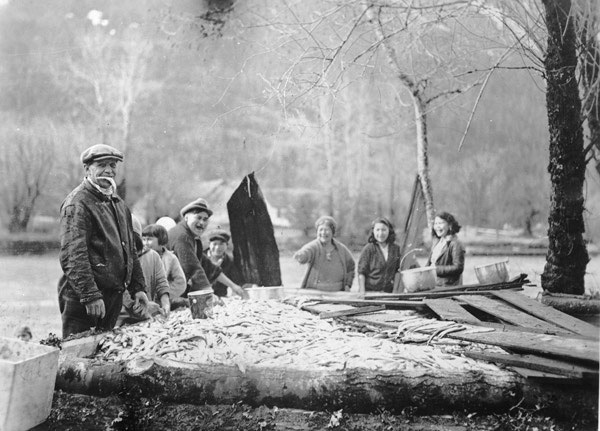
The Nuxalk Nation's traditional fisheries, reliant on and , have faced severe declines, impacting , culture, and economy. escapements in the Atnarko , historically exceeding 32,000 spawners annually from 1972 to 2004, collapsed in the late 1990s due to incidental harvest in mixed-stock fisheries, adverse conditions, and freshwater disturbances like floods and forest fires, averaging just 2,840 spawners from 2005 to 2015. runs in the Bella Coola , numbering in the millions during 1995 spawning events, vanished around 1997 and crashed further in 1999, possibly from in nearby shrimp trawls and glacier retreat linked to warming waters, with recent returns limited to 110–220 pounds annually. To address these losses, the Nuxalk have asserted inherent authority over , developing the Sputc to integrate ancestral knowledge, community consultations, and governance into eulachon stewardship plans, aiming to bypass federal Species at Risk Act regulations through Nation-to-Nation negotiations. A Marine Use Plan, grounded in customary laws, guides broader to restore balance amid declining stocks. The Nation opposes open-net aquaculture in its territories, citing escaped farmed fish interbreeding with and diluting wild . Specific recovery actions include Nuxalk Fisheries' river monitoring program, which has estimated food, social, and ceremonial catches in the Bella Coola since 2000. For sockeye, a dedicated recovery plan targets habitat restoration and reduced harvest rates, projecting a 50–60% chance of reaching 15,000 spawners within four generations under current conditions, rising to 69% if harvests are eliminated. In August , the rebuilt Snootli Creek —completed after a seven-year, $20 million project with and Ingenium—focuses on enhancing vulnerable chum, Chinook, sockeye, and coho stocks through incubation and community education on stewardship.

Notable Individuals and Contributions

Clayton Mack (1910–1993), a Nuxalk guide, gained renown for his hunts and preservation of oral traditions through stories of encounters and early interactions with non-Indigenous settlers. His narratives, blending Nuxalk knowledge with personal experiences, were compiled posthumously in Grizzlies & White Guys: The Stories of Clayton Mack (1993) and Bella Coola Man: More Stories of Clayton Mack (2000), offering insights into traditional resource use and cultural resilience. Snxakila Clyde Michael Tallio has advanced Nuxalk cultural revitalization as a fluent speaker, storyteller, and ceremonial leader, dedicating over two decades to teaching ancestral protocols and ceremonies suppressed under historical assimilation policies. In 2023, the awarded him an honorary for these efforts, recognizing his role in exhibitions like Nuxalk Strong (2025), which displayed repatriated artifacts and emphasized . Hereditary Chief Qwatsinas (Edward Moody, 1947–2010) spearheaded activism against clearcut logging in Nuxalk territories, organizing tree-sit blockades at the Itsa from 1995 to 1998 to assert unceded rights and halt . He advocated for as a duty to , stating, "We must protect the forests for our children, grandchildren and children yet to be born," influencing broader critiques of industrial practices in the .

References

Add your contribution
Related Hubs
User Avatar
No comments yet.