Hubbry Logo
Tsuruga, FukuiTsuruga, FukuiMain
Open search
Tsuruga, Fukui
Community hub
Tsuruga, Fukui
logo
8 pages, 0 posts
0 subscribers
Be the first to start a discussion here.
Tsuruga, Fukui
Tsuruga, Fukui
from Wikipedia

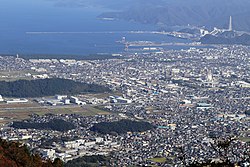
view of the port of Tsuruga

Key Information

Tsuruga City Hall

Tsuruga (敦賀市, Tsuruga-shi) is a city located in Fukui Prefecture, Japan. As of 29 June 2018, the city had an estimated population of 66,123 in 28,604 households and the population density of 260 persons per km2.[1] The total area of the city was 251.39 square kilometers (97.06 sq mi).

Geography

[edit]

Tsuruga is located in central Fukui Prefecture, bordered by Shiga Prefecture to the south and Wakasa Bay of the Sea of Japan to the north. Tsuruga lies some 50 km south of Fukui, 90 km northwest of Nagoya, 40 km northwest of Maibara, 115 km northeast of Osaka, 75 km northeast of Kyoto, and 65 km east of Maizuru. Among cities on the Sea of Japan coast, Tsuruga is the nearest city to the Pacific Ocean. The distance between Tsuruga and Nagoya is only 115 km. Tsuruga and Nagoya are historically close to Shiga Prefecture and Kyoto.

Neighboring municipalities

[edit]

Climate

[edit]

Tsuruga has a humid subtropical climate (Köppen climate classification Cfa) with hot summers and cool winters. Precipitation is plentiful throughout the year, and is particularly heavy in December and January. The average annual temperature in Tsuruga is 15.6 °C (60.1 °F). The average annual rainfall is 2,199.5 mm (86.59 in) with December as the wettest month. The temperatures are highest on average in August, at around 27.7 °C (81.9 °F), and lowest in January, at around 4.7 °C (40.5 °F).[2]

Climate data for Tsuruga (1991−2020 normals, extremes 1897−present)
Month Jan Feb Mar Apr May Jun Jul Aug Sep Oct Nov Dec Year
Record high °C (°F) 18.9
(66.0)
20.5
(68.9)
24.5
(76.1)
30.0
(86.0)
33.2
(91.8)
36.8
(98.2)
37.6
(99.7)
37.8
(100.0)
36.7
(98.1)
31.0
(87.8)
26.1
(79.0)
21.4
(70.5)
37.8
(100.0)
Mean daily maximum °C (°F) 7.8
(46.0)
8.5
(47.3)
12.3
(54.1)
17.8
(64.0)
22.5
(72.5)
25.8
(78.4)
30.0
(86.0)
31.9
(89.4)
27.7
(81.9)
22.2
(72.0)
16.5
(61.7)
10.7
(51.3)
19.5
(67.1)
Daily mean °C (°F) 4.7
(40.5)
5.1
(41.2)
8.3
(46.9)
13.4
(56.1)
18.2
(64.8)
22.1
(71.8)
26.3
(79.3)
27.7
(81.9)
23.7
(74.7)
18.1
(64.6)
12.7
(54.9)
7.4
(45.3)
15.6
(60.2)
Mean daily minimum °C (°F) 1.9
(35.4)
1.8
(35.2)
4.3
(39.7)
9.1
(48.4)
14.1
(57.4)
18.8
(65.8)
23.2
(73.8)
24.5
(76.1)
20.4
(68.7)
14.4
(57.9)
8.9
(48.0)
4.2
(39.6)
12.1
(53.8)
Record low °C (°F) −10.9
(12.4)
−10.5
(13.1)
−9.6
(14.7)
−1.7
(28.9)
2.0
(35.6)
7.9
(46.2)
13.1
(55.6)
14.1
(57.4)
8.6
(47.5)
2.7
(36.9)
−1.0
(30.2)
−6.2
(20.8)
−10.9
(12.4)
Average precipitation mm (inches) 269.5
(10.61)
164.7
(6.48)
144.6
(5.69)
120.4
(4.74)
141.4
(5.57)
144.1
(5.67)
204.0
(8.03)
146.9
(5.78)
204.9
(8.07)
152.6
(6.01)
176.0
(6.93)
316.7
(12.47)
2,199.5
(86.59)
Average snowfall cm (inches) 54
(21)
43
(17)
7
(2.8)
trace 0
(0)
0
(0)
0
(0)
0
(0)
0
(0)
0
(0)
0
(0)
19
(7.5)
126
(50)
Average precipitation days (≥ 1.0 mm) 21.8 17.3 14.4 11.6 10.7 10.7 12.2 9.3 11.3 11.7 14.1 20.7 165.8
Average snowy days (≥ 1 cm) 8.7 7.1 1.8 0.1 0 0 0 0 0 0 0 3.1 20.8
Average relative humidity (%) 73 71 67 66 68 74 75 72 74 72 71 73 71
Mean monthly sunshine hours 62.6 81.2 131.7 166.3 184.4 139.8 153.1 202.2 147.6 145.1 111.5 72.6 1,598.1
Source: Japan Meteorological Agency[3][2]

Demographics

[edit]

Per Japanese census data,[4] the population of Tsuruga peaked around the year 2000 and has declined slightly since.

Historical population
YearPop.±%
1970 56,445—    
1980 61,844+9.6%
1990 68,041+10.0%
2000 68,145+0.2%
2010 67,760−0.6%
2020 64,264−5.2%

History

[edit]

Although Tsuruga promotes itself as the leading city of the "Wakasa region", the city is actually has always been of ancient Echizen Province. A settlement at Tsuruga is mentioned in the Nara period Kojiki and Nihon Shoki chronicles. Kanagasaki Castle was the site of major battles during the early Muromachi period and the Sengoku period, Under the Edo period Tokugawa shogunate, large portions of the city were part of the holdings of Obama Domain and Tsuruga Domain, and prospered as a major port on the kitamaebune shipping routes between western Japan and Hokkaido. Following the Meiji restoration, the area became part of Tsuruga District of Fukui Prefecture. With the creation of the modern municipalities system, the town of Tsuruga was founded on April 1, 1889.

An Imperial decree in July 1899 established Tsuruga as an open port for trading with the United States and the United Kingdom.[5]

Tsuruga merged with the neighboring village of Matsubara and was incorporated as a city on April 1, 1937. Tsuruga was the only Japanese port opened to the Polish orphans in 1920, and to the Jewish refugees in 1940 thanks to Jan Zwartendijk, the Dutch Consul in Kaunas, who issued visa for Curaçao and Surinam, Mr. Chiune Sugihara, Vice-Consul for the Empire of Japan in Lithuania who issued transit visa for Japan. These events are detailed at the Port of Humanity Tsuruga Museum. However, much of the city center was destroyed in 1945 during the Bombing of Tsuruga during World War II,

The city expanded on January 15, 1955 by annexing the neighboring villages of Arachi, Awano, Togo, Nakago and Higashiura.

Government

[edit]

Tsuruga has a mayor-council form of government with a directly elected mayor and a unicameral city legislature of 26 members.

Economy

[edit]

Tsuruga has a very healthy mixed economy focused on providing services to the Wakasa region, and also features a container port, a bulk terminal, a coal-fired power plant, two textile mills, a large furniture factory, a playground equipment manufacturer, and a Panasonic (Matsushita) facility. Education and energy research also drive the economy.

Tsuruga is also known for its two nuclear power facilities - the Monju demonstration nuclear plant and the Tsuruga Nuclear Power Plant.

Education

[edit]

Tsuruga has 13 public elementary schools and five middle schools operated by the city government, and two public high schools operated by the Fukui Prefectural Board of Education. There is also one private high school and one private middle/high school. Tsuruga Nursing University is also located in the city.

Transportation

[edit]
Tsuruga Port

Railway

[edit]

High speed rail service to Tsuruga Station on the Hokuriku Shinkansen began on 16 March 2024.[6]

Highway

[edit]

Seaport

[edit]

Air

[edit]

The city does not have its own airport. The nearest airports are:

Sister cities

[edit]
Port of Humanity Tsuruga Museum, Tsuruga, Fukui Prefecture, Japan (2023).
Kehi no Matsubara beach

Local attractions

[edit]
  • Grave of Takeda Kounsai, a National Historic Site
  • Kanagasaki Castle site, a National Historic Site
  • Kanegasaki-gū, a Shinto shrine
  • Kehi Shrine, a large shrine complex built in 702. It hosts Kehi festival every year. Kehi shrine was also visited by the poet Matsuo Basho in 1689.[7]
  • Nakagō Kofun Cluster, a National Historic Site
  • Port of Humanity Tsuruga Museum, local history museum dedicated to the 20th century arrivals of Polish orphans and Jewish refugees
  • Tsuruga Red Brick Warehouse, Meiji-period port building
  • About twenty or so bronze statues – each perhaps four or five feet tall – of characters and scenes from the popular 1970s anime Uchū Senkan Yamato (Space Battleship Yamato or, in the United States, Star Blazers) and Galaxy Express 999 were erected in the city's downtown area in 1999. Though the creator of these shows, Leiji Matsumoto, was born elsewhere, an exhibit of his artwork was held in the city in 1999 as part of the city's 100th anniversary celebration, accompanied by the erection of the statues.

References

[edit]
[edit]
Revisions and contributorsEdit on WikipediaRead on Wikipedia
from Grokipedia
Tsuruga (敦賀市, Tsuruga-shi) is a port city located in southern , , on the western coast of facing Tsuruga Bay in the . As of 2024, the city has a population of 62,531 residents. The city's strategic position at a narrowing point of Honshu's coastline, approximately 100 km north of , has historically positioned it as a vital transportation and trade hub linking the to central via overland routes. Tsuruga Port facilitated maritime commerce and, notably during , served as the primary landing point for over 2,000 Jewish refugees who received transit visas from Japanese diplomat , earning the port its designation as the "Port of Humanity Tsuruga." In contemporary developments, the extension of the high-speed rail line to Tsuruga Station in March 2024 has bolstered its role as a modern gateway for regional connectivity and , complementing its focused on species like pufferfish and the area's natural attractions such as Kehi Shrine and coastal pine groves.

Geography

Location and Topography

Tsuruga occupies the southwestern portion of along the coast, specifically fronting Tsuruga Bay, a sub-bay of Wakasa Bay. The city is positioned where the Japanese main island narrows, approximately 100 kilometers north of , serving as a strategic coastal gateway in the . Its geographic coordinates center around 35°39′N latitude and 136°04′E longitude. The municipality spans 251.4 square kilometers, encompassing both urban coastal zones and inland terrain. Topographically, Tsuruga consists primarily of low-lying coastal plains at elevations averaging 7 meters above , facilitating its role as a hub. Inland areas rise gradually to wooded hills and surrounding mountains, including elevations reaching hundreds of meters, which divide the city from northern prefectural regions. The western shore of Tsuruga Bay features sandy beaches backed by pine groves, such as Kehi-no-Matsubara, contrasting with the more industrialized eastern shoreline. This coastal-mountainous interface influences local , with flat bayside areas supporting facilities and urban development, while elevated terrains preserve forests and limit extensive inland expansion.

Climate

Tsuruga experiences a (Köppen classification Cfa), marked by hot, humid summers and cool winters with notable snowfall due to from moist air masses encountering nearby mountains. Annual average temperatures hover around 13 °C (55 °F), with seasonal extremes ranging from highs near 30 °C (86 °F) in to lows approaching -1 °C (30 °F) in January. Precipitation totals approximately 2,350 mm (93 inches) yearly, distributed relatively evenly but peaking in summer months amid frequent influences. Summers, spanning late June to mid-September, bring oppressive humidity and mostly cloudy skies, fostering conditions conducive to mold and discomfort. Winters, from early December to mid-March, turn windy and partly cloudy, with persistent snow cover from late December to late February; average monthly snowfall peaks at about 5 cm (2 inches) in January, though interannual variability can yield much heavier accumulations from Siberian high-pressure systems channeling cold, moist airflow. Spring and autumn serve as transitional periods with moderate temperatures but still elevated rainfall, occasionally disrupted by early or late cold snaps. The table below summarizes monthly average high and low temperatures (in °C) and (in mm), derived from long-term observations:
MonthHigh (°C)Low (°C) (mm)
January7-197
February7297
March115122
April1710122
May2215140
June2519170
July2923185
August3024160
September2620200
October2114160
November158130
December103110
Humidity averages exceed 80% in and dip slightly in spring, while wind speeds peak at 19 km/h (12 mph) in , enhancing winter chill. These patterns reflect broader regional dynamics, with no pronounced but heightened flood risks in summer and hazards in winter.

Seismic and Geological Features

Tsuruga occupies a coastal position along Wakasa Bay in , underlain primarily by sedimentary rocks of the Mino-Tamba , which include sandstones, shales, and minor greenstones intruded by Early igneous bodies such as plutonic rocks and dike swarms. Surface geology features deposits, including talus accumulations with limited internal structure and intercalated layers containing humic matter, indicative of depositional environments influenced by local erosion and marine processes. The subsurface, as revealed by drilling data along regional infrastructure like expressways, consists of layered sediments reflecting and Pleistocene activity, with granitic intrusions such as the Tsuruga Body contributing to the area's lithological diversity from Eocene formations onward. Seismically, Tsuruga lies within a tectonically active zone on the Japan Sea side of , experiencing a very high level of frequency, with approximately 1,500 events of varying magnitudes recorded annually in proximity to the city. This activity stems from regional fault systems linked to the broader subduction dynamics of the Philippine Sea Plate, with at least two historical s exceeding magnitude 7 since 1900. Notable hazards include potential rupture along nearby active faults, as evidenced by extensive evaluations at the Tsuruga site, where features like the D-1 crushed rock zone and adjacent K Fault have been assessed for displacement, prompting concerns over their potential to generate strong ground motions. In September 2024, Japan's Nuclear Regulation Authority endorsed findings that the Tsuruga-2 reactor site fails to satisfy post-Fukushima criteria due to unresolved geological ambiguities and seismic risks from these faults, underscoring the challenges in confirming fault amid complex soil layering and historical seismic belts extending over 160 km in the prefecture. The 1948 Fukui (magnitude 7.1), part of this seismic belt, exemplifies the region's capacity for destructive inland events that propagate coastal shaking and secondary hazards like tsunamis from sources.

Demographics

Population Dynamics

As of the 2020 Japanese national census, Tsuruga's population stood at 64,264 residents, comprising 31,785 males and 32,479 females. This marked a decrease of 1,901 individuals, or 2.9%, from the 66,165 recorded in the 2015 census. The annual rate of decline averaged approximately -0.58% between 2015 and 2020. Historical trends indicate a pattern of stagnation followed by contraction, with earlier figures showing around 67,800 residents circa 2010 before the onset of more pronounced decreases. This trajectory aligns with depopulation observed in many provincial Japanese cities, driven primarily by structural factors such as rates—nationally around 1.3 births per woman in recent years—and net out-migration of working-age individuals seeking in larger urban centers. Local economic reliance on port activities and energy infrastructure has not offset these pressures, as younger cohorts depart for opportunities elsewhere, exacerbating the loss of in non-metropolitan areas. Demographic composition in 2020 reflected an aging society, with roughly 49.5% male residents and 1.2% foreign nationals. The age structure skewed toward older groups: individuals aged 65 and above constituted about 29.4% of the total, surpassing the national average and underscoring vulnerability to further shrinkage absent or policy interventions to retain youth. Detailed breakdowns showed concentrations in the 40-49 (8,982 persons) and 60-69 (8,592 persons) cohorts, indicative of a post-war baby boom generation entering retirement.
YearPopulation5-Year Change
201566,165-
202064,264-1,901 (-2.9%)

Household and Social Structure

In Tsuruga, the average household size has declined in line with national demographic trends, reaching 2.11 persons per as of 2025, down from higher figures in prior decades due to low birth rates, increased longevity, and out-migration of younger residents. This reflects a broader shift in toward smaller, nuclear-family units, with the 's total households numbering 29,307 against a of 61,734 in the same period. Household composition data from the 2020 indicate that single-person households constitute about 35.5% of general households (approximately 9,863 out of 27,769 total), a proportion elevated by the aging where 30.4% of residents are aged 65 or older. Elderly-only households, including high-aged single and couple units, further dominate, comprising over 20% of structures, as younger generations form independent nuclear families or delay . Two-or-more-person households, at 64.5%, primarily consist of couples with children or multi-generational setups in rural-port districts, though extended families remain rare compared to pre-war eras. Social structure emphasizes community-based support networks, with neighborhood associations (chōnaikai) facilitating mutual aid, disaster preparedness, and elderly welfare in a city where familial caregiving burdens have intensified amid shrinking household sizes. Local cooperatives, such as the Fukui Co-operative Society, provide welfare services and economic mutual aid, reinforcing ties in a port economy historically reliant on kinship and guild-like maritime groups. Multicultural initiatives, including the Fukui International Association's programs, address integration for the small foreign-resident population (about 1.2%), promoting social cohesion through language and cultural exchange events.

History

Early Development as a Port

Tsuruga's originated from its advantageous natural harbor on the coast, featuring calm waters and protection from prevailing winds, which enabled early maritime activities. This geographic suitability positioned it as a gateway for continental exchanges, with records indicating trade links to Korea and dating to ancient periods. The , initially known as Keinoura, served as a hub connecting to the Balhae kingdom in (698–926 CE) and the in (960–1279 CE), facilitating the exchange of goods such as , ceramics, and metals. By the (1603–1868), Tsuruga had evolved into a critical node in Japan's domestic coastal shipping network, particularly through the Kitamaebune merchant vessel system. These ships, operated by wealthy merchants, transported bulk commodities—including rice, dried goods, salt, and textiles—from Hokuriku and Tohoku production areas southward to urban markets in and , with Tsuruga acting as a major loading and transshipment point. The port's role supported regional under the Tokugawa shogunate's controlled trade policies, handling thousands of tons of cargo annually and contributing to the town's population growth and infrastructure, such as warehouses and wharves. This early port activity laid the foundation for Tsuruga's enduring maritime identity, though limited by feudal restrictions on foreign trade until the late . Notable visitors, including the poet in 1689 during his "Narrow Road to the Deep North" journey, underscored its cultural significance alongside economic functions. The absence of major or artificial enhancements in these phases highlights reliance on natural features, with development driven by demand from inland agricultural surpluses rather than state-led initiatives.

Edo Period and Trade Expansion

During the (1603–1868), Tsuruga developed as a critical hub for domestic coastal trade under the Tokugawa shogunate's policy, which restricted foreign commerce but permitted internal shipping. The port's position on the coast facilitated transshipment of goods from northern regions like Hokuriku and Tohoku to and the area, bypassing mountainous overland routes and leveraging allowed maritime routes. Tsuruga served as a primary call for kitamaebune ("northbound laden") merchant ships, large coastal vessels operated by and traders that carried southern , , and textiles northward in exchange for rice, soybeans, timber, and marine products. The kitamaebune system, originating in the mid-18th century and expanding through the early until the , drove Tsuruga's trade growth by enabling transport that evaded some shogunate controls on merchant activities. These ships, often numbering in the dozens annually at peak, docked at Tsuruga to unload southern cargoes and load northern staples, stimulating local warehousing, brokerage, and ancillary services; by the late era, the handled significant volumes of and raw materials that supported urban consumption in Kansai. Tsuruga's role was enhanced by its proximity to the Wakasa region, under domains like Obama, which integrated it into broader networks despite feudal oversight. This expansion also encompassed specialized commodities, such as early shipments from southern producers exchanged at Tsuruga and nearby Obama for northern grains and oils, marking one of the initial Sea-side routes for such goods in the 17th–18th centuries. The influx of merchants fostered economic vitality, with port facilities expanding to accommodate larger vessels and seasonal traffic, though prosperity was tempered by periodic shogunate inspections and risks. By the period's end, Tsuruga's and merchant class positioned it for Meiji-era transitions, underscoring the port's adaptation to domestic commerce amid .

Modern Industrialization and World War II

In the late , Tsuruga's modernization aligned with Japan's broader Meiji-era push toward industrialization, emphasizing to support trade and transportation. The completion of the Nagahama–Tsuruga line in 1882, just a decade after Japan's first domestic rail opened, connected the port to national networks, facilitating the shipment of goods like coal from and enhancing Tsuruga's role as a gateway. This boom extended to port facilities, with regular shipping routes established to Korea and , , by the early , positioning Tsuruga as a key node in Eurasian trade links, including a direct rail-to-boat connection for Europe-bound traffic. The construction of the Tsuruga Red Brick Warehouse in 1905 exemplified this era's architectural and logistical advancements, serving as a storage hub for imported and exported commodities amid Japan's shift from feudal isolation to export-oriented growth. While heavy manufacturing remained limited pre-war, Tsuruga's economy centered on maritime activities, including fishing, shipping, and light processing, bolstered by the port's strategic location. The Taishō period (1912–1926) saw continued expansion, with the port handling increased volumes of raw materials essential to Japan's emerging industrial base, though local development lagged behind urban centers like or . This port-centric modernization laid groundwork for wartime mobilization, as Tsuruga hosted the Imperial Japanese Army's No. 19 Infantry Regiment, contributing to regional defense and logistics efforts. During , Tsuruga's infrastructure supported Japan's military supply chains, but the city endured severe aerial bombardment as Allied forces targeted Japanese ports and industrial nodes. On the night of July 12–13, 1945, U.S. B-29 Superfortress bombers conducted an incendiary raid—the first major air attack on a coastal city—killing 109 civilians and destroying over 5,000 homes, much of the urban core. This assault, part of the broader campaign, devastated local shipping and warehousing, underscoring Tsuruga's vulnerability despite its secondary industrial status.

Post-War Reconstruction and Nuclear Era

Following the air raids of , which damaged key infrastructure including seaside warehouses and public buildings in Tsuruga, post-war recovery efforts prioritized the restoration of port facilities essential to the city's maritime economy. The red brick warehouses along the waterfront, critical for storage and , were repaired shortly after the war using salvaged materials amid resource shortages during the Allied occupation. Similarly, the former Owada Bank building, partially destroyed in the bombings, was repurposed by U.S. forces before being returned to local use, reflecting broader national reconstruction under SCAP oversight that emphasized stabilizing basic industries like shipping and fishing. By the mid-1950s, Tsuruga expanded administratively through mergers with surrounding villages on , , incorporating additional land to support urban growth and development amid Japan's broader economic stabilization. Symbolic projects, such as the concrete reconstruction of Tsuruga Castle's in , marked civic revival and tourism potential, while port enhancements revived pre-war trade routes across the . These efforts aligned with the national "income-doubling" push under Ikeda, fostering industrial diversification beyond traditional fishing and logistics. The nuclear era began in the late 1950s as part of Japan's energy independence strategy, with construction of the Tsuruga Nuclear Power Plant initiating site preparation for what became the region's cornerstone industry. Operated by Japan Atomic Power Company, Unit 1—a boiling water reactor—achieved commercial operation on March 14, 1970, marking one of Japan's early large-scale nuclear facilities and providing stable employment for thousands in construction, operations, and maintenance. This development spurred local economic growth, with ancillary firms in Fukui Prefecture specializing in nuclear-related services, though it later faced scrutiny over seismic risks in the fault-prone Wakasa Bay area. Subsequent projects, including the Fugen advanced thermal reactor attaining criticality in 1978, solidified Tsuruga's role in national nuclear R&D, contributing to energy exports and technological expertise until post-Fukushima pauses.

Government and Administration

Municipal Governance

Tsuruga operates under a mayor-council system of , as established by Japan's Local Autonomy Law, with executive authority vested in a directly elected and legislative functions handled by a unicameral city assembly. The , elected for a four-year term, directs city administration, proposes budgets, and represents the municipality in intergovernmental relations. The city assembly, comprising 22 members also elected for four-year terms, reviews and approves ordinances, budgets, and policies. The current mayor, Takanobu Fuchikami, born February 11, 1961, has held office through multiple terms, focusing on port development, nuclear safety coordination, and historical commemoration efforts related to wartime arrivals. Fuchikami's administration has emphasized and , including partnerships for smart systems utilizing drone technology. City assembly occur every four years; the most recent on April 23, 2023, filled all 22 seats from 24 candidates, with a of 60.43%. The assembly reduced its fixed membership from 24 to 22 via ordinance amendment approved December 21, 2021, effective for the 2023 onward, aiming to streamline operations amid fiscal constraints. Administrative operations are organized into departments such as the Citizens' Life Department, handling welfare and daily services, and the Urban Development Department, overseeing planning and infrastructure. The city hall, located at 2-1-1 Chūō-chō, coordinates with on regional issues like oversight and integration. Governance priorities include environmental preservation tied to coastal resources and economic diversification beyond maritime industries.

Political and Economic Policies

Tsuruga's municipal government formulates political and economic policies centered on sustaining its nuclear energy sector, diversifying into , and bolstering port-related industries and . As a long-standing host to plants, the city administration prioritizes policies that secure regulatory support and funding for nuclear operations, recognizing their contribution to local economic resilience over six decades. Local leaders advocate for improved disaster countermeasures and safety enhancements to facilitate reactor restarts and potential new developments, as evidenced by participation in national nuclear mayor associations urging policy reforms in 2025. The Tsuruga City Harmonious Hydrogen Society Formation Plan represents a key economic initiative to build a domestic , incorporating detailed roadmaps, guidelines, and projects backed by central government endorsements through bodies like the Liaison Council on Monju Decommissioning. This policy aims to position Tsuruga as a hub for clean transitions, complementing its nuclear base while addressing decommissioning challenges at the Monju reactor site. Complementary efforts include revitalizing , , primary industries, and to generate employment and foster sustainable growth. Environmentally oriented policies feature municipal coordination of beach cleanups targeting ocean waste, establishing routine frameworks for designated businesses to maintain coastal areas integral to the port economy. In tourism, the administration promotes sustainable sea-themed experiences designed to enhance economic contributions without ecological strain, leveraging the region's . Politically, Tsuruga's governance distinguishes itself through proactive local decision-making, integrating economic imperatives with national priorities like the 2024 extension to boost connectivity and investment.

Economy

Port and Maritime Industries

Tsuruga Port, situated in the sheltered Tsuruga Bay on Japan's coast, functions as a primary hub for bulk and containerized , as well as passenger and vehicle . The facility handles commodities such as , , and general , with roughly 90% of its trading volume moved by and roll-on/roll-off (Ro-Ro) vessels. This emphasis on underscores its role in efficient regional logistics, linking central to northern and international destinations. Operated through entities like Tsuruga Port International Terminal Co., Ltd., founded in 2009, the port features advanced infrastructure including a multi-purpose terminal with a 14-meter-deep and 25 hectares of storage area—the largest such expanse on the coast. It ranks as the second-busiest port by trade volume along this coastline, supporting imports and exports primarily with Asian partners. Annual container throughput stands at about 20,000 TEUs, bolstering Fukui Prefecture's economic connectivity through streamlined handling of diverse freight. Domestic ferry routes connect Tsuruga to Hokkaido ports like , with services from operators such as Shin Nihonkai Ferry providing up to nine weekly sailings and travel times around 20 hours. Internationally, regular container feeds and Ro-Ro shipments run to in —expanded to five weekly frequencies by the —alongside historical ties to Russian ports like and Vostochny, and Chinese hubs including and . These operations facilitate trade with continental , though geopolitical factors have influenced certain routes in recent years. Maritime industries in Tsuruga center on , stevedoring, and management rather than or heavy , employing workers in terminal operations and ancillary services that drive local . The 's strategic position as the sole facility offering combined and Ro-Ro access to both and enhances its utility for vehicle and bulk transport, sustaining steady economic contributions amid Japan's evolving maritime network.

Fishing and Agriculture

Tsuruga's fishing industry relies heavily on Tsuruga Port, a primary landing site for catches from the nutrient-rich waters of the . Local fleets target species such as snow crabs, which are unloaded at Tsuruga alongside nearby ports like Echizen, Mikuni, and Obama. Echizen gani crabs, a premium variety, have been certified with national-first yellow tags since 1997 to denote quality and origin, with landings supporting regional processing and distribution. Aquaculture represents a key component, with Tsuruga at the northern boundary for viable amid severe winter conditions; cultivated include pufferfish and the branded bream "Tsuruga Madai," caught via pole-and-line methods in dedicated ponds. The Nihonkai Sakana Machi market, among the largest seafood facilities on the Sea coast, handles fresh landings including Fukui and other , underscoring the sector's scale despite varying restaurant presence. Agriculture in Tsuruga maintains a presence through paddy cultivation, supported by the local Association, which estimates costs for conventional farming practices. However, specific production data and registered crops for the city remain limited, indicating secondary economic importance relative to maritime activities.

Industrial and Manufacturing Sectors

The industrial and manufacturing sectors in Tsuruga complement the city's port and nuclear activities, focusing primarily on chemicals, plastics, and related high-functional materials. Key facilities include the Tsuruga Research and Production Center operated by TOYOBO Co., Ltd., established in 1934, which produces specialized films, bioproducts, and advanced materials serving as a core hub for the company's operations. Similarly, Zeon Corporation's Tsuruga Plant manufactures plastic films, including retardation films for large-screen LCD televisions, leveraging proximity to other regional facilities for expanded production capacity as of 2025. These operations emphasize precision manufacturing tied to electronics and industrial applications, drawing on Tsuruga's logistical advantages. Electrical appliances and automotive components represent another pillar, with Automotive Systems Co., Ltd. maintaining a production site in the city that focuses on operational efficiencies through initiatives like innovation to enhance management and output as of 2024. Local firms such as Miyagen Co., Ltd., with its head office plant, produce power generation equipment including generators and inverters, supporting industrial and emergency needs. Broader includes chemical fibers and wood products, contributing to a diversified base amid the prefecture's strengths in textiles and machinery. These sectors employ advanced technologies but remain smaller-scale compared to nuclear-related activities, with companies prioritizing innovation in sustainable materials and efficiency to navigate regional economic shifts.

Nuclear Power Industry

Historical Development and Achievements

The nuclear power industry in Tsuruga originated with the establishment of the Tsuruga Nuclear Power Plant by the Japan Atomic Power Company (JAPC), founded in November 1957 as Japan's dedicated entity for commercial nuclear electricity generation. Construction of Unit 1, a 357 MWe , began in the mid-1960s amid national efforts to diversify sources post-oil dependency concerns, with the unit achieving criticality in late 1969 and entering commercial operation on March 14, 1970. This marked the debut of Japan's first commercial and Fukui Prefecture's inaugural nuclear facility, demonstrating scalable fission-based power production with an initial supporting grid integration. Unit 2, a 1,160 MWe , followed with construction starting in 1978 and commercial startup in February 1987, doubling the site's output and incorporating design refinements for enhanced and margins derived from Unit 1 operations. These early plants achieved reliable baseload , cumulatively operating for decades and contributing empirical on long-term performance and under Japanese regulatory frameworks, which informed subsequent domestic deployments. Tsuruga's role expanded into advanced reactor technology with the Monju prototype fast breeder reactor, a 280 MWe sodium-cooled design whose construction commenced in 1986 under the Power Reactor and Nuclear Fuel Development Corporation (later integrated into the Japan Atomic Energy Agency). Monju attained initial criticality on April 4, 1994, achieving self-sustaining fission and validating core breeding ratios exceeding unity through plutonium- fuel cycles, a key milestone in pursuing closed fuel loops to extend resources. Over its half-century trajectory from conceptual to limited runs totaling thousands of operational hours, Monju generated proprietary advancements in fast physics, intermediate heat exchanger integrity, and seismic-resistant sodium piping, as documented in engineering retrospectives, bolstering global knowledge for prototypes despite subsequent operational pauses. These accomplishments underscored Tsuruga's evolution from conventional light-water pioneer to experimental hub, yielding datasets on material endurance under high-flux irradiation that supported Japan's fast reactor R&D until shifts post-2011.

Tsuruga Nuclear Power Plant Operations

The Tsuruga Nuclear Power Plant, operated by Japan Atomic Power Company (JAPC), consists of two boiling water reactors originally designed for base-load electricity generation. Unit 1, with a capacity of 357 megawatts (MW), entered commercial operation on March 14, 1970, following start in 1968, and contributed to regional power supply until its decommissioning decision in 2015 due to economic and aging factors. Unit 2, a with 1,160 MW capacity, began commercial operations on November 17, 1987, after initiated in 1976, and operated intermittently until the nationwide shutdown following the 2011 Fukushima Daiichi accident. Post-Fukushima, both units ceased operations in compliance with Japan's regulatory halt on nuclear restarts pending enhanced reviews under the Nuclear Regulation Authority (NRA) standards established in 2013. Unit 1's decommissioning process commenced thereafter, with dismantling activities ongoing as of 2024, reflecting JAPC's shift away from relicensing the older reactor amid rising maintenance costs and requirements. Unit 2 underwent extensive evaluations, including geological surveys, but faced persistent regulatory denial due to evidence of an active fault—designated as the K Fault—directly beneath the reactor building, which violates post-Fukushima criteria prohibiting construction over capable seismic faults. JAPC submitted restart applications for Unit 2 in 2017, initiating NRA screenings that revealed data discrepancies, leading to a suspension of reviews in April 2021 after accusations of falsified geological survey records by the operator. Subsequent investigations confirmed the fault's potential for future movement, with NRA panels in July 2024 and November 2024 concluding non-compliance, marking Tsuruga-2 as the first reactor explicitly barred from restart under the new standards. As of August 2025, JAPC planned additional underground fault surveys to challenge the ruling, but regulatory approval remains unattainable without disproving fault activity, leaving the unit in cold shutdown with no generation output. Operational data from pre-shutdown periods indicate Unit 1 achieved a lifetime averaging around 60-70% typical for early Japanese reactors, while Unit 2's higher efficiency was curtailed by periodic outages for maintenance and minor incidents, including a steam tube leak and low-level radioactivity releases in the investigated by the Nuclear and Industrial Safety Agency. No major radiological releases occurred during routine operations, though post-2011 scrutiny highlighted vulnerabilities in seismic instrumentation and emergency cooling systems, prompting uncompleted upgrades. The plant's idled status has contributed to local economic reliance on decommissioning labor and research, with cumulative output historically supporting Kansai region's grid stability until 2011.

Monju Prototype Fast Breeder Reactor

The Monju is a loop-type, sodium-cooled situated in the Shiraki district of Tsuruga, Fukui Prefecture, , developed to demonstrate plutonium breeding and advanced technologies. It features an electrical output capacity of 280 MWe and a thermal output of 714 MWt, utilizing mixed oxide ( composed of and oxides, with liquid sodium as the primary and secondary coolants to enable fast neutron spectrum operation and fuel breeding. Construction commenced in October 1985 under the Power Reactor and Nuclear Fuel Development Corporation (PNC), which later evolved into the Japan Nuclear Cycle Development Institute (JNC) and subsequently the Agency (JAEA). The achieved initial criticality on April 4, 1994, followed by low-power test operations and grid connection in August 1994, accumulating only about 200 hours of operation before the major incident. On December 8, 1995, during heat transport system testing at 40% power, approximately 640 kg of sodium leaked from the secondary heat transport system piping over three hours due to the rupture of a thermocouple well in a , igniting on contact with air and causing a that damaged the piping and perforated a tube in the intermediate . No radioactive release occurred, but the event exposed design vulnerabilities in sodium handling and integrity, compounded by operator delays in shutdown and initial attempts to minimize the leak's scale through edited surveillance footage, eroding . Repairs and seismic upgrades extended over 15 years, with restart approval granted in 2005 but further delayed by regulatory scrutiny; limited operations resumed briefly in May 2010, generating power for 162 days before shutdown in August 2010 after a 3-ton refueling machine fell into the reactor vessel, damaging internal components. Subsequent inspections revealed non-compliance with protocols, including inadequate equipment checks and measures, leading to JAEA replacement in 2012 and prolonged inactivity amid escalating maintenance costs exceeding 1 trillion yen by 2016. In December 2016, the Japanese government mandated decommissioning due to repeated failures to meet operational and standards, with spent fuel removal targeted for completion by 2022. Defueling concluded in October 2022, transferring all assemblies to storage, marking the shift to full dismantlement projected for 2047 at an estimated cost of 11.4 trillion yen, reflecting challenges in handling radioactive sodium residues and structural decommissioning. A decommissioning basic plan was formalized in July 2017, with ongoing activities in 2024 focused on and facility surveys under JAEA and regulatory oversight, underscoring Monju's legacy as a technically ambitious but operationally troubled that advanced sodium reactor data despite minimal runtime.

Safety Incidents and Regulatory Scrutiny

The Tsuruga Nuclear Power Plant, operated by Atomic Power Company, experienced a fire on November 12, 2011, in its Unit 1 reactor's water processing facility, triggered by a in a spare electrical device during post-Fukushima shutdown operations. This incident highlighted vulnerabilities in auxiliary systems amid heightened national scrutiny following the 2011 Fukushima Daiichi accident. Regulatory focus intensified on seismic risks, particularly for Unit 2, where panels under Japan's Nuclear Regulation Authority (NRA) concluded in May 2013 and March 2015 that an active fault runs beneath the reactor building, posing unacceptable hazards. In July 2024, an NRA expert panel rejected restart approval, citing inability to rule out active fault activity, and on November 13, 2024, the NRA formally disqualified Unit 2—the first such rejection under post-Fukushima safety standards—for failing to mitigate risks from potential fault movement dating to the era. The Monju prototype fast breeder reactor, managed by the Japan Atomic Energy Agency, suffered a major sodium coolant leak on December 8, 1995, from the secondary heat transport system piping in the reactor auxiliary building, resulting in a and subsequent of the full extent of damage by operators. Further lapses included a 2012 safety inspection revealing over 9,000 unchecked components out of approximately 49,000 required parts, alongside repeated failures in equipment inspections documented in 2016. NRA scrutiny extended to seismic faults under Monju in a 2013 expert probe, contributing to operational halts and the government's December decision to decommission the facility due to persistent safety and management deficiencies. These events underscored systemic issues in fast breeder technology oversight, leading to indefinite shutdowns and eroded public confidence in Tsuruga's nuclear infrastructure.

Current Status and Economic Impacts as of 2025

As of October 2025, Tsuruga Nuclear Power Plant Unit 1 remains under decommissioning by Japan Atomic Power Company (JAPC), following its shutdown after the 2011 Fukushima Daiichi accident. Unit 2, a 1,160 MWe operational since 1987, continues in suspended status during periodic inspections, with no power generation since 2011. The Nuclear Regulation Authority (NRA) formally rejected its restart application in November 2024, determining that an underground fault beneath the site constitutes an active seismic risk under post-Fukushima safety standards. JAPC initiated additional borehole surveys in August 2025 to reassess the fault's activity, aiming to complete the first round by year's end and potentially resubmit safety reviews, though regulatory approval remains uncertain. The , a 280 MWe sodium-cooled facility in Tsuruga designed for breeding, has been non-operational since a 2010 fuel handling incident, following earlier shutdowns including a 1995 sodium leak. Decommissioning commenced after a 2016 government decision, with Japan Atomic Energy Agency (JAEA) awarding a contract to Cavendish Nuclear in October 2025 for planning and initial dismantling phases, marking a shift from revival efforts to permanent closure. This process, projected to span decades, involves sodium removal and waste management, prioritizing safety over any future operational prospects. These developments have constrained the nuclear sector's economic role in Tsuruga, a historically dependent on plant-related , , and local , which peaked during operational periods with thousands of direct and indirect jobs. Prolonged outages since have led to revenue losses for JAPC and reduced fiscal contributions to , exacerbating regional reliance on alternative sectors like port activities amid Japan's broader nuclear restart delays, where only about 12 operable reactors contribute to as of mid-2025. Decommissioning Monju sustains some short-term jobs in remediation but signals long-term contraction, with government subsidies and regional development funds attempting to mitigate impacts through diversification incentives. JAPC's FY2025 emphasizes maximizing existing assets, including Tsuruga-2 surveys, to potentially restore up to 20-30% of prior economic inputs if restarts materialize, though skeptics highlight persistent regulatory and seismic hurdles.

Education and Research

Primary and Secondary Education

Primary education in Tsuruga is delivered through 11 public elementary schools operated by the Tsuruga City Board of Education. These schools follow Japan's national curriculum, emphasizing foundational skills in Japanese language, mathematics, science, social studies, and moral education over six years. Enrollment varies by school, with larger institutions like Nakago Elementary serving around 393 students across 16 classes, while smaller rural schools such as Kutumi Elementary have fewer than 100 students. A notable development is Tsunoga Elementary School, which integrates with its junior high counterpart as part of a 2021 facility consolidation effort combining three former elementary schools and one junior high to address aging infrastructure and enhance continuous learning environments through collaborative design involving local stakeholders. Lower secondary education comprises five public junior high schools under city management, serving grades 7 through 9 with a focus on advanced academics, electives, and extracurricular activities aligned with national standards. Schools like Awano Junior High enroll approximately 687 students, reflecting consolidated districts in more populated areas, while others maintain smaller cohorts to support personalized instruction. In addition to public options, Tsuruga Kehi High School operates an attached junior high for select students preparing for its upper secondary programs. Upper secondary education falls under the Fukui Prefectural , with key institutions including , , and , offering general, comprehensive, and vocational tracks over three years. gained national recognition by winning the 2015 Spring Koshien . These schools emphasize preparation for university entrance or technical careers, with vocational programs at tied to local industries such as manufacturing and energy. Overall, Tsuruga's system benefits from Fukui Prefecture's strong scholastic outcomes, including high advancement rates to higher education.

Higher Education and Nuclear Research Ties

The University of Fukui operates the Research Institute of in Tsuruga, dedicated to advancing nuclear safety, disaster prevention, and through fundamental research on commercial reactors in collaboration with industry partners. Located at 1-3-33 Kanawa-cho, this facility leverages Tsuruga's proximity to operational nuclear sites, including the Tsuruga Nuclear Power Plant, to integrate practical training into curricula. The institute supports graduate-level education, with programs emphasizing hands-on experience near Japan's first , Tsuruga-1, which began operations in 1970. Tsuruga hosts collaborative initiatives like the Tsuruga Nuclear Seminar organized by the University of Fukui, which provides specialized training in nuclear facilities through partnerships with local institutes and universities in . These efforts aim to develop expertise in nuclear operations, safety protocols, and engineering applications, drawing on regional assets such as the Japan Atomic Energy Agency's (JAEA) Tsuruga Comprehensive and Development Center. The JAEA center facilitates shared-use facilities like Sumadeco for experimental nuclear , enabling academic-industrial cooperation on topics beyond traditional fields, including product development for local firms. The Wakasa Wan Energy Center, founded in 1994 and fully operational by 1998, functions as a regional nucleus for nuclear and , offering educational programs and supporting entry into nuclear-related industries for Fukui-based companies in tandem with university affiliates. Complementing these, international training courses on nuclear , , and are conducted in Tsuruga, targeting global participants to build capacity in nuclear development. Such programs underscore Tsuruga's role in fostering STEM talent, including site visits to nuclear facilities for in fields as of 2025. While Tsuruga lacks large-scale independent universities, these institutional ties position the city as a specialized hub for nuclear-focused higher education and , with the Fukui International Human Resources Development Center for Atomic Energy enhancing cross-border training since 2011. This ecosystem has contributed to local economic reliance on nuclear expertise, though post-Fukushima regulatory shifts have prompted adaptations in priorities toward and decommissioning.

Transportation

Rail Infrastructure

Tsuruga Station functions as the principal railway hub in Tsuruga, serving as the western endpoint of the , a high-speed line linking to the . The 125-kilometer extension from to Tsuruga opened for commercial service on March 16, 2024, incorporating major engineering features such as the 19.8-kilometer Shin-Hokuriku Tunnel and the 5.5-kilometer Kaga Tunnel. This development, constructed over 11 years and 8 months, has shortened travel times from to Tsuruga to approximately three hours via services including the E7 series trains. Operated jointly by JR West, the station features a multi-level with conventional rail platforms on the ground level for local and express services, a on the second level, and elevated platforms above. Conventional lines intersecting at Tsuruga include the Kosei Main Line, which connects southward to , and the Obama Line, extending northeast to Maizuru in ; these facilitate regional passenger and freight transport along the coast. The also integrates here, providing eastward links to Fukui and , though parallel conventional services adjusted post- opening to complement high-speed operations. Historically, Tsuruga emerged as a key rail node in the early , leveraging its coastal position as a distribution hub for routes connecting , , , and to northern via the Hokuriku corridor. By 2025, the infrastructure supports enhanced inter-regional mobility, with services such as Tsurugi operating between Toyama and Tsuruga, though ridership and economic viability remain under evaluation amid national fiscal pressures. Proposed extensions beyond Tsuruga to face mounting scrutiny over escalating costs, with preliminary assessments slated for 2025 to determine feasibility.

Road and Highway Networks

The Hokuriku Expressway (E8) provides primary highway access to Tsuruga via the Tsuruga Interchange, linking the city northward to the Toyama and Niigata regions and southward toward the Kansai area through connections at the Maihara Junction. This four-lane expressway supports efficient long-distance travel and freight movement, integral to Tsuruga's logistics as a port-adjacent hub. The Maizuru-Wakasa Expressway (E27), designated as part of the Kinki Expressway Tsuruga Route, converges with the Hokuriku Expressway at Tsuruga Junction, enabling direct connections from western Kansai via the Chugoku Expressway at Yoshikawa Junction and routes through Maizuru and Obama. The Obama Interchange to Tsuruga Junction segment, spanning key coastal and inland links, opened to full traffic, enhancing regional connectivity for approximately 162 km from its western terminus. Tsuruga's conventional road network features several national highways that intersect within city limits, including National Route 8, a vital coastal artery paralleling the for east-west traffic; National Route 27, extending southward toward ; National Route 161, providing inland routes to ; and National Route 476, connecting eastward to Ono in central Fukui. These routes, maintained under national standards, handle local commuter, commercial, and industrial transport, including access to port facilities and energy infrastructure, with Route 8 highlighted for urban improvements in Tsuruga as of 2024. Local prefectural roads, such as Route 204, supplement these for finer grid connectivity.

Port Facilities and Shipping

Tsuruga Port, located in Tsuruga Bay, , functions as a primary freight transport complex on Japan's coast, leveraging its position as the nearest such port to the . The port comprises the original Main Port area and the New Port area in Mariyama, which opened in 2010 to expand logistics capabilities. It accommodates diverse vessels, including cargo ferries, container ships, roll-on/roll-off ships, and dry bulk carriers. Key infrastructure includes the Maruyama-South Multipurpose International Terminal, featuring a 410-meter quay wall with water depths of 12-14 meters and a 25-hectare ground area. Additional berths encompass Mariyama Minami A, Mariyama Kita B and C, and Kanegasaki C and D, with overall public wharves at 12-meter depths and private wharves reaching 14 meters. Handling equipment supports container cranes, level luffing cranes, and quay cranes, alongside open yards, transit sheds, warehouses, and timber basins for storage. The port primarily manages cargo such as , , and , with approximately 90% of trading volume transported via ferries and vessels. International services include tri-weekly container routes and bi-weekly RORO connections to , —initiated in 1990—with expansions increasing frequency to five times weekly by 2010. Trade partners extend to (Vostochny, ), (, ), and (, ), positioning Tsuruga as the second-largest port by transaction volume on the coast for international exchanges. Preliminary container handling for 2023 indicates monthly volumes of around 1,000-1,200 TEU inbound and outbound during mid-year periods. Passenger services support cruise ships, building on the port's historical role as a gateway for transcontinental travel, including Meiji-era connections to via . Terminal expansions in 2024 aim to bolster capacity amid rising maritime transport demands. Mariyama breakwaters and the Rinko Tunnel further facilitate efficient access and logistics integration with national routes and expressways.

Culture and Society

Local Traditions and Festivals

The Tsuruga Festival, the city's premier annual event and the longest-running celebration in Japan's , occurs from September 2 to 4 and centers on the Kehi Jingu Shrine's grand festival. It combines ritual processions with community parades, including portable shrine carriers, gohōren lion dances, and the procession of six historic floats known as , which feature intricate mechanical dolls and puppets activated during the event. The float parades trace their origins to the in the 16th century, originally tied to Kehi Jingu's rituals for warding off plagues and ensuring bountiful harvests. Kehi Jingu Shrine, Tsuruga's chief guardian deity site and ichinomiya of former , hosts additional traditions like the O-taue Rice-Planting Festival, a ceremonial mock planting in a rice field before the main shrine to invoke agricultural prosperity, typically in . The shrine's main festival includes the Yoimiya evening rituals on September 2, followed by Shinkosai processions on September 3 and 4, drawing participants in traditional attire for purification rites and communal prayers. Other notable events include the Matsubara Grand Festival on , a memorial service honoring loyalists who sought refuge in Tsuruga during the late , featuring graveside rituals and historical reenactments to commemorate their heritage. These festivals reflect Tsuruga's maritime and agrarian roots, with community involvement emphasizing collective labor in parades and rituals passed down through generations.

Tourism and Historical Sites

Tsuruga serves as a key destination for visitors interested in Japan's and humanitarian legacies, drawing attention to its role as a of refuge during . The city features several preserved sites that highlight its ancient connections to continental via trade routes and its modern significance in international rescue efforts. Tourism centers on museums, shrines, and coastal landmarks, with annual visitors exploring the blend of natural beauty and . The Port of Humanity Tsuruga Museum, located in Kanegasaki Park, documents the arrival of approximately 2,100 Jewish refugees between 1940 and 1941, who received transit visas issued by Japanese diplomat Chiune Sugihara in Lithuania before reaching Tsuruga after arduous journeys across Russia. The museum also exhibits the story of over 1,000 Polish orphans evacuated from Siberia who transited through the port in 1922-1923, emphasizing local residents' aid to these groups amid global conflicts. Exhibits include photographs, artifacts, and videos illustrating the port's humanitarian role, open daily except Wednesdays from 9:00 a.m. to 5:00 p.m. Kehi Shrine (Kehi Jingu), established in 702, stands as one of Japan's oldest shrines and serves as the guardian deity for the Hokuriku region's coastal safety and maritime activities. Its prominent gate, measuring 9 meters in height and recognized among Japan's three great wooden torii, symbolizes the city's enduring spiritual heritage. The shrine grounds include associated structures like Tsunuga Shrine, linked to the of "Tsuruga," and attract pilgrims for rituals tied to safe voyages. Adjacent to the , Kehi no Matsubara pine grove spans 1 kilometer along the coast, featuring over 1,000 trees planted since the for erosion control and scenic preservation, designated as a nationally notable site for its natural and historical value. Visitors often combine visits with walks through this forested beach area, offering views of the . Other historical sites include the Tsuruga Red Warehouse, a Meiji-era (late ) structure repurposed for cultural events and port history displays, and the Tsuruga Railway Museum, which showcases the city's rail heritage from the early onward. These attractions underscore Tsuruga's evolution as a vital transportation hub, with preserved warehouses and rail exhibits providing insights into industrial development.

International Relations and Sister Cities

Tsuruga has established formal agreements with three international partners to foster cultural, economic, and educational exchanges. These include Donghae City in , formalized on April 13, 1981, focusing on mutual visits, youth programs, and commemorative events such as the 40th anniversary celebrations in 2021. in , , became a sister city in October 1982, building on earlier trade ties across the and emphasizing friendship delegations and joint initiatives dating back to 1971 goodwill voyages. Taizhou in Zhejiang Province, , joined as a sister city in 2001, with ongoing activities including high-level delegations, such as the Tsuruga mission in October 2024 and reciprocal visits marking anniversaries like the 10th in 2011. These relationships are supported by the Fukui International Association's Reinan Center in Tsuruga, which coordinates events, language programs, and consultations to enhance local-global ties. Beyond sister cities, Tsuruga's international profile stems from its historical role as a humanitarian . In 1940–1941, it received approximately 2,100 Jewish refugees escaping via transit visas issued by diplomat , earning the moniker "Port of Humanity Tsuruga." Earlier, in 1923, the port welcomed over 700 Polish orphans evacuated from amid the , fostering enduring commemorative links, including visits by Polish officials as recently as July 2024. These episodes underscore Tsuruga's legacy in facilitating safe passage and aid during global crises, distinct from modern economic or diplomatic pacts.

References

Add your contribution
Related Hubs
User Avatar
No comments yet.