Hubbry Logo
UlsteinvikUlsteinvikMain
Open search
Ulsteinvik
Community hub
Ulsteinvik
logo
8 pages, 0 posts
0 subscribers
Be the first to start a discussion here.
Ulsteinvik
Ulsteinvik
from Wikipedia

Ulsteinvik[4] is a town[1] in Ulstein Municipality in Møre og Romsdal county, Norway. The town is the commercial and administrative centre of the municipality and as such, Ulsteinvik contains 74% of the municipal population. The 3.93-square-kilometre (970-acre) town has a population (2024) of 6,208 and a population density of 1,580 inhabitants per square kilometre (4,100/sq mi).[2]

Key Information

The town of Ulsteinvik is located on the west side of the island of Hareidlandet, about 23 kilometres (14 mi) southwest of the city of Ålesund. Ulstein Church is located in the town, serving the population of the whole municipality. Ulsteinvik received town status on 1 July 2000.[5]

Economy

[edit]
View of Kleven Verft
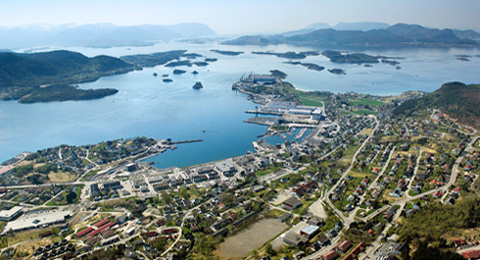
View of the town, looking northeast

The town is built in a natural harbour (in fact, the town's name means "Ulstein cove" or "Ulstein inlet"), and has an industry driven largely by shipbuilding, with two major shipyards: Ulstein Verft and Kleven Verft.

The Ulstein Group includes the Ulstein Verft shipyard and a growing number of other marine-related companies, the largest of which are Ulstein Power & Control AS and Ulstein Design & Solutions AS. The town has dozens of other maritime-related firms of all sizes, including the global head office of Rolls-Royce plc's marine division. The strength of this industry through the middle of the first decade of the 21st century has led to significant expansion and new construction, both residential and commercial.

In 2012, Ulsteinvik was the winner of the most attractive town in Norway.[6]

Culture and sports

[edit]

The Sjøborg theatre, on Ulsteinvik's waterfront, has both film and live theatre venues. It shows a mixture of "global" and Norwegian feature films (3-5 different films at a time over 10-12 showings per week). In addition, it welcomes a mixture of local and touring live acts, including big band, operatic revues, English- and Norwegian-language dramatic productions and stand-up comedy.

Ulsteinvik is the home of IL Hødd, a multi-sport club that includes a Norwegian First Division (as of 2011) football team. The team has a large local following, and generates strong attendance at their stadium, Høddvoll. Hødd also offers several other sports, including handball and rhythmic gymnastics. In 2012, Hødd became national cup champions of Norway, beating Tromsø IL in the final of the 2012 Norwegian Football Cup in the Ullevaal Stadion in Oslo. In addition, Ulsteinvik is the home of smaller clubs in each of basketball and rugby union (Sunnmøre Rugby). It is also the hometown of men's 400m hurdles world record holder and Olympic champion Karsten Warholm, as well as Norway's first-choice football goalkeeper in the Beijing Olympics, Erika Skarbø.

Ulsteinvik is the birthplace of the underground cartoonist Øystein Runde.

Media

[edit]

Ulsteinvik is the headquarters of the local subscription-based newspaper Vikebladet Vestposten (commonly known by only the first name), formed by a 1989 merger of two previously-existing newspapers (Vikebladet & Vestposten). The community is also served by the free regional weekly RegionAvisa and the Ålesund-based daily Sunnmørsposten.

Transport

[edit]

Norwegian county road Fv 61 runs along the south edge of the town centre, and is the major route connecting Ulsteinvik to points northeast (Hareid and Sula, with connections to Ålesund) and south (the villages of Eiksund and Haddal as well as the municipalities of Herøy Municipality, Sande, and others). Since its completion in 2008, the Eiksund Tunnel, the world's deepest undersea tunnel, connects Ulsteinvik by road to the mainland via Fv 653.

Ulsteinvik is served by one bus company, Vy Buss, with the express route directly to Oslo operated under its Vy express brand.

Ulsteinvik is 30 kilometres (19 mi) from the Ørsta–Volda Airport, Hovden, which has several-daily flights to Oslo Airport, Gardermoen and Sogndal Airport, Haukåsen. It is also served by Ålesund Airport, Vigra, 60 kilometres (37 mi) away, which has a broader selection of national and international flights.

See also

[edit]

References

[edit]
[edit]
Revisions and contributorsEdit on WikipediaRead on Wikipedia
from Grokipedia
Ulsteinvik is a coastal town and the administrative centre of Ulstein Municipality in Møre og Romsdal county, , situated on the western side of the island of Hareidlandet. Covering an area of 3.9 square kilometres with a of 6,208 as of 2024, it has a of approximately 1,592 inhabitants per and represents about 70% of the municipality's total of 8,855. The town, which gained town status in 2000, is renowned for its natural harbour and as a key hub in Norway's maritime sector, particularly and offshore industries. The economy of Ulsteinvik is predominantly driven by the maritime industry, anchored by the Ulstein Group, a family-owned conglomerate founded in 1917 as a small mechanical workshop and now a global leader in ship design, construction, and sustainable marine solutions. Employing hundreds locally, the group specializes in advanced vessels for offshore wind, fisheries, and expedition cruising, contributing significantly to the region's export-oriented growth. Beyond maritime activities, the town supports fishing, , and service sectors, bolstered by its strategic position near major fjords and approximately 23 kilometres southwest of the city of . Historically, Ulsteinvik's development traces back to early settlement on Hareidlandet, with archaeological sites like the Oshaugen burial indicating Bronze and activity. Modern growth accelerated in the through industrialization, transforming the once-agricultural area into a dynamic industrial town while preserving its scenic coastal landscape and , including local churches and trading posts. Today, it balances economic innovation with community-focused amenities such as sports facilities and , attracting visitors to its fjord views and maritime heritage.

Geography and Environment

Location and Topography

Ulsteinvik is a coastal town in , positioned at precise coordinates 62°20′38″N 5°50′55″E and situated at an elevation of 5 meters above sea level. It serves as the administrative center of Ulstein Municipality and occupies a strategic spot along the Atlantic seaboard. The town is located on the western side of Hareidlandet island, within the region of county. Ulsteinvik is built around a natural harbor, known locally as a sheltered that provides calm waters protected from open ocean swells, with surrounding terrain featuring gently sloping coastal hills rising from the shoreline. This positioning, approximately 23 kilometers southwest of the city of , places it amid the rugged Atlantic coast, where fjord systems from the nearby district exert subtle influences on local coastal morphology. Geologically, Ulsteinvik's island setting on Hareidlandet reflects the broader region's evolution through post-glacial processes. Following the retreat of the Fennoscandian Ice Sheet around 10,000 years ago, the area has undergone significant , with the crust uplifting at rates of several millimeters per year due to the removal of glacial load. This , combined with ongoing driven by wave action and , has sculpted the low-lying and exposed features characteristic of the locality.

Climate

Ulsteinvik experiences a temperate , classified as Cfb in the Köppen-Geiger system, which is typical of Norway's western coastal regions and features mild winters, cool summers, and consistent humidity throughout the year. This classification reflects the absence of extreme fluctuations, with no and warmest month averages below 22°C. The climate is moderated by the proximity to the North Atlantic, preventing severe cold snaps despite the high latitude. Precipitation in Ulsteinvik is abundant, averaging 1,500 mm annually (1991-2020 normals), with the highest amounts occurring during the autumn and winter months when frontal systems from the Atlantic bring persistent . The town sees about 200 rainy days per year, contributing to lush but also frequent skies. While summer months offer slightly drier conditions, the overall wetness supports the region's maritime character. Temperature ranges remain moderate, with an average high of 15.3°C (59.5°F) in , the warmest month, and an average low of 1.5°C (34.7°F) in , the coldest. Snowfall is rare, occurring only occasionally in winter due to the warming influence of the , which transports mild waters northward and keeps coastal lows above freezing most days. Daytime highs in winter rarely drop below 5°C, emphasizing the oceanic moderation. Wind patterns are dominated by frequent westerly breezes, averaging 15-20 km/h year-round, owing to the town's exposed coastal position facing the . These winds intensify during winter, leading to occasional storms with gusts exceeding 30 m/s, which can disrupt maritime activities but are integral to the dynamic weather system. Easterly winds are less common, providing brief respites of calmer conditions in summer.

History

Early Settlement and Medieval Period

The Sunnmøre region, encompassing Ulsteinvik, exhibits evidence of early Norse settlement dating back to the , with archaeological findings indicating habitation and agrarian activities from the late onward. These settlements were characterized by coastal communities reliant on fishing, farming, and maritime interactions, reflecting the broader patterns of Norse expansion and resource utilization in during this period. The area around Ulsteinvik holds potential historical ties to significant Viking-era events, including the nearby Battle of Hjørungavåg in 986 AD, a naval clash between Norwegian forces under Håkon Sigurdsson and invading , fought in the waters off Hareidlandet island adjacent to Ulstein. This battle, documented in medieval sagas, underscores the region's strategic maritime importance during the late , though direct connections to Ulsteinvik itself remain interpretive based on proximity and local traditions. During the medieval period, Ulstein Parish was formally established with the construction of a stone church in the , serving as the central religious and administrative hub for the local farming and fishing community. This church, whitewashed inside and out, functioned as the soknekyrkje () for approximately 700 years, anchoring the area's social and ecclesiastical life amid a of scattered coastal farms. In the , Ulstein was designated as a formannskapsdistrikt under the 1837 municipal law, effective from January 1, 1838, which granted limited local to rural parishes across . This administrative shift coincided with modest population growth in Ulsteinvik, fueled by coastal trade activities such as exports and inter-regional shipping, which complemented the traditional agrarian economy before the onset of industrialization. The original medieval church was destroyed by a on October 30, 1847, prompting the construction of a new octagonal wooden church in 1849 using designs by local Hans Nicolai Wraamann. In 1878, this structure was dismantled and relocated approximately 2 kilometers southeast to its current site in Ulsteinvik, enhancing the village's role as an emerging administrative center.

Industrial Development and Modern Era

The industrial development of Ulsteinvik began in earnest in the early with the establishment of Ulstein Mekaniske Verksted on August 9, 1917, by Martin Ulstein, a 23-year-old , and his brother-in-law Andreas Flø. Initially operating as a small mechanical workshop focused on converting local fishing boats to motorized vessels, the shipyard quickly became a cornerstone of the local economy, laying the foundation for Ulsteinvik's specialization in and maritime engineering. Following , the maritime sector in Ulsteinvik experienced significant expansion under the leadership of Martin Ulstein's successors. After Martin's death in 1948, his son Magnulf assumed management of the yard, overseeing growth in repair and construction activities, while the brought innovations under Idar Ulstein, including propeller production and the development of UT-series vessel designs optimized for harsh conditions with broader hulls and higher freeboards. This period marked Ulsteinvik's transition from a to an industrial hub, with the shipyard's advancements driving and improvements, culminating in the town's official recognition as an urban settlement on July 1, 2000, through a municipal council decision granting it town status under Norwegian criteria for densely populated areas with urban characteristics. In 2012, Ulsteinvik, as the core of Ulstein municipality, was awarded the national "Statens pris for attraktiv sted" (State Prize for Attractive Place) by the Norwegian Ministry of Local Government and Modernisation, recognizing its systematic efforts in urban planning, community engagement, and quality-of-life enhancements that positioned it as Norway's most livable town based on surveys evaluating factors like housing, services, and environment. This accolade highlighted the town's modern appeal amid its industrial base. More recently, following Norway's 2017–2020 regional reforms aimed at consolidating counties for efficiency, Ulsteinvik remained integrated within the unchanged Møre og Romsdal county, as proposed mergers with neighboring regions were not implemented, preserving local governance structures while benefiting from sustained regional support for maritime industries.

Government and Demographics

Local Administration

Ulsteinvik functions as the administrative center of Ulstein Municipality, which was established on 1 January 1838 under Norway's formannskapsdistrikt law and encompasses an area of 97.20 km². The municipality's central administration, including key offices for local governance, is headquartered in Ulsteinvik. The current mayor is Stian Skorgen Scheide of the Høyre (Conservative) party, elected in 2023 for the term 2023–2027. The municipal council, known as kommunestyret, consists of 25 members elected every four years, with the current composition (2023–2027) featuring 6 seats for Høyre, 5 for Fremskrittspartiet (Progress Party), 4 for Arbeiderpartiet (Labour Party), 3 for Senterpartiet (Centre Party), 2 for Industri- og Næringspartiet, 2 for Kristelig Folkeparti (Christian Democratic Party), 1 for Konservativt, 1 for Sosialistisk Venstreparti (Socialist Left Party), and 1 for Venstre (Liberal Party). The council holds primary responsibility for local policy-making, including budget approval, land-use planning, and oversight of municipal services. Ulstein Municipality delivers essential public services such as healthcare, social welfare, and , all coordinated from facilities in Ulsteinvik. These operations ensure comprehensive support for across the municipality. Ulstein Municipality forms part of county, which maintained its boundaries and structure following Norway's 2020 regional reform.

Population and Composition

As of 2024, Ulsteinvik has a of 6,208 , representing approximately 70% of the total 8,855 inhabitants in Ulstein Municipality as of Q2 2025. The spans 3.93 km², yielding a of 1,580 inhabitants per , indicative of its high residential concentration as the municipality's primary center. The demographic composition features a near-even distribution, with 49% male and 51% female residents. Age structure highlights a notable segment, including about 5% of the aged 0-4 years, reflecting family-oriented growth patterns. Ulsteinvik's has shown steady growth, rising from 5,788 in 2018 to the current figure, primarily driven by economic opportunities in the maritime sector attracting workers and families. The community remains predominantly ethnic Norwegian, supplemented by small immigrant groups from countries such as Poland and , comprising less than 10% of the total.

Economy

Shipbuilding and Maritime Industry

Ulsteinvik's and maritime industry centers on the Ulstein Group, a third-generation family-owned enterprise founded in 1917 as a mechanical workshop for fishing boats and now specializing in the , , and systems integration for offshore vessels. Headquartered in Ulsteinvik, the group operates Ulstein Verft for and offers advanced designs like the ULSTEIN X-BOW hull, which has been incorporated into over 100 vessels since its 2005 introduction to enhance performance in harsh conditions. As of 2024, Ulstein Group employs 530 people across its operations, with a strong local presence supporting sustainable marine solutions. Complementing this is Green Yard Kleven, the rebranded successor to Kleven Verft, a historic acquired by Green Yard Group in 2020 after to preserve its capabilities in vessel construction and refurbishment. Located in Ulsteinvik, the yard specializes in newbuilds, conversions, and repairs for offshore support vessels, including recent contracts for gas support ships and seismic vessel upgrades emphasizing . It employs approximately 710 workers, contributing to the area's expertise in modular steel production and pipe systems for maritime projects. Kongsberg Maritime maintains a key facility in Ulsteinvik focused on propulsion technologies, including the repair and overhaul of thrusters, gearboxes, and propellers such as azimuthing thrusters and controllable-pitch propellers. This site supports innovations in hybrid and , like the Rim Drive thruster designed for low-vibration, battery-hybrid applications, bolstering the local cluster's role in advanced . The industry has pioneered eco-friendly advancements, notably through Ulstein's delivery of the Color Hybrid in 2019—the world's largest vessel at the time, equipped with a 5 MWh battery for shore-charged, emission-free operations and waste heat recovery systems. Hybrid propulsion solutions, such as those on the Olympic Zeus anchor handler, combine diesel-mechanical and diesel-electric systems to reduce fuel consumption and emissions in offshore roles. Ulstein Group has also advanced global aquaculture by designing and converting vessels for support operations, including the 2013-built Eidsvaag Pioner upgraded in 2024 for efficient fish feed transport to farming sites, and repurposing offshore ships for industry needs. These contributions align with Norway's expanding sector, where specialized vessels enhance operational efficiency and environmental compliance. In 2025, the sector continued to expand with notable developments. In March, Ulstein Verft signed a with thyssenkrupp Marine Systems to collaborate on potential contracts for the Royal Norwegian Navy, strengthening industrial ties. In August, the received the hull for a next-generation commissioning service operations vessel (CSOV) for offshore wind support. Ulstein Group was awarded the Innovation, Digitalization, and Competence (IDC) "Teamwork of the Year 2025" in , recognizing collaborative efforts in sustainable maritime solutions. This sector forms the economic backbone of Ulsteinvik, employing hundreds in high-skill roles and generating substantial export revenues, as evidenced by Ulstein Group's NOK 3.1 billion turnover in 2024, which drives municipal prosperity through international maritime contracts.

Other Sectors and Employment

Ulsteinvik's economy extends beyond its prominent maritime sector to include traditional coastal industries such as and , which remain integral to local livelihoods despite their relatively modest scale. has long been a cornerstone activity, supported by the area's access and proximity to rich , with approximately 77 jobs recorded in , , and combined in 2020. Modern developments in , particularly farming, have introduced innovative operations like facilities and vessels, enhancing and in the sector; for instance, local firms such as Innovako offer services at rates of €1 per kg of , contributing to regional production chains. These activities complement traditional by providing year-round opportunities and leveraging Norway's national expertise in production. The services and retail sectors form a vital commercial backbone for Ulsteinvik, positioning the town as a regional hub for everyday needs and visitor amenities. In 2020, these areas accounted for 1,367 jobs in services, retail, and , underscoring their role in supporting daily and spillover from nearby industries. Retail outlets, including shops and supermarkets, cater to the local of around 8,855 residents, while tourism-related businesses—such as accommodations and guided experiences highlighting the fjords—draw visitors for outdoor activities and cultural sites, though remains supplementary to core economic drivers. Public services, including (739 jobs) and (393 jobs), further bolster employment stability, reflecting a balanced service-oriented economy. Overall in Ulstein totals approximately 3,900 jobs, with non-maritime sectors absorbing a significant portion and benefiting from and expertise derived from the dominant industry. The labor market is robust, evidenced by an rate of around 1.8% in late 2024—calculated from 82 registered unemployed individuals against an estimated labor force of about 4,500—well below the national average of 3.5-4%. This low unemployment highlights effective job retention and regional patterns, with 2,323 inbound commuters offsetting 1,913 outbound ones in 2024. Looking ahead, Ulsteinvik is pursuing diversification through initiatives in and digital services to foster long-term resilience. Local efforts include infrastructure and recovery projects, aligning with broader Norwegian goals for renewable transitions, while digital platforms from firms like Ulstein Digital enhance data-driven services in and compliance. These developments aim to create new opportunities in eco-friendly technologies and IT, supporting a projected to 9,708 by 2050.

Culture and Society

Arts and Cultural Facilities

Sjøborg kulturhus og kino serves as the primary venue for artistic and cultural activities in Ulsteinvik, hosting a range of films, live performances, concerts, and community events. Officially opened in June 2007 and co-located with Quality Hotel Ulstein, the facility features modern cinema screens for both blockbuster and arthouse films, as well as spaces for theatrical productions and musical events that engage local residents and visitors. Ulsteinvik's local festivals emphasize the town's maritime heritage, particularly through annual events that blend music, coastal traditions, and influences. The Trebaatfestivalen, held each —as of its 20th anniversary in 2025—celebrates wooden boat culture with boat parades, coastal exhibitions, live concerts by prominent Norwegian artists, and cultural programs that highlight the region's seafaring history and craftsmanship. This festival draws thousands, fostering community ties to Ulsteinvik's industrial roots in while incorporating musical performances that range from folk to contemporary genres. The town has produced notable artistic figures whose work reflects broader cultural narratives. Øystein Runde, born in Ulsteinvik in 1979, is a prominent Norwegian comics writer and artist known for graphic novels exploring themes of , , and human experience, such as his series on stem cells and Viking lore; his debut at age 19 marked an early contribution to the national comics scene. Public art installations in Ulsteinvik often draw on coastal motifs, featuring sculptures and site-specific works that evoke the sea, maritime labor, and natural landscapes, enhancing the town's aesthetic identity amid its shipyard surroundings. Ulstein Church, originally constructed in the mid-19th century and relocated to Ulsteinvik in 1877, plays a central role in preserving the community's cultural and historical identity. As a longstanding landmark, it hosts concerts, cultural gatherings, and events that reinforce local traditions, while its architecture symbolizes the transition from rural settlement to modern coastal town. A new church building, designed by Snøhetta and adjacent to the existing structure, is under development as of 2025 to address capacity needs while maintaining heritage. The church's preservation efforts underscore Ulsteinvik's commitment to maintaining its heritage amid ongoing development.

Sports and Community Life

Ulsteinvik's sports landscape is anchored by Idrettslaget Hødd (IL Hødd), a multi-sport club founded in 1919 that encompasses football, handball, and gymnastics sections. The club's football team achieved national prominence by winning the 2012 Norwegian Football Cup, defeating Tromsø IL 4–2 on penalties in the final, marking the first victory for a second-division side in 15 years. This triumph highlighted the club's resilience and community support, drawing widespread attention to the small coastal town. IL Hødd continues to compete in Norway's 1. divisjon, fostering local talent and participation across its disciplines. Notable athletes from Ulsteinvik include , born in 1996, who became the Olympic champion in the 400-meter hurdles at the 2020 Games and defended his title at the 2024 Paris Olympics, setting world records in the process. Another prominent figure is Erika Skarbø, a former Norwegian national team goalkeeper who moved to Ulsteinvik at age six and played for IL Hødd's women's team, contributing to her development in the local sports environment. These individuals exemplify the town's role in nurturing elite performers through involvement. Key facilities supporting sports and recreation include Høddvoll Stadion, a modern multi-purpose venue opened in 2015 with a capacity of 4,081, serving as the home ground for IL Hødd's football matches and hosting community events. Adjacent to it, Ulsteinhallen, completed in the same year, functions as Norway's third-largest indoor arena, featuring a 200-meter athletics track, courts, and areas; it accommodates national championships and serves as a hub for school and club activities. These venues enhance accessibility to organized for residents of all ages. Community life in Ulsteinvik thrives through volunteer-driven initiatives coordinated by Ulstein Frivilligsentral, established to promote between cultural, , and organizational sectors, stimulating voluntary engagement across the municipality. Complementing this, Ulstein Frivilligsentral UNG, launched in 2022, specifically targets youth participation in , directing efforts toward and local projects to build social cohesion and empower young residents. These programs underscore the town's emphasis on collective involvement, integrating sports with broader communal bonds.

Education and Media

Educational Institutions

Ulsteinvik Barneskule serves as the primary for children in grades 1 through 7, accommodating approximately 450 students with a focus on the standard Norwegian curriculum that emphasizes foundational skills in , , and . The school, located at Petterbakken 2, promotes local community involvement. Secondary education is provided by Ulstein Videregående Skule, which offers both general academic studies and vocational programs for students aged 16 to 19, with around 550 pupils enrolled as of the 2025–2026 school year. Vocational tracks include and computer technology, as well as , service, and , with practical training and apprenticeships. The school also features a prominent sports and program, utilizing facilities like Ulsteinhallen and Høddvoll stadium for hands-on activities that integrate athletic development with core academics. Early childhood education in Ulsteinvik is supported by nine kindergartens—two municipal and seven private—serving approximately 494 children aged 1 to 5 years as of 2024, with an average of 5.7 children per employee (municipality-wide, as of 2022). These institutions provide play-based learning aligned with national guidelines, fostering social and cognitive growth in a safe environment. Additionally, Ulstein Kompetansesenter offers adult education classes, including Norwegian language courses for immigrants, to facilitate integration and lifelong learning. For higher education, residents have access to Volda University College, located approximately 33 kilometres away in neighboring Volda, offering programs in fields like media and health sciences that attract commuters from Ulsteinvik.

Local Media Outlets

Vikebladet Vestposten, headquartered in Ulsteinvik, serves as the principal local newspaper for Ulstein and Hareid municipalities in the region. Established on January 21, 1929, by publishers Johs. H. Thorkildson and Erling Bjørnsen under the original name Vikebladet, it merged with Vestposten in 1989 to form its current title. The publication issues print editions twice weekly while offering daily updates through its online platform, focusing on local news, community issues, and developments in the area's shipbuilding sector, such as activities at Ulstein Verft. Complementing this are regional outlets like the free weekly RegionAvisa, which highlights towns across including Ulsteinvik's urban status and local attractions, and the Ålesund-based daily Sunnmørsposten, providing broader coverage of events and news affecting the municipality. For radio, Møre og Romsdal operates as the key public broadcaster, delivering localized programming for the area through radio, television, and digital streams that include updates pertinent to Ulsteinvik residents. These media entities have increasingly shifted toward digital formats to enhance , featuring robust online editions, mobile applications, and accounts on platforms such as and for timely community alerts and engagement. Historically, outlets like Vikebladet Vestposten have documented pivotal local narratives, including shipyard innovations and cultural happenings, thereby supporting communal discourse and preservation of regional identity.

Infrastructure and Transport

Road and Tunnel Networks

Ulsteinvik's road infrastructure is centered around Norwegian County Road 61 (Fv 61), the primary coastal route that traverses the south edge of the town and provides essential connectivity to regional hubs. This road links Ulsteinvik directly to Hareid to the northeast and extends westward toward , approximately 23 km away, facilitating integration with the broader transportation network. Fv 61 supports both local commuting and commercial transport, accommodating the flow of goods and passengers along the scenic coastal path of Hareidlandet island. A key component of the network is the , a 7.8 km subsea tunnel that stands as the world's deepest undersea road tunnel, plunging to 287 meters below . Opened on , 2008, the tunnel forms part of Norwegian County Road 653 (Fv 653) and connects Ulstein municipality, including access from Ulsteinvik via Fv 61, to the mainland at Ørsta across the Vartdalsfjorden. It links to the Eiksund Bridge on the mainland side, eliminating the need for ferry crossings and reducing travel time significantly for residents and industry. This engineering feat enhances regional accessibility while adhering to strict safety standards for subsea travel. The local road system in Ulsteinvik features a compact urban grid that branches off Fv 61, designed to handle residential access and heavy commercial traffic associated with the area's prominent activities. Traffic volumes on these roads fluctuate with operations, reflecting the town's reliance on efficient for maritime industry transport. Overall maintenance and operation of Fv 61, Fv 653, and the fall under the oversight of the Norwegian Public Roads Administration (Statens vegvesen), which ensures compliance with national standards for safety, , and upkeep. This network not only bolsters daily mobility but also underpins economic benefits for the shipbuilding sector by streamlining movement.

Air and Sea Connections

Ulsteinvik's air connectivity relies on two primary regional airports, providing essential links to major Norwegian cities. The nearest facility is Ørsta–Volda Airport at Hovden, located approximately 32 kilometers away by road. Operated by Avinor and served primarily by Widerøe Airlines, this airport offers daily domestic flights to and , with flight durations typically around 1 hour to the capital. A larger option is Airport at Vigra, situated about 58 kilometers from Ulsteinvik, which handles higher traffic volumes and broader routes. This airport connects to , , and via and SAS, alongside some international services to and . Access to both airports integrates with the local road infrastructure, including tunnels for efficient regional travel. Maritime transport in Ulsteinvik centers on its natural harbor, a key asset for the area's and offshore sectors. The Ulsteinvik Guest Harbor features a fixed quay with wooden fronts for larger vessels and 150 meters of floating jetties, accommodating , boats, and smaller craft. services, such as those linking to nearby islands like Runde, operate from here, supporting local commuting and tourism. While not a major cruise terminal, the harbor plays a vital role in offshore supply operations, bolstered by Ulstein Group's expertise in constructing support vessels for the industry. Public bus services enhance connectivity through Vy Buss, Norway's primary operator in the region. Local routes such as line 330 provide links from Ulsteinvik to in about 1 hour, while Vy express routes like VY190 offer service to over approximately 8-10 hours. VY146 provides direct service to , facilitating integration. These routes align with the area's tunnel network for seamless onward journeys to regional hubs. Looking ahead, Ulstein municipality is pursuing expansions under the Ulsteinvik Masterplan, aiming to foster eco-friendly mobility through innovative and reduced emissions in maritime and public transit systems. This includes potential upgrades to hybrid ferries and energy-efficient bus fleets, aligning with Norway's National Transport Plan for 2025–2036.

References

Add your contribution
Related Hubs
User Avatar
No comments yet.