Hubbry Logo
UpwordsUpwordsMain
Open search
Upwords
Community hub
Upwords
logo
8 pages, 0 posts
0 subscribers
Be the first to start a discussion here.
Upwords
Upwords
from Wikipedia
Upwords
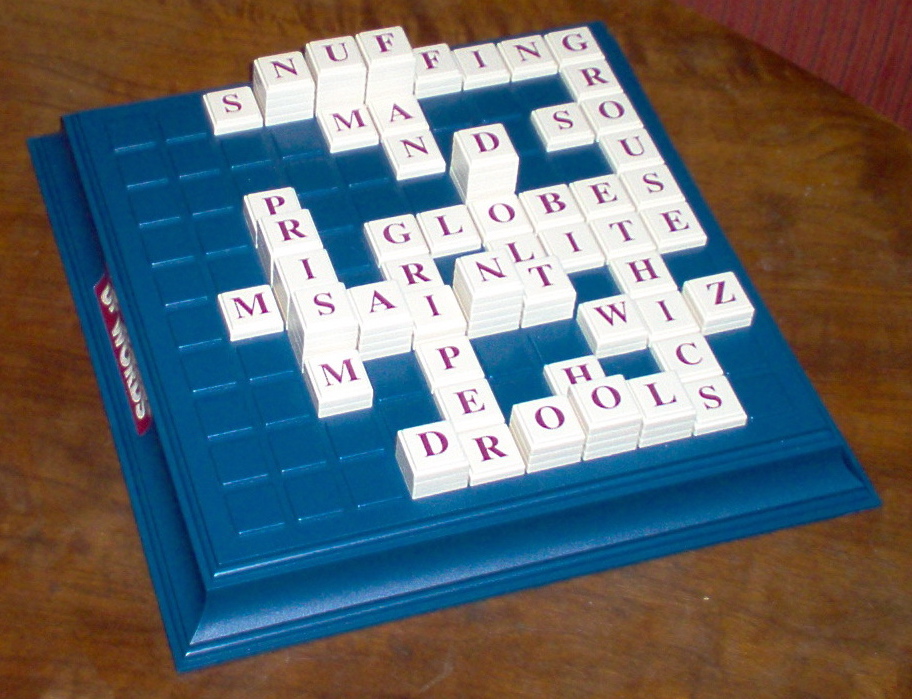
Upwords board and tiles
Other namesCrucimaster
Topword
Scrabble Upwords
DesignersElliot Rudell
PublishersMilton Bradley
Spin Master
Publication1982; 43 years ago (1982)
Years active1982–?
Genresboard game
LanguagesEnglish
Players2 to 4
Setup time< 2 min
Playing time45 to 90 minutes
ChanceMedium
Age range10+
SkillsMathematics, strategy, vocabulary
Websitespinmaster.com/upwords
Related games
Scrabble

Upwords is a board game. It was originally manufactured and marketed by the Milton Bradley Company, then a division of Hasbro. It has been marketed under its own name and also as Scrabble Upwords in the United States and Canada, and Topwords, Crucimaster, Betutorony, Palabras Arriba and Stapelwoord in other countries. It is currently available as a board game and a digital gaming app.

Upwords is a letter tile word game similar to Scrabble, with players building words using letter tiles on a gridded game board. Unlike Scrabble, in Upwords letters can be stacked on top of existing words to create new words. Scoring is determined by the number of letter tiles, including tiles in a stack, in a new word.

History

[edit]

Upwords was originally played on an 8×8 square board, with 64 letter tiles. Hasbro Europe later expanded the gameboard to a 10×10 matrix and 100 tiles, to accommodate the longer words frequently used in other languages such as German and Dutch. The 10×10 matrix is currently employed in worldwide versions of the game, with the "classic" 8×8 version also available.

Gameplay

[edit]

To determine play sequence, each player draws a tile; the player with the letter nearest to A will be the first to play. The tiles are returned to the draw pile.

Each player draws seven tiles to start the game. The first player forms a word with one or more of their tiles, and must place it so that the tiles cover at least one of the four central squares (e5, e6, f5, or f6). The player then draws more tiles to replace those played. Play continues clockwise.

Subsequent players may put tiles on the board adjacent to and/or on top of the tiles already played, as long as all words formed are found in the dictionary being used and the rules below are followed. All words must read horizontally from left to right, or vertically from top to bottom.

All tiles played on a turn must form part of one continuous straight line of tiles across or down.

For example, if the word CATER is on the board, a player could put a B and E in front of CATER and then put an L on top of the C and a D on top of the R to build BELATED.

Restrictions on words are as follows:

  • No proper nouns
  • No hyphenated words
  • No words requiring an apostrophe
  • No abbreviations or symbols
  • No prefixes or suffixes which cannot stand alone
  • No foreign words unless they are in the dictionary
  • Players may not pluralize a word simply by adding an S at its end. However, such a play is allowed if the S is part of another complete word that is played onto the board in the same turn. This rule is intended to prevent players from capitalizing on one another's words without changing them or playing new ones.

Restrictions on stacking tiles are as follows:

  • No stack may be more than five tiles high
  • No tile may be stacked directly onto a duplicate of itself
  • At least one tile or stack must be left unchanged; a player may not cover every letter in a word on a single turn.

A player may choose to pass at any time, or discard one tile and draw a replacement instead of playing. Once the draw pile is exhausted, the game ends when any player runs out of tiles, or every player passes in a single round. In some versions of the game it doesn't end when a player runs out of tiles, only when all pass or all the tiles are played.

Scoring

[edit]

Any word with no stacked letters scores two points per tile, while a word containing stacked letters scores one point for every tile it contains. In the CATER/BELATED example above, CATER would score 10 points, while BELATED would score nine. Two bonus points are awarded for using the "Qu" tile in a one-level word, and 20 for using all seven tiles in one turn. If changing two words at once, both words must be legal.

Players lose five points for every unused tile they hold at the end of the game.

Letter distribution

[edit]

The letter distribution of the 8×8 version of Upwords is as follows:[1]

64 tiles:

1 of each: F, J, K, Qu, V, W, X, Z

2 of each: B, C, G, H, R, Y

3 of each: D, L, M, N, P, S, U

4 of each: I, O, T

5 of each: A

6 of each: E

The letter distribution of the 10×10 version is as follows:[1]

100 tiles:

1 of each: J, Qu, V, X, Z

2 of each: K, W, Y

3 of each: B, F, G, H, P

4 of each: C

5 of each: D, L, M, N, R, T, U

6 of each: S

7 of each: A, I, O

8 of each: E

Electronic versions

[edit]

In the early 1990s, Hasbro licensed electronic marketing rights to Microsoft, briefly making the game available electronically. Microsoft no longer has rights to Upwords.

An app was released under license for iOS devices in 2013, with an Android version following in 2014.

Reviews

[edit]
  • Family Games: The 100 Best[2]

References

[edit]
[edit]
Revisions and contributorsEdit on WikipediaRead on Wikipedia
from Grokipedia
Upwords is a three-dimensional word-building invented by Elliot Rudell in the late 1970s and first published in 1983 by the (acquired by in 1984). In this game for 2 to 4 players aged 8 and up, participants take turns forming or modifying words by placing plastic letter tiles on an 8x8 game board either horizontally and vertically in a single layer or by stacking them up to five tiles high atop existing letters, with scoring determined by the length of words formed and the height of stacks created. The game's innovative stacking mechanic, inspired by elements of Sid Sackson's earlier game Domination, allows players to build vertically to change words—such as stacking letters on "CAT" to form ""—adding a strategic layer beyond traditional flat word placement seen in games like . Rudell's , initially rejected by , was refined after feedback from Milton Bradley executive , leading to rules like a five-tile stack limit and double points for flat words; upon release, it exceeded expectations by selling 650,000 units in its first year against a projected 250,000. Subsequent editions have been produced by through the and early , with Winning Moves issuing a version in 2015 featuring 64 tiles and simplified scoring (1 point per letter in stacks, 2 points for flat words, plus bonuses for using all tiles or the "Qu" tile). As of 2023, holds publishing rights, offering updated versions with a rotating board for easier access and support for up to 6 players in some variants, maintaining its appeal as an educational tool for vocabulary building while emphasizing quick turns and high-stacking excitement; the game has sold over 10 million units worldwide.

History and Development

Invention

Upwords was invented by Elliot Rudell, a toy designer who began his career at before establishing himself as an independent inventor. In the late , Rudell developed the game as a response to the limitations of flat word-building games, prototyping initial versions using cardboard letter tiles from a prior project. The concept drew inspiration from Scrabble-like mechanics for letter-based word formation but innovated by allowing players to stack tiles vertically, enabling the construction of new words atop existing ones to accelerate gameplay and minimize required board space compared to traditional horizontal-only layouts. A pivotal influence came from observing Sid Sackson's Domination, a game featuring stackable hemispheres, which sparked Rudell's idea to apply three-dimensional building to . Rudell first pitched the prototype to , where it was rejected, before licensing it to in the late 1970s; feedback from executive highlighted the need to balance vertical stacking with horizontal play to avoid overemphasizing height. This led to refinements ensuring faster turns and more dynamic interactions while maintaining accessibility. Key innovations included limiting stack height to five tiles to prevent physical instability during play and to promote without excessive complexity. Scoring was balanced by awarding height multipliers for stacked words alongside double points for flat (non-stacked) formations, encouraging varied building strategies. The stacking mechanic received formal protection under U.S. 4,776,597, filed on October 29, 1982, and issued on October 11, 1988, to Elliot A. Rudell for a "game board and playing pieces" design.

Publication History

Upwords was initially published by the in 1982 as a family designed by Elliot Rudell. Following Hasbro's acquisition of in 1984, the game continued under Hasbro's publishing umbrella, with editions released through subsidiaries including in 2002. In the , licensing agreements expanded distribution, notably with Winning Moves Games producing "new classic" editions starting around 2016. Spin became the primary publisher around 2015, issuing updated including a 2023 edition with a rotating board. Re-releases in the and beyond introduced variations such as a 10x10 board size in select international and deluxe editions, expanding from the original 8x8 grid.

Game Components

Board and Tiles

The core components of Upwords consist of a grid-based board and a collection of stackable letter tiles designed for three-dimensional word construction. The original 1982 edition featured an grid board with 64 squares, providing a compact playing surface suitable for 2 to 4 players. Some later editions, such as those from , use a 10x10 grid with 100 squares, allowing for more dynamic and prolonged without altering the fundamental mechanics, while others like the Winning Moves version retain the board. The letter tiles number 64 in original and some later sets (such as Winning Moves) or 100 in expanded editions (such as Spin Master), each formed as approximately 1-inch square pieces crafted from plastic with raised edges that facilitate secure interlocking during stacking. These tiles enable vertical building up to a maximum of five levels high, ensuring structural integrity even at full height, and the board itself features a plain grid without premium scoring squares akin to those in Scrabble. Early editions employed a wood-like plastic material for the tiles, imparting a sturdy, textured quality, while modern versions utilize lightweight, durable polymer to enhance portability and resistance to wear. Tile colors vary across editions for aesthetic and functional distinction; for instance, base-layer tiles are often white or cream, with upper stacks in multi-hued variants such as brown, tan, or gray to highlight elevation differences. This design supports the game's emphasis on layered , where the letter distribution on tiles influences available options during play.

Accessories

The standard Upwords set includes four plastic tile racks, which allow participants to hold their drawn letters concealed from opponents during play; recent editions from support up to 6 players, though with 4 racks. A cloth bag is provided to contain the letter tiles, facilitating random draws at the start and throughout the . An instruction sheet or rule booklet accompanies the set, outlining setup, gameplay, and scoring rules. Tile racks are briefly used during setup, where players draw seven tiles and stand them upright in their individual racks. Optional accessories, not included in the core set, can enhance gameplay; for instance, score pads are commonly recommended for tracking points across multiple rounds, as the game itself lacks built-in scoring tools. Some editions incorporate a rotating board for easier access. Edition-specific additions appear in travel-oriented releases, such as the Pack & Go variant, which features a compact, folding board for portability without a dedicated carrying case but designed for easy storage and transport. Upwords is compatible with official word lists like the (OSPD) for validating plays, though no physical reference is included in any edition. For maintenance, deluxe or replacement sets may include additional tile racks or trays to aid in sorting and redistributing letters after games, simplifying setup for repeated play.

Rules and Mechanics

Setup and Objective

Upwords is designed for 2 to 4 players, aged 8 and up. To prepare the game, place the gameboard—an 8×8 grid in the original edition or a 10×10 grid in later versions—in the center of the table for all players to access. Each player receives a tile rack to hold their letters. All letter tiles are turned face down, mixed thoroughly, and placed into the provided bag to form the draw pile; the original edition uses 64 tiles, while expanded versions use 100. Starting with the first player, each participant draws 7 tiles and places them upright in their rack, keeping them hidden from opponents. The starting player is determined by each participant drawing one tile from the bag; the player with the tile closest to the letter "A" goes first, after which all tiles are returned to the bag and reshuffled, with play proceeding clockwise. The objective is to score the most points by forming valid words on the board, either horizontally or vertically, and by stacking additional letters atop existing ones to create new words or modify prior ones, thereby increasing point values through height. The game concludes when the draw bag is depleted and no further moves are possible, with final scores calculated accordingly.

Turn Sequence

On a player's turn, they must either play one or more letter tiles from their rack to form or modify words on the board, exchange one tile from their rack, or pass their turn. All actions occur in a single line either horizontally (across) or vertically (down), and no play can extend beyond the board's edges. After successfully playing tiles, the player draws new tiles from the bag to refill their rack back to seven tiles; exchanging or passing does not allow drawing additional tiles. To play tiles, a player places them adjacent to existing words on the board or, for the first play of the game, on the blank board covering at least one of the four central premium squares. can be placed flat to extend words horizontally or vertically, or stacked vertically on top of existing to modify words by changing the visible top layer, which forms the new word. For instance, if the word "MOOD" is on the board, stacking a "W" on the "M" alters the top layer to read "WOOD," provided "WOOD" is a valid word. Stacking is limited to one new per stack per turn, and no more than five total per stack; additionally, a player cannot stack a letter directly on the same letter (e.g., "A" on "A"), and at least one letter from any modified word must remain uncovered. All words formed or modified by the play must be valid. Valid words must be standard English words found in a common , excluding proper nouns, abbreviations, acronyms, hyphenated terms, words with apostrophes, standalone prefixes or suffixes, or foreign words unless accepted in the . Players cannot simply add an "S" to an existing word to form a without creating a connected valid word. Before the next player begins their turn, any opponent may challenge a played word; if deemed invalid upon verification, the tiles are removed from the board, the points are deducted, and the player must either replay or pass their turn. Successful challenges have no penalty, but unsuccessful ones may vary by house rules, though official play does not specify a penalty. Instead of playing, a player may exchange one tile by placing it face down into the tile bag, drawing a replacement, and shuffling the exchanged tile back in, effectively ending their turn with the same number of tiles. Alternatively, a player may pass their turn entirely without playing or exchanging, which can be strategic, especially late in the game when waiting for better opportunities; consecutive passes by all players can contribute to ending the game, though this is detailed elsewhere. Higher stack heights during plays increase scoring potential by counting all tiles beneath the top letters.

End of Game

The game concludes under several specific conditions outlined in the official rules. Primarily, it ends when the draw pile is empty and one player uses all their letter tiles. Alternatively, the game terminates if no player can form a valid word and all players consecutively pass their turns. Upon reaching the end of the game, players calculate their final scores by subtracting penalties for any unused tiles remaining on their racks. Each unplayed letter tile deducts 5 points from the player's total score, regardless of the tile's individual letter value. This penalty encourages strategic play to minimize leftover tiles. Modern versions standardize the 5-point deduction. The winner is determined by the player with the highest total score after applying all bonuses, points from words formed, and penalties for unused tiles. If scores are tied, the rules do not specify a formal , though house rules may favor the player who formed the longest word during the game. In variant play, such as solo mode, the game follows similar termination conditions but ends with a personal high-score comparison rather than competition, without inter-player penalties. Timed variants, occasionally used in casual settings, may conclude after a fixed number of rounds to accommodate quicker sessions, though this is not part of the core rules.

Scoring System

Basic Points

In Upwords, the basic scoring for a newly formed word depends on whether it is constructed entirely at a single tile height or incorporates any stacked tiles. For words formed without any stacking—all tiles placed flat on the board—each tile in the word scores 2 points. For example, the four-letter word "DEAR" placed flat would score 8 points (4 tiles × 2 points each). If a word includes any stacked tiles (two or more levels high at one or more positions), the scoring shifts to 1 point per tile across the entire word, with the total tile count encompassing every layer beneath each letter, including those covered by stacks. This base calculation rewards height by adding points for each underlying tile contributed to the word's structure. For instance, the word "WOOD" with a single tile stacked under the "W" totals 5 tiles (the 4 surface letters plus 1 stacked tile), scoring 5 points. Stacks may reach up to five tiles high, thereby increasing the potential tile count and score for taller constructions. This system ensures that stacking not only allows for creative word-building but also directly enhances the word's value through additional counted tiles, with the height at each position effectively adding 1 point per level above the base (up to the maximum stack limit). Multiple words formed in a single turn are scored individually, but shared tiles or stacks contribute to the calculations for all affected words.

Bonuses and Penalties

A player earns 20 bonus points for using all 7 tiles from their rack in a single turn. Additionally, using the "Qu" tile in a flat word (one tile high) awards 2 extra bonus points. During challenges, a player may challenge an opponent's word before the next turn. If the challenge succeeds and the word is invalid, the tiles are removed from the board, and the opponent loses their turn. If the challenge fails, the play stands with no penalty to the challenger. At the end of the game, players deduct 5 points for each unused tile remaining on their racks from their total score, which discourages hoarding letters and promotes efficient play. Unlike , Upwords eschews triple word scores or other board-based multipliers, focusing instead on stacking mechanics to generate higher scores through vertical builds rather than positional premiums.

Letter Distribution

Tile Counts

The Upwords game set consists of 100 letter tiles, distributed according to frequencies but adjusted to support the game's stacking , which encourage frequent and rebuilding. This distribution prioritizes more common letters to increase the likelihood of playable words during turns, where players draw from a shared pool. There are no blank or wild tiles in the set, distinguishing Upwords from games like . The exact tile counts per letter are as follows:
LetterCount
A7
B3
C4
D5
E8
F3
G3
H3
I7
J1
K2
L5
M5
N5
O7
P3
Qu1
R5
S6
T5
U5
V1
W2
X1
Y2
Z1
This setup totals 100 tiles, with the "Qu" tile serving as a single unit for the letter combination. The abundance of vowels and frequent consonants, such as the 8 E tiles and 7 each of A, I, and O, impacts gameplay probability by making it easier to form valid words, especially when stacking on existing letters during setup draws or turns. This distribution is for the 100-tile set used in the edition (as of 2023) with a 10x10 board. Earlier 8x8 board variants, such as the 2015 Winning Moves edition, use 64 tiles with a proportionally adjusted distribution. There are no joker tiles or premium scoring tiles integrated into the distribution.

Letter Values

In Upwords, all letter tiles are assigned a uniform base point value, unlike Scrabble's variable system, which simplifies scoring to emphasize and . Each tile scores 2 points when part of a word formed entirely at the base level with no stacking involved. However, if any stacking occurs in the word (two or more tiles high), every tile in the word—including the new letters placed and all tiles beneath them—scores 1 point instead. This consistent valuation across all letters eliminates complexities like premium letter squares, allowing players to prioritize building vertical stacks up to five high for higher tile counts and thus greater scores. The topmost tile in any stack is visible for word validation, while covered lower still fully contribute to the total score; however, stacking rules require that at least one letter from any preexisting word remains partially visible to avoid invalidating prior plays. These letter values have been fixed since the game's original 1981 release by , with no modifications in subsequent editions.

Adaptations and Variants

Electronic Versions

The primary electronic adaptations of Upwords are mobile applications available for and Android devices. The version was released in 2013, followed by the Android version in 2014, both developed by Lonely Star Software, Inc., in collaboration with Rudell Design, LLC, the original game's designer. These apps faithfully recreate the core stacking mechanics of the , allowing players to form and modify words by placing letters across, down, or atop existing tiles on a digital 10x10 grid. Key features include touch-based controls for intuitive letter stacking, automatic scoring to track points based on word length and stack height, and built-in tutorials to guide new players through the rules. The apps offer multiple play modes, such as single-player against AI opponents adjustable across four difficulty levels, pass-and-play for local multiplayer on one device, and online matchmaking for real-time games with friends or random opponents, complete with in-game chat functionality. No external is required, as the app validates words internally. Spin Master, the current licensee for Upwords, oversees the game's branding in these digital formats, ensuring alignment with the physical edition's gameplay. The apps have received regular updates for performance enhancements and bug fixes, with the most recent versions available as of October 2025. By late 2025, the Android app had surpassed 100,000 downloads, while the version boasted over 8,700 ratings averaging 4.7 out of 5, indicating strong user engagement across platforms.

Board Size and Variants

The original 1981 invention and 1982 release of Upwords utilized an 8x8 game board, which supported faster-paced games with fewer spaces for word placement compared to later iterations. Later editions, such as the 1997 version, expanded the standard board size to 10x10, continuing in most subsequent and versions, enabling greater strategic complexity through additional grid spaces and higher potential for stacking. Travel variants, such as the Upwords Pack & Go edition introduced in the , incorporate a compact, folding board to facilitate portable play while preserving the core rules of word formation and stacking. Official rulebooks from publishers like Winning Moves and include suggestions for house rules, such as adapting play for teams by alternating moves within groups or incorporating timed rounds to accelerate turns and heighten competition.

Reception

Critical Reviews

Upon its release in the early 1980s, Upwords was praised for its innovative stacking mechanic that introduced a three-dimensional layer to word-building gameplay, distinguishing it from traditional games like . In modern assessments, Upwords holds an average rating of 5.8 out of 10 on , based on 3,550 user ratings as of November 2025, with reviewers frequently commending its accessibility for beginners and quicker pace compared to , while noting criticisms of scoring imbalance in prolonged sessions due to escalating stack heights. On Amazon, the game earns a 4.7 out of 5 stars from 2,685 customer ratings, often highlighted for its family-friendly design and straightforward rules that appeal to players of varying ages. Expert critiques have similarly emphasized its engaging twist on classic . A 2006 GameSpot review of the digital Upwords Deluxe adaptation described the stacking system as a compelling evolution that encourages strategic vertical building, recommending it for fans seeking a dynamic alternative to flat-board word puzzles. Reviews in family-oriented contexts, such as those on educational activity sites, have lauded Upwords for promoting vocabulary expansion and spatial reasoning in a lighthearted format suitable for children and adults alike. Upwords received a nomination for the 2004 Gra Roku (Game of the Year) award in Poland, recognizing its creative mechanics among contemporary board games. No significant declines in critical reception have been noted over time, with the game's core appeal enduring in updated editions, including positive feedback for the 2023 Spin Master edition's rotating board and expanded player support up to six.

Player Opinions and Legacy

Players have long praised Upwords for its innovative stacking mechanics, which allow for creative word-building by overlaying letters on existing plays, adding a layer of strategic depth absent in traditional flat-grid games like . Reviewers note that the uniform one-point value per tile reduces reliance on luck from high-value letters, emphasizing tile management and instead, making it more accessible yet challenging for word enthusiasts. This design fosters replayability, with sessions typically lasting 40 to 90 minutes, ideal for engaging family or group play without dragging on. The game's popularity as a steady seller in the word game category stems from its enduring print presence since its 1982 debut, maintaining relevance through multiple editions by publishers like and . A resurgence in the 2020s has been driven by digital adaptations, including a well-received released in 2013, which has amassed thousands of downloads and high user ratings for its faithful recreation of the stacking . This electronic version enhances , enabling solo practice, online multiplayer, and quick sessions on the go. Upwords has found a niche in educational settings, where it supports expansion and by encouraging players to manipulate words dynamically—such as transforming "" into "tames" through stacking—while integrating spatial reasoning skills. Teachers and parents use it to "trick" children into learning, as the game's competitive yet collaborative motivates of new terms and letter combinations without feeling like formal instruction. Culturally, Upwords remains a staple of game nights, promoting bonding through its simple rules and high-stakes that appeals across generations. Its influence extends to the broader landscape, where the stacking innovation has echoed in faster-paced titles like , contributing to a legacy of evolving mechanics in the genre. With over four decades in print, Upwords exemplifies timeless appeal in tabletop gaming, blending , strategy, and fun.

References

Add your contribution
Related Hubs
User Avatar
No comments yet.