Hubbry Logo
Stretch ArmstrongStretch ArmstrongMain
Open search
Stretch Armstrong
Community hub
Stretch Armstrong
logo
8 pages, 0 posts
0 subscribers
Be the first to start a discussion here.
Stretch Armstrong
Stretch Armstrong
from Wikipedia

Stretch Armstrong


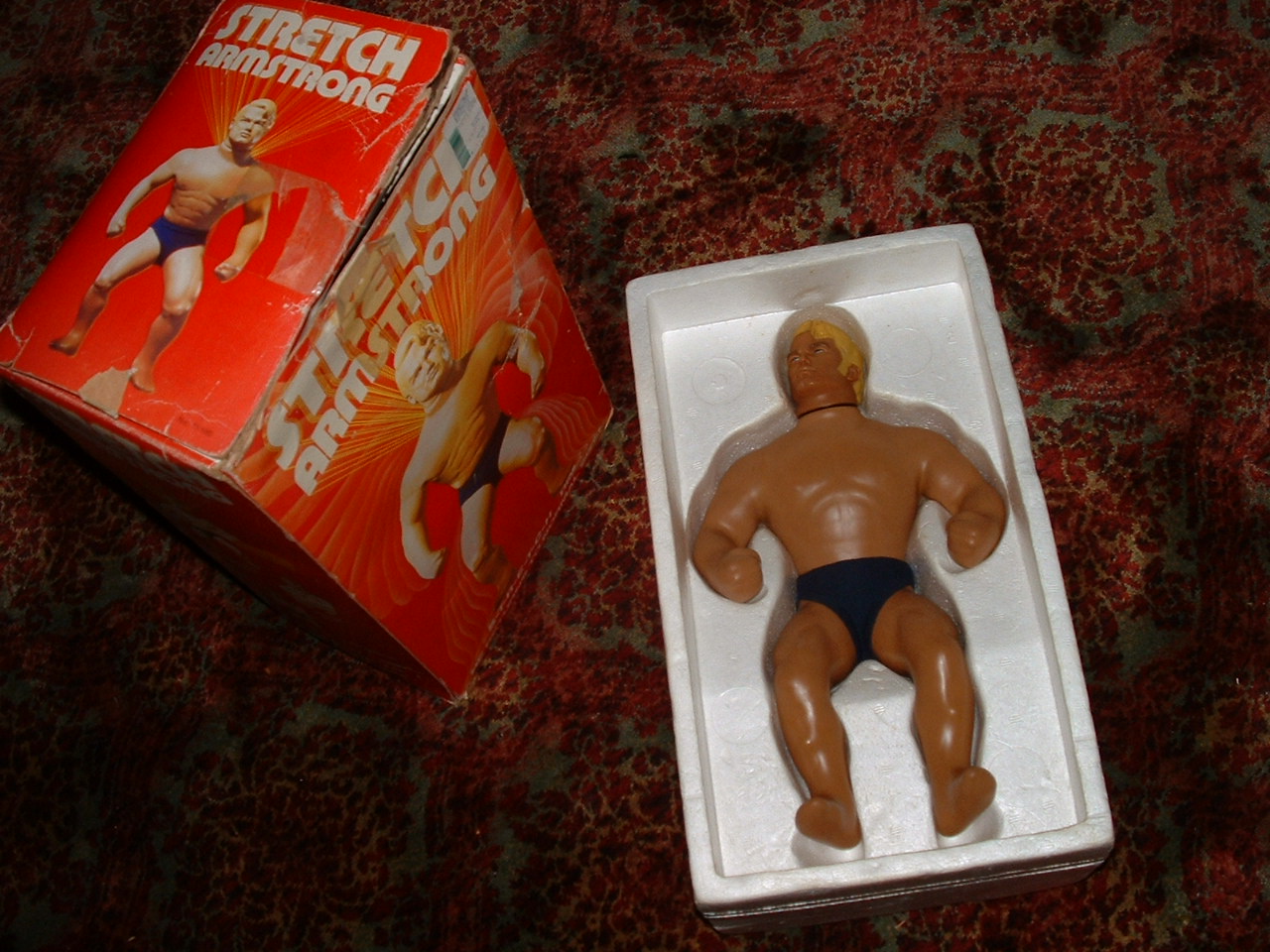
Vintage figure and packaging
TypeAction figure
Invented byJesse D. Horowitz [1]
Company
CountryUnited States
Availability1976–2016–present
MaterialsPlastic, rubber and gel

Stretch Armstrong is a large, gel-filled action figure that was first sold in 1976 by Kenner.[2]

It looks like a short muscular man with blond hair wearing black trunks, but can be stretched from its normal size of about 15 inches (38 cm) to four to five feet (120 to 150 cm).

The doll is made of latex rubber filled with a proprietary gelled substance similar to corn syrup, which allows it to retain shape for a short time before shrinking to its original shape. Tears can be fixed with an adhesive bandage, according to an instruction booklet included with the box.

In 2016, at the New York Toy Fair, Hasbro announced the return of the Stretch Armstrong toy in its original 1976 design.

In 2015, Hasbro gave the license for Stretch Armstrong to Character Options, which began releasing new products in 2016.[3] In 2023, Character Options announced plans to expand the brand until 2024. The plans included launching the original toy under the name "The Original Stretch Armstrong" and creating a "Stretch" brand to create crossover products with brands such as Star Wars and Transformers. [4]

In 2025, Basic Fun! acquired a license from Hasbro to manufacture and distribute products based on Stretch Armstrong and Vac-Man, including classic and reimagined versions of the characters, as well as partnering with other entertainment brands to launch new licensed products inspired by the Stretch Armstrong toy.[5]

History

[edit]

The Stretch Armstrong toy concept was created by Jesse D. Horowitz,[1] the industrial designer for Kenner's R&D group. The idea was approved for development by the head of R&D, Jeep (James) Kuhn, vice president of Kenner.

The "stretch man" idea as it was called was pursued with two different bodies in mind. One was a sumo wrestler and the other was an All-American blond hunk. Horowitz sculpted the models himself instead of hiring a freelancer. The sumo man was too bulky and large, so the All-American body was cast by Kenner's model maker Richard Dobek, and the resultant resin model was taken to a latex doll manufacturer in New Jersey, where the first bodies were dipped.

Originally, springs were thought of as the way to stretch the man. However, they were thought to be too awkward and stiff, too difficult to insert and would likely pierce the skin. Kuhn, a chemical engineer, pursued a liquid sugar idea which eventually proved successful. Tremendous quantities of Karo corn syrup were purchased from an A&P supermarket[citation needed]. The syrup was boiled down to get the proper viscosity. Kuhn and Horowitz flew to Kenner's headquarters in Cincinnati, Ohio, and presented the concept to Bernie Loomis, Kenner's president. He loved it and a toy icon was born.

The original Stretch Armstrong figure was conceived and developed by Bill Armasmith, and was in production from 1976 until 1980.[citation needed] Denys Fisher manufactured and released the figure in Europe, under license from Kenner.[6] The original 1970s toy commands high prices on the secondary collectors' market, selling for hundreds, perhaps thousands, of US dollars.[citation needed] Through storage and play, the figure could become damaged and rendered useless. There are still original Stretch Armstrongs that have survived the passing of time and are remarkably preserved through sheer luck or being stored at the correct temperature.[citation needed] The figure keeps best at room temperature.[citation needed]

Stretch Armstrong is made of latex rubber filled with gelled corn syrup, which allows it to retain shape for a short time before shrinking to its original shape.[7]

Similar releases

[edit]
Stretch Armstrong ad

An estimated 67 different versions from Japan, Germany, Italy, France, Australia, and other countries released Stretch Armstrong variations between 1976 and the 1990s.[8]

  • Stretch X-Ray (1977), had an oversized exposed brain and an alien-looking face with a transparent form that showed its internal organs which were lungs, an intestinal system and what appears to be a heart. This version was re-released.
  • Harbert Sport Mister Muscolo, 1977 Italian version of Stretch Armstrong[9]
  • Lili Ledy El Hombre Elastico, Mexican version of Stretch Armstrong[9]
  • Tsukuda Mr. X, Japanese version of Stretch Armstrong[9]
  • Stretch Monster, a reptilian green nemesis released by Kenner in 1978
  • Harbert Sport Mister Mostro, Italian version of Stretch Monster[9]
  • Tsukuda Stretch Monster, Japanese version[9]
  • Stretch Ollie and Stretch Olivia, male and female octopuses (colored blue and pink, respectively) which had the same face shape but the only difference was their color. Kenner issued both weeks apart but Ollie was more popular.[citation needed] The Denys Fisher UK toy company issued Ollie and Olivia in smaller boxes than their American counterparts, saving on shelf space. The figures are rare to come by now.
  • Denys Fisher Stretch Incredible Hulk (1979) This figure used the original Stretch Armstrong molds and graphics without permission, and was discontinued due to a lawsuit from Kenner in 1980.[6]
  • Mego Elastic Donald Duck (1980)[9]
  • Mego Elastic Mickey Mouse (1980)
  • Mego Elastic Batman[9]
  • Mego Elastic Incredible Hulk (1979)[6][9]
  • Mego Elastic Plastic Man (1979)[9]
  • Kenner Stretch Serpent[9]
  • Cap Toys Fetch Armstrong, Stretch Armstrong's pliable canine counterpart, released in the early 1990s
  • Kenner/Hasbro Super Stretch Mask[9]
  • Cap Toys Stretch Vac-Man
  • ToyQuest Super Morphman
  • Super Impulse Gumby and Pokey Stretch

The last two were filled with a granular solid in place of the viscous liquid found in the other figures. A vacuum pump, which attached to the heads of these figures, removed the air from within, which "froze" the toy in its stretched position.[7]

Stretch Armstrong was reissued in the 1990s by Cap Toys, with a canine sidekick, "Fetch Armstrong".[2][10] The reissue stretch Armstrong had a more comical exaggerated face (a huge genial smile) and had on a vanity T-shirt and shorts. This new reissue figure was introduced in 1993 and 1994 version exist with slightly different art work. He also has an evil brother named Evil X-ray Wretch Armstrong who has a skull face, sports a mohawk, and also stretches. Wretch Armstrong seems to be a redesigned, smaller remake of Stretch X-Ray but in reality looks nothing like the 1970s version. Evil X-ray Wretch Armstrong is only 7 inches tall whereas Stretch X-ray was over 12 inches tall.

Adaptations

[edit]

Cancelled film

[edit]

In 1994, Walt Disney Studios obtained the film rights to the character, with Caravan Pictures producing.[11] Several scripts were written, including an early version family comedy written by Greg Erb, a co-writer at Disney. The script which cast Tim Allen in the role of Stretch Armstrong as a "kind of single dad who is a research scientist" and is "stretched too thin" trying to balance his work and family life before he inadvertently accidentally takes one of his experimental serums giving himself "stretchy powers". A later version from screenwriter Michael Kalesniko was created and it was set in San Francisco. It was about a somewhat socially awkward nobody beset with troubles trying to venture out his failing personal life. He is then genetically modified with stretching abilities after a failed nuclear fusion experiment and must use his newfound abilities to solve the tragedy that has befallen his family. Among the actors who were considered for the role was Danny DeVito, who refused to do the film if the script made any jokes about his height. Several other writers, such as Mike Werb and Michael Colleary, provided rewrites, and Peter Care was attached to direct,[12] but due to lack of time on the rights, both ideas from Disney were scrapped and the rights were bought up by Hasbro.[13]

In 2008, Universal Studios signed a deal with Hasbro to create another film based on Stretch Armstrong from a screenplay written by Nicholas Stoller.[14]

It was announced from the studios co-chairman Donna Langley that Taylor Lautner would star as Armstrong and that the film would be in 3-D. She stated that "with Lautner's success energy and athleticism he is a perfect fit to a unlikely hero." Producer Brian Grazer stated "Stretch Armstrong is a character I have wanted to see on screen for a long time ... It’s a story about a guy stretching ... the limits of what is possible to become all that he can be."[15][16] Another script was being made by writer Steve Oedekerk introducing the character in the form of an uptight spy who stumbles across a stretching formula, which he takes and now must adjust to his newfound abilities when fighting crime and in his everyday life.

Two years later, after the excitement drummed up by the Studios ideas for the character, Relativity Media announced that they had picked up the film after it was dropped by Universal and set a new release date of April 11, 2014.[17] Planning to make the film more serious than originally intended by Universal, Relativity hired The Manchurian Candidate writer Dean Georgaris to write a new script,[18] dropped Lautner, and hired Breck Eisner to direct.[19] The film origin story was going to introduce an overwhelmed high schooler and the life-or-death consequences he was going to face after undergoing a transformation granting him superhuman abilities. Production was scheduled to start filming on May 15, 2013, in Montreal but by October 2013, both the studio and Hasbro had abandoned the film to work on other projects.[20]

Television

[edit]

After four attempted films for Stretch Armstrong, Hasbro Studios made a deal with the video streaming service website Netflix where the property was picked up for a full 26-episode animated series, making it the first deal between the company and the streaming service. This superhero action/comedy animated series followed a teenager named Jake Armstrong and his two best friends as they go into action after being exposed to an experimental chemical making them Stretch Armstrong and the Flex Fighters—a team of stretchable superheroes who must work together and embark on a series of adventures. The series debuted on Netflix on November 17, 2017.[21]

The series was developed by Kevin Burke, Victor Cook, and Chris "Doc" Wyatt. Burke and Wyatt also wrote a tie-in comic book for IDW Publishing.[22] The first 13 episodes of the 26-episode first season were released on Netflix on November 17, 2017.

Comics

[edit]

A similar concept with Stretch as a superhero was also shown in a one-off comic produced by Hasbro in 2011 dubbed Unit:E; there, the descendant of Acroyear and a Biotron (both from Micronauts) and Synergy (from Jem; here an alien artificial intelligence) conducted reconnaissance on heroes from Earth and beyond (including characters from G.I. Joe, Transformers, MASK, Battleship Galaxies, Action Man, and even Candy Land) to help fight against Baron Karza (the enemy of the Micronauts).

In September 2017, IDW Publishing announced a new comic book based on the Netflix series Stretch Armstrong and the Flex Fighters for January 2018.[23]

Video game

[edit]

In 2018, an interactive special called Stretch Armstrong: The Breakout was released on Netflix. It is set in the universe of the Flex Fighters series and involves Jake Armstrong, Ricardo and Nathan stopping villains from rampaging through Charter City.[24]

References

[edit]
Revisions and contributorsEdit on WikipediaRead on Wikipedia
from Grokipedia
Stretch Armstrong is a gel-filled, latex rubber toy designed to be stretched, twisted, and pulled up to four times its original 15-inch size before snapping back to its muscular, superhero-like form. Introduced in 1976 by , the toy was conceived by design director Jesse Horowitz in 1974 as a durable, interactive plaything filled with a proprietary gelled mixture to enable its elastic properties. Kenner, founded in 1947 and known for innovative toys like the , produced Stretch Armstrong until 1980, during which it became a sensation, generating over $50 million in sales during its initial production run from 1976 to 1980 and captivating children with its indestructible appeal. The figure's design featured a painted face with a determined expression, red trunks, and flesh-toned limbs, often pitted against a villainous counterpart, Stretch Monster, in imaginative battles. Kenner was acquired by Corporation in 1987, and subsequently, was purchased by , Inc. in 1991, transferring ownership of the Stretch Armstrong brand to , the world's largest toy company. reintroduced the toy in the through its Cap Toys subsidiary, which it acquired in , featuring updated versions like Vac-Man, a vacuum-powered stretching villain. In 2016, licensed the brand to Character Options for a faithful recreation of the original figure, which expanded globally by 2023 with new playsets and international distribution through retailers like Amazon. The toy's cultural impact extended to media adaptations, including multiple unsuccessful live-action film attempts; a 2009 Universal Pictures project directed by Breck Eisner was shelved, followed by a 2012 Relativity Media version that was ultimately canceled in 2014. In 2017, Hasbro and Netflix launched the animated series Stretch Armstrong and the Flex Fighters, a 26-episode action-comedy reimagining the character as teenager Jake Armstrong, who gains stretching powers alongside friends to form a superhero team against villains in Charter City. As of 2025, licensed the brand to Basic Fun! for a new line celebrating its near-50th anniversary, featuring classic recreations of Stretch Armstrong and Vac-Man alongside reimagined multi-scale figures filled with "Power Plasma" gel for enhanced stretching and battling play, available through major retailers. This ongoing evolution underscores Stretch Armstrong's enduring legacy as an iconic symbol of innovation and nostalgic play.

History

Invention and Initial Launch

The concept for Stretch Armstrong originated in 1974 at Kenner Products, where industrial designer Jesse Horowitz proposed a stretchable action figure named "Stretch Man" to replace unsafe spring-based toys with a safer gel-filled design. The invention was patented by chemical engineer James O. Kuhn, Kenner's vice president of research and development, who developed the formula for a high-viscosity gel using boiled corn syrup to allow the figure to stretch up to 300% of its size while slowly returning to shape. Initial prototypes featured a latex rubber exterior molded over the viscous filling, tested extensively to ensure durability and play value, with Kuhn's team refining the mixture to include micro-glass beads for added volume and realism. Stretch Armstrong launched in late 1976 for the holiday season, retailing for approximately $10 and quickly becoming a due to its innovative mechanics. The 15-inch figure, depicting a muscular in red trunks, could extend to four feet in length, twist into knots, and withstand rough play, appealing to children aged 5 and up. It sold over 4 million units in its first season alone. Marketing emphasized its indestructible nature through television commercials and print ads, positioning it as an action hero toy that encouraged imaginative stretching and battling scenarios, complete with 10 fabric bandages for simulated "wounds." The toy's debut generated significant buzz in the late 1970s market, selling millions of units and contributing to over $50 million in revenue for Kenner between and , with strong holiday demand leading to frequent store shortages. Its cultural impact was evident in toy store reports of rapid sell-outs and widespread popularity among boys, establishing it as a defining of the era alongside emerging lines like Star Wars. Kenner became the largest purchaser of during this period to meet production needs, underscoring the toy's commercial scale.

Discontinuation and Revivals

The original Stretch Armstrong toy, produced by Kenner from 1976 to 1979, was discontinued in 1980 primarily due to declining popularity and practical issues with the product's durability; the latex rubber exterior was prone to tearing during play, leading to leaks of the internal gel filler that rendered the figure unusable. Despite these challenges, the initial run achieved significant commercial success, generating over $50 million in sales and selling millions of units, establishing it as one of the top-selling toys of the late . It sold approximately 40,000 units on its first day of release. In 1994, Cap Toys revived the Stretch Armstrong line, licensing the property from (which had acquired Kenner in ) and introducing updated versions featuring the same corn syrup-based gel filler for enhanced stretchability and resilience compared to earlier designs. The revival included various themed figures, such as the villainous Wretch Armstrong and companion Vac-Man, though specific sales figures for this era remain limited; the line contributed to renewed interest in stretchable toys during the mid-1990s before Cap Toys was acquired by in 1997 for $166 million, consolidating ownership under . Hasbro relaunched Stretch Armstrong in 2016, coinciding with the announcement of an animated series, Stretch Armstrong and the Flex Fighters, which reimagined the character as a teenage ; the toy returned in its classic design with updated packaging and limited-edition variants, including mini-figures, achieving moderate success in nostalgic markets but without publicly detailed sales metrics. In a further shift, licensed the Stretch Armstrong brand to Basic Fun! in for a new toy line debuting in fall, featuring multi-scale figures filled with an innovative "Power Plasma" gel that allows stretching up to five times the original size while maintaining shape integrity; this iteration aims to blend retro appeal with modern play mechanics, marking the latest evolution in the franchise's ownership transitions from Kenner to and now to licensed production by Basic Fun!.

Toy Design and Features

Original Construction

The original Stretch Armstrong toy featured a body constructed from a thick, translucent flesh-colored rubber skin that was dip-molded over a pre-stretched filler composed of gelled to achieve the desired and cohesive for stretching and recovery. This elastic skin enclosed a high-viscosity filling designed to flow without separating during extension, enabling the figure to elongate significantly while maintaining structural integrity, with the skin's elastomeric facilitating a snap-back to the original form through internal pressure and cohesive tension. The filler was a gel-like material based on a liquid carrier (such as ) mixed with gelling agents like polyol esters of fatty acids, ensuring constant under typical play conditions and slow recovery to prevent immediate rebound hazards. Measuring approximately 15 inches (38 cm) in height, the toy's compact muscular design incorporated an internal volume that balanced stretchability—up to four times its length—with reliable retraction, supported by the pre-stretched state of the filler during assembly to optimize pressure mechanics. Manufacturing occurred at facilities, where aluminum or ceramic mandrels were used to dip-form the skin, followed by to enhance durability and elasticity against repeated stretching and environmental exposure. Workers filled the limbless body through the neck opening with the mixture under controlled conditions, then sealed it with a vulcanized head and attached pre-molded limbs, ensuring airtight integrity for the pressure-dependent snap-back mechanism. The toy was packaged in a colorful featuring illustrated action poses of the figure in various stretched configurations, prominently displaying the "Stretch Armstrong" branding along with instructions and accessory details like repair bandages. Released in , it complied with contemporary U.S. standards, including certification for non-toxic materials in both the skin and corn syrup-based filler to minimize ingestion or contact risks for children.

Functionality and Play Mechanics

The original Stretch Armstrong toy operates through a gel-filled latex rubber construction that enables significant deformation without permanent damage. When users pull on the figure's arms, legs, or torso, the internal —a mixture similar to dehydrated —displaces within the rubber skin, allowing extension up to four times the toy's original dimensions, such as from approximately 15 inches (38 cm) to 60 inches (152 cm) overall. Upon release, the gel's elastic cause it to flow back into place, returning the figure to its predefined shape. Core play mechanics revolve around interactive manipulation that encourages imaginative superhero scenarios. Children can twist the limbs into knots, stretch the figure to simulate combat poses like battling villains, or snap it back for dynamic action, all while the toy maintains integrity during normal use. These features promote , where the stretchability embodies and resilience. Durability is a key aspect, with the toy designed to endure repeated manipulation, though it has practical limits. Testing and user reports indicate it can handle extensive stretching cycles, but over time, minor wear such as pinholes in the latex may develop, leading to gel leakage that requires patching with adhesive. Common issues arise from excessive force, which can cause tears if the maximum extension is exceeded. Recommended for ages 5 and older, the toy includes guidelines to prevent . Parents are advised against over-stretching beyond specified limits or puncturing the surface, as these actions risk breakage and exposure to the internal , which poses a for younger children. The toy's behavior mirrors the physics of viscoelastic materials, which exhibit both elastic recovery—like a snapping back—and viscous flow, akin to slow-moving honey, allowing temporary deformation followed by reformation without residue strain. In the 2025 revival by Basic Fun!, the figure achieves enhanced extension up to five times its length while retaining these core properties.

Stretch Armstrong Variants

In the 1970s, Kenner produced several spin-off figures based on the original Stretch Armstrong design, expanding the line with antagonistic and thematic counterparts. The Stretch Monster, released in 1977, served as a villainous counterpart to the hero figure, featuring a green-skinned, monstrous appearance with the same gel-filled latex construction allowing for extreme stretching up to four times its normal 15-inch size. This variant was marketed for battling play and was available in major U.S. toy retailers like and Toys "R" Us from 1977 to 1980. Another notable variant was , introduced in 1977, which depicted an alien invader with a transparent body revealing internal organs like lungs and a heart, enabling see-through stretching mechanics while maintaining the core elasticity. It was retailed similarly to the Monster through department stores and had limited production as part of Kenner's short-lived expansion before the line's initial discontinuation in 1980. Kenner also released approximately 67 international variants in countries including , , , , and , adapting the design for local markets. During the 1990s revival under Cap Toys, the Stretch Armstrong line introduced diverse spin-offs emphasizing accessories, outfits, and character archetypes, all utilizing improved gel formulas for enhanced durability and stretch up to five times the figure's length. The Dark Avenger variant, launched in 1995, featured a darker, stealth-themed black-suited figure with weapon accessories like boomerangs, positioning it as an anti-hero counterpart available at mass-market retailers such as and until the mid-1990s. Other editions included the canine Fetch Armstrong (1992), a pliable dog sidekick for companion play, and the Evil X-Ray Wretch Armstrong (1995), a battery-operated villain with a glowing chest light-up feature and translucent elements, both retailed through toy chains with production aligned to Cap Toys' short revival cycle ending around 1996. No phosphorescent gel variants were produced, but these figures emphasized modular outfits like scuba or gear for varied play scenarios. Hasbro's 2010s iterations shifted toward superhero-themed spin-offs tied to the Stretch Armstrong and the Flex Fighters , introducing articulated figures with stretchable limbs and power-specific designs. The Flex Fighters line, debuting in , included variants like the core Stretch Armstrong in a red costume with disc-launching accessories, alongside team members such as Omni-Mass (expanding mass) and (extendable wings), all approximately 6 inches tall. These were widely available at retailers including and Target starting in late , with Hasbro producing millions across the media-tied toy wave, though specific per-variant counts are not publicly detailed. No modular limb system was implemented, but the figures' poseable joints allowed for customizable poses. In 2025, Basic Fun! relaunched the brand with innovative multi-scale variants featuring a proprietary "Power Plasma" gel filling that enables stretching up to five times the original size, twisting, and battle-ready snapping back without leakage, designed for enhanced durability in group play. Available sizes include 7-inch standard, mini 4-inch, and mega 12-inch figures, each with muscular builds and attitude-driven aesthetics like capes or armor accents. Production emphasizes global scalability, with initial runs targeted for major retailers worldwide such as Amazon, , and independent toy stores starting in fall 2025, building on Basic Fun!'s prior mini reproductions but without disclosed exact unit numbers.

Companion and Similar Toys

Kenner released several companion toys to complement Stretch Armstrong, expanding the play experience with similar stretching mechanics. In 1979, the company introduced Vac-Man, a villainous figure designed as Stretch Armstrong's , featuring a vacuum-sealed body that allowed it to be stretched, twisted, and posed by pumping air in and out via a head mechanism. Earlier, in 1978, Kenner launched Ollie the Stretch Octopus, a colorful, gel-filled companion aimed at younger children, which could extend its tentacles up to several times its length for imaginative ocean-themed play. These toys shared the core corn syrup-latex construction of the original Stretch Armstrong, promoting battling and interactive scenarios. Beyond Kenner's lineup, rival manufacturers produced similar stretchable figures that capitalized on the popularity of elastomeric toys in the late 1970s. Mego Corporation's Elastic Heroes series, launched around 1979, included licensed superhero figures like Elastic Hulk, Elastic Spider-Man, and Elastic Batman, which used a comparable gel-filled to stretch arms and legs for dynamic posing and combat simulation. These toys drew legal scrutiny from Kenner, who alleged overlaps in manufacturing techniques, highlighting the competitive fervor in the stretch toy market. Following Stretch Armstrong's discontinuation in due to declining sales and production challenges with the gel filling, competitors filled the void with their own elastomeric offerings. Tyco produced licensed stretch toys, such as elastic figure in the early , which mimicked web-slinging stretches using rubbery limbs. Generic store-brand elastomers, often sold in discount outlets, proliferated as affordable alternatives, featuring unnamed muscular figures or animal shapes that stretched similarly but at lower quality and price points. This diversification sustained consumer interest in stretch play during the gap, preventing the concept from fading entirely and paving the way for revivals. In the , , which acquired the Stretch Armstrong brand in , incorporated elastic elements into broader licensing lines. The Stretch Armstrong and the Flex Fighters series featured stretchable action figures of characters like Jake "Stretch" Armstrong and Ricardo "Omni-Mass" Perez with stretchable limbs on articulated bodies, tying into a animated show and blending the original mechanics with superhero narratives. These releases overlapped with 's other elastic-themed toys, such as stretchable variants in Marvel and Transformers lines, reinforcing the enduring appeal of deformable figures in modern toy markets.

Media Adaptations

Film Developments

In 2008, Universal Pictures entered into a multi-year partnership with Hasbro to develop films based on several toy and game properties, including Stretch Armstrong. The following year, on June 2, 2009, the studio formally announced the live-action feature adaptation of Stretch Armstrong as the first project under this agreement, with a targeted theatrical release of April 15, 2011. The screenplay was penned by Steve Oedekerk, known for his work on Bruce Almighty, and production was overseen by Brian Grazer of Imagine Entertainment alongside Hasbro executives Brian Goldner and Bennett Schneir. The concept centered on a live-action comedy-adventure depicting an overwhelmed high school student who, after a laboratory accident involving experimental chemicals, gains superhuman stretching abilities and becomes a reluctant hero navigating life-or-death challenges while learning to expand his personal limits. Development progressed with casting announcements in early 2010, when was attached to star as the teenage protagonist, positioning the film as a major event release for Universal in 2012. However, the project faced delays, leading CEO to indicate in October 2010 that the release might shift to 2013 to allow for refinements. By January 2012, Universal had abandoned the film amid broader challenges with its slate, prompting to acquire the rights in partnership with and schedule it for April 11, 2014. Under Relativity, director (The Crazies) was brought on board in July 2012 to helm the production, with a revised script by Greg Poirier emphasizing action elements tied to the toy's stretching mechanics. Despite these advancements, Relativity ceased development in 2013, citing financial constraints, and the project entered indefinite limbo without entering production. No further studio attachments or progress have been reported since, confirming its status in as of 2025, with no release date set. Early concepts briefly explored ties to a shared cinematic universe, including potential crossovers with the 2017 animated series Stretch Armstrong and the Flex Fighters.

Television Series

The primary television adaptation of Stretch Armstrong is the animated series Stretch Armstrong and the Flex Fighters, which premiered on on November 17, 2017. Produced by Studios in collaboration with Netflix Animation, the show reimagines the classic toy as part of a modern superhero universe aimed at young audiences. It consists of two seasons totaling 23 episodes, along with an interactive special titled Stretch Armstrong & the Flex Fighters: The Breakout released in March 2018. The series follows teenager Jake Armstrong, who, along with his best friends Nathan Park and Perez, is exposed to an experimental chemical called Flexarium that grants them superhuman abilities. Jake becomes Stretch, capable of elongating his body to extreme lengths, while Nathan transforms into with flight and wing-based powers, and into Omni-Mass, who can alter his size and mass. The trio forms the Flex Fighters to combat villains in the fictional Charter City, balancing their heroic duties with high school life. The voice cast includes as Jake/Stretch, as Nathan/, and Ogie Banks as /Omni-Mass, with additional notable performances by and . Reception to the series was mixed, with praise for its energetic action sequences and themes of but criticism for uneven quality and underdeveloped villains. On IMDb, it holds a 6.2/10 rating from over 400 user reviews, while awarded it 3 out of 5 stars, noting its appeal to fans of lighthearted fare despite some stereotypical elements. The show was closely tied to Hasbro's 2016 relaunch of the Stretch Armstrong toy line, which introduced new figures inspired by the Flex Fighters characters to capitalize on the series' promotion. No additional television projects featuring Stretch Armstrong have been produced since the conclusion of the second season in September 2018. The series shares its Flex Fighters universe with a comic book published by IDW.

Comics and Print Media

In 1992, a 16-page promotional titled The Origin of Stretch Armstrong was published as a licensed by Kenner. The story depicts Stretch Armstrong's journey to find his estranged father, leading to the formation of a crime-fighting team. Only one physical copy is known to exist, making it partially with limited availability. In 2017, announced a comic book tie-in to the Stretch Armstrong and the Flex Fighters, expanding the universe with new adventures for the titular hero and his team. The six-issue , planned in two three-issue arcs, was written by Kevin Burke and "Doc" Wyatt, the creators of the show, and illustrated by Koutsis. Released starting in January 2018, the story "Behold, the Mantoid!" follows the Flex Fighters—Stretch Armstrong, Omni-Mass, and —as they battle the villainous Mantoid and navigate threats in Charter City, sharing thematic elements like team dynamics and Flexarium-powered abilities with the television series. The series introduces expanded character lore, including allies such as the shape-shifting Omni-Mass (Ricardo Perez) and the winged (Nathan Park), alongside villains like the insectoid Mantoid, building on the toy's stretchable concept through dynamic action sequences and moral conflicts. Although only the first three issues were published, culminating in the defeat of the Mantoid, the collected trade paperback edition was released in May 2018, serving as a novelization-style print adaptation of the arc with full-color artwork emphasizing the heroes' elastic transformations. Digital editions were made available alongside physical copies for wider accessibility. Hasbro supported the media expansion with additional print materials in 2017 and 2018, including promotional activity books tied to the Flex Fighters theme, encouraging young readers to engage with puzzles and coloring pages featuring Stretch and his allies. These tie-ins reinforced the brand's revival, focusing on without venturing into new serialized narratives. As of November 2025, no further series or print media announcements have been made for Stretch Armstrong.

Video Games and Digital Media

In 2018, and released "Stretch Armstrong: The Breakout," an interactive special tied to the "Stretch Armstrong and the Flex Fighters" , allowing viewers to make choices that influence the storyline as the Flex Fighters—Stretch, , and Omni-Mass—battle villains in Charter City. This 22-minute episode featured branching narratives with multiple endings, emphasizing puzzle-solving and action sequences inspired by the toy's stretching mechanics. Produced as part of the broader Flex Fighters universe, it received mixed reception, with an IMDb user rating of 6.8 out of 10 based on viewer feedback highlighting its engaging interactivity for younger audiences despite limited replay value. No major console or PC video games featuring Stretch Armstrong have been developed or released by Hasbro or licensed partners. Early rumors in 2011 suggested potential video game adaptations following Mattel's trademark filing, but no projects materialized. An unofficial mobile app titled "Stretch Armstrong Simulator," released in 2018 for Android, offered basic stretching and anti-stress gameplay mimicking the toy but was not affiliated with Hasbro and received low visibility on app stores. Digital tie-ins extended to and online content, including minor (AR) experiences on platforms like in 2018, where users could overlay Stretch Armstrong effects on photos and videos for playful stretching simulations. also saw a surge in toy and challenge videos, contributing to viral trends that boosted the brand's online presence among families and nostalgia enthusiasts. As of 2025, "Stretch Armstrong: The Breakout" has been delisted from following the platform's decision to remove most interactive specials in December 2024, leaving it unavailable for streaming in major regions. No new digital projects, including apps or games, have been announced by , with focus shifting to physical toy relaunches.

References

Add your contribution
Related Hubs
User Avatar
No comments yet.