Recent from talks
Nothing was collected or created yet.
Ut queant laxis
View on Wikipedia

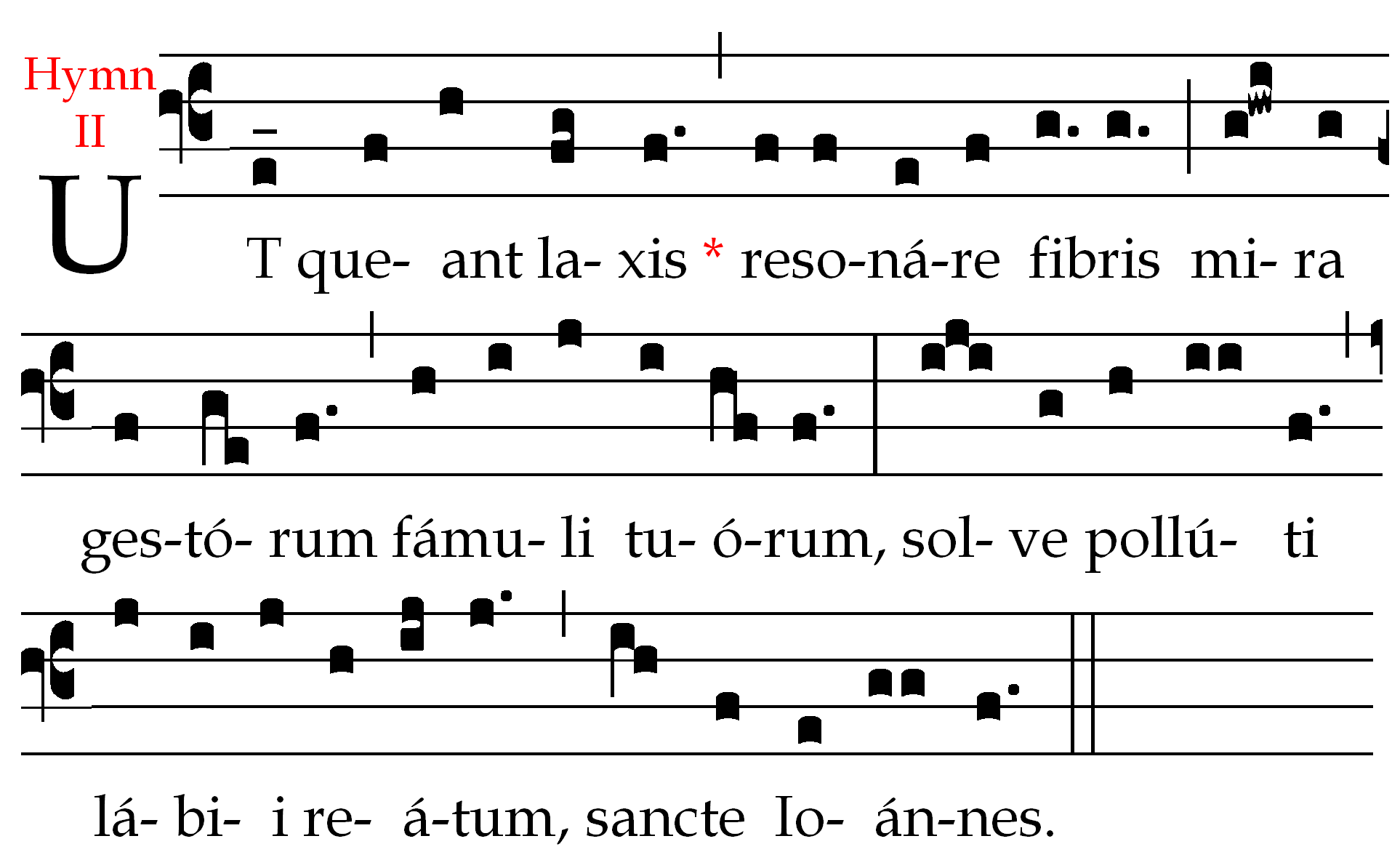
"Ut queant laxis" or "Hymnus in Ioannem" (English: "So that they may, with loosened [voices]" or "Hymn to John") is a Latin hymn in honor of John the Baptist, written in Horatian Sapphics[1] with text traditionally attributed to Paulus Diaconus, the eighth-century Lombard historian. It is famous for its part in the history of musical notation, in particular solmization. The hymn belongs to the tradition of Gregorian chant.
It is not known who wrote the melody. Guido of Arezzo possibly composed it,[2] but he more likely used an existing melody. A variant of the melody appears in an eleventh-century musical setting of Horace's poem Ode to Phyllis (4.11) recorded in a manuscript in France.[3]
Structure
[edit]The hymn uses classical metres: the Sapphic stanza consisting of three Sapphic hendecasyllables followed by an adonius (a type of dimeter).
The chant is useful for teaching singing because of the way it uses successive notes of the scale: the first six musical phrases of each stanza begin on a successively higher notes of the hexachord, giving ut–re–mi–fa–so–la; though ut is replaced by do in modern solfège. The naming of the notes of the hexachord by the first syllable of each hemistich (half line of verse) of the first verse is usually attributed to Guido of Arezzo. Guido, who was active in the eleventh century, is regarded as the father of modern musical notation. He made use of clefs (C & F clefs) and invented the ut-re-mi-fa-sol-la notation. The hymn does not help with the seventh tone as the last line, Sancte Iohannes, breaks the ascending pattern. The syllable si, for the seventh tone, was added in the 18th century.
The first stanza is:
Ut queant laxīs
resonāre fibrīs
Mīra gestōrum
famulī tuōrum,
Solve pollūtī
labiī reātum,
Sāncte Iohannēs.
It may be translated: So that they may, with loosened voices, resound the wonders of your deeds, clean the guilt from our stained lips, O Saint John.
A paraphrase by Cecile Gertken, OSB (1902–2001) preserves the key syllables and loosely evokes the original meter:
Do let our voices
resonate most purely,
miracles telling,
far greater than many;
so let our tongues be
lavish in your praises,
Saint John the Baptist.[4]
Ut is now mostly replaced by Do in solfège due to the latter's open sound, in deference to Italian theorist Giovanni Battista Doni.[5] The word "Ut" is still in use to name the C-clef. The seventh note was not part of the medieval hexachord and does not occur in this melody, and it was originally called "si" from "Sancte Ioannes" (Johannes).[2] In the nineteenth century, Sarah Glover, an English music teacher, renamed "si" to "ti" so that every syllable might be notated by its initial letter. But this was not adopted in countries using fixed do solfège: in Romance languages "si" is used alike for B and B flat, and no separate syllable is required for sharp "sol".
Liturgical use
[edit]In the Roman Rite, the hymn is sung in the Divine Office on June 24, the Feast of the Nativity of John the Baptist. The full hymn is divided into three parts, with "Ut queant laxis" sung at Vespers, "Antra deserti" sung at Matins, "O nimis felix" sung at Lauds, and doxologies added after the first two parts.
See also
[edit]- Diatonic and chromatic
- Do-Re-Mi (song). The lyrics teach the solfege syllables by linking them with English homophones (or near-homophones)
- Gamut
- Guidonian hand
- Solmization
References
[edit]- ^ Stuart Lyons, Music in the Odes of Horace (2010), Oxford, Aris & Phillips, ISBN 978-0-85668-844-7
- ^ a b (in French) Ut queant laxis in Encyclopédie Larousse
- ^ This manuscript H425 is held in Bibliothèque de l'école de Médecine, Montpellier.
- ^ Gertken, Cecile: Feasts and Saints, 1981
- ^ McNaught, W. G. (1893). "The History and Uses of the Sol-fa Syllables". Proceedings of the Musical Association. 19. London: Novello, Ewer and Co.: 43. ISSN 0958-8442. Retrieved 2010-12-12.
External links
[edit]- Full text, translation and some polyphonic settings at Choral Public Domain Library
- a short account at Catholicculture.org
- An alternative translation Archived 2012-06-03 at the Wayback Machine
- Catholic Encyclopedia article
Ut queant laxis
View on GrokipediaOrigins and History
Authorship and Composition Date
The hymn Ut queant laxis is traditionally attributed to Paul the Deacon (Paulus Diaconus), a prominent Lombard scholar, monk, and historian born around 720 in Friuli, Italy, and who died circa 799 at Monte Cassino.[4] Paul, educated at the court of Pavia and later serving at the courts of Benevento and Charlemagne, was known for his contributions to literature and liturgy during the Carolingian Renaissance.[5] This attribution dates back to medieval sources, including 12th-century writers such as Alberic of Monte Cassino and Peter the Deacon, who linked the hymn to Paul's scholarly activities.[6] While hymnologists like Dreves have upheld this ascription, noting its alignment with Paul's poetic style in honor of saints, the authorship is disputed by some modern scholars.[7][3] The composition is dated to the late 8th century, likely around 780–800, during Paul's residence as a monk at the Benedictine monastery of Monte Cassino in southern Italy, where he retreated after his time at Charlemagne's court in 782.[8] This period coincided with the reign of Charlemagne (768–814), whose efforts to standardize liturgical practices across the Frankish Empire promoted the creation and unification of hymns and chants, drawing on Roman and local traditions to foster ecclesiastical uniformity.[9] While no manuscripts of the hymn survive from Paul's lifetime, its text appears in an early 9th-century flyleaf in Vatican Ottobonianus lat. 532, supporting this timeframe.[6] There is no direct evidence of pre-existing versions of Ut queant laxis, though it may reflect broader influences from earlier Latin hymns dedicated to St. John the Baptist within the emerging Gregorian chant repertoire, which emphasized scriptural narratives and metrical poetry.[10] Paul's work at Monte Cassino, a center of Benedictine learning, positioned him to contribute to this tradition amid the Carolingian push for liturgical reform.Early Manuscript Evidence
The earliest known appearance of the hymn Ut queant laxis occurs in manuscripts from the late 8th and 9th centuries, reflecting its integration into early medieval liturgical practices. One of the oldest surviving copies of the text is found in the Vatican Ottobonianus lat. 532, dated to circa 800 AD, which preserves the hymn without musical notation and underscores its textual stability during the Carolingian era.[3] This manuscript, originating from an Italian scriptorium, represents a key witness to the hymn's dissemination in monastic circles south of the Alps.[3] Additional early evidence appears in the Codex Sangallensis 390, a 9th-10th century antiphonary from the Abbey of St. Gall in Switzerland, where the hymn is included as part of the office for the feast of St. John the Baptist.[11] This Swiss manuscript highlights the hymn's role in the standardized Gregorian chant repertory developed at St. Gall, a major center for liturgical music preservation. Early copies exhibit minor textual variations, such as alternative phrasing in the second stanza (e.g., "Solve polluti" versus slight orthographic adjustments in vowel endings), which paleographic studies attribute to scribal practices in different regional traditions.[3] These differences are minimal and do not alter the hymn's sapphic meter or core meaning, affirming its authenticity across witnesses. The Carolingian reforms, initiated under Charlemagne in the late 8th century, played a crucial role in standardizing and disseminating the hymn through Frankish monasteries, as liturgical unification efforts incorporated it into the Roman rite's vespers for St. John the Baptist, spreading copies from centers like St. Gall and Corbie.[12] Paleographic and codicological analysis of these manuscripts, including script types like Carolingian minuscule in Ottobonianus lat. 532 and neume precursors in Sangallensis 390, confirms origins in the 8th-9th centuries, with no verifiable pre-8th century evidence despite traditions linking it to Lombard authorship.[3][11] Such studies emphasize the hymn's emergence amid the 8th-century monastic revival, providing essential context for its textual and musical integrity before the 11th-century notational innovations associated with Guido of Arezzo.[3]Text and Lyrics
Full Latin Text
The hymn Ut queant laxis is structured in three parts for the Roman Breviary, each opening with a stanza in Sapphic meter (three hendecasyllables followed by an adonic). The following presents the full Latin text of these opening stanzas. Ut queant laxis (Vespers) Ut queant laxisresonare fibris
Mira gestorum
famuli tuorum
Solve polluti
labii reatum
Sancte Iohannes[13] The first syllables of these lines (Ut, Re, Mi, Fa, Sol, La) are the origin of the solfège note names. Antra deserti (Matins) Antra deserti
teneris sub annis
Cives turba s
fugiens petisti
Ne levi quidem
maculare saltem
Vitae fine famem
posses[13] O nimis felix (Lauds) O nimis felix
meritique celsi
Nesciens labem
nivei pudoris
Praepotens martyr
heremique cultor
Maxime vatum
germine Martyrum[13]

