Hubbry Logo
Utroba CaveUtroba CaveMain
Open search
Utroba Cave
Community hub
Utroba Cave
logo
8 pages, 0 posts
0 subscribers
Be the first to start a discussion here.
Utroba Cave
Utroba Cave
from Wikipedia

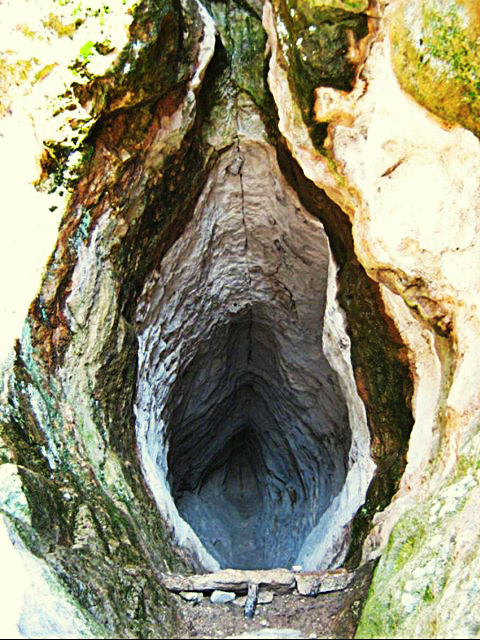
The Utroba Cave, also known as Womb Cave, is an ancient cave sanctuary in Kardzhali Province, Bulgaria. Located in the Eastern Rhodope Mountains near the Ilinitsa village, the cave resembles a human vulva and dates to the Thracian period.[1] Historians believe that it was once used as a fertility shrine.

Key Information

It is known in Bulgarian as Utrobata (Утробата, Bulgarian pronunciation: [oˈtrɔbɐtɐ], lit.'The Womb') or Peshtera Utroba (Пещера Утроба, [pɛʃtɛˈra oˈtrɔbɐ], 'Womb Cave').

History

[edit]

The cave is located 20 kilometers from the city of Kardzhali near the village of Ilinitsa and it dates to 480 BC. It is also referred to as "The Cave Womb" or "Womb Cave" because the entrance is the shape of a vulva. The inside of the cave resembles a uterus. Locally it is also called "The Blaring Rock".[2] Researchers believe that the entrance to the cave was a slit, which was then widened by humans. The entrance to the cave is 3 metres (9.8 ft) tall and 2.50 m (8.2 ft) wide and inside the cave there is a 1.3 m (4.3 ft)-tall altar which has been carved.[3]

Archaeologist Nikolay Ovcharov believes that the cave and altar were used by the Thracians.[3] There are several Thracian sanctuaries found in Bulgaria.[4] Ovcharov believes that it was used as a fertility shrine for the Thracians.[2] The "cult" places of the Thracians are usually located at the top of mountains and they have running water. There is also constantly flowing water at the Utroba Cave, which flows from the cave to the foothills.[3]

There is an opening in the ceiling which allows the light into the cave.[3] The light creates a phallus shape every day at noon, but it only reaches the altar on one day of the year.[2] In the middle of the day at a certain time of year the light which is in the shape of a phallus penetrates deep into the cave all the way to the altar.[5] In February or March the light takes the shape of a phallus and enters a hole at the altar: the light then flickers for 1–2 minutes. The penetrating and flickering light is thought to symbolize fertilization.[3]

Even today, there are childless couples who go to the cave hoping it will help them conceive a child.[2]

See also

[edit]

References

[edit]
[edit]
Revisions and contributorsEdit on WikipediaRead on Wikipedia
from Grokipedia
The Utroba Cave, also known as the Womb Cave, is a prehistoric Thracian sanctuary located in the Eastern near the village of Nenkovo in Bulgaria's . This roughly 22-meter-deep cave, formed in through natural water erosion over millennia, features an entrance resembling a human and an interior shaped like a , complete with niches, semi-circular carvings, and constantly flowing water. Hand-carved and modified by ancient inhabitants around 3,000 years ago during the Thracian period, it was rediscovered in 2001 and is renowned for its symbolic form suggesting use in and agricultural rituals. The cave's most striking feature is an at its southern end, which is dramatically illuminated by a beam of sunlight at noon on the , enhancing its ritualistic role. Archaeologists, including Nikolay Ovcharov, hypothesize that the —an Indo-European people who inhabited the region from approximately the BCE—utilized the site for ceremonies involving wine libations, as evidenced by nearby rock-cut basins known as sharapani used for pressing grapes. The sanctuary's inaccessible location on a steep cliff helped preserve it from looting, revealing no major artifacts but confirming its cultural importance through the intentional shaping of natural fissures into symbolic forms. Today, Utroba Cave attracts researchers and visitors interested in Thracian spirituality and prehistoric symbolism, though access requires a strenuous hike along unmarked trails with no facilities. Its womb-like architecture underscores themes of birth and renewal in ancient Balkan cultures, paralleling other regional rock sanctuaries and contributing to ongoing studies of Thracian religious practices. Local legends suggest childless couples visiting on the may conceive, tying into its fertility symbolism.

Location and geography

Site overview

Utroba Cave is situated in , southern , near the village of Ilinitsa within the Eastern . Its approximate geographic coordinates are 41°42′17″N 25°14′53″E. The site lies about 20 km from the city of . The surrounding landscape features forested terrain typical of the Eastern Rhodopes, with dense vegetation covering rocky outcrops and nearby watercourses such as the Borovitsa River facilitating natural trails through the area. This environment integrates the cave into a broader network of Thracian-era rock formations and niches. Access to the cave requires a 2-3 km hike from the nearest access road off the route between Kardzhali and Haskovo, involving steep, uneven paths that lack formal signage or visitor facilities. The trail, while scenic, demands moderate fitness due to the rugged terrain.

Geological formation

Utroba Cave formed through classic processes in the Eastern , where laden with slowly dissolved soluble over millions of years, creating subterranean voids and passages. This dissolution begins when rainwater absorbs from the atmosphere and soil, forming weak that reacts with in the limestone , gradually eroding it and enlarging cracks into larger cavities. The Rhodope region's extensive system, characterized by such chemical , has produced numerous similar features, with Utroba exemplifying the horizontal progression of these erosive forces along bedding planes and fissures. The cave is a horizontal fissure-type karst feature, approximately 22 meters deep, with smooth, curved walls and natural narrowings that evoke organic contours due to the selective dissolution patterns of flowing water. These organic-like shapes result from the uneven solubility of layers, where water preferentially erodes softer zones, leaving behind polished surfaces and constrictions that widen into chambers. Unlike vertical shaft caves, this orientation reflects lateral movement influenced by the regional , contributing to the cave's compact, tunnel-like structure. Geologically, Utroba is embedded in Mesozoic-era limestone deposits prevalent in the Eastern , formed from marine sediments when ancient seas covered the area. Cave development accelerated in the Pleistocene epoch, as glacial-interglacial cycles intensified hydrological fluctuations, promoting deeper erosion and the formation of active networks across the Rhodopes. This timeline aligns with broader regional patterns, where post-uplift and climatic shifts enhanced speleogenesis in terrains. Local plays a crucial role in the cave's ongoing , with underground sources—such as percolating rainwater and seasonal —continuing to contribute to and maintaining internal levels. These waters, often mineral-rich, deposit secondary features like flowstones while slowly enlarging passages, ensuring the cave remains part of a dynamic system in the Rhodopes. The presence of persistent subsurface flow prevents complete drying, preserving the humid conditions that facilitate further dissolution.

Physical description

Internal structure

The internal structure of Utroba Cave begins with a narrow horizontal serving as the entrance, measuring approximately 3 meters in and 2.5 meters in width, which was originally a natural rock crevice later shaped by human intervention. Inside, the passage widens to form an elongated main chamber resembling a curved corridor, with uneven floors and sections of low ceiling that create an intimate, enclosed space leading to a deeper alcove at the rear. The total length of the cave spans about 22 meters, with an average internal width of 1.5 meters, incorporating subtle side niches along the walls that add to its labyrinthine feel without extensive branching passages. A notable natural feature is the constant flow of water along the chamber walls, which collects at the base to form a small pool, contributing to the cave's damp and echoing acoustics. Natural lighting is limited due to the enclosed design, but a vertical shaft in the ceiling allows a beam of to penetrate directly to the floor, particularly intensifying around noon daily, with maximum penetration on the , to reach the alcove's man-made . This solar alignment highlights the chamber's central axis, casting dynamic shadows across the uneven surfaces.

Symbolic features

The Utroba Cave exhibits a profound symbolic morphology resembling the , with its narrow entrance serving as a metaphorical birth canal, the widening internal chamber evoking a , and a basal opening interpreted as a or vaginal passage. This womb-like configuration, measuring approximately 22 meters in depth, 3 meters in height, and 2.5 meters in width at the entrance, was likely enhanced by ancient modifications to emphasize themes central to Thracian spirituality. Along the cave walls, several hand-hewn trapezoidal niches and rocky protrusions stand out as potential sites for offerings or symbolic representations, integrating natural formations with deliberate carvings to reinforce themes of nurturing and . These features, combined with the cave's hemispherical dome that amplifies low-frequency sounds—creating reverberations akin to thunder—further evoke cosmic and the life-giving forces of nature. At the cave's deepest point lies a natural yet sculpted rock pedestal functioning as an altar, roughly 1.3 meters high, with a central aperture approximately 10 cm deep and 5 cm wide that resembles a vulva or yoni symbol in ancient iconography. This formation, positioned to receive direct illumination, underscores the cave's role in embodying rebirth and the sacred feminine. A striking astronomical alignment enhances the cave's symbolic potency: during the winter solstice or at midday, sunlight penetrates through a ceiling crevice, casting a phallus-shaped beam onto the altar for about 10-15 minutes, symbolizing a "sacred marriage" between solar energy and the earth, thereby enacting themes of fertilization and renewal. This interplay of light and shadow, oriented along a north-south axis, highlights the Thracians' integration of celestial events into fertility rituals.

Historical development

Thracian origins

The Utroba Cave served as a significant sanctuary during the Thracian period, with its primary use estimated between the 11th and 10th centuries BCE, aligning with the late transition to the early in Thracian civilization. This timeline is supported by the architectural style and regional archaeological parallels, indicating intentional human modification of the natural rock formation for ritual purposes. Archaeological examination reveals evidence of Thracian occupation through the cave's hand-carved features, including a horizontal slit entrance measuring approximately 3 meters high and 2.5 meters wide, extending 22 meters deep into the rock, and an altar at the southern end standing over 1 meter high. Tool marks suggest craftsmanship by Thracian artisans, who shaped niches and the altar to enhance the cave's symbolic form, with a central 10 cm deep and 5 cm wide aperture in the altar possibly facilitating ritual offerings. No major artifacts have been found, supporting its interpretation as a ritual site rather than a dwelling. Nearby rock niches, known as sharapanas, further indicate use for holding liquids in ceremonies, underscoring the site's status as a dedicated sanctuary rather than mere habitation. In the broader regional context, Utroba Cave forms part of an extensive network of Thracian sanctuaries in the , a cradle of Thracian megalithic culture near sites like and Tatul. These complexes, concentrated around , reflect interconnected religious practices tied to Thracian spiritual traditions, potentially including elements of mystery cults prevalent in the area. The cave's north-south orientation allows sunlight to penetrate and project symbolic patterns at noon, enhancing its ritual significance within this landscape of ancient Thracian monuments.

Rediscovery and excavation

The Utroba Cave was rediscovered in April 2001 during an expedition in the Eastern Rhodope Mountains, approximately 17-20 kilometers from . This finding brought attention to the site's unique womb-like formation, which had likely been known locally in ancient times but fell into obscurity. Initial documentation by Bulgarian archaeologists followed shortly thereafter, highlighting its potential as a Thracian based on the intentional carvings and altar within. Archaeological interest was led by prominent figures such as Nikolay Ovcharov, a specialist in Thracian studies often referred to as Bulgaria's "," who examined the cave and surrounding complex, concluding it served purposes during the Thracian period. Early studies focused on non-invasive assessments, including analysis of the cave's architectural features and nearby rock basins (sharapanas) used in ancient wine rituals, rather than extensive digging. Excavation efforts have remained limited due to the cave's remote, rugged location high in the mountains, which complicates access and logistics for large-scale operations. These challenges have delayed full surveys, leaving many aspects of the site's use and contents unexplored, with ongoing work emphasizing conservation over intrusive .

Cultural significance

Ritual uses

The Utroba Cave is believed to have functioned as a Thracian fertility shrine, where s centered on honoring the and seeking blessings for conception and rebirth. Nikolay Ovcharov, who documented the site, interprets the cave's vulva-shaped entrance and uterus-like interior as symbolic pathways for passage, allowing participants to experience symbolic rebirth through the narrow corridor leading to the inner chamber. This aligns with broader Thracian veneration of feminine life-giving forces, though specific ancient practices involving childless individuals remain inferred from the site's morphology rather than direct epigraphic or osteological evidence. Ceremonial activities likely incorporated the cave's natural features, including a carved at the southern end of the interior, measuring 1.3 meters in height and featuring a shallow basin for libations or offerings. Water flowing from the cave's depths toward a nearby pool may have played a role in purification rites, symbolizing life emergence, while annual solar alignments—where a phallus-shaped beam of sunlight penetrates the entrance at noon around the spring equinox (March 20-21) to fully illuminate for about two minutes—probably marked seasonal festivals of renewal and fertilization. This beam enters daily via a ceiling crack but reaches the full depth only on this date. Nearby rock-cut niches known as sharapanas, forming a complex, served for storing and fermenting wine used in these ceremonies, reflecting Thracian Dionysian traditions of communal and ecstasy. Evidence from analogous Thracian sites supports interpretations of group gatherings here for initiatory or ecstatic rites, potentially including dances honoring deities like or . The cave's womb-like form further evokes symbolic associations with , as explored in analyses of Thracian rock sanctuaries.

Interpretations and symbolism

The Utroba Cave has been interpreted by archaeologists as a key Thracian dedicated to the of the , a central figure in Thracian mythology representing the earth's generative and nurturing forces. This association stems from the cave's deliberate anthropomorphic design, which evokes the sacred feminine and aligns with broader Thracian reverence for deities embodying fertility and the natural world. Scholars link such sites to the Thracian spiritual tradition, where the symbolized the cycle of life, influencing later mystical practices like Orphism with its emphasis on rebirth and renewal. The cave's symbolic features, particularly its uterus-like form, are analyzed as a profound for creation, , and renewal, mirroring the Thracian of eternal cycles in nature and human existence. The narrow entrance and expansive inner chamber represent passage through birth and transformation, while the carved at the rear serves as a focal point for offerings invoking the goddess's life-giving power. A striking annual phenomenon occurs around the spring equinox (March 20-21), when a phallus-shaped beam of sunlight—entering daily but reaching full length only then—penetrates the cave's axis at noon, projecting onto through a small hole for about two minutes; this is widely interpreted as symbolizing fertilization and the rebirth of vegetation, reinforcing the cave's role in agricultural and human . The cave is proposed to have functioned as a protected for conception rituals or invocations for bountiful harvests. Debates persist among researchers regarding the extent of external influences, with some suggesting parallels to Anatolian fertility cults centered on mother goddesses like , given Thracian cultural exchanges in the region; however, the cave's unique solar alignment underscores indigenous Thracian ingenuity in blending cosmology and symbolism. Interpretations support communal ceremonies emphasizing renewal over mere burial practices. In contemporary , the Utroba Cave is increasingly viewed as a proto-feminist emblem of ancient matrifocal , celebrating agency in creation amid patriarchal historical narratives, while its precise orientation toward the sun's path prompts interpretations as an early astronomical attuned to seasonal rebirth cycles. These perspectives draw on the cave's enduring appeal to modern visitors seeking connections to ancestral earth-based traditions.

Preservation and modern use

Conservation measures

Utroba Cave faces general environmental and human-induced threats typical of sites in the Eastern , such as water erosion and potential or by visitors. As an , it benefits from Bulgaria's national heritage laws, though specific formal protections for the itself are not publicly documented. Limited efforts focus on educating visitors to minimize impacts, but no major restoration projects are reported. These measures aim to balance preservation with public access, though increasing poses ongoing challenges.

Tourism and access

Access to Utroba Cave is free, allowing self-guided visits without any entry fees. The site is situated approximately 17 kilometers from , reachable by road toward , with a near the village of Padartsi. A wooden provides entry to the cave opening. Reaching the cave involves a strenuous hike lasting 1 to 2 hours over rugged, steep terrain that demands good and sure-footedness. Visitors should wear appropriate shoes, carry water, and bring a , as the interior lacks artificial lighting. There are no on-site amenities or facilities, and parking is limited to areas near the village of Padartsi at the . Guided tours are available through local agencies in , offering insights into the site's Thracian and geological features. Photography is permitted throughout the cave, though care should be taken to avoid disturbing the natural and carved elements. Since its rediscovery in 2001, Utroba Cave has enhanced local in the Rhodope , drawing and eco-tourism enthusiasts as a burgeoning day-trip destination from Kardzhali and beyond.

References

Add your contribution
Related Hubs
User Avatar
No comments yet.