Hubbry Logo
HS Produkt VHSHS Produkt VHSMain
Open search
HS Produkt VHS
Community hub
HS Produkt VHS
logo
8 pages, 0 posts
0 subscribers
Be the first to start a discussion here.
HS Produkt VHS
HS Produkt VHS
from Wikipedia

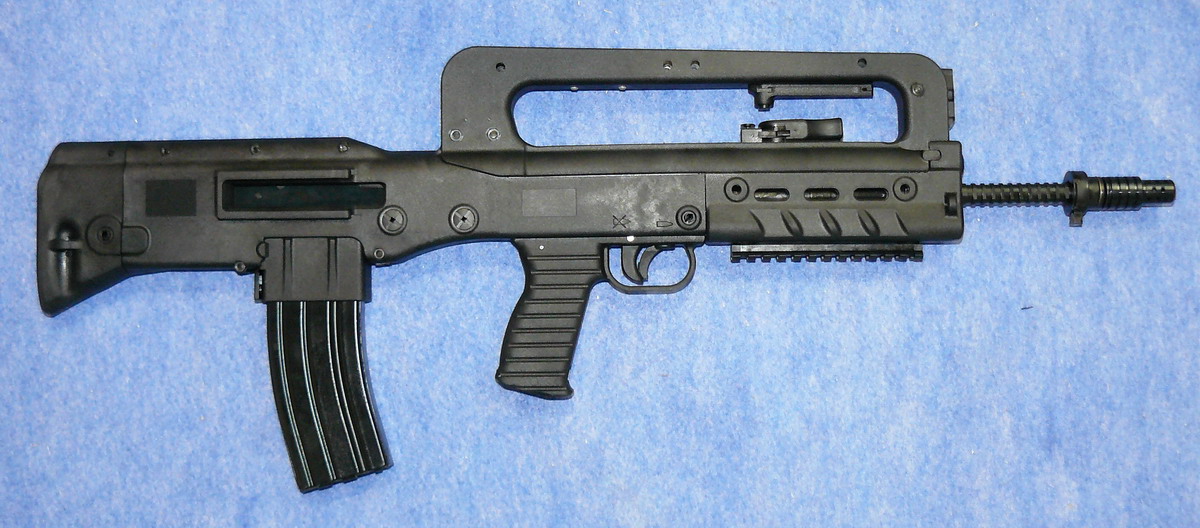
The VHS (Croatian: Višenamjenska Hrvatska Strojnica, lit. multifunctional Croatian machine gun) is a 5.56×45mm NATO bullpup assault rifle designed and manufactured by HS Produkt of Croatia. The VHS rifle was first introduced at the 2007 iKA exhibition, the annual Croatian innovation display that takes place in the city of Karlovac.[6] The development began from a Croatian Army request for a new infantry rifle to meet NATO standards.

Key Information

An improved version of the VHS rifle, known as the VHS-2, was introduced in April 2013. In January 2022, it was announced that Springfield Armory, Inc. will be importing the VHS-2 into the US as the Hellion.[7]

History

[edit]

Development

[edit]

During the Croatian War of Independence, HS Produkt (then called IM Metal) created a bullpup variant of the 7.62 mm Kalashnikov assault rifle.[2][8] This rifle had a number of flaws, partly caused by limited technological capabilities of IM Metal, but provided a valuable learning experience for the company.[2][8] A delayed blowback model was tested in the mid-1990s, but the results were still not satisfactory, and it was superseded by a design similar to the M16 rifle.[8] More prototypes followed in 1996, 1999 and 2004.[2]

The development cycle that ultimately led to the current version of the VHS rifle started circa 2003.[8] A new prototype, externally quite similar to the French FAMAS, was publicly announced in 2005 and presented to Croatian Minister of Defense Berislav Rončević.[6][8][9][10] However, only 10% of the 2004 prototype was retained in the production model.[2]

Evaluation and adoption

[edit]
Croatian soldier armed with a VHS-D rifle during a training exercise

On November 19, 2007, the Croatian Ministry of Defence placed an order for an experimental batch of 50 rifles to be tested by the Croatian contingent then deployed in Afghanistan within the International Security Assistance Force (ISAF). The contract was placed at 4.5 million kuna.[11][12] Other nations, including Kuwait[13] and Venezuela[14] showed interest in acquiring the rifle.

On November 24, 2008, HS Produkt introduced the final version of the VHS assault rifle.[15] After an initial testing phase with the first 40 rifles, an order for 1,000 rifles was made. In 2009, an additional order of 2,000 rifles was made to enter service with the Croatian Army. By the end of 2012, and as of 2013, the Croatian army had 3,600 VHS rifles in service. Another order of 2,000 rifles was to be delivered to the Croatian military by the end of 2014.[needs update] A long-term Croatian Army requirement calls for 50,000 assault rifles, ensuring the long-term production of VHS-2. The US Department of Defense also made an order for 500 VHS rifles.[16]

On May 12, 2009, Croatian Minister of Defence Branko Vukelić confirmed the positive conclusions of a series of torture tests and on May 15 officially signed a contract with HS Produkt for the acquisition of 1,000 rifles (both variants). As of 2015, the Croatian Army is using 7,000 VHS rifles.[17][needs update]

Design

[edit]

The VHS-D rifle is 765 mm (30.1 in) long, with a 500 mm (20 in) barrel.[5] The whole rifle body is a monoblock construction made from high-impact polymer.[18] Externally, it strongly resembles the French FAMAS rifle, but its operating mechanism and disassembly procedure are quite different.[19] The VHS-K is a carbine variant with an overall length of 665 mm (26.2 in) and a 410 mm (16 in) barrel.

Some characteristics of the rifle were not revealed to the public and provoked rumours during the development period. One involved a hypothesized venting system which recovered part of the gases generated from firing the weapon to cushion the bolt and dramatically buffer recoil. The production-stage VHS operated in a much more conventional manner, not utilizing this buffering system.[9] According to the schematic filed at the European Patent Office (EPO) the misconception may have come from combining two different features: a forced air ventilation system similar to the one in Pecheneg machine gun and a mechanical buffer reducer, similar in conception to the one used in Ultimax 100, a weapon Croatia used in the Croatian War of Independence and retains in its reserve inventory. The same patent states that the VHS works neither through direct gas impingement nor through a short- or long-stroke piston, but through a 'tappet' type of closed gas system much like the FN SCAR.[citation needed] There may have also been confusion with another prototype which did not go into production.

Confusion on the VHS's operating system was from several changes to the type of system used through its development. The first models used a Kalashnikov-style long-stroke piston, which was changed in 1999 to a lever delayed blowback system from the FAMAS. The next year, it was changed to a direct gas impingement system with a forced ventilation feature that formed a pneumatic cushion behind the bolt. The VHS was patented in that form in 2000 giving the impression of a "gas cushion" feature. That model was publicly known up to 2005. In 2004, the final and current operating system of the VHS was changed to a gas-operated, short-stroke piston system.[20]

When the VHS went through service life testing it fired 50,000 rounds without suffering any main part failures. The barrel has a birdcage flash suppressor and can fire rifle grenades. Like the FAMAS, it has a sliding grenade boom guide and grenade high-angle launching sight to aim when the rifle is turned on its side, but the sight is mounted on the underside of the carrying handle on the VHS instead of under it.[clarification needed] The rifle and carbine have different gas regulators, both with three settings changed by pushing in and turning 120 degrees: normal; high (larger opening for weak ammunition); and cut-off (for rifle grenades).[20]

One drawback of the VHS is its poor ergonomics. The fire selector has three positions for safe, semi, and automatic fire with no 3-round burst option. Production model rifles have the selector inside the trigger guard. Changing firing modes is difficult as the crank must be rotated a long distance before either firing mode is selected. It is also for right-handed use only; the receiver can only eject shells out the right side and cases leave sharply toward the rear, with a chance of hitting an extended elbow. This is unfortunate, as the non-reciprocating cocking handle is located centrally under the carrying handle and can be pulled from either side.[20]

Models presented in 2008 showed the VHS being STANAG magazine compatible. This was changed shortly after to accept HK G36 magazines. The reason was because the Croatian military has more G36s (which the VHS will replace) than M16-type rifles.[20]

Variants

[edit]
A Croatian soldier firing a VHS-2 rifle.

VHS-D

[edit]

The first VHS rifle made by HS Produkt, outfitted with rifle grenade discharging adapters and bayonet lugs.[21]

VHS-K

[edit]

A carbine version of the VHS rifle.[22]

VHS-2

[edit]

The VHS-2 was shown to the public for the first time in April 2013, during the Adriatic Sea Defense & Aerospace (ASDA) exhibition in Split, Croatia.[23] Its improvements include a more conventional fire selector, a redesigned carrying handle, an adjustable-length buttstock, and an ambidextrous cartridge casing ejection system that can be reconfigured in less than a minute.[24][25][26][27]

The VHS-2 line consists of the VHS-D2 assault rifle and the VHS-K2 carbine.[28]

Springfield Hellion

[edit]

A semi-automatic version of the VHS-2 was made for Springfield Armory, Inc., which was unveiled in January 2022.[29]

Users

[edit]
A map with HS Produkt VHS users in blue

Evaluation

[edit]
  •  France: The VHS-F2 variant was specifically produced for French military trials, with a magazine well accommodating the FAMAS magazine. It was shortlisted for a purchase order of 100,000 assault rifles[37] but the bid was ultimately won by the HK416.[38]
  •  Romania: Ongoing negotiations about local production and technology transfer.[30]
  •  United States: Purchased 500 VHS-1 for testing and training in 2012, and 250 VHS-2 for testing and training in 2015.[39]

References

[edit]
[edit]
Revisions and contributorsEdit on WikipediaRead on Wikipedia
from Grokipedia
The HS Produkt VHS (Croatian: Višenamjenska Hrvatska Strojnica, lit. "multifunctional Croatian machine gun") is a chambered in , designed and manufactured by the Croatian firearms company . It employs a short-stroke gas with operating system, features a for reduced weight, and accepts standard STANAG magazines in 20- or 30-round capacities. The rifle is available in two primary configurations: the compact VHS-2K with a 410 mm (16.1 in) barrel and overall length of 710 mm (28.0 in) [760 mm (29.9 in) extended], and the standard VHS-2D with a 500 mm (19.7 in) barrel and overall length of 800 mm (31.5 in), weighing 3.7 kg (8.2 lb) and 3.85 kg (8.5 lb) unloaded, respectively. Development of the VHS began in 2005 at the request of the Croatian to replace aging Soviet-era small arms with a modern, NATO-compatible during the country's modernization efforts. It was first publicly unveiled at the 2007 iKA arms exhibition in , , and underwent extensive testing before official adoption by the Croatian Armed Forces in 2009 as their standard-issue , with an initial order for several thousand units. The design emphasizes modularity, with Picatinny rails for and accessories, adjustable , and compatibility with the VHS-BG 40 mm underbarrel ; its layout provides a compact profile while maintaining a long sight radius and effective range up to 800 meters. Over time, the VHS has seen upgrades, culminating in the -2 variant introduced in April 2013, which incorporates full ambidexterity with dual ejection ports and controls, improved ergonomics, and enhanced reliability for use. Subvariants include the semi-automatic VHS-2S for civilian and export markets, and versions like the VHS-2D for precision roles. The rifle has been exported to several countries, including , , , and , and licensed for production in the United States as the Springfield Armory Hellion, including 20-inch barrel variants introduced in 2024. Notable for its robust translucent magazines and adaptability to modern combat, the VHS represents Croatia's advancements in indigenous production since the company's founding in 1991.

History

Development

HS Produkt was founded in 1991 as IM Metal in , , shortly after the country's , initially focusing on producing small arms to support the . By the early , following the war's end and a period of growth in pistol manufacturing, the company—renamed HS Produkt in 2001—shifted toward developing military rifles to meet domestic defense needs and expand its portfolio beyond handguns. This transition aligned with 's aspirations for membership, emphasizing modernized weaponry compatible with alliance standards. The VHS project originated in 2005 as a direct response to the Croatian Armed Forces' requirement for a domestically produced chambered in , intended to replace aging Soviet-era designs like the Zastava M70 and enhance national self-reliance in arms production. Led by chief designer Marko Vuković, a of the with prior experience in pistol development, the team drew inspiration from global configurations, particularly the AUG's compact layout and the FAMAS's gas-operated system, adapting these to create a versatile, modular platform suited to Croatian operational environments. Prototyping commenced in 2006, building on earlier experimental efforts from the 1990s where IM Metal had explored conversions of existing rifles like the and AK variants. By mid-2007, iterative designs incorporated a short-stroke gas piston mechanism and rotary bolt, culminating in the first public unveiling of the VHS prototype at the iKA 2007 innovation exhibition in , , where it demonstrated initial reliability in static displays. Subsequent testing in late and involved field trials with the Croatian , focusing on endurance, , and NATO , which revealed minor issues with the charging handle and optics mounting that were refined through several iterations. These evaluations, including a service-life test exceeding 50,000 rounds without major failures, led to the finalization of the VHS-1 designation in 2009, marking its official acceptance by the Croatian for limited production.

Evaluation and adoption

The VHS rifle underwent extensive military trials by the Croatian Armed Forces from 2008 to 2010, including live-fire testing and durability assessments conducted in , , and alongside troops. These evaluations featured torture tests simulating extreme conditions, with prototypes enduring over 50,000 rounds without major failures, demonstrating reliability comparable to established platforms like the M70 (an AK variant) and HK G36 rifles it was intended to replace for interoperability. Comparisons during trials highlighted the VHS's advantages in modularity and compactness over the longer conventional layouts of the AK and , though it faced scrutiny for initial ergonomic adjustments in handling. In 2009, the Croatian officially adopted the VHS as its standard-issue following positive trial outcomes, with an initial of 2,000 units (1,000 VHS-D and 1,000 VHS-K variants) at approximately €1,500 each, later reduced to around €1,000 per unit through scaled production. The VHS-2, an improved iteration with enhanced and safety features, was introduced in 2013 and adopted as the primary , backed by a contract for 20,000 units to fully equip Croatian forces and phase out legacy systems. This adoption marked a significant milestone for domestic defense , though faced delays in 2012 due to budgetary constraints amid economic challenges. Internationally, the VHS series has undergone evaluations but seen limited adoptions beyond . In 2015, submitted the VHS-2 for France's Arme Individuelle Future (AIF) program to replace the , competing against rifles like the HK416 and SCAR-L in rigorous two-year trials involving 15 units per entrant; despite performing well in reliability and modularity tests, it was not selected, with the HK416 ultimately winning the €300 million contract. Other evaluations, such as those in during joint operations, validated its field performance but did not lead to formal foreign military adoptions at scale during the initial post-development phase. Export discussions and contracts have expanded gradually up to 2025, focusing on in select nations rather than widespread sales. Notable deals include 10,000 VHS-2 units to Iraq's around 2015 for counter-ISIS operations, where the rifle gained praise for its durability in harsh environments, and smaller contracts to , , , and for their armed forces and police. In 2025, Senegal's national police received hundreds of VHS-2 rifles to bolster officer equipment, representing one of the most recent confirmed exports. Limited transfers to non-state actors have occurred, such as VHS variants appearing with Syrian opposition groups, likely through indirect channels via networks or regional intermediaries. Wider adoption has been hindered by the rifle's production costs, estimated at €1,000–1,500 per unit, which exceed those of mass-produced competitors like the AK or M4, limiting appeal in cost-sensitive markets. Intense global competition from entrenched designs, coupled with the VHS's configuration requiring user adaptation, has confined exports primarily to allied or regional partners rather than major procurements. Despite these challenges, ongoing Croatian contracts ensure sustained production, with potential for growth in adaptations and further defense partnerships.

Design

Operating mechanism

The HS Produkt VHS utilizes a gas-operated, short-stroke system with a for its primary operating mechanism. Gases are diverted from the barrel bore through a port into a positioned above the barrel, where they act upon a spring-loaded head. This travels rearward for a short distance before striking an attached operating rod, which transmits force to the bolt carrier group without further gas exposure to . The bolt carrier assembly features a rotary bolt head with multiple locking lugs that engage a threaded extension on the barrel, providing a secure lockup during firing. This bolt design draws inspiration from Eugene Stoner's AR-15 system, adapted for the VHS's configuration to maintain reliability in a compact layout while accommodating the rearward magazine placement. The operating rod is hollowed to enclose a captive spring, which absorbs energy and returns the bolt carrier forward after the firing cycle. A three-position gas regulator—normal for standard operation, high for adverse conditions or weak , and cut-off for rifle grenade launching—allows adjustment of gas flow to the piston without tools. In the operational cycle, upon firing, high-pressure gases propel the down the barrel and simultaneously bleed into the , driving the and operating rod rearward to unlock the via a cam pin. The bolt carrier continues rearward, extracting the spent cartridge case from the chamber and ejecting it through a right-side located forward of the , with casings directed sharply rearward to minimize interference with the shooter. The recoil spring then propels the bolt carrier forward, stripping a fresh round from the and rotating the bolt to lock it into the barrel extension, readying the for the next shot. This short-stroke design isolates from the action, enhancing durability in dusty environments compared to systems. Safety features integrated into the mechanism include a selective-fire lever positioned inside the trigger guard for intuitive access, offering (blocking the trigger), semi-automatic, and full-automatic modes, denoted by pictograms for universal recognition. The ejection incorporates a fixed, non-reciprocating dust cover that latches open during to prevent debris ingress when closed, contributing to the system's robustness in field conditions. While the VHS's mechanism shares conceptual similarities with the AR-15's bolt-locking principle, its short-stroke piston and adaptations—such as the forward gas placement—differentiate it for improved balance and reduced overall length without sacrificing cyclic reliability.

Ergonomics and features

The HS Produkt VHS rifle employs a bullpup configuration that enhances maneuverability by positioning the action behind the trigger, resulting in an overall length of 665 mm for the compact VHS-K variant (with a 410 mm barrel) or 765 mm for the standard VHS-D (with a 500 mm barrel), providing effective ballistics in confined spaces. This design improves balance and handling for the shooter, particularly in urban or vehicle-based operations, without compromising rifle stability. The original VHS features controls optimized for right-handed users, with a non-reciprocating charging handle and right-side ejection; the fire selector switch and safety lever are positioned over the for access, while the paddle-style magazine release is on the right side of the receiver. The VHS-2 variant introduces full with a reversible charging handle, mirrored controls, and dual ejection ports with interchangeable dust covers and case deflectors. An adjustable five-position buttstock and cheek rest provide customizable fit to the shooter's build and equipment, such as , ensuring consistent eye alignment with optics and reducing fatigue during extended use. The pistol grip incorporates texturing for secure hold in adverse conditions. Modularity is facilitated by a full-length MIL-STD-1913 on the receiver for mounting optics, lasers, and night sights, complemented by additional STANAG 4694 rails on the handguard at the 3, 6, and 9 o'clock positions for grips, lights, and underbarrel accessories like a 40 mm . The supports quick-change barrels via a simple removal process, allowing field swaps between standard and specialized configurations. The original VHS uses detachable 30-round magazines compatible with G36-pattern systems, semi-transparent for rapid ammo checks; later variants like the VHS-2 offer interchangeable magazine wells for standard STANAG compatibility. Integrated suppressor compatibility is achieved through an adjustable gas block with suppressed and normal modes, optimizing performance when attaching sound suppressors without requiring tools.

Specifications

Dimensions and weight

The HS Produkt VHS is available in two primary configurations. The standard VHS-D measures 765 mm (30.1 in) in overall length with a 500 mm (19.7 in) barrel, while the compact VHS-K variant has an overall length of 665 mm (26.2 in) with a 410 mm (16.1 in) barrel. Both models weigh approximately 3.4 kg (7.5 lb) unloaded, providing a balance of compactness and handling typical of designs. Compared to non-bullpup rifles such as the , which has an overall length of 756–832 mm (29.75–32.75 in) despite a shorter 368 mm (14.5 in) barrel, the VHS-D offers similar length with greater effective barrel length, while the VHS-K is notably more compact.

Performance characteristics

The HS Produkt VHS is chambered in caliber, utilizing SS109 ammunition for standard military applications. The VHS-K variant achieves a of approximately 940 m/s (3,080 ft/s), while the VHS-D reaches 950 m/s (3,120 ft/s), benefiting from the configuration that maintains effective barrel length in a compact form. The rifle's effective range supports point target engagement at 500 meters and area targets at 600 meters, extending further for the VHS-D due to its longer barrel. Its cyclic is rated at 750–860 rounds per minute, providing controllable full-automatic fire suitable for close to medium-range combat scenarios. Reliability testing by the Croatian demonstrated exceptional durability, with the VHS enduring 50,000 rounds without structural failure or major stoppages. The short-stroke gas operating system contributes to its robustness, allowing operation in adverse conditions including sandy and dusty environments, salt water exposure, and extreme temperatures ranging from -32°C to +49°C. Independent tests showed minimal stoppages in contaminated settings, outperforming some conventional designs. In accuracy trials, the VHS delivers consistent performance at 100–300 meters, supporting effective marksmanship in dynamic operational environments.

Variants

Original VHS models

The original VHS models, developed by and first presented in 2007, formed the initial production lineup of the VHS selective-fire chambered in . These rifles featured a configuration with a fixed and basic Picatinny rails on the receiver for mounting and accessories, prioritizing compactness while maintaining standard capabilities. The original VHS included two primary variants: the VHS-D, a standard-length model suited for general use, and the VHS-K, a variant designed for close-quarters operations. The VHS-D measured 765 mm in overall length with a 500 mm barrel, allowing for effective engagement ranges up to 600 meters in standard configuration, though it could support roles with added bipods and enhanced optics mounts for precision fire out to 800 meters. In contrast, the VHS-K offered a reduced overall length of 665 mm and a 410 mm barrel, enhancing maneuverability in urban or confined environments while retaining compatibility with 30-round STANAG magazines and selective-fire options for semi-automatic and full-automatic modes. Production of the original began with an initial batch of 50 units for Croatian testing in late 2007, followed by an order of 1,000 units in 2008 and an additional 2,000 units in 2009, with approximately 3,600 rifles in service by 2013 before the VHS-2 upgrades. Early models exhibited reliable performance in endurance tests, enduring over 50,000 rounds without major component failures, though they featured non-ambidextrous controls, including a toggle-style fire selector inside the that limited ease of use for left-handed operators—a limitation addressed in later iterations.

VHS-2 series

The VHS-2 series, introduced by in 2013, represents a significant upgrade to the original platform, emphasizing full and enhanced for contemporary requirements. Key improvements include dual ejection ports with case deflectors for seamless left- or right-handed operation, a refined short-stroke gas system with for reliable cycling, and expanded STANAG 4694 Picatinny rails on the receiver and handguard to support a wide array of optics, lights, and grips. The series maintains the layout's compact design while incorporating a durable receiver and 5-point adjustable buttstock, balancing weight, ergonomics, and ballistic performance in 5.56×45mm caliber. The VHS-D2 serves as the designated marksman configuration within the VHS-2 family, featuring a 500 mm hammer-forged barrel to deliver extended up to 800 m for precision engagements. Its adjustable allows for customizable and cheek weld, optimizing stability and accuracy in prone or supported firing positions suited to support roles. Retaining the series' ambidextrous controls and rail integration, the VHS-D2 weighs approximately 3.85 kg unloaded and supports 30-round polymer magazines, enabling sustained fire in designated marksman applications without excessive bulk. The VHS-K2 is the compact variant, designed with a 410 mm barrel to prioritize maneuverability in urban and confined environments. Measuring 710 mm overall (extendable to 760 mm via the buttstock), it preserves the full-length barrel of traditional in a shortened package, with around 880 m/s. This model excels in close-quarters battle through its lightweight 3.7 kg frame and quick-handling ergonomics, while the modular rails facilitate accessory attachment for tactical adaptability in dynamic operations. The VHS-BG functions as an integrated grenade launcher variant for the VHS-2 series, mounting under the barrel as a 40×46 mm system to enhance firepower. Constructed from high-durability with a 260 mm hammer-forged barrel, it accommodates low-velocity grenades for smoke, high-explosive, or non-lethal effects, achieving ranges up to 450 m with minimal . Its one-pin quick-mount design ensures rapid attachment to VHS-D2 or hosts, supporting versatile mission profiles in tactics.

Civilian adaptations

The adaptations of the HS Produkt VHS focus on semi-automatic configurations designed for markets, emphasizing compliance with international regulations while retaining the core design and ambidextrous features of the military VHS-2. These variants remove full-automatic capability to meet legal standards, often incorporating features like threaded barrels for suppressors and adjustable gas systems for versatility in non-combat applications. The VHS-2S serves as the primary semi-automatic export model from , chambered in and built on a modular platform with a short-stroke gas piston operating system. It features a 16.1-inch barrel, overall length of 710 mm (extendable to 760 mm with the adjustable buttstock), and weighs 3.60 kg without the magazine. Key civilian-oriented modifications include compatibility with 10-round STANAG magazines, a removable AR-15-style , M-LOK handguard slots for accessories, and dual ejection ports with case deflectors for ambidextrous use. The also includes a threaded muzzle device and a two-position adjustable gas block for suppressed or normal firing modes, enhancing its appeal for sport shooting and in regulated environments. In the United States, introduced the Hellion in 2022 as the imported semi-automatic version of the VHS-2, tailored to comply with federal regulations by featuring a 16-inch barrel to avoid short-barreled rifle restrictions. This model maintains the VHS-2's reversible case ejection and fully ambidextrous controls, with options for 18-inch and 20-inch barrels in later variants, the latter including a ribbed barrel for improved cooling and a . Additional civilian adaptations encompass a four-prong flash hider and for optics, positioning it as a compact tactical for recreational and defensive use. The Hellion's design prioritizes ballistic performance in a 28.9-inch overall length configuration, making it suitable for American shooters seeking without select-fire functions. Market reception for these civilian adaptations has been positive, particularly in and the , where the VHS-2S and Hellion have gained traction among enthusiasts for their reliability and modularity. In the , the Hellion received the NRA's American Rifleman Tactical Gun of the Year award in 2023 and contributed to Springfield Armory's recognition as Manufacturer of the Year by , reflecting strong initial demand. As of 2025, new Hellion rifles average $1,552 in retail price, with used models at around $1,174, indicating sustained and resale activity on platforms like GunBroker, where it frequently appears in top-selling reports for tactical rifles. In , HS Produkt's direct sales of the VHS-2S have bolstered its reputation for precision and compactness, appealing to shooters in countries with varying capacity limits.

Operational use

Military adoption

The VHS rifle was officially adopted by the Croatian Armed Forces in 2009, with the VHS-2 variant introduced as the primary standard-issue in 2013, replacing legacy systems such as the Zastava M70 and supplementing the in various roles. Approximately 15,000 units are in active service across the Croatian military as of the early 2020s, supporting ongoing modernization efforts. Within Croatian units, the VHS serves as the standard weapon for troops, while the VHS-D designated marksman variant, featuring a longer barrel for enhanced accuracy, is integrated into roles for precision engagements at extended ranges. Domestic by in provides a secure and efficient , enabling rapid production, maintenance, and parts availability tailored to Croatian operational needs. Beyond , the VHS has been adopted by military and security forces in several countries. In , approximately 10,000 VHS-2 rifles were delivered starting in 2015 and used by during counter-offensives against . The Togolese Army received VHS-2 rifles, displayed publicly in 2022. In , the rifle is used by rapid reaction brigades, with deliveries reported in 2020. In the , Bosnian federal special police are armed with VHS-K2 rifles for specialized operations. In April 2025, the Senegalese national police acquired hundreds of VHS-2 rifles. It also sees restricted application among private entities in the region, supporting local protection duties.

Trials and evaluations

The HS Produkt VHS rifle, particularly its VHS-2 variant, participated in the French Army's Arme Individuelle Future (AIF) program, a comprehensive evaluation launched in to select a replacement for the . This trial involved rigorous testing of multiple candidates, including the VHS-2 alongside conventional designs such as the HK416F, FN SCAR-L, MCX, and ARX160. The VHS-2 was adapted with a VHS-F2 configuration to accommodate French-specific magazines and underwent assessments for reliability, accuracy, , and compatibility with NATO-standard 5.56×45mm ammunition over a multi-year period. Despite demonstrating strong modularity and ambidextrous features, the VHS-2 was eliminated early in the process, with the HK416F ultimately selected in 2016 for its balance of performance and logistical familiarity in a non-bullpup layout. The evaluation highlighted the VHS-2's potential in high-stress environments but noted challenges inherent to bullpup configurations, such as adapting ejection patterns for left-handed users without major disassembly. This trial underscored the VHS's viability for NATO interoperability while revealing preferences for established conventional platforms in large-scale adoptions. In broader comparative studies of rifles like the VHS, the design excels in compactness, enabling an effective barrel length of up to 500 mm within an overall length of approximately 800 mm—shorter than many conventional rifles with similar , which enhances maneuverability in urban or vehicle-based operations. However, this layout positions the barrel closer to the shooter's face, exacerbating buildup during sustained fire and potentially reducing comfort compared to traditional designs where the action is forward. Barrel heating can also contribute to minor shifts in point of impact over extended firing sessions, though the VHS's short-stroke gas system mitigates effectively in dusty conditions. Private sector evaluations, including those by security contractors in arid environments akin to the , have praised the VHS's reliability in and , with reports of minimal malfunctions after exposure to abrasive conditions without —attributes tested in field simulations rather than formal trials. These assessments emphasize the rifle's robust construction and sealed action as key to its endurance, though quantitative data on long-term barrel life under high-round counts remains limited outside manufacturer claims.

References

Add your contribution
Related Hubs
User Avatar
No comments yet.