Hubbry Logo
Length of pullLength of pullMain
Open search
Length of pull
Community hub
Length of pull
logo
8 pages, 0 posts
0 subscribers
Be the first to start a discussion here.
Length of pull
Length of pull
from Wikipedia
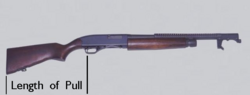
Pictorial definition of distance

Length of pull (sometimes abbreviated as LOP) is the distance from the trigger to the part of a rifle or shotgun which fits against the shoulder of the shooter. Length of pull is an important ergonomic factor for ease of use; and optimum length of pull may vary with the size of the shooter, the thickness of chest clothing and body armor being worn,[1] and whether the shooter is firing from a standing, sitting, or prone position.[2]

Variation

[edit]

Many rifles and shotguns are manufactured with a standard length of pull assumed to fit most shooters. This is often approximately 13.5 in (34 cm) for rifles[2] and about 0.8 in (2 cm) longer for shotguns.[1] Shooters with short arms may find the buttstock dragging along the underside of their arm as they attempt to raise the firearm into firing position. Shooters with broad shoulders or a long neck may experience face injuries from collision with the telescopic sight or thumb of the trigger hand as the firearm recoils. Modern firearms may be equipped with a telescoping stock or removable spacers to adjust the length of pull. Gunsmiths may adjust the length of pull of custom-built firearms or older firearms by cutting off a portion of the buttstock or adding a recoil pad to the buttstock.[3] Some sources[1][4] suggest a shooter's optimum length of pull will allow the butt of the firearm to exactly reach the inside of the elbow when the hand of that arm grips the unloaded firearm with a finger on the trigger. Other sources[5][6] suggest a more appropriate determination may be made using a non-firing "try-gun" resembling a firearm with an adjustable buttstock.[7] When a properly adjusted try-gun is held in a firing position, the shooter's nose should be about two finger-widths behind the thumb of the trigger hand.[8]

See also

[edit]

References

[edit]
Revisions and contributorsEdit on WikipediaRead on Wikipedia
from Grokipedia
Length of pull (LOP) is a fundamental dimension in the design and fitting of shoulder-fired , such as and shotguns, defined as the from the center of the trigger to the center of the buttstock or pad. This measurement, typically ranging from 12 to 15 inches depending on the shooter's build, ensures optimal alignment of the with the user's anatomy for effective handling and performance. Proper LOP is essential for shooter comfort and safety, as an ill-fitting stock can lead to increased felt recoil, poor posture, or even injury during firing. For instance, a stock that is too long may drag on the shoulder or catch in the armpit, slowing target acquisition, while one that is too short can drive the recoil directly into the shoulder and face, exacerbating discomfort. To determine the ideal LOP, shooters often use the "elbow method," where the arm is bent at a 90-degree angle and the distance from the elbow crease to the tip of the trigger finger is measured, aiming for about a half-inch gap when the firearm is shouldered. Many modern firearms feature adjustable stocks to accommodate variations in shooter height, clothing layers, or multiple users, with factory standards commonly set at 13 to 13.75 inches for adult males. Youth and women's models often have shorter LOPs, around 12 inches or less, to promote safe and accurate among smaller-framed individuals. Custom fitting by gunsmiths or through aftermarket stocks further refines this parameter, enhancing precision in , sport , and tactical applications.

Definition and Fundamentals

Core

Length of pull (LOP) is the distance measured in a straight line from the center of the trigger to the center of the buttplate or pad at the rear of the . This measurement is typically taken along the centerline of the to ensure consistency and accuracy in fitting. The endpoints involve the trigger as the forward point and the buttplate or pad as the rearward terminus, encompassing the grip and body in between. LOP primarily applies to shoulder-fired long guns, such as and shotguns, where it determines the firearm's alignment with the shooter's and body during mounting. In these weapons, the dimension influences the overall , allowing the shooter to achieve a natural and repeatable position for sighting and absorption. The measurement is expressed in inches or centimeters, with factory standards for adult males typically ranging from 13 to 13.5 inches, though custom adjustments may extend to 12.5–14.5 inches based on shooter build. This standard reflects an average fit for most adult users, ensuring compatibility with common shooting stances without excessive strain. While LOP plays a key role in overall , its precise adjustment contributes to improved comfort and control during use.

Historical Origins

During the , the advent of during the shifted firearm design toward standardization to meet growing military and civilian demands. Historical models like the Winchester Model 1873 lever-action rifle, introduced in the 1870s, featured lengths of pull around 13 inches, facilitating efficient manufacturing while approximating fit for average adult users. A pivotal occurred in the 1950s with the introduction of adjustable stock features in military rifles, notably experimental and variant designs for the M14, which recognized population-wide variability in shooter dimensions and prioritized adaptability for roles such as paratroopers. The M14E1 folding stock, tested during this period, allowed for collapsible configurations to enhance portability and fit, while the later M14A1 variant incorporated a fixed length of pull of 13.16 inches with adjustable foregrip positioning for stability in automatic fire.

Measurement Techniques

Measuring on Firearms

To measure the length of pull (LOP) on a firearm, begin by ensuring the firearm is completely unloaded, with the chamber visually inspected and no ammunition present in the magazine or nearby, to prioritize safety during handling. Common tools for this measurement include a standard ruler or tape measure for basic assessments, a digital or vernier caliper for higher precision, or a specialized LOP gauge designed for firearm stocks, such as those offered by stock manufacturers for consistent results. The standard step-by-step method involves positioning the on a stable surface with the horizontal and parallel to the . Start at the forward face or center of the trigger blade, then measure in a straight line to the center of the buttplate or pad at the 's end, ensuring the line follows the bore's direction to account for any stock geometry. For stocks with curves or irregular contours, such as certain designs, a flexible non-stretchable may be used to follow the natural path of the pull while maintaining alignment with the bore line, avoiding straight-line approximations that could skew results. Common pitfalls include taking diagonal or off-axis measurements, which can overestimate or underestimate the LOP by up to 1/2 inch, and failing to center the measurement on the trigger rather than its edge. Measurements are typically precise to within 1/8 inch using a caliper or gauge, allowing for reliable comparisons across . For example, many aftermarket for the Remington 700 , such as the Hogue OverMolded model, register an LOP of 13.75 inches when measured this way.

Assessing Shooter Fit

Assessing an individual's ideal length of pull (LOP) begins with a simple body that simulates the arm's position during trigger engagement. To determine this, bend the shooting arm at a 90-degree angle at the with the palm facing up, then measure the distance from the crease of the to the first knuckle of the , as if pulling the trigger. This typically yields an average of 13.5 to 13.75 inches for adult shooters, reflecting standard body proportions in the population. Several factors influence the appropriate LOP beyond the basic arm measurement, including arm length, torso height, and the adopted shooting stance. Longer arms or taller torsos often necessitate adjustments to maintain proper alignment, while a more open stance may require slight lengthening for stability. For instance, youth or shooters with shorter builds generally benefit from an LOP of 12 to 13 inches to avoid overextension, whereas taller males may require 14 to 15 inches for comfortable shouldering. To verify fit, perform a dry-fire test by mounting an unloaded to the in the intended position. The should naturally form a 90-degree without undue strain or on the , ensuring the buttstock contacts the body securely yet allows fluid movement. Customizing the LOP to within 0.5 inches of the personal body measurement promotes consistent cheek weld and reduces anticipatory tension.

Ergonomic Importance

Comfort and Recoil Management

A correct length of pull (LOP) enables the firearm's buttstock to fit naturally into the shooter's pocket, promoting a relaxed posture that minimizes muscle tension during aiming and firing. This alignment allows the shooter to maintain an upright stance without excessive forward lean, which occurs when the LOP is too long, forcing the body to compensate by stretching the arms and neck. Conversely, an LOP that is too short results in a cramped position, where the flares outward and the shoulder hunches, increasing strain on the upper body muscles. In terms of recoil management, an optimal LOP positions the buttplate squarely against the , distributing the recoil force across a broader surface area and directing it straight back into the body rather than upward or sideways. This configuration reduces perceived intensity, as the recoils in line with the shooter's skeletal structure, lessening the jolt to the and . Improper fit can exacerbate effects. For instance, studies on shoulder-fired weapons with high energy have reported injuries like contusions in up to 93% of users after repeated exposure to energies around 59 ft-lbs. Long-term mismatches in LOP contribute to health issues, including shoulder strain and repetitive stress injuries, as chronic awkward positioning amplifies the cumulative impact of recoil on the musculoskeletal system. For instance, ergonomic analyses from the early 2010s link recurrent rifle use to posterior instability, such as Bankart lesions, resulting from repeated counterforces against the anterior shoulder during firing. These injuries often manifest as and reduced mobility after prolonged training or sessions. In practical applications, such as with shotguns, an LOP under 13 inches enhances swing comfort for smaller-framed shooters, including women and , by allowing fluid mounting and movement through brush without binding or overextension. Models designed for these users, like youth variants with adjustable from 12 to 13 inches, facilitate better handling during extended walks and quick on flushing birds.

Impact on Accuracy

Proper length of pull (LOP) is essential for achieving consistent mounting of the , which directly influences cheek weld and sight alignment. A well-fitted LOP allows the shooter to establish a repeatable cheek-to-stock contact, ensuring the eye aligns precisely with the optic or sights without straining or shifting position between shots. This repeatability minimizes variations in point of impact (POI), as inconsistencies in head placement can otherwise cause the to deviate, leading to angular errors that manifest as lateral or vertical shifts on target. For instance, improper LOP contributing to variable cheek weld has been shown to produce POI shifts of 4–5 inches at 992 yards in long-range testing, underscoring the need for fit to maintain precision across multiple shots. Mismatched LOP can induce anticipation flinch, where the shooter subconsciously tenses or jerks in expectation of , disrupting the shot and enlarging group sizes. A fitted LOP promotes a natural, relaxed hold, reducing this anticipatory response and allowing better focus on trigger squeeze and follow-through. In scenarios, such as benchrest setups, adjusting to the correct LOP has been reported to yield noticeable improvements in grouping by enabling steadier control and less shooter-induced error, though exact percentages vary by individual and setup. This enhancement in flinch mitigation supports tighter shot clusters, particularly under repeated firing conditions where might otherwise exacerbate inconsistencies. In prone or offhand positions, LOP significantly affects trigger control and overall stability during dynamic . A properly adjusted LOP—typically shorter for offhand to center the rifle's weight over the torso—facilitates a squared stance and ergonomic , preventing the shooting hand from being pulled off-axis during trigger pull. Excessively long LOP in these unsupported positions can lead to awkward extension, compromising follow-through and introducing that widens groups, especially in precision disciplines requiring rapid transitions. Adjusting LOP for position-specific needs, such as shortening it by 0.25–0.5 inches for offhand compared to prone, enhances control and reduces such disruptions. Many precision rifle shooters use LOPs around 13.5–14 inches to achieve sub-MOA accuracy. This range accommodates the ergonomic demands of competitive , where adjustable allow fine-tuning for both bench and field stages, contributing to consistent sub-1-inch groups at 100 yards. Shooters in events like F-Class and often report sustained sub-MOA performance with this LOP, attributing it to optimized fit that supports reliable sight picture and minimal POI variation under varying conditions.

Adjustments and Variations

Modification Methods

One common method to shorten the length of pull involves cutting the butt end of the stock with a fine-tooth saw after removing the existing recoil pad, followed by filing the cut surface flat and sanding it smooth to prepare for refinishing or reattachment of a pad. This requires precise marking of the desired length—typically measured from the trigger—and wrapping the stock with to minimize splintering during the cut. Refinishing may include applying wood finish or bedding compound to restore and protect the wood. To extend the length of pull, a pad can be added or replaced, typically increasing it by 0.5 to 1 inch depending on the pad's thickness; installation involves grinding the pad to fit the stock's contour, securing it with retainer screws through pre-drilled holes, and applying for a permanent bond that withstands forces. Thicker pads or spacers can be used for greater extension, with screws providing mechanical hold while ensures even distribution of stress. Replacement offer a more comprehensive modification, allowing installation of aftermarket options designed for adjustability; for example, H-S Precision Pro-Series for Remington actions feature adjustable length of pull and include aluminum blocks for improved accuracy. These often can be swapped by removing the original via action screws, requiring no cutting of the firearm. Professional gunsmith services are preferred for modifications involving cutting or fitting, as they ensure precise alignment and finishing to maintain the firearm's balance and value, whereas DIY approaches carry risks such as uneven cuts that alter weight distribution and handling characteristics. Gunsmiths use specialized tools like jigs for straight cuts and professional sanders for smooth refinishing. Basic DIY pad addition can be completed in under 30 minutes with materials costing less than $50, while a full replacement may take 1 to 2 hours and cost over $200 including the itself; professional shortening and pad fitting typically ranges from $100 to $150.

Standard Lengths by Firearm Type

Standard lengths of pull vary significantly by type, reflecting design priorities such as handling, absorption, and user . For , bolt-action hunting models typically feature an average length of pull between 13 and 13.5 inches to accommodate a broad range of shooters in field conditions. AR-15 platforms, optimized for tactical applications, commonly range from 13 to 14 inches, allowing for compact maneuverability while maintaining stability during rapid fire; adjustable stocks on these platforms often permit variations from 10.5 to 14 inches via telescoping mechanisms. Shotguns exhibit greater variation to suit specific disciplines. Trap guns, designed for extended arm reach and smooth swings, generally have lengths of approximately 14.5 inches, promoting fluid target tracking. In contrast, shotgun models prioritize accessibility for smaller frames, with lengths averaging 11 to 12.5 inches to prevent overextension and enhance control. User-specific adaptations further influence these standards. configurations, such as the , adhere to approximately 13.75 inches in the extended position to balance portability and combat readiness across diverse personnel. For non-standard builds, women's and fits are often 1 to 2 inches shorter than standard adult lengths of 13 to 14 inches, reducing strain and improving mount consistency. Global manufacturing practices introduce additional nuances, particularly in sporting firearms. European models, including those from and , favor lengths of 14.5 to 15 inches to align with regional anthropometric data and traditional stock designs.

References

Add your contribution
Related Hubs
User Avatar
No comments yet.