Hubbry Logo
VorbunkerVorbunkerMain
Open search
Vorbunker
Community hub
Vorbunker
logo
8 pages, 0 posts
0 subscribers
Be the first to start a discussion here.
Vorbunker
Vorbunker
from Wikipedia

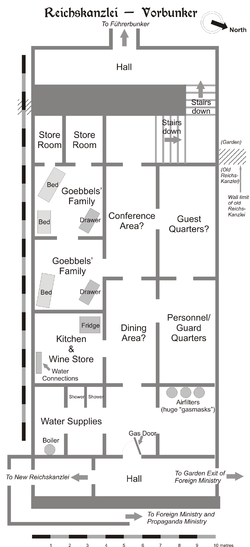
Schematic diagram of the Vorbunker as it was in April 1945

The Vorbunker (upper bunker or forward bunker) was an underground concrete structure originally intended to be a temporary air-raid shelter for Adolf Hitler and his guards and servants. It was located behind the large reception hall that was added onto the old Reich Chancellery, in Berlin, Germany, in 1936. The bunker was officially called the "Reich Chancellery Air-Raid Shelter" until 1943, when the complex was expanded with the addition of the Führerbunker, located one level below.[1] On 16 January 1945, Hitler moved into the Führerbunker. He was joined by his senior staff, including Martin Bormann. Later, Eva Braun and Joseph Goebbels moved into the Führerbunker while Magda Goebbels and their six children took residence in the upper Vorbunker. The Goebbels family lived in the Vorbunker until their deaths on 1 May 1945.[2]

Construction

[edit]

In 1933, Adolf Hitler decided to expand the Reich Chancellery (Reichskanzlei), which he considered too small for his needs.[3] On 21 July 1935, Leonhard Gall submitted plans for a large reception hall (that could also be used as a ballroom) to be built onto the old Chancellery. The drawings were unique because of the large cellar that led a further one-and-a-half meters down to a bunker, which later became known as the Vorbunker.[3]

The Vorbunker's roof was 1.6 meters (5.2 ft) thick, twice as thick as that of the bunker underneath the nearby Air Ministry building. The thick walls of the Vorbunker supported the weight of the reception hall overhead. It had three entry points, to the north, west, and south. Construction was completed in 1936.[4] It had 12 rooms branching out from a single corridor.[5]

The Führerbunker was built by the Hochtief company as part of an extensive program of subterranean construction in Berlin.[6] It was finished by 1944 and was connected to the Vorbunker by a stairway set at right angles (not a spiral staircase). The two bunkers could be closed off from each other by a bulkhead and steel door. A permanent guard detail was posted by the steel door.[7] The Führerbunker was located about 8.5 metres (28 ft) beneath the garden of the old Reich Chancellery, 120 meters (390 ft) north of the new Reich Chancellery building at Voßstraße 6.[8] The Führerbunker was located 2.5 meters lower than the Vorbunker and to the west-southwest of it.[8] The accommodations for Hitler were moved to the Führerbunker, and by February 1945 it had been decorated with high-quality furniture taken from the Chancellery, along with several framed oil paintings.[9]

Events

[edit]
3D model of Führerbunker (left) and Vorbunker (right)
Map showing the locations of the Führerbunker and Vorbunker in Berlin, 1945

The first air-raid drills for the Berlin central government district, which included the Reich Chancellery,[10] occurred in the autumn of 1937. The protocol for the drills stated, in part:

To carry out the air raid drills, a precise regulation is required for the three office buildings, Wilhelmstraße 77, Wilhelmstraße 78 and Voßstraße 1 ... The officials and residents of Wilhelmstraße 78 and Voßstraße 1 can go to the substitute shelters in Wilhelmstraße 78 and Voßstraße 1. The inhabitants of the Reich Chancellor House, Wilhelmstraße 77, will use the shelter under the ballroom.[11]

The only residents of Wilhelmstraße 77 were Hitler and his bodyguards, adjutants, orderlies and servants. It is unknown if the Vorbunker was used before January 1945. Hitler transferred his headquarters to the Führerbunker in Berlin on 16 January 1945, where he (along with his influential private secretary, Reichsleiter Martin Bormann and others), remained until the end of April.[12] After 16 January the Vorbunker was used by various military officers and housed men from Hitler's personal bodyguard. In April 1945, as the Battle in Berlin raged on, Joseph Goebbels showed his strong support for Hitler by moving his family into the Vorbunker.[13] He occupied a room in the Führerbunker which had recently been vacated by Hitler's personal physician, Theodor Morell.[14] Two rooms in the Vorbunker were used for food supply. Hitler's personal dietitian, Constanze Manziarly prepared meals in the kitchen, which was equipped with a refrigerator and a wine store.[15]

On the evening of 1 May 1945, Goebbels arranged for an SS dentist, Helmut Kunz, to inject his six children with morphine so that when they were unconscious, an ampule of cyanide could be crushed in each of their mouths.[16] According to Kunz's later testimony, he gave the children morphine injections but it was Magda Goebbels and SS-Obersturmbannführer Ludwig Stumpfegger, Hitler's personal doctor, who administered the cyanide.[16]

Afterwards, Goebbels and his wife went up the stairs to ground level and through the Führerbunker's emergency exit to the bombed-out garden behind the Reich Chancellery. There are several different accounts on what followed. According to one account, Goebbels shot his wife and then himself. Another account was that they each bit on a cyanide ampule and were given a coup de grâce immediately afterwards by Goebbels' SS adjutant, Günther Schwägermann.[17] Schwägermann testified in 1948 that the couple walked ahead of him up the stairs and out into the Chancellery garden. He waited in the stairwell and heard the "shots" sound.[18] Schwägermann then walked up the remaining stairs and outside. There he saw the lifeless bodies of the couple. Following Joseph Goebbels prior order, Schwägermann told an SS soldier to make sure Goebbels was dead. The soldier fired into Goebbels body, which did not move.[18] The bodies were then doused with petrol, but the remains were only partially burned and not buried.[17]

At 01:00 on 2 May, the Soviets picked up a radio message from the LVI Panzer Corps requesting a cease-fire and stating that emissaries would come under a white flag to Potsdamer bridge. Early in the morning of 2 May, the Soviets captured the Reich Chancellery.[19] General of the Artillery Helmuth Weidling, the commander of the Berlin Defense Area, surrendered with his staff at 06:00.[20] Down in the Führerbunker, Chief of the Army General Staff General Hans Krebs and Hitler's Chief Adjutant Generalleutnant Wilhelm Burgdorf committed suicide by gunshot to the head.[21][22] Johannes Hentschel, the master electro-mechanic for the bunker complex, stayed after everyone else had either committed suicide or left, as the field hospital in the Reich Chancellery above needed power and water. He surrendered to the Red Army as they entered the bunker complex at 09:00 on 2 May.[23] The bodies of Goebbels six children were discovered on 3 May. They were found in their beds in the Vorbunker; the clear mark of cyanide appeared on their faces.[24]

Post-war events

[edit]

The ruins of both Chancellery buildings were levelled by the Soviets between 1945 and 1949 as part of an effort to destroy the landmarks of Nazi Germany. The bunker complex largely survived, although some areas were partially flooded. In December 1947 the Soviets tried to blow up the bunkers, but only the separation walls were damaged. In 1959 the East German government began a series of demolitions of the Chancellery, including the bunker complex.[25] In 1974, 1.5 meters (4.9 ft) of water was pumped from inside the bunkers, and the East Germany Stasi conducted a survey of the interior of the Vorbunker and took external measurements of the Führerbunker. Since it was near the Berlin Wall, the site was undeveloped and neglected until after reunification.[26]

During the construction of residential housing and other buildings on the site in 1988–89, several underground sections of the bunker complex were uncovered by work crews.[27] In April 1988, the East German government allowed several visits to the site by photo-journalists. Water was pumped out of the Vorbunker for four days before access could be made via the underground passageway which led from the Chancellery.[28] The interior floor of the Vorbunker was covered with a muddy sludge from having been underwater for so many years. Old empty wine bottles were found on the floor of the kitchen and wine store room. Still present in the room next to the kitchen were the broken frames of the bunk beds used by the Goebbels children.[29] At the end of the hallway were the stairs leading down to the Führerbunker. However, the men could go no further than the mid-landing, as the Führerbunker was still underwater and the ceiling beyond the doorway had collapsed due to the demolitions performed in 1947.[30] After these inspections, work crews for the most part removed and destroyed the bunker complex.[31] The Vorbunker's top and external walls were the first structures to be torn down.[27] The construction of buildings in the area around the complex was a strategy for ensuring the surroundings remained anonymous and unremarkable.[32] The emergency exit point for the Führerbunker (which had been in the Chancellery gardens) was occupied by a car park.[33]

Site of the Bunker complex in 2007

On 8 June 2006, during the lead-up to the 2006 FIFA World Cup, an information board was installed to mark the location of the bunker complex. The board, including a schematic diagram of the bunker, can be found at the corner of In den Ministergärten and Gertrud-Kolmar-Straße, two small streets about three minutes' walk from Potsdamer Platz. Hitler's bodyguard, Rochus Misch, one of the last people living who was in the bunker at the time of Hitler's suicide, was on hand for the ceremony.[34]

See also

[edit]

References

[edit]
Revisions and contributorsEdit on WikipediaRead on Wikipedia
from Grokipedia
The Vorbunker, or forward bunker, was an underground air-raid shelter constructed in 1936 beneath the reception hall of the Old in , , primarily to protect government staff during aerial bombings. It featured a thick roof approximately 1.6 meters deep and was located about 1.5 meters below the cellar level, serving as the initial phase of a larger subterranean complex expanded amid intensifying Allied air raids in . As wartime pressures mounted, the Vorbunker transitioned from a staff shelter to a temporary command post for Adolf Hitler and his entourage starting in late 1944, housing living quarters, guards, and communications facilities before the deeper Führerbunker was completed in 1944 and connected via a tunnel. Hitler relocated fully to the lower Führerbunker on January 16, 1945, amid the Soviet advance, but the Vorbunker remained integral to the site's operations until the fall of Berlin in May 1945. The structure endured heavy bombardment yet symbolized the Nazi regime's desperate final defenses, with its remnants later demolished by Soviet forces and the site redeveloped into nondescript urban space post-war to prevent any neo-Nazi veneration.

Design and Purpose

Strategic Context and Initial Planning

The Vorbunker emerged from the Nazi regime's early recognition of Berlin's vulnerability to aerial , amid Germany's aggressive rearmament and the remilitarization of the Rhineland in 1936, which heightened fears of retaliatory air strikes by Britain and . Fortifying the was prioritized to ensure continuity of command, as doctrine emphasized offensive air power while acknowledging defensive needs for leadership protection. The bunker's planning reflected a pragmatic shift toward subterranean defenses, drawing on trench experiences and contemporary engineering for shelters capable of withstanding high-explosive bombs. Initial designs for the Vorbunker were tied to expansions of the complex, with construction commencing around 1936 as a provisional air-raid facility beneath the Chancellery gardens. Engineer Karl Piepenburg oversaw the project under Hitler's direct oversight, aiming for rapid completion to house up to 100 personnel including guards, servants, and teletype operators. The structure prioritized basic functionality over luxury, featuring two levels with emergency generators and ventilation, at a depth sufficient to resist conventional bombing but not prolonged sieges. By January 1939, the Vorbunker was operational alongside the completion of Albert Speer's , serving as the primary shelter until wartime intensification necessitated deeper reinforcements. This phase underscored causal priorities: immediate threat mitigation over long-term strategy, as German intelligence underestimated Allied bombing escalation until the 1940-1941 Blitz proved the tactic's efficacy. No formal strategic doctrine document survives, but orders reflect responses to perceived risks rather than preemptive grand planning.

Architectural Specifications and Defensive Features

The Vorbunker, constructed as the initial phase of the underground shelter complex beneath the , consisted of a positioned approximately 1.5 meters below the cellar level of the Old Chancellery's reception hall. This shallow depth relative to the later allowed for rapid while providing basic subterranean protection, with the emphasizing durability against conventional aerial bombing prevalent in 1944. The encompassed around 10 to 12 small rooms and corridors, including private quarters, a conference area, and utility spaces, all interconnected via narrow passages to facilitate quick access during alerts. Key architectural specifications included a roof slab of measuring 1.6 meters in thickness, which was engineered to distribute impact loads from potential direct bomb hits and was notably twice the thickness of comparable shelters under the nearby building. Walls were similarly robust, constructed from high-strength poured to form a monolithic enclosure capable of withstanding structural stresses, though exact wall thicknesses varied between 1 to 2 meters based on load-bearing requirements. Entrances featured heavy air-raid doors designed to be gas-tight, sealing the interior against chemical attacks, with the overall spanning roughly 200 square meters to accommodate essential personnel without excess space. Defensive features prioritized short-term survivability in air raids, incorporating a self-contained room to ensure independent electrical supply independent of surface grid failures, thereby powering , communications, and basic operations during blackouts. A dedicated ventilation plant with ducted systems provided air circulation, likely including rudimentary elements to mitigate smoke, dust, and potential gas ingress from bombardments, though not as advanced as later wartime standards for prolonged sieges. These elements, combined with emergency exits leading to the Chancellery garden, formed a layered defense focused on blast resistance and for hours to days, reflecting the bunker's provisional role before deeper expansions. No armaments or active countermeasures were integrated, as the emphasis remained on passive rather than offensive capability.

Construction

Timeline and Key Phases

The Vorbunker was constructed in 1936 as the initial phase of the subterranean air-raid shelter system beneath the , designed to protect , his guards, and key staff from aerial bombardment. Planning for the Chancellery expansion, incorporating the bunker, originated in 1933 with Hitler's directive to enlarge the existing facility, leading to architect 's submission of detailed proposals on 21 1935 for an adjacent reception hall supported by the bunker's structure. Excavation and pouring of began promptly after plan approvals, positioning the facility approximately 5 meters underground with walls thick enough—up to 1.6 meters—to bear the overhead load of the planned reception hall. This single-phase build yielded a compact layout of 12 rooms branching from a central corridor, emphasizing rapid completion amid escalating tensions in . By late , the structure was fully operational as the "Reich Chancellery Air-Raid Shelter," though it received no major modifications until the subsequent expansion in 1943.

Engineering Challenges and Innovations

The construction of the Vorbunker faced significant geotechnical challenges stemming from Berlin's subsurface conditions, characterized by sandy and gravelly soils overlaying a high groundwater table typically reached at depths of 2 to 3 meters. These factors necessitated advanced dewatering techniques, including pumping systems and temporary cofferdams, to enable excavation to approximately 8.5 meters below the Reich Chancellery garden surface without structural collapse or inundation. German military geologists, consulted for such projects, applied hydrological mapping and abstraction methods honed across WWII fortifications to predict and control water ingress, preventing the flooding that plagued many urban bunkers. Wartime constraints amplified these difficulties, with material rationing limiting steel rebar availability and reliance on forced labor under the introducing inefficiencies in and execution speed. Despite ongoing Allied bombings disrupting supply lines, the project achieved rapid completion—initiated in mid-1944 and operational by late that year—through modular formwork and on-site concrete mixing adapted from techniques, prioritizing volume over precision. Innovations included the use of high-strength pours for walls and a exceeding 1.5 meters in thickness, designed to distribute the load of overlying and resist direct impacts far beyond standard air-raid shelters of the era. innovations, such as integral bituminous admixtures and multi-layer sealing on joints, addressed persistent seepage issues common in groundwater-prone sites, while embedded ventilation shafts with preliminary precursors anticipated chemical threats. These features, though empirically tested under conditions, reflected causal trade-offs: enhanced blast resistance at the expense of long-term durability, as evidenced by structural degradation in similar constructs.

Operational Use

Early Deployment and Functionality

The Vorbunker entered service upon its completion in 1936 as the designated air-raid shelter for the New , providing subterranean protection amid escalating tensions in that foreshadowed . Constructed with a roof exceeding five feet in thickness and robust walls engineered to support the overlying reception hall, it was built into the Chancellery's cellar to safeguard personnel from bomb impacts. This structure, comprising approximately 12 rooms, initially functioned as the primary underground refuge for during his visits, along with his guards, servants, and administrative staff. In its early operational phase through the late and into the , the Vorbunker served mainly as a temporary haven during air-raid alerts, equipped with basic facilities such as a canteen connected to the shelter above. Though major Allied bombing campaigns against commenced in , the bunker's deployment aligned with Germany's early war preparations, offering filtered air and emergency power generation to sustain occupants amid potential disruptions. Hitler utilized it sporadically for conferences and protection, but it primarily accommodated Chancellery operations rather than full-time residence, reflecting its role as a forward defensive measure before deeper expansions. By 1943, as intensified, the Vorbunker's functionality underscored the need for enhanced capacity, prompting the adjacent Führerbunker's construction while it continued as an upper-level extension for routine sheltering and guard postings. Its design emphasized rapid access via stairways and compartmentalization for security, enabling segmented use during alerts without evacuating the entire complex. This early configuration proved adequate for dispersed threats but highlighted limitations in depth and scale against sustained high-explosive assaults.

Role During Late-War Bombings and the

The Vorbunker functioned as the primary air-raid shelter for staff and guards amid the escalating Allied bombing offensive on , which intensified from late 1944 onward, including major RAF night raids and USAAF daylight missions that dropped thousands of tons of explosives on the capital. Completed in mid-1944 with a roof over 1.5 meters thick, it initially housed during his intermittent visits to for protection against high-explosive and incendiary bombs, before he transferred to the adjacent, deeper on January 16, 1945, due to the increasing threat from heavier ordnance. Following Hitler's relocation, the Vorbunker accommodated military officers, members of his personal bodyguard from the , support personnel, doctors, and Propaganda Minister along with his family, serving as dormitories and operational spaces while the lower bunker concentrated high-level command functions. In this capacity, it sustained occupancy through the final months of aerial assaults, which by included the Eighth Air Force's largest raid on the city with over 1,000 bombers targeting industrial and administrative districts. As the unfolded from the Soviet offensive launch on April 16, 1945, the Vorbunker provided defensive shelter against the Red Army's massive artillery preparation—firing over 1.5 million shells in the initial barrage—and subsequent infantry advances that reached the gardens by April 29. Housing up to several dozen non-essential occupants amid the encirclement of the government quarter, it endured direct hits and nearby explosions, with its upper-level rooms repurposed for storage and auxiliary command amid the collapse of organized defenses. The facility remained operational until May 2, 1945, when surviving personnel either surrendered to Soviet forces or attempted breakouts following the suicides of key figures like Goebbels on May 1.

Integration with Führerbunker

Expansion Necessities

The Vorbunker, completed in as a provisional air-raid beneath the New , initially sufficed for lighter threats but became inadequate amid the Royal Air Force's and ' escalating of starting in late 1943. These raids employed heavier payloads, including high-explosive and incendiary bombs totaling over 45,000 tons dropped on the city by war's end, necessitating deeper fortifications to absorb direct impacts and vibrations that could compromise shallower structures like the Vorbunker, which featured only a 1.6-meter-thick roof. By early 1943, with Allied air superiority enabling frequent daylight and nighttime operations—such as the raids marking Hitler's birthday—German leadership recognized the Vorbunker's limitations for sustained command operations, as it lacked sufficient depth, independent ventilation against gas or smoke, and capacity for Hitler's inner circle during prolonged sieges. On January 18, 1943, Hitler directed the to excavate and build the directly beneath the Vorbunker, prioritizing rapid completion to counter the imminent risk of structural failure under repeated bombings that had already damaged surface Chancellery buildings. Engineering imperatives further underscored the expansion: the new bunker extended 15 meters deeper into the waterlogged Berlin soil, requiring dewatering pumps, steel reinforcements against collapse, and a shared access stairway to integrate with the Vorbunker while adding 30 rooms for 40-50 occupants, diesel generators for , and to mitigate heat from 2,500-cubic-meter concrete pours conducted under blackout conditions. This vertical extension preserved operational continuity by linking to the Vorbunker's emergency exits and utilities, avoiding horizontal sprawl that would expose construction to detection. The entered partial service by October 1944, just as faced over 350 Allied sorties monthly, fulfilling the necessity for a command capable of withstanding 1,000-pound bombs while accommodating Hitler's strategic conferences amid the Eastern Front's collapse. Without this upgrade, evacuation to remote like Rastenburg would have severed Berlin-based coordination, as surface alternatives offered no viable defense against the Luftwaffe's inability to contest air space.

Shared Infrastructure and Operational Overlap

The Vorbunker and formed an integrated subterranean complex connected by a guarded stairway featuring doors and bulkheads for sealing sections during emergencies. This linkage, oriented at right angles and descending approximately 8.5 meters, enabled personnel movement while maintaining structural independence between the upper and lower levels. Exits from the complex extended to the buildings and adjacent gardens, providing shared access points for evacuation and supply. Key infrastructure overlapped in the Vorbunker's upper level, which included a generator room supplying and a combined power-generating/ventilation station with filters to circulate air throughout the facility, even under power failure conditions. These systems supported basic sustainability features like showers, washrooms, and a , extending operational capacity to the deeper without fully redundant installations below. The roof of the Vorbunker, at 1.6 meters thick and positioned 1.5 meters below ground, complemented the 's deeper defenses, creating a layered protective envelope. Operationally, the bunkers exhibited significant overlap as a single from late 1944 onward, with the Vorbunker initially serving as the primary shelter before the Führerbunker's completion in January 1945. relocated to the lower bunker on January 16, 1945, while upper-level spaces housed support staff, guards, and families such as ', allowing fluid coordination during air raids and the . This integration facilitated command functions, with the complex functioning as Hitler's final operational hub until May 1945, despite increasing strain on shared resources amid Soviet advances.

Post-War Destruction and Rediscovery

Soviet Demolition Efforts

Following the Soviet capture of on May 2, 1945, engineers began systematic efforts to demolish the Vorbunker and associated complex, aiming to obliterate Nazi-era landmarks and prevent the site from becoming a focal point for sympathizers. Initial actions included filling access shafts with rubble and detonating explosives to collapse surface-level entrances and adjacent ruins, with work extending through 1947 as part of broader measures. These demolition attempts employed high-explosive charges strategically placed in the bunker's structures, which measured up to 4 meters thick in critical areas, but yielded incomplete results due to the engineering resilience designed for withstanding aerial . By 1947, blasts had succeeded in destroying the main entranceway and sealing off much of the interior, yet substantial underground chambers of the Vorbunker—originally constructed in as the forward command shelter—remained intact beneath the surface, flooded and debris-choked but structurally sound. Soviet records indicate multiple phases of explosive operations between 1945 and 1949, coordinated with the leveling of above-ground Chancellery remnants, but the depth and compartmentalized design frustrated total eradication without disproportionate resources, leaving the Vorbunker's core framework as a persistent subterranean relic. This partial failure underscored the bunker's wartime over-engineering, prioritizing survivability over ease of removal.

East German Reconstruction and 1980s Excavations

In the German Democratic Republic (GDR), the site, including the Vorbunker, remained largely untouched after initial Soviet demolitions in , as authorities avoided commemoration of Nazi history to prevent it from becoming a site of pilgrimage for extremists. The area was treated as a symbolic void, with minimal development, reflecting the state's ideological rejection of fascist legacies while prioritizing socialist reconstruction elsewhere in . By the late 1980s, amid broader efforts in East Berlin's former government district, construction of residential housing complexes prompted excavations that uncovered substantial remnants of the bunker complex. Between 1988 and 1989, workers unearthed concrete structures from both the Vorbunker and deeper levels, revealing waterlogged interiors filled with debris and wartime artifacts. GDR officials ordered the complete demolition of the Vorbunker remains, which were ripped out and removed, while portions of the —such as its roof slabs—were deliberately collapsed into the voids below to ensure structural instability and deter future access. These actions aligned with the GDR's policy of eradicating visible Nazi infrastructure to suppress revanchist or neo-Nazi sentiments, though the haste of the demolitions preserved little documentation beyond clandestine photographs taken by individuals like , who documented the site's flooded decay starting in 1987. The excavated materials were backfilled with and , allowing apartment blocks to be built atop the site by 1990, just after . This final intervention effectively buried the Vorbunker under layers of urban development, rendering it inaccessible without major disruption.

Current Site and Historical Assessment

Physical Remains and Site Alterations

The Vorbunker, as part of the broader complex, underwent systematic destruction post-World War II to prevent it from becoming a pilgrimage site. Soviet forces initially demolished accessible sections and sealed entrances with rubble and explosives between 1945 and 1947, though structures largely endured underground. Further attempts at obliteration occurred during East Berlin's residential development in the late ; authorities excavated the site in 1988–1989, destroying the Vorbunker by ripping out its concrete remains and collapsing portions of the adjacent deeper bunker using heavy machinery and explosives. Today, no visible physical remains of the Vorbunker exist above ground, as the area was redeveloped into a multi-story apartment complex and adjacent following in 1990. The site's location near the former had left it undeveloped during the , but post-1989 construction fully integrated it into the urban fabric of the Innenstadt district, with any subsurface debris buried under foundations. In June 2006, the Berliner Unterwelten e.V. association erected a bilingual information panel at the exact location (Gertrud-Kolmar-Straße 2, 10117 ), featuring a , historical photographs, and a timeline of events to provide context without glorifying the site. This marker, the first official acknowledgment of the bunker's position, emphasizes the historical consequences of Nazi leadership's final days rather than preserving architectural elements.

Significance in Military Engineering and WWII History

The Vorbunker represented a pioneering effort in subterranean fortification engineering, constructed in 1936 as an air-raid shelter beneath the Old Reich Chancellery in Berlin using reinforced concrete with a roof thickness of approximately 1.6 meters (5 feet 3 inches) to withstand aerial bombardment. This design prioritized rapid deployment and basic protection for high-level personnel, including Adolf Hitler, his guards, and staff, at a shallow depth of about 1.5 meters below the chancellery cellar, reflecting early Nazi adaptations to escalating Allied air campaigns without the deeper excavations later required. Its engineering emphasized structural integrity over luxury, with concrete walls engineered for load-bearing capacity to support overlying structures, though it lacked the advanced ventilation and power redundancy of subsequent bunkers like the adjacent Führerbunker completed in 1944. In the context of World War II military engineering, the Vorbunker exemplified Germany's shift toward hardened command infrastructures amid intensified , influencing later designs across by demonstrating the feasibility of converting civilian cellars into fortified zones with minimal disruption to surface operations. However, its limitations—such as vulnerability to ground assaults and reliance on surface access—highlighted causal realities of bunker warfare: while effective against high-explosive ordnance from the air, these structures could not isolate occupants from or resource depletion, as evidenced by the facility's overload during the 1945 bombings that prompted expansion. The bunker's construction by specialist firms like underscored resource prioritization in the Reich's corps, diverting and labor from frontline defenses to rear-area survivability, a strategic choice critiqued for accelerating industrial vulnerabilities. Historically, the Vorbunker served as the initial for Nazi high command during the late-war phase, with Hitler relocating there on January 16, 1945, amid the Soviet advance on , marking it as the nerve center for futile defensive directives in the . Operational from mid-1944, it facilitated coordination of fragmented forces against the Red Army's Operation Berlin, sustaining a semblance of centralized control for 105 days until Hitler's suicide on April 30, 1945, after which remaining occupants surrendered. Its role underscored the Third Reich's tactical desperation, as the bunker complex—despite engineering robustness—failed to alter the war's outcome, exposing the inefficacy of isolated fortifications against overwhelming mechanized offensives and internal collapse. Postwar analyses, drawing from declassified records, view it as a microcosm of Hitler's strategic isolation, where physical security paradoxically amplified delusional decision-making detached from battlefield realities.

References

Add your contribution
Related Hubs
User Avatar
No comments yet.