


Community hub
Recent from talks
Contribute something
Nothing was collected or created yet.
Fanny pack
View on Wikipedia

A waist bag, fanny pack, belt bag, moon bag, belly bag (American English), or bumbag (British English) is a small fabric pouch worn like a belt around the waist by use of a strap above the hips that is secured usually with some sort of buckle. The straps sometimes have tri-glide slides, making them adjustable in order to fit properly. It can be considered as a purse worn around the waist.
Although traditionally the bag is worn with the pouch at the front, the separate American and British names derive from the fact that they are often worn with the pouch above the buttocks, for which "fanny" and "bum" are respective slang terms in each country. In France, they are known as banana bags, in Spain and Poland as kidney bags, in Italy as the marsupio, from marsupium. In Costa Rica, they are called a skippy or canguru.[citation needed]
The modern bags resemble those used from antiquity in some cultures and have gone in and out of fashion from the second half of the 20th century. From the mid-2010s the bag is often worn crossbody.
Early usage
[edit]Historically, the bag was positioned in front of the body, so people could protect themselves from bandits. Bags attached to belts have been in use since antiquity in many cultures. One origin was the Native American buffalo pouch which was used instead of sewing pockets into clothing. Buffalo pouches may also be worn on the wrist or carried on the front of the chest via a neck strap or lanyard.[1] Ötzi had a belt pouch 5,000 years ago. The European medieval belt-pouch is another antecedent which was superseded as clothing came to have pockets. The Scottish sporran is a similar belted pouch that survived because of the impracticality of pockets in a kilt.
Use
[edit]Mobile devices (and USB charging cables and backup batteries), bottles of water, snacks, tissue paper, first aid, isopropyl alcohol, contact lenses, and pepper spray are among some of the most common items stored in the bag. Fanny packs designed for concealed carry of a weapon are available.[2]
Unlike handbags, they do not have to be carried, and unlike backpacks, they do not put undue strain on the back. Often referred to as "waist bags", they tend to be worn "cross body" rather than around the waist.[citation needed] Fashion houses such as Chanel and Gucci are at the forefront of the trend. The practicality of fanny packs is particularly popular in "festival fashion", where outfits tend to be more extravagant.
Fashion
[edit]In 1954, a skiers leather fanny pack appeared in a Sports Illustrated Christmas shopping guide:[3][4] "$10. The lightweight leather 'fanny pack' is designed to hold a cross-country skier's wax and lunch. It's also useful for cyclists, hikers, equestrians."[5]
In 1962, reportedly,[6][7][8] Melba Stone, an Australian widow, inspired by a kangaroo, is sometimes credited with making a fanny pack. "In 1988, Adweek named the fanny pack the product of the year."— i-D[9]
The modern version made from nylon and other synthetic materials came into use in the 1980s and they were especially en vogue in the 1990s, but gradually their popularity fell into decline by the mid-2000s.[10][11]
In 2012, calling them "belted satchels" or "hands-free bags", several designer labels sought to bring the accessory back by offering stylish and expensive designs selling for as much as $1,995.[12][13]
In July 2018, The Boston Globe reported that fanny packs were back in vogue with new packs introduced by fashion designers Gucci, Prada, and Louis Vuitton. Designer packs retailed for up to $1,500 and were worn by celebrities such as Kim Kardashian, Rihanna, Jaden Smith, and Russell Westbrook. Vogue magazine reported on the trend by writing "Alas, due to our odd fascination with ugly throwback clothing, the fanny pack has been vindicated."[14]
Gallery
[edit]-
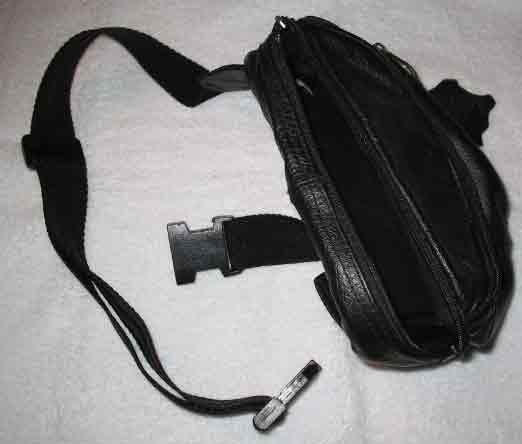
 Artificial leather belt bag with side release buckle, tri-glide slide for adjustment and top-open zipper compartment
 -
 A woman wearing a leather fanny pack
 -
 Medieval painting by the Limbourg brothers showing a lord wearing a belt bag with a bollock dagger, c. 1416
 -
 A nineteenth century photograph of a Plains Indian showing a belted bag known as a medicine pouch
 -
 Fanny pack on a Swedish fashion photo, 1937
 -
 Fanny pack worn across the chest, 2022

_Br%C3%BCder_(Pol_Limburg_006.jpg)


See also
[edit]- Money belt
- Messenger bag, a larger pouch than a fanny pack
- Utility belt
- Wristpack, essentially a fanny pack for the wrist
References
[edit]- ^ Wandahsega, Larissa. "Buffalo Pouch". PotawatomiLanguage.org. Archived from the original on 2015-03-30. Retrieved 2014-07-22.
- ^ Chris Ewens (1 April 2010). "Pack Mentality: Rethinking the Fanny Pack". usconcealedcarry.com. US Concealed Carry Association. Archived from the original on 16 June 2013. Retrieved 14 June 2013.
- ^ Muzquiz, Albert (6 August 2018). "History of the Fanny Pack / Cross-Body Bag". Heddels. Retrieved 15 April 2022.
- ^ "The Cultural History of the Fanny Pack". MEL Magazine. 16 August 2018. Retrieved 15 April 2022.
- ^ "CHRISTMAS BY MAIL ORDER". Sports Illustrated Vault. SportsIllustrated.com. November 22, 1954. Retrieved 15 April 2022.
- ^ Lowe, Jaime (4 September 2015). "Letter of Recommendation: Fanny Packs". The New York Times. Retrieved 15 April 2022.
- ^ Uthman, Daniel. "Quarterbacks get hip to fanny packs". USA TODAY. No. July 15, 2015. Retrieved 15 April 2022.
- ^ "From fashion joke to street-style hit: the return of the bumbag". the Guardian. 16 May 2017. Retrieved 15 April 2022.
- ^ Newell-Hanson, Alice (6 September 2017). "fanny packs are back, whether you like it or not". i-D. Retrieved 15 April 2022.
- ^ Muzquiz, A. (2018, August 6). History of the fanny pack/cross-body bag. Heddels. https://www.heddels.com/2018/08/history-fanny-pack-cross-body-bag/
- ^ Vanderweide, Zoe (2025-01-21). "The Best Fanny Packs". The New York Times. ISSN 0362-4331. Retrieved 2025-05-29.
- ^ Glen Levy (11 February 2011). "Fashion Fail: Are Fanny Packs Really Making a Comeback?". Time. Time Inc. Retrieved 9 July 2012.
- ^ Rachel Dodes (10 February 2011). "With Fanny Packs on the Runway, Can Mom Jeans Be Far Behind?". The Wall Street Journal. Dow Jones & Company, Inc. Retrieved 9 July 2012.
- ^ Teitell, Beth (2018-07-24). "Fanny packs: They're in vogue. We're not lying". The Boston Globe. Retrieved 2018-07-25.
Fanny pack
View on GrokipediaHistory
Prehistoric and Ancient Origins
The earliest known example of a waist-worn pouch dates to the Copper Age, discovered with the mummified remains of Ötzi the Iceman in the Ötztal Alps of northern Italy, dating to approximately 3350–3100 BCE.[4] This leather pouch, crafted from animal hide and attached to a belt, was secured with grass cordage or leather thongs.[7] It contained practical tools for survival, including a flint endscraper for processing plants, a borer for drilling holes in wood or leather, a small retouched flake for cutting soft materials, a bone awl for sewing, and pieces of Fomes fomentarius fungus used as tinder or for medicinal purposes, along with traces of pyrite for fire-starting.[7] The pouch's design allowed hands-free access to essentials during travel in rugged alpine terrain, highlighting its utility for a nomadic hunter-gatherer lifestyle.[7] Similar waist-attached pouches appear in the archaeological and artistic record of later ancient civilizations, serving as precursors to more formalized storage solutions. In ancient Greece, representations on pottery depict the phormiskos, a small leather or fabric bag tied to a belt or girdle.[8] In regions like ancient Egypt, basketry bags from New Kingdom sites (c. 1550–1070 BCE) demonstrate early woven constructions, as evidenced by preserved artifacts.[9] These early pouches were particularly vital in nomadic, warrior, or agrarian societies across Eurasia and the Near East, where hands-free storage enabled mobility and efficiency during hunting, trade, or combat.[7] In resource-scarce environments of prehistoric Europe and ancient Egypt, such designs supported survival by keeping essentials secure yet accessible, reflecting a shared conceptual evolution toward practical, body-worn storage long before industrialized forms emerged.[9]Modern Invention and Popularization
The modern fanny pack, as a commercial product, traces its origins to mid-20th-century innovations that transformed utilitarian waist pouches into accessible accessories. The earliest known advertisement appeared in a 1954 issue of Sports Illustrated, promoting a lightweight leather pouch priced at $10 for cross-country skiers to hold wax and lunch, and also recommended for cyclists, hikers, and equestrians.[1] The term "fanny pack" first appeared in print in a 1963 issue of the journal American Speech, referencing it as slang for ski patrol belts.[2] In the United States, development accelerated during the 1970s and 1980s, building on earlier utility belts from the early 20th century that served as precursors for hands-free storage. Leather variants emerged prominently in the 1950s for cross-country skiers, providing durable pouches to hold wax, lunch, and tools during outdoor pursuits, with popularity growing among European skiers in the 1960s and 1970s.[1] By the 1980s, these evolved into cycling accessories, offering cyclists secure storage for maps, water, and repairs without hindering movement.[10] Commercialization peaked in the 1980s, driven by the era's athletic wear boom. Mass production shifted to nylon materials in bright, vibrant colors, making them ideal for tourists navigating crowded sites while keeping valuables close—passports, cameras, and snacks within easy reach.[11] This surge aligned with rising global tourism and the aerobics fitness trend, propelling fanny packs from niche gear to ubiquitous accessories in American markets. Regional naming conventions solidified during this period, reflecting cultural slang differences. In the U.S., the term "fanny pack" arose due to the bag's placement near the "fanny," American slang for buttocks, while "bum bag" persisted in Australia and the UK to avoid the latter term's vulgar connotations elsewhere.[12]Design and Features
Construction and Materials
Fanny packs are primarily constructed from a zippered main pouch attached to an adjustable waist strap, typically featuring a quick-release buckle for secure closure and optional padding along the back panel for wearer comfort during extended use.[13] The strap is often made from durable nylon webbing or elastic material, ranging from 1 to 1.5 inches in width, allowing for sizes that accommodate waists from 24 to 50 inches.[13] Reinforcement elements, such as foam interfacing or woven padding, are integrated into the pouch base to provide structure and prevent sagging under load.[14] Common materials emphasize durability, lightness, and weather resistance, with nylon fabrics like 500D or ripstop variants (210D-400D) widely used for their abrasion resistance and ability to repel water without adding significant weight.[13] Polyester, often in ripstop weaves, serves similar purposes and is favored for its quick-drying properties, while premium models incorporate full-grain leather for enhanced longevity and a supple feel over time.[15] By the 2020s, eco-friendly alternatives have gained prominence, including recycled nylon and polyester derived from plastic bottles, upcycled leather scraps, and vegan options like cactus-based or TPU-coated synthetics, reducing environmental impact while maintaining functionality.[16] These materials are selected for their durability, allowing them to support everyday loads without deformation.[17] Manufacturing involves precise sewing techniques to ensure seams withstand repeated stress, starting with pattern cutting that includes ¼- to ½-inch allowances for the main body, lining, and strap slots.[13] Straight stitches (2.5-3 mm length) form primary seams, supplemented by zigzag stitching for edge finishing and bar-tacking or box stitching at high-tension areas like buckle attachments and zipper ends to prevent fraying.[18] Heavy-duty machines, such as those using size 16/100 needles and bonded nylon thread (Tex 70-210), handle thicker fabrics, with double or triple stitching applied to straps for added security.[13] Standard dimensions hover around 8-12 inches wide, 4-7 inches tall, and 1.5-3 inches deep, yielding capacities of 1-5 liters to balance portability and utility.[19][20] Over time, construction has evolved to incorporate multifunctional elements, such as internal dividers for organization, external loops for water bottle attachment, and RFID-blocking linings woven from conductive fabrics to shield against electronic theft in contemporary designs.[17] These additions rely on advanced sewing methods, like reinforced welting around ports, to maintain integrity without compromising the pack's compact form.[21]Variations and Types
Fanny packs have evolved into a range of styles that extend beyond the traditional waist-worn design, offering greater versatility in wear and function. The standard waist-worn fanny pack features a rectangular pouch secured around the hips with an adjustable strap, typically made from durable fabrics like nylon or canvas for everyday accessibility.[22] In contrast, cross-body sling styles, which drape diagonally across the chest or back, gained popularity in the late 2010s, allowing for hands-free movement and a more modern, urban aesthetic while maintaining the core pouch design.[23] Specialized variations cater to specific needs, such as runner's belts, which prioritize a minimalist profile to minimize bounce during physical activity. These belts often consist of slim, elastic waistbands with small, secure pockets for essentials like a phone or keys, constructed from lightweight, breathable materials to ensure stability without restricting motion.[24] Travel security pouches, designed for discreet protection, incorporate anti-theft features like slash-resistant fabrics, RFID-blocking layers, and hidden compartments that can be worn under clothing or as a visible waist pack.[25] Luxury versions elevate the form with premium materials, such as full-grain leather and ornate gold hardware, transforming the utilitarian pouch into a fashion statement suitable for high-end occasions.[26] Size and capacity among fanny packs vary significantly to suit different carrying requirements, with compact models typically offering 1-2 liters of space for items like keys and a smartphone, emphasizing portability and low bulk.[27] Larger variants, ranging from 3-5 liters, accommodate bulkier items such as tablets, snacks, or water bottles, often featuring multiple compartments for organized storage without compromising the belt-worn convenience.[17] Global adaptations reflect regional preferences and activities, including the "banane" style prevalent in French-speaking areas, which adopts a flat, discreet profile resembling a curved banana pouch for subtle, everyday wear around the waist.[28] For equestrians, hip packs provide a secure, low-profile option with zipper pockets and adjustable straps that fasten around the waist and thigh, allowing riders to carry essentials like phones or treats without interference during horseback activities.[29]Practical Uses
Everyday and Travel Applications
Fanny packs provide hands-free convenience for commuters and urban dwellers by securely carrying essentials such as wallets, keys, phones, and transit cards, eliminating the need for pockets or bulky bags during daily navigation of city environments.[17] This design allows users to maintain mobility while accessing items quickly, making it particularly useful for short trips on public transportation or walking through crowded streets.[17] In travel scenarios, fanny packs enhance security for tourists by holding passports, cash, and other valuables in crowded areas, with many models featuring anti-pickpocket designs like slash-resistant fabrics, RFID-blocking pockets, and locking zippers to deter theft.[30] These features make them a preferred choice for protecting belongings during international trips or urban sightseeing.[25] Their popularity surged in the 1980s at airports and theme parks, where visitors adopted them for easy access to tickets, snacks, and identification without hindering movement.[2] For daily practicality, parents often use fanny packs to transport diapers, wipes, and snacks for young children, offering a compact alternative to larger diaper bags that fits essentials without added bulk during outings.[31] Shoppers similarly rely on them for small purchases like groceries or impulse buys, as the adjustable waistband and multiple compartments keep items organized and accessible during errands.[17] In the 2020s, modern fanny packs have integrated technology for travelers, including built-in USB or wireless charging ports to power devices on the go, enhancing utility for extended journeys.[32] Some designs also incorporate slots for GPS trackers, allowing users to monitor bag location via smartphone apps for added peace of mind in transit-heavy settings.[33]Sports and Outdoor Activities
The fanny pack's adoption in sports began in the mid-20th century, with early models marketed for cross-country skiers in the 1950s to carry wax and lunch, and soon extending to cyclists for tools and snacks during rides.[11] By the 1970s, these pouches gained traction among European skiers as practical "bauchtaschen" for essentials on the slopes, evolving into more versatile designs for active use.[1] This period marked the shift toward sports-specific adaptations, including running belts derived from fanny packs, which feature tighter, elastic constructions to minimize bouncing during high-impact activities like jogging and trail running. For example, carrying a smartphone (0.3-0.5 kg, approximately 0.5% of body weight for a 70 kg runner) in a running belt has minimal effect on 800 m running time, as the low weight increases metabolic cost proportionally but only minimally; the central trunk position avoids balance disruption unlike hand-held items, which can increase energy expenditure by 3-5%; the short distance (0.8 km, lasting 1.5-4 minutes) limits fatigue accumulation, with the high anaerobic contribution diluting weight effects; and trunk loading generally requires more than 2 kg to noticeably impact running economy, far less disruptive than equivalent limb loading.[34][35][36][37] In hiking, biking, and equestrian events, fanny packs provide hands-free storage for critical items such as water bottles, maps, and energy bars, allowing participants to maintain mobility without backpacks.[19] Weather-resistant versions, often made from nylon or polyester, protect contents from rain and dust during extended outdoor sessions, with models like hydration waist packs integrating bottle holders for sustained endurance.[38] For equestrians, these packs secure phones, treats, and small tools around the waist, enabling riders to access items without dismounting during trail rides or competitions.[39] Niche applications include golfers using compact fanny packs to organize scorecards, tees, and gloves on the course, often with attached clips for easy bag integration.[40] Climbers may use lightweight fanny packs, such as those weighing around 3.5 ounces, to carry snacks and small personal items during approaches or short climbs, reducing bulk.[41] Such lightweight packs support endurance sports by reducing fatigue over long distances.[41] Safety enhancements in sports-oriented fanny packs include reflective strips along straps and pouches for low-light visibility during early morning runs or evening hikes, improving wearer detectability to vehicles and others.[42] Quick-release buckles allow rapid detachment in emergencies, such as falls or entanglements, while maintaining secure fit during normal activity.[43]Fashion and Cultural Impact
Trends and Revivals
During the 1980s and 1990s, fanny packs surged in popularity as vibrant neon nylon versions became essential accessories for tourists, carrying essentials like cameras and maps during travel.[1] Brands such as Nike and Gucci aggressively marketed them, blending utilitarian functionality with decorative flair to appeal to the athleisure trend that merged sportswear into everyday fashion.[1] However, by the early 2000s, their ubiquity—often emblazoned with corporate logos and distributed at events—cemented an image of tackiness tied to 1990s excess, leading to a sharp decline in mainstream fashion appeal.[44] The 2010s marked a notable revival, with high-end designers like Louis Vuitton and Prada reimagining fanny packs as luxurious "belt bags," elevating them from casual wear to sophisticated pieces often worn cross-body for a sleeker silhouette.[45] This rebranding gained momentum on international runways, exemplified by prominent displays during 2018 Paris Fashion Week, where the accessory symbolized a fusion of practicality and high style.[46] Entering the 2020s, fanny pack trends emphasized sustainability through eco-friendly materials like recycled nylon and organic cotton, alongside minimalist designs that prioritized clean lines and versatility.[15] Streetwear influences further propelled their resurgence, highlighted by collaborations such as Supreme's partnerships with The North Face and Barbour, which integrated bold graphics and durable fabrics into urban aesthetics.[47] Post-pandemic shifts amplified demand for hands-free options, aligning the accessory with heightened needs for convenience in active, contact-minimizing lifestyles.[48] Belt bags, including cargo styles, continued to gain traction in fall and winter 2025 runway and street style.[49] Globally, fashion perceptions diverge: in Europe, where they are commonly termed "bum bags," these items have long been embraced as chic, understated additions to outfits, as seen in French and British street style revivals.[50] In contrast, U.S. comebacks often draw on nostalgia for 1990s pop culture, reintroducing updated versions that evoke retro charm while shedding outdated stereotypes.[51]Men's Streetwear Styling with Gray Fanny Packs
In contemporary men's streetwear, gray fanny packs (known regionally as "böbrek çantası" in Turkish) serve as versatile accessories, often styled in casual urban outfits. Gray acts as a neutral color that pairs effectively with black, white, gray tones, and pastel shades. The bag can be worn at the waist, crossbody over the shoulder, or positioned on the chest for varied aesthetics. Typical combinations include:- A gray or black hoodie/sweatshirt with black joggers or cargo pants, paired with white or black sneakers, and the gray fanny pack worn at the waist or crossbody.
- An oversized white t-shirt with blue denim jeans, sports shoes, and the gray fanny pack.
- A black leather jacket over a gray t-shirt and black pants, creating a more edgy look with the gray fanny pack.