


Community hub
Recent from talks
Contribute something
Nothing was collected or created yet.
Westerbork transit camp
View on WikipediaCamp Westerbork (Dutch: Kamp Westerbork, German: Durchgangslager Westerbork, Drents: Börker Kamp; Kamp Westerbörk), also known as Westerbork transit camp, was a Nazi transit camp in the province of Drenthe in the Northeastern Netherlands, during World War II.[1] It was located in the municipality of Westerbork, current-day Midden-Drenthe. Camp Westerbork was used as a staging location for sending Jews, Sinti and Roma to concentration camps elsewhere.[2]
Key Information


Purpose of Camp Westerbork
[edit]The camp location was established by the Government of the Netherlands in the summer of 1939 to serve as a refugee camp for Germans and Austrians (German and Austrian Jews in particular), who had fled to the Netherlands to escape Nazi persecution.[1][3][4]


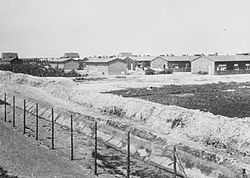
However, after the German invasion of the Netherlands in May 1940, that original purpose no longer existed. By 1942, Camp Westerbork was repurposed as a staging ground for the deportation of Jews.[2] Only 50 hectares (120 acres) in area, the camp was not built for the purpose of industrial murder as were Nazi extermination camps. Westerbork was considered by Nazi standards as "humane".[2] Jewish, Sinti and Roma inmates with families were housed in 200 interconnected cottages that contained two rooms, a toilet, a hot plate for cooking, as well as a small yard. Single inmates were placed in oblong barracks which contained a bathroom for each sex.[3][2]
Transport trains arrived at Westerbork every Tuesday from July 1942 to September 1944; an estimated 97,776 Jews, Sinti and Roma were deported during the period.[1] Jewish, Sinti and Roma inmates were deported in waves to Auschwitz concentration camp (65 train-loads totaling 60,330 people), Sobibór (19 train-loads; 34,313 people), Theresienstadt ghetto and Bergen-Belsen concentration camp (9 train-loads; 4,894 people).[3][1] Almost all of the 94,643 persons deported to Auschwitz and Sobibór in German-occupied Poland were killed upon arrival.[1]
Camp Westerbork also had a school, orchestra, hairdresser and even restaurants designed by SS officials to give inmates a false sense of hope for survival and to aid in avoiding problems during transportation.[3] Cultural activities provided by the Nazis for designated deportees included metalwork, jobs in health services and other cultural activities.[3]
A special, separate work cadre of 2,000 "permanent" Jewish, Sinti and Roma inmates were used as a camp labour force.[1] Within this group was a subgroup constituting a camp police force which was required to assist with transports and keep order.[1] The SS had little involvement with selecting transferees; this job fell to another class of inmates.[3] Most of these 2,000 "permanent" inmates were eventually sent to concentration or death camps themselves.[1]
Notable prisoners
[edit]
Notable prisoners in Westerbork included Anne Frank, who was transported to Camp Westerbork on 8 August 1944,[5] as well as Etty Hillesum, each of whom wrote of their experiences in diaries discovered after the war.[6] Frank remained at the camp in a small hut until 3 September, when she was deported to Auschwitz.[5]
Hillesum was able to avoid the Nazi dragnet that identified Jews until April 1942.[7] Even after being labeled a Jew, she began to report on antisemitic policies. She took a job with Judenrat for two weeks and then volunteered to accompany the first group of Jews sent to Westerbork.[6][7] Hillesum stayed at Westerbork until 7 September 1943, when she was deported to Auschwitz, where she was killed three months later.[7]

Camp Westerbork also housed German film actress and cabaret singer Dora Gerson who was interned there with her family before being sent to Auschwitz and Professor Sir William Asscher who survived the camp when his mother secured his family's release by fabricating English ancestry. Jona Oberski wrote of his experience as a small child at Westerbork in his book, Kinderjaren ("Childhood"), published in the Netherlands in 1978 and later made into the film, Jonah Who Lived in the Whale.
Maurice Frankenhuis chronicled his family's experiences while interned in Westerbork and in 1948 conducted an interview with its Commander Albert Konrad Gemmeker while Gemmeker awaited trial. The published interview in Dutch and English became the basis for a docudrama created in September 2019.[8] The film features colorization of original video of transports from Westerbork by photographer Rudolf Breslauer.
Another prisoner at Camp Westerbork from 9 March 1944 to 23 March 1944 was Hans Mossel (1905–1944), a Jewish-Dutch clarinetist and saxophonist, before he was sent to the Auschwitz III camp.[9]
On 16 May 2024, a memorial was erected to remember the famous Sinti families Weiss (Tata Mirando) and Meinhardt, who lost some 200 members of their families to the Holocaust, transported from Westerbork camp to Auschwitz-Birkenau.
Leadership within the Camp
[edit]Jacques Schol, a Dutchman, was commander of the camp from 16 July 1940 and until January 1943. Certain accounts report he was known for his brutality against Jewish inmates, allegedly kicking inmates to death.[10] Other accounts state on the contrary that "although strict and organised, Schol was never cruel or violent". Furthermore, "Schol, who was anti-German, understood that a strict organisation of the camp was the best way to keep the Germans from taking over the camp". In 1941, German authorities understood that "Schol was too lenient and because of this attitude, the Jews felt too comfortable in the camp".[11]
German authorities took control of Westerbork from the Government of the Netherlands on 1 July 1942 when Schol was replaced by a German commander.[1] Deportations began under the orders of Gestapo sub-Department IV-B4, which was headed by Adolf Eichmann.[2] Gestapo officer Albert Konrad Gemmeker had overall command of the camp and was responsible for sending up to 100,000 Jews to the death camps.[12] After the war, Gemmeker was sentenced to just ten years in prison. His light sentence was apparently due to his defense claim that he had no idea what would happen to the Jews after they were transported out of Westerbork.[13] Within the confines of the camp, German SS members were in charge of inmates, but squads of Jewish police and security under Kurt Schlesinger were used to keep order and aid in transport.[14]
Liberation
[edit]Transports came to a halt at Camp Westerbork in September 1944.[3] Allied troops neared Westerbork in early April 1945 after German officials abandoned the camp. Westerbork was liberated by Canadian forces on 12 April 1945. A total of 876 inmates were found.[3] The War Diary of the South Saskatchewan Regiment referenced the camp in its entry for 12 April 1945:
- At 0930 hrs Lt-Col V Stott, DSO, accompanied by the I(ntelligence)O(fficer), Lt JD Cade, visited the Jewish Concentration Camp at (map reference) 2480. It was a rather startling sight as you approached the camp to see what is normally the appearance of a penitentiary. It was completely surrounded with barbed wire and had four lookout towers. Approximately 900 people were being held in this camp. The CO visited the officers kitchens and medical room and found the food and medical supplies to be in fairly good condition. While in the kitchen a number of A Co(mpan)y boys were observed helping the girls peel potatoes. It's surprising the influence girls, especially pretty ones, have with soldiers. It's a pity our cooks are unable to apply the same methods. Visiting a camp like this brings home to us the reality of what we are fighting for. It makes the average Canadian indignant and he asks "Who do the Germans think they are that they enclose other humans behind barbed wire simply because they are born Jews!"[15]
Post World War II
[edit]Following the war, Westerbork was first used as a remand prison for alleged and accused Nazi collaborators. It housed later Dutch nationals who fled the former Dutch East Indies (Indonesia).
Westerbork was completely disassembled in the 1960s by the Government of the Netherlands.[3] Later, the Dutch built the Westerbork Synthesis Radio Telescope, a large radio telescope, on the site. Only the former camp commander’s house has been preserved, in a glass container.[3]
Historiography
[edit]
In 1950, the government appointed Jewish historian Jacques Presser to investigate the events connected with the mass deportation of Dutch Jewry and the extent of the collaboration by the non-Jewish Dutch population. The results were published fifteen years later in The Catastrophe (De Ondergang). Presser also published a novel, The Night of the Girondins, which was set in Westerbork.
Holding place for Moluccan soldiers
[edit]In 1949, when the Dutch left their over 300 year occupation of Indonesia, native Indonesians were left in political unrest. Some people who had worked with French, Algerian and Dutch militaries were evacuated, because they were the subject of anger by the other indigenous people who had resisted colonisation and felt betrayed at the Moluccan peoples siding with their colonisers. The peoples were promised a quick return to their homeland. However, from 1951 to 1971, former indigenous Moluccan KNIL soldiers and their families were made to stay in the camp. During this time, the camp was renamed Kamp Schattenberg (Camp Schattenberg).[16]
Memorials
[edit]
A museum was created two miles from Westerbork to keep the memories of those imprisoned in the camp alive.[3] As a tribute to those inmates who were killed after deportation, a memorial was commissioned;[3] it consists of 102,000 stones, representing each person who was deported from Westerbork and never returned.

The National Westerbork Memorial was unveiled at the site by Queen Juliana of the Netherlands on 4 May 1970.[17][18] Also, a monument of a broken railroad track torn from the ground is displayed near the camp to symbolize the destruction the camp, as well as others, wrought on the European Jewish population, and the determination that the tracks would never again carry people to their deaths.[18]
In 2017, films commissioned by the German camp commander Albert Gemmeker from a Jewish prisoner, Rudolf Breslauer, to document everyday life in the Westerbork transit camp, were submitted by the Netherlands and included in the UNESCO's Memory of the World Register.[19]
See also
[edit]References
[edit]- ^ a b c d e f g h i Holocaust Encyclopedia. "Westerbork". United States Holocaust Memorial Museum.
- ^ a b c d e Boas, Jacob (1985). Boulevard Des Miseres The Story of Transit Camp Westerbork. Hamden, Connecticut: Archon Books. pp. 3–32. ISBN 0-208-01977-4.
- ^ a b c d e f g h i j k l Project Aice. "Westerbork Transit Camp". Jewish Virtual Library. Retrieved 28 February 2018.
- ^ Prenger, Kevin. "Camp Westerbork". Traces of War. STIWOT (Stichting Informatie Wereldoorlog Twee). Retrieved 2021-05-18.
- ^ a b Prose, Francine (2009). Anne Frank: The Book, The Life, The Aftermath. New York, New York: Harper Collins. pp. 53–59.
- ^ a b De Costa, Denise (1998). Anne Frank and Etty Hillesum Inscribing Spirituality and Sexuality. New Brunswick, New Jersey: Rutgers University Press. pp. 167–191. ISBN 0-8135-2550-0.
- ^ a b c Hanan, Frenk (31 December 1999). "Etty Hillesum". Shalvi/Hyman Encyclopedia of Jewish Women. Jewish Women's Archive. Retrieved 20 April 2018.
- ^ "Première korte speelfilm Gemmeker met historische transport beelden in kleur" (in Dutch). September 12, 2019. Archived from the original on December 12, 2022. Retrieved November 4, 2019.
- ^ Information on the deportation of Hans Mossel via the Arolson online archives.
- ^ Ballis, Anja (2019). Holocaust Education Revisited. Springer. p. 114. ISBN 978-3-658-24205-3.
- ^ "Camp Westerbork - Jacques Schol", The Holocaust: Lest We Forget.
- ^ Buruma, Ian (2023). The Collaborators, Penguin Press, pg 176, ISBN 9780593296646
- ^ Buruma, pgs 221-222
- ^ "Camp Westerbork". Kamparchieven. Archived from the original on 25 April 2019. Retrieved 20 March 2018.
- ^ SSR War Diary
- ^ Polakow-Suransky, Sasha (2017). Go Back to Where You Came From: The Backlash Against Immigration and the Fate of Western Democracy. Nation Books. p. 19. ISBN 978-1-56858-592-5.
- ^ "Jodenvervolging: Nationaal Monument Westerbork". Drenthe in de oorlog (in Dutch). Retrieved 2019-02-08.
Het Nationaal Monument Westerbork wordt op 4 mei 1970 officieel door Koningin Juliana onthuld
- ^ a b "The National Westerbork Memorial". Herinneringscentrum Kamp Westerbork. Archived from the original on 23 September 2018. Retrieved 1 May 2018.
- ^ "Westerbork films". Memory of the World. United Nations Educational, Scientific and Cultural Organization. Retrieved 2025-05-02.
- Herbstrith, W. (1983). Edith Stein: A biography (5th rev. ed.) (Trans. B. Bonowitz). San Francisco, CA: Harper & Row Publishers.
Further reading
[edit]- Jonathan Gardiner: One-Way Ticket from Westerbork. Oegstgeest, The Netherlands: Amsterdam Publishers, 2021, ISBN 978-94-93056-75-6
- Hans-Dieter Arntz: Der letzte Judenälteste von Bergen-Belsen. Josef Weiss - würdig in einer unwürdigen Umgebung. Aachen 2012.
- Jacob Boas, Boulevard des Misères: the Story of the Transit Camp Westerbork. Hamden, Connecticut: Archon Books, 1985 ISBN 0-208-01977-4
- Etty Hillesum, Letters from Westerbork. New York: Pantheon, 1986 ISBN 0-394-55350-0 (originally published in the Netherlands as Het denkende hart van de barak, 1982)
- Cecil Law, Kamp Westerbork, transit camp to eternity : the liberation story. Clementsport, N.S. : Canadian Peacekeeping Press, 2000 ISBN 1-896551-35-1
- Harry Mulisch, The Discovery of Heaven. Penguin Press, 1992, ISBN 0-14-023937-5
- Jacob Presser, The Destruction of the Dutch Jews New York: Dutton, 1969, translated by A. Pomerans.
External links
[edit]


Westerbork transit camp
View on GrokipediaEstablishment and Early Use
Origins as a Dutch Refugee Camp
In February 1939, the Dutch government decided to establish a central refugee camp specifically for Jewish refugees fleeing Nazi persecution in Germany, aiming to consolidate their internment and alleviate pressure on local municipalities.[2] This decision responded to the influx of approximately 25,000 German Jews who had entered the Netherlands since 1933, particularly after events like the Kristallnacht pogrom in November 1938, though Dutch policy emphasized temporary containment rather than permanent settlement or repatriation.[2] [3] Construction of the Centraal Vluchtelingenkamp Westerbork began in the summer of 1939 on heathland in the northeastern province of Drenthe, roughly 15 kilometers north of the village of Westerbork, selected for its isolation and existing infrastructure from a prior unemployment relief camp.[4] [5] The camp featured barracks, administrative buildings, and basic facilities under Dutch oversight, with operations managed by the government's refugee organization. On October 9, 1939, the first group of 22 German Jewish refugees arrived, marking the official opening as a dedicated facility for processing and housing those deemed ineligible for dispersal into Dutch society.[6] [2] By the time of the German invasion of the Netherlands on May 10, 1940, the camp's population had grown to around 750 refugees, primarily German Jews unable to return home due to escalating Nazi policies.[7] [4] Conditions emphasized self-sufficiency through labor, including agriculture and workshops, while maintaining strict internment to prevent unauthorized movement, reflecting the Dutch authorities' restrictive approach to asylum amid economic strains and fears of espionage.[6] The camp functioned as a provisional solution, with some refugees granted temporary permits but most remaining in limbo as international borders tightened pre-war.[8]Initial Inmates and Conditions
The Westerbork camp, initially designated as the Centraal Vluchtelingenkamp Westerbork, was established by the Dutch government in response to the influx of Jewish refugees fleeing Nazi persecution in Germany. Construction began in the summer of 1939 following a decision in February of that year to create a centralized facility for Jewish refugees. The first group of 22 German Jewish refugees arrived on October 9, 1939, marking the camp's opening as a temporary shelter primarily for those who had emigrated from Germany after 1933, with many arriving in the aftermath of the November 1938 Kristallnacht pogroms. [9] Subsequent arrivals included Jews from Austria and Czechoslovakia, as well as some passengers from the MS St. Louis who were denied entry elsewhere.[1] By late 1939, the inmate population had reached approximately 1,000, growing to over 1,500 by mid-1940, though it stabilized around 750 by April 1940 and remained at similar levels until the German reorganization in July 1942.[9] [1] These inmates were predominantly stateless or "foreign" Jews deemed undesirable by Dutch authorities, including recent immigrants without full residency status; over time, the camp also housed Dutch Jews classified as such due to their recent arrival or lack of documentation. The population consisted largely of families, with provisions for children, though the remote location in Drenthe province isolated residents from broader society.[10] [1] Living conditions under Dutch administration were structured and relatively orderly compared to later phases, featuring basic wooden barracks with shared facilities, though limited in comfort and prone to overcrowding during influxes. Inmates followed a military-style routine, including daily roll calls, curfews, and registration requirements enforced by Dutch guards, with the camp enclosed by barbed wire fencing for security. Daily life involved mandatory work assignments for self-sufficiency, such as camp maintenance, crafting, and agricultural tasks, alongside access to medical care, a school for children, and communal activities to maintain morale. Food and sanitary provisions were basic but adequate, supported by internal Jewish organization under Dutch oversight, though restrictions on movement and external contact fostered a sense of confinement despite the absence of immediate extermination policies.[9] [1] [10]Nazi Takeover and Reorganization
German Occupation of the Camp in 1942
In July 1942, following the German occupation of the Netherlands since May 1940, the Nazi authorities formally took control of the Westerbork camp on July 1, designating it as Polizeiliches Durchgangslager Westerbork (Police Transit Camp Westerbork) under the supervision of the Commander of the Security Police and SD for the Netherlands.[1][11] This shift repurposed the site, previously managed by Dutch officials as a refugee internment facility holding around 1,100 Jewish refugees, into a collection and sorting point for systematic deportations to extermination camps in occupied Poland.[1] The initial commandant was SS-Obersturmführer Erich Deppner, appointed to oversee the transition from July to September 1942, followed briefly by Josef Hugo Dischner until October.[1] Reorganization under German direction involved rapid infrastructure enhancements to accommodate larger populations and enforce containment, including the erection of a barbed-wire perimeter fence, seven watchtowers, and additional wooden barracks to house incoming Dutch Jews rounded up from across the country.[12] External security was provided initially by an SS guard battalion until early 1943, supplemented by Dutch military police, while internal order relied heavily on the Ordedienst (OD), a Jewish auxiliary police force recruited from camp inmates to maintain discipline and prevent unrest.[12][1] This structure allowed the Germans to delegate administrative tasks—such as compiling transport lists and managing daily operations—to Jewish leadership under Dienstleiter Kurt Schlesinger, fostering a facade of normalcy to minimize resistance and ensure "efficient" deportations.[12] The occupation's immediate operational focus was initiating mass transports, with the first two trains departing on July 15 and 16, 1942, carrying roughly 1,100 Jews primarily to Auschwitz-Birkenau; subsequent weekly trains followed, deporting thousands more by year's end to camps including Sobibor.[1][13] By October 1942, SS-Hauptsturmführer Albert Konrad Gemmeker assumed command, refining the camp's deceptive efficiency through cultural activities and labor assignments that masked the transit function, though deportations continued unabated with over 20,000 Jews processed that year alone.[1][14] This German oversight transformed Westerbork into a linchpin of the Netherlands' Holocaust machinery, where nearly all of the approximately 100,000 Jews who would pass through en route to death camps were funneled starting in 1942.[13]Shift to Transit Function for Deportations
In early 1942, following escalating anti-Jewish measures by the Nazi occupation authorities in the Netherlands, Westerbork's role began evolving from a refugee and internment facility under Dutch administration to a centralized hub for deportations. By mid-1942, the camp held approximately 12,000 Jewish inmates, including refugees and Dutch Jews interned under orders from the German Sicherheitsdienst (SD).[1] The Nazis, seeking efficient logistics for the "Final Solution," designated Westerbork as the primary assembly point for Jews across the Netherlands to streamline transports to extermination camps in occupied Poland.[2] The formal shift to transit function occurred in July 1942, when the camp was officially reorganized as Polizeiliches Durchgangslager Westerbork (Police Transit Camp Westerbork) under direct German control. This reorganization involved replacing Dutch oversight with SS and SD personnel, expanding infrastructure for temporary holding, and prioritizing rail access for outbound trains. The decision aligned with broader deportation orders issued in June 1942, mandating Jews to report for "labor in the East," with Westerbork serving as the mandatory transit stop before onward journeys.[1] Over 4,000 summonses were issued in early July, directing Jews from Amsterdam and other areas to assemble at the camp.[15] The transition's immediacy was marked by the first deportation trains departing on July 15 and 16, 1942, carrying 2,030 Jews to Auschwitz-Birkenau.[16] These initial transports set the pattern for weekly operations, with selections emphasizing able-bodied workers for temporary exemption while prioritizing children, elderly, and others for immediate removal. By late 1942, under new commandant Albert Konrad Gemmeker (appointed October 1942), the camp's transit capacity was optimized, processing nearly 100,000 Jews through 1945, the vast majority to death camps like Sobibor and Auschwitz.[14] [1] This repurposing reflected the Nazis' causal prioritization of industrialized genocide, leveraging existing infrastructure to minimize resistance and maximize throughput.[17]Administration and Internal Governance
Commandants and SS Oversight
In July 1942, following the German occupation and reorganization of Westerbork as a transit camp, the facility came under direct SS control, with Erich Deppner appointed as the first German commandant, serving from July to September 1942.[1] Deppner, an SS officer, oversaw the initial implementation of deportation protocols as the camp shifted from refugee detention to systematic transit for extermination.[1] Deppner was replaced by Josef Hugo Dischner, another SS officer, who commanded from September to October 1942.[1] Dischner's brief tenure focused on consolidating administrative changes, including the construction of additional barracks and security fencing to enforce stricter containment.[1] Albert Konrad Gemmeker assumed command in October 1942 and held the position until the camp's liberation by Canadian forces on April 12, 1945.[1][14] As an SS-Obersturmführer with prior experience in the Sicherheitspolizei and SD, Gemmeker managed daily operations, including the selection of prisoners for deportation transports, which he organized with notable efficiency, resulting in the dispatch of approximately 80,000 Jews to camps such as Auschwitz and Sobibor between 1942 and 1944.[14][1] While Gemmeker permitted limited internal activities like cultural events to maintain order, he enforced deportations unpredictably and authorized executions, such as the shooting of prisoner Frederick Spier for escape attempts.[14] SS oversight of Westerbork operated through the broader structure of the Reich Security Main Office (RSHA), with the camp supervised by the Commander of the Security Police and Security Service (Sipo-SD) for the Netherlands, ensuring alignment with deportation quotas set in Berlin.[1] The commandant reported to higher SS authorities, including coordination with the Zentralstelle für jüdische Auswanderung in Amsterdam, while external security was provided by SS personnel alongside Dutch auxiliary police, minimizing direct SS staffing to prioritize transit efficiency over extermination on site.[1][14] This delegated oversight allowed Gemmeker significant operational autonomy, though ultimate policy control remained with SS leadership in the occupied Netherlands.[1]Role of the Jewish Council and Internal Leadership
The internal administration of Westerbork transit camp was primarily managed by Jewish inmates, particularly long-term residents known as alte Lagerinsassen (old camp inmates), who were mostly German Jewish refugees present since the camp's pre-war establishment in 1939.[18] These inmates formed a de facto Jewish leadership structure that handled day-to-day operations, including labor assignments, resource distribution, and maintenance of order, all under the ultimate authority of German SS commandants such as Albert Konrad Gemmeker, who directed the camp from October 1942 to April 1945.[1] This self-administration was not initiated by a centralized Jewish Council like the Joodse Raad in Amsterdam but evolved from the camp's original refugee governance, which the Nazis retained and adapted to ensure efficient deportations after assuming control in July 1942.[18] A key component of this internal leadership was the Orde Dienst (OD), a Jewish order service or police force composed of approximately 182 members, predominantly German Jews selected from the alte Lagerinsassen.[18] Led by figures such as Arthur Pisk, the OD was responsible for enforcing camp regulations, guarding the punishment barracks (known as the scheissbarak), organizing prisoner selections for deportation transports, and loading trains bound for extermination camps like Auschwitz and Sobibor.[18] [19] OD members wore distinctive green coveralls and operated under direct German supervision, with their privileges—such as temporary exemptions from deportation—tied to compliance; failure to maintain order could result in collective punishments, including the deportation of their families.[18] This system rewarded cooperation with positions of relative safety, creating an internal hierarchy that prioritized operational efficiency to appease Nazi overseers, including visits from SS officials like Adolf Eichmann.[18] The Jewish leadership, including a Jewish camp director like Kurt Schlesinger who served under Gemmeker, facilitated administrative tasks such as registration, health services, and cultural programs to sustain morale and productivity among the roughly 100,000 Jews who passed through the camp between 1942 and 1944.[1] [18] However, this arrangement drew sharp criticism from other inmates, who viewed the OD and privileged leaders as collaborators akin to a "Jewish SS" due to their role in suppressing resistance and expediting transports that led to the deaths of over 90% of deportees.[20] [18] While some OD members were coerced into service, the structure's effectiveness in minimizing disruptions enabled the Nazis to deport Jews systematically without large-scale SS presence, reflecting a pragmatic adaptation to survival amid total German control rather than autonomous governance.[19] Post-war accounts and trials highlighted these tensions, with leaders like Pisk surviving the war but facing enduring stigma for their enforced complicity.[18]Controversies in Camp Administration
The administration of Westerbork transit camp under Nazi oversight involved significant internal Jewish governance, which generated post-war debates over complicity and coercion. The camp's Jewish personnel, including the Ordedienst (OD)—a Jewish order service acting as an internal police force—were responsible for maintaining discipline, preventing escapes, and assisting in deportation logistics, such as rounding up Jews during razzias in Amsterdam in 1943 and evacuating the Apeldoornsche Bosch asylum on January 22, 1943.[21] The OD, numbering around 200 members by mid-1943 and uniformed in green overalls from April 27, 1943, enforced SS directives while benefiting from exemptions that spared them immediate transport, fostering resentment among inmates who viewed them as a "camp aristocracy" enforcing divisions between privileged staff and those designated for deportation.[21] This role drew sharp criticism, with contemporaries like journalist Philip Mechanicus labeling the OD the "Jewish SS" for their perceived harshness and collaboration in loading trains, though defenders argued their actions stemmed from threats of collective punishment, such as deporting five family members per non-compliant OD member.[1] OD survival rates were notably higher at approximately 24% (47 out of 196 members), compared to about 5% for those deported from the camp, highlighting the ethical tensions of their position without evidence of widespread post-war prosecutions.[1] Commandant Albert Konrad Gemmeker, who led the camp from October 1942 until its evacuation in April 1945, oversaw the deportation of roughly 80,000 Jews, primarily to Auschwitz-Birkenau and Sobibor, while permitting cultural activities like the Westerbork Revue cabaret to sustain productivity and morale among the roughly 2,000 long-term inmates.[1] Gemmeker's approach emphasized efficiency and relative order, with minimal overt violence, but controversies arose over his knowledge of the deportees' fate; at his 1948-1949 trial in Assen, Netherlands, he was convicted of facilitating deportation for forced labor and sentenced to 10 years (serving six until early release in 1951), maintaining he believed transports were for labor in Eastern camps and dismissing extermination rumors as Allied propaganda.[22] Prosecutors struggled with direct evidence of intent, as no documents proved Gemmeker knew of gassings, though historians like Ad van Liempt contend he must have inferred the truth from the scale of transports—including thousands of children and elderly unfit for labor—and reports of empty return trains, rendering his ignorance claim implausible given his SS rank and oversight role.[22] Later German proceedings in the 1960s and 1970s were dismissed for insufficient proof of mens rea, fueling debate over whether complicity standards should incorporate a "should have known" threshold rather than requiring explicit awareness.[22] Broader critiques targeted the Jewish Council's influence in camp operations, where it compiled deportation lists and managed exemptions for essential workers, inadvertently aiding the "divide and conquer" strategy by prioritizing certain groups like German Jewish refugees over Dutch ones, which exacerbated internal hierarchies and survival disparities.[1] Figures like camp administrator Kurt Schlesinger faced accusations of arrogance and favoritism toward German Jews, contributing to a perception of moral compromise among leadership, though such roles were constrained by SS ultimatums that compliance delayed harsher interventions.[1] These elements underscore the camp's function as a site of coerced self-administration, where Jewish leaders' efforts to mitigate suffering through organization often blurred into facilitation of Nazi aims, prompting ongoing historical scrutiny without absolving ultimate German responsibility.[1]Daily Life and Operations
Camp Layout and Infrastructure
The Westerbork transit camp was established on heath and marshland approximately 15 kilometers north of the village of Westerbork in Drenthe province, Netherlands.[8] Originally constructed in 1939 as a refugee camp, it consisted of 50 wooden barracks with central heating, supplemented by single-family houses and advanced sanitary installations.[23][24] Supporting infrastructure encompassed a synagogue, school, recreational areas, agricultural plots for horticulture and livestock, and workshops including a smithy and shoemaking facility.[24] Following the Nazi occupation and reorganization in July 1942, the camp was fortified with a barbed-wire perimeter fence and expanded through the addition of further barracks to accommodate deportees as a transit facility.[1] Administrative structures housed SS oversight and Jewish council operations, while specialized barracks served functions such as prisons for recent arrivals and laundry managed by permanent residents.[1] A commandant's residence was positioned at the entrance, overseeing the site's operations.[25] By November 1942, a dedicated railway spur had been built into the camp, facilitating the loading of freight and passenger cars for systematic deportations, with trains departing regularly from a siding adjacent to the barracks.[8] The layout featured an Appellplatz for daily roll calls, rows of housing barracks segmented by inmate status, and minimal watchtowers along the perimeter to maintain internal order primarily through Jewish police enforcement.[1] This configuration supported a transient population peaking at over 20,000 while preserving a core of approximately 2,000 long-term personnel in designated sections.[1]Labor, Culture, and Psychological Controls
Inmates at Westerbork transit camp were subjected to mandatory labor as a core element of daily operations, with individuals aged 15 to 65 required to work six days per week for ten hours daily.[26] This forced labor encompassed a range of activities, including sewing and laundry services, carpentry, dental work, and agricultural tasks, often organized through camp workshops and internal enterprises to sustain the facility's self-sufficiency and support deportation logistics.[27] The Jewish camp administration, under SS oversight, allocated these assignments, prioritizing skilled workers for exemptions from immediate transport while using labor to enforce discipline and productivity among the roughly 10,000 to 20,000 residents at peak occupancy.[1] Cultural activities were permitted and even encouraged within the camp to simulate normalcy and mitigate unrest, including performances by a resident cabaret troupe comprising professional Jewish entertainers such as Max Ehrlich and Werner Levie, who staged weekly satirical shows addressing camp life.[28] Additional pursuits encompassed Zionist groups, musical ensembles, and educational programs for children, with inmates producing theater, poetry, and visual arts despite the transit context.[29] These efforts, facilitated by the Jewish-led Ordedienst (Order Service) police force, drew on pre-war Dutch and German Jewish talents and served dual purposes: preserving morale through creative outlets and channeling energy away from resistance, as evidenced by the commandant's tolerance of such programs until transports resumed.[30] Psychological controls were exerted through a combination of deceptive normalcy, internal policing, and selective incentives, fostering compliance without overt brutality. Camp commandant Albert Gemmeker promoted recreational and cultural facilities from 1943 onward to normalize existence and instill false hopes of reprieve, convincing many inmates that Westerbork functioned as a semi-permanent work settlement rather than a deportation hub.[30] The Jewish council's administration, including its Ordedienst enforcers drawn from inmates, maintained order by meting out punishments for infractions like work refusal or escape attempts, thereby internalizing Nazi authority and reducing direct SS intervention.[1] This structure exploited divisions—exempting "essential" workers and performers from transports—creating a hierarchy that psychologically subdued the population, as transports to Auschwitz and Sobibor claimed over 97,000 lives despite intermittent lulls that reinforced illusions of stability.[1]Deportation Processes and Statistics
Deportations from Westerbork commenced on July 15–16, 1942, with the first transport departing for Auschwitz-Birkenau, marking the camp's transformation into a primary transit hub for systematic removal of Jews from the Netherlands.[16][1] Transports were initially scheduled twice weekly but later standardized to Tuesdays, with schedules and quotas determined in Berlin by Nazi authorities, while local SS oversight and the camp's Jewish administration handled selections and logistics.[1] Prisoners selected for deportation—often based on criteria set by the camp commandant or internal Jewish leadership—were notified by barrack, required to pack belongings under strict limits, and assembled at the "Boulevard des Misères" for roll call before boarding passenger or freight rail cars under supervision of SS guards and the camp's Fliegende Kolonne unit.[16] The process involved chalk-marking wagon numbers, sealing sliding doors, and routing trains via Hooghalen and Assen toward eastern destinations, evoking widespread distress amid confusion and occasional brutality.[1] Over 100 such trains departed until the final major transport on September 13, 1944, to Bergen-Belsen carrying 279 individuals, with a smaller earlier train that month on September 3 deporting 1,019 people, including Anne Frank, to Auschwitz.[16][1] Approximately 107,000 Jews and several dozen Roma and Sinti passed through Westerbork for deportation, comprising the vast majority of the 107,000 Dutch Jews and refugees removed during the occupation, with only about 5,000 sent directly from other sites.[31][16] Of these, over 102,000 were funneled eastward, primarily to extermination and concentration camps, resulting in fewer than 5,500 survivors overall from Dutch deportations.[31]| Destination | Approximate Number Deported | Notes |
|---|---|---|
| Auschwitz-Birkenau | >60,000 Jews | Primary site for multiple transports; <900 survivors from Dutch contingent.[31] |
| Sobibor | 34,313 Jews | 19 dedicated transports; 18 known survivors.[31] |
| Theresienstadt | ~5,000 Jews | ~1,980 initial survivors, though ~3,000 later sent to Auschwitz with near-total fatalities.[31] |
| Bergen-Belsen | 3,751 Jews | >2,000 survivors; included final 1944 transport.[31] |
| Other (e.g., Ravensbrück, Buchenwald) | Small numbers | Minor transports of Jews and resistance fighters.[16] |