Hubbry Logo
Vaginal wet mountVaginal wet mountMain
Open search
Vaginal wet mount
Community hub
Vaginal wet mount
logo
8 pages, 0 posts
0 subscribers
Be the first to start a discussion here.
Vaginal wet mount
Vaginal wet mount
from Wikipedia
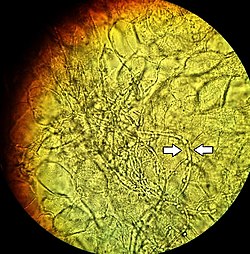
Vaginal wet mount showing slings of pseudohyphae of Candida albicans surrounded by round vaginal epithelial cells, conferring a diagnosis of candidal vulvovaginitis.

A vaginal wet mount (or vaginal smear[1] or wet prep[2]) is a gynecologic test wherein a sample of vaginal discharge is observed by wet mount microscopy by placing the specimen on a glass slide and mixing with a salt solution.[1] It is used to find the cause of vaginitis and vulvitis.[3]

Applications

[edit]

Vaginal wet mounts are used in case of vaginitis symptoms such as vaginal itching, burning, rash, odor, or discharge. It may assist in suspicion of vaginal yeast infection, trichomoniasis and bacterial vaginosis.[citation needed]

Infections such as chlamydia, genital warts, syphilis, herpes simplex, and gonorrhea can also affect the vagina, but these diseases are found by doing other tests.[1]

It may also be used in a rape investigation to detect presence of semen.[citation needed]

Method

[edit]

Vaginal wet mounts are not done during the menstrual period, because menstrual blood on the slide can confound the results. Vaginal irrigation, tampon use or sex (potentially disrupting the vaginal pH) should be avoided for 24 hours before the test. Vaginal medicines (such as a nonprescription vaginal yeast medicine) should not be used during the 2 to 3 days before the test.[1]

The sampling is done with the patient in lithotomy position. A speculum is used to facilitate use of a swab or spatula to sample fluid inside the vagina. The sampling procedure may cause some discomfort and minor bleeding, but otherwise there are no associated risks. The sample is then smeared upon a microscope slide and is observed by wet mount microscopy by placing the specimen on a glass slide and mixing with a salt solution.[1]

Interpretation

[edit]

Normally, no yeast or trichomonas are found on the slide. White blood cells and clue cells are normally absent or very low in number.[1]

Symptoms of infections able to be diagnosed by wet mount:

  • A vaginal yeast infection often causes a white, lumpy discharge that looks like cottage cheese.[1]
  • diagnosis is made if pseudohyphae or yeast buds are present (these are visible only 50% of the time)
  • Trichomoniasis causes a vaginal discharge that is yellow-green, foamy, and bad-smelling.[1]
  • Diagnosis is made if mobile trichomonads are visible on the slide
A vaginal wet mount with a clue cell, indicating bacterial vaginosis.
  • Diagnosis is made using Amsel Criteria - three of the four following criteria must be met:
  • >20% of the epithelial cells are clue cells (the single most reliable predictor)[4]
  • Discharge is thin and homogeneous
  • Sample smells fishy when mixed with potassium hydroxide ("whiff test")
  • Vaginal pH is >4.5

Furthermore, presence of white blood cells is a general sign of infection.[1]

Concomitant vaginal discharge tests

[edit]

A vaginal discharge sample wet mount is often also used for the following additional tests:

  • KOH slide. A sample of the vaginal discharge is placed on a slide and mixed with a solution of potassium hydroxide (KOH). The KOH kills bacteria and cells from the vagina, leaving only yeast for easier detection of a yeast infection. Several drops of a potassium hydroxide (KOH) solution may also be added to a sample of the vaginal discharge to test for any resultant strong fishy odor from the mix, which would indicate bacterial vaginosis. The latter procedure is called a Whiff test.[1]
  • Vaginal pH test. The normal vaginal pH is 3.8 to 4.5. Bacterial vaginosis, trichomoniasis, and atrophic vaginitis often cause a vaginal pH higher than 4.5.[1]

If indicated, the sample can also be used for:

See also

[edit]

References

[edit]
Revisions and contributorsEdit on WikipediaRead on Wikipedia
from Grokipedia
A vaginal wet mount, also known as a wet prep, is a simple microscopic examination of suspended in a medium, typically normal saline or (KOH), to identify infectious agents causing . This diagnostic test is performed in a clinical setting to detect common vaginal infections, including (characterized by clue cells), (motile protozoa), and (yeast forms or hyphae), by observing cellular and microbial elements under low- to high-power magnification. While highly useful for immediate diagnosis, its sensitivity varies (e.g., 50-60% for as of recent studies), and it is often complemented by newer for improved accuracy.

Overview

Definition and Purpose

The vaginal wet mount, also known as a wet prep or vaginal smear, is a fundamental gynecologic diagnostic test that involves the microscopic examination of a fresh sample of placed on a glass slide and suspended in a liquid medium, typically normal saline (0.9% NaCl), to visualize microorganisms, cells, and other structures without fixation. This technique allows for the direct observation of live elements in their natural state under light , enabling the identification of , morphology, and interactions among components. The primary purpose of the vaginal wet mount is to facilitate rapid, point-of-care of common vaginal infections, including , , and , by detecting characteristic pathogens or cellular changes that indicate infection or imbalance in the vaginal ecosystem. It serves as an accessible initial screening tool in clinical settings, particularly for patients presenting with symptoms such as abnormal discharge, itching, or , helping to guide immediate treatment decisions without the need for more complex processing. In contrast to dry mounts or fixed stained preparations, the wet mount method preserves the viability and natural appearance of organisms, such as motile trichomonads or yeast forms, which enhances its utility for real-time assessment and underscores its , low cost, and suitability as an in-office procedure. This approach plays a key role in the broader evaluation of by providing preliminary insights into microbial etiology.

Historical Context

The vaginal wet mount technique originated in the with advancements in , particularly for observing motile parasites in . In 1836, French microscopist Alfred François Donné first identified through microscopic examination of vaginal secretions, marking an early application of wet mount preparation to detect protozoan pathogens in gynecology. By the late 1800s, this method had become a standard tool for visualizing motile organisms like T. vaginalis in fresh vaginal samples, leveraging simple saline dilution on glass slides to preserve parasite under low-power . In the mid-20th century, following the recognition of imbalances as contributors to nonspecific , wet mount was integrated into routine gynecological practice. Key milestones included the description by Gardner and Dukes of Haemophilus vaginalis (later reclassified as ) as a cause of , where wet mounts revealed characteristic bacterial patterns alongside clinical symptoms. This era solidified the technique's role in assessing microbial shifts, such as reduced lactobacilli and increased anaerobes, transitioning it from parasite detection to broader diagnostic use in evaluating vaginal health. The 1980s brought standardization and wider adoption through incorporation into formal diagnostic frameworks for (BV). In 1983, Amsel and colleagues proposed clinical criteria for BV diagnosis, including wet mount identification of clue cells—vaginal epithelial cells coated with —as one of four key indicators, enhancing the test's specificity when combined with and assessments. Complementing this, the 1991 Nugent scoring system standardized evaluation of , correlating closely with wet mount findings to quantify BV severity and establish the technique as a cornerstone of diagnostics. Into the 2020s, while molecular and automated systems have emerged for faster analysis of vaginal samples, the manual wet mount retains its status as the gold standard for detecting motile pathogens like T. vaginalis due to its low cost, immediacy, and simplicity in resource-limited settings.

Clinical Applications

Indications for Use

The vaginal wet mount is primarily indicated for evaluating symptoms suggestive of , including abnormal , odor, itching, burning, or irritation, in both non-pregnant and pregnant women. These symptoms often point to common causes such as , , or vulvovaginal , where the test helps identify microbial elements like clue cells, motile trichomonads, or yeast forms. In pregnant women, it is particularly recommended due to the higher prevalence of (10-30%) and its association with adverse outcomes like preterm labor. Routine screening with vaginal wet mount is not advised for women, but it is targeted for sexually active individuals or those with risk factors such as multiple sexual partners, history of sexually transmitted infections, or inconsistent use, when symptoms arise. In sexually transmitted disease clinics, where prevalence can reach 30-65%, the test supports prompt evaluation of symptomatic patients to guide treatment and prevent complications. In special populations, the vaginal wet mount is useful for postmenopausal women experiencing atrophy-related symptoms like dryness, irritation, or discharge, where it may reveal parabasal cells or altered flora indicative of or bacterial overgrowth. For adolescents, it serves as an initial assessment tool for suspected infections in the context of early sexual activity or symptoms like itching and discharge. Cautions include avoiding the procedure during active or , as blood can interfere with microscopic visualization and lead to false-positive results for . Recent sexual intercourse should also be avoided prior to testing, since or can contaminate the sample and mimic or obscure pathological findings. Additionally, patients are advised to refrain from douching, using vaginal creams or medications, or inserting tampons for at least 24-48 hours beforehand to prevent disruption of vaginal or .

Diagnostic Role in Vaginitis

The vaginal wet mount plays a central role in the diagnosis of by enabling rapid microscopic identification of key pathogens and cellular changes associated with common infectious etiologies, such as , (BV), and vulvovaginal candidiasis (VVC). This point-of-care test integrates with clinical evaluation to confirm or rule out infectious causes, facilitating targeted therapy while distinguishing from noninfectious conditions like . In , the wet mount is particularly valuable for detecting motile trichomonads, which provides immediate confirmation of in symptomatic women, with sensitivity reported at approximately 50-70% under optimal conditions. The presence of these protozoan flagellates in saline preparations directly supports the diagnosis and prompts treatment, reducing transmission risk. For , the wet mount contributes to diagnosis through visualization of clue cells—vaginal epithelial cells obscured by adherent bacteria—as one of the Amsel criteria, which requires at least three of four findings: homogeneous discharge, vaginal pH greater than 4.5, positive whiff test, and clue cells comprising 20% or more of epithelial cells. This criterion offers high specificity (up to 98%) when present, aiding in differentiation from other vaginitides and guiding antibiotic therapy like . In VVC, the wet mount identifies budding yeast forms or pseudohyphae, especially in preparations, confirming candidal and supporting treatment decisions, though its sensitivity is lower than methods, necessitating follow-up cultures for persistent symptoms. Overall, by highlighting or excluding these microbial elements—such as the absence of pathogens in with predominant parabasal cells and inflammation—the wet mount helps differentiate infectious from noninfectious syndromes, informing and reducing unnecessary antibiotics.

Procedure

Sample Collection

The sample collection for a vaginal wet mount begins with the patient positioned in the to facilitate access during the . A speculum is gently inserted into the . This positioning allows clear visualization of the vaginal walls without causing unnecessary discomfort. A sterile, dry cotton-tipped swab is then used to collect , targeting the posterior or the middle third of the lateral vaginal walls where discharge typically pools. Care is taken to avoid contact with the , as cervical mucus can interfere with the accuracy of the microscopic examination by altering or obscuring cellular details. The swab is rotated gently against the vaginal mucosa for 10-30 seconds to gather an adequate amount of material. Timing of the procedure is critical for reliable results; it is best performed mid-cycle for baseline assessments or when symptoms such as discharge or are peaking to capture active pathological changes. Patients should be advised to abstain from douching, , tampon use, and vaginal antifungals or other medications for 24-48 hours beforehand, as these activities can disrupt the normal vaginal and confound findings. The test should not be conducted during , as blood can obscure the sample. Sufficient discharge—typically a small, pea-sized portion—is obtained on the swab to ensure enough material for analysis without excess that could dilute the sample. Immediately after collection, the swab is rolled onto a clean glass slide to transfer the discharge evenly and prevent drying artifacts, which could affect cell morphology; the slide is then prepared for microscopy.

Preparation and Microscopy

The preparation of a vaginal wet mount begins with placing a small sample of on a clean glass slide. Typically, 10 μL of the specimen is transferred using a sterile or by rolling a swab directly onto the slide, followed by the of 1-2 drops of 0.9% normal saline to suspend the material without dilution that could obscure details. A coverslip is then gently applied to the saline drop, ensuring even distribution and avoiding air bubbles or smearing, which could interfere with visualization. While 10% (KOH) may be added in a separate preparation for enhanced detection of elements, the standard wet mount relies primarily on saline to preserve of and . Microscopy requires a compound light equipped for bright-field illumination. The slide is initially examined at low magnification (10× objective) under reduced condenser light to optimize contrast and facilitate the detection of motile organisms across the field. Transition to higher magnification (40× objective) allows for detailed scrutiny of cellular and microbial structures, with phase-contrast optics optionally employed to improve visibility of unstained elements if available in the setup. The examination protocol involves a systematic scan of the entire slide, typically in an S-shaped pattern covering at least 10 fields, to ensure comprehensive coverage. Motility of pathogens, such as , should be assessed first, as it diminishes rapidly— with a 20% reduction observed within 60 minutes in covered wet mounts—followed by evaluation of cellular morphology and distribution. Processing and viewing must occur immediately, ideally within 10 minutes of preparation, to maximize recovery of viable organisms, as delays beyond 1 hour can significantly impair diagnostic yield. Safety protocols mandate the use of , including gloves, during handling to prevent exposure to infectious material. Slides and coverslips are treated as biohazards and disposed of in appropriate sharps or biological waste containers immediately after use, with the procedure ideally performed in a well-ventilated area to minimize risks. includes labeling slides with patient identifiers and collection details, along with prompt documentation of observations to support clinical correlation.

Interpretation

Normal Findings

In a normal vaginal wet mount, the microscopic examination reveals a predominance of lactobacilli, appearing as large, Gram-positive rods that are the dominant organisms in the under high-power . These lactobacilli contribute to a healthy acidic vaginal environment by producing , maintaining a typically between 3.8 and 4.5. This dominance of lactobacilli is a hallmark of eubiosis in the vaginal , reflecting a balanced that inhibits the overgrowth of pathogenic organisms. The cellular components in a healthy sample are sparse and unremarkable, featuring a few mature squamous epithelial cells shed from the vaginal walls, along with minimal —typically fewer than 10 per (HPF). No pathogens, such as forms, trichomonads, or clue cells (epithelial cells coated with adherent ), are present, and the background lacks significant debris or inflammatory markers. The discharge itself is typically clear or scant and mucoid, with no unusual odor or , and intermediate flora (such as Gardnerella or Mobiluncus species) may appear in low numbers without dominating the field. is absent except for occasional artifacts from . Variations in normal findings can occur across the menstrual cycle, with slightly increased numbers of squamous epithelial cells observed mid-cycle due to estrogen influence, but these changes do not alter the overall lactobacilli dominance or introduce pathological elements. Such cyclic shifts remain within physiological norms and do not indicate infection.

Abnormal Findings

In bacterial vaginosis (BV), the wet mount typically reveals clue cells, which are vaginal epithelial cells heavily stippled or coated with adherent coccobacilli, such that the cell borders are obscured or appear granular. These clue cells, often associated with Gardnerella vaginalis morphotypes appearing as small rods or coccobacilli, are accompanied by a reduction in lactobacilli and an increase in other small bacterial rods. Clue cells contribute to the Amsel criteria for BV diagnosis. For , the saline wet mount shows motile trichomonads, pear-shaped measuring 10-20 μm in length with flagella, exhibiting a characteristic jerky or tumbling movement. These organisms are often accompanied by elevated (WBCs), including numerous polymorphonuclear leukocytes (PMNs). In vulvovaginal , the wet mount, particularly with 10% (KOH), displays yeast forms (blastospores) and pseudohyphae, which are elongated, filamentous structures of fungal origin. These findings may be associated with , as indicated by increased . Other abnormalities include increased parabasal cells, small and round epithelial cells indicative of vaginal atrophy due to deficiency, often with abundant . Excessive mucus may appear in cases of , alongside PMNs, reflecting cervical . Rare observations encompass distinct Gardnerella morphotypes as pleomorphic rods in BV contexts.

Limitations and Complementary Tests

Accuracy and Pitfalls

The vaginal wet mount demonstrates variable sensitivity depending on the pathogen, with reported ranges of 50-70% for detecting motile , attributed to its reliance on observing under . Specificity for T. vaginalis exceeds 90%, often reaching 100%, as direct visualization of characteristic minimizes false positives when present. For (BV), sensitivity for identifying clue cells is approximately 60%, with specificity around 98%, making it a reliable indicator when positive but prone to missing cases without prominent epithelial cell adherence. In contrast, sensitivity for vulvovaginal candidiasis is lower, typically 30-60% for detecting budding yeast or pseudohyphae, as this method underperforms compared to fungal culture, though specificity remains high (>90%) for direct microscopic confirmation. Common pitfalls include false negatives due to delayed sample processing, where T. vaginalis loses motility within an hour at , leading to non-viable or rounded that evade detection. Low organism burden further reduces sensitivity, particularly for sparse infections, while observer inexperience contributes to interpretive errors in identifying subtle features like clue cells or hyphae. False positives are less frequent but can arise from contaminants such as or , which may introduce extraneous cells or debris mimicking pathological elements. Key limitations of the vaginal wet mount stem from its operator-dependent nature, requiring skilled microscopy to achieve consistent results, and its inability to detect non-motile organisms or low-burden infections effectively. The test is particularly less useful in mixed infections, where overlapping features obscure diagnosis, or post-treatment scenarios, as residual dead organisms may not exhibit diagnostic motility or morphology. Quality improvements involve standardized training programs, such as short 10-hour courses that enhance accuracy and inter-observer concordance to fair-to-good levels for key findings like clue cells and trichomonads. Correlating wet mount results with clinical symptoms and pH testing bolsters reliability. Emerging automated microscopy systems show promise, with 2023 studies reporting 84-91% sensitivity for BV and candidiasis against composite references, achieving approximately 85% agreement with manual wet mounts in diagnostic categorization. More recent 2024 research using machine learning models, such as MobileNetV2 on wet mount images, has demonstrated up to 87% agreement with expert assessments, further improving consistency in resource-limited settings.

Associated Diagnostic Methods

Vaginal pH testing is a simple, point-of-care method performed immediately after sample collection by applying to paper strips, with normal values ranging from 3.8 to 4.5 in a healthy, lactobacillus-dominated . An elevated greater than 4.5 is indicative of (BV) or , though it lacks high specificity and must be combined with other tests for accurate . The (KOH) preparation involves adding a drop of 10% KOH solution to a portion of the vaginal sample on a slide, which dissolves cellular debris and to reveal fungal elements such as hyphae or blastospores that may be obscured in saline wet mounts. This adjunct enhances the detection of vulvovaginal , with a sensitivity of approximately 50% compared to culture methods. During KOH preparation, the whiff test is conducted by noting any release of a fishy amine odor upon application, which strongly suggests or when positive. Additional diagnostic methods often used alongside wet mounts include Gram staining for Nugent scoring, which quantifies bacterial morphotypes in to grade the : scores of 0–3 indicate normal predominance, 4–6 suggest intermediate , and 7–10 confirm . Culture-based testing provides confirmatory identification of pathogens like Candida species or in cases where is inconclusive. Nucleic acid amplification tests (NAATs) serve as sensitive adjuncts for detecting sexually transmitted infections such as and , particularly when wet mount findings suggest or mixed infections, with NAATs outperforming for these etiologies. These methods are integrated with wet mounts to fulfill diagnostic criteria, such as the Amsel criteria for , which require at least three of four findings: thin, homogeneous discharge; clue cells on wet mount; greater than 4.5; and a positive whiff test. Molecular tests like NAATs are particularly valuable as adjuncts in scenarios of low wet mount sensitivity, such as or low-burden infections.

References

Add your contribution
Related Hubs
User Avatar
No comments yet.