Recent from talks
Nothing was collected or created yet.
Winburg
View on Wikipedia
This article needs additional citations for verification. (November 2007) |
Winburg is a small mixed farming town in the Free State province of South Africa.
Key Information
It is the oldest proclaimed town (1837) in the Orange Free State, South Africa and along with Griekwastad, is one of the oldest settlements in South Africa located north of the Orange River.
It is situated where the N1 national highway (which goes north to Johannesburg and south to Bloemfontein and Cape Town) meets the N5 national route (which goes east to Qwa Qwa & Harrismith). The nearest city, Bloemfontein, is 120 km to the south.
History
[edit]A small group of 11 Voortrekker settlers, led by Andries Hendrik Potgieter, first arrived in the area of Winburg in 1835.
They were able to buy access to the land between the Vaal and Vet rivers – virtually the entire northern part of what is now the Free State – from the local Bataung Chief, Makwana,[1] in 1836, by promising protection from rival tribes and offering 42 head of cattle.[3]
Within a year, more than 1,000 settler families had gathered in the region, making the need for an administrative and religious centre urgent. But the Voortrekker leaders disagreed over where to establish such a town. In 1841 a vote was held, with Andries Pretorius's group winning and electing to establish the town in its current position, on what was then the farm Waaifontein ("windy spring"), owned by Jacobus de Beer. Legend has it that the new town was named Winburg ("victory town") to commemorate this, and holds that the site nominated by the losers is today still called Mompeling ("muttering"). Alternative explanations suggest the name commemorates the 1837 Voortrekker victory over the Ndebele.[4]
Prior to 1843 Winburg formed part of the Boer Republic of Natalia (Port Natal, Pietermaritzburg). Following the British annexation of Natal in 1843, Winburg became the first capital of the Voortrekker republic of the Orange Free State. Winburg was granted municipal status in 1872, by which time the capital had been moved to Bloemfontein.[4] Winburg continued, however, to act as a settlement and religious centre for the local settlers.
The town was originally selected as the site for the main Voortrekker Monument, but Pretoria won favour and a five-tiered secondary Voortrekker monument was built on the outskirts of Winburg instead in the 1950s. It carries the names of the Voortrekker leaders: Piet Uys, Andries Hendrik Potgieter, Andries Pretorius, Piet Retief and Gerrit Maritz. The lengths of the five tiers are proportional to the distances travelled by the respective settler groups. The monument is built near the site of the birth-house of Martinus Theunis Steyn, who was president of the Boer Republic of the Orange Free State.[5]
Second Boer War
[edit]
| Historical states in present-day South Africa |
|---|
|
|
During the Second Boer War, the British established a concentration camp in Winburg for Afrikaner civilians, primarily women and children, who were captured in the Boer republics by British forces as part of a scorched earth campaign. 132 adults and 355 children died in the camp during the war due to a combination of malnutrition and infectious disease, exacerbated by the fact that they were kept in tents which did not offer protection from winter conditions.[6] Blacks were also housed at a nearby camp which was called "Balla Bosiu", meaning where they cry at night.
Koos de la Rey, a famous commander of the Boer commandos, was born near Winburg on a farm called Doornfontein. De la Rey served as a general of the Boer commandos in the Western Transvaal against British forces in the region from 1899 to 1901.[7] A Black military unit which fought on the side of the British was also raised in Winburg during the war.
Local politics
[edit]The first shots of the Maritz Rebellion in 1914, against the government's involvement in South West Africa, were fired in the district of Winburg.[citation needed]
The first President of the Republic of South Africa, when it gained independence from the United Kingdom in 1961, was Charles Robberts Swart, who was born and went to school in Winburg.
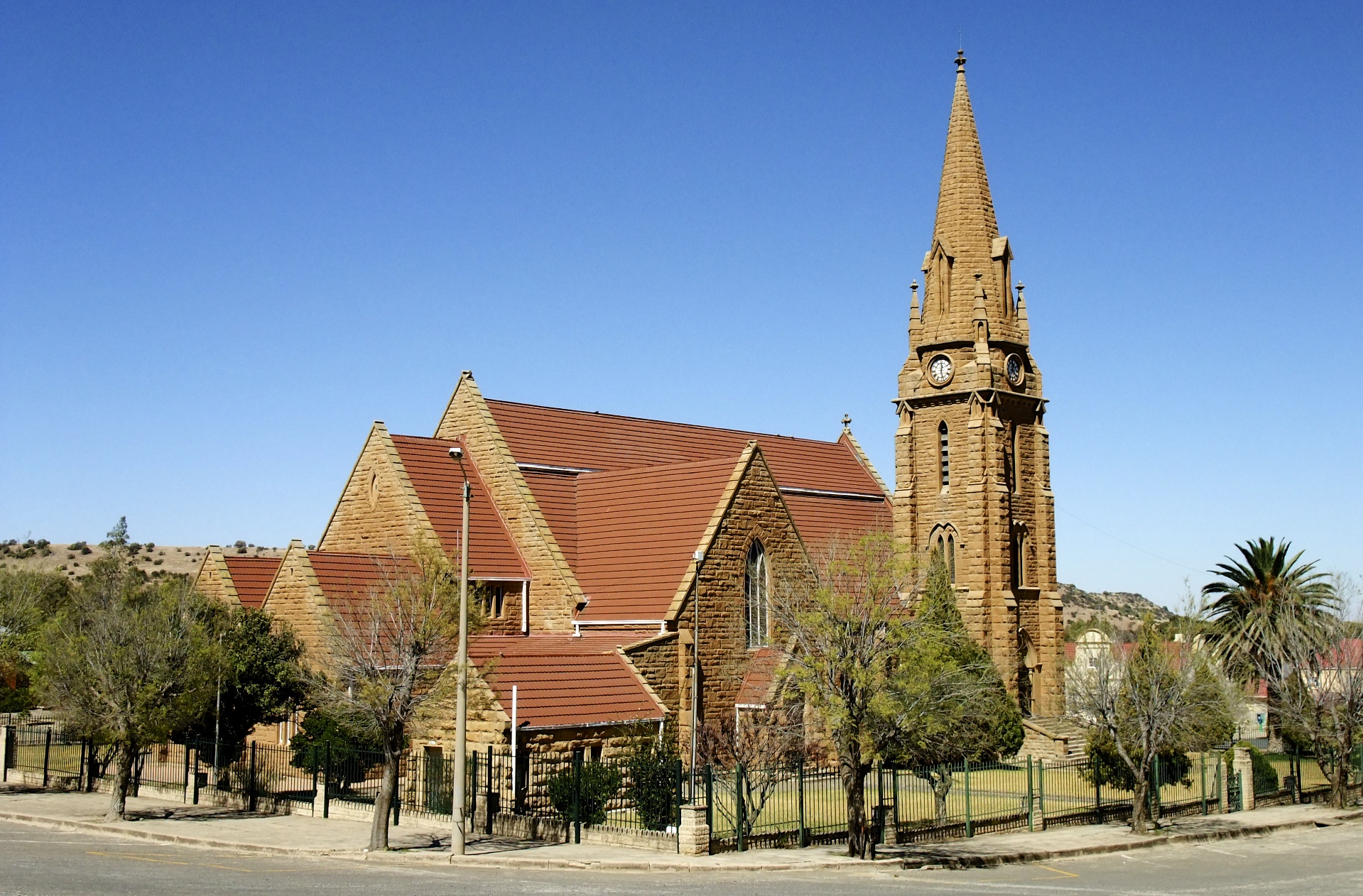
The white community of Winburg is famous for the differences in political heritage. The town was divided into two camps, due to their support to either the South African Party of General Jan Smuts, or the National Party of Dr Daniel François Malan. This led to the division of the Dutch Reformed Church into two separate congregations, Klip Kerk (Stone Church, because it was built from sandstone) and which was the original church for the Dutch Reformed Church and Rietfontein Kerk. Bitter feuds were fought between supporters of the two parties. The Klipkerk supporters demolished the Rietfontein Church project several times.[citation needed]
In later years this division was almost erased. The National Party's support and later abdication to the African National Congress, led to a new division in the community. Old feuds were re-ignited and with the town divided along religious lines again, a new church, the Afrikaans Protestant Church, was formed.[citation needed]
The communities in Winburg, as in most South African towns, still lead segregated lives, a remnant of apartheid days. Social interaction between different population groups is being encouraged by an official integration policy of the African National Congress government. However this has led to the deteriorations of many facilities in Winburg, of which the previous prestigious school and orphanage, are two examples.[citation needed]
Notable people
[edit]See also
[edit]References
[edit]- ^ Robson, Linda Gillian (2011). "Annexure A" (PDF). The Royal Engineers and settlement planning in the Cape Colony 1806–1872: Approach, methodology and impact (PhD thesis). University of Pretoria. pp. xlv–lii. hdl:2263/26503.
- ^ a b c d Main Places Winburg from Census 2011.
- ^ "Winburg, Orange Free State, South Africa".
- ^ a b On Route in South Africa: Explore South Africa region by region. Jonathan Ball Publishers. 6 June 2014. ISBN 9781920289805.
- ^ "President MT Steyn". Anglo-Boer War Museum.
- ^ "Concentration Camps". Anglo-Boer War Museum.
- ^ "General Jacobus Hercules de la Rey". Anglo-Boer War Museum.
Winburg
View on GrokipediaWinburg is a small mixed-farming town in the Lejweleputswa District of South Africa's Free State province, established by Voortrekker settlers in the 1830s and officially proclaimed in 1837 as the oldest town in the former Orange Free State.[1][2] Located along the N1 highway between Bloemfontein and Kroonstad, it briefly served as the capital of the Voortrekker republic following the British annexation of Natal in 1843.[3] The town's economy revolves around agriculture, including maize, wheat, and livestock production, supporting a population of approximately 14,000 residents as of the 2011 census.[4] Historically significant for its role in early Boer settlement and as a site of a British concentration camp during the Second Anglo-Boer War, Winburg features landmarks such as the Voortrekker Monument and Pioneer Museum, preserving its frontier heritage.[2]
Geography and Environment
Location and Topography
Winburg is situated in the Lejweleputswa District Municipality of the Free State Province, South Africa, at coordinates 28°31′S 27°01′E.[5] The town occupies a strategic position at the intersection of the N1 national highway, which links Gauteng Province to Bloemfontein and the Western Cape, and the N5 route extending westward.[6] This placement along the N1 corridor facilitated its role as a frontier outpost during the 19th-century Boer migrations northward from the Cape Colony, beyond the Orange River.[7] Topographically, Winburg lies on the Highveld plateau at an elevation of approximately 1,430 meters (4,690 feet), characterized by gently undulating plains dominated by short grasslands.[8] The terrain features scattered low hills or koppies and is crossed by minor streams such as the Laaispruit River, with underlying soils generally fertile and suitable for grain cultivation and cattle grazing due to the grassland biome's deep, well-drained profiles.[6][9] Water scarcity in the region, typical of the semi-arid Highveld, historically required reliance on seasonal rivers, necessitating the development of boreholes and small dams for sustained settlement.[10] The nearby Sand River, associated with the 1852 Sand River Convention that recognized Boer independence in territories north of the Vaal River, marks a historical boundary influencing the area's geopolitical positioning during early colonial treaties.[1][11]Climate and Natural Resources
Winburg features a semi-arid climate (Köppen classification BSh) typical of the Highveld region, with hot, wet summers and cold, dry winters. Summer months from October to March bring average high temperatures of 28–32°C (82–90°F) and frequent afternoon thunderstorms, accounting for over 70% of the annual precipitation of approximately 450–500 mm, which falls on about 60–75 days. Winter periods from May to August are marked by dry spells, clear skies, and average lows of 0–5°C (32–41°F), with occasional frost and rare snowfall on higher ground.[12][13] The area has experienced periodic droughts exacerbated by erratic rainfall patterns, including the severe 2015–2018 event linked to El Niño, which caused below-average precipitation across the Free State and prolonged dry conditions affecting soil moisture and habitability.[14][15] Natural resources in the Winburg vicinity are limited, with reliance on groundwater from fractured Karoo aquifers for water needs, as surface water is scarce and some historical thermal springs have dried up. The landscape supports Highveld grassland ecosystems hosting wildlife such as springbok (Antidorcas marsupialis) and black wildebeest (Connochaetes gnou), though populations are fragmented due to agricultural conversion. Unlike mineral-rich regions like the Witwatersrand, the local geology—dominated by sedimentary rocks of the Beaufort Group in the Karoo Supergroup—lacks significant deposits of gold, diamonds, or other exploitable minerals.Demographics
Population Trends
Winburg's population expanded modestly in the mid-19th century following its establishment as a Voortrekker outpost in 1837, serving as a hub for farming settlements in the Orange Free State, though precise enumeration from that era remains undocumented in available records. By the early 20th century, the town's growth stagnated amid agricultural mechanization after World War II, which diminished the need for on-farm labor and prompted initial outflows to larger centers.[16] Census data illustrates a marked decline in the core urban area. The 2001 census recorded 3,108 residents in the Winburg sub-place.[17] This figure dropped to 1,373 by the 2011 census for the main place, reflecting a contraction of over 55% in a decade.[18] Broader enumerations incorporating adjacent areas like Makeleketle township reported around 14,074 for the Winburg vicinity in 2011, with a modest 1.6% annual growth from 2001 levels prior to the town's core depopulation.[4] This downturn aligns with nationwide rural exodus patterns, where residents migrate to urban hubs like Bloemfontein or Johannesburg for economic prospects, exacerbated by deteriorating municipal services, high unemployment, and limited infrastructure investment in small Free State towns.[19] While the encompassing Masilonyana Local Municipality saw its population rise slightly from 59,895 in 2011 to an estimated 63,800 by 2022, Winburg's urban nucleus continued to shrink, underscoring selective depopulation in legacy rural seats.[20] No official 2022 census breakdown for Winburg has been released, but trends indicate persistence of net outmigration amid agricultural consolidation and youth emigration.[19]| Census Year | Population (Winburg Core/Town) | Source Notes |
|---|---|---|
| 2001 | 3,108 | Sub-place, including peripheral zones[17] |
| 2011 | 1,373 | Main place, urban core[18] |

