


Community hub
Recent from talks
Contribute something
Nothing was collected or created yet.
The Day the Music Died
View on Wikipedia
On February 3, 1959, American rock and roll musicians Buddy Holly, Ritchie Valens, and "The Big Bopper" J. P. Richardson were all killed in a plane crash near Clear Lake, Iowa, together with pilot Roger Peterson.[a][1][2] The event became known as "The Day the Music Died" after singer-songwriter Don McLean referred to it as such in his 1971 song "American Pie".
Key Information


.jpg)
At the time, Holly and his band, consisting of Waylon Jennings, Tommy Allsup, and Carl Bunch, were playing on the "Winter Dance Party" tour across the American Midwest. Rising artists Valens, Richardson and vocal group Dion and the Belmonts had joined the tour as well. The long journeys between venues on board the cold, uncomfortable tour buses adversely affected the performers, with cases of flu and even frostbite.
After stopping at Clear Lake to perform, and frustrated by the conditions on the tour buses, Holly chose to charter a plane to reach their next venue in Moorhead, Minnesota. Richardson, suffering from the flu, swapped places with Jennings, taking his seat on the plane, while Allsup lost his seat to Valens on a coin toss. Soon after takeoff, late at night and in poor, wintry weather conditions, pilot Peterson lost control of the light aircraft, a Beechcraft Bonanza, which crashed into a cornfield, killing all four on board.
The event has since been mentioned or referenced in various media. Various monuments have been erected at the crash site and in Clear Lake, where an annual memorial concert is held at the Surf Ballroom, the venue that hosted the artists' last performances.
Background
[edit]In November 1958, Buddy Holly terminated his association with The Crickets. According to Paul Anka, Holly realized he needed to go back on tour again for two reasons: he needed cash because the Crickets' manager Norman Petty had apparently stolen money from him, and he wanted to raise funds to move to New York City to live with his new wife, María Elena Holly, who was pregnant (although he already lived in New York when he started the tour).[3] Holly signed up with General Artists Corporation (GAC) because "he knew they were planning a British tour and he wanted to be in on that."[4]
For the start of the "Winter Dance Party" tour, Holly assembled a band consisting of Waylon Jennings (bass), Tommy Allsup (guitar) and Carl Bunch (drums), with the opening vocals of Frankie Sardo. The tour was set to cover twenty-four Midwestern cities in as many days—there were no off days. New hit artist Ritchie Valens, "The Big Bopper" J. P. Richardson and the vocal group Dion and the Belmonts joined the tour to promote their recordings and make an extra profit.[5][6]

The tour began in Milwaukee on January 23, 1959, with the performance in Clear Lake, Iowa on February 2 being the eleventh of the twenty-four scheduled events. The amount of travel required soon posed a serious problem. The distances between venues had not been properly considered when the performances were scheduled. Instead of systematically circling around the Midwest through a series of venues in close proximity to one another, the tour erratically zigzagged back and forth across the region, with distances between some tour stops exceeding 400 miles (640 km). As there were no off days, the bands had to travel most of each day, frequently for ten to twelve hours in freezing mid-winter temperatures. Most of the Interstate Highway System had not yet been built, so the routes between tour stops required far more driving time on narrow two-lane rural highways than would now be the case on modern expressways.
GAC, which booked the tour,[7] received considerable criticism for their seemingly total disregard for the conditions they forced the touring musicians to endure:
They didn't care. It was like they threw darts at a map ... The tour from hell—that's what they named it—and it's not a bad name.
— Bill Griggs, music historian and founder of the Buddy Holly Memorial Society[8]
The entire company of musicians traveled together in one bus, although the buses used for the tour were wholly inadequate, breaking down and being replaced frequently. Griggs estimates that five separate buses were used in the first eleven days of the tour—"reconditioned school buses, not good enough for school kids."[8] The artists themselves were responsible for loading and unloading equipment at each stop, as no road crew assisted them. Adding to the disarray, the buses were not equipped for the harsh weather, which consisted of waist-deep snow in several areas and varying temperatures from 20 °F (−7 °C) to as low as −36 °F (−38 °C). When the bus was delayed in departing Duluth, Minnesota late on January 31, Valens suggested chartering a plane, but a replacement bus arrived in time.[9]
In the early morning hours of February 1, while traveling from Duluth to a matinee performance in Appleton, Wisconsin, the bus's heating system broke down and its engine froze, leaving the musicians stranded on a remote stretch of U.S. Highway 51 near Pine Lake, Wisconsin. Temperatures reached as low as −40 °F (−40 °C) as they waited for help to arrive, with the musicians burning newspapers inside the bus to keep warm. It was two hours before Iron County sheriffs rescued the group, by which time Carl Bunch had developed frostbite in both feet. Bunch was taken to the nearest hospital in Ironwood, Michigan, where he remained under observation for the next few days, while the planned performance in Appleton was canceled. Taking a Chicago & North Western train from Hurley, the group made it to Green Bay, Wisconsin in time for that evening's performance at the Riverside Ballroom.[9]

With Bunch removed from the tour group, Holly, Valens and Dion DiMucci (and Carlo Mastrangelo of the Belmonts who was a drummer) took turns playing drums for each other at the performances in Green Bay and Clear Lake, Iowa, with Holly playing drums for Dion, Dion playing drums for Ritchie, and Ritchie playing drums for Holly.[10]
On Monday, February 2, the tour arrived in Clear Lake, west of Mason City, Iowa, having driven 350 miles (560 km) from the previous day's concert in Green Bay. Clear Lake had not been a scheduled stop; tour promoters hoped to fill the open date and called Carroll Anderson, the manager of the local Surf Ballroom, and offered him the show. Anderson accepted and they set the show for that night. By the time Holly arrived at the venue that evening, he was frustrated with the ongoing problems with the bus. After Valens closed his set at the Ballroom, he phoned his manager Bob Keane and after a conversation about the undesirable situation with the tour, they agreed that after the show in Moorhead, Ritchie would be going back to California.[11] The next scheduled destination after Clear Lake was Moorhead, Minnesota, a 365-mile (590 km) drive north-northwest—and, as a reflection of the poor quality of the tour planning, a journey that would have taken them directly back through the two towns they had already played within the last week. No respite was in sight after that, as the following day, after having traveled from Iowa to Minnesota, they were scheduled to travel back to Iowa, specifically almost directly south to Sioux City, a 325-mile (520 km) trip.
Holly chartered a plane to fly himself and his band to Fargo, North Dakota, which is adjacent to Moorhead. The rest of the party would have picked him up in Moorhead, saving him the journey in the bus and leaving him time to get some rest.[12] Their gig in Moorhead was to have been a radio performance at the station KFGO with disc jockey Charlie Boone.
Flight arrangements
[edit]Anderson chartered a plane from Dwyer Flying Service in Mason City, to fly to Fargo's Hector Airport, the closest airport to Moorhead;[13] the pilot was Roger Peterson, a 21-year-old married man who had "built his life around flying".[14]
Dwyer Flying Service charged a fee of $36 (equivalent to $390 in 2024) per passenger for the flight on the 1947 single-engined, V-tailed Beechcraft 35 Bonanza (registration N3794N[15]), which seated three passengers and the pilot.[16] A popular misconception, originating from Don McLean's song about the crash, was that the plane was called American Pie; no record exists of any name ever having been given to N3794N.[17]
The most widely accepted version of events was that Richardson had contracted the flu during the tour and asked Jennings for his seat on the plane.[18] When Holly learned that Jennings was not going to fly, he said in jest: "Well, I hope your damned bus freezes up." Jennings responded: "Well, I hope your ol' plane crashes", a humorous but ill-fated response that would haunt Jennings for the rest of his life.[19] Valens, who once had a fear of flying, asked Allsup for his seat on the plane. The two agreed to toss a coin to decide.[13] Bob Hale, a disc jockey with Mason City's KRIB-AM, was emceeing the concert that night and flipped the coin in the ballroom's side-stage room shortly before the musicians departed for the airport. Valens won the coin toss for the seat on the flight. Valens is apocryphally said to have remarked, "That's the first time I've ever won anything in my life."[20]
In contradiction to the testimony of Allsup and Jennings, Dion has since said that Holly approached him along with Valens and Richardson to join the flight, not Holly's bandmates. In a 2009 interview, Dion said that Holly called him, Valens and Richardson into a vacant dressing room during Sardo's performance and said, "I've chartered a plane, we're the guys making the money [we should be the ones flying ahead]...the only problem is there are only two available seats." According to Dion, it was Valens, not Richardson, who had fallen ill, so Valens and Dion flipped a coin for the seat. In his interview, no mention is made of Jennings or Allsup being invited on the plane. Dion said he won the toss, but ultimately decided that since the $36 fare equalled the monthly rent his parents paid for his childhood apartment, he could not justify the indulgence.[21]
Take-off and crash
[edit]


After the show ended, Anderson drove Holly, Valens and Richardson to nearby Mason City Municipal Airport,[22] where the elevation is 1,214 feet (370 m) AMSL. The weather at the time of departure was reported as light snow, a ceiling of 3,000 feet (900 m) AMSL with sky obscured, visibility six miles (10 km) and winds from 20 to 30 mph (17 to 26 kn; 32 to 48 km/h; 8.9 to 13.4 m/s). Although deteriorating weather was reported along the planned route, the weather briefings Peterson received failed to relay the information.[23]
The plane took off normally from runway 17 (today's runway 18) at 00:55 (12:55 am) CST on Tuesday, February 3.[24] Hubert Jerry Dwyer, owner of the flying service, watched the southbound take-off from a platform outside the control tower. He was able to clearly see the aircraft's tail light for most of the brief flight, which started with an initial 180 degree left turn to pass east of the airport, climbing to approximately 800 feet (240 m) AGL. After an additional left turn to a northwesterly heading, the tail light was observed gradually descending until it disappeared. Around 1 am, when Peterson failed to make the expected radio contact, repeated attempts were made to establish radio contact, without success.[14] Later that morning at daylight, after several attempts to contact the plane were unsuccessful, Dwyer retraced Peterson's planned route by air, and around 9:35 am he spotted the wreckage less than six miles (10 km) northwest of the airport.[14]
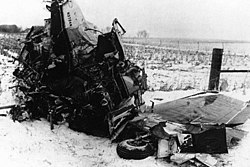
The Bonanza had impacted terrain at high speed, estimated to have been around 170 mph (150 kn; 270 km/h), banked 90° to the right and in a nose-down attitude. The right-wing tip struck the ground first, gouging a 12-by-2-foot-deep (3.7 m × 0.6 m) furrow, crumpling then breaking off. The fuselage then hit the ground right-side down and bounced a few feet back into the air, traveling another 50 feet (17 yd; 15 m) through the air, simultaneously rolling inverted due to the remaining left wing still generating lift. The plane struck the ground a final time, in an inverted, nose-down position, the nose hitting and flipping the plane over into a right-side up, tail-first position. The momentum of the heavy engine caused the fuselage, left wing remaining attached and intact to the end, to roll upon itself into a virtual ball, rolling nose-over-tail across the frozen field for 540 feet (180 yd; 160 m), before coming to rest tail-first against a wire fence.[14] The bodies of the performers had been ejected from the fuselage and lay near the plane's wreckage, while Peterson's body, which was entangled in the wreckage, could only be retrieved after the cockpit was cut open using blowtorches.[14][25] With the rest of the entourage en route to Minnesota, Anderson, who had driven the party to the airport and witnessed the plane's takeoff, had to identify the bodies of the musicians.[26] The county coroner, Ralph Smiley, reported that all four victims died instantly, the cause of death being "gross trauma to brain" for the three musicians and "brain damage" for the pilot.[27][28]
Aftermath
[edit].jpg)
María Elena Holly learned of her husband's death via a television news report. A widow after only six months of marriage, she suffered a miscarriage shortly after, reportedly due to "psychological trauma". Holly's mother, on hearing the news on the radio at home in Lubbock, Texas, screamed and collapsed.[5]
Despite the tragedy, the "Winter Dance Party" tour continued. Fifteen-year-old Bobby Vee was given the task of filling in for Holly at the next scheduled performance in Moorhead, in part because he "knew all the words to all the songs."[29] Jennings and Allsup carried on for two more weeks, with Jennings taking Holly's place as lead singer.[30] Other performers who were recruited for the remainder of the tour were Jimmy Clanton, Fabian and Frankie Avalon.[31]
Meanwhile, funerals for the victims were held individually. Holly and Richardson were buried in Texas, Valens in California and Peterson in Iowa. Holly's widow, María Elena, did not attend his funeral.[32] She said in an interview: "In a way, I blame myself. I was not feeling well when he left. I was two weeks pregnant, and I wanted Buddy to stay with me, but he had scheduled that tour. It was the only time I wasn't with him. And I blame myself because I know that, if only I had gone along, Buddy never would have gotten into that airplane."[33]
Official investigation
[edit]The official investigation was carried out by the Civil Aeronautics Board (CAB, precursor to the NTSB). It emerged that Peterson had over four years of flying experience, of which one was with Dwyer Flying Service, and had accumulated 711 flying hours, of which 128 were on Bonanzas. He had also logged 52 hours of instrument flight training, although he had passed only his written examination, and was not yet qualified to operate in weather that required flying solely by reference to instruments. Peterson and Dwyer Flying Service itself were certified to operate only under visual flight rules, which essentially require that the pilot must be able to see where the aircraft is going. On the night of the accident visual flight would have been virtually impossible due to the low clouds, the lack of a visible horizon and the absence of ground lights over the sparsely populated area.[14]


Furthermore, Peterson, who had failed an instrument checkride nine months before the accident, had received his instrument training on airplanes equipped with a conventional artificial horizon as a source of aircraft attitude information, while the accident aircraft was equipped with an older-type Sperry F3 attitude gyroscope. Crucially, the two types of instruments display the same aircraft pitch attitude information in graphically opposite ways. As a result, when the aircraft took off, Peterson, observing the older model Sperry F3 gyroscope, thought he was climbing when in fact he was descending.[14]
Another contributing factor was the "seriously inadequate" nighttime weather briefing provided to Peterson, which "failed to even mention adverse flying conditions which should have been highlighted".[14] The CAB concluded that the probable cause of the accident was "the pilot's unwise decision" to attempt a flight at night that required skills he did not have.[14]
Subsequent investigations
[edit]On March 6, 2007, in Beaumont, Texas, Richardson's body was exhumed for reburial. Forest Lawn Cemetery moved his body to a more suitable area after plans were made to erect a bronze statue near his gravesite to accompany a newly received historical marker. As the body was to be placed in a new casket while above ground, the musician's son, Jay Perry Richardson, took the opportunity to have his father's body re-examined to verify the original coroner's findings and asked forensic anthropologist William M. Bass to carry out the procedure.
A longstanding rumor surrounding the accident, which this re-examination sought to confirm or dispel, asserted that an accidental firearm discharge took place on board the aircraft and caused the crash. It had also been speculated that Richardson initially survived the crash and crawled out of the wreckage in search of help before succumbing to his injuries, prompted by the fact that his body was found farther from the plane than the other victims. Bass and his team took several X-rays of Richardson's body and eventually concluded that the musician had indeed died instantly from extensive, unsurvivable fractures to virtually every bone in his body. No traces of lead were found from any bullet, nor any indication that he had been shot. Coroner Smiley's original 1959 report was, therefore, confirmed as accurate.[34][35]
In March 2015, the NTSB received a request to reopen the investigation into the accident.[36] The request was made by L. J. Coon, a retired pilot from New England who felt that the conclusion of the 1959 investigation was inaccurate. Coon suspected a possible failure of the right ruddervator, or a problem with the fuel system, as well as possible improper weight distribution. Coon argued that Peterson may have tried to land the plane and that his efforts should be recognized.[37][38] The NTSB declined the request in April 2015, saying that the evidence presented by Coon was insufficient to merit the reconsideration of the original findings.[39][40]
Legacy
[edit]Policy
[edit]A policy not to report on a person's death until their family had been notified was implemented by authorities in the months after María Elena Holly suffered her miscarriage due to the psychological trauma of hearing about her husband's death on television for the first time.[41]
Memorials
[edit]A memorial service for Peterson was held at Redeemer Lutheran Church in Ventura, Iowa, on February 5. A funeral was held the next day at St. Paul Lutheran Church in his hometown of Alta; Peterson was buried in Buena Vista Memorial Cemetery in nearby Storm Lake.[42]
Films
[edit]- The accident closes the biographical film The Buddy Holly Story (1978); the film ends as the Clear Lake concert concludes, and a freeze-frame shot is followed with a caption revealing their deaths later that night "...and the rest is Rock 'N Roll."
- The run-up to the accident (which happens entirely off-camera) and its aftermath, particularly the reactions of Ritchie Valens' immediate family and loved ones, are depicted in the Valens biopic La Bamba (1987).
Memorial concerts
[edit]Fans of Holly, Valens, and Richardson have been gathering for annual memorial concerts at the Surf Ballroom in Clear Lake since 1979.[43] The fiftieth anniversary concert took place on February 2, 2009, with Delbert McClinton, Joe Ely, Wanda Jackson, Los Lobos, Chris Montez, Bobby Vee, Graham Nash, Peter and Gordon, Tommy Allsup, and a house band featuring Chuck Leavell, James "Hutch" Hutchinson, Bobby Keys, and Kenny Aronoff. Jay Perry Richardson, the son of the Big Bopper, was among the participating artists, and Bob Hale was the master of ceremonies, as he was at the 1959 concert.[44][45]
A series of tribute concerts called the Winter Dance Party Tour was started by John Mueller, who starred as Buddy Holly in the musical Buddy: The Buddy Holly Story. The recreation and live show is endorsed by the estates of Buddy Holly, Ritchie Valens, and J.P Richardson.[46]
Monuments
[edit]In June 1988, a 4-foot (1.2 m) tall granite memorial bearing the names of Peterson and the three entertainers was dedicated outside the Surf Ballroom with Peterson's widow, parents, and sister in attendance; the event marked the first time that the families of Holly, Richardson, Valens, and Peterson had gathered together.
In 1989, Wisconsin resident and 1950s fan Ken Paquette made a stainless-steel monument that depicts a guitar and a set of three records bearing the names of the three performers killed in the accident.[47] The monument is on private farmland, about 1⁄4 mi (1,300 ft; 440 yd; 400 m) west of the intersection of 315th Street and Gull Avenue, five miles (8 km) north of Clear Lake. At that intersection, a large plasma-cut steel set of Wayfarer-style glasses, similar to those Holly wore, marks the access point to the crash site.[40]
Paquette created a similar stainless-steel monument to the three musicians located outside the Riverside Ballroom in Green Bay, Wisconsin, where Holly, Richardson, and Valens played their penultimate show on February 1. This second memorial was unveiled on July 17, 2003.[48] In February 2009, a further memorial made by Paquette for Peterson was unveiled at the crash site.[49]
-
 Monument in front of the Surf Ballroom in Clear Lake, Iowa
 -
 Signpost east of the crash site replicating Holly's signature glasses. The crash site is actually about 1,850 feet (564 m) from this location, down the path along the fence line.
 -
 Memorial at crash site, 2024
 -
 Memorial to pilot Roger Peterson at crash site


Roads
[edit]A road originating near the Surf Ballroom, extending north and passing to the west of the crash site, is now known as Buddy Holly Place.[50]
Songs
[edit]
- Tommy Dee recorded "Three Stars" (1959), commemorating the musicians.[51]
- In 1961, Mike Berry recorded "Tribute to Buddy Holly", which describes the night of the flight.[52] It reached number 24 on the UK Singles Chart and was notoriously banned by the BBC for being "too morbid".[53][54]
- Don McLean, a fan of Buddy Holly, addressed the accident in his song "American Pie" (1971), dubbing it "the Day the Music Died",[55] which for McLean symbolized the "loss of innocence" of the early rock-and-roll generation.[56]
- In 1978, Waylon Jennings briefly added his own memories of the incident onto his song "A Long Time Ago", from the album I've Always Been Crazy. He sings the lines "Don't ask me who I gave my seat to on that plane, I think you already know, I told you that a long time ago."
- Dion recorded "Hug My Radiator" which references the "broken-down bus" and the chilling cold the performers experienced on the tour. The song does not directly reference the three performers who died, but Dion has said, in interviews,[57] that the song is a memory of the tour and that he almost got on the airplane that crashed, but it was too expensive.
- In 1985, German punk rock band Die Ärzte released their second album Im Schatten der Ärzte, which includes the song "Buddy Holly's Brille". In their trademark humorous fashion, they address the accident by asking where Holly's glasses ended up.
Fiction
[edit]Howard Waldrop's short story "Save a Place in the Lifeboat for Me" (collected in Howard Who?) describes a fictional attempt by a sextet of famous slapstick characters (Chico and Harpo Marx, Abbott and Costello, and Laurel and Hardy) to prevent the accident from occurring.[58]
TJ Klune's 2020 fantasy novel The House in the Cerulean Sea features an orphaned antichrist, Lucy, who collects records of Holly, the Big Bopper, and Valens, and discusses the crash with the protagonist, Linus.
In the animated series The Venture Brothers, the villainous duo of Red Mantle and Dragoon are implied to be Holly and Richardson, with the crash being used as a cover up of their abduction and turn to life of crime. The fate of Valens is never stated.
See also
[edit]Notes
[edit]- ^ This was one of three notable aviation incidents to occur on this date; the other two were the crash of American Airlines Flight 320 in New York City (which knocked the story of the Clear Lake crash down the headlines in the newspapers) and the near crash of Pan Am Flight 115 near Newfoundland.
References
[edit]Citations
[edit]- ^ "Rock 'n' roll singers die in air crash". Eugene Register-Guard. Oregon. Associated Press. February 3, 1959. p. 1A. Archived from the original on August 12, 2021. Retrieved October 3, 2020.
- ^ "Stars of rock 'n' roll troupe die in crash which claims 4 lives". Bend Bulletin. Oregon. UPI. February 3, 1959. p. 1. Archived from the original on August 12, 2021. Retrieved October 3, 2020.
- ^ Anka, Paul; Dalton, David (2013). My Way: An Autobiography. New York: St. Martin's Press. p. 88. ISBN 9781250035202. Archived from the original on April 12, 2023. Retrieved October 9, 2020.
- ^ Anka, Paul; Dalton, David (2013). My Way: An Autobiography. New York: St. Martin's Press. p. 90. ISBN 9781250035202. Archived from the original on April 12, 2023. Retrieved October 9, 2020.
- ^ a b Suddath, Claire (February 3, 2009). "The Day the Music Died". Time. Archived from the original on August 26, 2013. Retrieved December 22, 2020.
- ^ Everitt 2004, p. 10.
- ^ Lehmer 2004, p. 82.
- ^ a b Huey, Pamela (February 3, 2009). "Buddy Holly: The tour from hell". Star Tribune. Archived from the original on August 15, 2020.
- ^ a b Amburn, Ellis. Buddy Holly: A Biography, Macmillan, 1996, pages 235–239.
- ^ "Connection to Buddy Holly Death". WeGoNews.com. Archived from the original on August 27, 2010. Retrieved December 22, 2020.
- ^ "Narration of Ritchie Valens' Story as Told by Bob Keane, Producer and Manager of Ritchie Valens". YouTube. November 8, 2014.
- ^ Everitt 2004, p. 13.
- ^ a b Everitt 2004, p. 14.
- ^ a b c d e f g h i Durfee, James R.; Gurney, Chan; Denny, Harmar D.; Minetti, G. Joseph; Hector, Louis J. (September 23, 1959). Aircraft Accident Report (PDF) (Report). Civil Aeronautics Board. Archived from the original (PDF) on February 26, 2009. Retrieved February 4, 2009.
- ^ "FAA Registry (N3794N)". Federal Aviation Administration.
- ^ Schuck, Raymond 2012, p. 16.
- ^ "American Pie". Snopes.com. March 13, 2000. Archived from the original on March 22, 2021. Retrieved April 16, 2015.
- ^ "The Day the Music Died: Remembering The Lives Lost". Beyond the Dash. January 25, 2021. Archived from the original on February 10, 2024. Retrieved March 15, 2021.
- ^ Jennings & Kaye 1996, p. 70.
- ^ McArdle, Terence (January 12, 2017). "Tommy Allsup, guitarist who backed Buddy Holly, Kenny Rogers and others, dies at 85". The Washington Post. Archived from the original on January 13, 2017. Retrieved March 21, 2024.
- ^ DiMucci, Dion (1988). The Wanderer. Beech Tree Books. p. 89.
- ^ Everitt 2004, p. 15.
- ^ Everitt 2004, p. 16.
- ^ Everitt 2004, p. 17.
- ^ (February 4, 1959) "3 Rock, Roll Stars Killed in Air Crash", Anderson Herald. pg.3. United Press International. Retrieved February 6, 2024.
- ^ Everitt 2004, p. 21.
- ^ "Death certificates" (PDF). Awesome Stories. Archived (PDF) from the original on March 4, 2016. Retrieved June 1, 2015.
- ^ "Coroner's investigation" (PDF). Awesome Stories. Archived (PDF) from the original on March 4, 2016. Retrieved June 1, 2015.
- ^ "Bobby Vee Biography". bobbyvee.net. Paragraph 3. Archived from the original on January 29, 2019. Retrieved December 22, 2020.
- ^ Carr & Munde 1997, p. 155.
- ^ Genetti, Domenic (February 2, 2024). "Winter Dance Party's resilience after plane crash killed Buddy Holly, Ritchie Valens, The Big Bopper". Beaumony Enterprise. Retrieved May 14, 2024.
- ^ McLean, Craig (February 1, 2019). "'He knew he was going to die': Buddy Holly's widow on keeping his memory alive". The Telegraph. ISSN 0307-1235. Archived from the original on January 12, 2022. Retrieved May 28, 2020.
- ^ Kerns, William (August 15, 2008). "Buddy and Maria Elena Holly married 50 years ago". Lubbock Avalanche-Journal. Archived from the original on March 23, 2016. Retrieved April 29, 2015.
- ^ Griggs, Bill. "Big Bopper Exhumation". Archived from the original on July 7, 2012. Retrieved April 26, 2015.
- ^ "Autopsy of 'Big Bopper' to Address Rumors About 1959 Plane Crash". The Washington Post. January 18, 2007. ISSN 0190-8286. Archived from the original on June 28, 2011. Retrieved April 26, 2015.
- ^ "Board considers reopening investigation into plane crash that caused the death of Buddy Holly". KITV. March 3, 2015. Archived from the original on March 5, 2015. Retrieved March 4, 2015.
- ^ Kilen, Mike (March 4, 2015). "NTSB considers reopening Buddy Holly crash case". The Des Moines Register. Retrieved March 5, 2015.
- ^ Pilkington, Ed (March 5, 2015). "Buddy Holly plane crash: officials consider reopening 1959 probe". The Guardian. Archived from the original on March 5, 2015. Retrieved March 5, 2015.
- ^ "Buddy Holly crash investigation will not be reopened". The Des Moines Register. Associated Press. April 28, 2015. Retrieved April 1, 2016.
- ^ a b Munson, Kyle (February 4, 2016). "RIP Jerry Dwyer, a man haunted by the Buddy Holly crash". The Des Moines Register. Retrieved October 2, 2018.
- ^ Suddath, Claire (February 3, 2009). "The Day the Music Died". Time. Archived from the original on February 5, 2009. Retrieved April 29, 2015.
- ^ "Plane Crash Victim Rites at Ventura - Obituary of Roger A. Peterson". The Globe Gazette. Iowa. LE. February 4, 1959. p. 20. Archived from the original on February 10, 2023. Retrieved February 10, 2023.
- ^ "Winter Dance Party History". Surf Ballroom. Archived from the original on February 4, 2012.
- ^ Bream, Jon (February 3, 2009). "Fans Pack Surf Ballroom for Tribute to Buddy Holly, Ritchie Valens and the Big Bopper". CMT News. Archived from the original on November 30, 2012. Retrieved February 2, 2013.
- ^ Coffey, Joe (February 5, 2009). "Holly, Valens, Richardson Remembered: 50 Winters Later". Premier Guitar. Archived from the original on April 15, 2009. Retrieved February 2, 2013.
- ^ [John Mueller's Winter Dance Party https://winterdanceparty.com/]
- ^ Lehmer 2004, p. 342.
- ^ Jordan, Jennifer (April 11, 2007). "The Day the Music Died". Articles Tree. Archived from the original on February 7, 2012. Retrieved January 30, 2009.
- ^ Jordan, Jennifer (February 2, 2009). "Memorial to Buddy Holly pilot dedicated at crash site". The Des Moines Register. Retrieved April 14, 2009.
- ^ "Clear Lake, Iowa: Buddy Holly Crash Site". RoadsideAmerica.com. Archived from the original on June 23, 2011. Retrieved June 25, 2011.
- ^ "Three Stars by Tommy Dee". Archived from the original on January 12, 2020. Retrieved January 12, 2020.
- ^ Cleveland, Barry; Meek, Joe (2001). Creative Music Production: Joe Meek's Bold Techniques. Mix Books. ISBN 978-1-931140-08-9. Archived from the original on May 2, 2024. Retrieved October 3, 2020.
- ^ "a tribute to buddy holly | full Official Chart History | Official Charts Company". www.officialcharts.com. Archived from the original on June 26, 2020. Retrieved June 26, 2020.
- ^ Roberts, David (2006). British Hit Singles & Albums (19th ed.). London: Guinness World Records Limited. p. 55. ISBN 1-904994-10-5.
{{cite book}}: CS1 maint: publisher location (link) - ^ Crouse 2012, p. 86.
- ^ Thimou, Theodore (December 28, 2006). "Preview: The Twice-Famous Don McLean Plays Rams Head". Bay Weekly. Archived from the original on June 13, 2008. Retrieved September 11, 2008.
- ^ "Dion: The Wanderer Returns". Record Collector. December 28, 2006. Archived from the original on June 29, 2020. Retrieved June 28, 2020.
- ^ Waldrop, Howard (1986). "Notes on Stories". Howard Who?. Doubleday. pp. 241. ISBN 0-385-19708-X.
Web
[edit]- "Buddy Holly's Coroner's Report". February 4, 1959. Archived from the original on December 4, 2022. Retrieved December 4, 2022.
- "Coroner's investigation—Air crash, Feb. 3, 1959—SW1/4 Section 18, Lincoln Twp.—Cerro Gordo County, Iowa". May 5, 1998. Archived from the original on December 4, 2022. Retrieved December 4, 2022.
- "The Day the Music Died: February 3, 1959". Archived from the original on August 29, 2005. Retrieved February 3, 2007.
- Civil Aeronautics Board Aircraft Accident Report: September 15, 1959. Series: Minutes of Meetings, 1931 - 1984. September 23, 1959. Retrieved August 26, 2021. - Copy at the Archived July 3, 2023, at the Wayback Machine FAA website.
Books
[edit]- Carr, Joseph; Munde, Alan (1997). Prairie Nights to Neon Lights: The Story of Country Music in West Texas. Texas Tech University Press. ISBN 978-0-89672-365-8.
- Crouse, Richard (2012). Who Wrote The Book of Love?. Random House Digital. ISBN 978-0-385-67442-3.
- Everitt, Rich (2004). Falling Stars: Air Crashes That Filled Rock and Roll Heaven. Harbor House. ISBN 978-1-891799-04-4.
- Jennings, Waylon; Kaye, Lenny (1996). Waylon: An Autobiography. Warner Books. ISBN 978-0-446-51865-9.
- Lehmer, Larry (2004). The Day the Music Died: The Last Tour of Buddy Holly, the Big Bopper and Ritchie Valens (illustrated ed.). Music Sales Group. ISBN 0-8256-7287-2.
- Schuck, Raymond (2012). Do You Believe in Rock and Roll? Essays on Don Mclean's American Pie. McFarland. ISBN 978-1-4766-0036-9.
Further reading
[edit]- Norman, Phillip (2011). Buddy: The Definitive Biography of Buddy Holly. Pan Mcmillan. ISBN 978-1-4472-0340-7.
- Rabin, Staton (2009). Oh Boy! The Life and Music of Rock 'n' Roll Pioneer Buddy Holly (illustrated ed.). Van Winkle Publishing (Kindle). ASIN B001OQBLLG.
- Schinder, Scott; Huxley, Martin; Skinner, Quinton (2000). The Day the Music Died (illustrated ed.). Pocket Books. ISBN 0-671-03962-8.
External links
[edit]

- Beechcraft Bonanza 35 Dwyer Flying Service, N3794N Clear Lake, Iowa February 3, 1959 - Federal Aviation Administration
- February 3, 1959 front page of the Mason City Globe-Gazette, via Newspapers.com

- fiftiesweb.com The Day the Music Died
- Bakotopia Magazine's 50th Anniversary memorial article
- 1959: Buddy Holly killed in air crash
- Voices of Oklahoma interview with Tommy Allsup. First person interview conducted with Tommy Allsup on September 8, 2011. Original audio and transcript archived with Voices of Oklahoma oral history project.
- The true Buddy Holly history, Dion DiMucci's recollections of the tour and the accident, at his YouTube channel

| Singles |
|
|---|---|
| Studio albums | |
| Compilation albums | |
| Tribute albums | |
| Related articles | |


The Day the Music Died
View on GrokipediaBackground
The Winter Dance Party Tour
The Winter Dance Party was a multi-act rock and roll package tour organized by promoter Irvin Feld of the General Artists Corporation, designed to bring live performances by emerging artists to small and mid-sized towns across the Midwest during the harsh winter of 1959.[4] The tour launched on January 23, 1959, at the Eagles Ballroom in Milwaukee, Wisconsin, featuring Buddy Holly with his band, Ritchie Valens, J.P. "The Big Bopper" Richardson, Dion and the Belmonts, Frankie Sardo, and supporting acts including Waylon Jennings on bass.[5] Its purpose was to capitalize on the growing popularity of rock and roll by scheduling high-energy shows in regional venues, capitalizing on the rising fame of these performers to draw teenage audiences despite the season's challenges. Spanning three weeks from late January to mid-February, the tour was structured as a grueling 24-show itinerary zigzagging through the upper Midwest, covering cities in Wisconsin, Minnesota, Iowa, South Dakota, and beyond, often with long bus rides between distant locations.[6] Performances took place in a variety of modest venues, including unheated ballrooms, armories, and community halls, where audiences braved subzero temperatures and snowstorms to attend.[7] Early stops exemplified the relentless pace: after the opening in Milwaukee, the troupe traveled 40 miles south to the Eagles Ballroom in Kenosha, Wisconsin, on January 24, followed by a 200-mile northward haul to Mankato, Minnesota, on January 25, highlighting the inefficient routing that prioritized bookings over geography. Logistical shortcomings plagued the tour from the outset, with the provided bus suffering from a faulty heater that exposed performers to freezing conditions during overnight travels.[8] This led to widespread illnesses, including severe frostbite for drummer Carl Bunch, who was hospitalized after a January 31 show in Duluth, Minnesota, forcing adjustments to the rhythm section and underscoring the tour's inadequate preparation for the brutal winter weather.[9]The Musicians and Their Careers
Charles Hardin Holley, professionally known as Buddy Holly, was born on September 7, 1936, in Lubbock, Texas, to parents Lawrence and Ella Holley, becoming the youngest of their four children.[10] From an early age, Holly displayed musical talent, influenced by country, western swing, and rhythm and blues, and he began performing locally as a teenager. In February 1957, he formed the band The Crickets with drummer Jerry Allison, bassist Joe B. Mauldin, and guitarist Niki Sullivan, signing with Brunswick Records under producer Norman Petty.[10] The group's debut single, "That'll Be the Day," released in May 1957, became a major hit, peaking at No. 3 on the Billboard Hot 100 and No. 1 in the UK, marking Holly's breakthrough in rock and roll.[10] Follow-up successes included "Peggy Sue" and "Oh, Boy!" later that year, with the latter selling nearly one million copies and showcasing Holly's innovative rockabilly sound that fused country twang, R&B rhythms, and rock energy through his signature hiccupping vocals and layered guitar arrangements.[10] By 1958, Holly had married Maria Elena Santiago on August 15 in Lubbock, a union that reflected his growing interest in personal stability amid his rising fame.[10] Richard Steven Valenzuela, better known by his stage name Ritchie Valens, was born on May 13, 1941, in Pacoima, California, to parents Joseph and Concepcion Valenzuela, part of a large Mexican-American family.[11] Growing up in a working-class neighborhood, Valens developed a passion for music early, learning guitar by age nine and performing with school bands by his teens; at 16, he joined The Silhouettes, a local group that played at dances and events in the Los Angeles area.[11] His professional breakthrough came in 1958 after signing with Del-Fi Records under producer Bob Keane, releasing "Come On, Let's Go," an energetic rockabilly track that climbed to No. 42 on the Billboard Hot 100 and established his raw, youthful style blending Latino rhythms with rock and roll.[11] Valens followed with "Donna," a heartfelt ballad dedicated to his girlfriend, which peaked at No. 2 on the chart and became his signature hit, highlighting his songwriting talent and smooth tenor voice.[11] At just 17, Valens emerged as a trailblazing Mexican-American artist in a predominantly white rock scene, infusing Chicano cultural elements like Spanish-language influences and paving the way for future Latino musicians in the genre.[11] Jiles Perry Richardson Jr., who performed as The Big Bopper, was born on October 24, 1930, in Sabine Pass, Texas, and raised in nearby Port Arthur.[12] After serving in the U.S. Army and studying at Lamar College, he entered radio in the early 1950s as a disc jockey at KTRM in Beaumont, where his booming voice, rapid-fire patter, and promotional stunts—like a 1957 endurance broadcast lasting over five days—earned him regional fame and a promotion to program director.[12] Transitioning to music, Richardson adopted the flamboyant Big Bopper persona, dressing in oversized suits and checkered jackets, and recorded his debut single in 1958 for Small World Records; the B-side "Chantilly Lace," a playful call-and-response novelty about courting a girl, unexpectedly hit No. 6 on the Billboard Hot 100 and sold over a million copies.[12] Known for his humorous, exaggerated stage antics—including miming phone conversations during performances—Richardson blended country, R&B, and comedy in a lighthearted style that appealed to rock and roll audiences, while also writing hits for others like "White Lightning" for George Jones.[12] By late 1958, he left radio to focus on performing full-time, embracing a larger-than-life image that concealed his private family life.[12] The chartered flight's pilot, Roger Arthur Peterson, was a 21-year-old from Alta, Iowa, born on May 24, 1937, who had recently joined Dwyer Flying Service in Mason City after earning his private pilot's license in October 1955 and commercial certificate in April 1958.[13] As the oldest of four children, Peterson balanced flying duties with family responsibilities, obtaining a limited flight instructor certification in January 1959 but lacking an instrument rating or certification for instrument flight rules or extensive experience in adverse winter weather.[13]Events Leading to the Crash
Tour Challenges and Fatigue
The Winter Dance Party tour, which began on January 23, 1959, quickly encountered severe challenges from the harsh Midwestern winter weather, including blizzards, sub-zero temperatures dipping as low as 35 degrees below zero, and snow-covered roads that made travel treacherous.[14][9] These conditions led to frequent bus breakdowns and delays, with the group relying on reconditioned school buses that proved inadequate for the icy highways; for instance, on February 1, the bus broke down on Highway 51 near Pine Lake, Wisconsin, stranding the performers in the extreme cold about 100 miles from their destination.[14][9] Another incident occurred earlier when the bus got stuck in snow near Ironwood, Michigan, exacerbating the group's exposure to the elements.[15] The tour buses themselves were poorly equipped, lacking functional heaters and offering little protection from the freezing temperatures, which contributed to widespread exhaustion and health issues among the performers.[14][7] This inadequacy resulted in cases of frostbite and flu outbreaks; notably, Buddy Holly's drummer, Carl Bunch, suffered severe frostbite on his feet during the Ironwood breakdown and was hospitalized on February 1, forcing him to leave the tour.[14][9][7] The relentless performance schedule compounded these problems, with back-to-back shows across hundreds of miles daily and minimal rest—such as a 368-mile drive from Fort Dodge, Iowa, to Duluth, Minnesota, on January 31—leaving the musicians physically drained.[14] The weather even prompted the cancellation of the February 1 show in Appleton, Wisconsin, due to the ongoing transportation woes, though an impromptu performance was arranged in Green Bay that evening.[9] These cumulative strains manifested in individual performer difficulties by the tour's midpoint. Dion DiMucci of Dion and the Belmonts expressed reluctance to charter a flight when offered, citing the $36 cost as prohibitive given his financial situation at the time.[16] Waylon Jennings, Holly's bassist, was battling a cold but yielded his plane seat to J.P. "The Big Bopper" Richardson, who was also ill with the flu and sought relief from the frigid bus ride.[17][18] Similarly, guitarist Tommy Allsup lost his seat to Ritchie Valens after a coin flip, a decision influenced by the overall fatigue and desire to avoid another grueling bus leg.[19][20]Charter Flight Decision
On February 2, 1959, Buddy Holly and the other performers on the Winter Dance Party tour arrived at the Surf Ballroom in Clear Lake, Iowa, for a show that had been added to the itinerary after a cancellation in Wisconsin.[18] The performance, attended by over 1,000 enthusiastic fans, started late and extended beyond the scheduled time due to strong audience demand, concluding around midnight.[18] The grueling conditions of the tour, including repeated bus breakdowns and a non-functional heater in the harsh winter weather, had left the musicians fatigued after ten consecutive days of travel and shows without a break.[2] With the next concert scheduled for February 3 in Moorhead, Minnesota—approximately 365 miles away—the prospect of another long, cold bus ride proved too taxing, prompting Holly to seek an alternative.[21] He arranged to charter a plane to fly ahead to Fargo, North Dakota, the closest airport to Moorhead, allowing time for rest and laundry before the performance.[22] Holly contacted Dwyer Flying Service at Mason City Municipal Airport, about six miles from Clear Lake, to book a single-engine 1947 Beechcraft Model 35 Bonanza for the trip.[2] The charter cost $108, equivalent to $36 per passenger for the three available seats besides the pilot.[23] Initially intended for Holly and two bandmates, Waylon Jennings on bass and Tommy Allsup on guitar, the seating changed when J.P. Richardson, known as The Big Bopper and suffering from the flu, persuaded Jennings to relinquish his spot for comfort on the bus.[18] Ritchie Valens then claimed the third seat by winning a coin toss with Allsup, who later recalled the moment as a fateful game of chance.[24] Dwyer Flying Service assigned 21-year-old Roger Peterson as pilot for the short hop.[22] This decision to fly separately from the rest of the tour group reflected Holly's frustration with the logistical hardships and his desire to prioritize recovery amid the relentless schedule.[23]The Crash
Departure from Mason City
Following their performance at the Surf Ballroom in Clear Lake, Iowa, Buddy Holly, Ritchie Valens, J. P. "The Big Bopper" Richardson, and pilot Roger A. Peterson arrived at Mason City Municipal Airport around 12:40 a.m. on February 3, 1959.[25] The group, seeking to reach their next tour stop in Fargo, North Dakota, had chartered the flight earlier that evening to escape the breakdowns and discomforts of the Winter Dance Party tour bus.[26] Upon arrival, the passengers' baggage—including musical instruments and amplifiers—was stowed in the single-engine Beechcraft Model 35 Bonanza, registration N3794N, before they boarded the aircraft.[25] Peterson, a 21-year-old commercial pilot employed by Dwyer Flying Service, completed preflight preparations, though he held no instrument rating and had not undergone a formal instrument proficiency check.[26] Peterson received multiple weather briefings throughout the evening from the Air Traffic Communications Station at Mason City, with the final update at 11:55 p.m. indicating a 5,000-foot overcast ceiling, visibility exceeding 15 miles, temperature of 15°F, dew point of 13°F, and southwesterly winds at 25 to 32 knots.[26] These reports noted light snow possible en route and a cold front approaching Fargo after 2:00 a.m., but omitted flash advisories issued at 11:35 p.m. and 12:15 a.m. warning of moderate to severe icing, turbulence, and thunderstorms along the path.[25] By the time of departure, local conditions at Mason City had deteriorated: the ceiling had lowered to 3,000 feet with sky obscured, visibility reduced to 6 miles amid light snow flurries, barometric pressure falling to 29.85 inches of mercury, and south winds at 20 knots gusting to 30 knots.[26] Despite worsening weather prompting closures at nearby airports, Mason City remained operational for visual flight rules.[25] The aircraft departed Runway 17 at approximately 12:55 a.m., executing a normal takeoff and executing a left 180-degree turn while climbing to an estimated 800 feet above ground level.[25] It then passed east of the airport before turning to a northwesterly heading toward Fargo, approximately 300 miles away.[26] Airport owner Hubert L. Dwyer, observing from an elevated platform near the control tower, noted the plane's navigation lights during the initial climb and turn; no other witnesses reported sightings due to the late hour and rural surroundings.[25]The Accident and Wreckage
Following takeoff from Mason City Municipal Airport at 12:55 a.m. CST on February 3, 1959, the Beechcraft Bonanza N3794N, piloted by Roger Peterson with passengers Buddy Holly, Ritchie Valens, and J.P. Richardson, executed a left 180-degree turn to head northwest toward Fargo, North Dakota. Witnesses from the airport observed the aircraft climb to an estimated 800 feet above ground level before proceeding northwest, with the last visual contact noting it traveling northwest for approximately five miles before descending and disappearing from sight around 1:00 a.m.[27][28] The crash occurred at approximately 1:00 a.m. CST in an open cornfield five miles northwest of the airport, near the intersection of Gull Avenue and 315th Street in Cerro Gordo County, Iowa. The level, snow-covered field, with about four inches of accumulation on frozen soil, lay in a sparsely populated rural area. The aircraft struck the ground at high speed, with the airspeed indicator frozen between 165 and 170 miles per hour, in a steep right bank and nose-low attitude; the right wing tip contacted the terrain first, initiating a cartwheel motion.[27][28][29] Upon impact, the plane disintegrated severely, with wreckage components scattered over a distance of 540 feet before the main fuselage came to rest embedded against a barbed wire fence. No post-crash fire occurred, but the fragmentation was extensive due to the high-velocity ground collision on the frozen surface. The three passengers were ejected from the aircraft during the breakup, while the pilot remained partially enclosed in the cockpit wreckage. Among the debris recovered near Buddy Holly's body were his signature eyeglasses, discovered after the spring thaw revealed items buried in the snow. The rate-of-climb indicator was found stuck at a 3,000 feet per minute descent reading.[27][28]Immediate Aftermath
Discovery and Recovery
The wreckage of the Beechcraft Bonanza was located around 9:35 a.m. on February 3, 1959, approximately five miles northwest of Mason City Municipal Airport in an open farm field near Clear Lake, Iowa. The plane's owner, H. J. "Jerry" Dwyer, spotted the debris during an aerial search he conducted after receiving no communication from pilot Roger Peterson following takeoff. Dwyer immediately alerted local authorities, who dispatched first responders, including Cerro Gordo County Sheriff personnel and the county coroner, arriving at the remote site by approximately 10:00 a.m. despite challenging winter conditions with snow cover and subfreezing temperatures.[30][31] Upon arrival, responders confirmed the aircraft was completely destroyed, with debris scattered over a 100-foot area, and all four occupants deceased. The scene was promptly secured by local law enforcement and investigators from the Civil Aeronautics Board (CAB), the federal agency responsible for accident probes at the time. Due to the high-profile nature of the victims—rock and roll stars Buddy Holly, Ritchie Valens, and J. P. Richardson (known as The Big Bopper)—additional federal coordination ensured the site was preserved; the wreckage and personal effects were meticulously photographed, mapped, and inventoried before any removal to maintain evidentiary integrity for the ongoing investigation.[30] Acting Coroner Ralph E. Smiley, MD, of Cerro Gordo County oversaw the recovery and initial identification of the bodies, which were partially frozen from overnight exposure in near-18°F temperatures. Identification relied on clothing, personal items like wallets and jewelry, and fingerprints, as facial disfigurement from the impact was severe. Autopsies were conducted later that day at a funeral home in Mason City, confirming that all victims died instantly from massive trauma consistent with a high-velocity crash. Buddy Holly, for instance, sustained a complete median fracture of the skull, extensive facial lacerations with bleeding from both ears, crushing injuries to the chest and bony thorax, and multiple compound fractures of the arms, thighs, and legs. Ritchie Valens exhibited similar catastrophic damage, including skull fractures, brain lacerations, and limb breaks; J. P. Richardson suffered "fractures from head to toe" with soft tissue destruction in the chest and abdomen; and pilot Peterson had his skull fractured, skullcap separated, and body pinned in the fuselage with compound leg fractures.[31][32] Following the autopsies and official pronouncements of death, the remains were prepared and shipped to the victims' families for burial. Buddy Holly's body was transported to Lubbock, Texas; Ritchie Valens' to Pacoima, California; J. P. Richardson's to Beaumont, Texas; and Roger Peterson's to his hometown of Alta, Iowa. The recovery process highlighted the logistical challenges of the isolated rural location, with debris and effects later stored by the plane's owner pending CAB analysis.[30]Initial Reactions and Notifications
The families of the victims were notified in the afternoon of February 3, 1959, following the recovery of the bodies earlier that morning. Buddy Holly's wife, María Elena Holly, who was six months pregnant at the time, learned of the crash through a television news bulletin before official notification, causing her to faint and subsequently suffer a miscarriage. Ritchie Valens' mother learned of the tragedy through a radio news broadcast.[33] These media notifications, which also affected Buddy Holly's mother who heard the news on the radio, prompted authorities to implement policies requiring next-of-kin to be informed before public announcements of deaths.[34] Among the surviving performers on the Winter Dance Party tour, reactions were marked by profound guilt and reflection. Dion DiMucci of Dion and the Belmonts was haunted for years by his decision to give up his seat on the flight to J.P. Richardson after hearing the fare cost $36, a sum that reminded him of his parents' struggles during the Great Depression. Tommy Allsup, Holly's guitarist, later reflected on losing a coin flip to Valens for the final seat on the plane, an event he credited with saving his life and which he often recounted in interviews as a moment of fateful luck. Frankie Sardo and other remaining acts, including Dion and the Belmonts, continued the tour for a few more shows out of contractual obligation before it was effectively halted, with replacement performers such as Fabian, Frankie Avalon, and Jimmy Clanton brought in to fulfill dates. Media coverage spread rapidly after the crash site was discovered around 9:30 a.m., with initial wire service reports circulating by noon and confirming the deaths of the three musicians. Evening newspapers across the U.S. featured stark headlines like "Three Stars Killed in Plane Crash," amplifying the shock among fans and the music industry. The tragedy prompted immediate adjustments to the ongoing Winter Dance Party, as promoters scrambled to replace the headliners with acts like Fabian to salvage the tour's remaining Midwest stops. Funerals for the victims were held within days of the crash. Buddy Holly's service took place on February 7, 1959, at the Tabernacle Baptist Church in Lubbock, Texas, attended by over 1,000 mourners including family, friends, and fans. J.P. Richardson's funeral was also on February 7 in Beaumont, Texas, following a wake the previous day. Ritchie Valens was buried on February 7 at San Fernando Mission Cemetery in Mission Hills, California, in a service attended by his grieving family. Pilot Roger A. Peterson's funeral was a private affair held on February 6 in his hometown of Alta, Iowa, at a local Lutheran church.Investigations
Official CAB Report
The Civil Aeronautics Board (CAB), predecessor to the National Transportation Safety Board (NTSB), initiated an investigation immediately upon notification of the crash on February 3, 1959, in accordance with federal aviation regulations. The probe examined the aircraft wreckage, meteorological conditions, pilot records, and flight documentation to determine the sequence of events and underlying causes. The resulting Aircraft Accident Report was issued on September 23, 1959, concluding that the Beechcraft Model 35 Bonanza, registration N3794N, had departed Mason City Municipal Airport at approximately 00:55 Central Time, climbed to about 800 feet, and then entered a descending turn before impacting the ground in a steep right bank roughly five miles northwest of the airport.[28][35] The report identified the primary cause as pilot error attributable to spatial disorientation in conditions of darkness and deteriorating weather, exacerbated by the pilot's inadequate qualifications for instrument flight. Roger Peterson, the 21-year-old pilot, held a commercial pilot certificate with single-engine land and flight instructor ratings but lacked an instrument rating and had only 52 hours of instrument training, including a failed instrument flight check in March 1958. Additionally, Peterson was unfamiliar with the aircraft's Sperry F3 attitude gyro, which displayed pitch and bank information differently from the gyro system he had trained on, leading to misinterpretation during the flight. The CAB emphasized that Peterson's decision to undertake the flight, which required instrument navigation in marginal visibility, was unwise given his limited experience.[28][36] Contributing factors included inadequate pre-flight weather briefing and adverse environmental conditions. The weather at takeoff featured a ceiling of 3,000 feet, visibility of 6 miles with light snow showers, and south winds of 20 knots gusting to 30 knots; en route, conditions worsened with a cold front bringing snow showers, moderate to heavy icing in clouds, and winds of 30 to 50 knots below 10,000 feet. The briefing provided to Peterson did not sufficiently emphasize these hazards, including the potential for icing, and the aircraft lacked de-icing equipment. The report also noted improper weight and balance, with the aircraft slightly overloaded due to the distribution of passengers and baggage, though this was not deemed the principal factor.[28] Key evidence from the wreckage examination supported the absence of mechanical failure. The aircraft struck the ground in a nose-low attitude with a 90-degree right bank on a heading of approximately 315 degrees, scattering debris over 540 feet; the engine was developing power at impact, with no evidence of failure in the propeller, controls, or structure. Instrument readings indicated a descent rate of 3,000 feet per minute at 165-170 miles per hour, consistent with loss of control. Autopsies confirmed that Peterson and the three passengers—Charles Hardin Holley (Buddy Holly), Jiles P. Richardson (The Big Bopper), and Richard Valenzuela (Ritchie Valens)—died instantly from massive head and chest trauma upon impact, with no pre-existing medical issues contributing to the accident. The gyro horizon's calibration was found intact but its operation misinterpreted by the pilot due to his inexperience.[28]Later Analyses and Theories
In the decades following the 1959 crash, several independent reviews and petitions have scrutinized the official findings, often highlighting potential oversights in weather briefing and aircraft factors. A notable 2015 petition to the National Transportation Safety Board (NTSB) by pilot L.J. Coon argued that the original Civil Aeronautics Board report inadequately addressed issues such as possible weight and balance imbalances in the overloaded Beechcraft Bonanza, as well as mechanical concerns including carburetor icing and rudder malfunctions that could have contributed to the loss of control.[37][38] The NTSB reviewed the petition but declined to reopen the investigation in April 2015, stating that no new evidence warranted revisiting the probable cause of pilot error amid deteriorating weather, though it acknowledged advancements in pilot training standards since 1959 that might have prevented such incidents today.[39] The wreckage, retained by Dwyer Flying Service owner Jerry Dwyer after the initial probe and eventually scrapped without further analysis, precluded any physical re-examination.[40] Conspiracy theories have occasionally surfaced, including unsubstantiated claims of sabotage or drug-related impairment among the passengers, but these lack evidentiary support and align with broader patterns of speculation in high-profile aviation accidents. More prominently, rumors persisted that Buddy Holly accidentally discharged his .22-caliber pistol aboard the aircraft, causing the crash; this theory gained traction after the gun was recovered near the site months later. However, it was definitively debunked in 2007 when J.P. Richardson's body (The Big Bopper) was exhumed, revealing no gunshot wounds or other anomalies consistent with foul play.[35] Analyses have instead refocused on verifiable human and operational factors, such as pilot Roger Peterson's relative youth and inexperience—he was 21 with only about 700 total flight hours and limited instrument training—coupled with Dwyer Flying Service's decision to assign him despite marginal weather forecasts.[41] Recent scholarship continues to emphasize the crash as a classic case of visual flight rules (VFR) transition into instrument meteorological conditions (IMC), where Peterson, certified only for VFR operations, likely suffered spatial disorientation in snow-reduced visibility without adequate instrumentation or recent instrument proficiency checks. The 2022 documentary The Day the Music Died: The Story of Don McLean's American Pie provides further insights into human factors, interviewing experts who highlight the interplay of rushed charter arrangements, incomplete weather updates, and the era's lax oversight of small operators like Dwyer Flying Service, reinforcing that systemic vulnerabilities in pilot preparation and briefing protocols were pivotal.[42][43] A 2024 expert reassessment by meteorologists and aviators similarly attributes the tragedy to rapidly worsening wintry conditions—light snow turning to blowing flakes—that were not fully conveyed to Peterson, aligning with but expanding upon the original report's weather-related conclusions.[44]Legacy
Memorials and Monuments
The crash site near Clear Lake, Iowa, where Buddy Holly, Ritchie Valens, J.P. "The Big Bopper" Richardson, and pilot Roger Peterson perished on February 3, 1959, features several physical memorials. In 1988, music enthusiast Ken Paquette erected a stainless steel monument at the exact location, consisting of a guitar-shaped marker and three records engraved with the victims' names.[45] The site's entrance along Gull Avenue is marked by a large pair of black-rimmed glasses symbolizing Buddy Holly's signature style, with a half-mile gravel path leading visitors through a preserved cornfield to the monument.[45] The property remains privately owned farmland, but the landowner maintains public access and has preserved the area without development, including fencing along the field edges to protect the site.[46] A road originating from the Surf Ballroom and extending north toward the crash site was renamed Buddy Holly Place, providing directional signage along U.S. Highway 18 to guide visitors to the memorials.[45] In Lubbock, Texas—Buddy Holly's hometown—Avenue H was renamed Buddy Holly Avenue in 1996 to honor his legacy, with the street now featuring plaques and markers near related historical sites.[47] Dedicated monuments honor each musician individually. The Buddy Holly Center in Lubbock, opened on September 3, 1999, in a renovated historic railroad depot, serves as a museum preserving Holly's artifacts, including guitars and personal items, while showcasing West Texas music history.[48] In Pacoima, California—Ritchie Valens's hometown—the Ritchie Valens Recreation Center and Park at 10736 Laurel Canyon Boulevard offers community facilities like sports fields and a playground, named in his memory to promote youth programs in arts and fitness.[49] For The Big Bopper, his gravesite at Forest Lawn Memorial Park in Beaumont, Texas, includes a prominent headstone marking J.P. Richardson's burial place, serving as a key site for fans to pay respects.[50] Annual events commemorate the tragedy at the Surf Ballroom in Clear Lake, the site of the musicians' final performance. The Winter Dance Party Festival, launched in 1979 as a reunion concert, has evolved into a multi-day event held each February, featuring tribute bands, dance lessons, historical tours, and family programs to celebrate 1950s rock 'n' roll and the victims' contributions.[18] Recent developments at the Surf Ballroom include the 2024 groundbreaking and 2025 opening of the adjacent Music Experience Center, which added enhanced exhibits such as interactive displays of 1950s artifacts, including a Les Paul guitar prototype and personal items from the musicians, along with the immersive "Not Fade Away" experience, announced on August 5, 2025, and opened to the public in September 2025.[51] No major new physical monuments have been added by late 2025, though online video tours of the crash site and related memorials, including virtual walkthroughs of gravesites and the Surf Ballroom, continue to provide remote access for global visitors.Cultural Impact in Music and Media
The plane crash on February 3, 1959, profoundly shaped cultural narratives in music and media, symbolizing the fragility of early rock 'n' roll and inspiring tributes that kept the memory of Buddy Holly, Ritchie Valens, and The Big Bopper alive. Don McLean's 1971 song "American Pie," an eight-and-a-half-minute epic from his album of the same name, explicitly dubbed the date "The Day the Music Died" in its opening verse, lamenting the loss as a turning point for American music and culture.[52] The track topped the Billboard Hot 100 for four weeks in 1972, becoming the longest song to reach number one at the time, and was later certified 6x Platinum by the RIAA for six million units sold in the U.S. Its enduring legacy was explored in the 2022 Paramount+ documentary The Day the Music Died: The Story of Don McLean's 'American Pie', which delves into the song's creation and its 50-year cultural resonance through interviews with McLean and music historians.[53] Numerous songs emerged as direct tributes, amplifying the event's emotional weight in rock history. Tommy Dee's 1959 single "Three Stars," co-recorded with the Echoes, mourned the three musicians with lyrics evoking their heavenly ascent, quickly becoming a chart hit and one of the first public memorials in music.[54] Eddie Cochran, a close friend of Valens, recorded his own version of the song in February 1959 as a personal homage, though it was not released until 1966 on a posthumous compilation following Cochran's own death in a 1960 car crash.[55] Post-crash covers of Valens' "La Bamba," originally released posthumously in 1959, gained renewed prominence; notably, Los Lobos' 1987 rendition for the film soundtrack revitalized the track, topping the Billboard Hot 100 and introducing Valens' Chicano rock style to new generations.[56] In 1994, Weezer's "Buddy Holly" from their debut album paid homage through its title and lyrics referencing Holly's image alongside cultural icons like Mary Tyler Moore, blending nostalgia with 1990s alternative rock to evoke the pioneer's enduring cool.[57] The tragedy inspired biographical films that dramatized the musicians' lives and sudden ends, cementing their status in popular media. The 1978 film The Buddy Holly Story, directed by Steve Rash, portrayed Holly's rise from Lubbock, Texas, to rock stardom, with Gary Busey earning an Academy Award nomination for Best Actor for his energetic, guitar-playing performance that captured Holly's charisma and innovation. Similarly, the 1987 biopic La Bamba, written and directed by Luis Valdez, chronicled Valens' brief career and cultural breakthrough as a Mexican-American artist, starring Lou Diamond Phillips and featuring Los Lobos' soundtrack to highlight themes of identity and ambition cut short by the crash.[58] Beyond specific works, the event became a metaphor for rock 'n' roll's vulnerability, marking the end of its raw, youth-driven first wave amid scandals, military drafts, and the loss of key figures like Holly, whose songwriting and production influenced the genre's evolution.[59] This perceived void in American rock opened opportunities for the 1960s British Invasion, as bands like the Beatles drew directly from Holly's style—covering his songs and emulating his rhythmic energy—to revitalize the scene and shift global music dynamics.[60]Aviation Policy Changes
Following the February 3, 1959, crash, the Civil Aeronautics Board (CAB) placed increased scrutiny on charter aviation services, particularly those certified solely for visual flight rules (VFR) operations like Dwyer Flying Service, the operator of the Beechcraft Bonanza involved. The CAB's investigation criticized the service for permitting the flight into deteriorating weather conditions despite the pilot's lack of an instrument rating, highlighting risks in commercial charter flights under marginal visibility and night operations. Although no formal grounding was imposed on Dwyer Flying Service, the probe led to a lawsuit from the family of passenger Ritchie Valens and underscored vulnerabilities in small charter oversight.[25][61] In the 1960s, the incident contributed to broader reforms in pilot training standards, including revisions to Federal Aviation Regulations (FAR) Part 61 that emphasized enhanced instrument proficiency requirements for commercial and private pilots. These changes, prompted by a series of general aviation accidents including the 1959 crash, aimed to address deficiencies in instrument familiarization, as the pilot Roger Peterson had only 52 hours of dual instrument training but failed a practical flight check and was unfamiliar with the aircraft's Sperry F3 attitude indicator. Additionally, the CAB's findings on inadequate weather briefings—where critical flash advisories for snow, icing, and low visibility were not fully conveyed—spurred greater emphasis on standardized preflight weather protocols across aviation operations.[26][62] The crash played a role in the broader evolution of aviation safety oversight, influencing the transition from the CAB to the National Transportation Safety Board (NTSB) in 1967, which expanded investigative authority and focus on preventive recommendations for general aviation. It also informed later updates to small-aircraft safety measures, such as de-icing equipment mandates under FAR Part 91 for operations in known icing conditions, reflecting lessons from winter weather encounters like the snowstorm on the night of the accident. In the 1980s, FAA pilot certification reforms, including the 1989 adoption of FAR 91.507, prohibited commercial pilots without instrument ratings from carrying passengers at night beyond certain distances or over water, directly addressing limitations seen in Peterson's qualifications. By the 2020s, the incident remains a case study in FAA training materials for light aircraft and charter risks, though no direct links to recent regulations like drone operations exist.[63][64]References
- https://en.wikisource.org/wiki/Aircraft_Accident_Report_for_Buddy_Holly%27s_crash