


Community hub
Recent from talks
Contribute something
Nothing was collected or created yet.
The ZPU (Russian: ЗПУ; зенитная пулемётная установка, romanized: zenitnaya pulemotnaya ustanovka, lit. 'anti-aircraft machine gun mount') is a family of towed anti-aircraft guns based on the Soviet 14.5×114mm KPV heavy machine gun. It entered service with the Soviet Union in 1949 and is used by over 50 countries worldwide.
Key Information


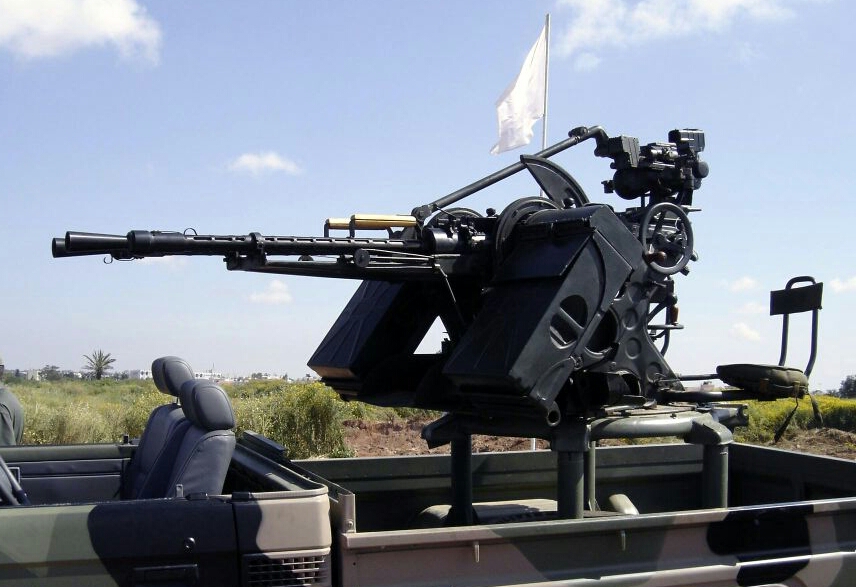
Quadruple-barreled (ZPU-4), double-barreled (ZPU-2 and ZU-2), and single-barreled (ZPU-1) versions of the weapon exist.
Precursor
[edit]The first dedicated Soviet mount for anti-aircraft machine guns was developed around 1928 by Fedor Tokarev and was adopted for service in 1931. It was a base for mounting up to four 7.62 mm PM M1910 (Russian Maxim) guns. This was also called a ZPU, although the name М-4 was also assigned to it. It served the Soviet armed forces in all major conflicts until 1945.[1] 12.7 mm DShK 1938 was used an anti-aircraft weapon it was mounted on pintle and tripod mounts, and on a triple mount on the GAZ-AA truck. Late in the war, it was mounted on the cupolas of IS-2 tanks and ISU-152 self-propelled guns. As an infantry heavy support weapon it used a two-wheeled trolley which unfolded into a tripod for anti-aircraft use.
Description
[edit]Development of the ZPU-2 and ZPU-4 began in 1945, with development of the ZPU-1 starting in 1947. All three were accepted into service in 1949. Improved optical predicting gunsights were developed for the system in the 1950s.
All weapons in the ZPU series have air-cooled quick-change barrels and can fire a variety of ammunition including API (B32), API (BS41), API-T (BZT) and I-T (ZP) projectiles. Each barrel has a maximum rate of fire of around 600 rounds per minute, though this is practically limited to about 150 rounds per minute.
The quad-barrel ZPU-4 uses a four-wheel carriage similar to that once used by the obsolete 25 mm automatic anti-aircraft gun M1940. In firing position, the weapon is lowered onto firing jacks. It can be brought in and out of action in about 15 to 20 seconds, and can be fired with the wheels in the traveling position if needed.
The double-barrel ZPU-2 was built in two different versions; the early model has large mud guards and two wheels that are removed in the firing position, and the late model has wheels that fold and are raised from the ground in the firing position.
ZPU-2 turned out to be too heavy for the airborne troops, so a new UZPU-2 (later redesignated as ZU-2) was developed from ZPU-1.
The single-barrel ZPU-1 is carried on a two-wheeled carriage and can be broken down into several 80-kilogram pieces for transport over rough ground.
Versions of the weapon are built in China, North Korea and Romania.
History
[edit]The series was used during the Korean War by Chinese and North Korean forces, and was later considered to be the most dangerous opposition to U.S. helicopters in Vietnam. Later it was used by Morocco and the Polisario Front in the Western Sahara War. It was also used by Iraqi forces during Operation Desert Storm and again in Operation Iraqi Freedom. In 1974 the Cyprus National Guard artillery batteries used their ZPU-2s against the Turkish air force. In the Russian military, it was replaced by the newer and more powerful ZU-23 23 mm twin automatic anti-aircraft gun.
During the Lebanese Civil War, the Lebanese militias mounted the ZPU-2 and ZPU-4 on various vehicles, such as M113 armored personnel carriers, to create self-propelled support vehicles.[2]

The ZPU has seen widespread use by both sides in the Libyan Civil War, Syrian Civil War, and Yemeni Civil War, being often mounted on technical pickup trucks.[3][4] The weapon is credited for bringing down several Syrian Air Force helicopters.[5]
In North Korea, ZPU systems have been modified to be able to be directed by a MR-104 "Drum Tilt", where the guns are shown to be fired without personnel manning them. [6] Several ZPU-4 weapons are suspected to have been used in public executions in the country in October 2014.
During the Donbas War, ZPUs were observed in use with Ukrainian and pro-Russian separatists forces.[7]
Czech company Excalibur Army developed the MR-2 Viktor mobile gun air defense system consisting of a ZPU-2 equipped with day/night sights mounted on a pickup truck chassis upgraded with a reinforced suspension and modified body. The Viktor was supplied to Ukraine in late 2022 during the Russian invasion of Ukraine to combat low-altitude aerial targets, particularly unmanned aerial vehicles.[8]
Ammunition
[edit]- API (BS.41): Full metal jacket bullet round with a tungsten carbide core. Projectile weight is 64.4 g (2.27 oz) and muzzle velocity is 1000 metres per second (3,281 ft/s). Armor-penetration at 500 m (550 yd) is 32 mm (1.3 in) of RHA at 90 degrees.[9]
- API-T (BZT): Full metal jacket round with a steel core. Projectile weight is 59.56 g (2.101 oz) and muzzle velocity is 1,005 m/s (3,297 ft/s). Tracer burns to at least 2,000 m (2,200 yd).
- I-T (ZP): "Instantaneous Incendiary" bullet with internal fuze, incendiary in tip, tracer container in base. Projectile weight is 60.0 g (2.12 oz).
Rounds are also produced by Bulgaria, China, Egypt, Poland, and Romania.
Variants
[edit].jpg)
- ZPU-4
- ZPU-2
- Type 58: Chinese-built version.[10]
- PKM-2: Polish-built version.
- ZU-2
- ZPU-1
- Type 75 and Type 75-1: Chinese built-versions.[10]
- BTR-40A SPAAG: A BTR-40 APC with a ZPU-2 gun mounted in the rear. Entered service in 1950.
- BTR-152A SPAAG: A BTR-152 with a ZPU-2 mounted in the rear. Entered service in 1952.
Specifications
[edit]| Model | ZPU-1 | ZPU-2 | ZU-2 | ZPU-4 |
|---|---|---|---|---|
| Barrels | 1 | 2 | 2 | 4 |
| Weight (travelling) | 413 kg (910 lb) |
994 kg (2,191 lb) |
649 kg (1,430 lb) |
1,810 kg (3,990 lb) |
| Weight (firing) | 413 kg (910 lb) |
639 kg (1,408 lb) |
621 kg (1,369 lb) |
1,810 kg (3,990 lb) |
| Length (travel) | 3.44 m (11 ft 3 in) |
3.54 m (11 ft 7 in) |
3.87 m (12 ft 8 in) |
4.53 m (14 ft 10 in) |
| Width (travel) | 1.62 m (5 ft 4 in) |
1.92 m (6 ft 4 in) |
1.37 m (4 ft 6 in) |
1.72 m (5 ft 8 in) |
| Height (travel) | 1.34 m (4 ft 5 in) |
1.83 m (6 ft 0 in)) |
1.1 m (3 ft 7 in) |
2.13 m (7 ft 0 in) |
| Elevation | +88 °/−8 ° | +90 °/−7 ° | +85 °/−15 ° | +90 °/−10 ° |
| Traverse | 360 ° | |||
| Maximum range | 8,000 m (8,750 yds) | |||
| Maximum altitude | 5,000 m (16,400 ft) | |||
| Effective altitude | 1,400 m (4,590 ft) | |||
| Ammunition (rounds) | 1,200 | 2,400 | 4,800 | |
| Crew | 4 | 5 | ||
Operators
[edit]

 Afghanistan[11]
 Albania - 336
 Algeria – 100 (40 ZPU-4 and 60 ZPU-2)[12]
 Angola[12]
 Bangladesh Type-56[13]
 Benin[14]
 Bulgaria[14]
 Burkina Faso[15]
 Burundi – 15[12]
 Cambodia
 Cameroon - 18[16]
 Cape Verde - 18[17]
 Chad[18]
 China[14]
 Congo-Brazzaville[19]
 Congo-Kinshasa - 12[20]
 Croatia
 Cuba[14]
 Cyprus
 Czechoslovakia[14]
 Djibouti
 East Germany − Used by the Combat Groups of the Working Class[21]
 East Timor
 Egypt[14]
 Ethiopia[14]
 Gabon[22]
 Ghana - 4+[23]
 Guinea[14]
 Guinea-Bissau[14]
 Hungary[14]
 Iran
Iran Iraq[14]
 Islamic State[24]
 Israel
 Kenya
Kenya Laos[14]
 Latvia – 2[12]
 Lebanon
 Libya[14]
 Madagascar – 50[25]
 Malawi – 40[12]
 Mali[14]
 Malta – 50[12]
 Mauritania – 12[12]
 Mongolia[14]
 Morocco – 19[12]
 Mozambique[14]
 Myanmar
 Namibia
 Nepal – 36[12]
 Nicaragua[14]
 North Korea[14]
 Pakistan[14]
 Panama[14]
- People's Defense Units (YPG): ZPU-4[26]
 Poland[14]
 Qatar – ZPU-2[27]
 Romania[14]
 Russia
 Sahrawi Republic – ZPU-2 and ZPU-4[28]
 São Tomé and Príncipe[14]
 Seychelles[14]
 Somalia[14]
 South Africa[29]
 Soviet Union[14]
 Sri Lanka
 Sudan[14]
 Syria[14]
 Tanzania – 21[12]
 Togo – 38[12]
 Transnistria
 Uganda[14]
 Ukraine[7]
 Vietnam[14]
 Yemen – ZPU-1, ZPU-2 and ZPU-4[30]
 Yugoslavia
 Zambia[14]
 Zimbabwe – 36[12]


Wars
[edit]
The ZPU served in several conflicts:
- Korean War
- Invasion of Panama
- Vietnam War
- Yom Kippur War
- Rhodesian Bush War
- Western Sahara War
- Angolan Civil War
- Cambodian Civil War
- Lebanese Civil War
- Soviet–Afghan War
- South African Border War
- Somali Civil War
- Gulf War
- Georgian Civil War
- South Lebanon conflict (1985–2000)
- First Chechen War
- Second Congo War[31]
- Second Chechen War
- War in Afghanistan (2001–2021)
- Iraq War (2003-2011)
- 2006 Lebanon War
- Russo-Georgian War
- First Libyan Civil War
- Sudanese conflict in South Kordofan and Blue Nile[32]
- Syrian Civil War
- Russo-Ukrainian War
- Second Libyan Civil War
- Yemeni Civil War (2014–present)
- Saudi Arabian-led intervention in Yemen
Gallery
[edit] |
 |
 |
See also
[edit]References
[edit]- ^ Семен Федосеев (2009). Пулеметы России. Шквальный огонь. Яуза / Коллекция / ЭКСМО. pp. 377–380. ISBN 978-5-699-31622-9.
- ^ Zaloga, Steven J. (2003). Tank battles of the Mid-East Wars (2): The wars of 1973 to the present. Hong Kong: Concord Publications. p. 7. ISBN 962-361-613-9.
- ^ "Rebels down Libyan aircraft as world leaders discuss next move". Arabian Business. 28 February 2011. Retrieved 6 May 2018.
- ^ Neville 2018, p. 34.
- ^ Neville, Leigh (19 Apr 2018). Technicals: Non-Standard Tactical Vehicles from the Great Toyota War to modern Special Forces. New Vanguard 257. Osprey Publishing. p. 10. ISBN 9781472822512.
- ^ Oryx. "A Visual Guide to North Korea's Fighting Vehicles". Oryx Blog. Retrieved 2020-12-20.
- ^ a b Ferguson & Jenzen-Jones 2014, p. 54.
- ^ Fiorenza, Nicholas (26 May 2023). "IDET 2023: Excalibur Army Viktor light air-defence vehicles supplied to Ukraine". Janes Information Services. Archived from the original on 28 May 2023.
- ^ "ZPU-4 14.5 mm quadruple guns anti-aircraft technical data sheet specifications information UK - Army Recognition - Army Recognition". Archived from the original on 2011-10-12. Retrieved 2011-10-10.
- ^ a b c d Gander, Terry J. (4 May 2001). "14.5 mm KPV heavy machine gun". Jane's Infantry Weapons 2002-2003. pp. 3732–3734.
- ^ Bhatia, Michael Vinai; Sedra, Mark (May 2008). Small Arms Survey (ed.). Afghanistan, Arms and Conflict: Armed Groups, Disarmament and Security in a Post-War Society. Routledge. p. 66. ISBN 978-0-415-45308-0. Archived from the original on 2018-09-01. Retrieved 2018-09-01.
- ^ a b c d e f g h i j k l Military Balance 2017
- ^ "TENDER NOTICE" (PDF). dgdp.gov.bd. Directorate General of Defence Purchase. Archived from the original (PDF) on 2 April 2023. Retrieved 2 March 2021.
- ^ a b c d e f g h i j k l m n o p q r s t u v w x y z aa ab ac ad ae Cullen & Foss 1992, p. 212.
- ^ Cherisey, Erwan de (July 2019). "El batallón de infantería "Badenya" de Burkina Faso en Mali - Noticias Defensa En abierto". Revista Defensa (in Spanish) (495–496).
- ^ The Military Balance 2021, p. 454.
- ^ The Military Balance 2021, p. 455.
- ^ The Military Balance 2021, p. 457.
- ^ The Military Balance 2021, p. 458.
- ^ The Military Balance 2021, p. 461.
- ^ "PKM-2 Polish 14.5mm Towed Anti-Aircraft Gun". ODIN - OE Data Integration Network. Retrieved 26 November 2023.
- ^ The Military Balance 2021, p. 467.
- ^ The Military Balance 2021, p. 469.
- ^ "Syrie: l'EI inflige un revers aux FDS dans l'est, mais reste acculé". France Soir (in French). 25 October 2018. Archived from the original on 25 October 2018. Retrieved 4 March 2019.
- ^ The Military Balance 2021, p. 473.
- ^ Mitzer, Stijn; Oliemans, Joost (29 October 2021). "Kurdish Armour: Inventorising YPG Equipment In Northern Syria". Oryx Blog.
- ^ Mitzer, Stijn; Oliemans, Joost (6 March 2021). "Qatar's Purchase of BP-12A SRBMs: A Guppy Sprouts Teeth". Oryx Blog.
- ^ Cooper, Tom; Grandolini, Albert; Fontanellaz, Adrien (2019). Showdown in Western Sahara, Volume 2: Air Warfare Over the Last African Colony, 1975-1991. Warwick, UK: Helion & Company Publishing. p. 43. ISBN 978-1-912866-29-8.
- ^ Jones, Richard D.; Ness, Leland S., eds. (January 27, 2009). Jane's Infantry Weapons 2009/2010 (35th ed.). Coulsdon: Jane's Information Group. ISBN 978-0-7106-2869-5.
- ^ Mitzer, Stijn; Oliemans, Joost (20 September 2015). "The Oryx Handbook of Pre-war Yemeni Fighting Vehicles". Oryx.
- ^ Cooper, Tom (2013). Great Lakes Conflagration: Second Congo War, 1998–2003. UK: Helion & Company Limited. p. 39. ISBN 978-1-920143-84-8.
- ^ "SPLA-N weapons and equipment, South Kordofan, December 2012" (PDF). HSBA Arms and Ammunition Tracing Desk. Small Arms Survey: 8. February 2013. Archived (PDF) from the original on 2016-03-22. Retrieved 2019-01-02.
- Jane's Land Based Air Defence 2005–2006. ISBN 0-7106-2697-5.
- Koll, Christian (2009). Soviet Cannon: A Comprehensive Study of Soviet Arms and Ammunition in Calibres 12.7mm to 57mm. Austria: Koll. p. 98. ISBN 978-3-200-01445-9. Archived from the original on 2009-10-19. Retrieved 2009-11-21.
- International Institute for Strategic Studies (February 2021). The Military Balance 2021. Vol. 121. Routledge. ISBN 9781032012278.
- Ferguson, Jonathan; Jenzen-Jones, N.R. (November 2014). Raising Red Flags: An Examination of Arms & Munitions in the Ongoing Conflict in Ukraine, 2014 (PDF) (Report). Australia: Armament Research Services (ARES). ISBN 978-0-9924624-3-7. Archived from the original (PDF) on 2023-04-04. Retrieved 17 June 2023.
- Cullen, Tony; Foss, Christopher F., eds. (1992). Jane's land-based air defence: 1992-93. Jane's Information Group. ISBN 978-0-7106-0979-3. Retrieved 26 November 2023.
External links
[edit]
- ZPU-1 single barrel anti-aircraft gun data sheet Archived 2011-10-12 at the Wayback Machine
- ZPU-2 anti-aircraft 14.5 mm twin guns data sheet Archived 2011-10-12 at the Wayback Machine
- http://en.rcamuseum.com/our-collection/zpu-4-anti-aircraft-gun-14-yugo
- ZPU-4 anti-aircraft 14.5 mm quadruple guns data sheet Archived 2011-10-12 at the Wayback Machine
- Video: ZPU-1 (single-barreled 14.5) being fired in Afghanistan
- Video: ZPU-2 (14.5) being fired in Syria from a technical
Development
Precursors and Influences
The ZPU anti-aircraft gun series emerged from Soviet efforts to address limitations in World War II-era light anti-aircraft systems, particularly against low-altitude threats posed by dive bombers and ground-attack aircraft. Guns such as the 37 mm automatic air defense gun M1939 (61-K), which entered service in 1939 and fired at a rate of 160-170 rounds per minute per barrel, were effective for medium-altitude engagements but required larger crews and more complex logistics, making them less ideal for widespread deployment in forward motorized units facing fast, low-flying attackers. Post-war assessments emphasized the need for lighter, higher-volume fire solutions to supplement these systems, favoring adaptations of heavy machine guns for rapid setup and minimal maintenance in divisional defenses.[4] A key technological influence was the KPV 14.5×114 mm heavy machine gun, developed by Semyon Vladimirov starting in 1944 to surpass the capabilities of the 12.7 mm DShK in penetration and velocity for both anti-tank and anti-air roles. With a muzzle velocity of 1,005 m/s and effective range exceeding 1,000 meters against air targets, the KPV's robust design and powerful cartridge enabled its mounting in towed configurations, providing the firepower foundation for the ZPU without the need for dedicated autocannon development. This adaptation leveraged the gun's wartime origins, where high-velocity rounds proved capable of damaging lightly armored aircraft and penetrating fuselage structures at low altitudes.[5] Doctrinally, the ZPU reflected a post-1945 Soviet shift toward mass-produced, towed anti-aircraft systems optimized for motorized infantry divisions, prioritizing affordability and quick deployment over sophisticated fire control amid anticipated large-scale mechanized warfare. This approach built on wartime lessons of integrating AA assets directly into advancing formations, using truck-towed mounts that small crews could emplace in minutes to create dense curtains of fire against tactical aviation, contrasting with heavier artillery-focused defenses. Such systems were intended to equip vast armies economically, aligning with broader Red Army reorganization for offensive operations in Europe.[4][6]Design Process and Adoption
The ZPU family originated in the Soviet Union during the mid-1940s as a response to the need for lightweight, towed anti-aircraft systems capable of engaging low-flying aircraft in the emerging Cold War environment. Development of the twin-barrel ZPU-2 commenced in 1944 to fulfill requirements issued by the Main Artillery Directorate (GAU) for enhanced volume of fire against anticipated NATO aerial threats.[5] Prototypes for single-barrel (ZPU-1), twin-barrel (ZPU-2), and quadruple-barrel (ZPU-4) configurations were engineered around the 14.5×114mm KPV heavy machine gun, emphasizing simplicity and mobility over complex automation.[1] Key engineering decisions prioritized a towed cruciform mount with pneumatic tires for rapid deployment and stability during firing, supporting manual traverse and elevation mechanisms integrated with basic optical sights for targeting. Each KPV barrel achieved a cyclic rate of approximately 600 rounds per minute, validated through empirical testing that confirmed reliable sustained fire without excessive overheating in short bursts. The design avoided powered traversal to reduce mechanical complexity and maintenance demands, aligning with Soviet doctrine for mass-producible divisional air defense. The ZPU series entered Soviet military service in 1949 following successful trials that demonstrated superior firepower density compared to preceding 12.7mm systems.[1] Initial production occurred at state arsenals, enabling rapid integration into motorized rifle and air defense units for standardization across Warsaw Pact forces, where its low cost and ease of training facilitated widespread export adoption.Technical Design
Core Components and Operation
The ZPU series employs a towed carriage optimized for mobility and quick setup, with the ZPU-2 variant featuring a two-wheeled design weighing approximately 994 kg in travel configuration.[7] This lightweight construction enables towing by light vehicles at road speeds of 40–50 km/h, facilitating rapid repositioning in fluid combat environments.[8] In firing position, stabilizing outriggers or spades are deployed to counter the recoil from the 14.5 mm KPV heavy machine guns, ensuring accurate sustained fire across 360-degree azimuth and elevations up to 90 degrees.[6] Operationally, the ZPU-2 requires a crew of 2 to 5 personnel, including a gunner who utilizes an optical anti-aircraft sight with integrated lead computation for targeting low-flying aircraft, a loader who manually inserts 40–50 round belts into the belt-fed mechanism, and optionally a commander for oversight and additional ammunition handlers.[9] [10] The mechanical trigger system, operable via hand crank or foot pedal in some configurations, allows continuous fire until belt depletion, with simple manual reloading minimizing complexity.[9] The design's simplicity enhances reliability through air-cooled barrels with quick-change capability to prevent overheating, absence of electronic components vulnerable to failure, and robust construction tolerant of environmental stressors such as dust, sand, and extreme cold, which maintain high operational uptime in austere field conditions without specialized maintenance.[8] [11] This causal emphasis on mechanical durability over sophistication reduces logistical demands, enabling sustained deployment by minimally trained crews in diverse terrains.[6]Armament and Ammunition
The ZPU anti-aircraft mount integrates the KPV heavy machine gun, chambered for the 14.5×114mm cartridge, which provides high-velocity projectiles suited for engaging low-flying aircraft.[5] The KPV operates on a gas-assisted short-recoil mechanism with an air-cooled barrel, enabling a cyclic rate of 550–600 rounds per minute while maintaining reliability in sustained bursts against aerial threats.[12] Muzzle velocity reaches approximately 1,000 m/s for standard armor-piercing incendiary (API) rounds, delivering kinetic energy exceeding 30,000 joules per projectile to penetrate light armor and ignite volatile targets like fuel tanks. Primary ammunition includes the B-32 API round, featuring a hardened steel core for armor penetration followed by incendiary effects upon impact, and the BZT API-tracer variant, which adds a tracer element visible to at least 2 km for ballistic correction during anti-aircraft fire.[13] These rounds, weighing around 60–64 grams, prioritize dual-purpose capability: piercing thin aircraft skin (up to 40 mm at 100 m) and initiating fires via chemical incendiary compounds, enhancing lethality against soft-skinned or lightly protected low-altitude targets.[14] Effective engagement range against air targets extends to 1.5 km, with maximum theoretical reach up to 2 km vertically, though practical accuracy diminishes beyond 1.4 km due to projectile drop and lead requirements for moving aircraft.[13] Ammunition feeds via non-disintegrating metal links in 50- or 150-round belts, coiled into boxes for rapid reloading, supporting burst firing patterns of 5–10 seconds to conserve barrels and mitigate overheating.[12] Logistically, the 14.5×114mm's rimless case facilitates high-volume production and storage, with Soviet-era resupply emphasizing truck-portable crates holding thousands of rounds, enabling mobile units to sustain defensive screens without heavy artillery dependence. However, prolonged firing risks ammunition cook-off from barrel temperatures exceeding 600°C, necessitating quick-change barrels and intermittent cooling pauses to prevent catastrophic failure in high-threat scenarios.[5] This vulnerability underscores the system's reliance on crew discipline for anti-air efficacy, contrasting with water-cooled alternatives but aligning with its lightweight, deployable design.Variants
The ZPU series comprises three main towed anti-aircraft variants distinguished by the number of 14.5 mm KPV heavy machine guns mounted: the single-barrel ZPU-1, the twin-barrel ZPU-2, and the quadruple-barrel ZPU-4, with differences primarily in firepower volume, system weight, crew requirements, and resulting deployment suitability.[6][1] All variants employ recoil-operated guns with a cyclic rate of approximately 600 rounds per minute per barrel, enabling scaled aggregate output from 600 rpm for the ZPU-1 to 2,400 rpm for the ZPU-4, though practical sustained rates are lower due to ammunition and barrel heating constraints.[15][16] The ZPU-1, introduced in 1949, mounts one gun on a lightweight two-wheeled carriage weighing about 410 kg, operated by a crew of four, which prioritizes portability for niche applications like point defense by forward observation units where minimal setup and manpower are essential, though its singular firepower limits effectiveness against grouped targets.[17][18][19] In contrast, the ZPU-2, also adopted in 1949, integrates two guns on a carriage of roughly 900–1,000 kg, served by a five-person crew, striking a balance that supports standard divisional air defense with doubled firepower for engaging low-flying formations through increased volume of fire, while retaining reasonable towed mobility on two wheels.[20][8][21] The ZPU-4, fielded from 1949 onward, features four guns on a heavier four-wheeled platform at approximately 1,800–2,100 kg combat weight, typically manned by five crew, optimized for high-density threat environments requiring maximum saturation fire but at the cost of greater logistical demands and reduced tactical mobility compared to lighter siblings.[1][22][23]Specifications
Performance Metrics
The ZPU anti-aircraft gun system's effective vertical range against aerial targets is 1,400 meters, with maximum vertical reach extending to 8,000 meters under ideal conditions, though practical engagement is constrained by tracer visibility and projectile ballistics.[10][6] Horizontal range for ground targets reaches up to 8,000 meters, but effective detection and aiming with incendiary tracers typically limits practical use to approximately 2,000 meters in daylight conditions.[6][16] Each 14.5 mm KPV barrel in the ZPU mount delivers a cyclic rate of fire of 600 rounds per minute, enabling high-volume bursts for short-range air defense, but sustained firing is restricted to practical rates of 150 rounds per minute per barrel to mitigate barrel overheating and wear.[16] Deployment from towed transport to firing position requires minimal crew effort, typically achievable in under five minutes for a two- or four-barrel configuration, facilitating rapid response in mobile operations.[24] The system's 14.5×114 mm API (B-32) ammunition penetrates 32 mm of rolled homogeneous armor at 500 meters and 90-degree obliquity, diminishing to lower values at extended slant ranges beyond 1,000 meters due to velocity loss.[25][26] Towed by standard light trucks or jeeps, the ZPU demonstrates robust field durability, with the KPV mechanism designed for operation across extreme climates inherent to Soviet military equipment, though specific mean time between failures exceeds thousands of rounds based on operational testing data.[5]Comparative Analysis
The ZPU-4's use of four 14.5×114 mm KPV heavy machine guns provides greater penetration against light armor and low-flying aircraft compared to the U.S. M55 quad mount's four 12.7×99 mm M2 Browning machine guns, owing to the heavier projectile mass and higher muzzle velocity of approximately 1,000 m/s versus 890 m/s.[22][27] This caliber advantage stems from the KPV's design for anti-materiel roles, enabling effective engagement of thinly protected vehicles or rotor blades at ranges up to 1.4 km effective against air targets, though the ZPU's manual traverse and elevation—lacking the M55's optional powered assists in some configurations—increases vulnerability to fast-moving threats requiring quick repositioning.[28][27] In contrast to the Bofors 40 mm L/60 autocannon, which delivers 120-140 rounds per minute with larger high-explosive shells suited for higher-altitude intercepts up to several kilometers, the ZPU-4 emphasizes volume of fire—up to 600 rounds per minute cyclic per barrel, practically sustained at 150—for saturating low-level trajectories like helicopters or drones, trading altitude reach for density in asymmetric engagements where threats operate below 1 km.[29] The ZPU's reliance on belt-fed heavy machine guns rather than complex recoil-operated mechanisms reduces mechanical failure rates and maintenance complexity, minimizing downtime in austere conditions compared to the Bofors' need for hydraulic or pneumatic servicing, thereby lowering overall logistical vulnerability in prolonged, supply-scarce operations.[28] The ZPU's modular, low-tech construction—adaptable to truck beds or static mounts with minimal training—enhanced its proliferation in contested environments, as demonstrated by North Vietnamese Army integration against U.S. helicopters during the 1960s-1970s and subsequent capture by Afghan mujahideen from Soviet withdrawals in the 1980s, followed by Taliban reuse of Afghan National Army stocks post-2001, where ease of operation by minimally equipped forces amplified turnover rates upon territorial shifts.[28][30] This contrasts with Western systems' higher complexity, which often deterred effective enemy appropriation due to specialized parts and doctrine requirements.Operational History
Early Deployments and Testing
The ZPU series was formally adopted by the Soviet armed forces in 1949 after completion of developmental and field trials that assessed its suitability for towed anti-aircraft roles.[1] These early tests focused on integration of the 14.5 mm KPV heavy machine guns into twin, quad, and single mount configurations, verifying mechanical reliability and fire control under simulated low-altitude threat scenarios typical of post-World War II tactical aviation.[8] Initial operational deployments began during the Korean War from 1950 to 1953, with North Korean and Chinese forces employing ZPU-2 and ZPU-4 variants to counter United Nations ground-attack aircraft conducting close air support missions.[1] This marked the system's combat debut, where batteries were positioned to engage low-flying sorties in support of infantry and armored advances, though the towed carriage design demonstrated vulnerabilities to rapid repositioning demands in Korea's rugged, mountainous terrain. Combat experience prompted tactical refinements, including the adoption of more dispersed battery layouts to minimize losses from UN counter-battery fire and enhance survivability against suppressive strikes.[8]Major Conflicts (1940s–1990s)
The ZPU family of anti-aircraft guns received its combat debut during the Korean War (1950–1953), operated by Chinese People's Volunteer Army and North Korean forces primarily against low-altitude United Nations fixed-wing aircraft and early helicopter operations. The ZPU-4 variant, with its quad 14.5 mm configuration, provided mobile volume fire capable of engaging targets at effective ranges up to 1,400 meters in altitude, though specific verified kill tallies remain limited in declassified records due to the dominance of heavier anti-aircraft artillery like the 37 mm M1939 in North Korean defenses.[1][31] North Vietnamese Army and Viet Cong units integrated ZPUs into layered air defenses during the Vietnam War (1955–1975), concealing single- and twin-barrel mounts amid dense jungle foliage to ambush U.S. helicopters conducting troop insertions, medevacs, and close air support. This tactical adaptation exploited the weapon's high rate of fire—up to 600 rounds per minute per barrel—and portability, contributing to the overall attrition of American rotary-wing assets, of which over 5,600 were lost in theater from various ground fire sources including heavy machine guns. However, ZPUs proved less effective against faster fixed-wing jets, and U.S. countermeasures like napalm strikes and improved low-level flying tactics mitigated their impact over time.[32] Egyptian and Syrian forces deployed ZPU batteries as point defenses during the 1967 Six-Day War and 1973 Yom Kippur War, integrating them with S-75 SAM systems to contest Israeli Air Force dominance over the Sinai and Golan Heights. In 1973, these light AA guns provided initial low-altitude coverage against Israeli helicopter assaults and close support aircraft, forcing tactical adjustments in Israeli operations, but suffered high losses to specialized suppression of enemy air defenses (SEAD) missions using AGM-45 Shrike missiles and cluster munitions. Their vulnerability stemmed from limited radar integration and exposure during daylit engagements, underscoring the shift toward integrated air defense networks in Arab doctrine.[33] Captured ZPUs became staples for Afghan Mujahideen during the Soviet-Afghan War (1979–1989), repurposed from Soviet-supplied stocks to target Mi-24 Hind helicopters and low-flying transports in mountainous terrain. Mujahideen groups mounted ZPU-1 and ZPU-2 variants on high ground for ambush fire, achieving localized successes against rotorcraft operating below 2,000 meters, which compounded Soviet aviation losses exceeding 300 helicopters and extended the conflict by denying uncontested air mobility. This irregular adaptation highlighted the ZPU's simplicity and logistical ease for non-state actors, contrasting with Soviet reliance on more complex systems.Post-Cold War and Modern Use
In the Syrian Civil War commencing in 2011, opposition groups such as Harakat Hazm employed ZPU-2 anti-aircraft guns alongside other heavy machine guns for defense against Syrian government fixed-wing aircraft and helicopters, as well as in ground support roles. These systems were integrated into rebel arsenals, often mounted on improvised vehicles to enhance mobility. [34] Insurgents in Iraq following the 2003 U.S.-led invasion repurposed captured ZPU variants from former Iraqi military stocks for ambushes on coalition convoys and sporadic anti-aircraft fire against helicopters. The weapons' availability from pre-invasion depots contributed to their adoption by Sunni militant groups during the insurgency phase through the late 2000s. [35] In Afghanistan, Taliban fighters utilized ZPU-series guns acquired from captured Soviet-era stockpiles to engage U.S. and NATO low-altitude helicopters and occasional drone incursions, particularly in rugged terrain where man-portable systems proved insufficient. This employment persisted into the 2010s, underscoring the ZPU's adaptability in asymmetric warfare against aerial threats. [36] During the Russian invasion of Ukraine starting February 2022, both belligerents relied on ZPU guns for countering low-flying unmanned aerial vehicles (UAVs). Ukrainian forces, facing intensified Russian drone reconnaissance and strikes, deployed ZPU-2 in mobile air defense units; on July 17, 2025, troops from the 115th Separate Mechanized Brigade fired the system at incoming drones in Kharkiv Oblast. Modernized variants, such as the Czech Viktor MR-2 derived from the ZPU-2 platform, have also proven effective against Shahed-type loitering munitions, with reports of successful intercepts in rear areas. [37] [38]Operators and Proliferation
State Operators
The ZPU series entered service with the Soviet Union in 1949 and proliferated widely among Warsaw Pact members and allied states, reaching over 50 operators globally through exports primarily during the Cold War.[1] Original recipients included the USSR, Poland, Bulgaria, Czechoslovakia, East Germany, Hungary, Romania, and Albania, where the systems served as standard low-level air defense assets until replacement by more advanced towed guns like the ZU-23 in the 1960s–1970s.[6] Post-dissolution of the Warsaw Pact in 1991, surplus units from Poland and unified Germany were exported to secondary markets, contributing to further dissemination.[8] In Russia, successor to the Soviet armed forces, the ZPU was phased out of active frontline roles by the late 20th century but persists in storage depots as reserve equipment, with open-source estimates indicating limited quantities available for mobilization or transfer.[6] Asian operators acquired ZPU variants through Soviet aid in the 1950s–1970s; North Korea maintains ZPU-4 units in operational service as of the 2010s, often in static or towed configurations for territorial defense.[1] Vietnam, having received deliveries during the Vietnam War era, has upgraded select ZPU-2 systems with vehicle mounts for enhanced mobility, retaining small active inventories alongside modern air defenses.[8] Middle Eastern and African states, including Syria, Algeria, and Angola, integrated ZPU guns via Soviet military assistance packages in the mid-20th century, with current open-source intelligence suggesting reserve holdings for territorial or convoy protection roles despite high attrition from prolonged conflicts.[39] Syria's forces, for instance, employ ZPU-2 and ZPU-4 in layered air defense networks, though exact numbers remain classified and subject to losses in ongoing operations.[39] Overall proliferation reflects the system's low cost and simplicity, enabling sustained use in resource-constrained militaries, though comprehensive global inventory figures are unavailable due to opaque reporting in many operator states.[1]Non-State and Irregular Use
Non-state actors have extensively utilized the ZPU series, often capturing systems from state forces during conflicts and adapting them for irregular warfare. In Afghanistan, mujahideen fighters employed ZPU-1 guns at checkpoints during the Soviet-Afghan War (1979–1989), demonstrating early non-state adaptation of the weapon for defensive and anti-aircraft roles.[40] These systems, left behind after the Soviet withdrawal, were later incorporated into Taliban arsenals, enabling rapid deployment against low-flying aircraft with crews requiring only basic training.[41] The ZPU's operational simplicity—allowing setup and firing in 15–20 seconds, even from wheeled positions—contrasts with more complex man-portable air-defense systems, which necessitate weeks of specialized instruction for effective use.[10] This low training threshold has driven proliferation among insurgents, as groups like Libyan rebels during the 2011 civil war mounted ZPU-2 and ZPU-4 variants on civilian pickup trucks to create mobile "technicals" for both anti-aircraft fire and suppressive ground support.[42] Similar modifications appeared in Somalia, where clan militias and Islamist groups enhanced vehicle mobility to counter government and African Union forces, bypassing the need for static emplacements.[43] Such adaptations challenge state monopolies on force by enabling non-state entities to contest air superiority at low cost, as captured stockpiles from collapsed regimes provide ready access without reliance on sophisticated supply chains. In Libya and Yemen, ZPU-equipped technicals proliferated amid civil strife, allowing irregulars to engage helicopters and fixed-wing assets, thereby complicating aerial operations in contested zones.[44] Dual-use capability against ground targets further extends their utility, turning anti-aircraft guns into versatile platforms for hit-and-run tactics in asymmetric conflicts.Effectiveness and Evaluation
Tactical Strengths
The ZPU series, particularly the ZPU-4 variant with its quadruple 14.5 mm KPV heavy machine guns, delivers a cyclic rate of fire up to 2,400 rounds per minute, allowing for intense suppressive barrages that saturate low-altitude flight paths and deny access to helicopters and fixed-wing aircraft operating below 1,400 meters effective range.[24] This high-volume fire creates a dense cone of projectiles, increasing probabilistic hits against maneuvering targets in visual range, as demonstrated by its deployment against low-flying assets where optical sights enable rapid engagement without reliance on complex targeting systems.[22] In combat environments like the Vietnam War, ZPU deployments proved causally effective in contesting low-altitude air operations, serving as a primary threat to U.S. helicopters by forcing evasive maneuvers or altitude gains that compromised mission efficacy.[45] North Vietnamese forces integrated ZPUs into layered defenses, where the guns' ability to deliver sustained bursts from mobile or static positions disrupted close air support and troop insertions, contributing to the overall vulnerability of rotorcraft in dense terrain.[46] The system's mechanical simplicity confers inherent resilience to electronic countermeasures, including radar jamming and electromagnetic pulses, as it operates without electronic fire control or guidance, depending instead on manual aiming and basic optics unaffected by such disruptions. This low-tech design ensures operational continuity in electronically contested environments where missile-based systems may fail due to spoofing or overload. Cost-wise, ZPUs represent a fraction of guided missile alternatives—estimated in the low tens of thousands per unit against millions for SAM launchers—enabling mass proliferation for area denial without prohibitive fiscal strain.[47] Psychologically, the ZPU's audible and visible firing signature compels pilots to avoid predictable low-level routes, elevating flight profiles and thereby degrading ground attack precision by exposing aircraft to higher-altitude winds, reduced visibility, and integration with upper-tier threats; this deterrent effect amplifies tactical denial beyond direct kills.[28]Operational Limitations
The ZPU's effective anti-aircraft range is limited to approximately 1.4 kilometers against low-flying targets, with practical engagement altitudes under 1,500 meters, making it largely ineffective against fast-moving jets operating at higher speeds or altitudes beyond this envelope due to ballistic dispersion and projectile velocity decay.[10][6] Reliance on manual optical sighting without radar guidance further hampers accuracy against supersonic aircraft, as operators struggle to track and lead targets exceeding 1,000 km/h, exposing emplacements to unhindered suppression of enemy air defenses (SEAD) via standoff munitions or reconnaissance-directed strikes once positions are visually acquired.[46] As a towed system, the ZPU requires a separate vehicle for relocation, with emplacement and displacement achievable in 15-20 seconds but still permitting enemy artillery or air strikes to target static firing positions during prolonged engagements, particularly in open terrain where smoke or firing signatures reveal locations.[10] The open-mount design offers no crew armor, leaving operators fully exposed to small-arms fire, shrapnel, or strafing runs, which increases casualties in contested environments lacking natural cover.[48] Sustained firing is constrained by mechanical vulnerabilities, including belt-feed jams exacerbated by dust or dirt ingress in field conditions, as observed in comparable Soviet heavy machine gun systems.[49] Barrel wear limits the KPV's service life to around 10,000 rounds under optimal conditions, accelerating erosion from high-velocity 14.5×114mm ammunition and necessitating frequent maintenance or replacement in intensive use, rendering the ZPU less reliable against persistent low-altitude threats like modern drones or man-portable air-defense systems (MANPADS) that outrange and guide autonomously to evade optical prediction.[5][50]Strategic Impact and Legacy
The deployment of ZPU systems in conflicts such as the Vietnam War demonstrated their capacity to erode technological air superiority through low-cost, dispersed anti-aircraft fire, compelling U.S. forces to adapt tactics and sustain higher operational costs. North Vietnamese forces employed ZPU-2 and ZPU-4 units extensively against low-flying helicopters, accounting for a significant portion of U.S. fixed-wing and rotary-wing losses; by 1968, these weapons were credited with downing numerous UH-1 Hueys and other assets, forcing pilots to adopt terrain-masking "nap-of-the-earth" flights and reducing mission efficiency.[46][1] This asymmetric denial prolonged ground engagements, contributing to escalated U.S. expenditures on air operations exceeding $100 billion by war's end, as interveners faced sustained attrition without decisive aerial dominance.[10] Similar dynamics emerged in the Soviet-Afghan War, where ZPU-equipped mujahideen contested helicopter insertions, prompting Soviet doctrinal reliance on massed Mi-24 Hind escorts and elevated flight profiles that diminished close air support efficacy. The proliferation of ZPU variants to irregular forces underscored a shift toward volume-of-fire defenses, influencing post-Cold War exports of analogous man-portable systems to proxy allies, thereby embedding low-tech air denial in hybrid warfare strategies.[51] U.S. responses included retrofitting UH-1 helicopters with ceramic armor plating by 1970 to withstand 14.5mm impacts, alongside formalized SEAD protocols that prioritized radar-guided suppression over direct assaults.[52][53] In legacy terms, the ZPU's empirical success validated first-mover advantages in asymmetric air contestation, shaping doctrines that prioritize resilient, distributed defenses over high-end interceptors; its widespread adoption—evident in over 50 nations' inventories by the 1990s—facilitated persistent low-intensity threats, as seen in prolonged insurgencies where air assets incurred cumulative losses without eradicating ground resistance.[10] By 2025, analogous heavy machine gun arrays continue countering low-altitude unmanned threats in peer-adjacent conflicts, affirming utility for territorial defense against aggression rather than offensive overmatch, despite calls for restrictions that overlook verified deterrence effects.[54]References
- https://handwiki.org/wiki/Engineering:ZPU