Hubbry Logo
Zero MostelZero MostelMain
Open search
Zero Mostel
Community hub
Zero Mostel
logo
8 pages, 0 posts
0 subscribers
Be the first to start a discussion here.
Zero Mostel
Zero Mostel
from Wikipedia

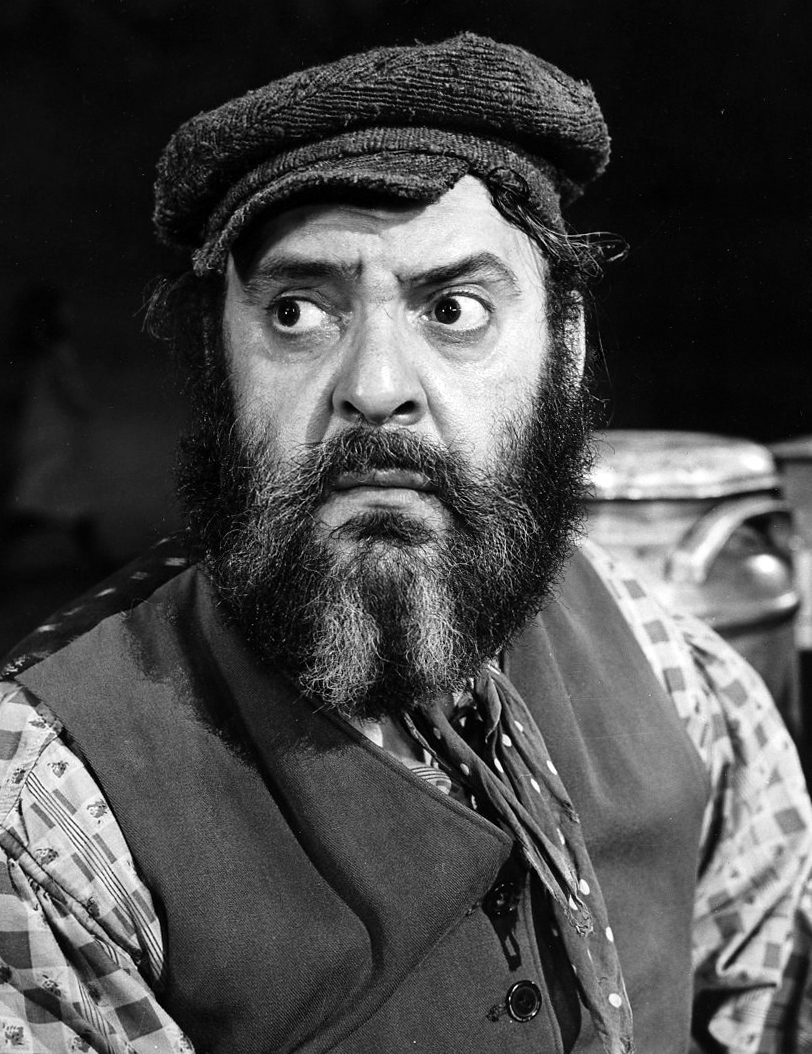
Samuel Joel "Zero" Mostel (February 28, 1915 – September 8, 1977) was an American actor, comedian, and singer. Mostel received several accolades including three Tony Awards and a Drama Desk Award as well as nominations for a British Academy Film Award and a Golden Globe Award. He is also a member of the American Theater Hall of Fame, inducted posthumously in 1979.[1]

Key Information

He is best known for his portrayal of comic characters including Tevye on stage in Fiddler on the Roof, Pseudolus on stage and on screen in A Funny Thing Happened on the Way to the Forum, and Max Bialystock in the original film version of Mel Brooks' The Producers (1967). Mostel was a student of Don Richardson and he used an acting technique based on muscle memory.[2][3][4]

Mostel was blacklisted during the 1950s; his testimony before the House Un-American Activities Committee was well publicized. Mostel later starred in the Hollywood Blacklist drama film The Front (1976) alongside Woody Allen, for which Mostel was nominated for the British Academy Film Award for Best Supporting Actor. His final roles included as a guest star on The Muppet Show and as a voice in Watership Down (1978).

Early life and education

[edit]

Mostel was born in Brooklyn, New York, to Israel Mostel and Tzina Druchs (also spelled Cina, known as Celia), both Ashkenazi Jewish immigrants from Galicia. His father was born in Dziewiętniki [uk],[5][6] then in Austria-Hungary, later in Poland, and now in Lviv Oblast, Ukraine.[7][8] He emigrated to the United States in 1898 with his first wife, Esther Wirklich Mostel, and young daughter, Celia. They would have three more children – Hyman, Sarah (Sadie), and Benjamin – before her death in 1908.[9] His mother, Tzina, grew up in Vienna, Austria, and immigrated in 1906.[5] Israel had five more children with Tzina: Morris, Milton, Aaron, Samuel (later known as Zero), and William.[8]

As a child, he earned the nickname "Zero" from his classmates to match his poor grades.[10] He kept the moniker when he went into show business, though his mother hated it.[11] Initially living in the Brownsville section of Brooklyn, the family moved to Moodus, Connecticut, where they bought a farm. The family's income in those days came from a winery and a slaughterhouse. The farm failed, and the family moved back to New York, where his father obtained work as a wine chemist. Zero was described by his family as outgoing and lively, and with a developed sense of humor. He showed an intelligence and perception which convinced his father he had the makings of a rabbi,[12] but Zero preferred painting and drawing, a passion he retained for life.

According to Roger Butterfield, Zero's mother sent him to the Metropolitan Museum of Art to copy paintings while dressed in a velvet suit. Zero had a favorite painting, John White Alexander's Study in Black and Green, which he copied every day, to the delight of the gallery crowds. One afternoon, while a crowd was watching over his velvet-clad shoulder, he solemnly copied the whole painting upside down, delighting his audience.[12] In addition to English, Zero Mostel spoke Yiddish, Italian, and German.[citation needed] He attended Public School 188, where he was an A student.[citation needed] He also received professional training as a painter through The Educational Alliance. He completed his high school education at Seward Park High School,[13] where his yearbook noted: "A future Rembrandt…or perhaps a comedian?".[citation needed] He attended the City College of New York, a public college that allowed many poor students to pursue higher education. He later claimed that he was on the swimming team and the Reserve Officers Training Corps, though the claim is dubious.[14] As only beginner classes were available in art, Mostel took them repeatedly to be able to paint and receive professional feedback.[13] During the time he worked odd jobs. He graduated in 1935 with a bachelor's degree. He then continued studying towards a master's degree at New York University before leaving after a year to find work.[13] He then joined the Public Works of Art Project (PWAP), which paid him a stipend to teach art.[citation needed]

Career

[edit]

1941–1949: Early comic routines

[edit]
Mostel as Leopold Bloom in Ulysses in Nighttown in 1958

Part of Mostel's duty with the Public Works of Art Project (PWAP) was to give gallery talks at New York's museums.[citation needed] In 1941, the Café Society, a downtown Manhattan nightclub, hired Mostel as a professional comedian to play regularly there, where he adopted the stage name Zero.[citation needed] Mostel's rise professionally was rapid. In 1942, his salary at the Café Society went up from $40 a week to $450; he appeared on radio shows, opened in two Broadway shows (Keep Them Laughing, Top-Notchers), played at the Paramount Theatre, appeared in an MGM movie (Du Barry Was a Lady), and booked into La Martinique at $4,000 a week. He also made cameo appearances at the Yiddish theatre, which influenced his performance style. In 1943 Life magazine described him as "just about the funniest American now living".[15] In March 1943, Mostel was drafted by the US Army. Although he gave varying accounts of his Army service, records show he was honorably discharged in August 1943 because of an unspecified physical disability. He entertained servicemen giving USO performances until 1945.[16]

Mostel married Kathryn (Kate) Cecilia Harkin, an actress and dancer, on July 2, 1944, after two years of courtship. The pair met at Radio City Music Hall where she was a Rockette.[17] The marriage caused problems in his relationship with his Orthodox Jewish parents: his new wife was not Jewish. His mother never met Kate or her grandsons.[18]: 89  The marriage had problems at times, again mostly due to Mostel's spending most of his time in his art studio. Their relationship was described by friends of the family as complicated, with many fights but having mutual adoration. The couple stayed together until Mostel's death; they had two children, film actor Josh Mostel in 1946 and Tobias in 1948. After Zero's discharge from the Army, his career resumed. He appeared in a series of plays, musicals, operas, and movies. In 1946 he even made an attempt at serious operatic acting in The Beggar's Opera, but received lukewarm reviews. He sang the title role in a short film of Puccini's comic opera Gianni Schicchi. Critics saw him as a versatile performer.

Zero Mostel made notable appearances on New York City television in the late 1940s. He had his own show in 1948 called Off The Record on WABD with comedian partner Joey Faye. Simultaneously, Mostel had a live TV show on WPIX, Channel Zero. He also appeared in the May 11, 1949 Toast of the Town broadcast hosted by Ed Sullivan.

1950–1956: Blacklist years and HUAC testimony

[edit]

Mostel had been a leftist since college and his nightclub routine included political jabs at right-wingers. His MGM contract was terminated, and his role in Du Barry Was a Lady was truncated, because studio executives were upset that he participated in protests against another MGM film, Tennessee Johnson, which protesters believed had downplayed the racism of former US President Andrew Johnson.[19] According to biographer Arthur Sainer, "MGM blacklisted Zero Mostel way before the days of the blacklist".[18]: 186  During his Army service he was under investigation for alleged Communist Party membership. The Military Intelligence Division of the U.S. War Department said it was "reliably reported" that he was a Communist Party member.[20] The Post Intelligence Officer at the Army's Camp Croft, where Mostel served, believed that Mostel was "definitely a Communist." As a result of that, his application to be an entertainment director with the US Army Special Services unit was denied. Mostel had lobbied hard to transfer to Special Services, at one point traveling to Washington to request a transfer.[21]

It was not until 1950 that Mostel again acted in movies, for a role in the Oscar-winning film Panic in the Streets, at the request of its director, Elia Kazan. Kazan describes his attitude and feelings during that period, where

Each director has a favorite in his cast... my favorite this time was Zero Mostel—but not to bully. I thought him an extraordinary artist and a delightful companion, one of the funniest and most original men I'd ever met... I constantly sought his company... He was one of the three people whom I rescued from the "industry's" blacklist... For a long time, Zero had not been able to get work in films, but I got him in my film."[22]

Mostel played supporting roles in five movies for Twentieth Century Fox in 1950, all in films released in 1951. Fox then abruptly cancelled his contract. Mostel learned this after he was lent out to Columbia for a film role but not permitted on the set. The studio may have received word that he was about to be named as a Communist in Congressional testimony.[23]

On January 29, 1952, Martin Berkeley identified Mostel to the House Un-American Activities Committee (HUAC) as having been a member of the Communist Party. After the testimony he was effectively blacklisted. He was subpoenaed to appear before HUAC on August 14, 1955. Mostel declined to name names and jousted with the members of Congress, invoked the Fifth Amendment, while standing up for his right to the privacy of his personal political beliefs.[24] His testimony won him admiration in the blacklisted community, and in addition to not naming names he also confronted the committee on ideological matters, something that was rarely done. Among other things, he referred to Twentieth Century Fox as "18th Century Fox" (due to its collaboration with the committee), and manipulated the committee members to make them appear foolish.[25] Mostel later commented: "What did they think I was going to do – sell acting secrets to the Russians?"[citation needed]

Segment of Zero Mostel's testimony before HUAC

MR. JACKSON: Mr. Chairman, may I say that I can think of no greater way to parade one's political beliefs than to appear under the auspices of Mainstream, a Communist publication...

MR. MOSTEL: I appreciate your opinion very much, but I do want to say that – I don't know, you know – I still stand on pay grounds, and maybe it is unwise and unpolitic of me to say this. If I appeared there, what if I did an imitation of a butterfly at rest? There is no crime in making anybody laugh ... I don't care if you laugh at me.

MR. JACKSON: If your interpretation of a butterfly at rest brought any money into the coffers of the Communist Party, you contributed directly to the propaganda effort of the Communist Party.

MR. MOSTEL: Suppose I had the urge to do the butterfly at rest somewhere.

MR. DOYLE: Yes, but please, when you have the urge, don't have such an urge to put the butterfly at rest by putting money in the Communist Party coffers as a result of that urge to put the butterfly at rest.

HUAC Hearing, Oct. 14, 1955.

The admiration he received for his testimony did nothing to take him off the blacklist and the family had to struggle throughout the 1950s with little income. Mostel used this time to work in his studio. Later he said that he cherished those years for the time it had afforded him to do what he loved most. Mostel's appearance before the HUAC (as well as others) was incorporated into Eric Bentley's 1972 play Are You Now or Have You Ever Been...? During this period he also appeared in many regional productions of shows such as Peter Pan (as Captain Hook) and Kismet (as the Wazir), with his name seen prominently in the advertising.

1957–1969: Broadway stardom and The Producers

[edit]

In 1957, Toby Cole, a New York theatrical agent who strongly opposed the blacklist, contacted Mostel and asked to represent him. Mostel agreed, and the partnership led to the revival of Mostel's career and made him a household name. He accepted the role of Leopold Bloom in Ulysses in Nighttown, a play based on the novel Ulysses, which he had greatly admired in his youth. It was an Off-Off-Broadway play produced in a small Houston Street theater, but the reviews he received were overwhelmingly favorable. Most notably, Newsweek's Jack Kroll compared him to Laurence Olivier, writing, "Something unbelievable happened. A fat comedian named Zero Mostel gave a performance that was even more astonishing than Olivier's". Mostel received the Obie award for best Off Broadway performance of the 1958–59 season. After the success of Ulysses, Mostel received many offers to appear in classic roles, especially abroad; he declined the offers because of artistic differences with the directors and the low salaries associated with the roles. By that time the effects of the blacklist were lessening, and in 1959 and 1961 he appeared in two episodes of TV's The Play of the Week.[26]

Mostel, c. 1960

On January 13, 1960, while exiting a taxi on his way back from rehearsals for the play The Good Soup, Mostel was hit by a number 18 (now the M86) 86th Street crosstown bus, and his leg was crushed. The doctors wanted to amputate the leg, which would have ended his stage career. Mostel refused, accepting the risk of gangrene, and remained hospitalized for four months. The injury took a huge toll; for the rest of his life, the massively-scarred leg gave him pain and required frequent rests and baths. He sought compensation for the injury by retaining the famous Harry Lipsig (the 5'3" self-described "King of Torts") as his attorney. The case was settled for an undisclosed sum. From this time forward, whenever he attended the Metropolitan Opera, Mostel carried a cane to go along with the cape that he also favored.[citation needed] Later in the year Mostel took on the role of Estragon in a TV adaptation of Waiting for Godot.

In 1961, he played Jean in Rhinoceros to very favorable reviews. The New Republic's Robert Brustein said that he had "a great dancer's control of movement, a great actor's control of voice, a great mime's control of facial expressions." His transition onstage from man to rhinoceros became a thing of legend; he won his first Tony Award for Best Actor, even though he was not in the lead role. In 1962 Mostel began work on the role of Pseudolus in the Broadway musical A Funny Thing Happened on the Way to the Forum, which was to be one of his best-remembered roles. The role of Pseudolus was originally offered to Phil Silvers, who declined it, saying he did not want to do this "old shtick". Mostel did not originally want to do the role either, which he thought below his capabilities, but was convinced by his wife and agent. The reviews were excellent, and, after a few slow weeks after which the play was partially rewritten with a new opening song, "Comedy Tonight", which became the play's most popular piece, the show became a great commercial success, running 964 performances and conferring star status on Mostel (he also won a Tony Award for Best Actor in a Musical for this role). A film version was produced in 1966, also starring Mostel – and Silvers.

In 1964, he was a narrator for the Naumburg Orchestral Concerts, in the Naumburg Bandshell, Central Park, in the summer series.[27] On September 22, 1964, Mostel opened as Tevye in the original Broadway production of Fiddler on the Roof. Because of Mostel's respect for the works of Sholem Aleichem he insisted that more of the author's mood and style be incorporated into the musical, and he made major contributions to its shape. He also created the cantorial sounds made famous in the song "If I Were a Rich Man". The New York Times wrote "Zero Mostel's Tevye is so penetrating and heartwarming that you all but forget that it is a performance."[28] In later years, the actors who followed Mostel in the role of Tevye invariably followed his staging. The show received rave reviews and was a great commercial success, running 3,242 performances, a record at the time. Mostel received a Tony Award for it and was invited to a reception in the White House, officially ending his status as a political pariah.[citation needed]

Mostel in 1967 appeared as Potemkin in Great Catherine. He was due to co-star with Julie Newmar in Monsieur Lecoq filmed in France and the U.K., but the film was never completed.[29] In the same year he took the role of Max Bialystock in The Producers. Mostel refused to accept the role of Max at first, but director Mel Brooks persuaded him to show the script to his wife, who then talked Mostel into doing it. His performance originally received mixed reviews, and the film overall was not a great success at the time of its release. The comedy, however, has since achieved classic status in the decades after its premiere. Reflecting on that rising popularity, Roger Ebert, longtime critic for the Chicago Sun-Times, wrote in 2000, "This is one of the funniest movies ever made", adding that Mostel's performance "is a masterpiece of low comedy."[30]

1970–1977: Later work and final roles

[edit]
Zero Mostel in 1973 on the set of the film Fore Play

In his last decade, Mostel's star dimmed as he appeared in movies that were received with indifference by both critics and the general audience. These titles include The Great Bank Robbery and Once Upon a Scoundrel. In the 1970s, he often played supporting rather than lead roles. His more notable films in these years include the movie version of Rhinoceros (appearing with his Producers costar Gene Wilder), The Hot Rock and The Front (where he played Hecky Brown, a blacklisted performer whose story bears a similarity to Mostel's own, and for which he was nominated for a BAFTA Award for Best Supporting Actor). Screenwriter Walter Bernstein loosely based the character of Hecky Brown on television actor Philip Loeb, who was a friend of Mostel.[31] On Broadway, he starred in revivals of Ulysses in Nighttown (receiving a Tony nomination for Best Actor) and Fiddler on the Roof. He also made memorable appearances in children's shows such as Sesame Street, The Electric Company (for which he performed the Spellbinder in the Letterman cartoons), and gave voice to the boisterous seagull Kehaar in the animated film Watership Down. He also appeared as a guest star during Season 2 of The Muppet Show,[32] taped during mid-1977 and broadcast after his death.

Personal life

[edit]

Marriage

[edit]

In 1939, he married Clara Sverd, and the couple moved to an apartment in Brooklyn. The marriage did not last, however, since Clara could not accept the many hours Mostel spent in his studio with his fellow artists, and he did not seem to be able to provide for her at the level to which she had been accustomed. They separated in 1941 and divorced in 1944, Clara only agreeing to the divorce in return for a percentage of Mostel's earnings for the rest of his life. The arrangement lasted until the mid-1950s.[33]

He lived in a large rented apartment in The Belnord on the Upper West Side of Manhattan and built a summer house on Monhegan Island in Maine.[34]

Death

[edit]

In the last four months of his life, Mostel took on a nutritionally unsound diet (later described by his friends as a starvation diet) that reduced his weight from 304 pounds (138 kg) to 215 pounds (98 kg). During rehearsals for Arnold Wesker's new play The Merchant (in which Mostel played a reimagined version of Shakespeare's Shylock) in Philadelphia, he collapsed in his dressing room and was taken to Thomas Jefferson University Hospital. He was diagnosed with a respiratory disorder; it was believed he was in no danger and would be released soon. However, on September 8, 1977, Mostel complained of dizziness and lost consciousness. The attending physicians were unable to revive him, and he was pronounced dead that evening. It is believed that he suffered an aortic aneurysm.[35] Wesker wrote a book chronicling the out-of-town tribulations that beset the play and culminated in Zero's death called The Birth of Shylock and the Death of Zero Mostel.[36]

In accordance with his final requests, his family did not stage any funeral or other memorial service. Mostel was cremated following his death; the location of his ashes is not publicly known.[37]

Reception and collaborations

[edit]

Mostel often collided with directors and other performers in the course of his professional career. He was described as irreverent, believing himself to be a comic genius (many critics agreed with him) and showed little patience for incompetence. He often improvised, which was received well by audiences but which often left other performers (who were not prepared for his ad-libbed lines) confused and speechless during live performances. He often dominated the stage whether or not his role called for it. Norman Jewison stated this as a reason for preferring Chaim Topol for the role of Tevye in the movie version of Fiddler on the Roof. Mostel took exception to these criticisms:

There's a kind of silliness in the theater about what one contributes to a show. The producer obviously contributes the money…but must the actor contribute nothing at all? I'm not a modest fellow about those things. I contribute a great deal. And they always manage to hang you for having an interpretation. Isn't [the theater] where your imagination should flower? Why must it always be dull as shit?[38]

Other producers, such as Jerome Robbins and Hal Prince, preferred to hire Mostel on short contracts, knowing that he would become less faithful to the script as time went on. His exuberant personality, though largely responsible for his success, had also intimidated others in his profession and prevented him from receiving some important roles.[citation needed] In his autobiography Kiss Me Like a Stranger, actor Gene Wilder describes being initially terrified of Mostel. However, just after being introduced, Mostel got up, walked over to Wilder, hugged him, and planted a big kiss on his lips. Wilder claims to be grateful to Mostel for teaching him such a valuable lesson, and for picking Wilder up every day so that they could ride to work together. He also tells the story of a dinner celebrating the release of The Producers. Mostel switched Wilder's place card with Dick Shawn's, allowing Wilder to sit at the main table. Mostel and Wilder later worked together in Rhinoceros and the Letterman cartoons for the children's show The Electric Company. The two remained close friends until Mostel's death.[citation needed]

Mostel was the subject of the 2006 retrospective play Zero Hour, written and performed by actor/playwright Jim Brochu. The play recounts events from Mostel's life and career, including his HUAC testimony, his professional relationships, and his theatrical work.

Acting credits

[edit]

Film

[edit]
Year Title Role Notes
1943 Du Barry Was a Lady Rami, the Swami/Taliostra
1950 Panic in the Streets Raymond Fitch
1951 The Enforcer Big Babe Lazick
Sirocco Balukjiaan
Mr. Belvedere Rings the Bell Emmett
The Guy Who Came Back Boots Mullins
The Model and the Marriage Broker George Wixted
1966 A Funny Thing Happened on the Way to the Forum Pseudolus
1967 Children of the Exodus Narrator short film
Monsieur Lecoq Max Lecoq
The Producers Max Bialystock
1968 Great Catherine Potemkin
1969 The Great Bank Robbery Rev. Pious Blue
1970 The Angel Levine Morris Mishkin
1972 The Hot Rock Abe Greenberg
1973 Marco Kublai Khan
1974 Rhinoceros John
Once Upon a Scoundrel Carlos del Refugio
1975 Fore Play President/Don Pasquale
Journey into Fear Kopelkin
1976 Mastermind Inspector Hoku Ichihara
The Front Hecky Brown
Hollywood on Trial Himself Documentary
1978 Watership Down Kehaar (voice) Final role; released posthumously
1979 Best Boy Himself Documentary

Television

[edit]
Year Title Role Notes
1948 Off the Record Performer 2 episodes
1949 Ford Theatre Banjo Episode: "The Man Who Came to Dinner"
1959 Zero Mostel Various Characters Television movie
1959 The Play of the Week Melamed Episode: "The World of Sholom Aleichem"
1961 The Play of the Week Estragon Episode: "Waiting for Godot"
1970 Rowan & Martin's Laugh-In Guest Performer 2 episodes
1971 The Flip Wilson Show Guest Performer 1 episode
1972–1977 The Electric Company Spell Binder (voice) 650 episodes
1976 The Little Drummer Boy, Book II Brutus (voice) Television special
1977 The Muppet Show Himself – Guest Star Episode: "Zero Mostel"; aired posthumously[32]

Theater

[edit]
Year Title Role Venue
1942 Cafe Crown Patron Cort Theatre, Broadway
1942 Keep 'em Laughing Performer 44th Street Theatre, Broadway
1942 Top-Notchers Performer
1945 Concert Varieties Performer Ziegfeld Theatre, Broadway
1946 Beggar's Holiday Hamilton Peachum Broadway Theatre, Broadway
1952 Flight into Egypt Glubb Music Box Theatre, Broadway
1954 Lunatics and Lovers Dan Cupid
(replaced Buddy Hackett)
Broadhurst Theatre, Broadway
1956 The Good Women of Szechwan Mr. Shu Fu Phoenix Theatre, Off-Broadway
1957 Good as Gold Doc Penny Belasco Theatre, Broadway
1958 Ulysses in Nighttown Leopold Bloom Rooftop Theatre, Off-Broadway
1960 The Good Soup The Croupier Plymouth Theatre, Broadway
1961 Rhinoceros John Longacre Theatre, Broadway
1962 A Funny Thing Happened on the Way to the Forum Prologus/Pseudolus Alvin Theatre, Broadway
1964 Fiddler on the Roof Tevye Imperial Theatre, Broadway
1971 Fiddler on the Roof Tevye Majestic Theatre, Broadway
1974 Ulysses in Nighttown Leopold Bloom Rooftop Theatre, Off-Broadway
1976 Fiddler on the Roof Tevye Winter Garden Theatre, Broadway

Awards and nominations

[edit]

Bibliography

[edit]

References

[edit]

Sources

[edit]
  • Zero Mostel: a Biography (1989), Jared Brown, Atheneum, NY (ISBN 0-689-11955-0)
  • Isenberg, Barbara (2014). Tradition!: The Highly Improbable, Ultimately Triumphant Broadway-to-Hollywood Story of Fiddler on the Roof, the World's Most Beloved Musical. New York: St. Martin's Press. ISBN 978-0-312-59142-7.
[edit]
Revisions and contributorsEdit on WikipediaRead on Wikipedia
from Grokipedia
Samuel Joel Mostel (February 28, 1915 – September 8, 1977), known professionally as , was an American actor, comedian, and singer noted for his dynamic stage presence and character portrayals in Broadway productions. Born to Jewish immigrant parents in , Mostel began his career as a and nightclub performer before transitioning to theater in the early . His ascent was derailed in the early 1950s when he was blacklisted following denunciations of communist sympathies to the , resulting in a professional hiatus that forced him to rely on and odd jobs for sustenance. Mostel reemerged in the late 1950s, securing acclaim for dramatic turns such as Jean in (1961), earning a Tony Award for in a Play, and comic leads including in A Funny Thing Happened on the Way to the Forum (1962), which netted him another Tony for in a Musical. His most iconic role came as the milkman in (1964), a performance that captured the and humor of Jewish life in tsarist and garnered a third Tony Award while solidifying his reputation as a theatrical powerhouse. Beyond stage successes, Mostel contributed to with memorable appearances, such as the bumbling producer Max Bialystock in Mel Brooks's The Producers (1967), and continued working until his death from a heart attack in during rehearsals for a revival.

Early Life and Education

Family Background and Childhood

Samuel Joel Mostel was born on February 28, 1915, in , New York, the youngest of eight children born to Israel Mostel, an Eastern European Jewish immigrant, and Cina "Celia" Druchs, a Polish Jew raised in . His family observed , reflecting the religious traditions of their Ashkenazi heritage. The Mostels resided initially in the working-class Brownsville section of before moving shortly after Mostel's birth to Manhattan's , a densely packed immigrant enclave. Later, seeking economic opportunity, the family relocated to a farm in , where Israel Mostel pursued ventures such as wine sales amid financial struggles typical of many immigrant households at the time. These early years exposed Mostel to the hardships of urban poverty and rural adjustment in a large, devout navigating American life.

Artistic and Academic Development

Mostel demonstrated early aptitude in the arts, attending art classes at the Educational Alliance, where he studied alongside painter . From around age 15, he frequented the daily, honing his skills as a self-taught painter focused on fine arts. He aspired to a career as a serious , pursuing formal education to support this goal. Academically, Mostel enrolled at the after high school, graduating in 1935 with majors in and English. He then briefly pursued a master's program in at but dropped out after one year to support himself through various jobs. During the 1930s, amid the , he worked for the Works Progress Administration's , serving as a drawing and painting instructor and gallery lecturer. These roles involved delivering interpretive tours at museums, during which he developed an improvisational style of monologue that highlighted his comedic timing and physical expressiveness, marking an initial shift from toward . To fund his painting supplies, Mostel began entertaining at social gatherings with humorous routines, gradually building skills in and audience engagement that foreshadowed his later prowess. This period solidified his artistic foundation, blending visual creativity with emerging performative instincts before his formal entry into professional entertainment.

Political Involvement and

Leftist Activism and Communist Associations

Mostel developed leftist political views during his college years at the , where he incorporated satirical commentary targeting conservatives and right-wing figures into his early nightclub routines and performances for labor union social clubs. In the late 1930s, he participated in the federal Works Progress Administration's arts initiatives, providing gallery talks at New York museums as part of efforts to promote cultural access, programs that attracted numerous individuals with progressive sympathies. He also contributed financially to various progressive organizations and causes during this period, aligning with broader intellectual and artistic circles sympathetic to socialist ideas amid the . By the early 1940s, Mostel's associations drew scrutiny from federal authorities; in June 1943, the U.S. Army's reported, based on reliable sources, that he had joined the Communist Party of the United States (CPUSA), a determination that influenced his classification despite his prior induction into the Army in 1942. These ties were further evidenced by his performances at venues frequented by left-wing audiences, including integrated nightclubs like , and his reported unreserved engagement in CPUSA-aligned activities, though he never publicly confirmed membership. In January 1952, screenwriter Martin Berkeley testified before the (HUAC), identifying Mostel as a CPUSA member based on his observations of Hollywood circles. Similarly, choreographer named Mostel during his own HUAC appearance in 1953 as part of a list of alleged communists in the entertainment industry. These accusations, compounded by earlier intelligence reports, contributed to Mostel's inclusion on industry blacklists, such as the 1950 Red Channels publication targeting suspected subversives in broadcasting and entertainment. During his HUAC testimony on October 14, 1955, Mostel denied ever having been a communist, stating he was not then nor had he ever been a member of the CPUSA, but invoked the Fifth Amendment when pressed on past associations or knowledge of others' involvement, refusing to name names or disclose details that might incriminate him. He described his political engagements as driven by humanitarian concerns rather than ideological allegiance, emphasizing contributions to causes like during , though committee members challenged this as indirect support for CPUSA efforts. Mostel's defiant yet evasive responses, including humorous deflections, underscored his resistance to the inquiry but did not dispel the prevailing suspicions rooted in witness testimonies and prior surveillance.

HUAC Testimony

On October 14, 1955, Samuel Joel Mostel, professionally known as Zero Mostel, testified before the (HUAC) during hearings on communist activities in the New York entertainment industry. Accompanied by his attorney Richard Gladstein, Mostel was interrogated by committee counsel Frank S. Tavenner, Jr., primarily about his prior associations with organizations identified as communist fronts, including the Actors' Laboratory Theatre and contributions to groups like the Joint Anti-Fascist Refugee Committee. He acknowledged past involvement in some leftist causes but refused to name other individuals connected to those activities, citing his Fifth Amendment rights against where pressed on specifics. Mostel's responses were marked by defiance and humor, challenging the committee's premises rather than fully cooperating. When questioned about distancing himself from communist-dominated groups to preserve his career, he replied, "My dear friend, I believe in the antiquated idea that a man works in his profession according to his ability rather than his political beliefs." In a notable exchange, after being accused of potentially aiding communist propaganda through his performances, Mostel quipped, "What if I did an imitation of a butterfly at rest? There is no crime in making anybody laugh. I don't care if you laugh at me." These retorts, delivered under the chairmanship of Representative Clyde Doyle, frustrated the interrogators and underscored Mostel's insistence on artistic freedom over political conformity. The testimony, part of HUAC's broader probe into suspected Soviet influence in American cultural sectors, did not lead to a citation against Mostel, as he appeared and answered some questions. However, his unwillingness to identify associates reinforced industry perceptions of his unreliability, extending an existing that had already curtailed his work since around following earlier denunciations of his communist ties. The session's transcript, preserved in congressional records, captures Mostel's blend of evasion and wit, later dramatized in plays like .

Blacklist Consequences

Following his defiant testimony before the on October 14, 1955, in which he refused to name alleged communists and mocked the proceedings, Zero Mostel faced immediate professional ostracism. Major Hollywood studios and Broadway producers, wary of backlash from anti-communist groups and industry self-policing, denied him roles, effectively him from high-profile entertainment work. The blacklist triggered severe financial distress, halting Mostel's rising film career—which had included roles in pictures like Panic in the Streets (1950)—and eliminating lucrative engagements that had previously sustained him. To provide for his family, including his wife and young son, he resorted to menial labor such as painting apartments, working as a janitor, and driving a taxi in . These jobs marked a stark decline from his pre-blacklist earnings, leaving him with virtually no steady income for several years during the mid-1950s. Limited opportunities persisted in fringe theater circuits, including productions, companies, and small venues that evaded major industry scrutiny, allowing sporadic performances but no significant revival. This period of enforced obscurity lasted until approximately , underscoring the blacklist's role in suppressing talent perceived as politically unreliable, though Mostel later attributed his resilience to these hardships in interviews.

Career

Vaudeville and Early Stage Work (1930s–1940s)

Mostel's transition to professional performance began in the nightclub circuit during the early 1940s, where he developed his signature improvisational comedy style rooted in physicality and audience interaction. Following art-related work in the 1930s, including gallery lectures under programs, he debuted at the nightclub in on February 16, 1942, earning rapid acclaim for routines that parodied highbrow culture and showcased his mime-like expressiveness. His Broadway debut came shortly thereafter in variety revues that echoed vaudeville traditions of , songs, and acrobatics. In Keep 'em Laughing, a short-lived musical vaudeville production directed by Hassard Short, Mostel appeared as a performer from its opening on April 24, 1942, at the 44th Street Theatre until its close after 35 performances on May 28, 1942, contributing comic bits amid a lineup featuring jugglers and dancers. He followed with a in Top-Notchers on May 29, 1942, another vaudeville-style revue emphasizing and novelty acts. Mostel also made uncredited onstage appearances as a patron in the comedy Café Crown, which ran from January 23 to May 23, 1942, at the Cort Theatre under Elia Kazan's direction, blending his energy with dramatic improvisation. By mid-decade, Mostel expanded into more structured musical roles while retaining vaudeville elements. He performed in Concert Varieties in 1945, a musical vaudeville featuring original songs by Harl MacDonald and Paquita Anderson, directed by Pembroke Davenport, which highlighted his versatility in ensemble comedy. His breakthrough came in 1946 with the starring role of the sly Hamilton Peachum in Beggar's Holiday, a jazz-infused adaptation of The Beggar's Opera with music by Duke Ellington and book by John La Touche, opposite Alfred Drake as Macheath; the production ran for 111 performances at the Broadway Theatre, cementing Mostel's reputation for blending operatic flair with proletarian wit. These early efforts, though interrupted by military service and later blacklisting, laid the foundation for his postwar stage persona through exaggerated gestures and vocal mimicry honed in intimate, responsive venues.

Career Revival Post-Blacklist (1957–1959)

In 1957, theatrical agent Toby Cole, who opposed the Hollywood blacklist, approached Mostel to represent him professionally, marking the initial breakthrough in his post-blacklist career. This arrangement facilitated Mostel's return to the stage amid lingering industry caution. His first notable appearance under this revival was as Doc Penny in the Broadway comedy Good as Gold by John Patrick, which opened at the Belasco Theatre on March 7, 1957, and closed after just three performances on March 9 due to poor reception. The pivotal role came in 1958 with Ulysses in Nighttown, an adaptation of the "Circe" episode from James Joyce's Ulysses by Marjorie Barkentin, presented at the Rooftop Theatre starting June 5. Mostel portrayed , a character he had long admired from the novel, in a production noted for its experimental staging and fidelity to Joyce's stream-of-consciousness style. The performance earned critical praise for Mostel's , vocal mimicry, and immersive embodiment of Bloom's psyche, culminating in an for distinguished performance. This success, despite the production's modest venue and budget, signaled Mostel's artistic resilience and reestablished his reputation among theater insiders. By late 1959, the momentum from Ulysses in Nighttown extended to television, with Mostel appearing in episodes of anthology series such as Play of the Week, broadening his visibility beyond stage restrictions imposed by era. These opportunities, though limited, demonstrated a gradual normalization of his employment, paving the way for major Broadway roles in the 1960s while highlighting the selective nature of post-blacklist reintegration, often confined to avant-garde or non-commercial venues initially.

Broadway Dominance (1960–1969)


Zero Mostel's return to Broadway prominence commenced with his portrayal of the boisterous John in Eugène Ionesco's absurdist drama Rhinoceros, which premiered on January 9, 1961, at the Longacre Theatre under Joseph Anthony's direction. His dynamic performance, resisting the play's metaphor for conformity and totalitarianism, garnered critical praise and secured him the Tony Award for Best Actor in a Play. The production ran for approximately 208 performances before a brief return engagement.
In 1962, Mostel originated the scheming slave in Stephen Sondheim's farce A Funny Thing Happened on the Way to the Forum, opening May 8 at the Alvin Theatre with direction by and choreography by Jack Cole. His exuberant, propelled the show's success, earning him the 1963 Tony Award for in a Musical and contributing to its extended run of 964 performances. The role highlighted his mastery of vaudevillian antics adapted to musical theater. Mostel's most iconic Broadway achievement came as Tevye in , debuting September 22, 1964, at the , directed by with music by and lyrics by . His nuanced depiction of the beleaguered Jewish milkman—balancing humor, , and tradition amid pogroms—defined the character and won him the 1965 Tony Award for in a Musical. The production achieved a record-breaking 3,242 performances, underscoring Mostel's central role in one of Broadway's longest-running musicals. These successive triumphs established him as a versatile leading man, blending physicality with emotional depth across genres.

Film and Final Stage Roles (1970–1977)

In 1970, Mostel appeared in The Angel Levine, a drama directed by Jan Kadar, portraying a Jewish delicatessen owner grappling with faith and mortality alongside Harry Belafonte and Zero Mostel as a cantor's son seeking divine intervention. The following year, he reprised his iconic stage role as Tevye the Milkman in the film adaptation of Fiddler on the Roof, directed by Norman Jewison, which grossed over $325 million adjusted for inflation and earned three Academy Awards, though Mostel's portrayal drew mixed reviews for lacking the original's vitality amid the production's expansive scope. Subsequent films included The Hot Rock (1972), a heist comedy with Robert Redford where Mostel played a hapless criminal accomplice, and Foreplay (1975), an anthology of satirical vignettes co-directed by John G. Avildsen among others, featuring Mostel as a beleaguered U.S. president in one segment. His later cinematic efforts encompassed Mastermind (1976), a thriller opposite Elke Sommer, and The Front (1976), a Martin Ritt-directed drama about Hollywood blacklisting in which Mostel ironically portrayed a persecuted performer, earning a BAFTA nomination for Best Supporting Actor. On stage, Mostel took on the demanding role of in the Broadway production of Ulysses in Nighttown (1974), an adaptation of James Joyce's Ulysses by Marjorie Barkentin, which opened at the on March 10 and ran for 69 performances; his physical and improvisational intensity dominated the surreal narrative, winning praise for theatrical bravura despite critiques that it overshadowed the source material's literary depth. In December 1976, he returned to for its first Broadway revival at the , again as , sustaining the production through 176 performances until May 1977 and leveraging his prior mastery of the role to draw audiences amid a cast including Thelma Lee as Golde. Mostel's final stage endeavor was Arnold Wesker's (1977), a reimagining of Shakespeare's with as protagonist, directed by John Dexter; during its tryout at the Forrest Theatre starting early September, Mostel performed briefly as before illness halted rehearsals, leading to his death on September 8 from a second heart attack at age 62, after which Joseph Leon assumed the role.

Personal Life

Marriages and Relationships

Mostel married Clara Sverd, a fellow student, in 1939 shortly after his graduation. The union dissolved amid conflicts over his burgeoning entertainment career; they separated in 1941 and finalized their in 1944, with Sverd securing a lifelong percentage of Mostel's professional earnings as a condition of the settlement. Later that year, on July 2, 1944, Mostel wed Kathryn Cecilia Harkin, a dancer and actress he had met during performances at or the Chez Paree nightclub following a two-year . The marriage, to the Irish Catholic Harkin, prompted his devoutly Orthodox Jewish family to disown him, as they refused to acknowledge or meet her. Despite reported strains, including separate sleeping arrangements and occasional infidelity allegations on Harkin's part, the couple remained together until Mostel's death; they raised two sons, Joshua ( (born 1946) and artist Tobias Mostel (born 1948). Harkin supported Mostel's career by appearing in minor stage roles and managing household affairs amid his blacklist-era hardships.

Family and Domestic Life

Mostel fathered two sons with his second wife, Kathryn Cecilia Harkin: , born in 1946, and , born in 1949. The family resided in a spacious, old-fashioned apartment on Manhattan's , where they had lived for over a dozen years by the mid-1960s. Joshua Mostel pursued a career in , appearing in films and theater productions, while Tobias maintained a lower public profile. The Mostels' marriage endured challenges but remained intact until Zero's death, with Kathryn actively supporting the household through her work as an actress, dancer, and later author. Domestic life centered on their urban family routine amid Mostel's fluctuating career demands, including periods of financial strain during his years that necessitated Kathryn's contributions to stability. The couple's papers, preserved in archives, reflect a blend of artistic and personal resilience in navigating postwar New York family dynamics.

Health Decline and Death

Mostel had struggled with obesity for much of his adult life, a condition exacerbated by his physically demanding performance style and reportedly hearty appetites. By mid-1977, he had achieved substantial weight loss through an intensive regimen ahead of rehearsals for Arnold Wesker's The Merchant, an adaptation of Shakespeare's The Merchant of Venice set in a 16th-century Venetian Jewish ghetto, in which he portrayed Shylock. During the Philadelphia tryout of the production, Mostel collapsed in his dressing room from dizziness before a matinee performance following the opening night on September 8, 1977. He was immediately hospitalized at Hahnemann Medical College and Hospital, where physicians diagnosed a respiratory disorder and anticipated a swift recovery. That evening, however, he went into ; despite efforts, he was pronounced dead at 7:47 P.M. at age 62. findings attributed the death to an , potentially linked to his recent extreme weight reduction from over 300 pounds to around 215 pounds via a nutritionally deficient "starvation diet" undertaken without medical supervision in the preceding months.

Performance Style and Collaborations

Acting Technique and Innovations

Zero Mostel's acting technique centered on physical expressiveness and the integration of personal experience into performance, viewing the actor's accumulated life as essential to authentic . He emphasized drawing from "what you know" to infuse roles with genuine emotion and spontaneity, rejecting rote in favor of lived . A proponent of , Mostel frequently ad-libbed during productions and public appearances, such as museum tours where he animatedly impersonated artworks like Picasso paintings or everyday objects like coffee percolators, arguing that such creativity combated theatrical stagnation. This approach extended to work, where he disrupted scripts to heighten vitality, blending scripted material with unscripted flair to engage audiences dynamically. Trained under coach Don Richardson, Mostel adopted a technique reliant on , using targeted physical actions to evoke emotional states rapidly and reliably, as an alternative to introspective Method practices. This enabled his hallmark physicality—explosive energy, grotesque contortions, and fluid transitions from bellowing force to graceful poise—seen in transformations like the pachyderm-like metamorphosis in (1961) or the acrobatic scheming in A Funny Thing Happened on the Way to the Forum (1962). His innovations lay in merging farcical exaggeration with profound humanism, elevating comic roles through Talmudic depth and expressive facial "eight-ball eyes," as in Tevye for Fiddler on the Roof (1964). This versatility across drama and musicals—earning Tony Awards for Best Actor in a Play (Rhinoceros, 1961) and Best Actor in a Musical (A Funny Thing..., 1963; Fiddler on the Roof, 1965)—pioneered a holistic style that prioritized bodily command and improvisational risk over psychological excavation.

Notable Collaborators and Tensions

Mostel frequently collaborated with , beginning with the 1967 film The Producers, where he portrayed the scheming producer Max Bialystock opposite Gene Wilder's Leo Bloom, a partnership that showcased Mostel's bombastic comedic timing alongside Brooks' satirical edge. This duo extended to stage influences, with Brooks drawing on Mostel's improvisational style for character development. In theater, Mostel partnered with composer Jerry Bock and lyricist Sheldon Harnick on Fiddler on the Roof (1964), originating the role of Tevye under producer Harold Prince, whose vision emphasized Jewish cultural authenticity amid Mostel's physicality and vocal delivery. Earlier, for A Funny Thing Happened on the Way to the Forum (1962), he worked with librettists Larry Gelbart and Burt Shevelove, and composer Stephen Sondheim, where his ad-libbing revitalized the farce after initial lukewarm previews. A prominent tension arose with director-choreographer , who testified before the (HUAC) in 1953, naming associates including Mostel, contributing to Mostel's blacklist-era ostracism from major productions between 1955 and 1959. Despite this history—Robbins as a "friendly witness" versus Mostel's defiant HUAC appearance in 1955—they collaborated uneasily on , with Robbins directing and choreographing; reports of onstage clashes surfaced, though Mostel publicly denied feuds, praising Robbins' principled direction while privately resenting the past betrayal. This dynamic persisted from Robbins' mid-run intervention in Forum, where he reportedly faced Mostel's verbal barbs referencing during rehearsals. Mostel also clashed with various directors over creative control, often disregarding blocking or scripts to prioritize his intuitive , leading to descriptions of him as disrespectful toward authority in ensemble settings. These disputes, while not always documented with specific names beyond Robbins, underscored Mostel's resistance to , prioritizing performer over hierarchical in post-blacklist revivals.

Reception and Legacy

Critical Acclaim and Achievements

Zero Mostel garnered significant critical recognition for his stage work, most notably through three Tony Awards for Best Actor in a Play and Best Actor in a Musical. In 1961, he won for portraying Jean in Eugène Ionesco's Rhinoceros, directed by Elia Kazan, where critics praised his transformation into the rhinoceros as a highlight of physical comedy and dramatic intensity. He secured another in 1963 for Pseudolus in A Funny Thing Happened on the Way to the Forum, earning acclaim for his manic energy and improvisational flair that elevated the farce. His third Tony came in 1965 for Tevye in Fiddler on the Roof, a role lauded for its poignant blend of humor, pathos, and Jewish cultural authenticity, contributing to the musical's record-breaking run of over 3,200 performances. Mostel's performances often received praise for their bold physicality and emotional depth, with reviewers noting his ability to dominate stages through exaggerated gestures and vocal improvisations. In Fiddler on the Roof, his interpretation of Tevye was described as receiving substantial acclaim, setting a benchmark for future actors in the role. He also earned an Obie Award for his work in off-Broadway productions, including Ulysses in James Joyce's Ulysses in Nighttown. Additionally, Mostel received a Drama Desk Award, recognizing his contributions to American theater amid a career marked by blacklist-era resilience. Beyond awards, Mostel's achievements include originating iconic comic roles that influenced Broadway's tradition of character-driven musicals and comedies. His in particular was credited with embodying the show's themes of tradition and adaptation, drawing from Sholem Aleichem's stories to resonate with audiences during the cultural shifts. These accomplishments solidified his status as a theater titan, despite occasional critiques of over-the-top style, with peers like recalling his commanding presence in productions.

Criticisms and Professional Disputes

Mostel's refusal to cooperate with the (HUAC) in 1955 led to his blacklisting, effectively halting his career for several years amid accusations of communist sympathies. Summoned to testify on October 25, 1955, he invoked the Fifth Amendment over 40 times, refusing to answer questions about his political associations, which resulted in a citation by the committee; however, the charges were later dismissed in 1957 after legal challenges. This episode stemmed from earlier denunciations, including his 1952 naming by actor before HUAC, and reflected broader industry purges where performers with left-leaning ties faced professional ostracism, though Mostel maintained he was never a . A prominent professional feud arose with director-choreographer , who had cooperated with HUAC in 1953 by naming associates, including potentially contributing to Mostel's , while Mostel had been defiant. Their tensions resurfaced during collaborations: in 1962, when Robbins intervened to salvage the faltering A Funny Thing Happened on the Way to the Forum, Mostel publicly rebuked him onstage, reportedly shouting, "Go back to the who sent you!", alluding to Robbins's HUAC and Jewish heritage amid lingering resentment. Despite this, producer insisted on pairing them for in 1964, where Mostel originated ; rehearsals were marked by underlying enmity from the McCarthy era, with Mostel viewing Robbins as a careerist , though the production succeeded commercially. Mostel frequently clashed with directors and co-stars, earning a reputation for and that disrupted scripted work. Colleagues described his onstage temperament as explosive and undisciplined, often prioritizing personal flair over collaborative fidelity, as in his ad-libbing during Ulysses in Nighttown (1958), which alienated some theater purists. Critics and peers noted his belief in his superior directorial instincts, leading to disputes where he challenged authority, such as resisting cuts in Rhinoceros (1961) under director . These traits, while fueling his distinctive energy, drew complaints of disrespect toward ensemble dynamics and production timelines.

Cultural Impact and Reevaluation


Zero Mostel's portrayal of Tevye in the original Broadway production of Fiddler on the Roof, which opened on September 22, 1964, and ran for 3,242 performances, established the character's enduring image as a resilient Jewish patriarch blending humor and pathos, influencing subsequent adaptations and cultural depictions of Eastern European Jewish life. His physically expansive and improvisational style in the role, drawing from Yiddish theater traditions, amplified the musical's appeal, contributing to its status as one of Broadway's longest-running shows and a cornerstone of American musical theater.
In film, Mostel's performance as Max Bialystock in Mel Brooks's The Producers (1967) exemplified anarchic comedy, with his bombastic energy helping cement the movie's cult following and later inspiring the 2001 Broadway musical adaptation, where the character retained echoes of his original interpretation. His work in A Funny Thing Happened on the Way to the Forum (1962 Broadway, 1966 film) showcased low-comedy mastery, influencing farce traditions in theater by prioritizing physicality and timing over subtlety. These roles highlighted Mostel's ability to merge high artistry with broad appeal, shaping mid-20th-century comedic performance norms. Mostel's 1955 testimony before the House Un-American Activities Committee (HUAC), where he refused to name associates despite suspected communist sympathies from his socialist-leaning youth, led to effective blacklisting that halted Hollywood work until a 1957 off-Broadway revival. His defiant, humorous responses—quipping about his "thousand faces, all blacklisted"—have been reevaluated as emblematic of resistance to governmental overreach, gaining appreciation in post-McCarthy analyses for prioritizing personal integrity over compliance. This stance, amid broader Hollywood blacklistings affecting over 300 professionals, underscores a cultural narrative of artistic freedom, though contemporary scrutiny notes the era's genuine security concerns from Soviet-aligned influences in entertainment. Recent portrayals, such as in Jim Brochu's Zero Hour (2006), revive his HUAC defiance as a lesson in free expression, prompting reflection on parallels with modern speech restrictions.

Awards and Honors

Mostel won three during his career for distinguished stage performances. His first was the 1961 Tony Award for Best Featured Actor in a Play for . He received the 1963 Tony Award for Best Performance by a in a Musical for A Funny Thing Happened on the Way to the Forum. His third Tony came in 1965 for Best Performance by a in a Musical for . He also earned an for his portrayal of in the production Ulysses in Nighttown in 1974. Mostel received a Drama Desk Award, recognizing outstanding achievement in theater, though specific details on the year and category align with his Tony-winning roles. In , Mostel was nominated for a 1969 Golden Globe Award for Best Actor in a Motion Picture – Musical or Comedy for The Producers. Posthumously, he received a 1978 BAFTA nomination for Best for his role in .
YearAwardCategoryWork
1961Tony AwardBest Featured Actor in a Play
1963Tony AwardBest Leading Actor in a MusicalA Funny Thing Happened on the Way to the Forum
1965Tony AwardBest Leading Actor in a Musical
1969Golden GlobeBest Actor – Musical or Comedy (nomination)The Producers
1974Distinguished PerformanceUlysses in Nighttown
1978BAFTABest Supporting Actor (nomination)

Credits

Film Roles

Mostel's film debut occurred in the musical comedy Du Barry Was a Lady (1943), in which he portrayed dual roles as a night club owner and a Roman citizen. His early screen work often featured him in supporting parts within film noir and crime dramas, such as the henchman Dimmy in Elia Kazan's Panic in the Streets (1950), a tense thriller about a manhunt in New Orleans. He followed with similar antagonistic roles, including a killer in The Enforcer (1951) and a henchman in Sirocco (1951), both directed by Bretaigne Windust. The severely curtailed Mostel's film opportunities after he invoked the Fifth Amendment during his 1955 testimony before the , resulting in no major studio work for over a decade as producers avoided those deemed uncooperative. This period forced him to sustain his career primarily through live theater and productions. His cinematic resurgence began in 1966 with the role of the cunning slave in the screen adaptation of A Funny Thing Happened on the Way to the Forum, reprising his Tony-winning Broadway performance under Richard Lester's direction. Mostel's portrayal of the flamboyant, ethically flexible producer Max Bialystock in ' satirical The Producers (1967) marked a career highlight, depicting a down-on-his-luck showman who conspires to stage a deliberate Broadway flop for profit; the role capitalized on Mostel's bombastic physicality and improvisational flair, contributing to the film's status as a classic. Subsequent films included the bumbling Emperor in Marco (1973), the safecracker Abe Greenberg in ' heist The Hot Rock (1972), and the existential everyman John in the absurdist (1974), adapted from Eugène Ionesco's play. In one of his final live-action roles, Mostel played Hecky Brown, a washed-up victimized by the blacklist, in Martin Ritt's (1976), a semi-autobiographical drama co-starring as a front for blacklisted writers; critics highlighted Mostel's poignant depiction of desperation and dignity amid professional ruin. His last contribution was the voice of the argumentative seagull Kehaar in the animated adaptation of Richard Adams' (1978), recorded prior to his death on September 8, 1977.

Television Appearances

Mostel's early television career included his debut on the DuMont Network series Off the Record on October 19, 1948, where he appeared as himself alongside comedian in a short-lived program that aired only a few episodes. He followed with another appearance on the same series on October 26, 1948. In 1949, he guest-starred in a production of The Man Who Came to Dinner on NBC's , broadcast on January 16. During the late 1950s and early 1960s, Mostel made anthology appearances, including in syndicated Play of the Week adaptations of The World of Sholom Aleichem on December 14, 1959, and Waiting for Godot on April 3, 1961. In the 1970s, he contributed voice work to children's programming, voicing the villainous Spell Binder, antagonist to the superhero Letterman, in recurring sketches on PBS's The Electric Company from 1971 to 1977. He also provided the voice of Brutus, a greedy Roman soldier, in the Rankin/Bass stop-motion Christmas special The Little Drummer Boy Book II, which aired on ABC on December 13, 1976. His final television appearance was as a guest star on The Muppet Show, in an episode taped May 31–June 2, 1977, and aired in the United States on December 9–13, 1977, shortly after his death on September 8, 1977.
YearTitleRoleType
1948Off the RecordSelfSeries (2 episodes)
1949The Ford Theatre Hour ("The Man Who Came to Dinner")GuestAnthology episode
1959Play of the Week ("The World of Sholom Aleichem")CastSyndicated special
1961Play of the Week ("Waiting for Godot")CastSyndicated special
1971–1977The Electric CompanySpell Binder (voice)Recurring sketches
1976The Little Drummer Boy Book IIBrutus (voice)TV special
1977The Muppet Show (Episode 202)Guest starVariety episode

Theater Productions

Zero Mostel's Broadway career began in the early with minor roles in productions such as Cafe Crown (1942, as replacement Patron) and vaudeville-style musicals like Keep 'em Laughing (1942) and Top-Notchers (1942), where he performed as part of ensembles. His first prominent role came in the musical Beggar's Holiday (December 26, 1946 – March 29, 1947), portraying Hamilton Peachum opposite . Following this, Mostel faced professional setbacks due to during the McCarthy era, which curtailed his stage opportunities until the late 1950s. Upon his return, Mostel appeared in shorter runs like (March 18 – April 19, 1952, as Glubb) and The Good Woman of Setzuan (December 18, 1956 – January 6, 1957, as Mr. Shu Fu). His breakthrough came with the absurdist play by (January 9 – August 5, 1961, as John), earning him the Tony Award for Best Actor in a Play for his transformative performance amid the theme of conformity. This led to starring roles in musical comedies, including A Funny Thing Happened on the Way to the Forum (May 8, 1962 – August 29, 1965, as and Prologus), for which he received the Tony Award for Best Actor in a Musical. Mostel's most iconic stage role was Tevye in the original Broadway production of Fiddler on the Roof (September 22, 1964 – July 2, 1972), a portrayal that garnered him another Tony Award for Best Actor in a Musical and defined his legacy in musical theater. He revisited the character in a 1976 revival (December 28, 1976 – May 21, 1977). Later, Mostel starred as Leopold Bloom in the Broadway adaptation Ulysses in Nighttown (March 10 – May 11, 1974), based on James Joyce's novel; he had originated the role Off-Broadway in 1958, winning an Obie Award for his immersive, physical interpretation. These productions highlighted Mostel's versatility, blending physical comedy, dramatic depth, and character-driven innovation across farce, musicals, and literary adaptations.

References

Add your contribution
Related Hubs
User Avatar
No comments yet.