Hubbry Logo
ZosteraZosteraMain
Open search
Zostera
Community hub
Zostera
logo
8 pages, 0 posts
0 subscribers
Be the first to start a discussion here.
Contribute something
Zostera
Zostera
from Wikipedia

Zostera (marine eelgrasses)
Zostera marina
Scientific classification Edit this classification
Kingdom: Plantae
Clade: Tracheophytes
Clade: Angiosperms
Clade: Monocots
Order: Alismatales
Family: Zosteraceae
Genus: Zostera
L.
Global distribution map of Zostera. Green indicates presence.
Synonyms[1]
  • Alga Tourn. ex Lam.
  • Heterozostera (Setch.) Hartog
  • Nanozostera Toml. & Posl.
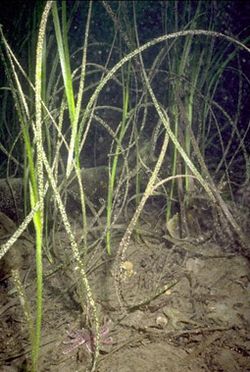
Zostera sp in Mussel Ridge Channel, Birch Island, Maine

Zostera is a small genus of widely distributed seagrasses, commonly called marine eelgrass, or simply seagrass or eelgrass. The genus Zostera contains 15 species.

Ecology

[edit]

Zostera marina is found on sandy substrates or in estuaries, usually submerged or partially floating. Most Zostera are perennial. They have long, bright green, ribbon-like leaves, the width of which are about 1 centimetre (0.4 in). Short stems grow up from extensive, white branching rhizomes. The flowers are enclosed in the sheaths of the leaf bases; the fruits are bladdery and can float.

Zostera beds are important for sediment deposition, substrate stabilization, as substrate for epiphytic algae and micro-invertebrates, and as nursery grounds for many species of important fish and shellfish. Zostera often forms beds in bay mud in the estuarine setting. It is an important food for brant geese and wigeons, and even (occasionally) caterpillars of the grass moth Dolicharthria punctalis.

The slime mold Labyrinthula zosterae can cause the wasting disease of Zostera, with Z. marina being particularly susceptible, causing a decrease in the populations of the fauna that depend on Zostera.

Zostera is able to maintain its turgor at a constant pressure in response to fluctuations in environmental osmolarity. It achieves this by losing solutes as the tide goes out and gaining solutes as the tide comes in.

Distribution

[edit]

The genus as a whole is widespread throughout seashores of much of the Northern Hemisphere as well as Australia, New Zealand, Southeast Asia and southern Africa. The discovery of Z. chilensis in 2005 adds an isolated population on the Pacific coast of South America to the distribution. One species (Z. noltii) occurs along the land-locked Caspian Sea.

Uses

[edit]

Eelgrass has been used for food by the Seri tribe of Native Americans on the coast of Sonora, Mexico. The rhizomes and leaf-bases of eelgrass were eaten fresh or dried into cakes for winter food. It was also used for smoking deer meat. The Seri language has many words related to eelgrass and eelgrass-harvesting. The month of April is called xnoois ihaat iizax, literally "the month when the eelgrass seed is mature".[2]

Zostera has also been used as packing material and as stuffing for mattresses and cushions.

On the Danish island of Læsø it has been used for thatching roofs. Roofs of eelgrass are said to be heavy, but also much longer-lasting and easier to thatch and maintain than roofs done with more conventional thatching material. More recently, the plant has been used in its dried form for insulation in eco-friendly houses and as a ground cover in permaculture gardens, once its salt layer washed off (ex: Friland, Danish eco-village).

In the United States, eelgrass insulation was commercially marketed in the early 1900s as Cabot's Quilt by the Samuel Cabot Co of Boston. However, due to an outbreak of Labyrinthula zosterae which destroyed crops of eelgrass, combined with the collapse of the homebuilding industry due to the great depression, it went out of production and was replaced in new homes with fiberglass (introduced in the late 1930s).

Some studies show promise for eelgrass meadows to sequester atmospheric carbon to reduce anthropogenic climate change.[3]

Zostera can also be utilized to produce biomass energy using the Jean Pain method.

Species

[edit]
Accepted species[1]

References

[edit]
[edit]
Revisions and contributorsEdit on WikipediaRead on Wikipedia
from Grokipedia
Zostera is a of about 15 species of , submerged marine in the Zosteraceae, commonly known as eelgrasses, characterized by creeping rhizomes, ribbon-like leaves up to 2 meters long, and hydrophilous via spadices enclosed in spathes. These seagrasses are marine angiosperms adapted to fully saline environments, with distichous leaves featuring a sheath and blade, and they exhibit both monoecious and dioecious flowering strategies. Species of Zostera inhabit intertidal and subtidal coastal waters, typically on sandy or muddy substrates at depths ranging from the low tide mark to 10–15 meters, with some populations extending up to 30 meters in clear waters, where they form dense meadows that thrive in temperate to polar regions across all continents except . The genus has a broad latitudinal distribution, with Z. marina extending from waters along northern coasts to the and being particularly abundant in areas like the and . Other notable species include Z. noltii, which dominates intertidal zones from southern to the , and Z. japonica, native to the western Pacific but invasive in parts of . Ecologically, Zostera meadows are foundational to coastal , serving as primary producers that support food webs, provide nursery habitats for and , and host epiphytic communities of and . These beds stabilize sediments by trapping particles and reducing , enhance through uptake, and act as significant carbon sinks, sequestering at rates up to 35 times higher than those of tropical forests per unit area. They also buffer coastal areas against wave energy and support commercially important fisheries by fostering populations of species like and . Despite their resilience, Zostera populations face threats from anthropogenic stressors including , habitat loss, and climate change-induced warming, which exacerbate diseases like wasting disease caused by the pathogen Labyrinthula zosterae. Conservation efforts emphasize restoration of meadows to maintain services, with ongoing research highlighting their and potential for recovery in suitable conditions.

Description and Biology

Morphology

Zostera species are submerged, perennial marine angiosperms belonging to the family Zosteraceae, featuring long, narrow, ribbon-like leaves that typically measure up to 1-2 in length. These lack true roots in the terrestrial sense but utilize extensive systems for anchorage in soft sediments and for absorbing nutrients and directly from the surrounding marine environment. The overall morphology is adapted to fully aquatic conditions, with flexible structures that withstand water currents and wave action while facilitating efficient and . The leaves of Zostera exhibit parallel venation without a prominent midrib, arising from sheathing bases that clasp the stem, which enhances in flowing . Leaf width and vary among species, with Z. marina, for example, producing blades 2-12 mm wide and up to 1 meter long, though extremes can reach 3 meters in optimal conditions. Morphological traits vary among species; for example, subtropical Z. capensis has shorter leaves adapted to estuarine conditions. These blades are bright green, flattened, and taper to a fine tip, with growth occurring primarily from a basal , allowing continuous elongation. Large cells along the margins provide longitudinal strength against mechanical stress from waves. The and systems form the foundational of Zostera . Horizontal , typically 2-8 mm in diameter, extend below the surface, producing vertical shoots at intervals and serving as storage organs for carbohydrates. These leptomorphic contain large lacunae in the outer cortex, aiding in internal gas transport. From each node, several (typically 5-20 in Z. marina) unbranched, fibrous emerge, often with fine hairs for better grip; these can penetrate the up to 30 cm or more, stabilizing the plant and accessing nutrients in anoxic layers. Inflorescences in Zostera are entirely submerged, consisting of a flattened spadix bearing unisexual flowers enclosed within a protective floral sheath or spathe. Flowers are typically arranged in two rows on one side of the spadix, with species generally monoecious (e.g., Z. marina), although occurs in some populations. This structure supports hydrophilous , where is released directly into the water column. Key adaptations for aquatic life include reduced compared to terrestrial , minimizing water loss and facilitating , as well as extensive tissue—manifested as air-filled lacunae—in leaves, rhizomes, and roots for efficient oxygen transport to belowground parts in oxygen-poor sediments. These rhizomes also contribute to stabilization by binding sediments, reducing in coastal areas.

Reproduction and Life Cycle

Zostera species employ both and , with the former facilitating and long-distance dispersal, while the latter supports local persistence in stable environments. occurs through submerged inflorescences that emerge on specialized flowering shoots, typically during spring and summer months such as May to July in temperate regions. is hydrophilous, relying on water currents to transport filamentous grains from male to female flowers, with each anther releasing thread-like structures adapted for underwater movement and capture by stigmas. Following fertilization, develop within the spathe and are dispersed primarily by sinking to the due to negative , though some may float initially for short distances before settling. Asexual reproduction predominates in established meadows and occurs via vegetative propagation through rhizome elongation and fragmentation, where horizontal s extend to produce new shoots and roots, forming clonal patches that can expand beds over time. Stolon-like extensions from rhizomes occasionally contribute to lateral spread, particularly in species like Zostera noltei, enhancing meadow connectivity without seed production. This clonal growth is energetically efficient and dominant in populations, allowing rapid of suitable substrates. The life cycle of Zostera begins with seed germination in coastal sediments, often triggered by cool temperatures below 15°C in late fall or spring, leading to seedling establishment in shallow, protected areas. Seedlings develop into vegetative shoots that mature to flowering within 1-2 years in perennial species like Z. marina, while annual species such as Z. japonica complete their cycle in one season, undergoing senescence and die-off in late summer or fall due to environmental stresses like high temperatures. Mature plants produce reproductive shoots alongside vegetative ones, with the cycle closing as seeds form persistent banks in the sediment for future recruitment. Seeds of Zostera exhibit that maintains viability for several months to over a year in anaerobic sediments, protecting them from predation and . Under natural conditions, rates are low, typically ranging from 10-30%, influenced by depth (optimal at 0-2 cm) and environmental cues like and light. Viability declines gradually, with 15-30% of seeds remaining viable after six months, supporting a that buffers against annual variability. Reproductive variations exist across Zostera species and populations, including in certain Z. marina meadows where separate male and female plants promote and enhance through seedling recruitment. This sexual dimorphism contrasts with monoecious forms and influences population resilience by introducing novel genotypes, particularly in disturbed habitats.

Taxonomy and Phylogeny

Classification History

The genus Zostera was established by Carl Linnaeus in his seminal work Species Plantarum in 1753, with Z. marina designated as the type species based on its distinctive marine habitat and morphology, though early classifications broadly encompassed various submerged aquatic monocots resembling seagrasses. Initially, the genus included a wider array of taxa that were later reassigned, reflecting the limited understanding of seagrass diversity at the time. The family Zosteraceae, to which Zostera belongs, was distinguished from other families such as Posidoniaceae primarily through floral characteristics like monoecious or dioecious flowers arranged in a flattened spadix and vegetative traits including creeping rhizomes and fully submerged marine habit. This morphological separation was formalized in early 19th-century works, such as Dumortier's division of Zostera into sections Alega and Zosterella in 1829, and further elaborated by key taxonomists including Ascherson and Graebner in their 1907 treatment in Das Pflanzenreich, which provided a comprehensive of the emphasizing anatomical details. Molecular studies in the late and early , including analyses of genes like matK and rbcL, confirmed the family's and its placement within the order , resolving earlier uncertainties about relationships to freshwater Potamogetonaceae. Phylogenetic revisions based on multi-locus , such as ITS1 nuclear and rbcL, matK, and psbA-trnH regions, have demonstrated Zostera as monophyletic within Zosteraceae, with divergences dating to approximately 14 million years ago from sister genera like Nanozostera and Heterozostera. A notable revision occurred around 2006, when Jacobs et al. proposed merging Heterozostera (erected by den Hartog in 1970) back into Zostera based on morphological and preliminary genetic similarities, though subsequent analyses in the reinstated Heterozostera as a distinct supported by cladistic evidence of unique anatomical and pathological traits. Recent assessments have refined species boundaries within Zostera, incorporating phylogenetic data to distinguish cryptic taxa and inform conservation, such as evaluating Z. noltei separately from Z. marina. Historical challenges, including the lumping of intertidal forms (e.g., Z. noltii as a variety of Z. marina) with subtidal ones due to , were largely resolved through cladistic analyses that integrated molecular and morphological data to clarify evolutionary relationships.

Species Diversity

The genus Zostera comprises approximately 12 accepted according to current taxonomic assessments, primarily distributed in temperate marine environments worldwide. These exhibit variation in leaf width, growth form, and tolerance, with Z. marina being the most widespread, forming extensive subtidal meadows in temperate regions of the , characterized by broad leaves up to 1 cm wide and lengths exceeding 1 m. Other notable include Z. japonica, a smaller-leaved form (leaves 1-4 mm wide) native to the Northwest Pacific but invasive in North American estuaries; Z. noltii, an intertidal with narrow leaves (1-2 mm wide) dominant in European shallow waters; and Z. muelleri, an Australasian with similar narrow leaves adapted to southern temperate coasts. Taxonomic revisions have influenced species recognition, with some former segregate genera reintegrated into Zostera. For instance, Z. japonica was previously classified as Nanozostera japonica, reflecting its open leaf sheath and diminutive size, but molecular and morphological evidence supports its placement within Zostera. Similarly, Z. noltii aligns with the section Zosterella, which encompasses small-leaved, often intertidal distinguished by lax sheaths and shorter rhizomes from the broader-leaved core Zostera section. Hybrid zones occur where overlap, such as between Z. noltii and Z. marina in European intertidal-subtidal transitions, producing intermediate forms with mixed morphological traits. Diversity patterns show a concentration in temperate latitudes, with lower in tropical or polar extremes, likely due to optimal ranges for growth and . is evident in regional , including Z. capensis restricted to southern African estuaries and Z. chilensis in South American Pacific waters, the latter representing a lineage with narrow leaves and limited distribution. Within cosmopolitan species like Z. marina, genetic analyses reveal distinct clades corresponding to ocean basins, such as Atlantic versus Pacific lineages, indicating historical vicariance and low . Regarding conservation, most Zostera species are assessed as Least Concern by the IUCN, reflecting their broad ranges, but regional endemics face higher risks; for example, Z. capensis is Vulnerable due to habitat loss in estuaries, and Z. caespitosa is also Vulnerable from limited populations in the North Pacific.
SpeciesKey CharacteristicsNative RegionIUCN Status
Z. marinaBroad leaves, subtidal meadowsTemperate Northern HemisphereLeast Concern
Z. japonicaNarrow leaves, intertidalNW PacificLeast Concern
Z. noltiiDwarf form, intertidalEurope to NW AfricaLeast Concern
Z. muelleriNarrow leaves, variable depthAustralasiaLeast Concern
Z. capensisIntertidal, estuary specialistSouthern AfricaVulnerable

Distribution and Habitat

Global Distribution

Zostera species are predominantly distributed in temperate regions of the , with Zostera marina being the most widespread, occurring from the southward to the Mediterranean in the North Atlantic and from to in the North Pacific. These distributions reflect the genus's adaptation to cold to cool waters, with extensions into subtropical zones in areas like the southern limits of Z. marina in and southern . Northern Hemisphere species of the genus span latitudes approximately 30° to 72° N, forming extensive meadows in coastal bays, estuaries, and lagoons where suitable conditions prevail. In the , Zostera is less abundant but present in temperate , where Z. muelleri dominates from to , and in , where Z. capensis forms meadows in 62 estuaries along the west and east coasts. The genus is largely absent from tropical regions due to thermal intolerance, though isolated introductions have occurred, such as Z. japonica in subtropical Pacific estuaries. These southern populations represent independent radiations from northern ancestors, with limited connectivity across the . Historical range expansions of Zostera have been shaped by both natural and anthropogenic factors, including post-glacial recolonization following the around 20,000 years ago, when retreating ice sheets allowed northward migration via ocean currents from refugia in the northwest Pacific and . Human-mediated spread has also played a role, notably the introduction of Z. japonica from to the Pacific coast of in the 1950s, likely via imports of Japanese oyster spat, leading to its establishment from to . These events have contributed to disjunct populations, with patchy distributions influenced by ocean currents that facilitate long-distance dispersal of seeds and fragments. Zostera meadows historically covered extensive areas worldwide, contributing significantly to temperate habitats prior to 20th-century declines. As of 2025, analyses indicate that approximately 5,602 km² of globally surveyed Zostera meadow area has been lost since , equating to about 19.1% of monitored habitats. Recent climate influences have driven poleward shifts in Zostera distributions, with observations since the indicating northern expansion of southern range limits in response to warming sea surface temperatures, such as the retreat of Z. marina from its southern edges in the Northwest Atlantic and . Projections for the Northwest Atlantic suggest further northward shifts of 1.4° to 6.4° latitude by 2100 under varying emissions scenarios, potentially altering biogeographic patterns while exacerbating losses at equatorial margins.

Habitat Preferences

Zostera species primarily inhabit subtidal to intertidal zones in coastal marine environments, typically occurring at depths ranging from 0 to 30 meters, though most beds are found in shallower waters up to 5-10 meters where penetration is sufficient. These seagrasses require a minimum of 10-11% of surface for survival and growth, with availability often serving as the primary ; deeper limits are constrained by reduced , particularly in turbid waters. In specific locales, such as Ailian Bay, , Z. marina exhibits optimal growth at depths of ≤3 meters, where levels reach 6-10% of surface , but survival declines sharply beyond this due to insufficient . Salinity preferences for Zostera fall within the euhaline range of 25-35 parts per thousand (ppt), though the genus demonstrates broad tolerance from 5 to 40 ppt, enabling persistence in estuarine settings with fluctuations. Optimal temperatures lie between 10 and 20°C, with overall tolerance extending from 5 to 30°C; exposure above 25°C can induce stress, while lower temperatures support growth in temperate regions. Water quality is critical, favoring low turbidity to maintain light levels and moderate currents of 0.1-0.5 m/s, which facilitate pollination without excessive sediment resuspension; anoxic sediments are avoided, as they impair root respiration. Sediment types consist of sandy or muddy substrates with low organic content, as higher organic matter elevates light demands and reduces meadow stability. Zostera forms extensive meadows or patchy beds, exhibiting vertical zonation across habitats; for instance, Z. noltii dominates upper intertidal areas exposed to air, while Z. marina prevails in subtidal zones. Adaptations include tolerance to periodic in intertidal species like Z. noltii, which recover photosynthetic function after emersion, and resilience to sediment burial, with rhizomes of Z. marina surviving depths up to 20 cm before mortality increases.

Ecology

Ecosystem Roles

Zostera meadows serve as critical nursery grounds for juvenile fish and invertebrates, providing shelter and food resources that enhance survival rates in early life stages. For instance, Zostera marina beds support 26 fish species in regions like the UK, including commercially important taxa such as cod and pollock. These meadows also stabilize sediments through root and rhizome networks, reducing resuspension by 30-65% via flow attenuation within the canopy, which minimizes erosion and maintains water clarity essential for photosynthesis. In terms of nutrient cycling, Zostera exhibits high primary productivity ranging from 200 to 800 g C/m²/year, supporting robust with burial rates up to 83 g C/m²/year in , thereby acting as a significant sink. Epiphytic communities on Zostera blades facilitate , with rates measured up to several micromoles N per gram of per hour, alleviating nutrient limitations in oligotrophic coastal waters. Additionally, in these meadows contributes substantially to coastal oxygen dynamics, generating up to 10 liters of O₂ per square meter daily and baffling water flow to reduce wave energy by approximately 40%, which further promotes accretion and habitat stability. Zostera enhances local by increasing 2-5 times relative to bare sediments, fostering diverse assemblages of macrofauna and epifauna through structural complexity. As a trophic base, detrital material from senesced leaves fuels coastal food webs, with 30-50% of production exported to adjacent habitats like deep-sea sediments, subsidizing heterotrophic communities and carbon transfer across ecosystems.

Biotic Interactions

Zostera species, particularly Z. marina, experience significant herbivory from various marine and avian consumers that can influence shoot density and overall structure. Brant geese (Branta bernicla) graze extensively on Z. marina beds, consuming large portions of above- and belowground during migration and breeding seasons, with studies indicating they can remove up to 20% of available in heavily grazed areas. Isopods, such as Idotea baltica, also contribute to herbivory by feeding on leaves and epiphytes, leading to reduced shoot density in dense s where grazer densities exceed 10 individuals per square meter. Sea urchins (Lytechinus variegatus and ) exert pressure through grazing that regulates , particularly in subtropical and temperate regions, with urchin densities above 20 per square meter capable of limiting expansion by halving shoot growth rates. Symbiotic relationships play a key role in Zostera's nutrient dynamics and reproduction. Epiphytic algae on Z. marina leaves facilitate , providing up to 30% of the plant's requirements in nutrient-limited environments through associated diazotrophic . Unlike terrestrial plants, Zostera relies on hydrochory for , with water currents dispersing filamentous pollen grains to female flowers, eliminating the need for pollinators. Pathogenic interactions pose major threats to Zostera populations. The Labyrinthula zosterae causes wasting disease, which devastated Atlantic Z. marina beds in , killing approximately 90% of plants through formation and tissue . Predation and further shape Zostera dynamics. Fish such as (Syngnathus spp.) and gobies prey on Zostera seeds, accounting for up to 65% of post-dispersal losses and limiting recruitment in shallow beds. Competitive interactions occur with macroalgae, which outcompete Zostera for in eutrophic conditions, and invasive cordgrasses like Spartina alterniflora, which displace Z. japonica by altering sediment chemistry in invaded estuaries. Mutualistic associations with microbes bolster Zostera's nutrient acquisition. Nitrogen-fixing bacteria, including sulfate-reducing species like in the of Z. noltii and Z. marina, enhance nutrient uptake by contributing 20-50% of the plant's needs through acetylene reduction processes, particularly during peak growth periods.

Human Interactions

Uses

Zostera species, particularly Z. marina, have been utilized by coastal communities for centuries in traditional applications. In , dried eelgrass served as and insulation material in buildings until the early , valued for its lightweight, moisture-resistant, and insulating properties that helped regulate temperature in homes and structures. European settlers in adopted similar practices, harvesting eelgrass to stuff mattresses and insulate walls due to its abundance and . Additionally, Zostera was employed as for , with historical records from in the 1700s documenting its use to feed cows, sheep, and other animals, often collected by scything submerged plants and drying them for winter feed. In coastal communities, the plant's nutrient-rich leaves were applied as to enrich agricultural soils, a practice spanning centuries across and to improve and fertility. In food and medicinal contexts, Zostera has featured in traditional practices, especially in and indigenous cultures. Historically, Z. marina was used as a remedy for wounds, with its leaves applied as bandages to promote healing, attributed to inherent properties that inhibit . Scientific analyses confirm these properties, showing extracts from Zostera species, including Z. capensis and related taxa, exhibit antibacterial activity against pathogens, supporting their traditional use in treating infections and sores. Contemporary uses of Zostera emphasize ecological and economic benefits. In restoration projects, Z. marina is planted to control , with densities of 1-2 million shoots per achieving successful bed establishment and stabilizing sediments against wave action. These efforts leverage the plant's root systems for habitat stabilization, briefly enhancing in degraded areas. As a substrate in , Zostera beds support farming by providing attachment sites and shelter for juvenile oysters and clams, improving growth rates and survival in integrated systems. Industrial applications of Zostera include historical experimentation with production from its fibrous leaves, though limited by processing challenges. More recently, its shows promise for production, with enzymatic and yielding up to 243 grams of per kilogram of Z. marina fiber, supported by annual dry productivity of 5-10 tons per in productive meadows. For ornamental and research purposes, Z. marina is cultivated in aquariums as a naturalistic element, simulating marine habitats for educational displays and maintaining through uptake. In scientific studies, Zostera serves as a key for research, with its fully sequenced enabling investigations into marine angiosperm adaptation, stress responses, and dynamics.

Conservation and Threats

Zostera populations have experienced significant global declines, with estimates indicating approximately 30% loss of meadows since the 1980s, driven by a combination of anthropogenic pressures and environmental changes. For instance, , the most widespread species, remains Least Concern globally due to its broad distribution, though it faces localized extirpations and ongoing degradation. These declines have accelerated in recent decades, with rates reaching up to 7% per year in some areas since 1990. Major threats to Zostera include from nutrient runoff, which promotes algal overgrowth and reduces light penetration to beds by up to 50% or more, leading to widespread die-offs. exacerbates vulnerability, as water temperatures exceeding 4°C above optimal levels (typically above 25–28°C) can cause lethal stress and mass mortality in temperate species like Z. marina. Coastal development, particularly for ports and infrastructure, has resulted in 20–50% loss in affected regions, directly removing or smothering meadows. Recurrent outbreaks of wasting disease, caused by the Labyrinthula zosterae, have historically decimated Zostera populations, as seen in the 1930s North Atlantic that eliminated up to 90% of Z. marina in some areas, with sporadic recurrences linked to environmental stressors like warming and nutrient enrichment. Invasive non-native species, such as the alga Caulerpa taxifolia and Caulerpa prolifera, further threaten Zostera through direct competition for space and resources, forming dense mats that outcompete seagrasses and alter conditions. Conservation efforts focus on restoration techniques like seed broadcasting, which has achieved variable success rates of 20–60% in establishing new meadows, depending on site conditions and seed viability. Protected areas play a critical role, with Zostera habitats safeguarded under frameworks like the EU , which designates seagrass beds as priority features in sites to prevent deterioration. Monitoring advancements, including via satellites like , enable large-scale tracking of meadow extent and health, supporting early detection of declines. Under the UN Decade on Ecosystem Restoration (2021–2030), international collaborative actions aim to enhance resilience of ecosystems against ongoing threats, with recent successes such as the 2025 restoration project in Loch Craignish, , demonstrating effective seed-based methods.

References

  1. https://www.coastalwiki.org/wiki/Seagrass_meadows
Add your contribution
Related Hubs
Contribute something
User Avatar
No comments yet.