Hubbry Logo
Ge with stroke and hookGe with stroke and hookMain
Open search
Ge with stroke and hook
Community hub
Ge with stroke and hook
logo
8 pages, 0 posts
0 subscribers
Be the first to start a discussion here.
Ge with stroke and hook
from Wikipedia
Ge with stroke and hook


Usage
Writing systemCyrillic
TypeAlphabetic
Sound values[ʁ]
This article contains phonetic transcriptions in the International Phonetic Alphabet (IPA). For an introductory guide on IPA symbols, see Help:IPA. For the distinction between [ ], / / and ⟨ ⟩, see IPA § Brackets and transcription delimiters.

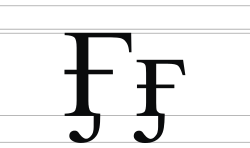
Ge with stroke and hook or descender (Ӻ ӻ; italics: Ӻ ӻ) is a letter of the Cyrillic script, formed from the Cyrillic letter Ge (Г г Г г) by adding a horizontal stroke and a descender. In Unicode this letter is called "Ghe with stroke and hook".[1] It is similar in shape to the Latin letter F with hook (Ƒ ƒ) but is unrelated.

The letter is only used for the Nivkh language, where it represents the voiced uvular fricative /ʁ/, like the r in French.[2] There are two common designs: the original form with a straight descender (, ), and a variant with a hook designed by Просвещение (Enlightenment) publishing house.

Computing codes

[edit]
Character information
Preview Ӻ ӻ
Unicode name CYRILLIC CAPITAL LETTER
GHE WITH STROKE AND HOOK
CYRILLIC SMALL LETTER
GHE WITH STROKE AND HOOK
Encodings decimal hex dec hex
Unicode 1274 U+04FA 1275 U+04FB
UTF-8 211 186 D3 BA 211 187 D3 BB
Numeric character reference Ӻ Ӻ ӻ ӻ

See also

[edit]

References

[edit]
Revisions and contributorsEdit on WikipediaRead on Wikipedia
from Grokipedia
Ge with stroke and hook (uppercase: Ӻ, lowercase: ӻ) is a letter of the Cyrillic script used exclusively in the orthography of the Nivkh language, a language isolate spoken by the indigenous Nivkh people primarily in Sakhalin Island and the lower Amur River region of Russia's Far East. Derived from the standard Cyrillic letter Ge (Г г) by incorporating a horizontal stroke across its middle and a descending hook from the lower right leg, it serves to represent a distinct voiced fricative phoneme in Nivkh, contrasting with other velar and uvular sounds in the language's complex consonant inventory. The Nivkh language adopted a modified Cyrillic alphabet in 1953, replacing an earlier Latin-based script used from 1931 to 1937, to facilitate literacy and integration within the Soviet educational system. This orthography includes several unique letters beyond the standard Russian set, such as Ӻ ӻ, to accommodate Nivkh's phonological features, including aspirated stops, fricatives, and a rich system of consonant alternations known as spirantization and hardening. The letter Ӻ ӻ appears in Nivkh literacy materials, liturgical texts, and general literature, though the language itself is endangered, with 117 native speakers as of the 2020 census. As part of the broader Cyrillic extensions encoded in Unicode's Cyrillic block (U+0400–U+04FF), Ӻ (U+04FA) and ӻ (U+04FB) were formally proposed for inclusion in 2005 to support digital representation of minority languages like Nivkh, ensuring accurate rendering in fonts and texts. Its design distinguishes it from similar variants, such as Ge with stroke (Ғ ғ, used in languages like Kazakh and Bashkir for /ʁ/ or /ɡ/), emphasizing the script's adaptability to non-Slavic phonologies in Eurasia.

Form and origins

Visual description

The Cyrillic letter known as Ge with stroke and hook is derived from the standard Ge (Г г) through the addition of a horizontal stroke across its middle and a hook extending from the base of the right . This modification creates a distinct form that combines the angular structure of Ge with linear and curved extensions for differentiation. The uppercase variant (Ӻ) features the blocky, mirrored-L shape of capital Ge, intersected by a straight horizontal bar at mid-height, with a curved projecting downward from the lower end of the right vertical stroke. In contrast, the lowercase form (ӻ) mirrors this design on a smaller scale, maintaining proportional thickness for the horizontal stroke and a similarly curved on the right , ensuring legibility in running text. Italic versions of both cases (Ӻ ӻ) adopt a slanted posture while preserving the core components, with the hook often rendered with subtle to enhance flow. Visually, Ge with stroke and hook differs from the plain Ge (Г г) by its added midline bar and bottom-right extension, which prevent confusion in scripts employing multiple Ge derivatives. It further distinguishes itself from Ge with stroke (Ғ ғ), which includes only the horizontal bar without the defining descender hook.

Historical development

The letter Ge with stroke and hook emerged as part of the Soviet Union's early 20th-century initiatives to extend the Cyrillic script to non-Slavic languages, particularly through standardization efforts for indigenous peoples in the Russian Far East during the 1930s. These efforts aimed to foster literacy and cultural integration among minority groups like the Nivkh (formerly known as Gilyak), whose language lacked a standardized writing system prior to Soviet rule. In 1931, linguist Erukhim Kreinovich developed the initial Nivkh alphabet on a Latin basis, drawing from the Unified Northern Alphabet used for other northern Soviet languages, to support education and publishing in the Amur dialect. Although a Cyrillic orthography was proposed in 1937 by Kreinovich amid the broader Soviet policy of transitioning minority scripts from Latin to Cyrillic between 1935 and 1940, it was not implemented due to political purges and other disruptions. A further attempt occurred in 1953, when V. N. Savelyeva and others created a Cyrillic-based primer, but this also remained largely unused. The Ge with stroke and hook was introduced in the modern Cyrillic orthography established in 1979 by V. Sangi and colleagues for the Amur and Sakhalin dialects, building on earlier proposals and influenced by similar extensions like Ge with stroke (Ғ) used for guttural sounds in Turkic languages such as Kazakh and Bashkir Cyrillic orthographies adopted around 1940. This standardization led to the publication of primers in 1981, promoting uniformity in printing materials and educational texts throughout the late Soviet era. This historical form persists in contemporary Nivkh linguistic usage.

Linguistic usage

In Nivkh

The letter ge with stroke and hook (Ӻ ӻ) is a key component of the Nivkh orthography, an isolate language spoken by around 30–50 fluent speakers, primarily in the Sakhalin and Amur regions of Russia, as of the 2010s. Following the transition from a Latin-based script to a modified Cyrillic alphabet in 1953, this letter was incorporated to accommodate unique phonological features of Nivkh, distinguishing it from standard Russian Cyrillic. In the contemporary Nivkh alphabet, ge with stroke and hook appears immediately after the variants of ge (specifically following Г г, Ӷ ӷ, and Ғ ғ) and before Д д, reflecting its role in encoding dialect-specific sounds rather than as a high-frequency letter. It is employed for particular morphemes and lexical items, with variations in application between dialects such as East (where it often marks uvular fricatives in roots) and (where usage aligns closely but may omit related letters like Ӷ ӷ). For instance, in East Sakhalin Nivkh, it appears in words like "куғытӻарта" (part of or expressions in traditional texts) and "салӻата" (referring to communal gathering practices). Despite discussions in the 1990s and early 2000s on and orthographic adjustments—prompted by a 1990 international survey on minority languages and later concerns over digital compatibility—the Cyrillic-based , including ge with stroke and hook, has been retained as the to support ongoing and publishing efforts.

In other languages

The letter Ge with stroke and hook (Ӻ ӻ) has no standard adoption in the orthographies of languages other than Nivkh. During the Soviet era, experimental Cyrillic-based writing systems were developed for various indigenous languages of Siberia, including Tungusic languages like Evenki and Nanai, but this letter was not incorporated into any standardized alphabets for those languages and was eventually replaced by other conventions in trial orthographies of the 1940s and 1950s. Archival records of Russian indigenous language documentation occasionally reference dialectal or provisional instances of similar forms in non-Nivkh contexts, but these remain non-standard and obsolete. It is distinct from related Cyrillic letters such as Ge with descender (Ӷ ӷ), which appears in the Abkhaz and Aleut alphabets but serves different phonetic roles, and is not used in scripts like those for Ossetian or Abkhazian variants. There are no current or ongoing uses of Ge with stroke and hook outside of Nivkh documentation.

Represented sounds

The Ge with stroke and hook (Ӻ ӻ) represents the /ʁ/ in the Nivkh language, a sound articulated with frication at the and voicing, setting it apart from the standard Cyrillic Ge (Г г), which denotes stops like /g/ or approximants like /ɦ/ in other contexts. This is central to Nivkh's posterior consonant series, contributing to the language's complex uvular inventory that includes both stops and fricatives. In International Phonetic Alphabet (IPA) transcription, the primary realization is /ʁ/, though Nivkh dialects show allophonic variation, such as a weaker [ʁ̞] in intervocalic environments where friction diminishes, resembling a uvular trill or in some realizations. These variants reflect the language's phonological patterns, where voiced fricatives often exhibit sonorant-like spectral properties due to reduced airflow. Phonetically, /ʁ/ in Nivkh aligns with the guttural 'r' found in languages like French (as in rue) or the voiced equivalent of the uvular fricative in German Bach (though the latter is typically voiceless /χ/), but it functions distinctly within Nivkh's system of posterior articulations, including contrasts with velar /ɣ/ and uvular stops /ɢ/. No other primary phonetic values for this letter are documented beyond its role in Nivkh phonology.

Phonological role

In Nivkh , the letter denotes the /ʁ/, which serves to distinguish the uvular series from the velar series, a contrast that is marginal but phonemically relevant in specific lexical contexts, such as /nanak/ vs. /naraʁak/ ('to gather'). This distinction arises primarily in syllables headed by the back vowels /a/ and /o/, where /ʁ/ contrasts with velar fricatives such as /ɣ/ or s like /g/, preventing near-allophonic merger and maintaining lexical integrity. The uvular series, including /ʁ/, is restricted in distribution compared to velars, yet it contributes to the language's rich inventory by encoding place-of-articulation differences in s. The phonological role of /ʁ/ is evident in its participation in minimal pairs, where it contrasts with /g/ or /ɣ/ to signal meaning differences, particularly in word-initial positions of verb roots or other morphemes, as in ŋa:s ‘wall’ vs. ŋas ‘strap’. These oppositions highlight /ʁ/'s function in the laryngeal contrast system, which is based on [spread glottis] features, classifying Nivkh as an aspiration language where voiceless fricatives pattern with aspirated plosives. Such contrasts are crucial for differentiating lexical items, though they remain limited due to the restricted occurrence of uvulars. Within Nivkh's agglutinative morphology, /ʁ/ often appears in codas or consonant clusters, arising through processes like spirantization, where uvular or velar plosives lenite to fricatives at morpheme-initial boundaries within syntactic domains such as noun phrases or verb phrases. This interaction is triggered by preceding vowels, glides, or plosives but blocked by fricatives or nasals, sometimes resulting in hardening to plosives; voicing of /ʁ/ is typically maintained medially adjacent to sonorants or voiced segments but devoices in final position or before pauses. These patterns enhance perceptual prominence of domain-initial morphemes and reflect the language's morphological complexity. Dialectal variations influence /ʁ/'s realization and phonological behavior. In the Amur dialect, /ʁ/ exhibits final fricative voicing when followed by vowels or sonorants and may delete preconsonantally, causing of the preceding vowel, which contributes to emerging phonemic distinctions. In dialects, particularly West Sakhalin, spirantization involving /ʁ/ is more variable across independent boundaries—obligatory between roots and suffixes but optional elsewhere—and the uvular-velar contrast is preserved more consistently before back vowels, though overall neutralization trends persist due to external influences like Russian. These differences underscore the dynamic nature of /ʁ/ in maintaining Nivkh's phonological system across varieties.

Computing

Unicode encoding

The uppercase form of ge with stroke and hook is encoded in Unicode as U+04FA CYRILLIC CAPITAL LETTER GHE WITH STROKE AND HOOK (Ӻ), while the lowercase form is U+04FB CYRILLIC SMALL LETTER GHE WITH STROKE AND HOOK (ӻ). These code points were added in version 5.0, released in 2006. Both characters belong to the Cyrillic block, which spans U+0400–U+04FF. The characters form a case pair, with U+04FA as the uppercase and U+04FB as the lowercase equivalent. Their general categories are Lu (Letter, Uppercase) for U+04FA and (Letter, Lowercase) for U+04FB. Neither has a decomposition mapping, and they have no canonical equivalents. In HTML, they can be represented using the decimal entities Ӻ for U+04FA and ӻ for U+04FB.

Input methods

The letter Ge with stroke and hook (Ӻ ӻ) can be input using specialized keyboard layouts designed for the Nivkh language, which extend the standard Russian JCUKEN layout to include additional Cyrillic characters. In 2024, the font developer Paratype released publicly available keyboard layouts for several indigenous minority languages of Russia, including Nivkh; these layouts map the letter to specific keys, often near the standard Ge (Г), facilitating efficient typing for Nivkh speakers familiar with Russian keyboards. Earlier Nivkh layouts, such as those for Windows 95/98/ME using Paleoasian fonts, position the uppercase Ӻ next to the standard "Ghe" and descender variants, with the apostrophe key shifted for accessibility. On Windows systems, users can input the uppercase Ӻ via the method by holding the and typing 1274 on the (corresponding to its decimal value), then releasing Alt; the lowercase ӻ uses Alt+1275. This method requires a font supporting the character and works in applications like or . Alternatively, the Windows Character Map utility allows selection and insertion of Ӻ from the Cyrillic block. For cross-platform input, Unicode-based methods are widely used. On with a enabled (e.g., right Alt), users can press Compose followed by Ctrl+Shift+U, then 04fa (hex) and Enter for uppercase, or 04fb for lowercase, though no predefined compose sequence exists specifically for this rare letter. In , the Insert Symbol dialog or equation editor supports direct Unicode entry via . Modern applications like also provide Unicode hex input options. Software support for rendering Ge with stroke and hook is robust in contemporary systems, with full compatibility in fonts such as Noto Sans and Noto Serif, which include it in their extended Cyrillic glyph sets since Unicode 5.0 in 2006. However, legacy systems predating 2008, such as older Windows XP installations without Unicode updates, may exhibit rendering issues or fallback to basic Ge (Г) due to incomplete font coverage. On mobile devices, iOS and Android offer character pickers in keyboards (accessible via the globe or symbols icon) that include extended Cyrillic under Unicode search, allowing selection of Ӻ; dedicated apps like Unicode Pad on Android enable direct code point input for such characters. For web forms, HTML input fields support direct Unicode entry or copy-paste from character tables.
Add your contribution
Related Hubs
User Avatar
No comments yet.