


Community hub
Recent from talks
Contribute something
Nothing was collected or created yet.
100 metres
View on Wikipedia
| Athletics 100 metres | |
|---|---|
 | |
| World records | |
| Men |  Usain Bolt (JAM) 9.58 (2009) Usain Bolt (JAM) 9.58 (2009) |
| Women |  Florence Griffith-Joyner (USA) 10.49 (1988) Florence Griffith-Joyner (USA) 10.49 (1988) |
| Olympic records | |
| Men | Usain Bolt (JAM) 9.63 (2012) |
| Women | Elaine Thompson-Herah (JAM) 10.61 (2021) |
| World Championship records | |
| Men | Usain Bolt (JAM) 9.58 (2009) |
| Women | Melissa Jefferson-Wooden (USA) 10.61 (2025) |
| World junior (U20) records | |
| Men |  Letsile Tebogo (BOT) 9.91 (2022) Letsile Tebogo (BOT) 9.91 (2022) |
| Women | Sha'Carri Richardson (USA) 10.75 (2019) |


The 100 metres, or 100-meter dash, is a sprint race in track and field competitions. The shortest common outdoor running distance, the 100-metre (109.36 yd) dash is one of the most popular and prestigious events in the sport of athletics. It has been contested at the Summer Olympics since 1896 for men and since 1928 for women. The inaugural World Championships were in 1983.
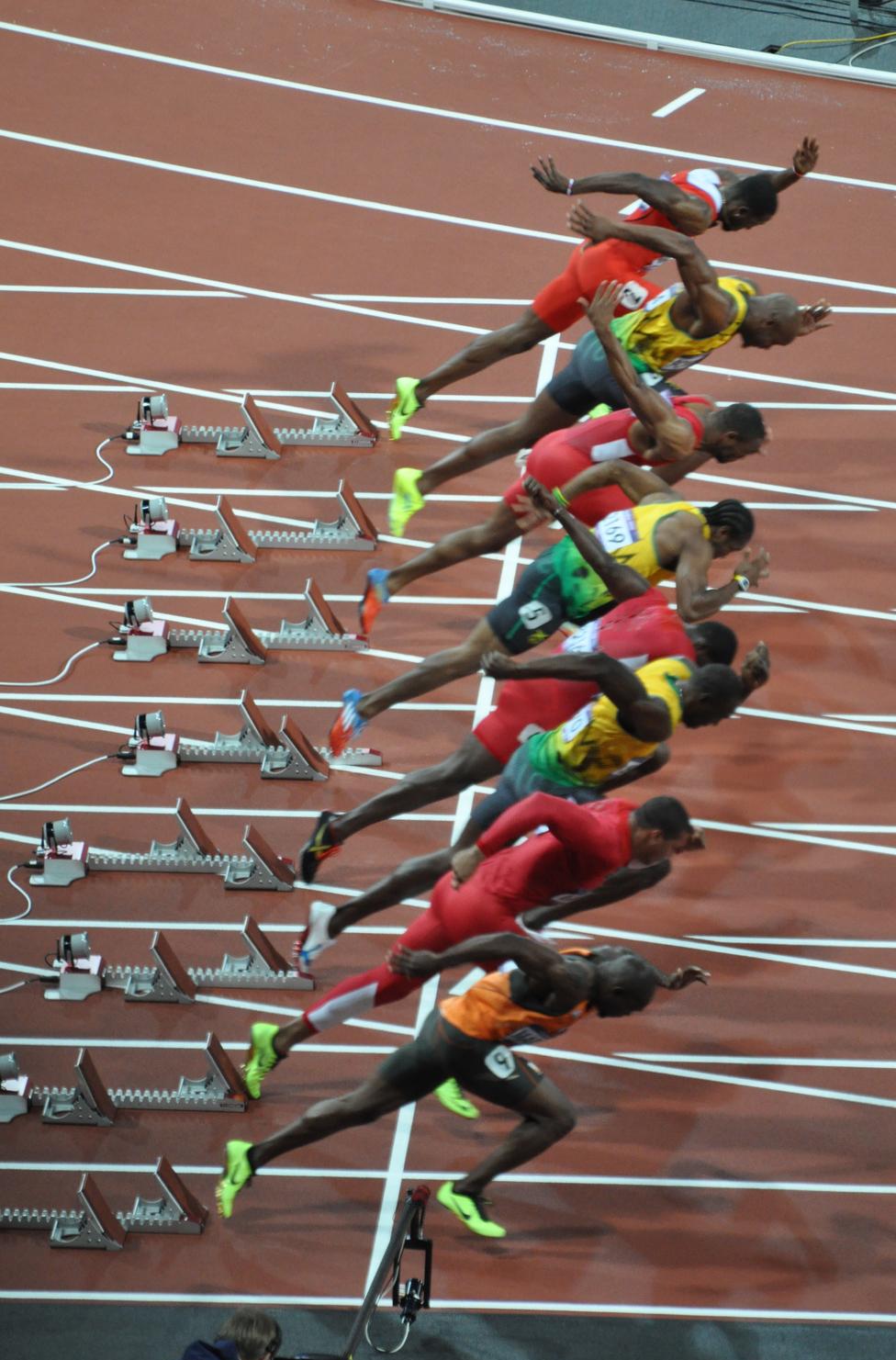
On an outdoor 400-metre running track, the 100 m is held on the home straight, with the start usually being set on an extension to make it a straight-line race. There are three instructions given to the runners immediately before and at the beginning of the race: "on your marks", "set", and the firing of the starter's pistol. The runners move to the starting blocks when they hear the "on your marks" instruction. The following instruction, to adopt the "set" position, allows them to adopt a more efficient starting posture and isometrically preload their muscles: this will help them to start faster. A race-official then fires the starter's pistol to signal the race beginning and the sprinters stride forwards from the blocks. Sprinters typically reach top speed after somewhere between 50 and 60 m. Their speed then slows towards the finish line.
The 10-second barrier has historically been a barometer of fast men's performances, while the best female sprinters take eleven seconds or less to complete the race. The men's world record is 9.58 seconds, set by Jamaica's Usain Bolt in 2009, while the women's world record is 10.49 seconds, set by American Florence Griffith-Joyner in 1988.[a]
The 100 metres is considered one of the blue ribbon events of the Olympics and is among the highest profile competitions at the games. It is the most prestigious 100 metres race at an elite level and is the shortest sprinting competition at the Olympics – a position it has held at every edition except for a brief period between 1900 and 1904, when a men's 60 metres was contested. The unofficial "world's fastest man or woman" title typically goes to the Olympic or world 100 metres champion.[3][4][5] The 200 metre time almost always yields a "faster" average speed than a 100-metre race time, since the initial slow speed at the start is spread out over the longer distance.[6] The current men's Olympic champion is Noah Lyles, while the current world champion is Oblique Seville. The current women's Olympic champion is Julien Alfred, and the world champion is Melissa Jefferson-Wooden.
Women's 100 Meter - Top Performers
[edit]The women's 100 Meter race features the top athletes from around the world. This event is constantly evolving with new technology, training methods, and global participation. Early competitions were mainly focused on North American and European athletes, but recent improvements to facility access and international investment in women's athletics has shown a drastic spread of the sport. By the late 20th century, sprinters from the Caribbean, United States, and all across Africa, began setting record after record in the 100 Meter sprint.[7][8]
Throughout the evolution of this race, several athletes from around the globe have been dominant. For example, Wilma Rudolph and Florence Griffith-Joyner are two prominent American sprinters. Rudolph was a triple gold medalist in 1960, and Florence set the 100 meter record in 1988 and still holds the female record. Jamaican sprinters also change the landscape for females in this event. Shelly-Ann Fraser-Pryce and Elaine Thompson-Herah have been at the lead of the Jamaican sprinters in the modern era. Other runners such as Marie-José Pérec of France, and Blessing Okagbare of Nigeria have helped spread awareness to this race across Europe and Africa. All of these sprinters have helped grown the 100 meter race internationally, helping the sport become more accessible to diverse regions around the globe.[7][8]
Mens 100 Meter - Top Performers
[edit]The men's 100 meter race is also known as the premier racing event in the world, determining the world's fastest man. Over the years the race has constantly evolved with new technology, training gear, and number of runners. Similar to the female race, the early known sprinters were from North America and Europe. This included United State athletes Jesse Owens and Carl Owens. The domination in these regions soon spread to the whole world. With the new advancements in technology, countries like the Caribbean, Africa, and Jamaica would soon add to the competition.[9]
Throughout history, many sprinters have made a long lasting mark on the 100 meter race. First of all, Jesse Owens, from Cleveland Ohio, captured attention in 1936 for winning the Olympic Gold medal for the United States. In the modern era, Usain Bolt from Jamaica still holds the Olympic record for the 100 meter race that he set back in 2009. Other sprinters, including Akani Simbine of South Africa and Linford Christie of Great Britain have helped spread the sport around other regions of world. All of these athletes have both helped push each other to new records, and pushed the sport to become more accessible to all genders, ages, ethnicities, and more.[10][11]
Race dynamics
[edit]Start
[edit]
At the start, some athletes play psychological games such as trying to be last to the starting blocks.[12][13][14]
At high level meets, the time between the gun and first kick against the starting block is measured electronically, via sensors built in the gun and the blocks. A reaction time less than 0.100 s is considered a false start. This time interval accounts for the sum of the time it takes for the sound of the starter's pistol to reach the runners' ears, and the time they take to react to it.
For many years a sprinter was disqualified if responsible for two false starts individually. However, this rule allowed some major races to be restarted so many times that the sprinters started to lose focus. The next iteration of the rule, introduced in February 2003, meant that one false start was allowed among the field, but anyone responsible for a subsequent false start was disqualified.
This rule led to some sprinters deliberately false-starting to gain a psychological advantage: an individual with a slower reaction time might false-start, forcing the faster starters to wait and be sure of hearing the gun for the subsequent start, thereby losing some of their advantage. To avoid such abuse and to improve spectator enjoyment, the IAAF implemented a further change in the 2010 season – a false starting athlete now receives immediate disqualification.[15] This proposal was met with objections when first raised in 2005, on the grounds that it would not leave any room for innocent mistakes. Justin Gatlin commented, "Just a flinch or a leg cramp could cost you a year's worth of work."[16] The rule had a dramatic impact at the 2011 World Championships, when current world record holder Usain Bolt was disqualified.[17][18]
Mid-race
[edit]Runners usually reach their top speed just past the halfway point of the race and progressively decelerate to the finish. Maintaining that top speed for as long as possible is a primary focus of training for the 100 m.[19] Pacing and running tactics do not play a significant role in the 100 m, as success in the event depends more on pure athletic qualities and technique.
Finish
[edit]The winner, by IAAF Competition Rules, is determined by the first athlete with their torso (not including limbs, head, or neck) over the nearer edge of the finish line.[20] There is therefore no requirement for the entire body to cross the finish line. When the placing of the athletes is not obvious, a photo finish is used to distinguish which runner was first to cross the line.
Climatic conditions
[edit]Climatic conditions, in particular air resistance, can affect performances in the 100 m. A strong head wind is very detrimental to performance, while a tail wind can improve performances significantly. For this reason, a maximum tail wind of 2.0 metres per second (4.5 mph) is allowed for a 100 m performance to be considered eligible for records, or "wind legal".
Furthermore, sprint athletes perform a better run at high altitudes because of the thinner air, which provides less air resistance. In theory, the thinner air would also make breathing slightly more difficult (due to the partial pressure of oxygen being lower), but this difference is negligible for sprint distances where all the oxygen needed for the short dash is already in the muscles and bloodstream when the race starts. While there are no limitations on altitude, performances made at altitudes greater than 1000 m above sea level are marked with an "A".[21]
10-second and 11-second barriers
[edit]The 10-second mark had been widely considered a barrier for the 100 metres in men's sprinting. The first man to break the 10 second barrier with automatic timing was Jim Hines at the 1968 Summer Olympics. Since then, more than 200 sprinters have run faster than 10 seconds.[22] Similarly, 11 seconds is considered the standard for female athletes. The first woman to go under 11 seconds was Marlies Göhr in 1977.
Record performances
[edit]
Major 100 m races, such as at the Olympic Games, attract much attention, particularly when the world record is thought to be within reach.
The men's world record has been improved upon twelve times since electronic timing became mandatory in 1977.[23] The current men's world record of 9.58 s is held by Usain Bolt of Jamaica, set at the 2009 World Athletics Championships final in Berlin, Germany on 16 August 2009, breaking his own previous world record by 0.11 s.[24] The current women's world record of 10.49 s was set by Florence Griffith-Joyner of the US, at the 1988 United States Olympic Trials in Indianapolis, Indiana, on 16 July 1988[25] breaking Evelyn Ashford's four-year-old world record by 0.27 seconds. The extraordinary nature of this result and those of several other sprinters in this race raised the possibility of a technical malfunction with the wind gauge which read at 0.0 m/s – a reading which was at complete odds to the windy conditions on the day with high wind speeds being recorded in all other sprints before and after this race as well as the parallel long jump runway at the time of the Griffith-Joyner performance. The next best wind legal performance is Elaine Thompson-Herah's 10.54 second clocking in 2021 at the Prefontaine Classic. Griffith-Joyner's next best legal performance of 10.61 from 1988, would have her third on the all-time list behind Thompson-Herah and Shelly-Ann Fraser-Pryce (10.60).[26]
Some records have been marred by prohibited drug use – in particular, the scandal at the 1988 Summer Olympics when the winner, Canadian Ben Johnson, was stripped of his medal and world record.
Jim Hines, Ronnie Ray Smith and Charles Greene were the first to break the 10-second barrier in the 100 m, all on 20 June 1968, the Night of Speed. Hines also recorded the first legal electronically timed sub-10 second 100 m in winning the 100 metres at the 1968 Olympics. Bob Hayes ran a wind-assisted 9.91 seconds at the 1964 Olympics.
Continental records
[edit]Updated 1 August 2025[27]
| Area | Men | Women | ||||||||
|---|---|---|---|---|---|---|---|---|---|---|
| Time (s) |
Wind (m/s) |
Season | Athlete | Nation | Time (s) |
Wind (m/s) |
Season | Athlete | Nation | |
| Africa (records) | 9.77[A] | +1.2 | 2021 | Ferdinand Omanyala |  Kenya Kenya |
10.72 | +0.4 | 2022 | Marie-Josée Ta Lou |  Ivory Coast Ivory Coast
|
| Asia (records) | 9.83 | +0.9 | 2021 | Su Bingtian |  China China |
10.79 | 0.0 | 1997 | Li Xuemei | China
|
| Europe (records) | 9.80 | +0.1 | 2021 | Marcell Jacobs |  Italy Italy |
10.73 | +2.0 | 1998 | Christine Arron |  France France
|
| North, Central America and Caribbean (records) |
9.58 WR | +0.9 | 2009 | Usain Bolt | Jamaica |
10.49 WR | 0.0 | 1988 | Florence Griffith-Joyner | United States
|
| Oceania (records) | 9.93 | +1.8 | 2003 | Patrick Johnson |  Australia Australia |
10.94 | +0.6 | 2025 | Zoe Hobbs |  New Zealand New Zealand
|
| South America (records) | 9.93 | +1.5 | 2025 | Erik Cardoso |  Brazil Brazil |
10.91 | −0.2 | 2017 | Rosângela Santos | Brazil
|
Notes
[edit]- A Represents a time set at a high altitude.
All-time top 25 men
[edit]| Tables show data for two definitions of "Top 25" - the top 25 100m times and the top 25 athletes: |
| - denotes top performance for athletes in the top 25 100m times |
| - denotes lesser performances, still in the top 25 100m times, by repeat athletes |
| - denotes top performance (only) for other top 25 athletes who fall outside the top 25 100m times |
As of September 2025[update][22][28]
| Ath.# | Perf.# | Time (s) | Wind (m/s) | Reaction (s) | Athlete | Nation | Date | Place | Ref. |
|---|---|---|---|---|---|---|---|---|---|
| 1 | 1 | 9.58 | +0.9 | 0.146 | Usain Bolt | Jamaica |
16 August 2009 | Berlin | [29][30] |
| 2 | 9.63 | +1.5 | 0.165 | Bolt #2 | 5 August 2012 | London | [31] | ||
| 3 | 9.69 | ±0.0 | 0.165 | Bolt #3 | 16 August 2008 | Beijing | [31] | ||
| 2 | 4 | 9.69 | +2.0 | 0.178 | Tyson Gay |  United States United States |
20 September 2009 | Shanghai | [32][33] |
| −0.1 | 0.142 | Yohan Blake | Jamaica |
23 August 2012 | Lausanne | [34][35] | |||
| 6 | 9.71 | +0.9 | 0.144 | Gay #2 | 16 August 2009 | Berlin | [29][30] | ||
| 7 | 9.72 | +1.7 | 0.157 | Bolt #4 | 31 May 2008 | New York City | [36] | ||
| 4 | 7 | 9.72 | +0.2 | Asafa Powell | Jamaica |
2 September 2008 | Lausanne | [37] | |
| 9 | 9.74 | +1.7 | 0.137 | Powell #2 | 9 September 2007 | Rieti | [38] | ||
| 5 | 9 | 9.74 | +0.9 | 0.161 | Justin Gatlin | United States |
15 May 2015 | Doha | [39][40] |
| 11 | 9.75 | +1.1 | Blake #2 | 29 June 2012 | Kingston | ||||
| +1.5 | 0.179 | Blake #3 | 5 August 2012 | London | [31] | ||||
| +0.9 | 0.164 | Gatlin #2 | 4 June 2015 | Rome | [41] | ||||
| +1.4 | 0.154 | Gatlin #3 | 9 July 2015 | Lausanne | [42] | ||||
| 6 | 11 | 9.75 | +0.8 | Kishane Thompson | Jamaica
|
27 June 2025 | Kingston | [43] | |
| 16 | 9.76 | +1.8 | Bolt #5 | 3 May 2008 | Kingston | ||||
| +1.3 | 0.154 | Bolt #6 | 16 September 2011 | Brussels | [44] | ||||
| −0.1 | 0.152 | Bolt #7 | 31 May 2012 | Rome | [45] | ||||
| +1.4 | 0.146 | Blake #4 | 30 August 2012 | Zürich | [46] | ||||
| 7 | 16 | 9.76 | +0.6 | 0.128 | Christian Coleman | United States |
28 September 2019 | Doha | [47][38] |
| 9.76[A] | +1.2 | Trayvon Bromell | United States |
18 September 2021 | Nairobi | [48] | |||
| 9.76 | +1.4 | Fred Kerley | United States
|
24 June 2022 | Eugene | [49] | |||
| 23 | 9.77 | +1.6 | 0.150 | Powell #3 | 14 June 2005 | Athens | [38] | ||
| +1.5 | 0.145 | Powell #4 | 11 June 2006 | Gateshead | [38] | ||||
| +1.0 | 0.148 | Powell #5 | 18 August 2006 | Zürich | [38] | ||||
| +1.0 | Gay #3 | 28 June 2008 | Eugene | ||||||
| −1.3 | Bolt #8 | 5 September 2008 | Brussels | ||||||
| +0.9 | Powell #6 | 7 September 2008 | Rieti | ||||||
| +0.4 | Gay #4 | 10 July 2009 | Rome | ||||||
| −0.3 | 0.163 | Bolt #9 | 11 August 2013 | Moscow | [50] | ||||
| +0.6 | 0.178 | Gatlin #4 | 5 September 2014 | Brussels | [51] | ||||
| +0.9 | 0.153 | Gatlin #5 | 23 August 2015 | Beijing | [52] | ||||
| +1.5 | Bromell #2 | 5 June 2021 | Miramar | [53] | |||||
| 10 | 23 | 9.77[A] | +1.2 | Ferdinand Omanyala | Kenya |
18 September 2021 | Nairobi | [48] | |
| 23 | 9.77 | +1.8 | Kerley #2 | 24 June 2022 | Eugene | [54] | |||
| +0.9 | K. Thompson #2 | 28 June 2024 | Kingston | [55] | |||||
| 10 | 23 | 9.77 | +0.3 | 0.157 | Oblique Seville | Jamaica |
14 September 2025 | Tokyo | [56] |
| 12 | 9.78 | +0.9 | Nesta Carter | Jamaica |
29 August 2010 | Rieti | [57] | ||
| 13 | 9.79 | +0.1 | Maurice Greene | United States |
16 June 1999 | Athens | [58] | ||
| +1.0 | 0.178 | Noah Lyles | United States |
4 August 2024 | Saint-Denis | [59] | |||
| +1.8 | Kenny Bednarek | United States |
1 August 2025 | Eugene | [60] | ||||
| 16 | 9.80 | +1.3 | Steve Mullings | Jamaica |
4 June 2011 | Eugene | [61] | ||
| +0.1 | Marcell Jacobs | Italy |
1 August 2021 | Tokyo | [62] | ||||
| 18 | 9.82 | +1.7 | Richard Thompson |  Trinidad and Tobago Trinidad and Tobago |
21 June 2014 | Port of Spain | [63] | ||
| +1.0 | 0.149 | Akani Simbine |  South Africa South Africa |
4 August 2024 | Saint-Denis | [59] | |||
| +1.3 | Bryan Levell | Jamaica |
23 July 2025 | Eisenstadt | [64] | ||||
| +1.8 | Courtney Lindsey | United States |
1 August 2025 | Eugene | [60] | ||||
| 22 | 9.83 | +0.9 | Su Bingtian | China |
1 August 2021 | Tokyo | |||
| +0.9 | Ronnie Baker | United States |
1 August 2021 | Tokyo | |||||
| +1.3 | 0.150 | Zharnel Hughes |  Great Britain Great Britain
|
24 June 2023 | New York City | [65] | |||
| +1.8 | T'Mars McCallum | United States |
1 August 2025 | Eugene | [60] |
Assisted marks
[edit]Any performance with a following wind of more than 2.0 metres per second is not counted for record purposes. Below is a list of wind-assisted times (equal or superior to 9.80). Only times that are superior to legal bests are shown:
- Tyson Gay (USA) ran 9.68 (+4.1 m/s) during the US Olympic Trials in Eugene, Oregon on 29 June 2008.[66]
- Obadele Thompson (BAR) ran 9.69 (+5.0 m/s) at high altitude in El Paso, Texas on 13 April 1996.
- Andre De Grasse (CAN) ran 9.69 (+4.8 m/s) during the Diamond League in Stockholm on 18 June 2017,[67] 9.74 (+2.9 m/s) during the Diamond League in Eugene, Oregon on 21 August 2021, and 9.75 (+2.7 m/s) during the NCAA Division I Championships in Eugene, Oregon on 12 June 2015.
- Richard Thompson (TTO) ran 9.74 (+5.0 m/s) in Clermont, Florida on 31 May 2014.
- Darvis Patton (USA) ran 9.75 (+4.3 m/s) in Austin, Texas on 30 March 2013.
- Trayvon Bromell (USA) ran 9.75 (+2.1 m/s) in Jacksonville, Florida on 30 April 2022.
- Jordan Anthony (USA) ran 9.75 (+2.1 m/s) in College Station, Texas on 30 May 2025.
- Churandy Martina (AHO) ran 9.76 (+6.1 m/s) at high altitude in El Paso, Texas on 13 May 2006.
- Carl Lewis (USA) ran 9.78 (+5.2 m/s) during the US Olympic Trials in Indianapolis, Indiana on 16 July 1988 and 9.80 (+4.3 m/s) during the World Championships in Tokyo on 24 August 1991.
- Maurice Greene (USA) ran 9.78 (+3.7 m/s) in Palo Alto, California on 31 May 2004.
- Ronnie Baker (USA) ran 9.78 (+2.4 m/s) during the Diamond League in Eugene, Oregon on 26 May 2018.
- Andre Cason (USA) ran 9.79 (+5.3 m/s) and 9.79 (+4.5 m/s) during the USA Championships in Eugene, Oregon on 16 June 1993.
- Favour Ashe (NGR) ran 9.79 (+3.0 m/s) in Baton Rouge, Louisiana on 30 April 2022.
- Walter Dix (USA) ran 9.80 (+4.1 m/s) during the US Olympic Trials in Eugene, Oregon on 29 June 2008.
- Mike Rodgers (USA) ran 9.80 (+2.7 m/s) during the Diamond League in Eugene, Oregon on 31 May 2014 and 9.80 (+2.4 m/s) in Sacramento, California on 27 June 2014.
- Terrance Laird (USA) ran 9.80 (+3.2 m/s) in College Station, Texas on 15 May 2021.[68]
- Marvin Bracy (USA) ran 9.80 (+2.9 m/s) in Montverde, Florida on 4 June 2022.
Annulled marks
[edit]- Tyson Gay (USA) also ran 9.75 (+1.1 m/s) during the USA Championships in Des Moines, Iowa on 21 June 2013, but he was later disqualified after he failed a drug test and his time was subsequently rescinded.[69]
- Justin Gatlin (USA) also ran 9.77 (+1.7 m/s) in Doha on 12 May 2006, which at the time equalled the world record and was later ratified. However, that same year, Gatlin tested positive for testosterone and the record was subsequently rescinded.[70]
- Tim Montgomery (USA) ran 9.78 (+2.0 m/s) in Paris on 14 September 2002, which was at the time ratified as a world record.[71] However, the record was rescinded in December 2005 following his indictment in the BALCO scandal on drug use and drug trafficking charges.[72] The time had stood as the world record until Asafa Powell first ran 9.77.[73]
- Ben Johnson (CAN) ran 9.79 (+1.1 m/s) during the Olympics in Seoul on 24 September 1988, but he was disqualified after he tested positive for stanozolol after the race. He subsequently admitted to drug use between 1981 and 1988, and also his time of 9.83 (+1.0 m/s) during the World Championships in Rome on 30 August 1987 was rescinded.
All-time top 25 women
[edit]| Tables show data for two definitions of "Top 25" - the top 25 100m times and the top 25 athletes: |
| - denotes top performance for athletes in the top 25 100m times |
| - denotes lesser performances, still in the top 25 100m times, by repeat athletes |
| - denotes top performance (only) for other top 25 athletes who fall outside the top 25 100m times |
As of September 2025[update][74][75]
| Ath.# | Perf.# | Time (s) | Wind (m/s) | Reaction (s) | Athlete | Nation | Date | Place | Ref. |
|---|---|---|---|---|---|---|---|---|---|
| 1 | 1 | 10.49 | ±0.0 | Florence Griffith-Joyner | United States |
16 July 1988 | Indianapolis | ||
| 2 | 2 | 10.54 | +0.9 | 0.150 | Elaine Thompson-Herah | Jamaica |
21 August 2021 | Eugene | [76] |
| 3 | 3 | 10.60 | +1.7 | 0.151 | Shelly-Ann Fraser-Pryce | Jamaica
|
26 August 2021 | Lausanne | [77][78] |
| 4 | 10.61 | +1.2 | 0.12 | Griffith-Joyner #2 | 17 July 1988 | Indianapolis | [79] | ||
| −0.6 | 0.150 | Thompson-Herah #2 | 31 July 2021 | Tokyo | [80] | ||||
| 4 | 4 | 10.61 | +0.3 | 0.173 | Melissa Jefferson-Wooden | United States
|
14 September 2025 | Tokyo | [81] |
| 7 | 10.62 | +1.0 | 0.107 | Griffith-Joyner #3 | 24 September 1988 | Seoul | [82] | ||
| +0.4 | 0.134 | Fraser-Pryce #2 | 10 August 2022 | Monaco | [83] | ||||
| 9 | 10.63 | +1.3 | Fraser-Pryce #3 | 5 June 2021 | Kingston | [84][85] | |||
| 5 | 10 | 10.64 | +1.2 | 0.150 | Carmelita Jeter | United States |
20 September 2009 | Shanghai | [33] |
| 10 | 10.64 | +1.7 | 0.154 | Thompson-Herah #3 | 26 August 2021 | Lausanne | [77] | ||
| 6 | 12 | 10.65[A] | +1.1 | 0.183 | Marion Jones | United States |
12 September 1998 | Johannesburg | [86] |
| 12 | 10.65 | +0.6 | 0.139 | Thompson-Herah #4 | 9 September 2021 | Zürich | [87] | ||
| −0.8 | 0.159 | Fraser-Pryce #4 | 8 September 2022 | Zürich | [88][89] | ||||
| 6 | 12 | 10.65 | +1.0 | Shericka Jackson | Jamaica
|
7 July 2023 | Kingston | [90] | |
| −0.2 | 0.156 | Sha'Carri Richardson | United States |
21 August 2023 | Budapest | [91] | |||
| 12 | 10.65 | +0.4 | Jefferson-Wooden #2 | 1 August 2025 | Eugene | [60] | |||
| 18 | 10.66 | +0.5 | 0.152 | Fraser-Pryce #5 | 6 August 2022 | Chorzów | [92][93] | ||
| +0.1 | 0.155 | Jefferson-Wooden #3 | 16 August 2025 | Chorzów | [94] | ||||
| 20 | 10.67 | −0.1 | 0.145 | Jeter #2 | 13 September 2009 | Thessaloniki | [95] | ||
| 10.67[A] | −0.4 | Fraser-Pryce #6 | 7 May 2022 | Nairobi | [96][97] | ||||
| 10.67 | +0.5 | 0.137 | Fraser-Pryce #7 | 18 June 2022 | Paris | [98][99] | |||
| +0.8 | 0.137 | Fraser-Pryce #8 | 17 July 2022 | Eugene | [100] | ||||
| +1.3 | 0.139 | Fraser-Pryce #9 | 8 August 2022 | Székesfehérvár | [101][102] | ||||
| 25 | 10.70 | +1.6 | Griffith-Joyner #4 | 17 July 1988 | Indianapolis | ||||
| −0.1 | 0.120 | Jones #2 | 22 August 1999 | Seville | [103] | ||||
| +2.0 | 0.188 | Jeter #3 | 4 June 2011 | Eugene | [104] | ||||
| +0.6 | Fraser-Pryce #10 | 29 June 2012 | Kingston | [105] | |||||
| +0.3 | Thompson-Herah #5 | 1 July 2016 | Kingston | [106] | |||||
| +1.1 | Fraser-Pryce #11 | 23 June 2022 | Kingston | [107] | |||||
| +0.8 | 0.190 | Jackson #2 | 16 September 2023 | Eugene | [108] | ||||
| 9 | 10.72 | +0.4 | Marie-Josée Ta Lou | Ivory Coast |
10 August 2022 | Monaco | [109] | ||
| −0.1 | 0.144 | Julien Alfred |  Saint Lucia Saint Lucia
|
3 August 2024 | Saint-Denis | [110] | |||
| 11 | 10.73 | +2.0 | Christine Arron | France |
19 August 1998 | Budapest | |||
| 12 | 10.74 | +1.3 | Merlene Ottey | Jamaica |
7 September 1996 | Milan | |||
| +1.0 | English Gardner | United States |
3 July 2016 | Eugene | [111] | ||||
| 14 | 10.75 | +0.4 | Kerron Stewart | Jamaica |
10 July 2009 | Rome | |||
| 15 | 10.76 | +1.7 | Evelyn Ashford | United States |
22 August 1984 | Zürich | |||
| +1.1 | Veronica Campbell-Brown | Jamaica |
31 May 2011 | Ostrava | |||||
| +0.3 | 0.203 | Tina Clayton | Jamaica
|
14 September 2025 | Tokyo | [81] | |||
| 18 | 10.77 | +0.9 | Irina Privalova |  Russia Russia |
6 July 1994 | Lausanne | |||
| +0.7 | Ivet Lalova |  Bulgaria Bulgaria |
19 June 2004 | Plovdiv | |||||
| +1.6 | Jacious Sears | United States
|
13 April 2024 | Gainesville | [112] | ||||
| 21 | 10.78[A] | +1.0 | Dawn Sowell | United States |
3 June 1989 | Provo | |||
| 10.78 | +1.8 | Torri Edwards | United States |
28 June 2008 | Eugene | ||||
| +1.6 | Murielle Ahouré | Ivory Coast |
11 June 2016 | Montverde | [113] | ||||
| +1.0 | Tianna Bartoletta | United States |
3 July 2016 | Eugene | |||||
| +1.0 | Tori Bowie | United States |
3 July 2016 | Eugene |
Assisted marks
[edit]Any performance with a following wind of more than 2.0 metres per second is not counted for record purposes. Below is a list of wind-assisted times (equal or superior to 10.75). Only times that are superior to legal bests are shown:
- Sha'Carri Richardson (USA) ran 10.57 (+4.1 m/s) in Miramar, Florida on 8 April 2023.
- Brittany Brown (USA) ran 10.66 (+3.2 m/s) in Waco, Texas on 23 April 2022.
- Tori Bowie (USA) ran 10.72 (+3.2 m/s) during the USA Championships in Eugene, Oregon on 26 June 2015 and 10.74 (+3.1 m/s) during the US Olympic Trials in Eugene, Oregon on 3 July 2016.
- Tawanna Meadows (USA) ran 10.72 (+4.5 m/s) in Lubbock, Texas on 6 May 2017.
- Blessing Okagbare (NGR) ran 10.72 (+2.7 m/s) in Austin, Texas on 31 March 2018 and 10.75 (+2.2 m/s) during the Diamond League in Eugene, Oregon on 1 June 2013.
- Aleia Hobbs (USA) ran 10.72 (+2.9 m/s) during the USA Championships in Eugene, Oregon on 24 June 2022.
- Cambrea Sturgis (USA) ran 10.74 (+2.2 m/s) during the NCAA Division I Championships in Eugene, Oregon on 12 June 2021.
- Twanisha Terry (USA) ran 10.74 (+2.9 m/s) during the USA Championships in Eugene, Oregon on 24 June 2022.
- Jenna Prandini (USA) ran 10.75 (+4.3 m/s) in Montverde, Florida on 4 June 2022.
Annulled assisted marks
[edit]- Blessing Okagbare (NGR) ran 10.63 (+2.7 m/s) in Lagos on 17 June 2021. Following the heats during the Olympics in Tokyo, she was suspended on 31 July 2021 after failing a drug test taken on 19 July 2021, which tested positive for human growth hormone. Her time was subsequently rescinded.[114]
- Sha'Carri Richardson (USA) ran 10.64 (+2.6 m/s) during the US Olympic trials in Eugene, Oregon on 19 June 2021, but her result was later nullified due to a positive test for cannabis.
Season's bests
[edit]Top 25 junior (under-20) men
[edit]Updated August 2025[update][115]
| Rank | Time | Wind (m/s) |
Athlete | Nation | Date | Place | Age | Ref |
|---|---|---|---|---|---|---|---|---|
| 1 | 9.89 | +0.8 | Issamade Asinga |  Suriname Suriname
|
28 July 2023 | São Paulo | 18 years, 211 days | [116] |
| 2 | 9.91 A | +0.8 | Letsile Tebogo | Botswana |
2 August 2022 | Cali | 19 years, 60 days | [117] |
| 3 | 9.92 | +1.8 | Maurice Gleaton | United States
|
1 August 2025 | Eugene | 18 years, 248 days | [118] |
| 4 | 9.92 | +1.1 | Tate Taylor | United States
|
3 May 2025 | Austin | 17 years, 219 days | [119] |
| 5 | 9.93 | +1.6 | Christian Miller | United States
|
20 April 2024 | Clermont | 17 years, 340 days | [120] |
| 6 | 9.97 | +1.8 | Trayvon Bromell | United States |
13 June 2014 | Eugene | 18 years, 338 days | [121] |
| 7 | 9.99 | +0.3 | Bouwahjgie Nkrumie | Jamaica |
29 March 2023 | Kingston | 19 years, 41 days | [122] |
| 9.99 A | +0.7 | Bayanda Walaza | South Africa |
15 March 2025 | Pretoria | 19 years, 34 days | [123] | |
| 9 | 10.00 | +1.6 | Trentavis Friday | United States |
5 July 2014 | Eugene | 19 years, 30 days | |
| +1.7 | Sorato Shimizu |  Japan Japan
|
26 July 2025 | Hiroshima | 16 years, 168 days | [124] | ||
| 11 | 10.01 | 0.0 | Darrel Brown | Trinidad and Tobago |
24 August 2003 | Saint-Denis | 18 years, 317 days | |
| +1.6 | Jeff Demps | United States |
28 June 2008 | Eugene | 18 years, 172 days | |||
| +0.9 | Yoshihide Kiryu | Japan |
28 April 2013 | Hiroshima | 17 years, 134 days | [125] | ||
| +1.1 | Brayden Williams | United States
|
3 May 2025 | Austin | 18 years, 31 days | [126] | ||
| 10.01 A | +1.9 | Renan Gallina | Brazil
|
19 May 2023 | Bogotá | 19 years, 65 days | [127] | |
| 15 | 10.03 | +0.7 | Marcus Rowland | United States |
31 July 2009 | Port of Spain | 19 years, 142 days | |
| +1.7 | Lalu Muhammad Zohri |  Indonesia Indonesia |
19 May 2019 | Osaka | 18 years, 322 days | [128] | ||
| +0.6 | Udodi Chudi Onwuzurike |  Nigeria Nigeria |
27 May 2022 | Fayetteville | 19 years, 124 days | [129] | ||
| +1.9 | Bradley Nkoana | South Africa
|
14 July 2024 | La Chaux-de-Fonds | 19 years, 169 days | [130] | ||
| +1.2 | Israel Okon | Nigeria
|
31 July 2025 | Abeokuta | 18 years, 262 days | [131] | ||
| 20 | 10.04 | +1.7 | D'Angelo Cherry | United States |
10 June 2009 | Fayetteville | 18 years, 313 days | |
| +0.2 | Christophe Lemaitre | France |
24 July 2009 | Novi Sad | 19 years, 43 days | |||
| +1.9 | Abdullah Abkar Mohammed |  Saudi Arabia Saudi Arabia |
15 April 2016 | Norwalk | 18 years, 319 days | [132] | ||
| −0.1 | Erriyon Knighton | United States |
16 April 2022 | Gainesville | 18 years, 77 days | [133] | ||
| 24 | 10.05 | NWI | Davidson Ezinwa | Nigeria
|
3 January 1990 | Bauchi | 18 years, 42 days | |
| +0.1 | Adam Gemili | Great Britain |
11 July 2012 | Barcelona | 18 years, 279 days | |||
| +0.6 | Abdul Hakim Sani Brown | Japan |
24 June 2017 | Osaka | 18 years, 110 days | [134] | ||
| −0.6 | 4 August 2017 | London | 18 years, 151 days | [135] |
Notes
[edit]- Trayvon Bromell recorded the fastest wind-assisted (+4.2 m/s) time for a junior or age-18 athlete of 9.77 seconds on 18 May 2014 (age 18 years, 312 days).[136]
- Yoshihide Kiryu's time of 10.01 seconds matched the junior world record set by Darrel Brown and Jeff Demps, but was not ratified because of the type of wind gauge used.[137]
- British sprinter Mark Lewis-Francis recorded a time of 9.97 seconds on 4 August 2001 (age 18 years, 334 days), but the wind gauge malfunctioned.[138]
- Nigerian sprinter Davidson Ezinwa recorded a time of 10.05 seconds on 4 January 1990 (age 18 years, 43 days), but with no wind gauge.[139]
Below is a list of all other legal times equal or superior to 10.05:
- Letsile Tebogo also ran 9.94 (2022), 9.96 (2022).
- Trayvon Bromell also ran 10.01 (2014), 10.02 (2014).
- Bouwahjgie Nkrumie also ran 10.02 A (2022).
- Yoshihide Kiryu also ran 10.05 (2014).
Top 25 junior (under-20) women
[edit]Updated August 2025[update][140]
| Rank | Time | Wind (m/s) |
Athlete | Nation | Date | Place | Age | Ref |
|---|---|---|---|---|---|---|---|---|
| 1 | 10.75 | +1.6 | Sha'Carri Richardson | United States |
8 June 2019 | Austin | 19 years, 75 days | [141] |
| 2 | 10.83 | +0.6 | Tamari Davis | United States |
30 July 2022 | Memphis | 19 years, 175 days | [142] |
| 3 | 10.88 | +2.0 | Marlies Göhr |  East Germany East Germany |
1 July 1977 | Dresden | 19 years, 102 days | |
| 4 | 10.89 | +1.8 | Katrin Krabbe | East Germany |
20 July 1988 | Berlin | 18 years, 241 days | |
| +0.9 | Shawnti Jackson | United States |
3 June 2023 | Nashville | 18 years, 32 days | [143] | ||
| 6 | 10.92 | +1.0 | Alana Reid | Jamaica |
29 March 2023 | Kingston | 18 years, 68 days | [122] |
| 7 | 10.95 A | −0.1 | Tina Clayton | Jamaica |
3 August 2022 | Cali | 17 years, 351 days | [144] |
| 8 | 10.97 | +1.2 | Briana Williams | Jamaica |
5 June 2021 | Miramar | 19 years, 76 days | [145] |
| 10.97 A | +1.6 | Christine Mboma |  Namibia Namibia |
30 April 2022 | Gaborone | 18 years, 343 days | [146] | |
| 10 | 10.98 | +2.0 | Candace Hill | United States |
20 June 2015 | Shoreline | 16 years, 129 days | [147] |
| 11 | 10.99 | +0.9 | Ángela Tenorio |  Ecuador Ecuador |
22 July 2015 | Toronto | 19 years, 176 days | [148] |
| +1.7 | Twanisha Terry | United States |
21 April 2018 | Torrance | 19 years, 148 days | [149] | ||
| 13 | 11.00 | +1.5 | Mia Brahe-Pedersen | United States
|
27 May 2023 | Eugene | 17 years, 180 days | [150] |
| 14 | 11.01 | +1.6 | Brianna Selby | United States
|
12 June 2025 | Eugene | 19 years, 227 days | [151] |
| 15 | 11.02 | +1.8 | Tamara Clark | United States |
12 May 2018 | Knoxville | 19 years, 123 days | |
| +1.2 | Dana Wilson | United States
|
3 May 2025 | Greensboro | 18 years, 223 days | [152] | ||
| 17 | 11.03 | +1.7 | Silke Gladisch-Möller | East Germany |
8 June 1983 | Berlin | 18 years, 353 days | |
| +0.6 | English Gardner | United States |
14 May 2011 | Tucson | 19 years, 22 days | |||
| 19 | 11.04 | +1.4 | Angela Williams | United States |
5 June 1999 | Boise | 19 years, 126 days | |
| +1.6 | Kiara Grant | Jamaica |
8 June 2019 | Austin | 18 years, 243 days | [153] | ||
| +0.9 | Kaila Jackson | United States
|
13 May 2023 | Baton Rouge | [154] | |||
| +1.2 | Mia Maxwell | United States
|
8 June 2025 | Renton | 20 years, 343 days | [155] | ||
| 23 | 11.06 | +0.9 | Khalifa St. Fort | Trinidad and Tobago |
24 June 2017 | Port of Spain | 19 years, 131 days | [156] |
| 24 | 11.07 | +0.7 | Bianca Knight | United States |
27 June 2008 | Eugene | 19 years, 177 days | |
| 25 | 11.08 | +2.0 | Brenda Morehead | United States |
21 June 1976 | Eugene | 18 years, 260 days | |
| +0.8 | Sabrina Dockery | Jamaica
|
26 March 2025 | Kingston | 18 years, 190 days | [157] |
Notes
[edit]- Briana Williams ran 10.94 s at the Jamaican Championships on 21 June 2019, which would have made her the fourth fastest junior female of all time.[158] However, she tested positive for the banned diuretic hydrochlorothiazide during the competition. She was determined to be not at fault and received no period of ineligibility to compete, but her results from the Jamaican Championships were nullified.[159][160][161]
Below is a list of all other legal times equal or superior to 11.08:
- Tamari Davis also ran 10.91 (2022).
- Tina Clayton also ran 10.96 (2022) and 11.09 (2021)
- Briana Williams also ran 10.98 (2021), 11.00 (2021), 11.01 (2021), 11.02 (2019, 2021), 11.09 (2021) and 11.10 (2019).
- Sha'Carri Richardson also ran 10.99 (2×2019).
- Twanisha Terry also ran 11.03 (2018) and 11.08 (2018).
- Mia Brahe-Pedersen also ran 11.05 (2023).
- Marlies Gohr also ran 11.07 (1977) and 11.10 (1977).
- Candace Hill also ran 11.07 (2016), 11.08 (2015) and 11.09 (2016).
- Silke Gladisch-Moeller also ran 11.08 (1983).
Top 25 Youth (under-18) boys
[edit]Updated August 2025[update][162]
| Rank | Time | Wind (m/s) |
Athlete | Country | Date | Place | Age | Ref |
|---|---|---|---|---|---|---|---|---|
| 1 | 10.00 | +1.7 | Sorato Shimizu | Japan
|
26 July 2025 | Hiroshima | 16 years, 168 days | [124] |
| 2 | 10.06 | +2.0 | Christian Miller | United States
|
8 July 2023 | Eugene | 17 years, 53 days | [163] |
| +1.4 | Puripol Boonson |  Thailand Thailand
|
30 September 2023 | Hangzhou | 17 years, 260 days | [164] | ||
| 4 | 10.15 | +2.0 | Anthony Schwartz | United States |
31 March 2017 | Gainesville | 16 years, 207 days | [165] |
| 5 | 10.16 | −0.3 | Erriyon Knighton | United States |
23 May 2021 | Boston | 17 years, 114 days | [166] |
| 6 | 10.17 | +0.9 | Gout Gout | Australia |
7 December 2024 | Brisbane | 16 years, 344 days | [167] |
| 7 | 10.19 | +0.5 | Yoshihide Kiryu | Japan |
3 November 2012 | Fukuroi | 16 years, 324 days | |
| 8 | 10.20 | +1.4 | Darryl Haraway | United States |
15 June 2014 | Greensboro | 17 years, 87 days | |
| +1.5 | Tlotliso Leotlela | South Africa |
7 September 2015 | Apia | 17 years, 118 days | [168] | ||
| +2.0 | Sachin Dennis | Jamaica |
23 March 2018 | Kingston | 15 years, 233 days | [169] | ||
| 11 | 10.22 | +1.0 | Abdul Hakim Sani Brown | Japan |
14 May 2016 | Shanghai | 17 years, 69 days | |
| 12 | 10.23 | +0.8 | Tamunosiki Atorudibo | Nigeria |
23 March 2002 | Enugu | 17 years, 2 days | [citation needed] |
| +1.2 | Rynell Parson | United States |
21 June 2007 | Indianapolis | 16 years, 345 days | |||
| 14 | 10.24 | 0.0 | Darrel Brown | Trinidad and Tobago |
14 April 2001 | Bridgetown | 16 years, 185 days | |
| 15 | 10.25 | +1.5 | J-Mee Samuels | United States |
11 July 2004 | Knoxville | 17 years, 52 days | |
| +1.6 | Jeff Demps | United States |
1 August 2007 | Knoxville | 17 years, 205 days | |||
| +0.9 | Jhevaughn Matherson | Jamaica |
5 March 2016 | Kingston | 17 years, 7 days | [170][failed verification] | ||
| 18 | 10.26 | +1.2 | Deworski Odom | United States |
21 July 1994 | Lisbon | 17 years, 101 days | |
| −0.1 | Sunday Emmanuel | Nigeria |
18 March 1995 | Bauchi | 16 years, 161 days | |||
| +0.6 | Teddy Wilson | Great Britain |
24 June 2023 | Mannheim | 16 years, 207 days | [171] | ||
| 21 | 10.27 | +0.2 | Henry Thomas | United States |
19 May 1984 | Norwalk | 16 years, 314 days | [citation needed] |
| +1.6 | Curtis Johnson | United States |
30 June 1990 | Fresno | 16 years, 188 days | |||
| +1.0 | Ivory Williams | United States |
8 June 2002 | Sacramento | 17 years, 37 days | |||
| −0.2 | Jazeel Murphy | Jamaica |
23 April 2011 | Montego Bay | 17 years, 55 days | |||
| +1.9 | Raheem Chambers | Jamaica |
20 April 2014 | Fort-de-France | 16 years, 196 days | [citation needed] | ||
| +1.3 | Jeff Erius | France |
16 July 2021 | Tallinn | 17 years, 130 days | [172] | ||
| +0.8 | Sebastian Sultana | Australia |
29 October 2022[b] | Sydney | 17 years, 47 days |
Notes
[edit]Below is a list of all other legal times equal or superior to 10.20:
- Puripol Boonson also ran 10.09 (2022), 10.12 (2022), 10.20 (2022).
- Sorato Shimizu also ran 10.19 (2025).
Top 25 Youth (under-18) girls
[edit]Updated August 2025[update][173]
| Rank | Time | Wind (m/s) |
Athlete | Nation | Date | Place | Age | Ref |
|---|---|---|---|---|---|---|---|---|
| 1 | 10.98 | +2.0 | Candace Hill | United States |
20 June 2015 | Shoreline | 16 years, 129 days | [147] |
| 2 | 11.02 | +0.8 | Briana Williams | Jamaica |
8 June 2019 | Albuquerque | 17 years, 79 days | |
| 3 | 11.09 | −0.6 | Tina Clayton | Jamaica |
19 August 2021 | Nairobi | 17 years, 2 days | |
| 4 | 11.10 | +0.9 | Kaylin Whitney | United States |
5 July 2014 | Eugene | 16 years, 118 days | [174] |
| 5 | 11.11 | +1.7 | Adaejah Hodge |  British Virgin Islands British Virgin Islands
|
29 April 2023 | Lubbock | 17 years, 47 days | [175] |
| 6 | 11.13 | +2.0 | Chandra Cheeseborough | United States |
21 June 1976 | Eugene | 17 years, 163 days | |
| +1.6 | Tamari Davis | United States |
9 June 2018 | Montverde | 15 years, 159 days | |||
| 11.13 | +1.2 | Theianna-Lee Terrelonge | Jamaica |
28 June 2024 | Kingston | 16 years, 255 days | [176] | |
| 9 | 11.14 | +1.7 | Marion Jones | United States |
6 June 1992 | Norwalk | 16 years, 238 days | |
| −0.5 | Angela Williams | United States |
21 June 1997 | Edwardsville | 17 years, 142 days | |||
| +1.7 | Leah O'Brian | Australia
|
8 April 2025 | Perth | 17 years, 69 days | [177] | ||
| 12 | 11.15 A | −0.1 | Shawnti Jackson | United States
|
3 August 2022 | Cali | 17 years, 93 days | [178] |
| 13 | 11.16 | +1.2 | Gabrielle Mayo | United States |
22 June 2006 | Indianapolis | 17 years, 147 days | |
| +0.9 | Kevona Davis | Jamaica |
23 March 2018 | Kingston | 16 years, 93 days | |||
| +1.2 | Kerrica Hill | Jamaica |
6 April 2022 | Kingston | 17 years, 31 days | [179] | ||
| 16 | 11.17 [A] | +0.6 | Wendy Vereen | United States |
3 July 1983 | Colorado Springs | 17 years, 70 days | |
| 17 | 11.19 | 0.0 | Khalifa St. Fort | Trinidad and Tobago |
16 July 2015 | Cali | 17 years, 153 days | |
| 18 | 11.20 [A] | +1.2 | Raelene Boyle | Australia |
15 October 1968 | Mexico City | 17 years, 144 days | |
| 19 | 11.21 | 0.0 | Kelly Doualla | Italy
|
21 July 2025 | Skopje | 15 years, 243 days | [180][181] |
| 20 | 11.22 | +1.2 | Alana Reid | Jamaica |
6 April 2022 | Kingston | 17 years, 76 days | |
| 11.22 A | +0.2 | Viwe Jingqi | South Africa |
31 March 2022 | Potchefstroom | 17 years, 42 days | ||
| 22 | 11.24 | +1.2 | Jeneba Tarmoh | United States |
22 June 2006 | Indianapolis | 16 years, 268 days | |
| +0.8 | Jodie Williams | Great Britain |
31 May 2010 | Bedford | 16 years, 245 days |
Notes
[edit]- Briana Williams ran 10.94 s at the Jamaican Championships on 21 June 2019, which would have been a world under-18 best time.[158] However, she tested positive for the banned diuretic hydrochlorothiazide during the competition. She was determined to be not at fault and received no period of ineligibility to compete, but her results from the Jamaican Championships were nullified.[159][160][161]
Below is a list of all other legal times equal or superior to 11.24:
- Briana Williams also ran 11.10 (2019), 11.11 (2019), 11.13 (2018), 11.21 (2018).
- Adaejah Hodge also ran 11.12 (2023).
- Tamari Davis also ran 11.15 (2020).
- Tina Clayton also ran 11.17.
- Kevona Davis also ran 11.24 (2017).
100 metres per age category
[edit]The best performances by 5- to 19-year-old athletes are also recorded by Dominique Eisold, exclusively considering performances from 60 countries.[182][183]
Boys[edit]
|
Girls[edit]
|
Para world records men
[edit]Updated June 2025[184]
| Class | Time | Wind (m/s) |
Athlete | Nationality | Date | Place | Ref |
|---|---|---|---|---|---|---|---|
| T11 | 10.82 | +1.2 | Athanasios Ghavelas |  Greece Greece
|
2 September 2021 | Tokyo | [185] |
| T12 | 10.43 | +0.2 | Salum Ageze Kashafali |  Norway Norway
|
29 August 2021 | Tokyo | [186] |
| T13 | 10.37 | +0.8 | Salum Ageze Kashafali | Norway
|
15 June 2023 | Oslo | [187] |
| T32 | 23.25 | 0.0 | Martin McDonagh |  Ireland Ireland
|
13 August 1999 | Nottingham | |
| T33 | 16.24 | 0.0 | John Stephen |  Tanzania Tanzania
|
13 June 2003 | Dar es Salaam | |
| T34 | 14.46 | +0.6 | Walid Ktila |  Tunisia Tunisia
|
1 June 2019 | Arbon | |
| T35 | 11.39 | 0.0 | Dmitrii Safronov | Russia
|
30 August 2021 | Tokyo | [188] |
| T36 | 11.72 | +0.7 | James Turner | Australia
|
10 November 2019 | Dubai | |
| T37 | 10.95 | +0.3 | Nick Mayhugh | United States
|
27 August 2021 | Tokyo | [189] |
| T38 | 10.64 | +0.9 | Jaydin Blackwell | USA
|
31 August 2024 | Saint-Denis | |
| T42 | 12.04 | −0.5 | Anton Prokhorov | Russia
|
30 August 2021 | Tokyo | [190] |
| T43 | 17.00 | −0.9 | Achileas Stamatiadis | Greece
|
26 April 2025 | Marrakech | [191] |
| T44 | 11.00 | +1.1 | Mpumelelo Mhlongo | South Africa
|
11 November 2019 | Dubai | |
| T45 | 10.94 | +0.2 | Yohansson Nascimento | Brazil
|
6 September 2012 | London | |
| T46/47 | 10.29 | +1.8 | Petrucio Ferreira dos Santos | Brazil
|
31 March 2022 | São Paulo | |
| T51 | 19.13 | +1.1 | Roger Habsch |  Belgium Belgium
|
13 February 2024 | Dubai | |
| T52 | 16.01 | +0.5 | Maxime Carabin | Belgium
|
2 February 2025 | Sharjah | |
| T53 | 14.10 | +0.7 | Brent Lakatos |  Canada Canada
|
27 May 2017 | Arbon | |
| T54 | 13.62 | 0.0 | Athiwat Paeng-nuea | Thailand
|
24 May 2025 | Nottwil | [192] |
| T61 | 12.73 | +0.9 | Ali Lacin |  Germany Germany
|
3 July 2020 | Berlin | |
| T62 | 10.54 | +1.6 | Johannes Floors | Germany
|
10 November 2019 | Dubai | |
| T63 | 11.95 | +1.9 | Vinicius Goncalves Rodrigues | Brazil
|
25 April 2019 | São Paulo | |
| T64 | 10.61 | +1.4 | Richard Browne | United States
|
29 October 2015 | Doha | |
| T71 | 21.96 | +0.8 | Artur Krzyzek |  Poland Poland
|
24 May 2025 | Nottwil | [193] |
| 21.96 | −0.6 | Artur Krzyzek | Poland
|
2 June 2025 | Paris |
Para world records women
[edit]Updated November 2025[194]
| Classification | Time | Wind (m/s) |
Athlete | Nationality | Date | Place | Ref |
|---|---|---|---|---|---|---|---|
| T11 | 11.80 | +0.2 | Jerusa Geber dos Santos | Brazil
|
2 September 2024 | Saint-Denis | [195] |
| T12 | 11.40 | +0.2 | Omara Durand |  Cuba Cuba
|
9 September 2016 | Rio de Janeiro | [196] |
| T13 | 11.76 | +0.3 | Lamiya Valiyeva |  Azerbaijan Azerbaijan
|
3 September 2024 | Saint-Denis | [197] |
| T32 | 17.67 | 0.0 | Lindsay Wright | Great Britain
|
25 July 1997 | Nottingham | |
| T33 | 19.89 | +0.3 | Shelby Watson | Great Britain
|
26 May 2016 | Nottwil | |
| T34 | 16.31 | +1.1 | Hannah Cockroft | Great Britain
|
27 May 2023 | Nottwil | [198] |
| T35 | 13.00 | +1.2 | Zhou Xia | China
|
27 August 2021 | Tokyo | [199] |
| T36 | 13.41 | +0.8 | Danielle Aitchison | New Zealand
|
15 March 2024 | Wellington | [200] |
| T37 | 12.82 | +1.0 | Karen Palomeque |  Colombia Colombia
|
13 July 2023 | Paris | [201] |
| T38 | 12.38 | +1.0 | Sophie Hahn | Great Britain
|
12 November 2019 | Dubai | |
| +0.4 | 28 August 2021 | Tokyo | [202] | ||||
| T42 | 14.64 | +2.0 | Karisma Evi Tiarani | Indonesia
|
27 May 2022 | Nottwil | [203] |
| T43 | 12.80 | +1.0 | Marlou van Rhijn |  Netherlands Netherlands
|
29 October 2015 | Doha | [204] |
| T44 | 12.72 | +0.5 | Irmgard Bensusan | Germany
|
24 May 2019 | Nottwil | [205] |
| 12.72 | +1.8 | Irmgard Bensusan | Germany
|
21 June 2019 | Leverkusen | ||
| T45 | 14.00 | 0.0 | Giselle Cole | Canada
|
2 June 1980 | Arnhem | |
| T46/47 | 11.89 | −0.2 | Brittni Mason | United States
|
12 November 2019 | Dubai | [206] |
| T51 | 24.69 | −0.8 | Cassie Mitchell | United States
|
2 July 2016 | Charlotte | |
| T52 | 18.33 | +1.3 | Tanja Henseler |  Switzerland Switzerland
|
27 May 2023 | Nottwil | [207] |
| T53 | 15.25 | +1.2 | Catherine Debrunner | Switzerland
|
27 May 2023 | Nottwil | [207] |
| T54 | 15.35 | +1.9 | Tatyana McFadden | United States
|
5 June 2016 | Indianapolis | |
| T61 | 14.95 | +1.5 | Vanessa Louw | Australia
|
20 January 2020 | Canberra | |
| T62 | 12.78 | +1.0 | Fleur Jong | Netherlands
|
21 August 2020 | Leverkusen | |
| T63 | 13.98 | +0.6 | Ambra Sabatini | Italy
|
13 July 2023 | Paris | [208] |
| T64 | 12.64 | +1.6 | Fleur Jong | Netherlands
|
3 June 2021 | Bydgoszcz | [209] |
Olympic medalists
[edit]Men
[edit]| Games | Gold | Silver | Bronze |
|---|---|---|---|
| 1896 Athens |
Thomas Burke United States United States
|
Fritz Hofmann Germany Germany
|
Francis Lane United States
|
Alajos Szokolyi Hungary Hungary
| |||
| 1900 Paris |
Frank Jarvis United States United States
|
Walter Tewksbury United States
|
Stan Rowley Australia
|
| 1904 St. Louis |
Archie Hahn United States
|
Nathaniel Cartmell United States
|
William Hogenson United States
|
| 1908 London |
Reggie Walker South Africa
|
James Rector United States
|
Robert Kerr Canada Canada
|
| 1912 Stockholm |
Ralph Craig United States United States
|
Alvah Meyer United States
|
Donald Lippincott United States
|
| 1920 Antwerp |
Charley Paddock United States
|
Morris Kirksey United States
|
Harry Edward Great Britain Great Britain
|
| 1924 Paris |
Harold Abrahams Great Britain
|
Jackson Scholz United States
|
Arthur Porritt, Baron Porritt New Zealand
|
| 1928 Amsterdam |
Percy Williams Canada Canada
|
Jack London (athlete) Great Britain
|
Georg Lammers Germany Germany
|
| 1932 Los Angeles |
Eddie Tolan United States
|
Ralph Metcalfe United States
|
Arthur Jonath Germany
|
| 1936 Berlin |
Jesse Owens United States
|
Ralph Metcalfe United States
|
Tinus Osendarp Netherlands
|
| 1948 London |
Harrison Dillard United States
|
Barney Ewell United States
|
Lloyd LaBeach Panama Panama
|
| 1952 Helsinki |
Lindy Remigino United States
|
Herb McKenley Jamaica Jamaica
|
McDonald Bailey Great Britain
|
| 1956 Melbourne |
Bobby Morrow United States
|
Thane Baker United States
|
Hector Hogan Australia Australia
|
| 1960 Rome |
Armin Hary United Team of Germany United Team of Germany
|
Dave Sime United States
|
Peter Radford Great Britain
|
| 1964 Tokyo |
Bob Hayes United States
|
Enrique Figuerola Cuba Cuba
|
Harry Jerome Canada Canada
|
| 1968 Mexico City |
Jim Hines United States
|
Lennox Miller Jamaica
|
Charles Greene United States
|
| 1972 Munich |
Valeriy Borzov Soviet Union Soviet Union
|
Robert Taylor United States
|
Lennox Miller Jamaica
|
| 1976 Montreal |
Hasely Crawford Trinidad and Tobago
|
Don Quarrie Jamaica
|
Valeriy Borzov Soviet Union
|
| 1980 Moscow |
Allan Wells Great Britain Great Britain
|
Silvio Leonard Cuba
|
Petar Petrov Bulgaria Bulgaria
|
| 1984 Los Angeles |
Carl Lewis United States
|
Sam Graddy United States
|
Ben Johnson Canada
|
| 1988 Seoul |
Carl Lewis United States
|
Linford Christie Great Britain
|
Calvin Smith United States
|
| 1992 Barcelona |
Linford Christie Great Britain
|
Frankie Fredericks Namibia
|
Dennis Mitchell United States
|
| 1996 Atlanta |
Donovan Bailey Canada
|
Frankie Fredericks Namibia
|
Ato Boldon Trinidad and Tobago
|
| 2000 Sydney |
Maurice Greene United States
|
Ato Boldon Trinidad and Tobago
|
Obadele Thompson Barbados Barbados
|
| 2004 Athens |
Justin Gatlin United States
|
Francis Obikwelu Portugal Portugal
|
Maurice Greene United States
|
| 2008 Beijing |
Usain Bolt Jamaica
|
Richard Thompson Trinidad and Tobago
|
Walter Dix United States
|
| 2012 London |
Usain Bolt Jamaica
|
Yohan Blake Jamaica
|
Justin Gatlin United States
|
| 2016 Rio de Janeiro |
Usain Bolt Jamaica
|
Justin Gatlin United States
|
Andre De Grasse Canada
|
| 2020 Tokyo |
Marcell Jacobs Italy
|
Fred Kerley United States
|
Andre De Grasse Canada
|
| 2024 Paris |
Noah Lyles United States
|
Kishane Thompson Jamaica
|
Fred Kerley United States
|
Women
[edit]| Games | Gold | Silver | Bronze |
|---|---|---|---|
| 1928 Amsterdam |
Betty Robinson United States
|
Fanny Rosenfeld Canada
|
Ethel Smith Canada
|
| 1932 Los Angeles |
Stanisława Walasiewicz Poland Poland
|
Hilda Strike Canada
|
Wilhelmina von Bremen United States
|
| 1936 Berlin |
Helen Stephens United States
|
Stanisława Walasiewicz Poland
|
Käthe Krauß Germany Germany
|
| 1948 London |
Fanny Blankers-Koen Netherlands
|
Dorothy Manley Great Britain
|
Shirley Strickland Australia
|
| 1952 Helsinki |
Marjorie Jackson Australia
|
Daphne Hasenjäger South Africa South Africa
|
Shirley Strickland de la Hunty Australia
|
| 1956 Melbourne |
Betty Cuthbert Australia
|
Christa Stubnick United Team of Germany
|
Marlene Mathews Australia
|
| 1960 Rome |
Wilma Rudolph United States
|
Dorothy Hyman Great Britain
|
Giuseppina Leone Italy
|
| 1964 Tokyo |
Wyomia Tyus United States
|
Edith McGuire United States
|
Ewa Kłobukowska Poland
|
| 1968 Mexico City |
Wyomia Tyus United States
|
Barbara Ferrell United States
|
Irena Szewińska Poland
|
| 1972 Munich |
Renate Stecher East Germany
|
Raelene Boyle Australia
|
Silvia Chivás Cuba
|
| 1976 Montreal |
Annegret Richter West Germany
|
Renate Stecher East Germany
|
Inge Helten West Germany
|
| 1980 Moscow |
Lyudmila Kondratyeva Soviet Union
|
Marlies Göhr East Germany
|
Ingrid Auerswald East Germany
|
| 1984 Los Angeles |
Evelyn Ashford United States
|
Alice Brown United States
|
Merlene Ottey Jamaica
|
| 1988 Seoul |
Florence Griffith-Joyner United States
|
Evelyn Ashford United States
|
Heike Drechsler East Germany
|
| 1992 Barcelona |
Gail Devers United States
|
Juliet Cuthbert Jamaica
|
Irina Privalova Unified Team
|
| 1996 Atlanta |
Gail Devers United States
|
Merlene Ottey Jamaica
|
Gwen Torrence United States
|
| 2000 Sydney |
Vacant[210] | Ekaterini Thanou Greece
|
Merlene Ottey Jamaica
|
| Tayna Lawrence Jamaica
| |||
| 2004 Athens |
Yulia Nestsiarenka Belarus Belarus
|
Lauryn Williams United States
|
Veronica Campbell Jamaica
|
| 2008 Beijing |
Shelly-Ann Fraser Jamaica
|
Sherone Simpson Jamaica
|
none awarded |
| Kerron Stewart Jamaica
| |||
| 2012 London |
Shelly-Ann Fraser-Pryce Jamaica
|
Carmelita Jeter United States
|
Veronica Campbell-Brown Jamaica
|
| 2016 Rio de Janeiro |
Elaine Thompson Jamaica
|
Tori Bowie United States
|
Shelly-Ann Fraser-Pryce Jamaica
|
| 2020 Tokyo |
Elaine Thompson-Herah Jamaica
|
Shelly-Ann Fraser-Pryce Jamaica
|
Shericka Jackson Jamaica
|
| 2024 Paris |
Julien Alfred Saint Lucia
|
Sha'Carri Richardson United States
|
Melissa Jefferson United States
|
World Championships medalists
[edit]Men
[edit]| Championships | Gold | Silver | Bronze |
|---|---|---|---|
| 1983 Helsinki |
Carl Lewis (USA)
|
Calvin Smith (USA)
|
Emmit King (USA)
|
| 1987 Rome |
Carl Lewis (USA)
|
Raymond Stewart (JAM)
|
Linford Christie (GBR)
|
| 1991 Tokyo |
Carl Lewis (USA)
|
Leroy Burrell (USA)
|
Dennis Mitchell (USA)
|
| 1993 Stuttgart |
Linford Christie (GBR)
|
Andre Cason (USA)
|
Dennis Mitchell (USA)
|
| 1995 Gothenburg |
Donovan Bailey (CAN)
|
Bruny Surin (CAN)
|
Ato Boldon (TRI)
|
| 1997 Athens |
Maurice Greene (USA)
|
Donovan Bailey (CAN)
|
Tim Montgomery (USA)
|
| 1999 Seville |
Maurice Greene (USA)
|
Bruny Surin (CAN)
|
Dwain Chambers (GBR)
|
| 2001 Edmonton |
Maurice Greene (USA)
|
Bernard Williams (USA)
|
Ato Boldon (TRI)
|
| 2003 Saint-Denis |
 Kim Collins (SKN) Kim Collins (SKN)
|
Darrel Brown (TRI)
|
Darren Campbell (GBR)
|
| 2005 Helsinki |
Justin Gatlin (USA)
|
Michael Frater (JAM)
|
Kim Collins (SKN)
|
| 2007 Osaka |
Tyson Gay (USA)
|
 Derrick Atkins (BAH) Derrick Atkins (BAH)
|
Asafa Powell (JAM)
|
| 2009 Berlin |
Usain Bolt (JAM)
|
Tyson Gay (USA)
|
Asafa Powell (JAM)
|
| 2011 Daegu |
Yohan Blake (JAM)
|
Walter Dix (USA)
|
Kim Collins (SKN)
|
| 2013 Moscow |
Usain Bolt (JAM)
|
Justin Gatlin (USA)
|
Nesta Carter (JAM)
|
| 2015 Beijing |
Usain Bolt (JAM)
|
Justin Gatlin (USA)
|
Trayvon Bromell (USA) Andre De Grasse (CAN)
|
| 2017 London |
Justin Gatlin (USA)
|
Christian Coleman (USA)
|
Usain Bolt (JAM)
|
| 2019 Doha |
Christian Coleman (USA)
|
Justin Gatlin (USA)
|
Andre De Grasse (CAN)
|
| 2022 Eugene |
Fred Kerley (USA)
|
Marvin Bracy (USA)
|
Trayvon Bromell (USA)
|
| 2023 Budapest |
Noah Lyles (USA)
|
Letsile Tebogo (BOT)
|
Zharnel Hughes (GBR)
|
| 2025 Tokyo |
Oblique Seville (JAM)
|
Kishane Thompson (JAM)
|
Noah Lyles (USA)
|
Medalists by country
[edit]| Rank | Nation | Gold | Silver | Bronze | Total |
|---|---|---|---|---|---|
| 1 | United States (USA) |
12 | 11 | 7 | 30 |
| 2 | Jamaica (JAM) |
5 | 3 | 4 | 12 |
| 3 | Canada (CAN) |
1 | 3 | 2 | 6 |
| 4 | Great Britain (GBR) |
1 | 0 | 4 | 5 |
| 5 | Saint Kitts and Nevis (SKN) |
1 | 0 | 2 | 3 |
| 6 | Trinidad and Tobago (TRI) |
0 | 1 | 2 | 3 |
| 7 | Bahamas (BAH) |
0 | 1 | 0 | 1 |
| Botswana (BOT) |
0 | 1 | 0 | 1 |
Women
[edit]| Championships | Gold | Silver | Bronze |
|---|---|---|---|
| 1983 Helsinki |
Marlies Oelsner-Göhr (GDR)
|
Marita Koch (GDR)
|
Diane Williams (USA)
|
| 1987 Rome |
Silke Gladisch-Möller (GDR)
|
Heike Daute-Drechsler (GDR)
|
Merlene Ottey (JAM)
|
| 1991 Tokyo |
Katrin Krabbe (GER)
|
Gwen Torrence (USA)
|
Merlene Ottey (JAM)
|
| 1993 Stuttgart |
Gail Devers (USA)
|
Merlene Ottey (JAM)
|
Gwen Torrence (USA)
|
| 1995 Gothenburg |
Gwen Torrence (USA)
|
Merlene Ottey (JAM)
|
Irina Privalova (RUS)
|
| 1997 Athens |
Marion Jones (USA)
|
 Zhanna Pintusevich (UKR) Zhanna Pintusevich (UKR)
|
Savatheda Fynes (BAH)
|
| 1999 Seville |
Marion Jones (USA)
|
Inger Miller (USA)
|
Ekaterini Thanou (GRE)
|
| 2001 Edmonton |
Zhanna Pintusevich-Block (UKR)
|
Ekaterini Thanou (GRE)
|
Chandra Sturrup (BAH)
|
| 2003 Saint-Denis |
Torri Edwards (USA)
|
Chandra Sturrup (BAH)
|
Ekaterini Thanou (GRE)
|
| 2005 Helsinki |
Lauryn Williams (USA)
|
Veronica Campbell (JAM)
|
Christine Arron (FRA)
|
| 2007 Osaka |
Veronica Campbell-Brown (JAM)
|
Lauryn Williams (USA)
|
Carmelita Jeter (USA)
|
| 2009 Berlin |
Shelly-Ann Fraser (JAM)
|
Kerron Stewart (JAM)
|
Carmelita Jeter (USA)
|
| 2011 Daegu |
Carmelita Jeter (USA)
|
Veronica Campbell-Brown (JAM)
|
Kelly-Ann Baptiste (TRI)
|
| 2013 Moscow |
Shelly-Ann Fraser-Pryce (JAM)
|
Murielle Ahouré (CIV)
|
Carmelita Jeter (USA)
|
| 2015 Beijing |
Shelly-Ann Fraser-Pryce (JAM)
|
Dafne Schippers (NED)
|
Tori Bowie (USA)
|
| 2017 London |
Tori Bowie (USA)
|
Marie-Josée Ta Lou (CIV)
|
Dafne Schippers (NED)
|
| 2019 Doha |
Shelly-Ann Fraser-Pryce (JAM)
|
Dina Asher-Smith (GBR)
|
Marie-Josée Ta Lou (CIV)
|
| 2022 Eugene |
Shelly-Ann Fraser-Pryce (JAM)
|
Shericka Jackson (JAM)
|
Elaine Thompson-Herah (JAM)
|
| 2023 Budapest |
Sha'Carri Richardson (USA)
|
Shericka Jackson (JAM)
|
Shelly-Ann Fraser-Pryce (JAM)
|
| 2025 Tokyo |
Melissa Jefferson-Wooden (USA)
|
Tina Clayton (JAM)
|
Julien Alfred (LCA)
|
Medalists by country
[edit]| Rank | Nation | Gold | Silver | Bronze | Total |
|---|---|---|---|---|---|
| 1 | United States (USA) |
10 | 3 | 6 | 19 |
| 2 | Jamaica (JAM) |
6 | 8 | 4 | 18 |
| 3 | East Germany (GDR) |
2 | 2 | 0 | 4 |
| 4 | Ukraine (UKR) |
1 | 1 | 0 | 2 |
| 5 | Germany (GER) |
1 | 0 | 0 | 1 |
| 6 | Ivory Coast (CIV) |
0 | 2 | 1 | 3 |
| 7 | Bahamas (BAH) |
0 | 1 | 2 | 3 |
| Greece (GRE) |
0 | 1 | 2 | 3 | |
| 9 | Netherlands (NED) |
0 | 1 | 1 | 2 |
| 10 | Great Britain (GBR) |
0 | 1 | 0 | 1 |
| 11 | France (FRA) |
0 | 0 | 1 | 1 |
| Russia (RUS) |
0 | 0 | 1 | 1 | |
| Saint Lucia (LCA) |
0 | 0 | 1 | 1 | |
| Trinidad and Tobago (TRI) |
0 | 0 | 1 | 1 |
See also
[edit]Notes
[edit]- ^ It is widely believed that the anemometer was faulty for the race in which Florence Griffith-Joyner set the official world record for the women's 100 m of 10.49 s.[1] A 1995 report commissioned by the IAAF estimated the true wind speed was between +5.0 m/s and +7.0 m/s, rather than the 0.0 recorded.[1] If this time, recorded in the quarter-final of the 1988 US Olympic trials, were excluded, the world record would be 10.54 s, recorded by Elaine Thompson-Herah at the 2021 Prefontaine meet in Eugene on 21 August 2021.[1]
[2] - ^ by World Athletics source; 30 October 2022 by OAA source
References
[edit]- ^ a b c Linthorne, Nicholas P. (June 1995). "The 100-m World Record by Florence Griffith-Joyner at the 1988 U.S. Olympic Trials" (PDF). Brunel University. Retrieved 24 March 2012.
- ^ "Women's outdoor 100m". All-time top lists. IAAF. 17 September 2011. Retrieved 24 March 2012.
- ^ Giddens, David (10 August 2017). "Meet me in the middle: The weird Donovan Bailey vs. Michael Johnson 150m race". CBC Sports.
- ^ Schnell, Lindsay (16 September 2023). "Christian Coleman wins 100 with a world lead time of 9.83 and Noah Lyles takes second". USA Today. Retrieved 15 December 2024.
- ^ Jiwani, Rory (26 September 2019). "Who will be the world's fastest woman in Doha". Olympic Channel. Archived from the original on 22 September 2020. Retrieved 22 May 2020.
- ^ "Who is the fastest man in the world?". Sportsscientists.com. 26 June 2008. Archived from the original on 23 May 2012. Retrieved 11 April 2012.
- ^ a b "Supplemental Information 1: List of all Transcription Factors retrieved in this analysis". doi.org. Retrieved 13 November 2025.
- ^ a b Bose, K. S.; Sarma, R. H. (27 October 1975). "Delineation of the intimate details of the backbone conformation of pyridine nucleotide coenzymes in aqueous solution". Biochemical and Biophysical Research Communications. 66 (4): 1173–1179. doi:10.1016/0006-291x(75)90482-9. ISSN 1090-2104. PMID 2.
- ^ 1. "U.S. All-Time List — Women". Track & Field News. Retrieved 2025-10-29.
- ^ Tobias, Diego (2025-05-12). "Top 20 Male 100m Sprinters (2000–2025)". The Runner Journal. Retrieved 2025-10-29.
- ^ "Men’s 100 Metres All-Time List." World Athletics. Retrieved 2025-10-29.
- ^ Bob Harris; Ramela Mills; Shanon Parker-Bennett (22 June 2004). BTEC First Sport. Heinemann. p. 35. ISBN 978-0-435-45460-9.
- ^ "The Day - Google News Archive Search". news.google.com.
- ^ "Athletics Weekly • View topic - IAAF Tweaks False Start Rule". Archived from the original on 29 July 2014. Retrieved 23 August 2012.
- ^ "IAAF keeps one false-start rule". BBC. 3 August 2005. Retrieved 15 August 2008.
- ^ "Gatlin queries false start change". BBC News. 6 May 2005. Retrieved 15 August 2008.
- ^ Christopher Clarey (28 August 2011). "Who Can Beat Bolt in the 100? Himself". The New York Times. Retrieved 28 August 2011.
- ^ "The disqualification of Usain Bolt". IAAF. 28 August 2011. Archived from the original on 14 September 2011. Retrieved 28 August 2011.
- ^ "Usain Bolt 100m 10 meter Splits and Speed Endurance". Speedendurance.com. 22 August 2008. Retrieved 7 August 2012.
- ^ Sandre-Tom. "IAAF Competition Rules 2009, Rule 164" (PDF). IAAF. Archived from the original (PDF) on 23 July 2011. Retrieved 23 August 2009.
- ^ 100 metres IAAF
- ^ a b "Toplists – All time Top lists – Senior Outdoor 100 Metres Men". World Athletics. Retrieved 5 June 2021.
- ^ "Progression of 100 meters world record". ESPN. Associated Press. 12 May 2006. Retrieved 28 June 2011.
- ^ "100 Metres Results" (PDF). IAAF. 16 August 2009. Archived from the original (PDF) on 23 August 2009. Retrieved 31 May 2011.
- ^ 100 Metres All Time. IAAF (9 March 2009). Retrieved 6 May 2009. Archived 8 May 2009.
- ^ Linthorne, N.(PHD)(1995)The 100m World Record by Florence Griffith Joyner at the 1988 U.S Olympic Trials. Report for the International Amateur Athletic Federation Department of Physics, University of Western Australia
- ^ Records - Records by Event - 100 Metres. World Athletics. Retrieved 6 July 2023.
- ^ "All-time men's best 100m". alltime-athletics.com. 25 August 2019. Retrieved 29 August 2019.
- ^ a b Layden, Tim (31 August 2009). "Bolt Strikes Twice". Sports Illustrated. Retrieved 5 December 2018.
- ^ a b "100 Metres Result | 12th IAAF World Championships in Athletics". worldathletics.org. Retrieved 10 May 2023.
- ^ a b c Butler, Mark. "IAAF Statistics Handbook Special Edition Games of the XXXI Olympiad Rio 2016". p. 74. Retrieved 10 May 2023.
- ^ "Tyson Gay equals Usain Bolt's old world record with second fastest 100m". The Guardian. 20 September 2009. Retrieved 5 December 2018.
- ^ a b "News - 2009 Results / Video - Shanghai Golden Grand Prix". www.runnerspace.com. Retrieved 10 May 2023.
- ^ Campigotto, Jesse (23 August 2012). "Yohan Blake becomes 3rd man to run 9.69". Canadian Broadcasting Corporation. Retrieved 5 December 2018.
- ^ "SAMSUNG DIAMOND LEAGUE 2012 Lausanne (SUI) 23 August 2012 100m Men" (PDF). Retrieved 10 May 2023.
- ^ "News - 9.72 World Record for Usain Bolt - Reebok Grand Prix". www.runnerspace.com. Retrieved 10 May 2023.
- ^ Ledsom, Mark (2 September 2008). "Powell equals second fastest 100 meters time". Reuters. Retrieved 5 December 2018.
- ^ a b c d e "Men's 100m Split Times - by time" (PDF). Retrieved 10 May 2023.
- ^ "Justin Gatlin runs fastest 100 meters in world this year". ESPN. 15 May 2015. Retrieved 5 December 2018.
- ^ "IAAF DIAMOND LEAGUE Doha (QAT) 15.05.2015 Results 100m Men" (PDF). Retrieved 11 May 2023.
- ^ "IAAF DIAMOND LEAGUE Rome (ITA) 4 June 2015 Results 100m Men" (PDF). Retrieved 12 May 2023.
- ^ "IAAF DIAMOND LEAGUE Lausanne (SUI) 9 July 2015 Results 100m Men" (PDF). Retrieved 12 May 2023.
- ^ "Thompson speeds to 9.75 at Jamaican Championships". World Athletics. 28 June 2025. Retrieved 28 June 2025.
- ^ "SAMSUNG DIAMOND LEAGUE 2011 Brussels (BEL) 16.09.2011 100m Men" (PDF). Retrieved 12 May 2023.
- ^ "SAMSUNG DIAMOND LEAGUE 2012 Roma (ITA) 31 May 2012 100m Men" (PDF). Retrieved 12 May 2023.
- ^ "SAMSUNG DIAMOND LEAGUE 2012 Zürich (SUI) 29 - 30 August 2012 100m Men" (PDF). Retrieved 12 May 2023.
- ^ "100m Results" (PDF). IAAF. 28 September 2019. Retrieved 29 September 2019.
- ^ a b "World Athletics Continental Tour | World Athletics". World Athletics. 18 September 2021. Retrieved 20 September 2021.
- ^ "Kerley cruises to speedy 100m triumph at US Championships | REPORT | World Athletics". worldathletics.org. Retrieved 24 June 2023.
- ^ "IAAF RESULTS 100 Metres Men - Final World Championships Moscow (RUS) 10-18 August 2013" (PDF). Retrieved 12 May 2023.
- ^ "IAAF DIAMOND LEAGUE Brussels (BEL) 5 September 2014 100m Men" (PDF). Retrieved 12 May 2023.
- ^ "100 Metres Result | 15th IAAF World Championships". worldathletics.org. Retrieved 12 May 2023.
- ^ "NACAC NEW LIFE INVITATIONAL Mens 100 Dash". halfmiletiming.com. Retrieved 5 June 2021.
- ^ Karen Rosen (25 June 2022). "Kerley cruises to speedy 100m triumph at US Championships". World Athletics. Retrieved 28 June 2022.
- ^ Noel Francis (29 June 2024). "Thompson and Jackson win 100m titles at Jamaican Championships". World Athletics. Retrieved 29 June 2024.
- ^ "RESULTS / リザルト 100m Men - Final" (PDF). media.aws.iaaf.org. 14 September 2025. Retrieved 14 September 2025.
- ^ "Nesta Carter ties for fastest 100 of year". The Seattle Times. 29 August 2010. Archived from the original on 10 December 2018. Retrieved 9 December 2018.
- ^ Litsky, Frank (17 June 1999). "Greene Breaks World Record in the 100 Meters". The New York Times. Retrieved 5 December 2018.
- ^ a b "Men's 100m Final Result" (PDF). olympics.com. 4 August 2024. Retrieved 4 August 2024.
- ^ a b c d Jonathan Gault (2 August 2025). "Melissa Jefferson-Wooden (10.65) & Kenny Bednarek (9.79) shine brightly to win super fast USA 100m finals". letsrun.com. Retrieved 3 August 2025.
- ^ Cherry, Gene (4 June 2011). "Tyson Gay runs year's fastest 100 metres". The Globe and Mail. Retrieved 14 December 2013.
- ^ "Men's 100m Final Results" (PDF). olympics.com. 1 August 2021. Archived from the original (PDF) on 1 August 2021. Retrieved 16 August 2021.
- ^ "Thompson breaks record". guardian.co.tt. Trinidad and Tobago Guardian. 22 June 2014. Retrieved 14 December 2018.
- ^ "100m Results". World Athletics. Retrieved 25 July 2025.
- ^ "Hughes runs world-leading British 100m record in New York | REPORT | World Athletics". worldathletics.org. Retrieved 24 June 2023.
- ^ Zinser, Lynn (30 June 2008),"Shattering Limits on the Track, and in the Pool" The New York Times
- ^ Ewing, Lori (The Canadian Press) (18 June 2017), [1] National Post
- ^ "Results: Men 100 M (Final)". flashresults.com. 15 May 2021. Retrieved 15 May 2021.
- ^ Kitchen, Matthew (21 June 2013). "Tyson Gay wins U.S. 100m title with world's best 9.75". NBC Sports. Retrieved 3 August 2025.
- ^ MacKay, Duncan (31 July 2006). "Gatlin turns into the fastest falling hero in the world". The Guardian. London. Retrieved 3 August 2025.
- ^ "100m World Record falls to Montgomery – 9.78!". iaaf.org. IAAF. 14 September 2002. Retrieved 9 December 2018.
- ^ "CAS decision on Montgomery and Gaines". iaaf.org. IAAF. 13 December 2005. Retrieved 9 December 2018.
- ^ Nikitaridis, Michalis (14 June 2005). "Powell keeps his World record promise". iaaf.org. IAAF. Retrieved 9 December 2018.
- ^ "Toplists - All time Top lists - Senior Outdoor 100 Metres Women". World Athletics. 31 July 2021.
- ^ "All-time women's best 100m". alltime-athletics.com. 31 July 2021.
- ^ "Prefontaine Classic 2021 Complete Results" (PDF). sportresult.com. 21 August 2021. Retrieved 27 August 2021.
- ^ a b Simon Turnbull (27 August 2021). "Fraser-Pryce and Rojas show their class in Lausanne". World Athletics. Retrieved 10 September 2021.
- ^ "Wanda Diamond League Stade Olympique de la Pontaise - Lausanne (SUI) 25th - 26th August 2021 Results 100m Women" (PDF). Retrieved 10 May 2023.
- ^ "Women's 100m Split Times - by time" (PDF). Retrieved 10 May 2023.
- ^ "Athletics – Women's 100m Final Results" (PDF). olympics.com. 31 July 2021. Archived from the original (PDF) on 2 August 2021. Retrieved 13 August 2021.
- ^ a b "RESULTS / リザルト 100m Women - Final" (PDF). media.aws.iaaf.org. 14 September 2025. Retrieved 14 September 2025.
- ^ Pollitt, Lysander. "BIOMECHANICAL REPORT FOR THE 200 m Women's". p. 40. Retrieved 10 May 2023.
- ^ "Wanda Diamond League Stade Louis II - Monaco (MON) 10th August 2022 Results 100m Women" (PDF). Retrieved 10 May 2023.
- ^ Glynn A. Hill (5 June 2021). "Jamaican sprinter becomes the second-fastest woman of all time ahead of Tokyo Olympics". The Washington Post. Retrieved 15 June 2021.
- ^ "JOA/JAAA OLYMPIC DESTINY SERIES #3". Archived from the original on 14 June 2021. Retrieved 10 May 2023.
- ^ "1st IAAF/VTB BANK CONTINENTAL CUP IAAF STATISTICS HANDBOOK SPLIT 2010" (PDF). 26 October 2012. p. 59. Archived from the original (PDF) on 26 October 2012.
- ^ "Wanda Diamond League Final Letzigrund - Zürich (SUI) 8th - 9th September 2021 Results 100m Women" (PDF). Retrieved 10 May 2023.
- ^ Jess Whittington; Jon Mulkeen (8 September 2022). "Amusan and Lyles break meeting records en route to Diamond League wins in Zurich". World Athletics. Retrieved 16 September 2022.
- ^ "Wanda Diamond League Final 2022 7th September - Sechseläutenplatz, Zürich (SUI) 8th September - Letzigrund, Zürich (SUI) Results 100m Women" (PDF). Retrieved 10 May 2023.
- ^ "Shericka Jackson runs 10.65secs to win Jamaica Championships". world-track.org. 7 July 2023. Retrieved 8 July 2023.
- ^ "100m Final Results" (PDF). World Athletics. 21 August 2023. Retrieved 21 August 2023.
- ^ Chris Broadbent (6 August 2022). "Fraser-Pryce flies to world-leading 10.66 in Silesia". World Athletics. Retrieved 19 August 2022.
- ^ "Wanda Diamond League Silesian Stadium - Chorzów (POL) 6th August 2022 Results 100m Women" (PDF). Retrieved 10 May 2023.
- ^ "100m Results" (PDF). swisstiming.com. Retrieved 16 August 2025.
- ^ Nickinson, Chris. "World Athletics Final - Videos - Carmelita Jeter 10.67!!! #3 ALL TIME 100m - World Athletics Final 2009 Thessaloniki". www.runnerspace.com. Retrieved 10 May 2023.
- ^ Justin Lagat (7 May 2022). "Fraser-Pryce produces one of several world leads in Nairobi". World Athletics. Retrieved 27 May 2022.
- ^ "KIP KEINO CLASSIC WORLD CONTINENTAL TOUR GOLD - NAIROBI 2022 Women's 100 m" (PDF). Retrieved 10 May 2023.
- ^ Mike Rowbottom (19 June 2022). "Pocket Rocket Fraser-Pryce into orbit again in Paris as she equals 100m world lead". World Athletics. Retrieved 19 June 2022.
- ^ "Wanda Diamond League Stade Charléty - Paris (FRA) 18th June 2022 Results 100m Women" (PDF). Retrieved 10 May 2023.
- ^ "100m Final Results" (PDF). World Athletics. 17 July 2022. Retrieved 19 July 2022.
- ^ Chris Broadbent (8 August 2022). "McLaughlin sets European all-comers' record of 51.68 in Szekesfehervar". World Athletics. Retrieved 22 August 2022.
- ^ "2022 – Gyulai István Memorial". p. 10. Retrieved 10 May 2023.
- ^ Ferro, Amelia. "Biomechanical analysis of the 7th World Championships in Athletics Seville 1999" (PDF). p. 42. Retrieved 10 May 2023.
- ^ "SAMSUNG DIAMOND LEAGUE 2011 Eugene (USA) 3 - 4 June 2011 VISA 100m Women" (PDF). Retrieved 10 May 2023.
- ^ "Jamaican Senior National Championships - Videos - Shelly-Ann Fraser-Pryce Jamaican 10.70 Womens 100m Final - Jamaican Senior National Championships 2012". Retrieved 10 May 2023.
- ^ Sherdon Cowan (1 July 2016). "#NatlTrials: Elaine Thompson storms to 10.70s win in 100m". jamaicaobserver.com. Archived from the original on 28 August 2017. Retrieved 3 July 2016.
- ^ "100m Heats Results". JAAA. 23 June 2022. Retrieved 28 June 2022.
- ^ "100m Result" (PDF). sportresult.com. 16 September 2023. Retrieved 19 September 2023.
- ^ "100m Results" (PDF). sportresult.com. 10 August 2022. Retrieved 23 August 2022.
- ^ "Women's 100m Final Result" (PDF). olympics.org. 3 August 2024. Retrieved 4 August 2024.
- ^ Roy Jordan (4 July 2016). "Six world leads on third day of US Olympic Trials". IAAF. Retrieved 4 July 2016.
- ^ "Perez launches discus 73.09m, Sears clocks 10.77 for 100m | REPORT | World Athletics". worldathletics.org. Retrieved 14 April 2024.
- ^ Cathal Dennehy (11 June 2016). "Ahoure powers to African 100m record of 10.78 in Florida". IAAF. Retrieved 11 June 2016.
- ^ "Nigeria's Blessing Okagbare out of women's 100m semis after doping ban". The Guardian. 31 July 2021. Retrieved 3 August 2025.
- ^ "U20 Outdoor 100 Metres Men". worldathletics.org. World Athletics. Retrieved 5 January 2020.
- ^ "100m Final Result". World Athletics. 28 July 2023. Retrieved 28 July 2023.
- ^ "100m Final Results" (PDF). World Athletics. 2 August 2022. Retrieved 18 August 2022.
- ^ "100m Results". World Athletics. Retrieved 18 August 2025.
- ^ Melling, Shane (3 May 2025). "Tate Taylor Sets New National Mark in 100m". Milesplit. Retrieved 4 May 2025.
- ^ Olivia Ekpone (20 April 2024). "Christian Miller Goes 9.93, Breaks U20 American 100m Record". milesplit.com. Retrieved 22 April 2024.
- ^ Jon Gugala (14 June 2014). "Freshman Sprinting Phenom Wins NCAAs, Sets World Junior Record". deadspin.com. Dead Spin. Retrieved 13 December 2018.
- ^ a b Noel Francis (2 April 2023). "Nkrumie and Reid sizzle at Jamaican High School Championships". World Athletics. Retrieved 17 April 2023.
- ^ "100m Final Results". World Athletics. Retrieved 28 March 2025.
- ^ a b Ockert de Villiers (27 July 2025). "Japanese teen Sorato Shimizu storms to 100m under-18 world record in Hiroshima". Olympics.com. Retrieved 2 August 2025.
- ^ Jon Mulkeen (29 April 2013). "Kiryu equals World junior 100m record in Hiroshima". iaaf.org. IAAF. Retrieved 29 April 2013.
- ^ Melling, Shane (3 May 2025). "Tate Taylor Sets New National Mark in 100m". Milesplit. Retrieved 4 May 2025.
- ^ "Renan vence os 100 m em 10.01 e brilha em Bogotá" (in Portuguese). CBAt. 19 May 2023. Retrieved 19 May 2023.
- ^ Jon Mulkeen (19 May 2019). "Norman, Wang and Lalova break meeting records in Osaka". IAAF. Retrieved 26 May 2019.
- ^ "100m Results". Track & Field Results Reporting System (TFRRS). 27 May 2022. Retrieved 18 August 2022.
- ^ "100m Results". World Athletics. Retrieved 18 August 2025.
- ^ "100m Round 1 Heat 2Results". World Athletics. Retrieved 18 August 2025.
- ^ "58th ANNUAL MT. SAC RELAYS Results – Friday Field" (PDF). mtsacrelays.com. Mt. San Antonio College. 15 April 2016. p. 10. Archived from the original (PDF) on 3 October 2018. Retrieved 22 February 2019.
- ^ "US quartet breaks distance medley relay world record in Boston". World Athletics. 16 April 2022. Retrieved 28 April 2022.
- ^ "Sprinter Sani Brown outlcasses field in 100-meter final for first national title". Japan Times. 24 June 2017. Retrieved 24 June 2017.
- ^ "Results 100 Metres Men – Round 1" (PDF). iaaf.org. IAAF. 4 August 2017. p. 1. Retrieved 22 February 2019.
- ^ Todd Grasley (19 May 2014). "Bromell Blazing! World Leading 9.77w (4.2) To Win Big 12 Championship". milesplit.com. FloSports, Inc. Retrieved 22 February 2019.
- ^ "IAAF denies Kiryu share of junior world record". Japan Times. 15 June 2013. Retrieved 22 February 2019.
- ^ Donald McRae (15 February 2004). "Athletics: An interview with Mark Lewis-Francis". The Guardian. Retrieved 22 February 2019.
- ^ Bill Buchalter (26 May 1990). "Neal Puts Speedy Reputation On The Line At Showalter Field". Orlando Sentinel. Retrieved 22 February 2019.
- ^ "U20 Outdoor 100 Metres Women". World Athletics. Retrieved 18 July 2022.
- ^ Jenna West (8 June 2019). "LSU Freshman Breaks Women's 100m Collegiate Record in 10.75, Celebrates Early". Sports Illustrated. Retrieved 8 June 2019.
- ^ Cory Mull (30 July 2022). "Tamari Davis, AAU Alumnus, Sets Potential World U20 Record". milesplit.com. Retrieved 18 August 2022.
- ^ Steve Campbell (3 June 2023). "Shawnti Jackson runs blistering 10.89 secs, set national high school record". world-track.org. Retrieved 7 June 2023.
- ^ "100 Metres Women – Final – Results" (PDF). World Athletics. 4 August 2022. Retrieved 18 August 2022.
- ^ Leighton Levy (6 June 2021). "Thompson-Herah runs 10.87, Briana Williams breaks 100m U20 record, again, at New Life Invitational". SportsMax. Retrieved 26 June 2021.
- ^ "World U20 sprint records fall as Knighton runs 19.49 and Tebogo clocks 9.96". World Athletics. 30 April 2022. Retrieved 9 May 2022.
- ^ a b Jon Mulkeen (20 June 2015). "Hill breaks world youth 100m best and American junior record with 10.98". IAAF. Retrieved 21 June 2015.
- ^ "100m Results" (PDF). results.toronto2015.org. 22 July 2015. Archived from the original (PDF) on 28 July 2015. Retrieved 26 July 2015.
- ^ Jon Mulkeen (22 April 2018). "Terry breezes to 10.99 at Mt SAC Relays". IAAF. Retrieved 25 April 2018.
- ^ Olivia Ekpone (28 May 2023). "Mia Brahe-Pedersen Clocks 11.00 For No. 3 All-Time In 100m". milesplit.com. Retrieved 2 June 2023.
- ^ "100m Results". World Athletics. Retrieved 18 August 2025.
- ^ "100m Results". World Athletics. Retrieved 18 August 2025.
- ^ Anthony Foster (8 June 2019). "Kiara Grant recaptures NJR with 11.04s". Trackalerts.com. Archived from the original on 9 June 2019. Retrieved 8 June 2019.
- ^ "100m Results". World Athletics. Retrieved 18 August 2025.
- ^ "100m Results". World Athletics. Retrieved 18 August 2025.
- ^ "100m Results". NAAATT. 24 June 2017. Retrieved 30 June 2017.
- ^ "100m Results". World Athletics. Retrieved 18 August 2025.
- ^ a b Noel Francis (22 June 2019). "Thompson beats Fraser-Pryce to Jamaican 100m title as both clock 10.73". IAAF. Retrieved 5 January 2020.
- ^ a b Gillen, Nancy (1 September 2019). "Jamaican teenage sprint star Williams faces ban for failed doping test". Inside the Games. Retrieved 5 January 2020.
- ^ a b Raynor, Kayon; Osmond, Ed (26 September 2019). "Jamaica's Williams escapes doping ban". Reuters. Retrieved 5 January 2020.
- ^ a b "ATHLETE PROFILE Briana WILLIAMS". World Athletics. Retrieved 5 January 2020.
- ^ "U18 Outdoor 100 Metres Men". worldathletics.org. World Athletics. Retrieved 5 January 2020.
- ^ Olivia Ekpone (9 July 2023). "Christian Miller Clocks 10.06 For No. 4 All-Time In The 100m". milesplit.com. Retrieved 13 July 2023.
- ^ "100m Semifinal Results" (PDF). hangzhou2022.cn. 30 September 2023. Retrieved 1 October 2023.
- ^ "100m Results". deltatiming.com. 31 March 2017. Retrieved 31 March 2017.
- ^ "Harrison & Holloway hurdles sweep highlights adidas Boost Boston Games". USATF. 24 May 2021. Retrieved 28 June 2021.
- ^ "100m Results". World Athletics. Retrieved 13 December 2024.
- ^ Phil Minshull (7 September 2015). "Leotlela clocks second fastest ever youth 100m with 10.20 in Samoa". IAAF. Retrieved 13 September 2015.
- ^ Noel Francis (25 March 2018). "Taylor and Davis delight at Jamaica's Boys and Girls Champs". IAAF. Retrieved 27 March 2018.
- ^ Raymond Graham (6 March 2016). "Matherson sprints to National Youth record". jamaica-gleaner.com. Retrieved 3 June 2016.
- ^ "Teddy Wilson Sprints To European U18 Record In Mannheim". British Athletics. 25 June 2023. Retrieved 28 June 2023.
- ^ "100m Result" (PDF). EAA. 16 July 2021. Retrieved 24 July 2021.
- ^ "U18 Outdoor 100 Metres Women". worldathletics.org. World Athletics. Retrieved 5 January 2020.
- ^ "Florida's Whitney sets world junior 200 record". newsobserver.com. 7 July 2014. Archived from the original on 15 July 2014. Retrieved 8 July 2014.
- ^ "Adaejah T. Hodge lowers her own National Record in 100m". virginislandsnewsonline.com. 30 April 2023. Retrieved 2 June 2023.
- ^ "100m Results". World Athletics. Retrieved 2 August 2025.
- ^ "100m Results". World Athletics. Retrieved 2 August 2025.
- ^ "100m Final Results" (PDF). World Athletics. 3 August 2022. Retrieved 2 June 2023.
- ^ Noel Francis (11 April 2022). "Hill, Clayton, Lyston and Hibbert impress at Jamaican High School Championships". World Athletics. Retrieved 20 April 2022.
- ^ Stefano Villa (21 July 2025). "TORNADO DOUALLA! A 15 anni vince gli EYOF con un tempo folle: frantumato il record europeo U18!" (in Italian). OA Sports. Retrieved 21 July 2025.
- ^ "100m Final Results". skopje2025.furkisport.com. Retrieved 2 August 2025.
- ^ "不同年纪的男孩,100米"世界纪录"是多少?" [What is the 100-meter "world record" for boys of different ages?]. sohu.com (in Chinese). Retrieved 24 September 2024.
- ^ "Dominique Eisold's International Age Records Compilation". Track and Field News. Retrieved 24 September 2024.
- ^ "IPC Men's 100m Records". IPC. Retrieved 10 October 2024.
- ^ "Men's 100m T11 Results" (PDF). Tokyo 2020 official website. Archived from the original (PDF) on 2 September 2021. Retrieved 6 September 2021.
- ^ "Athletics - Men's 100 m T12 – Results". paralympic.org. Retrieved 31 August 2024.
- ^ "100m Result" (PDF). sportresult.com. 15 June 2023. Retrieved 17 June 2023.
- ^ "Men's 100m T35 Final Results". IPC. 30 August 2021. Retrieved 8 November 2021.
- ^ "Men's 100m T37 Final Results". IPC. 27 August 2021. Retrieved 21 November 2021.
- ^ "Men's 100m T42/T63 Final Results". IPC. 30 August 2021. Retrieved 1 December 2021.
- ^ "Men's T43/64 100m Results". racetimermorocco.com. 26 April 2025. Retrieved 29 May 2025.
- ^ "Nottwil 2025 Grand Prix – Results and Records" (PDF). IPC. p. 7. Retrieved 19 August 2025.
- ^ "Nottwil 2025 Grand Prix – Results and Records" (PDF). IPC. p. 7. Retrieved 4 June 2025.
- ^ "Women's 100m World Para Athletics World Records". IPC. Retrieved 10 November 2025.
- ^ "Paris 2024 – Women's 100m - T11 – Semi-Final 2/2 – Results" (PDF). olympics.com. 2 September 2024. Retrieved 12 October 2024.
- ^ "Women's 100m T12 Results" (PDF). Rio 2016 official website. 9 September 2016. Archived from the original (PDF) on 21 September 2016. Retrieved 14 September 2016.
- ^ "Women's 100m T13 Final Results" (PDF). olympics.com. 3 September 2024. Retrieved 29 October 2024.
- ^ "COCKROFT IMPROVES T34 100M RECORD ON FINAL DAY IN NOTTWIL". British Athletics. 30 May 2023. Retrieved 16 November 2023.
- ^ "Athletics - Women's 100 m T35 – Results". International Paralympic Committee. IPC. Retrieved 11 October 2023.
- ^ "Confirmed: Danielle Aitchison sets world 100m T36 record". ANZ. 16 March 2024. Retrieved 29 May 2024.
- ^ "Women's 100m T37 Results" (PDF). IPC. 13 July 2023. Retrieved 18 July 2023.
- ^ "Heat 2 results" (PDF). Archived from the original (PDF) on 28 August 2021. Retrieved 27 August 2021.
- ^ "Fastest run 100 metres (T42, female)". Guinness World Records. Retrieved 11 October 2023.
- ^ "Women's 100m T43/44 Results" (PDF). IPC. 29 October 2015. Retrieved 29 October 2015.
- ^ "Super seven in Nottwil". paralympic.org. 25 May 2019. Retrieved 4 June 2019.
- ^ "Dubai 2019 World Para Athletics Championships – Women's 100m T47 – Final – Results" (PDF). International Paralympic Committee. 12 November 2019. Retrieved 11 October 2023.
- ^ a b "Debrunner serves up world record bonanza in spectacular Nottwil 2023 GP". International Paralympic Committee. 28 May 2023. Retrieved 11 October 2023.
- ^ "Women's 100m T63 Results" (PDF). IPC. 13 July 2023. Retrieved 18 July 2023.
- ^ "Women's 100m T64 Result" (PDF). IPC. 3 June 2021. Retrieved 28 June 2021.
- ^ Marion Jones admitted to having taken performance enhancing drugs prior to the 2000 Summer Olympics. She relinquished her medals to the United States Olympic Committee, and the International Olympic Committee formally stripped her of her medals.
- 100 metres
- not awarded
 Ekaterini Thanou 11.12 and
  Tayna Lawrence 11.18
- Merlene Ottey 11.19
External links
[edit] Media related to 100 metres at Wikimedia Commons
- IAAF list of 100-metres records in XML
- All-time men's 100 m list
- All-time women's 100 m list
- Olympics 100 m – Men
- Olympics 100 m – Women

| Track |
| ||||||||||||
|---|---|---|---|---|---|---|---|---|---|---|---|---|---|
| Field |
| ||||||||||||
| Combined | |||||||||||||
| Road |
| ||||||||||||
| Other | |||||||||||||
.jpg)

100 metres
View on GrokipediaEvent Fundamentals
Rules and Format
The 100 metres sprint is a straight-line event contested over a fixed distance of exactly 100 metres, without turns, and has been a staple of the Olympic programme since its introduction at the 1896 Athens Games, where it served as the opening event.[2][9] Governed by World Athletics (formerly the IAAF), the event adheres to strict technical rules ensuring fairness, precision, and safety, with the distance measured along the athletes' running path from the edge of the start line to the vertical plane of the finish line.[10] Races are run entirely within designated lanes on an oval track's straightaway, emphasizing explosive speed and acceleration in a linear path.[10] In major competitions such as the Olympics or World Athletics Championships, the 100 metres typically features a multi-round format to qualify competitors, starting with heats (often three or more, depending on entries), followed by semifinals, and culminating in a final with eight athletes.[10] Heats are seeded by athletes' best recent performances, with progression based on placings (usually the top two or three per heat) and the fastest overall times to fill semifinal spots; lane draw for the first round is by lot, while later rounds assign lanes by ranking to balance advantages.[10] Since the 100 metres is a straight event, there is no staggering of starting positions—all athletes align at a common start line across eight lanes, each 1.22 metres wide, and must remain within their lane until the finish to avoid disqualification for infringement.[10] False starts are governed by a zero-tolerance policy implemented in 2010: any movement with a reaction time under 0.100 seconds to the starter's gun results in immediate disqualification of the offending athlete, with the race recalled for the remaining competitors; this rule, detected via the Start Information System, applies without warnings in individual sprints.[11][12] Measurement standards ensure accuracy and environmental equity: the 100-metre distance is verified precisely, with the finish line positioned to create the exact length, and wind conditions are monitored using a gauge placed adjacent to lane 1, 50 metres from the finish line at a height of 1.22 metres above the track, recording average velocity over 10 seconds to the nearest 0.1 m/s—assisting legal wind limits of +2.0 m/s for record ratification.[10] Disqualifications extend to other violations, such as obstructing another athlete or gaining an unfair advantage, requiring the offender to leave the track immediately.[10] Eligibility requires athletes to be registered with a World Athletics member federation, provide age verification (e.g., via passport), and comply with sex category regulations; for the female category, athletes must be biological females (no Y chromosome, verified via SRY gene testing); athletes with Differences of Sex Development (DSD) face restrictions, with only those having Complete Androgen Insensitivity Syndrome (CAIS) eligible to compete, per regulations effective September 1, 2025.[13] Anti-doping rules are uniform across events.[14] Doping violations, enforced through the World Anti-Doping Agency (WADA) code and World Athletics' anti-doping rules, include prohibitions on substances like anabolic agents or stimulants that enhance sprint performance, with sanctions ranging from temporary bans to lifetime ineligibility for repeat offenders; athletes must undergo testing in and out of competition, with whereabouts reporting for those in registered testing pools.[14][15]Track Specifications and Equipment
The 100 metres race is conducted on a standard synthetic running track, which has been the norm for international competitions since the 1968 Summer Olympics in Mexico City, when the first all-weather Tartan surface replaced traditional cinder tracks to provide consistent footing and faster times.[16] These tracks feature a porous polyurethane surface, such as those produced by Mondo, designed for optimal energy return and traction while minimizing injury risk. The track layout for the 100 metres consists of a straight 100-metre marked path within a 400-metre oval, with the finish line positioned precisely at the 100-metre point as an extension of the main track's return line.[17] Lanes for the 100 metres must be 1.22 metres wide, measured from the inner edge to the outer line, with each lane separated by white boundary lines exactly 5 centimetres wide to ensure clear demarcation and prevent interference.[17] The track surface must be level, with a maximum lateral inclination of 1:100 and longitudinal slope of 1:1000, and all markings are applied in a durable, non-slip material compliant with World Athletics standards.[17] Starting blocks are mandatory for all 100 metres races and must be World Athletics certified, consisting of two adjustable foot pedals attached to a rigid frame fixed securely to the track using spikes or pins to avoid movement or damage.[17] The pedals allow for customizable angles—typically 35 to 65 degrees for the front and 45 to 75 degrees for the rear—to accommodate individual athlete biomechanics, while the crouch start position is required, with athletes placing hands behind the line.[17] For major competitions, blocks are integrated with the Start Information System, which uses sensors to detect reaction times and false starts with precision to 0.001 seconds.[17] Athlete equipment is strictly regulated to promote fairness, with running shoes limited to a maximum of 11 spikes per foot, each projecting no more than 9 millimetres from the sole on synthetic tracks (or 6 millimetres indoors). Additionally, the sole stack height is limited to a maximum of 20 mm, effective November 1, 2024.[18][19] Clothing, including tops and shorts, must be clean, non-transparent, and designed without features that could aid propulsion, such as springs or excessive padding; all uniforms require approval from the relevant federation for international events to ensure they do not provide an unfair advantage.[17] For record eligibility in the 100 metres, wind assistance is measured at 1.22 metres height adjacent to lane one, 50 metres from the finish, over a 10-second period starting from the gun; a tailwind exceeding +2.0 metres per second disqualifies the performance.[17] Timing is conducted using fully automatic systems to 0.01-second precision, a standard mandated by World Athletics for official results and records since 1977 to eliminate human error in manual stopwatch measurements.[20]Race Mechanics
Starting Procedure
The starting procedure in the 100 metres sprint begins with athletes adopting a crouch position using starting blocks, which are mandatory for races up to 400 metres. In this four-point stance, athletes place both hands on the ground shoulder-width apart, with fingers and thumbs touching, and at least one knee on the track surface behind the start line, while their feet are positioned against the adjustable pedals of the blocks. The rear pedal is typically set about 1.5 times farther from the start line than the front one, with common configurations placing the front pedal two foot lengths and the rear three foot lengths from the line, optimized for each athlete's stride length, ensuring the body remains fully behind the line without any part touching it.[21][22] The sequence of commands directs the start: "On your marks" signals athletes to enter the blocks and settle into position, raising their hips slightly if needed for balance. The "Set" command follows once all are steady, prompting athletes to lift their front knee higher and straighten their rear leg while keeping hands and feet in contact, creating tension for explosive propulsion. The starter's gun (or electronic equivalent) is fired immediately after, initiating the race; any disturbance may lead to an aborted start.[21][22] Reaction time is electronically measured from the gun's firing to the moment the athlete's front foot leaves the block, using sensors integrated into the starting blocks since their introduction in the late 1970s, with systems like Omega's false start detection debuting at the 1984 Olympics. A reaction under 0.100 seconds is deemed a false start, as it exceeds human auditory-motor response capabilities, resulting in disqualification after one warning per race. Elite sprinters typically achieve reactions of 0.120-0.150 seconds, with optimal times around 0.150 seconds for males aged 26-29. For instance, in his 2009 world record of 9.58 seconds, Usain Bolt reacted in 0.146 seconds.[21][23][24][25] Block setup variations allow optimization for individual biomechanics, such as the medium start with a moderate front knee angle (around 90 degrees) for balanced force application, versus a higher-knee configuration that elevates the front knee closer to the chest for greater explosive hip drive in athletes with superior power. These adjustments influence initial acceleration, with kinematic studies showing higher-knee setups can enhance horizontal velocity in elite performers but require precise strength to avoid instability.[26][27] Training emphasizes explosive power from the blocks, focusing on lower-body strength and neuromuscular coordination to maximize the start's contribution, which accounts for approximately 20-30% of the total race time through the initial 0-10 metre phase. Drills target rapid force production against the pedals, simulating the crouched drive to improve reaction and propulsion efficiency.[28][29]Acceleration and Mid-Race Dynamics
The acceleration phase of the 100 metres sprint, spanning approximately the first 30 metres and lasting 0-7 seconds, involves sprinters transitioning from the starting blocks to building velocity through powerful ground force application. During this period, athletes generate high horizontal forces by driving the legs backward against the track, with peak ground reaction forces often exceeding three times body weight to propel forward momentum. This phase relies predominantly on the anaerobic ATP-CP (adenosine triphosphate-creatine phosphate) energy system, which provides immediate energy without oxygen, fueling the rapid muscle contractions needed for explosive starts. Elite sprinters typically achieve stride frequencies of 4.5-5 Hz and lengths of 2.3-2.5 metres in this segment, optimizing power output while minimizing air resistance through a forward body lean that begins around 45 degrees relative to the ground and gradually decreases. As sprinters progress into the maximum velocity phase from roughly 30-60 metres (7-8 seconds), they attain peak speeds of approximately 12 m/s, where stride length reaches its optimum and frequency stabilizes to maintain efficiency. For instance, in his 2009 world record performance of 9.58 seconds, Usain Bolt recorded a 60-metre split of 6.31 seconds, illustrating the seamless shift to top-end speed through refined biomechanics. Ground force application here shifts emphasis from horizontal to vertical components to counteract gravity, with elite athletes producing net positive impulses that sustain velocity; arm drive plays a crucial role in balancing the torso and countering rotational forces, ensuring symmetrical propulsion. Recent biomechanical analyses highlight how fast-twitch muscle fiber dominance (type IIx and IIa, comprising over 70% in elite sprinters) enables this phase's high-force, short-duration contractions, contributing to superior power generation compared to slower-twitch profiles in endurance athletes. The mid-race dynamics from 60-80 metres demand speed endurance, where sprinters maintain near-maximum velocity against accumulating fatigue, with velocity curves showing minimal deceleration in top performers. Stride mechanics refine further, with the body assuming a more upright posture to reduce drag, while continued emphasis on rapid leg turnover and elastic energy return from the stretch-shortening cycle preserves momentum. Studies underscore that optimal force-velocity profiles—balancing high force at low velocities during acceleration with high velocity at low forces during maintenance—distinguish elite sprinters, as deviations lead to efficiency losses. This phase's energetic demands still draw heavily from ATP-CP stores, supplemented minimally by anaerobic glycolysis, ensuring sustained power until the final approach.Finish Techniques
In the final 20 meters of the 100 metres sprint, athletes employ specific techniques to maximize their chances of victory, focusing on a controlled forward lean to ensure the torso—the vertical plane of the body excluding the head, neck, limbs, hands, and feet—crosses the finish line first, as per World Athletics rules. This lean, initiated approximately 5-10 meters before the line, shifts the athlete's center of mass forward without disrupting stride rhythm, potentially gaining a decisive edge equivalent to several inches over competitors who maintain an upright posture. Diving or falling across the line is not prohibited but is strongly discouraged, as it risks injury, disrupts balance, and may not effectively advance the torso if the athlete is no longer on their feet, potentially leading to a slower overall time or disqualification for course deviation. Precise timing at the finish relies on photo-finish cameras, which capture images at up to 1,000 frames per second in elite competitions to record the exact moment the torso breaks the vertical plane of the finish line's nearer edge, enabling times to be measured to 0.001 seconds for tie resolution. These systems, mandatory for international events under World Athletics Technical Rules, revolutionized race outcomes by providing objective evidence; their first widespread use occurred at the 1968 Mexico City Olympics, where they confirmed timings to 0.001-second accuracy and filmed ten new world records. At top speeds of around 12 m/s, a 0.01-second margin translates to approximately 0.12 meters, underscoring how even minor technique errors can cost a race by mere inches. The physiological demands of the finish phase intensify due to anaerobic metabolism, with lactic acid accumulation contributing to muscle fatigue and a velocity decrement of roughly 2-5% in the last 20 meters as athletes approach exhaustion. To maintain stability during the lean, sprinters minimize excessive arm swing, keeping elbows close to the body and avoiding wide gestures that could be interpreted as lane infringement or obstruction, potentially resulting in disqualification under World Athletics rules for impeding other competitors.Environmental Factors
Wind conditions significantly influence 100 metres sprint performance, with tailwinds providing an advantage by reducing air resistance while headwinds impose a greater penalty. Under World Athletics rules, a performance is eligible for records only if the average tailwind does not exceed +2.0 m/s, measured by an anemometer positioned no more than 2 metres from the track and at a height of approximately 1.22 metres to approximate the athlete's centre of mass. A tailwind of +2.0 m/s typically improves times by 0.10 to 0.14 seconds compared to calm conditions, whereas a headwind of -2.0 m/s can slow times by up to 0.16 seconds, roughly equivalent to 0.08 seconds per metre per second of opposing wind. During the 1991 World Championships in Tokyo, several quarter-final heats recorded winds exceeding +3.0 m/s, including one at +4.6 m/s, rendering those performances ineligible for record consideration despite fast times. Altitude affects sprinting through reduced atmospheric density, which lowers aerodynamic drag and enables faster times, particularly in short sprints like the 100 metres where oxygen demands are lower than in endurance events. At the 1968 Mexico City Olympics, held at 2,250 metres elevation, the men's 100 metres world record was set at 9.95 seconds by Jim Hines, an improvement of approximately 0.17 seconds over comparable sea-level performances, attributed to the thinner air. Generally, for every 1,000 metres of elevation gain, 100 metres times improve by 0.03 to 0.04 seconds at sea level, resulting in about 0.06 to 0.08 seconds faster at 2,000 metres—equivalent to a 0.6% to 0.8% enhancement for elite athletes. Sea-level races, by contrast, feature denser air that increases drag, leading to slower splits in the mid-race phase where athletes reach maximum velocity, with high-altitude venues like Mexico City showing pronounced advantages in the 30- to 70-metre segment. Temperature and humidity also play key roles in 100 metres performance, with optimal conditions around 20-25°C allowing peak muscle function and minimal physiological stress. Higher temperatures above 25°C elevate core body heat, accelerating fatigue and dehydration, which can impair explosive power and increase perceived effort by up to 5% per degree Celsius rise. Rainy or high-humidity conditions reduce track traction, heighten slip risk, and add air resistance through water droplets, potentially slowing times by 0.05 to 0.10 seconds due to altered stride mechanics and surface grip. Emerging research highlights the broader implications of environmental factors, including how climate change may alter future 100 metres events through rising temperatures and shifting weather patterns. A 2024 World Athletics survey found that 70% of athletes report direct negative impacts on health and performance from climate change, such as more frequent heatwaves disrupting training and increasing injury risk in outdoor sprints. While warmer global conditions could marginally benefit short sprints by optimizing muscle temperatures, extreme weather variability poses challenges for event scheduling and athlete preparation at venues worldwide.[30]Performance Barriers
Men's 10-Second Barrier
The 10-second barrier in the men's 100 metres represents a historic and psychological milestone in sprinting, signifying elite-level speed and marking the transition from hand-timed eras to precise electronic measurements. The first official sub-10-second performance came from American sprinter Jim Hines, who clocked 9.95 seconds to win gold at the 1968 Mexico City Olympics, aided by the high altitude and fully automatic timing introduced at those Games.[31] This feat shattered a long-standing threshold, previously approached only through hand-timed 9.9-second runs that were subject to human error and often converted to 10.0 or slower electronically. Hines' achievement highlighted the potential of modern tracks and starting techniques, setting the stage for rapid progress in the sport.[32] Subsequent breakthroughs were marred by controversy and propelled by technological and training innovations. In 1988, Canada's Ben Johnson stunned the world with a 9.79-second world record at the Seoul Olympics, but it was annulled due to a positive doping test for stanozolol, reverting the gold to Carl Lewis who had run 9.92 seconds in the same final.[33] Lewis himself became a pioneer in legal sub-10 performances, recording the first low-altitude electronic sub-10 with 9.97 seconds in 1983. The barrier's significance grew in the 1990s, with over 100 athletes achieving sub-10 times since then, driven by advancements like adjustable starting blocks, synthetic Mondo tracks for better traction, and spiked shoes optimized for energy return. Training evolutions, including plyometrics for explosive power and periodized strength programs, further enabled athletes to sustain higher velocities, equating the 10-second mark to an average speed of 36 km/h. By the early 2000s, 9.8x-second performances became commonplace among top sprinters, reflecting deepened global talent pools. Maurice Greene marked a new era in 1999 by becoming the first to ratify a legal sub-9.80 time with 9.79 seconds in Athens, a record that stood until Usain Bolt's iconic 9.58 at the 2009 World Championships in Berlin. Bolt's performance, aided by his 6-foot-5 frame and stride efficiency, remains the world record and exemplifies how biomechanical analysis and altitude training have pushed limits. As of 2025, over 200 unique athletes have achieved sub-10 second performances historically, with annual performances surging post-2024 Paris Olympics—where all eight finalists broke 10 seconds for the first time—exemplified by Jamaican Kishane Thompson setting a personal best of 9.75 at the national championships, underscoring the barrier's diminishing exclusivity amid rising competitive depth.[34]Women's 11-Second Barrier
The 11-second barrier in the women's 100 metres represents a pivotal performance threshold, symbolizing elite speed and technical proficiency, with an average velocity of approximately 32.7 km/h required to achieve it. This mark equates to covering 100 metres in under 11.00 seconds under legal wind conditions (+2.0 m/s or less), highlighting the physiological demands of maximal acceleration and power output. The barrier's significance lies in its role as a benchmark for world-class status, distinct from the men's 10-second equivalent due to inherent sex-based differences in biomechanics and muscle composition.[35] The breakthrough occurred in the late 1970s amid growing opportunities for female athletes, with East German Marlies Göhr becoming the first woman to run sub-11 seconds, clocking 10.99 in Dresden in June 1977. This paved the way for rapid advancements, fueled by the U.S. Title IX legislation of 1972, which dramatically increased female participation in track and field—from fewer than 32,000 women in college sports in 1971 to over 215,000 by 2005—leading to enhanced training infrastructure, coaching, and competitive depth that accelerated performance gains in sprint events. By 1983, American Evelyn Ashford shattered the barrier as the first U.S. woman to do so, timing 10.97 seconds in Colorado Springs, marking a key moment in the event's internationalization. Florence Griffith Joyner (Flo-Jo) further elevated the standard in 1988, setting the current world record of 10.49 seconds at the U.S. Olympic Trials, a mark that has endured for over three decades despite scrutiny. Other influential figures include Jamaican sprinters Shelly-Ann Fraser-Pryce, who has run sub-11 over 80 times with a personal best of 10.60, and Elaine Thompson-Herah, holder of the second-fastest legal time ever at 10.54 in 2021; Marion Jones also achieved multiple sub-11 performances in the late 1990s, though these were later annulled due to doping violations.[36][37][38] Biological factors contribute to the gender-specific nature of the 11-second barrier, as women generally possess shorter stature and limb lengths compared to men, necessitating a higher stride cadence—often 5-10% greater—to attain comparable velocities, alongside differences in fast-twitch muscle fiber distribution that cap absolute power output. Post-1980s advancements in equipment equality, driven by Title IX's equity mandates, provided women with standardized access to synthetic tracks, starting blocks, and spikes previously more available to men, further narrowing performance gaps through improved traction and energy return. As of 2025, more than 100 unique athletes have joined the sub-11 club in legal conditions, reflecting sustained progress. That year, American Melissa Jefferson-Wooden underscored the barrier's ongoing relevance by setting a championship record of 10.61 seconds to win gold at the World Athletics Championships in Tokyo, establishing herself among the all-time elite.[39][40][38]Global Records
World Record Progression
The progression of world records in the 100 metres has been meticulously documented by World Athletics (formerly the IAAF), with ratification requiring fully automatic timing (introduced in the 1970s for sub-10-second performances), wind assistance not exceeding +2.0 m/s measured by an anemometer, and mandatory doping controls with samples analyzed for prohibited substances in accordance with World Athletics Anti-Doping Rules.[41][42][43] Early records, set before electronic timing, relied on hand-held stopwatches and are denoted with an "h" suffix, often introducing a variability of up to 0.1-0.2 seconds compared to modern standards. Since the first ratified men's record in 1912, there have been numerous ratifications, reflecting advancements in training, equipment, and track surfaces, though no new men's or women's records have been set between 2010 and 2025 despite several near-misses.[44] The men's world record progression began with Donald Lippincott's 10.6 seconds at the 1912 Stockholm Olympics, a hand-timed mark that stood amid limited international competition.[41] Improvements were gradual in the hand-timing era (pre-1968), with Jesse Owens lowering it to 10.2 seconds in 1936 amid the rise of American dominance.[41] The shift to electronic timing accelerated progress; Jim Hines became the first under 10 seconds electronically with 9.95 in 1968 at the Mexico City Olympics, aided by high altitude but ratified under legal wind conditions.[41] The 1970s and 1980s saw electronic records solidify, with Calvin Smith (9.93 in 1983) and Carl Lewis (9.86 in 1991) pushing boundaries during an era of intense U.S.-Jamaican rivalry.[41] Maurice Greene's 9.79 in 1999 marked the sub-9.8 barrier, followed by Asafa Powell's 9.77 in 2005, which he equalled multiple times before Usain Bolt's breakthrough.[41] Bolt set the current record of 9.58 seconds on August 16, 2009, at the Berlin World Championships with +0.9 m/s wind, a mark that crossed the 10-second barrier decisively and remains unbroken after 16 years.[41] Recent near-misses include Kishane Thompson's 9.75 (+0.8 m/s) at the 2025 Jamaican Championships, a world-leading performance but short of Bolt's standard due to the stringent criteria.[34]| Key Men's Milestones | Athlete (Nationality) | Time | Wind (m/s) | Date | Location |
|---|---|---|---|---|---|
| First Record | Donald Lippincott (USA) | 10.6h | N/A | 6 Jul 1912 | Stockholm (SWE) |
| Pre-Electronic Peak | Jesse Owens (USA) | 10.2h | +1.2 | 20 Jun 1936 | Chicago (USA) |
| First Sub-10 | Jim Hines (USA) | 9.95 | +0.9 | 14 Oct 1968 | Mexico City (MEX) * |
| Electronic Era Advance | Calvin Smith (USA) | 9.93 | +1.4 | 3 Jul 1983 | Colorado Springs (USA) |
| Sub-9.8 | Maurice Greene (USA) | 9.79 | +0.1 | 16 Jun 1999 | Athens (GRE) |
| Current Record | Usain Bolt (JAM) | 9.58 | +0.9 | 16 Aug 2009 | Berlin (GER) |
| Key Women's Milestones | Athlete (Nationality) | Time | Wind (m/s) | Date | Location |
|---|---|---|---|---|---|
| First Record | Mary Lines (GBR) | 12.8h | N/A | 20 Aug 1922 | Paris (FRA) |
| Olympic Breakthrough | Wilma Rudolph (USA) | 11.2 | +0.7 | 19 Jul 1961 | Stuttgart (GER) |
| Sub-11 | Renate Stecher (GDR) | 11.07 | -0.2 | 2 Sep 1972 | Munich (GER) |
| Late 1980s Surge | Evelyn Ashford (USA) | 10.76 | +1.7 | 22 Aug 1984 | Zürich (SUI) |
| Current Record | Florence Griffith Joyner (USA) | 10.49 | 0.0 | 16 Jul 1988 | Indianapolis (USA) |
Continental Records
Continental records in the 100 metres highlight the pinnacle of sprinting performance within each of World Athletics' continental areas, encompassing wind-legal marks (≤ +2.0 m/s) achieved by athletes affiliated with those regions. These records underscore geographical disparities in sprinting prowess, with the NACAC area (North America, Central America, and the Caribbean) demonstrating unparalleled excellence, particularly in the men's event where athletes from this region have set the vast majority of world records throughout history.[41]Men's Continental Records
The men's continental records reflect a blend of historical achievements and recent breakthroughs, with the NACAC area's benchmark remaining untouched since 2009. Recent updates include South America's progression in 2021, signaling emerging talent in the region.| Continent/Area | Time | Athlete | Nationality | Date | Venue |
|---|---|---|---|---|---|
| Africa | 9.77 (+1.2 m/s) | Ferdinand Omanyala | KEN | 18 Sep 2021 | Moi International Sports Centre, Nairobi (KEN) |
| Asia | 9.83 (+0.9 m/s) | Su Bingtian | CHN | 1 Aug 2021 | National Stadium, Tokyo (JPN) |
| Europe | 9.80 (+0.1 m/s) | Lamont Marcell Jacobs | ITA | 1 Aug 2021 | National Stadium, Tokyo (JPN) |
| NACAC | 9.58 (+0.9 m/s) | Usain Bolt | JAM | 16 Aug 2009 | Olympiastadion, Berlin (GER) |
| Oceania | 9.93 (+1.8 m/s) | Patrick Johnson | AUS | 5 May 2003 | Mito (JPN) |
| South America | 10.02 (+1.9 m/s) | Paulo André | BRA | 1 Aug 2021 | National Stadium, Tokyo (JPN) |
Women's Continental Records
In the women's event, the NACAC record stands as the world record, while other continents show steady but less frequent updates. Oceania's mark was last updated in 2024, illustrating ongoing development in underrepresented regions.| Continent/Area | Time | Athlete | Nationality | Date | Venue |
|---|---|---|---|---|---|
| Africa | 10.72 (+0.4 m/s) | Marie-Josée Ta Lou | CIV | 10 Aug 2022 | Stade Louis II, Monaco (MON) |
| Asia | 10.79 (0.0 m/s) | Li Xuemei | CHN | 18 Oct 1997 | Shanghai (CHN) |
| Europe | 10.73 (+2.0 m/s) | Christine Arron | FRA | 19 Aug 1998 | Népstadion, Budapest (HUN) |
| NACAC | 10.49 (0.0 m/s) | Florence Griffith Joyner | USA | 16 Jul 1988 | Indianapolis, IN (USA) |
| Oceania | 11.06 (+1.2 m/s) | Zoe Hobbs | NZL | 7 Jun 2024 | Auckland (NZL) |
| South America | 10.91 (-0.2 m/s) | Rosângela Santos | BRA | 6 Aug 2017 | Olympic Stadium, London (GBR) |
All-Time Top Lists
The all-time top lists for the 100 metres, maintained by World Athletics, compile the fastest ratified outdoor performances under senior rules, requiring electronic timing, wind assistance no greater than +2.0 m/s, and adherence to anti-doping regulations. These lists reflect historical progression and current elite standards, with updates incorporating performances through November 2025. As of this date, the men's list features intensified competition, with Jamaican and American athletes dominating the upper echelons, while the women's list underscores enduring benchmarks alongside emerging talents. In the men's event, Usain Bolt's world record of 9.58 seconds from the 2009 World Championships in Berlin remains unmatched, achieved with a +0.9 m/s wind. Recent additions, such as Kishane Thompson's 9.75 in Kingston and Oblique Seville's 9.77 in Tokyo during the 2025 World Championships, have extended the list's depth. By 2025, more than 50 performances under 9.80 seconds have been recorded, highlighting the event's evolution beyond the 10-second barrier first broken in 1968.[49][50] The following table presents the top 25 men's performances:| Rank | Time | Wind | Athlete | Nationality | Date | Venue |
|---|---|---|---|---|---|---|
| 1 | 9.58 | +0.9 | Usain Bolt | JAM | 16.08.2009 | Berlin (GER) |
| 2 | 9.63 | 0.0 | Usain Bolt | JAM | 16.08.2008 | Beijing (CHN) |
| 3= | 9.69 | +2.0 | Tyson Gay | USA | 20.09.2009 | Shanghai (CHN) |
| 3= | 9.69 | +1.4 | Yohan Blake | JAM | 23.08.2012 | Lausanne (SUI) |
| 5 | 9.72 | +0.2 | Asafa Powell | JAM | 02.09.2008 | Lausanne (SUI) |
| 6 | 9.74 | +0.9 | Justin Gatlin | USA | 15.05.2015 | Doha (QAT) |
| 7 | 9.75 | +0.8 | Kishane Thompson | JAM | 27.06.2025 | Kingston (JAM) |
| 8= | 9.76 | +0.6 | Christian Coleman | USA | 28.09.2019 | Doha (QAT) |
| 8= | 9.76 | +1.2 | Trayvon Bromell | USA | 18.09.2021 | Nairobi (KEN) |
| 8= | 9.76 | +1.4 | Fred Kerley | USA | 24.06.2022 | Eugene (USA) |
| 11= | 9.77 | +1.2 | Ferdinand Omanyala | KEN | 18.09.2021 | Nairobi (KEN) |
| 11= | 9.77 | +0.3 | Oblique Seville | JAM | 14.09.2025 | Tokyo (JPN) |
| 13 | 9.78 | +0.9 | Nesta Carter | JAM | 29.08.2010 | Rieti (ITA) |
| 14= | 9.79 | +0.1 | Maurice Greene | USA | 16.06.1999 | Athens (GRE) |
| 14= | 9.79 | +1.0 | Noah Lyles | USA | 04.08.2024 | Paris (FRA) |
| 14= | 9.79 | +1.8 | Kenneth Bednarek | USA | 01.08.2025 | Eugene (USA) |
| 17= | 9.80 | +1.3 | Steve Mullings | JAM | 04.06.2011 | Eugene (USA) |
| 17= | 9.80 | +0.1 | Lamont Marcell Jacobs | ITA | 01.08.2021 | Tokyo (JPN) |
| 19= | 9.82 | +1.7 | Richard Thompson | TTO | 21.06.2014 | Port-of-Spain (TTO) |
| 19= | 9.82 | +1.0 | Akani Simbine | RSA | 04.08.2024 | Paris (FRA) |
| 19= | 9.82 | +1.3 | Bryan Levell | JAM | 23.07.2025 | Eisenstadt (AUT) |
| 19= | 9.82 | +1.8 | Courtney Lindsey | USA | 01.08.2025 | Eugene (USA) |
| 23= | 9.83 | +0.9 | Bingtian Su | CHN | 01.08.2021 | Tokyo (JPN) |
| 23= | 9.83 | +0.9 | Ronnie Baker | USA | 01.08.2021 | Tokyo (JPN) |
| 23= | 9.83 | +1.3 | Zharnel Hughes | GBR | 24.06.2023 | New York (USA) |
| 23= | 9.83 | +1.8 | T'Mars McCallum | USA | 01.08.2025 | Eugene (USA) |
| Rank | Time | Wind | Athlete | Nationality | Date | Venue |
|---|---|---|---|---|---|---|
| 1 | 10.49 | 0.0 | Florence Griffith Joyner | USA | 16.07.1988 | Indianapolis (USA) |
| 2 | 10.54 | +0.9 | Elaine Thompson-Herah | JAM | 21.08.2021 | Eugene (USA) |
| 3 | 10.60 | +1.7 | Shelly-Ann Fraser-Pryce | JAM | 26.08.2021 | Lausanne (SUI) |
| 4 | 10.61 | +0.3 | Melissa Jefferson-Wooden | USA | 14.09.2025 | Tokyo (JPN) |
| 5 | 10.64 | +1.2 | Carmelita Jeter | USA | 20.09.2009 | Shanghai (CHN) |
| 6= | 10.65 | +1.1 | Marion Jones | USA | 12.09.1998 | Johannesburg (RSA) |
| 6= | 10.65 | +1.0 | Shericka Jackson | JAM | 07.07.2023 | Kingston (JAM) |
| 6= | 10.65 | -0.2 | Sha'Carri Richardson | USA | 21.08.2023 | Budapest (HUN) |
| 9= | 10.72 | +0.4 | Marie-José Ta Lou | CIV | 10.08.2022 | Monaco (MON) |
| 9= | 10.72 | -0.1 | Julien Alfred | LCA | 03.08.2024 | Paris (FRA) |
| 11 | 10.73 | +2.0 | Christine Arron | FRA | 19.08.1998 | Budapest (HUN) |
| 12= | 10.74 | +1.3 | Merlene Ottey | JAM | 07.09.1996 | Milan (ITA) |
| 12= | 10.74 | +1.0 | English Gardner | USA | 03.07.2016 | Eugene (USA) |
| 14 | 10.75 | +0.4 | Kerron Stewart | JAM | 10.07.2009 | Rome (ITA) |
| 15= | 10.76 | +1.7 | Evelyn Ashford | USA | 22.08.1984 | Zurich (SUI) |
| 15= | 10.76 | +1.1 | Veronica Campbell-Brown | JAM | 31.05.2011 | Ostrava (CZE) |
| 15= | 10.76 | +0.3 | Tina Clayton | JAM | 14.09.2025 | Tokyo (JPN) |
| 18= | 10.77 | +0.9 | Irina Privalova | RUS | 06.07.1994 | Lausanne (SUI) |
| 18= | 10.77 | +0.7 | Ivet Lalova-Collio | BUL | 19.06.2004 | Plovdiv (BUL) |
| 18= | 10.77 | +1.6 | Jacious Sears | USA | 13.04.2024 | Gainesville (USA) |
| 21= | 10.78 | +1.0 | Dawn Sowell | USA | 03.06.1989 | Provo (USA) |
| 21= | 10.78 | +1.8 | Torri Edwards | USA | 28.06.2008 | Eugene (USA) |
| 21= | 10.78 | +1.6 | Murielle Ahouré | CIV | 11.06.2016 | Montverde (USA) |
| 21= | 10.78 | +1.0 | Tianna Bartoletta | USA | 03.07.2016 | Eugene (USA) |
| 21= | 10.78 | +1.0 | Tori Bowie | USA | 03.07.2016 | Eugene (USA) |
Seasonal and Age-Group Performances
Annual Season Bests
The annual season bests in the men's 100 metres have shown a gradual progression since 2000, with notable accelerations during eras dominated by key athletes like Maurice Greene, Asafa Powell, and Usain Bolt. The year 2009 stands out as a historical peak, featuring Usain Bolt's world record of 9.58 seconds in Berlin and three legal sub-9.80 performances overall, including Tyson Gay's 9.69 in Shanghai, reflecting intensified competition and optimized conditions at major events. More recently, the 2024 Olympic final saw Noah Lyles claim gold in 9.784 seconds in Paris, underscoring the event's role in elevating performances. In 2025, Kishane Thompson set the season best of 9.75 seconds in Kingston, Jamaica, on June 27.[54]| Year | Time (s) | Athlete | Location |
|---|---|---|---|
| 2000 | 9.86 | Maurice Greene (USA) | Berlin, Germany |
| 2001 | 9.82 | Maurice Greene (USA) | Edmonton, Canada |
| 2002 | 9.89 | Maurice Greene (USA) | Rome, Italy |
| 2003 | 9.93 | Patrick Johnson (AUS) | Mito, Japan |
| 2004 | 9.85 | Justin Gatlin (USA) | Athens, Greece |
| 2005 | 9.77 | Asafa Powell (JAM) | Athens, Greece |
| 2006 | 9.77 | Asafa Powell (JAM) | Gateshead/Zürich, GBR/SUI |
| 2007 | 9.74 | Asafa Powell (JAM) | Rieti, Italy |
| 2008 | 9.69 | Usain Bolt (JAM) | Beijing, China |
| 2009 | 9.58 | Usain Bolt (JAM) | Berlin, Germany |
| 2010 | 9.78 | Tyson Gay (USA)/Nesta Carter (JAM) | London, GBR/Rieti, Italy |
| 2011 | 9.76 | Usain Bolt (JAM) | Brussels, Belgium |
| 2012 | 9.63 | Usain Bolt (JAM) | London, GBR |
| 2013 | 9.77 | Usain Bolt (JAM) | Moscow, Russia |
| 2014 | 9.77 | Justin Gatlin (USA) | Brussels, Belgium |
| 2015 | 9.74 | Justin Gatlin (USA) | Doha, Qatar |
| 2016 | 9.80 | Justin Gatlin (USA) | Eugene, USA |
| 2017 | 9.82 | Christian Coleman (USA) | Eugene, USA |
| 2018 | 9.79 | Christian Coleman (USA) | Brussels, Belgium |
| 2019 | 9.76 | Christian Coleman (USA) | Doha, Qatar |
| 2020 | 9.86 | Michael Norman (USA) | Fort Worth, USA |
| 2021 | 9.76 | Trayvon Bromell (USA) | Nairobi, Kenya |
| 2022 | 9.76 | Fred Kerley (USA) | Eugene, USA |
| 2023 | 9.83 | Zharnel Hughes (GBR)/Noah Lyles (USA)/Christian Coleman (USA) | New York, USA/Budapest, HUN/Xiamen, CHN |
| 2024 | 9.77 | Kishane Thompson (JAM) | Kingston, Jamaica |
| 2025 | 9.75 | Kishane Thompson (JAM) | Kingston, Jamaica |
| Year | Time (s) | Athlete | Location |
|---|---|---|---|
| 2000 | 10.78 | Marion Jones (USA) | London, GBR |
| 2001 | 10.82 | Zhanna Block (BLR) | Edmonton, Canada |
| 2002 | 10.91 | Debbie Ferguson-McKenzie (BAH) | Manchester, GBR |
| 2003 | 10.86 | Chryste Gaines (USA) | Monaco |
| 2004 | 10.77 | Ivet Lalova (BUL) | Plovdiv, Bulgaria |
| 2005 | 10.84 | Chandra Sturrup (BAH) | Lausanne, Switzerland |
| 2006 | 10.82 | Sherone Simpson (JAM) | Kingston, Jamaica |
| 2007 | 10.89 | Veronica Campbell-Brown (JAM) | Kingston, Jamaica |
| 2008 | 10.78 | Torri Edwards (USA)/Shelly-Ann Fraser-Pryce (JAM) | Eugene, USA/Beijing, China |
| 2009 | 10.64 | Carmelita Jeter (USA) | Shanghai, China |
| 2010 | 10.78 | Veronica Campbell-Brown (JAM) | Eugene, USA |
| 2011 | 10.70 | Carmelita Jeter (USA) | Eugene, USA |
| 2012 | 10.70 | Shelly-Ann Fraser-Pryce (JAM) | Kingston, Jamaica |
| 2013 | 10.71 | Shelly-Ann Fraser-Pryce (JAM) | Moscow, Russia |
| 2014 | 10.80 | Tori Bowie (USA) | Monaco |
| 2015 | 10.74 | Shelly-Ann Fraser-Pryce (JAM) | Saint-Denis, France |
| 2016 | 10.70 | Elaine Thompson (JAM) | Kingston, Jamaica |
| 2017 | 10.71 | Elaine Thompson (JAM) | Kingston, Jamaica |
| 2018 | 10.85 | Marie-Josée Ta Lou (CIV)/Dina Asher-Smith (GBR) | Doha, Qatar/Berlin, Germany |
| 2019 | 10.71 | Shelly-Ann Fraser-Pryce (JAM) | Doha, Qatar |
| 2020 | 10.85 | Elaine Thompson-Herah (JAM) | Rome, Italy |
| 2021 | 10.54 | Elaine Thompson-Herah (JAM) | Eugene, USA |
| 2022 | 10.62 | Shelly-Ann Fraser-Pryce (JAM) | Monaco |
| 2023 | 10.65 | Shericka Jackson (JAM)/Sha’Carri Richardson (USA) | Kingston, Jamaica/Budapest, HUN |
| 2024 | 10.71 | Sha’Carri Richardson (USA) | Eugene, USA |
| 2025 | 10.61 | Melissa Jefferson-Wooden (USA) | Tokyo, Japan |
Junior and Youth Records
Junior and youth records in the 100 metres highlight the development of elite sprinting talent, serving as key indicators of future senior-level performers. The under-20 (U20) category, encompassing athletes aged 17 to 19, features world bests that underscore the rarity of exceptional speed at a young age. For men, the U20 world record stands at 9.76 seconds, set by Trayvon Bromell of the United States in 2014 with a legal wind reading of +1.2 m/s.[57] This mark remains unbeaten, with only a handful of U20 athletes ever breaking the 10-second barrier, emphasizing the sub-10 achievement as a profound rarity that signals potential world-class ability. In the women's U20 category, Sha'Carri Richardson holds the record at 10.75 seconds, achieved in 2019 under still conditions, marking a significant progression from earlier benchmarks like Elaine Thompson's 10.98 in 2009.[58] These records, all wind-legal (within +2.0 m/s), illustrate the talent pipeline, as many record holders transition to senior success; for instance, Bromell later ran 9.76 as a senior, while Richardson achieved 10.65 in elite competition. The under-18 (U18) youth category, for athletes 17 and younger, showcases even earlier prodigies. The boys' U18 world best is 10.00 seconds, set by Japan's Sorato Shimizu in July 2025 with a +1.7 m/s wind, shattering the previous mark and positioning him as a rising star at just 16 years old.[59] For girls, the U18 best is 10.98 seconds by Candace Hill of the United States in 2015 (+2.0 m/s), a time that highlights the developmental gap but also the potential for breakthroughs. These performances often propel athletes toward U20 and senior levels; Sorato Shimizu, for example, set this mark in 2025 and is expected to progress rapidly. Recent competitions reflect ongoing talent emergence. At the 2024 World U20 Championships in Lima, Bayanda Walaza of South Africa won the men's 100m in 10.19 seconds (-0.9 m/s), while Alana Reid of Jamaica took the women's title in 11.17 seconds.[60] In 2025, the European U20 Championships in Tampere saw Italy's 15-year-old Kelly Doualla claim the women's 100m gold, establishing her as a record-breaking prodigy with times approaching national senior marks. Emerging talents like Australia's Torrie Lewis, who ran 11.08 seconds in 2025 to set a national record while still U20-eligible, further exemplify this pipeline, with her performance ranking her among the top young sprinters globally.[61] To provide context on depth, the all-time U20 top lists reveal concentrated excellence, particularly among American and Jamaican athletes. The following table summarizes the top 10 all-time U20 men's performances (wind-legal):| Rank | Time | Athlete | Nationality | Year | Wind |
|---|---|---|---|---|---|
| 1 | 9.76 | Trayvon Bromell | USA | 2014 | +1.2 |
| 2 | 9.82 | Christian Coleman | USA | 2016 | +0.2 |
| 3 | 9.85 | Jaylen Bacon | USA | 2022 | +1.9 |
| 4 | 9.89 | Issam Asinga | SUR | 2023 | +0.8 |
| 5 | 9.91 | Letsile Tebogo | BOT | 2022 | +0.8 |
| 6 | 9.93 | Erriyon Knighton | USA | 2022 | +1.7 |
| 7 | 9.94 | Elijah Morrow | USA | 2021 | +1.6 |
| 8 | 9.95 | Anthony Schwartz | USA | 2021 | +1.3 |
| 9 | 9.96 | Sebastian Micheal Baeza | USA | 2024 | +0.5 |
| 10 | 9.97 | Jalen Miller | USA | 2023 | +1.4 |
| Rank | Time | Athlete | Nationality | Year | Wind |
|---|---|---|---|---|---|
| 1 | 10.75 | Sha'Carri Richardson | USA | 2019 | 0.0 |
| 2 | 10.88 | Marlies Göhr | GDR | 1977 | +2.0 |
| 3 | 10.95 | Elaine Thompson | JAM | 2009 | +1.7 |
| 4 | 11.00 | Shelly-Ann Fraser | JAM | 2005 | +1.7 |
| 5 | 11.01 | Tianna Bartoletta | USA | 2004 | 0.0 |
| 6 | 11.07 | English Gardner | USA | 2011 | +1.3 |
| 7 | 11.10 | Aleia Hobbs | USA | 2017 | +1.7 |
| 8 | 11.11 | Natasha Hastings | USA | 2005 | +1.2 |
| 9 | 11.12 | Jeneba Tarmoh | USA | 2008 | +0.9 |
| 10 | 11.13 | Octavious Freeman | USA | 2012 | +1.4 |
Age-Category Benchmarks
Age-category benchmarks in the 100 metres provide standardized performance measures across different life stages, enabling fair comparisons through age-grading systems that account for physiological changes. These benchmarks draw from world bests and official standards set by organizations like World Athletics for youth categories and World Masters Athletics (WMA) for adults aged 35 and older. Age-grading adjusts performances relative to open-class world records, using factors derived from empirical data on age-related decline, typically around 0.5-1% per year after age 35 for sprint events. The age-graded percentage is calculated as (age performance / open world record) × age factor × 100, with WMA tables providing the factors (e.g., for W35, factor ~0.941 for 100m).[62][63] For youth athletes, benchmarks focus on under-14 to under-17 categories (U14-U17), where rapid development allows top performers to approach senior levels. World bests serve as the pinnacle benchmarks, with times improving progressively from U14 to U17 due to maturation. For example, elite U16 boys often achieve around 11.5 seconds for competitive standards, though world bests are faster. These are tracked through international compilations of verified performances.[59] The following table summarizes select world best times for youth 100m (outdoor, legal wind ≤2.0 m/s), highlighting top performers as of November 2025:| Age Group | Gender | Time (s) | Athlete | Nationality | Date | Location |
|---|---|---|---|---|---|---|
| U14 | Boys | 10.30 | Divine Iheme | GBR | 26 Aug 2024 | Lee Valley, UK |
| U14 | Girls | 11.57 | Chloe Gakii | KEN | 2023 | Nairobi, KEN |
| U15 | Boys | 10.46 | Sebastian Micheal Baeza | USA | 2023 | USA |
| U15 | Girls | 11.40 | Ashley Seymour | USA | 2017 | USA |
| U16 | Boys | 10.17 | Jaylen Bacon | USA | 2021 | USA |
| U16 | Girls | 11.13 | Briana Williams | JAM | 17 Mar 2018 | Jacksonville, FL, USA |
| U17 | Boys | 9.92 | Tate Taylor | USA | 3 May 2025 | Austin, TX, USA |
| U17 | Girls | 11.14 | Sophie Popp | GER | 2024 | Europe |
| Age Group | Gender | Time (s) | Athlete | Nationality | Date | Location |
|---|---|---|---|---|---|---|
| M35-39 | Men | 9.87 | Kim Collins | SKN | 2016 | Atlanta, USA |
| M40-44 | Men | 10.12 | Shawn Crawford | USA | 18 Jul 2013 | Eugene, OR, USA |
| M45-49 | Men | 10.72 | Willie Gault | USA | 19 Jul 2006 | Greensboro, NC, USA |
| M50-54 | Men | 11.07 | Willie Gault | USA | 7 Aug 2010 | Sacramento, CA, USA |
| W35-39 | Women | 11.07 | Veronica Campbell-Brown | JAM | 7 Sep 2013 | Zürich, SUI |
| W40-44 | Women | 11.52 | Inez Turner | JAM | 2001 | JAM |
| W45-49 | Women | 11.34 | Merlene Ottey | SLO | 12 Aug 2006 | Glasgow, GBR |
| W50-54 | Women | 12.28 | Phil Raschker | USA | 10 Jul 2005 | San Sebastian, ESP |
Paralympic Achievements
Men's Para World Records
In para athletics, men's 100 metres world records are categorized by impairment classes under the T prefix for track events, as ratified by World Para Athletics (the governing body under the International Paralympic Committee, or IPC). Classifications range from T11 to T64, with lower numbers indicating more severe impairments; for instance, T11-T13 cover visual impairments (T11 for total blindness requiring a guide runner, T12 for B2 partial vision, and T13 for B3 less severe vision loss), T42-T47 address lower-limb impairments (from double above-knee amputation in T42 to minor impairments in T47), and T61-T64 pertain to athletes using prosthetic legs (T61 for double above-knee, up to T64 for below-knee). Records are set under strict wind limits (+2.0 m/s maximum) and must be achieved in officially sanctioned competitions. As of November 2025, several records were updated during the 2025 World Para Athletics Championships in New Delhi, India, reflecting advancements in training and technology.[74] The following table summarizes current ratified men's 100 metres world records by selected classes, focusing on visual, lower-limb, and prosthetic categories. Times are in seconds, with wind readings; only senior-level records are included, and no records exist for some classes (e.g., T40-T41 for short stature due to limited participation in sprints). These establish benchmarks for Paralympic and world championship performances, often approaching able-bodied elite times when adjusted for impairment severity.| Class | Description | Athlete | Nationality | Time | Wind (m/s) | Date | Location | Notes |
|---|---|---|---|---|---|---|---|---|
| T11 | Visual impairment (B1, blind with guide) | Athanasios Ghavelas | Greece | 10.82 | +1.2 | 2 Sep 2021 | Tokyo, Japan | Set at Tokyo Paralympics; no updates in 2025.[74] |
| T12 | Visual impairment (B2, partial sight) | Salum Ageze Kashafali | Norway | 10.42 | N/A | 28 Sep 2025 | New Delhi, India | Updated at 2025 World Championships, improving prior 10.43 from 2021; Kashafali also holds T13 record.[75][74] |
| T13 | Visual impairment (B3, less severe) | Salum Ageze Kashafali | Norway | 10.37 | +0.8 | 15 Jun 2023 | Oslo, Norway | Remains current; 2025 championships saw times around 10.91 but no WR challenge.[74] |
| T42 | Lower limb (double above-knee amputation) | Anton Prokhorov | RPC | 12.04 | -0.5 | 30 Aug 2021 | Tokyo, Japan | Stable record; emphasizes bilateral impairment challenges.[74] |
| T44 | Lower limb (single below-knee or unilateral above-knee) | Naif Almasrahi | Saudi Arabia | 10.94 | +0.2 | 30 Sep 2025 | New Delhi, India | New WR at 2025 Championships, surpassing 11.00 by Mpumelelo Mhlongo (2019); prior claims like Blake Leeper's 10.66 (2014) were disputed due to classification eligibility reviews by World Athletics, preventing ratification in para events.[76][74][77] |
| T47 | Lower limb (minor impairments, e.g., hand absence affecting arm swing) | Petrucio dos Santos Ferreira | Brazil | 10.29 | +1.8 | 31 Mar 2022 | São Paulo, Brazil | Combined T46/T47 class; no 2025 updates, though times near 10.57 were noted in prior years without ratification.[74] |
| T61 | Prosthetics (double above-knee) | Ali Lacin | Germany | 12.73 | +0.9 | 3 Jul 2020 | Berlin, Germany | Early prosthetic benchmark; focuses on energy return from blades.[74] |
| T64 | Prosthetics (single below-knee) | Richard Browne | USA | 10.61 | +1.4 | 29 Oct 2015 | Doha, Qatar | Long-standing; 2025 saw competitive times but no breakage, highlighting prosthetic tech limits.[74] |
Women's Para World Records
The women's para world records in the 100 metres are established by World Para Athletics and categorized into impairment classes to group athletes with comparable functional abilities, promoting equitable competition. Visual impairment classes T11-T13 require athletes to compete with a guide runner tethered by a band or string, with T11 designated for those classified as totally blind (no light perception in either eye) and progressively less severe impairments in T12 and T13. Coordination impairment classes T37-T38 accommodate athletes with conditions like cerebral palsy affecting moderate to severe hypertonia or ataxia, respectively. Lower limb classes T44-T47 address amputations or impairments ranging from mild (T47, above-elbow or minimal leg involvement) to more significant (T44, below-knee amputation with prosthesis), while T62/T64 are for lower-limb amputees using prosthetic blades (T62 for double below-knee, T64 for single). These classifications undergo rigorous evaluation by certified classifiers to verify eligibility. World records reflect ongoing advancements in training, coaching, and assistive technologies, with notable progress in women's events driven by World Para Athletics' commitment to gender parity since 2017, which has expanded female participation and event offerings to match men's. For instance, prosthetic innovations in T62 have enabled times approaching able-bodied standards, while guide runner synchronization has optimized starts in visual classes. Post-2024 Paris Paralympics, the 2025 World Para Athletics Championships in New Delhi showcased emerging talent and one new record, underscoring continued evolution in the discipline. The following table highlights select current world records across key women's classes, focusing on those demonstrating significant historical or recent impact:| Class | Athlete | Nationality | Time | Date | Location | Notes/Source |
|---|---|---|---|---|---|---|
| T11 | Jerusa Geber dos Santos | BRA | 11.80 | 1 Sep 2024 | Paris, France | Set in Paralympic semi-final with guide Gabriel Aparecido dos Santos; previous record 11.83 by same athlete. |
| T12 | Omara Durand | CUB | 11.40 | 9 Sep 2016 | Rio de Janeiro, Brazil | Achieved at Paralympics; fastest female para sprinter overall, with guide Enrique Nuñez.[80] |
| T13 | Lamiya Valiyeva | AZE | 11.76 | 3 Sep 2024 | Paris, France | Set at Paris Paralympics; broke previous 11.82 by Kimigeesha Jeyraj (2023); highlights global progression in less severe visual classes.[81] |
| T37 | Zoe Awan | GBR | 12.68 | 13 Jun 2021 | Bydgoszcz, Poland | Coordination impairment; record held amid challenges in event access. |
| T38 | Karen Palomeque Moreno | COL | 12.26 | 31 Aug 2024 | Paris, France | Set in Paralympic final; surpassed prior mark by 0.12s, showcasing improved cerebral palsy adaptations. |
| T44 | Amelia Hicks | AUS | 12.22 | 18 Jul 2023 | Paris, France | Below-knee prosthesis; reflects blade technology gains. |
| T47 | Brittni Mason | USA | 11.89 | 29 Apr 2023 | Walnut, USA | Minimal impairment class; closest to able-bodied elite times. |
| T62 | Fleur Jong | NED | 12.02 | 3 Aug 2025 | Amsterdam, Netherlands | Double below-knee prostheses with blades; broke own record multiple times in 2025, from 12.31 (June) to 12.19 (July) to 12.02 (August), demonstrating tech-driven speed.[82] |
| T71 | Thekra Alkaabi | UAE | 19.89 | 27 Sep 2025 | New Delhi, India | Intellectual impairment using three-wheeled frame; new record at 2025 Worlds, beating prior 20.08s. |
Major Competition Results
Olympic Medalists
The men's 100 metres event has been a staple of the Summer Olympics since its inception in 1896, comprising 30 editions through 2024, with the United States historically dominating by securing 17 gold medals. Jamaican sprinter Usain Bolt stands out as the only athlete to claim three consecutive golds, winning in 2008, 2012, and 2016 while setting Olympic records each time. The 2024 Paris Olympics saw Noah Lyles of the United States claim gold in 9.79 seconds, edging out Jamaica's Kishane Thompson by five-thousandths of a second in a dramatic photo finish.[5][83] The women's 100 metres debuted at the 1928 Amsterdam Games and has featured in 23 editions to date, with the United States leading in golds (9). Florence Griffith Joyner of the United States won in 1988 with a world-record time of 10.62 seconds that remains unbroken. Shelly-Ann Fraser-Pryce of Jamaica has won two golds (2008, 2012) and a silver (2020) in the event across four Olympics (2008–2024). At the 2024 Paris Games, Julien Alfred of Saint Lucia claimed gold in 10.72 seconds, marking her nation's first Olympic medal in any sport.[5][84] Jamaica has exerted significant dominance in the event since 2008, capturing every women's gold through 2020 and multiple men's medals via Bolt's trio of victories, reflecting a surge in sprinting talent from the island nation. Doping scandals have also marked history, notably in 1988 when Canada's Ben Johnson was stripped of his Seoul gold after testing positive for stanozolol, awarding the medal to Carl Lewis of the United States. Looking ahead to the 2028 Los Angeles Olympics, emerging stars like Lyles and Richardson are expected to contend, potentially extending North American and Jamaican rivalries.[85][86]Men's Medalists
| Year | Host City | Gold Medalist (Nation) | Time | Silver Medalist (Nation) | Time | Bronze Medalist (Nation) | Time |
|---|---|---|---|---|---|---|---|
| 1896 | Athens | Thomas Burke (USA) | 12.0 | Fritz Hofmann (GER) | 12.2 | Francis Lane (USA) | 12.6 |
| 1900 | Paris | Frank Jarvis (USA) | 11.0 | Walter Tewksbury (USA) | 11.1 | Stan Rowley (AUS) | 11.2 |
| 1904 | St. Louis | Archie Hahn (USA) | 11.0 | Nathaniel Cartmell (USA) | 11.2 | William Hogenson (USA) | 11.2 |
| 1908 | London | Reggie Walker (RSA) | 10.8 | James Rector (USA) | 10.9 | Robert Kerr (CAN) | 11.0 |
| 1912 | Stockholm | Ralph Craig (USA) | 10.8 | Alvah Meyer (USA) | 10.9 | Donald Lippincott (USA) | 11.0 |
| 1920 | Antwerp | Charles Paddock (USA) | 10.8 | Morris Kirksey (USA) | 10.8 | Harry Edward (GBR) | 10.8 |
| 1924 | Paris | Harold Abrahams (GBR) | 10.6 | Jackson Scholz (USA) | 10.6 | Arthur Porritt (NZL) | 10.9 |
| 1928 | Amsterdam | Percy Williams (CAN) | 10.8 | Jack London (GBR) | 10.8 | Georg Lammers (GER) | 10.9 |
| 1932 | Los Angeles | Eddie Tolan (USA) | 10.38 | Ralph Metcalfe (USA) | 10.38 | Arthur Jonath (GER) | 10.50 |
| 1936 | Berlin | Jesse Owens (USA) | 10.3 | Ralph Metcalfe (USA) | 10.4 | Tinus Osendarp (NED) | 10.5 |
| 1948 | London | Harrison Dillard (USA) | 10.3 | Barney Ewell (USA) | 10.4 | Lloyd LaBeach (PAN) | 10.4 |
| 1952 | Helsinki | Lindy Remigino (USA) | 10.4 | Herb McKenley (JAM) | 10.4 | McDonald Bailey (GBR) | 10.5 |
| 1956 | Melbourne | Bobby Morrow (USA) | 10.5 | Thane Baker (USA) | 10.6 | Hector Hogan (AUS) | 10.7 |
| 1960 | Rome | Armin Hary (EUA) | 10.2 | Dave Sime (USA) | 10.2 | Peter Radford (GBR) | 10.3 |
| 1964 | Tokyo | Bob Hayes (USA) | 10.0 | Enrique Figuerola (CUB) | 10.2 | Harry Jerome (CAN) | 10.2 |
| 1968 | Mexico City | Jim Hines (USA) | 9.95 | Lennox Miller (JAM) | 9.99 | Charles Greene (USA) | 10.0 |
| 1972 | Munich | Valeriy Borzov (URS) | 10.14 | Robert Taylor (USA) | 10.21 | Lennox Miller (JAM) | 10.24 |
| 1976 | Montreal | Hasely Crawford (TRI) | 10.06 | Donald Quarrie (JAM) | 10.18 | Valeriy Borzov (URS) | 10.27 |
| 1980 | Moscow | Allan Wells (GBR) | 10.25 | Silvio Leonard (CUB) | 10.25 | Petar Petrov (BUL) | 10.39 |
| 1984 | Los Angeles | Carl Lewis (USA) | 9.99 | Sam Graddy (USA) | 10.19 | Ben Johnson (CAN) | 10.22 |
| 1988 | Seoul | Carl Lewis (USA) | 9.92 | Linford Christie (GBR) | 9.97 | Calvin Smith (USA) | 9.99 |
| 1992 | Barcelona | Linford Christie (GBR) | 9.96 | Frankie Fredericks (NAM) | 10.02 | Dennis Mitchell (USA) | 10.04 |
| 1996 | Atlanta | Donovan Bailey (CAN) | 9.84 | Frankie Fredericks (NAM) | 9.89 | Ato Boldon (TRI) | 9.90 |
| 2000 | Sydney | Maurice Greene (USA) | 9.87 | Ato Boldon (TRI) | 9.99 | Obadele Thompson (BAR) | 10.01 |
| 2004 | Athens | Justin Gatlin (USA) | 9.85 | Francis Obikwelu (POR) | 9.86 | Maurice Greene (USA) | 9.87 |
| 2008 | Beijing | Usain Bolt (JAM) | 9.69 | Richard Thompson (TRI) | 9.82 | Walter Dix (USA) | 9.92 |
| 2012 | London | Usain Bolt (JAM) | 9.63 | Yohan Blake (JAM) | 9.75 | Justin Gatlin (USA) | 9.79 |
| 2016 | Rio de Janeiro | Usain Bolt (JAM) | 9.81 | Justin Gatlin (USA) | 9.89 | Andre De Grasse (CAN) | 9.91 |
| 2020 | Tokyo | Marcell Jacobs (ITA) | 9.80 | Fred Kerley (USA) | 9.84 | Andre De Grasse (CAN) | 9.89 |
| 2024 | Paris | Noah Lyles (USA) | 9.79 | Kishane Thompson (JAM) | 9.79 | Fred Kerley (USA) | 9.81 |
Women's Medalists
| Year | Host City | Gold Medalist (Nation) | Time | Silver Medalist (Nation) | Time | Bronze Medalist (Nation) | Time |
|---|---|---|---|---|---|---|---|
| 1928 | Amsterdam | Betty Robinson (USA) | 12.2 | Fanny Rosenfeld (CAN) | 12.3 | Ethel Smith (CAN) | 12.6 |
| 1932 | Los Angeles | Stanisława Walasiewicz (POL) | 11.9 | Hilda Strike (CAN) | 11.9 | Wilhelmina von Bremen (USA) | 12.0 |
| 1936 | Berlin | Helen Stephens (USA) | 11.5 | Stanisława Walasiewicz (POL) | 11.7 | Käthe Krauß (GER) | 11.9 |
| 1948 | London | Fanny Blankers-Koen (NED) | 11.9 | Dorothy Manley (GBR) | 12.0 | Shirley Strickland (AUS) | 12.1 |
| 1952 | Helsinki | Marjorie Jackson (AUS) | 11.5 | Daphne Hasenjäger (RSA) | 11.6 | Shirley Strickland (AUS) | 11.7 |
| 1956 | Melbourne | Betty Cuthbert (AUS) | 11.5 | Christa Stubnick (EUA) | 11.7 | Marlene Mathews (AUS) | 11.7 |
| 1960 | Rome | Wilma Rudolph (USA) | 11.0 | Dorothy Hyman (GBR) | 11.3 | Giuseppina Leone (ITA) | 11.3 |
| 1964 | Tokyo | Wyomia Tyus (USA) | 11.4 | Edith McGuire (USA) | 11.6 | Ewa Kłobukowska (POL) | 11.6 |
| 1968 | Mexico City | Wyomia Tyus (USA) | 11.0 | Barbara Ferrell (USA) | 11.1 | Irena Szewińska (POL) | 11.2 |
| 1972 | Munich | Renate Stecher (GDR) | 11.07 | Raelene Boyle (AUS) | 11.23 | Silvia Chivás (CUB) | 11.25 |
| 1976 | Montreal | Annegret Richter (FRG) | 11.08 | Renate Stecher (GDR) | 11.13 | Inge Helten (FRG) | 11.13 |
| 1980 | Moscow | Lyudmila Kondratyeva (URS) | 11.06 | Marlies Göhr (GDR) | 11.08 | Ingrid Auerswald (GDR) | 11.10 |
| 1984 | Los Angeles | Evelyn Ashford (USA) | 10.97 | Alice Brown (USA) | 11.13 | Merlene Ottey (JAM) | 11.16 |
| 1988 | Seoul | Florence Griffith Joyner (USA) | 10.62 | Evelyn Ashford (USA) | 10.83 | Heike Drechsler (GDR) | 10.90 |
| 1992 | Barcelona | Gail Devers (USA) | 10.82 | Juliet Cuthbert (JAM) | 10.83 | Irina Privalova (EUN) | 10.84 |
| 1996 | Atlanta | Gail Devers (USA) | 10.94 | Merlene Ottey (JAM) | 10.94 | Gwen Torrence (USA) | 11.04 |
| 2000 | Sydney | Marion Jones (USA)* | 10.75 | Ekaterini Thanou (GRE) | 11.12 | Merlene Ottey (JAM) | 11.25 |
| 2004 | Athens | Yulia Nestsiarenka (BLR) | 10.93 | Lauryn Williams (USA) | 11.02 | Veronica Campbell (JAM) | 11.05 |
| 2008 | Beijing | Shelly-Ann Fraser-Pryce (JAM) | 10.78 | Sherone Simpson (JAM) | 10.87 | Kerron Stewart (JAM) | 10.88 |
| 2012 | London | Shelly-Ann Fraser-Pryce (JAM) | 10.70 | Carmelita Jeter (USA) | 10.84 | Veronica Campbell-Brown (JAM) | 10.88 |
| 2016 | Rio de Janeiro | Elaine Thompson (JAM) | 10.71 | Tori Bowie (USA) | 10.83 | Shelly-Ann Fraser-Pryce (JAM) | 10.86 |
| 2020 | Tokyo | Elaine Thompson-Herah (JAM) | 10.61 | Shelly-Ann Fraser-Pryce (JAM) | 10.74 | Shericka Jackson (JAM) | 10.76 |
| 2024 | Paris | Julien Alfred (LCA) | 10.72 | Sha'Carri Richardson (USA) | 10.87 | Melissa Jefferson (USA) | 10.92 |
World Championships Medalists
The World Athletics Championships have featured the 100 metres event since their inception in 1983, held biennially (except for the 2020 cancellation due to the COVID-19 pandemic, with the next edition in 2022). The men's competition has seen intense rivalry between the United States and Jamaica, with the USA securing 12 gold medals and a total of 27 medals overall, underscoring their historical dominance in sprinting. Jamaica has claimed 5 golds, bolstered by Usain Bolt's unprecedented three-peat from 2009 to 2015, during which he set the championship record of 9.58 seconds in Berlin. Other standout performers include Carl Lewis and Maurice Greene, each with three golds for the USA. In the women's event, the USA leads with 10 golds and 23 total medals, while Jamaica follows with 6 golds, largely driven by Shelly-Ann Fraser-Pryce's record five titles. The 2025 edition in Tokyo highlighted Jamaica's resurgence in the men's race with a 1-2 finish, and the USA's continued prowess in the women's.[7][6][90]Men's Medalists
The following table lists the gold medalists in the men's 100 metres at each World Athletics Championships, highlighting multiple winners and notable performances. Full podium results vary by edition, but the USA's medal tally includes 12 golds, 10 silvers, and 5 bronzes, while Jamaica holds 5 golds, 4 silvers, and 3 bronzes. Times are included for championship records or significant marks.[7]| Year | Venue | Gold Medalist (Country, Time) |
|---|---|---|
| 1983 | Helsinki, Finland | Carl Lewis (USA) |
| 1987 | Rome, Italy | Carl Lewis (USA) |
| 1991 | Tokyo, Japan | Carl Lewis (USA) |
| 1993 | Stuttgart, Germany | Linford Christie (GBR) |
| 1995 | Gothenburg, Sweden | Donovan Bailey (CAN) |
| 1997 | Athens, Greece | Maurice Greene (USA) |
| 1999 | Seville, Spain | Maurice Greene (USA) |
| 2001 | Edmonton, Canada | Maurice Greene (USA) |
| 2003 | Paris, France | Kim Collins (SKN) |
| 2005 | Helsinki, Finland | Justin Gatlin (USA) |
| 2007 | Osaka, Japan | Tyson Gay (USA) |
| 2009 | Berlin, Germany | Usain Bolt (JAM, 9.58 CR/WR) |
| 2011 | Daegu, South Korea | Yohan Blake (JAM) |
| 2013 | Moscow, Russia | Usain Bolt (JAM) |
| 2015 | Beijing, China | Usain Bolt (JAM) |
| 2017 | London, United Kingdom | Justin Gatlin (USA) |
| 2019 | Doha, Qatar | Christian Coleman (USA) |
| 2022 | Eugene, USA | Fred Kerley (USA) |
| 2023 | Budapest, Hungary | Noah Lyles (USA, 9.83) |
| 2025 | Tokyo, Japan | Oblique Seville (JAM, 9.77) |
Women's Medalists
The women's 100 metres has produced 16 different gold medalists across 20 editions, with Shelly-Ann Fraser-Pryce of Jamaica holding the record for most titles (five). The USA's 10 golds and 23 total medals highlight their edge, often through athletes like Marion Jones (two golds) and recent stars. Jamaica's 6 golds underscore their sprinting prowess. Notable times include Fraser-Pryce's 10.67 in 2022.[6]| Year | Venue | Gold Medalist (Country, Time) |
|---|---|---|
| 1983 | Helsinki, Finland | Marlies Oelsner-Göhr (GDR) |
| 1987 | Rome, Italy | Silke Gladisch-Möller (GDR) |
| 1991 | Tokyo, Japan | Katrin Krabbe (GER) |
| 1993 | Stuttgart, Germany | Gail Devers (USA) |
| 1995 | Gothenburg, Sweden | Gwen Torrence (USA) |
| 1997 | Athens, Greece | Marion Jones (USA) |
| 1999 | Seville, Spain | Marion Jones (USA) |
| 2001 | Edmonton, Canada | Zhanna Pintusevich-Block (UKR) |
| 2003 | Paris, France | Torri Edwards (USA) |
| 2005 | Helsinki, Finland | Lauryn Williams (USA) |
| 2007 | Osaka, Japan | Veronica Campbell-Brown (JAM) |
| 2009 | Berlin, Germany | Shelly-Ann Fraser-Pryce (JAM) |
| 2011 | Daegu, South Korea | Carmelita Jeter (USA) |
| 2013 | Moscow, Russia | Shelly-Ann Fraser-Pryce (JAM) |
| 2015 | Beijing, China | Shelly-Ann Fraser-Pryce (JAM) |
| 2017 | London, United Kingdom | Tori Bowie (USA) |
| 2019 | Doha, Qatar | Shelly-Ann Fraser-Pryce (JAM) |
| 2022 | Eugene, USA | Shelly-Ann Fraser-Pryce (JAM, 10.67) |
| 2023 | Budapest, Hungary | Sha'Carri Richardson (USA) |
| 2025 | Tokyo, Japan | Melissa Jefferson-Wooden (USA, 10.61 CR) |
Country Medal Tallies (Men's 100m, 1983–2025)
| Country | Gold | Silver | Bronze | Total |
|---|---|---|---|---|
| USA | 12 | 10 | 5 | 27 |
| JAM | 5 | 4 | 3 | 12 |
| GBR | 1 | 2 | 1 | 4 |
| CAN | 1 | 0 | 1 | 2 |
| SKN | 1 | 0 | 0 | 1 |
| Others | 0 | 5 | 11 | 16 |
Country Medal Tallies (Women's 100m, 1983–2025)
| Country | Gold | Silver | Bronze | Total |
|---|---|---|---|---|
| USA | 10 | 7 | 6 | 23 |
| JAM | 6 | 5 | 4 | 15 |
| GDR/GER | 3 | 2 | 1 | 6 |
| UKR | 1 | 1 | 0 | 2 |
| Others | 0 | 5 | 9 | 14 |