Hubbry Logo
177th Fighter Wing177th Fighter WingMain
Open search
177th Fighter Wing
Community hub
177th Fighter Wing
logo
8 pages, 0 posts
0 subscribers
Be the first to start a discussion here.
177th Fighter Wing
177th Fighter Wing
from Wikipedia

177th Fighter Wing
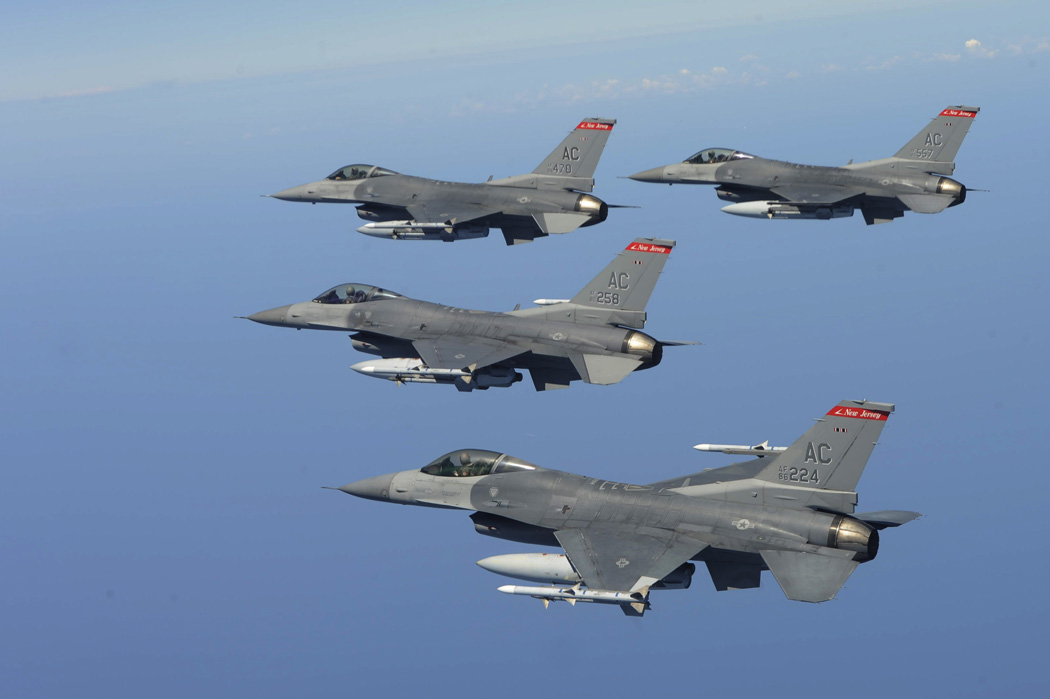
A formation of F-16C Fighting Falcons from the 177th Fighter Wing flies a training mission 18 August 2009 near Atlantic City, N.J.
Active15 October 1962 – present
Country United States
Allegiance New Jersey
Branch  Air National Guard
TypeWing
RoleFighter
Part ofNew Jersey Air National Guard
Garrison/HQAtlantic City Air National Guard Base, Egg Harbor, New Jersey
NicknameJersey Devils
DecorationsAir Force Outstanding Unit Award
Commanders
Current
commander
Colonel Benjamin W. Robbins
Insignia
177th Fighter Wing emblem
Tail codeAC black tail stripe "New Jersey"

The 177th Fighter Wing is a unit of the New Jersey Air National Guard, stationed at Atlantic City Air National Guard Base, New Jersey. If activated to federal service, the Wing is gained by the United States Air Force Air Combat Command.

The 119th Fighter Squadron assigned to the wing's 177th Operations Group, is a descendant organization of the World War I 5th Aviation School Squadron (later 119th Aero Squadron), established on 5 June 1917. It was reformed on 30 January 1930, as the 119th Observation Squadron, and is one of the 29 original observation squadrons of the United States Army National Guard formed before World War II.

Mission

[edit]

Federal Mission: provide combat-ready citizen airmen, aircraft and equipment for worldwide deployment in support of United States Air Force objectives.

State Mission: support the citizens of New Jersey by protecting life and property, preserving the peace, order, and public safety when called upon by the Governor.

Units

[edit]
  • Headquarters 177th Fighter Wing[1]
  • 177th Operations Group
    • 119th Fighter Squadron
    • 227th Air Support Operations Squadron
    • 177th Operations Support Squadron
    • 177th Fighter Wing Detachment 1, Warren Grove Gunnery Range
  • 177th Maintenance Group
    • 177th Aircraft Maintenance Squadron
    • 177th Maintenance Operations Flight
    • 177th Maintenance Squadron
  • 177th Medical Group
  • 177th Mission Support Group
    • 177th Civil Engineering Squadron
    • 177th Communications Squadron
    • 177th Force Support Squadron
    • 177th Logistics Readiness Squadron
    • 177th Security Forces Squadron

History

[edit]

Tactical Air Command

[edit]

On 15 October 1962, the New Jersey Air National Guard 119th Tactical Fighter Squadron was authorized to expand to a group level, and the 177th Tactical Fighter Group was established by the National Guard Bureau. The 119th became the group's flying squadron. Other squadrons assigned into the group were the 117th Headquarters, 117th Material Squadron (Maintenance), 177th Combat Support Squadron, and the 177th USAF Dispensary.

January 1968 saw a new crisis, the seizure of the American ship USS Pueblo by North Korean forces, and the 119th was called to active duty. In May 1968, the 119th TFS was assigned to the 113th Tactical Fighter Wing, District of Columbia Air National Guard and stationed at Myrtle Beach Air Force Base, South Carolina when the active-duty 354th Tactical Fighter Wing deployed to South Korea. Group personnel were spread throughout the United States, Taiwan, South Korea, and South Vietnam. The 177th was placed in non-operational status. The 177th was reformed at Atlantic City airport in June 1969, and returned to New Jersey State control. The 119th Squadron transitioned into the F-105 "Thunderchief" in 1970.

Air Defense mission

[edit]
F-106s of the 119th Fighter-Interceptor Squadron, 1984

In 1972, the National Guard Bureau announced that the 177th would be gained by Aerospace Defense Command and be responsible for protecting the United States from airborne attacks, and so was redesignated as the 177th Fighter-Interceptor Group. In 1973, the unit transitioned to the Convair F-106 Delta Dart all-weather interceptor and assumed alert status the following year. In 1979 Aerospace Defense Command was inactivated and the group was reassigned to Air Defense Tactical Air Command, and then again changed to a numbered Air Force, First Air Force in 1985.

October 1984, the 177th participated in the air defense community's Worldwide Weapons Meet, known as "William Tell", at Tyndall Air Force Base, Florida. The unit captured the Special Achievement Award for Professionalism and Team Spirit, Overall Best Looking Aircraft, Best F-106 Team, Major Richard I. Bong Fighter Interceptor Award, Top Gun Award, F-106 Category Best Looking Aircraft Award, the Pratt and Whitney Award, the Sperry Corporation Award, and the General Dynamics Corporation Award.

In July 1988 the 177th started receiving their first General Dynamics F-16 Fighting Falcons, a compact, multi-role fighter aircraft. The initial F-16A/B's were of the Block 15 type, replacing the aging F-106 in the air defense role. Since this was the primary role of the unit, it was decided to upgrade these airframes with the air defense fighter variant. To that date the unit also flew some F-106s aside the F-16. The 119th FS was the last USAF unit to withdraw the F-106 from operational duty. In 1994 the squadron started trading in their air defense version of the Falcon for the more advanced block 25 version. In September 2007 the first USAF F-16Cs to be retired to AMARG were from the 119th Squadron who sent two to 309th Aerospace Maintenance and Regeneration Group. Replacing the aging block 25s were the not much newer block 30s. During this transition the mission of the squadron remained. This being a double task as an air defense squadron in the northern section of the US and as a multirole squadron to carry out contingency operations abroad.

During Operation Desert Shield/Storm, 73 members of the 177 FIG were called to active duty, and others served as volunteers. Fire fighters and Food Services personnel from the 177th Civil Engineering Squadron, elements of the 177th USAF Clinic, members of the Transportation section of the 177th Resource Management Squadron, and Explosive Ordnance Disposal personnel from the Consolidated Aircraft Maintenance Squadron provided backfill at various bases whose members had been deployed to Saudi Arabia. Those activated from the 177th Security Police Flight served at home station. And the 177th Chaplain's Assistant completed a five-month tour of active duty in Saudi Arabia. All members were returned to normal Guard status at home base by July 1991.

Last F-106 59-0031 of the 119th FIS with a newly assigned F-16A 81-739 of the squadron flying over the Atlantic City Beach, 1988

Since October 1998, the wing has had an active involvement in Operation Noble Eagle, Operation Southern Watch, Operation Northern Watch, Operation Enduring Freedom, Operation Iraqi Freedom, Operation Freedom's Sentinel, and Operation Inherent Resolve.[2]

From 1 May through 13 June 1998, the wing deployed five F-16C Fighting Falcon aircraft and 46 personnel to Howard AFB, Panama, in support of OPERATION CORONET NIGHTHAWK. 130 personnel rotated on a two-week basis during the six-week deployment. Operating as part of a joint interagency task force, the wing's role was to detect and identify suspected drug smuggling aircraft. Once identified, the suspected aircraft are turned over to law enforcement agencies for apprehension.

As a result of the September 11 attacks on the United States in 2001 the Wing found itself in a key position. Located between New York and Washington DC, the 119th FS was immediately tasked with providing combat air patrols over cities in its region. In fact three aircraft were scrambled to intercept the aircraft that impacted the Pentagon, but were too late. They were then vectored to intercept flight 93 which eventually crashed in Pennsylvania. Following the attacks, the 119th FS began flying missions for Operation Noble Eagle. On 12 July 2002 the squadron flew its 1000th mission for Operation Nobel Eagle. From that year they also started to contribute in other overseas contingency operations.

The wing has earned numerous awards to include the Air Force Outstanding Unit Award for the 2016-2017 and the 2018-2019 periods.[3] In 2019, the 177th Aircraft Maintenance Squadron (AMXS) was recognized as the Air National Guard top maintenance unit when it won the Category 1 Maintenance Effectiveness Award.[4] The 177th Medical Group earned the Air Force Outstanding Unit Award in 2009.[5]

Lineage

[edit]
  • Designated 177th Tactical Fighter Group, and allotted to New Jersey ANG, 1962
Extended federal recognition and activated on 15 October 1962
Nonoperational, from 26 January 1968 to 18 June 1969
Redesignated 177th Fighter-Interceptor Group on 27 January 1973
Redesignated 177th Fighter Group on 15 March 1992
Redesignated 177th Fighter Wing on 11 October 1995

Assignments

[edit]
Gained by: Tactical Air Command
Gained by: Aerospace Defense Command, 27 January 1973
Gained by: Tactical Air Command, 1 October 1979 – present

Components

[edit]
  • 177th Operations Group, 11 October 1995 – present
  • 119th Tactical Fighter Squadron (later 119th Fighter-Interceptor Squadron, 119th Fighter Squadron), 15 October 1962 – 26 January 1968; 18 June 1969 – 11 October 1995

Stations

[edit]
Designated: Atlantic City Air National Guard Base, New Jersey, 1991–present

Aircraft

[edit]

References

[edit]
[edit]
Revisions and contributorsEdit on WikipediaRead on Wikipedia
from Grokipedia
The 177th Fighter Wing is a unit of the stationed at Atlantic City Air National Guard Base, located at in . It operates F-16C Fighting Falcon multirole fighter aircraft as its primary equipment. The wing executes federal missions centered on air defense and sovereignty alert operations, alongside expeditionary combat deployments, while supporting state-level emergency response and disaster relief efforts. Tracing its origins to the 119th Aero Squadron formed in September 1917 during , the unit received federal recognition in 1930 as the 119th Observation Squadron and has since evolved through multiple redesignations, shifting from reconnaissance to interceptor and tactical fighter roles amid alerts and modern conflicts. Key activations include federal service during the Berlin Crisis in 1961, the Pueblo Incident in 1968, Operation Desert Storm with 70 personnel mobilized, and sustained contributions to post-9/11 operations such as Noble Eagle for homeland defense, Enduring Freedom, and Iraqi Freedom since 2001.

Role and Mission

Primary Operational Objectives

The primary operational objectives of the 177th Fighter Wing encompass delivering combat-ready airpower for homeland defense and expeditionary missions under federal tasking. The wing's core federal mission is to furnish highly qualified citizen-airmen, mission-capable F-16C Fighting Falcon aircraft, and supporting equipment for worldwide deployment to advance priorities, emphasizing rapid mobilization and sustained operational tempo. A key focus involves air sovereignty and defense of the continental , particularly the Northeast region, through integration with North American Aerospace Defense Command () operations. This includes maintaining alert postures for intercepting potential aerial threats, such as unauthorized aircraft or temporary flight restriction violations, as demonstrated in responses over areas like , in September 2025. Since its transition to the F-16 platform on October 1, 1998, under directives, the wing has prioritized general-purpose fighter roles, including continuous participation in for post-9/11 homeland security patrols and threat mitigation. Training regimens underscore multi-domain proficiency, encompassing air-to-air engagements, weapons system evaluations at sites like , and distributed operations exercises such as Sentry Aloha to enhance readiness for contested environments. These objectives ensure the wing's can execute , suppression of enemy air defenses, and forward deployment, while integrating active-duty elements like the 306th Fighter Squadron for augmented combat effectiveness since July 2022. Historical federal activations, including the 1961 Berlin and 1968 Pueblo , reinforce this emphasis on scalable response to imperatives.

Strategic Contributions to National Defense

The 177th Fighter Wing's primary federal mission involves providing combat-ready Citizen-Airmen, aircraft, and equipment for worldwide deployment to support United States Air Force objectives, emphasizing rapid response capabilities and operational readiness. This includes maintaining air sovereignty alert (ASA) postures as part of the North American Aerospace Defense Command (NORAD) framework, where the wing defends critical airspace sectors. Specifically, it covers the mid-Atlantic region from Long Island, New York, to the Virginia Capes, acting as the initial defensive layer for high-value targets including New York City and Washington, D.C. In this role, the wing conducts continuous armed aircraft patrols and interception missions to counter potential aerial threats, undergoing rigorous evaluations such as no-notice Fighter Alert Force assessments that test flying, maintenance, security, and command functions. Post-September 11, 2001, it has sustained involvement in , contributing to homeland air defense by scrambling fighters in response to unidentified aircraft incursions. Beyond continental defense, the wing supports expeditionary operations, including enforcement of no-fly zones in Operations Southern Watch and Northern Watch, as well as combat deployments during Operation Iraqi Freedom. Recent strategic enhancements include a historic deployment of F-16C Fighting Falcons from the 119th Fighter Squadron to Kadena Air Base, Okinawa, Japan, in October 2025 to strengthen Pacific readiness, alongside participation in distributed lethality exercises demonstrating rapid deployment to the theater, underscoring the wing's versatility in projecting against emerging global threats. Its consistent excellence has been recognized with multiple Outstanding Unit Awards, reflecting reliable delivery of mission-critical capabilities. These contributions bolster national deterrence by ensuring layered, responsive air superiority and integration with active-duty forces for surge capacity.

Organization and Units

Core Squadrons


The 119th Fighter Squadron constitutes the principal operational flying unit of the 177th Fighter Wing, tasked with conducting air defense, air superiority, and close air support missions using the F-16C Fighting Falcon multi-role fighter aircraft. This squadron maintains a fleet of approximately 18 F-16C jets, emphasizing high-performance capabilities in both air-to-air and air-to-ground roles. Established with roots tracing to 1917, the 119th holds the distinction of being the oldest continuously active fighter squadron in the Air National Guard.
Complementing the 119th, the active-duty 306th Fighter Squadron was activated on July 8, 2022, as the wing's first associated unit under Command's Total Force Integration program. Comprising around 50 personnel—including pilots, maintainers, and support staff—this squadron augments the 177th's F-16 operations by addressing elevated maintenance demands, fostering pilot proficiency, and enhancing overall combat readiness. Assigned to the 495th Fighter Group, the 306th leverages the wing's and facilities while integrating operations with the personnel, excluding leadership positions. This structure exemplifies hybrid active-reserve collaboration to sustain mission effectiveness.

Support and Logistics Elements

The 177th Fighter Wing's support and logistics capabilities are primarily organized under the 177th Mission Support Group and the 177th Maintenance Group, which ensure operational sustainment, base infrastructure, personnel services, and equipment readiness at Atlantic City Base. The Mission Support Group coordinates essential non-combat functions, including for facility maintenance and emergency response, force support for personnel management and morale programs, for base defense and , and communications for network and information systems operations. Central to logistics operations is the 177th Logistics Readiness Squadron, which manages , fuels distribution, transportation, and accountability to support F-16 Fighting missions and deployments. This squadron handles petroleum, oils, and lubricants (POL) functions, including fuel management for and ground vehicles, as demonstrated in exercises like integrated combat turnaround training where Airmen refueled assets under simulated combat conditions. It also oversees deployment logistics, such as coordinating blood drives and reutilization programs to optimize resources and reduce costs through partnerships. The 177th Maintenance Group provides direct logistical support for aircraft sustainment, encompassing the 177th Aircraft Maintenance Squadron responsible for inspections, repairs, and mission generation of the F-16 fleet to maintain rates. This group supports increased sortie production through specialized teams, including recent activations like the 306th for additional capacity, enabling higher fleet availability for air defense and expeditionary tasks. These elements collectively enable the wing's dual state-federal mission, with activations for events like the Berlin Crisis in 1961 and Pueblo Crisis in 1968 highlighting their role in rapid mobilization .

Bases and Infrastructure

Primary Location

The 177th Fighter Wing is headquartered at Atlantic City Air National Guard Base, co-located with in . This facility serves as the primary operational hub for the wing's fighter squadrons and support elements, enabling rapid response capabilities for both federal air defense missions and state emergency support. The base's address is 400 Langley Road, Egg Harbor Township, NJ 08234. The wing established its presence at this location in 1958, when the 119th Fighter-Interceptor Squadron relocated from Newark Airport to the former Naval Air Facility Atlantic City. Situated approximately 10 miles northwest of Atlantic City, the site's proximity to major East Coast population centers and airspace corridors positions it ideally for homeland defense operations, including surveillance and interception duties in coordination with the North American Aerospace Defense Command (NORAD). The joint civil-military nature of facilitates efficient logistics and maintenance while supporting commercial aviation.

Facility Developments and Upgrades

In 2019, the 177th Fighter Wing completed renovations to its , , and Lubricants (POL) facility, incorporating innovative in-house solutions to minimize disruptions and ensure continued fuel storage and distribution capabilities essential for F-16 operations. A 112-foot radio communications tower was erected in May 2021 to improve base-wide signal reliability and support enhanced command-and-control functions. In 2023, federal funding of $8.1 million was allocated for base upgrades, including installation of a high-security gate and initial maintenance hangar enhancements to bolster infrastructure security and aircraft sustainment. The for fiscal year 2026, passed by the House in September 2025, authorized $61 million for construction of a new maintenance hangar designed to accommodate advanced , addressing capacity needs for potential fleet transitions such as the F-35.

Aircraft and Equipment

Current Fleet

The 177th Fighter Wing's current fleet comprises F-16C/D Fighting Falcon multirole fighter aircraft, which have been in service since 1994. These fourth-generation fighters are equipped with advanced , systems, and precision weaponry, enabling air-to-air and air-to-ground operations for homeland defense and expeditionary missions. The wing's primary operational aircraft is the single-seat F-16C variant, flown by the for tasks including air superiority, interception, and . The two-seat F-16D variant supports training and specialized missions. The fleet undergoes regular maintenance and upgrades to maintain , with the activation of the 306th in recent years dedicated to enhancing support for the F-16 aircraft, including increased sortie generation rates. As demonstrated in exercises like Resolute Force Pacific 2025, the F-16s remain central to the wing's deployments, conducting missions from bases such as Komatsu in . While funding has been secured for infrastructure to accommodate future fifth-generation aircraft like the F-15EX or F-35, the 177th continues to rely on its F-16 fleet as of October 2025, with no completed transition reported.

Historical Aircraft Transitions

The 177th Fighter Wing, through its primary flying unit the , underwent several aircraft transitions reflecting shifts in mission emphasis from tactical fighter to air defense interceptor roles. In August 1958, upon relocation to Atlantic City Municipal Airport (now Atlantic City Air National Guard Base), the unit adopted the Republic F-84F Thunderjet, a swept-wing fighter-bomber suited for ground attack and air superiority missions. This marked the wing's early alignment with requirements. By 1962, following redesignation as the 177th Tactical Fighter Group, the squadron transitioned to the North American F-86H Sabre, a single-engine interceptor variant optimized for high-speed interception and ground support. In 1964, it upgraded to the North American F-100C Super Sabre, a supersonic fighter capable of nuclear delivery and conventional strikes, enhancing the unit's versatility amid escalating global tensions. The wing shifted to the Republic F-105B Thunderchief in 1970, a large supersonic designed for low-level penetration strikes, aligning with its tactical fighter designation after a period of deployment support. This was short-lived; by 1973, redesignation as the 177th Fighter Interceptor Group prompted adoption of the Convair F-106A/B Delta Dart, a Mach 2 interceptor equipped with advanced radar and missiles for air defense against Soviet bombers, with full alert status achieved in 1974. The F-106 served until 1988, providing continental air defense under tasking. In July 1988, the unit began replacing the aging F-106 with the General Dynamics F-16A/B Fighting Falcon (Block 15), initially retaining an air defense focus while introducing multi-role capabilities like precision strikes and beyond-visual-range engagements. This transition continued through 1994, after which F-16C/D variants were introduced, featuring upgraded , conformal fuel tanks, and enhanced for all-weather operations. On 1 October 1998, NORAD-directed conversion to a general-purpose fighter mission fully integrated the F-16C/D, emphasizing expeditionary deployments and homeland defense interoperability. These upgrades sustained the wing's readiness into the post-Cold War era.

History

Origins and World War II Era

The 119th Aero Squadron, the antecedent unit of the 177th Fighter Wing, was organized on September 17, 1917, at Langley Field, , as an active-duty training squadron during . It conducted pilot and instruction but saw no overseas deployment before in May 1919. In the , the unit was reorganized in September 1928 as the 119th Observation Squadron of the , stationed at Metropolitan Airport in Newark, and received federal recognition on January 30, 1930, as part of the 44th Infantry Division's aviation element. Equipped initially with observation aircraft such as the O-2 and later O-47s, the squadron focused on training, artillery spotting exercises, and support for infantry maneuvers, participating in annual summer encampments and state missions. With the onset of , the 119th Observation Squadron was federally inducted into active service on September 16, 1940, under the expansion of U.S. air defenses. The unit relocated for training to bases including Morris Field, , and Will Rogers Field, , before assignment to Drew Field, , where it conducted antisubmarine patrols along the Gulf Coast and East Coast using aircraft like the A-20 Havoc. It transitioned to fighter-reconnaissance roles but remained stateside, focusing on coastal defense and training without overseas combat deployment; the squadron was disbanded on May 20, 1944, at Thomasville Army Air Field, Georgia, amid Army Air Forces reorganizations.

Cold War Realignments and Air Defense

In the early period, the 177th's predecessor units underwent realignments to adapt to emerging air defense needs, with the relocating to Atlantic City Municipal Airport (later Atlantic City Air National Guard Base) on August 5, 1958, and transitioning to the F-84F Thunderstreak for tactical fighter roles. By 1962, the unit was reorganized as the 177th Tactical Fighter Group, equipped with F-86H Sabre fighters initially, followed by F-100 Super Sabres in 1964 and F-105 Thunderchiefs in 1970, supporting both state missions and federal activations such as the Berlin Crisis in October 1961 and the USS Pueblo incident in January 1968, during which squadron personnel deployed for air defense augmentation and operations including support. A pivotal realignment occurred in 1972 when the 177th was redesignated the 177th Fighter Interceptor Group under , shifting primary focus to continental air defense as the 119th Fighter Interceptor Squadron transitioned from F-105s to F-106 Delta Dart interceptors by 1973, assuming alert status the following year to patrol the mid-Atlantic region from [Long Island](/page/Long Island) to the Capes. This equipped the unit for rapid-response intercepts against potential Soviet bomber threats, maintaining continuous alert postures with armed aircraft and pilots on 15-minute readiness, contributing to the layered U.S. air sovereignty network amid escalating nuclear deterrence strategies. Throughout the late , the 177th executed air defense operations, including participation in the 1984 Worldwide Weapons Meet at Tyndall AFB, , where F-106 crews demonstrated interceptor proficiency in live-fire exercises against drone targets simulating enemy bombers. The unit's F-106 fleet, known for and MA-1 fire-control systems enabling beyond-visual-range engagements, sustained this mission until the mid-1980s, when initial upgrades toward F-16 Fighting Falcons began in 1988, reflecting broader ANG transitions as strategic threats evolved from massed bomber raids to more diverse aerial incursions.

Post-Cold War Transitions

Following the in 1991, the 177th Fighter Interceptor Group underwent redesignation on 15 March 1992 as the 177th Fighter Group, reflecting the broader U.S. Air Force shift away from dedicated interceptor missions toward more versatile fighter operations amid reduced strategic threats. This change aligned with post-Cold War force reductions and the emphasis on multi-role capabilities for units. On 11 October 1995, the unit was redesignated as the 177th Fighter Wing, incorporating the Objective Wing organization structure that centralized operations, maintenance, and support under a single wing headquarters. Concurrently, the wing transitioned its fleet from F-16A/B variants optimized for air defense to F-16C/D models beginning in , enhancing precision strike and ground attack capabilities with advanced and weaponry. A pivotal mission realignment occurred on 1 October 1998, when the 177th Fighter Wing converted from its -assigned air sovereignty alert role—focused on intercepting potential incursions over the mid-Atlantic region—to a general-purpose F-16 fighter mission supporting global Air Expeditionary Force deployments. This shift, driven by tasking and the evolving post-Cold War security environment, ended the unit's dedicated alert posture while enabling participation in expeditionary operations, as demonstrated by its deployment of five F-16C aircraft and 130 personnel to , , from 1 May to 13 June 1998 for Operation Coronet counter-narcotics interdiction.

21st Century Deployments and Modernization

Following the September 11, 2001, terrorist attacks, the 177th Fighter Wing initiated combat air patrols over the as part of the immediate response. This effort evolved into sustained participation in , focusing on homeland air defense and sovereignty missions, with involvement dating from October 2001 onward. The wing provided support to overseas operations, including Operations Enduring Freedom and Iraqi Freedom, through personnel deployments for logistics and sustainment roles. In May 2003, 177th Fighter Wing petroleum specialists fueled such as C-130s, C-17s, and C-5s in during Operation Iraqi Freedom, contributing to operational tempo across the theater. Additional engagements encompassed Operations Southern Watch and Northern Watch in the early 2000s, enforcing no-fly zones over . For modernization, the wing integrated the Human-Machine Interface Technology (HMIT) upgrade into its F-16C/D Fighting Falcon fleet by March 2014, enabling rapid via advanced cueing systems that allow pilots to designate targets through helmet-mounted displays. This enhancement, applied to select F-16 squadrons, improves and multi-role mission effectiveness without requiring full replacement. Recent activities underscore evolving readiness, including the 2025 REFORPAC exercise, where the wing deployed assets to test rapid power projection and interoperability in the Pacific theater, informing 21st-century strategies. In March 2025, several hundred airmen mobilized under reserve component directives, supporting rotational deployments. These efforts maintain the F-16's viability amid broader fleet sustainment, with no transition to fifth-generation platforms like the F-35 reported as of 2025.

Operations and Deployments

Major Combat and Support Roles

The 177th Fighter Wing executes federal combat missions primarily through the Air Sovereignty Alert (ASA) role for NORAD's , stationing armed F-16C/D Fighting Falcons on 24-hour alert at Atlantic City Airport to intercept and deter aerial threats over the . This mission, ongoing since the wing's transition to F-16s in 1994, involves rapid response to unidentified aircraft, with the unit achieving status as the first single-squadron entity to log 1,000 combat and irregular airspace patrol sorties in support of post-9/11 operations. The wing has supported overseas combat operations by deploying aircraft and personnel for enforcement of s and direct warfighting. From November to December 2000, five F-16s and approximately 150 personnel deployed to , , as Aerospace Expeditionary Force 9 under , conducting armed reconnaissance and combat air patrols over southern . Since October 2001, wing elements have contributed to Operations Northern Watch in Iraq's northern , Enduring Freedom in , and Iraqi Freedom, including and suppression of enemy air defenses, alongside sustained rotations for these theaters. Federal activations include full mobilization in 1961 for the Berlin Crisis, deploying F-84F Thunderstreaks to , and partial activation in 1968 for the Pueblo Crisis, with over 100 members sent to including for F-100 Super Sabre operations. In support capacities, the 177th augments active-duty forces with logistics, maintenance, and security personnel during crises, such as activating 70 members for Operation Desert Storm in 1991 to provide base support and aircraft preparation stateside. For Operation Iraqi Freedom, wing Airmen from the Logistics Readiness Squadron deployed to in 2003, fueling aircraft including C-130s, C-17s, and platforms at forward bases. Domestically, under state control, the wing's Mission Support Group delivers , communications, and force sustainment for , such as hurricane relief and search-and-rescue coordination, while maintaining readiness through exercises like Resolute Force Pacific in 2025 for Agile Combat Employment in the .

Recent Exercises and Readiness Activities

In August 2025, the 177th Fighter Wing participated in Resolute Force Pacific (REFORPAC) 2025, a historic exercise hosted in the Pacific region that emphasized Agile Combat Employment (ACE) tactics for distributed operations and rapid deployment. This first-of-its-kind involvement for the wing integrated F-16 Fighting Falcon operations with allied forces, focusing on contested environments to bolster deterrence capabilities against potential adversaries. Earlier in November 2024, the wing conducted Operation Pegasus Dawn alongside the 108th Wing, strengthening proficiency through simulated austere airfield operations, hot-pit refueling, and rapid aircraft generation in . This exercise honed the unit's ability to disperse forces and sustain combat sorties under resource-constrained conditions, enhancing overall wing interoperability and surge capacity. In May 2024, personnel from the 177th joined Sentry Aloha 24-2 at Joint Base Pearl Harbor-Hickam, , collaborating with active-duty and reserve aviation units to practice large-scale force employment, including air-to-air and air-to-ground missions with live ordnance. The exercise integrated the wing's F-16s into joint training scenarios, improving tactics, techniques, and procedures for high-end combat readiness. Domestically, the wing maintained operational tempo through recurrent night-flying sorties, such as those conducted from December 6 to 13, 2024, and multiple sessions in June, August, and December 2024, to sustain pilot proficiency in low-light conditions and home-station alert postures. In July 2025, Airmen executed "Operation Belt Feed," a focused event simulating ammunition handling and under expeditionary settings to refine support for sustained fighter operations. Civil engineer squadrons within the wing supported readiness via specialized drills, including a June 9, 2024, collaboration with units at Warren Grove Range for explosive ordnance disposal and base recovery training, and preparations for security scenarios in August 2025. These activities underscored the wing's dual-role capability in air defense and expeditionary engineering, ensuring holistic combat preparation.

Lineage and Honors

Official Lineage

The 177th Fighter Wing traces its formal lineage to the 119th Aero Squadron, organized as a training unit on 5 June 1917 and redesignated on 2 September 1917, which demobilized after service. The squadron's heritage continued through reorganizations, receiving federal recognition as the 119th Observation Squadron in 1930 as part of the 44th Infantry Division at . By 24 May 1946, it was redesignated the and allotted to the , forming the core flying component of subsequent group and wing structures. The parent organization's lineage commenced with the designation and allotment of the 177th Tactical Fighter Group to the ANG in 1962, followed by activation and federal recognition on 15 October 1962 at Atlantic City Municipal Airport (later Atlantic City Air National Guard Base), . The group entered non-operational status from 26 January 1968 to 18 June 1969 amid force reductions. It was redesignated the 177th Fighter Interceptor Group effective circa 1972–1973 to align with air defense missions under . Further redesignations reflected post-Cold War shifts: the 177th Fighter Interceptor Group became the 177th Fighter Group on 15 March 1992, emphasizing multi-role capabilities. On 11 October 1995, it gained wing status as the 177th Fighter Wing under Air Force restructuring to integrate composite missions, including the 119th Fighter Squadron's transition to F-16C Fighting Falcons by October 1998 for general-purpose fighter operations. The unit has remained stationed at Atlantic City Air National Guard Base since 1958, assigned to the New Jersey ANG with primary aircraft evolving from F-106 Delta Darts to F-16s.

Awards, Campaigns, and Recognitions

The 177th Fighter Wing has earned the Outstanding Unit Award multiple times, including for the period from September 5, 2018, recognizing superior performance across mission sets such as air defense and readiness. It repeated this honor in 2020, highlighting consistent excellence in providing combat-ready personnel and equipment over consecutive evaluation cycles. The wing's subordinate units have also received recognitions, such as the Outstanding Unit Award to the 177th Medical Group in 2009 for operational support contributions. Earlier decorations include Outstanding Unit Awards for periods spanning January 1, 1967, to March 1, 1968, and July 1, 1981, to an unspecified end date, tied to Cold War-era alert and training missions. In terms of campaigns, the wing traces campaign credits to World War II-era antisubmarine operations and the American Theater through its lineage units. It was federally activated during the Berlin Crisis in 1961 and the Pueblo Crisis in 1968, with personnel deployed worldwide, including to . During Operation Desert Storm in 1991, approximately 70 members were activated for support roles. Since October 2001, the 177th Fighter Wing has maintained continuous involvement in , conducting combat air patrols and homeland defense missions as a alert site following the . It has further contributed personnel to Operations Southern Watch, Northern Watch, Enduring Freedom, and Iraqi Freedom, augmenting expeditionary air operations in the .

References

Add your contribution
Related Hubs
User Avatar
No comments yet.