Hubbry Logo
1888 Barcelona Universal Exposition1888 Barcelona Universal ExpositionMain
Open search
1888 Barcelona Universal Exposition
Community hub
1888 Barcelona Universal Exposition
logo
8 pages, 0 posts
0 subscribers
Be the first to start a discussion here.
Contribute something
1888 Barcelona Universal Exposition
from Wikipedia
1888 Barcelona
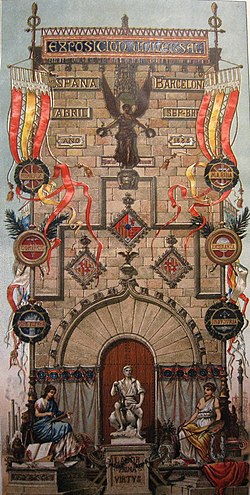
Official Poster
Overview
BIE-classUniversal exposition
CategoryHistorical Expo
NameExposició Universal de Barcelona / Exposición Universal de Barcelona
Building(s)Arc de Triomf
Area46.5 ha
Visitors2.300.000
Organized byTomàs Moragas (artistic director)
Participant(s)
Countries30
Location
CountrySpain
CityBarcelona
VenueParc de la Ciutadella
Coordinates41°23′17″N 2°11′15″E / 41.38806°N 2.18750°E / 41.38806; 2.18750
Timeline
Opening8 April 1888 (1888-04-08)
Closure10 December 1888 (1888-12-10)
Universal expositions
PreviousMelbourne International Exhibition (1880) in Melbourne
NextExposition Universelle (1889) in Paris

The 1888 Barcelona Universal Exposition (in Catalan: Exposició Universal de Barcelona and Exposición Universal de Barcelona in Spanish) was Spain's first International World's Fair[1] and ran from 8 April to 9 December 1888.[2] The second one in Barcelona was held in 1929.

Summary

[edit]
Pavilions in the Parc de la Ciutadella
CTE pavilion at the expo, designed by Antoni Gaudí.
The Arc de Triomf in Barcelona

Eugenio Serrano de Casanova (journalist, writer and entrepreneur) tried to launch an exposition in 1886, and when that failed, the Mayor of Barcelona, Francesc Rius i Taulet, took over[1] the planning of the project. The fair was hosted on the reconstructed 115-acre (47 ha) site of the city's main public park, the Parc de la Ciutadella, with Vilaseca's Arc de Triomf forming the entrance.[1] More than 2 million people from Spain, the rest of Europe, and other international points of embarkation visited the exhibition,[3] which made the equivalent of $1,737,000 USD.[2] The fair was opened by Alfonso XIII of Spain and Maria Christina of Austria.[1] Twenty-seven countries participated, including China, Japan and the United States.[3]

Contents

[edit]

The piano manufacturer Erard sponsored a series of 20 concerts featuring Isaac Albéniz, a Catalan pianist and composer best known for his piano works based on folk music idioms.[4] The artistic director was Tomàs Moragas.[5]

Luisa Lacal de Bracho won a gold medal and Josep Maria Tamburini won a silver medal at the exhibition.[6]

Legacy and surviving monuments

[edit]

The main legacy of the 1888 World Fair is the Ciutadella Park: the World Fair served as the opportunity for Barcelona to rid itself of the hated citadel and transform it into a central park for the city's denizens. The entire Ciutadella Park in its present layout is a product of the World Fair, with its monumental fountain and small ponds, its Castell dels tres dracs (Castle of the Three Dragons) built by Domènech i Montaner to house the World Fair's café / restaurant, which later served to house the Zoology Museum, Hivernacle (Glasshouse or Greenhouse), the classicist Geology Museum and the Umbracle (a remarkable shaded structure for plants).

Another product of the World Fair is the Modernista or Neo-Mudéjar Arc de Triomf (triumphal arch), the Fair's former gateway, presiding over Passeig de Lluís Companys.

The Columbus Monument (Monument a Colom), a 60 m (197 ft) tall monument to Christopher Columbus, was built for the exposition on the site where Columbus returned to Europe after his first voyage to the Americas. It was erected at the lower end of Les Rambles and remains standing today.

See also

[edit]

References

[edit]
[edit]
Revisions and contributorsEdit on WikipediaRead on Wikipedia
from Grokipedia

The 1888 Barcelona Universal Exposition was Spain's inaugural international , held from 8 April to 10 December 1888 in the to promote industrial, artistic, and cultural advancements amid the city's rapid urbanization. Organized under the regency of Maria Cristina following the death of , the event featured exhibits from 30 countries across 46.5 hectares, emphasizing fine and industrial arts while serving as a catalyst for demolishing 's medieval walls and expanding infrastructure like the as its grand entrance.
Attracting over two million visitors during its 246-day run, the exposition highlighted Catalan industrial prowess and bourgeois aspirations, with notable pavilions showcasing machinery, textiles, and that foreshadowed the rise of in architecture and design. It spurred significant , transforming former military grounds into public parks and boulevards, thereby embedding lasting landmarks and boosting Barcelona's global profile as a modern European hub. The fair's success, despite economic challenges, underscored the interplay of state patronage and local initiative in fostering and without notable controversies, though it reflected tensions between central Spanish authority and regional Catalan ambitions.

Historical Background

Political and Economic Context in Spain and Catalonia

's political landscape in the late 19th century remained marked by the aftermath of the of 1868, which overthrew Queen amid widespread discontent with her authoritarian rule and corruption, leading to the short-lived (1873–1874) and renewed that prolonged national instability. The Bourbon Restoration followed in December 1874 with ascending the throne, establishing a under the 1876 Constitution that emphasized turno pacífico—a pragmatic alternation between Conservative (led by ) and Liberal (led by ) governments to maintain elite consensus and avert further upheavals. This system, while stabilizing central authority in , suppressed regional autonomies and fostered resentment in provinces like , where economic dynamism clashed with centralized fiscal policies that redirected peripheral wealth to the core. Economically, exhibited relative stagnation compared to , with GDP per capita growth lagging due to heavy reliance on , protectionist tariffs that hindered competitiveness, and limited outside enclaves; industrial output constituted less than 10% of GDP by the , far below Britain's 30%. The loss of institutional reforms from earlier upheavals and ongoing colonial dependencies (though intact until 1898) diverted resources without yielding proportional modernization, resulting in levels stuck at about 40% of the European average. In , however, industrialization propelled divergence, with the sector—centered on spinning and weaving—expanding rapidly from the onward through and colonial raw material imports, making the region Spain's primary producer of fabrics by mid-century and accounting for over 80% of national output. , as the epicenter, saw its swell to around 450,000 by 1888, driven by rural migration to factories and ports that handled burgeoning exports. Alfonso XII's untimely death on November 25, 1885, from at age 27, plunged the monarchy into regency under until their son reached majority in 1902, introducing minor political flux amid unresolved succession questions and amplifying Catalan elites' incentives to showcase regional vitality against perceived Castilian neglect. This context of uneven development and fragile centralism underpinned Barcelona's initiative for the Exposition, as industrial bourgeoisie sought international legitimacy and economic leverage amid the Renaixença cultural revival that reasserted Catalan distinctiveness without direct confrontation.

Origins of the Initiative

The initiative for the 1888 Barcelona Universal Exposition originated as a private entrepreneurial proposal by Eugenio Serrano de Casanova, a Galician businessman, , and based in , who first approached the city council in to host an international exhibition aimed at showcasing local industry. Unable to muster adequate private funding or organizational backing, Serrano's effort stalled, highlighting the limitations of purely market-driven ventures without institutional leverage. This reflected the pragmatic self-interest of Barcelona's emerging industrial elite, particularly manufacturers dominant in the region's economy, who viewed such an event as a mechanism to penetrate foreign markets and counter Spain's peripheral position in global trade networks. In 1886, Barcelona's mayor, Francesc Rius i Taulet, assumed leadership of the project, transforming it from a faltering private scheme into a municipal priority that secured Spanish government endorsement. The exposition's organizers, including representatives from the city's commercial associations, prioritized export-oriented displays to address stagnant domestic demand and competition from European powers, driven less by civic than by calculated economic incentives for industrial expansion. Royal approval formalized the event's international status, enabling participation from over 30 countries and underscoring how local imperatives—rooted in Catalonia's sector, which accounted for a significant portion of Spain's output—propelled the initiative forward against initial skepticism regarding feasibility and costs. This bottom-up genesis contrasted with top-down state mandates seen in other European fairs, as Barcelona's leveraged the exposition to project industrial prowess amid Spain's uneven modernization, where regional autonomy in trade promotion filled gaps left by central authorities. The transition to official support ensured logistical viability, including site repurposing and infrastructure commitments, while aligning with broader merchant goals of fostering maritime and rail links for export growth.

Organization and Preparation

Key Figures and Funding

The organization of the 1888 Barcelona Universal Exposition was spearheaded by Mayor Francesc Rius i Taulet, who championed the initiative as a means to elevate Barcelona's global profile amid Spain's political instability following the death of King in 1885. Rius i Taulet coordinated the Central Commission, which included prominent Catalan industrialists and financiers such as banker Manuel , president of the Banco de Barcelona, and shipping magnate Claudio López Bru, who served as a commissioner representing private sector interests. These figures, drawn largely from Catalonia's burgeoning , emphasized local enterprise over central Spanish authority, reflecting regional economic autonomy. Funding relied predominantly on private capital, with Catalan banks and industrialists providing the bulk through subscriptions, lottery bonds, and direct contributions, underscoring the exposition's dependence on local entrepreneurial networks rather than substantial public subsidies. Initial commitments included 500,000 pesetas from the Barcelona city council and 1,500,000 pesetas from the Spanish state, but these were dwarfed by private fundraising efforts that aimed to amass around 20 million pesetas overall. The Fomento del Trabajo Nacional, a key industrial association, played a pivotal role in soliciting donations from textile manufacturers, shipowners, and merchants, prioritizing investments in infrastructure and exhibits to boost trade prospects. Public-private coordination revealed underlying tensions, as profit-oriented industrialists clashed with prestige-driven municipal goals, leading to budgetary overruns and an eventual deficit exceeding 7 million pesetas that strained Barcelona's finances for years. While proponents hailed the model as a triumph of Catalan initiative, the losses stemmed from optimistic revenue projections and inefficient allocation, where private backers sought commercial returns amid lavish displays that prioritized spectacle over fiscal restraint.

Site Selection and Urban Reforms

The site for the 1888 Barcelona Universal Exposition was selected as the former grounds of the Ciutadella fortress, a Bourbon-era military installation constructed between 1716 and 1719 following the to suppress Catalan resistance and enforce central absolutist control. The fortress, which included barracks for up to 8,000 troops and served as a political prison, symbolized repression under Bourbon rule and was widely resented by Barcelona's populace for restricting urban expansion and embodying foreign domination. After the of 1868, General transferred the site to the city in 1869, enabling its demolition and repurposing, which aligned with longstanding demands for dismantling absolutist structures to facilitate growth. This selection integrated with Ildefons Cerdà's 1859 expansion plan, which had anticipated the fortress's removal to connect the historic core with new grid-patterned districts, promoting hygienic urban extension amid Barcelona's industrialization and population surge to over 400,000 by the 1880s. Demolition cleared approximately 46.5 hectares (465,000 square meters), transforming a militarized enclave into the city's first major public green space and addressing and deficits in a smoke-choked industrial . Urban reforms centered on creating Parc de la Ciutadella, designed primarily by architect Josep Fontserè starting in 1872, with adaptations for the exposition including promenades, a central lake, and the monumental Cascada fountain completed between 1875 and 1881 to enhance aesthetic and functional appeal. These features incorporated for water circulation, supporting broader municipal efforts to mitigate risks from poor drainage and density, while the park's layout preserved some fortress remnants like the (later the Geology Museum) for practical reuse. The reforms yielded tangible hygiene benefits by introducing Barcelona's largest contiguous green area, fostering ventilation and recreation in an era of rampant and outbreaks tied to unchecked .

The Exposition Itself

Duration, Attendance, and Layout

The 1888 Barcelona Universal Exposition operated from April 8 to December 10, 1888, spanning 246 days, though the official inauguration occurred on May 20. It drew a total of 2.3 million visitors, averaging roughly 9,350 attendees per day. Paid admissions numbered about 1.23 million, with approximately 600,000 entering without charge, reflecting inclusions for locals, children, and special groups. The exposition grounds were centered in the , covering 47 hectares, with additional maritime exhibits linked to the nearby port. The layout integrated over 60 temporary structures, including galleries and display halls, arranged within the park's existing framework rather than a rigidly planned radial . Pavilions represented 30 participating countries, primarily housed within main buildings like the Palace of Industry rather than standalone national structures. The served as the principal gateway, channeling visitors into the core exhibition area.

Pavilions, Exhibits, and Technological Displays

The exposition's exhibits were housed primarily in large halls such as the Palacio de la Industria and a dedicated machinery section, rather than standalone national pavilions, allowing for integrated displays of industrial products and innovations across 46.5 hectares of the . Space allocations in these venues prioritized industrial output, with receiving 4,200 m², 3,200 m², France 2,500 m², and 1,600 m², alongside allocations for , , , , the , and others. These arrangements facilitated comparisons of mechanical efficiency and material quality, emphasizing practical applications in and to enhance competitiveness. Catalan industries dominated local showcases, featuring textile machinery that highlighted regional mechanization levels, though these lagged behind Belgian standards in steam integration. Agricultural equipment included approximately 300 Catalan-built machines for processing crops, such as wine production tools that demonstrated efficiencies in pressing and fermentation to support viticulture exports. Foreign contributions underscored technological disparities; French and German exhibitors displayed advanced chemical instruments, glassware, and orthopedic devices, with Germany's allocation enabling exhibits of precision engineering components. Overall, the displays cataloged over 12,000 exhibitors from around 22 nations, focusing on trade goods like minerals, ceramics, and gas appliances to verify empirical advancements in productivity. Technological highlights centered on power generation and illumination, with early electric lighting systems—drawing on Edison's dynamos—installed in the Palacio de la Industria and extending to street-level applications, outperforming traditional gas in reliability for large-scale operations. Steam engines drove much of the machinery hall's operations, powering textile looms and agricultural prototypes like Escuder's ball mechanism for automated motion, which illustrated causal links between motive force and output efficiency. An awards system, documented in official catalogs such as Saturnino Lacal's El libro de honor, recognized innovations based on jury evaluations of utility and novelty, incentivizing exhibitors to prioritize verifiable improvements in over ornamental designs. These elements collectively promoted causal realism in , linking mechanical inputs directly to economic gains in exports and production scales.

Cultural and Entertainment Events

The official inauguration occurred on May 20, 1888, presided over by Queen Regent Maria Cristina acting on behalf of her infant son, King . The ceremony emphasized pomp and spectacle, with orchestral concerts in the Saló de Sant Joan, fireworks displays, and the revival of the Jochs Florals—traditional Catalan competitions honoring poetry and rhetoric, restoring a medieval custom to promote local . Performative events formed a core draw, including daily parades through the grounds and ethnographic demonstrations from foreign and colonial pavilions, such as living exhibits of and customs from Spanish territories like the . These were complemented by international congresses on , , and related sciences, which convened experts to discuss reforms and ethnographic studies amid the fair's industrial theme. Attendance surged during festival periods tied to these activities, contributing to a total of over 2.2 million visitors across the event's duration from to December 10, 1888, with roughly 1.2 million paying entry fees. Such spectacles enhanced public engagement and positioned as a hub of Mediterranean vibrancy, yet contemporary elite perspectives highlighted a tension: the emphasis on nationalist pageantry and diversionary risked overshadowing substantive and industrial objectives, framing the expo as more ceremonial showcase than economic catalyst.

Economic and Infrastructural Impacts

Financial Performance and Trade Outcomes

The 1888 Barcelona Universal Exposition generated significant revenues primarily from ticket sales and concessions, estimated at around 12 million pesetas, but total expenditures exceeded these figures, resulting in a deficit of approximately 6.5 to 7 million pesetas. This shortfall was ultimately covered by contributions from the Barcelona city government and the Spanish state, reflecting the event's reliance on public funds to offset private organizational shortfalls despite high attendance of over 2.4 million visitors. Such outcomes highlighted the inherent financial risks of ambitious international expositions, where upfront and promotional costs often outpaced immediate returns, even for a privately initiated venture backed by local industrialists. In outcomes, the exposition facilitated numerous commercial contracts between Catalan exhibitors and foreign buyers, particularly in sectors like textiles, machinery, and cork products, which showcased regional industrial strengths to over 30 participating nations. of boosts includes documented increases in Catalan merchandise shipments to Latin American and European markets in the years following the event, though precise volume metrics remain sparse in contemporary accounts and suggest modest rather than transformative gains. These results stemmed largely from private enterprise networks rather than state-directed policies, countering interpretations that frame the exposition as an early model for public welfare interventions in economic recovery.

Contributions to Barcelona's Modernization

The preparations for the 1888 Exposition accelerated the completion of key elements of Ildefons Cerdà's plan, including the paving and alignment of several chamfered blocks and avenues that had lagged since the due to funding shortfalls and administrative delays. City officials prioritized these works to facilitate visitor access and demonstrate urban progress, resulting in the operationalization of approximately 20% more grid infrastructure by late 1887 compared to pre-Exposition baselines. Sewerage systems, which had been rudimentary and prone to overflows in the expanding district, saw targeted expansions starting in 1886 under engineer Pere García Faria, with Exposition-driven funding enabling the construction of the first modern network serving the new bourgeois extension and core areas. This included separated drains for wastewater and stormwater, covering initial segments totaling over 10 km by 1889, which reduced risks in a of roughly 450,000 residents by improving diversion to the sea. Port enhancements focused on pragmatic commerce needs, with the completion of the Passeig de Colón waterfront avenue and the new Moll de la Fusta quay, extending docking capacity by about 300 meters to handle increased trade volumes during and after the event. These works, tied directly to Exposition for international shipping, boosted throughput without relying on symbolic embellishments. Public underwent a shift from gas to lamps in major thoroughfares like Las Ramblas, Passeig de Colón, and Plaça de Sant Jaume, with over 100 fixtures installed by opening day to extend usable hours for the anticipated 2.3 million visitors and local population. This infrastructure, powered by early generators, served as a for citywide electrification, illuminating roughly 5 km of high-traffic routes and marking a causal step in reducing nighttime limitations on economic activity.

Cultural and Ideological Dimensions

Architectural Innovations and Catalan Modernism

The 1888 Barcelona Universal Exposition featured a blend of neoclassical grandeur and nascent modernist experimentation, driven by the need to accommodate diverse exhibits within tight timelines and budgets. Official structures emphasized monumental scale, such as the , designed by Josep Vilaseca i Casanovas as the primary entrance gate; constructed from red brick in an eclectic historicist style with classical proportions, it stood 30 meters high and incorporated allegorical sculptures symbolizing Barcelona's hospitality toward participating nations. This design prioritized visual impact and symbolic function over utilitarian innovation, reflecting state oversight that favored representational aesthetics at the expense of practical efficiency. In parallel, the exposition showcased early Catalan Modernism through permanent pavilions like the Castell dels Tres Dragons, engineered by between 1887 and 1888 as a café-restaurant. This structure pioneered exposed brickwork combined with iron framing and ceramic ornamentation, techniques that anticipated Modernisme's emphasis on industrial materials and organic forms, distinct from Gaudí's concurrent but unrealized contributions to the event. The building's robust, castle-like facade demonstrated how competition among architects—fueled by the exposition's commercial imperatives—spurred technical advancements, such as load-bearing innovations that reduced construction costs compared to more ornate temporary pavilions elsewhere on the site. Competitive bidding and private sponsorships incentivized cost-effective designs, contrasting with extravagant state-commissioned elements prone to budgetary overruns; for example, while ephemeral displays relied on for rapid assembly, enduring structures like Domènech i Montaner's incorporated verifiable material efficiencies, evidenced by the Castell's survival and adaptation into a museum without major structural failure. This dynamic highlighted individual ingenuity responding to market demands, rather than prescriptive directives, fostering innovations that influenced subsequent Catalan architectural practices.

Interplay of Local and National Narratives

The 1888 Barcelona Universal Exposition embodied a tension between Spanish national aspirations and emergent Catalan regional assertions, with organizers leveraging the event to project as a dynamic industrial center within the broader Spanish framework. Promoted as a showcase of Spain's progress amid its imperial holdings, including , , and the , the Exposition drew on local bourgeois initiative to highlight Catalonia's and strengths, often framing the affair as a municipal triumph rather than a purely national endeavor. This local emphasis appeared in promotional posters and speeches that foregrounded 's medieval heritage alongside modern achievements, such as depictions of the city's historic core integrated with industrial exhibits, thereby reinforcing a sense of regional distinctiveness. Central oversight from , including royal endorsement under Regent Maria Christina, sought to align the Exposition with national unity, evident in official rhetoric invoking "honra y orgullo de la patria española" to underscore Spain's collective honor and imperial vitality. Yet, Catalan elites, through outlets like El Barcelonés, celebrated openings with phrases such as "El triunfo," prioritizing and local enterprise over centralized narratives, which generated subtle frictions over funding and thematic control. Unionist observers critiqued this regional tilt as potentially fragmenting Spanish cohesion, arguing it elevated parochial interests at the expense of imperial solidarity. In contrast, autonomist voices, including those in Catalanist periodicals like La Veu del Centre Català, portrayed the event as an affirmation of cultural vitality, where Barcelona's hosting demonstrated the region's capacity for self-directed progress without undermining loyalty to the Crown. This interplay avoided outright separatism, instead fostering a hybrid identity that balanced local pride—rooted in linguistic and historical revival—with national symbols, such as the Arc de Triomf bearing Spanish heraldic motifs alongside Catalan elements. The Exposition thus crystallized early modern Catalanism as compatible with, yet challenging to, Madrid's unitary vision, setting precedents for future regionalist mobilizations.

Controversies and Criticisms

Political Divisions and Regionalist Agendas

The 1888 Barcelona Universal Exposition exposed underlying political fractures between Spain's centralist monarchy and Catalonia's burgeoning regionalist sentiments, as local elites maneuvered to elevate Barcelona's profile while navigating Madrid's oversight. Organized primarily by Catalan industrialists and bourgeois figures under the regency of Maria Christina, the event served as a platform for advocating decentralist policies, emphasizing Catalonia's industrial achievements and to critique the inefficiencies of centralized . These elites, financially empowered by regional prosperity, channeled resources into political movements pushing for greater to compensate for the Spanish state's limited administrative reach. Tensions arose from conservative Catalanist factions who perceived the Exposition as an instrument of national assimilation, prompting acts of symbolic resistance such as the suspension of the official Floral Games—a longstanding Catalan poetry competition held on —to preempt political demonstrations, with opponents instead sponsoring an alternative event. This reflected elite divisions within Catalanism itself, where figures like Valentí Almirall decried the Exposition's alignment with the Spanish crown as compromising regional . The Exposition's backdrop of stark social inequalities fueled ideological opposition from emerging anarchist and worker circles, who viewed the lavish display as emblematic of bourgeois excess amid widespread urban poverty and labor exploitation in Barcelona's factories. Although no large-scale strikes disrupted the event itself, the period's rising labor unrest—exemplified by contemporaneous environmental protests at Rio Tinto mines involving thousands of workers—underscored causal links between elite-driven spectacles and proletarian grievances, with anarchists decrying the Exposition's role in masking systemic inequities rather than addressing them. In the aftermath, the Exposition accelerated the political ascendancy of Catalan regionalist parties, which capitalized on the event's demonstration of local vitality to dominate municipal in Barcelona and other Catalan cities, prioritizing self-government over strict centralism. This shift balanced arguments for Spanish unity's economic benefits against demands for regional , fostering a political landscape where decentralist agendas gained traction without immediate secessionist rupture.

Organizational Shortcomings and Public Backlash

The organization of the 1888 Barcelona Universal Exposition encountered significant delays in construction, exacerbated by workers' strikes that postponed major works from their start in June 1887 until March 1888, with negotiations for demolishing military buildings extending until immediately before the April 8 opening. These setbacks stemmed partly from initial mismanagement under director Eugenio R. Serrano de Casanova, whose leadership accrued debts and inadequate funding, prompting his removal and a restructuring of the executive board in 1887 under Mayor Francesc Rius i Taulet, who incorporated local business leaders and architects to salvage the project. Financial strains were evident in budget constraints that necessitated relying on existing structures like the Ciutadella Park's and , rather than comprehensive new builds, amid Barcelona's broader economic that stalled urban modernization efforts. The event concluded with a substantial deficit of approximately 6.72 million pesetas, reflecting overruns and underwhelming despite the exposition's ambitions. Public and elite support was uneven, with the exposition facing skepticism during the prevailing , as not all sectors endorsed the resource-intensive venture proposed initially by private interests before municipal intervention. Contemporary accounts highlight organizational controversies, including the directorial ouster as indicative of internal commission discord, though the event proceeded without further major halts, underscoring tensions between promotional hype and logistical realities.

Long-term Legacy

Surviving Monuments and Urban Endowments

The , encompassing 47 hectares, remains the primary physical legacy of the 1888 exposition, transformed from the event's venue into Barcelona's central urban park. Originally redesigned by architect Josep Fontserè to host exhibition halls and displays, the park now integrates repurposed structures into daily civic life, including the Parlament de Catalunya established in 1977 within the former arsenal building and the , which originated from exposition animal exhibits and formalized operations in 1892. These elements support ongoing urbanization by providing accessible green space amid the city's densification, with pathways and lakes facilitating pedestrian connectivity rather than mere commemoration. The , constructed as the exposition's principal entrance, stands 30 meters high in style under architect Josep Vilaseca i Casanovas, marking the threshold to the Passeig de Lluís Companys promenade. Retained post-event for its structural utility, it anchors urban circulation, framing views toward the park and enabling continuous public thoroughfare without reliance on tourism-driven upkeep. The Castell dels Tres Dragons, erected between 1887 and 1888 by initially as a café-restaurant, later served as the Museu de Geologia and Museu de Zoologia, housing collections until the latter's closure to the public in 2010. The building persists as a documentation center and , exemplifying for administrative functions that sustain municipal operations. Adjacent Hivernacle greenhouses, built for exotic plant displays, continue botanical preservation efforts, contributing to the park's role in urban maintenance. These endowments underscore utilitarian persistence, with the park's —paths, water features, and enclosures—integrated into Barcelona's expansion, accommodating from 400,000 in to over 1.6 million today by offsetting urban heat and promoting recreational access over nostalgic preservation.

Assessments of Broader Influence

Historians have linked the 1888 Exposition to a purported chain of mega-events that propelled Barcelona's urban evolution, including the 1929 International Exposition on and the 1992 Olympics, with proponents arguing it established a precedent for international showcasing and infrastructural renewal. Yet, assessments emphasize incremental continuity over transformative causality, situating these occurrences within Barcelona's established pattern of episodic urban interventions, such as the mid-19th-century expansion, rather than ascribing decisive origins to the 1888 event alone. Empirical reviews of hosting legacies for world expos indicate that while short-term visibility accrues, sustained economic multipliers often dissipate without complementary policy frameworks, a dynamic observable in Spain's post-Exposition trajectory. Culturally, the Exposition amplified Catalan by aligning with its stylistic zenith around 1888–1911, fostering visibility for architects like amid the event's decorative showcases, but this impetus rested on antecedent industrial accumulation and textile trade prosperity that predated the fair by decades. Barcelona's manufacturing base, centered on and , had already generated bourgeois patronage for innovative design by the , rendering less a novel Exposition byproduct than an extension of endogenous wealth-driven experimentation. Claims of the event singularly birthing a modernist overlook these causal priors, as evidenced by the movement's roots in regional Renaixença cultural revivalism independent of expo stimuli. Economically, narratives of the Exposition catalyzing Barcelona's ascent as a nexus persist, yet quantifiable legacies remain elusive amid Spain's broader stagnation; per capita GDP failed to recover pre-1929 peaks until the 1950s, reflecting structural agrarian dominance and that muted any Exposition-spurred network expansions. Visitor inflows of approximately 2.3 million generated transient commerce but no verifiable long-term uplift in volumes or industrial diversification, with patterns reverting to pre-1888 baselines dominated by colonial dependencies rather than diversified global ties. This tempers hyperbolic "modern " origin stories, as Catalonia's relative outperformance stemmed more from localized entrepreneurialism than the fair's isolated demonstration effects, underscoring causal realism in attributing persistence to foundational industrial preconditions over event-specific hype.

References

Add your contribution
Related Hubs
Contribute something
User Avatar
No comments yet.