


Community hub
Recent from talks
Contribute something
Nothing was collected or created yet.
Nissan 300ZX
View on Wikipedia
| Nissan 300ZX | |
|---|---|
 | |
| Overview | |
| Manufacturer | Nissan |
| Also called | Nissan Fairlady Z |
| Production | 1983–2000 |
| Assembly |
|
| Body and chassis | |
| Class | Grand Tourer / Sports car |
| Layout | Front-engine, rear-wheel-drive |
| Chronology | |
| Predecessor | Nissan Fairlady Z (S130) |
| Successor | Nissan 350Z |
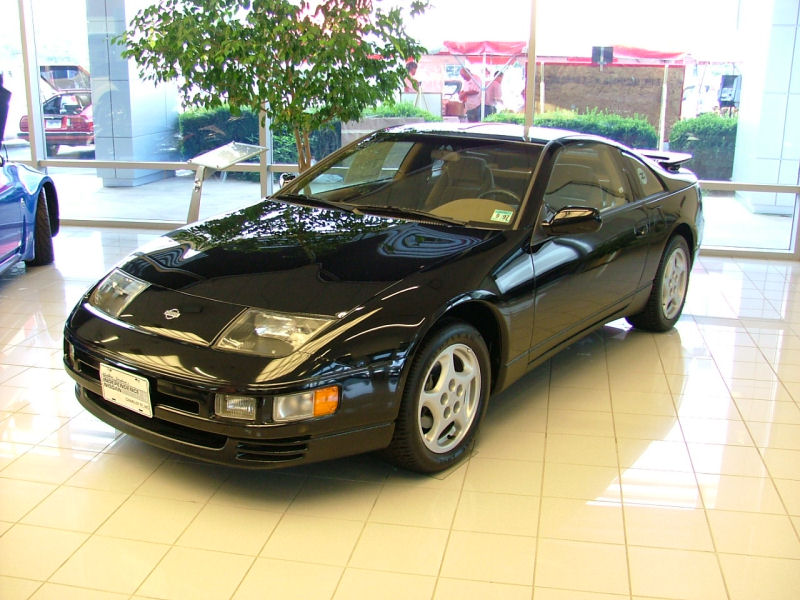
The Nissan 300ZX is a sports car that was produced across two different generations. As with all other versions of the Z, the 300ZX was sold within the Japanese domestic market under the name Fairlady Z.[2]
It was sold in Japan from 1983 to 2000 and in the United States from 1984 to 1996, the 300ZX name followed the numerical convention initiated with the original Z car, the Nissan Fairlady Z (S30), which was marketed in the U.S. as the 240Z. The addition of the "X" to the car's name was a carryover from its predecessor, the 280ZX, to signify the presence of more luxury and comfort oriented features. The first generation 300ZX known as the Z31 model was produced from 1983 through 1989 and was a sales success becoming the highest volume Z-car for Nissan.
To become even more competitive in the sports car market, the second generation 300ZX was driven up-market. It was redesigned to be faster and to feature more advanced technology, but came with a higher price than its predecessor, with consecutive price increases each model year of availability. As such, sales dwindled each year, a trend in the higher end sports car market at the time, and Nissan placed a hiatus on selling new Nissan Z-Cars to the US after the 1996 model year, though the car would continue to be sold in the Japan domestic market until 2001 in low production numbers.
Car and Driver placed the Z32 on its Ten Best list for seven consecutive years, each model year of its availability in the United States. Motor Trend awarded it as the 1990 Import Car of the Year.[3] The Nissan 350Z, officially the Z33 generation Z-Car, succeeded the 300ZX in 2003.
Z31
[edit]| Z31 | |
|---|---|
_(cropped).jpg) 1984–85 300ZX, with T-tops | |
| Overview | |
| Also called | Nissan Fairlady Z |
| Production |
|
| Model years | 1984–1990 |
| Designer | Kazumasu Takagi[5] (1982) |
| Body and chassis | |
| Body style | |
| Powertrain | |
| Engine | |
| Transmission | |
| Dimensions | |
| Wheelbase |
|
| Length |
|
| Width | 1,725 mm (67.9 in) |
| Height | 1,260 mm (49.6 in) |
| Curb weight | 2,888–3,280 lb (1,310–1,488 kg) |
| Chronology | |
| Predecessor | Nissan 280ZX |
| Successor | Nissan 300ZX (Z32) |

The Z31 chassis designation was first introduced in Japan on September 16, 1983, as the Fairlady Z. Designed by Kazumasu Takagi and his team of developers, the Z31 improved aerodynamics and increased power when compared to its predecessor, the 280ZX. The newer Z-car had a drag coefficient of 0.30 and many were powered by Japan's first mass-produced V6 engine instead of the inline-sixes of the previous Z-cars. According to Nissan, the new V6 engine was intended to uphold the sporty, six-cylinder spirit of the original Fairlady Z, but in a more compact and efficient package.[5]
Mechanical
[edit].jpg)
All Z31s were equipped with engines that had electronic fuel injection (EFI), and all cars were rear wheel drive. There were five engine options in total: A turbocharged dual overhead cam 2.0 L straight-six (RB20DET (NICS), used in the 200ZR), a turbocharged single overhead cam 2.0 L V6 (VG20ET, found in the Japanese domestic market 200Z/ZS/ZG), a naturally aspirated single overhead cam 3.0 L V6 (VG30E, found in 300ZX), a turbocharged single overhead cam 3.0 L V6 (VG30ET, used in 300ZX Turbo) and a naturally aspirated dual overhead cam 3.0 L V6 (VG30DE, used in 300ZR).
| Model | Engine | Displ. | Config. | Power | Torque |
|---|---|---|---|---|---|
| 200Z /ZS /ZG[7] | VG20ET | 1,998 cc (122 cu in) | V6, OHC with turbo | 125 kW (168 hp) at 6000 rpm | 216 N⋅m (159 lbf⋅ft) at 3600 rpm |
| 200ZR[8] | RB20DET | 1,998 cc (122 cu in) | I6, DOHC with turbo | 133 kW (178 hp) at 6400 rpm | 226 N⋅m (167 lb⋅ft) at 3600 rpm |
| 300ZX | VG30E | 2,960 cc (181 cu in) | V6, OHC | 119–123 kW (160–165 hp) at 5200 rpm | 233 N⋅m (172 ft⋅lb) at 4000 rpm |
| 300ZR | VG30DE | 2,960 cc (181 cu in) | V6, DOHC | 140 kW (190 hp) at 6000 rpm | 245 N⋅m (181 ft⋅lb) at 4400 rpm |
| 300ZX Turbo[9][10] | VG30ET | 2,960 cc (181 cu in) | V6, OHC with turbo | 147 kW (197 hp) at 5200 rpm | 308 N⋅m (227 lbf⋅ft) at 3600 rpm |
| 300ZX (racing)[11] | VG30ET | 2,960 cc (181 cu in) | V6, OHC with turbo | 169 kW (227 hp) at 5200 rpm | 333 N⋅m (246 lbf⋅ft) at 3600 rpm |
Many of the Z31s were equipped with the new VG family of V6 engines, which was Japan's first 60-degree V6, unlike its predecessors, which used L-series I6 engines. The VG engines were found in the 200Z/ZS/ZG, 300ZX and 300ZR trims, from 2.0L to 3.0L. The VG30 engine was either a type A or type B sub-designation from 1984 to March 1987, while models from April 1987 to 1989 had a W sub-designation. The W-series engines featured redesigned water jackets for additional cooling, and fully floating piston wrist pins. Finally, these engines were equipped with self-adjusting hydraulic valve lifters.
Some Z31s are equipped with the turbocharged RB20DET engine, which are the last Z-cars to use a inline-six cylinder engine; these were sold as the Fairlady Z 200ZR, of which roughly 8,283 were produced between 1985 and 1988. 200ZR's came in two trims; 200ZR-I (base model with the 'slicktop roof,' crank windows, A/C, base model creature comforts, and only with a manual transmission), and 200ZR-II (t-top roof, more electronic options, and available with an optional automatic transmission). 200ZR models also came standard with the R200 limited-slip differential, white faced gauges, and ZR specific cloth upholstery.
The Z31s are equipped with a 5-speed manual or an optional 4-speed automatic transmission; all Z31 automatics were the E4N71B equipped with torque-converter lockup, including turbo models. All Z31s were equipped with a Nissan R200 rear differential.[citation needed] April 1987 and later turbo models received a modified R200 featuring a clutch-based limited-slip differential, except 1988 Shiro Specials which had a viscous-type limited-slip differential.
Technology
[edit].jpg)
As with some other Nissan models of the period, the new Z31s were equipped with a "Voice Warning System". The Voice Warning System used a pre-recorded voice box, the vehicle's radio and driver's door speaker to mute the radio and provide a vocal warning whenever the left or right door was ajar, the exterior lights were left on after the vehicle was turned off, parking brake was left on while trying to operate the car, or the fuel level was low. This system was dropped for the 1987 model year.[12]
Other technological features in the 300ZX included a "Body Sonic" audio system (which utilized a separate amplifier and speakers in the vehicle's front seats that allowed bass from music to be felt by the vehicle's occupants), analog gauges, stereo and climate control, or an optional digital gauge cluster, digital stereo with equalizer and an optional fully digital climate control system.
Chassis
[edit]The Z31 chassis was based on the 280ZX. Although the newer chassis had the same wheelbase and MacPherson strut/semi-trailing arm independent suspension design,[13]: 85–86 it handled and accelerated better than the 280ZX it replaced.[14]: 129–130 Turbocharged models, except for the Shiro Special edition, lower trim 200Z models, and the 200ZR-I, had 3-way electronically adjustable shock absorbers.[13]: 86–87 The Z31 was available in either left or right hand drive.
Style and evolution
[edit]


.jpg)
As originally released, the Z31 used black polypropylene bumper covers and body side moldings, with black front and rear spoilers. Turbo models had a hood-mounted scoop mounted off-center. All cars were fitted with a T-top roof.[15]
The Z31 body was slightly restyled in 1986 with the addition of side skirts, flared fenders, and 16-inch wheels (turbo models only). Many black plastic trim pieces were also painted to match the body color, and the hood scoop was removed.[16]
The car was given a final makeover in 1987 that included more aerodynamic bumpers, fog lamps within the front air dam, and 9004 bulb-based headlamps that replaced the outdated sealed beam headlights. The 300ZX-titled reflector in the rear was updated to a narrow set of tail lights running the entire width of the car and an LED third brake light on top of the rear hatch. This was the first car in history to have the central brake light with LED, in 1987 model year, made by Stanley Electric.
The Z31 continued selling until 1989, longer than any other Z-Car at the time. Cars produced from 1984 to 1985 are referred to as "Zenki" or "Zenki-gata" models, while cars produced from 1987 to 1989 are known as "Kouki" or "Kouki-gata" models. The 1986 models are unique due to sharing some major features from both. They are sometimes referred to as "Chuki" models, but are usually grouped with the Zenki models because of the head and tail lights.[17]
North American market
[edit]North America was the main market for the 300ZX, as for previous generations of the Z-car. It was introduced to the United States in October 1983, along with the remainder of Nissan's 1984 model year lineup.[18] By now the "Datsun" nameplate had been completely retired in North America.[18] Over 70,000 units were sold in North America in 1985 alone. There were three trim models available: SF, GL, and GLL. The SF model was only available in Canada. The new V6 (2960 cc) Single overhead cam engine was available as a naturally aspirated VG30E or a turbocharged VG30ET producing 160 and 200 hp (119 and 149 kW), respectively.[14]: 130 The 1984 to 1987 turbo models featured a Garrett T3 turbocharger with a 7.8:1 compression ratio, whereas 1988 to 1989 models featured a low inertia T25 turbocharger with an increased 8.3:1 compression ratio and slightly more power — 165 hp (123 kW) naturally aspirated and 205 hp (153 kW) turbocharged.[19]
For the 1986 model year, the base two-seater model was made available without the T-bars, creating a lower cost entry-level version.[20]
Special editions
[edit],_front.jpg)
,_interior.jpg)
Two Special Edition versions of the Z31 generation model were produced by Nissan; a 50th Anniversary Edition celebrated the company's semi-centennial in 1984 and offered additional luxury features, and a "Shiro Special", released four years later, with performance-oriented upgrades.[21][22][17]
The 1984 300ZX 50th Anniversary Edition, released to celebrate the automaker's half-century, was a turbocharged coupé (two-seater) model with a Light Pewter/Thunder Black color scheme. All 50th Anniversary Editions came equipped with a digital dash and ancillary gauges including average mileage, G-force, and compass readouts, in-car electronic adjustable shocks, Bodysonic speakers in the seats, cruise and radio controls in the steering wheel, mirrored t-tops, embroidered leather seats, embroidered floor mats, 16 inches (406 mm) aluminum wheels, rear fender flares, flared front fenders, a 50th AE logo badge on the driver's side front fender, and grey cloth indoor car cover with 50AE printing.[13]: 92–93 The only option available to the 50th Anniversary Edition was the choice between an automatic or a 5-speed manual transmission. 5,148 AE models were produced for the U.S. market and 300 for the Canadian market. A non-turbo 2+2 model was also available with 50AE badging in the Australian market.
.jpg)
.jpg)
In 1988, the turbocharged Shiro Special debuted with pearl white paint, stiffer springs and matched shocks, heavy-duty anti-sway bars, a unique front air dam, paint matched wheels, Recaro seats with matching door panels, painted bumperettes, white painted door handles and a viscous limited-slip differential. No options were available for the Shiro. It was the fastest car out of Japan, capable of 153 mph (246 km/h) speeds, as tested by Motor Trend with the electronic speed limiter disabled.[21][23] A total of 1,002 Shiro Special Z31s were produced for the U.S. market between January and March 1988,[22] plus an additional 75 units for the Canadian market.[24]
Japanese market
[edit]In Japan, the Z31 was marketed as the Fairlady Z and was originally only available with two turbocharged engines: the 170 PS (125 kW) VG20ET in the regular Fairlady Z and the 230 PS (169 kW) VG30ET in the Fairlady Z 300ZX.[25] Both outputs are JIS Gross and both engines use the Garrett AiResearch T03 turbocharger. The 300ZX, unencumbered by Japanese Government dimension regulations restricting overall width to less than 1,700 mm (67 in) was somewhat wider than the 2-liter models, at 1,725 mm (67.9 in).[25] Japanese 300ZX buyers were liable for additional yearly taxes that affected sales. As originally introduced, all Japanese market Fairlady Z's were slicktops, but the T-top option was made available in February 1984.
The 2-liter models later gained the 200Z, 200ZG, or 200ZS monikers to help differentiate from the larger, three-liter models. They all used the VG20ET. The 300ZX, meanwhile, came with the VG30ET, with similar specifications to the USDM model. The only Fairlady Z variant to use the VG30DE engine, and the only Japanese-market model with a naturally aspirated engine, was the 300ZR.[26] It continued to be marketed as a companion fastback to the more formal appearance of the Nissan Skyline-based Nissan Leopard coupé at Nissan Store Japanese dealerships.
The 200ZR model was introduced in October 1985, featuring the RB20DET NICS, which was the first generation of the RB engine to feature the DOHC 4 valve head and turbocharging. Speaking of the turbocharger, the 200ZR featured the world's first ceramic turbocharger, which was a joint project between Nissan and NGK.[27] Maximum power output is 180 PS (132 kW). The 200ZR was offered on both wheelbases, as either a slicktop (200ZR-I) or as a T-top (200ZR-II). 1985 to 1986 model year 200ZR's feature a wide central hood scoop to feed air to the top mount intercooler. This hood scoop was made much smaller with the October 1986 facelift, which generally made for a smoother appearance overall. Additionally, the smaller engine in the 200ZR dropped the cars weight by 170 kg (375 lb) compared to cars equipped with the VG30ET, dramatically changing the weighting of the steering. Every 200ZR came equipped with the R200 clutch-pack type limited-slip differential (featuring the lowest available gear ratio), stiffer springs and shocks, ZR specific seats/upholstery, and a ZR specific steering wheel (for 1985 and 1986). Recaro seats were optional in all facelifted ZR models (including the 300ZR), in both 2+0 and 2+2 seating configurations. Much like the Fairlady Z 432, the 200ZR features the "P" chassis code designation (either as a PZ31 or PGZ31, whereas the 432's chassis code starts with PS30). 8283 examples were made between 1985 and 1989 (only a handful of Z31's carried over into the 1989 model year). The production numbers between the "I" and "II" are as follows: 1044 200ZR-I: 880 2+0, 164 2+0. All 200ZR-I's came with manual transmissions. 7239 200ZR-II: 1126 2+0, 6113 2+2. Between the transmission options, 2345 were automatics, and 4894 were manuals. While by this point the Z31 had morphed into more of a GT, the 200ZR was an attempt by Nissan's engineers to claw back some of the sporty driving characteristics of the original S30 Fairlady Z/240Z. The more responsive engine, lighter body, shorter gearing, and stiffer suspension demonstrate this.
With the facelift, claimed power of the turbocharged 300ZX dropped to 195 PS (143 kW) as Nissan changed from Gross to Net ratings, and the VG20-powered models were discontinued.[28] This was also when the DOHC, naturally aspirated, 300ZR model was added to the lineup, with 190 PS (140 kW), making for three differently engined models with nearly the same performance. The 300ZR was positioned as a sportier alternative to the 300ZX Turbo, with tighter suspension settings and an R200 limited-slip differential, while the turbocharged 300ZX was now only offered with an automatic transmission, and the 200ZR was a budget alternative as it fit into a lower tax and insurance category thanks to its smaller engine.
European models
[edit]The European turbo models, as well as those sold in other markets unencumbered by strict emissions regulations, produce 228 PS (168 kW; 225 hp)[29] due to higher lift and higher duration on the camshaft profile, also known outside of Europe as the Nismo camshafts. The two-seater model was not available in mainland Europe but was available in the United Kingdom.[30] Some models were also equipped without catalytic converters. All European turbocharged models received a different front lower spoiler as well, with 84-86 models being unique and 87-89 production having the same spoiler as the USDM 1988 Shiro Special model.
Swedish- and Swiss-market models (as well as those sold in Australia) received exhaust gas recirculation control systems to meet those countries particular emissions regulations.[31]
Australian models
[edit]All Australian model Z31 300ZXs were 2+2 T-top body, with an engine offering of either the 3.0L V6 N/A VG30E, or the 3.0L V6 Turbo Charged VG30ET. The cars sold in 1984 and '85 were all naturally aspirated with no catalytic converter, while the turbocharged version was the only model available from 1986 to 1988. There was only one trim level in Australia, with the digital dashboard and climate control being an optional upgrade package, and leather seats only available in the redesigned series 3 "Californian" models. The Australian factory service manual provides camshaft measurements which do not match any of the known USDM or EDM camshaft profiles, the FSM states the exhaust valve has an open duration of 252 degrees, but the specified opening and closing angles add up to 258 degrees. All Australian publication content express that N/A versions possess 166 hp (124 kW), along with the turbocharged versions as 208 hp (155 kW).[32] The Australian 50th Anniversary Edition was more basic than the U.S. version, the 50th AE was a normal n/a 300ZX with the digital dash package, a black interior, black velour seats, and a 50th AE badge on the exterior. The exterior badge was fixed to the cars by dealerships, so the position of the badge is not the same on all models. There was no Shiro Special in Australia, and no models featured the adjustable shock absorbers.
Z32
[edit]| Z32 | |
|---|---|
 | |
| Overview | |
| Also called | Nissan Fairlady Z |
| Production |
|
| Model years | 1990–1996 |
| Assembly |
|
| Designer | Isao Sono & Toshio Yamashita (1986) |
| Body and chassis | |
| Body style |
|
| Powertrain | |
| Engine |
|
| Transmission | |
| Dimensions | |
| Wheelbase | 2,450 mm (96.5 in) 2+0[2] 2,550 mm (100.4 in) 2+2[2] |
| Length | 4,305 mm (169.5 in) 2+0[2] 4,520 mm (178.0 in) 2+2[2] |
| Width | 1,790 mm (70.5 in) 2+0[2] 1,800 mm (70.9 in) 2+2[2] |
| Height |
|
| Curb weight |
|
| Chronology | |
| Predecessor | Nissan 300ZX (Z31) |
| Successor | Nissan 350Z (Z33) |
Design
[edit],_1989,_rear.jpg)

The Z32 was designed by Isao Sono and Toshio Yamashita, approved in final form by Nissan management on October 1, 1986.[33] The body was wider with a rounder profile and fewer hard edges. It had a marginally increased coefficient of drag of 0.31 compared to the Z31's 0.30. Nissan utilized the Cray-2 supercomputer to design the new Z32 with a form of CAD software[34] making it one of the first production cars to utilize this tool.
Like previous generations, Nissan offered a 4-seater (2+2) model with the Z32. All Z32s initially featured T-tops as standard.[35] A hardtop model was available in North America, only in non-turbo models, and in Japan was available along with an extremely rare Twin Turbo model (Japan-only). All "Slicktops" were 2 seaters (2+0).
In 1992, a 2-seat convertible version (produced by ASC[36]) was introduced for the first time, in response to aftermarket conversions.
Mechanical
[edit]
The 2,960 cc (3.0 L) VG30DE V6 engine was carried over from the previous generation 300ZX (Z31), but fitted with a DOHC head and variable valve timing (N-VCT), producing 222 bhp (225 PS; 166 kW) at 6,400 rpm and 198 lb⋅ft (268 N⋅m) at 4,800 rpm in naturally aspirated (NA) form.[35] During instrumented testing conducted by Car and Driver in 1989, the NA car recorded a time of 6.7 seconds to accelerate from 0 to 60 mph (97 km/h), an elapsed time of 15.0 seconds over 1⁄4 mi (0.40 km) with a trap speed of 93 mph (150 km/h), and a maximum speed of 143 mph (230 km/h).[35]
The high output engine (VG30DETT) was upgraded with Garrett AiResearch parallel twin-turbochargers and dual intercoolers, producing 300 bhp (304 PS; 224 kW) at 6,400 rpm and 283 lb⋅ft (384 N⋅m) of torque at 3,600 rpm.[37] Benefiting from Project 901, the Z32 was the first car to be marketed following the introduction of the 280 PS (206 kW) power ceiling imposed by JAMA that remained until 2004.[38] Performance varied for the sprint from 0 to 60 mph (97 km/h), with recorded times of 5.0-6.0 seconds depending on the source,[citation needed] and a governed top speed of 155 mph (249 km/h).
The engine was detuned to 280 bhp (209 kW) when the optional automatic transmission was fitted, but an automatic-equipped car was slightly faster to accelerate to 100 mph (161 km/h), taking 15.8 seconds compared to 16.3 seconds for the manual.[39]
All Z32s used the same multilink rear suspension, a design shared with other Project 901 cars.[35] Turbo Z32s also featured adjustable two mode suspension and the four-wheel steering systems called "Super HICAS" (High Capacity Actively Controlled Steering), first introduced on the R31 Nissan Skyline.
Regional variations
[edit]North America
[edit]American Z-car sales reached one million sales during the 1990 model year, making it at that time the best selling sports car.[40] In America the 300ZX faced the same fate of many Japanese sports cars of the time. While the 1989 300ZX was priced at around $30,000, its final model year price increased to about $50,000. The mid-1990s marketplace trends toward SUVs and the rising Yen:Dollar ratio contributed to the end of North American 300ZX sales in 1996 with over 80,000 in sales. A Commemorative Edition for the final 300 units shipped to America included decals and certificates of authenticity.
Europe
[edit]

In the UK and Europe, all Z32s offered were in 2+2 TT form between 1990 and 1996 (1990–1994 for UK). They were sold through dealerships in the UK, France, Germany, Belgium and Italy.
Australia
[edit]In Australia, all Z32s offered were in 2+2 NA form between 1990 and 1995.
Japan
[edit]In Japan, the 300ZX continued until August 2000. The Japanese Domestic Market was offered a number of variants unavailable to the international market such as the "Version S" (Spec Model), "Version R" (Ready Model) and Slicktop Twin Turbo (the most expensive trim option only available in Version S guise).
Version S was a base grade specification that includes all necessary road trim and items as standard, such as stereo and A/C. It could be ordered with various options separately. Options were available separately by order only, and include:
- 2+0 SWB 2-Seater T-Top trim
- 2+0 SWB 2-Seater solid roof (slicktop) trim
- 2+2 LWB 4-Seater T-Top trim
- Automatic Climate Control
- Cruise Control
- 8-way Power Drivers Seat
- 4-way Power Passengers Seat
- Recaro Seats
- BOSE Audio
- VG30DE Naturally Aspirated Engine
- VG30DETT Twin Turbo Engine
- Super HICAS (only available on TT option)
- Anti-Lock Brake System
- Driver-side airbag
- Suede / Tweed / Cloth / Leather Seating
- All other available “Altia” options from order guide
Version R:
Available only on 2+2 LWB 4-Seater with the only major options being in N/A or Twin Turbo configuration, with automatic or manual transmissions, this trim came with preset options from the factory at a reduced (combined) cost, giving customers a “ready” model by which to order if they did not feel like ordering options one by one. This presented buyers with an easier choice selection and a “base model” car by which to settle for.
Standard features (for 1998) included:
- Recaro Seats
- Sideskirts
- Rear Spoiler
- Drivers Side Airbag
- Cloth Seats
- Anti-Lock Brakes
- Xenon HID Headlamps
- Cruise Control
- Automatic Climate Control
The only options were:
- Carbon / Marble Interior Trim
- Audio Equipment Package with EQ.
- Automatic or Manual Transmission
- VG30DE or VG30DETT
The aforementioned facelift of late 1998 featured a new front fascia, tail lights, optional Xenon HID headlights, optional rear spoiler, optional BBS mesh wheels, orange rear corner lights and an instrument cluster with white dials as well as other minor changes.
All JDM Z32s used a front rebar system made out of fiberglass rather than steel (like their American Market counterparts), and also had different exhaust systems with lighter weight Catalytic Converters (with only one set on the JDM Twin Turbo model vs. two sets on the USDM Twin Turbo models). Given the lack of these regulatory items, JDM Z32s were often more than 100 lb (45 kg) lighter than their American specification counterparts.[5]
Changes by model year
[edit]The Z32 chassis underwent some changes during its production run between 1989 and 2000 (Japan) and 1990 to 1996 (US). The Z32's extended model year sales in 1990 reached 39,290 units.[41]

1991
- Manual climate controls discontinued (except convertible models)
- New electronic climate controls allowed control over air flow direction, but the ambient temperature gauge was discontinued
- Air conditioner evaporator valve changed from aluminum to steel to reduce noise
- Driver-side airbag available as an option
- CD player option was added for both the TT and NA (previously only available in the NA), while the Bose stereo head unit changed
- Front brake rotors on NA models were changed to TT units (previous front rotors were 4 mm thinner)
- Brake master cylinder was changed to a new unit (February 1991)
- Nissan logo appears on front nose panel instead of a decal on the front fascia
- Hardtop coupe available mid-year (NA only)
- Floor mat logo changed from "300ZX" to "Z"
- Keyhole on driver's door and interior light illuminates green when door handle is pulled (similar to Z31)
- US Sales: 17,652 units[41]
1992
- Driver-side airbag made standard
- Dashboard and door complementary material changed from fabric to suede
- Separate mirror heater switch eliminated (combined with rear defroster switch)
- Power adjustable driver's seat standard on T-top models
- Mirror heaters made standard, and are activated with front windshield defrost button
- US Sales: 6,708 units[41]
1993
- Turbo oil line insulation changed
- Convertible option added
- Brake caliper material changed from aluminum to iron
- New style fuel injectors for the non-turbo, (except convertible)
- Upgraded Bose stereo made standard
- Air injection valve (AIV) system eliminated
- Non-turbo model, (except convertible), ECUs changed from 8-bit to 16-bit by Japan Electronic Control System Co.
- US Sales: 11,599 units[41]
1994
- Rear spoiler design changed to a taller, pedestal-type
- Seat belts redesigned; attachment points moved from door mounts to pillar mounts
- Super HICAS system changed from hydraulic to electrical actuation (previously power steering actuated)
- New style fuel injectors for the convertible
- Passenger-side airbag introduced and made standard
- Keyless entry added
- Titanium keys discontinued in November 1994
- 'Reset' button removed from clock
- Off-white 'Pearl' color is dropped. Future 'Pearls' are more of a semi-metallic white
- US Sales: 5,320 units[41]
1995
- New style fuel injectors for the twin-turbo (Less prone to failure from modern ethanol blended gasoline)
- Front fascia became body colored instead of gray strip
- Twin-turbo model ECUs changed from 8-bit to 16-bit (in late-1994 model year)
- Special 25th Anniversary gold paint available
- Version S trim level made available (Japan only)
- 16-inch BBS mesh wheels made available as an option (Japan only)
- US Sales: 3,135 units[41]
- Australian market received 40 only 25th Anniversary Editions with body enhancements including Front lower bar spoiler, grille fascia, High mount rear spoiler, rear bar lower lip, tailgate garnish, wheels and "25th Anniversary" decals.
1996
- Variable cam timing (NVTC) dropped due to emission regulations
- OBD II electronics introduced
- Driver's seat back rest no longer included adjustable side bolsters[41]
- Sales: 2,929 units - the last 300 of which are the "Commemorative Edition"[42]
MY1997-1998 (Japan only)
- Twin-turbo front fascia adopted by all models, presumably to lower production costs
- Lift-style window switches
- Version R trim level made available
- T-top option dropped from 2+0 models
- Automatic transmission option dropped from 2+0 models
MY1999-2000 (Japan only)
- Convertible chassis dropped
- Revised manual transmission using stronger synchronizers to combat a common "soft-synchro" problem that had become apparent on earlier Z32s.
- Instrument cluster with white dials
- New front fascia
- Xenon HID headlights
- New taillights (featuring clear turn signal lenses, chrome housings and black pinstriping)
- New taillight centre panel ("300ZX" lettering in red instead of silver)
- New rear spoiler (standard on TT models, option for NA models)
- New side-skirts (Version R only)
- Door locking mechanism of convertible adopted (all models)
- Steering member bracket and support stay of convertible added to 2+2 models
- Thickness of floor panels and structural members increased for greater rigidity (all models)
- Large central cross member added for greater rigidity (Version R only)
Tuned variants
[edit].jpg)
In 1990, Motorsports International of Waco, Texas collaborated with Japanese tuning company HKS to create the SR-71 Z32, named for the Lockheed SR-71 Blackbird. The cars were upgraded with larger Garrett turbochargers, HKS electronics and a Kaminari body kit designed by Pete Brock. The SR-71 was California CARB certified and was to be sold through a select dealer network and Japanese performance tuning shops located within the United States. It was planned to build 500 cars per year through 1993. One hundred orders were already in hand, but it is claimed that just eight cars were built.[43] The SR-71 claimed the title of the third fastest production car in the world in 1990 for a fraction of the price of a Lamborghini Diablo and Ferrari F40 according to the designer Randy Ball.[citation needed] The base price was $65,000 for the Z32 and SR-71 conversion.[44]
In 1995 and 1996, Steve Millen Motorsports (Stillen), developed a SMZ model with Nissan North America that were sold throughout the U.S. and Canada through designated Nissan dealerships. The performance upgrades were covered by the factory warranty. These performance upgrades included: Skyline Group N/GT-R Brakes, which were cross drilled and axially vented rotors with larger calipers and pistons and upgraded HI-Metal front and rear brake pads; a high flow intake system, which allowed the engine to run more efficiently; an aluminized steel free flow exhaust system, which extended from the catalytic converter; and a turbocharger boost pressure increase, bringing the total output to 365 bhp (272 kW) and 332 lb⋅ft (450 N⋅m).[45] Each vehicle was numbered in the engine bay and interior. A total of 104 SMZs were produced at $14,000 more than the standard Nissan Z32 Twin Turbo.[43]
Advertising
[edit]Nissan aired a commercial during Super Bowl XXIV in 1990 advertising the new Nissan 300ZX Twin Turbo. The 60-second commercial was directed by Ridley Scott and only aired once. Executives at Nissan pulled the commercial after the initial airing when they became concerned the commercial would promote street racing since the commercial features the 300ZX being faster than a sport bike, a Formula One car and a fighter jet.[46][47]
Another memorable 300ZX commercial is "Toys" from 1996. Inspired by the film Toy Story, the commercial is set to Van Halen's cover of "You Really Got Me" and depicts a G. I. Joe-like action figure coming to life, getting behind the wheel of a red 300ZX radio-controlled car and picking up a Barbie-like doll for a date, stealing her away from her husband, who resembles Ken. They then drive around the feet of Mr K, a caricature of former Nissan executive Yutaka Katayama acted by Dale Ishimoto, who smiles as he watches them go by.[48] Toy manufacturer Mattel filed a lawsuit against Nissan in 1997, claiming the ad's use of dolls that resemble G. I. Joe, Barbie and Ken amounted to "trademark and copyright infringement" and caused "irreparable injury to Mattel's name, business reputation and goodwill."[49] Mattel sought unspecified damages and an injunction that would pull the ad off the air.[49] Nissan defended the ad, claiming that the dolls were named "Roxanne", "Nick" and "Tad" and that they were modeled after celebrities.[50] Mattel and Nissan eventually settled the lawsuit out of court and observers noted that the lawsuit ultimately just gave Nissan and the advertisement further exposure and publicity.[51]
Motorsports
[edit]
The 300ZX was campaigned during 1984 and 1985 in showroom stock racing. The car scored a Trans Am win in 1986 at Lime Rock by Paul Newman for Bob Sharp Racing.[52] This would be the only Trans Am win by a 300ZX.[citation needed]
From 1985 to 1987, the Electramotive-developed GTP ZX-Turbo was raced in the IMSA GT Championship's GTP class and also the All Japan Sports Prototype Championship, badged as a Fairlady Z, using a Lola T810 chassis and a VG30ET engine. Following development through 1987, the car would become dominant in IMSA GT in 1988. Additional factory endorsement, combined with a new chassis, transmission and more reliable Goodyear tires contributed to the team's success. The SOHC VG30ET was making upwards of 1,000 hp (700 kW), with a power band that extended from 4,000 to 9,000 rpm on a single turbo.[53]

From 1990 to 1995, Steve Millen drove the twin turbo 300ZX for Clayton Cunningham Racing. The car dominated the IMSA in its GTO, then later GTS categories due to its newly designed chassis and engine. Millen would rank as the #1 Factory Driver for Nissan for 7 years and earn two IMSA GTS Driving Championships and two IMSA GTS Manufacturer's Championships. The biggest triumph for the Z32 racecar was the victory in the 1994 24 Hours of Daytona. In the 1994 24 Hours of Le Mans, the 300ZX ranked first in the GTS-1 class and 5th overall. In an attempt to level the playing field in the GTS-1 class by reducing the allowable horsepower, the IMSA declared the twin turbo VG engine ineligible for the 1995 season.[54] The 1995 GTS 300ZX car would debut with the V8 Nissan VH engine at Daytona[55] and would place first in the GTS-1 class at the 12 Hours of Sebring and Moosehead Grand Prix in Halifax.[56]
The JUN-BLITZ Bonneville Z32 holds the E/BMS class land speed record of 260.87 mph (419.83 km/h) set at the 1995 Bonneville Speed Trial.[citation needed] The vehicle was built as a partnership between JUN Auto and BLITZ. In 1990, JUN's first Z32 went 210.78 mph (339.22 km/h) at their Yatabe test course and hit 231.78 mph (373.01 km/h) after some tuning at Bonneville.[57]
Awards and recognition
[edit] | This section needs additional citations for verification. (May 2021) |
| Year | Motor Trend | Road & Track | Car and Driver | Automobile |
|---|---|---|---|---|
| 1990 | "Import Car of the Year"[58] "Top Ten Performance Cars" |
"Ten Best Cars in the World" | 10Best | "All Stars" |
| 1991 | — | 10Best | "All Stars" | |
| 1992 | 10Best | "All Stars" | ||
| 1993 | 10Best | "All Stars" | ||
| 1994 | 10Best | "All Stars" | ||
| 1995 | 10Best | — | ||
| 1996 | 10Best | |||
After the final year of U.S. sales (1996), the Z32 has continued to win awards:
- 2004: Automobile lists the Z32 as one of the 100 greatest cars of all time
- 2006: Automobile lists the Z32 on both the "20 Greatest Cars of the Past 20 years" and the "25 Most Beautiful Cars in History"
- 2010: GQ Magazine lists the Z32 as one of the most stylish cars over the past 50 years[59]
From the year it was introduced, the Z32 has also won many comparison tests against similar sports cars, including the Mitsubishi 3000GT/Dodge Stealth,[60] Mazda RX-7,[61] Chevrolet Corvette,[62] Toyota Supra, Dodge Viper, Porsche 944 S2,[63] and Porsche 968.
Safety
[edit]In Australia, the 1990 to 1995 Nissan 300ZX was assessed in the Used Car Safety Ratings brochure as providing "average" protection for its occupants in the event of a crash.[64]
In the US, the National Highway Traffic Safety Administration (NHTSA) gave the 1991-1993 300ZX 3 out of 5 stars in front driver collision crash test ratings.[65]
Trivia
[edit]Between 1999 and 2001, the Nissan 300ZX (Z32)'s headlights were also used under license on the Lamborghini Diablo, replacing its original pop-up lights.[66]
Notes
[edit]- ^ "South African History". SA Z-car. Archived from the original on 24 February 2001.
- ^ a b c d e f g Nissan 300ZX 1991 Service Manual No. SM1E-0Z32U0. Tokyo, Japan: Nissan Overseas Service Department. December 1990.
- ^ "Motor Trend Import Cars of the Year Complete Winners List". Motortrend.com. 20 September 2004. Retrieved 22 January 2012.
- ^ a b Long, Brian (2004). Nissan 300 ZX/350 Z. Veloce Publishing. p. 203. ISBN 978-1-904788-04-1.
- ^ a b c Long, Brian (1999). Datsun/Nissan 280/300 ZX. Veloce Publishing. pp. 66–69. ISBN 978-1-901295-06-1.
- ^ "Z31 Engine Information and Specifications". Xenon Zcar. Retrieved 20 February 2025.
- ^ "No. 236: Fairlady 200ZG (1985 : GZ31)". Nissan Heritage Collection. Retrieved 20 February 2025.
- ^ Calderwood, Charlie (9 June 2023). "Mitsubishi Starion EX vs Nissan Fairlady 200ZR: the forbidden Z". Classic & Sports Car. Retrieved 20 February 2025.
- ^ "No. 472: NISSAN 300ZX Turbo T-top 50th Anniversary (1983 : HZ31)". Nissan Heritage Collection. Retrieved 20 February 2025.
- ^ Sherman, Don (February 1984). "1984 Nissan 300ZX Turbo". Car and Driver. Retrieved 20 February 2025.
- ^ "No. 100: Fairlady Z 300ZX, Japanese Rally Championship in 1985 (1985 : HZ31)". Nissan Heritage Collection. Retrieved 20 February 2025.
- ^ Ceppos, Rich (November 1986). "Charting the Changes". Car and Driver. Vol. 32, no. 5. CBS Magazines. p. 61.
- ^ a b c Hutton, Ray (1985). "8: The third generation". The Z-series Datsuns: a collector's guide (Second ed.). Motor Racing Publications Ltd. pp. 83–93. ISBN 0-947981-02-0.
- ^ a b Lamm, Michael (November 1983). "Driving Nissan's New 300ZX". Popular Mechanics. pp. 85, 129–131. Retrieved 20 February 2025.
- ^ "Nissan 300ZX (brochure)". Nissan U.K. Ltd. April 1984. Retrieved 20 February 2025.
- ^ Taylor, Rich (July 1986). "PM Comparison Test: Super Coupes". Popular Mechanics. Photography by Humphrey Sutton. pp. 78–83. Retrieved 20 February 2025.
- ^ a b ZBUM. "The US 300ZX Production Numbers". Retrieved 4 February 2011.
- ^ a b Flammang, James M. (1994). Standard Catalog of Imported Cars, 1946-1990. Iola, WI: Krause Publications, Inc. pp. 173–174. ISBN 0-87341-158-7.
- ^ Flammang, p. 175
- ^ Flammang, p. 174
- ^ a b Z-Club Hungary. "Nissan 300ZX - Z31". Archived from the original on 30 September 2007. Retrieved 20 February 2007.
- ^ a b ZBUM. "US 1988 300ZX SS Registry and Information". Retrieved 20 February 2007.
- ^ Sillars, Brad (24 January 2014). "1988 Nissan 300ZX - From Shiro To Hero". Motor Trend. Retrieved 20 February 2025.
- ^ Koch, Jeff (25 March 2024). "1988 Nissan 300ZX 'Shio Special'". www.hemmings.com. Retrieved 28 August 2024.
- ^ a b 自動車ガイドブック [Japanese Motor Vehicles Guide Book 1983-84] (in Japanese), vol. 30, Japan: Japan Automobile Manufacturers Association, 28 October 1983, p. 178, 0053-830030-3400
- ^ ZBUM. "ZBUM's Z31 FAQs". Retrieved 13 March 2007.
- ^ 自動車ガイドブック [Japanese Motor Vehicles Guide Book 1986–'87] (in Japanese), vol. 33, Japan: Japan Automobile Manufacturers Association, 20 October 1986, pp. 115–116, 0053-870034-3400
- ^ 自動車ガイドブック [Japanese Motor Vehicles Guide Book 1987~'88] (in Japanese), vol. 34, Japan: Japan Automobile Manufacturers Association, 28 October 1987, p. 125, 0053-870034-3400
- ^ Nissan 300ZX, Model Z31 Series: New Model Introduction (PDF), vol. 130, Nissan Motor Co. Ltd., 1984, p. 14, archived from the original (PDF) on 9 April 2011, retrieved 19 March 2011
- ^ New Model Introduction Product Bulletin, pp. 13, 16
- ^ New Model Introduction Product Bulletin, p. 27
- ^ "Zed Speed - Part One". AutoSpeed. Archived from the original on 28 July 2011. Retrieved 23 October 2010.
- ^ Schefter, James (21 January 1998). All Corvettes Are Red. Simon and Schuster. ISBN 9780671685010.
- ^ "Johnthecopywriter: 300ZX Brochure" (PDF). Retrieved 23 October 2010.
- ^ a b c d St. Antoine, Arthur (August 1989). "1990 Nissan 300ZX Aces Form and Function". Car and Driver. Retrieved 27 February 2025.
- ^ Long, Brian (May 2004). Nissan 300ZX and 350Z: The Z-Car Story. Veloce Publishing. ISBN 9781904788041.
- ^ "Nissan 300ZX forum". TwinTurbo.NET. Retrieved 23 October 2010.
- ^ Lyon, Peter (13 April 2008). "Why Japan finally got its foot off the brake". The Japan Times Online. Retrieved 22 January 2012.
- ^ Griffin, Larry (September 1990). "1990 Nissan 300ZX Turbo Automatic Widens the Appeal". Car and Driver. Retrieved 27 February 2025.
- ^ "Z Cars ~ Z History". Zcca.org. Archived from the original on 7 January 2014. Retrieved 7 January 2014.
- ^ a b c d e f g "FAQ: What are the differences between model years?". TwinTurbo.net. 2007. Retrieved 8 February 2007.
- ^ Hillman, Paul. "The US 300 ZX Production Numbers". Retrieved 14 March 2008.
- ^ a b Jurnecka, Rory (12 July 2018). "Market Watch: 1990–1996 Nissan 300ZX Z32". Motor Trend. Retrieved 27 February 2025.
- ^ "Seen the Sr-71 Yet? Better Look Fast". Archived from the original on 22 October 2015.
- ^ "SMZ Brochure" (PDF). 300zxtt.co.uk. Retrieved 23 February 2023.
- ^ Edwards, Jim (6 June 2012). "TV Ads Ridley Scott Made Before He Directed 'Prometheus'". Business Insider. Retrieved 15 December 2015.
- ^ Nunez, Alex (4 February 2007). "Super Bowl XXIV: Nissan 300ZX Twin Turbo commercial by Ridley Scott". Autoblog.com. Retrieved 15 December 2015.
- ^ Remember Nissan’s Ken and Barbie Toy Ads? Throwback Thursday
- ^ a b "Mattel Sues Nissan Over TV Commercial". The New York Times. 20 September 1997 – via NYTimes.com.
- ^ "After Aqua, Mattel Goes After Car Ad". MTV. Archived from the original on 28 January 2023.
- ^ "Throwback Thursday: A Look Back at Nissan's 1996 $200 Million Ad Campaign". Archived from the original on 28 October 2021. Retrieved 23 February 2023.
- ^ Stone, Matt; Lerner, Preston (2009). Winning: The Racing Life of Paul Newman. Motorbooks. pp. 75, 172. ISBN 9780760337066.
- ^ "Electromotive VG30ET Power Band". RedZ31 Dyno Charts. Retrieved 20 June 2007.
- ^ Konik, Michael (1995). "On the Edge". Cigar Aficionado Online. Archived from the original on 13 October 2007. Retrieved 16 December 2014.
- ^ "Racing Heritage 2". Stillen. Archived from the original on 10 February 2007. Retrieved 5 March 2007.
- ^ "Imsa 1995". WSPR Racing. Archived from the original on 30 December 2006. Retrieved 5 March 2007.
- ^ "JUN Demonstration Cars". Tanaka Industrial. 2005. Retrieved 8 February 2007.
- ^ "Import Car of the Year". Motor Trend. March 1990.
- ^ gq.com (29 December 2009). "GQ Rewinds: The Most Stylish Cars of the Past 50 Years". GQ. Retrieved 27 May 2018.
- ^ St. Antoine, Arthur (August 1991). "1991 Nissan 300ZX Turbo vs. Dodge Stealth R/T Turbo". Car and Driver. Retrieved 28 February 2025.
- ^ "RX-7 vs. 3000GT vs. Corvette vs. 300ZX". Motor Trend. April 1992. pp. 46–52.
- ^ Phillips, John (February 1990). "1991 Chevrolet Corvette Z51 FX3 vs. Nissan 300ZX Turbo". Car and Driver. Retrieved 28 February 2025.
- ^ Sherman, Don (September 1989). "Two-seat heat". Popular Science. pp. 38–48. Retrieved 28 February 2025.
Picking a winner from this group [including the RX-7 and 944 S2] is not easy. [...] But if you're a sucker for a beguiling fender, if you appreciate leading-edge technology, and you hunger for a sports car that is an absolute joy to drive, there is but one way to travel: the new Nissan 300ZX.
- ^ "Passenger vehicles built 1982-2004, 2006 update" (PDF). Used Car Safety Ratings: 17. June 2006. ISSN 1176-9890. Archived from the original (PDF) on 27 September 2007. Retrieved 21 February 2007.
- ^ "Nissan 300ZX 2-DR. Hatchback". safercar.gov. Retrieved 15 December 2015.
- ^ Karkafiris, Michael (27 January 2017). "Did The Lamborghini Diablo Really Have Nissan Headlights?". Car Scoops.
Bibliography
[edit]- Jackson, Terry (1992). Japanese Super Cars. London: Apple Press. pp. 6–11, 44–51. ISBN 1-85076-365-8.
External links
[edit]


Nissan 300ZX
View on GrokipediaOverview
Development history
The Nissan 300ZX originated as the next evolution in Nissan's Z-car lineage, succeeding the Datsun 280ZX (S130 chassis), which had been produced from 1978 to 1983 and emphasized grand touring comfort over pure sports car dynamics.[2] As part of Nissan's global rebranding effort, the 300ZX marked the transition from the Datsun nameplate—used internationally since the 1960s—to the unified Nissan branding, with the Z31 generation introduced primarily under the Nissan name starting in 1983, though some early U.S. exports carried dual Datsun/Nissan badges during the phase-out period.[5][6] Development of the first-generation Z31 began in the early 1980s, with concept work starting around 1981 under the leadership of designer Kazumasu Takagi, aiming to reposition the Z-car as a premium sports coupe competitive in the global market against European rivals like Porsche.[7] Key design goals included enhancing aerodynamics for better high-speed stability, boosting overall performance through refined engineering, and elevating luxury with features such as improved interior materials and advanced amenities, all while maintaining an affordable entry point compared to luxury imports.[8][9] The Z31 achieved a low drag coefficient of 0.30, reflecting Nissan's focus on wind-tunnel-tested body shapes to reduce lift and improve handling.[10] Major milestones for the Z31 included its public unveiling at the 1983 Tokyo Motor Show in October, where it was presented as the Fairlady Z for the Japanese market, highlighting its sleek, angular styling and technological advancements.[2] Production commenced in Japan in late 1983, with vehicles going on sale domestically in December, followed by exports to international markets beginning in 1984.[9] For the second-generation Z32, engineering efforts kicked off in the mid-1980s, emphasizing cutting-edge technologies such as sophisticated suspension systems and electronic aids to further elevate performance and driver engagement, with development prioritizing a more aggressive, aerodynamic profile and superior build quality.[11] The Z32 debuted in 1989, continuing the Z-car's trajectory toward high-tech sophistication.[2]Production and sales
The first-generation Nissan 300ZX (Z31) achieved significant production volumes, with a total of 329,900 units manufactured between 1983 and 1989, including 294,516 units for export markets and 35,384 units for the Japanese domestic market.[12] This output marked it as the highest-volume Z-car in Nissan's lineup at the time, reflecting strong global demand for its blend of sporty performance and practicality.[12] Sales of the Z31 peaked in the U.S. market in 1985, with over 70,000 units sold, establishing it as a bestseller among Japanese sports cars during the mid-1980s.[13] The model's success stemmed from its affordable base pricing, starting around $16,000 for non-turbo variants, which made it accessible to a broader audience compared to European rivals, alongside the appeal of an optional turbocharged engine that delivered 200 horsepower for enhanced acceleration.[14] The second-generation Nissan 300ZX (Z32) saw lower overall production, totaling 164,170 units from 1989 to 2000, comprising 99,286 export units and 64,884 for the domestic Japanese market.[15] U.S. sales for the Z32 exceeded 80,000 units cumulatively from 1990 to 1996, with initial strong performance including approximately 39,000 units in its debut year of 1990.[16][17] However, Z32 sales declined sharply after the early 1990s, dropping below 10,000 units annually by 1994 due to the appreciating value of the Japanese yen, which raised pricing to over $40,000 for turbo models by the mid-1990s, and stricter U.S. emissions and safety regulations that necessitated costly redesigns.[18] This combination eroded its competitiveness in a market increasingly favoring more affordable or versatile vehicles. Production of the Z32 concluded in Japan in 2000, as Nissan shifted focus toward the burgeoning SUV segment amid changing consumer preferences for practical, all-wheel-drive family vehicles over high-end sports coupes.[6]First generation (Z31; 1983–1989)
Styling and body design
The Nissan 300ZX (Z31) featured an aerodynamic wedge-shaped body design, characterized by sharp angles and a low-slung profile that marked a departure from the softer curves of previous Z-cars like the 280ZX. This styling, led by designer Kazumasu Takagi, emphasized performance-oriented aesthetics with pop-up headlights, a long hood, and a standard T-top removable roof panel that enhanced the open-air driving experience. The overall form achieved a low drag coefficient of 0.30, contributing to improved high-speed stability and efficiency.[19][6][10][20] The Z31's body was constructed as a steel unibody for structural rigidity, with dimensions tailored for agile handling: a wheelbase of 91.3 inches for the two-seater variant, an overall length of 170.7 inches, and a curb weight ranging from 2,900 to 3,100 pounds depending on configuration. These proportions provided a balanced stance, with a wide track and minimal overhangs to optimize weight distribution. Pop-riveted panels and lightweight components helped maintain the model's sporty curb weight without compromising durability.[21][22][23] Over its production run, the Z31 underwent evolutionary styling updates to refine its appearance and aerodynamics. The 1986 model year introduced a minor facelift with a more rounded nose, revised hood shape, relocated fog lamps in the front bumper, and the addition of side skirts for a lower, more aggressive look; an optional digital dashboard also became available. For 1987–1989, further changes included updated bumpers and standard rear spoilers on turbo models to improve airflow management and visual cohesion, aligning the design with Nissan's evolving sports car ethos.[24][25]Powertrain
The powertrain of the first-generation Nissan 300ZX (Z31) centered on the VG-series 3.0-liter V6 engines, designed for a balance of performance and refinement in a rear-wheel-drive layout. The naturally aspirated VG30E featured a single overhead camshaft (SOHC) per bank with 12 valves and electronic fuel injection, producing 160 horsepower at 5,200 rpm and 173 lb-ft of torque at 4,400 rpm in 1984–early 1987 models; output increased to 165 horsepower from mid-1987 to 1989 thanks to refinements like floating wrist pins and improved cooling passages in the "W-series" variant, with torque remaining consistent at 173 lb-ft.[24][26][27] The turbocharged VG30ET, also SOHC, used a Garrett T3 turbocharger at 6.7 psi boost for 1984–1987 models and delivered 200 horsepower at 5,200 rpm and 227 lb-ft of torque at 3,600 rpm from 1984 to early 1987, rising to 205 horsepower from mid-1987 onward with ECU updates; in 1988–1989, it switched to a Garrett T25 turbocharger at 4.5 psi boost.[28][24][27] Both engines used a 9.0:1 compression ratio for the NA version and 7.8:1 for the turbo in 1984–1987, with the latter's lower compression aiding boost tolerance; turbo compression increased to 8.3:1 in 1988–1989.[26][27] Transmission choices included a standard five-speed manual (FS5R30A for turbo models, FS5W71C for NA) or optional four-speed automatic (E4N71B), both sending power to the rear wheels via a R200 differential housing; a viscous limited-slip differential was available as an option on higher-trim turbo models for improved traction.[29][26] Performance varied by configuration, with the NA model accelerating from 0-60 mph in 7.5–8.5 seconds and reaching a top speed of around 130 mph, while the turbo version improved to 6.5–7.0 seconds to 60 mph (6.8 seconds in Car and Driver testing with the manual) and 137–140 mph top speed, electronically limited in some markets.[28][21] Fuel economy reflected the era's standards, with EPA estimates varying by year and configuration; early turbo manual models were rated at 19 mpg city and 28 mpg highway (per 1984 Car and Driver testing), with observed figures around 18 mpg in testing, while estimates ranged 16–19 mpg city and 22–28 mpg highway for manuals overall, lower for automatics.[28][21][30]| Engine | Type | Displacement | Power (1984–early 1987) | Power (mid-1987–1989) | Torque | Compression Ratio |
|---|---|---|---|---|---|---|
| VG30E | SOHC V6, NA | 3.0 L (2,960 cc) | 160 hp @ 5,200 rpm | 165 hp @ 5,200 rpm | 173 lb-ft @ 4,400 rpm | 9.0:1 |
| VG30ET | SOHC V6, Turbo | 3.0 L (2,960 cc) | 200 hp @ 5,200 rpm | 205 hp @ 5,200 rpm | 227 lb-ft @ 3,600 rpm | 7.8:1 (1984–1987) 8.3:1 (1988–1989) |
Chassis and suspension
The Nissan 300ZX Z31 featured an independent suspension system designed for enhanced handling and stability, with MacPherson struts at the front incorporating high caster angles, low trail geometry, a shorter scrub radius, and increased anti-dive characteristics to improve steering response and reduce nose dive under braking.[21] The rear suspension employed semi-trailing arms with a lower roll center, greater anti-squat properties, a wider track, and negative initial camber, supported by structurally stiffer components and a broader pivot base for better cornering composure.[21] This setup contributed to a near 50/50 weight distribution, promoting balanced dynamics across various driving conditions.[31] Braking was handled by ventilated front disc brakes measuring 10.8 inches in diameter, paired with solid rear drums on non-turbo models; turbo variants upgraded to 11.4-inch rear discs for improved stopping power and heat dissipation.[21] The system delivered strong performance, with 70-mph stops recorded at 191 feet, exhibiting minimal fade and excellent stability.[21] Standard tires were sized 195/60R15 on non-turbo models, while turbo versions used wider 225/50R16 rubber on 16-inch wheels to enhance grip, complemented by 215/60R15 options on some turbo configurations.[32] Steering was provided by a rack-and-pinion mechanism, power-assisted and licensed from ZF, which offered precise, lash-free control with speed-sensitive assist that reduced effort at low speeds while firming up for high-speed stability.[21] The overall chassis tuning resulted in exceptional roadholding, with the Z31 praised for its composure and lack of understeer at elevated speeds, making it a benchmark for sports car handling in its era.[21]Features and technology
The first-generation Nissan 300ZX (Z31) incorporated several advanced electronic and interior features that emphasized comfort and technological innovation for a 1980s sports car. Standard on 1984–1986 models, the Voice Warning System delivered computerized audio alerts via a pre-recorded female voice for issues like low fuel, open doors, lights left on, and parking brake engagement, using a compact phonograph record mechanism with parallel grooves for multiple messages. This system, patented by Nissan and primarily in English for U.S. models, provided an early form of hands-free driver notification.[33] The optional Body Sonic audio system enhanced the entertainment experience with transducers embedded in the front seats, creating vibrations synchronized to the music for tactile feedback; it included eight units—four in the seat cushions and four in the seatbacks—powered by a dedicated amplifier integrated with the standard AM/FM stereo. Available on higher trims like the 1984 50th Anniversary Edition, this setup offered an immersive "feel" of bass and rhythm without compromising cabin space.[34][35] From 1987 onward, an optional $1,200 electronics package introduced a digital instrument cluster with LCD displays for speed, tachometer, fuel level, and other metrics, paired with a trip computer that tracked mileage, fuel economy, and elapsed time. Automatic climate control, also part of this package, used digital inputs to regulate cabin temperature precisely, while an optional digital compass mounted in the rear provided directional guidance. The interior supported these technologies with optional leather upholstery on power-adjustable seats, standard power windows and mirrors, and overall ergonomic design focused on driver-centric functionality.[36][37]Regional markets and variants
In North America, the Nissan 300ZX Z31 was marketed with a strong emphasis on turbocharged models, starting with the 1984 model year introduction of the VG30ET 3.0-liter V6 turbo engine producing 200 horsepower, while the naturally aspirated VG30E version offered 160 horsepower.[38] Non-turbo models were available in both 2-seater and 2+2 seating configurations, but turbo variants were exclusively 2-seaters to optimize weight distribution and performance.[39] The model became Nissan's sales leader in the region, with peak U.S. sales of 73,652 units in 1984, driven by its blend of sporty handling and luxury features.[40] In Japan, where it was sold as the Fairlady Z, the Z31 lineup included the GTS-1 trim with the VG30ET turbo engine, detuned to 195 horsepower in automatic transmission versions due to stricter emissions regulations, though manual variants reached 230 horsepower.[19] Naturally aspirated options like the 2.0-liter VG20E were also available exclusively in the domestic market, alongside smaller turbo engines such as the VG20ET (168 horsepower) and RB20DET (178 horsepower) for compliance with local displacement taxes.[41] Domestic sales remained relatively low at 35,384 units total, reflecting the model's export focus and competition from other Japanese sports cars.[12] European and Australian markets received right-hand-drive versions of the Z31, with engines adapted for local fuel quality and emissions standards; the naturally aspirated VG30E was detuned to approximately 168 horsepower (170 PS) in some regions to meet regulations, while turbo availability was limited until later years.[39][42] In Australia, early 1984-1985 models were naturally aspirated without catalytic converters, transitioning to turbocharged VG30ET variants from 1986 with Australia-specific suspension tuning for improved ride compliance on local roads.[43] Turbo models in these markets often produced higher outputs closer to 225 horsepower due to less restrictive tuning compared to U.S. federal standards.[44] The Z31 was offered in two primary body styles: a 2-seater hardtop for purist driving dynamics and a 2+2 targa-top variant providing additional rear seating at the expense of slight weight increase and cargo space.[39] The 2+2 configuration was standard in European and Australian markets, while in North America it was reserved for non-turbo models to maintain the turbo's sportier profile.[39] In Japan, both styles were available across turbo and non-turbo trims, allowing greater flexibility for domestic buyers.[39]Second generation (Z32; 1989–2000)
Exterior and interior design
The second-generation Nissan 300ZX (Z32) featured a significantly wider stance at 70.5 inches compared to its predecessor, contributing to enhanced stability and a more aggressive road presence.[45] Its exterior design emphasized aerodynamic efficiency with rounded, flowing lines and fixed projector-beam headlights slanted at over 60 degrees, departing from the pop-up lamps of the prior Z31 model. This styling achieved a low drag coefficient of 0.31, aligning with Nissan's development goals for superior high-speed aerodynamics.[45] The body measured 169.5 inches (two-seater) to 178.0 inches (2+2) in overall length and 96.5 inches in wheelbase, with curb weights ranging from approximately 3,300 to 3,500 pounds depending on configuration.[46][47] T-tops were standard on coupe models, offering an open-air experience, while a convertible variant—exclusive to the U.S. market—was introduced for the 1993 model year as a factory-authorized conversion by American Sunroof Corporation (ASC), featuring a manual soft top that retracted in about 30 seconds.[48][49] Inside, the Z32's cabin adopted a driver-focused cockpit layout, with controls for cruise, lighting, and HVAC clustered around the central gauge pod for intuitive access during spirited driving. Configurations included two-seater and 2+2 options in markets like the U.S., with the two-seater prioritizing sporty ergonomics.[45] Analog instrumentation provided clear readouts of speed, RPM, and other vitals, supplemented by a boost gauge on turbocharged variants. Upholstery choices included optional leather seating with Alcantara-like suede accents on door panels and dashboard from 1992 onward for a premium, grippy feel.[50] For the 1993 model year, minor exterior refinements included updated wheel designs and subtle taillight adjustments to enhance visual cohesion, alongside the addition of the convertible body style.[50]Engines and drivetrain
The second-generation Nissan 300ZX (Z32) featured two variants of the VG30 series 3.0-liter DOHC V6 engine, both designed for high performance and smooth power delivery. The naturally aspirated VG30DE produced 222 horsepower at 6,400 rpm and 198 lb-ft of torque at 4,800 rpm, emphasizing responsive acceleration without forced induction.[51] In contrast, the twin-turbocharged VG30DETT, equipped with Garrett AiResearch turbochargers and dual intercoolers, delivered 300 horsepower and 283 lb-ft of torque, representing a significant power increase for enthusiasts seeking supercar-like thrust.[45] These engines shared a 24-valve aluminum head design with variable valve timing on the intake side, contributing to their efficiency and broad torque bands. The drivetrain options prioritized driver engagement and reliability. A five-speed manual transmission (RS5R30A) with double-cone synchronizers was standard on most models, offering precise shifts and robust construction for high-torque applications.[52] An electronically controlled four-speed automatic (RE4R01A for non-turbo, RE4R03A for turbo) was available, providing smoother cruising at the expense of some performance responsiveness. All Z32 models included a viscous limited-slip differential (VLSD) in the rear R200 unit, which used silicone fluid to distribute torque between wheels during cornering, enhancing traction without the harshness of mechanical LSDs.[53] Twin-turbo models featured Nissan's Super-HICAS (High Capacity Actively Controlled Steering) system as standard, a hydraulic (early) or electronic (later) rear-wheel steering setup available on select naturally aspirated variants in Japan.[54] Performance metrics underscored the Z32's sporting credentials, particularly in turbo form. The twin-turbo model accelerated from 0 to 60 mph in 5.0 seconds, completed the quarter-mile in 13.7 seconds at 102 mph, and reached a top speed of 153 mph, making it competitive with contemporaries like the Porsche 944 Turbo.[55] The non-turbo version was slightly less brisk, with 0-60 mph in 6.7 seconds, a quarter-mile in 15.0 seconds at 93 mph, and a top speed of 143 mph.[51] Fuel efficiency varied by configuration and driving conditions, with combined estimates ranging from 17 to 22 mpg, reflecting the engines' thirst under aggressive use despite their advanced tuning.[46]| Engine | Type | Horsepower | Torque (lb-ft) | 0-60 mph (sec) | Quarter-Mile (sec @ mph) |
|---|---|---|---|---|---|
| VG30DE | 3.0L DOHC V6 NA | 222 @ 6,400 rpm | 198 @ 4,800 rpm | 6.7 | 15.0 @ 93 |
| VG30DETT | 3.0L DOHC V6 Twin-Turbo | 300 | 283 | 5.0 | 13.7 @ 102 |