Hubbry Logo
England Air Force BaseEngland Air Force BaseMain
Open search
England Air Force Base
Community hub
England Air Force Base
logo
8 pages, 0 posts
0 subscribers
Be the first to start a discussion here.
England Air Force Base
from Wikipedia

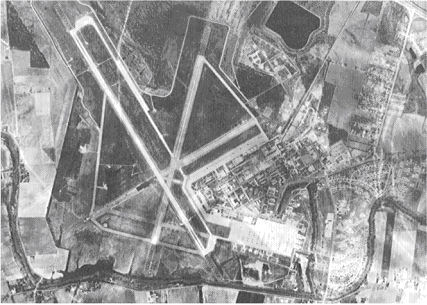
England Air Force Base is a former United States Air Force base in Louisiana, located 5 miles (8.0 km) northwest of Alexandria and about 170 miles (270 km) northwest of New Orleans. Originally known as Alexandria Army Air Base, on 23 June 1955 the facility was renamed England Air Force Base in honor of Lt Col John Brooke England (1923–1954).[1]

Key Information

The base was closed in 1992. The airfield and buildings are now Alexandria International Airport. Three episodes of The Crocodile Hunter were recorded in this base because the area is an important area for conservation.

History

[edit]

The base was opened on 21 October 1942 and during the Second World War performed Boeing B-17 Flying Fortress aircrew training. It was placed on inactive status on 23 September 1946, although a small cadre of Army and Air Force personnel (331 Composite Squadron) remained assigned to Alexandria Municipal Airport throughout the late 1940s.

Republic F-84G-1-RE Thunderjet Serial 51-733 from the 27th Fighter Escort Wing(SAC)taken during Operation Fox Peter Two in October 1952)
North American F-86F-25-NH Sabre Serial 52-4850 from the 366th Fighter-Bomber Wing.
Boeing B-KB50D Superfortress 48–123 of Air Proving Ground Command carrying out first triple-point refuelling operation with three North American F-100C Super Sabres (54-1825, 53–1774, 54–1848) of the 451st Fighter Day Squadron (322d FDG), 1956
North American F-100D-50-NH Super Sabre Serial 55-2895 from the 401st Tactical Fighter Wing.
North American F-100D-51-NH Super Sabre 55-2881 of the 3d TFW 531st TFS (Taken at Bien Hoa AB)
Ling-Temco-Vought A-7D-11-CV Corsair II Serial No: 71-0338 of the 75th Tactical Fighter Squadron taken in May 1973. A-7D attack aircraft were assigned to England AFB from 1972 through 1981

On 10 October 1950, the United States Air Force reopened Alexandria Air Force Base during the Korean War. The station's primary mission was tactical fighter operations for Tactical Air Command.

Its major operating units were:

67th Airdrome Squadron, 1 February 1943 – 25 March 1943
471st Bombardment Group, 1 May 1943 – 7 May 1943
469th Bombardment Group, 7 May 1943 – 1 April 1944
221st AAF Base Unit, 25 March 1944 – 1 March 1945
329th AAF Base Unit, 1 March 1945 – 23 September 1946
4416th Base Complement Sq, 23 October 1950 – 22 December 1950
137th Fighter-Bomber Wing, 22 December 1950 – 2 May 1952
Composite Air National Guard wing activated to Federal Service due to Korean War
Flew Republic F-84 "Thunderjets". Three operational squadrons 125th (Oklahoma ANG, F-84B/G, 127th (Kansas ANG F-84C/G), 128th (Georgia ANG, F-84B/G)). ANG personnel trained at Alexandria AFB 1950/51, being replaced by active duty Air Force personnel in 1951/52. Wing reassigned to USAFE at Chaumont-Semoutiers Air Base, France
132d Fighter-Bomber Wing, 2 May 1952 – 1 January 1953
Iowa ANG Wing activated to Federal Service replacing reassigned 137th FBW
One operational squadron (124th FIS). Flew Republic straight winged F-84s. Returned to state control.(F-84Fs were not assigned to front line units until January 1954-please see pages 42/3 in POST WORLD WAR TWO FIGHTERS 1945–73 U S Government Printing Office)
366th Fighter-Bomber Wing, 1 January 1953 – 1 April 1959
Active duty Air Force wing activated at Alexandria AFB. Three operational squadrons (389th, 390th, 391st) being initially equipped with North American F-51D Mustang, reequipped with North American F-86F "Sabre" jet aircraft by end of 1953.
Alexandria AFB renamed England AFB on 23 June 1955 in honor of Lt Col John Brooke England, who died in an aircraft crash in France while attempting to land in heavy fog.
Wing became first TAC unit to perform six-month TDY rotations with NATO at Aviano AB, Italy, with rotations continuing to support NATO in France and Italy. Redesignated 366th Tactical Fighter Wing 1 July 1958. Inactivated 1 April 1959 as part of a general budgetary reduction of USAF wings. Aircraft transferred to Air National Guard.
420th Air Refueling Squadron (Tactical), 18 March 1954 – 4 October 1955
(Activated at England AFB, equipped with Boeing KB-29P.
First unit in TAC of its type. Provided TAC with independent air refueling capability. Reassigned to USAFE at RAF Sculthorpe, England.
622d Air Refueling Squadron (Tactical), 18 July 1955 – 1 April 1964
Activated at England AFB, assigned to 4505th Air Refueling Wing, Langley AFB, Virginia 1 July 1958.
Equipped with Boeing KB-29P (1955–57), later turbojet-augmented Boeing KB-50J (1957–64) aircraft. Aircraft became obsolescent and unit inactivated 1 April 1964.
401st Tactical Fighter Wing, 1 April 1959 – 27 April 1966
According to AIR FORCE COMBAT WINGS 1947–1977(GPO) pages 194/5 and 214, the 366th FBW had two FB Groups under it: 366th & 401st. The 366th WING became a TFW in July 1958 and inactivated in April 1959. Meanwhile, the 401st FBG upgraded to a FBW in September 1957 and remained in place with four squadrons of F-100D/Fs. The aircraft and most of the personnel of the 366th Wing were transferred to other units in TAC and overseas. There was no redesignations of any 366th squadrons to 401st squadrons.
Four tactical fighter squadrons (612th, 613th, 614th, 615th) redesignated from former 366th TFW units. Participated in numerous firepower demonstrations, tactical exercises and maneuvers in the United States and overseas, and deployed its tactical squadrons to bases in Europe and the Middle East in support of NATO. Deployed to Homestead AFB, Florida during Cuban Missile Crisis (1962) as tactical airstrike unit. Wing designation along with 613th TFS reassigned to USAFE at Torrejon Air Base, Spain.
3d Tactical Fighter Wing, 9 January 1964 – 7 November 1965
Reassigned from Yokota AB, Japan, Equipped with F-100 Super Sabres after arrival at England AFB.
Four tactical fighter squadrons (90th, 416th, 510th, 531st)., with the 510th coming from Clark AB, RP and the 416th and 531st moving from Misawa AB Japan, each unit with about 25 F-100D/Fs, then trained and rotated its squadrons in detached status to Southeast Asia for combat duty. Reassigned to Bien Hoa AB, South Vietnam. The 3rd Wing number transferred from Yokota AB Japan along with one squadron number, the 90th "Pair-O-Dice", in the spring of 1964, so the wing had four squadrons assigned.[citation needed]
834th Air Division, 1 July 1964 – 15 October 1966
Assumed command and control over 3d and 401st Tactical Fighter Wings.
After reassignment of wings, assumed remaining organization and operational squadrons of former 401st TFW. Deployed to South Vietnamese bases (834th AD to Tan Son Nhut AB), (612th, 614th, 615th) TFS to Phan Rang AB, Phu Cat AB).
1st Air Commando/Special Operations Wing 15 January 1966 – 15 July 1969
317th, 319th, 603rd Air Commando/Special Operations Squadrons
Reassigned from Hurlburt Field Florida. Redesignated 1st SOW 8 July 1968. Reassigned to Hurlburt Field, Florida.
4410th Combat Crew Training Wing/Group 15 July 1969 – 31 July 1973
6th Special Operations Training Squadron, 427th, 4412th, 4532d Combat Crew Training Squadrons
Wing reassigned from Hurlburt Field Florida. Redesignated as Group, 15 September 1970. Inactivated July 1973 due to US withdrawal from South Vietnam. Upon group inactivation, 6th SOTS reassigned to 1st SOW at Hurlburt Field but remained at England AFB until inactivation, January 1974.

On 15 September 1970, the 4403d Tactical Fighter Wing, a temporary Major Air Command-Controlled (MAJCOM) unit, activated at England. With its subordinate 416th (activated 28 September 1970) and 431st Tactical Fighter Squadrons,[2] it absorbed returning North American F-100 Super Sabre aircraft of 31st TFW from Tuy Hoa Air Base South Vietnam. It transferred aircraft and other assets to the Air National Guard. Acted as holding unit for arriving LTV A-7D Corsair II aircraft starting April 1972. The 4403d TFW and the 416th TFS both inactivated on 1 July 1972.

On 1 July 1972, the 23d Tactical Fighter Wing reactivated at the base, without personnel or equipment, and took over the organization and assets of the temporary 4403d TFW. Three A-7D tactical fighter (74th, 75th, 76th) squadrons formed. The wing re-equipped with Fairchild Republic A-10 Thunderbolt II aircraft in 1981. Redesignated 23d Fighter Wing 1 October 1991. Inactivated 1 June 1992.[3]

Air Defense Command

[edit]

Alexandria (and later England) AFB was base for Air Defense Command interceptor and radar units along the Gulf Coast. In 1959, the 332d Fighter-Interceptor Squadron, assigned to the 32d Air Division stationed F-102 Delta Dagger interceptors at the base between 1959 and 1960.

In addition to the fighter-interceptor squadron, England AFB part of the planned deployment by Air Defense Command of forty-four Mobile radar stations across the United States to support the permanent Radar network established during the Cold War for air defense of the United States. This deployment had been projected to be operational by mid-1952. Funding, constant site changes, construction, and equipment delivery delayed deployment.

On 1 November 1954 the 653d Aircraft Control and Warning Squadron began operations at Alexandria AFB with the activation of AN/MPS-14, AN/TPS-1D, and AN/TPS-10D radars. The site was designated as M-125, and initially the station functioned as a Ground-Control Intercept (GCI) and warning station. As a GCI station, the squadron's role was to guide interceptor aircraft toward unidentified intruders picked up on the unit's radar scopes. The AN/MPS-14 continued to operate until site closure in 1963. In 1958 the site was operating an AN/FPS-20 search set.

In addition to the main facility, Air Defense Command operated three AN/FPS-18 Gap Filler sites:

England AFB was a planned Semi Automatic Ground Environment (SAGE) Data Center (DC) location, for the also-planned Shreveport Air-Defense Sector. However, in March 1963 Air Defense Command ordered the site to close due to budget reductions and operations ceased on 23 April.

The station was picked up by the Federal Aviation Administration (FAA) after the ADC shut down operations. The site is still in operations using the FPS-20A, being known as Alexandria, Louisiana. Virtually all other parts of this old Air Force radar station have been removed. A golf course now occupies part of the old M-125 site.

Closure

[edit]

In October 1990, the 1991 Base Realignment and Closure Commission decided that England Air Force Base would be closed by September 1992. Reduction of equipment and personnel began almost immediately. The 23d Fighter Wing's Fairchild A-10 "Thunderbolt II" aircraft were sent to other units, and the base was closed on 15 December 1992.[3] During the period of its military use, Air Force units from England Air Force Base served in combat in World War II, the Vietnam War and Operation Desert Storm.

See also

[edit]

Notes

[edit]

Further reading

[edit]
[edit]
Revisions and contributorsEdit on WikipediaRead on Wikipedia
from Grokipedia
England Base was a former installation located in , that served as a key training and operational hub for tactical air forces from through the era until its closure in 1992. Originally established in 1939 as the Alexandria Municipal Airport on a 1,339-acre site that later expanded significantly, it was leased to the U.S. Air Corps following the attack and activated as Alexandria Air Base in October 1942, primarily for training B-17 and B-29 bomber crews. The base was placed on standby status in 1946 and reverted to civilian use as a municipal , but it was reactivated in 1950 amid the as Alexandria Air Force Base under the , focusing on fighter and fighter-bomber operations. In June 1955, it was renamed England Air Force Base in honor of John B. England, a World War II flying ace with the 357th Fighter Group who achieved 17.5 aerial victories and later died in an F-86 Sabre crash in in 1954 while commanding a fighter-bomber squadron. Over its military history, the base hosted numerous units, including the 23rd Tactical Fighter Wing from 1972 onward, and supported a range of aircraft such as the F-84 Thunderjet, F-100 Super Sabre, A-7 Corsair II, and A-10 Thunderbolt II, contributing to pilot training, , and national defense missions. Designated for closure by the 1991 Base Realignment and Closure Commission due to post-Cold War reductions in military needs, England Base officially shut down on December 15, 1992, after employing around 3,000 and 681 civilians and generating approximately $100 million annually for the local . Following , the site was transferred to the England Economic and Industrial Development District in 1995 and redeveloped as England Airpark, a multi-use facility encompassing Alexandria International Airport (AEX), industrial parks, commercial spaces, and recreational areas like the Oakwing Golf Club, preserving its legacy while fostering economic growth in Central .

Overview

Location and Geography

England Air Force Base is situated in Rapides Parish, central , at coordinates 31°19′49″N 92°32′13″W. The installation encompassed approximately 2,284 acres, bounded by Bayou Rapides to the east and to the west. The base lies about 5 miles northwest of , the largest city in central , providing strategic access to regional transportation networks. It is positioned near the Red River, which flows through Alexandria and influences local hydrology, and borders the to the north and west, offering proximity to approximately 604,000 acres of protected pine-dominated woodlands. The region features a , characterized by hot, humid summers with average highs exceeding 90°F (32°C) and mild winters rarely dipping below freezing, supported by annual precipitation of around 50 inches (127 cm) that sustains dense vegetation. This climate, moderated by influences, contributed to the base's operational reliability for year-round activities. The terrain consists of relatively flat, low-lying typical of the Uplands, with elevations around 80 feet (24 m) above and sandy-loam soils dominated by loblolly and shortleaf pines, making it ideal for airfield construction and expansion. Land for the base was initially acquired in 1942 when the U.S. Army Air Corps leased the existing Alexandria Municipal Airport, comprising 1,339 acres from the McNutt Plantation and adjacent properties, for $1 per year amid preparations. By 1943, additional parcels were secured to support activation as Alexandria Army Air Base, with expansions in the early —including a 1954 donation from the City of —enlarging the site to accommodate runways and support facilities for tactical aviation.

Facilities and Infrastructure

England Air Force Base featured a primary designated 14/32, measuring 9,350 feet in length and 150 feet in width, constructed initially during and extended in 1943 to accommodate heavy bombers. A secondary , 18/36, spanned 7,000 feet in length and 150 feet in width, supporting tactical operations throughout the base's active period. These runways underwent periodic upgrades, including drainage tile repairs to address , ensuring compatibility with as the base evolved from propeller-driven trainers to modern fighters. The base's aviation infrastructure included multiple hangars along the flightline, such as Building 525 at 41,087 square feet and Building 2502 at 51,704 square feet, designed for maintenance and support. Support buildings encompassed maintenance shops totaling over 34,000 square feet, a control tower integrated with operations under the 1908th Communications Squadron, and various administrative structures that replaced early temporary tarpaper facilities with modern construction in the mid-1950s. Barracks consisted of four dormitory complexes housing seven dormitories and three visitors' quarters, providing accommodations for personnel across the base's operational phases. Fuel storage facilities were extensive, featuring a , oil, and lubricants (POL) area with 25 underground storage tanks ranging from 500 to 50,000 gallons for , diesel, and mogas, alongside 25 aboveground tanks up to 420,000 gallons capacity, including a hydrant refueling system with six 50,000-gallon underground tanks. Ammunition infrastructure included dedicated storage in Building 1633 and disposal sites such as Site D-1 for II-era bombs, with associated open burn/open detonation areas and hot pads for ordnance loading near runways and taxiways. For air defense, the base supported operations through the nearby Lake Charles Air Force Station, a 4.4-acre site equipped with systems approximately 90 miles southwest. Expansion efforts shaped the base's infrastructure over decades, beginning with 1939 land acquisitions from local plantations totaling 1,339 acres to establish the Municipal Airport, with subsequent military expansions bringing the total to approximately 2,284 acres. In the 1950s, following reactivation in 1950 and renaming in 1955, construction added modern hangars, support buildings, and fuel systems to replace wartime structures, enhancing capacity for tactical fighter wings. The 1960s saw further developments, including a precision approach installation south of Runway 14/32 for improved landing guidance and extensions to taxiways and aprons to support advanced aircraft operations. By the late 1960s and into the 1970s, infrastructure adaptations accommodated squadrons like the 23rd Tactical Fighter Wing, with reinforced aprons and maintenance facilities for A-7 Corsair II aircraft, including over 4,000 feet of taxiway additions.

History

Establishment and World War II Service

Alexandria Army Air Base was designated on October 16, 1942, and formally activated on October 21, 1942, as part of the U.S. Army Air Forces' expansion to support operations. The base, built on land previously used as the Alexandria Municipal Airport, benefited from the area's flat terrain and central location, which facilitated rapid construction of runways and support facilities suitable for heavy bombers. Assigned to , the base served primarily as a training facility and hosted units such as the 799th Bombardment Squadron, focusing on preparing personnel for in and the Pacific. was completed in , enabling the base to reach full operational status with expanded hangars, , and bombing ranges to accommodate intensive flight operations. During its World War II service, Alexandria Army Air Base trained numerous aircrews for the , emphasizing phase training programs that included specialized instruction for bombardiers, navigators, and gunners to ensure proficiency in , , and . Peak activity occurred in 1944, supporting a high of sorties and simulations that contributed significantly to the Allied air campaign. The base's role remained critical until its inactivation in late 1945, following the end of hostilities.

Postwar Inactivation and Reactivation

Following the end of , Alexandria Army Air Base was placed in standby status, with full inactivation occurring by early 1946 as training operations ceased and the facility was largely turned over to the city of for use as a municipal airport. The base remained in this reduced status under reserve oversight until the necessitated its reactivation on October 10, 1950, when it reopened as Alexandria Air Force Base and was assigned to for fighter-bomber training missions. Initial operations focused on equipping and training units with F-51D Mustang aircraft, including the activation of the 137th Fighter-Bomber Wing and its squadrons in December 1950 to prepare for combat deployment. During the early 1950s, infrastructure upgrades at the base supported the shift from propeller-driven aircraft to jets, enabling the hosting of advanced tactical units such as the 366th Wing, which began transitioning to F-84 Thunderjets by 1952. On June 23, 1955, the installation was renamed England Air Force Base to honor Lieutenant Colonel John Brooke England, a decorated P-51 Mustang ace who later commanded the 389th Squadron at the base after , achieving 17.5 aerial victories, and who was killed on November 17, 1954, in an F-86 Sabre crash near Toul-Rosieres Air Base, , while serving as commander of the 389th Squadron.

Cold War Tactical Operations

During the mid-1950s, England Air Force Base served as a key hub for tactical fighter training, hosting units equipped with the North American F-100 Super Sabre for air-to-ground operations. The 401st Fighter-Bomber Wing, redesignated as the 401st Tactical Fighter Wing, operated F-100s from the base starting in 1957, focusing on close air support and gunnery proficiency to enhance Cold War readiness against potential ground threats. Similarly, the 366th Fighter-Bomber Wing, later the 366th Tactical Fighter Wing, flew F-100s at England AFB from 1957 to 1959, conducting similar tactical maneuvers before transitioning to other aircraft and locations. These operations emphasized supersonic speed and precision bombing, adapting the base's infrastructure for jet-era demands such as extended runways to support high-performance fighters. The base's tactical operations evolved further in the 1970s with the arrival of the 23rd Tactical Fighter Wing on July 1, 1972, which assumed assets from the provisional 4403rd Tactical Fighter Wing and equipped with the LTV A-7D Corsair II for subsonic precision strike capabilities. The A-7D, featuring advanced navigation and bombing systems, enabled low-level attacks with high accuracy, prioritizing for ground troops in contested environments. In 1973, the 74th Tactical deployed to for seven months, flying sorties in support of the ongoing air campaign in and demonstrating the wing's role in sustaining U.S. tactical airpower during the war's final phases. This period underscored England AFB's contribution to developing precision strike tactics, with the 23rd TFW conducting routine exercises to refine integration with Army units and joint operations. Throughout the to , units at AFB participated in major exercises that advanced U.S. tactical doctrine, emphasizing realistic combat scenarios for fighter wings. Operations like those under honed air-to-ground coordination, with representative examples including weapons training deployments that simulated conflicts and improved sortie generation rates for rapid response. These efforts prioritized conceptual advancements in multirole fighter employment, focusing on survivability and mission effectiveness over exhaustive metrics, while avoiding overlap with defensive interceptor roles.

Air Defense Role

In 1956, England Air Force Base was integrated into the Air Defense Command's network to bolster continental air defense capabilities during the early period, hosting interceptor operations with aircraft as part of transitions to defensive roles. By 1959, the base supported the 32d Air Division's deployment of the 332d Fighter-Interceptor Squadron, which arrived from , , and began operations with supersonic interceptors designed for all-weather interception of potential bomber threats. These aircraft, armed with missiles and equipped for radar-guided intercepts, enabled the squadron to conduct air patrols and readiness exercises over central , contributing to the layered defense of the against Soviet long-range aviation incursions. The 332d Fighter-Interceptor Squadron's tenure at England AFB from July 1959 to July 1960 marked a brief but critical phase of dedicated air defense, with pilots training in supersonic tactics and ground crews maintaining the F-102's Hughes fire-control system for rapid response to airborne alerts. Although no 401st Fighter-Interceptor Squadron was permanently based there, England AFB's role aligned with Air Defense Command's emphasis on high-speed, long-range capabilities to counter intercontinental threats. England AFB was a planned site for integration with the Semi-Automatic Ground Environment (SAGE) system, intended to link local radars to the Shreveport Air Defense Sector's central computer network for automated tracking and vectoring of interceptors across the central U.S., providing real-time data fusion from ground-based AN/FPS-3 search radars. However, the Shreveport sector and associated SAGE facilities were cancelled. During the Cuban Missile Crisis in , England AFB achieved peak alert status as part of the nationwide air defense posture, with interceptor units scrambling to heightened readiness to defend against potential Soviet air reinforcements or retaliatory strikes, while alerts ensured coordinated coverage of Gulf Coast approaches. This episode underscored the base's strategic positioning for rapid deployment, as F-102 and F-100 assets from associated wings stood by for immediate launch under continental defense protocols. By the late , however, the interceptor mission waned as priorities shifted toward tactical operations. In 1981, the 23d Tactical Fighter Wing transitioned to the at England AFB, primarily for roles. The A-10's cannon and missile loadouts were adapted for ground-attack scenarios, allowing pilots to practice attacks against simulated low-flying intruders while emphasizing the aircraft's rugged design for survival in contested airspace. This evolution reflected broader adaptations in the waning , focusing on tactical fighter assets to address evolving threats from regional adversaries.

Closure and Transition

Base Realignment and Closure Process

England Air Force Base was recommended for closure as part of the 1991 (BRAC) process, initiated by the Department of Defense's initial list submitted in April 1991, amid broader post- military drawdowns that sought to reduce infrastructure and consolidate resources, including F-16 fighter operations at more strategically located installations. The recommendation reflected the Air Force's need to streamline tactical fighter wings following the end of the , with England AFB's role in supporting A-10 and F-16 squadrons deemed redundant in the evolving force structure. Local opposition to the closure was vigorous, led by elected officials, leaders, and who formed teams to lobby and the President while simultaneously preparing for potential . Economic impact studies commissioned by the highlighted the base's vital role, estimating that closure would jeopardize approximately 5,000 direct and indirect jobs in the area, representing a substantial portion of the regional reliant on base-related and contracts. Despite these efforts, including public hearings attended by thousands and testimonies emphasizing contributions, the BRAC Commission's recommendations were approved by in October 1991 without modification. The drawdown proceeded in phases to minimize disruption to ongoing missions under the 23d Wing, with the relocation of aircraft and personnel prioritized. The 23d Wing's aircraft and personnel relocated to Pope Air Force Base, , in phases during 1991 and 1992, with the wing activating there on June 1, 1992, marking the end of flying operations by mid-1992. The base achieved full closure on December 15, 1992, after the inactivation of the 23d Tactical Fighter Wing. Property disposition followed statutory BRAC guidelines, with the Air Force transferring 2,447 acres to the England Economic and Industrial Development District by 1995 through a long-term that facilitated immediate planning. The Air Force retained approximately 122 acres for ongoing and support needs.

Economic and Environmental Impacts

The closure of England Air Force Base in December 1992 led to the immediate loss of approximately 3,000 and 681 jobs, severely straining the local economy in . These positions had previously contributed around $100 million annually to the community through payroll and related spending. Projections at the time estimated the base's shutdown would eliminate 20-25% of the regional economy, exacerbating challenges in an area already dependent on operations for stability. During the era, the base had functioned as a major economic driver, supporting tactical air operations and sustaining thousands of indirect jobs in housing, retail, and services. Environmental remediation efforts began promptly under the Comprehensive Environmental Response, Compensation, and Liability Act (CERCLA), targeting over 300 sites of contamination from decades of aviation activities. Key issues included fuel spills that had contaminated soil and , as well as potential from training exercises, necessitating extensive investigation and treatment to enable property transfer. The U.S. Air Force, in collaboration with the Environmental Protection Agency and the Department of Environmental Quality, implemented measures such as extraction, treatment systems, and usage restrictions, with ongoing monitoring to address residual risks. To offset short-term economic disruptions, federal support through the (BRAC) process provided planning assistance and grants for community redevelopment initiatives. Early relocations of businesses to the site, including and firms, created initial jobs and helped stabilize the workforce transition by 1994. The establishment of the England Economic and Industrial Development District facilitated coordinated planning for an , which began mitigating job losses through targeted economic strategies during the 1992-1995 period. Community-wide effects were pronounced, with reduced demand straining local institutions such as schools due to outflows tied to job losses. However, proactive reuse planning, including the 1993 FAA-approved master plan for , helped preserve some educational and social services by prioritizing rapid economic diversification.

Legacy and Current Use

Reuse as England Airpark

Following the closure of England Air Force Base in 1992, the England Economic and Industrial Development District (EEIDD) was established in 1993 as an independent political subdivision of the State of to manage the former military property and facilitate its conversion into a mixed-use industrial and known as England Airpark. The EEIDD, often referred to as the England Authority, accepted title to the approximately 4,000-acre site from the federal government and developed a comprehensive plan emphasizing support, , , and commercial activities while preserving compatible . This entity has overseen leasing, development incentives, and partnerships to transform the site into a vibrant economic hub. By the early 2000s, England Airpark had attracted numerous businesses, leveraging the site's strategic location and existing facilities to draw firms in services and . Examples include providers like CAM Logistics for cargo handling and industrial manufacturers such as Calvary Industries for production operations. As of 2023, the park hosts over 60 tenants across these sectors, contributing to sustained growth through targeted recruitment and infrastructure investments. Former military infrastructure has been repurposed effectively for civilian industrial use, with large hangars converted into warehouses and facilities for storage and light , while select areas support ground-based without overlapping operations. These adaptations have enabled efficient utilization, with over 1 million square feet of commercial leased out. As of 2023, England Airpark supports approximately 2,000 jobs through its tenants, partially restoring pre-closure employment levels of around 3,700. Recent developments through 2025 have further expanded the park's appeal, including the addition of technology-oriented firms such as Ucore Rare Metals, which announced a $75 million investment in rare earth processing facilities in 2023. A groundbreaking ceremony for the facility was held in May 2025. Conservation efforts have also integrated environmental stewardship, preserving natural areas like wetlands and bottomland forests amid industrial growth. The EPA has recognized England Airpark as a Base Realignment and Closure (BRAC) success story for its economic revitalization and environmental restoration, including being declared "Ready for Reuse" in 2004 after addressing contamination sites. Initial environmental hurdles during the transition were navigated through federal and state remediation programs.

Alexandria International Airport

Following the closure of England Air Force Base in December 1992, the airfield was transferred to the England Economic and Industrial Development District, which officially redesignated it as Alexandria International Airport (AEX) and opened it for operations in August 1993. This transition marked the beginning of its role as a facility, leveraging the existing infrastructure from its past to support local needs. Commercial passenger service began at AEX in August 1996, with inaugural flights operated by American Eagle to /Fort Worth, alongside services to , , and Memphis by other carriers. The airport has since undergone significant upgrades to accommodate growing demand, including federal funding for and terminal improvements that enhanced its capacity for larger . Currently, the primary (14/32) measures 9,352 feet, supporting regional jet operations. Passenger traffic has stabilized at approximately 340,000 travelers annually, reflecting steady growth in central Louisiana's air connectivity. AEX serves as a key regional hub with nonstop flights operated by (via American Eagle) to /Fort Worth and (via ) to , providing essential links for business and leisure travel. Cargo operations are facilitated through major providers like , supporting logistics for the surrounding area. The airport retains a designation, enabling occasional U.S. utilization, including visits by heavy aircraft such as the C-5 Galaxy for training and transport missions. As of 2025, AEX continues its post-COVID recovery as a vital regional flight hub, with passenger traffic up 1% from the previous year amid broader rebound efforts. Future developments include a major extension project on 18/36, wash facilities, and south ramp expansions to boost capacity and attract additional routes, including the anticipated return of service to in May 2026.

References

Add your contribution
Related Hubs
User Avatar
No comments yet.