Hubbry Logo
AlmansaAlmansaMain
Open search
Almansa
Community hub
Almansa
logo
8 pages, 0 posts
0 subscribers
Be the first to start a discussion here.
Almansa
Almansa
from Wikipedia

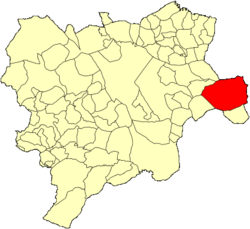
Almansa (Spanish pronunciation: [alˈmansa]) is a Spanish town and municipality in the province of Albacete, part of the autonomous community of Castile-La Mancha. The name "Almansa" stems from the Arabic المنصف (al-manṣaf), "half way of the road".[2][3] The municipality borders with Alicante, Valencia and Murcia. Almansa is famous for its Moros y cristianos festival celebrated from 1 to 6 May.

Key Information

Almansa is built at the foot of a white limestone crag, which is surmounted by a Moorish castle, and rises abruptly in the midst of a fertile and irrigated plain. About 1 mile (1.6 km) south of the town centre stands an obelisk commemorating the Battle of Almansa fought there on 25 April 1707 during the War of Spanish Succession, in which a French, Spanish and Irish army under command of the duke of Berwick, a natural son of James II, routed the allied British, Portuguese and Spanish[dubiousdiscuss] troops.[4] Annual reenactments of that battle have been formally listed in the Spanish cultural register.[5]

The Sierra del Mugrón is located within the Almansa city limits.

Main sights

[edit]

The main sightseeing attraction is the 14th-century Castle of Almansa.

There are other important monuments, such as:

  • Church of la Asunción (16th-19th century)
  • Palace of Los Condes de Cirat (16th century), today the Town Hall
  • Church of the Agustinas Convent (18th century)
  • The Convent of San Francisco (17th century)
  • Clock Tower (1780)

8 km from the city is the reservoir of Almansa, built in 1584. This reservoir is the oldest one in Europe. 12 km from the city is the Sanctuary of Our Lady of Belen (17th century).

La Asuncion church's bell tower.
Convent of San Agustin
Clock tower
The medieval 'Castle of Almansa'.
Facade of the City hall
Almansa in 1823 by Edward Hawke Locker

Camino de Santiago

[edit]

Two pilgrim routes on the Camino de Santiago meet in Almansa. From the south comes the Camino de la Lana and from the east, the Camino de Levante. The Camino de la Lana joins Alicante with Burgos, and the Camino de Levante joins Valencia with Zamora.

Past residents

[edit]

Santiago Bernabéu de Yeste (8 June 1895 – 2 June 1978) - The 11th President of Real Madrid - Bernabéu was born in Montealegre del Castillo (named simply Montealegre before 1916), in the province of Albacete, Spain. However, he was registered at his parents' home in the near town Almansa, where his family lived. His family moved to Madrid when he was very young, and Bernabéu himself joined the Real Madrid junior ranks in 1909 at age 14, after being a regular spectator at their matches for years.

See also

[edit]

References

[edit]
[edit]
Revisions and contributorsEdit on WikipediaRead on Wikipedia
from Grokipedia
Almansa is a town and municipality in the , autonomous community of Castile-La Mancha, southeastern . With a of 24,322 as of 2024, it spans 531.9 square kilometers at an elevation of 712 meters above , featuring a with hot summers and cold winters. The municipality borders the and the , positioned along the strategic Corredor de Almansa corridor that connects central with the Mediterranean coast. Historically, Almansa traces its origins to Arab times, with its prominent castle originally constructed during the and significantly rebuilt in the 14th century by Don Juan Manuel, serving as a key defensive fortress. The town gained lasting fame for the on April 25, 1707, a pivotal engagement in the where Bourbon forces under Philip V decisively defeated a Grand Alliance army, securing control over eastern and marking a turning point in the conflict. The historic quarter, declared a Historic-Artistic Site, preserves narrow streets, Mannerist architecture like the Palace of the Counts of Cirat, and religious landmarks including the 16th- to 19th-century Parish Church of Asunción and convents. Almansa's economy centers on and industry, with wine production prominent under the Almansa established in 1966, cultivating varieties such as Monastrell, (Cencibel), and Garnacha Tintorera on limestone and sandy soils at around 700 meters altitude. The sector also plays a vital role, alongside supported by the Almansa , a curved structure built in 1584 and recognized as one of Europe's oldest operational dams for flood control and agricultural water supply. The Almansa Wine Route integrates these elements, promoting enotourism, local , and heritage sites like the and nearby reservoirs.

Geography

Location and Borders

Almansa is a located in the within the autonomous community of Castilla-, in southeastern . Its geographical coordinates are approximately 38°52′06″N 1°05′40″W, placing it on the La Mancha plateau at an elevation of 712 meters above . The municipality covers an area of 531.91 km². Almansa shares administrative borders with municipalities in the neighboring provinces of , , and , positioning it at the eastern edge of Albacete province. This strategic location forms part of the "Corredor de Almansa," a key geographical corridor that historically and logistically connects central with the eastern Mediterranean coast. As a historical crossroads on the La Mancha plateau, Almansa facilitates regional connectivity between the interior plateau and the Levante area.

Physical Features and Climate

Almansa is situated on a high plateau at elevations ranging from 700 to 1,100 meters above , characterized by predominantly flat to slightly undulating that supports extensive agricultural activity. The town itself is built at the foot of a prominent white crag, which rises abruptly and serves as the foundation for its historic , while the surrounding landscape includes fertile irrigated plains that benefit from the region's topography. The municipal limits encompass part of the Sierra del Mugrón mountain range, a north-south oriented spanning approximately 16.6 kilometers, which adds topographic diversity with its hilly slopes and contributes to the area's natural . This sierra, shared with neighboring municipalities, features ecosystems that support wildlife such as wildcats, boars, and various bird species, including the and , and is designated as a for birds under European environmental directives. The plateau's overall structure influences local by providing well-drained, limestone-based soils that, when irrigated, yield productive lands for crops and . A key water resource is the Almansa Reservoir, formed by the Almansa Dam on the Vega de Belén River, constructed in 1584 and recognized as Europe's oldest reservoir still in operation, playing a vital role in irrigating the surrounding plains. The dam, a structure approximately 25 meters high and 90 meters long, creates a storage capacity of about 3 million cubic meters (3 hm³), enabling sustained water supply in an otherwise semi-arid environment. The climate of Almansa is classified as continental Mediterranean with semi-arid characteristics, featuring hot, dry summers and cold winters due to its inland plateau location. Average high temperatures in summer reach 32–35°C, with extremes up to 40°C, while winter lows average 2–5°C and can drop to -10°C; the annual mean temperature ranges from 11–15°C. totals around 400–500 mm annually, concentrated primarily in spring (April–May) and autumn (September–November), with a pronounced dry period lasting 4–5 months from July to August, which underscores the reliance on for the region's productivity.

History

Etymology and Early Settlement

The name Almansa derives from the term al-manṣaf, meaning "the halfway point of the road" or "midway," which likely refers to its strategic location along ancient trade and communication routes between major Iberian centers such as and Toledo during the Islamic period. This etymology underscores the town's role as a transitional point in the landscape of , where it served as a midpoint on paths facilitating commerce and movement across the . Evidence of early human presence in the Almansa region dates back to the period, though findings remain sparse due to geological factors like erosion and limited systematic excavations, with isolated artifacts such as scrapers and retouched blades indicating activities near flint outcrops and water sources. By the (circa second millennium BCE), settlement intensified, with over 200 documented sites concentrated on hilltops, including fortified enclosures at locations like Cerro del Cuchillo, where archaeological digs have uncovered stone walls, burial cists, ceramics, and tools suggestive of pastoral economies focused on sheep, goats, and cattle herding. These communities show continuity into the pre-Roman Iberian period, with sites like El Amarejo yielding decorated ceramics that reflect cultural transitions and territorial organization in the corridor between the Júcar and Segura river basins. Roman-era occupation marked a significant development in the area, with the process transforming Almansa into a key node along communication routes, evidenced by multiple rural settlements and possible villas documented in surveys of the province. Key sites include Las Torres, an agricultural estate active from the first century BCE to the second century CE, featuring structural remains, inscriptions, and artifacts that highlight a rural centered on farming and local production. Other findings, such as those at Jódar and Casas del Cerro, reveal , pottery, and building materials like , pointing to organized agricultural exploitation and integration into the broader imperial network, though no major urban centers emerged. Inscriptions from the municipal area, including funerary and dedicatory texts, further attest to a settled under Roman administration.

Medieval Period and Reconquista

During the Islamic era, Almansa emerged as a settlement of Arab origin within the territory of , serving as a strategic point in the region known as the Levante. The area's incorporation into Muslim rule dates back to the early following the Umayyad conquest of the , though the specific village developed later amid the fragmented kingdoms and subsequent Almohad unification. By the 12th to 13th centuries, under Almohad control, the initial was constructed on the Cerro del Águila, featuring robust tapial walls designed for defense against Christian incursions; this fortress, a ḥiṣn or hilltop stronghold, underscored Almansa's role in securing the southern frontier of the Nasrid Kingdom of . The brought significant transformations to Almansa in the , as Christian forces from the Kingdom of Castile advanced southward. The town and its were conquered in 1244 during the campaigns of Ferdinand III, led by his son Infante Don Alfonso, marking its incorporation into Castile by and initiating Christian repopulation efforts. Privileges were granted to settlers by Alfonso X in the late to encourage habitation and agricultural development. In the , the underwent major rebuilding under Don Juan Manuel, Lord of , who expanded and fortified it to adapt to evolving warfare tactics, integrating it more firmly into the seigneurial structure of the Crown of Castile. Feudal developments further defined Almansa's medieval trajectory, positioning it as a vital frontier town amid ongoing border skirmishes between Castile and Granada. In 1445, King John II of Castile granted the lordship of Almansa to Alonso Téllez Girón (also known as Alfonso Téllez Girón y Vázquez de Acuña) for life, with rights of succession to his son Juan Pacheco, as a reward for loyalty following the Battle of Olmedo; this transfer confiscated the estate from a rival noble and bolstered Pacheco's influence in the Marquisate of Villena. Following the final phase of the Reconquista and the conquest of Granada in 1492, Almansa transitioned from a contested border outpost to a stable possession fully integrated into the Crown of Castile, ending centuries of intermittent conflict and enabling consolidated royal administration.

Battle of Almansa and Early Modern Era

The Battle of Almansa was fought on 25 April 1707, during the War of the Spanish Succession, pitting Bourbon loyalists supporting Philip V against a coalition of Habsburg allies backing Archduke Charles III. The Bourbon army, numbering approximately 25,000 troops and comprising French, Spanish, and Irish contingents, was commanded by James Fitzjames, the Duke of Berwick. Opposing them were around 16,000 allied forces, including British, Portuguese, Dutch, and Huguenot French units, led by the Earl of Galway and Portuguese general Marquês das Minas. The engagement unfolded on open plains south of Almansa, where Berwick's cavalry wings enveloped the allied lines after initial infantry clashes, leading to a rout of the coalition army. Casualties were devastating for the allies, with the Bourbons suffering around 3,000 killed and 3,000 wounded, while the allies incurred approximately 4,000 killed or wounded and 5,000 captured, resulting in total losses exceeding 15,000. This decisive Bourbon triumph, one of the war's most one-sided battles, shifted momentum in the Iberian theater. Strategically, the victory at Almansa solidified Philip V's hold on eastern , enabling Bourbon forces to reclaim , , and from allied control and forcing the coalition into a defensive posture confined to . The battle's outcome prevented further allied incursions into the Spanish heartland, bolstering Philip V's legitimacy and contributing to the eventual Bourbon consolidation of the Spanish throne under the 1713 Treaty of . To commemorate the event, an obelisk monument was erected on 10 September 1707 in the approximately one mile south of Almansa, serving as a enduring symbol of the Bourbon success. In the early following the battle, Almansa saw enhancements to its defensive infrastructure, including reinforcements to existing fortifications like the medieval , which had played a peripheral role in the conflict but became integral to regional security amid ongoing war tensions. These post-battle measures underscored the town's elevated military significance under Bourbon rule. By the , the battle's legacy endures through annual reenactments organized by local historical associations, which recreate the engagement with period costumes, encampments, and mock combats to educate on the ; in 2013, the regional government announced plans to declare these events a , and they were later recognized as a Fiesta de Interés Turístico Regional in 2022.

19th and 20th Centuries

In the , Almansa remained a predominantly agricultural town, with farming serving as the primary economic activity amid overall . The provided by the historic Almansa , constructed in the 16th century but supporting expanded cultivation, enabled growth in local , including crops suited to the region's . This post-reservoir expansion facilitated modest increases in productivity, though the economy stayed largely rural until the latter part of the century. Around 1800, artisan began to emerge as a supplementary , with small workshops and family-based production focusing on local needs, marking the initial steps toward industrialization. By mid-century, these activities were confined to tanneries and modest obradores, producing basic without large-scale . The 20th century witnessed significant industrial growth in Almansa's footwear sector, transforming the town into a key hub for shoe production. Early in the century, the first formal factories appeared, such as those established by the Coloma family and others around 1887–1900, leading to rapid output increases—from 87,000 pairs in 1900 to 1.36 million by 1906. This expansion attracted workers, contributing to population growth from early 20th-century levels of around 10,000 to over 20,000 by mid-century, fueled by an economic boom in the 1960s and 1970s when shoemaking became a major employer. During the (1936–1939), Almansa experienced local political tensions, including the election of a socialist-led municipal government in 1936 and subsequent repression under Francoism, which disrupted communities but did not halt industrial momentum. In the late , Almansa transitioned toward a more diversified modern , with the footwear industry adapting to global markets through exports while facing challenges from international competition. By the and , efforts to preserve intensified, including initiatives to document and promote traditional techniques and local festivals, ensuring the town's artisanal roots endured amid economic shifts. These preservation activities, supported by municipal programs, helped maintain social cohesion and appeal.

Demographics

Population and Density

As of January 1, 2024, Almansa has a population of 24,281 inhabitants, according to official data from the Instituto Nacional de Estadística (INE). The residents are known as almanseños. The population of Almansa has shown steady growth over the late 20th century, increasing from 20,331 inhabitants in 1981 to a peak of 25,432 in 2011, driven by and regional migration patterns. Since then, it has experienced a slight decline, reaching 24,281 by 2024, with an average annual change of approximately -0.15% between 2021 and 2024. Almansa's population density is 45.66 inhabitants per square kilometer, calculated over its municipal area of 531.91 km². Despite the low overall density, reflecting the municipality's extensive rural surroundings, the population is primarily concentrated in the urban center around the historic core, where most residential, commercial, and administrative activities are located. Almansa exhibits a slight majority in its demographic composition, with 50.4% of the being (12,240 individuals) and 49.6% (12,041 individuals) as of 2024. This balance reflects broader patterns in rural Spanish municipalities, where women often outnumber men due to higher for work. The age structure of Almansa's indicates an aging trend typical of inland , with 17.1% under 18 years old (4,154 individuals), 61.9% in the working-age group of 18–64 (15,030 individuals), and 21.0% over 65 (5,097 individuals) in 2024. This distribution, with over one-fifth of residents elderly, underscores challenges such as dependency ratios and the need for elder care services, as the proportion of seniors has risen steadily over the past decade. Migration patterns in Almansa show a modest foreign-born population of 8.8% (2,138 individuals) in 2024, primarily originating from the (1,265 individuals) and (433 individuals). Additionally, 6.9% of residents hold non-Spanish (1,666 individuals), with notable growth in Latin American communities since 2000 driven by economic opportunities in and industry. The influx peaked during Spain's 2000s economic boom, attracting workers to the region's and sectors, but has since stabilized amid post-2008 and return migration.

Economy

Agriculture and Viticulture

Agriculture in Almansa, located in the , , is predominantly centered on the primary sector, with serving as the cornerstone due to the region's favorable continental-Mediterranean climate and calcareous soils. The irrigated plains support a mix of crops, including olives, cereals such as and , and vegetables like tomatoes and peppers, which benefit from the area's water management systems to enable consistent yields despite semi-arid conditions. These agricultural practices contribute significantly to the local economy, emphasizing sustainable on the flat to gently sloping terrains around the town. Viticulture dominates the landscape, with the Denominación de Origen (DO) Almansa encompassing over 9,000 hectares of vineyards across eight municipalities: Almansa, Alpera, Bonete, Corral-Rubio, Higueruela, Hoya-Gonzalo, Pétrola, and El Villar de Chinchilla. The Garnacha Tintorera grape variety is particularly prominent, known for its red-fleshed berries that impart intense color and structure to red wines, making it a signature of the region's bold, full-bodied styles. Other authorized varieties include Monastrell and , often blended to enhance complexity. Many vineyards feature traditional bush vines (en vaso), some over 60 years old, dry-farmed to concentrate flavors through low yields in the high-altitude plots ranging from 700 to 1,100 meters. The Almansa Reservoir, constructed in 1584 on the Vega de Belén River, plays a crucial role in , storing up to 1.6 million cubic meters (1,300 acre-feet) of to support year-round farming on the surrounding plains and mitigate risks in this inland area. This historic , one of Europe's oldest operational dams, has enabled the expansion of irrigated , allowing for diversified crop production beyond rain-fed cereals and olives. Wine production under DO Almansa yielded approximately 40,000 hectoliters as of 2017, with over 70% exported to markets in , , and , generating around €7.5 million from exports in 2015. The focus on quality-driven practices, such as hand-harvesting and minimal intervention, has elevated the region's reds and rosés on the international stage, with bottling volumes reaching over 6 million units. In response to climate challenges like prolonged droughts and rising temperatures, Almansa viticultors are increasingly adopting organic methods, with several estates achieving to preserve and . For instance, producers emphasize reduced chemical use, cover cropping, and in to build resilience, ensuring the longevity of bush vine traditions amid environmental pressures. The 2023 harvest was 30-40% shorter than average due to .

Industry and Services

The footwear industry forms the backbone of Almansa's manufacturing sector, with roots tracing back to artisan workshops established in the early , when the town's strategic location along trade routes fostered small-scale leatherworking guilds. By the late , these evolved into formal factories, such as those founded by the Coloma family around 1887, marking the transition from cottage production to organized industry. Today, the sector remains a major employer, with approximately 62 companies—including factories and auxiliary firms—providing around 2,200 jobs as of 2013, primarily focused on mid-to-high-end men's and women's shoes. Production emphasizes quality craftsmanship, with annual output supporting exports valued at over €90 million in 2022, primarily to markets in and the , increasing by 10% to over €99 million in 2024. Beyond footwear, Almansa's industrial landscape includes small-scale food processing operations that complement local agricultural outputs, such as and wine bottling, though these remain limited in scope. is virtually absent, with the prioritizing to maintain its traditional, labor-intensive character. This focus has helped the sector weather global challenges, including rising material costs, by adapting through technological upgrades in stitching and design processes. The service sector plays an increasingly vital role in Almansa's economy, encompassing retail, , and emerging activities. Tourism has grown notably through the Ruta del Vino Almansa, a certified wine route launched in recent years that integrates visits, vineyard tours, and cultural experiences, attracting over 1,000 visitors in 2024 alone. Local festivals, such as those celebrating the town's heritage, further bolster services, while retail outlets tied to footwear production support daily commerce. Post-2008 , unemployment in Almansa surged to peaks above 30% by 2013, driven by construction and export slumps, but has since declined steadily, reaching historic lows of around 1,457 registered unemployed in mid-2025—a 2.2% monthly drop—reflecting recovery in services and industry. The tertiary (services) sector dominates employment, with 63% of unemployment concentrated there compared to 19% in industry.

Government and Administration

Local Governance

Almansa's local governance is administered by the Ayuntamiento, the municipal council, which operates from the 16th-century Palacio de los Condes de Cirat, a Renaissance palace constructed in 1575 and serving as the town hall since 1996. The council comprises 21 concejales, determined by the municipality's population of approximately 25,000, and these members are elected every four years in line with Spain's municipal election cycle. The structure includes a plenary session for major decisions, a junta de gobierno local for executive functions, and various informative commissions to oversee specific areas. As of 2025, the is Pilar Callado García of the Partido Socialista Obrero Español (PSOE), who assumed office in June 2023 after her party's victory in the municipal elections, marking her as the first female in Almansa's history. The 2023 elections resulted in a balanced council with PSOE and Partido Popular (PP) each holding 10 seats, and Izquierda Unida (IU) securing one, leading to a PSOE-led government supported by IU. Politically, Almansa experienced PSOE dominance from the late 1970s through the 2000s, with figures like Virginio Sánchez Barberán (1979–1983) and Antonio Callado García (1983–1995) leading during the and subsequent terms. This shifted in 2011 when the PP, under Francisco Núñez, gained control and retained it through 2023, focusing on before the PSOE's return. Current policies under Mayor Callado prioritize heritage preservation, including restorations of historical sites like the Lonja del Mercado, and economic diversification via programs such as the Estrategia de Desarrollo Urbano Sostenible e Integrado (EDUSI) Almansa Impulsa, which promotes sustainable growth and job creation beyond traditional . These efforts align with the Agenda Urbana 2030, emphasizing urban regeneration and enhanced for residents.

Public Infrastructure and Services

Almansa's water supply is primarily sourced from the Almansa Reservoir on the Vega de Belén River, supporting municipal consumption and agricultural in the region. The city's wastewater includes a modern treatment plant that underwent enlargement to incorporate nutrient removal and tertiary treatment processes, ensuring treated is stored and reused for or discharged safely. Electricity distribution relies on Spain's national grid, enhanced locally by renewable integrations such as the 50 MW CSF Almansa Solar PV Park, a ground-mounted facility spanning 134 hectares that generates 90 GWh annually, powering about 30,000 households and reducing CO₂ emissions by 29,000 tons per year. Healthcare in Almansa is provided through the publicly funded Servicio de Salud de Castilla-La Mancha (SESCAM), with available at the Centro de Salud de Almansa on Calle San Juan s/n. The Hospital General de Almansa, located at Avenida s/n, offers comprehensive services including care, inpatient treatment, and specialized consultations. For advanced procedures, residents access the Complejo Hospitalario Universitario de , approximately 40 km away, which integrates services for the Almansa area. The system encompasses public primary schools, such as Colegio Esclavas de Maria, and secondary-level Institutos de Educación Secundaria (IES), including IES Herminio Almendros, IES Escultor José Luis Sánchez, and IES José Conde García, which offer , vocational training, and bilingual programs. These institutions serve the local population with modern facilities focused on academic and . Waste management is managed municipally through collection, transportation, and treatment services, supported by dedicated vehicles and contracts for efficient operations, including medical waste handling. Public lighting infrastructure has seen upgrades to energy-efficient LED systems, particularly in sports facilities like the Municipal Pavilion and indoor , yielding 70% reductions in energy use and emissions as part of broader efforts funded by the . Social services in Almansa implement national programs tailored to vulnerable groups, including through home assistance and geriatric support under 's welfare framework, which aids over 18% of those aged 65+ with personalized services. For immigrants, integration initiatives draw from the Humanitarian Care Program, offering accommodation, basic healthcare, , and civic orientation to facilitate settlement and access to employment benefits equivalent to nationals.

Culture and Traditions

Festivals and Celebrations

Almansa's most prominent annual event is the Fiestas Mayores, centered on the Moros y Cristianos celebrations, held from April 30 to May 6 in honor of the Virgin of Belén, the town's patron saint. These festivals reenact historical episodes from the , the Christian reconquest of the from Muslim rule, through elaborate parades, mock battles, and fireworks displays. The festivities feature "entradas" (grand entrances) by comparsas, or troupes, divided into five Moorish groups—Almanzárabes, Beduinos, Almohades, Zegries, and Mozárabes—and five Christian groups—Mosqueteros, Templarios, Almogávares, Corsarios, and Piratas—totaling over 4,000 participants in vibrant costumes. A highlight is the Nocturnal Moorish Parade and the Embajada Mora, a theatrical reenactment of the conquest of Almansa Castle performed at night in Plaza Santa María. Progressing from declarations of Regional Tourist Interest in 1999 and National Tourist Interest in 2008, the event was declared a Fiesta of International Tourist Interest in 2019, drawing thousands of visitors annually, fostering community participation and generating significant economic benefits through increased , , and local commerce. Semana Santa, or , in Almansa involves solemn processions led by religious brotherhoods (cofradías), carrying sacred images such as Cristo Yacente, Sagrado Corazón de Jesús, and María Santísima de la Esperanza through the streets, commemorating the Passion of Christ. These traditions originated in the with the formation of cofradías across , evolving in Almansa to include penitential marches and floral decorations during through Sunday. In addition to these major events, May brings the Cruces de Mayo, where residents decorate wooden crosses with flowers and greenery, often accompanied by traditional songs and dances known as "canto de los mayos," celebrating spring and community spirit. Almansa's wine harvest season in late summer and early autumn also features local events tied to the Denominación de Origen Almansa, including vineyard tours and tastings that highlight the region's viticultural heritage, though without a singular large-scale .

Cuisine and Local Arts

Almansa's cuisine reflects the hearty traditions of Castilla-La Mancha, emphasizing simple, robust preparations using local ingredients like vegetables, game, and lamb. Key staples include pisto manchego, a ratatouille-like of tomatoes, peppers, onions, , and , often topped with a and served as a main course or side. Another emblematic dish is gazpacho manchego, a thick featuring or simmered with , paprika, and torn pieces of (torta de gazpacho), which absorbs the flavors during cooking. Lamb dishes, such as roasted cordero manchego seasoned with and herbs, highlight the region's pastoral heritage, providing tender, flavorful that embodies the area's agrarian roots. Local wines from the DO Almansa denomination play a central role in culinary pairings, particularly the robust reds made primarily from Monastrell () grapes, which offer notes of dark fruit, spice, and earth that complement the intensity of meat-based dishes. These reds pair exceptionally well with lamb preparations, cutting through the richness of roasted or stewed cuts while enhancing their savory depth, as seen in traditional meals where a full-bodied Almansa Monastrell accompanies cordero asado. In social settings, such as gatherings during local events, lighter DO Almansa rosés or young reds are served with of pisto or cured meats, fostering a culture of shared, wine-infused bites that integrate with everyday dining. Artisanal traditions in Almansa center on leatherworking, particularly the renowned craft that dates to the , when family-run workshops began producing high-quality footwear using local hides and traditional techniques like hand-stitching and vegetable tanning. This heritage persists through family-based artisan guilds, which evolved from early structures to maintain quality standards and pass down skills across generations, with notable examples including the Coloma family's that once dominated Spanish production. Complementary crafts include , featuring rustic glazed in earthy tones for everyday use, and , where intricate patterns on linens and clothing draw from regional motifs. Modern cultural centers, such as the Baeza Wagner International Cultural Center and the House of Culture, host exhibitions showcasing these arts, blending historical demonstrations with contemporary interpretations to preserve Almansa's creative legacy.

Heritage and Attractions

Architectural and Historical Sites

The Castle of Almansa, perched on the Cerro del Águila, is a prominent Moorish fortress originating from the Almohad period in the 13th century, characterized by its tapial walls and strategic defensive position overlooking the town. Following the Reconquista, it underwent significant reconstruction and expansion in the 14th and 15th centuries, first under the lordship of Don Juan Manuel and later by Don Juan Pacheco, the Marquis of Villena, who imparted its current form with Gothic elements. The structure measures approximately 100 meters in length and 30 meters in width, featuring two enclosures, cylindrical towers, battlements, and a central rectangular Torre del Homenaje with a rib-vaulted Gothic ceiling across four floors. Abandoned by the mid-16th century and later used as a quarry, it was ceded to the Almansa municipality in the late 19th century and declared a Monumento Histórico-Artístico Nacional in 1921, with major restorations occurring between 1959 and 1971, and further interventions from 2016 to 2019 that included the addition of a museum. The Church of la Asunción, the principal , exemplifies a blend of architectural styles developed over several centuries from the 16th to the 19th. Construction began in 1524 with foundations laid by Maestro Marquina, followed by the 's design in 1530–1538 under Juan de Aranguren, incorporating Gothic and elements; later phases added and Neoclassical features, including a in 1630–1650 and a communion chapel in 1680–1799. The church consists of a single divided into seven sections with a and windows, flanked by side chapels, and culminates in a presbytery with a polygonal . Its main portal, completed in 1639, depicts the and Assumption through sculpted reliefs, while an 18th-century brick tower rises adjacent to the structure. Recognized as a Bien de Interés Cultural in 1983, it stands as a testament to Almansa's evolving religious and artistic heritage. Among other notable civic and religious buildings, the Palace of Los Condes de Cirat, also known as the Casa Grande, represents 16th-century civil architecture, constructed around 1575 on the site of an old inn by Alfonso de Pina. The two-story edifice centers on a square courtyard with Ionic-columned galleries and semicircular arches, accessed via a Mannerist portal adorned with heraldic shields of the Pina lineage. Owned by the Counts of Cirat in the and later the Marquises of Montortal, it was acquired by the Almansa City Council in 1992 and now serves as the Town Hall, with an adjacent garden hosting contemporary sculptures. Declared a in 1990, it anchors the Plaza de Santa María near the Church of la . The Convent of San Francisco, founded in 1563 and built in the from 1660 to 1663, embodies sober design in a simple rectangular layout with lateral and an inscription marking its entrance. Dedicated to Santiago Apóstol, it features exuberant decoration in one side chapel and houses a 1804 wooden of San Pascual Bailón by sculptor Roque López, evoking influences from . Nearby, the , erected in 1780 to replace a malfunctioning church clock, rises as a square-section structure with four cornices-separated bodies, a Rococo-style municipal shield on the base, clock faces on the third level, and a bell chamber topped by a railing. Almansa's historic quarter, encompassing these structures and narrow medieval streets, was declared a Conjunto Histórico-Artístico on April 18, 1983, preserving its architectural integrity as one of Albacete province's most characteristic ensembles. Within this area stands an obelisk commemorating the 1707 Battle of Almansa, a neoclassical monument erected in the 18th century and later rebuilt in 1925 following its destruction in 1868.

Natural and Recreational Sites

The Almansa Reservoir, located approximately 8 km from the town center, serves as a key natural attraction offering scenic views of the surrounding landscape and opportunities for outdoor recreation. Visitors can engage in walking and hiking along circular routes that encircle the reservoir, providing panoramic vistas of the adjacent Sierra del Mugrón. Water-based activities include paddle surfing, kayaking, and limited boating with electric motors at designated embarcaderos, while fishing is permitted throughout the area under local regulations managed by the Sociedad de Pesca Deportiva Pantano de Almansa. The Sierra del Mugrón, forming part of Almansa's municipal boundaries, features rugged terrain ideal for enthusiasts, with trails ranging from moderate loops to more challenging ascents reaching elevations up to 1,200 meters. These paths, such as the Almansa to El Mugrón route covering about 16 km with significant elevation gain, traverse limestone-rich slopes that support diverse including vineyards and Mediterranean scrub, contributing to the region's . The sierra's trails offer opportunities to observe local and enjoy unobstructed views of the Almansa plain, making it a prime spot for nature immersion. Within the town, local green spaces provide accessible recreational areas for residents and tourists. The Parque de los Reyes Católicos, a central featuring landscaped zones, a , , and for events, serves as a hub for leisurely strolls and family outings. Similarly, the Parque de Miguel includes children's playgrounds, pet areas, walking paths, and sports facilities, enhancing urban recreation. The Recinto Ferial, often referred to in the context of local fiestas as a park-like space, hosts community events amid open green areas. Complementing these, the Almansa Wine Route integrates short trails through vineyard landscapes, allowing visitors to combine wine tastings with light walks amid the natural of the region. Almansa's natural sites hold significant potential for and eco-tourism, with the equipped with dedicated observatories for spotting like little bustards and in nearby areas. Protected zones such as the ZEPA Moratillas, Almela, and Els Alforins, adjacent to the municipality, support over 100 , promoting sustainable observation activities. Eco-tourism initiatives emphasize low-impact experiences, including guided hikes and water sports, fostering appreciation of the area's wetlands and mountain ecosystems while supporting local conservation efforts.

Transportation

Road and Rail Connectivity

Almansa benefits from a well-integrated road network that connects it to major Spanish cities, facilitating both and freight movement. The Autovía A-31 serves as the primary highway, providing direct links to in the southeast (approximately 95 km away) and extending northward to , enhancing accessibility for regional travel and commerce. Additionally, the N-330 connects Almansa to , supporting east-west connectivity within the broader Levante region. The , a key geographical and in southeastern province, plays a significant role in , leveraging these routes for industrial logistics between Castilla-La Mancha and the . Rail services in Almansa are operated by , Spain's national railway company, with the local station offering regional connections to nearby urban centers. Direct trains link Almansa to (about 66 km north), with services taking around 35-70 minutes depending on the route. Similarly, regional lines extend to (approximately 92 km east), with journeys averaging 1 hour 30 minutes to 1 hour 46 minutes. These services include both conventional regional trains and occasional high-speed options, catering to daily commuters and longer-distance travelers. Bus transportation complements the road and rail systems, with ALSA providing intercity services from Almansa's central station to destinations such as , , and . Routes to Alicante operate twice daily, covering the 95 km distance in about 1 hour 15 minutes. For air travel, Almansa lacks a local but offers access to Alicante-Elche Airport (ALC), located roughly 95 km southeast via the A-31 highway, with bus and train combinations available for transfers taking 2-3 hours total. Recent developments have focused on enhancing efficiency to support growth in the region. In , the interurban in the Corredor de Almansa was expanded from one on-demand route to six fixed itineraries, improving connectivity to surrounding municipalities and boosting for visitors. Broader national investments in rail infrastructure, including upgrades to Renfe's regional lines, continue to benefit Almansa by modernizing tracks and stations for more reliable service.

Pilgrimage and Walking Routes

Almansa serves as a key intersection point for two branches of the , the ancient network of pilgrimage routes leading to the shrine of Saint James in . The Camino de la Lana, originating from and extending northward to where it joins the more popular Camino Francés, converges with the Camino de Levante, which runs from through Toledo to Zamora, at Almansa. This meeting occurs briefly in the town, allowing pilgrims to choose their onward path while benefiting from local facilities designed to support their journey. The town's role as a pilgrim stop is enhanced by dedicated accommodations and navigational aids. The Albergue Esclavas de María, a parochial located at Calle Cervantes 7, provides basic services including beds, hot showers, and communal spaces for up to 20 pilgrims, with reservations recommended in advance. Additionally, parts of these routes through Almansa and the surrounding province have been officially marked as the GR-239 long-distance footpath since , featuring yellow arrows, scallop shell symbols, and directional signs to guide walkers along historical tracks. These markers ensure safe passage across varied terrain, from open plains to gentle hills. Historically, Almansa's position at this crossroads has made it a natural resting place for travelers since , with its name derived from the "Al-Mansha," meaning "the lookout" or "resting place," reflecting its strategic location for wayfarers. While the main Camino routes attract hundreds of thousands annually, the less-traveled paths through Almansa see a modest flow of pilgrims, emphasizing its significance as a quiet, authentic segment of tradition rather than a high-traffic hub. Beyond the Camino, Almansa offers local walking routes that highlight its natural and cultural landscapes. In the nearby Sierra del Mugrón, a 16.6 km , hikers can explore moderate circular trails such as the 12 km route from Alpera to the Castellar de Meca Iberian settlement, featuring 450 m of elevation gain through pine forests and panoramic viewpoints. These paths, suitable for day trips, showcase the sierra's and archaeological sites without requiring advanced skills. The Almansa Wine Route integrates walking opportunities with enotourism, allowing visitors to combine winery tours with interpretive trails amid vineyards. Experiences often pair guided hikes through the plains and hills—such as those near the Pantano de Almansa reservoir—with tastings of local varietals like Bobal and , promoting a holistic exploration of the region's viticultural heritage. These walks, typically 5-10 km, emphasize and the interplay between and the landscape.

Notable People

Figures in Sports

Santiago Bernabéu de Yeste, born on June 8, 1895, in Almansa, province, was a pivotal figure in Spanish football whose early life in the town shaped his lifelong passion for the sport. Although his family relocated to shortly after his birth, Bernabéu maintained strong ties to Almansa, where he was officially registered, and later honored the town through his enduring legacy. As a player, he appeared in 79 official matches for Real Madrid, scoring 68 goals as a forward before transitioning to administrative roles. Bernabéu served as the 11th president of Real Madrid from 1943 until his death in 1978, a tenure marked by transformative leadership that elevated the club from post-war struggles to a global powerhouse. Under his guidance, Real Madrid secured six consecutive European Cups between 1956 and 1960, along with 16 titles and numerous domestic honors, establishing the club as a symbol of excellence in European football. His vision included the construction of the , inaugurated in 1947 and expanded to host over 80,000 spectators, which remains a cornerstone of the club's identity and a testament to his impact. Almansa's sports culture is deeply intertwined with regional football traditions, exemplified by Unión Deportiva Almansa (UD Almansa), a club founded in 1992 that competes in Spain's Primera Autonómica Preferente – Group 1 as of 2025 and fosters community engagement through local matches at the Paco Simón Stadium. The town's football heritage reflects broader Castile-La Mancha influences, with youth academies and amateur leagues promoting grassroots participation since the early 20th century. In athletics, Almansa supports running and track events via organizations like the Escuela del Corredor de Almansa, which organizes community races and training on local facilities, contributing to regional competitions and nurturing talents in endurance sports.

Other Notable Residents

Alfonso Téllez Girón y Vázquez de Acuña (c. 1380–1449), a Castilian noble of Portuguese descent and lord of Frechilla, was granted the lordship of Almansa and its surrounding lands in 1444 by King John II of Castile, establishing a significant medieval connection to the town's feudal history. His role as a figure and participant in the 1431 Granadan campaign highlighted his influence in regional power structures, contributing to Almansa's early development as a strategic territory. In the realm of literature, Alicia Giménez-Bartlett (born 1951), a renowned Spanish crime novelist, was born in Almansa and later moved to , where she became a full-time after initial success with her early works. Best known for her Petra Delicado series, which explores social issues through and has been adapted for television, her contributions have elevated contemporary while reflecting broader Iberian cultural narratives. Giménez-Bartlett's international acclaim, including the 2010 Planeta Prize for Los amigos del perfecto asesinato, underscores Almansa's ties to influential voices in global storytelling. José Luis Sánchez Fernández (1926–2018), a pioneering Spanish sculptor from Almansa, advanced in post-war through his works, often exploring human forms and existential themes. Trained in amid economic hardship, he became a forerunner of , with pieces like Thanatos [Muerte] (1972) held in major collections such as the Foundation, influencing modern Spanish . His sculptures grace public spaces, including Almansa's , symbolizing the town's artistic heritage rooted in its industrial and cultural evolution. In music, tenor José Manuel Delicado Villaescusa (born 1972), also from Almansa, has built a career in and choral direction, founding and leading the Escuela Coral de la Sociedad Unión Musical de Almansa since 1999. With a lyric voice suited for and stage performances, he has performed internationally and serves as an oboist in local ensembles, fostering musical education and tradition in the region. Politically, Francisco Javier Núñez Núñez (born 1982), born and raised in Almansa, has served as mayor since 2011 and as a member of the Cortes of Castilla-La Mancha, representing the People's Party in regional governance. His leadership has focused on local development, including economic initiatives tied to Almansa's industry, which employs traditional techniques passed through generations and contributes to the area's identity as Spain's footwear hub. These figures collectively enhance Almansa's regional profile through their impacts on politics, arts, and cultural preservation.

References

Add your contribution
Related Hubs
User Avatar
No comments yet.