Hubbry Logo
logo
Amphitheatre
Community hub

Amphitheatre

logo
0 subscribers
Read side by side
from Wikipedia

The Colosseum, an amphitheatre in Rome (built 72–80 AD)
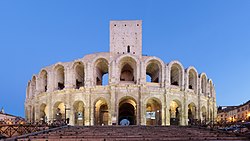
Arles Amphitheatre, France: a Roman arena still used[1] for bullfighting, plays, and summer concerts.

An amphitheatre (American English: amphitheater) is an open-air venue used for entertainment, performances, and sports.[2] The term derives from the ancient Greek ἀμφιθέατρον (amphitheatron),[3] from ἀμφί (amphi), meaning "on both sides" or "around"[4] and θέατρον (théātron), meaning "place for viewing".[5][6]

Ancient Greek theatres were typically built on hillsides and semi-circular in design. The first amphitheatre may have been built at Pompeii around 70 BC.[7] Ancient Roman amphitheatres were oval or circular in plan, with seating tiers that surrounded the central performance area, like a modern open-air stadium. In contrast, both ancient Greek and ancient Roman theatres were built in a semicircle, with tiered seating rising on one side of the performance area.

Modern English parlance uses "amphitheatre" for any structure with sloping seating, including theatre-style stages with spectator seating on only one side, theatres in the round, and stadia. They can be indoor or outdoor.

Roman amphitheatres

[edit]
Pula Arena, Croatia

About 230 Roman amphitheatres have been found across the area of the Roman Empire. Their typical shape, functions and name distinguish them from Roman theatres, which are more or less semicircular in shape; from the circuses (similar to hippodromes) whose much longer circuits were designed mainly for horse or chariot racing events; and from the smaller stadia, which were primarily designed for athletics and footraces.[8]

Roman amphitheatres were circular or oval in plan, with a central arena surrounded by perimeter seating tiers. The seating tiers were pierced by entrance-ways controlling access to the arena floor, and isolating it from the audience. Temporary wooden structures functioning as amphitheaters would have been erected for the funeral games held in honour of deceased Roman magnates by their heirs, featuring fights to the death by gladiators, usually armed prisoners of war, at the funeral pyre or tomb of the deceased. These games are described in Roman histories as munera, gifts, entertainments or duties to honour deceased individuals, Rome's gods and the Roman community.[9]

Some Roman writers interpret the earliest attempts to provide permanent amphitheaters and seating for the lower classes as populist political graft, rightly blocked by the Senate as morally objectionable; too-frequent, excessively "luxurious" munera would corrode traditional Roman morals. The provision of permanent seating was thought a particularly objectionable luxury.[10]

The earliest permanent, stone and timber Roman amphitheatre with perimeter seating was built in the Campus Martius in 29 BCE.[11] Most were built under Imperial rule, from the Augustan period (27 BCE–14 CE) onwards.[12] Imperial amphitheatres were built throughout the Roman Empire, especial in provincial capitals and major colonies, as an essential aspect of Romanitas. There was no standard size; the largest could accommodate 40,000–60,000 spectators. The most elaborate featured multi-storeyed, arcaded façades and were decorated with marble, stucco and statuary.[13] The best-known and largest Roman amphitheatre is the Colosseum in Rome, also known as the Flavian Amphitheatre (Amphitheatrum Flavium), after the Flavian dynasty who had it built. After the ending of gladiatorial games in the 5th century and of staged animal hunts in the 6th, most amphitheatres fell into disrepair. Their materials were mined or recycled. Some were razed, and others were converted into fortifications. A few continued as convenient open meeting places; in some of these, churches were sited.[14]

Modern amphitheatres

[edit]
Aerial photograph of the Hollywood Bowl, showing the seating after the 2005 renovation.

In modern english usage of the word, an amphitheatre is not only a circular, but can also be a semicircular or curved performance space, particularly one located outdoors.[15] Contemporary amphitheatres often include standing structures, called bandshells, sometimes curved or bowl-shaped, both behind the stage and behind the audience, creating an area which echoes or amplifies sound, making the amphitheatre ideal for musical or theatrical performances. Small-scale amphitheatres can serve to host outdoor local community performances.

Notable modern amphitheatres include the Shoreline Amphitheatre, the Hollywood Bowl and the Aula Magna at Stockholm University. The term "amphitheatre" is also used for some indoor venues, such as the (by now demolished) Gibson Amphitheatre and Chicago International Amphitheatre.


Natural amphitheatres

[edit]

A natural amphitheatre is a performance space located in a spot where a steep mountain or a particular rock formation naturally amplifies or echoes sound, making it ideal for musical and theatrical performances. An amphitheatre can be naturally occurring formations which would be ideal for this purpose, even if no theatre has been constructed there.

Notable natural amphitheatres include the Drakensberg Amphitheatre in South Africa, Slane Castle in Ireland, the Supernatural Amphitheatre in Australia, and the Red Rocks and the Gorge Amphitheatres in the western United States.

There is evidence that the Anasazi people used natural amphitheatres for the public performance of music in Pre-Columbian times including a large constructed performance space in Chaco Canyon, New Mexico.[16]

See also

[edit]

Notes

[edit]

References

[edit]
Revisions and contributorsEdit on WikipediaRead on Wikipedia
from Grokipedia
An amphitheatre is a freestanding, open-air architectural structure typically oval or circular in shape, featuring tiered seating arranged concentrically around a central arena designed for mass public events.[1] This form originated with the ancient Romans, who adapted earlier Greek theatrical concepts but innovated by enclosing the seating on all sides, enabling efficient viewing of spectacles from multiple angles without reliance on hillsides for natural elevation.[2] The design facilitated acoustic projection and crowd control, with capacities often exceeding tens of thousands, reflecting Roman engineering prowess in concrete vaulting and radial access tunnels known as vomitoria.[3] The earliest permanent stone amphitheatre dates to around 70 BCE in Pompeii, a settlement for Roman veterans, marking the transition from temporary wooden arenas to durable monuments funded by local elites or imperial patronage.[4] Over 230 such structures were erected across the Roman Empire by the 4th century CE, serving as venues for gladiatorial contests, wild beast hunts, mock sea battles, and public executions, which reinforced social hierarchies and imperial propaganda through visceral displays of power and entertainment.[3] The archetype, the Flavian Amphitheatre—commonly called the Colosseum—commissioned by Emperor Vespasian in 70 CE and inaugurated by Titus in 80 CE, exemplifies this legacy with its multi-story facade of arches and columns, hydraulic systems for naumachiae, and estimated capacity of 50,000 to 80,000 spectators.[5][6] In contemporary usage, amphitheatres denote similar open venues for performances, often drawing on Roman precedents but adapted for acoustics and safety, such as the Hollywood Bowl in Los Angeles, which hosts orchestral concerts in a natural basin enhanced by artificial seating.[7] These modern iterations prioritize cultural events over combat, yet echo the original causal role of amphitheatres in communal gathering and spectacle, underscoring enduring human demand for shared, immersive experiences under the sky.[8]

Definition and Etymology

Linguistic origins

The English term amphitheatre (or amphitheater in American spelling) entered usage in the late 14th century, borrowed directly from Latin amphitheatrum, denoting an ancient Roman edifice for public spectacles such as gladiatorial combats.[9] This Latin form derives from Ancient Greek amphitheatron (ἀμφιθέατρον), a compound of the prefix amphi- (ἀμφί), signifying "on both sides," "around," or "of both kinds," and theatron (θέατρον), meaning "theater" or "a place for viewing."[9][10] The Greek amphitheatron literally evokes a "double theater" or "theater on all sides," reflecting the structure's oval or circular design that surrounded the central arena with tiered seating, in contrast to the semicircular form of a standard Greek theater.[9] The root theatron traces further to the verb theaomai (θεάομαι), "to behold" or "to gaze upon," combined with hedra (ἕδρα), "seat" or "base," underscoring its function as a seated venue for spectatorship. In Roman Latin usage, amphitheatrum first appears in literary sources around the 1st century BCE, coinciding with the construction of early permanent structures like the one in Pompeii (circa 70 BCE), though the term's descriptive application emphasized the innovative enclosure of the performance space.[11] While the architectural archetype emerged in Italic or Etrusco-Campanian contexts predating widespread Greek influence, the nomenclature remained Hellenized, highlighting Rome's cultural assimilation of Greek theatrical terminology.[12]

Core architectural features

Roman amphitheatres featured an elliptical or oval plan, distinguishing them from semicircular Greek theatres, with the central arena surrounded on all sides by tiered seating to provide views from every angle.[13] This freestanding design, a Roman innovation, relied on vaulted substructures rather than natural hillsides for support, enabling construction on level ground.[14] The arena, typically sand-covered (harena) to absorb blood and facilitate drainage, measured around 80 by 45 meters in major examples like the Colosseum, serving as the performance space for gladiatorial combats and beast hunts.[15] The cavea, or seating area, comprised concentric rows of stone benches divided into hierarchical sections: the lower ima cavea for elites, the middle media cavea for citizens, and the upper summa cavea for lower classes and women, often accommodating 10,000 to 50,000 spectators depending on the structure's scale.[16] Supporting this were radial barrel vaults and crisscrossing corridors known as vomitoria, which allowed rapid crowd ingress and egress while distributing weight evenly.[17] Construction employed opus caementicium—Roman concrete of volcanic ash, lime, and aggregate—faced with travertine or tufa stone for durability, with brick or stone arches forming the skeletal framework.[18] Exterior facades typically rose in three or four stories, adorned with superimposed orders of columns—Doric at the base, Ionic above, and Corinthian at the top—framing arches and entablatures, as exemplified in the Colosseum completed in 80 CE.[16] Beneath the arena in imperial-era amphitheatres lay the hypogeum, a network of tunnels, cages, and lifts powered by capstans or counterweights to introduce animals and scenery dramatically.[15] A retractable velarium awning, supported by masts and ropes, provided shade, enhancing spectator comfort during events.[19] These elements collectively demonstrated Roman engineering prowess in managing acoustics, sightlines, and structural integrity without precedent in prior civilizations.[1]

Historical Origins and Development

Ancient precursors

Early spectacles such as gladiatorial combats and animal hunts in the Roman Republic were typically staged in temporary wooden arenas or adapted public spaces like forums, lacking permanent architectural forms. These provisional structures, often erected for funerary games commemorating the dead, emerged around 264 BCE when the first recorded gladiatorial munera were held in Rome by Decimus Junius Brutus Scaeva and his brother to honor their father. Such events drew from Etruscan funerary rituals involving ritual combat, though the architectural setup remained rudimentary and non-specialized.[20][2] Archaeological evidence points to the initial development of dedicated amphitheatre-like venues in Campania, a region with strong Greek colonial and Italic influences, where gladiatorial traditions reportedly originated. The earliest known stone amphitheatres appear at sites such as Capua, Cumae, and Liternum toward the end of the second century BCE, marking a shift from ephemeral wood frames to more durable constructions suited for venationes (animal hunts) and ludi (games). These Campanian structures, oval in plan and freestanding unlike the hillside-embedded Greek theaters, facilitated 360-degree visibility for crowd control and spectacle immersion, reflecting practical adaptations for violent, central-arena events rather than stage-bound drama.[21][3] The amphitheatre at Pompeii, constructed around 70 BCE, represents the earliest securely dated permanent stone example, built by the Samnite quaestor Quinctius Valgus and Marcus Porcius to honor local patrons and host games fostering civic unity. Measuring approximately 135 by 104 meters with a capacity for 20,000 spectators, it featured substructures for animal access and wooden seating later upgraded, prefiguring Imperial designs while rooted in Republican-era Italic engineering. This evolution from temporary setups to fixed venues correlated with expanding municipal sponsorship of games, driven by elite competition for popularity amid Rome's civil wars.[22][4] Greek theatrical architecture, with its koilon (auditorium) and skene (stage house), provided indirect precedents through radial seating geometries, but Roman amphitheatres diverged by enclosing the arena fully and eliminating proscenium barriers, optimizing acoustics and sightlines for blood sports over dialogue. Hellenistic influences in Campania, via cities like Cumae founded circa 750 BCE, likely informed early hybrid forms, yet the distinct oval typology and subterranean service tunnels underscore indigenous Roman innovations for mass containment and event logistics.[2][1]

Republican and early Imperial innovations

The earliest permanent amphitheatres emerged during the late Roman Republic in southern Italy, marking a shift from temporary wooden scaffolds erected for funerary gladiatorial games (munera) to fixed stone venues designed specifically for combative spectacles. These structures addressed the logistical challenges of accommodating large crowds for events like beast hunts and armed contests, which required an oval or elliptical arena for unobstructed, all-around visibility—distinct from the semicircular theatres used for dramatic performances. The innovation of permanence reduced setup costs and risks associated with wooden frames, which were prone to collapse under crowds exceeding 10,000 spectators, as reported in historical accounts of early games.[1] A prime example is the amphitheatre at Pompeii, constructed circa 70 BC by magistrates Quinctius Valgus and Marcus Porcius shortly after the town's refounding as a Roman colony for Sulla's veterans in 80 BC. Built primarily of travertine and sarno limestone with earthen banking for seating tiers, it measured approximately 150 by 105 meters and held up to 20,000 people across three levels, including standing room for lower classes. Key features included radial vomitoria (entry/exit tunnels) for efficient crowd flow and an arena barrier to separate performers from spectators, innovations that prioritized safety and spectacle continuity without relying on temporary barriers. No subterranean hypogeum existed yet, but the design's compactness integrated it into the urban fabric, reflecting Republican emphasis on local elite patronage for public entertainment to foster civic loyalty.[23][24] In Capua, a gladiatorial training hub, an even earlier stone amphitheatre dates to the late second or early first century BC, possibly during the Gracchan reforms or Sullan era, underscoring Campania's role as a pioneer region due to its Samnite and Oscan influences on combat traditions. These Republican venues innovated by forgoing proscenium stages, instead focusing on a flat arena floor suited for dynamic events, with basic drainage and perimeter walls to contain animals or debris. The first such structure in Rome itself was the Amphitheatrum Statilii Tauri, erected in 29 BC by consul Titus Statilius Taurus in the Campus Martius as a gift to Augustus following his military victories. Inaugurated with extensive gladiatorial shows, this stone-built arena (likely with a wooden upper seating frame) represented the capital's adoption of provincial innovations, seating thousands and symbolizing the Republic's transition to imperial pomp. It burned in the Great Fire of 64 AD, highlighting vulnerabilities in hybrid wood-stone construction, but paved the way for fully vaulted designs.[25][1] Early Imperial innovations under Augustus and his successors built on these foundations, emphasizing durability and scale through widespread use of opus caementicium (Roman concrete) for vaulted supports, which eliminated reliance on earthen embankments and enabled steeper, higher seating tiers for capacities over 30,000 in some cases. Emperors like Nero experimented with temporary wooden amphitheatres post-fire, but permanent builds incorporated arcaded facades for aesthetic grandeur and structural integrity, as seen in provincial examples influencing Rome. The gradual addition of the velarium—a sail-like canopy system rigged on masts—provided shade for audiences, an engineering feat requiring coordinated ropes and pulleys, though full implementation awaited later Flavian projects. These advancements reflected causal priorities of crowd control, imperial propaganda, and engineering efficiency, prioritizing stone over wood to minimize fire risks and maintenance.[3][26]

Provincial spread and adaptations

Roman amphitheatres proliferated beyond Italy into the provinces starting in the late Republic, with constructions in regions such as Gaul, Hispania, Africa, and the eastern territories reflecting the empire's administrative expansion and cultural dissemination. The earliest provincial examples, like the amphitheatre at Pompeii in Campania dated to 70-65 BCE, demonstrated the form's viability outside central Italy, paving the way for widespread adoption as local elites funded similar structures to host gladiatorial games and venationes, thereby aligning provincial cities with Roman civic ideals. By the Imperial period, over two hundred such venues dotted the empire, from Britain to Syria, often erected under imperial patronage or by provincial magistrates seeking prestige.[13][2] Adaptations to provincial contexts emphasized pragmatic use of local resources and terrain, diverging from the opus caementicium-dominated builds in Italy. In Gaul, the Arles amphitheatre, constructed around 90 CE during the Flavian dynasty, utilized regional limestone and spanned 136 by 107 meters, accommodating approximately 21,000 spectators with an oval arena suited to the site's topography. Similarly, in Istria (modern Croatia), the Pula amphitheatre, built between 27 BCE and 68 CE under Augustus and Nero, employed abundant local limestone for its robust facade, retaining four corner towers that facilitated structural integrity and event logistics, marking it as the sixth largest surviving example. These variations in materials—stone in drier climates versus occasional wood reinforcements in forested areas—ensured durability against local environmental stresses while maintaining the elliptical plan and tiered seating essential for visibility and acoustics.[27][28] In North African provinces, amphitheatres like that at Thysdrus (El Djem, Tunisia), completed in 238 CE, scaled up to rival Italian counterparts, using indigenous sandstone and achieving a capacity of 35,000 through multi-tiered vaults adapted to seismic-prone regions. Provincial designs occasionally incorporated hybrid elements, such as enhanced substructures for animal hunts in frontier zones or modified entrances for crowd control in densely populated urban settings, underscoring causal links between imperial infrastructure export and localized engineering solutions driven by resource availability and spectacle demands. This diffusion not only facilitated Romanization but also evidenced elite emulation, with inscriptions attesting to benefactors' euergetism in sponsoring builds to foster social cohesion amid diverse populations.[29]

Roman Amphitheatres

Engineering and construction

Roman amphitheatres employed innovative engineering that combined local stone masonry with Roman concrete to support vast, elliptical enclosures capable of holding 5,000 to over 50,000 spectators. Core materials included travertine for load-bearing facades, tuff for interior partitions, and opus caementicium—a hydraulic concrete made from lime, pozzolana volcanic ash, and rubble aggregate—for vaults and foundations, enabling curved forms and rapid assembly.[30][31] These techniques, refined from Republican-era experiments, allowed structures to span 50–80 meters in major axes while resisting seismic stresses through flexible joints and interlocking blocks.[16] Construction began with deep trench foundations filled with concrete to stabilize often uneven or marshy sites, as in the Colosseum where a drained artificial lake formed the base. Radial and concentric walls, up to 4 meters thick at the base, were erected using ashlar blocks secured by iron clamps rather than mortar, promoting durability and minor flexibility. Barrel vaults and arches, cast in concrete over temporary wooden centering, formed the ceiling of ambulatory passages and supported stepped cavea seating, distributing weight evenly to outer piers.[5][15] This vaulting system, an evolution from Etruscan and Greek precedents, minimized material use while maximizing interior volume, with voussoirs in arches interlocking to transfer compressive forces.[32] Labor-intensive quarrying and transport dominated early phases; for the Colosseum, initiated under Vespasian in 70–72 CE and completed by Titus in 80 CE, workers extracted 100,000 cubic meters of travertine from nearby Tivoli quarries, hauled via sledges and rollers without wheels due to terrain. Brick-faced concrete walls accelerated upper-level progress, while lime mortar bound non-structural elements like marble veneers. Provincial amphitheatres adapted these methods with regional stones—such as limestone in Arles or Istrian stone in Pula—retaining the arched skeleton but scaling down for local resources and audiences of 10,000–20,000.[33][34] Advanced features included vomitoria—vaulted tunnels enabling rapid 15-minute evacuation—and substructures like the hypogeum in imperial-era venues, featuring concrete-lined channels for drainage and beast access. These elements underscored causal engineering priorities: compressive strength over tensile, achieved via geometry rather than reinforcement, yielding structures that endured earthquakes better than rigid stone temples.[35] Overall, amphitheatre construction exemplified Roman pragmatism, prioritizing functionality and spectacle over ornament until facade embellishments in the Flavian period.[16]

Prominent examples

The most iconic Roman amphitheatre is the Flavian Amphitheatre, commonly known as the Colosseum, located in Rome, Italy. Construction began in 70 or 72 AD under Emperor Vespasian and was completed in 80 AD under Titus, with further modifications by Domitian.[36] [37] It measures 188 meters in length, 156 meters in width, and stands 48 meters high, with an estimated seating capacity of 50,000 to 80,000 spectators.[38] [37] The structure incorporated innovative features such as a retractable awning (velarium) for shade and an extensive underground network (hypogeum) for staging spectacles.[37] The Amphitheatre of Capua in Campania, Italy, ranks as the second largest after the Colosseum, built in the 1st century BC with a capacity approaching 60,000.[38] It served as a precursor to the Colosseum and hosted significant gladiatorial events, including those involving Spartacus in the 1st century BC.[38] In northern Italy, the Verona Arena, constructed around 30 AD, originally accommodated about 30,000 spectators across its elliptical structure measuring 152 by 123 meters.[39] Much of its pink marble exterior and major walls remain intact, allowing continued use for operas and concerts today.[39] Outside Italy, the Arena of Nîmes in southern France, built circa 100 AD, exemplifies provincial Roman engineering with dimensions of 133 by 101 meters and a height of 21 meters, seating up to 24,000.[40] Its well-preserved facade features two levels of 60 arches each, and it still hosts bullfighting events.[40] The Pula Arena in Croatia, erected between 27 BC and 68 AD, stands out for its exceptional preservation, retaining all four corner towers and the complete exterior circuit wall with three architectural orders.[41] This 1st-century structure measures approximately 132 by 105 meters and could hold around 23,000 spectators.[41]

Spectacles and events

Roman amphitheatres hosted a variety of blood sports and public executions designed to entertain large crowds, primarily featuring gladiatorial combats, venationes (wild animal hunts), and the punishment of condemned criminals. These spectacles, often sponsored by wealthy elites or emperors as acts of euergetism, drew tens of thousands of spectators and emphasized martial prowess, exoticism from the empire's provinces, and the spectacle of death.[2][42] Gladiatorial contests involved armed fighters, including slaves, prisoners of war, and free volunteers, who battled in pairs or groups using weapons and armor specific to their class, such as the heavily armed murmillo or the net-wielding retiarius. Fights continued until one combatant yielded or was killed, with referees (summa rudis) enforcing rules and the crowd influencing outcomes via thumbs-up or down gestures, though the exact meaning of pollice verso remains debated among historians. Munera gladiatoria originated as funerary offerings but evolved into state-subsidized events by the late Republic, with professional gladiators training in ludi (schools) and achieving fame comparable to modern athletes.[42][43] Venationes showcased the slaughter of exotic animals imported from Africa and Asia, including lions, elephants, bears, and rhinoceroses, pitted against venatores (professional hunters) or, less commonly, gladiators. These hunts demonstrated Roman dominance over nature and distant territories, with stages sometimes rigged with traps or artificial environments to prolong the action; for instance, during the inaugural games of the Flavian Amphitheatre in AD 80, thousands of animals were killed over 100 days. Bestiarii specialized in these events, using spears and shields, while the beasts symbolized imperial power through their rarity and ferocity.[2][42] Public executions formed another core element, where damnati ad bestias (criminals condemned to beasts) or other noxii faced death by wild animals, gladiators, or combat as a deterrent spectacle rather than sport. These punitive displays targeted slaves, rebels, and religious nonconformists, reinforcing social order by publicly affirming the emperor's or state's authority over life and death. Unlike gladiatorial fights, no quarter was given, and the events often preceded or interspersed main combats to heighten audience anticipation.[43][42] Occasional variations included mythological reenactments with condemned participants or, in adaptable venues, naumachiae (staged naval battles) after temporary flooding, though these were rarer in standard amphitheatres due to engineering limits. All events unfolded in a ritualized sequence starting with a pompa (procession), accompanied by music and fanfares, underscoring their integration into Roman civic and religious life.[2][42]

Sociopolitical functions

Roman amphitheatres served as key venues for sociopolitical reinforcement, where public spectacles like gladiatorial combats, animal hunts, and executions projected elite power and maintained social cohesion. In the Republic, magistrates sponsored munera—gladiatorial shows originally funerary rites—to build political support; Julius Caesar, as curule aedile in 65 BC, staged games with 320 pairs of gladiators in silvered armor to honor his deceased father and curry favor with voters, prompting senatorial limits on such displays due to fears of private armies.[42] Emperors later monopolized these events to centralize authority, transforming voluntary elite largesse into state-controlled propaganda that distracted from governance failures and secured plebeian loyalty through entertainment.[44] The imperial era amplified this function, with rulers like Augustus hosting munera involving roughly 10,000 gladiators across his reign (27 BC–AD 14), outstripping predecessors in scale to embody paternalistic rule.[45] Satirist Juvenal, in his tenth Satire circa AD 100, coined "panem et circenses" to lambast how free grain and amphitheatre games supplanted civic virtue, enabling emperors to pacify urban masses amid unemployment and inequality without addressing deeper reforms.[46] Venationes, featuring thousands of exotic beasts slain to evoke conquests, and noonday executions of criminals or rebels underscored Roman dominance over chaos and outsiders, fostering collective identity and deterring dissent.[42] Seating hierarchies embedded sociopolitical order: the emperor occupied the podium with priests, senators reserved the lowest cavea tiers marked by togas, equestrians the next via bronze markers from Domitian's era, and plebeians filled upper wooden benches, with women and slaves segregated higher, visually perpetuating class stratification during mass gatherings that could seat tens of thousands.[47][2] This architecture of control, evident in structures like the Colosseum built by Vespasian in AD 70–80 to legitimize Flavian rule post-civil war, channeled potential unrest into vicarious participation, prioritizing spectacle over substantive politics.[48]

Historical critiques and legacy

Ancient Roman elites and philosophers voiced criticisms of amphitheatrical spectacles, focusing on their promotion of vice and distraction from productive pursuits. The Stoic philosopher Lucius Annaeus Seneca, writing around 65 CE in Epistulae Morales ad Lucilium (Letter 7), detailed the midday intermissions at gladiatorial games, where executions of criminals involved inventive tortures such as burning, crucifixion, and wild animal maulings, describing the events as devoid of skill and driven by raw bloodlust from an unrefined crowd.[49] Seneca argued that witnessing such brutality either assimilates the observer to the mob's depravity or renders them an object of contempt, advising avoidance to preserve personal integrity amid the arena's corrupting spectacle.[49] Similarly, historian Tacitus critiqued the games for fostering moral and political decay, portraying them as mechanisms that eroded intellectual and civic discipline under imperial patronage.[50] Early Christian apologists amplified these objections, framing amphitheatres as emblematic of pagan immorality and idolatry. Tertullian, in De Spectaculis (c. 200 CE), condemned the games as celebrations of cruelty and devilish excess, incompatible with Christian asceticism, asserting that true spectacles awaited in the afterlife rather than arenas glorifying death and false gods.[51] Figures like Cyprian of Carthage and Firmicus Maternus echoed this, decrying the spectacles' role in perpetuating social hierarchy through violence and urging abstention to align with scriptural prohibitions against bloodshed and theater-linked debauchery.[52] These critiques contributed to the eventual decline of games post-Constantine (after 325 CE), as imperial edicts curtailed funding and Christian emperors repurposed venues, though outright bans came later under Theodosius I in 393 CE for gladiatorial combat and 404 CE for venationes.[53] The legacy of Roman amphitheatres persists in architectural innovation and cultural memory, influencing open-air venues worldwide while symbolizing both engineering achievement and ethical caution. Over 200 structures survive across the former empire, from the Flavian Amphitheatre (Colosseum, dedicated 80 CE, capacity ~50,000) to provincial examples like those in Arles and Pula, demonstrating standardized use of concrete vaults, radial corridors, and elliptical arenas for mass assembly.[54] Modern stadiums, including U.S. football fields, adopted the oval layout and tiered seating for visibility and acoustics, evolving from lethal contests to spectator sports without ritual killing.[55] Repurposed sites like Verona's Arena (built 30 CE, seating ~22,000) host operas and concerts annually, preserving acoustic efficacy while evoking the original spectacles' communal draw, though contemporary uses reject the violence that ancient critics decried as dehumanizing.[54] This endurance underscores amphitheatres' causal role in shaping public entertainment infrastructure, tempered by historical reflection on their facilitation of estimated tens of thousands of deaths in games peaking under Trajan (c. 107-117 CE, ~11,000 combatants slain in one set).[56]

Natural Amphitheatres

Formation processes

Natural amphitheatres form through erosional processes that concentrate headward retreat, producing steep, bowl-shaped depressions with concave walls.[57] These landforms arise from differential weathering and erosion acting on bedrock, often enhanced by stratigraphic variations where resistant caprocks overlie softer substrates, leading to undercutting and wall retreat.[58] Glacial erosion creates cirque amphitheatres by abrasive scouring and plucking at high-elevation mountain heads, forming steep-sided basins typically 0.5–1 km in diameter during Pleistocene glaciations.[59] In non-glacial settings, fluvial processes dominate, with knickpoint migration and plunge-pool undercutting driving amphitheatre development in canyons, as observed in southern Utah where strong-over-weak layering amplifies headwall recession rates up to 0.1–1 mm/year.[60] Groundwater sapping contributes in permeable substrates like sandstones, where subsurface flow emerges at seeps, eroding alcoves and propagating headward channels without significant surface runoff, forming amphitheatres in arid regions with drainage areas as small as 0.1 km².[61] Catastrophic events, such as megafloods from glacial lake outbursts around 46,000 years ago, rapidly excavate amphitheatre-headed canyons in basalts via high-velocity turbulent flow, producing vertical walls exceeding 100 m in height.[62] In layered sedimentary formations like the Eocene Claron Formation, uplift exposes rocks to mechanical weathering via freeze-thaw cycles (expanding water by 9% in pores) and chemical dissolution, with annual erosion rates of 0.2–1 mm eroding weaker limestones and siltstones faster than resistant dolomites, sculpting amphitheatres over millions of years.[63][58] These processes operate synergistically, with initial uplift (e.g., 13–5 Ma on the Colorado Plateau) preconditioning exposure before erosion dominates.[64]

Key geological examples

The Bryce Amphitheater in Bryce Canyon National Park, Utah, represents a quintessential example of a natural amphitheatre, characterized by its expansive bowl-shaped depression carved into the eastern edge of the Paunsaugunt Plateau. This formation spans several kilometers and hosts the highest concentration of hoodoos—irregular rock spires—anywhere on Earth, resulting from the interplay of physical and chemical weathering processes acting on the Claron Formation, a sequence of limestones, siltstones, and mudstones deposited in lacustrine and fluvial environments between 63 and 40 million years ago. Uplift along the Sevier thrust fault initiated approximately 13 million years ago, followed by episodic frost-wedging, where water freezes in rock fractures during cold nights and expands to pry apart layers, and rainwater dissolution of soluble minerals, which has sculpted the amphitheater's dramatic contours over the past 2-5 million years.[64][58][65] Cedar Breaks Amphitheater, located in Cedar Breaks National Monument, Utah, exemplifies a similar erosional landform on a grand scale, measuring about 3 miles (4.8 km) wide and up to 2,000 feet (610 m) deep, with vibrant hoodoo formations in pink, red, and orange hues derived from the Claron Formation's iron oxide staining. Formed through comparable mechanisms of freeze-thaw cycles and precipitation-induced spalling since the plateau's uplift in the Miocene epoch around 20 million years ago, the amphitheater's rim exposes a cross-section of Tertiary sedimentary rocks overlying Cretaceous shale, highlighting rapid downcutting by streams and mass wasting in this high-elevation setting above 10,000 feet (3,000 m).[66] In Hawaii, amphitheater-headed valleys such as those on the windward sides of islands like Kauai and Oahu demonstrate valley formation driven by headwall retreat via waterfall erosion following a base-level fall, often linked to eustatic sea-level changes or reef drowning. These U-shaped or V-shaped basins, incised into volcanic basalt, can reach depths exceeding 1,000 meters and widths of several kilometers, with processes accelerating after volcanic island emergence, where plunging waterfalls undermine cliffs, promoting landslides and sapping that propagate amphitheater shapes upslope at rates up to 0.1-1 mm/year. Specific examples include the Na Pali Coast valleys, where Pleistocene sea-level fluctuations initiated the erosional regime, contrasting with drier leeward sides lacking such features.[57]

Utilization in human activities

Natural amphitheatres serve primarily as sites for tourism and scenic viewing, attracting millions of visitors annually to observe geological formations shaped by erosion. In Bryce Canyon National Park, the Bryce Amphitheater draws crowds to viewpoints such as Sunrise Point, Sunset Point, Inspiration Point, and Bryce Point, which offer panoramic vistas of hoodoos and cliffs accessible year-round via short walks or scenic drives.[67] These locations emphasize passive appreciation of the landscape, with the amphitheater's bowl-shaped depression providing a natural frame for the colorful rock spires formed over millions of years.[68] Recreational activities, particularly hiking and trail exploration, represent a core utilization, enabling direct engagement with the terrain while minimizing environmental impact through designated paths. Bryce Amphitheater features a range of trails, from easy rim walks offering elevated perspectives into the basin to more demanding descents like the Navajo Loop or Queen's Garden trails that weave among the hoodoos at the amphitheater floor.[69] Similarly, Echo Amphitheater in Carson National Forest supports hiking on a short trail amid sandstone formations, complemented by covered picnic areas that facilitate family outings, school groups, and community gatherings. Such activities promote physical exercise and connection to natural processes, though access is regulated to preserve fragile ecosystems.[70] Educational and scientific purposes further exploit the amphitheatres' accessibility for studying erosion, geology, and ecology, often integrated into park interpretive programs. Visitors at Bryce Canyon participate in ranger-led talks and self-guided exhibits highlighting the sedimentary rock layers and freeze-thaw cycles responsible for hoodoo creation, fostering public understanding of geomorphic evolution.[71] In remote or extreme settings, such as the Ruth Amphitheater in Denali National Park, backcountry users conduct informal data collection on glaciated terrain during ski touring or climbing expeditions, contributing observations to broader environmental monitoring where formal scientific access is limited.[72] These uses underscore the formations' value for experiential learning, though intensive scientific fieldwork remains secondary to conservation priorities.[73]

Modern Amphitheatres

Design evolution from antiquity

Modern amphitheatre designs retain core principles from ancient Roman prototypes, particularly the elliptical or oval plan that optimizes sightlines and acoustics for audiences surrounding a central performance area. Roman engineers, as seen in structures like the Colosseum completed in 80 AD, employed tiered seating rising in concentric rows to ensure visibility and sound projection without modern amplification, a feature echoed in contemporary open-air venues where radial geometry minimizes obstructed views and enhances natural reverberation. This form, absent in earlier Greek theatres which were semicircular, allowed for 360-degree encirclement of the arena, influencing modern stadiums and concert halls that prioritize immersive spectator experiences over linear stage-audience divides.[2][74] Evolutionary advancements stem from material innovations and engineering refinements, supplanting Roman opus caementicium (pozzolanic concrete) with reinforced steel and Portland cement composites that enable steeper seating gradients, larger capacities, and seismic resilience without the load-bearing limitations of stone facades. Ancient vomitoria—radial tunnels for rapid crowd egress accommodating up to 50,000 spectators in venues like the Colosseum—evolved into code-compliant access systems incorporating escalators, wider aisles, and fire-rated materials to meet contemporary safety standards, such as those exceeding 5,000 occupants per NFPA guidelines. Structural arches and vaults, pioneered by Romans for spanning wide arenas, inform modern cantilevered roofs and retractable covers in hybrid amphitheatres, allowing weather protection while preserving open-air aesthetics.[75][76] Adaptations for diverse programming, from orchestral performances to amplified rock concerts, have shifted focus from central sand-covered arenas for combat to proscenium stages with thrust extensions, yet the enveloping seating retains Roman-inspired immersion to foster communal energy. Acoustic modeling software now simulates ancient natural projection, integrating parabolic reflectors and absorptive panels to counter urban noise, while sustainability features like solar shading and rainwater harvesting address environmental demands absent in antiquity. These evolutions maintain the amphitheatre's causal efficacy in crowd control and spectacle delivery, validated by enduring use in venues holding over 20,000, but prioritize comfort with ergonomic, upholstered seats over stone benches.[77][78]

Contemporary constructions

Contemporary amphitheatres built since 2000 emphasize modular steel and concrete construction for durability and scalability, often integrating sustainable features like solar shading and natural ventilation to optimize open-air acoustics while accommodating large crowds for concerts and festivals. These venues prioritize sloped terracing for unobstructed sightlines and amplified sound distribution, drawing functional inspiration from ancient prototypes but adapting to electrical infrastructure for lighting and audio systems. Capacities typically range from 5,000 to over 20,000, with designs focused on urban integration and event revenue generation rather than multipurpose spectacles.[79] The Heymann Park Amphitheater in Lafayette, Louisiana, exemplifies recent municipal projects, with groundbreaking occurring on September 29, 2025, for a 5,000-seat venue featuring a central stage, vendor pavilion, restrooms, and segregated parking for performers and vendors to streamline operations.[80] This $15 million initiative replaces outdated facilities, enhancing local tourism through year-round programming in a subtropical climate suited to outdoor events.[81] In academic contexts, Brown University's Stephen Sondheim Amphitheater, dedicated on October 23, 2025, within the renovated Ruth J. Simmons Quadrangle, incorporates tiered seating and accessibility ramps to support performances and gatherings, reflecting a trend in campus infrastructure upgrades for communal assembly.[82] Similarly, the Syd Blackmarr Amphitheater at Fulwood Park in Albany, Georgia, announced for construction in March 2025, will supersede a 2000-era stage with modern terraced seating and enhanced staging, targeting community concerts and public use.[83] Commercial developments include the Riverside Amphitheater in Kansas City, Missouri, slated for a 2026 opening along the Missouri River, designed to host over 40 annual shows with contoured seating and integrated greenways for pedestrian flow, as part of a broader waterfront revitalization.[84] The relocated Red Hat Amphitheater in Raleigh, North Carolina, advanced by city council approval on June 3, 2023, shifts one block south to a 6,000-capacity site with improved urban connectivity, minimizing construction disruption through phased relocation.[85] These projects underscore a causal link between venue proximity to population centers and economic viability, evidenced by post-construction attendance surges in comparable sites averaging 20-30% year-over-year growth in ticket sales.[86]

Technological and acoustic advancements

Modern amphitheatres incorporate advanced structural technologies to enhance durability and safety, particularly in seismically active regions. For instance, the renovation of the Greek Theatre in Los Angeles, completed in 2021, utilized carbon fiber-reinforced polymer (FRP) applied over 6,000 square feet of the backstage roof to improve seismic resistance against nonductile concrete vulnerabilities mandated by local ordinances.[87] Seating terraces were reinforced with buckling-restrained braced frames and concrete grade beams to distribute lateral loads evenly during earthquakes, supported by geotechnical analyses of underlying bedrock and soil.[87] These innovations allow for preservation of historical aesthetics, such as new slip-cast terra-cotta tiles secured with adhesive foam, while achieving modern performance standards.[87] Acoustic design in contemporary amphitheatres builds on geometric principles with engineered enhancements for optimal sound propagation in open-air settings. Curved "clamshell" structures direct sound reflections toward audiences, mimicking natural amplification while integrating absorptive materials to control reverberation and echoes.[88] Bandshell roofs and extended overhangs further project sound and shield against wind interference, as seen in venues prioritizing speech clarity over distances exceeding hundreds of feet.[89] Noise barriers and stage enclosures with acoustic treatments minimize external intrusions, ensuring balanced auditory experiences through a combination of reflective surfaces for projection and absorptive panels for diffusion.[90] Electro-acoustic systems represent a core technological advancement, enabling precise sound reinforcement for diverse events from speeches to amplified concerts. Distributed line array speakers, such as L-Acoustics K2 systems employed at Red Rocks Amphitheatre, utilize wavefront synthesis and strategic placement—including front fills and delay towers—to achieve uniform coverage and high-fidelity bass response across large audiences.[91] In large venues, these setups address dual demands for intelligible speech announcements and energetic low-frequency output, calibrated via acoustic simulation software that models propagation before construction.[92] Recent implementations, like the 2025 sound walls at Ford Amphitheater, further contain and direct audio, integrating with digital processing for real-time adjustments.[93]

References

User Avatar
No comments yet.