Hubbry Logo
Angela MericiAngela MericiMain
Open search
Angela Merici
Community hub
Angela Merici
logo
8 pages, 0 posts
0 subscribers
Be the first to start a discussion here.
Angela Merici
Angela Merici
from Wikipedia

Angela Merici (/məˈri/ mə-REE-chee, Italian: [ˈandʒela meˈriːtʃi]; 21 March 1474 – 27 January 1540) was an Italian Catholic religious educator who founded the Company of St. Ursula in 1535 in Brescia, in which women dedicated their lives to the service of the church through the education of girls.

Key Information

From this organisation later sprang the Order of Saint Ursula, whose nuns established places of prayer and learning throughout Europe and, later, worldwide, most notably in North America.

After her death, Merici was venerated by Catholics around the world and a cause for sainthood was opened. She was canonized by Pope Pius VII in 1807.

Life

[edit]

Merici was born in 1474 on a farm near Desenzano del Garda, a small town on the southwestern shore of Lake Garda in Lombardy, Italy. She and her older sister, Giana Maria, were left orphans when she was ten years old.[1] They went to live with their uncle in the town of Salò. Young Angela was very distressed when her sister suddenly died without receiving the last rites of the church and prayed that her sister's soul rest in peace. It is said that in a vision she received a response that her sister was in heaven in the company of the saints.[2] She joined the Third Order of St. Francis around that time. People began to notice Angela's beauty and particularly to admire her hair. As she had promised herself to God, and wanted to avoid the worldly attention, she dyed her hair with soot.

Merici's uncle died when she was twenty years old and she returned to her home in Desenzano, and lived with her brothers,[3] on her own property, given to her in lieu of the dowry that would otherwise have been hers had she married. She later had another vision that revealed to her that she was to found an association of virgins who were to devote their lives to the religious training of young girls. This association was a success and she was invited to start another school in the neighboring city of Brescia.[2][4]

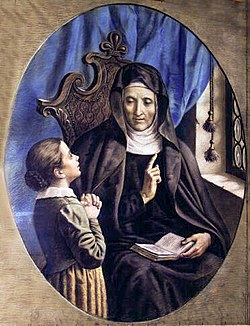
St. Angela Merici (17th century)

According to legend, in 1524, while traveling to the Holy Land, Merici suddenly became blind when she was on the island of Crete. Despite this, she continued her journey to the Holy Land and was ostensibly cured of her blindness on her return, while praying before a crucifix, at the same place where she had been struck with blindness a few weeks earlier.[2] In 1525, she journeyed to Rome in order to gain the indulgences of the Jubilee Year then being celebrated. Pope Clement VII, who had heard of her virtue and success with her school, invited her to remain in Rome. Merici disliked notoriety, however, and soon returned to Brescia.

On 25 November 1535, Merici gathered with 12 young women who had joined in her work in a small house in Brescia near the Church of Saint Afra, where together they committed themselves in the founding of the Company of St. Ursula, placed under the protection of the patroness of medieval universities. Her goal was to elevate family life through the Christian education of future wives and mothers. They were the first teaching order of women religious.[5]

Four years later the group had grown to 28.[6] Merici taught her companions to serve God, while remain in the world, teaching the girls of their own neighborhood, and to practice a religious form of life in their own homes.[a] The members wore no special habit and took no formal religious vows. Merici wrote a Rule of Life for the group, which specified the practice of celibacy, poverty and obedience in their own homes. The Ursulines opened orphanages and schools. On 18 March 1537, she was elected "Mother and Mistress" of the group. The Rule she had written was approved in 1544 by Pope Paul III.[7]

When Merici died in Brescia on 27 January 1540,[1] there were 24 communities of the Company of St. Ursula serving the Catholic Church through the region.[8] Her body was clothed in the habit of a Franciscan tertiary and was interred in the Church of Sant'Afra.

The traditional view is that Merici believed that better Christian education was needed for girls and young women, to which end she dedicated her life. Querciolo Mazzonis argues that the Company of St. Ursula was not originally intended as a charitable group specifically focused on the education of poor girls, but that this direction developed after her death in 1540, sometime after it received formal recognition in 1546.[9]

Veneration

[edit]
The incorrupt body of Saint Angela Merici in Brescia, Italy

During her life, Merici had often prayed at the tombs of the Brescian martyrs at the Church of St. Afra in Brescia. She lived in small rooms attached to a priory of the Canons Regular of the Lateran. According to her wishes, after her death, she was interred in the Church of St Afra to be near the martyrs' remains. There her body remained until the complete destruction of this church and its surrounding area by Allied bombing during the Second World War, on 2 March 1945, in which the parish priest and many townspeople died. The church and corresponding buildings were afterwards rebuilt, and reopened on 10 April 1954. The church was consecrated on 27 January 1956, with a new dedication to Saint Angela Merici, while the Parish of St. Afra was transferred to the neighboring Church of St. Eufemia.[10]

Merici was beatified in Rome on 30 April 1768, by Pope Clement XIII. She was later canonized on 24 May 1807 by Pope Pius VII.

Feast day

[edit]

Merici was not included in the 1570 Tridentine calendar of Pope Pius V because she was not canonized until 1807. In 1861, her feast day was included in the Roman calendar – not on the day of her death, 27 January, since this date was occupied by the feast day of Saint John Chrysostom, but instead on 31 May. In 1955, Pope Pius XII assigned this date to the new feast of the Queenship of Mary, and moved Merici's feast to 1 June.

However, for the Ursulines of the Roman Union, the Sacred Congregation of Rites on 29 January 1929 has permitted them to celebrate the Saint's feast on her dies natalis, which is 27 January and ranked as Double of the First Class with a common octave. The same Congregation also allowed them to celebrate her proper Feast as in the General Roman Calendar, which is 31 May. This particular Mass has the introit Gaudeamus and a proper Gradual and Alleluia, but the prayers are taken as usual from the Missal.[11]

The celebration was ranked as a Double until 1960, when Pope John XXIII gave it the equivalent rank of Third-Class Feast. Lastly, in the major 1969 reform of the liturgy, Pope Paul VI moved the celebration, ranked as a Memorial, to the saint's day of death, 27 January.[12]

Dedications

[edit]
  • St. Angela Merici Catholic School, Bradford, Ontario, Canada.
  • St. Angela Merici Catholic School, Windsor, Ontario, Canada.
  • St. Angela Merici Academy, Coeur d'Alene, Idaho, United States.
  • St. Angela Merici Catholic School, Chatham, Ontario. Canada
  • St. Angela Merici Montessori School, Dasmariñas, Cavite, Philippines
  • St. Angela's College, Cork, Ireland.
  • St. Angela's College, Sligo
  • St. Angela's School, Ursuline Convent Waterford, Waterford, Ireland.
  • Ursuline College, Cleveland, Ohio, U.S.A.
  • Ursuline College, Blackrock, Cork, Ireland
  • Ursuline College Thurles, Tipperary, Ireland.
  • St. Angela's Ursuline RA School Forest Gate, London, United Kingdom
  • Merici College, Braddon, ACT, Australia.
  • École St. Angela Merici, Regina, Saskatchewan, Canada.

See also

[edit]

Notes

[edit]

References

[edit]

Bibliography

[edit]
[edit]
Revisions and contributorsEdit on WikipediaRead on Wikipedia
from Grokipedia
Saint Angela Merici (21 March 1474 – 27 January 1540) was an Italian Franciscan tertiary and the founder of the , the first religious community of women dedicated to the of girls and the practice of charity in a secular setting without enclosure or vows. Born in , a town on the southwestern shore of in , , Merici was orphaned at the age of ten following the deaths of her parents and later her sister, which profoundly shaped her spiritual life. Raised by her uncle in , she joined the Third Order of Saint Francis as a , embracing a life of prayer, mortification, and service to the poor, which included caring for the sick during plagues in . At around age twenty, after her uncle's death, she returned to Desenzano to establish a for young girls, focusing on their Christian and moral formation, before moving to Brescia to expand her charitable works among the city's youth and needy. Merici's visionary approach to religious life culminated in 1535, when she gathered twelve companion virgins in to form the Compagnia di Sant'Orsola (Company of ), an innovative association that allowed women to live in their family homes while dedicating themselves to teaching, prayer, and , under the patronage of . This group, initially without habits, cloister, or formal vows, emphasized lay integration and education as a means of spiritual renewal during the era, marking a departure from traditional monastic models for women. Her rule, dictated on her deathbed in 1540, outlined a path of humility, charity, and detachment, influencing the evolution of the into a worldwide teaching order. A mystic noted for visions, including one confirming her sister's salvation and another during a 1524 pilgrimage to the Holy Land where she temporarily lost her sight only to be miraculously healed on the return journey, Merici's life exemplified resilience and devotion. She visited Rome in 1525, receiving encouragement from Pope Clement VII, but chose to remain in northern Italy to serve locally. Beatified in 1768 by Pope Clement XIII and canonized on 24 May 1807 by Pope Pius VII, she is venerated as the patron saint of the sick, disabled, and those grieving the loss of parents, with her feast day observed on 27 January. Buried in the Church of Saint Afra in Brescia, her legacy endures through the Ursuline congregations' global contributions to female education and social justice.

Early Life

Birth and Family Background

Angela Merici was born on March 21, 1474, in , a small town in the region of northern Italy, near the southwestern shore of . Her birthplace is identified as a house at Via del Castello, n° 95, in the hamlet of Grezze, reflecting the rural setting of her early years. She was the daughter of Giovanni Merici, a farmer of modest noble origins who cultivated land, owned livestock, and paid taxes on inherited property, and her mother, from the wealthy and educated Biancosi family of merchants in nearby Salò. The family, which included an older sister who died young and two older brothers, formed a close-knit, devout Catholic household marked by unity and religious practice; Giovanni regularly read stories from the Lives of the Saints to his children, fostering an environment of faith and moral instruction. Merici's early childhood showed initial signs of religious devotion, including participation in family prayers and attendance at local church services, influenced by the pious atmosphere of her home and the surrounding community's emphasis on Catholic rituals. From around age five, she practiced sobriety and renunciation, drawn to tales of virgin martyrs and saints shared by her father. Born amid the in , a time of cultural flourishing yet marked by political strife, wars, plagues, and social upheaval under Venetian influence, Desenzano provided a relatively stable rural backdrop compared to the turbulent urban life in nearby . The played a central role in society, promoting spiritual life through Franciscan ideals of and amid widespread moral challenges and economic pressures that affected families like the Merici, who had relocated to Desenzano around 1470 due to financial difficulties.

Orphanhood and Early Formative Experiences

In her early childhood, following the deaths of her parents, Angela and her older sister, Giana Maria, moved from Desenzano to live with their uncle in the nearby town of , becoming orphans around age ten according to traditional accounts, though recent indicates a sequential loss of her father and sister early, followed by her mother later, with the exact timing uncertain. Her sister died unexpectedly without receiving the last sacraments, intensifying the young girl's sense of loss and isolation, though the precise age and date remain debated in scholarly sources. The successive tragedies plunged Angela into deep grief, which she channeled into an intensified spiritual life, turning to and self-imposed penances as sources of solace. Influenced by the local Franciscan friars, whose emphasis on simplicity and service resonated with her circumstances, she joined the Third Order of St. Francis as a tertiary around age fifteen, adopting their and committing to a life of evangelical and . This affiliation not only provided communal support but also guided her decision to forgo personal comforts, living simply amid her mourning and fostering an early commitment to spiritual discipline over material security. In the years following her sister's death, Angela began modest acts of service in , assisting at the local parish and sharing basic religious instruction with children in the community, while maintaining a semi-eremitic routine of extended and . When her uncle died around 1494, at Angela's age of twenty, she returned to Desenzano to live with her brothers, where she expanded these efforts by teaching , , and practical skills like to poor neighborhood girls who lacked formal education. These formative activities honed her sense of , blending contemplative withdrawal with emerging . This phase of personal trial and initial ministry transitioned around 1516, when Franciscan superiors invited the then-forty-two-year-old Angela to relocate to to support a grieving , Caterina Patengola, thereby shifting her focus toward broader urban outreach.

Spiritual Journey

Franciscan Influence and Visions

Around the age of sixteen, circa 1490, Angela Merici joined the Third Order of St. Francis while residing with her uncle in following the death of her parents, taking vows of poverty, chastity, and obedience as a secular tertiary living in the world. Earlier, around age ten, she had made a private vow of virginity, which deepened her commitment to a . She wore the Franciscan tertiary throughout her life and received her initial from the Friars Minor, which deepened her commitment to a life of austerity and service. Angela's early supernatural experiences began in her childhood, with her first reported vision occurring around age ten, shortly after becoming an , in which she was assured that her deceased sister was , providing comfort amid her . In 1506, while praying in the fields of Brudazzo near Desenzano, she received a pivotal of a ascending to , flanked by angels and young women ascending and descending, one of whom she recognized as her deceased sister. In this revelation, the figures symbolized future companions dedicated to God's service, instructing Merici to establish a group focused on the Christian of girls, a calling that echoed her Franciscan tertiary vows of and . These encounters reinforced a divine call to consecrated virginity, shaping her vocational path away from toward an active . The Franciscan spirituality that permeated Angela's life emphasized , , and the imitation of Christ in poverty, profoundly influencing her rejection of traditional cloistered religious life in favor of an engaged, secular form of consecration that allowed her to minister directly in society. This charism of Christ-centeredness, familial community, and reconciliation with the marginalized became central to her later foundations, blending contemplation with practical service to the needy. In and later in , Angela received guidance from Franciscan friars, including at the Convent of Friars Minor of San Bernardino, where she took her tertiary habit, and from superiors who reinforced her emerging through counsel and support for her active ministry. These mentors in the Friars Minor helped nurture her vision for a renewed form of women's religious life, encouraging her to live out Franciscan ideals amid everyday challenges.

Pilgrimages and Mystical Encounters

In 1524, Angela Merici undertook a significant pilgrimage to the , accompanied by her cousin Biancosi and the merchant Romano, motivated by her deepening spiritual devotion and desire to visit the sacred sites of Christ's life. During the journey, while on the island of (then known as Candia), she suddenly lost her sight, an affliction that persisted throughout the pilgrimage. Undeterred, Merici continued onward, experiencing the holy places through spiritual insight rather than physical vision, which she later described as a profound grace that heightened her interior contemplation. Her sight was miraculously restored upon the return voyage, at the same location in , as she prayed before a , an event she attributed to divine intervention. This pilgrimage profoundly shaped Merici's mystical experiences, reinforcing her sense of divine guidance amid personal trials. Merici's travels extended beyond the , including two pilgrimages to Varallo in , where she meditated on the Passion through its renowned shrines depicting scenes from ' life, further deepening her commitment to contemplative amid worldly . In 1525, she journeyed to during the Year, seeking plenary indulgences and gaining an audience with , who admired her work with young women and urged her to remain in the city, though she returned to to pursue her local calling. These journeys, marked by hardship and revelation, served as divine affirmations of her emerging vocation in an era of religious upheaval during the .

Ministry in Brescia

Care for the Needy and Education

Upon arriving in around 1516 at the invitation of her Franciscan superiors, Angela Merici took up residence with the noble Patengola family, where she was welcomed to assist a widowed tertiary in need. As a member of the Third Order of St. Francis, she embraced a life of simplicity and service, sleeping on a simple pallet and dedicating herself to amid the city's social challenges, including and plague outbreaks. Merici soon immersed herself in charitable endeavors, joining local confraternities such as that of St. Afra to organize aid for the vulnerable. She personally cared for orphans by supporting infirmaries and shelters, tended to the sick and disabled in their homes, distributed to the impoverished, and visited prisoners to offer spiritual comfort and material assistance. These activities reflected the Franciscan emphasis on mercy toward the marginalized, drawing from her own experiences of loss and her commitment to imitating Christ's compassion for the suffering. In parallel, Merici initiated informal educational initiatives tailored to the era's limited opportunities for girls, particularly those from poor families facing gender-based exclusion from formal schooling. She gathered young girls in private homes for , instructing them in Christian doctrine, basic reading, prayer practices, and practical domestic skills like and household management to foster self-sufficiency and moral formation. These sessions not only addressed spiritual needs but also empowered participants to navigate 16th-century societal constraints, promoting dignity and virtue among women overlooked by traditional institutions. To sustain these efforts, Merici began forming small groups of like-minded women. These lay women met for mutual spiritual support, prayer, and collaborative service, creating a network that amplified charitable and educational outreach while allowing them to remain active in family and community life. This grassroots community building laid essential groundwork for broader apostolic work, embodying Merici's vision of holiness through everyday acts of love.

Formation of the Company of St. Ursula

On November 25, 1535, in , , Angela Merici formally established the Company of St. Ursula, gathering 28 women, including herself as leader, who dedicated their lives under the patronage of the virgin martyr St. Ursula. This founding event marked a pivotal moment in Merici's ministry, building briefly on her prior informal efforts to educate and care for young girls in the region. The formation responded to the pressing spiritual and social challenges of 16th-century , amid Catholic reform movements that anticipated the (1545–1563), emphasizing the need for lay women to contribute actively to Church renewal through apostolic work. Merici envisioned a that empowered women to serve without withdrawing from society, addressing the era's turmoil from wars, plagues, and moral decline by fostering and charity among the . The initial structure was innovative for its time, allowing members to remain in their family homes unbound by monastic , while committing to daily , mutual support, and the Christian of girls in faith, virtues, and practical skills, without requiring formal . This secular approach enabled the women to integrate their spiritual dedication with everyday responsibilities, distinguishing the Company from traditional cloistered orders. Merici recruited her initial companions from like-minded women in Brescia's middle and upper classes, including daughters of merchants and professionals who shared her vision of lay holiness and service. In March 1537, following the Company's early growth, she was unanimously elected mother general for life, solidifying her role in guiding the group's development.

Founding Principles and Rule

Vision for Secular Religious Life

Angela Merici's vision for the Company of St. Ursula centered on a form of that allowed women to remain in the secular world, unbound by the typical of traditional monastic communities. She envisioned members living as ordinary women—wives, mothers, or single individuals—who would integrate their spiritual commitment into everyday family and social roles, thereby infusing into society from within. This approach emphasized a "hidden life," where consecration was discreet and unobtrusive, enabling women to serve without withdrawing from the world. In her to the Rule, Merici urged her followers to persevere in this , describing it as a grace that separated them spiritually from worldly darkness while keeping them actively engaged in it. The theological foundations of this vision drew heavily from Franciscan spirituality, which Merici embraced as a tertiary, stressing simplicity, humility, and personal devotion to Christ over institutional structures. Influenced by her Franciscan formation, she rejected strict enclosure as incompatible with the active service she deemed essential for laywomen, promoting instead a life of voluntary and charity in the midst of daily existence. Devotion to St. Ursula, the legendary protector of virgins and leader of women, further shaped the charism, portraying members as modern apostles under Ursula's patronage, dedicated to preserving purity and faith in a turbulent era. Merici's writings reflect this, calling members "true and virginal spouses of the " who must vigilantly resist worldly snares while embracing divine love. At the heart of Merici's apostolic focus was the formation of girls in , , and practical skills, aimed at countering the spiritual threats of and the in 16th-century . By educating young women to become exemplary within their families and communities, she sought to renew from its core, viewing this mission as a direct response to God's call for active evangelization. This emphasis empowered women as equals in the , granting them leadership roles and affirming their dignity as co-builders of the Church, a radical stance that anticipated later lay movements. In the , Merici exhorted perseverance in this path, promising that adherence to her guidelines would transform adversities into joys and lead to heavenly queenship.

Organization and Spiritual Guidelines

Angela Merici composed the Rule of the Company of around 1536–1537, providing a foundational guide for the group's internal life and practices without imposing formal . Instead, members made personal promises of obedience to , the Church, their , spiritual directors, superiors, and family; through voluntary preservation of with pure intentions and conduct; and service to and neighbor as devoted spouses of Christ. These commitments emphasized a lifelong dedication to spiritual growth, entered joyfully with for younger members, and sustained through perseverance amid trials. The organization's structure featured a hierarchical yet flexible under Merici as the initial leader, supported by a comprising four capable virgins as spiritual guides, four prudent widowed matrons as caregivers, and four mature men as agents or fathers, all elected by the Company. Members, primarily virgins living dispersed in their family homes across , were grouped informally by age and status, with governors visiting every fifteen days or as needed to provide guidance and oversight. This arrangement prioritized humility, mutual charity, and integration into secular life over rigid uniformity, eschewing habits or to allow women to remain active in society while fostering spiritual unity. Daily spiritual practices centered on prayer, including recitation of the Office of Our Lady, the seven , and focused on supplications to , with illiterate members substituting Pater Nosters and Ave Marias. Weekly elements involved seeking pardon from superiors for faults and biweekly gatherings for instruction, while monthly meetings on the first Friday required and Communion. Mutual correction occurred through these interactions, where governors addressed personal failings or interpersonal issues, escalating to matrons or male agents if necessary, always aiming to restore harmony through fraternal charity. Educational methods within the Company were home-based and integrated into everyday life, with senior members teaching younger ones—especially those under twelve—the essentials of and Christian living upon entry. Instruction emphasized Scripture, particularly narratives from the life of Christ; the lives of female saints like Ursula and as models of virtue; and practical cultivation of humility, modesty, simplicity, and charity to counter societal vices. This approach reinforced the Company's secular vision by enabling members to educate girls in their neighborhoods without withdrawing from or roles. Disciplinary guidelines promoted spiritual poverty by detaching from material attachments and relying on divine providence, quoting "Blessed are the poor in spirit, for theirs is the kingdom of heaven." Conflicts, whether internal or arising from family pressures, were resolved through mediation by governors, emphasizing obedience as superior to sacrifice—"It is better to obey than to sacrifice"—and avoiding expulsion in favor of patient correction. The lifelong commitment precluded enclosure or monastic separation, allowing members to embody their consecration amid worldly duties while upholding the Rule's call to joyful, unwavering service.

Later Life and Death

Expansion of the Company

During the final years of Angela Merici's life, the Company of St. Ursula experienced significant growth in membership and geographical reach, reflecting the appeal of its secular model of for women. Founded in 1535 with an initial group of approximately 28 members in , the Company expanded to around 150 members by 1540, demonstrating rapid adoption among women seeking spiritual commitment without enclosure. By 1537, affiliates had begun forming in nearby regions, including and , allowing the Company's principles of and charity to influence broader areas of through local groups of virgins and widows. Despite this expansion, the Company faced notable challenges from Church authorities who increasingly favored enclosed religious life for women, creating tension with its secular charism that permitted members to remain in their family homes and communities. Local clergy expressed opposition to the model's emphasis on women's and , viewing it as unconventional amid emerging reformist pressures that would later intensify during the . Angela Merici provided steadfast leadership during this period, offering ongoing formation to members through a series of seven exhortations known as or counsels, which emphasized unity, humility, and fidelity to their . Despite her declining health and recurring illnesses, she stressed the importance of enduring trials with patience, drawing on her own experiences to inspire resilience among the growing membership. In preparation for continuity, Angela designated a successor, selecting a trusted companion to lead after her, and established a structure with elected leaders—such as the five Matrone chosen in 1537—to safeguard the Company's mission and organization.

Death and Immediate Aftermath

In her later years, Angela Merici suffered from chronic health issues, including episodes of illness that limited her physical activities, though she continued to guide the Company of St. Ursula spiritually. She fell seriously ill in early January 1540 and died on January 27 at the age of 65 in her home in . On her deathbed, Merici exhorted her companions to maintain unity and love, urging them: "The last word that I address to you and one I urge upon you with all the ardor of my soul, is that you live in harmony, united together, all of one heart and one will." Her final counsels, preserved in her writings, emphasized gentleness, mutual support, and fidelity to the Company's mission as preparation for her legacy. The members of the Company prepared her body for , and reports emerged of a sweet emanating from it, interpreted as an early sign of sanctity. Merici's funeral was a simple ceremony attended by a large crowd of the faithful, reflecting her humble life as a Franciscan tertiary. She was buried without a coffin in the Church of St. Afra in . Eighteen days later, her body was exhumed due to the sweet scent from her grave and attributed cures; it was found incorrupt, flexible, and lifelike, and was placed in a glass coffin for public . Her remains remained there until the church's destruction by Allied bombing during on March 2, 1945, after which they were lost. In the immediate aftermath, the Company of St. Ursula responded to her death by electing Elena Lodrone, whom Merici had designated as her successor, ensuring seamless leadership transition. Operations continued without disruption, with members adhering to Merici's rule and expanding local efforts in education and care for the needy.

Canonization and Veneration

Path to Sainthood

Following her death on January 27, 1540, Angela Merici experienced immediate popular in , where her body was laid out in the habit of a Franciscan tertiary and remained incorrupt for approximately thirty days. Numerous , including healings, were reported at her tomb in the Church of St. Afra, spreading her fame for holiness beyond the region and prompting early calls for her recognition by the Church. By the early seventeenth century, devotion to Angela had grown sufficiently to initiate formal steps toward canonization; in 1624, a group of pious women gathered to study her writings, fostering a spiritual movement that supported the opening of her cause in the seventeenth century. The process advanced slowly amid historical upheavals, but investigations confirmed several post-mortem attributed to her , including cures examined by Church authorities. These healings, particularly those documented in the eighteenth century, played a key role in establishing the supernatural evidence required for her . Angela was beatified on April 30, 1768, by , recognizing her and the validity of the miracles associated with her cult. The canonization process continued under subsequent popes; issued a approving her in 1790, though political disruptions from the and delayed the formal ceremony. On May 24, 1807, solemnly her in , affirming her charism for the Christian education of women and girls through the that celebrated her innovative approach to lay religious life. In the twentieth century, the Church extended further recognitions of Angela's intercessory power. She was declared a of the sick, the disabled, and those who have lost their parents, reflecting her lifelong for the vulnerable. The 500th anniversary of her birth in 1974 was marked by special events organized by Ursuline communities worldwide, including liturgical celebrations and reflections on her enduring educational legacy. In 2025, Ursuline communities marked the 500th anniversary of her pilgrimage to with global events, including liturgical celebrations and educational reflections.

Liturgical Feast and Patronages

The liturgical feast of Saint Angela Merici is observed on , marking the date of her death in 1540, as an optional memorial in the General Roman Calendar. It was initially added on May 31 in 1861, moved to June 1 in 1955, and transferred to in the 1969 revision. This placement honors her as a virgin and foundress, with the memorial's readings taken from the Common of Virgins or the Common of Holy Men and Women: For Teachers, emphasizing themes of lay and service that reflect her innovative approach to secular religious life. The propers for her draw from those designated for feasts of holy virgins, including the introit "Dilexisti iustitiam" (You have loved justice), which underscores her chaste dedication to Christ and her role in establishing a of women devoted to and charity. Her commemoration appears in the Franciscan as a member of the Third Order of Saint Francis and holds special prominence in Ursuline liturgical calendars, where it is often elevated to a or feast day to celebrate her foundational legacy. Saint Angela Merici is officially invoked as patroness of the sick, disabled people, and those grieving the loss of parents, roles attributed to her own experiences as an orphan and her lifelong care for the vulnerable, as noted in traditional Catholic hagiographies. She is also informally regarded as a patron of educators due to her establishment of the Company of St. Ursula as a teaching apostolate, and of single women for her model of consecrated virginity in the world. Devotional practices honoring Saint Angela include novenas prayed for intercession in matters of sickness, , and parental loss, often culminating on her feast day with petitions for courage in service. Veneration of her relics, such as first-class relics enshrined in Ursuline chapels and altars, has been a focal point of , particularly in post-World War II Europe where communities sought her aid in recovery and rebuilding. She is also invoked in dedicated litanies that praise her humility, prayerfulness, and commitment to the poor, integrating her into broader traditions of saintly .

Legacy and Influence

Development of the Ursuline Order

Following Angela Merici's founding of the Company of St. Ursula in 1535 as a secular association of women dedicated to education and charity, the group began evolving into a more formalized during the late 16th and early 17th centuries. In 1612, issued a bull elevating the Ursuline congregation in to the status of a , permitting for its members while allowing continued outreach in teaching and pastoral care; this approval marked the transition from a loose company to structured branches, with similar recognitions extended to communities in and shortly thereafter. The spread to France that year facilitated rapid growth across Europe, as the order adapted to local needs while preserving its core mission. Key figures drove early expansions, notably Anne de Xainctonge, who in 1606 founded the Society of the Sisters of of the Blessed Virgin in , emphasizing active ministry without strict and influencing subsequent Ursuline adaptations. This branch, along with others, transformed into cloistered convents in various regions during the , yet retained a strong focus on girls' education even within enclosed settings, blending contemplative life with apostolic work. By the mid-, Ursuline houses had proliferated in , , and , with over a dozen independent congregations emerging, each navigating tensions between enclosure and external service. The 19th and 20th centuries saw significant global growth through missionary endeavors, as from European foundations established missions in the starting in the late , such as the 1727 arrival in New Orleans, and expanding further in the 1800s to regions like and . In , missions began in the early 20th century, including the 1924 establishment in Siam (modern ), followed by outposts in and , where sisters addressed and healthcare amid colonial and post-colonial challenges; in 2024, the Ursulines marked the centenary of their mission in , underscoring continued presence in . Today, the Ursulines comprise over 20 autonomous congregations worldwide, with approximately 4,000 members serving in , , and pastoral roles across six continents. The Second Vatican Council (1962–1965) prompted internal reforms that renewed the order's identity, encouraging a return to Merici's vision of secular, active religious life over strict and fostering the inclusion of lay associates—non-vowed women who collaborate in ministry and spirituality. These changes, outlined in documents like Perfectae Caritatis, led many congregations to adapt constitutions, reduce cloistering, and emphasize collaborative models with , revitalizing the Ursulines' presence in modern society while honoring their foundational charism.

Impact on Catholic Education and Women's Roles

Angela Merici's foundational work in 1535 established the Company of St. Ursula, pioneering a model of Christian specifically for girls that emphasized holistic formation encompassing spiritual, intellectual, and practical dimensions. This approach focused on gentle guidance rather than coercion, aiming to develop the whole person—body, mind, and spirit—for harmonious integration into family and society. Her emphasis on incarnational learning through stories, art, and community interaction laid the groundwork for Ursuline , which adapted her writings like the Primitive Rule and Counsels for classroom use over centuries. In the context of the , following the (1545–1563), Ursulines became instrumental in teaching to girls and women, contributing to the Church's efforts to re-Christianize society and restore moral order through family . Merici's vision empowered women by creating an active apostolate that allowed laywomen to pursue consecrated lives in the secular world, predating modern feminist movements and offering an alternative to traditional paths of marriage or cloistered . Through the Company, she fostered mutual collaboration among women, enabling them to lead in spiritual and educational roles while resisting patriarchal constraints, as seen in the hierarchical of matrons and governors drawn from female members. This model inspired laywomen's movements and the development of secular institutes, promoting women's agency in the Church by integrating contemplation with apostolic service in everyday settings like homes and communities. In 20th-century scholarship, Merici has been recognized as a proto-feminist figure for her use of empowering symbols, such as St. Ursula, and her advocacy for women's leadership and virtue in a male-dominated era. Her charism continues to influence contemporary Catholic through a global network of Ursuline schools in over 30 countries, emphasizing service, , and girls' holistic development. Furthermore, twentieth-century scholarship, including , has reclaimed her legacy, highlighting her contributions to dynamics in the Church and inspiring NGOs focused on and .

References

Add your contribution
Related Hubs
User Avatar
No comments yet.