Hubbry Logo
Southern brown kiwiSouthern brown kiwiMain
Open search
Southern brown kiwi
Community hub
Southern brown kiwi
logo
8 pages, 0 posts
0 subscribers
Be the first to start a discussion here.
Contribute something
Southern brown kiwi
Southern brown kiwi
from Wikipedia

Southern brown kiwi
Temporal range: Pleistocene-recent[1]
Stewart Island tokoeka
Scientific classification Edit this classification
Kingdom: Animalia
Phylum: Chordata
Class: Aves
Infraclass: Palaeognathae
Order: Apterygiformes
Family: Apterygidae
Genus: Apteryx
Species:
A. australis
Binomial name
Apteryx australis
Shaw, 1813[3]
Subspecies[4]

A. a. lawryi Rothschild, 1893
(Stewart Island tokoeka)
A. a. australis Shaw, 1813
(Haast tokoeka)

The distribution of southern brown kiwi
Synonyms

Apteryx lawryi Rothschild, 1893[5]

The southern brown kiwi, tokoeka, or common kiwi[3] (Apteryx australis) is a species of kiwi from South Island of New Zealand. Until 2000 it was considered conspecific with the North Island brown kiwi, and still is by some authorities.

Taxonomy

[edit]

Apteryx australis is based on Greek and Latin. Apteryx means "A-" without "pterux" wings, and "australis" from "auster" the south wind, and "-alis" relating to.[6] The southern brown kiwi belongs to the kiwi family and it is a ratite, and a member of the order Apterygiformes. Like all ratites, its sternum has no keel, it is flightless, and it has a distinctive palate.[3]

Apteryx australis NML-VZ D180 Holotype from World Museum

The holotype specimen of Apteryx australis Shaw (Nat. Miscell., 24,1813, pl1057) is held in the collections of National Museums Liverpool at World Museum, with accession number NML-VZ D180. The specimen was collected by Captain Barclay at Dusky Sound, South Island, New Zealand and came to the Liverpool national collection via the 13th Earl of Derby's collection which was bequeathed to the people of Liverpool.

The southern brown kiwi is divided into two subspecies, with some conservationists arguing for a third:

  • A. a. australis, the Fiordland tokoeka, with a population of approximately 15,000 birds is found on and near the Fiordland on the South Island of New Zealand. A disjunct population, near Haast, called the Haast tokoeka or Haast brown kiwi (not to be confused with Apteryx haastii), is rare (with only about 350 specimens left) and is characterised by its rufous plumage.[7][8]
  • A. a. lawryi, the Stewart Island tokoeka, is relatively common (20,000 birds) throughout its range, with about 17 birds per square kilometre. Its feathers are streaked lengthwise with reddish brown.[8]

A specimen described as Apteryx occidentalis in 1893 is often considered a junior synonym of Apteryx owenii, but a study in 2002 indicated this may be a hybrid between Apteryx australis and Apteryx owenii.[9]

Description

[edit]
Drawing of dissected specimen, with exposed muscles and wing-claw

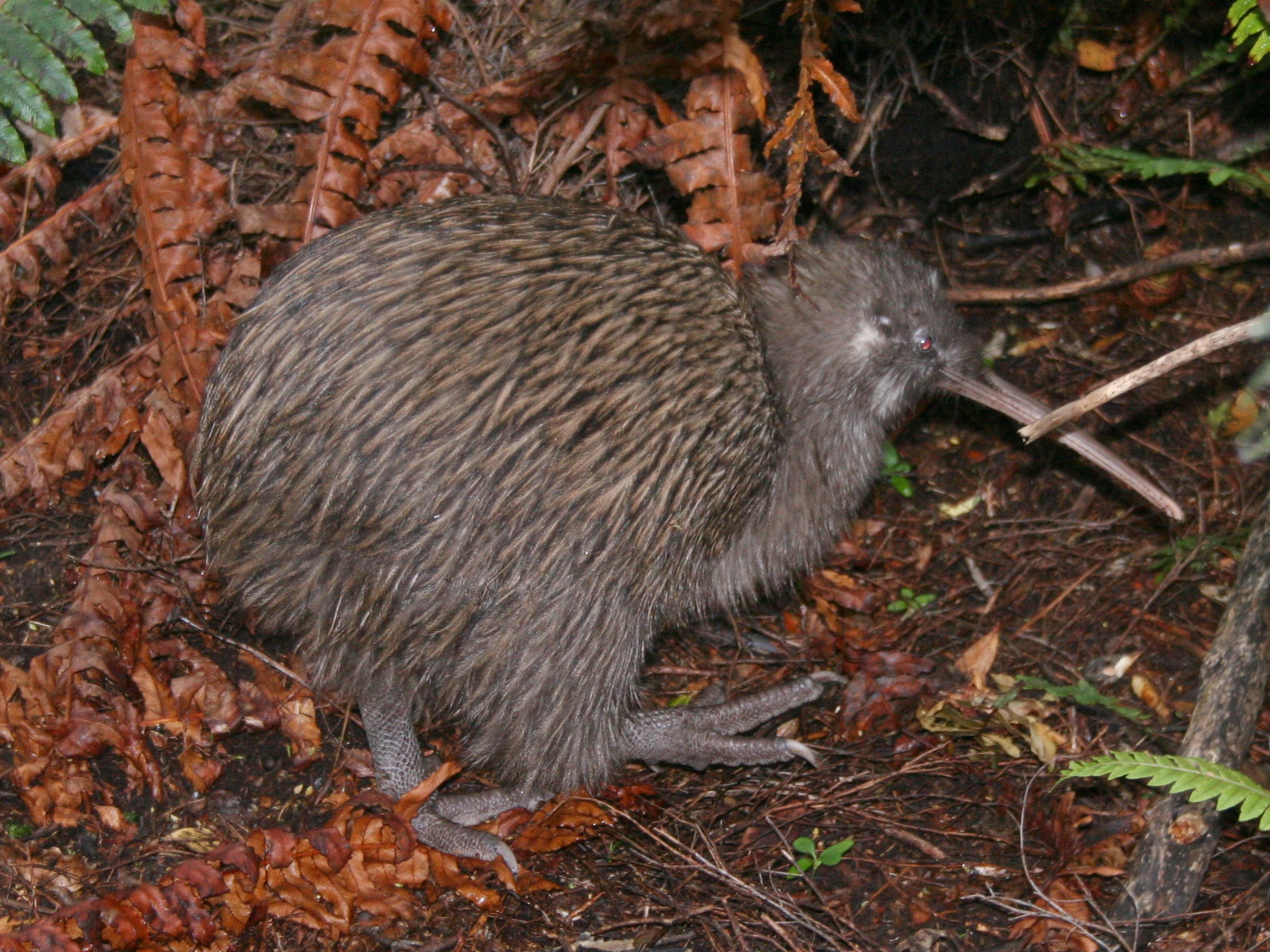
It has no preen gland, and its feathers have no aftershafts and no barbules. There are large vibrissae around its gape, and it has no tail, only a pygostyle. It has a length of 45 to 55 cm (18–22 in) and the female weighs 2.1 to 3.9 kg (4.6–8.6 lb) and the male weighs 1.6 to 2.8 kg (3.5–6.2 lb). Its bill is long and slender with a slight down-curve. Like other kiwis it is nocturnal. The colour of its plumage is rufous with some streaking.[3]

Behaviour

[edit]

Vocalisation

[edit]

Southern brown kiwi communicate vocally to aid in defending their territory. They will also sing duets with each other, with the male shrill "kee-wee" or "kee-kee" and the females hoarse "kurr kurr".[7] Males are more vocal and they both call in an upright position with their legs stretched out and their bill pointing up.[3]

Diet

[edit]
Specimen foraging on Stewart Island

The southern brown kiwi has a long slender bill with lateral nostrils at the tip, which helps give them their keen sense of smell. They utilise this, more than sight and sound, to forage in dirt for invertebrates, including earthworms, beetle larvae, snails, crayfish,[10] spiders, centipedes, and orthoptera, as well as eels and amphibians.[10] Its gizzard is weak, and underutilised due to the lack of plant matter. Its caeca are long and narrow and aid in digestion.[3]

Reproduction

[edit]
Skeleton

The southern brown kiwi, like all kiwi, has two functioning ovaries, however only the left oviduct functions, allowing eggs from both ovaries to pass through. It is a monogamous species and once paired up, they will defend their territories with warning calls. The size of their territory is between 4.9 and 43 hectares (12 and 106 acres). Nests are made in burrows, or sheltered beneath thick vegetation. The female lays 1–2 eggs, typically just one, which the male incubates for 90 days. After a few days the chick will exit the nest and feed on its own, although it may stay around parents for a year. When not incubating eggs, they roost alone in sheltered places at ground level.[3]

Range and habitat

[edit]
Breeding Population and Trends[8]
Location Population Date Trend
Stewart Island 20,000 1996 Stable
Fiordland 7,000 1996 Decreasing
Haast 300[11] 2008 Increasing
Total (New Zealand) 27,000 1996 Declining

Southern brown kiwi live in the South Island and Stewart Island. On the mainland (South Island) they live in Fiordland and Westland. Their range is temperate and sub-tropical forests, grassland, and shrubland, the denser the better.[3] They are widespread throughout Stewart Island where they also live on the sand dunes.[8]

Conservation

[edit]

In 2000, after being recognised by IUCN, they were placed in the Vulnerable status group.[2] They have an occurrence range of 9,800 km2 (3,800 sq mi) and population of 27,000 was estimated in 1996.[8] Brush-tailed possums, Trichosurus vulpecula, and stoats, Mustela erminea, will eat the eggs, while stoats and cats will eat chicks and juveniles. Adults are also under threat as dogs, ferrets, and brush-tailed possums, attack them and the juveniles. The Stewart Island population is stable due to the lack of these predators,[2] however stoats may have colonised the island in 2000.[8]

In 2018 a drought caused a poor breeding season for Haast tokoeka and killed three chicks; six were airlifted to Orokonui Ecosanctuary near Dunedin, and then on to a "creche" on Rona Island in Lake Manapouri, Fiordland.[12]

Footnotes

[edit]

References

[edit]
[edit]
Revisions and contributorsEdit on WikipediaRead on Wikipedia
from Grokipedia
The Southern brown kiwi (Apteryx australis), known in as tokoeka, is a flightless, nocturnal endemic to southern , one of the five extant kiwi species. It measures 50–65 cm in length, with males weighing 1.4–3.1 kg (bill length 110–155 mm) and females 2.1–3.9 kg (bill length 130–205 mm), featuring a rotund body, hair-like rufous-brown plumage with streaking, tiny vestigial wings, strong legs for scratching soil, and a long slender bill with nostrils at the tip for detecting prey by smell. This shy, ground-dwelling bird inhabits diverse environments such as dense forests, subalpine scrub, tussock grasslands, and coastal sand dunes from to 1,500 m elevation, primarily across and the Haast region of southwestern , Stewart Island (Rakiura), and nearby offshore islands, with small translocated populations in predator-free sanctuaries like Orokonui Ecosanctuary. It forages mainly on earthworms, , and fallen fruit by probing the leaf litter and at night, while spending days hidden in burrows or under vegetation, and exhibits territorial behavior with home ranges of 19–50 ha for pairs. Southern brown kiwis are long-lived, reaching 27–50 years in the wild, and form lifelong monogamous pairs that raise a single chick every 2–4 years, with males performing most incubation of the large (74–84 days) and both parents sharing chick-rearing duties; fledglings are fully feathered at and independent after 5–7 days but may remain with family groups for up to 7 years in some populations. Classified as Vulnerable on the due to ongoing declines of 30–49% over three generations from predation by introduced mammals like stoats, cats, dogs, ferrets, and possums, the numbers approximately 16,500 mature individuals (as of 2018), with subpopulations varying from endangered Haast tokoeka (~400–500 birds (as of 2024), over half protected in a 12,000-ha ) to more stable groups (~8,000–10,000). Intensive conservation by New Zealand's Department of Conservation, including Operation Nest Egg (egg removal and rearing) and large-scale predator trapping, has reversed declines in managed areas, enabling population growth of up to 10% annually where implemented.

Taxonomy

Classification

The Southern brown kiwi (Apteryx australis) belongs to the order Apterygiformes and the family Apterygidae, classifying it as a flightless characterized by a keelless sternum and reduced wings. This placement highlights its ancient lineage among New Zealand's endemic birds, distinct from other s like ostriches or emus due to its small size and nocturnal adaptations. The species was first described scientifically by British zoologist George Shaw in 1813, in volume 24 of The Naturalist's Miscellany, where he established the genus Apteryx and named it Apteryx australis based on a specimen from . The specimen, collected from (Rakiura), is preserved at in the National Museums Liverpool collection (accession number LIV D180). A 2021 genetic and historical study confirmed the Stewart Island origin of the , reassigning the nominate to that population and leaving mainland forms without formal subspecific names. Prior to 2000, A. australis was often lumped with populations under a broader brown kiwi complex, but morphological differences—such as texture and body —and genetic analyses confirmed its status as a distinct , separate from Apteryx mantelli and other forms. This taxonomic revision, supported by molecular evidence from studies in the late , underscored the evolutionary divergence driven by geographic isolation. The Māori name "tokoeka," used particularly by Ngāi Tahu, derives from te reo Māori and translates to "weka with a walking stick," alluding to the bird's long resembling a staff, akin to the weka's probing behavior but extended for nocturnal foraging.

Subspecies and genetics

The Southern brown kiwi (Apteryx australis) is currently recognized with the Stewart Island population as the nominate A. a. australis (Rakiura tokoeka), while the mainland Fiordland tokoeka populations (including Haast) are treated as A. australis subsp. (unnamed). The Fiordland includes northern and southern populations, with an estimated 8,200 individuals in northern and 3,900 in southern as of 2018 (with recent growth in managed areas), while the Stewart Island numbers approximately 13,000 individuals (recent estimate). An isolated Haast tokoeka population, considered part of the Fiordland form but genetically distinct, is limited to about 400 individuals in southern Westland as of 2024. Recent genetic research has revealed further subdivisions within A. australis, identifying four evolutionarily significant units (ESUs) based on mitochondrial DNA and microsatellite analyses: the Haast, northern Fiordland, southern Fiordland, and Stewart Island populations. These ESUs exhibit significant genetic divergence, with limited gene flow between them due to geographic isolation, reflecting long-term separation shaped by New Zealand's fragmented landscapes. A key 2025 study using molecular techniques, including analysis and comparisons, confirmed a previously unrecognized subpopulation within the Haast ESU at Junction Hill in southern Westland, approximately 18 km from the main Haast range. This subpopulation, estimated at around 34 individuals (17 pairs) as of 2024, possesses a unique mitochondrial (Haast8) and three private alleles, indicating isolation and adding to the overall of the Haast tokoeka. Such findings underscore the need for targeted conservation to preserve these cryptic genetic distinctions. Conservation genetics studies have also established that A. australis represents a distinct from the (A. mantelli), supported by allozyme, , and morphological evidence showing deep phylogenetic divergence equivalent to species-level separation. This analysis highlighted the brown kiwis' extreme population structuring, with genetic differentiation among southern populations comparable to that seen in some mammalian .

Physical description

Morphology

The Southern brown kiwi (Apteryx australis) is a flightless measuring 50–65 cm in length, with pronounced in body size; females weigh 2.1–3.9 kg and are larger than males, which weigh 1.4–3.1 kg. Its overall build is rotund and chicken-like, supported by marrow-filled bones and a flat lacking a , adaptations consistent with its terrestrial lifestyle. The bird lacks an external , contributing to its compact form. Key anatomical features include a long, slender, slightly decurved bill measuring 11–20.5 cm (males 11–15.5 cm, females 13–20.5 cm), equipped with sensory pits at the tip for detecting prey vibrations. The wings are rudimentary and non-functional for flight, reduced to 3–5 cm in length with a small at the tip, and concealed beneath the shaggy . The legs are strong and stout, enabling rapid bursts of speed, and terminate in three forward-pointing toes armed with sharp claws suitable for digging and scratching. Sensory adaptations are prominent, particularly for a nocturnal, ground-foraging existence; the olfactory bulbs are enlarged and proportionately the largest relative to among birds, facilitating acute smell detection. Uniquely among birds, the nostrils are positioned at the bill tip, allowing olfactory sampling during probing. Juveniles hatch as fully feathered miniature adults with open eyes and functional but relatively short bills (around 4–5 cm), which grow rapidly alongside body size over the first 3–5 years to reach adult proportions.

Plumage and senses

The plumage of the Southern brown kiwi consists of soft, hair-like feathers that lack barbules and have unlinked barbs on a single rachis, giving a fur-like appearance distinct from the interlocking structure typical of most birds. These feathers are rufous-brown overall, streaked longitudinally with darker brown and black, and are denser on the head and back. The absence of reflects the bird's flightless nature, with vestigial wings hidden beneath the . Juveniles exhibit lighter, fluffier plumage than adults, with softer, more downy feathers that gradually darken to the adult coloration over 12 to 18 months. Coloration varies by subspecies: mainland populations, such as the Haast tokoeka, display darker brown-grey tones with a reddish tinge, while Stewart Island individuals (A. a. lawryi) have redder, less coarse plumage with finer streaking on smaller upperpart feathers. These hair-like feathers provide effective insulation against New Zealand's variable climate, aiding in a ground-dwelling, nocturnal lifestyle. The Southern brown kiwi possesses an exceptional , unique among birds due to a highly developed with nostrils positioned at the bill tip and enlarged olfactory centers in the . This , supported by a high number of genes comparable to mammals, enables precise detection of scents and correlates with its nocturnal foraging behavior. Hearing is well-developed, with large ear openings concealed under feathers and inner ear specializations, including an auditory fovea in the basilar papilla, tuned to high frequencies around 4–6 kHz for enhanced in low-light conditions. Vision is poor relative to other birds, featuring small eyes and a rod-dominated with a thick outer nuclear layer that boosts sensitivity to dim light, though genetic alterations eliminate to suit a primarily nocturnal existence.

Behavior and ecology

Activity patterns and vocalization

The Southern brown kiwi (Apteryx australis) is predominantly nocturnal, emerging from daytime burrows or dense cover approximately 30 minutes after sunset to forage and move within its territory, with activity peaking around dusk and just before dawn. During the day, individuals rest in sheltered burrows or under thick to avoid predators and diurnal competitors, though limited diurnal activity has been observed in predator-free sanctuaries where birds occasionally venture out during low-light periods. This nocturnal lifestyle aligns with their reliance on acute olfactory and tactile senses for navigation in low-visibility forest environments. Monogamous pairs maintain exclusive territories ranging from 4.9 to 43 hectares, depending on quality and availability, with boundaries often delineated by natural features such as or ridges. These territories are defended year-round through vocal displays and occasional physical confrontations, particularly by males near nesting areas, ensuring access and pair stability. Activity within territories remains consistent across seasons, though calling intensity increases during breeding periods from late winter to early summer. Vocalizations play a central role in communication, with males producing series of 15–25 shrill, ascending whistles described as a high-pitched "kee-wee" or "ah-el" repeated several times, while females emit 10–20 lower-pitched, hoarser growls or cries like "kurr-kurr" or "aarh." Pairs often engage in duets, alternating calls within seconds to reinforce bonding and coordinate territorial defense, with these exchanges most frequent from to . Warning calls against intruders include rapid, penetrating shrieks that signal or alarm. These vocalizations feature low-frequency components around 1–2 kHz, enabling effective transmission through dense forest with minimal , up to 2 km under optimal conditions like calm nights. Such acoustic traits facilitate advertisement, mate location, and pair coordination in obscured habitats, with calls often delivered from an upright posture to maximize projection.

and diet

The Southern brown kiwi primarily forages for in and leaf litter, with its diet dominated by earthworms, larvae of beetles, moths, and cicadas, spiders, centipedes, , and . In mainland populations such as , earthworms constitute a major component, often comprising around 40-45% of the diet by volume, while other make up the bulk of intake. On , where invertebrate biomass is lower due to nutrient-poor , the diet shifts toward higher proportions of lepidopteran larvae (36% of non-annelid dry matter), coleopterans (21%), and arachnids (19%), with earthworms still present in 80% of fecal samples but in lower volumes. matter, including fallen fruits, seeds, and leaves, is consumed occasionally, typically accounting for 10-15% or less of the diet across populations. Foraging involves slow nocturnal walks, covering 1-4 km per night, during which the bird taps the ground ahead with its bill tip to locate prey. It then probes deeply into , rotten logs, or leaf litter using its long, sensitive bill, which is equipped with nostrils at the tip for olfaction to detect odors of buried . Facial vibrissae, or bristles around the bill, are extended forward during probing to form a sensory "net" that detects substrate vibrations from prey movement, enhancing remote-touch capabilities similar to those in other probing . This nocturnal activity pattern aids efficient in low-light forest environments, though Stewart Island individuals often forage diurnally in response to scarce nighttime prey. The bird's keen sense of taste further allows it to avoid potentially toxic items, selecting only suitable . Due to its elevated metabolic rate relative to other birds, the Southern brown kiwi requires substantial daily food intake to sustain energy demands, often consuming food equivalent to a significant fraction of its body weight. Foraging strategies exhibit seasonal variations, with greater emphasis on surface insects and larvae during summer when they are more abundant and accessible, shifting to deeper-probing for earthworms in other seasons. Habitat degradation, such as through deforestation or invasive predators disrupting soil ecosystems, reduces invertebrate prey availability and forces longer foraging bouts, potentially leading to nutritional stress.

Reproduction and breeding

The southern brown kiwi exhibits a monogamous , with pairs forming lifelong bonds and typically attempting to breed annually from late winter to early summer, though they successfully raise a single chick only every 2–4 years due to low breeding success. occurs from , coinciding with both sexes reaching peak body weight, and pairs defend territories that support their reproductive activities. Breeding takes place seasonally from late winter to early summer, with egg-laying spanning June to December. Females produce a single large per clutch, weighing up to 20% of the female's body mass—among the largest relative egg sizes in birds—and second clutches are rare. Nests are constructed in burrows, rock crevices, hollow logs, or tree bases, often lined with vegetation for insulation. Incubation is biparental, with both male and female sharing duties; the male typically handles daytime incubation while responsibilities are divided at night, and in some populations like tokoeka, extended family members may assist. The lasts 74 to 84 days, one of the longest among birds, during which the egg is turned regularly to maintain an internal temperature of about 36.5°C. Post-hatching, chicks are semi-precocial, emerging fully feathered with a for initial nourishment and capable of independently within days. The provides brooding care for the first one to two weeks, after which chicks leave the nest but remain under parental protection; dependence varies by , lasting one to two months in Haast tokoeka but up to two to seven years in and populations, during which young may contribute to territory defense. Breeding success is generally low, with only 20 to 30% of surviving to adulthood due to high predation risks during incubation and early chick stages; for instance, studies of Okarito rowi report hatching rates of about 70% but overall productivity of roughly 0.5 fledged chicks per pair annually.

Distribution and habitat

Geographic range

The Southern brown kiwi (Apteryx australis) is endemic to and currently occupies a restricted native range on the , primarily in the region, Westland, and the isolated Haast area, as well as on [Stewart Island](/page/Stewart Island) (Rakiura). These populations are disjunct, reflecting historical fragmentation, with the Haast group separated by approximately 30 km from the main Fiordland distribution. Historically, the species was far more widespread across the southern and eastern portions of the , ranging northward to prior to human arrival and subsequent alterations. and introduced predators have confined remaining wild populations to remnant forested areas, resulting in the current patchy distribution. Conservation translocations have established small introduced populations in protected sanctuaries, such as Orokonui Ecosanctuary near , where Haast tokoeka chicks have been relocated to bolster and survival. The Southern brown kiwi is non-migratory and sedentary, with individuals maintaining lifelong territories typically spanning 10–50 hectares.

Habitat preferences

The Southern brown kiwi (Apteryx australis) primarily inhabits dense podocarp-broadleaf forests, which provide the thick essential for shelter and , as well as tussock grasslands and shrublands that support burrowing in soft, loamy soils rich in . These environments offer dense vegetation cover to protect against predators during the day, when the birds rest in burrows, hollow logs, or under thick foliage, and moist, shaded areas that maintain humidity for prey availability. Populations on favor coastal scrub and sand dunes alongside forested zones, demonstrating some tolerance for edge habitats adjacent to modified farmlands or plantations, though they avoid open pastures. Microhabitat selection emphasizes areas with friable soil suitable for probing with their long bills to access earthworms and other soil-dwelling , alongside leaf litter and rotten logs that harbor abundant prey. In and Haast regions, preferences lean toward mature indigenous over seral scrub, with birds seeking moist understories to sustain invertebrate populations. This reliance on humid conditions makes them vulnerable to habitat drying caused by , which reduces and prey density. The species occupies an altitudinal range from to 1,500 m, with Haast tokoeka subpopulations extending into subalpine zones up to 1,500 m in grasslands and shrublands near the bush line. It thrives in temperate, wet climates characteristic of southwestern , where consistent rainfall supports the forested and scrubby ecosystems it prefers, but shows adaptability to slightly drier modified edges without fully entering agricultural clearings.

Conservation

Population status and threats

The Southern brown kiwi (Apteryx australis) has an estimated total population of approximately 25,000 individuals, based on assessments from 2018 that include about 3,900 in southern , 8,200 in northern , 12,300 on , and 450 near Haast. The Haast subspecies population is estimated at 350–500 individuals and shows signs of increase in managed areas. In unmanaged habitats, the population is declining at an annual rate of about 2%. However, specific subpopulations exhibit positive trends; for instance, the Fiordland tokoeka at Shy Lake is growing by approximately 2% per year, according to 2024 monitoring data. The is classified as Vulnerable on the due to ongoing declines. The primary threats to the Southern brown kiwi stem from predation by introduced mammals, which cause high mortality rates among eggs, chicks, and juveniles. Stoats (Mustela erminea) are the leading predator, particularly for chicks, while dogs pose the greatest risk to adults via direct attacks or disturbance. Possums (Trichosurus vulpecula) also contribute by preying on eggs and competing for food resources. On Stewart Island, stoats have posed an escalating threat since their invasion around 2000, when initial signs of their presence were detected, leading to increased predation pressure on the stable population there. Habitat fragmentation further exacerbates vulnerability by reducing available foraging areas and increasing exposure to predators along forest edges. For example, ongoing loss of native podocarp-hardwood forest on has been linked to territorial declines and lower body mass in the Rakiura tokoeka subspecies. Human-related impacts include strikes, which kill individuals crossing roads in fragmented habitats, and secondary from anticoagulant rodenticides that accumulate in the and affect kiwi through consumed prey.

Conservation efforts and management

Conservation efforts for the southern brown kiwi (Apteryx australis), also known as tokoeka, are led by the Department of Conservation () and the Save the Kiwi Foundation, focusing on mitigating predation through intensive control measures. These programs emphasize trapping invasive predators such as stoats () and possums (Trichosurus vulpecula), which are primary threats to kiwi eggs and chicks. Humane kill traps are deployed in managed areas to target these species, with community involvement enhancing coverage and effectiveness. Additionally, aerial application of 1080 toxin is used in high-risk regions to suppress stoat populations during plague years, significantly boosting chick survival rates from near zero to around 20% in treated sites. Translocation initiatives have been crucial for establishing secure populations, particularly for the critically endangered Haast tokoeka . In 2018, six Haast chicks were airlifted from drought-affected areas to the predator-free Orokonui Ecosanctuary near , where they were reared before release to bolster and survival. Ongoing monitoring in , such as at Shy Lake, has demonstrated following predator control, with the local tokoeka group increasing by approximately 2% annually since 2020, marking the first reversal of decline in this remote area without prior intervention. Genetic management strategies include and targeted releases to support the Haast subpopulation, which numbers around 450 individuals. Operation Nest Egg involves incubating eggs in captivity and hand-rearing chicks until they exceed 1 kg, making them resistant to stoats, before releasing them into protected sites. Recent 2025 genetic studies identified a distinct subpopulation at Junction Hill near Haast, informing refined protection protocols to preserve unique lineages and prevent . These efforts have yielded measurable successes, with managed populations in sanctuaries showing growth rates of 2-10% annually, far exceeding the unmanaged decline of 2%. For instance, the Haast tokoeka population has increased steadily due to combined predator control and rearing programs. The broader Kiwi Recovery Plan aims to expand all kiwi species, including southern brown kiwi, to 100,000 individuals nationwide by 2030 through sustained 2% annual growth across taxa.

References

Add your contribution
Related Hubs
Contribute something
User Avatar
No comments yet.