Hubbry Logo
Scrovegni ChapelScrovegni ChapelMain
Open search
Scrovegni Chapel
Community hub
Scrovegni Chapel
logo
8 pages, 0 posts
0 subscribers
Be the first to start a discussion here.
Scrovegni Chapel
Scrovegni Chapel
from Wikipedia
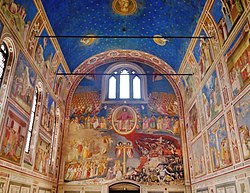
The exterior of the Scrovegni Chapel

Key Information

An 1842 engraving (from an earlier watercolor painting) shows the Arena Chapel to the right of an older palace, also bought, and redecorated, by Enrico Scrovegni. The palace had been demolished by 1827.[a][1]
Kiss of Judas, one of the panels in the Scrovegni Chapel

The Scrovegni Chapel (Italian: Cappella degli Scrovegni [kapˈpɛlla deʎʎi skroˈveɲɲi]), also known as the Arena Chapel, is a small church, adjacent to the Augustinian monastery, the Monastero degli Eremitani in Padua, region of Veneto, Italy. The chapel and monastery are now part of the complex of the Musei Civici di Padova.

The chapel contains a fresco cycle by Giotto, completed around 1305 and an important masterpiece of Western art. In 2021, the chapel was declared part of the UNESCO World Heritage Site of 14th-century fresco cycles composed of 8 historical buildings in Padua city centre.[2] The Scrovegni Chapel contains the most important frescoes that marked the beginning of a revolution in mural painting and influenced fresco technique, style, and content for a whole century.

Description

[edit]

Giotto and his team covered all the internal surfaces of the chapel with frescoes, including the walls and the ceiling. The nave is 20.88 metres long, 8.41 metres wide, and 12.65 metres high. The apse area is composed of a square area (4.49 meters deep and 4.31 meters wide) and a pentagonal area (2.57 meters deep). The largest element is extensive cycles showing the Life of Christ and the Life of the Virgin. The wall at the rear of the church, through which the chapel is entered, has a large Last Judgement. There are also panels in grisaille (monochrome) showing the Vices and Virtues.

The church was dedicated to Santa Maria della Carità at the Feast of the Annunciation, 1303, and consecrated in 1305. Much of Giotto's fresco cycle focuses on the life of the Virgin Mary and celebrates her role in human salvation. A motet by Marchetto da Padova appears to have been composed for the dedication on 25 March 1305.[3] The chapel is also known as the Arena Chapel because it was built on land purchased by Enrico Scrovegni that abutted the site of a Roman arena. The space was where an open-air procession and sacred representation of the Annunciation to the Virgin had been played out for a generation before the chapel was built.[4]

History

[edit]

Building and decoration

[edit]
Cast of Giovanni Pisano's effigy of Enrico Scrovegni, in the chapel

The Arena Chapel was commissioned to Giotto by the affluent Paduan banker, Enrico Scrovegni.[5] In the early 1300s Enrico purchased from Manfredo Dalesmanini the area on which the Roman arena had stood. Here he had his luxurious palace built, as well as a chapel annexed to it. The chapel's project was twofold: to serve as the family's private oratory and as a funerary monument for himself and his wife. Enrico commissioned Giotto, the famous Florentine painter, to decorate his chapel. Giotto had previously worked for the Franciscan friars in Assisi and Rimini, and had been in Padua for some time, working for the Basilica of Saint Anthony in the Sala del Capitolo and in the Blessings's Chapel.

A number of 14th-century sources (Riccobaldo Ferrarese, Francesco da Barberino, 1312–1313) testify to Giotto's presence at the Arena Chapel's site. The fresco cycle can be dated with a good approximation to a series of documentary testimonies: the purchase of the land took place on 6 February 1300; the bishop of Padua, Ottobono dei Razzi, authorised the building some time prior to 1302 (the date of his transferral to the Patriarcato of Aquileia); the chapel was first consecrated on 25 March 1303, the feast day of the Annunciation; on 1 March 1304 Pope Benedict XI granted an indulgence to whoever visited the chapel; one year later on 25 March 1305 the chapel received its definitive consecration. Giotto's work thus falls in the period from 25 March 1303 to 25 March 1305.

Model of the interior of the chapel, towards entrance
Towards the apse and altar

Giotto, who was born around 1267, was 36–38 years old when he worked at Enrico Scrovegni's chapel. He had a team of about 40 collaborators, and they calculated that 625 work days (giornate) were necessary to paint the chapel. A "work day" meant that portion of each fresco that could be painted before the plaster dried and was no longer "fresh" (fresco in Italian ).

In January 1305, friars from the nearby Church of the Eremitani filed a complaint to the bishop, protesting that Scrovegni had not respected the original agreement. Scrovegni was transforming his private oratory into a church with a bell tower, thus producing unfair competition with the Eremitani's activities. We do not know what happened next, but it is likely that, as a consequence of this complaint, the monumental apse and the wide transept were demolished. Both are visible on a model of the church painted by Giotto on the counter-façade (the Last Judgement). The apse was the section where Enrico Scrovegni had meant to have his tomb. The presence of frescoes dating to after 1320 supports the demolition hypothesis proposed by Giuliano Pisani. The apse, the most significant area in all churches, is where Enrico and his wife, Jacopina d'Este, were buried.

This apse presents a narrowing of the space which gives a sense of its being incomplete and inharmonious. When one observes the lower frame of the triumphal arch, right above Saint Catherine of Alexandria's small altar piece, Giotto's perfect symmetry is altered by a fresco decoration representing two medallions with busts of female saints, a lunette with Christ in glory, and two episodes from the Passion (the prayer in the Garden of Gethsemane and the Flagellation of Christ, which together give an overall sense of disharmony. The artist who painted these scenes also painted the greater part of the apse, an unknown artist called "The Master of the Scrovegni Choir" who worked at the Chapel about twenty years after Giotto's work was completed. The main focus of the unknown artist's work is constituted by six monumental scenes on the side walls of the chancel that depict the last period of Mary's earthly life. This choice is in tune with the iconographic program inspired by Alberto da Padova and painted by Giotto.

Modern period

[edit]

The chapel was originally connected with the Scrovegni palace, which was built on what remained of the foundations of the elliptical ancient Roman arena. The palace was demolished in 1827 in order to sell the precious materials it contained and to erect two condominiums in its place.[citation needed] The chapel was purchased by the Municipality of the City of Padua in 1881, a year after the City Council's deliberation of 10 May 1880 leading to a decision to demolish the condominiums and restore the chapel.

In June 2001, following a preparation study lasting over 20 years, the Istituto Centrale per il Restauro (Central Institute for Restoration) of the Ministry for Cultural Activities, in collaboration with Padua's Town Hall in its capacity of owner of the Arena Chapel, started a full-scale restoration of Giotto's frescoes under the late Giuseppe Basile's technical direction. In 2000 the consolidation and restoration of the external surfaces had been completed and the adjacent "Corpo Tecnologico Attrezzato" (CTA) had been installed. In this "equipped technological chamber" visitors wait for fifteen minutes to allow their body humidity to be lowered and any accompanying smog dust to be filtered out. In March 2002 the chapel was reopened to the public in its original splendor. A few problems remain unsolved, such as flooding in the crypt under the nave due to the presence of an underlying aquifer, and the negative effect on the building's stability of the cement inserts that replaced the original wooden ones in the 1960s.

Scholarly debates

[edit]
Section of the wall, showing the setting of the narrative panels.

Giuliano Pisani's studies argued that a number of commonly held beliefs concerning the chapel are groundless, among them, the notion that Dante inspired Giotto. However, a posthumous portrait of Dante was included in the Paradise section of the frescoes.[6] Another claim was that the theological program followed by Giotto is based on St Thomas Aquinas, whereas Pisani claims it to be wholly Augustinian. Pisani also argued against the conjecture that the Frati Gaudenti fraternity, of which Enrico Scrovegni was a member, influenced the content of Giotto's fresco cycle.[7] He also argued against the belief that Enrico Scrovegni required that the iconography program have no emphasis placed on the sin of usury. Giuliano Pisani pointed out that Dante's condemnation of Scrovegni's father, Reginaldo, as a usurer in Canto 17 of the Inferno dates to a few years after Giotto's completion of the chapel, so it cannot be regarded as a motive behind any theological anxieties on the part of Enrico Scrovegni. Pisani's arguments have not yet been widely embraced by the scholarly community, and that debates persist regarding the impetus for the chapel's creation and the reasons behind its design.

According to Pisani,[8] Giotto painted the chapel's inner surface following a comprehensive iconographic and decorative project devised by the Augustinian theologian, Friar Alberto da Padova. Among the sources utilized by Giotto following Friar Alberto's advice are the Apocryphal Gospels of Pseudo-Matthew and Nicodemus, the Golden Legend (Legenda aurea) by Jacobus de Voragine and, for a few minute iconographic details, Pseudo-Bonaventure's Meditations on the Life of Jesus Christ, as well as a number of Augustinian texts, such as De doctrina Christiana, De libero arbitrio, De Genesi contra Manicheos, De quantitate animae, and other texts from the Medieval Christian tradition, among which is the Phisiologus.[9]

Most Giotto scholarship believes that Giotto had made a number of theological mistakes. For instance, Giotto placed Hope after Charity in the Virtues series, and did not include Avarice in the Vices series, due to the usual representation of Enrico Scrovegni as a usurer. Giuliano Pisani asserts that Giotto followed a careful and deliberate theological programme based on Saint Augustine and devised by Friar Alberto da Padova. Avarice, far from being "absent" in Giotto's cycle, is portrayed with Envy, forming with it a fundamental component of a more comprehensive sin. For this reason Envy is placed facing the virtue of Charity, to indicate that Charity is the exact opposite of Envy, and that in order to cure oneself of the sin of Envy one needs to learn from Charity. Charity crushes Envy's money bag under her feet, while on the opposite wall red flames burn under Envy's feet.[10]

The depiction of the sacred stories, and the message of the vault

[edit]
The scene of the Lamentation of Christ
The centre of the vault, with Madonna and Child as one of the two suns, and prophets as planets

Giotto frescoed the chapel's whole surface, including the walls and the ceiling. The fresco cycle is organized along four tiers, each of which contains episodes from the stories of the various protagonists of the Sacred History. Each tier is divided into frames, each forming a scene. The chapel is asymmetrical in shape, with six windows on the longer south wall, and this shape determined the layout of the decoration. The first step was choosing to place two frames between each double window set on the south wall; secondly, the width and height of the tiers was fixed in order to calculate the same space on the opposite north wall.

Cycles of scenes showing the Life of Christ and the Life of the Virgin were the grandest form of religious art in the period, and Giotto's cycle is unusually large and comprehensive, showing the ambition of the commission. Allowing for this, the selection and iconography of the scenes is broadly comparable to other contemporary cycles; Giotto's innovation lies in the monumentality of his forms and the clarity of his compositions.

The cycle recounts the story of salvation. It starts from high up on the lunette of the triumphal arch, with the uncommon scene of God the Father instructing the Archangel Gabriel to perform the Annunciation to Mary.[11] The narrative continues with the stories of Joachim and Anne (first tier from the top, south wall) and the stories of Mary (first tier from the top, north wall). After a return to the triumphal arch, the scenes of the Annunciation and the Visitation follow. The stories of Christ were placed on the middle tier of the south and north walls. The scene of Judas receiving the money to betray Jesus is on the triumphal arch. The lower tier of the south and north walls shows the Passion and Resurrection; the last frame on the north wall shows the Pentecost. The fourth tier begins at ground level with the monochromes of the Vices (north wall) and the Virtues (south wall). The west wall (counter-façade) presents the Last Judgment.

The scenes depicted are as follows:

Sacred stories:

Triumphal arch (lunette):

Upper tier, south wall:

  • The Expulsion of Joachim
  • Joachim amongst the shepherds
  • An angel comes to Anna in prayer announcing the birth of Mary
  • Joachim sacrifices a kid goat to the Lord
  • Joachim's dream
  • Joachim meets Anna at the Golden Gate

Upper tier, north wall:

Expulsion of the money changers from the temple

Triumphal arch:

Middle tier, south wall:

Middle tier, north wall:

Triumphal arch:

Lower tier, south wall:

Lower tier, north wall;

Bottom tier, north wall: Vices:

Infidelity
Justice
  • Stultitia
  • Inconstantia
  • Ira
  • Iniustitia
  • Infidelitas
  • Invidia
  • Desperatio

Bottom tier, south wall: Seven virtues:

Counter-façade:

Last Judgment

The vault presents the eighth day, the time of eternity, God's time, with eight planets (the tondos which enclose the seven great prophets of the Old Testament plus John the Baptist) and two suns (which show God and the Madonna and Child), while the blue sky is studded with eight-point stars (8, sideways, symbolises infinity).

The monochrome personifications of Vices and Virtues

[edit]

The bottom tiers of the side walls feature 14 personifications in grisaille, representing single figures of Vices on the north wall and Virtues on the south wall. The Vices are Stultitia, Inconstantia, Ira, Iniusticia, Infidelitas, Invidia, and Desperatio. The Virtues are grouped as follows: the four cardinal virtues: Prudentia, Iustitia, Temperantia, Fortitudo, followed by the three theological ones: Fides, Karitas, Spes. Each virtue and vice is embedded within a mirror-like marble frame. The name of the vice or the virtue is written in Latin on top of each figure, indicating what these figures represent, namely, the seventh day (the time between Jesus's birth and the Final Judgement).

According to the controversial theory of Giuliano Pisani, the Vices and Virtues read starting from the altar's side, going towards the counter-façade (Final Judgement), and the sequence is not "Vices first, then Virtues" as was long believed. It rather proceeds from Vice 1 (Stultitia) (north wall, right hand side) to Virtue 1 (Prudencia) (south wall, left hand side), to Vice 2 (Inconstantia) (north wall) to Virtue 2 (Fortitudo) (south side), and so on. Vices and Virtues symbolise humanity's progress toward bliss (heavenly happiness). With the aid of Virtues, humanity can overcome obstacles (Vices). This is the philosophical-theological itinerary designed by Giotto's theologian, a learned theologian who drew his inspiration from Saint Augustine. The Vice-Virtue section of the Arena Chapel illustrates the philosophical-theological message underlying the overall project and is key to clarifying several points previously considered to be either obscure or the result of Giotto's only approximate theological knowledge.[12] For instance, in the Arena Chapel the vices are not the traditional capital vices or deadly sins (Pride, Envy, Wrath, Sloth, Greed, Gluttony and Lust), just like the "corresponding" virtues do not reflect the traditional order, consisting in four "cardinal virtues" (Prudence, Justice, Fortitude and Temperance) and three "theological virtues" (Faith, Hope and Charity).

A twofold therapeutic path leading to salvation is presented. The first, composed of four virtues, brings a cure by means of the opposing force provided by the cardinal virtues. The arrival point in this first part of the itinerary is Justice, Iusticia, who makes peace possible and therefore ensures Paradise on earth and earthly happiness. The first Vice in this first section is Stultitia, namely the incapacity to distinguish good and evil. Its cure (opposite wall) is Prudencia, Prudence, which in classical and theological terms is not "cautiousness" but "moral intelligence" or the capacity to distinguish good and evil. The viewer is in the sphere of Knowledge. Next comes the pair Inconstantia, Inconstancy, (north wall) and Fortitudo, Fortitude, (south wall). Fortitude (moral and mental strength) triumphs over Inconstancy's lewd oscillations by means of will. "Inconstancy" is literally "the lack of a stable seat"; it is a mix of light-headedness, volubility, and inconsistency. "Inconstancy" is portrayed as a young woman rolling over a ball, ready to fall, on a motley marble floor signifying the lack of "unity" ("constancy") which characterizes an inconstant mind. Here is the sphere of Will. Wrath, the third vice, is "tempered" by Temperantia, Temperance. According to Saint Augustine, Temperantia is the inner balance which ensures the will's stable dominion over instincts and keeps human desires within the boundaries of honesty. It is the therapy necessary to prevail over passions, which are symbolized by Wrath, because Wrath is the most perilous of all the passions: it is sudden and destructive, even against own's dearest ones, and is therefore the passion that human beings first need to learn how to control. This notion is a tenet of ancient Greek and (in its footprints) Roman philosophy, which Saint Augustine made his own and Giotto's theologian transmitted to him, fusing together a number of Saint Augustine's writings. [citation needed]

Prudence, Fortitude and Temperance pertain to each individual's ethical sphere of action and have as their goal the cure of each individual "self". Ethical virtue takes form in practical application, through action and behaviour that pertain both to the personal and the social sphere and affect human relations. The notions of Justice and Injustice, the central "pair" in Giotto's Arena Chapel, emanate from this notion. Justice' perfect centrality is visually emphasized by an architectural "die", a small cube that runs above each of the various personifications in a slightly slanted way, pointing either toward the apse or the counter-façade, everywhere but above the head of Justice (south wall) and Injustice (north wall), where the small die falls in a perpendicular line, marking at the same time the exact physical half of the chapel as well as Justice's curing function from a theological-philosophical viewpoint, without forgetting that Justice is what cures the soul of the sickening effects of Injustice (on the chapel's other side).[13]

Those who have successfully progressed in their therapeutic path have attained Justice. Those who have not, have attained Injustice. Those who have attained Justice have practiced a soul's therapy that can be defined as "human" and that led them to earthly happiness. They used as their therapy the "medicina animi", the "soul's medicine" provided by the cardinal virtues (in the sequence Prudence-Fortitude-Temperance-Justice), namely the moral and intellectual virtues with whose "medicine" human beings can be cured of, and are able to prevail over, the opposing vices. [citation needed]

Next come the theological virtues. In order to be able to aspire to heavenly Paradise one needs divine teaching, the revelation of truth, with which one overcomes and transcends human reason, and to practice the theological virtues. The "divine therapy" begins with the rejection of false beliefs (Infidelitas) through Faith in God (Fides). Only with the "medicine" of Charity (Karitas) can man overcome Selfishness and Envy (Invidia), which lead him to look with malevolent eyes (Latin in-vidēre) at his neighbour, who is also made by God in His likeness. Finally, with the aid (the medicine), Hope (Spes) can be contrasted with Lack of Hope, or Desperation (Desperatio). Hope is an attitude consisting in actively waiting for God's future blessings which descend from trust in God and in His word, and also consisting in love, through the love of God, of the whole of humankind. [citation needed]

The sources of this extraordinary program were identified by Pisani in a number of passages of Saint Augustine's works. Everything finds a perfect correspondence with something else. It is the theme of the "therapy of opposites", the sequential order of the cardinal and theological virtues, and the centrality of Justice. [citation needed]

In literature

[edit]

Giotto's painting of Charity is frequently cited in Remembrance of Things Past by Marcel Proust. Mr. Swann likens the kitchen maid to this painting and it becomes something of a joke between him and the narrator.

Amongst those artists who derived inspiration from the Chapel, British painter Sir Stanley Spencer (1891-1959) is known to have based the scale and narrative sequence for the Sandham Memorial Chapel at Burghclere, near Newbury, England (1924-32). [14]

Images

[edit]
Image Name Size (cm) Image Name Size (cm)
The Expulsion of Joachim 200x185 The Birth of the Virgin 200x185
Joachim among the Shepherds 200x185 Presentation of Mary at the Temple 200x185
Annunciation to St Anne 200x185 The Bringing of the Rods to the Temple 200x185
Joachim's Sacrificial Offering 200x185 The Suitors Praying 200x185
Joachim's dream 200x185 Marriage of the Virgin 200x185
Joachim and Anne Meeting at the Golden Gate 200x185 Wedding Procession 200x185
Annunciation – The Angel Gabriel Sent by God 150x195 Annunciation – The Virgin Receiving the Message 150x195

The life of Christ

[edit]
Image Name Size (cm) Image Name Size (cm)
Visitation 150x140 Judas' Betrayal 150x140
Nativity – Birth of Jesus 200x185 Last Supper 200x185
Adoration of the Magi 200x185 Washing of Feet 200x185
Presentation of Christ at the Temple 200x185 The Arrest of Christ (Kiss of Judas) 200x185
Flight into Egypt 200x185 Christ before Caiaphas 200x185
Massacre of the Innocents 200x185 Christ mocked 200x185
Christ among the Doctors 200x185 Road to Calvary 200x185
Baptism of Christ 200x185 Crucifixion 200x185
Marriage at Cana 200x185 Lamentation (The Mourning of Christ) 200x185
Raising of Lazarus 200x185 Resurrection (Noli me tangere) 200x185
Entry into Jerusalem 200x185 Ascension 200x185
Expulsion of the Money-changers from the Temple 200x185 Pentecost 200x185
Coretto 150x140 Coretto 150x140

Vices and Virtues

[edit]
Image Name Size (cm) Image Name Size (cm)
Prudence 120x60 Foolishness 120x55
Fortitude 120x55 Inconstancy 120x55
Temperance 120x55 Wrath 120x55
Justice 120x60 Injustice 120x60
Faith 120x55 Infidelity 120x55
Charity 120x55 Envy 120x55
Hope (virtue) 120x60 Desperation 120x60

Other

[edit]
Image Name Size (cm)
Vault
The Annunciation to Mary 230x690
Last Judgment 1000x840
Circumcision 200x40
Crucifix 223x164

Footnotes

[edit]

Citations

[edit]
  1. ^ Eimerl, Sarel (1967). The World of Giotto: c. 1267–1337. et al. Time-Life Books. p. 109. ISBN 0-900658-15-0.
  2. ^ UNESCO. "Padua's fourteenth-century fresco cycles, UNESCO declaration". UNESCO. Retrieved 15 August 2021.
  3. ^ Anne Robertson 'Remembering the Annunciation in Medieval Polyphony' Speculum70 (1995), 275–304
  4. ^ Schwarz, Michael Viktor (2010). "Padua, its Arena and the Arena Chapel: A Liturgical Ensemble". Journal of the Warburg and Courtauld Institutes. 73: 39–64. doi:10.1086/JWCI41418713. JSTOR 41418713. S2CID 190076925.
  5. ^ Kohl, Benjamin G. (2004). "Giotto and his Lay Patrons". In Derbes, Anne; Sandona, Mark (eds.). The Cambridge Companion to Giotto. Cambridge: Cambridge University Press. pp. 176–193.
  6. ^ Eimerl, Sarel (1967). The World of Giotto: c. 1267–1337. et al. Time-Life Books. p. 155. ISBN 0-900658-15-0.
  7. ^ Jacobus, Laura (2008). Giotto and the Arena Chapel: Art, Architecture and Experience. Harvey Miller.
  8. ^ Giuliano Pisani, I volti segreti di Giotto. Le rivelazioni della Cappella degli Scrovegni (Rizzoli, 2008)
  9. ^ Giuliano Pisani, La concezione agostiniana del programma teologico della Cappella degli Scrovegni, in Alberto da Padova e la cultura degli agostiniani, a cura di Francesco Bottin, Padova University Press 2014, pp. 215–268
  10. ^ Alberto da Padova e la cultura degli agostiniani, a cura di F. Bottin, Padova University Press 2014, pp. 1–322
  11. ^ Schiller, I, 47
  12. ^ Giuliano Pisani, I volti segreti di Giotto. Le rivelazioni della Cappella degli Scrovegni
  13. ^ * Beck, Eleonora M. (2004). "Justice and Music in Giotto's Scrovegni Chapel Frescoes". Music in Art: International Journal for Music Iconography. 29 (1–2): 38–51. ISSN 1522-7464.
  14. ^ "Paul Gough Journey to Burghclere".

Bibliography

[edit]

Further reading

[edit]
[edit]
Revisions and contributorsEdit on WikipediaRead on Wikipedia
from Grokipedia
The Scrovegni Chapel, also known as the Arena Chapel, is a small private chapel in , , celebrated for its comprehensive cycle executed by the artist di Bondone between 1303 and 1305. Dedicated to Saint Mary of the Charity, it was commissioned by the wealthy banker Enrico Scrovegni and built adjacent to his family's palace on the remnants of a Roman arena, from which it derives its alternative name. The chapel's interior is entirely covered in frescoes depicting the lives of the Virgin Mary and Christ, culminating in the on the entrance wall, making it a cornerstone of early art. Enrico Scrovegni, a prominent figure in 14th-century , likely commissioned the chapel around 1300 as an act of penance for his family's involvement in , a practice condemned by the . The structure follows the elliptical outline of the ancient arena and was originally connected to the now-demolished Scrovegni palace. Acquired by the City of in 1880, the chapel has undergone multiple restorations, including significant efforts in the 19th and 20th centuries to preserve its fragile frescoes from environmental damage. Architecturally modest yet ingeniously designed for artistic impact, the chapel measures approximately 180 square meters, with a rectangular and barrel-vaulted ceiling painted to resemble a starry blue sky. Giotto's frescoes, completed in a remarkably short period of about two years, are arranged in three tiers along the side walls: the top register illustrates the life of the Virgin Mary, the middle her role in Christ's infancy and ministry, and the bottom his Passion. Key scenes include the flanking the altar and innovative details like simulated architectural frames that enhance spatial depth and narrative flow. The chapel's significance lies in Giotto's pioneering techniques, which introduced emotional realism, natural human figures, and perspectival illusionism, bridging medieval Byzantine styles with the emerging Renaissance. Recognized as a UNESCO World Heritage Site in 2021 as part of Padua's 14th-century fresco cycles, it exemplifies the revolutionary advancements in mural painting that influenced subsequent European art. Today, it attracts scholars and visitors for its role in art history, with controlled access to protect the frescoes from degradation.

Overview

Architecture and Layout

The Scrovegni Chapel is a freestanding rectangular structure measuring approximately 20.9 meters in length and 8.4 meters in width, designed as a private family adjacent to the Scrovegni . Its simple basilica-like plan consists of a single leading to a polygonal at the eastern end and an entrance facade at the west, reflecting the modest scale typical of early 14th-century private devotional spaces in . The chapel was commissioned by Scrovegni as a site for and family burial. Constructed primarily from pinkish-brown brick, a common material in 14th-century due to local and seismic resilience, the building features a gabled that emphasizes its elongated form without elaborate ornamentation. The exterior maintains minimal decoration, limited to a classicizing portal on the facade—characterized by semi-circular steps and arch motifs drawing from antique influences—and a modest above it, which allows natural light into the while preserving the structure's austere profile. Inside, the walls are horizontally divided into three tiers to accommodate decorative programs, creating a unified vertical rhythm that draws the eye upward from the floor level to the . The is a , providing structural stability and a continuous overhead plane, while the area is slightly raised to elevate and emphasize its liturgical focus within the compact space. Positioned on the remnants of an ancient Roman amphitheater known as the , from which the derives one of its names, the structure integrates with the site's historical topography by occupying a portion of the former arena's eastern curve, linking the medieval palace complex to Padua's classical past. This location not only repurposed the arena's ruins for contemporary use but also underscored the 's role as an intimate, enclosed extension of the Scrovegni family's urban residence.

Patronage and Commissioning

Enrico Scrovegni, a prominent Paduan banker in the early , amassed significant wealth through his family's banking activities, which included practices of condemned by the Church. His father, Reginaldo degli Scrovegni, was explicitly denounced by in the Inferno (Canto 17) as one of the arch-usurers, symbolizing the moral stigma attached to such financial dealings. In February 1300, during the papal Jubilee Year proclaimed by Boniface VIII, purchased a plot of land adjacent to the ruins of the ancient Roman arena in from Manfredo Dalesmanini, intending to construct a palace and on the site. The commission for the , formally initiated around this time, was explicitly dedicated to Santa Maria della Carità (the Virgin Mary of Charity) as an act of penance to atone for his own and his father's sins, particularly , in hopes of securing divine forgiveness and entry into . This dedication underscored the chapel's role as a personal monument of redemption, aligning with contemporary theological emphases on charitable works as countermeasures to avarice. The artistic contract specified as the lead painter, with the decoration executed between March 1303 and March 1305 by and his workshop of assistants, who contributed to secondary elements while maintaining stylistic unity under his direction. The chapel's consecration occurred on March 25, 1305, the Feast of the , marking the completion of this ambitious project adjacent to the Scrovegni palace. Scrovegni ensured his legacy through prominent self-commemoration in the program, including a in the scene where he kneels, clad in penitential violet, presenting a model of the to the Virgin Mary as an offering of devotion. The also served as a family , with provisions for his tomb in the area, further embedding his identity and redemptive intent within the .

Historical Context

Construction and Decoration (1300–1305)

The construction of the Scrovegni Chapel commenced in 1300, when the wealthy Paduan banker Enrico Scrovegni acquired land on the site of a former Roman arena and laid the during the papal Year, integrating the new structure with his adjacent family palace. The project was overseen directly by Scrovegni to expedite completion as an act of for his family's usurious practices, with local masons employing brick construction in a simple rectangular layout oriented east-west, measuring approximately 20.9 meters long, 8.4 meters wide, and 12.6 meters high internally. By 1303, the walls and structural elements, including the barrel-vaulted ceiling and , were finished, allowing immediate preparation for decoration and reflecting the urgency of Scrovegni's devotional commitment. Decoration began in 1303 under the direction of the Florentine artist di Bondone and his workshop, who applied the technique—painting with water-based pigments on freshly laid wet (intonaco) that chemically bonds as it dries—to cover nearly every interior surface, a method chosen for its durability and luminosity in the chapel's controlled environment. Preparatory underdrawings in reddish were first applied to the arriccio (rough plaster layer) to outline compositions and guide the daily painting sessions (giornate), ensuring precision across the expansive cycle while accommodating the plaster's quick drying time of about 12 hours per section. The workshop sequenced the frescoes progressively from the entrance wall (depicting the ) toward the altar, working downward from the upper registers to the lower ones on the side walls to align with the narrative flow and structural drying process, a logistical approach that enabled completion within two years despite the project's scale. Among the integrated decorative elements was Giotto's painted wooden in , suspended above the altar as a focal sculptural-like feature that complemented the frescoes' emotional depth and drew worshippers' attention during services. The chapel's inauguration occurred on March 25, 1305—the Feast of the —when the space was consecrated, dedicating it to Santa Maria della Carità and marking the fulfillment of Scrovegni's vow with papal indulgences offered to pilgrims. This rapid timeline from foundation to consecration, spanning just five years, underscored the chapel's role as a private yet monumental expression of redemption.

Post-Completion History to the 19th Century

Following its completion around 1305, the Scrovegni Chapel remained under the ownership of the Scrovegni family, serving as a private oratory attached to their palace on the site of the ancient Roman arena in . The family maintained control through the 14th and early 15th centuries, though the chapel faced early challenges, including protests from neighboring Augustinian friars in 1305 over its public use and the addition of a , which they viewed as competition to their . By the 1440s, the Scrovegni had lost possession of the palace and chapel due to financial difficulties, with the property passing to the Capodilista family before being sold in 1530 to the Foscari family. During the Renaissance, the chapel's frescoes gained renewed attention among artists and scholars. In his 1550 Lives of the Most Excellent Painters, Sculptors, and Architects, Giorgio Vasari praised Giotto's work in the chapel as a revival of naturalism and emotional depth, describing scenes like the Lamentation and Last Judgment as revolutionary for their lifelike figures and departure from Byzantine rigidity. Minor alterations occurred during this period, including the addition of an altarpiece featuring statues by Giovanni Pisano above the altar, enhancing the chapel's liturgical function while preserving Giotto's original fresco cycle. The structure also saw practical modifications, such as the integration of the chapel more closely with the adjacent Augustinian monastery by the mid-15th century, reflecting shifts in religious patronage. By the , ownership had transferred to the Foscari-Gradenigo family through in , but the chapel began to suffer from neglect and structural decline. The Napoleonic suppressions of religious orders in led to the abandonment of nearby monastic properties, exacerbating the chapel's vulnerability and contributing to the collapse of its exterior around 1800, which filled the interior with dust and caused early damage to the frescoes from humidity and exposure. The palace attached to the chapel was demolished in 1827 amid these upheavals, leaving the structure isolated and at risk of further deterioration. In the early 19th century, romantic interest in spurred initial efforts to protect the chapel, though its fate remained precarious under private ownership. The Foscari-Gradenigo family resisted selling the property to the City of , but following their deaths, it was acquired by the municipality in 1881 following the city council's deliberation in 1880, through the pivotal intervention of Jewish lawyer Giacomo Levi Civita, who advocated against its potential sale to a foreign buyer and ensured public stewardship to safeguard the frescoes. This acquisition marked the end of private ownership and the beginning of systematic protections, amid documented damages from long-term neglect, including flaking plaster and moisture infiltration on the walls.

The Fresco Program

Overall Iconographic Scheme

The interior of the Scrovegni Chapel is adorned with a comprehensive fresco program executed by Giotto di Bondone around 1305, organized into a tripartite division across the side walls to create a layered visual and symbolic hierarchy. The lower tier, or dado, consists of monochrome grisaille figures representing seven Vices on the north wall and seven corresponding Virtues on the south wall, serving as a moral foundation that contrasts human flaws with redemptive qualities. Above this, the middle tier features the primary narrative cycles: scenes from the Life of the Virgin Mary on the north wall and the Life of Christ on the south wall, each comprising six panels that unfold in a sequential manner. The upper tier displays bust-length figures of prophets, pagan sibyls, and allegorical personifications, framing the narratives with Old Testament precedents and eschatological allusions. The barrel-vaulted ceiling, painted as a starry blue heaven, is punctuated by circular medallions depicting Christ, the Virgin Mary, John the Baptist, and seven Old Testament prophets, encircled by evangelist symbols and further prophets, unifying the overhead space as a celestial realm overlooking the earthly drama below. This iconographic scheme achieves thematic unity by tracing the history of from ancestral origins through divine to final redemption, with a deliberate emphasis on themes of , charity, and spiritual renewal to atone for such as —a pointed reference to the Scrovegni family's banking background. The vices and virtues in the lower register establish a didactic framework of , while the central narratives illustrate God's merciful intervention in , culminating in sacrificial love that counters avarice and barrenness. Symbolic elements, such as Mary's fecundity opposing Judas's sterile greed, reinforce this message of transformation from to grace, integrating the chapel's decorative program into a cohesive on divine economy versus human excess. The overall structure draws from medieval typological traditions, where figures in the upper tier prefigure events below, creating a vertical axis of fulfillment that mirrors the chapel's role as a private oratory for penitential . Spatially, the frescoes guide the viewer's progression from the chapel's entrance on the west wall, dominated by the monumental scene depicting damnation and salvation, toward the east altar wall with the and a paradisiacal vision, fostering a liturgical journey from judgment to divine favor. The narrative flow on the side walls proceeds clockwise from the entrance: beginning with the Joachite cycle near the west on the north wall (ancestors of Mary) and advancing eastward through Mary's life on the north wall, then to the south wall for Christ's infancy and ministry eastward, before returning westward along the south for Christ's public ministry and Passion, before resolving at the altar. This directional movement integrates the donor, Enrico Scrovegni, who kneels in the fresco offering a model of the to the Virgin, positioning him as a participant in the salvific narrative and underscoring the program's personal devotional intent. The color scheme employs predominant blues for heavenly backgrounds and the vault's , evoking divine transcendence, contrasted with golds for halos, divine figures, and architectural accents to signify sanctity and . Reds and earth tones animate the human dramas in the middle register, while the lower tier's mimics sculpted reliefs for a grounded, illusory depth. Motifs of illusionistic , including painted frames, columns, and arcades that align with the real chapel structure, expand the interior spatially, drawing viewers into the scenes as if entering sacred history itself and enhancing the program's immersive, participatory quality.

Scenes from the Life of the Virgin and Christ

The fresco cycle in the Scrovegni Chapel features 38 narrative panels depicting key events from the lives of the Virgin Mary and Christ, arranged across the north and south walls in three horizontal registers that spiral chronologically from the top downward. These panels, executed by and his workshop between 1303 and 1305, alternate with full-length figures of prophets on the upper and middle registers and personifications of virtues on the lowest register, creating a rhythmic visual flow that guides the viewer's eye through the salvation history. Each panel measures approximately 200 by 185 centimeters (about 6.5 by 6 feet), allowing for detailed compositions that integrate innovative uses of , such as architectural frameworks and elements to enhance depth and narrative clarity. On the north wall, the cycle begins with the story of Mary's parents, and Anna, in six scenes that set the stage for the Virgin's life, followed by ten panels focused on Mary's own biography, totaling 16 scenes dedicated to her lineage and early years. The and Anna sequence opens with the Rejection of 's Sacrifice, where is expelled from the temple for his , depicted with dramatic gestures and a crowded temple interior to convey rejection and isolation. Subsequent scenes include among the Shepherds, showing him in contemplative solitude amid a rugged , and the Meeting at the , where and Anna embrace in a tender reunion, emphasizing themes of divine promise through intimate figure groupings. Transitioning to Mary's life, representative panels include the Birth of the Virgin, portrayed in a domestic setting with attentive midwives and a sense of quiet wonder; the Presentation of the Virgin in the Temple, with young Mary ascending steps toward priests in a monumental architectural space; and the , featuring a formal with selected via a miraculous rod, highlighted by balanced compositions and expressive faces. The unfolds across two adjacent panels: one showing sending in a vast celestial realm, and the other capturing Mary's receptive pose in a simple interior, with 's dynamic arrival introducing early experiments in perspective and emotional nuance. The Visitation concludes the cycle, depicting Mary greeting Elizabeth with mutual recognition and joy, rendered through flowing drapery and subtle gestures that convey relational depth. The south wall hosts 22 scenes from the Life of Christ, spanning his infancy, ministry, passion, and resurrection, arranged in a parallel chronological progression that mirrors the north wall's structure. Early panels illustrate Christ's infancy, such as the Nativity, where the holy family is placed in a ruined stable with oxen and angels, using soft lighting to evoke humility and divine light; the Adoration of the Magi, with the kings offering gifts in a procession that demonstrates Giotto's skill in grouping figures to suggest movement and hierarchy; and the Flight into Egypt, showing the family's hurried journey through a varied landscape that adds spatial recession. Ministry scenes include the Baptism of Christ by John in the Jordan River, with rippling water and descending dove symbolizing spiritual renewal, and the Marriage at Cana, where Christ's miracle is framed by banquet tables and astonished guests, showcasing crowd dynamics through varied poses and interactions. The passion sequence builds tension, as in the Betrayal of Christ (also known as Judas's Betrayal), where Judas's kiss amid torch-bearing soldiers creates chaotic crowd energy with overlapping figures and stark contrasts of light and shadow. The Crucifixion panel centers the cross against a darkened sky, with mourners below displaying profound sorrow through slumped postures and tearful expressions, while the Lamentation that follows intensifies emotional realism, as Mary cradles her son's body in a Pietà-like composition that draws viewers into the grief through intimate scale and naturalistic anatomy. Later scenes, such as the Resurrection (Noli me tangere), portray Christ gently rebuffing Mary Magdalene in a garden setting with dawn light, and the Ascension, where Christ rises amid apostles gazing upward, employing ascending lines and ethereal clouds for dramatic uplift. These compositions innovate by prioritizing human emotion and spatial coherence, with figures often arranged in cohesive groups against integrated backgrounds of architecture or nature, departing from earlier Byzantine styles toward greater realism.

Personifications of Vices and Virtues

The Personifications of Vices and Virtues consist of fourteen frescoes located on the lower register, or dado, of the chapel's side s, positioned below the narrative cycles of the Virgin's and Christ's lives. These figures occupy simulated architectural niches, with the seven Virtues painted on the south and the seven Vices on the north , allowing them to confront each other across the . Executed in the technique using secco on dry plaster, the figures imitate sculpted reliefs in stone, enhanced by subtle accents to evoke multicolored slabs and create an illusion of three-dimensional depth through shading. Each figure stands approximately 120 cm tall and 55-60 cm wide within its niche, accompanied by a Latin inscription identifying the virtue or vice above its head, such as Spes for Hope or Invidia for Envy. The Virtues include Hope, Charity, Faith, Justice, Temperance, Fortitude, and Prudence, while the Vices comprise Inconstancy, Foolishness, Injustice, Infidelity, Despair, Wrath, and Envy; they are arranged in a sequence from the entrance toward the altar, with oppositions designed to highlight moral contrasts. For instance, Envy faces Charity across the chapel, depicted as a tormented woman engulfed in flames, clutching a money bag while a snake emerges from her mouth to strike her eyes, symbolizing self-destructive jealousy; in opposition, Charity is shown as a nurturing figure extending alms to the needy, attended by angelic figures. Similarly, Despair opposes Hope, the latter portrayed as a winged woman reaching upward toward a heavenly crown, evoking aspiration and divine reward, while Despair hangs from a noose in suicidal anguish; Injustice confronts Justice, with the vice shown binding a figure with falsified scales and Infidelity opposite Faith, the latter holding a cross amid crumbling pagan idols. Other notable pairings include versus Temperance, where the vice lunges aggressively with a club, demonic attendants urging violence, and Temperance balances a pitcher and jug to symbolize restraint; Foolishness faces , the vice crowned with ass's ears and feathers in a mocking pose, opposed by Prudence examining a mirror and book for wise reflection; and Inconstancy opposes Fortitude, the vice as an unsteady woman slipping on a rotating wheel, while Fortitude, depicted as a female warrior in a lion-skin and cuirass inspired by , grips a mace and stands resolute behind a shield embedded with broken weapons. These symbolic attributes—such as serpents for deceit, crowns for reward, or armor for endurance—draw from medieval theological traditions to embody ethical choices. Giotto's innovative approach in these allegories lies in their psychological depth and dynamic compositions, which contrast with the more vibrant, narrative energy of the upper frescoes; the figures exhibit expressive faces conveying inner turmoil or serenity—such as Envy's contorted agony or Fortitude's calm determination—and fluid poses that suggest movement within the static medium, blurring the line between and to heighten moral introspection. This didactic pairing underscores themes of relevant to patron Scrovegni's commission, guiding viewers toward virtuous redemption.

Last Judgment and Vault

The fresco, executed by around 1305 on the west wall of the Scrovegni Chapel, occupies the entire surface measuring approximately 10 by 8.4 meters and serves as the dramatic culmination of the chapel's narrative cycle. Centrally enthroned within a radiant rainbow , Christ presides as judge, gesturing with his right hand toward the elect on the viewer's left and his left hand toward the damned on the right, flanked by the twelve apostles seated in two rows. Above Christ, a of angels rolls back the like a , evoking the apocalyptic imagery of the , while below, the composition divides into contrasting realms of salvation and damnation. The upper and left sections depict Paradise, where the blessed souls ascend gently, guided by angels toward the golden-red gates of the , rendered in luminous blues and golds to symbolize and redemption. In the lower right, unfolds in a dense, chaotic narrative of torment, dominated by a massive blue devouring and torturing the damned within a black and red maw reminiscent of infernal abysses; demons with hybrid human-animal forms drag souls, usurers hang by purses of gold—a pointed reference to the Scrovegni family's moneylending past—and Judas is suspended in agony, heightening the scene's moral intensity through vivid color contrasts of dark reds and shadowy tones against the brighter salvific side. The patron, Enrico Scrovegni, kneels in the lower left among the elect, offering a model of the to the Virgin Mary, underscoring themes of and inclusion of his lineage among the saved. The chapel's features a deep blue starry sky, dotted with gold eight-pointed stars to evoke the celestial heavens, framed by illusionistic ribs painted in faux to mimic architectural stonework and create a sense of three-dimensional depth. At the center, the of Grace is represented by two large medallions: one with the Blessing Christ and the other with the Virgin and Child, surrounded by smaller circular medallions containing busts of prophets—such as , , , and Daniel—and evangelist symbols, totaling around sixteen such figures arranged symmetrically along the vault's spine and in the triangular spandrels. This decorative scheme integrates apocalyptic motifs with prophetic announcements, enhancing the chapel's overarching theme of and mercy through its immersive, starlit canopy.

Interpretations and Significance

Theological and Moral Themes

The Scrovegni Chapel's fresco program centers on the theme of penance, directly addressing Enrico Scrovegni's familial legacy of usury through visual contrasts between sin and redemption. Usury, condemned as a grave sin in medieval theology for its unnatural generation of wealth, is evoked in scenes like the Pact of Judas, where money bags symbolize greed leading to betrayal and damnation, juxtaposed against acts of charity such as the Visitation, which represents fruitful human connection and divine favor. This binary underscores Scrovegni's personal atonement, as he renounced usury around 1300 and dedicated the chapel to Santa Maria della Carità, echoing contemporary Franciscan sermons that urged restitution and mercy for moneylenders seeking salvation. The Virgin Mary's intercessory role amplifies this message, portraying her as a mediator whose womb offers rebirth, as seen in the Last Judgment where she aids the elect, providing hope for penitents like Scrovegni. A stark moral binary structures the chapel's didactic program, with personifications of Vices on the north wall opposed by Virtues on the south, guiding viewers toward . For instance, clutches money bags akin to those of usurers in hell, while Charity holds a bowl of natural abundance, illustrating the choice between sterile greed and generative piety as paths to eternal reward or punishment. This antithetical arrangement culminates in the on the west wall, where Christ separates the saved from the damned, with vices like and avarice consigned to torment, reinforcing the frescoes as a compass for the faithful. The program draws on scholastic thought, including Thomas Aquinas's view of as contrary to nature, to emphasize ethical transformation as essential for . Theological underpinnings reflect a hierarchical influenced by Pseudo-Dionysius the Areopagite's celestial orders, evident in the structured procession of figures from precursors like to the , affirming God's ordered creation. of Fiore's prophetic visions further inform scenes of 's life, portraying and divine election as harbingers of spiritual renewal, while the emphasis on Christ's humanity in the scenes highlights the accessibility of redemption through the divine made flesh. These elements, drawn from apocryphal gospels and liturgical texts, integrate a cosmic theology where human actions align with eternal hierarchies. Patron-specific features position Scrovegni as a model for spiritual emulation, with his donor portrait in the showing him offering the chapel to Mary and the saints, embodying and public of . This image, alongside his tomb effigy, invites viewers to mirror his journey from usurer to penitent, reinforcing the chapel's role as a space for personal moral reflection and aspiration toward .

Artistic Innovations and Techniques

employed the technique for the primary narrative scenes in the Scrovegni Chapel, applying water-based pigments directly to damp to allow the colors to bind chemically with the surface for durability. He supplemented this with for intricate details and retouches on dry , using binders like egg yolk or glue to adhere the , which permitted finer adjustments but was less permanent. The preparation process began with an arriccio layer of coarse applied to the walls, followed by a underdrawing in red ochre on this rough base to outline compositions, as evidenced by traces of such sketches discovered during restorations. A final intonaco layer of finer was then applied over select areas daily, limiting the workable surface to what could be painted before drying. Giotto's innovations marked a departure from Byzantine flatness through advanced three-dimensional modeling of figures using , where contrasts of light and shadow created volume and depth, as seen in the rounded forms of bodies in scenes like the Lamentation. He introduced realistic and expressive gestures, portraying human forms with natural proportions and emotional dynamism; for instance, in the Kiss of Judas, Judas's enveloping grasp and the soldiers' varied reactions convey tension and betrayal through lifelike poses. Landscapes were integrated innovatively, with rolling hills and architectural elements receding into space to ground the figures in a coherent environment, enhancing narrative immersion. Spatial effects were achieved through fictive architecture that aligned with the chapel's real structure, such as simulated frames and vaults that extended the illusion of depth and unified the interior, breaking from two-dimensional conventions toward proto-Renaissance naturalism. These trompe-l'œil elements, like painted thrones and canopies interacting with actual walls, drew viewers into the scenes, fostering a sense of participation. The execution involved a workshop division of labor, with designing the overall compositions and principal figures while assistants handled secondary elements and application, resulting in stylistic variations across panels that reflect collaborative efficiency. This approach allowed rapid progress on the extensive cycle, completed between 1300 and 1305, while maintaining 's visionary coherence.

Scholarly Debates and Recent Scholarship

Scholarly debates surrounding the Scrovegni Chapel have long centered on the extent of di Bondone's direct involvement in the frescoes, as opposed to contributions from his . While the cycle is universally attributed to , analyses in the 2010s using non-invasive techniques such as portable (XRF) have confirmed his personal hand in key elements, including the golden haloes, through identification of consistent layers that align with his documented style. These findings, which distinguish 's precise use from variations, have bolstered arguments for his primary authorship while acknowledging assistants' roles in less central scenes. Refinements to the chapel's dating have drawn on historical inscriptions and consecration records, establishing the program between 1303 and 1305, with completion marked by the March 25, 1305, dedication to Saint Mary of Charity. Recent studies in the , including seismic and material analyses, have supported this timeline by correlating construction phases with regional architectural evidence, though no definitive dendrochronological data from wooden elements has emerged to further narrow it. These efforts underscore the chapel's rapid execution under patron Scrovegni's commission, aligning with documentary references to atonement for familial rather than broader accusations. A 2025 examining fragments from related Paduan sites provides new insights into pigment sources and techniques in the Scrovegni Chapel, revealing Giotto's use of natural for blues, applied both in and a secco with protein-based binders like glue and oil, sourced regionally for durability. Comparative Raman and FTIR analyses show consistency in plasters and shading across the cycle, distinguishing original layers from later restorations and affirming workshop practices. These revelations highlight Giotto's blend of traditional and adaptive methods, with green earth and ochres derived from local minerals, enhancing understanding of economies in early 14th-century . Methodological advances since 2000 include digital reconstructions, such as virtual reality models using 360-degree photography and game engines to recreate the chapel's interior, allowing scholars to simulate viewer perspectives and test iconographic interpretations without physical access. These VR tools have facilitated debates on spatial dynamics in Giotto's compositions, revealing how architectural constraints influenced narrative flow. Complementing this, climate impact studies over two decades have questioned earlier attributions of fresco deterioration solely to , emphasizing instead fluctuations in temperature and humidity as primary factors accelerating chemical degradation in pigments like . Long-term monitoring data highlight the need for integrated environmental controls, challenging assumptions about external versus internal damage sources.

Conservation and Modern Access

Historical Preservation Efforts

Following its acquisition by the City of in 1880, the Scrovegni Chapel became the focus of organized preservation initiatives aimed at safeguarding Giotto's frescoes from progressive deterioration caused by environmental factors, including and . Initial efforts included detailed surveys and documentation, such as a photographic campaign conducted in 1869 by Naja di Venezia and architectural drawings by Caratti and Toniolo in the same year, followed by structural plans by Benvenisti and Grasselli in 1871. These assessments informed early interventions to improve the chapel's stability and mitigate moisture ingress through basic drainage enhancements around the foundations. In the early , particularly during the and , Italian restorers carried out cleanings and partial removals of overpainting and stucco layers that had accumulated over centuries, helping to reveal portions of the original surfaces. These manual efforts addressed surface dirt and previous incompatible repairs, though they were limited in scope compared to later projects. During , the chapel was safeguarded from aerial bombings through protective measures, including the stacking of sandbags against the interior walls, which prevented direct damage but left residual dust that required post-war cleanup. Mid-20th-century preservation advanced with significant consolidations to combat flaking and detachment risks. In 1957, art historian and conservator Ugo Procacci initiated emergency interventions on the counter-facade, leading to a comprehensive restoration campaign led by Leonetto Tintori from 1957 to 1963 under the auspices of the Istituto Centrale per il Restauro. This work employed innovative mixed with sand to reattach unstable , while careful removal of earlier stuccos uncovered underdrawings and preparatory techniques, offering valuable insights into Giotto's working methods. Procacci's documentation of these findings emphasized the need for reversible materials and minimal intervention, influencing subsequent conservation philosophy in .

20th–21st Century Restoration and Monitoring

A comprehensive restoration campaign from 1986 to 2002, led by the Opificio delle Pietre Dure in , addressed accumulated damage to the frescoes, including the removal of deposits from atmospheric and soluble salts that had caused flaking and detachment. This effort, involving meticulous cleaning and consolidation techniques, restored the vibrancy of Giotto's cycle while stabilizing the plaster layers, culminating in the chapel's reopening to the public in 2002. Concurrently, a enclosure—a sealed, filtered entry vestibule—was constructed to mitigate external pollutants and regulate , preventing further exposure of the frescoes to urban dust and vehicular emissions. In the early 2000s, advanced indoor monitoring systems were installed to continuously track , relative , and air quality, building on preliminary studies from the and enabling real-time data collection via sensors placed throughout the chapel. These systems, operational by 2001, revealed fluctuations linked to visitor influxes, prompting adjustments in the 2010s such as enhanced HVAC controls to dampen spikes and structural reinforcements to counter subtle from foot and nearby urban activity. Such measures addressed ongoing challenges from , where high visitor numbers risked accelerating deterioration through increased CO2 and particulate matter, necessitating strict limits on group sizes to preserve the controlled environment. Recent conservation efforts include a 2020 documentary film produced by the , which chronicles the chapel's restoration and underscores the transition to preventive, technology-driven protection strategies. Recent assessments have confirmed the frescoes' structural stability, with no significant detachments observed since the 2002 restoration, allowing for targeted rather than major overhauls. Long-term monitoring studies spanning over 20 years demonstrate that average conditions, with relative humidity around 60% and temperatures about 18°C, remain optimal for preservation, validating the efficacy of the enclosure and monitoring protocols. Persistent threats, including rise exacerbating flood risks in the underlying and residual urban pollution, continue to inform adaptive strategies like periodic drainage enhancements.

Current Visitor Experience and Technological Enhancements

Visitors access the Scrovegni Chapel through a protective structure completed in 2001, designed by architect to serve as an system that filters airborne pollutants and stabilizes the internal before entry. This facility includes an air-conditioned waiting room where visitors view a 15-minute introductory video on the chapel's history and conservation, ensuring controlled environmental conditions that support the long-term stability of the frescoes. Reservations are mandatory and obtained via timed tickets on the official Vivaticket platform, with bookings opening months in advance to manage demand; capacity is limited to groups of up to 25 people per slot to minimize wear on the site. Inside the chapel, visits are restricted to to protect the artworks, during which photography is permitted for personal use without flash and from a distance that avoids direct proximity to the frescoes. Multilingual audioguides are available through partnered tour providers, offering narrated explanations in languages such as English, Italian, and Spanish to enhance understanding of Giotto's cycles. Post-pandemic protocols include standard measures like hand sanitization stations at entry points and encouraged mask use in enclosed spaces, though no unique restrictions beyond general museum guidelines apply as of 2025. Technological enhancements include a dynamic LED lighting system installed in 2017 by iGuzzini, utilizing IoT sensors and tunable white LEDs to adjust color temperatures and intensity in real-time, optimizing visibility while adhering to conservation limits of 180 average daily . This integrates artificial and , simulating optimal viewing conditions without harming the pigments. Complementing on-site features, VR and AR applications for virtual tours were expanded around 2022 through collaborations like Smarthistory's 360-degree experiences, allowing interactive exploration of the chapel's interior on mobile devices. Recent digital initiatives from 2023 to 2025 have introduced high-resolution 3D reconstructions and off-site virtual access platforms, such as Haltadefinizione's ultra-high-definition 360° viewer and Flyover Zone's immersive VR tour announced in late 2025, enabling global audiences to engage with the frescoes remotely and promoting inclusivity for those unable to visit physically. These tools provide zoomable details of individual scenes, fostering educational outreach while reducing on-site foot traffic pressures.

Cultural Impact

Influence on Art and Architecture

The frescoes of the Scrovegni Chapel, executed by around 1305, profoundly shaped the development of painting by introducing naturalistic figures with volumetric depth and emotional expressiveness, departing from the stylized Byzantine tradition. This innovation directly inspired Masaccio's work in the in during the 1420s, where Giotto's emphasis on perspectival rendering and human suffering is evident in scenes like The Expulsion from the , which builds on the spatial coherence and dramatic realism seen in Giotto's Lamentation in the Scrovegni. Similarly, was influenced by Giotto's work, as seen in the compositional structure and emotional intensity of the , particularly in the dynamic grouping of figures in and the . Giotto's proto-Renaissance style facilitated a broader transition in from Byzantine formalism to greater naturalism, impacting Sienese painters who adapted his techniques while retaining local decorative elements. The Lorenzetti brothers, Pietro and Ambrogio, more explicitly absorbed Giotto's influence, evident in their use of massive figures, heavy , and experimental perspective to create spatial depth; Pietro's Birth of the Virgin (1342) in echoes the narrative clarity of Scrovegni scenes, while Ambrogio's Allegory and Effects of Good Government (1337–1339) in the Palazzo Pubblico advances Giotto's urban realism. Architecturally, the Scrovegni Chapel served as a model for private family chapels in , exemplifying how wealthy patrons could commission intimate devotional spaces adjacent to their residences for personal piety and legacy. Commissioned by Enrico Scrovegni as an act of atonement, its compact rectangular design with and extensive coverage influenced similar projects, such as the Bardi Chapel in Florence's Santa Croce (c. 1320s), where himself painted a cycle for the , adapting the Scrovegni's narrative format to a smaller ecclesiastical setting. In the 19th and 20th centuries, Giotto's Scrovegni frescoes experienced revivals that underscored their enduring legacy, particularly among the , who admired the pre-Renaissance purity of his emotional directness and natural settings as a counter to academic conventions. The drew inspiration from early , including Giotto's vivid storytelling, seeking to revive the sincerity of medieval authenticity. Modern restorations, including the Scrovegni's own 1999–2002 conservation project, have further propagated Giotto's techniques, employing advanced environmental controls and pigment analysis to preserve and inspire contemporary practices worldwide. The Scrovegni Chapel has been a recurring subject in literary works since the , with Giorgio Vasari's Lives of the Most Excellent Painters, Sculptors, and Architects (1550) devoting significant attention to Giotto's frescoes there, describing them as a masterful demonstration of naturalism and emotional depth that elevated the artist above his predecessors. In the 19th century, extensively analyzed the chapel's decorations in The Stones of Venice (1851–1853), praising Giotto's realistic portrayal of human figures and vices as a moral and artistic triumph that infused with lifelike vitality. This literary engagement continued into the 20th century, as seen in Marcel Proust's (1913–1927), where the author draws on Giotto's allegorical figure of Charity from the chapel's Virtues and Vices cycle to symbolize unassuming amid , likening a kitchen maid to the fresco's serene expression. In 20th- and 21st-century media, the chapel has featured prominently in documentaries and art historical narratives that underscore its enduring legacy. The 1969 BBC series Civilisation: A Personal View by Lord Clark, presented by art historian Kenneth Clark, highlights the Scrovegni frescoes in its third episode as a pivotal shift toward humanism in Western art, emphasizing Giotto's innovative use of space and narrative sequence. More recently, the 2020 documentary The Scrovegni Chapel: 715 Years of Beauty, produced by the University of Padua, chronicles the chapel's conservation history from its 14th-century origins to modern efforts, marking the anniversary of its consecration and showcasing high-resolution footage of the frescoes. Another example is the 2023 Italian film Giotto e il sogno del Rinascimento, which explores the chapel alongside other Paduan frescoes as part of Giotto's broader Renaissance influence. The chapel's presence in popular culture extends to exhibitions and digital media that broaden its accessibility beyond scholarly circles. A 2023 exhibition at the , titled The Scrovegni Chapel in Photography: Between the 19th and 20th Centuries, displayed historical images and reproductions to illustrate the chapel's evolving visual documentation and cultural impact. Virtual reality experiences, such as the 360-degree tour developed by in collaboration with the chapel's custodians, have further embedded it in contemporary digital culture, allowing global audiences to navigate Giotto's frescoes interactively.

References

Add your contribution
Related Hubs
User Avatar
No comments yet.