Hubbry Logo
Visitation (Christianity)Visitation (Christianity)Main
Open search
Visitation (Christianity)
Community hub
Visitation (Christianity)
logo
8 pages, 0 posts
0 subscribers
Be the first to start a discussion here.
Visitation (Christianity)
from Wikipedia

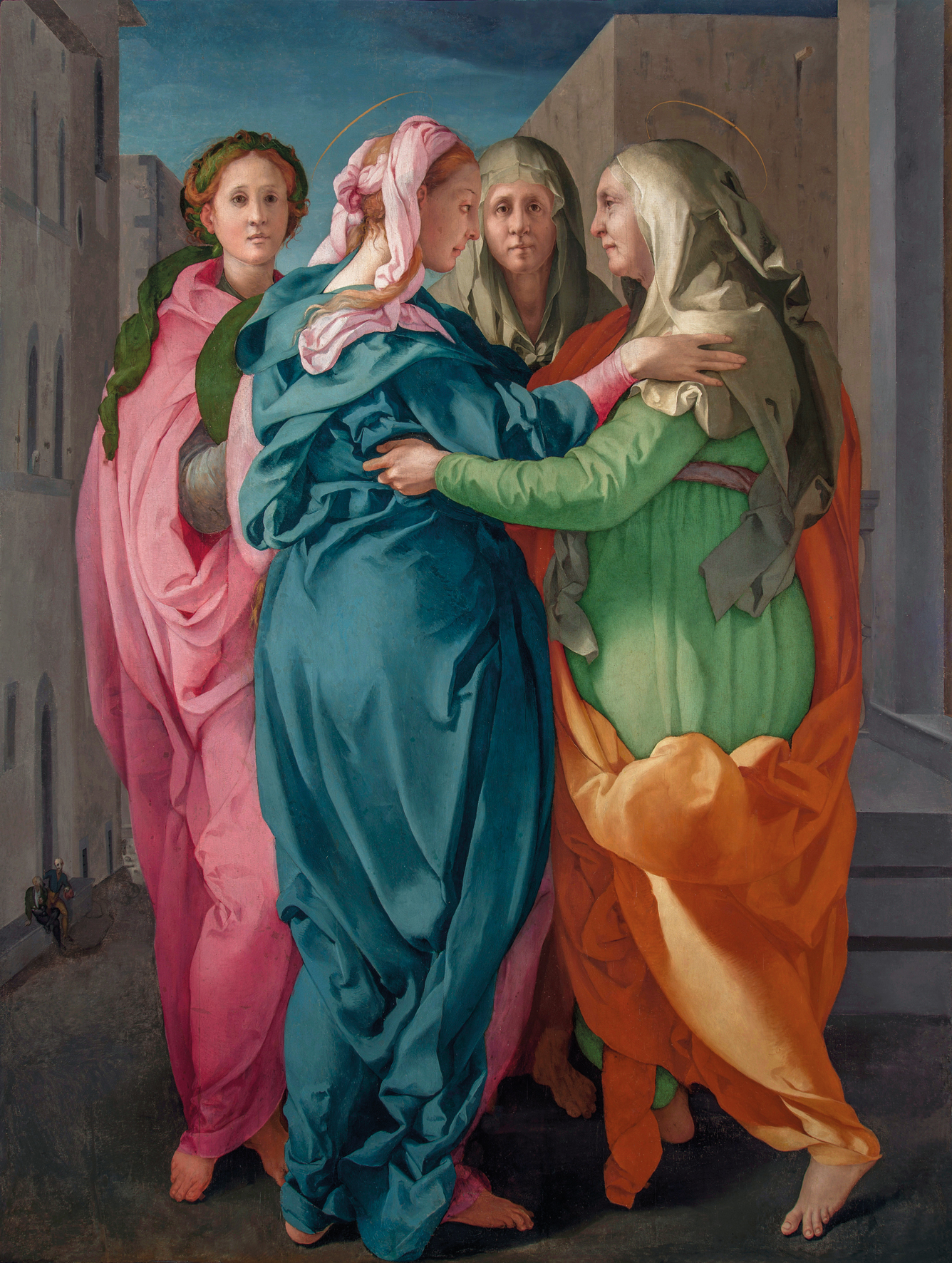
Visitation by Pontormo, 1528, Rectory of Saints Michael and Francis, Carmignano

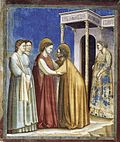
In Christianity, the Visitation, also known as the Visitation of the Blessed Virgin Mary, refers to the visit of Mary, who was pregnant with Jesus, to Elizabeth, who was pregnant with John the Baptist, in the Gospel of Luke, Luke 1:39–56. The episode is one of the standard scenes shown in cycles of the Life of the Virgin in art, and sometimes in larger cycles of the Life of Christ in art.

It is also the name of a Christian feast day commemorating this visit, traditionally celebrated on July 2 in Western Christianity and March 30 in Eastern Christianity. In the revised calendars of some churches in the West, it is now often celebrated on May 31 instead.

Biblical narrative

[edit]
Traditional Visitation journey from Nazareth to the hill country of Judea

The Gospel of Luke gives the only Biblical account of the Visitation:

And Mary arose in those days, and went into the hill country with haste, into a city of Juda; and entered into the house of Zacharias, and saluted Elisabeth. And it came to pass, that, when Elisabeth heard the salutation of Mary, the babe leaped in her womb; and Elisabeth was filled with the Holy Ghost: and she spake out with a loud voice, and said, Blessed art thou among women, and blessed is the fruit of thy womb. And whence is this to me, that the mother of my Lord should come to me? For, lo, as soon as the voice of thy salutation sounded in mine ears, the babe leaped in my womb for joy. And blessed is she that believed: for there shall be a performance of those things which were told her from the Lord.

In the story, Mary visited her cousin Elizabeth, the wife of Zechariah. They are both pregnant, Mary with Jesus and Elizabeth about six months' pregnant with John the Baptist (Luke 1:36). Mary left Nazareth immediately after the Annunciation and went "into the hill country ... into a city of Judah" (Luke 1:39) to attend to her cousin (Luke 1:36) Elizabeth. There are several possibilities as to exactly which city this was, including Hebron, south of Jerusalem, and Ein Karem. The journey from Nazareth to Hebron is about 130 kilometres (81 mi) in a direct line, probably up to half as far again by road, depending on the route taken.

Upon hearing Mary's greeting to Elizabeth, Elizabeth exclaims, beginning, “Blessed art thou among women, and blessed is the fruit of thy womb” (Luke 1:42), echoing and expanding upon the greeting given by the archangel Gabriel at the Annunciation (Luke 1:28). This exclamation forms the second part of the Hail Mary. In response to Elizabeth, Mary proclaims the Magnificat, also known as the Song of Mary.

Mary stayed three months with Elizabeth (Luke 1:56), and most scholars hold she stayed for the birth of John. [citation needed] Given the prevailing cultural traditions and needs for security, it is probable that Joseph accompanied Mary to Judah then returned to Nazareth, and came again after three months to take his wife home. The apparition of the angel, mentioned in Matthew 1:19–25, may have taken place then to end the tormenting doubts of Joseph regarding Mary's maternity.[1]

Feast

[edit]
Feast of the Visitation
Painting by Jerónimo Ezquerra, circa 1730s
Observed byLiturgical churches
TypeChristian
DateMay 31 (General Roman Calendar)
July 2 (Anglican, Germany, Slovakia)
March 30 (Eastern Orthodox)
Third Sunday in the Season of Annunciation (Syriac)
FrequencyAnnual
Related toFeast of the Annunciation,
Nativity of John the Baptist

Western Christianity

[edit]

The feast of the Visitation of the Blessed Virgin Mary is of medieval origin. In 1389 Pope Urban VI, hoping thereby to obtain an end to the Great Western Schism, inserted it at the urging of John of Jenstein, Archbishop of Prague, in the Roman Calendar, for celebration on July 2.[2] In the Tridentine calendar, it was a Double. When that Missal of Pope Pius V was replaced by that of Pope Clement VIII in 1604, the Visitation became a Double of the Second Class, or, as it would be called from 1960 by Pope John XXIII's reform, a Second-Class Feast.[3] It continued to be assigned to July 2, the day after the end of the octave following the birthday of John the Baptist, who was still in his mother's womb at the time of the Visitation. In addition to July 2, the Visitation was also traditionally marked on Ember Friday in Advent, providing the Gospel reading for that day.[4]

The 1969 revision of the Roman calendar moved it to May 31, between the "Annunciation of the Lord (25 March) and that of the Nativity of St. John the Baptist (24 June), so that it would harmonize better with the Gospel story."[5] The Visitation is also the second Joyful Mystery of the Rosary.[6]

In the calendar of the Anglican 1662 Book of Common Prayer, the Visitation of the Blessed Virgin Mary is a black-letter day marked on July 2,[7] although many modern Anglican calendars now celebrate the Visitation on May 31 in line with the changes made to the Roman calendar.[citation needed] The Catholic and Lutheran churches of Germany have also retained the date of July 2.[citation needed] Similarly, the Catholic Church in Slovakia has also retained July 2 because of an important national pilgrimage to the Basilica of the Visitation in the town of Levoča that has been held in the first weekend of July since the 13th century.[citation needed] Traditionalist Catholics, who use a pre-1970 calendar, also observe July 2.[citation needed]

Eastern Christianity

[edit]
Eastern Christian fresco of the Visitation, c. 1000, St Sophia Cathedral, Kyiv, Ukraine

The celebration of a feast day commemorating this event in the Eastern Orthodox Church is of relatively recent origin, dating only to the 19th century. The impetus to establish a feast day in the Eastern Orthodox liturgical calendar, and the composition of a service to be included in the Menaion, were the work of Archimandrite Antonin Kapustin (1817–1894), head of the Russian Orthodox Ecclesiastical Mission in Jerusalem.[8] The Gorny Convent [ru] in Ein Karem, built on the traditional site of the Visitation, celebrates this feast on 30 March. If 30 March falls between Lazarus Saturday and Pascha / Easter, the Visitation Feast is transferred to Bright Friday. Celebration of the Feast of the Visitation has not yet been accepted by all Orthodox jurisdictions.[citation needed]

In Syriac Christianity the feast of the Visitation is celebrated on the third Sunday in the Season of Annunciation prior to Christmas.[9]

Commentary

[edit]
Visitation by Raphael, c. 1517

The visitation of Mary to Elizabeth in Luke 1:39—56 is seen by many as a rich source of commentary on the role of Mary in the Christian Church. Pointing to the veneration of the Mother of God in the Catholic Church, German theologian Justus Knecht (1839–1921), writes that:[10]

In the Magnificat Mary said prophetically: "From henceforth all generations shall call me blessed." This prophecy has been fulfilled in the Catholic Church, for our holy Church honours our Lady by special feasts and special devotions. How would it be possible not to pay honour to her whom God raised to such a high dignity, and praised in such a manner by the mouths of Gabriel and Elizabeth! Our veneration of the holy Mother of God is well founded both on Holy Scripture and on reason.

Knetch also notes that Mary gives us a "pattern of charity", writing:[10]

Why did Mary hasten to visit her cousin? ... Firstly, the angel had referred her to Elizabeth, although she had believed his words without asking for a sign. She therefore believed it to be God’s will that she should visit her cousin, and convince herself of the truth of the sign given her, i. e. that Elizabeth was about to have a son. Secondly, Mary knew well that her cousin had grieved for many years on account of being childless, and she knew how happy she must be now that the cause of her grief was removed. Mary’s loving heart sympathised with the happiness of her cousin; she desired to wish her joy, rejoice with her, and join her in praising God’s mercy. He who really loves his neighbour has a loving sympathy with his joys and sorrows. Thirdly, Mary, as the holy Fathers teach, wished to minister to her cousin, and help her in her household affairs.

Some Catholic commentators have maintained that the purpose of this visit was to bring divine grace to both Elizabeth and her unborn child. Even though he was still in his mother's womb, John became aware of the presence of Christ, and leapt for joy as he was cleansed from original sin and filled with divine grace. Elizabeth also responded and recognised the presence of Jesus, and thus Mary exercised her function as mediatrix between God and man for the first time.[1]

In Roger Baxter's Meditations For Every Day In The Year, he compares the visitation to the Ark of the Covenant, writing the following:[11]

Consider the inspired words of Scripture: "The ark of the Lord abode in the house of Obededom, the Gethite, three months; and the Lord blessed Obededom and all his household." (2 Samuel vi. 11.) [sic] How much more may we suppose did He bless the house of Zachary, in which the living ark of the Lord and the mother of God dwelt so long.

The word "blessed" in Elizabeth's exclamation is rendered in Greek not by the word "makarios" but as "evlogimeni", which is the feminine second person singular, used only this once in the New Testament. Its masculine third person singular counterpart "evlogimenos" is used only for Jesus and only on this occasion and when he was welcomed into Jerusalem on Palm Sunday with "Blessed is he who comes in the name of the Lord".[citation needed]

See also

[edit]

References

[edit]
[edit]
Revisions and contributorsEdit on WikipediaRead on Wikipedia
from Grokipedia
In , the Visitation refers to the biblical event in which the Virgin Mary, newly pregnant with following the , travels to visit her relative Elizabeth, who is pregnant with , as recounted in the Gospel of Luke (1:39–56). This encounter, marked by mutual recognition of their divine pregnancies, features Elizabeth filled with the proclaiming Mary "blessed among women" and Mary responding with the , a poetic hymn of praise to God. The Visitation symbolizes themes of humility, joy, and charitable service, serving as a pivotal moment in the early life of Christ that highlights the interconnectedness of salvation history. The biblical narrative describes Mary hastening from Nazareth to a town in the hill country of , traditionally identified as , to assist Elizabeth in her advanced pregnancy. Upon Mary's greeting, the infant John leaps in Elizabeth's womb, prompting Elizabeth to acclaim Mary as "the mother of my " in a moment of prophetic insight. Mary remains with Elizabeth for about three months before returning home, an act interpreted as embodying selfless support and the spread of the Gospel's joy. The , Mary's extended song of thanksgiving, echoes the in the and proclaims God's mercy toward the lowly, establishing it as a cornerstone of and social teaching. Liturgically, the Visitation holds significant place in , particularly in the Roman Catholic and Eastern Orthodox traditions, where it is observed as a feast; it has limited recognition in some Anglican and Lutheran churches but is not generally commemorated in other Protestant denominations. In the Roman Catholic tradition, it is observed as a memorial feast on May 31, a date rooted in devotion and formally included in the general by in 1969 to align with the liturgical sequence and emphasize unity among Christians. Though originating as a relatively late feast in the 13th or , it draws on early Church veneration of Mary's life events. In the , the Visitation constitutes the second Joyful Mystery, meditated upon to reflect on Mary's prompt obedience and charity in bringing Christ to others. Eastern Christian traditions, such as the , commemorate it on July 2, integrating it into the liturgical calendar as part of the post-Pentecost season. Theologically, the Visitation underscores Mary's unique role as (Mother of God), affirmed by Elizabeth's greeting, and illustrates the Holy Spirit's action in fostering recognition of Christ's among the faithful. It exemplifies virtues of and service, as Mary, despite her own miraculous conception, prioritizes aiding her elder cousin, modeling Christian discipleship. The event also prefigures the bond between and , linking the forerunner's ministry to the Messiah's advent, and inspires ongoing devotion through art, prayer, and sites associated with the story.

Scriptural Basis

Account in the Gospel of Luke

In the Gospel of Luke, the account of the Visitation begins with Mary departing from Nazareth to visit her relative Elizabeth in the hill country of Judea. Following the Annunciation, Mary sets out with haste to a Judean town, where she enters the house of Zechariah and greets Elizabeth. Upon hearing Mary's greeting, Elizabeth experiences a profound spiritual response: the child in her womb—John the Baptist—leaps for joy, and Elizabeth herself is filled with the Holy Spirit. This physical manifestation underscores the prenatal recognition of Mary's role, as the infant's movement signifies prophetic awareness of the Messiah's presence. Elizabeth then exclaims loudly, blessing Mary among women and the fruit of her womb, questioning why the mother of her Lord should come to her, and affirming the joy of the child's leap at the sound of the greeting. She further praises Mary's faith, declaring her blessed for believing in the fulfillment of the Lord's words. In response, Mary recites the Magnificat, a of praise that magnifies the Lord and rejoices in as her Savior. The song highlights 's favor toward the lowly state of his servant, promising that all generations will call her blessed, and celebrates the Mighty One's great deeds, including his mercy across generations. Key themes include divine strength that scatters the proud, brings down the powerful from their thrones while lifting the lowly, fills the hungry with good things, and sends the rich away empty—portraying a reversal of fortunes in 's justice. The Magnificat concludes with 's aid to in remembrance of his mercy, fulfilling the promises made to Abraham and his descendants forever. Mary remains with Elizabeth for about three months, a period that likely encompasses the time until John’s birth, during which she humbly assists her elderly relative in her final stages of pregnancy. Afterward, Mary returns to her home in Nazareth.

Immediate Biblical Context

The Visitation is chronologically situated in the Gospel of Luke immediately after the Annunciation to Mary (Luke 1:26-38) and the angelic announcement to Zechariah concerning the conception of John the Baptist (Luke 1:5-25). It unfolds during the sixth month of Elizabeth's pregnancy, prompting Mary to travel hastily from Nazareth to the hill country of Judah to visit her relative, where she remains for about three months until shortly before John's birth (Luke 1:57-80). This placement positions the event as a pivotal link in the infancy narrative, bridging the divine announcements and the subsequent births of John and Jesus (Luke 2:1-20), underscoring the synchronized unfolding of God's salvific plan. Thematically, the Visitation foreshadows John the Baptist's role as the forerunner to the , evident in the infant's leap in Elizabeth's womb upon Mary's greeting, which signifies prenatal prophetic recognition of as and fulfills the angel's earlier prophecy that John would be filled with the from his mother's womb (:15, 41, 44). This moment echoes Old Testament precedents of divine-human encounters, such as Abraham's hospitality to the three heavenly visitors who announce Isaac's birth (Genesis 18:1-15), paralleling the theme of gracious visitation bringing promise and joy. Additionally, Mary's song, the (:46-55), draws structural and linguistic parallels to Hannah's song of thanksgiving after 's birth (1 2:1-10), both celebrating God's reversal of human fortunes—exalting the lowly, scattering the proud, and fulfilling covenant mercy to —thus framing the Visitation as a new era of divine faithfulness. Unlike other accounts, the Visitation narrative appears exclusively in Luke's Gospel and has no parallels in Matthew, Mark, or John, which focus more on Joseph's lineage and dreams (Matthew 1-2), Jesus' ministry and passion (Mark), or theological discourses (John). This uniqueness reflects Luke's distinctive emphasis on the active participation of women, such as Mary and Elizabeth, in the unfolding drama of salvation history, portraying them as bearers of divine and praise.

Historical Development

Medieval Origins

The Visitation of Mary to Elizabeth began to emerge as a distinct devotional theme in medieval Christian liturgy during the , with the Gospel account (Luke 1:39–56) appearing in readings for the Friday of the Advent in the Roman liturgy as early as the 8th century, reflecting an early integration into seasonal prayer cycles focused on Mary's role in salvation history. By the 11th and 12th centuries, the Visitation gained further prominence through its incorporation into the Hours of the Virgin within breviaries, where antiphons and readings from Luke 1:39–56 highlighted the encounter as a moment of joyful proclamation and . This gradual inclusion in private and communal devotions laid the groundwork for broader popularization, emphasizing the and charity exemplified by Mary. The Franciscan Order played a pivotal role in elevating the Visitation as a dedicated feast, adopting it formally at their general chapter in in 1263 under the guidance of St. , the Minister General—though the earliest evidence for such a distinct feast remains debated among historians. , in his sermons and writings such as the Mirror of the Blessed Virgin Mary, underscored the event's theological depth, portraying Mary's visit as a profound act of humility and service that mirrored Christ's . This adoption within the facilitated its dissemination through itinerant preaching, mystery plays, and confraternities, transforming the Visitation from a scriptural into a vibrant theme for lay devotion across . Devotional practices surrounding the Visitation expanded in the late , intertwining with relic veneration at emerging Marian pilgrimage sites such as Loreto in , where the Holy House—traditionally identified as Mary's dwelling from —arrived miraculously around December 10, 1294 and became a focal point for contemplating her life events, including the visit to Elizabeth. This growth intensified during the (1378–1417), as prayers invoking the Visitation's themes of unity and reconciliation were promoted to heal the Church's divisions; in 1389, extended the feast's observance universally to solicit Mary's intercession for ecclesiastical harmony.

Institutionalization and Calendar Variations

The formal institutionalization of the Feast of the Visitation in the Western Church took place during the , as a means to seek Mary's for unity. decreed its establishment in 1389, fixing the observance on and extending it beyond local practices to broader adoption within the Roman obedience. This initiative was promptly confirmed by his successor, , through a issued on , 1389, which mandated the feast's celebration across the universal to foster prayers for the schism's resolution. The date of persisted in the Roman liturgical calendar for over five centuries, reflecting its original placement three days before the on June 24. Following the Second Vatican Council, the 1969 revision of the relocated the feast to May 31, integrating it more closely with the season and the narrative sequence of the (March 25) and John's Nativity. Pre-1969, the July 2 observance was standard in the , including in regions like , where it held prominence in local calendars before the universal shift. In , the Feast of the Visitation lacks a universally fixed date, varying by tradition and rite to align with local liturgical rhythms. The commemorates it on March 30, shortly after the on March 25, unless the date falls during , in which case it transfers to Bright Friday. Certain Byzantine-rite churches, such as the , observe it on June 23, the vigil of the , emphasizing the temporal proximity of the biblical events. Other Eastern calendars, including some Slavic Orthodox traditions, retain July 2 as an alternative observance.

Liturgical Observance

Western Traditions

In the Roman Catholic Church, the Feast of the Visitation is observed on as a significant Marian celebration, featuring a proper Mass with readings from Zephaniah 3:14-18a (or Romans 12:9-16), and the Gospel account in Luke 1:39-56. This observance highlights Mary's journey of charity and joy, serving as the second Joyful Mystery in the , where devotees meditate on her visit to Elizabeth as an act of humble service. Protestant traditions vary but include commemoration in the liturgical calendars of several denominations. In the Anglican Church, particularly through the (ACNA), the Visitation is marked on with collects and readings emphasizing the scriptural narrative of Mary's encounter with Elizabeth, focusing on themes of and community without a pronounced Marian devotion. Similarly, Lutheran churches, such as those in the Evangelical Lutheran Church in America (ELCA), observe it as a Lesser Festival on , centering on biblical reflection and the as a song of praise to God. Contemporary customs associated with the Visitation in often echo the biblical theme of charitable visitation. In Catholic communities, processions may feature Marian statues carried through streets, as seen in some European parishes, symbolizing Mary's . Acts of service, such as visiting the elderly or ill to provide companionship and aid, are encouraged to imitate Mary's haste to support her cousin Elizabeth. Hymns like the traditional or modern compositions such as "My Soul Gives Glory to My God" (a metrical ) are sung during liturgies to evoke the joy of the encounter. to the Church of the Visitation in , —believed to be the site of Elizabeth's home—draw Western Christians annually for prayer and reflection on the event.

Eastern Traditions

In Eastern Orthodox Christianity, the Visitation is commemorated as the Meeting of the Most Holy Theotokos with Righteous Elizabeth, observed on March 30 in the liturgical calendar. Churches following the New (Gregorian or Revised Julian) calendar celebrate it on March 30 Gregorian, while those following the Julian calendar celebrate it on March 30 Julian, corresponding to April 12 Gregorian. This date aligns with Slavic traditions, such as those in the Russian Orthodox Church, where the feast honors the joyful encounter described in Luke 1:39-56, emphasizing Mary's haste to serve her cousin and the leaping of John in Elizabeth's womb as a prophetic recognition of the Messiah. In some Byzantine-rite communities, like the Melkite Greek Catholic Church, the feast falls on June 23, the eve of the Nativity of St. John the Baptist, integrating it with themes of preparation for Christ's birth. The Divine Liturgy forms the core of the observance, featuring readings from the Gospel of Luke recounting the event, along with troparia and kontakia that praise the Theotokos' humility and the fulfillment of Old Testament prophecies, such as her role as the new Ark of the Covenant. A Synaxis of St. John the Baptist may accompany the feast in certain locales, highlighting his role as forerunner through additional hymns and intercessions. Iconographic veneration plays a central role in Eastern traditions, with icons depicting the embrace of Mary and Elizabeth—often shown pregnant, with subtle representations of Christ and John in their wombs—to convey the mystery of divine incarnation and joyful communion. These icons, found in churches and homes, are venerated through prostrations, kisses, and incense during the feast, underscoring the theological emphasis on the ' visitation as a bridge between the prophetic era and the . Hymns during the services, such as those in the canon, echo Elizabeth's exclamation ("Blessed are you among women"), reinforcing themes of prophetic fulfillment and shared maternal joy in the divine plan. Communal aspects include processions with the in some monasteries, like the Gorneye in , built on the traditional site of the meeting, fostering a sense of ecclesial unity. Among , the Visitation is integrated into the liturgical cycle of feasts honoring the Baptist, with the Coptic tradition observing it on the third of Kiyahk (the Advent month, typically late ), as part of a structured progression through that builds anticipation for the Nativity. This 's features the Gospel reading of :39-56, proclaimed in Coptic and Arabic, with praises to the for her obedience and the sanctification of Elizabeth's household, often accompanied by special psalmody and hymns lauding Mary's as a model of humility. In the Ethiopian Tewahedo Church, which shares the , the observance aligns similarly on the third of Tahsas (equivalent to Kiyahk), weaving the event into broader and the of St. John, with liturgical texts emphasizing the prophetic joy of the unborn Baptist. Some communities incorporate vigil services or preparatory prayers during Kiyahk, though without strict fasting, focusing instead on communal chanting and the distribution of blessed bread symbolizing the shared grace of the encounter. remains prominent, with Ethiopian-style paintings depicting the scene in vivid colors to highlight themes of divine favor and intercession.

Theological Significance

Mariological Interpretations

In early Christian , the Visitation narrative highlighted Mary's exemplary virtues and prophetic role. St. Ambrose of , in his Exposition on the Gospel of Luke, interpreted Mary's journey "in haste" to Elizabeth not as doubt in God's promise but as an expression of her ardent zeal and devotion, urging the faithful to emulate this prompt obedience in serving others. Early viewed Elizabeth's greeting—"Blessed are you among women, and blessed is the fruit of your womb"—as recognizing Mary's unique dignity as the mother of the Savior through the Holy Spirit's inspiration. Byzantine theologians connected the event to Mary's title as (God-bearer), seeing Elizabeth's acclamation of her as "mother of my Lord" as an early affirmation of her divine maternity. Magisterial teachings have further developed these insights, portraying the Visitation as a pivotal moment in Mary's pilgrimage of faith and her maternal mission within the Church. The Second Vatican Council's (no. 57) describes the event as the first manifestation of Mary's union with her Son in the work of , where her haste to visit Elizabeth and the subsequent greeting affirm her belief in God's promise, modeling the Church's own journey toward eschatological fulfillment. Building on this, Pope St. John Paul II's Redemptoris Mater (1987, no. 12) emphasizes Mary's charitable service to Elizabeth as an extension of her obedience at the , illustrating her active participation in redemption through faith and her role in salvation history. The further highlights Mary's ongoing for humanity, which continues even after her Assumption (nos. 39-40). Central to Mariological reflections on the Visitation is the extension of Mary's —"Behold, I am the handmaid of the Lord"—from verbal consent at the to concrete action in her journey, embodying total self-gift to God's will as a for Christian discipleship. The that follows serves as a prophetic , proclaiming God's preferential and lowly, as Mary foretells how the Almighty "has cast down the mighty from their thrones and has exalted those of humble estate; he has filled the hungry with good things." Elizabeth's words also provide scriptural foundation for later doctrines: her declaration of Mary as "blessed among women" due to her faith prefigures the by highlighting her singular grace from the moment of divine election, while the event's emphasis on Mary's fruitful maternity supports the Assumption as the culmination of her incorrupt .

Ecclesial and Soteriological Themes

The Visitation narrative in the of Luke exemplifies ecclesial dimensions of charity and communal support, particularly in serving the marginalized such as the elderly and pregnant women, as Mary hastens to aid her cousin Elizabeth in her advanced . This act models the Christian call to bear Christ to others through practical solidarity and evangelization, emphasizing the church's role in fostering relationships among the vulnerable. The event also prefigures the outpouring of the , as the Spirit fills Elizabeth and moves John in the womb in joyful recognition of , anticipating the communal empowerment and prophetic witness of the early church. Soteriologically, the Visitation underscores themes of history through John's prenatal leap, which signifies his Spirit-filled recognition of the Savior in Mary's womb and fulfills the prophetic role of the forerunner announced in 3:1. This moment highlights the divine initiative in redemption, where the unborn Baptist acknowledges the incarnate Lord, bridging prophecy with fulfillment. The further amplifies these elements as a proto-Gospel, proclaiming God's divine reversal—lifting the poor and lowly while casting down the mighty—as the core pattern of that permeates Luke's account of ' ministry. In modern applications, Pope Francis's Evangelii Gaudium (2013) connects the Visitation to , portraying Mary's hasty journey to Elizabeth as a paradigm of service to the poor and marginalized, urging the church to advocate for a more equitable world. The shared Lukan narrative of the Visitation holds ecumenical significance, uniting Catholic, Orthodox, Protestant, and other Christian traditions in a common scriptural foundation that emphasizes communal joy and prophetic fulfillment across denominational lines.

Cultural Impact

Depictions in Visual Art

The Visitation scene has been a recurring motif in Christian iconography since , often illustrating the biblical meeting between the pregnant Mary and Elizabeth in the hill country of (Luke 1:39–56). In Byzantine icons, the depiction typically features a formal embrace between the two women, set against a stylized landscape with rolling hills to evoke the Judean terrain, emphasizing spiritual solemnity over naturalistic detail. Mary is portrayed in a blue mantle symbolizing her purity, while Elizabeth appears veiled and reverent, with the composition adhering to hierarchical proportions and gold backgrounds to convey . During the Gothic period, artistic representations shifted toward greater emotional expressiveness, highlighting the joy and recognition in the women's greeting. and artists further innovated the , introducing dynamic compositions and dramatic lighting to explore human emotion and narrative depth. For example, Dürer's Visitation (c. 1503), part of his Life of the Virgin series, depicts the encounter with intricate line work and emotional depth, emphasizing the spiritual significance. Jacopo da Pontormo's Visitation (1528–1530), an oil on panel, originally in the Church of San Michele in Carmignano and temporarily at the Medici Villa of Poggio a Caiano (as of 2025), exemplifies Mannerist style with elongated figures in swirling poses, where Mary and Elizabeth embrace amid two attendant women, creating a sense of rhythmic tension and psychological intensity against a subdued urban setting. In the era, van Rijn's Visitation (1640), an oil on cedar panel at the , adds nocturnal drama through moonlight, depicting the embrace with Elizabeth supported by a cane and including diverse figures such as Zechariah and an African servant assisting Mary, reflecting contemporary Dutch explorations of global encounters. Symbolic elements in these depictions often draw on bodily and architectural metaphors to convey theological themes of incarnation and divine indwelling. Architecture frequently represents the body as a sacred enclosure, with structures like houses or gates symbolizing wombs or temples housing new life, as Mary embodies the "temple of God's Son." The rounded forms of pregnant figures and enclosing portals reinforce womb imagery, celebrating the quickening of life within Elizabeth and Mary. The Visitation is frequently incorporated into broader Life of the Virgin cycles, appearing in altarpieces, manuscripts, and frescoes to narrate Mary's journey from to Assumption, as seen in fifteenth-century illuminations like those by the Master of the Geneva Latini. This placement highlights its transitional role in Marian devotion, linking personal piety with communal worship. In modern contexts, the scene persists in sculptural forms, such as the bronze statue of Mary greeting Elizabeth in the courtyard of the Church of the Visitation in , , a contemporary Franciscan site marking the traditional location, where the figures' embrace invites pilgrims to reflect on the event amid panels and biblical inscriptions.

Representations in Music and Literature

The biblical event of the Visitation, described in Luke 1:39–56, has profoundly influenced , especially through settings of Mary's , which forms the centerpiece of the narrative. Composers have drawn on this text to evoke themes of joy, humility, and divine favor, often performing such works on the feast day of May 31. In the era, Johann Sebastian created several seminal choral works for the Feast of the Visitation. His Meine Seele erhebt den Herrn (BWV 10), premiered in 1724, directly paraphrases the in its opening movement, celebrating Mary's song of praise with intricate for soloists, chorus, and . Similarly, the 1723 Herz und Mund und Tat und Leben (BWV 147) was composed for the same feast; its concluding , known as "," has become one of Bach's most enduring pieces, symbolizing the spiritual leaping of joy described in the Visitation account. Bach's Magnificat (BWV 243), revised in D major around 1733, was also associated with Visitation celebrations, featuring a grand choral framework that amplifies the canticle's revolutionary themes of God's mercy toward the lowly. These compositions, performed in Lutheran churches, underscore the event's liturgical centrality in Protestant traditions. Beyond Bach, earlier chorales and motets provided foundational repertoire. The 17th-century chorale "Meine Seele erhebt den Herrn" by Christian Keimann (Zahn 1203) served as a for the feast, emphasizing soulful exaltation of . In Catholic contexts, polyphonic motets like Ecce tu pulchra (attributed to 16th-century composer Jacobus de Borssum) incorporated Visitation motifs from the to parallel Mary's role. Modern hymns continue this legacy; for instance, Timothy Dudley-Smith's "Tell Out, My Soul" (1961), a metrical paraphrase of the , is widely sung in Anglican and ecumenical services, blending ancient text with contemporary accessibility. In , the Visitation appears in medieval dramatic cycles as a pivotal scene dramatizing female solidarity and prophetic fulfillment. The York Cycle of Mystery Plays (c. 14th–15th century), one of the most complete surviving English examples, includes the Visitation in Play 12 (Annunciation and Visitation), where Mary travels to Elizabeth's hill-country home, greeted with exclamations of blessing that highlight the unborn John's recognition of Christ. Performed by guilds on festival wagons during Corpus Christi processions, these vernacular plays made the event accessible to lay audiences, emphasizing themes of and divine visitation through drawn from Luke. Similar depictions occur in the N-Town Plays (c. 15th century), where the scene underscores Mary's humility and Elizabeth's Spirit-filled prophecy, reinforcing Marian devotion in late medieval piety. Poetry has offered intimate reflections on the encounter's emotional depth. American poet Joyce Kilmer's "The Visitation" (1913) vividly captures Elizabeth's prophetic insight and Mary's role as bearer of divine glory, portraying the "wall of flesh" before John's eyes and invoking from the figures involved: "Saint John, pray for us, weary souls that tarry / Where life is withered by sin's deadly breath." Published in Trees and Other Poems, Kilmer's work, rooted in Catholic tradition, uses the event to explore redemption and spiritual vitality. Later poets, such as in his 2011 "Hidden Joys," meditate on the cousins' shared pregnancy as a moment of concealed divine presence, drawing parallels to everyday encounters with grace. These literary representations collectively emphasize the Visitation's role as a bridge between personal faith and communal .

References

Add your contribution
Related Hubs
User Avatar
No comments yet.