Hubbry Logo
search
logo
2107485

Ashoka Chakra

logo
Community Hub0 Subscribers
Read side by side
from Wikipedia

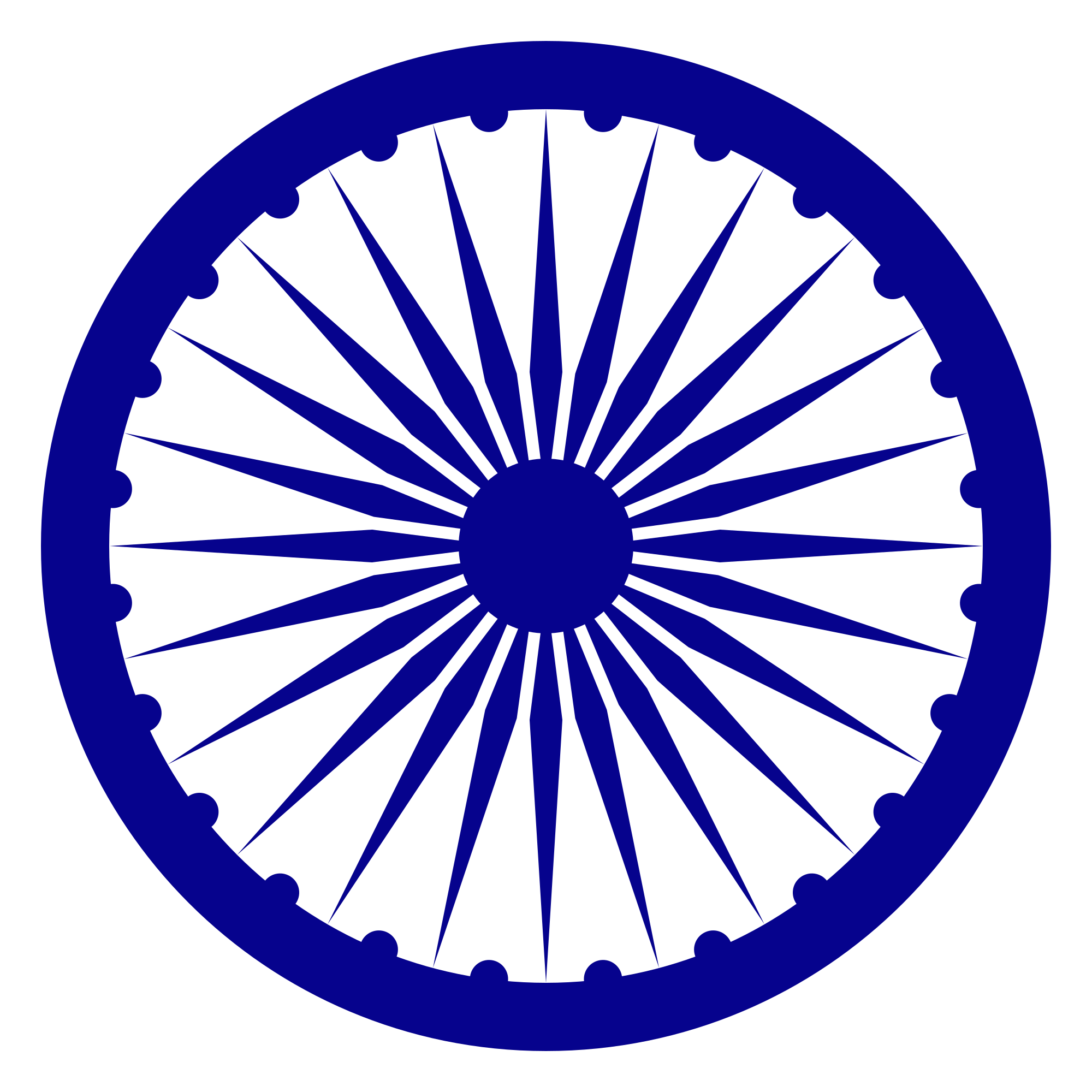
Illustration of the Ashoka Chakra, as depicted on the flag of India.
Depiction of a chakravartin, possibly Ashoka, with a 16-spoked wheel (1st century BCE/CE)

The Ashoka Chakra (Transl: Ashoka's wheel) is an Indian symbol which is a depiction of the Dharmachakra. It is called so because it appears on a number of edicts of Ashoka, most prominent among which is the Lion Capital of Ashoka.[1] The most visible use of the Ashoka Chakra today is at the centre of the Flag of India (adopted on 22 July 1947), where it is rendered in a navy blue colour on a white background, replacing the symbol of charkha (spinning wheel) of the pre-independence versions of the flag. It is also shown in the Ashoka Chakra medal, which is the highest award for gallantry in peacetime.

Symbolic history

[edit]

When Gautama Buddha achieved enlightenment at Bodh Gaya, he came to Sarnath. There, he found his five disciples, Assaji, Mahānāman, Kondañña, Bhaddiya and Vappa, who had earlier abandoned him. He introduced his first teachings to them, thereby establishing the Dharmachakra;. This is the motif taken up by Ashoka and portrayed on top of his pillars.

The 24 spokes represent the twelve causal links taught by the Buddha and paṭiccasamuppāda (Dependent Origination, Conditional Arising) in forward and then reverse order.[2] The first 12 spokes represent 12 stages of suffering. The next 12 spokes represent no cause no effect. So, due to awareness of the mind, the formation of mental conditioning stops. This process stops the process of birth and death, i.e. nibbāna. It also depicts the “wheel of time”. The twelve causal links, paired with their corresponding symbols, are:

  1. Avidyā ignorance
  2. Saṅkhāra conditioning of mind unknowingly
  3. Vijñāna not being conscious
  4. Nāmarūpa name and form (constituent elements of mental and physical existence)
  5. Ṣalāyatana six senses (eye, ear, nose, tongue, body, and mind)
  6. Sparśa contact
  7. Vedanā sensation
  8. Taṇhā thirst
  9. Upādāna grasping[3]
  10. Bhava coming to be
  11. Jāti birth
  12. Jarāmaraṇa old age[4] and death[5]corpse being carried.

These 12 in forward and reverse represent a total 24 spokes representing the dharma. The Ashoka Chakra depicts the 24 principles that should be present in a human.

Inclusion in the national flag of India

[edit]

Ashoka Chakra was included in the middle of the national flag of India. The chakra intends to show that there is life in movement and death in stagnation.[6][7] Originally, the Indian flag was based on the Swaraj flag, a flag of the Indian National Congress adopted by Mahatma Gandhi after making significant modifications to the design proposed by Pingali Venkayya.[8] This flag included charkha which was replaced with Ashoka Chakra in 1947 by Jawaharlal Nehru.[9]

Construction Sheet

[edit]

See also

[edit]

Notes

[edit]
Revisions and contributorsEdit on WikipediaRead on Wikipedia
from Grokipedia
The Ashoka Chakra is a navy-blue wheel featuring 24 equally spaced spokes, positioned at the center of the white band on the National Flag of India, symbolizing the Dharmachakra or wheel of dharma.[1] It derives from the abacus of the Lion Capital, a sculptural pillar top commissioned by Mauryan Emperor Ashoka around 250 BCE at Sarnath, where the Buddha delivered his first sermon.[2][3] The emblem represents the eternal law of righteousness, with its design conveying that progress and virtue sustain life while stagnation leads to decline.[4][5] Adopted in its current form during India's independence in 1947, the Ashoka Chakra underscores principles of moral governance and continuous advancement, reflecting Ashoka's historical promotion of ethical rule following his embrace of Buddhist teachings after the Kalinga War.[4]

Historical Origins

Emperor Ashoka's Reign and Transformation

Ashoka, third emperor of the Mauryan dynasty, ascended to the throne around 268 BCE after the death of his father Bindusara, inheriting an empire that spanned much of the Indian subcontinent from modern-day Afghanistan to Bengal.[6] Early in his reign, Ashoka pursued aggressive military expansion, suppressing revolts in regions like Taxila and Ujjain before launching the conquest of the independent kingdom of Kalinga (present-day Odisha) circa 261 BCE, in his eighth regnal year.[7] This campaign marked the zenith of Mauryan territorial growth but also its brutal culmination, with Ashoka's Rock Edict XIII recording approximately 100,000 Kalingans killed in battle, a similar number perishing from related causes, and 150,000 deported as captives, alongside widespread suffering among civilians and animals.[6] The scale of devastation in Kalinga prompted a profound personal and political transformation in Ashoka, as detailed in his own inscriptions. In Rock Edict XIII, he expresses remorse for the conquest, stating that "when an independent country is conquered, the slaughter, death, and deportation... is extremely grievous to the Beloved of the Gods," leading him to prioritize moral conquest through Dhamma—ethical principles emphasizing non-violence, compassion, and welfare—over further armed expansion.[6] [7] This shift, evident from edicts dated to his tenth regnal year onward (circa 258 BCE), involved patronage of Buddhist institutions, though Ashoka's texts describe a gradual attraction to Buddhism's teachings rather than an abrupt conversion, and he promoted interfaith tolerance without exclusively endorsing one doctrine.[8] Under this new orientation, Ashoka centralized welfare initiatives, dispatching emissaries to promote Dhamma across his realm and beyond, including to Hellenistic kingdoms and Sri Lanka, while constructing infrastructure like roads, wells, and rest houses for public benefit.[7] His reign until circa 232 BCE thus transitioned from imperial conquest to ethical governance, with the Dharmachakra wheel emerging as a symbol on monolithic pillars erected to propagate these ideals, representing the eternal motion of moral law. Archaeological evidence from these pillars confirms the policy's implementation, though the edicts' emphasis on remorse aligns more closely with primary inscriptions than later Buddhist hagiographies, which amplify the narrative of a pre-Kalinga conversion unsupported by Ashoka's records.[6][8]

The Dharmachakra on Pillars and Edicts

The Dharmachakra, representing the wheel of Dharma or law, appears as a prominent sculptural element on the capitals of monolithic pillars erected by Emperor Ashoka in the mid-3rd century BCE, following his embrace of Buddhist principles after the Kalinga War circa 261 BCE.[9] These pillars, typically 12 to 15 meters in height and carved from single blocks of Chunar sandstone, were positioned at key locations across the Mauryan Empire, such as Sarnath, Vaishali, and Lauriya Nandangarh, to visually and inscriptionally disseminate ethical governance and non-violence.[2] The wheel motif, often centrally placed on the abacus beneath animal figures like lions or elephants, symbolized the axis mundi and the perpetual motion of moral order, aligning with Ashoka's edicts promoting Dharma as a universal ethic beyond ritualistic religion.[3] The exemplar is the Sarnath Lion Capital, excavated in fragments between 1904 and 1905 near the site of Buddha's first sermon, where the abacus displays a large Dharmachakra encircled by high-relief procession animals—an elephant, horse, bull, and lion—carved in a clockwise direction to evoke the spread of teachings in all quarters.[3] [10] This wheel, originally part of a structure topped by four back-to-back lions, measured approximately 1.5 meters in diameter and featured intricate spokes, with archaeological reconstruction suggesting up to 32 in some interpretations, though surviving details indicate a design emphasizing radial symmetry for dynamic balance.[11] The capital's placement atop a pillar shaft bearing Major Pillar Edicts 1–7 underscores the integration of symbol and text, where the chakra visually reinforces the inscribed calls for compassion, restraint in conquest, and respect for all life forms.[9] Archaeological surveys confirm similar chakra motifs on other pillar remnants, such as potential crowning wheels at sites like Sankissa, though erosion and iconoclastic damage limit intact examples to fewer than 20 pillars empire-wide.[12] In contrast to the pillar shafts' textual edicts, which detail administrative reforms like medical missions and road-building by the 11th regnal year (circa 257 BCE), the Dharmachakra served a non-verbal, emblematic role, predating widespread Buddhist iconography and evidencing early synthesis of Indic royal symbolism with emerging doctrinal motifs.[9] No direct chakra carvings appear on Ashoka's rock or cave edicts, which prioritize prose over pictographs, but the pillar complexes holistically project Dharma through combined inscription and aniconic wheel, influencing later Buddhist art from the 1st century BCE onward.[12]

Archaeological Evidence and Variations

Archaeological excavations at Sarnath, Uttar Pradesh, uncovered the Lion Capital of a pillar erected by Emperor Ashoka around 250 BCE, featuring four Dharmachakra motifs carved on the abacus between animal figures, each with 24 spokes symbolizing dharma.[3] The capital, discovered in fragments during 1904–1905 digs by the Archaeological Survey of India, originally supported a larger Dharmachakra atop the lions, reconstructed from recovered pieces as having 32 spokes.[13] This site, linked to the Buddha's first sermon, provides direct evidence of the wheel's use in Mauryan imperial architecture to propagate Buddhist principles, as corroborated by associated pillar edicts inscribed in Brahmi script promoting moral governance.[14] Other Ashokan pillars, such as those at Lauriya Nandangarh in Bihar and Sankissa in Uttar Pradesh, dating to the 3rd century BCE, bear edicts referencing dharma but lack surviving capitals with wheels; however, stylistic consistency with Sarnath suggests similar symbolic motifs.[9] In 2016, excavations in Amaravati village, Andhra Pradesh, revealed a rock-cut Dharmachakra panel with 32 spokes alongside four stupas, tentatively dated to the Mauryan period based on iconographic parallels to Ashokan edicts, though precise attribution requires further epigraphic analysis.[15] Variations in the Dharmachakra's depiction across artifacts reflect non-standardized early Buddhist iconography, with spoke counts differing by context: 8 spokes occasionally appear to evoke the Noble Eightfold Path, while 12 align with dependent origination links, contrasting the 24-spoke abacus wheels at Sarnath and 32-spoke superior wheel or regional carvings.[3] These discrepancies, evident in 3rd-century BCE Mauryan reliefs and later adaptations, indicate the symbol's flexibility before canonical fixation, prioritizing thematic resonance over uniform numerology in Ashoka's era.[16]

Symbolism and Interpretations

Representation of Dharma and Eternal Motion

The Ashoka Chakra, depicted as the Dharmachakra or Wheel of Dharma, embodies the eternal principles of moral order and righteousness inherent in Dharmic traditions. In the edicts of Emperor Ashoka, who ruled from approximately 268 to 232 BCE, the chakra signifies the propagation of Dharma as a universal ethic of non-violence, tolerance, and ethical governance following his conversion to Buddhism after the Kalinga War in 261 BCE.[5] This symbol underscores Dharma not as static doctrine but as an active force guiding human conduct and societal harmony.[4] The wheel's form represents perpetual motion, illustrating the dynamic continuity of cosmic law and the necessity of progress to sustain life and virtue. Official interpretations, such as those in India's Flag Code, articulate that the chakra denotes motion, affirming "there is death in stagnation" and "there is life in movement," emphasizing that adherence to Dharma requires ongoing adaptation and rejection of inertia.[5] This symbolism aligns with philosophical views where the revolving wheel mirrors the cyclical yet progressive nature of time and ethical evolution, preventing decay through ceaseless ethical vigilance.[4] In broader Indian philosophy, the Ashoka Chakra's eternal motion evokes the Sanatana Dharma's resilience against entropy, where the 24 spokes—though detailed elsewhere—collectively propel the wheel forward, symbolizing unyielding momentum in the pursuit of truth and justice.[5] Archaeological depictions on Ashoka's pillars, dating to the 3rd century BCE, reinforce this as a visual metaphor for Dharma's inexorable advance, influencing interpretations in both religious and national contexts.[17]

Significance of the 24 Spokes

The 24 spokes of the Ashoka Chakra, originating from the Dharmachakra atop Emperor Ashoka's Mauryan pillars (circa 268–232 BCE), primarily symbolize the Buddhist doctrine of pratītyasamutpāda (dependent origination), comprising the 12 causal links of suffering's arising in samsara and their 12-fold reversal toward cessation and nirvana.[18] [19] These links—ignorance, formations, consciousness, name-and-form, six sense bases, contact, feeling, craving, clinging, becoming, birth, and aging-death—illustrate cyclical causality, with the doubled spokes denoting both entrapment in rebirth and the path to liberation via the Noble Eightfold Path, as expounded in early Buddhist texts like the Samyutta Nikaya.[12] Archaeological evidence from sites such as Sarnath confirms the 24-spoke design on Ashokan capitals, aligning with this interpretive tradition rather than later numerological overlays.[10] While Ashoka's edicts emphasize ethical governance (Dharma) without explicit spoke exegesis, the symbolism underscores causal realism in Buddhist philosophy: actions (karma) propagate effects unless interrupted by insight, reflecting Ashoka's post-Kalinga (261 BCE) shift toward non-violence and moral causation over conquest.[3] This contrasts with anachronistic claims, such as equating spokes to 24 Jain Tirthankaras or Hindu rishis, which lack epigraphic support and stem from syncretic modern readings rather than 3rd-century BCE context.[20] In the Indian national flag's adoption (July 22, 1947), the chakra retains this dharmic essence but accrues civic interpretations, with spokes evoking 24 hours of diurnal cycle to denote ceaseless national endeavor.[21] Constituent Assembly records note the wheel's selection for its representation of perpetual motion and righteousness, sans specific spoke enumeration, though contemporary official commentary attributes them to virtues like love, courage, and ethical conduct—principles inferred from Dharma but not verifiably enumerated in Ashokan artifacts.[1] [22] Such extensions prioritize inspirational utility over strict historicity, as no primary Mauryan source delineates individual spoke meanings.

Broader Philosophical Meanings

The Ashoka Chakra, embodying the Dharmachakra, extends into philosophical domains of Indian thought by symbolizing the dynamic interplay between cosmic order and ethical action. Predating its Buddhist codification, wheel motifs in Vedic literature represented ṛta, the unchanging principle of natural harmony and truth that regulates universal cycles, predating Ashoka's era by centuries and influencing later Dharmic concepts of moral law.[23] This foundational symbolism underscores causal mechanisms where individual and collective conduct aligns with or disrupts equilibrium, reflecting a realism grounded in observable patterns of reciprocity rather than abstract idealism. In broader interpretations, the chakra's perpetual motion evokes the flux of existence—laws of change, time's cyclical progression, and resilience through adversity—while its structural integrity signifies enduring principles like justice and inner harmony that guide transformation from ignorance to wisdom.[24] [25] Ashoka's adoption amplified this by linking the wheel to pragmatic ethics in governance, as seen in his edicts promoting non-violence, tolerance, and welfare as tools for societal stability, portraying power not as dominion but as the dissemination of truth's influence.[26] Philosophically, these elements converge on the idea of disciplined motion: the hub and rim denoting concentration and ethical boundaries, spokes as facets of wisdom propelling enlightenment, applicable across traditions to denote progress amid impermanence without devolving into fatalism.[18] Such meanings prioritize empirical adherence to verifiable moral outcomes over dogmatic assertions, as evidenced in Ashoka's third-century BCE inscriptions detailing measurable welfare metrics like animal welfare and equitable justice administration.[26]

Adoption and Design in the Indian National Flag

Pre-Independence Flag Evolution

The evolution of flags representing Indian nationalism commenced in the early 20th century, reflecting the burgeoning independence movement against British colonial rule. In 1906, the inaugural tricolor flag was hoisted on August 7 in Calcutta (now Kolkata) by activists associated with the Swadeshi movement, featuring horizontal stripes of red (top), yellow (middle), and green (bottom), symbolizing sacrifice, prosperity, and fertility, respectively, with the phrase "Vande Mataram" inscribed in the center to evoke cultural pride.[4] This design marked an early assertion of unity amid partition protests in Bengal.[27] By 1907, Madam Bhikaji Cama, an Indian expatriate revolutionary, modified the tricolor for display at the International Socialist Conference in Stuttgart, Germany, arranging the stripes as green (top, for Islam), saffron (middle, for Hinduism), and red (bottom, for sacrifice), adorned with eight blooming lotuses representing the provinces of British India and a crescent moon with stars evoking unity across communities.[4] This version emphasized interfaith harmony and was hoisted in exile to evade colonial suppression. In 1917, during the Home Rule League campaigns led by Annie Besant and Bal Gangadhar Tilak, another variant emerged with alternating horizontal stripes of red and green (five red, four green), incorporating the Union Jack in the upper left canton to signify constitutional aspirations, alongside seven stars forming the Saptarishi constellation and a white crescent with a star for Islamic symbolism.[27] Mahatma Gandhi's influence shaped subsequent designs toward self-reliance. In 1921, at the Indian National Congress session in Bezwada (now Vijayawada), Gandhi endorsed a flag proposed by Pingali Venkayya, initially comprising red and green horizontal stripes denoting Hindus and Muslims, with a white stripe added for other communities and a charkha (spinning wheel) at the center to symbolize swadeshi economic independence and khadi promotion.[4] The colors evolved to saffron (top, for courage), white (middle, for truth), and green (bottom, for faith), retaining the charkha. This culminated in 1931 at the Karachi session of the Congress, where the tricolor with the charkha was formally resolved as the party's official flag on April 29, becoming the emblem of the independence struggle and hoisted during mass protests, including the Dandi March.[28] The design persisted through World War II-era agitations, embodying non-violent resistance until modifications in 1947.[29]

Constituent Assembly Deliberations

The Constituent Assembly of India deliberated on the design of the national flag during meetings in June and July 1947, with the Flag Committee, formed on June 23, recommending a tricolour of saffron, white, and green, substituting the charkha (spinning wheel) from the Indian National Congress flag with the Ashoka Chakra drawn from the abacus of the Sarnath Lion Capital. This change addressed practical concerns, such as the charkha's asymmetrical spindle disrupting the flag's balance, while invoking Emperor Ashoka's legacy of dharma and non-violence as a unifying symbol less tied to recent political movements.[30] On July 22, 1947, Jawaharlal Nehru moved the resolution adopting the flag, describing the Ashoka Chakra as "a symbol of India's ancient culture" linked to Ashoka's edicts promoting peace and ethical governance, emphasizing its representation of continuity from antiquity rather than transient symbols like the charkha.[30] Sarvepalli Radhakrishnan elaborated on its philosophical import, stating that "Asoka's wheel represents the wheel of the Law, the wheel of Dharma," signifying perpetual motion toward moral progress and the abandonment of static ideals in favor of dynamic righteousness.[30] He contrasted it with the charkha, noting that while the latter evoked self-reliance, the chakra embodied universal law applicable across eras and communities. Some members expressed reservations about discarding the charkha, viewed as emblematic of Mahatma Gandhi's emphasis on swadeshi and mass mobilization. Syed Muhammad Saadulla voiced regret over its replacement, arguing it had become "the emblem of the masses" and Gandhi's non-violent struggle, though he acquiesced to the chakra's spiritual depth as a compromise for national cohesion.[30] In contrast, V.I. Muniswamy Pillai endorsed the shift, hailing the Ashoka Chakra as evoking Ashoka's transformative reign from conquest to ethical rule, symbolizing advancement and unity. Seth Govind Das similarly praised it as a emblem of "love and unity," transcending partisan associations.[30] The resolution passed unanimously, with the Ashoka Chakra specified as navy blue, 24-spoked, and centered on the white band, its selection reflecting a deliberate pivot toward pre-colonial imperial symbolism to foster secular consensus amid partition's divisions, as deliberated in the committee under Rajendra Prasad's oversight where Badruddin Tyabji advocated the chakra to neutralize potential religious interpretations of other motifs.[30][31] This choice prioritized historical authenticity over ideological continuity, drawing from archaeological artifacts rather than modern inventions, though it sidelined Gandhi's preference for the charkha as a perpetual reminder of economic independence.[1]

Official Specifications and Construction

The Ashoka Chakra in the Indian national flag is depicted as a navy blue wheel with 24 equally spaced spokes, centered in the white horizontal band of the tricolour.[5] This design replicates the Dharma Chakra from the abacus of the Sarnath Lion Capital, a Mauryan artifact attributed to Emperor Ashoka, omitting the surrounding animal figures and inscriptions.[32] The wheel's diameter is dimensioned to approximate the width of the white band, ensuring proportional balance within the flag's 2:3 width-to-length ratio, where each band occupies one-third of the height.[1] Construction adheres to specifications outlined in the Flag Code of India, mandating screen printing or equivalent methods for the chakra to achieve uniformity across official flags.[5] The spokes radiate linearly from the center at 15-degree intervals, forming a symmetrical pattern without curvature or embellishments beyond the basic geometric form. For standard flag sizes, such as the largest at 6.3 meters by 4.2 meters, the chakra's diameter measures 1.295 meters, scaling proportionally for smaller variants like 3 meters by 2 meters.[33] The navy blue shade ensures visibility and consistency, derived from the original stone carving's tonal representation adapted for fabric dyeing.[5] Official manufacturing requires khadi or hand-spun materials for the flag, with the chakra applied via precise vector-based or templated printing to prevent distortions.[1] Deviations in spoke count, spacing, or coloration invalidate the flag's authenticity under government regulations, emphasizing fidelity to the 1947 Constituent Assembly's adopted design.[5]

Cultural and National Role

Religious Contexts in Buddhism and Dharmic Traditions

In Buddhism, the Ashoka Chakra embodies the Dharmachakra, or Wheel of Dharma, signifying the perpetual dissemination of the Buddha's teachings and the cycle of moral causation leading to enlightenment. This symbol originates from the Buddha's first discourse at Sarnath around 528 BCE, known as the Dhammacakkappavattana Sutta, where he articulated the Four Noble Truths and initiated the Noble Eightfold Path, metaphorically "turning the wheel" of Dharma to counteract suffering.[18] The chakra's circular form represents the unending nature of cosmic law (Dharma), with its motion denoting progress and the rejection of stagnation in ethical practice.[34] Emperor Ashoka, reigning from approximately 268 to 232 BCE, adopted the chakra following his conversion to Buddhism circa 261 BCE after the Kalinga War, erecting pillars like the one at Sarnath featuring the 24-spoke wheel to propagate non-violence, moral governance, and the Dharma across his empire.[19] The 24 spokes lack a singular canonical interpretation but are commonly linked in Buddhist exegesis to 24 ethical precepts or the 12 links of dependent origination (pratītyasamutpāda) traversed in both forward and reverse, underscoring vigilant adherence to causality and karmic balance.[18] Within other Dharmic traditions, the wheel motif parallels the Ashoka Chakra but diverges in emphasis. In Jainism, a similar Dharmachakra symbolizes the cosmic wheel of time and the teachings of the Tirthankaras on ahimsa (non-violence) and ethical conduct, as depicted in ancient Jain icons predating Ashoka by centuries.[35] Hinduism employs chakra imagery for concepts like ṛta (cosmic order) or the solar wheel in Vedic rituals, though the spoked Dharmachakra as a centralized emblem of moral law remains distinctly tied to Buddhist propagation under Ashoka, influencing shared Indic symbolism without direct equivalence.[34]

Modern Usage and State Symbolism

The Ashoka Chakra occupies the central position in the Indian national flag, rendered in navy blue with 24 spokes against a white horizontal band, as specified in the design adopted by the Constituent Assembly on July 22, 1947.[36] This placement symbolizes the perpetual motion of dharma, or righteous governance, underscoring the state's commitment to moral and administrative continuity independent of individual leaders.[32] In the State Emblem of India, adapted from the Lion Capital at Sarnath, four Ashoka Chakras are inscribed on the abacus base beneath the lions, representing the wheel's association with Ashoka's edicts on ethical rule and non-violence.[37] [38] The emblem, officially adopted on January 26, 1950, appears on official documents, currency notes, coins, passports, and government seals, embodying state authority and the integration of ancient imperial symbolism into modern republican governance.[32] Its use is regulated by the State Emblem of India (Prohibition of Improper Use) Act, 2005, to prevent commercial exploitation and maintain its dignity as a marker of sovereignty.[37] Beyond visual insignia, the Ashoka Chakra informs state awards and architecture, such as the Ashoka Chakra gallantry decoration established in 1952 for exemplary courage in non-operational contexts, awarded 84 times as of 2023 to military personnel and civilians alike.[39] In public buildings like the Rashtrapati Bhavan, chakra motifs adorn gates and interiors, reinforcing its role as a emblem of national unity and ethical progress under the constitutional framework.[40] This modern appropriation emphasizes causal continuity from historical dharmic principles to contemporary state functions, prioritizing empirical governance over transient ideologies.

Instances of Misuse and Public Reception

In September 2024, Bihar Police arrested two individuals for displaying an altered Indian national flag featuring a crescent moon and star in place of the Ashoka Chakra during a public event, violating the Prevention of Insults to National Honour Act, 1971, which prohibits desecration or modification of the flag.[41] Similar alterations occurred during anti-CAA protests in Hyderabad in February 2020, where demonstrators replaced the Ashoka Chakra with the Islamic Shahada ("la ilaha illallah"), an act documented in viral images and condemned as flag desecration under the same Act.[42] Further instances include June 2022 protests in Hyderabad following remarks on Prophet Muhammad, where flags bore the Islamic Kalima in lieu of the Chakra, prompting widespread criticism for undermining national symbols.[43] In January 2025, a Republic Day decoration at RV Institute of Technology and Management in Bengaluru substituted the Chakra with a map of Karnataka, igniting online backlash for regional overreach and flag tampering, though no formal charges were reported.[44] An earlier case in November 2017 at a Jaipur demonetization anniversary event featured flags lacking the Chakra entirely, drawing accusations of incomplete national representation.[45] In September 2025, controversy erupted at the Hazratbal shrine in Jammu and Kashmir when the Ashoka emblem—part of state symbolism—was allegedly placed and then damaged on a foundation stone, with National Conference MLA Tanvir Sadiq claiming it had been "misused" by Waqf authorities despite respect for the Chakra, while Chief Minister Omar Abdullah deemed such placement in religious sites inappropriate.[46][47] These acts contravene the Flag Code of India, 2002, which mandates the Chakra's unaltered central position on the tricolor and restricts flag use to official or dignified contexts. Public reception to these misuses has been uniformly negative, with social media outrage, political condemnations, and demands for stricter enforcement under laws like the State Emblem of India (Prohibition of Improper Use) Act, 2005, which extends protections to emblematic elements.[48] Incidents often frame the Chakra's alteration as an assault on national unity, eliciting swift police action and bipartisan criticism, though some defenses invoke protest rights, highlighting tensions between symbolic reverence and free expression.[49] Overall, the Chakra retains broad symbolic esteem as a marker of dharma and sovereignty, with misuses reinforcing public vigilance against perceived dilutions of its integrity.

Debates and Criticisms

Disputes Over Spoke Count and Historical Accuracy

The Ashoka Chakra in the Indian national flag consists of 24 spokes, modeled after the Dharma wheels relief-carved on the abacus section of the Sarnath Lion Capital erected by Emperor Ashoka around 250 BCE.[4] These abacus wheels explicitly feature 24 spokes each, symbolizing the 12 links of dependent origination in Buddhist philosophy doubled to represent forward and reverse causation.[3] However, the original capital was topped by a larger, now-lost Dharma Chakra wheel supported by the lions, of which only fragments survive in the Sarnath Museum. Archaeological reconstructions of this topmost wheel have sparked debate, with some analyses of the fragments indicating approximately 32 spokes rather than 24, based on the curvature and spacing of preserved sections.[50] [51] Other interpretations propose up to 36 spokes, citing inconsistencies in early excavation photographs and the proportional scaling relative to the abacus wheels. These variations arise from the incomplete nature of the artifacts, excavated in 1904–1905 by F.O. Oertel, and the absence of a complete surviving example from Ashoka's era, leading scholars to rely on replicas like the 13th-century Thai version at Wat Umong, which aligns with 24 spokes but may reflect later conventions. Critics of the flag's design argue that adopting the 24-spoke abacus motif over a reconstructed top wheel compromises historical accuracy, as the crowning Chakra represented Ashoka's primary dharma symbol in edicts and pillar iconography.[50] Proponents counter that the abacus wheels were integral to the capital's symbolism and that Ashokan art across sites like Lauriya Nandangarh shows wheels with spoke counts ranging from 24 to 32, reflecting artistic license rather than doctrinal rigidity.[52] No edicts specify an exact count, but the 24-spoke version was formalized in the flag's specifications on July 22, 1947, prioritizing visual clarity and Buddhist interpretive traditions over precise replication of fragmentary evidence.[4] This scholarly contention underscores broader challenges in adapting ancient motifs to modern state symbols, where empirical reconstruction yields ambiguity, and selections like the 24 spokes favor symbolic continuity with Mauryan aesthetics over unresolved archaeological disputes.[3]

Secular Interpretation vs. Religious Origins

The Ashoka Chakra derives from the Dharmachakra, a longstanding emblem in Buddhist iconography representing the "Wheel of Dharma," symbolizing the Buddha's first sermon at Sarnath where he expounded the Four Noble Truths and set the dharma—understood as cosmic law and ethical teachings—in motion around the 5th century BCE.[19] Emperor Ashoka, reigning from approximately 268 to 232 BCE, adopted and propagated this symbol after his conversion to Buddhism circa 261 BCE following the Kalinga War, inscribing it on pillars and edicts to denote righteous governance infused with Buddhist principles of non-violence and moral order.[53] Archaeological evidence, such as the Sarnath Lion Capital from the 3rd century BCE, features a 24-spoked wheel akin to the flag's design, linking it directly to Ashoka's era and Buddhist dissemination across ancient India.[24] In contrast, the chakra's incorporation into the Indian national flag on July 22, 1947, reflects a deliberate secular reinterpretation during Constituent Assembly deliberations, where it supplanted Gandhi's charkha to evoke dharma as an eternal, non-sectarian principle of law, virtue, and dynamic progress rather than religious doctrine.[5] Assembly discussions, including statements attributing to Jawaharlal Nehru, framed the wheel as "the wheel of the Law, the wheel of the Dharma," signifying that truth emerges through adherence to moral duty and rejects ideological stasis, aligning with India's post-independence ethos of pluralistic governance unbound by theology.[54] Official descriptions in the Flag Code of India emphasize its role in embodying satya (truth) and dharma as controlling principles for national conduct, with the 24 spokes interpreted variably as representing 24 hours of vigilant righteousness or universal ethical virtues, thus universalizing the symbol beyond its Buddhist roots.[5][22] This secular pivot, while rooted in first-principles of ethical realism over ritualism, has not erased scholarly recognition of the chakra's primary historical causation in Buddhist propagation under Ashoka, prompting critiques that its retention subtly privileges Dharmic heritage in a nominally secular state. Empirical analysis of Ashokan edicts reveals dharma as practically synonymous with Buddhist-influenced policies like welfare and tolerance, contrasting with the flag's abstracted emphasis on perpetual motion and justice devoid of soteriological intent.[55] Proponents counter that pre-Buddhist wheel motifs in Indus Valley seals and Vedic texts evidence a broader Indic symbolism of sovereignty and cosmic order, allowing a non-religious causal lineage, though such claims lack the direct evidentiary weight of Ashoka's explicit Buddhist appropriations.[56]

Political Symbolism and Nationalist Critiques

The Ashoka Chakra serves as a central emblem of India's constitutional commitment to dharma, interpreted as righteous governance and perpetual motion toward justice, distinct from religious iconography to foster national unity across diverse communities. Adopted in the flag's design on July 22, 1947, it replaced Mahatma Gandhi's charkha to evoke pre-colonial imperial heritage while signaling secular progressivism, with its 24 spokes symbolizing either the 24 hours of the day—urging ceaseless national endeavor—or 24 ethical principles drawn from Buddhist and Dharmic lore.[4][22] Politically, it embodies Nehruvian secularism's emphasis on ancient, non-sectarian authority, positioning India as a modern dharmic republic rather than a theocratic state, and has been invoked in state rhetoric to underscore anti-stagnation and ethical continuity amid post-independence nation-building.[57] Hindu nationalists, particularly from the Rashtriya Swayamsevak Sangh (RSS) and Hindu Mahasabha, have historically critiqued the chakra's inclusion as emblematic of diluted Hindu identity, favoring the bhagwa dhwaj—a unicolored saffron flag representing Vedic sacrifice and martial valor—over the tricolor, which they viewed as a compromise with minority appeasement through its green stripe and Buddhist-derived wheel. RSS chief M.S. Golwalkar derided the tricolor as "communal" for ostensibly prioritizing inter-community harmony over Hindu singularity, and the organization refrained from hoisting it at its headquarters until a 2002 Supreme Court mandate, reflecting deeper reservations about symbols not rooted in Hindu rashtra ideals.[58][59] Veer Savarkar, architect of Hindutva, opposed the flag's 1947 finalization, rejecting its multicultural composition and implicitly its Ashokan element in favor of a Hindu-centric design evoking icons like Vishnu's sudarshana chakra.[60] Critiques extend to Ashoka himself, portrayed by some nationalists as a tyrant whose post-Kalinga (circa 261 BCE) embrace of Buddhism and ahimsa undermined Vedic martial traditions, fostering pacifism that allegedly facilitated later foreign invasions; thus, his chakra is seen as glorifying a figure who prioritized "foreign" (Buddhist) ethics over indigenous Hinduism, diluting the flag's potential as a vessel for cultural nationalism.[61] These views, articulated in Hindutva literature, argue the symbol entrenches secular equivocation, sidelining overt Hindu emblems like the omnipresent om or kalash for a Mauryan relic tied to emperor who edicts suppressed animal sacrifices central to Brahmanical rites.[62] Despite RSS's post-2000 formal acceptance of the tricolor to align with constitutional patriotism, residual critiques persist in fringe discourse, framing the chakra as a relic of Congress-era syncretism that obscures India's Hindu civilizational core.[63]

References

User Avatar
No comments yet.