


Community hub
Recent from talks
Contribute something
Nothing was collected or created yet.
Asyut
View on WikipediaAsyut[spelling 1] (Arabic: أسيوط Asyūṭ pronounced [ʔɑsˈjuːtˤ]) is the capital of the modern Asyut Governorate in Egypt. It was built close to the ancient city of the same name, which is situated nearby. The modern city is located at 27°11′00″N 31°10′00″E / 27.18333°N 31.16667°E, while the ancient city is located at 27°10′00″N 31°08′00″E / 27.16667°N 31.13333°E. The city is home to one of the largest Coptic Christian communities in the country.
Key Information


Name and etymology
[edit]The name of the city is derived from early Egyptian zꜣwtj (late Egyptian, Səyáwt)[2][unreliable source?] which became Coptic ⲥⲓⲟⲟⲩⲧ [ˈsjowt], meaning "Guardian" of the northern approach of Upper Egypt.[3] In Graeco-Roman Egypt, it was called Lycopolis or Lykopolis (Greek: Λυκόπολις, "ἡ Λύκων πόλις"),[4] ('wolf city') Lycon,[5] or Lyco.[6][7]
With the Islamic conquest, the Arabs retained the name "Syout," which appears in works such as Al-Masalik by Ibn Khordadbeh and Al-Mukhtar by Al-Qudā‘ī. Later, the name was modified to "Asyut," which is found in Kitāb al-Buldān by Al-Ya‘qūbī, who described it as “one of the principal cities of Upper Egypt, where crimson carpets resembling Armenian ones are produced,”[8] and in Nuzhat al-Mushtāq as well as Mu‘jam al-Buldān by Yāqūt al-Hamawī, who wrote: “A city in western Egypt on the Nile, it is a large and noble city,” and cited Al-Hasan ibn Ibrahim al-Miṣrī: “It produces Armenian and triangular Debequi fabrics and all kinds of sugar, found in every Islamic and pre-Islamic town; its quince orchards surpass every other place in quantity, and opium is also produced there.”[9] Ibn ‘Abd al-Haqq mentioned it as Asyut, while noting its district (kūra) under the name Syout,[10] and it is also referred to as Asyut in Subh al-A‘shā and in Qawānīn Ibn Mammātī.[11] ‘Alī Pasha Mubārak recorded both names, Syout and Asyut, noting that according to the French, the city in their time was mostly built of mudbrick with some fired brick, had solid mosques, grand baths, and six olive oil presses. Its market contained numerous shops, and along the Nile-side gardens there were sycamores and palm trees. Most of its trade at that time consisted of linen garments, natron, pottery vessels, and opium.[12] Similarly, Muḥammad Amīn al-Khānjī mentioned some of the city’s commercial buildings.[13]
History
[edit]
Ancient Asyut was the capital of the Thirteenth Nome of Upper Egypt (Lycopolites Nome) around 3100 BC. It was located on the western bank of the Nile. The two most prominent gods of ancient Egyptian Asyut were Anubis and Wepwawet, both funerary deities.
During the First Intermediate Period, the rulers of "Zawty" (Khety I, Tefibi, and Khety II) were supporters of the Herakleopolitan kings, of whose domain the Nome formed the southern limits. The conflict between this Nome and the southern Nomes under the rule of the Eleventh Dynasty ended with the victory of Thebes and the decline of Asyut's importance.

Lycopolis has no remarkable ruins, but in the excavated chambers of the adjacent rocks mummies of wolves have been found, confirming the origin of its name, as well as a tradition preserved by Diodorus Siculus,[14] to the effect that an Ethiopian army, invading Egypt, was repelled beyond the city of Elephantine by packs of wolves. Osiris was worshipped under the symbol of a wolf at Lycopolis. According to a myth, he had come "from the shades" as a wolf to aid Isis and Horus in their combat with Typhon.[15] Other ancient Egyptian monuments discovered in Asyut include; the Asyut necropolis (west of the modern city), tombs which date to dynasties Nine, Ten and Twelve, and the Ramessid tombs of Siese and Amenhotep.
| ||||
| Asyut, transliterated 'sꜣwt'[16] in hieroglyphs | ||||
|---|---|---|---|---|
| Era: 1st Intermediate Period (2181–2055 BC) | ||||


In Graeco-Roman times, there was a distinct dialect of Coptic spoken in Asyut, known as "Lycopolitan", after the Greek name for the city. Lesser-used names for this dialect are "Sub-Akhmimic" and "Assiutic".
In the Christian era, Asyut became the site of various monasteries and churches. On Gebel Asyut, for example, the ruins of two monasteries are partially preserved.[17] A large Byzantine Treasure was discovered near the city in the early twentieth century and is now dispersed amongst a number of museums in the West. The hoard is composed of some of the most elaborate jewellery to survive from late antiquity.
Asyut was at the end of the 40 Day Road that connected the city to Darfur through the Selima and Kharga Oases. The history of the road, known by local herders as Darb al-Arba'in, goes back over 700 years. It was used as a pathway for great caravans of up to 12,000 camels at its peak in the 14th century.[18]
Modern Asyut
[edit]Today, the city of Asyut has almost 400,000 inhabitants.[19] It is the Egyptian city with one of the highest Coptic Christian concentrations of approximately 50%.[20] It is also home to the Assiut University, one of the largest universities in Egypt, to the Assiut Barrage, and to the Lillian Trasher Orphanage.
The city is one of the only cities in the world that still makes silver appliqué-work shawls and is home to a large textile industry. The city also produces fine pottery, inlaid woodwork, and rugs.[21]
Asyut is the terminus of the Ras Shukheir-Asyut oil pipeline, the terminus of the Cairo-Asyut gas pipeline and the beginning of the proposed Asyut-Qena gas pipeline, the last two being part of the Nile Valley Gas Company Pipeline Project.[22] Aysut is next to the Aysut Dam across the Nile river in the neighboring port of Al-Hamra. The dam was built in 1902 and a hydroelectric plant was added in the 1980s.[21]
Coptic Catholic Eparchy
[edit]On 10 August 1947, a Coptic Catholic eparchy (Eastern Catholic Diocese) of Assiut (or Lycopolis) was established on southern Egyptian territory split off from the Coptic Catholic Eparchy of Luqsor, each suffragan of Coptic Catholic Patriarch of Alexandria. Its episcopal see is the cathedral of the Mother of Divine Love, in Assyut.
- Suffragan Eparchs (Bishops) of Assiut
(all Coptic Rite)
- Alexandros Scandar (9 August 1947 – death 29 December 1964)
- Youhanna Nueir, Friars Minor (O.F.M.) (26 March 1965 – retired 20 March 1990); previously Auxiliary Eparch of Luqsor of the Copts (Egypt) (8 December 1955 – 26 March 1965) & Titular Bishop of Phatanus (8 December 1955 – 26 March 1965)
- Kyrillos Kamal William Samaan, O.F.M. (16 May 1990 – 2022)
- Daniel Lotfy (2022–present)
Geography
[edit]Climate
[edit]Köppen-Geiger climate classification system classifies its climate as hot desert (BWh). It is the driest city of Egypt.[23] Luxor, Minya, Qena and Asyut have the widest difference of temperatures between days and nights of any city in Egypt, with almost 16 °C (29 °F) difference. The city of Asyut is sandwiched between two mountain ranges of about 600m height. There is also a lowering in elevation in mid Egypt, from the Mediterranean and the Red Sea. This gives the city and nearby towns and villages the similar properties of a continental climate, meaning that the city has harsh and chilly cold winter weather, and very hot but non-humid summers. During summer the temperature can exceed 42 °C (108 °F). Yet, in winter Asyut gets below 0 °C (32 °F) temperatures during the night and frost can easily form, while hail or snow are rare because of the low average of the city's precipitation and general low humidity.
The highest record temperature was 51 °C (124 °F), recorded on July 23, 1994, while the lowest record temperature was −2 °C (28 °F), recorded on January 16, 2008.[24]
| Climate data for Asyut | |||||||||||||
|---|---|---|---|---|---|---|---|---|---|---|---|---|---|
| Month | Jan | Feb | Mar | Apr | May | Jun | Jul | Aug | Sep | Oct | Nov | Dec | Year |
| Record high °C (°F) | 32.2 (90.0) |
39.8 (103.6) |
44.2 (111.6) |
44.6 (112.3) |
47.8 (118.0) |
48.4 (119.1) |
44.3 (111.7) |
45.2 (113.4) |
43.5 (110.3) |
41.5 (106.7) |
37.6 (99.7) |
32.2 (90.0) |
48.4 (119.1) |
| Mean daily maximum °C (°F) | 19.3 (66.7) |
21.7 (71.1) |
25.1 (77.2) |
31.4 (88.5) |
35.2 (95.4) |
37.1 (98.8) |
36.5 (97.7) |
36.0 (96.8) |
34.2 (93.6) |
30.5 (86.9) |
25.1 (77.2) |
20.3 (68.5) |
29.4 (84.9) |
| Daily mean °C (°F) | 11.7 (53.1) |
13.9 (57.0) |
17.4 (63.3) |
23.2 (73.8) |
27.2 (81.0) |
29.6 (85.3) |
29.6 (85.3) |
29.0 (84.2) |
26.9 (80.4) |
23.4 (74.1) |
17.4 (63.3) |
13.3 (55.9) |
21.9 (71.4) |
| Mean daily minimum °C (°F) | 6.7 (44.1) |
6.3 (43.3) |
9.7 (49.5) |
14.5 (58.1) |
18.6 (65.5) |
21.3 (70.3) |
22.0 (71.6) |
21.7 (71.1) |
19.6 (67.3) |
16.2 (61.2) |
10.7 (51.3) |
6.7 (44.1) |
14.3 (57.7) |
| Record low °C (°F) | 0.0 (32.0) |
1.2 (34.2) |
0.7 (33.3) |
6.2 (43.2) |
11.3 (52.3) |
15.4 (59.7) |
17.9 (64.2) |
18.0 (64.4) |
13.8 (56.8) |
10.7 (51.3) |
3.0 (37.4) |
0.9 (33.6) |
0.0 (32.0) |
| Average precipitation mm (inches) | 0 (0) |
0 (0) |
0 (0) |
0 (0) |
0 (0) |
0 (0) |
0 (0) |
0 (0) |
0 (0) |
0 (0) |
0 (0) |
0 (0) |
0 (0) |
| Average precipitation days (≥ 1.0 mm) | 0.0 | 0.1 | 0.0 | 0.2 | 0.0 | 0.0 | 0.0 | 0.0 | 0.0 | 0.0 | 0.0 | 0.0 | 0.3 |
| Average relative humidity (%) | 52 | 42 | 36 | 28 | 25 | 27 | 32 | 36 | 40 | 42 | 48 | 52 | 38.3 |
| Mean daily sunshine hours | 9 | 9 | 10 | 10 | 11 | 12 | 12 | 12 | 11 | 10 | 9 | 8 | 10 |
| Source 1: NOAA[25] | |||||||||||||
| Source 2: Weather2Travel for sunshine[26] | |||||||||||||
Culture
[edit]
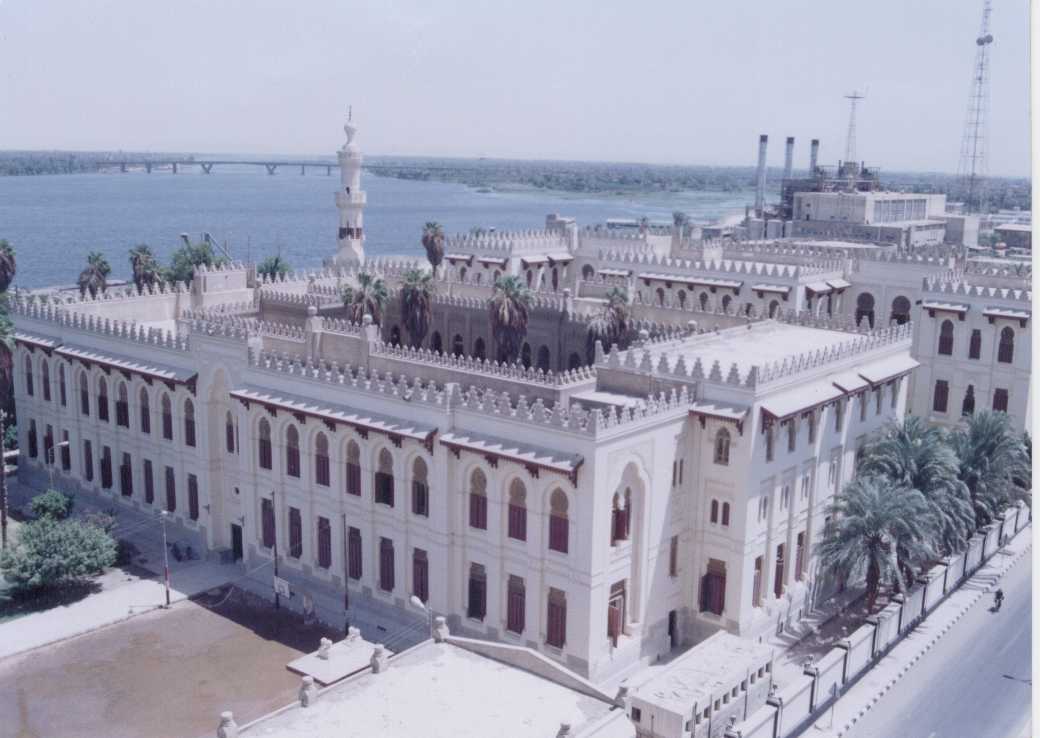
The Alexan Pasha Palace was constructed in 1910 as a riverside residence of a local aristocratic family. It remained in possession of the family until 1995 when it was sold to the state. There are plans to restore the mansion and turn it into a museum.[27]
Notable people
[edit]- Plotinus, Neoplatonic philosopher 204 or 205 – 270 CE
- Coluthus, 5th century Greek poet
- Pope Shenouda III, Pope and Patriarch of the Egyptian Orthodox Church in Egypt and All Middle East
- Thutmose Kamel Gabrial, an Egyptian military pilot who was killed in action during the 1948 Palestine War.
- Gamal Abdel Nasser, second Egyptian president
- Samir Ghanem, comedian, singer, and entertainer
- Ahmed Lutfi el-Sayed, Egyptian nationalist
- Melitius of Lycopolis, founder of the Melitians.[28]
- al-Suyuti, Sunni Muslim theologian who died in 1505
- Ali El-Araby, footballer
- Umar Makram, revolutionary and noble
- Regina Khayatt, feminist, educator, philanthropist, suffragist, and temperance worker
Twinnings
[edit]
See also
[edit]Notes
[edit]- ^ Also spelled Assiout or Assiut.
References
[edit]- ^ a b "Egypt: Governorates, Major Cities & Towns - Population Statistics, Maps, Charts, Weather and Web Information". citypopulation.de. Retrieved 13 June 2023.
- ^ "Hiếu-ức quốc ???". October 1, 2016.
- ^ Wilkinson, Toby (2013). The Rise and Fall of Ancient Egypt. Bloomsbury Publishing. p. 35. ISBN 978-1408852989.
- ^ Ptol. iv. 5. § 63; Steph. B. s. v.; Strabo xvii. p. 813)
- ^ (Plin. v. 9. s. 11)
- ^ (Itin. Anton. p. 157)
- ^ Macmillan & Co (1905). Guide to Egypt and the Sudan: Including a Description of the Route Through Uganda to Mombasa. Macmillan. pp. 105–.
- ^ al-Yaʿqubi (2002). البلدان (in Arabic) (1st ed.). Beirut: Dar Al-Kotob Al-Ilmiyah. p. 170. ISBN 978-2-7451-3419-6. OCLC 51236000. Wikidata Q114966099.
- ^ Yaqut al-Hamawi (1977), معجم البلدان (in Arabic), vol. 1 (1st ed.), Beirut: Dar Sader, p. 193-194, OCLC 1014032934, Wikidata Q114913343
- ^ ʻAbd al-Muʾmin Ibn ʻAbd al-Ḥaqq (1992), مراصد الاطلاع على أسماء الأمكنة والبقاع (in Arabic), vol. 1, 2, Beirut: dār al-ǧīl llṭbʿ wālnšr wāltūzīʿ, p. 79, 769, Wikidata Q121008728
- ^ Cite error: The named reference
:0was invoked but never defined (see the help page). - ^ Ali Mubarak (c. 1886), الخطط التوفيقيَّة الجديدة لمصر القاهرة ومدنها وبلادها القديمة والشهيرة (in Arabic), vol. 12 (1st ed.), Cairo: Bulaq Press, p. 259-260, OCLC 1114309965, Wikidata Q127175828
- ^ Muḥammad Amīn al-H̱ānǧī (1907), منجم العمران في المستدرك على معجم البلدان (in Arabic), vol. 2 (1st ed.), Maṭbaʻat al-Saʻādah, p. 262-263, Wikidata Q124980359
- ^ (ii. 88; comp. Aelian. Hist. An. x. 28)
- ^ (Champollion, Descript. de l'Egypte, vol. i. p. 276; Jollois, Egypte, vol. ii. ch. 13.)
- ^ Gauthier, Henri (1928). Dictionnaire des Noms Géographiques Contenus dans les Textes Hiéroglyphiques Vol. 5. pp. 3–4.
- ^ Eichner, Ina (2020). Der Survey der spätantiken und mittelalterlichen christlichen Denkmäler in der Nekropole von Assiut/Lykopolis (Mittelägypten) [The survey of the late antique and medieval Christian monuments in the necropolis of Assiut/Lykopolis (Middle Egypt)]. The Asyut Project, vol. 14. Wiesbaden: Harrassowitz, ISBN 978-3-447-11457-8.
- ^ Stephens, Angela. "Riding the Forty Days' Road". AramcoWorld. Archived from the original on 18 November 2015. Retrieved 18 November 2015.
- ^ "Egypt". Citypopulation.de. Retrieved 22 November 2014.
- ^ "The Coptic Orthodox Church in action - Al-Ahram Weekly". weekly.ahram.org.eg. Retrieved 2016-02-18.
- ^ a b "Asyūṭ Egypt". Encyclopædia Britannica. Retrieved 18 November 2015.
- ^ "North Africa Pipelines map - Crude Oil (petroleum) pipelines - Natural Gas pipelines - Products pipelines". Theodora.com/pipelines. Archived from the original on 26 May 2011. Retrieved 2011-05-19.
- ^ "Egypt Climate Index". Climate Charts. Archived from the original on 23 June 2012. Retrieved 20 June 2013.
- ^ "Asyut, Egypt". Voodoo Skies. Retrieved 18 August 2013.
- ^ "Asyut Climate Normals 1961–1990". National Oceanic and Atmospheric Administration. Archived from the original on 2024-07-03. Retrieved October 25, 2015.
- ^ "Asyut Climate and Weather Averages, Egypt". Archived from the original on 5 January 2014. Retrieved 12 December 2013.
- ^ "Alexan Palace". World Monuments Fund.
- ^ Herbermann, Charles, ed. (1913). . Catholic Encyclopedia. New York: Robert Appleton Company.
 This article incorporates text from a publication now in the public domain: Smith, William, ed. (1854–1857). Dictionary of Greek and Roman Geography. London: John Murray.

Bibliography
[edit]- Loprieno, Antonio: Ancient Egyptian: A Linguistic Introduction, Oxford University Press 1996. ISBN 0-521-44849-2
- Baines & Malek Cultural Atlas of Ancient Egypt, 2000. ISBN 0-8160-4036-2
- Kahl, Jochem: "Ancient Asyut: The first Synthesis after Three Hundred Years of Research", The Asyut Project vol. I. Wiesbaden 2008. ISBN 978-3-447-05666-3
External links
[edit] Media related to Asyut at Wikimedia Commons
 Asyut travel guide from Wikivoyage
- References to Alexandria in Coptic Literature - Coptic Scriptorium database
- Publication series: The Ancient Egyptian Necropolis of Assiut (University of Heidelberg/Propylaeum)


27°11′N 31°10′E / 27.183°N 31.167°E
| International | |
|---|---|
| National | |
| Geographic | |
| Other | |

Asyut
View on GrokipediaHistory
Ancient and Pre-Islamic Periods
![Statue of Yuny and Renenutet from Asyut][float-right]Ancient Asyut, known in Egyptian as Zꜣwty or Swt, functioned as the capital of the Thirteenth Nome of Upper Egypt, termed the Lycopolite Nome, with its prominence emerging around 3100 BCE during the Early Dynastic Period.[10] The region's strategic position along the Nile facilitated its role as a guardian settlement at the boundary between Middle and Upper Egypt, influencing military and trade dynamics in pharaonic times.[11] Religiously, Asyut was a focal point for worship of the jackal-headed deities Anubis and Wepwawet, both associated with funerary practices and processions, as evidenced by temple dedications and iconography from the Middle Kingdom onward.[12] The city's necropolis on the western desert mountain features extensive rock-cut tombs of nomarchs dating to the First Intermediate Period (c. 2181–2055 BCE) and Middle Kingdom (c. 2055–1650 BCE), including elaborate biographical inscriptions detailing local governance and loyalty to pharaohs.[6] These tombs, such as those of the nomarchs Khety and Intef, highlight Asyut's administrative autonomy and cultural continuity amid Egypt's political fragmentation.[6] During the Late Period and Ptolemaic era, Asyut retained significance as Lycopolis under Greek influence, reflecting the adaptation of Anubis worship to lupine symbolism in Hellenistic nomenclature.[13] Roman and Byzantine occupations saw continued settlement, with archaeological evidence of Late Period burials and early Christian reuse of pharaonic tombs for monastic complexes by the Coptic period, prior to the Arab conquest in 641 CE.[14][15]
Islamic Era to Ottoman Rule
Following the Arab conquest of Egypt, completed in 642 CE under Amr ibn al-As, Asyut—retaining its ancient name of Syut—integrated into the nascent Islamic administration as a provincial settlement in Upper Egypt, governed successively by Umayyad (661–750 CE), Abbasid (750–969 CE), Fatimid (969–1171 CE), Ayyubid (1171–1250 CE), and Mamluk (1250–1517 CE) rule.[16] The city lacked prominent political or military events distinguishing it from broader Egyptian provincial patterns, functioning primarily as a regional administrative and agricultural hub amid the Nile's floodplain.[17] A notable feature was the persistence of Coptic Christian communities, including the Monastery of the Virgin Mary at al-Muharraq (Deir el-Muharraq), established in the 4th century CE and enduring as a pilgrimage site under dhimmi protections despite periodic fiscal pressures and social tensions inherent to minority status under Islamic governance.[18] Mamluk-era chronicles and documents highlight infrastructure such as the Asyut dyke, an embankment system linking the urban core to the Nile and adjacent desert, underscoring the city's role in local flood control and land management.[17] The Ottoman conquest of 1517 CE incorporated Asyut into the empire's Egyptian eyalet, where it persisted as a modest provincial backwater with an estimated population of around 10,000, dwarfed by commercial rivals like Qena and Farshut.[17] Economically, it specialized in linen production while serving as a critical nexus for overland caravan routes linking Cairo and Lower Egypt to Upper Egypt and sub-Saharan Africa, facilitating trade in ivory, ostrich feathers, furs, and medicinal goods from Darfur and Sudan.[17] Local merchants, including Arab and Coptic traders, formed a burgeoning class profiting from this revival of trans-Saharan commerce, though Asyut's peripheral status limited its broader influence until administrative shifts in the late 18th century.[19][17]Modern Developments and Contemporary Challenges
The New Assiut Barrage, completed in 2018, replaced the original structure built in 1903 and incorporates a 32 MW hydroelectric power plant, two navigation locks measuring 17 meters wide by 156 meters long, eight sluiceway bays, and an overlying bridge spanning 20 meters wide with four lanes to enhance regional connectivity and irrigation efficiency.[20][21] This project, initiated in 2012, addresses longstanding maintenance issues with the aging dam while generating clean energy with a projected long operational lifespan and low costs.[22] Asyut University, founded in October 1957 as the inaugural higher education institution in Upper Egypt, has expanded to offer comprehensive programs fostering scientific and technical expertise among graduates.[23] Recent industrial initiatives include the May 2025 agreement for a hydrocracking complex at the Assiut refinery, poised to become Upper Egypt's largest oil refining endeavor, alongside the 1,500 MW New Assiut Power Plant under development for dual-fuel electricity generation.[24][25] Urban expansion efforts encompass the West Asyut project, a 1,600-acre development in Nasser City focused on infrastructure enhancement, and the Tarboul Industrial City with supporting roads, utilities, and drainage systems.[26][27] Persistent challenges include elevated poverty levels in Asyut Governorate, where alleviation policies implemented between 2000 and 2011 yielded inconsistent outcomes amid broader economic dependencies on agriculture vulnerable to Nile water fluctuations and national population pressures.[28] Unplanned settlement expansion, driven by institutional land management shortcomings, has led to haphazard urban growth, straining resources and complicating environmental sustainability in the Nile Valley region.[29] These issues are exacerbated by Upper Egypt's structural underdevelopment, including high unemployment and migration outflows, despite infrastructural gains.Geography
Location and Topography
Asyut, the capital of Asyut Governorate, is situated on the western bank of the Nile River in Upper Egypt at geographic coordinates 27.18°N, 31.19°E.[30] The city lies approximately 370 kilometers south of Cairo by road, positioning it as a central hub in the Nile Valley region.[31] This location places Asyut at the interface between the cultivated Nile floodplain and the encroaching Western Desert, facilitating historical trade and transportation routes along the river.[32] The topography of Asyut features low-lying alluvial plains formed by Nile sediments, with the river valley averaging 15.5 kilometers in width across the governorate.[33] Elevations in the city center range from 56 meters above sea level, increasing to surrounding limestone plateaus and desert terrains that exceed 100 meters.[34][35] Key landforms include young and old alluvial deposits bordering the Nile channel, transitional desert zones with wadis, and elevated valley sides characterized by rock-cut features and quarries.[36] These elements create a narrow cultivable strip amid arid expanses, influencing settlement patterns and economic activities centered on the river.[37]Climate and Environmental Conditions
Asyut experiences a hot desert climate classified as BWh under the Köppen-Geiger system, characterized by extreme aridity, significant diurnal temperature variations, and prolonged sunshine.[38] [39] Annual average temperatures range from 21.9°C to 24.0°C, with summers featuring highs exceeding 37°C in June and July, while winter lows can drop to around 8°C in January.[40] [39] Precipitation is negligible, averaging 4.4 mm annually, making Asyut one of Egypt's driest locations, with most rare events occurring in winter months from isolated thunderstorms or Mediterranean influences.[41] This hyper-arid setting confines vegetation and agriculture to Nile Valley floodplains, where irrigation sustains cotton, sugarcane, and grains, but exposes surrounding areas to frequent sandstorms (khamsin winds) that elevate particulate matter and reduce visibility.[38] Environmental conditions are shaped by the Nile's lifeline amid desert dominance, with the Assiut Barrage regulating flow for irrigation and hydropower since 1902, mitigating floods but contributing to downstream sedimentation and upstream waterlogging in some zones.[42] Groundwater and surface waters face degradation from agricultural runoff, industrial effluents, and untreated sewage, leading to elevated nitrates, phosphates, and heavy metals that impair quality for potable and irrigation use.[43] [44] Anthropogenic pollution, including organic contaminants from farming and household waste, exacerbates mineralization and redox imbalances in aquifers, posing risks to ecosystems and human health despite natural dilution by Nile inflows.[45] [44]| Month | Avg. High (°C) | Avg. Low (°C) | Precipitation (mm) |
|---|---|---|---|
| Jan | 20.6 | 7.8 | 0.8 |
| Feb | 23.3 | 8.9 | 0.5 |
| Mar | 27.2 | 13.3 | 0.7 |
| Apr | 32.2 | 17.8 | 0.2 |
| May | 35.6 | 21.1 | 0.1 |
| Jun | 37.1 | 21.7 | 0.0 |
| Jul | 36.7 | 21.7 | 0.0 |
| Aug | 36.1 | 21.7 | 0.0 |
| Sep | 34.4 | 20.6 | 0.0 |
| Oct | 30.6 | 17.2 | 0.1 |
| Nov | 25.6 | 12.2 | 1.0 |
| Dec | 21.7 | 8.9 | 1.0 |
Demographics
Population Trends and Statistics
The population of Asyut city, as recorded in Egypt's 2017 General Census by the Central Agency for Public Mobilization and Statistics (CAPMAS), was 364,599 residents.[47] Subsequent estimates for the urban area indicate growth to 481,000 by 2023, with an annual increase of approximately 1.48% from the prior year, driven primarily by natural population growth amid limited net migration.[3] Projections for 2025 place Asyut's urban population at 497,000, reflecting a 1.64% rise from 2024 and a cumulative expansion of over 36% since the 2017 census benchmark.[3] [48] This trajectory aligns with broader Upper Egypt patterns, where Asyut's crude birth rate stood at 23.8 per 1,000 inhabitants in mid-2025—among the nation's highest, contributing to sustained demographic pressure despite national fertility declines.[49] Historical data reveal accelerated urbanization post-1950, when Asyut's population was 98,001; by 2000, it had surpassed 300,000, with average annual growth exceeding 2% during peak decades of rural-to-urban migration and agricultural expansion along the Nile.[48]| Year | Estimated Urban Population | Annual Growth Rate (from prior year) |
|---|---|---|
| 1950 | 98,000 | - |
| 2000 | ~320,000 | ~2.0% (average 1950-2000) |
| 2017 | 364,599 (census) | ~1.7% |
| 2023 | 481,000 | 1.48% |
| 2025 | 497,000 | 1.64% |
Ethnic and Religious Composition
The ethnic composition of Asyut Governorate is largely homogeneous, dominated by native Egyptians of Upper Egyptian descent who have undergone Arabization since the Islamic conquests, with the population primarily speaking the Sa'idi dialect of Arabic.[50] No substantial non-Egyptian ethnic groups, such as Nubians or Berbers, are present in significant numbers, though nomadic Bedouin Arabs may occasionally traverse peripheral desert areas.[51] This uniformity stems from millennia of intermixing among ancient Nile Valley inhabitants, with minimal recent immigration altering the baseline demographic structure. Religiously, the governorate's over 5 million residents are overwhelmingly Sunni Muslim, comprising the vast majority akin to national patterns where Sunni Islam accounts for about 90% of Egypt's population.[52] Coptic Orthodox Christians form a substantial minority, with estimates placing their share at 30-35% of the local population—one of the highest concentrations in the country, exceeding the national Christian average of roughly 10%.[53] [7] This elevated presence reflects historical continuity from pre-Islamic Christian communities in Upper Egypt, though official Egyptian censuses, conducted by CAPMAS, omit religion due to sensitivity, leading to reliance on church records and independent analyses that often cite figures from 20% upward for Asyut specifically.[54] Smaller denominations, including Coptic Catholics and Protestants, constitute under 10% of Christians overall, with negligible Jewish, Shia, or other faith adherents.[54] These proportions contribute to Asyut's reputation as a hub for Coptic institutions amid a Muslim-majority context.Economy
Agricultural and Industrial Sectors
Agriculture forms the backbone of Asyut Governorate's economy, with the sector contributing significantly to gross value added in the region alongside manufacturing and construction.[55] The governorate's fertile Nile Valley lands support extensive cultivation, irrigated primarily through the Assiut Barrage, constructed between 1892 and 1902 to maintain a 4-meter water level difference feeding key canals like the Ibrahimia.[56] This infrastructure enables year-round farming across thousands of feddans, though rehabilitation efforts have raised concerns over increased seepage and groundwater rise potentially affecting adjacent lands.[57] Wheat stands as the premier winter crop, covering approximately 208,140 feddans and underscoring its economic priority amid Egypt's broader food security needs.[58] Maize ranks among the top field crops alongside wheat, with both driving local production and farmer livelihoods in Assiut.[59] The governorate also excels in medicinal and aromatic plants, producing major shares of national fennel (87.64% of Egypt's total), cumin, coriander, and others, bolstering export potential in niche markets.[60] Vegetable cultivation, including tomatoes with high consumption yields exceeding 170 million tons annually nationwide, further diversifies output, though local extension needs persist for improved practices.[61] Overall, agriculture employs over 55% of Upper Egypt's workforce, reflecting Asyut's reliance on smallholder farming vulnerable to water management and climate variability.[62] Industrial activity in Asyut remains nascent compared to agriculture, centered on resource-based processing and supported by designated zones like Dashlut, Sahel Selim for small industries, and Badari.[63] Key facilities include the Assiut Cement Factory, operational since expansions in the late 1990s, producing construction materials vital for regional infrastructure.[64] The Assiut Oil Refinery, one of Upper Egypt's largest, refines crude into petroleum products and features a new hydrocracking complex signed for construction in 2025 to enhance output efficiency.[65][24] Chemical production is prominent via the Egyptian Financial and Industrial Company's Assiut plant, manufacturing fertilizers and manures to support local farming.[66] Small and medium enterprises dominate emerging sectors, with complexes like Abnub's focusing on food packaging, engineering, and apparel feeders, inspected for expansion in 2025.[67] These efforts aim to diversify beyond agriculture, though industry lags in GDP share relative to national manufacturing trends, constrained by infrastructure and investment gaps in Upper Egypt.[55] Public investments, totaling EGP 8 billion for 2022/23, target balanced growth across sectors.[68]Economic Challenges and Development Efforts
Asyut Governorate faces severe economic challenges, including the highest poverty rate among Egyptian governorates, driven by limited job opportunities, heavy reliance on subsistence agriculture, and inadequate infrastructure.[69] Multidimensional poverty in Asyut stood at 8.8% in recent assessments, reflecting deprivations in health, education, and living standards, though monetary poverty remains elevated compared to national averages of 29.7% as of 2019.[70] [71] Unemployment, particularly among rural youth, is exacerbated by water scarcity, land fragmentation, and insufficient diversification into non-agricultural sectors, leading to significant out-migration to urban centers like Cairo.[55] These issues are compounded by environmental vulnerabilities, such as Nile-dependent farming susceptible to fluctuations in water supply and climate variability.[55] Development efforts have intensified through substantial government investments and international partnerships aimed at infrastructure enhancement and job creation. In fiscal year 2024-2025, Egypt allocated EGP 10.2 billion for Assiut projects, including expansions under the national Decent Life initiative to improve rural living conditions for 2.4 million residents via utilities, roads, and services.[72] An EGP 11.6 billion plan for 2023-2024 encompassed 63 projects in housing and social services, targeting sustainable development goals such as affordable settlements and youth empowerment.[73] Key infrastructure initiatives include the West Asyut urban development project spanning 1,600 acres with modern water systems and roadways, and the New Assiut Barrages featuring a hydroelectric plant to bolster irrigation and energy production.[26] [22] Energy sector expansions, such as the 650 MW addition to the Assiut Thermal Power Plant, aim to support industrial growth and reduce energy shortages that hinder manufacturing.[74] Complementary programs focus on entrepreneurship, with initiatives like the Youth Employability and Entrepreneurship Booster providing training for sustainable businesses in key sectors, alongside World Bank-backed efforts improving infrastructure for over 8 million in Upper Egypt and fostering 6,000+ enterprises.[75] [76] These measures seek to address structural bottlenecks, though sustained impact depends on effective implementation amid fiscal constraints and regional disparities.[76]Religion and Society
Coptic Christian Heritage and Institutions
Asyut serves as a major hub for Coptic Orthodox Christianity in Upper Egypt, with its western mountains hosting numerous rock-cut monasteries and hermitages dating to the early Christian era, reflecting the region's role in the development of Egyptian monasticism.[77] These sites, including those at Durunka, Rifa, and Al-Ganadla, feature carved churches, cells, and refectories adapted from ancient quarries and tombs, underscoring Coptic adaptation of pre-existing topography for ascetic communities.[78] Archaeological evidence, such as a mudbrick structure unearthed in the Monqabad area in May 2025, further attests to Coptic architectural presence from late antiquity.[79] The Coptic Orthodox Diocese of Assiut, encompassing Sahil Selim and Elbadary, administers over 300 religious establishments, including parishes, churches, and monasteries, supporting a substantial Coptic community.[80] Key institutions under its purview include the Coptic Clerical and Theological College for priestly training and the Coptic Institute for Church Administration and Development, which focus on ecclesiastical education and organizational capacity.[80] The diocese also maintains pastoral care programs emphasizing education and community outreach.[80] Prominent among Asyut's monastic heritage is the Monastery of the Virgin Mary at Al-Muharraq on Mount Qusqam, established around the 3rd century and revered as one of Egypt's oldest continuously inhabited Coptic sites, traditionally linked to the Holy Family's sojourn during their flight from Herod.[81] Its ancient church, despite restorations, retains simple Coptic architectural elements, serving as a pilgrimage center.[81] Similarly, the Monastery of the Virgin Mary in Drunka, in the western mountain, holds significance as a reputed final resting place for the Holy Family, drawing devotees and preserving cave churches and relics associated with early saints like St. John the Assioti.[80] These institutions perpetuate Coptic liturgical traditions, iconography, and communal resilience amid historical challenges.[82]Islamic Influence and Institutions
Islam arrived in Asyut as part of the broader Arab conquest of Egypt between 639 and 642 CE, integrating the region into the Islamic caliphate and initiating a process of cultural and religious transformation that solidified Muslim dominance by the 14th century.[83] Over subsequent centuries, Islamic governance under dynasties such as the Fatimids, Ayyubids, and Mamluks reinforced religious institutions, with Asyut serving as a provincial center where mosques and scholarly centers emerged to propagate Sunni orthodoxy.[84] Prominent mosques exemplify enduring Islamic architectural and communal influence. The El-Farghal Mosque in Abu Tig, featuring twin minarets, stands as the largest mosque in Upper Egypt and attracts pilgrims for its religious significance.[85] The Al-Mujahideen Mosque, dating to the Ottoman era in the 16th–19th centuries, represents one of the oldest surviving Islamic structures in the Asyut Governorate, originally built atop ancient foundations to assert religious authority.[86] Other notable sites include the El-Megahdeen and El-Amawy Mosques in Old Asyut, which preserve Ottoman-style elements amid the city's historic fabric.[87] Educational institutions underscore Islam's institutional footprint. Assiut University hosts a Department of Islamic Studies within its Faculty of Arts, offering programs in Islamic jurisprudence, theology, and history to train scholars and educators.[88] Al-Azhar University, Egypt's premier center for Sunni learning founded in 970 CE, maintains branches in Asyut, including the Faculty of Medicine for Men and the Islamic Girls College, which emphasize integration of religious sciences with modern disciplines.[89][90] These facilities, part of Al-Azhar's nationwide network, serve thousands of students annually, fostering clerical training and community outreach.[91] The Fouad I Institute in Asyut Governorate, an Andalusian-style complex, further highlights historical endowments supporting Islamic scholarship and welfare.[92]Sectarian Tensions and Violence
Asyut governorate, home to a significant Coptic Christian minority comprising approximately 10-15% of the population, has been a focal point for sectarian tensions between Muslims and Christians, often erupting into mob violence over disputes involving church construction, land rights, or personal altercations that escalate along religious lines. These incidents reflect broader patterns in Upper Egypt, where socioeconomic grievances, rapid Islamization since the 1970s, and the influence of Salafist groups exacerbate communal divides, leading to attacks on Christian properties rather than state institutions.[93] Reports indicate that such violence is frequently underreported or resolved through informal "reconciliation" sessions that Coptic advocates criticize for bypassing legal accountability and favoring Muslim perpetrators.[94] Notable flare-ups include clashes on October 25, 2009, in a village near Asyut city, where stone-throwing erupted between Muslim students and Coptic residents, prompting police intervention and arrests of individuals accused of inciting attacks on Christians.[95] Following the violent dispersal of Muslim Brotherhood sit-ins on August 14, 2013, mobs targeted multiple Coptic churches and homes across Asyut governorate, with at least four churches in Asyut city and surrounding areas looted or burned, contributing to a nationwide wave that damaged over 40 Christian sites and killed several.[96] More recently, in the period leading to 2025, a Christian family in Assiut governorate fell victim to mob violence amid sectarian disputes, alongside attacks on two church buildings, underscoring persistent vulnerabilities despite government claims of improved security.[94] Human rights organizations attribute recurring patterns to inadequate state protection and discriminatory laws hindering church building, which fuel rumors and preemptive aggression against Copts.[93][96] While large-scale Islamist insurgencies in Asyut during the 1990s targeted Copts as symbols of perceived Western influence, contemporary violence tends to involve local mobs rather than organized militants, though underlying ideological tensions persist.[93]Security and Conflicts
Historical Islamist Insurgencies
Following the assassination of President Anwar Sadat on October 6, 1981, Islamist militants affiliated with al-Gama'a al-Islamiyya launched an attempted uprising in Asyut two days later, attacking police stations and seeking to seize control of the city.[97] [98] The militants, numbering in the hundreds and some disguised in military uniforms, killed at least 54 policemen and injured dozens more before security forces suppressed the revolt, resulting in several militant deaths and over 100 arrests.[97] This event marked an early escalation of al-Gama'a al-Islamiyya's violent campaign against the Egyptian government, which the group viewed as apostate for its secular policies and peace accords with Israel.[99] Al-Gama'a al-Islamiyya, Egypt's largest Islamist militant organization formed in the 1970s, established Asyut Governorate as a primary stronghold in Upper Egypt during the 1980s and 1990s, drawing on rural support networks and university radicals to build operational capacity.[99] [100] The group's insurgency intensified from 1992 to 1998, with Asyut serving as a base for ambushes on security forces, assassinations of local officials, and targeted killings of Coptic Christians, whom militants accused of collaborating with the regime.[99] [100] These attacks contributed to over 1,000 deaths nationwide during the period, including civilians, as the group aimed to destabilize the government and impose sharia law.[99] Government counteroperations, including mass arrests and emergency laws, gradually eroded al-Gama'a al-Islamiyya's presence in Asyut by the late 1990s, culminating in the group's unilateral cease-fire announcement in 1997 and formal renunciation of violence in 2003 by its imprisoned leadership.[100] [99] Despite the decline, remnants maintained ideological influence in Asyut's conservative villages, though no major resurgence occurred until later, distinct ISIS-linked incidents in the 2010s.[99]Recent Terrorism Incidents
In the aftermath of the Egyptian security forces' dispersal of pro-Mohamed Morsi sit-ins on August 14, 2013, mobs supporting the Muslim Brotherhood launched coordinated attacks on Coptic Christian sites across Egypt, including multiple incidents in Asyut governorate. In Asyut city, assailants torched the Seventh-day Adventist Church, inflicting severe fire damage to the structure.[101] At least four Catholic churches and a convent were also set ablaze or looted in the area, contributing to a regional toll of dozens of Christian properties damaged or destroyed.[102] These assaults resulted in fatalities and injuries amid widespread arson and vandalism, with attackers chanting anti-Christian slogans.[103] Human Rights Watch documented over 50 such attacks nationwide in the ensuing days, attributing them to retaliation against perceived Coptic support for Morsi's ouster.[96] Post-2013, terrorist incidents in Asyut have been limited, shifting toward smaller-scale militant activities and security interceptions rather than mass-casualty operations. Egyptian authorities reported neutralizing terrorist cells in the governorate, such as the July 2018 raid on a hideout in Dirout where six militants were killed.[104] Broader trends indicate a marked decline in attacks outside the Sinai Peninsula, with no major incidents in Asyut recorded in U.S. State Department assessments from 2019 onward.[105] This reduction aligns with intensified counterterrorism campaigns, though sporadic arrests of ISIS sympathizers continue in Upper Egypt.[106]State Responses and Security Measures
The Egyptian government responded to the al-Gama'a al-Islamiyya (IG) insurgency of the 1990s, centered in Asyut and Upper Egypt, with extensive deployments of Central Security Forces and military units to disrupt militant strongholds. Operations involved surrounding villages suspected of harboring IG fighters, conducting house-to-house searches, and imposing curfews, which dismantled much of the group's operational infrastructure in the region. By the mid-1990s, these measures had led to the arrest of over 20,000 suspected Islamists nationwide, with a significant portion in Asyut governorate, under the emergency laws enacted in 1981 that permitted indefinite detention without trial and expanded police powers.[100][107] The 1997 Luxor massacre, perpetrated by IG affiliates and resulting in 62 deaths, prompted an intensified crackdown, including the extradition and imprisonment of IG leader Omar Abdel-Rahman from the United States and the capture of numerous mid-level commanders in Asyut. This pressure contributed to the group's internal fractures and the initiation of its non-violence review process in 2002-2003, where imprisoned leaders publicly renounced armed struggle, leading to a sharp decline in attacks by 2006. Security forces maintained ongoing surveillance and raids in Asyut to prevent regrouping, leveraging intelligence from defectors and informants.[108][109] In the post-2011 period, following the resurgence of violence after President Mohamed Morsi's ouster in 2013, Egyptian authorities in Asyut focused on preempting ISIS-inspired cells through targeted arrests and the designation of groups like Hasm as terrorist entities under Law No. 8 of 2015. The nationwide state of emergency declared in 2017 and extended until October 2021 authorized military trials for civilians accused of terrorism, rapid detentions, and property seizures, with Asyut seeing heightened checkpoints and joint police-army patrols to monitor sectarian flashpoints and border areas. These measures, combined with deradicalization programs for former militants, have contained threats, though human rights organizations have documented instances of extrajudicial killings and coerced confessions during operations.[110][111][112] Post-2021, counterterrorism in Asyut has shifted toward intelligence-driven prevention, including enhanced monitoring of mosques and online radicalization, supported by the National Security Agency's expanded role. Development initiatives, such as infrastructure projects under the "Hayah Karima" program launched in 2019, aim to address socioeconomic grievances in Upper Egypt that fueled past insurgencies, though security remains prioritized with permanent garrisons and travel restrictions for foreigners in the governorate. Effectiveness is evidenced by the absence of large-scale attacks since the mid-2010s, despite persistent low-level risks from affiliated networks.[113][114]Culture and Education
Traditional Culture and Heritage
Asyut's traditional handicrafts center on the production of al-tally (also known as assiut shawls), a distinctive textile crafted from cotton tulle base cloth embroidered with thin metal strips using a single-stitch technique that creates shimmering fringe effects.[115] Originating in Asyut during the early 20th century as a local innovation blending netting and metalwork, these garments gained prominence in Egyptian folkloric performances and were exported globally by the 1920s, often measuring up to 174 cm by 58 cm in vintage examples.[116] The craft, preserved through family workshops, reflects Upper Egyptian ingenuity in adapting machine-loomed tulle with hand-stitched metal for durability and visual appeal in dance attire.[117] In performing arts, Asyut shares the Sa'idi traditions of Upper Egypt, where tahtib—a rhythmic stick-fighting display—serves as both martial training and folk dance, performed by men wielding 1.5-meter bamboo sticks in synchronized mock combats during weddings and harvests, tracing origins to ancient Egyptian combat practices over 5,000 years old.[118] Women contribute raqs assaya, a graceful variant incorporating a single stick as a prop for expressive movements, often set to percussive rhythms that highlight regional pride and agility.[119] These dances, accompanied by live ensembles featuring the tabla drum, nay flute, and vocal mawwal improvisation, underscore communal celebrations and transmit generational skills without formal notation.[120] Oral folklore in Asyut includes epic tales and proverbs tied to the Nile's cycles and local landmarks like Gebel Asyut, where folk narratives blend historical events with supernatural elements, as documented in interdisciplinary studies of regional gebel lore.[121] Social customs emphasize hospitality and kinship ties, with practices like elaborate wedding processions featuring zaffa parades of music and dance, preserving Sa'idi values of honor and collectivism amid modernization pressures.[122] Efforts by groups like the Egyptian Society for Folk Traditions have supported safeguarding these elements through workshops, countering urbanization's erosion since the 2010s.[123]Educational Institutions and Intellectual Contributions
Assiut University, established in 1957, functions as the principal higher education institution in Asyut and the broader Upper Egypt region, marking it as the first university in that area.[124] Initially comprising faculties of science and engineering to address regional educational demands, it has since expanded significantly, incorporating additional faculties such as agriculture, arts, education, medicine, law, and pharmacy.[125][126] As a state institution with administrative autonomy, it enrolls tens of thousands of students and emphasizes education, research, and community service across disciplines including Arabic, English, and sciences.[127][128] The university contributes to intellectual advancements through research in key areas like biology, chemistry, medicine, mathematics, and engineering, with global rankings reflecting strengths in chemistry (170th) and mathematics (128th).[129][130] Its academic output supports Egypt's scientific development, particularly in applied fields relevant to Upper Egypt's agricultural and industrial needs, though specific breakthrough publications tied directly to Asyut remain less prominently documented in international indices compared to Cairo-based institutions.[129] Notable intellectuals associated with Asyut include Sayyid Qutb (1906–1966), born near the city, whose writings on Islamic governance and critique of Western materialism influenced 20th-century Islamist thought, including concepts later adopted by jihadist groups.[131] While not formally affiliated with Assiut University, Qutb's early life in the region underscores local roots in producing ideologically impactful figures, though his ideas have sparked debate over their role in promoting extremism versus reformist Islam.[131] Modern contributions from the university's alumni and faculty continue in academia, with emphasis on regional challenges like water management and public health, but comprehensive metrics on pioneering research outputs are limited.[129]Governance and Infrastructure
Administrative Structure
Asyut Governorate, with the city of Asyut as its capital, is one of Egypt's 27 governorates and is led by a governor appointed by the President of Egypt to oversee local administration, development, and security.[132] The governor coordinates with national ministries on infrastructure, services, and economic planning, while local units handle day-to-day governance. As of 2025, the governor is Dr. Hisham Abu el Nasr, who has emphasized programs such as illiteracy eradication benefiting nearly 195,000 residents.[133] [134] The governorate's administrative framework follows Egypt's standard subdivision system, comprising eleven marakiz (rural administrative centers), three aqsam (urban districts primarily in Asyut city), and one planned new city, Madinat Asyut al-Jadidah (New Asyut).[135] [136] Each markaz and qism (aqsam* plural) is managed by a director responsible for local councils, service delivery, and revenue collection, often overlapping in names for shared urban-rural areas like Abu Tig. The city of Asyut itself is segmented into fully urban kisem (districts), including Asyut 1 (population approximately 300,000) and Asyut 2 (population approximately 254,000 as of recent estimates), facilitating targeted urban management.[136]| Administrative Unit Type | Examples |
|---|---|
| Markaz (rural centers) | Abnub, Abu Tig, Dayrut, El Badari, El Fath, El Ghanayem, El Qusiya, Manfalut, Radis, Sahel Selim, Sidfa[137] [135] |
| Qism (urban districts) | Asyut 1, Asyut 2 (within Asyut city)[136] |
| New City | New Asyut[136] |